
By Dr. Pellumb Kabashi, DBA, MBA, EA, CFE, CES
Founder, Tax Expert Today LLC · Tax advisors, enrolled agents, CPAs, and attorneys · Serving clients in all 50 states
Quick Answer: Can the IRS take your house? Yes, but only through a narrow path. Under IRC §6334, the IRS cannot levy a home you live in for a levy of $5,000 or less, and it cannot levy a principal residence at all unless a federal district court judge approves it in writing. The IRS conducted only 50 seizures of any kind in fiscal year 2025. Call (239) 441-2005 for a free consultation.
Can the IRS take your house?
Yes, the IRS can take your house, but federal law makes it the hardest asset to reach. A home you live in is exempt when the levy is $5,000 or less, and a principal residence can be levied only after a federal judge or magistrate approves it in writing, on a showing that no reasonable alternative exists.
- The general power exists. IRC §6331 authorizes the IRS to levy on all property and rights to property of a person who neglects or refuses to pay a tax after notice and demand, and real estate is property.
- A small-balance floor. Section 6334(a)(13)(A) exempts any real property used as a residence by the taxpayer if the amount of the levy does not exceed $5,000.
- A judge for a principal residence. Section 6334(e)(1) removes the exemption for a principal residence only when a federal district court judge or magistrate approves the levy in writing, and gives the district courts exclusive jurisdiction to do so.
- Two separate routes. The IRS can pursue a home by an administrative levy with court approval, or by a lawsuit under section 7403 to foreclose its tax lien.
Much of what is published on this question contradicts itself. Some sources say the IRS will never take a house you live in, while others imply a revenue officer can simply seize it. Neither is accurate. The answer depends on who lives in the house, how much is owed, whether the property is a principal residence, a second home or a rental, and which of the two legal routes the IRS uses. The rest of this guide walks through each of those variables with the statute, the regulation and the Internal Revenue Manual that control them.
How often does the IRS actually seize property?
Rarely. According to Table 4-1 of the IRS Data Book, the IRS conducted 50 seizures of all property types in fiscal year 2025 and 71 in fiscal year 2024. In the same years it filed more than 196,000 and 214,000 notices of federal tax lien and requested more than 313,000 and 339,000 levies on third parties such as banks and employers.
- Seizures are counted across every asset type. The Data Book figure covers vehicles, business equipment and real estate together, so the number of homes seized is smaller still.
- Liens and third-party levies dominate. The IRS collects far more often through a lien that waits for a sale or refinance, or through a bank levy or a wage garnishment.
- The inventory is enormous. The IRS ended fiscal year 2025 with more than 13.1 million taxpayer delinquent accounts, which puts 50 seizures in perspective.
- Rare is not never. A low count reflects the procedural burden the law places on the IRS, not a promise that it will not act in a particular case.
| Collection action (IRS Data Book, Table 4-1) | Fiscal year 2024 | Fiscal year 2025 |
|---|---|---|
| Notices of federal tax lien filed | 196,996 | 214,099 |
| Notices of levy requested on third parties | 313,792 | 339,137 |
| Seizures conducted by Field Collection (all property types) | 71 | 50 |
| New installment agreements established | 3,403,214 | 3,160,047 |
| Taxpayer delinquent accounts in ending inventory | 14,901,508 | 13,112,485 |
Source: IRS Data Book, Table 4-1, Delinquent Collection Activities, Fiscal Years 2024 and 2025. The table footnote explains that the seizure count represents seizures conducted by the Field Collection program.
The numbers explain the real risk profile for most homeowners with a tax debt. The practical threat to the house is usually not a seizure but the federal tax lien, which attaches to the home, appears in the public record and has to be dealt with before the property can be sold or refinanced with clear title. A seizure sits at the far end of the process, after the notices, the hearing rights and an internal investigation that the statute itself requires.
What protects a principal residence from an IRS levy?
A principal residence is protected by section 6334(a)(13)(B) and (e)(1). The IRS may not levy it unless a judge or magistrate of a United States district court approves the levy in writing. The regulation extends that protection to a home owned by the taxpayer and used as the principal residence of the taxpayer, a spouse, a former spouse or a minor child.
- Principal residence has a set meaning. The statute borrows the definition used for the home sale exclusion in section 121, which generally looks to where the owner actually lives most of the time.
- Family members are covered. Treas. Reg. §301.6334-1(d) requires court approval where the taxpayer owns the home and it is the principal residence of the taxpayer’s spouse, former spouse or minor child.
- No jeopardy shortcut. IRM 5.10.2.4 states there is no jeopardy exception to the judicial approval requirement, unlike the rule for business assets.
- The contents are protected too. The same IRM section requires area director approval to seize the contents of a principal residence, including items in a garage or other structures on the land.

These protections were added by the IRS Restructuring and Reform Act of 1998. Before that amendment, a principal residence could be levied with the written approval of an IRS district director, or on a finding that collection was in jeopardy. The change moved the decision out of the IRS and into a federal courtroom, which is the single biggest reason principal residence seizures are uncommon. It also means a homeowner facing one will know about it in advance, because the process starts with a court filing and a court order served on the taxpayer, not with a revenue officer arriving unannounced.
What is the $5,000 rule for an IRS levy on a home?
Section 6334(a)(13)(A) exempts from levy any real property used as a residence by the taxpayer, and any non-rented real property of the taxpayer used by another individual as a residence, if the amount of the levy does not exceed $5,000. The IRM restates it for a principal residence: the liability must exceed $5,000 before a seizure can be pursued.
- It reaches any residence, not only the principal one. A vacation home the taxpayer uses as a residence qualifies for the $5,000 floor even though it is not a principal residence.
- It protects others living there. A house the taxpayer owns and lets a relative live in without rent also falls within the exemption when the levy is $5,000 or less.
- Rented property is excluded. Real property that is rented to someone else is outside the second clause of the exemption.
- The figure is not indexed. Section 6334(g) adjusts only the dollar amounts in paragraphs (a)(2) and (a)(3) for inflation, so the $5,000 threshold in paragraph (a)(13) is fixed in the statute.
The $5,000 floor matters most for taxpayers with a modest balance who have received a CP504 notice and fear the word “levy” in it. A levy under that threshold cannot reach a home the taxpayer lives in, although it can still reach a bank account or wages. Once a balance grows past $5,000, the floor no longer applies, and the protection for a principal residence then rests on the court approval requirement described above.
How does the court approval process for a principal residence work?
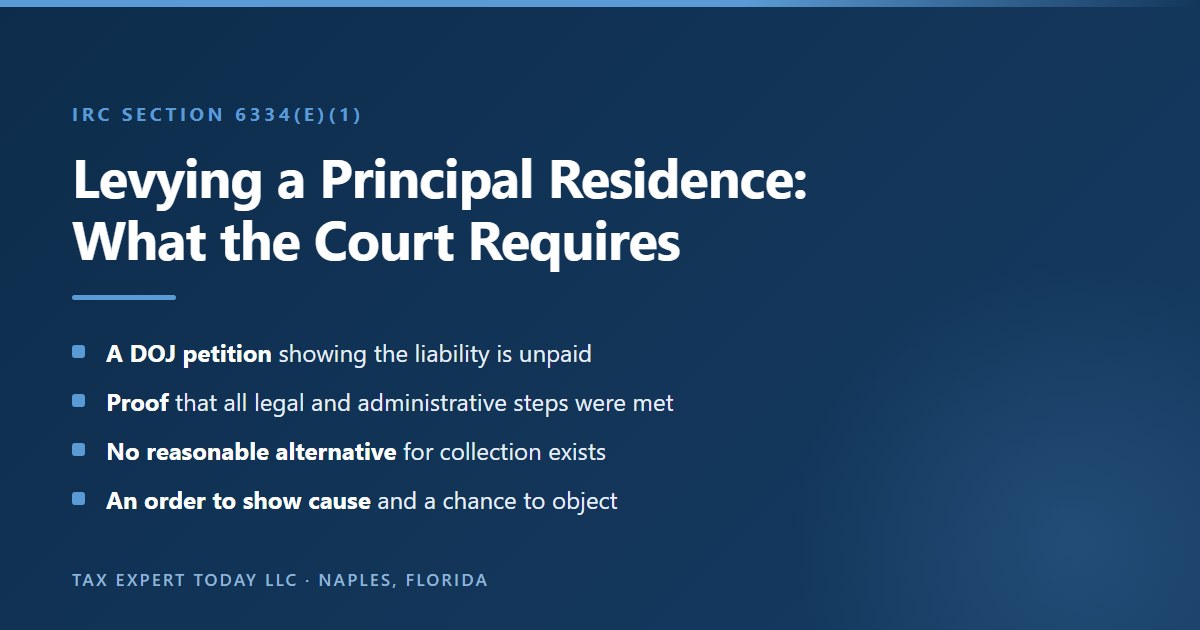
The Department of Justice files a petition in federal district court showing that the liability has not been satisfied, that all legal and administrative requirements for the levy have been met, and that no reasonable alternative for collection exists. The court issues an order to show cause, and the taxpayer can object and receive a hearing.
- The IRS builds a suit package first. Under IRM 5.10.2.3 the revenue officer prepares Form 4477-B, Civil Suit Narrative Report, the package passes through Advisory and the area director, and Area Counsel refers it to the Department of Justice.
- A title report is required. IRM 5.10.1 requires a commercial title report on every case requiring judicial approval for seizure of a principal residence.
- Three grounds to object. Under Treas. Reg. §301.6334-1(d)(2), a taxpayer who files a timely objection raising a genuine issue of material fact can show the liability was satisfied, that other assets can satisfy it, or that the IRS did not follow the required procedures.
- The merits are off the table. The same regulation states the taxpayer is not permitted to challenge the merits of the underlying liability in this proceeding.
- Family members receive notice. A spouse, former spouse or minor child living in the home receives a notice letter, but only the taxpayer is a party with a right to be heard.
Two details of this process deserve emphasis. First, silence is costly. The regulation states that unless the taxpayer files a timely and appropriate objection, the court would be expected to enter an order approving the levy. A homeowner served with a show cause order has a short window set by the court, and missing it can turn a contestable case into an approved levy. Second, the “other assets” ground is often the most practical. If the taxpayer has retirement funds, investment accounts, or the ability to borrow against the home, showing that the liability can be satisfied from those sources goes directly to the element the government must prove. IRM 5.10.2.3 also notes that Rule 62 of the Federal Rules of Civil Procedure generally places a 30-day stay on execution of judgments, which gives time to post a bond or seek a stay.
Can the IRS take a second home, a rental property, or vacant land?
Yes, and more easily than a principal residence. IRM 5.10.2 states that judicial approval applies to principal residences, not personal residences. A second home used as a residence needs only group manager approval once the levy exceeds $5,000, and rented real property needs only group manager approval, with no court involvement for either.
- Second homes and vacation properties. They are “personal residences” in IRM terms, protected by the $5,000 floor but not by the court approval rule.
- Rental property. Rented real property is excluded from both the residence floor and the business asset protection, and IRM 5.10.2.4 treats it as a group manager approval item.
- Business real estate of an individual. Real property used in the trade or business of an individual taxpayer, other than rented property, requires written area director approval, which may be given only if other assets are insufficient, unless collection is in jeopardy.
- Vacant land. Land that is not used as a residence or in a trade or business has no special exemption and follows the ordinary seizure approval rules.
| Type of real property | Exempt when the levy is $5,000 or less? | Approval needed to seize above that | Authority |
|---|---|---|---|
| Principal residence of the taxpayer, spouse, former spouse or minor child | Yes | Written approval of a federal district court judge or magistrate; no jeopardy exception | IRC §6334(a)(13), (e)(1); Treas. Reg. §301.6334-1(d) |
| Second home or other personal residence of the taxpayer | Yes | Group manager | IRC §6334(a)(13)(A); IRM 5.10.2, Exhibit 5.10.2-1 |
| Non-rented home owned by the taxpayer and lived in by someone else | Yes | Ordinary seizure approvals, or court approval if it is a family member’s principal residence | IRC §6334(a)(13)(A)(ii); Treas. Reg. §301.6334-1(d) |
| Real property used in an individual’s trade or business (not rented) | No | Written area director approval after finding other assets insufficient, or a jeopardy finding | IRC §6334(a)(13)(B)(ii), (e)(2) |
| Rented real property | No | Group manager | IRC §6334(a)(13); IRM 5.10.2.4 |
For many Southwest Florida households this distinction is the one that matters. A seasonal residence, a condominium held for family use, or a rental unit carries far less protection than the house a taxpayer lives in year round. A taxpayer with significant equity in a second property should expect the IRS to look at that property first, and a revenue officer’s collection analysis will usually treat the equity as available to pay the balance, whether by sale, refinance or levy.
Does the Florida homestead exemption protect your house from the IRS?
No. Article X, section 4 of the Florida Constitution protects a homestead from forced sale by most creditors, but it does not bind the federal government. Treas. Reg. §301.6334-1(c) states that property exempt under state homestead laws is nevertheless subject to levy for federal taxes, and the Supreme Court held in United States v. Rodgers that section 7403 overrides state homestead rights.
- Strong against ordinary creditors. Florida Constitution Article X, section 4 exempts a qualifying homestead from forced sale under process of any court, which is why Florida homeowners are often told their house is safe.
- Not a shield against federal tax. The Supremacy Clause lets federal collection statutes sweep aside state-created exemptions, and the regulation says so directly for levies.
- Rodgers reached a homestead. In United States v. Rodgers, 461 U.S. 677 (1983), the Court held that a district court may order the sale of a Texas homestead under section 7403, with compensation to a spouse who did not owe the tax.
- The federal protections still apply. Losing the state shield does not remove the federal ones: the $5,000 floor and the court approval requirement for a principal residence apply in Florida exactly as elsewhere.
This is a common misunderstanding in Florida, and it runs in both directions. Some homeowners assume homestead status makes the IRS irrelevant, and are surprised when a federal tax lien blocks a sale or a refinance. Others assume the IRS can move as freely as a private judgment creditor in another state. The accurate picture is that Florida homestead law does not protect the house from the IRS, but federal law supplies its own protections, and in practice those protections are what keep principal residence seizures rare.
Can the IRS take a house you own with a spouse who does not owe the tax?
It can reach the owing spouse’s interest, and in a section 7403 suit a court can order the whole house sold. United States v. Craft (2002) held that a federal tax lien attaches to a spouse’s interest in entireties property, and Rodgers requires that the non-owing spouse be compensated from the proceeds.
- Tenancy by the entirety is not a barrier. Florida recognizes ownership by the entireties, but United States v. Craft, 535 U.S. 274 held that each tenant holds rights to which the federal lien can attach.
- The non-owing spouse is paid out. Under Rodgers, the spouse who does not owe the tax receives the share of proceeds that compensates for the loss of their interest.
- The spouse can be heard in a lien suit. Section 7403(b) requires all persons claiming an interest in the property to be made parties to the action.
- Relief may change the picture. Where the debt comes from a joint return, innocent spouse relief may remove one spouse’s liability entirely, which changes whose interest the lien reaches.
Jointly owned homes are one of the situations where the IRM points revenue officers toward a lien foreclosure suit rather than an administrative seizure. IRM 5.10.2.3 states that where there are issues related to ownership or nominee situations, a suit recommendation to foreclose the federal tax lien may be the appropriate case action. A court proceeding lets every owner and lienholder appear and lets the judge divide the proceeds, which an administrative sale cannot do cleanly.
What is the difference between a federal tax lien and the IRS taking your house?
A federal tax lien is a legal claim, not a taking. Under section 6321 it arises automatically when a tax is assessed, demanded and not paid, and it attaches to all of the taxpayer’s property, including the house. A levy or foreclosure is the actual seizure and sale. Most homeowners with a tax debt face the lien and never face a seizure.
- The lien attaches on its own. Section 6321 creates the lien, and section 6322 dates it from assessment until the liability is satisfied or becomes unenforceable.
- The public notice is separate. A notice of federal tax lien makes the lien public and sets priority against later creditors and buyers, and it triggers a Collection Due Process hearing right under section 6320.
- Selling with a lien is possible. Section 6325(b) allows a certificate of discharge that releases a specific property from the lien, for example where the IRS is paid its share from the sale proceeds.
- Withdrawal is a different remedy. Withdrawing the public notice does not extinguish the debt, but it can help credit and refinancing once a qualifying payment arrangement is in place.
The lien is often the IRS’s patient strategy for a home. As long as the lien stands, the IRS will generally be paid from the equity when the owner sells or refinances, without any seizure at all. That is why an offer in compromise or a collection information statement must account for home equity: the IRS treats equity as an asset available to pay the debt even when it has no intention of seizing the house.
Can the IRS foreclose on your house without a levy?
Yes. Section 7403 allows the Attorney General, at the IRS’s request, to file a civil action in federal district court to enforce the tax lien against any property in which the taxpayer has an interest. The court decides all competing claims and may decree a sale, with proceeds distributed by priority. This route does not depend on the section 6334 levy exemptions.
- Every interest holder is joined. Section 7403(b) requires that all persons having liens on or claiming an interest in the property be made parties, including a mortgage lender and a co-owner.
- The court sells, not the IRS. Under section 7403(c) the sale is made by the proper officer of the court, and the United States may bid up to the amount of its lien when it holds a first lien.
- Used where title is complicated. IRM 5.10.2.3 points to a foreclosure suit where ownership, nominee questions or the collection statute make an administrative seizure a poor fit.
- A judgment can outlast the 10-year window. A suit to reduce the liability to judgment is one of the IRM’s listed options when the collection statute expiration date is one year away or less.
A foreclosure suit is a federal lawsuit with a complaint, service, an answer and a judge. It is slower and more expensive for the government than an administrative levy, which is another reason it is reserved for cases with substantial equity or complicated ownership. For the homeowner, it also means formal notice, the chance to raise defenses, and time to propose a resolution before any sale is decreed.
What steps must the IRS take before it can seize a house?
Before any levy, the IRS must assess the tax, send notice and demand, and send a final notice of intent to levy with a right to a Collection Due Process hearing at least 30 days in advance. Before selling seized property, section 6331(j) requires a thorough investigation that verifies the liability, confirms sufficient equity and considers collection alternatives.
- The notice ladder comes first. Balance due notices such as the CP14, CP501 and CP503 precede the levy notices.
- The final notice opens the hearing window. Under section 6330, the Letter 1058 or LT11 must be given at least 30 days before the levy, and a timely hearing request generally suspends levy action.
- An equity test applies. Section 6331(j)(2) requires a determination that the equity in the property is sufficient to yield net proceeds for the liability.
- Alternatives must be weighed. The same provision requires a thorough consideration of alternative collection methods, and the IRS’s own Taxpayer Bill of Rights page states it must show there is no reasonable alternative way to collect before seizing a primary home.
| Stage | What happens | Statute or source |
|---|---|---|
| Assessment and notice and demand | The tax is assessed and billed; the federal tax lien arises if it is not paid | IRC §6303, §6321, §6322 |
| Final notice of intent to levy | At least 30 days before a levy, with Collection Due Process hearing rights | IRC §6330, §6331(d) |
| Pre-seizure investigation | Liability verified, equity confirmed, alternatives considered | IRC §6331(j); IRM 5.10.2 |
| Court approval (principal residence only) | Department of Justice petition, order to show cause, optional hearing | IRC §6334(e)(1); Treas. Reg. §301.6334-1(d) |
| Seizure and notice of sale | Notice to the owner and public notice; sale 10 to 40 days after public notice | IRC §6335 |
| Redemption period | Owner may redeem within 180 days after the sale | IRC §6337(b) |
The Taxpayer Bill of Rights 7 page on irs.gov puts the rule in plain terms: the IRS cannot seize a primary home without court approval, and it must show there is no reasonable, alternative way to collect the tax debt. That requirement is where a well-prepared collection alternative carries the most weight, because an installment agreement or other resolution that the taxpayer can actually sustain is, by definition, a reasonable alternative.
What happens after the IRS seizes a house?
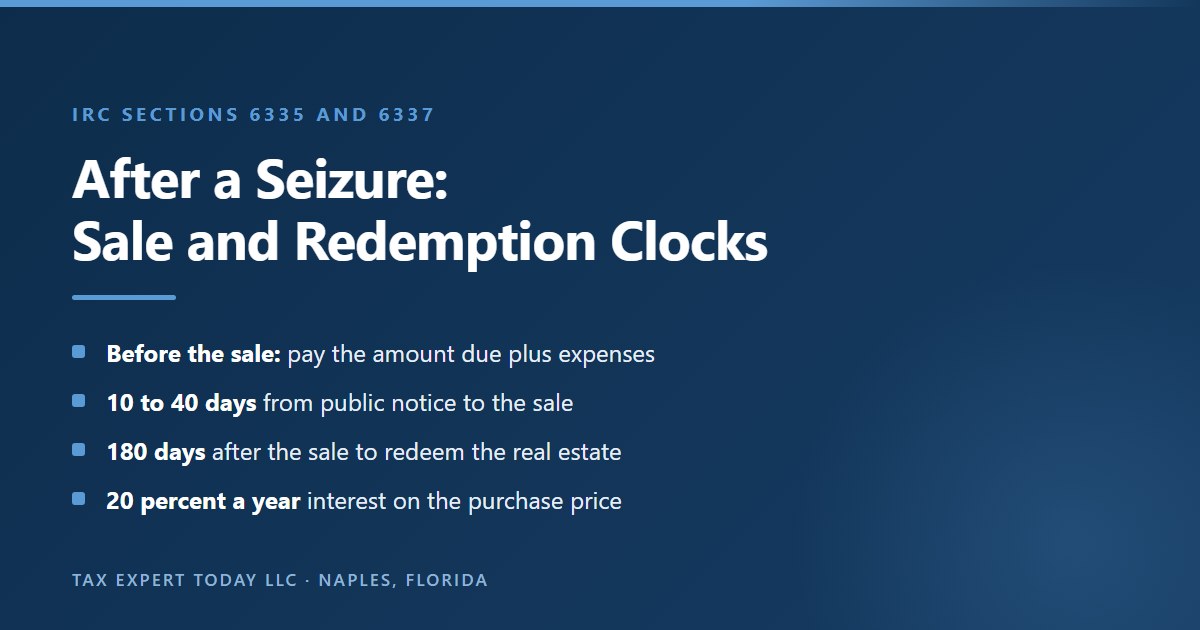
The IRS must notify the owner and publish a notice of sale in the county, and the sale takes place 10 to 40 days after public notice. Afterward, section 6337(b) gives the owner, or anyone with an interest in the property, 180 days to redeem it by paying the purchaser the price plus 20 percent annual interest.
- A minimum price is set. Section 6335 requires a minimum bid, and the property is sold to the highest bidder at or above it.
- The owner can redeem before the sale. Section 6337(a) allows the owner to recover the property before the sale by paying the tax and the expenses of the seizure.
- The 180-day window after the sale. Section 6337(b) lets the owner, heirs or any person with an interest or lien redeem within 180 days after the sale.
- Release is possible in some cases. Section 6343(a) requires release of a levy in listed situations, including where the IRS determines the levy is creating an economic hardship.
The redemption price can be estimated. The hypothetical below uses only the statutory formula, and actual figures depend on the sale price and the exact number of days that pass.
| Hypothetical redemption under section 6337(b) | Amount |
|---|---|
| Price paid by the purchaser at the IRS sale | $300,000 |
| Days between the sale and redemption | 180 |
| Interest at 20 percent a year ($300,000 × 20% × 180 ÷ 365) | $29,589 |
| Approximate amount to redeem | $329,589 |
The practical lesson is that redemption is expensive and time-limited, and it requires paying the purchaser in full. For most families the realistic time to protect the home is well before the sale, while a court petition is pending or, better still, before the IRS has decided to pursue the house at all.
How do you stop the IRS from taking your house?
Put a collection alternative in place. Section 6331(k) bars a levy while an installment agreement request or an offer in compromise is pending, while an installment agreement is in effect, and for 30 days after a rejection or termination. Currently not collectible status, a Collection Due Process hearing, or paying from equity can also stop it.
- An installment agreement. An IRS installment agreement, including a partial payment installment agreement, blocks levy while it is pending and while it is in effect.
- An offer in compromise. A pending offer bars levy under section 6331(k)(1), although the IRS will expect home equity to be reflected in the offer amount.
- Currently not collectible status. Where paying would prevent meeting basic living expenses, currently not collectible status pauses active collection, measured against the IRS allowable living expenses.
- A Collection Due Process hearing. A timely request after the final notice lets an Appeals officer consider collection alternatives before any levy.
- Using the equity on your own terms. A refinance or a voluntary sale with a section 6325(b) discharge can pay the IRS without a forced sale.
Every one of these options depends on accurate financial information. A complete Form 433-A collection information statement shows income, expenses, assets and home equity in the format the IRS uses to decide what a taxpayer can pay. Presenting that picture before a revenue officer builds a seizure recommendation is far more effective than responding after a suit package has been sent to the Department of Justice. If the IRS has already issued a summons for bank or property records, our guide to the IRS summons explains what that step usually signals in a collection case.
How long can the IRS pursue your house for a tax debt?
Generally 10 years from the date of assessment. Section 6502(a) allows collection by levy or by a court proceeding only if the levy is made or the proceeding begun within 10 years after assessment. Some events suspend that period, and a timely lawsuit can reduce the liability to a judgment that extends the government’s ability to collect.
- The collection statute expiration date. Section 6502(a)(1) sets the 10-year period, commonly called the CSED.
- The lien lasts as long as the liability. Under section 6322 the lien continues until the liability is satisfied or becomes unenforceable by reason of lapse of time.
- Some actions suspend the clock. Pending offers, pending installment agreement requests and Collection Due Process hearings can extend the period for the time they are pending.
- A near-expiry case is a lawsuit risk. IRM 5.10.2.3 lists a CSED expiring in one year or less as a reason to consider a suit to foreclose or reduce the claim to judgment.
Waiting out the statute is not a strategy that protects a house. Where there is meaningful equity and the clock is running down, the IRM tells revenue officers to consider exactly the court action that can reach the home. The safer course is to resolve the balance through one of the alternatives above while the options are still open.
IRS home seizure help Naples: tax resolution Naples and Southwest Florida
Tax Expert Today LLC works with homeowners in Naples, Florida and across Southwest Florida who owe the IRS and are worried about their house. Many cases here involve features that change the analysis: homestead property that owners assume is untouchable, seasonal and second homes that carry less protection than a year-round residence, rental condominiums, and homes owned by the entireties with a spouse who does not owe the tax. The most useful work happens early, while the IRS is still weighing alternatives rather than preparing a suit package.
People searching for IRS home seizure help in Naples usually want to know whether homestead status protects them, whether a second home is at greater risk, and whether a lien means a seizure is coming. The short answers are that homestead status does not stop the IRS, that a second home has fewer protections, and that a lien usually means the IRS expects to be paid from a sale or refinance rather than a seizure. Our IRS resolution and audit support service and our Naples tax resolution page describe how these matters are handled, including coordination with counsel where a court petition has already been filed.
Tax Expert Today LLC
11983 Tamiami Trail N, Naples, FL 34110
Phone: (239) 441-2005
Hours: Monday through Friday, 10:00 to 5:00 ET
Which court would decide whether the IRS can levy a principal residence in Naples? Section 6334(e)(1)(B) gives the federal district courts exclusive jurisdiction to approve a levy on a principal residence. Under 28 U.S.C. §89(b), Collier and Lee Counties are in the Middle District of Florida, which holds court in Fort Myers. A section 7403 lien foreclosure suit involving a Naples home would also be filed in federal court, not in the Collier County circuit court that handles ordinary mortgage foreclosures.
When to Engage a Professional
Many homeowners with a tax debt will never face a seizure, and a clear installment agreement or other alternative is often enough. Consider engaging a representative where the balance is well above $5,000 and a final notice of intent to levy has been issued, where a revenue officer has asked about the home, its value or its mortgage, where you own a second home or rental property with significant equity, where the home is owned with a spouse who does not owe the tax, where the collection statute is close to expiring, or where you have been served with an order to show cause or a lien foreclosure complaint. Those are the situations in which timing and the right collection alternative matter most. Tax Expert Today LLC was founded by Dr. Pellumb Kabashi, and every engagement starts from the statute, the regulation and the IRS’s own procedures rather than from assumptions about what the IRS will do.
This article is educational and general in nature. It does not constitute tax or legal advice for any particular taxpayer, and outcomes depend on individual facts and circumstances. A pending court petition or lien foreclosure suit should be reviewed with qualified legal counsel. Statutory references and IRS statistics are current as of the publication date and are subject to change.
Published September 24, 2026 by Dr. Pellumb Kabashi « Back to Learning Center
Have a question this article touches on?
Tax Expert Today LLC, based in Naples, Florida and serving clients across the United States.
Schedule a Consultation (239) 441-2005