
By Dr. Pellumb Kabashi, DBA, MBA, EA, CFE, CES
Founder, Tax Expert Today LLC · Tax advisors, enrolled agents, CPAs, and attorneys · Serving clients in all 50 states
Quick Answer: The FBAR deadline for foreign accounts held during 2026 is Thursday, April 15, 2027. FinCEN grants every filer an automatic extension to Friday, October 15, 2027, with no form and no request. The June 15 expat date and a Form 4868 extension do not move the FBAR, and an IRS disaster postponement moves it only when FinCEN issues its own notice. Call (239) 441-2005 for a free consultation.
What is the FBAR deadline for 2026 accounts?
The FBAR deadline for foreign accounts held at any point in calendar year 2026 is Thursday, April 15, 2027. A filer who misses that date receives an automatic extension to Friday, October 15, 2027. No extension request exists or is needed, and the report is filed electronically with FinCEN, not with the tax return.
- Reporting year: January 1 through December 31, 2026, a calendar year for every filer.
- Annual due date: April 15, 2027, set by statute, not by the tax return.
- Automatic extended date: October 15, 2027, granted by FinCEN to everyone.
- Where it goes: FinCEN Form 114 through the BSA E-Filing System.
- Who it covers: U.S. persons whose foreign accounts together topped $10,000 at any time in 2026.
The FBAR deadline is one of the few federal dates that looks like the income tax deadline but does not behave like it. The Report of Foreign Bank and Financial Accounts, FinCEN Form 114, is a Bank Secrecy Act report under 31 U.S.C. 5314, not an Internal Revenue Code return. If you are still deciding whether you have to file at all, start with our pillar guide, Do I need to file an FBAR?, which walks through the $10,000 aggregate test, the definition of a foreign financial account, and who counts as a U.S. person. This guide picks up from there and answers one question in depth: when the report is due, what moves that date, and what does not.
The answer for the 2026 reporting year is short, and it is stated in FinCEN’s own filing instructions. The BSA Electronic Filing Requirements for the FBAR say the report must be received by the Department of the Treasury on or before April 15th of the year immediately following the calendar year being reported, and that FinCEN grants filers who miss that date an automatic extension to October 15th each year. The IRS repeats the same rule on its FBAR page, adding that you do not need to request an extension to file the FBAR.
The longer answer matters because most FBAR problems we see at the deadline are not caused by people forgetting April 15. They are caused by people assuming that something else they did, such as filing Form 4868, living abroad, or living in a county that received hurricane relief, also moved the FBAR. Usually it did not. The sections below go through each of those assumptions against the primary sources.
| Reporting year | Annual FBAR due date | Automatic extended date | Day of week (extended date) |
|---|---|---|---|
| 2024 accounts | April 15, 2025 | October 15, 2025 | Wednesday |
| 2025 accounts | April 15, 2026 | October 15, 2026 | Thursday |
| 2026 accounts | April 15, 2027 (Thursday) | October 15, 2027 | Friday |
| 2027 accounts | April 15, 2028 | October 15, 2028 | Sunday (see the weekend section below) |
One practical note on the table. For the 2025 reporting year, the extended date of October 15, 2026 has already passed. A report for 2025 accounts that has not been filed by now is a late FBAR, and the right guide for that situation is our walkthrough on how to file a late or delinquent FBAR, not this one. This guide is written for the 2026 reporting year, which most households will file in the spring of 2027.
Why does the FBAR regulation still say June 30?
The FBAR regulation at 31 CFR 1010.306(c) still reads June 30 because the text was never rewritten after Congress changed the date. Section 2006(b)(11) of Public Law 114-41 moved the FBAR deadline to April 15 with a six month extension, starting with 2016 reports. The statute controls, and FinCEN applies April 15 and October 15.
- Regulation text today: June 30 of each calendar year, in 31 CFR 1010.306(c).
- Statute that overrides it: section 2006(b)(11) of Public Law 114-41, enacted in 2015.
- First year affected: FBARs for calendar year 2016, due in 2017.
- Old rule: June 30, with no extension available at all.
- Current rule: April 15, plus a maximum six month extension, which FinCEN grants automatically.
This is a genuine trap for anyone who reads regulations directly. Both the Cornell copy of 31 CFR 1010.306 and the official electronic Code of Federal Regulations, checked on November 18, 2026, still say that reports required by section 1010.350 shall be filed with FinCEN on or before June 30 of each calendar year. A taxpayer who relies on that sentence will believe there are two and a half months more than there are, and will also believe there is no extension, which is wrong in the other direction.
The date changed by statute. The Surface Transportation and Veterans Health Care Choice Improvement Act of 2015, Public Law 114-41, contains a provision, section 2006(b)(11), that ties the FBAR due date to April 15 and allows a maximum six month extension. FinCEN’s December 2025 notice cites that exact provision in its footnote describing the due date, stating that beginning with the 2016 tax year the due date for FBAR reporting is April 15 of the year following the December 31 report ending date, as changed by 26 U.S.C. 6072 and section 2006(b)(11) of Public Law 114-41. The IRS FBAR Reference Guide (Publication 5569) gives the same history: before the 2015 Act, reports for calendar year 2015 and earlier were due June 30 with no provision for an extension.
| Source | What it says about the due date | Is it current law? |
|---|---|---|
| 31 CFR 1010.306(c), text as published | June 30 of each calendar year | No, superseded by statute for 2016 and later years |
| Public Law 114-41, section 2006(b)(11) | April 15, with a maximum six month extension | Yes |
| FinCEN BSA E-Filing instructions for Form 114 | April 15, automatic extension to October 15, no request required | Yes, this is how FinCEN administers the statute |
| IRS Publication 5569 | April 15, automatic October 15, file as complete a report as possible | Yes |
| IRS FBAR web page | April 15, automatic extension to October 15 | Yes |
Why does this matter for a 2026 filer? Mostly because of what people find when they search. Older articles written before 2017, and some forum answers that quote the regulation, still give June 30. If you see June 30 anywhere, treat it as a sign the source is either out of date or quoting regulation text that no longer controls.
What does the automatic FBAR extension to October 15 actually mean?
The automatic FBAR extension means a report filed on or before October 15 is treated as timely even though April 15 passed. There is no form, no checkbox, and no request. FinCEN applies it to every filer, so the practical last day to file a 2026 FBAR on time is Friday, October 15, 2027.
- No request: FinCEN says specific requests for this extension are not required.
- No form: Form 4868 and Form 7004 play no role in it.
- No reason needed: you do not explain why you filed after April 15.
- Same for everyone: individuals, spouses, trusts, entities, and preparers filing for clients.
- Hard stop: after October 15 the report is late, and the e-file form asks for a reason code.
The phrase “automatic extension” is easy to misread. It does not mean that something happens in the background and gives you more time only if you qualify. It means FinCEN has decided, as a matter of administration, that the six month extension Congress authorized is granted to all filers at once. The FinCEN filing instructions state that the agency will grant filers failing to meet the April 15th annual due date an automatic extension to October 15th each year, and that specific requests for this extension are not required.
The IRS Reference Guide explains the purpose: to implement the statute with minimal burden to the public. In practice, that means an FBAR filed in May, July, or the first half of October of 2027 for 2026 accounts is an on time FBAR. The BSA E-Filing form treats it that way too. Its late filing question only appears for reports filed after October 15th of the year following the reporting year, according to FinCEN’s Filing Late page.
| Filing date for a 2026 FBAR | Status | Late reason code asked on the form? |
|---|---|---|
| On or before April 15, 2027 | Timely, annual due date | No |
| April 16 through October 15, 2027 | Timely, automatic extension | No |
| After October 15, 2027 | Late | Yes, choose a reason or “other” with an explanation |
| After October 15, 2027, under a FinCEN waiver notice | Filed under the notice’s own date | Yes, select “other” and identify the notice number |
Two cautions follow from this. First, because nobody has to ask for the October date, nobody receives a confirmation that they have it. Calendar it yourself. Second, the extension exists for the report, not for gathering information indefinitely. If records are still missing as October approaches, the IRS guidance is to file as complete a report as possible and amend it later, which we cover in the section on incomplete reports.
Is there any FBAR extension beyond October 15?
For an ordinary filer, no FBAR extension exists beyond October 15. The statute allows a maximum six month extension, and FinCEN already grants all of it automatically. Later dates come only from FinCEN notices, such as disaster relief notices or the annual signature authority deferral for certain employees with no financial interest.
- Statutory ceiling: six months past April 15, which lands on October 15.
- No individual request route: there is no FBAR equivalent of asking the IRS for more time.
- Disaster notices: FinCEN has extended FBAR dates for FEMA and IRS designated areas.
- Signature authority notices: a yearly deferral for specified employees and officers.
- Everything else: a report filed after October 15 is a late report.
People sometimes ask whether they can write to FinCEN or the IRS to ask for a few more weeks. There is no published procedure for that. The Reference Guide describes the six month extension as the maximum the Act mandated. Past October 15, the only filers whose date moves are those covered by a FinCEN notice, and FinCEN issues those notices on its own initiative for defined groups. The FinCEN FBAR page lists them under “FBAR Filing Due Date,” going back to 2017.
| Route to a later FBAR date | Who it covers | How you get it |
|---|---|---|
| Automatic extension to October 15 | Every filer | Nothing to do |
| FinCEN disaster relief notice | Filers in areas designated by FEMA and by the IRS, under the terms of each notice | Only if FinCEN issues a notice for that disaster |
| FinCEN signature authority notice | Certain employees and officers with signature authority over, but no financial interest in, employer accounts | Only if you fall within 31 CFR 1010.350(f)(2)(i) to (v) as the notice describes |
| Writing to FinCEN or the IRS for more time | Nobody | No published procedure exists |
If you are a regular account holder with no disaster designation and no employer signature authority question, plan on October 15, 2027 as the true last day for 2026 accounts, and aim for April 15, 2027 so the report goes out with the rest of your filing season work.
What happens when the FBAR deadline falls on a weekend?
For 2026 accounts, the weekend question does not arise, because April 15, 2027 is a Thursday and October 15, 2027 is a Friday. FinCEN’s instructions speak of the report being received by Treasury on or before April 15, so the safest course in any year is to file on or before the stated calendar date, not after it.
- April 15, 2027: Thursday, an ordinary business day.
- October 15, 2027: Friday, an ordinary business day.
- October 15, 2028: a Sunday, relevant to 2027 accounts, a year from now.
- Electronic filing: the BSA E-Filing System accepts reports every day.
- Practical rule: do not plan to use any weekend carryover; file before the date.
The income tax rules have a well known provision that moves a deadline falling on a Saturday, Sunday, or legal holiday to the next business day. Whether and how a similar carryover applies to a Title 31 report is a question we do not need to resolve for the 2026 reporting year, because neither of the two 2027 dates falls on a weekend. Because the FBAR is filed electronically, the cleanest approach every year is to treat the printed calendar date as the last day and file before it. Electronic submissions are not tied to post office hours, and FinCEN’s instructions frame timeliness as receipt by Treasury on or before the date.
If you are reading this in a later year and the date falls on a weekend, check the FinCEN FBAR page and the current filing instructions for that year’s statement before relying on a next business day assumption.
Who has to meet the FBAR deadline for 2026?
Any U.S. person with a financial interest in, or signature or other authority over, foreign financial accounts whose combined value exceeded $10,000 at any time in 2026 must meet the FBAR deadline. U.S. persons include citizens, resident aliens, and domestic entities, trusts, and estates. The $10,000 test is an aggregate of the maximum values of all such accounts.
- Citizens: wherever they live, including Naples, Florida residents with a single account abroad.
- Resident aliens: green card holders and those who meet the substantial presence test.
- Entities: domestic corporations, partnerships, limited liability companies, trusts, and estates.
- Aggregate test: add each account’s highest 2026 balance; the threshold is more than $10,000.
- Signature authority: counts even with no ownership, subject to listed exceptions.
The filing requirement itself sits in 31 CFR 1010.350, which requires each United States person having a financial interest in, or signature or other authority over, a bank, securities, or other financial account in a foreign country to report that relationship for each year in which it exists. The IRS FBAR page summarizes it the same way and lists citizens, residents, corporations, partnerships, limited liability companies, trusts, and estates.
Resident status for this purpose follows the income tax tests, so a foreign national living in Southwest Florida who passes the substantial presence test for 2026 is generally a U.S. person for the 2026 FBAR as well. The FBAR pillar guide covers the threshold in detail, and our guide to FBAR signature authority covers employees, officers, and family members who can move money in accounts they do not own.
| Hypothetical 2026 account | Highest balance in 2026, converted to dollars | Counts toward the aggregate? |
|---|---|---|
| Checking account in Toronto | $4,200 | Yes |
| Savings account in London | $3,900 | Yes |
| Brokerage account in Zurich | $2,600 | Yes |
| Aggregate of maximum values | $10,700 | Over $10,000, so a 2026 FBAR is due April 15, 2027 |
In the hypothetical above, no single account ever came close to $10,000, and the three highest balances may have occurred in different months. The test still adds the three maximum values together, which is why a household with several small accounts abroad can owe an FBAR without ever holding $10,000 in one place. Conversion uses the Treasury Reporting Rates of Exchange for the last day of the calendar year, which we cover later in this guide.
Does the June 15 expat date move the FBAR deadline?
No. The June 15 date for U.S. citizens and residents living abroad is an income tax extension under Treas. Reg. section 1.6081-5. It applies to returns of income, not to the FBAR, which is a Title 31 report. An American living abroad still has an FBAR due April 15, 2027, with the same automatic extension to October 15, 2027.
- What June 15 covers: Form 1040 for citizens and residents whose tax home and abode are outside the United States and Puerto Rico.
- What it does not cover: FinCEN Form 114.
- 2027 date: June 15, 2027 falls on a Tuesday.
- Interest still runs: tax not paid by April 15 accrues interest even with the June 15 extension.
- FBAR result: April 15, then October 15 automatically, for everyone.
This is the second most common date confusion we see after the Form 4868 question. Treas. Reg. section 1.6081-5 grants an extension of time for filing returns of income and for paying any tax shown on the return to the fifteenth day of the sixth month after year end for United States citizens or residents whose tax homes and abodes, in a real and substantial sense, are outside the United States and Puerto Rico, and for those in military or naval service on duty outside the country. The IRS explains the same rule on its page about the automatic two month extension for citizens and residents abroad, noting that even with the extension, interest is owed on tax not paid by the regular due date.
The regulation is written for income tax returns under the Internal Revenue Code. The FBAR is not one. It is filed with FinCEN under the Bank Secrecy Act, and its due date comes from Public Law 114-41 as administered by FinCEN. Nothing in the June 15 rule reaches it. The good news for Americans abroad is that the FBAR’s own automatic extension to October 15 is longer than the June 15 income tax date, so the FBAR does not have to be finished first. It simply has its own clock.
| Filing | Regular 2027 date | Abroad on the due date | Further extension |
|---|---|---|---|
| Form 1040 (2026 tax year) | April 15, 2027 | June 15, 2027, automatic, attach a statement | October 15, 2027 with Form 4868 |
| FinCEN Form 114, FBAR (2026 accounts) | April 15, 2027 | No change; still April 15, 2027 | October 15, 2027, automatic for everyone |
| Form 8938 (attached to Form 1040) | April 15, 2027 | Follows the return, so June 15, 2027 | Follows the return |
| Form 3520 (2026 tax year) | April 15, 2027 | June 15, 2027 with a statement | October 15, 2027 when the income tax return is extended |
For an American who moved abroad and then moved home to Florida, the residence test matters only for the income tax date. If you were not living abroad on the regular due date, June 15 does not apply to your return, and in either case it never applied to your FBAR. Our guides to the bona fide residence test and to Form 2555 cover the income tax side of living abroad.
Does filing Form 4868 extend the FBAR deadline?
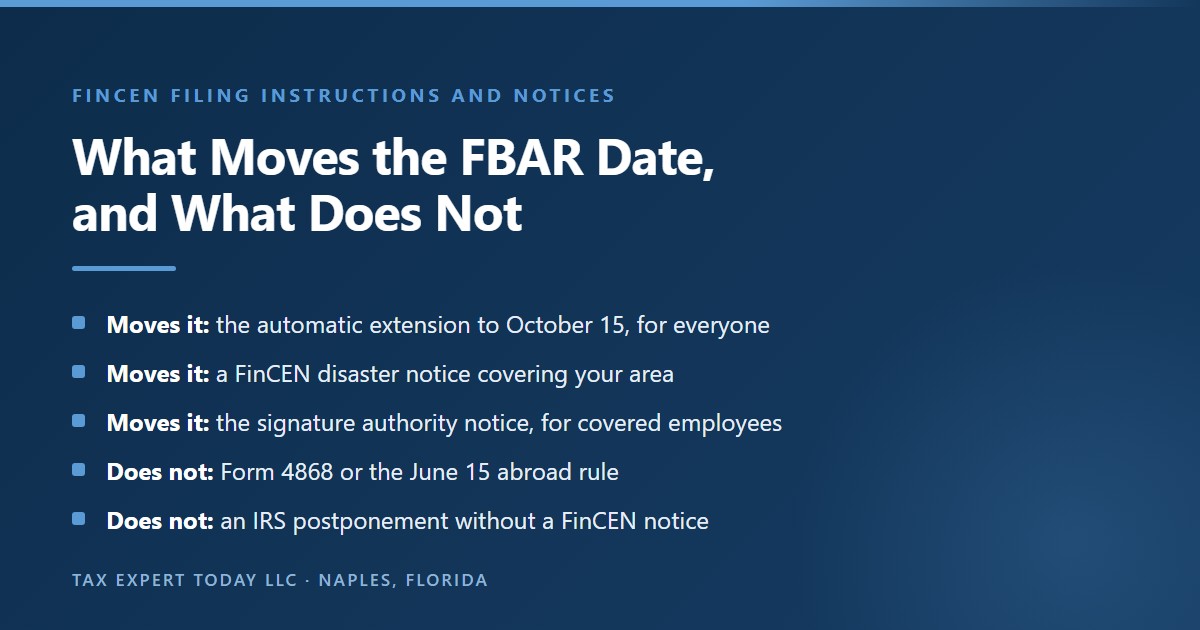
No. Form 4868 extends the time to file Form 1040 and the forms attached to it, such as Form 8938. It has no effect on the FBAR, which is filed separately with FinCEN. The FBAR’s own extension to October 15, 2027 is automatic, so the two extended dates line up even though they come from different laws.
- Form 4868 reach: the income tax return and attached information forms.
- FBAR reach: none; the FBAR is not attached to the return.
- Coincidence of dates: both extended dates fall on October 15, 2027.
- Common mistake: believing the FBAR was “on extension” because the return was.
- What actually protects the FBAR: filing Form 114 by October 15, 2027.
Because the extended income tax date and the extended FBAR date are the same day, October 15, many filers treat them as one deadline and one extension. That works until it does not. The FBAR is not part of the return. The IRS Reference Guide says plainly that you should not file the FBAR with the federal tax return; it goes to FinCEN through the BSA E-Filing System. An income tax extension filed on Form 4868 is a request to the IRS about Form 1040. It says nothing to FinCEN.
The practical risk shows up when a return is filed in, say, August 2027 under an extension and the FBAR is forgotten in the process, or when a preparer files the return and assumes the client is handling the FBAR. The return can be complete and timely while the FBAR is late. The opposite can also happen: a household files the FBAR in April and then believes the income tax return is covered too, when only a Form 4868 or the abroad rule would extend the return.
| Action taken in April 2027 | Effect on Form 1040 | Effect on the FBAR |
|---|---|---|
| File Form 4868 by April 15, 2027 | Filing date extended to October 15, 2027; payment date not extended | None |
| File the FBAR by April 15, 2027 | None | Timely on the annual date |
| Do nothing by April 15, 2027 | Return is late unless an exception applies | Still timely if filed by October 15, 2027 |
| File Form 4868 and forget the FBAR until November 2027 | Return timely if filed by October 15 | Late; the e-file form asks for a reason |
A useful habit is to treat the FBAR as its own line item on your filing calendar, with its own confirmation. FinCEN issues a BSA Identifier for each accepted report. Keep that number with your return file so you can show, years later, that the report went in and when.
Does an IRS disaster postponement move the FBAR deadline?
Not by itself. An IRS postponement under section 7508A covers federal tax deadlines. The FBAR is a Title 31 report, so FinCEN must issue its own notice. FinCEN has done so for many hurricanes, usually matching the IRS date for areas both FEMA and the IRS designated, but each notice sets its own terms and coverage.
- IRS relief: postpones tax filing and payment dates for a covered disaster area.
- FinCEN relief: a separate notice that may extend FBAR dates.
- Recent pattern: 2024 notices for Helene, Milton, Debby, Beryl, and Francine.
- Typical coverage: areas designated by FEMA for individual or public assistance and by the IRS for tax relief.
- Check both lists: the IRS disaster page and the FinCEN FBAR page.
Southwest Florida families know the IRS disaster relief routine. After a federally declared disaster, the IRS publishes a release naming the covered counties and a postponed date, and the IRS tax relief in disaster situations page lists every release by year and state. Those postponements come from section 7508A of the Internal Revenue Code and apply to deadlines under the Code. The FBAR is not filed under the Code, so the IRS release alone does not move it.
FinCEN fills that gap with its own notices. The Hurricane Milton notice, FIN-2024-NTC6, dated October 11, 2024, is a good model of how they work. It gave victims until May 1, 2025 to file FBARs for calendar year 2023, which otherwise were due on or before October 15, 2024. It applied to any area designated both by FEMA as qualifying for individual or public assistance and by the IRS as eligible for tax filing relief. It said that areas the IRS designated later would receive FBAR relief automatically, and that FBAR deadlines would be the same as those set in the IRS designations. It also invited filers outside the area who needed records located inside it to contact FinCEN’s Regulatory Support Section. The Hurricane Helene notice, FIN-2024-NTC4, set the same May 1, 2025 date.
| FinCEN FBAR relief notice | Date issued | FBAR year covered | Relief date |
|---|---|---|---|
| Hurricane Helene (FIN-2024-NTC4) | October 7, 2024 | 2023 accounts | May 1, 2025 |
| Hurricane Milton (FIN-2024-NTC6) | October 11, 2024 | 2023 accounts | May 1, 2025 |
| Hurricanes Debby and Beryl, Tropical Storm Francine | October 7, 2024 | 2023 accounts | Per each notice |
| Natural disasters (Hurricane Ida, California wildfires, Tropical Storm Fred) | October 5, 2021 | 2020 accounts | December 31, 2021 |
| Natural disaster notices | 2020, 2022, and 2023 | Prior years | Per each notice |
Two features of the older notices are worth noticing. The coverage test has changed over time: the October 2021 announcement covered areas FEMA designated for individual assistance, while the 2024 notices required designation by both FEMA and the IRS. And the relief dates differ from notice to notice. That is why we do not recommend assuming any particular FBAR relief from a hurricane. Read the specific FinCEN notice for that storm, and if there is none, the ordinary April 15 and October 15 dates apply.
The IRS Reference Guide also points to older FinCEN guidance, FIN-2013-G002 of June 24, 2013, for circumstances such as natural disasters that may prevent timely filing. Where no notice exists, a filer who could not file because of a disaster should document the facts, file as soon as possible, and use the late filing explanation on the e-file form.
Did Hurricane Isaias in 2026 change any FBAR deadline?
As of November 18, 2026, the FinCEN FBAR page lists no FBAR relief notice for Hurricane Isaias, and its most recent disaster notice dates from October 2024. The IRS release FL-2026-07 postponed tax deadlines to February 8, 2027 for 27 Florida counties. Collier and Lee counties are not on that list.
- IRS release: FL-2026-07, relief for Hurricane Isaias beginning October 9, 2026.
- IRS postponed date: February 8, 2027 for covered tax deadlines.
- Counties covered: 27 counties, concentrated in the Panhandle and Big Bend.
- Southwest Florida: Collier, Lee, and Charlotte counties are not listed.
- FBAR status: no FinCEN Isaias notice was listed when we checked on November 18, 2026.
The IRS announced relief for Florida taxpayers affected by Hurricane Isaias in release FL-2026-07. It covers individuals and businesses in Baker, Bay, Calhoun, Citrus, Columbia, Dixie, Escambia, Franklin, Gadsden, Gilchrist, Gulf, Hamilton, Holmes, Jackson, Jefferson, Lafayette, Leon, Levy, Liberty, Madison, Okaloosa, Santa Rosa, Suwannee, Taylor, Wakulla, Walton, and Washington counties. Deadlines falling on or after October 9, 2026 and before February 8, 2027 move to February 8, 2027. The release says the date applies to individuals who had a valid extension to file their 2025 income tax return, while payments that were due April 15, 2026 are not eligible.
The 2025 FBAR’s extended date, October 15, 2026, fell inside that window. That is exactly the situation in which FinCEN issued notices in 2024. But when we reviewed the FinCEN FBAR page on November 18, 2026, its due date list began with the Hurricane Milton notice of October 11, 2024 and showed nothing later. We cannot tell you whether FinCEN will publish one, and we do not assume it will. If you live or keep your records in one of the 27 listed counties and your 2025 FBAR was not filed by October 15, 2026, check the FinCEN page again before relying on the IRS date, and document why the report could not be filed.
| Question for a Florida filer | Status on November 18, 2026 |
|---|---|
| Did the IRS postpone tax deadlines for Hurricane Isaias? | Yes, to February 8, 2027, in 27 listed counties (FL-2026-07) |
| Is Collier County (Naples) a covered county? | No |
| Is Lee County (Fort Myers, Cape Coral) a covered county? | No |
| Did FinCEN list an FBAR notice for Isaias? | No notice listed on the FinCEN FBAR page |
| Does any of this affect 2026 accounts due April 15, 2027? | No; those dates are outside the IRS postponement window |
For the 2026 reporting year, which is the focus of this guide, the point is simpler. The Isaias postponement covers deadlines falling before February 8, 2027. The 2026 FBAR is due April 15, 2027. Unless a future disaster produces a new notice, the 2026 FBAR dates are unaffected.
What is the FBAR signature authority deferral?
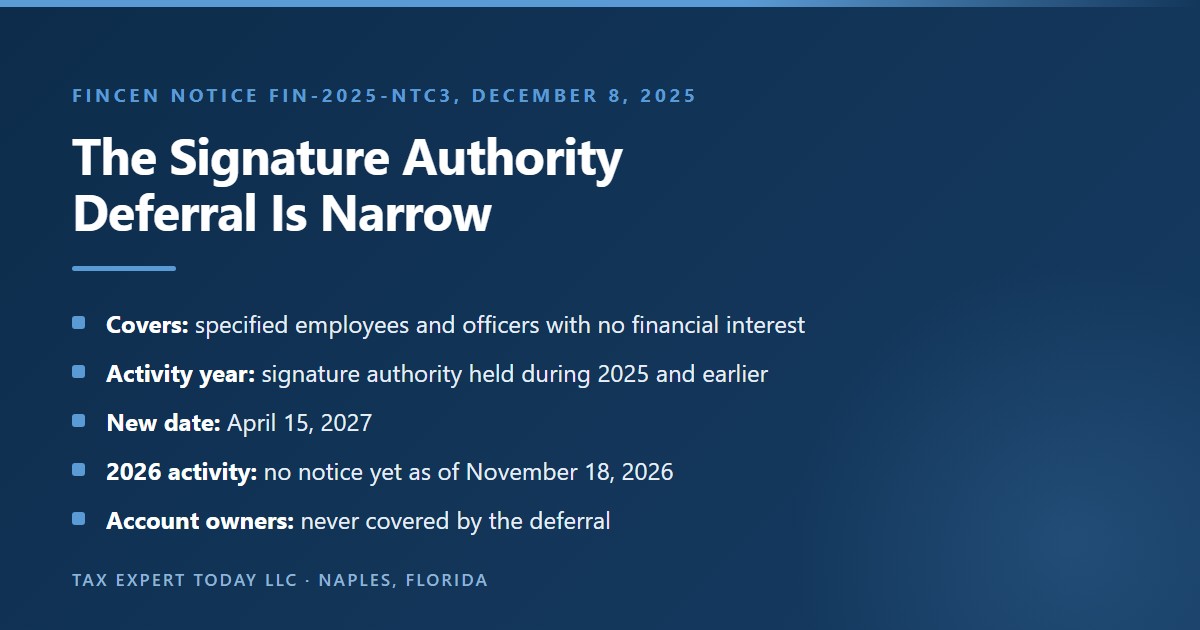
The signature authority deferral is a yearly FinCEN notice that pushes back the FBAR date for certain employees and officers who have signature authority over, but no financial interest in, employer accounts. Notice FIN-2025-NTC3 extended the date for signature authority held during 2025 to April 15, 2027. It does not cover account owners.
- Latest notice: FIN-2025-NTC3, dated December 8, 2025.
- Covered year: signature authority held during calendar year 2025, plus earlier deferred years.
- New date: April 15, 2027.
- Who qualifies: individuals whose obligation may be affected by 31 CFR 1010.350(f)(2)(i) through (v).
- Why it keeps happening: a 2016 proposed rule on these exemptions has never been finalized.
Since 2011, FinCEN has issued an extension every year for a narrow group of filers. The current version, Notice FIN-2025-NTC3, explains the reason. FinCEN proposed amendments in March 2016 that would expand and clarify the exemptions for U.S. persons with signature or other authority over foreign financial accounts, and because the proposed rulemaking is not yet finalized, FinCEN extended the due date to April 15, 2027 for individuals whose date had previously been extended by Notice FIN-2024-NTC7. The notice states that it applies to the reporting of signature authority held during the 2025 calendar year, and to all reporting deadlines extended by previous notices going back to 2011.
The group is defined by reference to the exceptions in 31 CFR 1010.350(f)(2). Those exceptions cover officers and employees of banks examined by federal banking regulators, of financial institutions registered with and examined by the SEC or CFTC, of authorized service providers to registered investment companies, of entities with equity securities listed on a U.S. national exchange, and of entities with equity securities registered under section 12(g) of the Securities Exchange Act, in each case where the individual has no financial interest in the account. The notices extend the date for individuals whose filing requirement may be affected by those exceptions, which in practice means people whose job gives them authority over an employer’s accounts.
| Situation | Covered by FIN-2025-NTC3? | Due date for 2025 activity |
|---|---|---|
| Treasury officer of a U.S. listed company who signs on the company’s foreign accounts, no ownership | Generally within the class the notice describes | April 15, 2027 |
| Employee of a privately held U.S. business with signature authority over its Mexican account | Depends on the facts; the (f)(2) categories are specific | Review against 1010.350(f)(2) before relying on the notice |
| Adult child named on a parent’s account abroad, no ownership | No; not an employer account | April 15, 2026, extended to October 15, 2026 (already passed) |
| Owner of a personal account abroad | No; the notice covers no financial interest only | April 15, 2026, extended to October 15, 2026 (already passed) |
The notice ends with a sentence that matters for everyone else: for all other individuals with an FBAR filing obligation, the filing due date remains April 15, 2026, for the 2025 year. In other words, the deferral is not a general extension. Our guide to FBAR signature authority explains how signature authority is defined and how family and business arrangements fit into it.
Does the signature authority deferral cover 2026 accounts yet?
Not yet. As of November 18, 2026, the latest notice, FIN-2025-NTC3, covers signature authority held during 2025. FinCEN has issued a similar notice every year since 2011, usually in November or December, but until a notice covering 2026 is published, signature authority held in 2026 is reportable under the normal April 15, 2027 date.
- Covered today: 2025 and earlier deferred years, now due April 15, 2027.
- Not yet covered: signature authority held during 2026.
- Historical timing: recent notices were dated December 2022, December 2023, November 2024, and December 2025.
- Safe assumption: none; check the FinCEN FBAR page in December 2026.
- If a notice issues: read its own scope and date before relying on it.
This is where precision matters. The December 2025 notice describes itself as applying to the reporting of signature authority held during the 2025 calendar year. A reader in late 2026 might reasonably expect another notice, because FinCEN has issued an identical extension each year since 2012, as the notice’s own footnote recounts. The December 2023 notice, FIN-2023-NTC5, followed the same pattern. But an expectation is not a notice. Until FinCEN publishes one covering 2026, an employee in the covered class who held signature authority during 2026 should plan on the ordinary FBAR deadline of April 15, 2027, extended automatically to October 15, 2027.
| Signature authority held during | Notice that extends it | Current due date |
|---|---|---|
| 2011 through 2024 | Earlier notices, carried forward by FIN-2025-NTC3 | April 15, 2027 |
| 2025 | FIN-2025-NTC3 (December 8, 2025) | April 15, 2027 |
| 2026 | None published as of November 18, 2026 | April 15, 2027, automatic extension to October 15, 2027, unless a new notice says otherwise |
Notice the overlap in the table: the deferred date for 2025 activity and the ordinary date for 2026 activity are the same day, April 15, 2027. For people in the covered class, that is a convenient coincidence. Many will simply file both years’ reports together in the spring of 2027.
When is an FBAR considered filed on time?
An FBAR is on time when Treasury receives it through the BSA E-Filing System on or before the due date, which for 2026 accounts is April 15, 2027, or October 15, 2027 under the automatic extension. Filing produces a BSA Identifier that serves as your record that FinCEN accepted the report and when.
- Receipt standard: FinCEN’s instructions speak of receipt by Treasury on or before the date.
- Electronic only: the FBAR is filed through the BSA E-Filing System.
- Confirmation: a BSA Identifier is issued by email or secure message.
- Keep it: the identifier is needed to amend the report later.
- Do not rely on mail: mailing a paper report is not the filing method.
The FinCEN filing instructions say the FBAR must be received by the Department of the Treasury on or before April 15th of the year immediately following the calendar year being reported. The IRS Reference Guide notes that electronic filing of FBARs is mandatory and that the FBAR is not filed with the federal tax return. Taken together, the timeliness question is answered by when the electronic submission reaches FinCEN, which is why we recommend submitting several days early rather than at 11 p.m. on the last day.
Once the report is accepted, FinCEN issues a BSA Identifier, sent either by email or through the BSA E-Filing System’s secure messaging feature. The instructions call it the Prior Report BSA Identifier when you later need to amend. Save it, and save a copy of the submitted report. The IRS Reference Guide notes that keeping a copy of the filed FBAR can help satisfy the recordkeeping requirement.
How do you file the FBAR by the deadline?
Individuals file FinCEN Form 114 through the BSA E-Filing System without registering for an account. Attorneys, CPAs, and enrolled agents filing for clients must register as BSA E-Filers and file as institutions. Each account is listed with its maximum 2026 value in U.S. dollars, rounded up to the next whole dollar.
- Individual filers: use the no registration individual filing option on BSA E-Filing.
- Professional preparers: register as BSA E-Filers and file as an institution.
- Values: each account’s maximum value during 2026, converted and rounded up.
- 25 or more accounts: report the count and keep detailed records instead of listing each one.
- Before you start: gather account numbers, institution names and addresses, and statements.
FinCEN’s FBAR page explains the two filing paths. Individuals may electronically file their FBAR through the BSA E-Filing System without registering for an account. An attorney, CPA, or enrolled agent filing on behalf of a client must register to become a BSA E-Filer and file as an institution rather than an individual. The filing itself is not complicated once the information is assembled. The time goes into the assembly.
| Information needed for each foreign account | Where to find it |
|---|---|
| Maximum value during 2026, in the account’s currency | Monthly or quarterly statements; the highest balance shown |
| Treasury exchange rate for December 31, 2026 | Treasury Reporting Rates of Exchange, published by the Bureau of the Fiscal Service |
| Account number or other designation | Statements or the institution’s online portal |
| Name and address of the financial institution | Statements; use the branch or institution address |
| Type of account | Bank, securities, or other |
| Joint owners or principal owners, if any | Account opening documents |
Amounts are recorded in U.S. dollars and rounded up to the next whole dollar; FinCEN’s example is that $15,265.25 would be entered as $15,266. A filer with a financial interest in 25 or more foreign financial accounts checks a box, enters the number of accounts, and skips the account detail parts of the form, but must keep the information and provide it if asked, under 31 CFR 1010.350(g).
What is Form 114a and when do you need it?
Form 114a, the Record of Authorization to Electronically File FBARs, lets a third party preparer or a spouse file and sign the FBAR for you. It is never sent to FinCEN. You sign it, keep it with your records, and provide it if FinCEN or the IRS asks. It should be signed before the preparer submits the report.
- Purpose: authorizes another person to e-file your FBAR.
- Who uses it: clients of paid preparers, and spouses filing one joint report.
- Where it goes: nowhere; it stays in the filer’s and preparer’s files.
- When to sign: before the preparer files, so the authority exists at filing.
- Deadline link: no separate due date; it rides with the FBAR it authorizes.
Searches for “form 114a” peak in the same weeks as searches for the FBAR deadline, because it is the one piece of paper a preparer needs from a client before filing. The FinCEN filing instructions describe it as the FinCEN BSA E-Filing Signature Authorization Record. The filer or owner who is using a third party preparer should complete and maintain a record of Form 114a to authorize the third party filing. The instructions are direct about where it goes: do not file or send the completed Form 114a to FinCEN. It must be maintained by the filer or owner and made available to FinCEN or the IRS on request.
The form has no deadline of its own, but it has a practical one. A preparer who files your FBAR on April 14, 2027 should have your signed authorization in hand before that submission. A Form 114a collected in May for a report filed in April leaves a gap in the file that is easy to avoid. When we prepare FBARs for clients, the signed 114a is one of the first items we collect, alongside the statements.
| Form 114a fact | Rule |
|---|---|
| Filed with FinCEN? | No, never |
| Who keeps it? | The filer or owner, and in practice the preparer as well |
| Who signs? | The account owner or filer, and each spouse when used for a joint report |
| Does it extend the FBAR deadline? | No |
| Is it needed if you file your own FBAR? | No, unless your spouse is filing a joint report for both of you |
Can married couples file one FBAR by the deadline?
Yes, if all the accounts the non-filing spouse must report are jointly owned with the filing spouse, the filing spouse reports those joint accounts on a timely, electronically signed FBAR, and both spouses complete and sign Form 114a. Otherwise each spouse files a separate FBAR and reports the full value of each joint account.
- Condition one: every account the non-filing spouse must report is joint with the filing spouse.
- Condition two: the filing spouse reports those accounts on a timely, electronically signed FBAR.
- Condition three: both spouses complete and sign Form 114a and keep it.
- Tax filing status: married filing jointly or separately has no effect on this rule.
- If any condition fails: two FBARs, each showing the full joint account value.
The spouse rule depends on timeliness. The FinCEN instructions say a spouse is not required to file a separate FBAR if all the financial accounts that the non-filing spouse is required to report are jointly owned with the filing spouse, the filing spouse reports the jointly owned accounts on a timely filed FBAR electronically signed, and the filers have completed and signed Form 114a, maintained with the filers’ records. The IRS FBAR page adds that income tax filing status, such as married filing jointly and married filing separately, has no effect on qualification for this exception.
The word timely is doing real work. If the filing spouse’s report goes in after October 15, 2027, the spouse exception as written is not met, because it requires a timely filed FBAR. That is one more reason to plan on April, not October.
| Hypothetical household, 2026 | One FBAR or two? |
|---|---|
| Spouses share one joint account in Germany; neither has any other foreign account | One, if both sign Form 114a and the report is timely |
| Spouses share a joint account in Germany; one spouse also has a solely owned account in Italy | One is still possible if the non-filing spouse’s only reportable account is the joint one and the spouse with the Italian account files |
| Each spouse has a separate account abroad in his or her own name | Two |
| Spouses qualify, but the report is filed in November 2027 | The exception requires a timely report; review with a professional |
Couples where one spouse is not a U.S. person face a different question, because only U.S. persons file. Our guide on the nonresident alien spouse covers the income tax elections, and the FBAR follows the U.S. person status of each spouse separately.
How do the FBAR and Form 8938 deadlines differ?
Form 8938 is attached to the income tax return and is due with it, including extensions, so it follows Form 4868 and the June 15 abroad rule. The FBAR is filed separately with FinCEN and has its own automatic extension. For 2026 accounts both can be finished by April 15, 2027, but they extend through different routes.
- Form 8938: part of Form 1040; due with the return including extensions.
- FBAR: separate FinCEN report; April 15 with automatic October 15.
- Thresholds differ: Form 8938 thresholds are higher and depend on filing status and residence.
- Both may be required: filing one does not satisfy the other.
- Different agencies: the IRS receives Form 8938; FinCEN receives the FBAR.
The Instructions for Form 8938 say to attach Form 8938 to your annual return and file by the due date, including extensions, for that return, and not to send a Form 8938 to the IRS unless it is attached to an annual return or an amended return. The instructions also remind readers that filing Form 8938 does not relieve you of the requirement to file the FBAR. Our guide to FBAR vs Form 8938 compares the thresholds, the asset definitions, and the penalties side by side.
| Feature | FBAR (FinCEN Form 114) | Form 8938 |
|---|---|---|
| Legal basis | 31 U.S.C. 5314, Bank Secrecy Act | 26 U.S.C. 6038D, Internal Revenue Code |
| Filed with | FinCEN, BSA E-Filing System | IRS, attached to Form 1040 |
| Due date for 2026 | April 15, 2027 | With the 2026 return, April 15, 2027 |
| Extension | Automatic to October 15, 2027 | Follows the return: June 15 abroad, October 15 with Form 4868 |
| Does Form 4868 matter? | No | Yes |
| Does the June 15 abroad rule matter? | No | Yes |
When are Form 3520 and Form 3520-A due for 2026?
For a calendar year individual, Form 3520 for 2026 is due April 15, 2027, June 15, 2027 if living abroad, and October 15, 2027 if the income tax return is extended. Form 3520-A for a calendar year foreign trust is due March 15, 2027, and an income tax extension does not extend it; the trust files Form 7004.
- Form 3520 regular date: 15th day of the 4th month, April 15, 2027.
- Form 3520 abroad: 15th day of the 6th month, June 15, 2027, with a statement.
- Form 3520 extended: no later than October 15, 2027 when the income tax return is extended.
- Form 3520-A: 15th day of the 3rd month after the trust’s year, March 15, 2027.
- Form 3520-A extension: Form 7004 using the trust’s EIN, by March 15.
Households with foreign gifts, inheritances, or interests in foreign trusts often have an FBAR and a Form 3520 in the same year, and the two calendars only partly overlap. The Instructions for Form 3520 state that the form is due by the 15th day of the 4th month after the end of the taxpayer’s tax year, that taxpayers who live and work outside the United States have until the 15th day of the 6th month, and that if a citizen or resident is granted an extension of time to file the income tax return, Form 3520 is due no later than the 15th day of the 10th month. The Instructions for Form 3520-A state that the trust return is due by the 15th day of the 3rd month after the end of the foreign trust’s tax year, and that an extension of time to file an income tax return does not extend the time to file Form 3520-A; Form 7004 must be filed for the trust.
For a family with a foreign grantor trust, March 15, 2027 is therefore the first international date of the season, a full month before the FBAR. Our guide to Form 3520 for foreign gifts and trusts covers the thresholds and the reporting itself.
When is Form 5471 due for 2026?
Form 5471 is attached to the income tax return of the U.S. person who must file it and is due with that return, including extensions. For a calendar year individual that means April 15, 2027, June 15, 2027 if living abroad, or October 15, 2027 with Form 4868. It does not follow the FBAR calendar.
- Attachment rule: attach to the income tax, partnership, or exempt organization return.
- Due date: the due date of that return, including extensions.
- Individuals: April 15, 2027, or later under the abroad rule or Form 4868.
- Entities: the entity return’s own due date.
- FBAR interaction: the same foreign corporation’s bank accounts may also require an FBAR from officers or owners.
The Instructions for Form 5471 say to attach Form 5471 to your income tax return, or, if applicable, partnership or exempt organization return, and file both by the due date, including extensions, for that return. That puts Form 5471 on the income tax track and Form 8938 alongside it. A U.S. owner of a foreign corporation may also have an FBAR obligation for the corporation’s foreign accounts through a financial interest or signature authority, which runs on the FBAR track. Our guide to Form 5471 for foreign corporations covers filer categories.
What does the full 2027 international filing calendar look like?
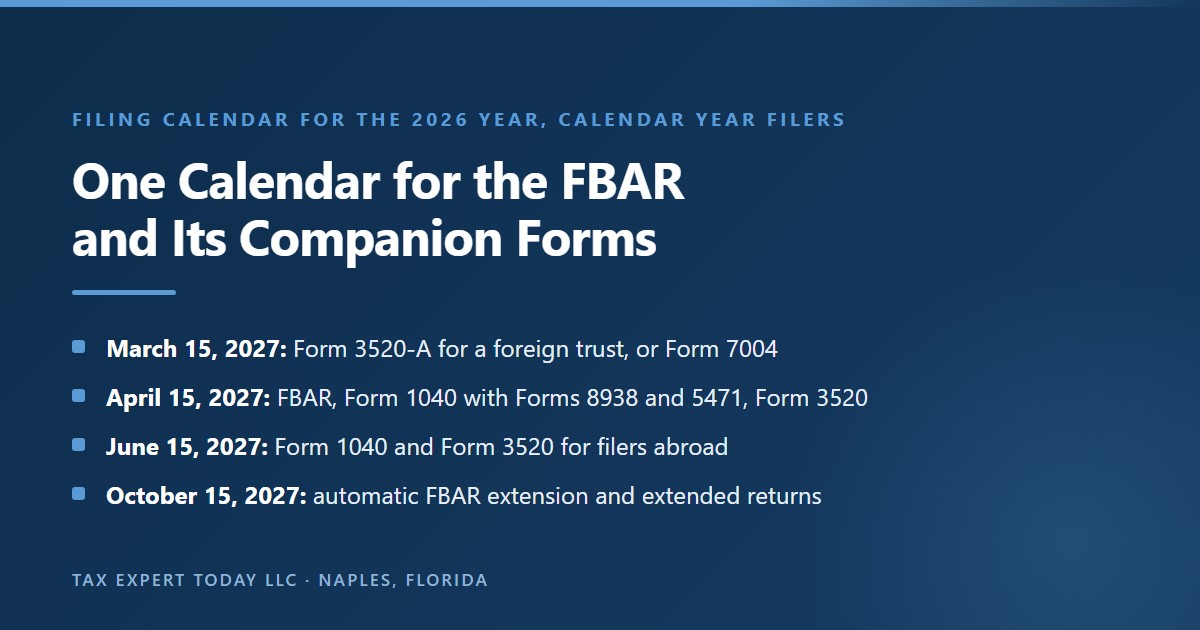
For a calendar year individual reporting 2026, the international season runs from March 15, 2027 for Form 3520-A, through April 15, 2027 for the FBAR, Form 1040, Forms 8938, 3520, and 5471, to June 15 for filers abroad and October 15, 2027 as the last extended date for the FBAR and extended returns.
- March 15, 2027: Form 3520-A for a calendar year foreign trust, or Form 7004.
- April 15, 2027: FBAR, Form 1040 and attachments, Form 3520, Form 4868.
- June 15, 2027: Form 1040 and Form 3520 for filers living abroad.
- September 15, 2027: extended Form 3520-A filed under Form 7004.
- October 15, 2027: the FBAR’s automatic extended date and extended Form 1040.
This is the table most of the ranking pages for the FBAR deadline leave out, and it is the one we find most useful in planning a client’s spring. Each row cites its own source because each form runs on its own rule.
| Date (2027) | Filing for the 2026 year | Rule | Extends how? |
|---|---|---|---|
| Monday, March 15 | Form 3520-A (calendar year foreign trust) | 15th day of the 3rd month | Form 7004 by March 15; not by Form 4868 |
| Thursday, April 15 | FBAR, FinCEN Form 114 | Public Law 114-41, section 2006(b)(11) | Automatic to October 15 |
| Thursday, April 15 | Form 1040 with Form 8938 and Form 5471 | Return due date | Form 4868, or June 15 if abroad |
| Thursday, April 15 | Form 3520 | 15th day of the 4th month | June 15 if abroad; October 15 if the return is extended |
| Tuesday, June 15 | Form 1040 and Form 3520 for qualifying filers abroad | Treas. Reg. 1.6081-5; Form 3520 instructions | Form 4868 to October 15 |
| Wednesday, September 15 | Form 3520-A filed under a Form 7004 extension | Six month extension | None further |
| Friday, October 15 | FBAR, extended Form 1040, extended Form 3520 | Automatic FBAR extension; Form 4868 | None for the FBAR, absent a FinCEN notice |
A note on the September 15 row: the six month extension available on Form 7004 for a calendar year Form 3520-A runs to September 15. Confirm the current Form 7004 instructions in the year you file, because the IRS adjusts extension periods by form type.
What happens if you miss the FBAR deadline of October 15, 2027?
An FBAR filed after October 15, 2027 for 2026 accounts is late. The e-file form asks you to choose a reason or explain one, penalties become possible, and since July 1, 2026 the IRS no longer offers the Delinquent FBAR Submission Procedures. Relief now depends on reasonable cause and the facts of each case.
- Late status: any report filed after October 15 of the year after the reporting year.
- Reason code: select a reason or “other” and write an explanation.
- Penalty exposure: civil penalties under 31 U.S.C. 5321, adjusted for inflation each year.
- Program change: the Delinquent FBAR Submission Procedures ended in 2026.
- IRS guidance today: file late FBARs as soon as possible, before IRS contact.
The FinCEN e-file form asks a late filer, meaning one filing after October 15th of the year following the reporting year, to select a reason from a drop down list or to select “other” and provide a written explanation, according to FinCEN’s Filing Late page. Civil penalties for FBAR violations are set by 31 U.S.C. 5321 and adjusted for inflation every year. We do not restate the dollar ceilings here, because they change annually; our guide to FBAR penalties carries the current figures and explains the difference between non-willful and willful violations, and the FBAR penalty calculator shows how the ceilings apply.
What changed in 2026 is the program landscape. For years, filers who had reported all their income but missed FBARs could use the Delinquent FBAR Submission Procedures. That IRS program page now returns an error, and the current IRS FBAR page says that filing an FBAR late or not at all is a violation and may subject you to penalties, and that if the IRS has not contacted you and you are not under civil or criminal investigation, you should file late FBARs as soon as possible to keep potential penalties to a minimum. The IRS Reference Guide adds that if a filer properly reports the account on a late filed FBAR and the IRS determines the violation was due to reasonable cause, no penalty will be imposed. Our step by step guide to filing a late or delinquent FBAR and our guide to reasonable cause explain how that defense is built.
| Path after missing October 15 | What it is | Status in late 2026 |
|---|---|---|
| File the late FBAR with an explanation | Report filed through BSA E-Filing with a late reason | Available; the IRS recommends filing as soon as possible |
| Delinquent FBAR Submission Procedures | Former IRS program for reported income, missed FBARs | Ended; the IRS program page no longer loads |
| Streamlined Filing Compliance Procedures | For non-willful failures that also involve unreported income or missed returns | Listed by the IRS; page last updated July 11, 2026 |
| Reasonable cause | A defense to the non-willful penalty when facts support it | Available, decided case by case |
The Streamlined Filing Compliance Procedures remain listed by the IRS for taxpayers whose failure was non-willful and that also involves income tax issues. They are not a way to fix a willful failure, and they are not a substitute for meeting the deadline. Our guide to the Streamlined procedures explains who may qualify and why the non-willful certification is the center of the filing.
Should you file an incomplete FBAR by the deadline or wait?
File by the deadline. The IRS Reference Guide says that a filer who does not have all the information by the October 15 automatic extension date should file as complete an FBAR as possible and amend it when more or new information becomes available. Waiting for one missing statement turns a correctable report into a late one.
- IRS guidance: file as complete a report as possible, then amend.
- What usually goes missing: a closed account’s statements or a year end exchange rate source.
- Documented estimate: use the most reliable information you have and record how you got it.
- Amend promptly: once the missing information arrives.
- Do not hold the report: the extension is already at its maximum.
The sentence in the Reference Guide is short and worth knowing: if a filer does not have all information available to file the FBAR by the automatic extension date of October 15th, the filer should file as complete an FBAR as possible and amend it when more or new information becomes available. Because there is no further extension for ordinary filers, holding the report past October 15 to perfect it gains nothing and changes the report’s status from timely to late.
A typical scenario: a Naples, Florida retiree closed a small account in Portugal in mid 2026 and cannot download statements after closure. The institution promises copies in December 2027. The retiree knows the account balance at closure from a transfer confirmation and knows it never exceeded that figure in 2026. The reasonable course is to report the account by October 15, 2027 using the most reliable documented maximum value, note the source in the file, and amend if the statements show a higher figure.
How do you amend an FBAR after the deadline?
To amend an FBAR, file a complete new report through the BSA E-Filing System, check the Amend box in Item 1, and enter the Prior Report BSA Identifier from the original filing. If you cannot locate that identifier, FinCEN’s instructions say to enter fourteen zeros. An amendment corrects the report; it does not reset the deadline.
- Method: a complete new FBAR, not a page of changes.
- Box to check: Amend, in Item 1.
- Identifier: the Prior Report BSA Identifier from the email or secure message.
- Lost identifier: enter 00000000000000.
- Timeliness: judged by the original report, filed by the deadline.
The FinCEN instructions describe amendments this way: if you filed your FBAR through the BSA E-Filing website and need to amend it to correct any information, fill out a new FBAR completely and check the Amend box in Item 1, then provide your Prior Report BSA Identifier. The identifier was sent to you by email or through the system’s secure messaging feature, and if it is not known, you enter fourteen zeros in that field.
The practical point for the deadline is that an amended report fixes the content of a timely report. A filer who files a good faith, nearly complete report by October 15, 2027 and amends it in January 2028 is in a very different position from a filer who files nothing until January 2028. That difference is the reason to file on time even when the report is not perfect.
How long must you keep FBAR records after the deadline?
Keep records for each reported account for five years from the FBAR’s due date. For 2026 accounts the due date is April 15, 2027, so records should be kept until at least April 15, 2032. Records include the account name, number, institution name and address, account type, and maximum value.
- Retention period: five years from the due date of the report.
- 2026 accounts: keep until at least April 15, 2032.
- Required contents: name on the account, number, institution and address, type, maximum value.
- Simple method: keep a copy of the filed FBAR plus year end statements.
- Employer accounts: employees reporting signature authority over employer accounts need not keep them personally.
The recordkeeping rule in 31 CFR 1010.420 requires records of reportable accounts, and the IRS Reference Guide describes the period as generally five years from the due date of the report, which is April 15 of the year following the calendar year being reported. It lists what the records should contain and notes that a copy of the filed FBAR can help satisfy the requirement. It also notes that an officer or employee who files to report signature authority over an employer’s foreign account does not need to keep personal records on that account; the employer keeps them.
| FBAR year | Due date | Keep records until at least |
|---|---|---|
| 2024 accounts | April 15, 2025 | April 15, 2030 |
| 2025 accounts | April 15, 2026 | April 15, 2031 |
| 2026 accounts | April 15, 2027 | April 15, 2032 |
Notice that the retention period runs from the due date, April 15, not from the extended date or the date you actually filed. If the same records support a Form 8938 or Form 3520, keep them for the longer of the FBAR period and the income tax assessment period that applies to that return.
How do you value accounts for the FBAR deadline?
Report each account’s maximum value during 2026, determined in the account’s own currency, then convert to U.S. dollars using the Treasury Reporting Rates of Exchange for December 31, 2026. If no Treasury rate is available, use another verifiable rate and identify its source. Round up to the next whole dollar.
- Measure: the highest value at any time during 2026, not the year end balance.
- Currency first: find the maximum in the foreign currency before converting.
- Rate: Treasury Reporting Rates of Exchange for the last day of the calendar year.
- No Treasury rate: use another verifiable rate and state the source.
- Rounding: always up to the next whole dollar.
The IRS Reference Guide walks through the steps using an account in Japan: determine the maximum value in yen, then convert to U.S. dollars using the Treasury Reporting Rates of Exchange for the last day of the calendar year, and if no Treasury rate is available, use another verifiable exchange rate and give its source. That December 31 rate is published after the year ends, which is one reason the April 15 date works in practice: the rate for 2026 will be available well before April 15, 2027.
| Hypothetical account | Highest 2026 balance | Assumed December 31, 2026 Treasury rate | Reported value |
|---|---|---|---|
| Euro savings account | EUR 8,000 | 1.10 dollars per euro (illustrative only) | $8,800 |
| Canadian chequing account | CAD 3,300 | 0.73 dollars per Canadian dollar (illustrative only) | $2,409 |
| Aggregate | $11,209, over $10,000 |
The rates in the table are illustrative, chosen to show the arithmetic, and are not the published 2026 rates. Use the published Treasury rate for December 31, 2026 when you prepare the actual report.
Which accounts count toward the FBAR deadline?
Accounts that count include foreign bank, savings, checking, and time deposit accounts, brokerage and securities accounts, commodity futures and options accounts, insurance or annuity policies with a cash value, and publicly offered pooled funds. The IRS lists Canadian RRSPs and TFSAs and Mexican AFORE retirement accounts as reportable foreign financial accounts.
- Bank accounts: savings, checking, and time deposits held abroad.
- Securities accounts: brokerage, derivatives, and other financial instrument accounts.
- Cash value policies: whole life insurance and annuities with a cash value.
- Pooled funds: mutual funds with a regular net asset value and regular redemptions.
- Retirement accounts abroad: RRSP, TFSA, Fondos para el Retiro, and AFORE are named examples.
The IRS FBAR Reference Guide gives the working list. Financial accounts include bank accounts such as savings and checking accounts and time deposits; securities accounts such as brokerage, securities derivatives, or other financial instruments accounts; commodity futures or options accounts; insurance or annuity policies with a cash value; mutual funds or similar pooled funds available to the public with a regular net asset value determination and regular redemptions; and any other accounts maintained in a foreign financial institution or with a person performing the services of a financial institution. The guide then names examples: Canadian Registered Retirement Savings Plans, Canadian Tax-Free Savings Accounts, Mexican individual retirement accounts, and Mexican AFORE accounts are reportable on the FBAR.
The same page names two things that are not reportable at this time. Foreign hedge funds and private equity funds are not reportable on the FBAR. And a foreign account holding only virtual currency is not reportable, unless it also holds other reportable assets. The guide notes that FinCEN Notice 2020-2 announced FinCEN’s intention to propose changing that rule, so this is an area to recheck each year before the deadline.
| Hypothetical asset held by a Naples, Florida snowbird | Counts for the 2026 FBAR? | Source |
|---|---|---|
| Chequing account at a bank in Ontario | Yes | IRS Publication 5569, bank accounts |
| Canadian RRSP | Yes | Publication 5569, named example |
| Canadian TFSA | Yes | Publication 5569, named example |
| Whole life policy with a cash value issued by a foreign insurer | Yes | Publication 5569, cash value policies |
| Interest in a foreign private equity fund | No, at this time | Publication 5569, named example |
| Foreign exchange account holding only virtual currency | No, at this time | Publication 5569 and FinCEN Notice 2020-2 |
Two related points come up every spring with Canadian clients. First, whether an RRSP or TFSA belongs on the FBAR is a separate question from how its income is taxed; our guide to the Canada US tax treaty covers the income side. Second, foreign mutual funds that count for the FBAR may also raise passive foreign investment company reporting on the income tax return, which our guide to Form 8621 and PFIC reporting explains. Both of those forms run on the income tax calendar, not the FBAR calendar.
Is an account in Puerto Rico or at a U.S. bank’s branch abroad foreign?
The location of the account decides it, not the bank’s nationality. An account at a U.S. bank’s branch physically located in Germany is foreign. An account at a French bank’s branch in Texas is not. Accounts in Puerto Rico, Guam, the U.S. Virgin Islands, and other U.S. territories are not foreign for FBAR purposes.
- Test: where the account is maintained, not who owns the bank.
- U.S. bank branch abroad: foreign, and counts toward the deadline.
- Foreign bank branch in the United States: not foreign.
- U.S. territories: Puerto Rico, Guam, American Samoa, the Northern Mariana Islands, and the U.S. Virgin Islands are not foreign.
- Foreign securities bought through a U.S. broker: not a foreign account.
The Reference Guide says it is the location of the account, not the nationality of the financial institution, that determines whether an account is foreign for FBAR purposes. It lists the places that are not foreign: the states and the District of Columbia; U.S. territories and possessions including the Northern Mariana Islands, American Samoa, Guam, Puerto Rico, the U.S. Virgin Islands, and the Trust Territory of the Pacific Islands; and Indian lands as defined in the Indian Gaming Regulatory Act. Its examples are clean: a branch of a U.S. bank physically located in Germany holds foreign accounts, and a branch of a French bank physically located in Texas does not. A U.S. citizen who buys shares of a French company through a broker in New York does not have a foreign account because of that purchase.
This location rule is why a Floridian who moves to Puerto Rico and opens a local account does not create an FBAR obligation from that account alone, while the same person’s Swiss account remains reportable. Our guide to Act 60 Puerto Rico federal tax rules covers the broader federal picture for those moves.
| Account | Foreign for the FBAR? |
|---|---|
| U.S. bank, branch in Frankfurt | Yes |
| French bank, branch in Houston | No |
| Bank in San Juan, Puerto Rico | No |
| French shares bought through a New York broker | No |
| Account at a bank on a U.S. military installation abroad | No, under the military banking exception |
Which U.S. persons are excused from filing by the FBAR deadline?
Several groups are excepted. They include entities named in a consolidated FBAR filed by a more than 50 percent owner, owners and beneficiaries of U.S. IRAs, participants in qualified U.S. retirement plans, certain trust beneficiaries whose U.S. trust or trustee reports the accounts, and specified officers and employees with signature authority but no financial interest.
- Consolidated FBAR: a subsidiary named on a parent’s consolidated report.
- U.S. IRAs: foreign accounts held by or for an IRA located in the United States.
- Qualified plans: section 401(a), 403(a), or 403(b) plan accounts.
- Trust beneficiaries: when a U.S. trust, trustee, or agent files for the trust’s accounts.
- Specified employees: the signature authority exceptions in 31 CFR 1010.350(f)(2).
The Reference Guide’s list of filing exceptions is worth reading before deciding that a deadline applies to you. An entity named in a consolidated FBAR filed by a greater than 50 percent owner does not file separately. An owner or beneficiary of an IRA located in the United States does not report a foreign account held by or on behalf of the IRA. A participant in or beneficiary of a plan described in sections 401(a), 403(a), or 403(b) does not report a foreign account held by the plan. A beneficiary with a financial interest in a trust does not report the trust’s foreign accounts if the trust, trustee, or agent is a U.S. person and files an FBAR disclosing them. And the officer and employee exceptions in 31 CFR 1010.350(f)(2) cover signature authority at examined banks, registered financial institutions, authorized service providers, and listed or registered companies.
Each exception is narrow. A U.S. IRA that holds foreign securities is excepted, but a retirement account maintained abroad, such as an RRSP, is not covered by the IRA exception; it is a foreign account in its own right. A trust beneficiary is excused only when the U.S. trust or trustee actually files. When an exception might apply, we recommend documenting why, because the deadline question becomes moot only if the exception truly fits.
| Hypothetical situation | Exception available? |
|---|---|
| Self directed U.S. IRA holds shares through a foreign custodian | Yes, the IRA owner need not report the IRA’s account |
| Canadian RRSP owned directly by a Florida resident | No; the U.S. IRA exception does not cover it |
| Beneficiary of a domestic trust whose U.S. trustee files an FBAR for the trust’s accounts | Yes |
| Beneficiary of a foreign trust with a foreign trustee | No; the exception requires a U.S. trust, trustee, or agent that files |
| Subsidiary listed on its U.S. parent’s consolidated FBAR | Yes |
How do joint accounts with someone other than a spouse affect the deadline?
When two or more persons jointly hold a foreign account, each U.S. person has a financial interest and must report the entire value of the account on his or her own FBAR by the deadline. Only spouses have a combined filing exception. A parent and an adult child, or two siblings, each file separately and each reports the full balance.
- Each U.S. owner reports: the account appears on every co-owner’s FBAR.
- Full value: each reports the entire account value, not a share.
- Spouse exception only: no combined filing for non-spouses.
- Non-U.S. co-owners: they do not file; the U.S. co-owners still do.
- Agents and nominees: the person for whom the account is held may have a financial interest.
The Reference Guide states that if two persons jointly maintain a foreign financial account, or if several persons each own a partial interest in an account, each U.S. person has a financial interest in that account and each person must report the entire value of the account on an FBAR. A limited exception is available only to spouses, under the conditions covered earlier. The guide’s financial interest examples also show that an account held in a relative’s name, but run on your instructions, can be your account for FBAR purposes: its example of John, whose brother Paul keeps accounts in Mexico on John’s behalf, concludes that John has a financial interest and that Paul must also report if he is a U.S. citizen or resident.
| Hypothetical joint account, highest 2026 balance $40,000 | Who files a 2026 FBAR by April 15, 2027? | Value each reports |
|---|---|---|
| Spouses, both U.S. citizens, no other foreign accounts | One spouse, if both sign Form 114a | $40,000 |
| U.S. citizen parent and U.S. citizen adult child | Both | $40,000 each |
| U.S. citizen and a sibling who is not a U.S. person | The U.S. citizen only | $40,000 |
| Three U.S. citizen siblings inheriting an account | All three | $40,000 each |
Inherited accounts abroad are a common source of joint ownership among siblings. If the inheritance itself was large enough, a Form 3520 may also be due on the income tax calendar, as discussed in the Form 3520 section above.
Does closing a foreign account in 2026 remove the 2026 FBAR?
No. The FBAR reports each account you held at any time during the calendar year, using its maximum value during that year. An account closed in March 2026 still counts toward the 2026 aggregate and still appears on the FBAR due April 15, 2027. Closing it affects the 2027 report, not the 2026 one.
- Reporting period: any time during calendar year 2026.
- Closed accounts: report the maximum value before closure.
- Transfers between your own accounts: both accounts may count, each at its own maximum.
- Records: keep the closing statement and transfer confirmation.
- Next year: a closed account drops off the 2027 report if it stays closed.
The rule in 31 CFR 1010.350(a) requires a report for each year in which the relationship with the foreign account exists. A relationship that existed for two months of 2026 existed in 2026. The Reference Guide defines the maximum value as a reasonable approximation of the greatest value of currency and non-monetary assets in the account during the calendar year, so a closed account is reported at its high point before closure, not at zero.
A typical scenario: a couple who retired to Naples, Florida, moves $60,000 from a savings account in the United Kingdom to a U.S. bank in February 2026 and closes the British account. For the 2026 FBAR, the British account is still reported, at its maximum value before the transfer. For the 2027 FBAR, it no longer appears. Because statements for closed accounts can be hard to get later, the time to download them is before the account is closed.
Can you rely on quarterly statements to meet the deadline?
Yes, in most cases. The IRS Reference Guide says U.S. persons may rely on periodic account statements issued at least quarterly to determine the maximum value, if the statements fairly reflect the maximum account value during the calendar year. If a large deposit came and went between statements, the statements may not fairly reflect the maximum.
- Standard: a reasonable approximation of the greatest value during the year.
- Safe source: statements issued at least quarterly that fairly reflect the high point.
- When statements fall short: a large inflow and outflow between statement dates.
- Better source then: transaction history or online banking records.
- Keep the support: the statements you relied on belong in your FBAR file.
The Reference Guide describes the maximum account value as a reasonable approximation of the greatest value of currency and non-monetary assets in the account during the calendar year, and says U.S. persons may rely on periodic account statements issued at least quarterly if the statements fairly reflect the maximum account value. That rule makes the deadline workable for most households: four quarterly statements per account, the highest figure on them, and the December 31 Treasury rate are usually enough.
The exception is the account that briefly held much more than usual. If $50,000 arrived from a property sale abroad in May and was wired to the United States in June, a quarterly statement dated March 31 and another dated June 30 may both show modest balances. In that case the transaction history, not the statements, shows the maximum, and the FBAR should reflect it.
How does Schedule B connect to the FBAR deadline?
Form 1040 Schedule B, Part III, asks whether you had a financial interest in or signature authority over a foreign account, and whether you must file FinCEN Form 114. Answering yes on a return filed in April 2027 tells the IRS an FBAR is due, so the answer and the FBAR filing should match. Entity returns ask similar questions.
- Individuals: Form 1040, Schedule B, questions 7a and 7b.
- Trusts and estates: Form 1041, Other Information, question 3.
- Partnerships: Form 1065, Schedule B, question 8.
- Corporations: Form 1120, Schedule N, questions 6a and 6b.
- Consistency: a yes on the return with no FBAR filed is an obvious gap.
The Reference Guide lists the return questions that ask about foreign accounts: Form 1040, Schedule B, questions 7a and 7b; Form 1041, Other Information, question 3; Form 1065, Schedule B, question 8; and Form 1120, Schedule N, questions 6a and 6b. These questions are on the income tax calendar, while the FBAR is on its own. In practice, the return and the FBAR should tell the same story: a return answering yes to the foreign account question, with an FBAR that never arrives, is the kind of inconsistency that draws attention.
| Return filed for 2026 | Foreign account question | Return due date | FBAR due date |
|---|---|---|---|
| Form 1040 | Schedule B, questions 7a and 7b | April 15, 2027 | April 15, 2027, automatic to October 15 |
| Form 1041 | Other Information, question 3 | April 15, 2027 for a calendar year trust | April 15, 2027, automatic to October 15 |
| Form 1065 | Schedule B, question 8 | March 15, 2027 for a calendar year partnership | April 15, 2027, automatic to October 15 |
| Form 1120 | Schedule N, questions 6a and 6b | April 15, 2027 for a calendar year corporation | April 15, 2027, automatic to October 15 |
Where can you get FBAR help before the deadline?
The IRS runs an FBAR help line at 866-270-0733 inside the United States and 313-234-6146 from abroad, Monday through Friday, 8 a.m. to 4:30 p.m. Eastern. FinCEN’s BSA E-Filing Help Desk at 866-346-9478 handles technical filing questions, Monday through Friday, 8 a.m. to 6 p.m. Eastern.
- Completing the FBAR: IRS, 866-270-0733 (toll free in the United States).
- Calling from abroad: IRS, 313-234-6146 (not toll free).
- Technical e-filing questions: BSA E-Filing Help Desk, 866-346-9478.
- Regulatory questions: FinCEN’s Resource Center, 800-949-2732.
- Disaster record access: FinCEN Regulatory Support Section, 800-767-2825, per the 2024 notices.
These numbers come from the IRS Reference Guide, which lists them under Resources for FBAR Filers, and from the 2024 Hurricane Milton notice, which directed filers outside the disaster area who needed records inside it to FinCEN’s Regulatory Support Section. Expect longer waits in the weeks before April 15 and October 15. Calling in February or early March is usually easier, and it leaves time to act on the answer.
Government help lines explain the rules; they do not prepare the report or review your facts. If your question is whether a particular account, exception, or notice applies to you, a professional review of your documents is the more reliable route.
What are the most common FBAR deadline mistakes?
The most common FBAR deadline mistakes are assuming Form 4868 extended the FBAR, assuming the June 15 abroad rule applies to it, relying on an IRS disaster postponement without a FinCEN notice, using the June 30 date from the regulation text, leaving closed accounts off, and waiting past October 15 for a missing statement.
- Form 4868 confusion: it extends the return, never the FBAR.
- June 15 confusion: the abroad rule covers income tax returns only.
- Disaster confusion: the FBAR moves only under a FinCEN notice.
- Outdated sources: June 30 is the pre-2016 date.
- Perfection delay: file a complete as possible report and amend later.
Every one of these mistakes has the same root: treating the FBAR as part of the income tax return. It is not. It has its own statute, its own agency, its own filing system, and its own extension. Once that is clear, the calendar becomes simple. The table below collects the corrections in one place.
| Mistake | Correction | Source |
|---|---|---|
| “I filed Form 4868, so my FBAR is extended.” | The FBAR’s own extension to October 15 is automatic; Form 4868 does nothing for it | FinCEN filing instructions; Publication 5569 |
| “I live abroad, so the FBAR is due June 15.” | The FBAR is due April 15, automatic to October 15 | Treas. Reg. 1.6081-5 covers returns of income only |
| “The IRS gave my county until February, so my FBAR is extended.” | Only a FinCEN notice extends the FBAR | FinCEN disaster notices, 2024 |
| “The regulation says June 30.” | Public Law 114-41 moved the date to April 15 from the 2016 year | FIN-2025-NTC3, footnote 6 |
| “I closed the account in March, so it is off the 2026 report.” | Any account held during 2026 is reported at its maximum value | 31 CFR 1010.350; Publication 5569 |
| “I will wait until the last statement arrives.” | File as complete a report as possible by October 15 and amend | Publication 5569 |
If one of these describes your 2025 report rather than your 2026 report, the 2025 deadline has already passed, and the path forward is a late filing. Our guide on filing a late or delinquent FBAR is the place to start, and the related FBAR penalties guide explains the stakes.
How does the FBAR deadline apply to accounts owned through a company you control?
A U.S. person who owns, directly or indirectly, more than 50 percent of the vote or value of a corporation, or more than 50 percent of a partnership’s profits or capital, has a financial interest in that entity’s foreign accounts. Those accounts belong on the owner’s own FBAR, due April 15, 2027 for 2026, alongside any FBAR the entity files.
- Corporations: more than 50 percent of total value or voting power, directly or indirectly.
- Partnerships: more than 50 percent of profits or of capital.
- Grantor trusts: a U.S. grantor with an ownership interest for tax purposes.
- Chains of ownership: indirect ownership through a U.S. company counts.
- Same deadline: the owner’s FBAR and the entity’s FBAR share the April 15 date.
The Reference Guide lists the situations in which a U.S. person has a financial interest. One is where the owner of record is a corporation in which the U.S. person owns, directly or indirectly, more than 50 percent of the total value of shares or more than 50 percent of the voting power. Another is a partnership in which the U.S. person owns more than 50 percent of profits or more than 50 percent of capital. A third is a trust of which the U.S. person is the grantor and has an ownership interest for federal tax purposes.
The guide’s own example is set in Florida. A Florida corporation that owns 100 percent of a Spanish company with foreign financial accounts must file an FBAR, because the corporation is a U.S. person that directly owns more than 50 percent of the Spanish company. A U.S. person who owns 75 percent of that Florida corporation must also file, because that person indirectly owns more than 50 percent of the Spanish company. So one group structure can produce two FBARs from the same foreign accounts, both due on the same day.
| Hypothetical ownership chain | Who files a 2026 FBAR for the foreign company’s accounts? |
|---|---|
| Naples, Florida resident owns 100 percent of a Florida LLC taxed as a corporation, which owns 100 percent of a Spanish company | The Florida company and the Naples owner |
| Owner holds 75 percent of the Florida company | The Florida company and the 75 percent owner |
| Owner holds 40 percent of the Florida company | The Florida company; the 40 percent owner only if another rule, such as signature authority, applies |
| Owner holds 60 percent of a foreign partnership’s capital directly | The owner |
Owners of foreign companies usually face income tax information returns as well, such as Form 5471 for foreign corporations or Form 8865 for foreign partnerships. Those follow the income tax calendar, while the FBAR stays on April 15 with its automatic October 15 extension. A consolidated FBAR filed by a greater than 50 percent owner can cover the entities it names, which is one way groups reduce the number of separate reports.
How has the FBAR deadline changed over time?
Before 2016, the FBAR was due June 30 with no extension. Mandatory electronic filing began July 1, 2013. Public Law 114-41 moved the date to April 15 with a six month extension starting with 2016 reports. FinCEN has deferred certain signature authority filings every year since 2011, and the IRS ended the Delinquent FBAR Submission Procedures in 2026.
- Calendar year 2015 and earlier: due June 30, no extension available.
- July 1, 2013: electronic filing became mandatory.
- Calendar year 2016 forward: April 15, automatic extension to October 15.
- Since 2011: annual signature authority deferrals for certain employees.
- 2026: the IRS’s Delinquent FBAR Submission Procedures came to an end.
The history explains most of the conflicting dates found online. The IRS Reference Guide records that the deadline for calendar year 2015 and earlier was June 30, with no provision for requesting an extension, and that electronic filing of FBARs became mandatory July 1, 2013. The December 2025 FinCEN notice traces the signature authority deferrals back to Notice 2011-1, issued May 31, 2011, and to the proposed rule of March 10, 2016 that, still unfinished, is the reason the deferrals continue.
| Year | Change | Effect on the deadline |
|---|---|---|
| 2011 | FinCEN Notices 2011-1 and 2011-2 | Deferred filing for certain employees with signature authority only |
| 2013 | Electronic filing became mandatory on July 1 | Paper filing ended; timeliness tied to electronic submission |
| 2015 | Public Law 114-41, section 2006(b)(11) | April 15 due date with a six month extension, for 2016 reports onward |
| 2016 | FinCEN proposed rule, March 10 | Pending; the reason signature authority deferrals continue |
| 2024 | Disaster notices for Helene, Milton, Debby, Beryl, and Francine | 2023 FBARs extended for designated areas, including May 1, 2025 for Helene and Milton |
| 2025 | FinCEN Notice FIN-2025-NTC3 | Signature authority deferral extended to April 15, 2027 |
| 2026 | Delinquent FBAR Submission Procedures ended | Late filings now rest on reasonable cause and the facts of each case |
When you read an older article about the FBAR deadline, check its date against this table. An article from before 2017 will give June 30. An article from before mid 2026 may still describe the Delinquent FBAR Submission Procedures as available. Neither reflects the rules that apply to the 2026 reporting year.
Does the FBAR deadline apply to children with foreign accounts?
Yes. A child who is a U.S. person and whose foreign accounts exceed the $10,000 aggregate is responsible for the FBAR, with the same April 15, 2027 and October 15, 2027 dates. If the child cannot file it, a parent, guardian, or other legally responsible person files it and signs it electronically for the child.
- Same deadline: no separate date for minors.
- Who files: the child, or a parent or guardian on the child’s behalf.
- How to sign: the parent or guardian signs electronically for the child.
- Filer title: “Parent/Guardian filing for child” in Item 45.
- Common source: accounts opened by grandparents abroad, or education savings held abroad.
The FinCEN instructions say that if a child cannot file his or her own FBAR, a parent, guardian, or other legally responsible person must file it for the child, and that if the child cannot sign, a parent or guardian must electronically sign the child’s FBAR and enter “Parent/Guardian filing for child” as the filer title. We see this most often in families with relatives abroad, where a grandparent has opened a savings account in a grandchild’s name. The child’s account is the child’s FBAR, not a line on the parent’s report, unless the parent also has signature authority or a financial interest in it.
When are FBARs due for trusts, estates, and businesses?
Entities follow the same FBAR calendar as individuals. A domestic corporation, partnership, limited liability company, trust, or estate that is a U.S. person with a reportable foreign account files its 2026 FBAR by April 15, 2027, with the automatic extension to October 15, 2027, regardless of the entity’s own tax year or return due date.
- Calendar year report: the FBAR always covers January 1 to December 31.
- Fiscal year entities: the FBAR still follows the calendar year.
- Return extensions: Form 7004 does not move the entity’s FBAR.
- Officers and employees: may have their own signature authority reports.
- Consolidated FBAR: a parent may report for subsidiaries in some cases.
The FinCEN notices describe the FBAR as a calendar year report ending December 31 of the reportable year. That is true for entities as much as for individuals, so a corporation with a June 30 fiscal year still reports its foreign accounts on a calendar year FBAR due April 15. The same separation between the income tax extension and the FBAR applies: Form 7004 extends an entity’s return, not its FBAR. Entities with foreign branches or disregarded entities abroad often have both an FBAR and a Form 8858, and partnerships with foreign partnership interests may have a Form 8865 on the income tax calendar.
| Filer type | 2026 FBAR due date | Does the entity’s return extension move it? |
|---|---|---|
| Calendar year C corporation | April 15, 2027, automatic to October 15, 2027 | No |
| Fiscal year corporation (June 30 year end) | April 15, 2027, automatic to October 15, 2027 | No |
| Partnership or LLC | April 15, 2027, automatic to October 15, 2027 | No |
| Domestic trust or estate | April 15, 2027, automatic to October 15, 2027 | No |
What should you do between now and the April 15, 2027 FBAR deadline?
Between now and April 15, 2027, list every foreign account you owned or could sign on in 2026, request missing statements before year end, confirm whether any account was closed, decide who will file and collect Form 114a if a preparer or spouse files, and calendar both April 15 and October 15, 2027.
- December 2026: list accounts and request statements for closed accounts now.
- January 2027: collect year end statements and the December 31 Treasury rates.
- February 2027: confirm the aggregate and whether Form 8938 also applies.
- March 2027: sign Form 114a and handle any Form 3520-A due March 15.
- By April 15, 2027: file the FBAR and save the BSA Identifier.
Most late FBARs we see were late because a statement was missing in October, not because anyone forgot. Starting in December avoids that. Foreign institutions can take weeks to produce statements for closed accounts, and some require a written request from the account holder. A short checklist in the order of the calendar keeps the FBAR from becoming an October scramble.
| Step | Target date | Why then |
|---|---|---|
| List every foreign account, including closed and signature only accounts | December 2026 | Closed account statements take time to request |
| Download or request December 2026 statements | January 2027 | Year end statements show balances and some show yearly highs |
| Find the Treasury rate for December 31, 2026 | January 2027 | Published after year end; needed for conversion |
| Confirm the aggregate maximum value | February 2027 | Decides whether an FBAR is required at all |
| Check Form 8938, Form 3520, and Form 5471 obligations | February 2027 | Different thresholds and calendars |
| Sign Form 114a if a preparer or spouse files | March 2027 | Authority should exist before submission |
| File the FBAR and save the BSA Identifier | By April 15, 2027 | Leaves the automatic extension as a safety margin |
FBAR Deadline Help in Naples & Southwest Florida
Tax Expert Today LLC is a federal tax practice based in Naples, Florida, at 11983 Tamiami Trail N, Naples, FL 34110. We prepare FBARs and the international information returns that travel with them for households and business owners across Southwest Florida and in all 50 states, and our international and expat tax services cover FBAR filing, Form 8938, Forms 3520 and 3520-A, Form 5471, and the planning that keeps those dates from colliding. You can reach the office at (239) 441-2005, Monday through Friday, 10 a.m. to 5 p.m. Eastern.
FBAR filing help Naples: many of the households we work with in Collier and Lee counties are retirees with accounts left open in Canada, the United Kingdom, Germany, or Italy, families receiving money from relatives abroad, and business owners with suppliers or subsidiaries overseas. For each of them the FBAR is one date among several, and the work is mostly about assembling the right numbers early.
International tax Naples FL: when a client also has a foreign trust, a foreign corporation, or income earned abroad, we build one calendar that covers the FBAR and every related form, using the dates set out in this guide. Our Naples international tax page describes the full range of work, and our Naples tax planning page covers the domestic side.
Foreign tax Naples: FBARs are filed electronically, so we serve clients wherever they live, including snowbirds who spend part of the year in Southwest Florida and part abroad, and former residents who now live overseas. For those clients we track the June 15 income tax date and the April 15 FBAR date separately, because, as this guide explains, they are not the same rule.
- FBAR Naples: preparation and electronic filing of FinCEN Form 114, with Form 114a on file.
- Calendar planning: one schedule for the FBAR, Form 8938, Forms 3520 and 3520-A, and Form 5471.
- Late reports: help documenting reasonable cause and filing reports that missed October 15.
- Disaster years: checking whether a FinCEN notice actually covers your county and year.
Do Naples, Florida residents get extra time for the FBAR after a hurricane?
Only if FinCEN issues a notice that covers the area. In 2024, FinCEN extended 2023 FBARs to May 1, 2025 for areas designated after Hurricanes Helene and Milton. For Hurricane Isaias in 2026, the IRS release FL-2026-07 does not list Collier or Lee counties, and the FinCEN FBAR page listed no Isaias notice when we checked on November 18, 2026. Plan on the standard April 15, 2027 date for 2026 accounts.
When to Engage a Professional
Many people with a single account abroad and a straightforward balance history can file their own FBAR through the BSA E-Filing System before April 15, 2027. Professional help tends to be most useful in situations like these:
- Several accounts in several currencies: where the aggregate is close to $10,000 and the conversion matters.
- Prior years were missed: where the 2026 report is not the only one outstanding and the right path depends on whether income was also unreported.
- Signature authority questions: where you are unsure whether the FinCEN deferral covers your role.
- Foreign trusts, gifts, or corporations: where Forms 3520, 3520-A, or 5471 run on different calendars.
- Disaster years: where the IRS and FinCEN rules for a storm do not match.
- Spouses filing one report: where the joint account conditions and Form 114a need to be confirmed.
Our firm includes tax advisors, enrolled agents, CPAs, and attorneys, and we work from the primary sources cited in this guide. Outcomes in any FBAR matter depend on the facts, including whether a failure was non-willful, and nothing in this guide promises a particular result. If you would like a review of your 2026 FBAR obligations before the filing season begins, call (239) 441-2005 or reach us through our contact page. For questions about penalties already assessed, our guide on how IRS penalties are reviewed for relief explains the general framework for tax penalties.
Frequently Asked Questions
What is the FBAR deadline for 2026?
The FBAR for foreign accounts held during calendar year 2026 is due April 15, 2027. FinCEN grants every filer an automatic extension to October 15, 2027, with no request required. The report is filed electronically with FinCEN through the BSA E-Filing System, separately from the income tax return.
Do I need to request an extension for my FBAR?
No. FinCEN’s filing instructions say specific requests for the extension to October 15 are not required. Form 4868 does not extend the FBAR, and there is no FBAR extension form. A report filed on or before October 15, 2027 for 2026 accounts is treated as timely.
Does living abroad give me until June 15 to file the FBAR?
No. The June 15 date in Treas. Reg. section 1.6081-5 applies to income tax returns of citizens and residents whose tax home and abode are outside the United States and Puerto Rico. The FBAR keeps its April 15 date, with the automatic extension to October 15.
Why does 31 CFR 1010.306 say June 30?
The regulation text was not updated after Public Law 114-41 changed the FBAR due date to April 15, with a six month extension, starting with 2016 reports. FinCEN applies the statutory date. A source giving June 30 is out of date or quoting superseded regulation text.
What is Form 114a?
Form 114a is the record of authorization that lets a third party preparer, or one spouse for both, electronically file an FBAR. It is not sent to FinCEN. The filer keeps it and provides it to FinCEN or the IRS on request. It should be signed before the preparer submits the report.
Can I still use the Delinquent FBAR Submission Procedures if I miss the deadline?
No. The IRS ended the Delinquent FBAR Submission Procedures in 2026. The current IRS guidance is to file late FBARs as soon as possible if the IRS has not contacted you, explain the reason on the e-file form, and rely on reasonable cause where the facts support it.
Do Naples, Florida residents get extra time for the FBAR after a hurricane?
Only if FinCEN issues a notice covering the area. For Hurricane Isaias in 2026, the IRS relief release FL-2026-07 does not list Collier or Lee counties, and no FinCEN FBAR notice for Isaias was listed on November 18, 2026. Plan on April 15, 2027 for 2026 accounts.
This guide is general information about federal reporting deadlines as of November 18, 2026. It is not legal or tax advice for any particular situation, and reading it does not create a client relationship. FinCEN and the IRS can issue new notices at any time, and FBAR outcomes depend on individual facts. Consult a qualified professional about your circumstances before acting.
Published November 18, 2026 by Dr. Pellumb Kabashi « Back to Learning Center
Have a question this article touches on?
Tax Expert Today LLC, based in Naples, Florida and serving clients across the United States.
Schedule a Consultation (239) 441-2005