
By Dr. Pellumb Kabashi, DBA, MBA, CES, CFE, EA
Founder, Tax Expert Today LLC · Tax advisors, enrolled agents, CPAs, and attorneys · Serving clients in all 50 states
Quick Answer: The California SDI tax for 2026 is 1.3 percent of every dollar of wages, with no wage ceiling since January 1, 2024, so bonuses and RSU vests are fully exposed. For a high earner the bill can exceed $15,000 a year. Coverage generally ends once your work is localized in Florida, even when California income tax still reaches part of a later vest. Call (239) 441-2005 for a free consultation.
Most explanations of the California SDI tax are written for payroll departments. They give the rate, say who pays it, list the benefits, and stop. That is enough for an hourly employee whose SDI deduction is a small line on each pay stub. It is not enough for an executive, an engineer with a large equity package, or a physician paid through a medical group, because the rules changed in 2024 in a way that falls almost entirely on high earners, and because the question that matters most to someone who is leaving California is one that payroll explanations rarely reach: when does it stop?
This guide is written for the high earner. It explains what the tax is and how the 2026 rate is set, why the removal of the wage ceiling turned a modest deduction into a five figure annual cost for some workers, how SDI applies to bonuses and restricted stock units, how the four multistate employment tests decide whether SDI continues after a move to Florida, why an RSU vest after the move can be partly taxable to California for income tax purposes and yet outside California SDI, how SDI interacts with the federal SALT deduction cap in 2026, and what to do when an employer keeps withholding after you leave. Every figure is drawn from the statute or from the Employment Development Department, and every example below is a hypothetical illustration rather than a description of any client.
What is the California SDI tax?
The California SDI tax is a mandatory employee payroll contribution under Unemployment Insurance Code section 984 that funds two state programs: Disability Insurance, which replaces part of wages during a non work related illness, injury, or pregnancy, and Paid Family Leave. Employers withhold it from wages and remit it to the Employment Development Department.
- Who pays: the employee. Unlike unemployment insurance and the Employment Training Tax, which California employers pay, SDI is a worker contribution withheld from pay.
- Who administers it: the Employment Development Department (EDD), not the Franchise Tax Board. SDI is a payroll tax, separate from California personal income tax.
- What it funds: Disability Insurance benefits for up to 52 weeks and Paid Family Leave benefits, both paid from the state Disability Fund.
- How it appears: usually as a pay stub line labeled CASDI or CA SDI, and in a box on Form W-2.
California is one of a small number of jurisdictions that require an employee paid disability contribution. The others with mandatory programs are Hawaii, New Jersey, New York, Rhode Island, and Puerto Rico, and each sets its own rate and wage base. California’s version is by far the most expensive for a high earner because it is the only one in that group with no cap at all on the wages subject to the contribution.
Section 984 directs the EDD to compute the worker contribution rate each year from the Disability Fund’s disbursements and balance, and to publish it by October 31 for the following calendar year. The rate applies to “wages” as defined in section 926, which means all remuneration payable to an employee for personal services, including commissions and bonuses and the cash value of remuneration paid in any medium other than cash. That last phrase is what brings stock compensation into the base.
| Feature | California SDI | California personal income tax |
|---|---|---|
| Agency | Employment Development Department | Franchise Tax Board |
| Legal source | Unemployment Insurance Code section 984 | Revenue and Taxation Code section 17041 |
| Base | Wages only | All taxable income |
| 2026 rate | 1.3 percent, flat | Graduated, up to 12.3 percent plus 1 percent above $1,000,000 |
| Ceiling | None since January 1, 2024 | None |
| Annual return | None for the employee; withheld and remitted by the employer | Form 540 or Form 540NR |
What is the California SDI tax rate for 2026?
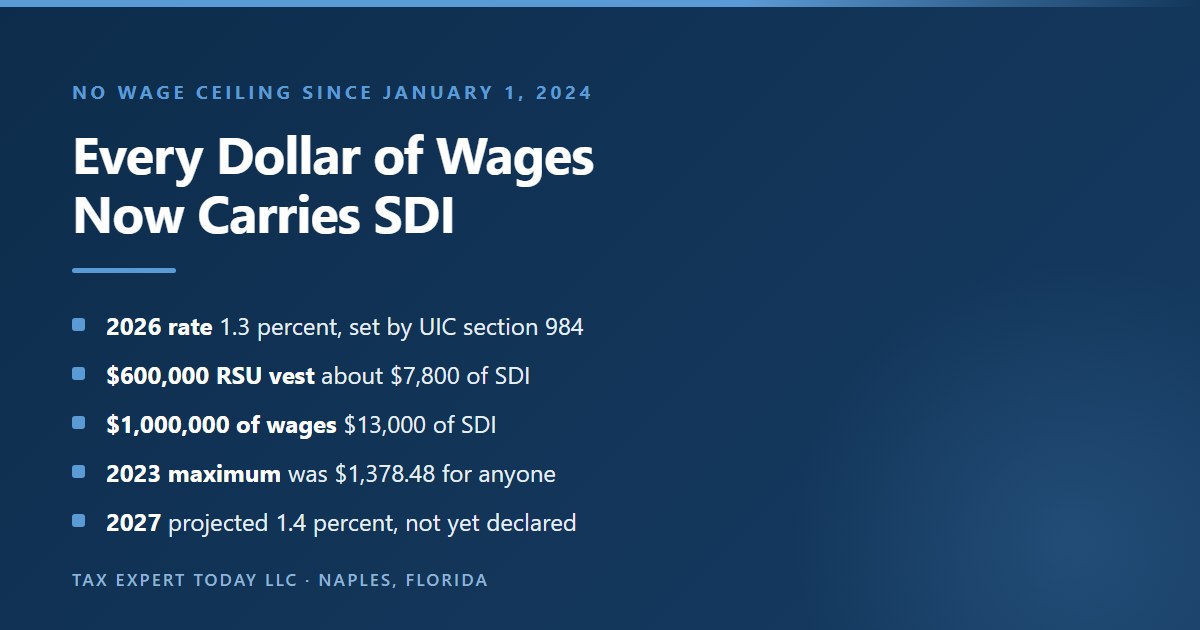
The California SDI withholding rate for 2026 is 1.3 percent, applied to all wages with no taxable wage limit. The EDD states this on its rates page, in the 2026 California Employer’s Guide (DE 44), and in its rate table (DE 3395). The rate covers both Disability Insurance and Paid Family Leave.
The EDD rates page puts it in one sentence: the SDI withholding rate for 2026 is 1.3 percent, and effective January 1, 2024, all wages are subject to SDI contributions. The 2026 California Employer’s Guide (DE 44) repeats the rate as .013 and notes that it provides for both Disability Insurance and Paid Family Leave benefits. Several payroll vendor pages that still rank for this topic show the 2025 rate of 1.2 percent, and at least one still shows a wage ceiling, so the date on any source matters.
| Year | SDI rate | Taxable wage ceiling | Maximum withheld per employee |
|---|---|---|---|
| 2021 | 1.2 percent | $128,298 | $1,539.58 |
| 2022 | 1.1 percent | $145,600 | $1,601.60 |
| 2023 | 0.9 percent | $153,164 | $1,378.48 |
| 2024 | 1.1 percent | None | No maximum |
| 2025 | 1.2 percent | None | No maximum |
| 2026 | 1.3 percent | None | No maximum |
| 2027 | 1.4 percent projected by the EDD in May 2026, not yet declared | None | No maximum |
The 2021 through 2023 rates and ceilings come from the EDD’s rate history table (DE 3395); the 2021 and 2022 maximums are the rate multiplied by the ceiling, and the 2023 maximum is the figure the EDD published. The pattern is the point. For decades a California worker’s SDI cost stopped growing once wages passed the ceiling, which kept the annual maximum under about $1,600. Since 2024 the cost simply keeps rising with pay.
- The rate is set by formula: section 984(a)(2) ties it to the Disability Fund’s disbursements over the 12 months ending September 30, less the fund balance, divided by covered wages.
- It is bounded by statute: section 984(a)(3) keeps the rate between 0.1 percent and 1.5 percent and limits any single year decrease to two tenths of a percentage point.
- The director has a small adjustment: section 984(d) lets the director move the formula rate up or down by up to 0.1 percent, still within the 1.5 percent maximum.
- It is published by October 31: the EDD must declare the next year’s rate by that date and notify covered employers.
Why is there no California SDI wage limit anymore?
Senate Bill 951, enacted in 2022, removed the SDI taxable wage ceiling for wages paid on or after January 1, 2024. Section 985 still describes the old ceiling formula, but its subdivision (b) now says the section does not apply to wages paid on or after that date, so section 984 reaches every dollar of wages.
Before 2024, section 985(a) exempted remuneration above a ceiling computed from the maximum weekly benefit, which is why the ceiling moved each year. SB 951 paired the removal of that ceiling with higher benefit replacement rates that took effect in 2025, so lower and middle income workers receive a larger share of their wages during a claim. The financing came from the top of the wage distribution. The EDD’s own May 2026 Disability Insurance Fund Forecast attributes the growth in worker contributions to the rate increases and to the removal of the taxable wage ceiling as of January 1, 2024, which it says increased net worker contributions significantly.
The legal text matters because some sources describe the change loosely as a raised cap. It is not. Section 985(b), as amended in 2023, reads simply that the section does not apply with respect to wages paid on or after January 1, 2024. There is no successor ceiling. A worker paid $5,000,000 in 2026 owes 1.3 percent of $5,000,000.
- Payment date controls: the test in section 985(b) is when wages are paid, so a December 2023 bonus paid in January 2024 fell under the new uncapped rule.
- No annual maximum: because there is no ceiling, there is also no maximum contribution, which the EDD’s statistics page shows as “NA” for 2026.
- Benefits did not lose their cap: the maximum weekly benefit still exists, which is why the change is a net cost for high earners rather than a trade.
How much California SDI tax does a high earner pay?
A high earner pays 1.3 percent of total 2026 wages, so $500,000 of wages costs $6,500, $1,000,000 costs $13,000, and $2,000,000 costs $26,000. Under the 2023 rules the most anyone paid was $1,378.48. The difference is entirely the result of the ceiling’s removal and the higher rate.
| Annual W-2 wages | 2023 SDI (0.9 percent, capped) | 2026 SDI (1.3 percent, uncapped) | 2027 SDI if 1.4 percent is declared |
|---|---|---|---|
| $150,000 | $1,350.00 | $1,950 | $2,100 |
| $300,000 | $1,378.48 | $3,900 | $4,200 |
| $500,000 | $1,378.48 | $6,500 | $7,000 |
| $750,000 | $1,378.48 | $9,750 | $10,500 |
| $1,000,000 | $1,378.48 | $13,000 | $14,000 |
| $1,250,000 | $1,378.48 | $16,250 | $17,500 |
| $2,000,000 | $1,378.48 | $26,000 | $28,000 |
The 2027 column is illustrative only. It uses the 1.4 percent rate the EDD projected in its May 2026 fund forecast; the director has not declared the 2027 rate as of the date of this article, and the statute permits the final figure to differ.
Two features make these numbers larger in practice than a salary alone suggests. First, the base is total W-2 wages, which for many high earners means salary plus an annual bonus plus the value of vesting restricted stock units, and sometimes nonqualified option exercises. Second, SDI has no deductions, exemptions, or credits of its own. It is a flat contribution on gross wages. A worker whose taxable income is reduced by retirement contributions still pays SDI on the wages that funded those contributions, because the base follows the definition of wages in section 926 rather than taxable income.
- 401(k) deferrals: elective deferrals do not reduce SDI wages, so a maximum 401(k) contribution does not lower the SDI bill.
- Section 125 plans: the treatment of cafeteria plan reductions follows EDD rules for each benefit, so the W-2 SDI wage figure can differ from both Box 1 and Box 16.
- Two jobs: each employer withholds 1.3 percent of what it pays, and because there is no ceiling, holding two jobs no longer produces an overpayment to recover.
Are bonuses and RSU vests subject to the California SDI tax?
Yes. Section 926 defines wages as all remuneration for personal services, including commissions, bonuses, and the cash value of remuneration paid in any medium other than cash. Restricted stock units are wages when they vest and are paid, and nonqualified stock options generally become wages at exercise, so both are subject to SDI.
The EDD’s information sheet on stock compensation, DE 231SK, sets out the treatment option by option. Income from a nonqualified stock option that had no readily ascertainable fair market value when granted, which the sheet notes is most of them, is wages for California employment tax purposes and is subject to unemployment insurance, the Employment Training Tax, SDI, and personal income tax withholding when the option is exercised. Statutory options are different: an incentive stock option or a qualified employee stock purchase plan produces no wages at grant or exercise, and a disqualifying disposition produces income that must be reported as personal income tax wages but is not subject to SDI.
| Type of compensation | Subject to California SDI? | When |
|---|---|---|
| Salary and hourly pay | Yes | When paid |
| Annual or signing bonus | Yes | When paid |
| Commissions | Yes | When paid |
| Restricted stock units | Yes | When the shares vest and are delivered as wages |
| Nonqualified stock option (no readily ascertainable value at grant) | Yes | At exercise, on the spread |
| Incentive stock option, qualifying disposition | No | Not wages for employment tax purposes |
| Incentive stock option or ESPP, disqualifying disposition | No SDI | Reported as personal income tax wages only |
| Severance and dismissal pay | Yes | When paid |
The practical consequence is concentration. An engineer whose salary is $250,000 may have an RSU vest of $400,000 in a single quarter. Withholding on that vest happens in the pay period it is delivered, so the SDI withheld from one paycheck can exceed what the same person paid in an entire year under the pre 2024 rules. Our guide to California RSU tax when you leave the state explains how those vests are sourced for income tax; the SDI answer, as the later sections show, follows a different rule.
What does a $600,000 RSU vest cost in California SDI tax?
At the 2026 rate, a $600,000 RSU vest paid to an employee whose work is covered by California carries $7,800 of SDI, withheld in the pay period the shares are delivered. Before 2024 the same vest would have added nothing for anyone already over the ceiling, which most such employees were by spring.
Consider a hypothetical illustration. A software director based in San Jose earns a salary of $320,000, receives a cash bonus of $180,000 in March, and has quarterly RSU vests that total $600,000 for 2026, one of which is $240,000 in May. Total 2026 W-2 wages are $1,100,000.
| Item (hypothetical) | Wages | SDI at 1.3 percent |
|---|---|---|
| Salary | $320,000 | $4,160 |
| March bonus | $180,000 | $2,340 |
| RSU vests for the year | $600,000 | $7,800 |
| Of which, May vest alone | $240,000 | $3,120 |
| Total 2026 | $1,100,000 | $14,300 |
Under the 2023 rules this director would have paid $1,378.48 for the whole year and nothing after roughly the first five months of salary. In 2026 the director pays more than ten times that amount. Because the director’s wages also exceed $1,000,000, the 1 percent Mental Health Services Tax applies to taxable income above that threshold for income tax purposes; it is a separate tax on a different base, covered in our guide to the California mental health tax.
- Withholding is not optional: the employer must withhold SDI on covered wages; an employee cannot elect out of the state plan individually.
- Share withholding: many employers net shares to cover withholding on a vest, and the SDI amount is part of what the withheld shares fund.
- Year end check: the W-2 SDI figure should equal 1.3 percent of covered wages; a larger figure is a sign of an error worth tracing.
What do high earners get back in California SDI benefits?
Not proportionally more than anyone else. For claims in 2026, Disability Insurance pays between $50 and $1,765 a week for up to 52 weeks, at 70 to 90 percent of wages from the highest quarter of the base period. The weekly maximum is reached at roughly $32,780 of quarterly wages, so pay above about $131,000 a year buys no additional benefit.
The EDD’s page on calculating Disability Insurance benefit amounts sets out the schedule. Workers with the lowest earnings receive 90 percent of weekly wages. Above the top bracket, which begins at $20,931.31 of highest quarter earnings, the benefit is 70 percent of weekly wages up to the $1,765 maximum. The EDD Quick Statistics page confirms the 2026 minimum of $50 and maximum of $1,765, and notes that the taxable wage ceiling and maximum contribution are not applicable.
Working the formula backward, 70 percent of weekly wages equals $1,765 when weekly wages are about $2,521, which is roughly $32,780 for a 13 week quarter. That is our arithmetic on the EDD’s published formula, not an EDD figure, but it shows the structure. Every dollar of wages above that level is taxed at 1.3 percent with no change in the maximum weekly benefit.
| Annual wages (hypothetical) | 2026 SDI paid | Maximum weekly DI benefit | Maximum DI benefit over 52 weeks |
|---|---|---|---|
| $131,000 | $1,703 | About $1,765 | About $91,780 |
| $500,000 | $6,500 | $1,765 | $91,780 |
| $1,000,000 | $13,000 | $1,765 | $91,780 |
| $2,000,000 | $26,000 | $1,765 | $91,780 |
- It is still insurance: a high earner who becomes disabled for many months can recover a meaningful sum, and the coverage has value even when the contribution exceeds the expected benefit.
- It replaces a small share of high pay: $1,765 a week is about 9 percent of the weekly pay of someone earning $1,000,000 a year, so private disability coverage usually matters more to this group.
- Base period lag: benefits are computed from wages subject to SDI paid about 5 to 18 months before the claim begins, which matters after a move, as discussed below.
Nothing here suggests the program is optional or that an individual can reduce the contribution by choosing different compensation. The only lawful ways the California SDI tax stops applying to a worker are a change in which state covers the work, an employer approved voluntary plan that replaces the state plan, or wages that are not wages under the statute. The rest of this guide concentrates on the first of those, because for someone moving to Florida it is the one that matters.
Does the California SDI tax stop when you move to Florida?
Generally yes, once your services are localized in Florida. Under Unemployment Insurance Code sections 602 and 603, SDI covers service that is localized in California. A worker who moves to Naples and performs all of the work from Florida, even for a California employer, is generally no longer in California employment, and SDI withholding should stop for wages paid after that point.
SDI follows the employment, not the employer’s address and not the employee’s former domicile. Section 602 says California employment includes an individual’s entire service, performed within or both within and without the state, if the service is localized in the state. Section 603 then defines localized: the service is performed entirely within the state, or it is performed both within and without the state but the service outside the state is incidental, for example temporary or transitory, or consisting of isolated transactions.
The EDD’s multistate information sheet, DE 231D, adds the point that decides most departures: an employee must perform some service in California before the tests can be applied at all, and services outside California cannot become subject to California law unless some portion of the services are rendered in the state. A remote worker who performs every working day in Florida has no California service to which the tests can attach.
- The employer does not decide by preference: the tests are applied to each employee, in order, and must produce a single state.
- Remote work counts where it is performed: a laptop in Naples is service performed in Florida, whatever the employer’s headquarters.
- Florida has no SDI: Florida does not have a state disability insurance program or a personal income tax, so wages localized in Florida carry neither an SDI deduction nor state income tax withholding.
- The employer still has Florida obligations: Florida reemployment tax is paid by employers, not withheld from employees, so the employee’s pay stub simply loses the CASDI line.
This is the same move that changes your California income tax status, but the two systems answer different questions. Our guides to leaving California taxes and moving from California to Florida taxes cover domicile and residency. SDI does not ask where you are domiciled. It asks where your work is localized.
How do the four multistate tests work for a remote worker?
The EDD applies four tests in descending order: localization, base of operations, place of direction and control, and the employee’s residence. The first test that points to a single state decides coverage. For a full time remote worker in Florida, the first test usually ends the inquiry because the work is localized in Florida.
| Order | Test (DE 231D, sections 602 and 603) | Question asked | Typical result after a move to Florida |
|---|---|---|---|
| 1 | Localization | Is all or most of the work in one state, with only incidental work elsewhere? | Florida, if the work is done from Florida with occasional trips |
| 2 | Base of operations | If not localized anywhere, is there one permanent place the employee starts work and returns to? | Applies only to genuinely mobile roles |
| 3 | Direction and control | If no base of operations, where does the employer exercise general direction and control? | Could point to California for a traveling employee of a California company |
| 4 | Residence | If none of the above, where does the employee live, provided some service is performed there? | Rarely reached |
The order matters. Tests 2 through 4 apply only when the work is not localized in any state. A worker who spends roughly a third of the year working from California and two thirds working from Florida may not be localized in either, and then the base of operations or the place of direction and control can pull the whole of that worker’s service back into California. The DE 231D example makes the line clear: where the service outside California is permanent, substantial, or unrelated, it cannot be treated as localized in California.
- Full time Florida remote: localized in Florida; California SDI should not apply.
- Florida based with a few short trips to the California office: generally still localized in Florida, because the California days are incidental.
- Split schedule, substantial time in both states: possibly not localized anywhere; the later tests decide, and the answer can be California.
- Traveling role with no fixed base: direction and control often decides, which can mean the employer’s California office.
There is also a reciprocal coverage arrangement. When a worker’s services are not localized in any one state, DE 231D and the DE 44 explain that the employer may request approval to report all of that worker’s wages to one state in which services are performed, the employee resides, or the employer has a place of business. That election is the employer’s to make with the agencies, and it can place a multistate worker’s wages in California or elsewhere.
How is an RSU vest after the move treated for SDI compared with income tax?
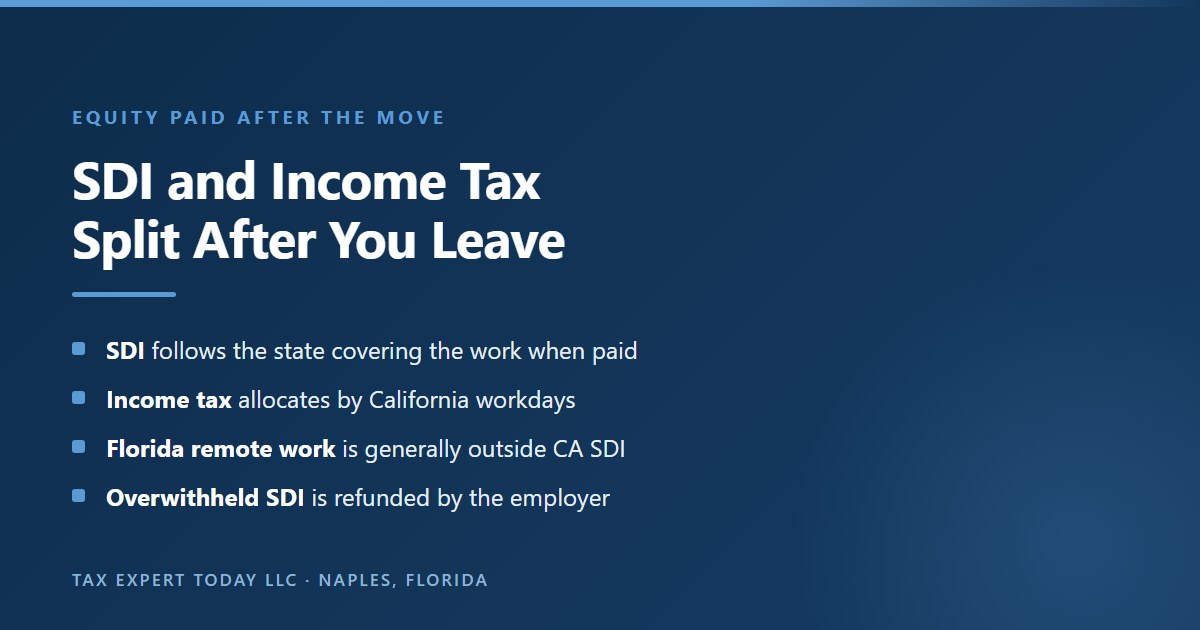
Differently, and the difference is the most overlooked point in this area. For SDI, the EDD’s DE 231SK says stock compensation is subject to the jurisdiction of the state that covers the employee’s services when the wages are paid. For California income tax, the same compensation is allocated across the states where the employee worked from grant to vest, so part can remain California source.
The EDD’s information sheet on stock options states it directly under the heading Multistate Jurisdictional Issues. For unemployment insurance, the Employment Training Tax, and SDI, wages derived from the exercise of a stock option are subject to the jurisdiction of the state in which services are otherwise subject at the time the wages are paid, meaning when the option becomes taxable. For California personal income tax, wages derived from stock options are allocated between the states in which the employee performed services for the employer that granted the option, beginning at grant and ending when the income becomes taxable.
The sheet is written about options, but its logic is the logic of the payroll tax itself: SDI attaches to wages when they are paid, in the state whose law covers the employment at that moment. RSU vests are wages paid at vesting, so payroll systems that follow the EDD’s approach treat a post move vest the same way. The income tax side is set out in the Franchise Tax Board’s Publication 1004, which allocates equity compensation by California workdays over the relevant period. That allocation is covered in detail in our guides to California RSU tax when you leave and California source income.
| Question | California SDI | California personal income tax |
|---|---|---|
| Which state’s rule applies to a vest after the move? | The state that covers the employment when the wages are paid | Allocation across states worked during the grant to vest period |
| Authority | UIC sections 602 and 603; EDD DE 231SK | R&TC section 17951 and the regulations; FTB Publication 1004 |
| If work is localized in Florida at vest | Generally no California SDI on the vest | California taxes the California workday share as a nonresident |
| How it is reported | On the employer’s EDD wage reports for covered wages | California source wages on Form 540NR |
| Who fixes an error | The employer, through an adjustment with the EDD | The taxpayer, through the return and withholding credit |
The result surprises people in both directions. A Florida resident can owe California income tax on part of a vest and still owe no California SDI on any of it. And a payroll department that sees California income tax withholding on a vest may assume SDI belongs there too, and withhold 1.3 percent on the whole amount. On a large vest that error is several thousand dollars.
What does a move year look like in numbers?
In a hypothetical move year, SDI applies only to wages paid while the work was localized in California. An employee who moves to Naples on July 1 and works only from Florida afterward pays SDI on January through June wages and, generally, none on wages or vests paid from July onward, while California income tax still reaches part of later vests.
Take a hypothetical product executive who works for a San Francisco company. The executive establishes Florida domicile and begins working full time from Naples on July 1, 2026, with the employer’s written approval of the remote arrangement and payroll updated to Florida that day. Salary is $400,000 a year, paid evenly. An RSU tranche of $600,000 vests on September 15, 2026. Over that tranche’s vesting period, 75 percent of the executive’s workdays were in California, as the guides above explain how to count.
| Item (hypothetical) | Amount | California SDI | California income tax treatment |
|---|---|---|---|
| Salary, January to June | $200,000 | $2,600 (1.3 percent) | California source, taxed on Form 540NR as a part year resident |
| Salary, July to December | $200,000 | None if localized in Florida | Not California source if all work is in Florida |
| September RSU vest | $600,000 | None if localized in Florida when paid | $450,000 California source (75 percent of workdays) |
| Total | $1,000,000 | $2,600 | $650,000 California source wages |
Had the employer left the payroll coded to California for the full year, SDI withheld would have been $13,000 rather than $2,600. The $10,400 difference is the cost of an unchanged payroll record. The income tax figures are a simplified illustration of the workday method; part year residents compute tax under the rules described in our guide to California part year resident tax, and the FTB scrutinizes the move date itself, as our guide to a California residency audit explains.
- Tell payroll in writing: the change of work location, the date, and the new address, before the first post move pay date.
- Check the first Florida paycheck: the CASDI line should be gone and state withholding should reflect California source rules, not residence.
- Check the first post move vest: confirm whether the employer applied SDI, and confirm how it allocated California income tax withholding.
- Keep the workday record: the calendar that supports the income tax allocation also supports the localization of the work.
What if business trips bring you back to California after the move?
Occasional trips generally do not change the answer. Section 603 treats service outside a state as incidental when it is temporary, transitory, or a set of isolated transactions. A Florida remote worker who visits the California office for a few short meetings a year is usually still localized in Florida for SDI purposes.
The analysis turns on the pattern, not on a fixed number of days. Incidental work is the kind that would not exist without the main assignment, such as a quarterly planning session or a client visit. Regular, recurring blocks of work in California are different. An employee who spends one week in every month at the California office has a recurring California presence that may mean the work is no longer localized in Florida, which sends the analysis to the base of operations and direction and control tests.
- Short and occasional: generally incidental, and SDI stays off.
- Recurring and substantial: may defeat localization in Florida, with the later tests deciding coverage.
- Income tax still counts the days: even when SDI is unaffected, California income tax generally reaches wages for days worked in California, which our guide to California remote work tax explains.
- Residency is a separate risk: frequent California stays also feed the residency analysis; the Florida 183 day rule calculator helps track the days that matter.
Because SDI and income tax look at different things, a single trip can matter for one and not the other. A three day board meeting in Los Angeles adds California workdays for income tax and generally does nothing to SDI. A standing arrangement to work from the California office for a week every month may change SDI coverage for the whole year, while adding only the actual California days to the income tax allocation.
What if the employer keeps withholding California SDI after you move?
Ask the employer to correct it. The DE 44 says overwithheld SDI must be credited or refunded to the employee before the employer can take a credit or obtain a refund from the EDD, using a quarterly adjustment (DE 9ADJ). Since 2024 there is no excess SDI credit on the California income tax return to fall back on.
The 2026 California Employer’s Guide (DE 44) addresses overwithholding in its section on correcting reports. Overwithheld SDI or California personal income tax must be credited or refunded to the employee before the employer can take a credit or receive a refund from the EDD, and the employer should obtain a receipt from the employee. Corrections to filed wage reports go through the Quarterly Contribution and Wage Adjustment Form (DE 9ADJ). The guide also states the time limit: a claim for refund must be filed within 3 years of the last timely date of the quarter being adjusted, within 6 months after an assessment becomes final, or within 60 days from the date of the overpayment, whichever is later.
| Step | Who acts | What happens |
|---|---|---|
| 1. Identify the error | Employee | Compare pay stubs and the W-2 SDI figure with the date work became localized in Florida |
| 2. Notify payroll | Employee | Provide the move date, work location, and a request to correct state coding and SDI |
| 3. Refund or credit | Employer | Refunds or credits the overwithheld SDI to the employee and obtains a receipt |
| 4. Adjust with the EDD | Employer | Files a DE 9ADJ for the affected quarters to recover the amount remitted |
| 5. Corrected W-2 | Employer | Issues a corrected W-2 if the year has closed |
The employee’s leverage is documentation. A payroll team is more likely to act on a short written request that gives the move date, the address of the Florida home office, the approval of remote work, and a reference to sections 602 and 603 than on a general complaint. If the employer believes the work is not localized in Florida, because of recurring California work or a mobile role, that disagreement is about the multistate tests, and it is worth resolving before the next large vest.
Can you still claim an excess SDI refund on Form 540?
No, not for wages paid since 2024. The excess SDI credit existed because each employer withheld up to the ceiling, so two employers could over collect. Section 1176 refunds that excess by reference to the section 985 ceiling, which no longer applies, and the 2025 Form 540 instructions no longer include an excess SDI line.
Section 1176 entitles an employee to a refund or credit when wages from more than one employer during a calendar year exceed the remuneration on which contributions are payable under section 985. With section 985 switched off by its subdivision (b), every dollar of wages is remuneration on which contributions are payable, so the condition cannot arise from having two employers. For years the Form 540 carried a line for excess SDI withheld, and taxpayers with two high paying jobs in one year routinely recovered several hundred dollars there. The FTB’s 2025 Form 540 instructions no longer contain that line.
- Two jobs in 2026: each employer correctly withholds 1.3 percent of what it pays, and there is no excess to recover.
- Old years: for wages paid before 2024, the excess SDI rules applied, subject to the normal limitation periods for the return year.
- Errors are now an employer matter: an incorrect withholding, such as SDI withheld after the work moved to Florida, is fixed through the employer and the DE 9ADJ, not on the income tax return.
This is a small change with a practical effect on movers. Before 2024, a mistake that over withheld SDI could sometimes be absorbed by the excess SDI credit. Now there is no automatic backstop, so a move year error stays an error until the employer corrects it.
Is the California SDI tax deductible?
On the federal return, yes, as a state income tax on Schedule A for taxpayers who itemize, within the SALT cap. The IRS Schedule A instructions list mandatory contributions to the California Nonoccupational Disability Benefit Fund among deductible state income taxes. On the California return, no: Schedule CA disallows the deduction.
The IRS Instructions for Schedule A list, among the state and local income taxes that may be included on line 5a, mandatory contributions to the California, New Jersey, or New York Nonoccupational Disability Benefit Fund, and mandatory contributions to state family leave programs. California SDI fits that description. The FTB’s 2025 Schedule CA (540) instructions take the opposite position for state purposes: California does not allow a deduction for state and local income tax and State Disability Insurance, which must be removed on line 5a, column B.
| Return | Treatment of California SDI | Where |
|---|---|---|
| Federal Form 1040, itemizing | Deductible as a state income tax, subject to the SALT cap | Schedule A, line 5a |
| Federal Form 1040, standard deduction | No separate benefit | Not applicable |
| California Form 540 or 540NR | Not deductible | Schedule CA, line 5a, column B adjustment |
| Voluntary plan contributions | Treatment depends on the plan; confirm with the plan insurer and a preparer | Varies |
For a high earner the federal deduction is often worth little or nothing at the margin, for the reason the next section explains. That makes the SDI cost close to a pure after tax cost for most people paying the largest amounts.
How does the SALT cap affect the SDI deduction in 2026?
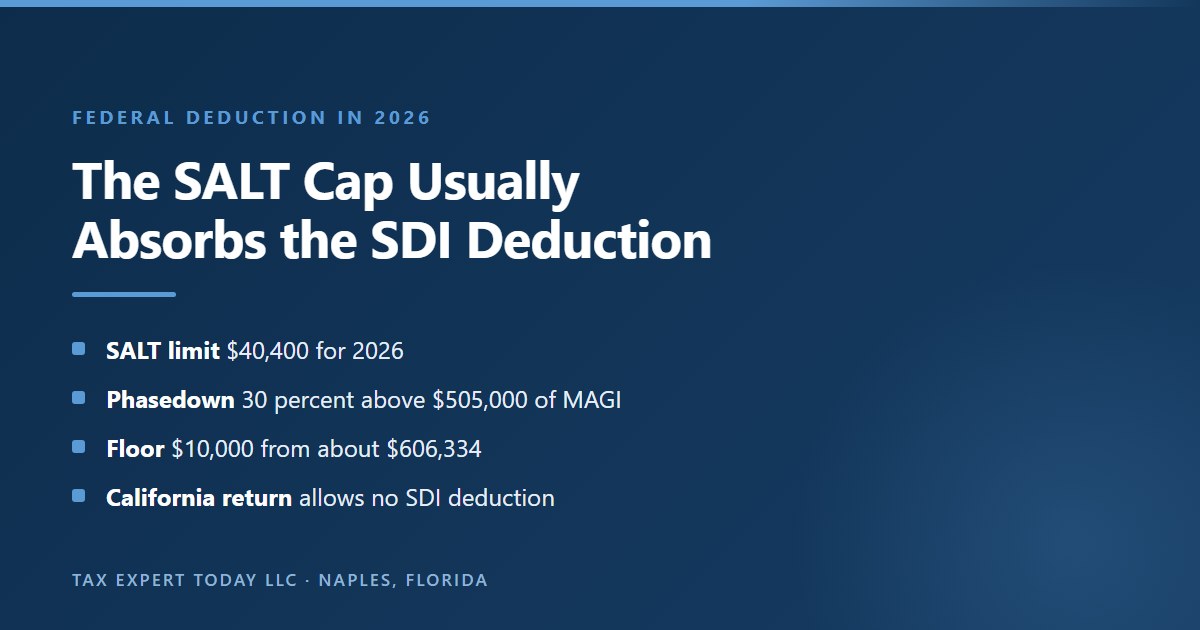
For 2026 the federal SALT deduction is capped at $40,400, and that limit falls by 30 percent of modified adjusted gross income above $505,000, but never below $10,000. Most high earners paying large SDI amounts are already at the $10,000 floor through California income tax alone, so the SDI they pay adds no federal deduction.
Section 164(b)(6) and (7), as amended in 2025, set the applicable limitation at $40,000 for 2025 and $40,400 for 2026, with 1 percent annual increases through 2029 and a return to $10,000 for 2030. The phasedown reduces the limit by 30 percent of the excess of modified adjusted gross income over $500,000 for 2025 and $505,000 for 2026, but not below $10,000. Half amounts apply to married individuals filing separately.
| 2026 MAGI (hypothetical) | Phasedown | SALT limit | Does SDI add a deduction? |
|---|---|---|---|
| $450,000 | None | $40,400 | Possibly, if California income tax and property tax leave room under $40,400 |
| $550,000 | $13,500 | $26,900 | Often no; California income tax at this level usually fills the limit |
| $606,334 or more | Reaches the floor | $10,000 | Almost never; California income tax alone exceeds $10,000 |
| $1,000,000 | Floor | $10,000 | No |
The floor is reached when 30 percent of the excess over $505,000 equals $30,400, which happens at about $606,334 of modified adjusted gross income. Above that level, a taxpayer’s SALT deduction is $10,000 regardless of how much California income tax, property tax, and SDI was paid. The PTET election is the main mechanism that moves state tax for business owners outside this cap, as our guide to the California PTET explains, but it applies to qualified pass through income, not to W-2 wages, and so does nothing for SDI.
- Itemizers only: a taxpayer who takes the standard deduction receives no federal benefit from SDI.
- Below the phasedown: SDI can matter for an itemizer with moderate California tax and no property tax, which is uncommon among high earners.
- After the move: once Florida residency begins, California income tax falls, which can leave room under the cap in later years, but SDI will usually have stopped by then too.
Are California SDI and Paid Family Leave benefits taxable?
California does not tax them. The FTB’s Schedule CA instructions direct taxpayers to exclude Paid Family Leave benefits, which the EDD reports on federal Form 1099-G, from California income. Federally, Paid Family Leave benefits are reported as taxable, while Disability Insurance benefits are generally not taxable unless paid as a substitute for unemployment benefits.
The 2025 Schedule CA (540) instructions say that payments from the Paid Family Leave program are reported on federal Form 1099-G and that California excludes them from taxable income, with the amount entered as a subtraction on line 7, column B. Disability Insurance benefits for the worker’s own illness or injury are generally not reported as taxable income for federal purposes, with an exception where they are paid as a substitute for unemployment insurance, for example when a person receiving unemployment benefits becomes disabled. Anyone who receives benefits should look at the Form 1099-G the EDD issues rather than assuming either treatment.
- Paid Family Leave: Form 1099-G, generally taxable federally, subtracted for California.
- Disability Insurance for your own condition: generally not taxable, unless a substitute for unemployment benefits.
- Florida residents: no state income tax applies in Florida to either benefit.
- Base period after a move: because benefits are computed from SDI wages paid about 5 to 18 months before a claim, a worker who recently left California may still have California base period wages; eligibility is decided by the EDD on the facts.
That last point is worth understanding before a move, not after. Stopping SDI contributions when the work moves to Florida does not cancel coverage on the day of the move, because the claim formula looks back. Coverage based on California wages fades as those wages age out of the base period. A departing employee who relies on SDI as part of a disability plan should look at private coverage in the same planning conversation as the move itself.
Can an employer voluntary plan replace the California SDI tax?
Yes. Section 3254 lets the EDD approve an employer’s voluntary plan in place of the state plan if it gives employees greater rights than the state plan, is offered to all California employees or all employees at a distinct establishment, has majority employee consent, and costs employees no more than SDI.
Section 3254 lists the conditions for approval, including that the rights afforded covered employees be greater than those under the state Disability Insurance and Paid Family Leave chapters, that a majority of covered employees consent, and that any insurance be issued by an admitted disability insurer on approved policy forms. The DE 44 summarizes the practical test: a voluntary plan must provide all the benefits of SDI, at least one benefit that is better, and cannot cost employees more than SDI.
- It is an employer decision: an individual high earner cannot opt into a voluntary plan the employer does not have.
- It does not reduce cost below SDI: the plan can cost the same or less, and the employee contribution is reported in a W-2 box as VPDI.
- It still ends with the move: a voluntary plan covers California employment, so the same localization tests decide whether it continues after a move to Florida.
For most departing employees a voluntary plan changes the label on the pay stub, not the analysis. The question that matters after a move is still whether the work is California employment.
Do business owners and the self-employed pay the California SDI tax?
It depends on how they are paid. Shareholder employees of an S corporation who receive W-2 wages from California employment are subject to SDI on those wages. Sole proprietors and LLC members who are not employees are not, though they may elect Disability Insurance coverage, which in 2026 carries a contribution rate of 8.84 percent of an assumed wage base.
An owner who works in an S corporation and takes a salary is an employee for payroll purposes, so that salary is SDI wages like any other. Distributions are not wages. The choice of entity therefore affects how much of an owner’s income is exposed to SDI, which is one of the state level differences discussed in our guide to California LLC vs S corp. The size of the salary must still be reasonable for the work performed; it is set by the facts, not by the SDI rate.
Self-employed individuals who are not employees may apply for Disability Insurance Elective Coverage under section 708.5. The EDD’s DE 3395 lists the 2026 elective coverage rate at 8.84 percent, applied to quarterly wages deemed to be the greater of $1,150 or 25 percent of the profit reported on the prior Schedule SE, based on the year two years earlier. Section 984(b) sets that rate separately from the employee rate.
| How the owner is paid | California SDI on that income? | Notes |
|---|---|---|
| S corporation salary | Yes, 1.3 percent in 2026 | Wages from California employment |
| S corporation distributions | No | Not wages |
| Sole proprietor profit | No, unless elective coverage is chosen | Elective rate 8.84 percent of deemed wages in 2026 |
| LLC member payments for services | Generally no | Members are not employees of the LLC |
| Salary after the owner moves and works only from Florida | Generally no | Localization tests apply as for any employee |
How does the California SDI tax differ from income tax and the mental health tax?
SDI is a 1.3 percent payroll contribution on wages only, collected by the EDD, with no threshold and no ceiling. California income tax reaches all income at graduated rates, and the 1 percent Mental Health Services Tax applies to taxable income above $1,000,000. A high earner with large wages pays all three, on different bases and with different rules after a move.
| Feature | California SDI | California income tax | Mental Health Services Tax |
|---|---|---|---|
| Base | Wages from California employment | All taxable income (residents) or California source income (nonresidents) | Taxable income above $1,000,000 |
| 2026 rate | 1.3 percent | 1 to 12.3 percent | 1 percent |
| Threshold or ceiling | Neither | Graduated brackets | Applies only above $1,000,000 |
| Investment income | Never | Yes for residents | Yes if over the threshold |
| Post move equity vest | Follows the state covering the work when paid | Allocated by California workdays | Follows the income tax computation |
| Federal deduction | Schedule A, within the SALT cap | Schedule A, within the SALT cap | Schedule A, within the SALT cap |
These are separate obligations, so solving one does not solve the others. A Florida resident with a large vest can owe California income tax and the Mental Health Services Tax on the California share and still owe no SDI on any of it, as the earlier example shows. Our guide to California nonresident withholding explains how employers withhold income tax on those California source wages after a move.
Will the California SDI tax rate rise in 2027?
The EDD projected 1.4 percent for 2027 in its May 2026 Disability Insurance Fund Forecast, but the rate is not final until the director declares it, which section 984 requires by October 31, 2026. The statute caps the rate at 1.5 percent and limits a single year decrease to 0.2 percentage points.
The May 2026 forecast states that the SDI contribution rate was 1.1 percent for 2024, 1.2 percent for 2025, and 1.3 percent for 2026, and is projected to rise to 1.4 percent in 2027. It projects the fund balance at $3.5 billion at the end of 2026 and $5.1 billion at the end of 2027. Those are projections, and the formula in section 984(a)(2) uses the actual disbursements and fund balance at September 30, 2026.
- Budget at 1.4 percent: a reasonable working assumption for 2027 cash planning until the rate is declared.
- The ceiling is 1.5 percent: section 984(a)(3) does not allow a higher rate without a change in the law.
- Vest timing: a vest in late 2026 is withheld at 1.3 percent and one in early 2027 at the 2027 rate, but SDI alone is rarely large enough to drive the timing of compensation, which the employer usually controls anyway.
- Movers: for someone whose work is localized in Florida before 2027, the 2027 rate generally does not matter at all.
What records should a departing high earner keep for SDI?
Keep the records that prove when and where the work moved: the employer’s remote work approval, the payroll change of work location and its effective date, pay stubs before and after, the first post move vest confirmation, and a workday calendar. The same file supports both the SDI localization question and the income tax allocation.
- Remote work approval: the email or policy document that permits full time work from Florida, with its start date.
- Payroll records: the change of work state in the payroll system and the first pay stub without a CASDI line.
- Equity records: each vest or exercise confirmation showing the date, the value, and the taxes withheld by state.
- Workday calendar: a contemporaneous record of where each working day was performed, including any trips to California.
- Correspondence: any request to correct SDI withholding and the employer’s response, which matters for the DE 9ADJ time limit.
| Record | Supports SDI? | Supports income tax? | Supports residency? |
|---|---|---|---|
| Remote work approval | Yes | Yes | Partly |
| Payroll work location change | Yes | Yes | Partly |
| Workday calendar | Yes | Yes | Yes |
| Vest confirmations | Yes | Yes | No |
| Florida declaration of domicile, license, voter registration | No | Indirectly | Yes |
Residency itself is a separate inquiry with its own evidence; our guides to establishing Florida residency, Florida domicile for executives, and the dual state residency trap cover the domicile side, and our guide to a Florida residency audit covers how a move is defended.
Frequently Asked Questions
What is the California SDI tax rate for 2026?
The California SDI withholding rate for 2026 is 1.3 percent of all wages. There has been no taxable wage limit since January 1, 2024, so there is no maximum contribution. The rate funds both Disability Insurance and Paid Family Leave.
Is there a maximum California SDI tax in 2026?
No. Senate Bill 951 removed the taxable wage ceiling for wages paid on or after January 1, 2024, and Unemployment Insurance Code section 985(b) confirms the old ceiling no longer applies. A worker with $1,000,000 of wages pays $13,000 at the 2026 rate.
Are RSUs subject to California SDI tax?
Yes, when the employee’s work is covered by California at the time the shares vest and are paid. Section 926 defines wages to include remuneration paid in any medium other than cash, so RSU vests are SDI wages, and nonqualified stock options are generally SDI wages at exercise.
Do I pay California SDI tax after moving to Florida?
Generally not on wages paid after your work becomes localized in Florida. Under Unemployment Insurance Code sections 602 and 603, SDI covers work localized in California. A full time remote worker performing all work from Florida is generally outside California SDI, even if the employer is in California.
Can I owe California income tax on an RSU vest but no SDI?
Yes. The EDD’s DE 231SK says stock compensation is subject to SDI in the state covering the employee when the wages are paid, while California income tax allocates the same compensation by California workdays from grant to vest. A Florida resident can owe income tax on the California share and no SDI.
Can I still claim excess SDI on my California return?
Not for wages paid since 2024. The excess SDI credit depended on the wage ceiling, which no longer applies, and the 2025 Form 540 instructions no longer include an excess SDI line. SDI withheld in error must be refunded by the employer, which then adjusts with the EDD.
Is California SDI tax deductible?
Federally, yes, as a state income tax on Schedule A line 5a for itemizers, within the SALT cap of $40,400 for 2026, reduced above $505,000 of modified adjusted gross income to a $10,000 floor. California does not allow the deduction on its own return.
Can a Naples, Florida advisor help with California SDI after a move?
Yes. California SDI depends on where the work is performed and how payroll records it, not on where the advisor works. A Naples, Florida advisor can review pay stubs, W-2s, and vest confirmations against the move date and help prepare the documentation an employer needs to correct withholding.
California SDI Tax Help in Naples & Southwest Florida
California SDI tax help Naples employees and executives can use starts with the payroll record and the calendar, not with the tax return. Tax Expert Today LLC advises on state residency and tax matters nationwide, including California departures and Florida arrivals, from our office in Naples, Florida. Our team includes tax advisors, enrolled agents, CPAs, and attorneys, and we review whether a move has been reflected correctly in payroll, how post move equity has been treated for SDI and for California income tax, and what to raise with an employer when the two do not match.
We are located at 11983 Tamiami Trail N, Naples FL 34110. Call (239) 441-2005, Monday through Friday, 10:00 to 5:00 Eastern Time. Clients across Naples, Bonita Springs, Estero, Fort Myers, Marco Island, and the wider Southwest Florida region engage us on California part year returns, equity compensation after a move, and residency questions. Our California tax services page describes the state engagements we take, Naples tax planning covers our local advisory work, and our tax planning services page explains how a planning engagement is structured.
- California SDI review Naples FL: reading pay stubs, the W-2, and vest confirmations against the date your work moved to Florida.
- Equity compensation after a move: reconciling SDI on each vest with the California workday allocation for income tax.
- Employer correction requests: preparing the documentation a payroll team needs to refund overwithheld SDI.
- Move year returns: preparing the California Form 540NR and the federal return so the two agree.
Local FAQ: I moved from the Bay Area to Naples and kept my job working remotely, but my pay stubs still show CASDI. Can a Naples advisor help? Yes. Whether California SDI applies turns on where your work is performed and how your employer has recorded it, not on where your advisor is located. Bring your remote work approval, pay stubs from before and after the move, your most recent W-2, any RSU or option confirmations since the move, and a calendar of where you worked, and we can review whether the withholding matches the multistate tests and help you prepare the request your payroll team needs to correct it.
When to Engage a Professional
Engage a professional before your first paycheck from Florida, before the first large vest or option exercise after the move, when a W-2 shows SDI on wages paid after your work moved, and whenever your schedule includes recurring work in California. The SDI answer depends on facts that payroll systems often record incorrectly.
- You have moved to Florida but still see a CASDI line on your pay stub.
- A large RSU vest or option exercise is scheduled after your move and you want to know how SDI and income tax will each apply.
- You split time between California and Florida for work and are unsure which state covers your employment.
- You own an S corporation and are moving its operations or your own work to Florida.
- You have received an EDD or FTB notice about wages or withholding; our guide to the FTB power of attorney explains how a representative is authorized for the FTB side.
This article explains the law as it stands for 2026. It is not legal or tax advice for any specific situation, and outcomes depend on where and how the work is performed, the employer’s payroll records, the type of compensation, and facts that only a full review can establish. The examples are hypothetical illustrations, not client results. Call (239) 441-2005 to arrange a review.
Published October 6, 2026 by Dr. Pellumb Kabashi « Back to Learning Center
Have a question this article touches on?
Tax Expert Today LLC, based in Naples, Florida and serving clients across the United States.
Schedule a Consultation (239) 441-2005