
By Dr. Pellumb Kabashi, DBA, MBA, CES, CFE, EA
Founder, Tax Expert Today LLC · Tax advisors, enrolled agents, CPAs, and attorneys · Serving clients in all 50 states
Quick Answer: Texas use tax is the 6.25 percent state tax, plus up to 2 percent local tax, that a business owes on taxable items it stores, uses or consumes in Texas when the seller did not charge Texas tax. Out of state equipment, software and supplies are the usual sources. Permitted businesses report it as taxable purchases on their regular return. Call (239) 441-2005 for a free consultation.
Most owners think of Texas sales tax as something the business collects from its customers. That is the side of the tax that gets attention, because it shows up on every invoice and every return. There is a second side that gets far less attention and causes a large share of the trouble. When the business itself buys a taxable item and the seller does not charge Texas tax, the obligation does not disappear. It moves to the buyer. The business owes Texas use tax on that purchase, and nobody sends it a bill.
The purchases that create this obligation are ordinary ones. A Texas company orders a piece of shop equipment from a dealer in another state that does not collect Texas tax. A marketing team buys promotional items from an online vendor that ships them to a Texas trade show. A firm signs a software subscription with a vendor that has never registered in Texas. An owner who moved the business to Texas brings along furniture, computers and tools that were bought elsewhere a few months earlier. Each of these can produce a Texas use tax liability, and each is easy to miss because the invoice simply shows no tax line.
The ranking pages on this subject define use tax, give the rate and point to the return. That is accurate as far as it goes. What they do not cover is how a business actually finds these purchases in its own books, how it reports them on the return it already files, how the one year rule treats property used elsewhere before it arrives in Texas, and why unpaid use tax on the purchases side is a regular feature of a Texas sales tax examination. This guide covers those questions, using the statute, the Comptroller’s use tax rule and the Comptroller’s own instructions.
This guide is about the business as a buyer. How an out of state business becomes obligated to collect Texas tax from its customers is a separate question, covered in our guide to Texas sales tax nexus. How a buyer avoids paying tax at the register on a qualifying purchase is covered in our guide to the Texas sales tax exemption certificate. And how a Comptroller examination tests both sides of the tax is covered in our guide to the Texas Comptroller audit.
What Is Texas Use Tax?
Texas use tax is a tax on the storage, use or other consumption in Texas of a taxable item purchased for that purpose, imposed by Tax Code Section 151.101 at the sales tax rate. It applies when Texas sales tax was not paid at purchase, so it completes the sales tax rather than adding to it.
- Same rate as sales tax. The state rate is 6.25 percent, and local use tax can add up to 2 percent.
- Owed by the user. The person who stores, uses or consumes the item in Texas is liable.
- Not a second tax. If Texas sales or use tax was already paid, no further use tax is due on the item.
- Covers goods and services. It reaches tangible personal property and taxable services used in Texas.
The statute is short. Section 151.101(a) imposes a tax “on the storage, use, or other consumption in this state of a taxable item purchased from a retailer for storage, use, or other consumption in this state.” Section 151.101(b) sets the rate at the same percentage as the sales tax under Section 151.051. The Comptroller’s use tax page describes the result in practical terms: use tax “is a nonrecurring tax that is complementary to sales tax.”
Both parts of that description matter. Use tax is complementary because it fills a gap the sales tax would otherwise leave. Texas taxes the retail sale of a taxable item. When the sale happens outside Texas, or happens through a seller that does not collect Texas tax, there is no Texas taxable sale to reach. Use tax reaches the same item at the point where it comes to rest in Texas instead. Use tax is nonrecurring because it is paid once on a given item. A business that pays Texas use tax on a forklift does not pay it again each year it keeps using the forklift.
The Comptroller’s use tax rule, 34 Texas Administrative Code Section 3.346, supplies the definitions that make the statute work. “Storage” means keeping or retaining tangible personal property in Texas for any purpose other than transporting it out of state for use solely outside Texas, or incorporating it into other property that will be shipped out of state. “Use” means the exercise of a right or power over tangible personal property incidental to its ownership, and, for a taxable service, “the derivation in this state of direct or indirect benefit from the service.” That last definition is the reason use tax reaches services and software, not only physical goods, a point this guide returns to below.
The key word in the business setting is consumption. A business that buys inventory to resell is not the consumer of that inventory; its customers are. A business that buys a printer, a pallet jack, cleaning supplies, a laptop, a trade show booth or a software license for its own operations is the consumer. Those are the purchases on which use tax arises when the seller does not charge Texas tax.
How Is Texas Use Tax Different From Sales Tax?
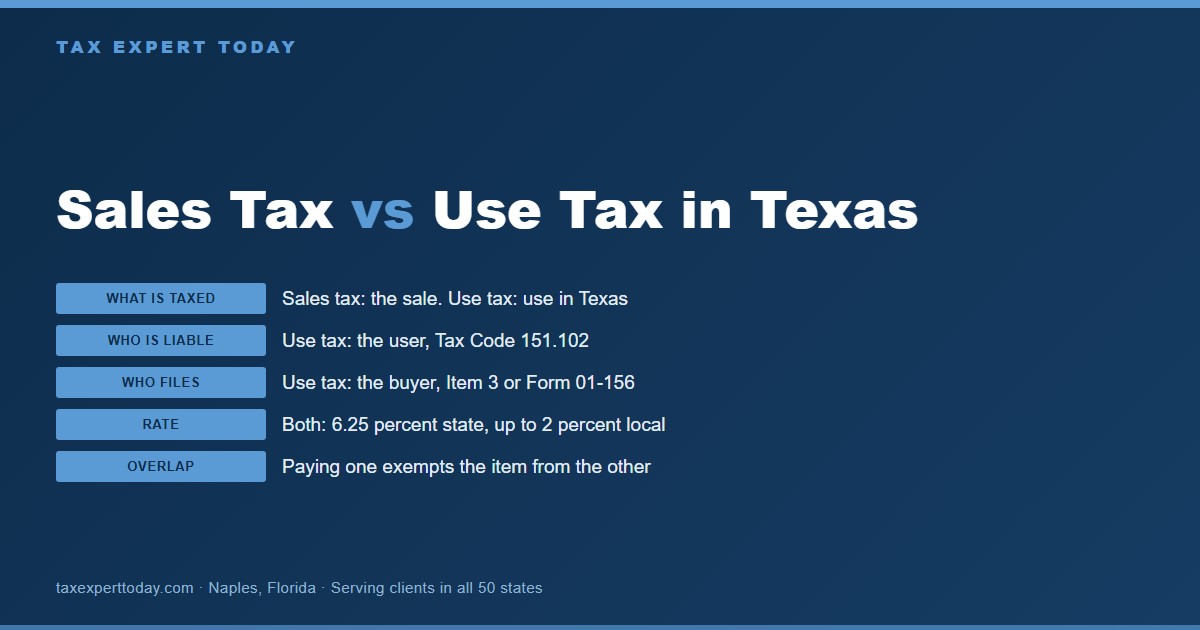
Sales tax is imposed on the retail sale and is collected by the seller, who remits it to the Comptroller. Use tax is imposed on the storage, use or consumption of the item in Texas and is owed by the purchaser when the seller did not collect Texas tax. The rate, the taxable items and most exemptions are the same.
- Different trigger. Sales tax attaches to the sale; use tax attaches to what happens to the item in Texas.
- Different collector. The seller collects sales tax; the buyer usually self assesses use tax.
- Same base. Both are measured by the sales price, including delivery charges.
- Either satisfies the other. Payment of one exempts the item from the other under Section 151.303.
The two taxes are mirror images. The table below sets them side by side. For most businesses, the practical difference comes down to a single question: did the invoice include Texas tax? If it did, the purchase is finished. If it did not, and the item is taxable and is being used in Texas, the business has a use tax line to report.
| Feature | Texas sales tax | Texas use tax |
|---|---|---|
| What is taxed | The retail sale, lease or rental of a taxable item in Texas | The storage, use or other consumption of a taxable item in Texas |
| Statute | Tax Code Section 151.051 | Tax Code Section 151.101 |
| Who is liable | The purchaser pays it; the seller must collect and remit it | The person storing, using or consuming the item, under Section 151.102 |
| Who usually files | The seller, on its sales and use tax return | The purchaser, as taxable purchases on its own return or on Form 01-156 |
| State rate | 6.25 percent | 6.25 percent |
| Local tax | Up to 2 percent, generally based on the seller’s location or the delivery point | Up to 2 percent, due to the jurisdictions where the item is first stored, used or consumed |
| Typical situation | A Texas store sells an item to a customer | An out of state vendor ships an item to a Texas business and charges no Texas tax |
| Relationship | Payment of sales tax exempts the item from use tax | Payment of use tax exempts the item from further use tax |
The relationship row is the one that keeps the system from taxing an item twice. Section 151.303(a) exempts from use tax the storage, use or consumption of an item whose sale was subject to the sales tax. Section 151.303(b) exempts an item on which the person has already paid use tax. So the business is never paying both on the same item. It is paying one or the other, and use tax is simply the version it pays itself when the seller did not.
Who Owes Texas Use Tax, the Seller or the Buyer?
The buyer is liable. Section 151.102 makes the person storing, using or consuming a taxable item in Texas liable for the use tax, and the liability continues until the tax is paid. A seller engaged in business in Texas must collect it, but if the seller does not, the buyer still owes it directly to the Comptroller.
- Liability sits with the user. Section 151.102(a) places it on the person storing, using or consuming the item.
- It does not expire on its own. The liability “continues until the tax is paid to the state.”
- A receipt discharges it. Under Section 151.102(b), paying a seller authorized to collect the tax ends the buyer’s liability.
- The Comptroller can pursue either party. Where a Texas seller failed to collect, Rule 3.346 allows the Comptroller to proceed against the seller or the purchaser.
The statute puts the obligation on the buyer first and then provides a way to discharge it. Section 151.102(a) states that the person storing, using or consuming a taxable item in Texas “is liable for the tax,” and that “the liability continues until the tax is paid to the state.” Section 151.102(b) provides that the person is not further liable if it pays the tax to “a retailer engaged in business in this state or other person authorized by the comptroller to collect the tax” and receives a receipt.
Section 151.103 then imposes the collection duty on the seller. A retailer engaged in business in Texas that sells a taxable item for use in Texas “shall collect the use tax that is due from the purchaser and give the purchaser a receipt for the tax payment.” That is why most purchases from large national vendors arrive with Texas tax already on the invoice. Those vendors are engaged in business in Texas, through physical presence or because their Texas revenue exceeds the $500,000 remote seller safe harbor described on the Comptroller’s remote sellers page, and they collect.
The gap appears with sellers that are not collecting. That can be a small specialty manufacturer in another state, a foreign supplier, a used equipment dealer, an individual selling through an auction, or a software company that has never registered. It can also be a Texas seller that simply charged the wrong amount. In each case the buyer is still liable under Section 151.102, and the fact that the seller should have collected does not protect the buyer. Rule 3.346 states the point directly for Texas sellers that failed to collect: “The comptroller may proceed against the seller or the purchaser for the sales tax owed by either.”
For a business, the practical rule is that the absence of Texas tax on an invoice is a signal, not an answer. It means one of three things. The purchase is not taxable. The purchase is taxable but exempt, for example because the business gave the seller a valid exemption certificate. Or the purchase is taxable, no exemption applies, and the business owes use tax. Only the third outcome produces a liability, but the business has to sort every untaxed purchase into one of the three to know.
What Purchases Trigger Texas Use Tax for a Business?
Use tax arises when a business buys a taxable item for its own use in Texas and Texas tax is not charged. The common sources are out of state equipment and furniture, supplies and promotional goods, software and taxable services from vendors that do not collect, items imported from another country, and items taken out of resale inventory.
- Fixed assets bought out of state. Machinery, vehicles other than motor vehicles, furniture, computers and tools.
- Consumables. Supplies, packaging the business uses itself, cleaning and maintenance materials.
- Promotional items shipped into Texas. Gifts, catalogs and giveaways delivered at the buyer’s direction.
- Software and services. Taxable services and software from vendors not collecting Texas tax.
- Items pulled from inventory. Goods bought for resale and then used by the business itself.
The Comptroller’s use tax page gives consumer examples: a shirt bought through an online auction from a seller in Ohio, a camera bought from a New York electronics store’s website, items bought in Mexico and brought back to Texas. The business versions follow the same logic and usually involve larger amounts. The table below collects the purchases that most often produce a use tax liability for a Texas business, with the rule that applies to each.
| Purchase | Why use tax can arise | Authority |
|---|---|---|
| Equipment or furniture bought from an out of state dealer that does not collect Texas tax | The item is stored and used in Texas and no Texas tax was paid | Tax Code Section 151.101; Rule 3.346(b)(1) |
| Items bought in another country and brought into Texas | Use tax applies to items bought abroad and used in Texas | Comptroller use tax page |
| Promotional goods, gifts or catalogs shipped into Texas by an out of state supplier at the buyer’s direction | Use tax is due if the purchaser is engaged in business in Texas | Rule 3.346(b)(4) |
| Software or a taxable service from a vendor that does not collect Texas tax | Use of a taxable service includes deriving benefit from it in Texas | Rule 3.346(a)(2) |
| Items bought from a person making an occasional sale | A permit holder generally must accrue use tax on these purchases | Rule 3.346(b)(7) |
| Printed materials printed out of state and delivered into Texas | Use tax is due on the total cost, including printing, paper and ink | Rule 3.346(b)(6) |
| Goods bought tax free for resale and then used by the business | The resale exemption no longer fits the actual use | See our guide to the Texas resale certificate |
| Local tax shortfall on an in state purchase | The seller charged state tax only, but the item is used in a jurisdiction with local tax | Comptroller use tax page; Rule 3.346(f) |
Two of these rows deserve more explanation. The promotional goods rule in Rule 3.346(b)(4) applies to items “such as gifts, catalogs and promotional goods purchased outside this state by a purchaser engaged in business in this state if the taxable items are delivered at the direction of the purchaser to a location in Texas designated by the purchaser.” A business that orders branded merchandise from an out of state supplier and has it shipped to a Texas event or to Texas customers owes use tax on it, even though the business never physically handled the goods. Local use tax on those deliveries is due only to the extent the purchaser is engaged in business in the local jurisdictions into which the deliveries are made.
The resale row is the one that surprises owners most. A business that buys goods tax free by giving the seller a resale certificate has told the seller it will resell them. If it then uses some of those goods itself, as display models, internal supplies or gifts to customers, the basis for the tax free purchase no longer fits. The business owes tax on what it used. How resale certificates work, and the traps around them, are covered in our guide to the Texas resale certificate; the point here is that inventory withdrawals for internal use belong on the use tax review list.
The local shortfall row reflects an example on the Comptroller’s own page. A buyer who lives in a city with a 2 percent local tax buys a coffee table for $200 in an area with no local tax. The seller collects only the 6.25 percent state tax. When the buyer brings the table home, the Comptroller states, “you owe the additional 2 percent local use tax of $4.” The same logic applies to a business that buys an item in a low tax part of Texas and uses it at a location with a higher local rate.
What Is the Texas Use Tax Rate?
The state use tax rate is 6.25 percent, the same as the state sales tax rate under Section 151.101(b). Local jurisdictions can add up to 2 percent in local use tax, for a combined maximum of 8.25 percent. Local use tax is owed to the jurisdictions where the item is first stored, used or consumed.
- State rate. 6.25 percent on the sales price.
- Local rate. Up to 2 percent, from cities, counties, transit authorities and special purpose districts.
- Combined maximum. 8.25 percent, as Form 01-156 states.
- Sourcing. Rule 3.346(f) assigns local use tax to the place of first storage, use or consumption.
The Comptroller states the rate plainly: “The state use tax rate is 6.25 percent. For Texas purchasers, depending on where you use, store or consume the item, you may owe up to an additional 2 percent in local use taxes.” The instructions to Form 01-156 put the ceiling in the same terms: “The maximum combined state and local tax is 8.25 percent.” The Comptroller’s Sales Tax Rate Locator gives the local rate at a specific address.
The local piece is where the details sit. Rule 3.346(f) provides that “local use tax is due to the jurisdictions where taxable items are first stored, used, or consumed.” For a business with a single location, that is usually simple. For a business with several Texas locations, or one that receives goods at a central warehouse and then distributes them, the place of first storage or use controls which local rates apply. The rate the business reports should match the place the item actually came to rest, not the address on the vendor’s invoice.
| Component | Rate | Where it comes from |
|---|---|---|
| State use tax | 6.25 percent | Tax Code Section 151.101(b), tied to the sales tax rate in Section 151.051 |
| Local use tax | Up to 2 percent in total | City, county, transit and special purpose district taxes, due where the item is first stored, used or consumed under Rule 3.346(f) |
| Combined maximum | 8.25 percent | Form 01-156 instructions |
| Single local use tax rate | 1.75 percent | An alternative that qualifying remote sellers may elect to collect in place of destination local rates; Texas businesses cannot use it for their own sales |
The single local use tax rate in the last row is a seller side rule, but buyers meet it. The Comptroller’s remote sellers page states that “the current single local use tax rate is 1.75 percent, and the rate is published in the Texas Register by Jan. 1 of each year.” A remote seller can elect to collect that flat local rate instead of the actual local rate at each destination. The Comptroller’s use tax page then gives the buyer the protection that matters: “If you purchase an item from a remote seller and pay the state use tax and single local use tax, you do not owe any additional taxes.” A business that receives an invoice from a remote seller showing 6.25 percent state and 1.75 percent single local tax has nothing further to accrue on that item, even if its own local rate is 2 percent.
How Is the Texas Use Tax Base Measured?
Use tax is measured by the total purchase price of the taxable item, including related charges such as shipping and handling, whether or not those charges are separately stated. Rule 3.346(d)(3) sets this base. A business that accrues use tax on the equipment price alone, and leaves out freight, understates the tax.
- Start with the price. The amount paid for the taxable item.
- Add delivery. Shipping and handling charges are part of the base.
- Separate statement does not matter. Freight listed on its own line is still included.
- Exclude exempt items. Under Section 151.103(c), items whose use is exempt are left out of a combined sale.
Rule 3.346(d)(3) is explicit: “The basis of the use tax is the total purchase price of the taxable item, including any related charges such as shipping and handling fees, regardless of whether such fees are separately stated.” The rule cross references Rule 3.303 on transportation and delivery charges. In practice, this means the business should accrue use tax on the landed cost of the item as invoiced, not on the line item for the equipment alone.
Freight is a frequent source of small but recurring differences. A business that buys heavy equipment from out of state vendors may pay substantial delivery charges, and an accrual process that picks up only the equipment line will understate the base on every one of those purchases. Installation charges, setup fees and similar items need their own analysis, because whether a particular service charge is part of the sales price depends on what the service is. Where the invoice combines taxable and exempt items, Section 151.103(c) provides that the tax is determined on the sum of the sales prices “exclusive of any item the storage, use, or other consumption of which is exempted.”
The base is the price the business actually paid. It is not the value of the item on the books after depreciation, and it is not a list price the business did not pay. The one exception to that intuition, discussed in the next section, concerns property that was used outside Texas for a substantial period before it arrived. Even there, the rule does not change the base; it changes whether use tax applies at all.
Does Texas Use Tax Apply to Property Used Outside Texas Before It Arrives?
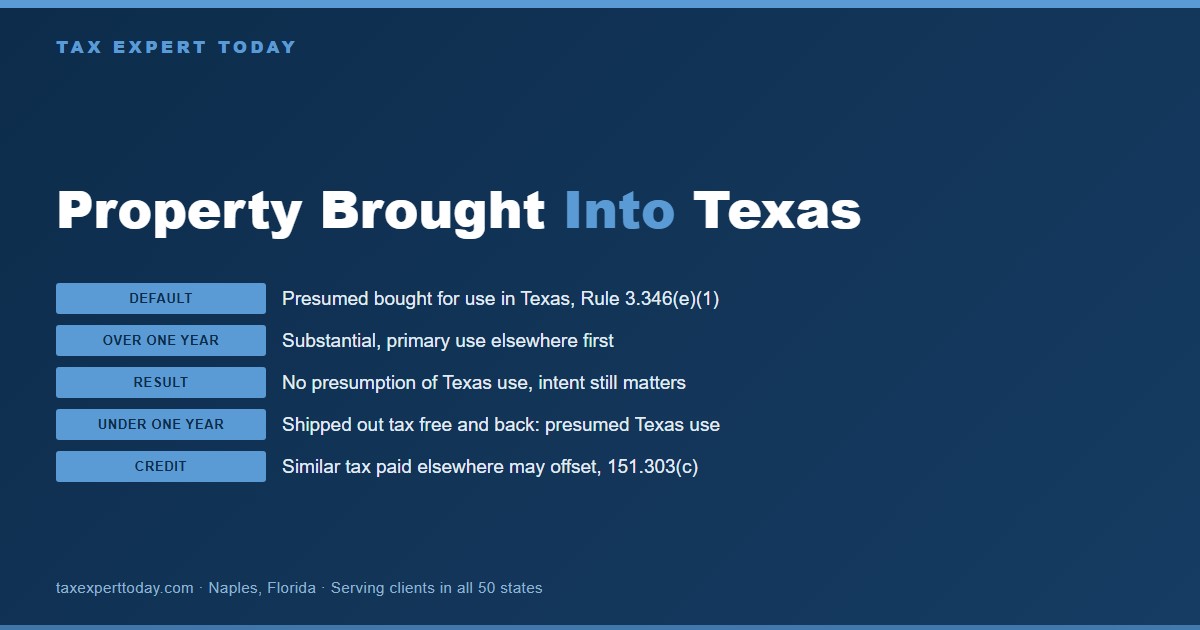
It depends on how long and how the property was used elsewhere. Rule 3.346(e)(2) provides that property bought out of state and used for its intended purpose outside Texas for more than one year before entering Texas is not presumed to have been bought for use in Texas, if that outside use was substantial and primary.
- The default presumption. Property shipped or brought into Texas by the purchaser is presumed bought for use in Texas.
- The one year exception. More than one year of substantial, primary use outside Texas removes the presumption.
- Intent still matters. Either side may introduce evidence about intent at the time of purchase.
- Short trips out do not help. Property shipped out tax free and back within a year is presumed bought for Texas use.
This is the rule that matters most for a business relocating to Texas, and for any business that moves equipment between states. Rule 3.346(e)(1) states the starting presumption: “Tangible personal property that is shipped or brought into this state by, or at the direction of, a purchaser is presumed, in the absence of evidence to the contrary, to have been purchased from a seller for storage, use, or consumption in this state.”
Rule 3.346(e)(2) then provides the exception: “Tangible personal property purchased out of state and used for its intended purpose outside of Texas for more than one year before the date of entry into Texas will not be presumed to have been purchased for use in Texas. This presumption applies only if the use outside Texas is substantial and constitutes a primary use for which the property was purchased. Either the comptroller or the purchaser may introduce evidence to establish the intent or absence of intent to use the taxable items in Texas at the time of purchase.”
Rule 3.346(e)(3) closes one obvious route around the rule. If property is shipped outside Texas by the seller so that the sale is exempt from Texas sales tax under Section 151.330(a), “and the property is outside of Texas for less than one year before reentering Texas, the presumption is that the property is purchased for use in Texas.”
| Situation | Starting presumption | Practical result |
|---|---|---|
| Equipment bought out of state and shipped directly to a Texas location | Bought for use in Texas | Use tax generally due if no Texas tax was charged |
| Equipment used in the business’s Oklahoma plant for three years, then moved to its new Texas plant | Not presumed bought for use in Texas, if the Oklahoma use was substantial and primary | Use tax generally not due, subject to evidence of intent at purchase |
| Furniture bought four months before a planned move to Texas and used briefly at the old office | Bought for use in Texas, because the one year period was not met | Use tax generally due; evidence of intent may be examined |
| Item shipped out of Texas by the seller tax free, then brought back within a year | Bought for use in Texas, under Rule 3.346(e)(3) | Use tax generally due |
| Inventory held in Texas solely for shipment to customers outside Texas | Not storage, under the Rule 3.346(a)(1) definition | No use tax on the storage itself |
The examples in the table are illustrations of how the rule is structured, not conclusions about any particular set of facts. The rule itself makes intent a factual question. A business that bought equipment eleven months before a move it had already planned, and then claims it bought the equipment for use in another state, may find that the documents tell a different story. A business that genuinely operated equipment in another state for years before relocating is in the position the rule was written to protect. The broader set of steps for a relocating company, including entity, registration and franchise tax questions, is covered in our guide to moving a business to Texas.
How Do Permitted Businesses Report Texas Use Tax?
A business that holds a Texas sales and use tax permit reports use tax in Item 3, Taxable Purchases, of its regular Texas Sales and Use Tax Return, on its next regularly scheduled due date. Rule 3.346(d)(4) ties the reporting to the return covering the period in which the items were first stored, used or consumed in Texas.
- Same return. No separate use tax return is filed by a permit holder.
- Item 3. Untaxed taxable purchases are entered as Taxable Purchases.
- Timing. The period of first storage, use or consumption controls.
- Form 01-156 is not available. The form’s instructions state that permitted persons cannot use it.
The Comptroller’s instructions are direct: “If you are a Texas purchaser with a Texas sales and use tax permit, you will report the use tax in Item 3, Taxable Purchases, of your Texas Sales and Use Tax Return, on your next regularly scheduled due date.” Rule 3.346(d)(4) adds the timing rule: “The tax must be reported and remitted to the comptroller with the return covering the period in which the taxable items are first stored, used, or otherwise consumed in Texas.”
For a monthly filer, that means the untaxed purchases first used in a given month go on that month’s return. For a quarterly or annual filer, the same rule applies to the quarter or year. The amount entered is the purchase price on which tax is owed, and the return computes the tax at the applicable rates. A business with locations in several local jurisdictions needs to allocate the purchases to the jurisdictions where the items were first stored or used, because that determines the local tax under Rule 3.346(f).
A common misunderstanding among permit holders is that the permit relates only to sales. It does not. The permit is a sales and use tax permit, and the return is a sales and use tax return. A business that files every return on time but leaves Item 3 at zero month after month, while buying equipment and software from vendors that do not collect Texas tax, has a filing history that looks complete and an exposure that is not. The Form 01-156 instructions make the point from the other side: “Persons and businesses that are permitted for Texas sales and use tax cannot use this form and must report any taxable purchases on their sales and use tax return.”
How Do Businesses Without a Permit Report Texas Use Tax?
A Texas business without a sales and use tax permit reports use tax on Form 01-156, Texas Use Tax Return. If the use tax owed for the calendar year is under $1,000, the return and payment are due by January 20 of the following year. Once the total reaches $1,000, they are due by the 20th of the following month.
- Who files Form 01-156. Persons and businesses not permitted for Texas sales and use tax.
- Under $1,000 for the year. File and pay by January 20 of the following year.
- $1,000 or more. File and pay by the 20th of the month after the threshold is reached.
- What goes on the form. Total taxable purchases, the combined state and local rate, and the amount due.
Many service businesses never need a sales and use tax permit, because they do not sell taxable items. A consulting firm, a medical practice or a law office may have no taxable sales at all. Those businesses still buy taxable items for their own use, and when a seller does not charge Texas tax, they still owe use tax. They report it on Form 01-156, which the Comptroller describes as the return for “any person or business, not permitted for Texas sales and use tax, that has not paid Texas sales or use tax on taxable goods and services brought or shipped into the state for use, storage or consumption.”
The Comptroller’s use tax page sets the deadlines. “A purchaser who owes less than $1,000 of use tax must file and pay no later than Jan. 20 of the following year. A purchaser who owes $1,000 or more in use tax must file and pay on or before the 20th of the month following the month when the $1,000 threshold is reached.” The page gives an example: a purchaser who owes $250 on one untaxed item can file any time through January 20 of the next year, but if a second purchase adds $750, bringing the total to $1,000, the return is due by the 20th of the following month.
| Point | Business with a sales and use tax permit | Business without a permit |
|---|---|---|
| Where use tax is reported | Item 3, Taxable Purchases, on the regular Texas Sales and Use Tax Return | Form 01-156, Texas Use Tax Return |
| When it is reported | The return covering the period of first storage, use or consumption | By January 20 of the following year if under $1,000 for the year; otherwise by the 20th of the month after the $1,000 threshold is reached |
| Can the other method be used | No; the Form 01-156 instructions bar permitted persons from using it | Not applicable |
| Rate applied | 6.25 percent state plus local rates where the item is first stored or used | 6.25 percent state plus applicable local rates, entered as a combined rate on the form |
| Typical business | Retailers, distributors, manufacturers, businesses selling taxable services | Professional and other service firms with no taxable sales |
The form itself is short. It asks for the taxpayer’s identifying number, the physical address where the items were received in Texas, the total taxable purchases in whole dollars, the combined state and local rate, and the amount due. The physical address line matters because it determines the local rate. A business that receives items at a Texas office should use that office’s address, not a mailing address or post office box; the form states “Do not use a P.O. box address.”
What Credit Does Texas Allow for Tax Paid to Another State?
Section 151.303(c) gives a credit against Texas use tax equal to a similar tax the taxpayer paid in another state on the same item, if that state provides a similar credit for Texas taxpayers. The tax must have been legally due and paid. If the other state’s tax was lower, Texas use tax is due on the difference.
- Similar tax. The other state’s tax must be a sales or use tax of a similar kind.
- Legally due and paid. Tax charged in error by another state does not qualify.
- Reciprocity. The other state must provide a similar credit for Texas taxpayers.
- Credit, not exemption. It offsets the Texas tax up to the amount paid; any difference is still owed.
Section 151.303(c) states that “a taxpayer is entitled to a credit against the use tax imposed by Subchapter D of this chapter on a taxable item in an amount equal to the amount of any similar tax paid by the taxpayer in another state on the sale, purchase, or use of the taxable item if the state in which the tax was paid provides a similar credit for a taxpayer of this state.” Rule 3.346(d)(5) adds that the credit is allowed “to the extent that a similar sales or use tax was legally due and paid to another state,” and cross references Rule 3.338 on multistate tax credits.
The credit matters most for businesses that buy equipment while operating in another state and later move it to Texas within the one year window, or that buy items while traveling and pay the local sales tax where they bought them. The word “credit” is important. It reduces the Texas tax by the amount paid elsewhere; it does not erase the Texas tax if the other state’s rate was lower. The hypothetical below shows how the arithmetic works. It is an illustration only, using round figures, and it is not based on any client.
| Step | Hypothetical figure | Explanation |
|---|---|---|
| Purchase price of equipment, including delivery | $50,000 | The use tax base under Rule 3.346(d)(3) |
| Texas use tax at an assumed combined rate of 8.25 percent | $4,125 | State 6.25 percent plus an assumed 2 percent local rate |
| Sales tax legally due and paid in the other state at an assumed rate of 5 percent | $2,500 | Qualifies only if the other state grants a similar credit to Texas taxpayers |
| Credit allowed under Section 151.303(c) | $2,500 | Limited to the similar tax actually paid |
| Texas use tax remaining due | $1,625 | The difference between the Texas tax and the credit |
Documentation decides whether the credit is allowed. The business needs the invoice or receipt showing the other state’s tax, and the tax must have been legally due in that state. If a vendor in another state charged its own state’s tax on an item it shipped directly to Texas, that tax may not have been legally due there at all, and the proper remedy may be a refund from that state or that vendor rather than a Texas credit. These are the cases where it pays to look at the transaction before reporting it.
What If the Seller Charged Some Texas Tax, but Not Enough?
The buyer owes the difference. If a Texas seller charged only the 6.25 percent state tax and the item is first used in a jurisdiction that imposes local tax, the buyer owes the local use tax. The exception is a purchase from a remote seller that collected the state tax and the 1.75 percent single local use tax.
- Under collected local tax. The buyer owes the local use tax shortfall.
- Remote seller single local rate. Paying it satisfies the local tax; nothing more is due.
- Wrong rate, wrong location. A seller using the wrong address can produce a shortfall the buyer must report.
- Over collection. Tax charged in excess is a matter to raise with the seller, not an offset against other use tax.
Partial collection is the most overlooked category, because the invoice shows Texas tax and the purchase looks finished. The Comptroller’s coffee table example is the model: the seller collected 6.25 percent state tax, and the buyer owed the additional 2 percent local use tax at home. A business that buys supplies from a vendor located in an area without local tax, and receives them at a location with local tax, can be in the same position on every invoice.
The remote seller exception is the counterweight. When an out of state remote seller has elected the single local use tax rate, the Comptroller states that a purchaser who pays the state use tax and the single local use tax does “not owe any additional taxes.” A business reviewing invoices should therefore distinguish between a Texas seller that charged state tax only, which can leave a local shortfall, and a remote seller that charged 6.25 percent plus 1.75 percent, which does not.
Where a seller charged more Texas tax than was due, the overpayment is not a use tax credit the buyer can apply to other purchases. The usual path is to ask the seller for a refund of the excess or, in the right circumstances, to file a refund claim with the Comptroller. Refund procedures have their own rules and deadlines and are outside the scope of this guide.
Does Texas Use Tax Apply to Software and Services From Out of State Vendors?
It can. Use tax reaches taxable services as well as goods, and Rule 3.346(a)(2) defines use of a taxable service as deriving direct or indirect benefit from it in Texas. When an out of state vendor provides a taxable service or software used in Texas without charging Texas tax, the Texas business generally owes use tax on it.
- Benefit test. Use of a service means deriving benefit from it in Texas.
- Only taxable services. The service must be one Texas taxes in the first place.
- Software counts. Texas treats computer software as tangible personal property for these purposes.
- Partial exemptions apply here too. Where a sale would be partly exempt, the same exemption limits the use tax.
The definition in Rule 3.346(a)(2) is what brings services into the use tax: “With respect to a taxable service, use means the derivation in this state of direct or indirect benefit from the service.” A Texas business that subscribes to a taxable service delivered from another state, and benefits from it at its Texas locations, is using that service in Texas. If the vendor has not registered and does not charge Texas tax, the business is the one with the obligation.
Whether a particular service is taxable in the first place is a separate question with its own detailed rules, including the treatment of data processing and information services and the partial exemptions that apply to them. That analysis is covered in our guide to what services are taxable in Texas, and this guide does not repeat it. The use tax point is narrower: whatever portion of a service would have been taxable had a Texas vendor sold it is the portion on which use tax arises when the vendor does not collect. Rule 3.346(c)(2) states the general principle that use tax “is not applicable to the storage, use, or other consumption of taxable items in this state if the sale, lease, or rental of the taxable items would be exempt from the sales tax.”
For businesses with employees and offices in several states, software and service subscriptions raise an allocation question. A subscription that benefits users in several states is not entirely used in Texas. How the benefit is allocated, and what documentation supports the allocation, is a fact specific matter that often comes up in examinations. The safest approach is to decide the method in advance, apply it consistently, and keep the support.
Do Contractors Owe Texas Use Tax on Materials?
Often. Rule 3.346(b)(3) provides that use tax is due on taxable items a contractor uses, consumes or incorporates into real property in Texas under a lump sum contract for new construction or residential repair, and on items used under other contract types. When the contractor buys from a vendor that does not collect, the contractor accrues the tax.
- Lump sum contracts. The contractor is the consumer of incorporated materials.
- Separated contracts. Items used or consumed in performance, such as tools and supplies, carry use tax.
- Out of state suppliers. Materials shipped in without Texas tax are the usual exposure.
- Nonresidential repair rules differ. Rule 3.357 governs those contracts.
Rule 3.346(b)(3)(A) states that use tax “is due on taxable items used, consumed or incorporated into real property in Texas by a contractor in the performance of a lump-sum contract for construction of a new improvement to realty or for repair and remodeling of a residential improvement to realty.” Rule 3.346(b)(3)(B) adds use tax on taxable items used or consumed by a person performing a lump sum or separated contract for nonresidential repair or remodeling, or a separated contract for new construction or residential repair.
For contractors, the practical consequence is that materials bought from out of state suppliers, and equipment and consumables bought for jobs, belong in the same accrual review as any other business purchase. The detailed contract type rules are beyond the scope of this guide. The general point is that a contractor that does not collect tax from its customer on a lump sum job is usually the consumer of what it puts into that job, and pays tax on its own purchases one way or the other.
How Does a Business Build a Texas Use Tax Accrual Process?
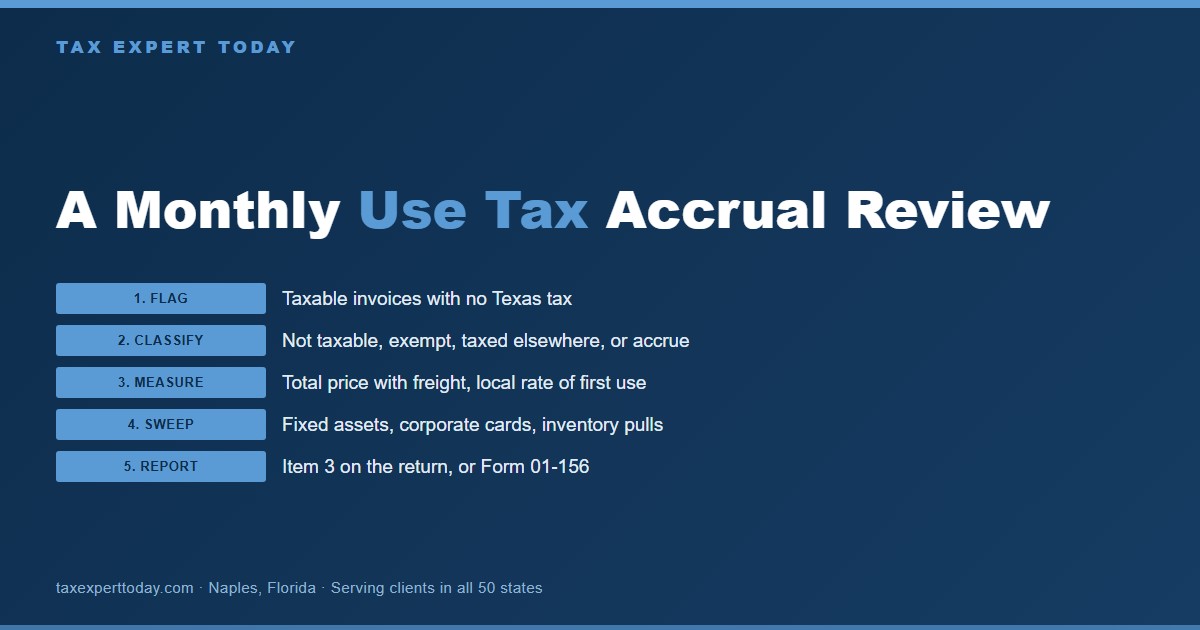
A workable accrual process identifies every untaxed purchase, decides whether each is taxable, exempt or already taxed, and reports the taxable ones in the right period at the right local rate. Most businesses do this monthly through accounts payable, with a separate review of fixed asset additions and corporate card purchases.
- Flag untaxed invoices. Any taxable category invoice without Texas tax goes to review.
- Classify each one. Not taxable, exempt with documentation, taxed elsewhere, or accrue.
- Review fixed assets separately. Large equipment purchases often bypass the normal invoice flow.
- Capture freight. Accrue on the total price including delivery.
- Keep the file. Retain the classification and support for each decision.
No statute prescribes an accrual method. What the law prescribes is the outcome: tax reported on every untaxed taxable item, in the period it was first stored, used or consumed, at the rate for the place it came to rest. The process below is a common way to reach that outcome. It is offered as a practical framework, not as a statement of what the Comptroller requires.
| Step | What it involves | Why it matters |
|---|---|---|
| 1. Vendor review | Identify vendors that do not charge Texas tax, especially out of state and foreign suppliers and software vendors | These vendors produce most untaxed purchases |
| 2. Invoice flag | Route any invoice in a taxable category without Texas tax to a use tax review | Catches the purchase before it is paid and forgotten |
| 3. Classification | Decide whether the item is not taxable, exempt with a certificate on file, already taxed in another state, or subject to use tax | Only the last category produces a liability |
| 4. Base and rate | Use the total price including delivery; apply the local rate for the place of first storage or use | Rules 3.346(d)(3) and 3.346(f) |
| 5. Fixed asset and card review | Compare fixed asset additions and corporate card purchases against the accruals | Large purchases often bypass the normal invoice workflow |
| 6. Inventory withdrawals | Record goods bought for resale and then used by the business | The resale exemption no longer fits the use |
| 7. Report | Enter the total in Item 3 on the return for the period, or on Form 01-156 if not permitted | Rule 3.346(d)(4) and the Form 01-156 deadlines |
| 8. Retain support | Keep the invoices, certificates, other state receipts and allocation workpapers | The records are what an examination will test |
Accounting systems can do some of this work. Many purchasing and accounts payable systems can assign a tax code to each invoice line and calculate an accrual automatically. The software is only as good as the vendor and item setup behind it, and it rarely captures purchases that never go through accounts payable, such as items bought on a corporate card or equipment acquired in an asset purchase. A periodic manual review of those categories closes the gap.
Direct payment permit holders work under a different arrangement. A business that holds a direct payment permit pays Texas tax directly to the Comptroller on its taxable purchases instead of paying it to vendors, and Rule 3.346(g) lets a permit holder that does not know at purchase whether a stored item will be used in Texas elect when to pay. Whether a direct payment permit makes sense is a separate decision with its own qualifications, covered in our guide to the Texas direct pay permit, and the election, once made, must be applied consistently.
Why Does Texas Use Tax Come Up in a Comptroller Audit?
A Texas sales tax examination tests both sides. On the sales side the auditor looks at what the business collected. On the purchases side the auditor reviews what the business bought for its own use, looking for taxable items on which neither the vendor nor the business paid Texas tax. Unaccrued use tax is what that review finds.
- Two sides. Sales collected and purchases consumed are both in scope.
- Expense accounts. Repairs, supplies, software and similar accounts are common review areas.
- Fixed assets. Equipment additions are often reviewed in detail.
- Sampling. Results from a sample period may be projected across the audit period, depending on the method used.
Businesses that collect Texas tax carefully are sometimes surprised that an examination produces a deficiency at all. The explanation is usually the purchases side. The business collected tax correctly from its customers and filed every return, but it bought equipment, software and supplies from vendors that did not charge Texas tax, and it never reported those purchases in Item 3. The examination is designed to find exactly that gap.
How the examination works, including the audit plan, the choice between a detailed review and a sample, and how a sample result can be projected across the audit period, is covered in our guide to the Texas Comptroller audit. The use tax point is simpler. Every untaxed taxable purchase that the business did not accrue is a potential finding, and when a sample is projected, a modest pattern of missed accruals in the sample can become a larger figure across the full period. A consistent accrual process is the most direct way to reduce that exposure before an auditor arrives, and it does not depend on predicting what any examination would conclude.
How Far Back Can the Comptroller Assess Unpaid Texas Use Tax?
Generally four years. Tax Code Section 111.201 sets a four year limitation on assessment from the date the tax was due and payable. Section 111.205 lists exceptions that allow assessment at any time, including when no report was filed. A business that never filed any return reporting the tax may not have the protection of the four year rule.
- Four year general rule. Section 111.201 limits assessment for periods covered by filed reports.
- No report filed. Section 111.205 can leave periods open indefinitely.
- Permit holders. A filed sales and use tax return generally starts the four year clock for that period.
- Nonpermitted businesses. A business that never filed Form 01-156 should take the unfiled report exception seriously.
The general limitation in Section 111.201 is four years from the date the tax became due and payable. For a permit holder that files its regular returns but leaves out use tax, each filed return covers the period, and the four year rule generally applies to it. For a business that never filed any return reporting the tax, the analysis can be different, because Section 111.205 permits assessment at any time when no report was filed. How those two rules interact, and why the difference matters for a business deciding whether to come forward, is covered in detail in our guide to the Texas voluntary disclosure agreement.
The practical takeaway is that the limitation period is not a reason to ignore unaccrued use tax. For a permit holder, the four most recent years are generally open, and those are the years an examination will cover. For a nonpermitted business, the open period may be longer. In either case, the earlier the business identifies the issue, the more options it has.
What Should a Business Do When It Finds Unpaid Texas Use Tax?
First, measure it: identify the untaxed taxable purchases, the periods, and the local jurisdictions involved. Then choose a path. Small, recent amounts can often be reported going forward and corrected for past periods by amended reporting. Larger or older exposure may call for the Comptroller’s voluntary disclosure program, which requires coming forward before any Comptroller contact.
- Quantify first. Purchases, periods, rates and any other state tax credits.
- Fix the process. Start accruing correctly on current purchases.
- Correct past periods. Amended reporting or a disclosure, depending on size and age.
- Timing matters. Voluntary disclosure is available only before the Comptroller makes contact.
The order matters. A business that discovers a use tax gap should not start by contacting the Comptroller. It should start by understanding the size and shape of the problem: which purchases were missed, in which periods, at which local rates, and whether any of them carry credits for tax paid elsewhere. That review often shrinks the problem. Some untaxed purchases turn out to be exempt, some were taxed in another state, and some are not taxable at all.
Once the exposure is measured, the choice of path depends on its size, its age, and whether the Comptroller has contacted the business. Recent, modest gaps in an otherwise compliant permit holder are often corrected through amended returns, with the accrual process fixed going forward. Larger exposure, older periods, or a business that never filed at all may justify a voluntary disclosure, which requires that the business has not been contacted by the Comptroller about the liability. The eligibility rules, the relief available and its conditions are explained in our guide to the Texas voluntary disclosure agreement. Penalties under Tax Code Section 111.061 and interest under Section 111.060 can apply to late tax, and the path chosen affects how those are treated, which is one more reason to measure before acting.
Which Exemptions Remove Texas Use Tax?
Use tax does not apply where the sale would have been exempt from sales tax, under Rule 3.346(c)(2), or where Texas sales or use tax was already paid on the item, under Section 151.303(a) and (b). So the manufacturing exemption, other statutory exemptions and out of state use reduce use tax just as they reduce sales tax.
- Exempt sale, exempt use. An item exempt from sales tax is exempt from use tax.
- Already taxed. Texas sales or use tax paid once is not paid again.
- Out of state use. Property stored only for shipment out of state is not in Texas storage.
- Documentation still required. The business must be able to show why the exemption applies.
Rule 3.346(c)(2) states the parallel: “Use tax is not applicable to the storage, use, or other consumption of taxable items in this state if the sale, lease, or rental of the taxable items would be exempt from the sales tax had the items” been purchased in Texas. A manufacturer that buys qualifying production equipment from an out of state vendor does not owe use tax on it, for the same reason it would not owe sales tax had it bought the equipment in Texas. How that exemption works and what qualifies is covered in our guide to the Texas manufacturing exemption.
The exemption still has to be supportable. When a business buys from a Texas vendor, it typically gives the vendor an exemption certificate, as explained in our guide to the Texas sales tax exemption certificate. When it buys from a vendor that does not collect Texas tax at all, there may be no certificate in the file, and the business’s own records have to show why the item was exempt. An exemption that is real but undocumented is difficult to defend in an examination.
The storage definition provides a further exclusion that matters for distributors. Under Rule 3.346(a)(1), “storage” does not include keeping property in Texas for the purpose of “transporting property out of state to a location outside Texas for use solely outside of Texas.” A business that warehouses goods in Texas only to ship them to customers or locations elsewhere is not storing them in Texas for use tax purposes.
Does Texas Use Tax Apply When a Business Buys Another Business’s Assets?
It can, depending on the transaction. Rule 3.346(b)(7) generally requires a permit holder to accrue use tax on purchases from a person making an occasional sale. It does not require accrual on certain transactions, including the sale of the entire operating assets of a business or of an identifiable segment of a business.
- General rule. Purchases from a seller making an occasional sale carry use tax for a permit holder.
- Entire operating assets. The sale of the whole business, or an identifiable segment, is excluded from the accrual requirement.
- Related party transfers. Transfers where ownership stays substantially the same are also excluded.
- Read the purchase agreement. Which assets were bought, and how, determines the answer.
Rule 3.346(b)(7)(A) states that a person who holds or is required to hold a sales and use tax permit “must accrue use tax on the purchase of a taxable item from a person entitled to the occasional sale exemption from sales tax and remit it to the comptroller.” The rule ties this to Tax Code Section 151.304(b)(1), the provision on one or two sales in a twelve month period by a person not in the business of selling. Rule 3.346(b)(7)(B) then excludes from the accrual requirement purchases under the other occasional sale categories, including Section 151.304(b)(2) on “the sale of the entire operating assets of a business or of a separate division, branch, or identifiable segment of a business” and Section 151.304(b)(3) on transfers after which the ownership of the property remains substantially similar.
The difference between buying a few pieces of used equipment from another company and buying the company’s entire operating assets can therefore change the use tax result. Buyers in an asset purchase also need to consider whether the seller had unpaid Texas tax, and what the buyer’s exposure is for it, which is a separate question from use tax on the assets themselves. The steps a seller takes when winding down, including the Comptroller’s clearance process, are covered in our guide to closing a business in Texas.
How Does Texas Use Tax Fit With Other Texas Business Taxes?
Use tax is part of the sales and use tax system administered by the Comptroller under Tax Code Chapter 151. It is separate from the Texas franchise tax, which is a privilege tax on entities measured by margin, and from federal income tax. A business can owe use tax whether or not it owes franchise tax.
- Sales and use tax. Chapter 151, reported on the sales and use tax return or Form 01-156.
- Franchise tax. Chapter 171, a separate annual report with its own threshold.
- No state income tax. Texas has no personal income tax, which shifts weight to these transaction taxes.
- Federal treatment. Use tax paid on an asset is generally part of its cost for federal purposes.
Owners who move a business to Texas sometimes hear that Texas has no income tax and conclude that state tax compliance will be light. The absence of a personal income tax is real, and its effects are explained in our guide to Texas having no state income tax. But the state funds itself in part through transaction taxes, and the sales and use tax is the broadest of them. The franchise tax is a separate obligation for most entities, with its own no tax due threshold and margin computation, explained in our guide to the Texas franchise tax, and the overall picture for a limited liability company is in our guide to Texas LLC taxes.
On the federal side, sales or use tax paid in connection with acquiring property is generally treated as part of the cost of that property, which means it is recovered through depreciation for a depreciable asset rather than deducted separately. How that applies to a particular purchase depends on the asset and the business’s federal method, and is a question for the business’s federal return preparer.
What Are Common Texas Use Tax Mistakes?
The most frequent errors are treating the permit as a sales only obligation, accruing on equipment price without freight, missing corporate card and fixed asset purchases, ignoring local tax shortfalls, claiming credits for other state tax without support, and assuming property brought into Texas after a move is automatically exempt.
- Leaving Item 3 at zero. Filing every return while never reporting taxable purchases.
- Leaving out freight. The base includes shipping and handling.
- Skipping off system purchases. Cards, asset purchases and owner paid items.
- Assuming relocation exempts everything. The one year rule has conditions.
| Mistake | Why it causes trouble | What the rule says |
|---|---|---|
| Treating the sales and use tax permit as covering sales only | Untaxed purchases go unreported for years | Permit holders report use tax in Item 3 on their regular return |
| Accruing on the equipment line and not on freight | The base is understated on every shipped purchase | Rule 3.346(d)(3) includes shipping and handling |
| Missing corporate card and fixed asset purchases | Large untaxed items bypass the accounts payable review | Use tax applies regardless of how the item was paid for |
| Ignoring local tax when the seller charged state tax only | A local shortfall accumulates across many invoices | Local use tax is due where the item is first stored or used, Rule 3.346(f) |
| Claiming a credit for other state tax without a receipt | The credit may be disallowed | Section 151.303(c) and Rule 3.346(d)(5) require similar tax legally due and paid |
| Assuming everything brought in after a move is exempt | Recently bought items may be presumed bought for Texas use | Rule 3.346(e)(2) requires more than one year of substantial, primary outside use |
| Using resale inventory internally without accruing | The tax free purchase basis no longer fits | The business owes tax on items it uses itself |
| A service firm without a permit never filing Form 01-156 | The open period may extend beyond four years | Form 01-156 deadlines and Tax Code Section 111.205 |
None of these mistakes is unusual, and most of them come from a reasonable assumption that turned out to be incomplete. The shared remedy is a process that looks at every untaxed purchase rather than relying on the vendor to have gotten it right.
Texas Use Tax Help in Naples & Southwest Florida
Tax Expert Today LLC advises businesses on state tax matters nationwide from our office in Naples, Florida. Southwest Florida owners meet Texas use tax in a few recurring ways. Florida companies open Texas locations and begin buying equipment and supplies for them from vendors in Florida and elsewhere. Naples investors own interests in Texas operating businesses whose accrual practices have never been reviewed. And owners who relocate between Florida and Texas move equipment and furniture across state lines, where the one year rule and the credit for tax paid elsewhere both come into play.
Our work on a Texas use tax review follows the sequence in this guide. We identify the untaxed purchases, classify them, apply the correct base and local rates, check for credits and exemptions, measure any past exposure, and help the business set up an accrual process that holds up going forward.
- Texas use tax help Naples owners can reach in person. Our office is on Tamiami Trail North in Naples, Florida, and we work with clients locally and remotely.
- Texas use tax Naples FL and nationwide. We serve clients in all 50 states, and the Comptroller’s rules apply the same way wherever the owner lives.
- Accrual process design. A practical monthly review built around the business’s own systems.
- Past exposure analysis. Measuring missed accruals before deciding how to correct them.
- Coordinated with your other obligations. Sales and use tax, franchise tax, payroll and federal positions are reviewed together.
Related services include our Texas tax services for businesses with Texas obligations and our Naples tax planning work for Southwest Florida owners.
Tax Expert Today LLC
11983 Tamiami Trail N, Naples, FL 34110
Phone: (239) 441-2005
Hours: Monday through Friday, 10:00 a.m. to 5:00 p.m. ET
Local question we are asked often: A Naples company opened a Texas branch last year and has its Florida headquarters order computers and office furniture for the branch from Florida vendors, who charge Florida sales tax and ship to Texas. Does the branch owe Texas use tax? The items are first used in Texas, so Texas use tax generally applies. Whether the Florida tax was legally due on items shipped out of Florida, and whether it supports a Texas credit or a Florida refund instead, depends on the facts of each sale, which is worth reviewing before the purchases are reported.
When Should You Engage a Professional?
A business with a Texas sales and use tax permit, a small number of vendors and clean records can often set up a sound accrual process using this guide and the Comptroller’s instructions. Professional review becomes worthwhile when the business has several Texas locations with different local rates, buys significant equipment or software from vendors that do not collect, has moved property into Texas from another state, has completed an asset purchase, has discovered unaccrued purchases from past periods, or is facing a Comptroller examination. Texas use tax is a state tax matter administered by the Texas Comptroller, not an IRS matter, and our multidisciplinary team of tax advisors, enrolled agents, CPAs and attorneys advises on state tax matters nationwide. Contested matters that proceed to a formal hearing or to court may call for Texas licensed counsel; we coordinate with those professionals where appropriate.
If you would like a review of your accrual process, an analysis of past exposure, or help reporting use tax correctly, contact Tax Expert Today at (239) 441-2005 or visit our Texas tax services page. Businesses dealing with a federal examination at the same time can also review our IRS resolution and audit support services.
Frequently Asked Questions
What is Texas use tax?
It is a tax on the storage, use or other consumption in Texas of a taxable item on which Texas sales tax was not paid, imposed by Tax Code Section 151.101 at the same rate as the sales tax. The state rate is 6.25 percent, and local use tax can add up to 2 percent.
Who has to pay Texas use tax?
The person storing, using or consuming the taxable item in Texas, under Section 151.102. A seller engaged in business in Texas must collect it, but if the seller does not, the buyer owes it directly to the Comptroller, and the liability continues until it is paid.
How does a business report Texas use tax?
A business with a Texas sales and use tax permit reports it in Item 3, Taxable Purchases, on its regular sales and use tax return. A business without a permit reports it on Form 01-156, Texas Use Tax Return, by the deadlines the Comptroller sets for that form.
When is Form 01-156 due?
If the use tax owed for the calendar year is less than $1,000, the return and payment are due by January 20 of the following year. Once the total reaches $1,000, they are due by the 20th of the month following the month the threshold is reached.
Does Texas give credit for sales tax paid in another state?
Yes, under Section 151.303(c), for a similar tax legally due and paid in a state that provides a similar credit to Texas taxpayers. The credit offsets the Texas use tax up to the amount paid. If the other state’s tax was lower, the difference is still owed in Texas.
Do I owe Texas use tax on equipment I bring with me when I move my business to Texas?
It depends on how long and how the equipment was used elsewhere. Under Rule 3.346(e)(2), property used for its intended purpose outside Texas for more than one year, where that use was substantial and primary, is not presumed bought for use in Texas. Recently bought items generally are.
Does Texas use tax include shipping charges?
Yes. Rule 3.346(d)(3) makes the total purchase price the base, including related charges such as shipping and handling fees, whether or not they are separately stated on the invoice.
Can a Naples, Florida business owe Texas use tax?
Yes, if it stores, uses or consumes taxable items in Texas, for example at a Texas branch, on which Texas tax was not paid. Tax Expert Today advises on state tax matters nationwide from Naples, Florida, including accrual reviews, past exposure analysis and Texas reporting.
Published October 30, 2026 by Dr. Pellumb Kabashi « Back to Learning Center
Have a question this article touches on?
Tax Expert Today LLC, based in Naples, Florida and serving clients across the United States.
Schedule a Consultation (239) 441-2005