
By Dr. Pellumb Kabashi, DBA, MBA, CES, CFE, EA
Founder, Tax Expert Today LLC · Tax advisors, enrolled agents, CPAs, and attorneys · Serving clients in all 50 states
Quick Answer: The Texas manufacturing exemption in Tax Code Section 151.318 removes sales and use tax from materials, machinery and supplies a manufacturer uses directly to make products for sale. It applies only inside the manufacturing process, which begins at the first stage of production and ends when the product is finished and packaged. Exempt utilities need a predominant use study, and later nonexempt use can trigger tax. Call (239) 441-2005 for a free consultation.
Most pages about the Texas manufacturing exemption give the reader a list. Raw materials are exempt. Production machinery is exempt. Hand tools, forklifts and office supplies are not. The lists are accurate, and the Comptroller publishes one of its own. The difficulty is that a list does not decide the cases that produce assessments. A Texas manufacturer rarely loses an exemption because it misread the word “hand tool.” It loses the exemption because a machine it treated as production equipment turned out to sit before the first stage of production, or after the product was finished, or between two machines as transportation equipment, or because the electricity it bought tax free was never supported by a study, or because exempt equipment was later used for something other than making products for sale.
The Texas manufacturing exemption is one of the largest sales and use tax exemptions in the state, and for a plant that buys equipment, parts, chemicals and power every month it can be worth far more than any single deduction on a federal return. It is also a claim the manufacturer makes for itself. There is no application, no exemption number and no advance approval. The manufacturer hands its vendor an exemption certificate, the vendor stops charging tax, and the question of whether the claim was right is answered later, usually by a Comptroller auditor, with the burden of proof on the manufacturer.
This guide is built around the tests that decide those later answers. It explains who qualifies, what the statute exempts and excludes, and then works through the four boundary questions that drive most disputes: where manufacturing begins and ends, what it means for equipment to directly cause a physical or chemical change, where production equipment stops and intraplant transportation begins, and how exempt utilities are proved. It then follows the exemption forward in time through divergent use recapture, repairs, leases, the exemption certificate, audit and refunds. It covers Texas sales and use tax. The general rules for exemption certificates are in our guide to the Texas sales tax exemption certificate, and the separate certificate for items bought for resale is in our guide to the Texas resale certificate.
What Is the Texas Manufacturing Exemption?
The Texas manufacturing exemption is the sales and use tax exemption in Tax Code Section 151.318 for items a manufacturer buys, leases or uses to make products for sale. It covers ingredients and components, equipment that directly causes a physical or chemical change in the product, and related categories such as pollution control and quality control.
- A purchase exemption. It removes the 6.25 percent state tax and any local tax from qualifying purchases, leases and uses.
- Self claimed. The manufacturer gives the vendor a Form 01-339 exemption certificate; the Comptroller does not issue an approval or number.
- Use based. Whether an item qualifies depends on how it is used in the plant, not on what the item is called or who sells it.
- Proved by the taxpayer. Section 151.318(r) places the burden of proof on the person claiming the exemption.
Texas imposes a 6.25 percent state sales and use tax on retail sales, leases and rentals of most goods and on taxable services, and local taxing jurisdictions can add up to 2 percent, for a maximum combined rate of 8.25 percent. A manufacturer buys a great deal of tangible personal property. Without an exemption, every ton of steel, every press, every replacement die and every month of electricity at a plant would carry that tax, and the tax would then be embedded in the price of the finished product, where the buyer pays sales tax again on the full price. The manufacturing exemption exists to keep that tax from stacking. Publication 94-124 describes it plainly: the exemption is available to taxpayers who manufacture, fabricate or process tangible personal property for sale.
The operative statute is Tax Code Section 151.318. Subsection (a) lists eleven categories of exempt property. Subsection (b) adds chemicals and catalysts, and cleanroom equipment for semiconductor and pharmaceutical biotechnology manufacturers. Subsection (c) lists what the exemption does not include. Subsection (d) defines manufacturing as each operation beginning with the first stage in the production of tangible personal property and ending with the completion of tangible personal property having the physical properties, including packaging, that it has when transferred by the manufacturer to another. The Comptroller’s detailed rule is 34 Tex. Admin. Code Section 3.300, and the companion rule for electricity and natural gas is Section 3.295.
Two features of the exemption shape everything that follows. First, it is an exemption for a use, not for a type of business. A manufacturer does not become exempt on all its purchases by being a manufacturer. It becomes exempt on the purchases that are used in the qualifying way, and it remains taxable on everything else, including much of what it buys for the same building. Second, the exemption is tested at the item level. An auditor does not ask whether the plant is a manufacturing plant. The auditor asks whether this conveyor, this compressor, this chiller and this month of electricity were used inside the manufacturing process and in the way the statute requires.
Who Qualifies as a Manufacturer for the Texas Manufacturing Exemption?
A business qualifies if it manufactures, processes or fabricates tangible personal property for ultimate sale, including a submanufacturer that performs one step for another manufacturer and a custom manufacturer working to order. Contractors, businesses repairing property that belongs to others, and service providers such as data processors do not qualify, even when they use heavy equipment.
- Manufacturers of products for sale. The product must be tangible personal property that is sold, not used internally.
- Submanufacturers. A business performing one or more manufacturing operations for another manufacturer qualifies for that work.
- Fabricators and assemblers. Assembling components into a product for ultimate sale is fabrication.
- Processors. Physically modifying the characteristics of property for sale is processing.
Rule 3.300 defines a manufacturer as a person engaged in manufacturing and states that the definition includes processors, fabricators, submanufacturers and custom manufacturers. It then defines the two activities that most often decide close cases. Fabrication means to make, build, create, produce or assemble components of tangible personal property, or to make tangible personal property work in a new or different manner. Processing means the physical application of the materials and labor necessary to modify or to change the characteristics of tangible personal property. The rule gives an example: a business that takes raw steel and makes pipe is fabricating, and workers who coat or thread the pipe are processing. Both are manufacturing.
The rule also draws lines. The repair of tangible personal property belonging to another, by restoring it to its original condition, is not processing. The mere packing, unpacking or shelving of a product to be sold is not processing. Processing does not include remodeling, which the rule defines as making property belonging to another over again in a similar but different way without changing its identity or making it work in a new manner. Manufacturing does include the repair or rebuilding of property the manufacturer owns for the purpose of selling it, so a business that buys used engines, rebuilds them and sells them is manufacturing, while a business that rebuilds a customer’s engine for a fee is performing a taxable repair service.
| Business | Qualifies as a manufacturer? | Why |
|---|---|---|
| Metal fabricator making parts sold to equipment makers | Yes | Fabricates tangible personal property for ultimate sale |
| Coating shop that powder coats parts owned by a manufacturer before they are sold | Yes, as a submanufacturer | Performs a manufacturing operation for a manufacturer on product being made for sale |
| Food processor packaging sauces for grocery distribution | Yes, with limits on prepared food utilities | Processes tangible personal property for sale; Section 151.317 excludes prepared food preparation and storage from the utility exemption |
| Machine shop that rebuilds customer owned pumps | No, for that work | Repairing property belonging to another is not manufacturing |
| General contractor building a warehouse | No | Contractors are excluded; real property work follows separate contractor rules |
| Data processing company | No | Service providers do not manufacture tangible personal property |
| Software publisher selling software | Yes, for software manufacturing | Section 151.318(p) treats design, coding, testing and demonstration as manufacturing |
Publication 94-124 lists the three classes of non manufacturers that do not qualify: contractors, persons repairing real or tangible personal property belonging to others, and service providers such as telecommunications service providers or data processors. These are not technicalities. A construction company may own equipment heavier than anything in a small factory, and a repair shop may machine metal all day, but neither is making tangible personal property for sale, and that is the activity the exemption protects. How Texas taxes the repair and real property services those businesses sell is covered in our guide to Texas taxable services. A business that does both, for example a fabricator that also performs field repairs, qualifies only for the property used in the fabrication work, and the mixed use of the same equipment raises the divergent use questions covered later in this guide.
The phrase “for ultimate sale” also matters. Rule 3.300 treats samples as taxable: because the sole use of a sample is to demonstrate other items, the raw materials used to make samples are subject to tax even if the sample is later sold. A manufacturer that makes fixtures, jigs or tooling for its own use is not making property for sale, and the materials and equipment used to make those internal items do not qualify. Publication 94-124 makes the same point about equipment used to make molds or dies, and equipment used to make other equipment that is then used to make a product for sale: both are taxable manufacturing support.
What Purchases Does the Texas Manufacturing Exemption Cover?
The exemption covers ingredients and component parts, equipment directly used in production that causes a physical or chemical change, services that make the product more marketable, equipment that powers or controls exempt machinery, pollution control, lubricants that protect exempt equipment, protective gases, quality control, required safety apparel, public health compliance items, and water reduction and wastewater reuse equipment.
- What goes into the product. Ingredients and components that become part of the item sold.
- What changes the product. Equipment that directly makes or causes a chemical or physical change.
- What supports exempt equipment. Power, control, lubrication and steam equipment tied to exempt machinery.
- What the law requires. Pollution control, safety apparel and public health compliance items used in production.
Section 151.318(a) is the list that defines the exemption, and it is more specific than many summaries suggest. The table below sets out each category with the condition the statute attaches to it. The conditions are where the exemption is won or lost.
| Section 151.318(a) | What is exempt | Condition the statute attaches |
|---|---|---|
| (1) | Ingredients and component parts | The property becomes an ingredient or component of the product manufactured for ultimate sale |
| (2) | Production equipment and other property used in manufacturing | Directly used or consumed during actual manufacturing, necessary or essential to the operation, and directly makes or causes a chemical or physical change to the product or an intermediate product |
| (3) | Services performed on the product | Performed directly on the product before distribution, to make it more marketable |
| (4) | Actuators, steam equipment and fuel, cooling towers, generators, transformers, control room equipment, pumps, compressors, hydraulic units | Used to power, supply, support or control equipment exempt under (2) or (5), or to generate electricity, chilled water or steam for sale |
| (5) | Pollution control property | Used in actual manufacturing and necessary and essential to a pollution control process |
| (6) | Lubricants, chemicals, gases and liquids | Necessary and essential to prevent decline, failure or deterioration of exempt equipment |
| (7) | Gases used on the plant premises | Used to prevent contamination of raw material or product, or fire, explosion or other hazards |
| (8) | Quality control property | Necessary and essential to a quality control process testing product being made for sale |
| (9) | Safety apparel and work clothing | Manufacturing would not be possible without it, and it is not resold to the employee |
| (10) | Public health compliance property | Necessary and essential to comply with federal, state or local public health laws |
| (11) | Water reduction, wastewater reuse and treatment equipment | Specifically installed to reduce water use, reuse wastewater, or replace fresh water with treated wastewater |
Subsection (b) adds that the exemption includes chemicals, catalysts and other materials used during manufacturing to produce or induce a chemical or physical change, to remove impurities, or to make the product more marketable. It also adds semiconductor fabrication cleanrooms and equipment and pharmaceutical biotechnology cleanrooms and equipment, which follow special rules discussed later.
Rule 3.300(d) restates these categories and fills in practical detail. It confirms that gas and electricity used directly in manufacturing are exempt under the separate rules of Section 3.295. It exempts labor charges for repair, maintenance, remodeling or restoration of exempt machinery and of pollution control equipment that a law or regulation requires. It exempts wrapping, packing and packaging supplies used to further the sale of a product, under the separate rule on packaging. And it exempts display items used only to demonstrate themselves before sale, with the warning that any other use by the manufacturer is taxable as a divergent use.
Two categories deserve attention because they are underused. Category (4), the power, supply, support and control equipment, reaches items that do not themselves touch the product: the compressor that drives a pneumatic press, the hydraulic unit behind a forming machine, the computerized control unit that runs a line, the cooling tower that keeps exempt equipment in operating range. These items qualify only through their connection to equipment that is itself exempt, so the analysis must start with the exempt machine and work outward. Category (8), quality control, reaches testing equipment used during actual manufacturing on product being made for sale. A laboratory that develops new formulas is research and development, which subsection (c)(3) excludes. A laboratory that tests samples pulled from today’s production run is quality control. The same instrument can fall on either side depending on which work it does, and a plant that uses one lab for both is in divergent use territory.
What Is Excluded From the Texas Manufacturing Exemption?
The exemption excludes intraplant transportation equipment such as most piping and conveyors, hand tools, maintenance and janitorial supplies, office equipment, items used in sales, distribution, research and development or transportation, equipment used to maintain or store property, electricity transmission equipment, and any taxable item rented or leased for less than one year.
- Moving things. Intraplant transportation, forklifts, cranes, hoists and most piping and conveyors are taxable.
- Hand powered tools. A hammer stays taxable even when used on product for sale.
- Everything outside production. Offices, maintenance, cleaning, storage, sales and research are taxable.
- Short leases. Equipment rented or leased for less than one year does not qualify.
Section 151.318(c) and (e) set out the exclusions, and Rule 3.300(c) repeats them as a list of items specifically subject to tax. Publication 94-124 adds the practical framing: machinery and equipment used for manufacturing support, but not directly in the manufacturing process, generally do not qualify. Its examples are air conditioning for employee comfort, equipment used to make molds or dies, and equipment used to make other equipment.
| Excluded item | Source | Common example in a plant |
|---|---|---|
| Intraplant transportation equipment, including piping and conveyor systems | Section 151.318(c)(1); Rule 3.300(c)(5) | Conveyor moving parts from a stamping press to a welding cell; forklifts; cranes |
| Hand tools | Section 151.318(c)(2); Rule 3.300(a)(6) | Hammers, screwdrivers, files, trowels, paint brushes |
| Maintenance supplies and equipment, janitorial supplies, office equipment | Section 151.318(c)(3) | Floor scrubbers, shop rags used for cleaning, printers in the plant office |
| Equipment used in sales, distribution, research and development, or transportation | Section 151.318(c)(3) | Delivery trucks, pilot lines for new products, showroom fixtures |
| Equipment used to maintain or store property | Section 151.318(c)(4); Rule 3.300(c)(6) | Racking and refrigeration for finished goods inventory |
| Electricity transmission and distribution property | Section 151.318(c)(5) | Lines, poles and towers; transformers not tied to exempt generation |
| Items rented or leased for less than one year | Section 151.318(e); Rule 3.300(c)(2) | A six month rental of an extra press during a busy season |
The hand tool definition in Rule 3.300 is precise and worth reading in full. A hand tool is an instrument used, managed and powered by the hand, such as a paint brush, trowel, hammer, screwdriver or file. Equipment that is controlled or operated by the hand but moved or powered by electricity, gas, steam or another fuel is not a hand tool, and the rule names the electric drill, chain saw and jack hammer as examples. A powered tool can therefore qualify if it directly causes a physical change to the product during actual manufacturing, while an unpowered tool doing the same work cannot.
The research and development exclusion is also narrower than it sounds. It excludes equipment used in research or development of new products. It does not exclude quality control testing of current production, which category (8) exempts, and it does not exclude the first production runs of a product the manufacturer will sell. The line between a pilot line and a production line is a fact question, and a plant that runs both on the same equipment should document which runs were which.
Where Does Manufacturing Begin and End Under the Texas Manufacturing Exemption?
Manufacturing begins with the first act of production that changes raw materials, not with receiving, gathering, sorting or arranging them. It ends when the product has all the physical properties, including packaging, that it has when the manufacturer transfers it to another. Equipment used before or after that window is outside the exemption.
- Before the start line. Receiving, unloading, staging, sorting and storing raw materials are preparation, which is taxable.
- Inside the process. From the first change to the raw material through final packaging is manufacturing.
- After the finish line. Warehousing, loading, shipping and distribution of finished goods are taxable.
- Software is special. Manufacturing starts with design and coding and includes testing and demonstration.
This boundary is the single most important test in the Texas manufacturing exemption, and it is the one a list cannot answer. Section 151.318(d) defines manufacturing as each operation beginning with the first stage in the production of tangible personal property and ending with the completion of tangible personal property having the physical properties, including packaging, if any, that it has when transferred by the manufacturer to another. Rule 3.300(a)(9) adds two clarifications. The first production stage means the first act of production and does not include acts in preparation for production. And completion of production means the property has all the physical properties, including packaging, that it has when transferred.
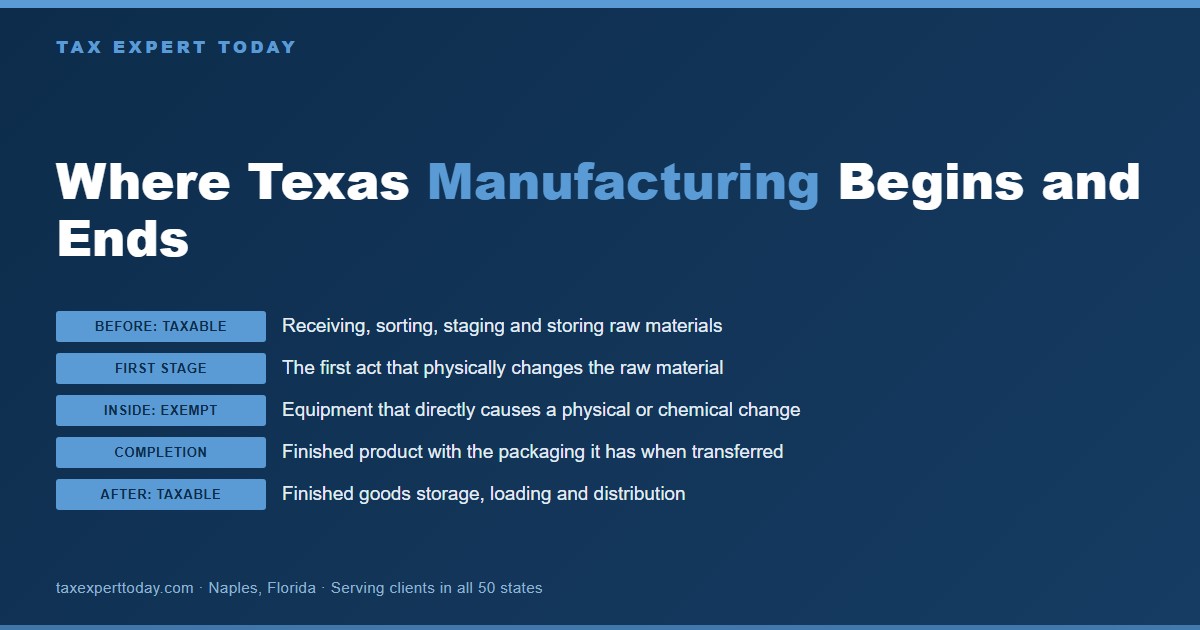
The rule gives two examples of preparation. A lumber company that cuts trees is preparing for production, not manufacturing, and a manufacturer that gathers, arranges or sorts raw materials or inventory is also preparing for production. On the other end, the rule offers raw rubber: a manufacturer of raw rubber has completed production when the raw rubber is ready to be transferred to a manufacturer of rubber goods. Publication 94-124 states the same test in plain terms. Typically, the first activity that changes raw materials or ingredients of the product begins the manufacturing process, and the process ends when the product has the same physical properties as when sold or transferred, including any packaging.
Applied to a real plant, the boundary usually falls in predictable places, but the places are not always where the plant layout suggests. The table below shows a common pattern for a metal products manufacturer.
| Plant activity | Inside or outside manufacturing? | Reasoning under Rule 3.300(a)(9) |
|---|---|---|
| Unloading coil steel from trucks and placing it in storage racks | Outside, before | Receiving and storing raw material is preparation for production |
| Inspecting incoming coil for thickness | Outside, before, in most cases | Inspection of raw material before any change is preparation; quality control of product in process is a different category |
| Uncoiling and cutting the steel to blank size | Inside | The first act that physically changes the raw material |
| Stamping, welding, machining and coating | Inside | Physical changes to the product during actual manufacturing |
| Testing finished parts pulled from the line | Inside, as quality control | Section 151.318(a)(8) covers testing of product being made for sale |
| Boxing and labeling parts for shipment to the customer | Inside | Completion includes packaging the product has when transferred |
| Storing boxed parts in the finished goods warehouse | Outside, after | The product is complete; storage is excluded by Section 151.318(c)(4) |
| Loading trucks and delivering to customers | Outside, after | Distribution and transportation are excluded by Section 151.318(c)(3) |
The finish line moves with the product. If the manufacturer sells its product in bulk, completion may occur when the product leaves the last processing step, and later packaging for a distributor may be distribution. If the manufacturer sells the product in retail packaging, the packaging step is part of manufacturing because the product is not complete until it has the packaging it has when transferred. That is why two plants making the same product can draw the line in different places, and why the analysis should begin with what the customer actually receives.
Software has its own start line. Section 151.318(p) provides that the manufacturing of computer software begins with the design and writing of the code or program and includes the testing or demonstration of the software. Rule 3.300(a)(9) repeats it. For a software business that sells software as tangible personal property under Texas rules, equipment used in coding and testing can be inside the manufacturing process in a way that office equipment would not be in a conventional plant.
What Does “Directly Makes or Causes a Chemical or Physical Change” Mean?
Under Section 151.318(a)(2), it is not enough that equipment is used in the plant or is essential to the business. It must be directly used during actual manufacturing, be necessary or essential to the operation, and directly make or cause a chemical or physical change to the product or to an intermediate product that becomes part of it.
- Directly used. Incidental or merely useful equipment does not qualify under Rule 3.300(c)(3).
- Necessary or essential. The operation could not be performed without the item.
- Causes the change. The equipment itself must act on the product, not merely be present while change occurs.
- During actual manufacturing. The change must occur between the first stage and completion.
The three part test in Section 151.318(a)(2) is conjunctive, and each part removes a different class of equipment. “Directly used or consumed in or during the actual manufacturing” removes equipment that operates before or after the process. “Necessary or essential to the manufacturing operation” removes conveniences. “Directly makes or causes a chemical or physical change” removes equipment that is present during manufacturing and important to it but does not itself act on the product. Comfort air conditioning in a production area is a standard example of the last category: it runs during manufacturing and the plant may not be able to operate without it, but it does not change the product, and Publication 94-124 lists it as taxable manufacturing support.
The Texas Supreme Court addressed the causation element in Southwest Royalties, Inc. v. Hegar, decided June 17, 2016. An oil and gas producer claimed the exemption for casing, tubing and pumps used to bring hydrocarbons to the surface, arguing that the hydrocarbons changed phase as pressure and temperature changed on the way up. The Court agreed with the producer that processing is not limited to activity inside a factory, and it adopted the definition of processing in Rule 3.300 as the physical application of materials and labor necessary to modify or change the characteristics of tangible personal property. It then held the equipment did not qualify, because the trial court had found that the changes were caused by natural pressure and temperature changes rather than by the equipment acting on the hydrocarbons. The case is a useful reminder that the question is not whether change happens while the equipment runs. The question is whether the equipment causes it. Mineral owners and investors face separate federal questions on production income, which we cover in our guide to royalty income taxes.
In practice, this element is proved with engineering facts, not with labels. A process flow description that identifies, step by step, what each machine does to the product is far more persuasive than an asset list marked “production.” Where an item supports exempt equipment without touching the product, the claim usually belongs under category (4), the power, supply, support and control equipment, and the support relationship should be documented in the same way.
How Does the Intraplant Transportation Exclusion Work?
Equipment that moves product or raw material within the plant is taxable intraplant transportation, including most piping and conveyor systems, even if processing happens while the material moves. Piping and conveyors qualify only as a component of a single exempt machine, or when they recycle product within one step or back to an earlier machine.
- Default rule. Forklifts, hoists, cranes, conveyors, pipes, related pumps, meters, valves and rollers are taxable.
- Component exception. Rollers and pipes inside a single exempt machine, such as a printing press, stay exempt.
- Recycle loop exception. Piping that circulates product between one machine and the ancillary equipment supporting only that machine can qualify.
- Forward piping. Pipe carrying material forward from one machine to the next is taxable.
Section 151.318(c)(1) excludes intraplant transportation equipment, including equipment used to move a product or raw material in connection with the manufacturing process, and specifically including all piping and conveyor systems. It then preserves three exceptions: piping or conveyors that are a component part of a single item of manufacturing or pollution control equipment; piping through which product is recycled or circulated in a loop between a single machine and ancillary equipment that supports only that machine, where they operate together to perform a specific step; and piping through which product is recycled back to another single machine and its ancillary equipment in the same process.
Subsection (f) then closes the most common argument. Piping through which material is transported forward from one single item of manufacturing equipment to another is not a component part of a single item and is not exempt. And an integrated group of machines and ancillary equipment that operate together to make a product is not a single item of manufacturing equipment. A plant cannot, in other words, treat an entire line as one machine and claim every pipe and conveyor in it as a component.
Rule 3.300(c)(5) adds that intraplant transportation equipment is taxable even if manufacturing or processing activities, such as cooling, mixing or pollution containment, occur during the transportation of product. The rule’s own example of the component exception is a printing press: the press contains rollers and pipes to feed paper or ink, the purchase of the press qualifies, and rollers, pipe and other press repair parts remain exempt even when bought separately. The practical test is physical: is the piece of pipe or conveyor inside the boundary of one machine, or does it connect two machines?
| Equipment | Likely treatment | Statute or rule |
|---|---|---|
| Feed rollers inside a printing press | Exempt as a component of a single exempt machine | Section 151.318(c)(1)(A); Rule 3.300(d)(17) |
| Conveyor carrying parts from the press to the next station | Taxable intraplant transportation | Section 151.318(c)(1), (f) |
| Recirculation piping between a reactor and its dedicated heat exchanger | May be exempt as a recycle loop within one step | Section 151.318(c)(1)(B) |
| Piping returning off specification product to an earlier vessel in the same process | May be exempt as recycle piping | Section 151.318(c)(1)(C) |
| Transfer piping from a mixing tank to a filling line | Taxable forward piping | Section 151.318(f) |
| Forklift moving work in process between cells | Taxable intraplant transportation | Publication 94-124; Rule 3.300(c)(5) |
Semiconductor fabrication and pharmaceutical biotechnology cleanrooms are the stated exception to all of this. Section 151.318(q) and (q-1) provide that cleanroom equipment in those industries is not intraplant transportation equipment, and subsection (s) removes the intraplant transportation and storage exclusions for that equipment. Outside those two industries, the exclusion applies in full.
Are Electricity and Natural Gas Exempt Under the Texas Manufacturing Exemption?
Yes, in part. Section 151.317 exempts gas and electricity used to power exempt manufacturing equipment and used for lighting, cooling and heating in the manufacturing area during actual manufacturing, other than preparation or storage of prepared food. When one meter serves both exempt and taxable uses, the whole bill is exempt or taxable based on predominant use.
- Exempt uses. Powering exempt equipment, and lighting, cooling and heating the manufacturing area during production.
- Taxable uses. Offices, storage, engineering, research, break rooms, restrooms and public marketing areas.
- Single meter rule. The meter’s predominant use makes the entire billing period exempt or taxable.
- Proof required. Rule 3.295 requires a certified utility study on file before the exemption certificate is given to the utility.
Section 151.317(a)(2) exempts gas and electricity sold for use in powering equipment exempt under Section 151.318 by a person processing tangible personal property for sale, other than the preparation or storage of prepared food. Subsection (a)(3) exempts gas and electricity used in lighting, cooling and heating in the manufacturing area during the actual manufacturing or processing of tangible personal property for sale, again excluding prepared food. Subsection (d) requires that the gas or electricity be sold to the person using it in the exempt manner, while treating use by an independent contractor engaged by the purchaser as use by the purchaser.
Subsection (e) contains the rule that makes utilities different from every other purchase. Natural gas or electricity used during a regular monthly billing period for both exempt and taxable purposes under a single meter is totally exempt or taxable based on the predominant use of the natural gas or electricity measured by that meter. Rule 3.295(f) requires a person claiming the exemption to establish predominant use based on twelve consecutive months of use, with a seasonal alternative for a business that performs the exempt function only part of the year. The rule does not state a numeric percentage in its text. It requires the study to show the percentage of exempt use, and predominant, in ordinary usage, means the greater part.
Rule 3.295(f)(3) also tells the manufacturer what counts on each side. Utilities used to operate exempt machinery, and for lighting, cooling and heating in the manufacturing area during actual manufacturing, are exempt. Utilities used for lighting, cooling and heating in manufacturing support areas are taxable, and the rule lists storage, engineering, office, accounting, research and development, break, eating and restroom areas as examples. Utilities used in an area open to the public for marketing a product ready for sale are taxable, and utilities used to operate other nonproduction machinery are taxable. A plant on one meter with a large warehouse, office block or showroom may find that the predominant use test is closer than it expected.
What Is a Predominant Use Study and What Must It Contain?
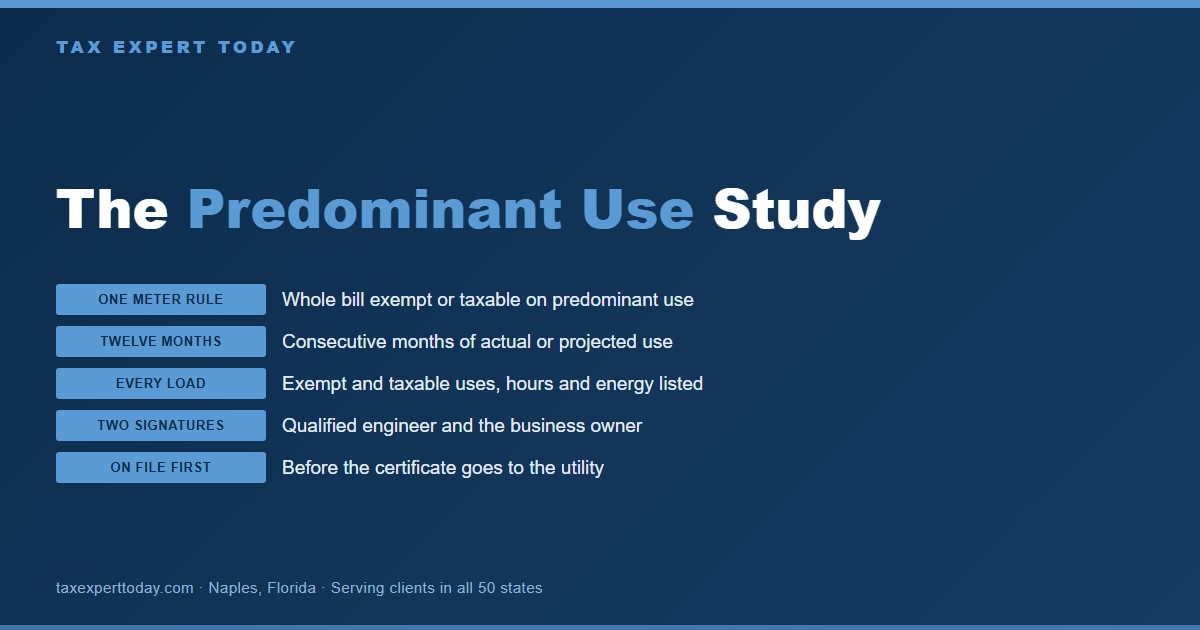
A predominant use study is the engineering study Rule 3.295 requires to support an electricity or natural gas exemption on a meter with mixed use. It must list every use, its timing, energy and tax status, cover twelve consecutive months, and carry certifications from a qualified engineer and from the business owner.
- Complete inventory. Every item using the utility on that meter, exempt and taxable.
- Twelve months. Consecutive months of actual usage, or projected use for a new business.
- Two certifications. A registered engineer or engineering graduate, and the owner, both on the face of the study.
- On file first. The study must be at the location before the exemption certificate goes to the utility.
Rule 3.295(g) sets the requirements in detail, and they are stricter than many manufacturers assume. The study must list all uses of the utility, both exempt and taxable, the times of usage, the energy used, whether each use was taxable or exempt, and the percentage of exempt use. Twelve consecutive months of utility usage must be part of the study. The kilowatt or BTU ratings, duty factors where needed for cycling equipment, and the electrical or natural gas computations must be certified by a registered engineer or a person with an engineering degree from an accredited engineering college. The owner must certify that all items using the utility are listed and that the hours of use are correct, and both certifications must appear on the face of the study.
| Rule 3.295(g) requirement | What it means in practice |
|---|---|
| All uses listed, exempt and taxable | Every motor, heater, light circuit, HVAC unit and office load on the meter, not only the production equipment |
| Twelve consecutive months | Twelve months of actual usage, or a projected study for a business operating less than twelve months, to be supported later by actual use if requested |
| Engineering certification | Ratings, duty factors and computations certified by a registered engineer or a person with an accredited engineering degree |
| Owner certification | The owner certifies that every item is listed and the hours of use are correct |
| On file before the certificate | The study must be completed and on file at the location when the exemption certificate is submitted to the utility, or the claim is presumed invalid |
| Power of attorney for agents | An agent acting for the business must hold a power of attorney stating it is seeking the exemption for the principal |
| Changes after the study | A retrospective study for a refund must account for changes in equipment, activities and square footage served by the meter |
The consequences of a missing or weak study are written into the rule. Without the study, the claim for exemption is presumed invalid. A person who obtains a refund from a utility company without a valid study will be assessed tax, penalty and interest on the full amount of the refund if the exemption is not proved. The Comptroller may request the study before or after the exemption is granted, and neither the Comptroller’s review nor the utility’s acceptance of a certificate confirms the study’s accuracy. If the Comptroller later finds the study incomplete or inaccurate, tax, penalty and interest are assessed to the extent the predominant use is taxable. The Comptroller will not accept a study that cannot be independently verified, such as one performed for a closed utility account.
Two provisions reduce the burden. A business in operation less than twelve months may claim the exemption on a projected study, as long as it can support the claim with a study of actual use after twelve months if asked. And a business that changes utility providers without changing its usage does not need a new study, though it must keep the study on file and give the new provider a properly completed certificate. Rule 3.295(g)(7) also recognizes industry wide studies, approved by the Comptroller, for industries in which the utility use would always qualify as exempt.
The study is not a one time exercise. A plant that adds a warehouse on the same meter, converts production floor to office space, or adds significant nonproduction equipment has changed the facts the study measured. Because the single meter rule is all or nothing, a change that moves the meter from predominantly exempt to predominantly taxable converts the entire bill to taxable, and a study that no longer reflects the plant is the kind the rule says will not be relied on.
What Is Divergent Use Under the Texas Manufacturing Exemption?
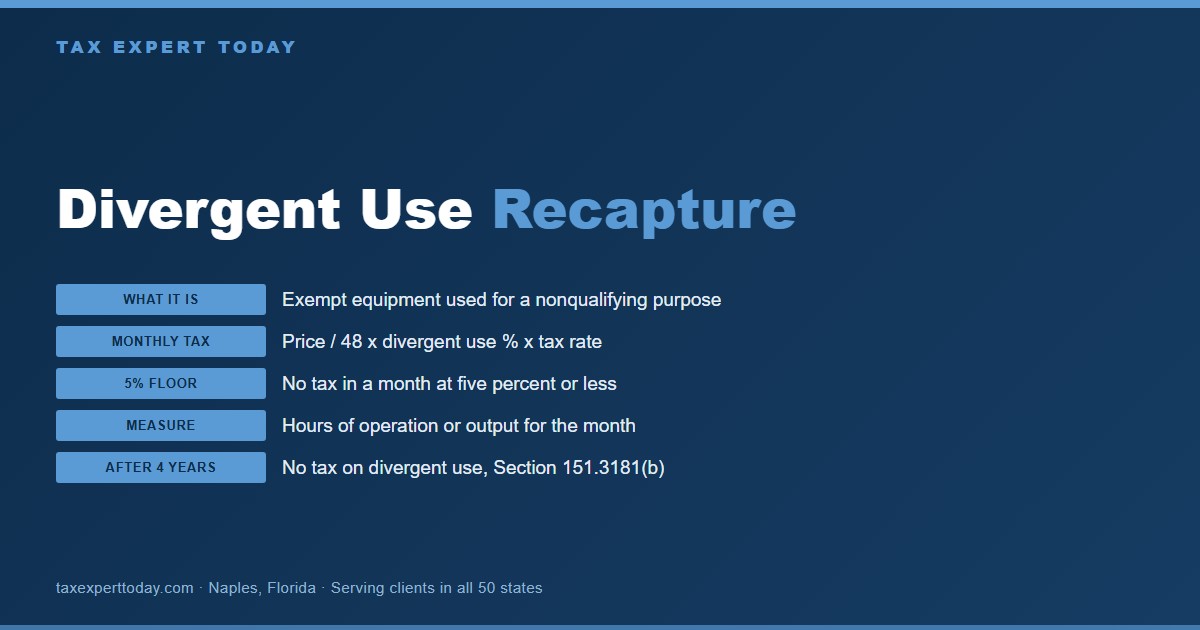
Divergent use is using exempt manufacturing property in a way other than the way that qualified it, such as internal projects or customer repairs. Under Section 151.3181, divergent use in the first four years creates a monthly tax of 1/48 of the price, times the divergent use percentage, times the tax rate, unless that month is five percent or less.
- Four year window. No tax is due on divergent use after the fourth anniversary of the purchase date.
- Monthly measurement. Divergent use is measured each month by hours of operation or by output.
- Five percent floor. A month with divergent use of five percent or less owes nothing.
- Self assessed. The manufacturer computes and remits the tax and keeps the records that support it.
Section 151.3181 defines divergent use as the use of property in a manner or for a purpose other than the manner or purpose that qualified it for exemption under Section 151.318. It then sets a formula that recaptures the exemption gradually rather than all at once. Divergent use after the fourth anniversary of the purchase date produces no tax. Divergent use during any month before that anniversary produces tax for that month equal to 1/48 of the purchase price, multiplied by the percentage of divergent use during the month, multiplied by the sales and use tax rate applicable at the time of purchase. No tax is due for a month in which divergent use does not exceed five percent of total use. The amount of divergent use is measured either by hours of operation or by output.
Publication 94-124 restates the formulas. Divergent use percentage by hours equals total hours of divergent operation in the month divided by total hours of operation in the month. By output, it equals output during divergent use divided by total output for the month. Tax due equals 1/48 of the purchase price times the divergent use percentage times the tax rate. Rule 3.300(k) adds that the 48 month period begins when the equipment is purchased. One drafting difference is worth noting: the statute refers to the rate applicable at the time of purchase, while the rule’s text refers to the rate when the divergent use occurs. In most locations the two are the same; where a local rate changed during the four years, the difference should be confirmed before the tax is computed.
The table below is a hypothetical illustration only, not based on any client. It assumes a fabricator bought a CNC machine for $480,000 at a combined 8.25 percent rate and claimed the exemption, then began using the machine for some internal tooling and customer repair work.
| Month (hypothetical) | Divergent hours / total hours | Divergent use percentage | Computation | Tax due for the month |
|---|---|---|---|---|
| Month 6 | 12 / 300 | 4.0% | Five percent or less | $0 |
| Month 14 | 30 / 300 | 10.0% | $480,000 / 48 x 10.0% x 8.25% | $82.50 |
| Month 30 | 60 / 300 | 20.0% | $480,000 / 48 x 20.0% x 8.25% | $165.00 |
| Month 47 | 18 / 300 | 6.0% | $480,000 / 48 x 6.0% x 8.25% | $49.50 |
| Month 50 | 90 / 300 | 30.0% | After the fourth anniversary | $0 |
Two lessons follow from the formula. First, divergent use does not cancel the exemption. Publication 94-124 confirms that a manufacturer may still give its supplier an exemption certificate when it buys qualifying equipment it expects to use divergently, and then pay tax on the divergent share. Second, the tax is small in any one month but cumulative, and it is self assessed. A manufacturer that never tracks divergent hours has no basis for the five percent floor, and an auditor who finds evidence of nonproduction use may estimate it. The records that matter are machine logs, job tickets or output reports that separate production work for sale from everything else.
The rule also covers resale certificates. Under Rule 3.300(k)(1), a manufacturer that used a resale certificate to buy property tax free and then used it for a nonexempt purpose owes tax based on the purchase price or fair market rental value, under the general resale and use tax rules explained in our guide to the Texas resale certificate. The 1/48 formula applies to property bought on an exemption certificate under Section 151.318, not to items bought for resale, which is one reason the two certificates should not be used interchangeably.
How Are Repair Parts, Repair Labor and Consumables Treated?
Replacement parts and accessories for exempt equipment generally share its exempt status, and labor to repair or maintain exempt machinery is exempt under Rule 3.300(d). For mixed use equipment, Rule 3.300(k) applies the month’s divergent use percentage to minor parts and consumables, and ties repair labor to how the equipment was used when the repair was needed.
- Parts follow the machine. Repair parts for an exempt press remain exempt, even when bought separately.
- Labor on exempt machinery. Repair, maintenance, remodeling and restoration labor on exempt equipment is exempt.
- Mixed use parts election. Non capitalized parts and consumables may be taxed at the divergent use percentage for the month of purchase.
- Labor timing test. Repair labor is exempt if the equipment was in exempt use when the repair was needed.
Rule 3.300(a)(12) defines a replacement part as any repair part attached to the machinery, equipment or accessory, and the rule’s printing press example confirms that rollers, pipe and other press repair parts remain qualifying accessories or repair parts even when purchased separately. Rule 3.300(d)(14) exempts labor charges for repair, maintenance, remodeling or restoration services to exempt machinery and to pollution control equipment that a law or regulation requires. Repair labor on nonexempt equipment, such as a forklift, an office HVAC unit or a finished goods freezer, remains a taxable service, which we explain more broadly in our guide to Texas taxable services.
For equipment routinely used in both exempt and nonexempt ways, Rule 3.300(k)(3)(D) and (E) provide two practical rules. A manufacturer that buys non capitalized repair parts or consumables for that equipment may elect to pay tax on them by applying the equipment’s divergent use percentage for the month the parts were purchased. For repair labor, the rule looks at the moment the repair was needed. If the equipment was in exempt use, no tax is due on the repair. If it was in nonexempt use, tax is due on the full price of the repair. If the manufacturer cannot determine which, it may pay tax on the repair price multiplied by the divergent use percentage for the month the repair service was bought. Each of these rules depends on the same monthly records the divergent use formula requires.
Do Leased and Rented Items Qualify for the Texas Manufacturing Exemption?
Yes, if the lease is for one year or more and the item is used in an exempt manner. Section 151.318(e) and Rule 3.300(c)(2) make machinery, equipment, replacement parts and accessories rented or leased for less than one year taxable, regardless of how they are used. A one year or longer lease of qualifying equipment can be exempt.
- Less than one year. Taxable, even if the equipment is used directly in production.
- One year or more. Exempt when the equipment is used in a qualifying way, under Rule 3.300(e).
- Read the term. The contract term, not the actual period of use, is what the rule measures.
- Renewals. Month to month extensions of a short rental should be reviewed before an exemption is claimed.
Rule 3.300(e) states that taxable items used in an exempt manner and leased on or after October 1, 1995, for a term of one year or more qualify for the exemption. The short term rental exclusion catches a common practice: renting an extra machine for a seasonal spike or a single large order. A six month rental of a press used directly in production is taxable under the rule even though the same press would be exempt if bought or leased for a year. A manufacturer that expects to need equipment for longer than a few months should compare the tax cost of a short rental against a one year lease before signing.
How Do You Claim the Texas Manufacturing Exemption With Form 01-339?
The manufacturer gives the vendor a completed Form 01-339 (back), the Texas Sales and Use Tax Exemption Certification, describing the items and the reason for exemption. No exemption number exists or is required. The certificate goes to the vendor, not the Comptroller, and a separate certificate goes to the utility.
- Required contents. Purchaser name and address, item description, reason for exemption, signature and date, and seller name and address.
- No number. The form states that sales and use tax exemption numbers do not exist.
- Kept by the seller. The certificate is furnished to the supplier and is not sent to the Comptroller.
- Signed under penalty. Knowingly misusing a certificate is a criminal offense ranging from a Class C misdemeanor to a second degree felony.
Publication 94-124 directs a qualifying manufacturer to give its vendor a properly completed Form 01-339 (back), Texas Sales and Use Tax Exemption Certification instead of paying tax on qualifying manufacturing equipment, materials and supplies, and lists the required contents. The form itself carries three statements every manufacturer should read before signing. It states that the certificate does not require a number to be valid and that exemption numbers do not exist. It states that the purchaser will be liable for all state and local taxes that become due for failure to comply with the law. And it states that it is a criminal offense to give an exemption certificate for items the purchaser knows, at the time of purchase, will be used in a manner other than the one stated, with penalties that range from a Class C misdemeanor to a felony of the second degree depending on the amount of tax evaded. The form also notes that it cannot be used for the purchase, lease or rental of a motor vehicle.
The certificate shifts risk from the seller to the buyer. Section 151.054 presumes that all of a seller’s gross receipts are taxable unless the seller accepts a properly completed resale or exemption certificate, and it makes a sale exempt if the seller receives the exemption certificate in good faith. Once the vendor has a valid certificate, the manufacturer is the party responsible if the item does not qualify. Our guide to the Texas sales tax exemption certificate covers the general rules, including blanket certificates and what happens when items bought tax free are later used in a taxable way.
A blanket certificate given to a supplier of mixed items is a common source of trouble. A manufacturer that buys both production parts and maintenance supplies from the same industrial distributor should not give that distributor an unqualified certificate covering everything it buys. The better practice is either an item specific certificate or a purchasing process that separates exempt from taxable items at the order level, combined with use tax accrual on any taxable item bought without tax. The Comptroller’s use tax guidance confirms that a buyer who uses an exemption certificate and then uses the item for a taxable purpose owes the tax.
What Special Exemptions Apply to Specific Industries?
Texas adds industry specific rules on top of the general exemption. Printers and newspaper publishers may exempt pre press equipment and supplies. Production companies may exempt items used to produce films, video and audio masters. Semiconductor and pharmaceutical biotechnology manufacturers may exempt cleanrooms and equipment, including items affixed to realty, without the usual direct change and transportation limits.
- Printing. Cameras, computers, film, plates and composition proofs used in the printing process, under Section 151.318(t).
- Production companies. Cameras, lights, sets, props and similar items, under the Comptroller’s separate publication 94-104.
- Cleanrooms. Semiconductor and pharmaceutical biotechnology cleanrooms and equipment, under Section 151.318(b), (q) and (q-1).
- Not the building. The cleanroom exemption excludes the building and its permanent, nonremovable components.
Section 151.318(t) exempts pre press machinery, equipment and supplies, including computers, cameras, photographic props, film, film developing chemicals, plate making machinery, plate metal, negatives, production art work and typesetting or composition proofs, when necessary and essential to the printing process and bought by a person printing for sale or producing a free general interest newspaper. Publication 94-124 lists the items in similar terms.
The cleanroom provisions are broader. Section 151.318(q) defines semiconductor fabrication cleanrooms and equipment as all tangible personal property, whether or not affixed to or incorporated into realty, used in connection with semiconductor manufacturing in a cleanroom environment, whether or not actually contained in the cleanroom. It includes integrated systems, fixtures, piping, contamination and environmental controls, production equipment, movable partitions and cleanroom lighting, and excludes the building and its permanent, nonremovable components. Subsection (q-1) applies a parallel definition to pharmaceutical biotechnology, and subsection (b)(3) limits that category to equipment installed as part of a new facility on which construction began after July 1, 2003. Subsection (s) removes the direct physical or chemical change requirement, the intraplant transportation exclusion and the storage exclusion for both industries.
What Happens to the Texas Manufacturing Exemption in a Comptroller Audit?
In a Comptroller sales and use tax audit, the manufacturer must prove each exemption it claimed. Section 151.318(r) places the burden on the taxpayer to show the exemption applies and that no exclusion applies. Auditors typically review fixed asset additions, repair and supply purchases, utility exemption certificates and studies, and divergent use records, and may sample large purchase populations.
- Burden of proof. The taxpayer proves both qualification and the absence of an exclusion.
- Asset by asset. Fixed asset additions are reviewed against the process boundaries and exclusions.
- Utilities. The auditor may request the predominant use study and test it against the plant as it operates.
- Divergent use. Evidence of nonproduction use without self assessment can produce an estimated assessment.
Because the exemption is self claimed, the audit is where it is tested. Section 151.318(r) is explicit that the taxpayer claiming the exemption has the burden of proof that the exemption is applicable and that no exclusion under subsection (c) applies. That double burden matters. It is not enough to show that a conveyor is used in production. The manufacturer must also show that the conveyor is not intraplant transportation, which usually means showing that it is a component of a single exempt machine or part of a qualifying recycle loop.
The general audit process, including sampling, the four year assessment period under Section 111.201, and the options after an audit, is covered in our guide to the Texas Comptroller audit. For a manufacturer, the preparation that matters most is a process map that marks the start and end of manufacturing, an asset list coded to the statutory category each item relies on, a current predominant use study for every exempt meter, and divergent use records for equipment with any nonproduction use. Audits also cut both ways. A careful review often finds qualifying purchases on which the manufacturer paid tax, and those can be pursued as a refund or offset, as described in the refund section of our Texas Comptroller audit guide.
Can a Manufacturer Recover Tax Paid on Exempt Purchases?
Generally yes. A manufacturer that paid tax on purchases that qualified for the exemption can request a refund from the vendor, or file a written refund claim with the Comptroller within the limitation period, generally four years. The claim must state each ground in detail, and a utility refund requires a valid study.
- Four year window. Refund claims track the four year limitation period in Section 111.201.
- Written and detailed. Section 111.104 requires each reason or ground to be stated fully and in detail.
- Who may claim. The person who directly paid the tax to the state, or an assignee; buyers often obtain a vendor assignment.
- Utilities. A refund claim on electricity or gas must rest on a study that can be independently verified.
Section 111.104 provides that a tax refund claim may be filed with the Comptroller only by the person who directly paid the tax to the state or by that person’s attorney, assignee or other successor. It requires the claim to be written, to state fully and in detail each reason or ground on which it is founded, and to be filed before the applicable limitation period expires. Because a manufacturer that paid tax to a vendor did not pay it directly to the state, the usual paths are a refund from the vendor or a claim filed with an assignment of the vendor’s refund rights. The Comptroller’s refund page describes the forms and procedures.
Utility refunds carry a specific risk under Rule 3.295. A retrospective study supporting a refund must account for changes in equipment, business activities and square footage during or after the refund period, and the Comptroller will not accept a study that cannot be independently verified. A person who obtains a refund from a utility without a valid study will be assessed tax, penalty and interest on the full refund if the exemption is not proved. A refund review should therefore start with the study, not with the bills.
What Are Common Texas Manufacturing Exemption Mistakes?
The most common mistakes are treating every purchase for the plant as exempt, claiming conveyors and transfer piping as production equipment, buying electricity tax free without a current study, ignoring divergent use, using blanket certificates with mixed suppliers, renting equipment for less than a year without tax, and overlooking qualifying purchases on which tax was paid.
- Plant wide claims. The exemption follows use, not location.
- Transportation as production. Forward piping and conveyors are taxable unless an exception applies.
- Stale or missing studies. A study that no longer matches the plant may not support the claim.
- Missed refunds. Overpayment is as common as overclaiming.
| Mistake | Why it causes trouble | Better practice |
|---|---|---|
| Exempting all purchases delivered to the plant | Offices, warehouses, maintenance and research are taxable under Section 151.318(c) | Code each purchase to a statutory category before issuing a certificate |
| Treating a line of machines as one machine | Section 151.318(f) says an integrated group is not a single item, so connecting piping is taxable | Map component boundaries machine by machine |
| Claiming receiving and storage equipment | Preparation for production and storage of finished goods are outside manufacturing | Mark the first stage and completion on a process map |
| Electricity exemption with no study on file | Rule 3.295 presumes the claim invalid without a study | Complete a certified twelve month study before giving the utility a certificate |
| Not updating the study after a plant change | The single meter rule is all or nothing, and the study must reflect the plant | Re-run the study after material changes in equipment or space served |
| No divergent use tracking | Without records, the five percent floor cannot be shown and auditors may estimate | Log hours or output by job type for mixed use equipment |
| Short term rental treated as exempt | Items rented or leased for less than one year are taxable | Price a one year lease when the need may run longer |
| Paying tax on qualifying items | Vendors charge tax when no certificate is on file | Run a periodic refund review within the four year window |
How Does the Texas Manufacturing Exemption Interact With Other Texas Taxes?
The manufacturing exemption is a sales and use tax provision only. It does not affect the Texas franchise tax or federal income tax. It does interact with use tax, because items bought tax free and later used taxably are self assessed, and with sales tax nexus for out of state manufacturers.
- Franchise tax. A separate tax on taxable entities doing business in Texas, with its own reports and thresholds.
- Use tax. The buyer self assesses tax on items bought exempt but used taxably.
- Sales tax nexus. An out of state manufacturer may also have to collect Texas tax on its own sales.
- No personal income tax. Texas has no individual income tax, so owners look to federal planning for income tax.
A manufacturer operating in Texas usually deals with several state taxes at once. The franchise tax is a separate margin tax with its own computation and reporting, which we explain in our guide to the Texas franchise tax, and the manufacturing exemption does not change it. A manufacturer based outside Texas that sells products to Texas customers may also have to register and collect sales tax on those sales, a separate question covered in our guide to Texas sales tax nexus. And because Texas imposes no state income tax on individuals, owners of pass through manufacturing entities focus their income tax planning at the federal level, including entity choice, which we discuss in our guides to Texas LLC taxes and Texas LLC vs S corp.
Manufacturers relocating production into Texas should build the exemption into the move from the start. Equipment bought for a new plant, the utility meters for the new building, and the leases for temporary equipment during the transition all have exemption consequences, and the study for a new plant can begin on projected use under Rule 3.295. Our moving your business to Texas checklist covers the wider registration and nexus steps, our guide to closing a business in Texas covers the reverse move, and owners comparing the two states can review our Texas vs Florida taxes comparison.
How Should a Manufacturer Prepare a Texas Manufacturing Exemption Review?
Start with a process map that marks where manufacturing begins and ends, then code every significant purchase and asset to the Section 151.318 category it relies on, test each against the exclusions, confirm a current predominant use study for each exempt meter, set up divergent use tracking, and review the last four years for tax paid on qualifying items.
- Process map. Mark the first stage of production and the point of completion, including packaging.
- Category coding. Assign each exempt item to a subsection of Section 151.318(a) or (b).
- Exclusion test. Check transportation, hand tools, storage, research and short leases item by item.
- Records. Keep studies, certificates, machine logs and engineering descriptions where an auditor can see them.
A useful review produces a short set of documents that answer the questions an auditor will ask before the auditor asks them. The process map shows the start and end lines. The asset and purchase coding shows which subsection each claim rests on, with the support equipment under category (4) tied to the exempt machine it serves. The exclusion analysis shows, for each conveyor, pipe and lift, why it is or is not transportation equipment. The utility file holds the certified study, the exemption certificates given to each utility, and notes on any changes since the study was performed. The divergent use file holds monthly logs for any equipment used for both production and other work. And the refund analysis lists qualifying items on which tax was paid within the last four years.
For a new plant, the same review can be performed in advance, before purchasing begins, so that certificates are issued correctly from the first order. For an existing plant, the review often pays for itself in two ways at once: it reduces audit exposure on items that were claimed without support, and it identifies refunds on items that qualified but were taxed.
Texas Manufacturing Exemption Help in Naples & Southwest Florida
Tax Expert Today LLC advises businesses on state tax matters nationwide from our office in Naples, Florida. Southwest Florida owners reach the Texas manufacturing exemption more often than they expect. Florida companies open or acquire production facilities in Texas, contract with Texas submanufacturers, or move fabrication work to Texas to be closer to customers. Owners who relocated from Texas to Florida sometimes continue to own Texas plants. In each case, the Texas sales and use tax rules apply to the Texas operation regardless of where the owner lives.
Our work on this topic follows the sequence in this guide. We map the manufacturing process and its boundaries, code purchases and fixed assets to the statutory categories, test each against the exclusions, review the predominant use studies and utility certificates, set up divergent use tracking, and identify refunds within the four year window. Where a Comptroller audit is under way, we organize the support so the exemption claims can be defended item by item.
- Texas manufacturing exemption Naples FL owners can reach in person. Our office is on Tamiami Trail North in Naples, Florida, and we work with clients locally and remotely.
- Texas sales tax help Naples and nationwide. We serve clients in all 50 states, and the Texas rules apply the same way wherever the owner lives.
- Exemption reviews before an audit. Process mapping and category coding are easiest before an auditor arrives.
- Refund reviews. We look for qualifying purchases taxed in error within the limitation period.
- Coordinated with your other Texas obligations. Sales and use tax, franchise tax, payroll tax and federal positions are reviewed together.
Related services include our Texas tax services for businesses with Texas obligations and our Naples tax planning work for Southwest Florida owners.
Tax Expert Today LLC
11983 Tamiami Trail N, Naples, FL 34110
Phone: (239) 441-2005
Hours: Monday through Friday, 10:00 a.m. to 5:00 p.m. ET
Local question we are asked often: A Naples company that makes marine components is opening a second fabrication shop in Texas and plans to run one meter for the production floor, a parts warehouse and the shop office. Can it buy electricity tax free from the first month? Possibly. Rule 3.295 allows a business in operation less than twelve months to claim the exemption on a study of projected use, certified by a qualified engineer and the owner and on file before the certificate goes to the utility. The study must count the warehouse and office loads as taxable, and because the meter is all or nothing, the layout decision may determine the result. Separate metering for nonproduction space is worth pricing before the building is wired.
When Should You Engage a Professional?
A small manufacturer with a simple process, a few major machines and a dedicated production meter can often apply the Texas manufacturing exemption correctly using this guide and the Comptroller’s publication. Professional review becomes worthwhile when the plant has long transfer systems and connecting piping, mixed use equipment, a single meter serving production and support space, a large volume of maintenance and repair purchases, short term equipment rentals, an upcoming or open Comptroller audit, or several years of purchases that may include refundable tax. The Texas manufacturing exemption is a state tax matter administered by the Texas Comptroller, not an IRS matter, and our multidisciplinary team of tax advisors, enrolled agents, CPAs and attorneys advises on state tax matters nationwide. Engineering certifications for utility studies must come from a qualified engineer, and contested matters that proceed to a formal hearing or to court may call for Texas licensed counsel; we coordinate with those professionals where appropriate.
If you would like a review of your manufacturing exemption claims, help preparing for an audit, or an analysis of refunds on purchases that qualified, contact Tax Expert Today at (239) 441-2005 or visit our Texas tax services page. Businesses dealing with a federal examination at the same time can also review our IRS resolution and audit support services.
Frequently Asked Questions
What is the Texas manufacturing exemption?
It is the sales and use tax exemption in Tax Code Section 151.318 for items a manufacturer buys, leases or uses to make tangible personal property for sale. It covers ingredients and components, equipment that directly causes a physical or chemical change in the product, and related categories such as pollution control, quality control and required safety apparel.
Do I need to apply to the Comptroller for the manufacturing exemption?
No. The manufacturer claims the exemption by giving its vendor a completed Form 01-339 exemption certificate stating the reason for exemption. No application or exemption number exists. The certificate stays with the seller, and the manufacturer carries the burden of proving the exemption if the Comptroller later reviews it.
Are forklifts and conveyors exempt under the Texas manufacturing exemption?
Generally no. Section 151.318(c)(1) excludes intraplant transportation equipment, including forklifts, cranes, hoists, piping and conveyor systems. Exceptions apply to piping or conveyors that are a component part of a single exempt machine and to certain piping that recycles product within one step or back to an earlier machine in the same process.
Is electricity exempt for Texas manufacturers?
Electricity and natural gas used to power exempt manufacturing equipment, and to light, cool and heat the manufacturing area during production, are exempt under Section 151.317. When one meter serves exempt and taxable uses, the whole bill is exempt or taxable based on predominant use, which must be supported by a certified twelve month utility study.
What happens if I use exempt equipment for something other than manufacturing?
That is divergent use. For the first four years after purchase, tax is due for each month of divergent use equal to 1/48 of the purchase price times the divergent use percentage times the tax rate. No tax is due in a month where divergent use is five percent or less, or after the fourth anniversary.
Does rented equipment qualify for the manufacturing exemption?
Only if rented or leased for one year or more and used in a qualifying way. Section 151.318(e) and Rule 3.300 make machinery, equipment, replacement parts and accessories rented or leased for less than one year taxable, even when the equipment is used directly in production.
Can I get a refund of sales tax I paid on qualifying manufacturing purchases?
Generally yes, within the limitation period, which is four years for most Texas taxes. The refund may come from the vendor, or from the Comptroller on a written claim that states each ground in detail, often with an assignment from the vendor. Utility refunds require a predominant use study that can be independently verified.
Can a Naples, Florida company use the Texas manufacturing exemption for a Texas plant?
Yes. The exemption depends on the manufacturing activity in Texas, not on where the owner or headquarters is located. A Florida company that manufactures, processes or fabricates products for sale at a Texas facility claims the exemption under the same rules as a Texas company, using Form 01-339 and the same records.
Published October 18, 2026 by Dr. Pellumb Kabashi « Back to Learning Center
Have a question this article touches on?
Tax Expert Today LLC, based in Naples, Florida and serving clients across the United States.
Schedule a Consultation (239) 441-2005