
By Dr. Pellumb Kabashi, DBA, MBA, CES, CFE, EA
Founder, Tax Expert Today LLC · Tax advisors, enrolled agents, CPAs, and attorneys · Serving clients in all 50 states
Quick Answer: Texas taxable services are the 16 categories that Tax Code Section 151.0101 lists by name, and nothing else. Most professional work stays exempt, while data processing, information services, and nonresidential repair do not. The hard cases are bundled charges, where a taxable line worth more than five percent of a single price can make the whole invoice taxable. Call (239) 441-2005 for a free consultation.
Texas is not a state that taxes services. It is a state that taxes a closed list of services and leaves the rest alone. That distinction sounds academic until an invoice arrives with two lines on it, one from the list and one not, and the question becomes what portion of the total carries tax. Most guidance available online stops at reproducing the list. The list is the easy part, and it is rarely what an assessment turns on.
This guide covers what the state actually taxes, where the twenty percent exemption on data processing and information services applies and where it silently disappears, how a single bundled price is characterized under the Comptroller rules, and why construction labor sits in three different categories depending on a distinction most contractors never document. It is the companion to our guide on Texas sales tax nexus, which answers who has to register and collect in the first place. This one answers what to charge once the answer to that question is yes.
What Are Texas Taxable Services?
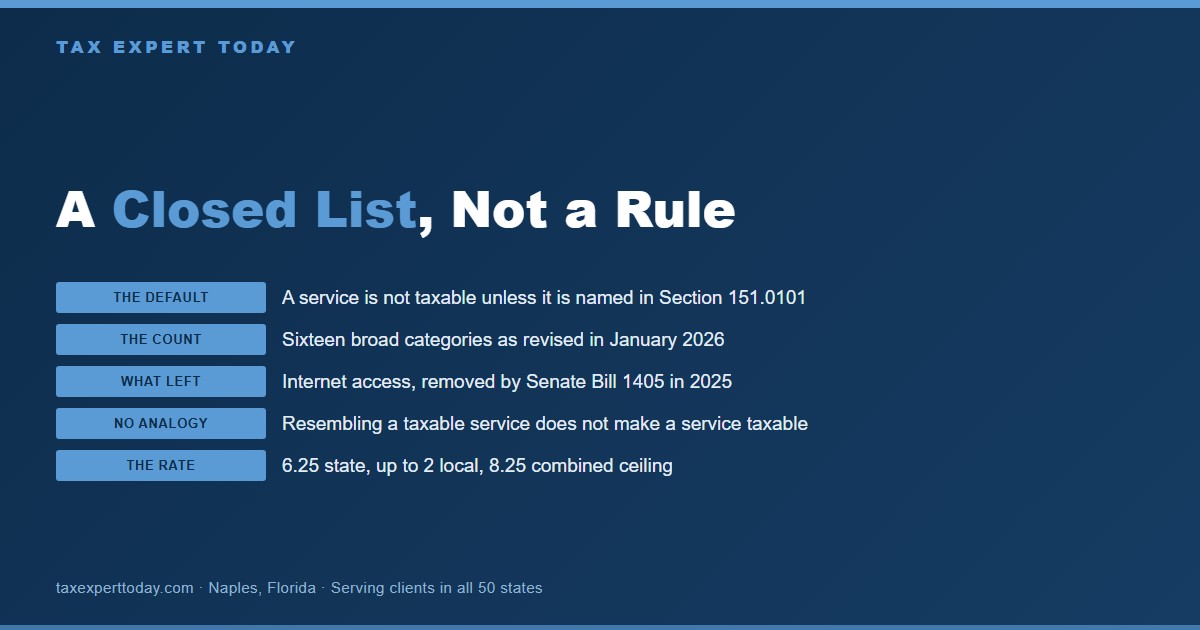
Texas taxable services are the 16 broad categories named in Tax Code Section 151.0101. A service that does not fall inside one of those categories is not subject to sales tax, no matter how commercial it is. The state rate is 6.25 percent, and local jurisdictions may add up to 2 percent, for a maximum combined rate of 8.25 percent.
The structure matters more than the list. Texas uses an enumerated approach, which means the default answer for any service is that it is not taxable and the burden falls on identifying it inside a named category. That is the opposite of the approach used for tangible goods, where the default is taxable and the exemption has to be found. A service business that cannot place its offering inside one of the 16 categories generally has no collection obligation at all.
- The list is closed, not illustrative. Categories are added by the Legislature, not by analogy, so a service that resembles a taxable one is not taxable for that reason.
- The category controls, not the label on the invoice. Calling a charge consulting does not make it consulting if the work performed is data entry.
- Sixteen is the current count. Publication 96-259 as revised in January 2026 states 16 broad categories, down from 17, and several widely circulated summaries still carry the older number.
- Each category has its own administrative rule. The rule, rather than the publication, is what governs the close cases.
| Category under Section 151.0101 | Representative services | Governing rule |
|---|---|---|
| Amusement services | Movie theaters, concerts, sporting events, health clubs, golf courses, sightseeing tours, online games | Rule 3.298 |
| Cable television and bundled cable | Video programming, direct broadcast satellite, streaming video and video on demand | Rule 3.313 |
| Credit reporting services | Creation or delivery of a credit report for consideration | Rule 3.343 |
| Data processing services | Word processing, data entry, storage, web hosting, software as a service | Rule 3.330 |
| Debt collection services | Collecting delinquent accounts, repossession, filing liens | Rule 3.354 |
| Information services | Newsletters, mailing lists, financial market reports, database access | Rule 3.342 |
| Insurance services | Loss appraisal, claims adjustment, actuarial analysis, loss prevention | Rule 3.355 |
| Motor vehicle parking and storage | Parking meters, decals and permits, valet parking, impound fees | Rule 3.315 |
| Nonresidential real property repair, restoration or remodeling | Rebuilding, replacing or upgrading existing commercial realty | Rule 3.357 |
| Personal property maintenance and repair | Appliance repair, upholstering, jewelry cleaning, shoe repair, dog grooming | Rule 3.292 |
| Personal services | Massage parlors, Turkish baths, escort services | Rule 3.317 |
| Real property services | Landscaping and lawn care, pest control, janitorial, waste removal, surveying | Rule 3.356 |
| Security services | Locksmiths, private investigation, armored car, alarm installation and monitoring | Rule 3.333 |
| Telecommunications services | Local and long distance telephone, mobile, VoIP, fax, paging, texting | Rule 3.344 |
| Telephone answering services | Receiving and relaying messages by a human operator | Section 151.0101 |
| Utility transmission and distribution | Delivery by a transmission and distribution utility to a taxable end user | Rule 3.295 |
Laundry, cleaning and garment services sit alongside these as taxable services in their own right, covering dry cleaning, carpet and upholstery cleaning, alterations and uniform services. A separate group of activities is taxed not as services at all but as the sale or fabrication of tangible personal property, which produces the same result through a different route and is covered further below.
Is Labor Taxable in Texas?
Labor by itself is not a taxable category in Texas. Labor becomes taxable when it is performed inside one of the enumerated service categories, or when it produces or repairs tangible personal property. The same hour of work can be taxable or exempt depending on what it is applied to, which is why the question cannot be answered without the underlying subject matter.
This is the single most common source of confusion for Texas service businesses, and it produces errors in both directions. Contractors collect tax on residential remodeling labor that is not taxable. Fabricators fail to collect on assembly labor that is. Neither error is discovered until the books are examined, and by then the periods at issue are usually several years deep.
- Labor on tangible personal property is generally taxable. Repairing, remodeling, maintaining or restoring property belonging to a customer produces a taxable charge.
- Labor that creates tangible personal property is taxable as a sale. Manufacturing, assembling, fabricating and processing are taxable even when the customer supplies the raw materials, tools or equipment.
- Labor on real property depends on residential against nonresidential. That distinction is set out in detail further below and it is where contractor assessments concentrate.
- Labor applying professional judgment is generally not taxable. The work of an engineer, accountant or attorney does not become taxable because a computer was used to perform it.
Photography and videography, producing artwork, printing, calligraphy, embroidering, custom tailoring, woodworking, welding and catering all fall on the taxable side, not because they appear in the list of services but because the Comptroller treats them as producing or processing tangible personal property. A business that thinks of itself as selling a creative service is often selling a taxable item under the sales tax rules.
Which Services Stay Nontaxable in Texas?
Any service outside the 16 enumerated categories is nontaxable, which covers most of the professional economy. Accounting, legal work, engineering, architecture, medicine, marketing strategy, real estate brokerage and management consulting carry no sales tax in Texas because the Legislature has never placed them on the list, not because a specific exemption applies to them.
The practical importance of that framing is what happens when the rules change. A business that is exempt because nothing on the list describes it has no exemption certificate to keep and no documentation burden. A business that is exempt because of a specific statutory carve out has to be able to prove the carve out applies. The two look identical on an invoice and behave very differently in an examination.
- Professional services are outside the list entirely. Consulting, auditing, forecasting, interpreting client data and preparing financial statements are all named as nontaxable in Publication 94-127.
- Preparing tax returns is nontaxable. That includes federal income tax returns and state sales, franchise and income tax returns, even when prepared entirely on a computer.
- Some services left the list by statute. Internet access service is the current example and is covered in its own section below.
- Some are carved out of a taxable category. Medical transcription and certain payment processing activities are excluded from data processing by name.
| Service | Texas sales tax status | Why |
|---|---|---|
| Management or strategy consulting | Not taxable | Outside the enumerated list |
| Accounting, bookkeeping and tax return preparation | Not taxable | Professional judgment, computer used as a tool |
| Engineering and architectural design | Not taxable | Professional judgment, including computer aided design from original specifications |
| Legal services | Not taxable | Outside the enumerated list |
| Real estate brokerage commissions | Not taxable | Outside the enumerated list |
| Web hosting and website creation | Taxable | Data processing service |
| Payroll processing and check preparation | Taxable | Data processing service |
| Landscaping and lawn maintenance | Taxable | Real property service |
| Janitorial and custodial work | Taxable | Real property service |
| Alarm monitoring and locksmith work | Taxable | Security service |
| Medical transcription | Not taxable | Excluded from data processing by name |
| Seminars and training | Not taxable | Outside the enumerated list |
Is Professional Consulting Taxable in Texas?
Consulting is not taxable in Texas, but the exemption depends on what is delivered rather than on the word used to describe it. The Comptroller draws the line at whether the provider exercises discretion or judgment drawn from a field of knowledge, or instead performs computerized entry, retrieval, compilation, manipulation or storage of the data a customer supplies.
Rule 3.330 states the test directly. Merely using a computer as a tool to help perform a professional service is not a data processing service. The illustration the Comptroller uses is an architect preparing original building plans with computer aided design software, which is not data processing, and a bookkeeper applying accounting principles to produce an income statement or a balance sheet, which is also not data processing. The computer is incidental in both cases.
The same reasoning cuts the other way when the judgment is absent. Entering client data, formatting it, scanning documents, converting files from one medium to another and producing reports from figures the client supplied are all taxable, because the provider is operating on the information rather than applying expertise to it. Firms that describe themselves as offering back office support frequently sit on both sides of this line within a single engagement.
- Discretion and judgment are the test. The rule directs the Comptroller to consider the extent to which the provider applies knowledge of the physical sciences, accounting principles, law or another field.
- The deliverable matters more than the title. A monthly report produced from client figures without analysis looks like data processing regardless of who signs it.
- Mixed engagements are the common case. Advisory work paired with recurring data entry has to be characterized charge by charge, not engagement by engagement.
- Documentation is created at the invoice, not at the audit. The moment to establish the split is when the transaction occurs.
How Does the 20 Percent Exemption on Data Processing Work?
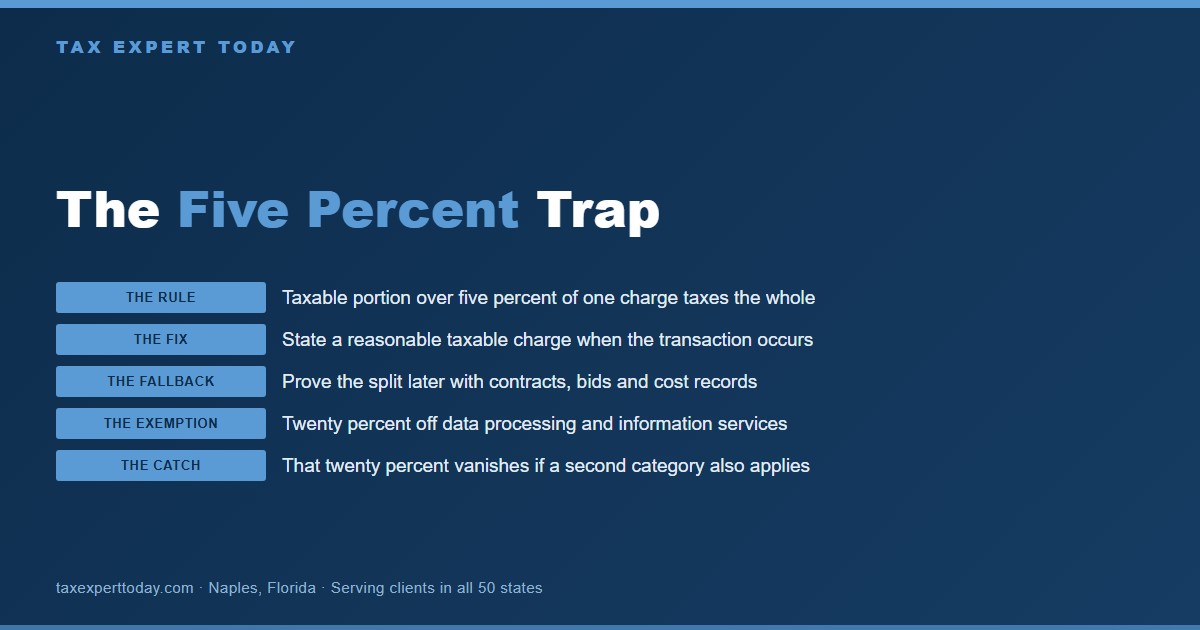
Tax Code Section 151.351 exempts twenty percent of the value of information services and data processing services, so tax is collected on eighty percent of the charge. The exemption is automatic and requires no certificate. It is also narrower than it appears, because it disappears entirely when the service is also taxable under another category.
The mechanics are simple. A provider billing a client for a taxable data processing service collects tax on eighty percent of that charge, and the remaining fifth is exempt by statute. The twenty percent is not something the customer claims, and no exemption certificate changes the result. It applies at the statutory level to the value of the service itself, and it has been in the Tax Code since October 1, 1999.
The limitation is where the analysis goes wrong, and it is stated in Rule 3.330 in a single sentence that almost no secondary source reproduces. If the data processing service is also taxable as another type of taxable service other than an information service, the twenty percent exemption does not apply. A provider whose offering also constitutes a taxable security service or a taxable telecommunications service, for example, loses the reduction and owes tax on the full charge.
| Situation | Portion subject to tax | Authority |
|---|---|---|
| Data processing service, nothing else | 80 percent of the charge | Section 151.351 |
| Information service, nothing else | 80 percent of the charge | Section 151.351 |
| Service is both data processing and an information service | 80 percent of the charge, exemption preserved | Rule 3.330 |
| Service is data processing and another taxable category | 100 percent of the charge, exemption lost | Rule 3.330 |
| Materials and equipment used to provide the service | Provider pays tax on its own purchases | Publication 94-109 |
| Information service bought for resale | Resale certificate to the supplier, then tax on 80 percent to the customer | Publication 94-109 |
Ownership of the equipment does not change the outcome either. Rule 3.330 states that a charge for data processing services is taxable regardless of who owns the computer and regardless of whether the data was supplied by the customer or by an authorized designee. Providers who assumed that running the work on client owned infrastructure removed the charge from the tax base have generally been mistaken. Where a provider does buy hardware to deliver the result, such as a drive used to transfer output, a Texas resale certificate can be issued only when care, custody and control of that property actually passes to the client.
Is Software as a Service Taxable in Texas?
Yes. The Comptroller treats sellers of software as a service and application service providers as data processing service providers, which places subscription software inside a taxable category. The twenty percent exemption then applies, so a Texas customer is charged tax on eighty percent of the subscription price rather than on the full amount.
Publication 96-259 names software as a service directly, so this is not a matter of inference from older rulings. The consequence is that a software company selling into Texas has a collection obligation the moment it has nexus, even though it never ships anything and never touches tangible property. Whether that nexus exists is a separate question governed by the economic and physical presence rules covered in our guide to Texas sales tax nexus and thresholds.
- The effective rate on a subscription is lower than the headline rate. Eighty percent of the price at a combined 8.25 percent produces an effective 6.6 percent on the full subscription.
- Implementation and training can be separated. Training and consultation are named in Rule 3.330 as nontaxable related services, which makes them separable if they are stated correctly.
- Internet access bundled into the price is not data processing. The rule excludes internet access service as defined by Section 151.00394 from the definition entirely.
- Payment processing has its own carve outs. Encryption exclusively to meet Payment Card Industry standards, and settlement by certain financial institutions and processors, are excluded by name.
Those payment carve outs are unusually specific and worth reading closely if they might apply. Rule 3.330 excludes services performed exclusively to encrypt electronic payment information for acceptance onto a payment card network, and it excludes settlement of an electronic payment transaction by a downstream or point of sale payment processor routing to a covered institution, by a federally insured financial institution or its affiliate, by a payment card network, by a sponsorship agreement counterparty, or by a licensed money transmitter. A fintech business that sits close to any of those descriptions should establish which one applies before deciding it is taxable.
How Does Texas Tax a Bundled or Mixed Charge?
If taxable and nontaxable services are sold for a single charge and the taxable portion exceeds five percent of the total, the entire charge is presumed taxable. The presumption is rebuttable only by separately stating a reasonable charge for the taxable services to the customer at the time the transaction occurs, or by later proving the split with documentary evidence.
This is the rule that decides most disputes, and it is almost entirely absent from the guidance published on this topic. The threshold is not fifty percent or a majority. It is five percent. A monthly retainer that is ninety four percent strategic advice and six percent data entry, billed as one number, is presumed taxable in full unless the invoice was written differently.
Rule 3.330 sets out what a nontaxable related service has to be before it can be separated at all. It must not be a data processing service and must not be taxed under another provision of Chapter 151, each service provided must be of a type commonly provided on a stand alone basis, and the performance of the service must be distinct and identifiable. The rule names consultation, development and preparation of feasibility studies, design and development, and training as examples that qualify.
There is also a threshold question that precedes the split. Under Rule 3.330 the Comptroller excludes from data processing entirely any data processing sold for a single charge with another service where the data processing has no separate value and is ancillary to that other service. The burden of showing that sits with the taxpayer. If the relationship runs the other way, and the other service is the ancillary one, the entire charge becomes taxable as data processing.
| How the charge is presented | Result | What has to be proved |
|---|---|---|
| Taxable and nontaxable stated separately at the time of the transaction | Tax on the taxable line only | The stated charge is reasonable against cost or normal stand alone price |
| Single charge, taxable portion is 5 percent or less | Presumption of full taxability does not attach | The portion actually falls at or below the threshold |
| Single charge, taxable portion exceeds 5 percent | Entire charge presumed taxable | Rebuttal by later documentary evidence of the percentages |
| Data processing is ancillary and has no separate value | Not data processing at all | Taxpayer bears the burden on both elements |
| The other service is ancillary to the data processing | Entire charge taxable as data processing | Comptroller position under the same rule |
| Stated split is unreasonable on review | Comptroller adjusts and assesses tax, penalty and interest | Books must support apportionment by cost or normal charge |
The books requirement is the part businesses underestimate. The rule states that the provider records must support the apportionment between exempt and nonexempt activities based on the cost of providing the service or on a comparison to the normal charge for each service when provided alone. An allocation invented after an examination begins, with nothing in the accounting records behind it, is the pattern the rule was written to defeat.
What Happens to Expenses Passed Through to a Client?
Charges for expenses directly related to and incurred while providing a taxable service are themselves taxable, and Rule 3.330 states they may not be separated out to exclude them from the tax base. Meals, telephone calls, hotel rooms and airplane tickets rebilled to a client as part of a taxable engagement carry tax even when listed as reimbursements.
This trips up professional service firms that correctly treat their advisory work as nontaxable and then apply the same instinct to a taxable line. Once a charge is taxable, its associated pass through costs travel with it. Labeling a line as a reimbursement or an out of pocket cost has no effect, because the rule addresses the substance of what the expense was incurred for.
- The test is what the expense supported. Travel incurred to deliver a taxable service is taxable, and the same travel incurred to deliver exempt consulting is not.
- Separate statement does not help here. The rule expressly forecloses separating these charges for the purpose of excluding them.
- Building permit fees are the notable exception. In nonresidential repair work, separately stated permit fees paid on behalf of a customer come out of the taxable total.
- Mixed engagements need expenses coded to the right work. Expense allocation should follow the same records that support the service split.
What Changed When Internet Access Left the Taxable List?
Senate Bill 1405 of the 89th Regular Legislative Session removed internet access service from the list of taxable services in Tax Code Section 151.0101 effective July 1, 2025. That change is why the current count is 16 categories rather than 17, and several widely circulated summaries of Texas taxable services have not caught up with it.
The history explains why the removal took so long. Internet access was a taxable service in Texas, with tax due on any amount over 25 dollars charged for it, until July 1, 2020. The Internet Tax Freedom Act of 2016 barred states from taxing internet access but grandfathered jurisdictions, Texas among them, that had imposed such a tax before October 1, 1998. That grandfather clause expired on June 30, 2020, which ended collection. The statute itself was only cleaned up five years later.
- Collection stopped in 2020, the statute changed in 2025. The federal preemption ended the tax well before the Legislature amended the list.
- The definition survives the removal. Internet access service remains defined in Section 151.00394 because it still matters to other taxable items.
- Bundling still reaches it. Internet access bundled with taxable telecommunications or cable television service is taxable unless the provider can establish a reasonable allocation from its books and records.
- Without a reasonable allocation the whole bundle is taxable. That is the same structural rule as the five percent presumption, applied through Section 151.025 and Rule 3.313.
The point generalizes beyond this one service. A category leaving the enumerated list does not remove the associated revenue from the tax base if it is sold alongside something still on the list. Texas resolves nearly every mixed charge question the same way, by presuming taxability of the whole and putting the burden on the seller to have documented the split contemporaneously.
When Is Construction or Remodeling Labor Taxable?
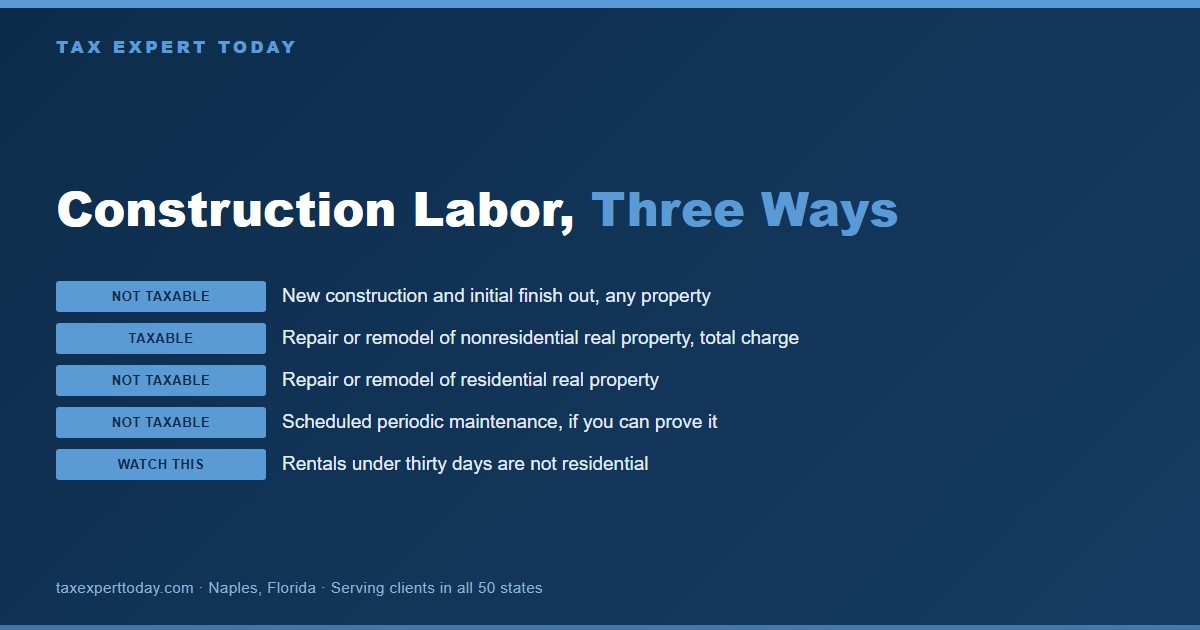
Labor to repair, remodel or restore nonresidential real property is taxable on the total charge, including materials. The same labor on residential real property is not taxable. New construction labor is not taxable in either case, and scheduled periodic maintenance on property that is not broken is not taxable either.
Tax Code Section 151.0047, current as of January 1, 2026, defines real property repair and remodeling as work on an improvement to real property other than a structure or part of a structure used as a residence, an improvement immediately adjacent to such a structure and used in its residential occupancy, or an improvement to a manufacturing or processing production unit in a petrochemical refinery or chemical plant that provides increased capacity. Those three exclusions carry the whole distinction.
| Work performed | Property type | Labor taxable | How tax is handled |
|---|---|---|---|
| New construction or initial finish out | Either | No | Lump sum contractor pays tax on purchases, separated contractor collects on materials |
| Repair, remodel or restore | Nonresidential | Yes | Collect tax on the total charge for the job |
| Repair, remodel or restore | Residential | No | Contractor rules, construction labor not taxed |
| Scheduled periodic maintenance | Either | No | Contract or documentation must prove it is scheduled and periodic |
| Increased capacity work | Petrochemical refinery or chemical plant production unit | No | Statutory exclusion under Section 151.0047 |
| Repair after a declared natural disaster | Nonresidential | No | Labor must be separately stated from materials, materials remain taxable |
Residential is defined more broadly than owners expect. It means family dwellings, and the Comptroller includes apartment complexes, nursing homes, condominiums and retirement homes. It does not include hotels, and it does not include residential properties rented for periods of less than 30 days, which puts a great deal of short term rental property on the nonresidential side of the line. Owners weighing that structure should read our discussion of the short term rental tax rules alongside this one. Those same short stays also carry the Texas hotel occupancy tax, which is a separate lodging tax with its own rate, its own thresholds and a local component the Comptroller does not collect. The property does not have to be the owner residence to qualify as residential.
The five percent presumption reappears here in identical form, which is the strongest signal that it is a general principle rather than a quirk of the data processing rule. Publication 94-116 states that where a contract covers both new square footage and remodeling of existing footage in nonresidential realty for a single charge, and the remodeling portion is more than five percent of the total, the entire charge is presumed taxable. The rebuttal is the same, a reasonable separately stated charge made at the time of the transaction, or later documentary proof. The publication names the acceptable documentation directly, listing written contracts detailing the scope of work, bid sheets, tally sheets, schedules of values and blueprints.
- Maintenance means work on property that is not broken. It has to be scheduled and periodic, and the provider must be able to prove that with a contract or other documentation.
- Repainting and reroofing are repair or remodeling. They are taxable on nonresidential property unless they meet the maintenance definition.
- Minor part replacement during maintenance stays nontaxable. The example the Comptroller gives is replacing a belt on a machine.
- Incorporated parts and materials are taxable even in exempt maintenance. The labor is exempt, the parts are not.
How Do You Register and What Rate Do You Charge?
A business providing taxable services in Texas applies for a sales and use tax permit on Form AP-201 and then collects the 6.25 percent state rate plus any local rate, capped at 2 percent, for a maximum combined 8.25 percent. Local jurisdictions include cities, counties, transit authorities and special purpose districts, and the applicable rate depends on where the service is sourced.
Sourcing rules vary by category rather than following one general principle, which is a frequent source of error for providers operating across several Texas markets. Local tax on personal services is due at the place of business of the service provider. Debt collection is sourced by reference to the last known address of the debtor and the location of the creditor. Credit reporting turns on the address of the credit applicant and the location of the requester. Satellite television service delivered directly to a customer location is exempt from local sales and use tax entirely, for residential and nonresidential customers alike.
| Component | Rate | Imposed by |
|---|---|---|
| State sales and use tax | 6.25 percent | State of Texas |
| City | Up to 2 percent combined across all local jurisdictions | Municipality |
| County | Within the same 2 percent local cap | County |
| Transit authority | Within the same 2 percent local cap | Transit authority |
| Special purpose district | Within the same 2 percent local cap | Special purpose district |
| Maximum combined rate | 8.25 percent | Statutory ceiling |
Registration is a separate obligation from the franchise tax, and a new Texas business generally faces both. Owners setting up in the state can work through the sequence in our guides to Texas LLC taxes and the Texas franchise tax, and businesses relocating from another state should also work through the tax checklist for moving a business to Texas, which covers the permit alongside payroll and entity registration. Employers adding staff in the state will also need the separate obligations set out in our guide to Texas payroll taxes.
What Do Comptroller Auditors Focus On in a Service Business?
Texas Comptroller examinations of service businesses concentrate on characterization rather than arithmetic. The recurring issues are single charges covering taxable and nontaxable work, allocations unsupported by the accounting records, the twenty percent exemption applied where it is not available, and pass through expenses excluded from the base of a taxable service.
These are state tax matters administered by the Texas Comptroller of Public Accounts, not federal ones, and the analysis is separate from anything happening at the federal level. The framing matters because the documents that resolve a state sales tax question, meaning contracts, invoices, bid sheets and the underlying cost records, are usually not the documents a business keeps closest to hand.
| Examination issue | What is typically found | What prevents it |
|---|---|---|
| Single charge covering mixed work | Whole invoice presumed taxable under the five percent rule | Separate statement of a reasonable taxable charge on the invoice itself |
| Allocation created after the fact | Percentages unsupported by cost or stand alone pricing | Books that tie the split to actual cost or normal charges |
| Twenty percent exemption claimed too broadly | Exemption applied where a second taxable category also reaches the service | Confirming no other category applies before reducing the base |
| Reimbursed expenses excluded | Travel and meals tied to taxable work left out of the base | Coding expenses to the engagement line they support |
| Maintenance treated as exempt without proof | No contract showing the work was scheduled and periodic | Written recurring service agreements retained with the job file |
| Resale certificates taken or given loosely | Certificate issued where care, custody and control did not transfer | Certificate practices reviewed against the underlying facts |
Two structural points are worth holding onto. The first is that the presumption runs against the seller, so an absence of evidence is not neutral. The second is that the rules repeatedly reward contemporaneous documentation over later reconstruction, which means the cheapest version of this work happens when invoices are designed rather than when they are defended. A business winding down should also review the final period obligations set out in our guide to closing a business in Texas, because permit cancellation and final returns are handled separately from the entity filings. Owners running several ventures through one structure should read how the reporting works for a Texas series LLC, where one report can cover activity that feels separate to the owner.
None of this is a reason to assume an assessment is inevitable or that any particular outcome follows. Characterization questions of this kind turn on specific facts, and two businesses describing themselves in the same words can reach different answers because their invoices and records differ. What can be said generally is that the rules are written to be applied at the moment of the transaction, and businesses that treat them that way tend to have far less to reconstruct later.
Texas Taxable Services Help in Naples & Southwest Florida
Tax Expert Today LLC advises business owners on state and federal tax matters nationwide from our office in Naples, Florida. Texas service taxability work reaches us from two directions. Florida based service companies that have picked up Texas customers and now have to decide what their invoices should say, and Texas operators who have relocated to Southwest Florida while the original business continues to bill Texas clients. Both arrive with the same underlying question, which is whether the way they describe their work matches the way the Texas rules classify it.
Our approach starts with the invoices rather than with the marketing description of the business. We read how charges are presented to customers, identify which lines fall inside an enumerated category, test whether any single charge combines taxable and nontaxable work above the five percent threshold, and check whether the accounting records would actually support the allocation being claimed. Where the records do not support the position, we say so before anything is filed.
- Texas sales tax help Naples business owners can reach in person. Our office is on Tamiami Trail North in Naples, Florida, and we meet clients locally as well as remotely.
- Taxable services review Naples FL and nationwide. We work with clients in all 50 states, and the Texas analysis is the same regardless of where the owner now lives.
- Invoice and contract design before the first billing cycle. Separate statement has to happen at the time of the transaction, so this work is worth far more before invoices go out than after.
- Coordination with the permit, franchise and payroll obligations. Service taxability rarely arrives on its own, and the registrations interact.
Related services include our Texas tax services and our business consulting practice for owners building an internal compliance function. Southwest Florida businesses can also review our Naples tax planning work, and companies that need the underlying records maintained can look at our CFO advisory and bookkeeping support.
Tax Expert Today LLC
11983 Tamiami Trail N, Naples, FL 34110
Phone: (239) 441-2005
Hours: Monday through Friday, 10:00 a.m. to 5:00 p.m. ET
Local question we are asked often: A Naples marketing agency bills Texas clients a single monthly retainer that covers strategy, campaign management and a recurring report built from the client advertising data. Is any of that taxable in Texas? Possibly. Strategy and campaign management sit outside the enumerated categories, but building a recurring report from data the client supplies looks like a data processing service. Because it is billed as one number, the five percent presumption is the controlling question, and if the report component exceeds five percent of the retainer the whole retainer is presumed taxable. The fix is prospective and simple, which is to state the report charge separately at a reasonable amount and keep records showing how that amount was derived.
When Should You Engage a Professional?
Engage a professional when any single charge covers both taxable and nontaxable work, when the twenty percent exemption is being applied, when construction contracts mix new square footage with remodeling, or when a Comptroller notice arrives. Each of those turns on a presumption that runs against the business, and each is decided by documentation created before the question is asked.
A single category service business with clean invoices does not need advisors to charge Texas sales tax correctly. A landscaper who does landscaping and nothing else has a straightforward obligation. The work becomes worth paying for when the number of characterization questions rises, and that usually happens gradually rather than all at once.
- Your invoices combine services. The five percent threshold is low enough that most mixed billing crosses it without anyone noticing.
- You sell software, hosting or reporting. Data processing has more exclusions and carve outs than any other category, and they are specific rather than general.
- You contract on nonresidential real property. The residential line, the maintenance definition and the new construction split each carry their own documentation requirement.
- You are registering in Texas for the first time. Permit, franchise tax and payroll obligations arrive together and interact.
- You have received a notice or an examination letter. The records that answer the question are the ones created earliest, so the response should begin with what exists rather than with what is argued.
Businesses weighing Texas against other no income tax states as a base of operations should also look at the wider picture rather than at sales tax alone. Our comparison of Texas and Florida taxes sets the two side by side, and our discussion of what no state income tax in Texas actually delivers covers the trade offs that the headline hides. Owners planning a sale of the business should add our guide to Texas capital gains tax to that reading.
Frequently Asked Questions
What is considered a taxable service in Texas?
A taxable service is one that falls inside the 16 broad categories listed by name in Tax Code Section 151.0101, as set out in Comptroller Publication 96-259. Those categories include amusement, cable television, credit reporting, data processing, debt collection, information services, insurance services, motor vehicle parking, nonresidential real property repair, personal property repair, personal services, real property services, security, telecommunications, telephone answering and utility transmission. Laundry, cleaning and garment services are taxable as well, and certain labor is taxed as the sale or fabrication of tangible personal property rather than as a service.
Should I charge sales tax on services in Texas?
Only if the service falls inside one of the enumerated categories and the business has a Texas collection obligation. Texas taxes a closed list of services, so the starting presumption for any service is that it is not taxable. If the service is on the list, the next questions are whether the twenty percent exemption applies, whether the charge is bundled with nontaxable work, and what local rate applies at the applicable sourcing location.
Are professional services taxable in Texas?
Generally no. Accounting, legal, engineering, architectural, medical and management consulting services are not enumerated and therefore carry no sales tax. The exception arises when what is actually delivered is computerized entry, retrieval, compilation, manipulation or storage of a customer data set, because that is a data processing service regardless of the professional title of the provider. Publication 94-127 states that using a computer as a tool to perform a professional service does not make the charge taxable.
Is labor taxable in Texas?
Labor is not a taxable category on its own. It becomes taxable when performed inside an enumerated service category, when it repairs or maintains tangible personal property, when it produces tangible personal property through manufacturing, fabricating, assembling or processing, or when it repairs, remodels or restores nonresidential real property. The same work on residential real property, and new construction labor on any property, is not taxable.
How does the twenty percent exemption on data processing work?
Tax Code Section 151.351 exempts twenty percent of the value of information services and data processing services, so tax is charged on eighty percent of the price. No exemption certificate is required. The exemption is lost entirely if the service is also taxable as a category other than an information service, which is a limitation stated in Rule 3.330 and reproduced by very few secondary sources.
Is SaaS taxable in Texas?
Yes. Publication 96-259 states that data processing service providers include sellers of software as a service and application service providers, so a subscription is taxable as data processing. The twenty percent exemption then applies, producing tax on eighty percent of the subscription charge. Separately stated training and consultation may qualify as nontaxable related services if they are genuinely distinct and commonly offered on a stand alone basis.
What happens if I bill taxable and nontaxable work as one charge?
If the taxable portion exceeds five percent of the total, the entire charge is presumed taxable. That presumption can be overcome by separately stating a reasonable charge for the taxable services to the customer at the time of the transaction, or afterwards by documentary evidence establishing the percentages. The accounting records have to support the apportionment based on cost or on the normal stand alone charge, and an allocation the Comptroller considers unreasonable can be adjusted with tax, penalty and interest assessed.
Is internet access still taxable in Texas?
No. Senate Bill 1405 of the 89th Regular Legislative Session removed internet access service from Section 151.0101 effective July 1, 2025, and collection had already ended on July 1, 2020 when the federal grandfather clause under the Internet Tax Freedom Act expired. Internet access remains defined in Section 151.00394 because it is still relevant to other taxable items, and it can still be taxed when bundled with a taxable service unless the provider establishes a reasonable allocation from its books and records.
This article is general tax information and does not constitute tax, legal, or accounting advice for any particular situation. State and federal tax rules change and their application depends on specific facts. Consult a qualified professional regarding your circumstances before acting.
Published September 6, 2026 by Dr. Pellumb Kabashi « Back to Learning Center
Have a question this article touches on?
Tax Expert Today LLC, based in Naples, Florida and serving clients across the United States.
Schedule a Consultation (239) 441-2005