
By Dr. Pellumb Kabashi, DBA, MBA, CES, CFE, EA
Founder, Tax Expert Today LLC · Tax advisors, enrolled agents, CPAs, and attorneys · Serving clients in all 50 states
Quick Answer: A Texas sales tax exemption certificate is the back side of Comptroller Form 01-339, which a qualifying buyer signs and hands to the seller to buy a taxable item without paying sales tax. It needs no exemption number, it is limited to exempt organizations and exempt uses, and it protects the seller only if accepted in good faith at or before the sale. Call (239) 441-2005 for a free consultation.
Most guidance on the Texas sales tax exemption certificate stops at the question of which box to fill in. University purchasing offices post a copy of the form with their own name already typed in. Supplier websites post a blank copy and ask customers to send it back. Sales tax software vendors publish a short summary of who qualifies. All of that is useful, and none of it explains what the certificate actually does, which is the part that matters when a Comptroller auditor later asks why a sale was not taxed.
The short version is that Texas starts from a presumption that every sale is taxable, and the Texas sales tax exemption certificate is the document that rebuts the presumption for one particular sale. When a seller accepts a properly completed certificate in good faith, the liability for the tax moves off the seller and onto the buyer who signed it. When the certificate is missing, incomplete, late, or accepted for something the seller should have known did not qualify, the presumption stands and the seller owes the tax it never collected. This guide is organized around that mechanism: who can give a certificate, what it has to say, what the seller has to do to earn the protection, how the buyer can lose the exemption after the sale, and what happens in an audit when certificates are missing.
Two boundaries keep this guide focused. First, the front of the same Form 01-339 is the resale certificate, which is a different claim made by a different kind of buyer. We cover that side in detail in our guide to the Texas resale certificate, and this guide refers to it only where the two sides interact. Second, the specific exemption for manufacturing equipment and materials has its own rules on taxable use, so it is mentioned here only to note where it departs from the general rule. Everything else about the Texas sales tax exemption certificate, including the exempt organization, agricultural and timber variations, is covered below.
What Is a Texas Sales Tax Exemption Certificate?
A Texas sales tax exemption certificate is a signed statement from a buyer to a seller claiming that a purchase of a taxable item is exempt from state and local sales and use tax. The standard version is the Exemption Certification on the back of Comptroller Form 01-339, and a substantially similar form is accepted.
- Given by the buyer, kept by the seller. The form itself instructs that it be furnished to the supplier and not sent to the Comptroller.
- A claim, not a license. The Comptroller does not issue the certificate. The buyer completes it and takes responsibility for the claim by signing it.
- Tied to a reason. Every certificate must state why the purchase is exempt, and that reason has to match an exemption in the Tax Code.
- Covers sales and use tax together. A valid certificate removes both the state tax and the local taxes that would otherwise apply to the sale.
The definition in the Comptroller’s rule is precise. Under 34 Tex. Admin. Code Section 3.287(a), an exemption certificate is a document that, when properly completed, allows a purchaser to buy an otherwise taxable item tax free. The rule names Form 01-339 (Back), or a substantially similar form, as the standard document. Subsection (h) repeats the point: a certificate must be substantially in the form of Form 01-339 (Back). That language matters for businesses that design their own customer onboarding forms or accept a multistate certificate. A homemade form is acceptable if it captures everything Form 01-339 captures; a form that leaves out a required element is not saved by looking official.
The stakes are set by the tax rate. Texas imposes a 6.25 percent state sales and use tax, and cities, counties, transit authorities and special purpose districts may add up to 2 percent more, for a maximum combined rate of 8.25 percent, according to the Comptroller’s sales and use tax overview. On an ordinary invoice, that is a modest amount. Across four years of exempt sales to schools, churches, cities, farms and ranches, the tax that a seller did not collect can become a significant audit exposure if the certificates behind those sales do not hold up.
It also helps to be clear about what the certificate is not. It is not a sales tax permit, which a seller obtains from the Comptroller in order to collect tax once it has nexus with Texas. It is not the Comptroller’s letter recognizing a nonprofit as exempt, although an exempt organization will usually need that letter before it can honestly sign a certificate. And it is not a resale certificate, which is the claim a buyer makes when it intends to resell the item rather than use it. The three documents are frequently confused, and each confusion has its own audit consequence, which we come back to later in this guide.
What Does the Exemption Certificate Actually Do for the Seller?
The certificate shifts liability. Texas presumes every gross receipt of a seller is taxable unless the seller accepts a properly completed resale or exemption certificate. A seller that accepts a valid exemption certificate in good faith owes no tax on that sale, and the buyer who signed it becomes responsible if the exemption claim later proves wrong.
- The starting point is a presumption. Section 151.054(a) presumes all gross receipts are subject to tax unless a certificate is accepted.
- Good faith converts the sale. Section 151.054(c) makes the sale exempt when the seller receives the certificate in good faith.
- The buyer carries the risk afterward. The form states that the purchaser is liable for all state and local taxes that become due for failure to comply with the Tax Code.
- Without a certificate, the seller pays. If the presumption is not rebutted, the uncollected tax is assessed against the seller in an audit.
The statutory structure is short and worth reading in full. Tex. Tax Code Section 151.054(a) states that all gross receipts of a seller are presumed to have been subject to the sales tax unless a properly completed resale or exemption certificate is accepted by the seller. Subsection (c) provides that a sale is exempt if the seller receives in good faith from a purchaser an exemption certificate stating qualifications for an exemption provided in Subchapter H of Chapter 151, which is the subchapter that lists the Texas sales tax exemptions. A related presumption in Section 151.104(a) treats a sale for delivery in Texas as a sale for storage, use or consumption in Texas unless a resale or exemption certificate is accepted by the seller.
Read together, those provisions mean the certificate does two jobs at once. It is evidence that the sale was exempt, and it is the legal mechanism that relieves the seller of the obligation to collect. That second job is why the details matter so much. A seller who simply believes that a customer is a church, a school district or a working ranch, and who does not have the certificate in the file, has no defense in an audit beyond trying to obtain the certificate later within the limited window the statute allows. A seller who has a complete certificate, accepted on time and for an item that plausibly fits the stated reason, is protected even if the buyer misused the exemption.
The Comptroller’s rule states the same idea from the seller’s side. Under Section 3.287(d)(1), all of a seller’s gross receipts are presumed taxable unless the seller accepts a valid, complete resale or exemption certificate. Subsection (d)(2) then provides that a seller who accepts a properly completed certificate in good faith is relieved of the tax on that sale. What good faith requires is specific, and it is covered in its own section below.
From the buyer’s side, the certificate is a promise with consequences. The Exemption Certification on the back of Form 01-339 includes two statements the purchaser signs. The first is an acknowledgment that the purchaser will be liable for payment of all state and local sales or use taxes that may become due for failure to comply with the Tax Code. The second is an acknowledgment that it is a criminal offense to give an exemption certificate for taxable items the purchaser knows, at the time of purchase, will be used in a manner other than the one expressed in the certificate. A buyer who signs casually is making both statements.
| Situation at the time of sale | Who owes the tax if the exemption fails | Authority |
|---|---|---|
| No certificate accepted, tax not collected | The seller, under the presumption that the receipt was taxable | Tax Code Section 151.054(a) |
| Complete certificate accepted in good faith at or before the sale | The buyer, who certified the exemption; the seller is relieved | Tax Code Section 151.054(c); Rule 3.287(d)(2) |
| Certificate missing a required item | The seller, because an incomplete certificate is disallowed regardless of when obtained | Rule 3.287(d)(4) and (f) |
| Certificate accepted when the seller knew or had reason to know the sale was not exempt | The seller, because the acceptance was not in good faith | Rule 3.287(d)(2) |
| Valid certificate, item later used for a taxable purpose | The buyer, on the value of the divergent use | Tax Code Section 151.155 |
Who Can Issue a Texas Sales Tax Exemption Certificate?
Only two groups may issue the Texas exemption certificate: organizations that qualify as exempt under Tax Code Sections 151.309 or 151.310, such as government entities and qualifying religious, educational and charitable organizations, and purchasers buying items that are exempt under Subchapter H of Chapter 151 because of how the items will be used.
- Exempt entities. The exemption follows the buyer, provided the purchase relates to the organization’s exempt purpose.
- Exempt uses. The exemption follows the item and the use, whoever the buyer is, such as qualifying agricultural or timber use.
- Not every nonprofit. Nonprofit status alone does not make an organization exempt from Texas sales tax.
- Other routes exist. Direct payment permits, data centers, qualified research and exports have their own rules and documents.
Section 3.287(b) of the Comptroller’s rule limits the certificate to these two categories. The first is organizations that qualify for exemption under Tax Code Section 151.310, the religious, educational and public service organization exemption, or under Section 151.309, the governmental entity exemption, as described in the Comptroller’s exempt organization rule at 34 Tex. Admin. Code Section 3.322. The second is purchasers of items that are exempt under Subchapter H, which is the long list of product and use exemptions in Chapter 151.
The difference between the two categories is practical. When a qualifying charity buys office supplies for its programs, the exemption exists because of who the buyer is. When a rancher buys fencing or a fertilizer spreader, the exemption exists because of how the item will be used, and the rancher is not an exempt entity at all. The Comptroller’s agricultural guidance makes this point directly: agricultural and timber producers are not exempt entities, so not all of their purchases are exempt. That distinction shapes what the seller should expect to see on the certificate and how much scrutiny the stated reason deserves.
Section 151.310(a) lists the organizations covered by the entity exemption. They include an organization created for religious, educational or charitable purposes if no part of its net earnings benefits a private shareholder or individual and the items purchased relate to its purpose; an organization exempt from federal income tax under Internal Revenue Code Section 501(c)(3), (4), (8), (10) or (19), if the item relates to its purpose and is not used for the personal benefit of a private stockholder or individual; a nonprofit organization engaged exclusively in providing athletic competition among persons under 19 years old; a volunteer fire department; and a nonprofit chamber of commerce or convention and tourist promotional agency representing at least one Texas city or county. Government entities qualify under the separate exemption in Section 151.309.
| Type of buyer | Why the purchase can be exempt | What the seller should expect |
|---|---|---|
| Federal, Texas state or Texas local government entity | Exempt by law under Tax Code Section 151.309, no application needed | Form 01-339 (Back) or a purchase voucher from a qualifying governmental entity, which Rule 3.322(g)(3) treats as sufficient proof |
| Qualifying religious, educational or charitable organization | Entity exemption under Section 151.310(a)(1), for items related to its purpose | Form 01-339 (Back) signed in the organization’s name; exempt status confirmed by the Comptroller |
| Federally exempt 501(c)(3), (4), (8), (10) or (19) organization | Entity exemption under Section 151.310(a)(2), for items related to its purpose | Form 01-339 (Back); exempt status granted by the Comptroller after application |
| Youth athletic organization, volunteer fire department, nonprofit chamber or tourism agency | Entity exemption under Section 151.310(a)(3), (4) or (5) | Form 01-339 (Back) |
| Farm, ranch or timber producer | Use exemption under Section 151.316 or 151.3162, for qualifying items used in production for sale | Form 01-924 or 01-925 with a current Ag/Timber Number |
| Any purchaser of an item exempt by its use under Subchapter H | Use exemption stated on the certificate | Form 01-339 (Back) with a specific reason that matches the item |
Two limits on that table are easy to miss. First, other states’ government entities and foreign governments are not exempt from Texas tax, as the Comptroller explains in Publication 96-122. Rule 3.322(l) allows a narrow reciprocal exception for governmental units of Arkansas, Louisiana, New Mexico and Oklahoma, only to the extent their state grants similar treatment to Texas. Second, the Comptroller’s exempt organization pages list several kinds of nonprofit, including homeowner associations and 501(c)(2), (5), (6), (7), (16) and (25) organizations, that may qualify for franchise tax exemption without qualifying for sales tax exemption on their purchases. A seller who assumes that any nonprofit customer can buy tax free will accept certificates that do not hold up.
Section 3.287(c) also points to other rules for specialized exemptions that use their own procedures: direct payment permits under Rule 3.288, maquiladoras under Rule 3.358, agriculture under Rule 3.296, timber under Rule 3.367, qualifying data centers under Rule 3.335, qualified research under Rule 3.340, prior contracts under Rules 3.319 and 3.334, and sales for resale under Rule 3.285. If a customer’s exemption falls under one of those rules, the seller should follow that rule’s documentation requirements rather than relying on a general Form 01-339 alone.
Is There a Texas Tax Exempt Number for Sales Tax?
No. Texas does not issue sales tax exemption numbers, and Form 01-339 states that the exemption certificate does not require a number to be valid. A buyer who offers a tax exempt number, or a seller who insists on one, is working from a misunderstanding. The main exception is the Ag/Timber Number required for agricultural and timber exemptions.
- The form says so twice. The back of Form 01-339 states the certificate does not require a number and that exemption numbers do not exist.
- The rule agrees. Rule 3.287(a) states that Chapter 151 has no provision for an exemption number or tax exempt number.
- The resale side is different. The resale certificate on the front asks for an 11 digit Texas sales and use tax permit number.
- Ag and timber are different. Section 151.1551 requires a Comptroller registration number on those exemption certificates.
This is one of the most common points of confusion, and it causes problems on both sides of the counter. Sellers sometimes refuse a perfectly valid certificate from a church or school because it has no number on it, or they accept a certificate because a number has been written in, as though the number proved the exemption. Buyers sometimes write their federal employer identification number, their IRS determination letter reference, or their sales tax permit number into a blank and assume that settles the matter. None of those numbers makes the certificate more or less valid. The Exemption Certification is explicit: this certificate does not require a number to be valid, and sales and use tax exemption numbers or tax exempt numbers do not exist.
The number question does have two real answers. On the front of Form 01-339, the resale certificate asks for the purchaser’s Texas sales and use tax permit number, which must contain 11 digits, or for an out-of-state retailer’s registration number or a Mexican Federal Taxpayers Registry number. That is because a resale claim depends on the buyer being in the business of selling. On the agricultural and timber exemption certificates, Tax Code Section 151.1551(b) requires that a registration number issued by the Comptroller be stated on the certificate. Outside those two situations, the general exemption certificate rests on the buyer’s signed statement of the reason, not on any number.
What a seller can verify, when the buyer is an exempt organization, is the organization’s status. The Comptroller maintains a Texas tax-exempt entity search, and the Comptroller’s publications on taxable services tell sellers they can verify a nonprofit’s exemption through that search or by calling 800-252-5555. Verifying status is a sensible step for a large or unusual sale, and it is evidence of good faith if the claim is later questioned. It is not a substitute for the certificate itself.
What Must a Texas Sales Tax Exemption Certificate Contain?
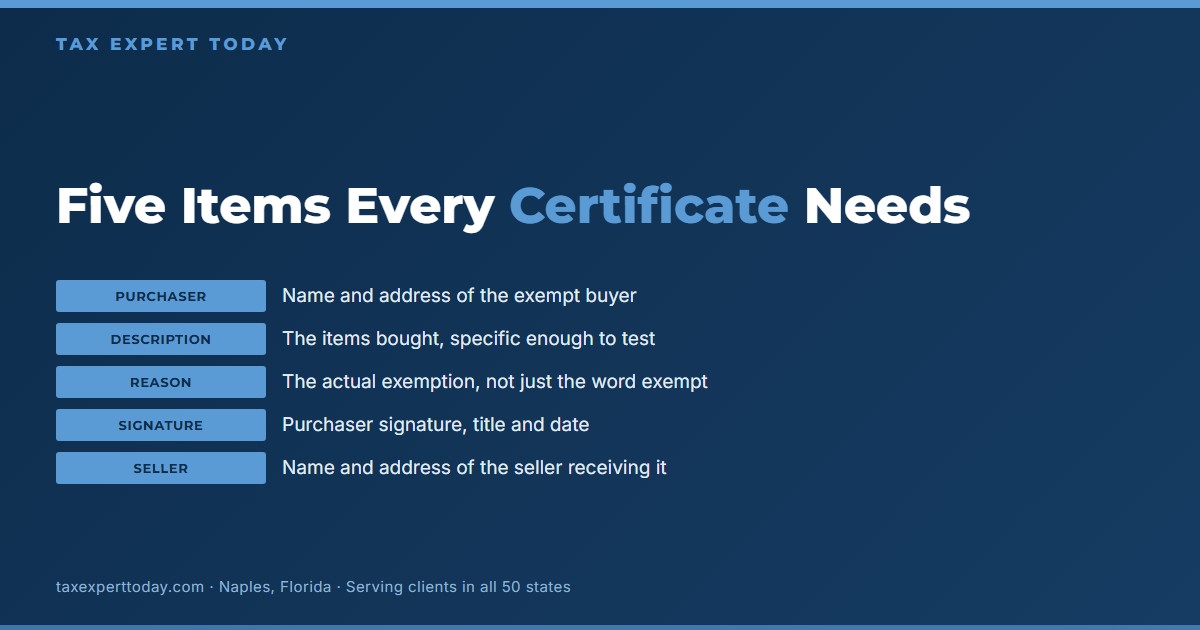
Rule 3.287(f) requires five items: the purchaser’s name and address, a description of the item purchased, the reason the purchase is exempt, the purchaser’s signature and the date, and the seller’s name and address. A certificate missing any of them is incomplete, and an incomplete certificate is disallowed in an audit no matter when it was obtained.
- All five, legible. Good faith acceptance requires every required item to be present and readable.
- A real reason. The reason must identify an actual exemption, not just say “exempt” or “nonprofit.”
- A description that fits. The item description must be specific enough to compare against the stated reason.
- Signed by someone with authority. The form asks for the purchaser’s signature, title and date.
The list in Rule 3.287(f) is short, which makes the defects easy to spot once you know what to look for. In practice, the items that most often fail are the reason and the description. A certificate that gives the reason as “tax exempt,” “nonprofit organization” or “501(c)(3)” without connecting it to the purchase may not establish the exemption, and a certificate whose description reads “various” or “all purchases” gives an auditor nothing to compare. The Comptroller’s rule puts the responsibility for knowing the law on the seller: under Rule 3.287(d)(2), a seller is responsible for knowing Texas sales tax law as it applies to its business and to the exemptions available for the items it sells.
| Required item under Rule 3.287(f) | What it does | Defects auditors commonly question |
|---|---|---|
| Purchaser’s name and address | Identifies who is claiming the exemption and who is liable if it fails | Individual’s name instead of the organization; no address; name does not match the exempt entity of record |
| Description of the item | Allows the reason to be tested against what was actually sold | “Various,” “supplies” or “all items” on a single sale; description inconsistent with the invoice |
| Reason the purchase is exempt | Ties the sale to an exemption in Chapter 151 | Blank, “exempt,” a federal ID number, or a reason that cannot apply to the item described |
| Purchaser’s signature and date | Makes the purchaser responsible for the claim and fixes the timing | Unsigned; undated; dated after the sale; signed by someone with no apparent authority |
| Seller’s name and address | Shows the certificate was given to this seller for these purchases | Blank seller section; a certificate addressed to a different vendor or a generic “to whom it may concern” |
The form itself goes slightly further than the rule. The back of Form 01-339 asks for the purchaser’s phone number, the description of items purchased or reference to an attached order or invoice, the purchaser’s title, and the reason. A seller that collects the full form, filled out completely, will satisfy the rule with room to spare. A seller that uses its own form or a multistate certificate should compare it line by line against Rule 3.287(f) and Form 01-339 before relying on it.
One practical point concerns the reference to an attached order or invoice. Form 01-339 allows the description to be given on an attached order or invoice instead of on the form itself. That is a convenience for a single purchase, but it creates a records problem if the attachment is not kept with the certificate. In an audit, a certificate that says “see attached” with nothing attached may be treated as missing its description. Sellers who rely on attachments should store the certificate and the attached document together, in the same file, for the full retention period.
Resale Certificate or Exemption Certificate: Which Side of Form 01-339 Applies?
Use the front, the resale certificate, when the buyer will resell, lease or rent the item, or transfer it as an integral part of a taxable service. Use the back, the exemption certificate, when the buyer will use or consume the item but the purchase is exempt because of who the buyer is or how the item is used.
- Resale defers the tax. Tax is collected later, from the buyer’s own customer.
- Exemption ends the tax. No one in the chain collects tax on that item if the claim is valid.
- Different buyers. A resale buyer must be in the business of selling; an exemption buyer need not sell anything.
- Different numbers. The front asks for an 11 digit permit number; the back requires no number.
The two certificates share a page, a revision number and a penalty statement, and they are regularly used interchangeably by mistake. Section 151.054(b) covers resale certificates received in good faith from a purchaser in the business of selling, leasing or renting taxable items; Section 151.054(c) covers exemption certificates stating qualifications for an exemption in Subchapter H. The defects that come up most often on the resale side, such as a retailer buying its own supplies on a resale certificate, are covered in our guide to Texas resale certificate rules and traps. For exemption purposes, the useful question is simpler: is the buyer going to sell this item, or use it?
| Feature | Resale certificate (Form 01-339 front) | Exemption certificate (Form 01-339 back) |
|---|---|---|
| Claim being made | The item will be resold, leased or rented, or transferred as part of a taxable service | The purchase qualifies for an exemption in Subchapter H of Chapter 151 |
| Typical buyer | Retailer, distributor, contractor reselling materials, service provider transferring parts | Government entity, qualifying nonprofit, school, church, buyer making an exempt use |
| Number required | Texas sales and use tax permit number (11 digits) or listed out-of-state or Mexican registration | None; the form states exemption numbers do not exist |
| Tax result if valid | Tax deferred to the next sale in the chain | No tax collected on the sale |
| Liability if the buyer uses the item instead | Section 151.154: tax on the value of the use | Section 151.155: tax on the value of the divergent use |
| Governing rule | 34 Tex. Admin. Code Section 3.285 | 34 Tex. Admin. Code Section 3.287 |
Mixed transactions sometimes call for both. A nonprofit that runs a gift shop, for example, may buy inventory for resale and supplies for its programs from the same vendor. The inventory is properly purchased on a resale certificate, because the organization will collect tax when it sells those items, and the program supplies are properly purchased on an exemption certificate. The Comptroller’s nonprofit guidance makes the point that the exemption applies to items an organization buys, not items it sells, and that nonprofits that make taxable sales generally need their own sales tax permit. Using the exemption certificate for both kinds of purchases mixes the two claims and leaves the resale inventory untaxed at every stage.
Services raise the same question. Under Texas law, many services are taxable, which is a separate question from the absence of a Texas income tax, and our guide to Texas taxable services covers which ones. A service provider that buys a component which becomes part of a taxable service it performs for its customer may use a resale certificate for that component, because the component is transferred as an integral part of the taxable service. The same provider buying tools or office equipment for its own use cannot use either certificate unless an exemption applies to the tool itself.
What Does Good Faith Acceptance Require From a Texas Seller?
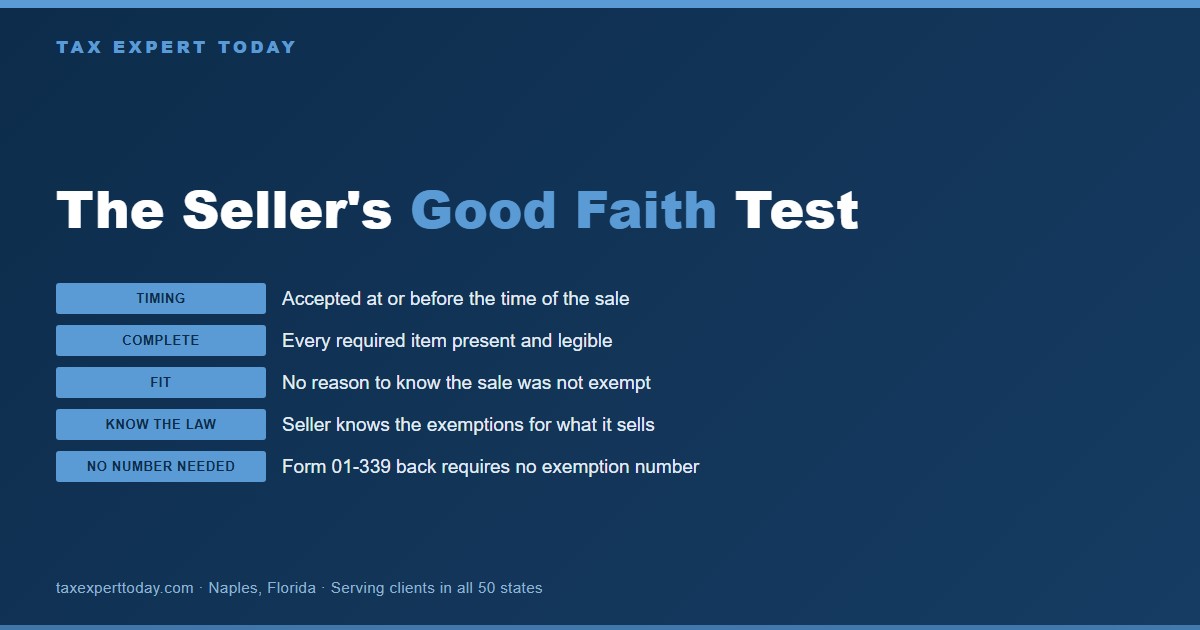
Under Rule 3.287(d)(2), a seller accepts in good faith when three conditions are met: the certificate was accepted at or before the sale, every required item is present and legible, and the seller had no reason to know the sale was not exempt. Missing any one removes the seller’s protection.
- Timing. The certificate should be in hand when the sale occurs, not requested after an audit begins.
- Completeness. All five required items, legible, with nothing left to be filled in later.
- No reason to know. The item described has to be something that could plausibly qualify for the stated reason.
- Knowledge of the law. The seller is expected to know how the exemptions apply to what it sells.
The three conditions come from Rule 3.287(d)(2), and the statute reflects the first one directly. Section 151.054(e) states that properly completed resale or exemption certificates should be in the possession of the seller at the time the nontaxable transaction occurs. A certificate collected months later is not worthless, but it is treated differently, as the audit section of this guide explains.
The third condition is where judgment comes in. The Comptroller does not expect sellers to investigate every customer, but it does expect them to notice when the item and the reason obviously do not fit. The Comptroller’s agricultural exemption guidance gives a concrete example: retailers may not accept agricultural certificates for items that clearly do not qualify, such as jewelry or furniture. The same logic applies to entity exemptions. A school district buying classroom furniture fits its exemption. A certificate from the same school district for a personal television delivered to an employee’s home address does not, and a seller that accepts it has a reason to know.
| Good faith condition | What the seller can do to satisfy it | What weakens it |
|---|---|---|
| Accepted at or before the sale | Require the certificate before the first tax-free invoice; flag accounts that have no certificate on file | Waiving tax first and requesting the certificate later, or only when an audit begins |
| All required items present and legible | Review each certificate against Rule 3.287(f) before setting the account to tax exempt | Blank reason or seller fields; illegible signatures with no printed name or title |
| No knowledge or reason to know the sale was not exempt | Compare the items sold against the stated reason; verify exempt status for large or unusual purchases | Items unrelated to the stated reason; delivery to a personal address; payment from a personal account |
| Knowledge of the applicable law | Train staff on which exemptions apply to the products the business sells | Treating every nonprofit as exempt, or accepting a number in place of a reason |
Payment method is a useful warning sign. The Comptroller’s exempt organization rule states in Rule 3.322(g)(5) that employees cannot claim the exemption on personal purchases, even if the organization reimburses them or gives an allowance, and Publication 96-122 repeats that personal purchases by employees or volunteers are not exempt even on official business. A purchase paid with an individual’s personal card, delivered to a home address, with an exemption certificate in the organization’s name is exactly the situation in which a seller may later be told it had reason to know. Rule 3.322(g)(4) does allow an authorized agent to make a cash purchase on the organization’s behalf, but the agent must still give the vendor an exemption certificate.
It also helps to know what good faith does not require. The Comptroller’s agricultural guidance states that retailers may verify an Ag/Timber Number online but that verification is not required to accept a properly completed certificate in good faith. A seller is not obliged to audit its customer. It is obliged to collect a complete certificate, at the right time, for an item that fits, and to apply what it knows about its own products.
How Do Nonprofits and Government Buyers Use the Exemption Certificate?
Government entities are exempt by law and do not apply for exemption. Nonprofits must apply to the Comptroller and receive exempt status before making tax-free purchases, then give sellers a completed Form 01-339 (Back) for purchases related to their exempt purpose. A seller is not required to accept the certificate, and the organization can seek a refund instead.
- Status comes first. A nonprofit is not considered exempt before the earlier of its application postmark date or a Comptroller audit assessment date.
- Purpose test on every purchase. Items must relate to the exempt purpose and not benefit a private individual.
- Sellers may decline. The organization can then obtain Form 00-985 from the seller and request a refund from the Comptroller.
- Donations by individuals. A person buying an item to donate to a qualifying organization may use the certificate if the item is not used first.
The Comptroller’s Publication 96-122, revised in February 2025, sets out the process for organizations. Federal government entities and Texas state and local government entities are exempt by law and do not need to apply. Nonprofits that may qualify, including chambers of commerce, charitable organizations, convention and tourist promotion agencies, educational organizations, federally exempt 501(c)(3), (4), (8), (10) and (19) organizations, religious organizations, volunteer fire departments and youth athletic organizations, must apply and receive exempt status from the Comptroller before making tax-free purchases. The publication directs application questions to the Comptroller’s exempt organizations section, and the Comptroller’s Guidelines to Texas Tax Exemptions, Publication 96-1045, explains the application categories in more detail.
Timing is the first trap for organizations. Under Rule 3.322(g)(8)(B)(i), an organization is not considered exempt before the earlier of the postmark date of its application or the date of a Comptroller audit assessment, and Publication 96-122 confirms that no refund is available for purchases made before that date. A newly formed charity that waits a year to apply will have paid tax on its purchases during that year with no route to recover it. Federal recognition under Section 501(c)(3) does not substitute for the Texas application.
The documentation the Comptroller expects with an application is also specific. Rule 3.322(e) requires the organization to submit its application, governing documents and IRS documents, including all pages of its IRS determination or group exemption letter. If that letter is more than four years old, the organization must include a recent IRS letter confirming that the federal exemption remains in effect. A subordinate organization relying on a parent’s group exemption must provide the parent’s group ruling letter and a letter from the parent confirming its subordinate status. The Comptroller notifies the organization in writing when it qualifies.
Once exempt status is in place, the organization uses Form 01-339 (Back) for each qualifying purchase or as a blanket certificate with regular vendors. Publication 96-122 notes that an authorized agent may use the certificate in the organization’s name, and that sellers are not required to accept it. If a seller refuses, the organization can obtain Form 00-985, Assignment of Right to Refund, from the seller and request a refund from the Comptroller, subject to the four year limitation period.
Several kinds of purchase remain taxable even for an exempt organization. Publication 96-122 lists personal purchases by employees or volunteers, most purchases of beer, wine and liquor because they usually do not relate to the exempt purpose (sacramental wine for religious organizations is the noted exception), and motor vehicles, with limited exceptions for religious organizations, volunteer fire departments and government entities. Hotel stays are handled separately: exempt organizations present Form 12-302 and the Comptroller’s exemption letter to the hotel, and that exemption reaches only the state hotel tax, not local hotel taxes. Our guide to the Texas hotel occupancy tax covers that certificate.
Status can also end. Under Rule 3.322(f), a revocation of exempt status takes effect on the date of the Comptroller’s notification letter, and purchases after that date are taxable. An organization that loses its exemption must notify its suppliers immediately, and the rule treats a failure to do so as a sales tax violation. For sellers, that is one more reason to verify the status of long-standing exempt customers from time to time rather than relying on a certificate collected many years earlier.
Individuals who buy items to donate to an exempt organization also have a route. Publication 96-122 explains that an individual buying items to donate to a qualifying organization can use Form 01-339 in place of paying sales tax, provided the certificate shows both the individual’s name and the receiving organization’s name. If the individual uses the item before donating it, the exemption is lost and tax is owed. Section 151.155(e) provides the statutory basis: a purchaser who gives an exemption certificate is not liable for the tax if the item is donated to an organization exempt under Section 151.309 or 151.310(a)(1) or (2), except that any use other than retention, demonstration or display is taxable.
How Do Agricultural and Timber Exemption Certificates Differ?
Farm, ranch and timber purchases use their own certificates, Form 01-924 for agriculture and Form 01-925 for timber, and Tax Code Section 151.1551 requires the buyer’s Comptroller-issued Ag/Timber Number on the certificate. Numbers must be renewed every four years, and current numbers expire on December 31, 2027.
- A number is required. This is the one general exemption that depends on a registration number.
- Exclusive use. Many items must be used exclusively in the qualifying operation, which the Comptroller describes as 100 percent of the time.
- Not an exempt entity. A producer’s personal and household purchases remain taxable.
- Blanket certificates expire too. Agricultural and timber blanket certificates must be updated every four years.
Tax Code Section 151.1551 applies to the agricultural and timber exemptions listed in subsection (a), including qualifying machinery, equipment and supplies used in producing agricultural products for sale, items used in producing timber for sale, electricity used in agricultural or timber operations, and services performed on exempt agricultural and timber property. Subsection (b) states that to claim one of those exemptions, a registration number issued by the Comptroller must be stated on the exemption certificate. Subsection (f) requires registration numbers to be renewed every four years on a uniform date. The Comptroller’s agricultural and timber exemption page states that renewed and new Ag/Timber Numbers expire on December 31, 2027.
Eligibility turns on producing for sale. The Comptroller lists qualifying activities such as raising agricultural products for sale, timber production, feedlots, commercial fish farms, beekeeping, custom harvesting and commercial nurseries, and it lists activities that do not qualify, including home gardening, pet breeding, pleasure riding, hunting and wildlife operations and commercial fishing. Producers apply online or by mail on Form AP-228, and they receive a confirmation letter with courtesy cards. The Comptroller notes that the cards do not replace a properly completed exemption certificate.
The certificate then works much like the general form. The buyer gives Form 01-924 or Form 01-925 to the retailer, including the Ag/Timber Number and its expiration date. A retailer may keep a blanket certificate on file and stamp or note later invoices, and the retailer must keep records that match those invoices to the certificate. Some items are exempt without any certificate, such as seeds and annual plants used for food, feed for farm and ranch animals and certain livestock, while items such as fertilizers, pesticides, machinery and irrigation equipment require the certificate and number. The Comptroller also notes that Form 01-339 covers certain work animals and feed without requiring an Ag/Timber Number.
The exclusive use requirement is the point most often misunderstood. The Comptroller’s guidance explains that “exclusively” means the item must be used 100 percent of the time in a commercial farm or ranch operation, and that an item loses its exemption if used for any other purpose. Motor vehicles have a different threshold: qualifying farm and timber machines and trailers must be used at least 80 percent of the time for qualifying purposes, and claiming that exemption requires Form 14-319 at purchase and the Ag/Timber Number on the title application. The Ag/Timber Number cannot be used to buy motor fuel tax free. If a buyer uses tax-free items in a non-exempt way, the Comptroller states that the exemption is lost and the buyer owes tax, penalty and interest on those items.
Can a Seller Accept a Blanket Texas Sales Tax Exemption Certificate?
Yes. Rule 3.287(d)(5) allows a seller to accept a blanket exemption certificate from a buyer who purchases only exempt items from that seller. When the same buyer also buys taxable items, the seller needs a certificate for each exempt purchase or a reliable way to identify which purchases the blanket certificate covers.
- Only exempt items. The general blanket rule assumes everything the buyer purchases from the seller is exempt.
- Agriculture and timber have extra rules. Rules 3.296 and 3.367 add requirements, and those blanket certificates must be updated every four years.
- Keep it current. A blanket certificate from a customer whose status or business has changed is weak evidence.
- Match invoices to the file. In an audit, each exempt invoice has to be traceable to a certificate.
A blanket certificate is a single Form 01-339 (Back) kept on file to support a series of sales to the same buyer. It is efficient for regular customers such as a school district buying classroom supplies every week, and the rule expressly permits it in Section 3.287(d)(5) for a buyer who purchases only exempt items. The risk is that blanket certificates outlive the facts that supported them. A customer that was a qualifying nonprofit when the certificate was signed may have lost exempt status, changed its name or merged into another organization. A customer that bought only exempt items for years may begin buying items that are taxable to it.
A workable approach is to treat a blanket certificate as a standing claim that has to be reviewed on a schedule. Many sellers refresh blanket certificates at a fixed interval, such as every few years, and whenever a customer’s name, address or ordering pattern changes. For agricultural and timber customers, the four year renewal cycle for Ag/Timber Numbers creates a natural refresh date, and the Comptroller’s guidance states that agricultural and timber blanket certificates must be updated every four years. For exempt organizations, a periodic check of the tax-exempt entity search catches revocations that the customer did not report.
When a customer buys both exempt and taxable items, the blanket approach needs a control. Some sellers ask the customer to identify exempt purchases on each purchase order, so that the invoice can be marked accordingly. Others limit the exempt flag to specific product categories that fit the stated reason. Either approach can work, provided the records show which invoices relied on the certificate and why. The test an auditor applies is whether each tax-free sale can be connected to a certificate that covered it.
What Happens When the Buyer Uses the Item for a Taxable Purpose?
Under Tax Code Section 151.155, a buyer who certifies an exempt use and then uses the item differently owes sales tax on the value of that divergent use, measured by fair market rental value for goods or fair market value for services. If the certificate was invalid when given, Rule 3.287(e) measures the tax on the original purchase price instead.
- The seller stays protected. A later change in use is the buyer’s liability, not the seller’s.
- Value of the use, not the price. Tax is based on what renting the item would cost for the period of divergent use.
- Option to settle on price. The buyer may stop paying on rental value and pay tax on the original price, without credit for tax already paid.
- Manufacturing is separate. Items bought under the manufacturing exemption follow Section 151.3181 and Rule 3.300 instead.
Section 151.155(a) provides that, except for property used in manufacturing under Section 151.3181, if a purchaser certifies in writing that a taxable item will be used in a manner or for a purpose that qualifies for an exemption, and then uses it in some other manner or for some other purpose, the purchaser is liable for sales tax on the value of the item for any period during which it is used in the divergent manner. Subsection (b) defines value for goods as fair market rental value, the amount a purchaser would pay on the open market to rent or lease the property, and for services as fair market value. Subsection (c) falls back to the original purchase price when there is no rental or market value, and subsection (d) lets the person making the divergent use stop paying on rental value at any time and instead pay tax on the original purchase price, without credit for taxes already paid.
The Comptroller’s rule adds a distinction that the statute leaves implicit. Under Rule 3.287(e)(1), if an item bought under a valid certificate is later used taxably, in Texas or elsewhere, the buyer owes tax based on the value of the item or service for the period of use. If the certificate was invalid when it was issued, the buyer owes tax on the original purchase price. The difference is significant. A valid claim that later changes produces a rental value calculation; a claim that was never valid produces tax on the full price.
| Hypothetical, for illustration only | Measure of tax | Tax at an assumed 8.25 percent combined rate |
|---|---|---|
| Equipment bought for $12,000 on a valid exemption certificate, later used for a non-exempt purpose for three months, with a fair market rental value of $600 per month | Fair market rental value for the period of divergent use: $1,800 | $148.50 |
| Same equipment, buyer elects under Section 151.155(d) to pay on the original purchase price instead | Original purchase price: $12,000 | $990.00, with no credit for tax already paid on rental value |
| Same equipment, but the certificate was invalid when given because the buyer never qualified | Original purchase price under Rule 3.287(e)(1): $12,000 | $990.00, plus any penalty and interest that applies |
The table uses invented figures to show the structure of the calculation; it does not describe any client or predict any result. Actual liability depends on the local rate where the use occurs, the facts of the use, and any penalty and interest the Comptroller applies.
Donation is the one change of use the statute treats generously. Section 151.155(e) states that a purchaser who gives an exemption certificate is not liable for tax if the item is donated to an organization exempt under Section 151.309 or 151.310(a)(1) or (2), except that any use other than retention, demonstration or display remains taxable. Rule 3.287(e)(5) repeats that rule for donations to those organizations. Manufacturing purchases are the main exclusion: under Rule 3.287(e)(6), the divergent use rules in subsection (e) do not apply to items bought under the manufacturing exemption in Section 151.318, whose taxable use is governed by Rule 3.300. That formula, and the rest of the manufacturer rules, are explained in our guide to the Texas manufacturing exemption.
What Are the Penalties for Misusing a Texas Exemption Certificate?
Tax Code Section 151.707 makes it a criminal offense to knowingly make a false entry on an exemption or resale certificate, to use a certificate known to be false intending it to be accepted, or to conceal or impair a certificate. The offense ranges from a Class C misdemeanor to a second degree felony, depending on the tax avoided.
- Graded by the tax avoided. Thresholds run from under $20 up to $20,000 or more.
- Knowledge matters. The offenses require intent or knowledge, not an honest error.
- Civil liability is separate. The unpaid tax, penalty and interest remain due regardless of any prosecution.
- Both parties can be exposed. Concealing or impairing a certificate is an offense, which reaches seller conduct too.
Section 151.707(a) lists three offenses: intentionally or knowingly making a false entry in, or a fraudulent alteration of, an exemption or resale certificate; making, presenting or using a certificate with knowledge that it is false and with the intent that it be accepted as valid; and intentionally concealing, removing or impairing the verity or legibility of a certificate, or unreasonably impeding its availability. Subsection (b) grades the offense by the tax avoided, and Rule 3.287(d)(3) repeats the same scale.
| Tax avoided by the certificate | Offense grade under Section 151.707(b) |
|---|---|
| Less than $20 | Class C misdemeanor |
| $20 or more, but less than $200 | Class B misdemeanor |
| $200 or more, but less than $750 | Class A misdemeanor |
| $750 or more, but less than $20,000 | Felony of the third degree |
| $20,000 or more | Felony of the second degree |
The criminal provision exists alongside the civil consequences, not in place of them. A buyer who misuses a certificate owes the tax under Section 151.155 and the Comptroller’s rules, along with penalty and interest. A seller whose certificate file does not hold up owes the uncollected tax under the presumption in Section 151.054, assessed through the Comptroller audit process. The criminal statute is aimed at deliberate conduct, and most certificate problems in practice are administrative: an unsigned form, a missing reason, a certificate never collected. Those are civil problems, and they are the ones a good process prevents.
What Purchases Can Never Use the Texas Exemption Certificate?
The general exemption certificate cannot be used to buy, lease or rent a motor vehicle, cannot prove an export, does not cover motor fuel under an Ag/Timber Number, does not reach personal purchases by employees of exempt organizations, and does not replace the separate hotel tax exemption certificate. Each of those situations has its own rule or document.
- Motor vehicles. Form 01-339 states it cannot be issued for the purchase, lease or rental of a motor vehicle.
- Exports. Rule 3.287(d)(6) requires proof of export under Rules 3.323 and 3.360, not a certificate.
- Personal purchases. Employees and volunteers pay tax on personal items even when reimbursed.
- Hotel rooms. Exempt hotel stays use Form 12-302 with the Comptroller’s letter, for state hotel tax only.
The motor vehicle exclusion is printed on the form itself: the back of Form 01-339 states that the certificate cannot be issued for the purchase, lease or rental of a motor vehicle. Motor vehicle sales and rentals are taxed under a different chapter of the Tax Code, and the limited exemptions that exist, such as for qualifying religious organizations, volunteer fire departments, government entities and agricultural vehicles, are claimed through motor vehicle forms at titling or rental rather than through Form 01-339.
Exports follow a separate path. Rule 3.287(d)(6) states that an exemption certificate is not acceptable to claim an exemption for tangible personal property exported outside the United States, and that proof of export is governed by Rules 3.323 and 3.360. A seller shipping goods to a foreign customer needs the export documentation those rules describe, such as shipping and customs records, not a signed exemption certificate.
Several other limits were discussed earlier and are worth collecting in one place. The Ag/Timber Number cannot be used to buy motor fuel tax free, although off-highway use may support a refund. Exempt organizations cannot extend their exemption to an employee’s personal purchase, as Rule 3.322(g)(5) states. And the exemption certificate cannot be used for items an organization will sell; those require a resale certificate and, in most cases, a sales tax permit to collect tax on the later sale. A seller that understands these limits can reject inappropriate certificates at the counter instead of discovering the problem in an audit.
How Long Must Texas Sellers Keep Exemption Certificates?
At least four years from the date of the sale, and longer if any tax, penalty or interest for that period may still be assessed, collected or refunded, or if a hearing or lawsuit is pending. Rule 3.287(d)(7) applies the general recordkeeping rule in Rule 3.281 to exemption certificates.
- Four years minimum. The retention period matches the general four year assessment period.
- Longer if the period is open. A waiver, audit, hearing or lawsuit extends how long the certificate is needed.
- Blanket certificates last longer. Keep a blanket certificate for four years after the last sale it supports.
- Keep attachments together. An invoice referenced on the certificate is part of the certificate.
Rule 3.281 sets out the Comptroller’s general records requirements, and Rule 3.287(d)(7) applies them to exemption certificates. Sellers must keep certificates for at least four years from the date of the sale, and longer if tax, penalty or interest may still be assessed, collected or refunded, or if an administrative hearing or judicial proceeding is pending. The practical point for blanket certificates is that the four years run from the sales the certificate supports. A blanket certificate signed in 2019 that supported a sale in 2026 still matters for an audit of 2026, and it should be kept for at least four years after the last sale it covered.
The four year period is also the general limitation period on Texas assessments, which is why the two line up. Our guide to the Texas Comptroller audit explains the exceptions that keep a period open longer, including the absence of a filed report, fraud, and an understatement of 25 percent or more on a report. Where a period is open longer, the certificates for that period are needed longer as well.
What Happens to a Missing Texas Sales Tax Exemption Certificate in an Audit?
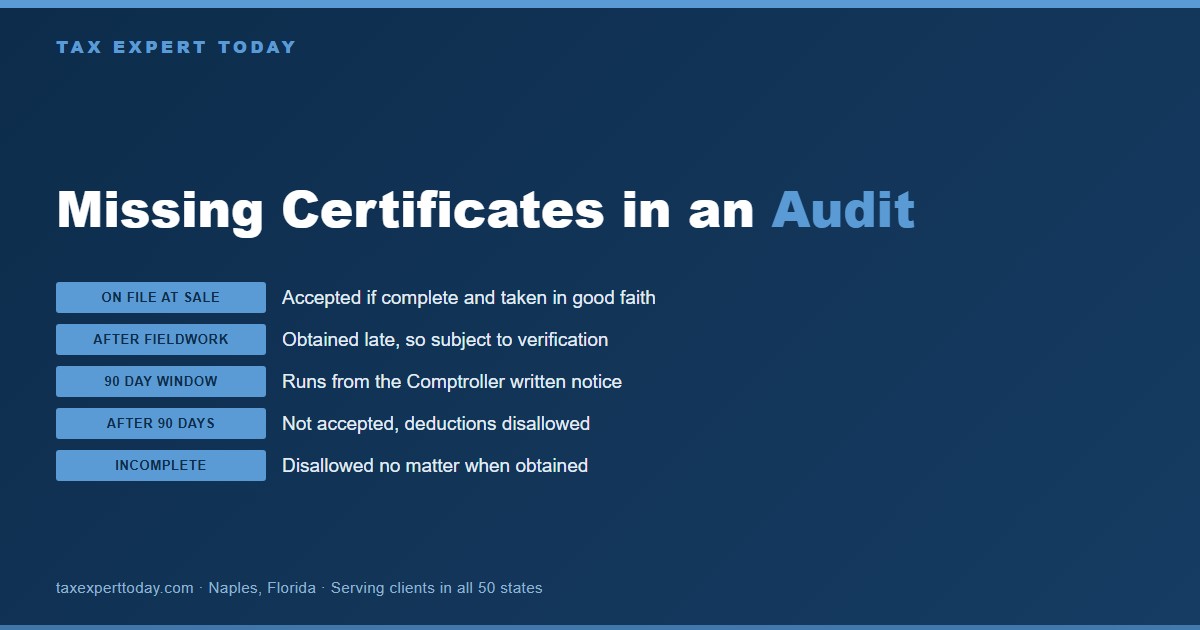
After written notice from the Comptroller, a seller has 90 days, or a later date agreed in writing, to produce missing resale and exemption certificates under Tax Code Section 151.054(e). Certificates produced after that window are not accepted, certificates obtained after the audit begins are subject to verification, and incomplete certificates are disallowed regardless of when obtained.
- A 90 day window. It runs from the date of the Comptroller’s written notice requiring the certificates.
- Not after the window closes. The statute bars deductions based on certificates delivered late.
- Late certificates get verified. The Comptroller may verify the exemption basis before allowing the deduction.
- Incomplete means disallowed. A late but complete certificate can help; an incomplete one cannot.
Section 151.054(e) states that if the seller is not in possession of the certificates within 90 days from the date written notice requiring possession is given by the Comptroller, or a later date agreed by the Comptroller and the seller, deductions that require the certificates are disallowed, and no deduction may be granted on the basis of certificates delivered after that period. Subsection (f) allows the Comptroller to verify the reason or basis for the exemption claimed in a certificate delivered during the period before allowing the deduction. Rule 3.287(d)(4) fills in the details: certificates obtained on or after the date the auditor begins work, or after the entrance conference, are subject to verification; the written notice itself is given only after a petition for redetermination or a refund claim has been filed, so the window is not a substitute for a complete file during fieldwork; mailed notice is presumed received within three business days of deposit with the Postal Service, a presumption the seller may rebut with evidence of later delivery; and incomplete certificates are disallowed regardless of when obtained.
| Audit stage | What happens to exemption certificates | Authority |
|---|---|---|
| Certificates on file before the sale | Accepted if complete and taken in good faith | Section 151.054(c) and (e); Rule 3.287(d)(2) |
| Certificates obtained after fieldwork begins or after the entrance conference | Subject to verification of the exemption basis before the deduction is allowed | Rule 3.287(d)(4) |
| Written notice requiring missing certificates | Seller has 90 days, or a later agreed date, to deliver them | Section 151.054(e); Rule 3.287(d)(4) |
| Certificates delivered within the period | Independently verified before the exemption is allowed | Section 151.054(f); Rule 3.287(d)(4) |
| Certificates delivered after the period | Not accepted; the deductions are disallowed | Section 151.054(e) |
| Incomplete certificates at any stage | Disallowed regardless of when obtained | Rule 3.287(d)(4) |
The window is short, and it is easy to lose. A seller with hundreds of exempt sales in the audit period may need to contact customers who have since closed, changed staff or moved, and each certificate obtained late will be checked. Two steps help. The first is to inventory the certificate file as soon as an audit notice arrives, before the auditor asks, so that the 90 day period is used to fill real gaps rather than to discover them. The second is to calendar the notice date carefully, including the three business day mailing presumption, and to ask for a written extension early if the volume justifies it. Our Texas Comptroller audit guide explains how certificate gaps interact with sampling, since a missing certificate in a sampled month can be projected across the whole audit period.
Sellers sometimes ask whether they can avoid the issue by charging tax on every sale and leaving exempt customers to seek refunds. That approach removes certificate risk but creates customer friction, and it is not what the law requires. Publication 96-122 does recognize that sellers are not required to accept a certificate, and that a customer can then obtain Form 00-985 from the seller to request a refund from the Comptroller. Most businesses that sell regularly to exempt buyers find that a disciplined certificate process is less costly than refusing exemptions outright.
How Should a Texas Seller Build an Exemption Certificate File?
A defensible file collects a complete certificate before the first tax-free sale, checks it against Rule 3.287(f), confirms the reason fits what the customer buys, links every exempt invoice to a certificate, refreshes blanket certificates on a schedule, and keeps everything for at least four years after the last sale it supports.
- Gate the tax-exempt flag. No account is set to exempt until a reviewed certificate is on file.
- Review, then store. Check the five required items and the fit between item and reason.
- Verify where it is cheap to do so. Exempt entity searches and Ag/Timber Number checks take minutes.
- Reconcile periodically. Compare exempt sales reported on returns with the certificates in the file.
The process does not need to be complicated, but it does need to be consistent. The steps below reflect the statute and rule discussed in this guide and the practical points that arise when certificates are tested in an audit.
- Collect before the sale. Ask for Form 01-339 (Back), Form 01-924 or Form 01-925, as applicable, when the account is opened or before the first exempt invoice.
- Check completeness. Confirm the purchaser’s name and address, the item description, the reason, the signature and date, and the seller’s name and address are all present and legible.
- Check fit. Compare the reason with the products the customer is likely to buy. Flag categories that could not qualify.
- Verify status where relevant. Use the exempt entity search for organizations and the online Ag/Timber Number check for producers, and note the date checked.
- Link invoices. Make sure each exempt invoice can be traced to the certificate that supports it, including any attached order referenced on the form.
- Refresh and retain. Update blanket certificates when facts change and on a regular cycle, and keep each certificate for at least four years after the last sale it supports.
Businesses that sell into Texas from other states face the same rules once they are registered. If you are deciding whether you have a Texas collection obligation at all, start with our guide to Texas sales tax nexus. If you are winding down a Texas operation, our guide to closing a business in Texas explains why the certificate file still matters after the permit is closed: the four year period continues to run after the last sale.
How Should Buyers Use a Texas Sales Tax Exemption Certificate?
Buyers should confirm they actually qualify before signing, state a specific reason tied to the item, sign in the name of the exempt entity, keep copies of every certificate given, and stop using the certificate for any item that will be used outside the exempt purpose. The signature makes the buyer responsible for the tax if the claim fails.
- Qualify first. A nonprofit needs Comptroller exempt status; a producer needs a current Ag/Timber Number.
- Be specific. State the actual exemption and the actual use, not a general label.
- Control who signs. Limit authority to people who understand what they are certifying.
- Track divergent use. When an item moves to a non-exempt use, the tax becomes due under Section 151.155.
From the buyer’s side, the Texas sales tax exemption certificate is a liability document. The organization or business that signs it is representing to the seller, and through the seller to the Comptroller, that the purchase qualifies. For exempt organizations, that means internal controls on who may sign certificates and on what purchases they may cover. For agricultural and timber producers, it means separating farm or ranch purchases from household purchases and watching the exclusive use requirement. For any business claiming a use-based exemption, it means documenting the use, because the exemption depends on it.
Businesses that are new to Texas often meet these rules for the first time when a supplier asks for a certificate. Our checklist for moving a business to Texas covers sales tax registration alongside the other first year obligations, and our overview of Texas LLC taxes explains how sales tax sits alongside the Texas franchise tax for a typical closely held business.
Texas Sales Tax Exemption Certificate Help in Naples & Southwest Florida
Tax Expert Today LLC advises businesses and organizations on state tax matters nationwide from our office in Naples, Florida. Texas sales tax exemption certificate questions reach us in several ways. Florida companies that sell equipment, supplies or services into Texas register for Texas sales tax and then find their customer list includes school districts, churches, cities and ranches, each of which expects to buy tax free. Owners who relocated from Texas to Southwest Florida, a move we compare in our guide to Texas vs Florida taxes, often keep operating Texas businesses and handle Texas compliance from Naples. And some businesses first focus on their certificate file only when a Comptroller audit notice arrives and the 90 day window begins.
Our work on this topic is built around the mechanism described in this guide. We review existing certificate files against Rule 3.287, identify certificates that are incomplete or do not fit the products sold, design collection and refresh procedures that sales and billing staff can follow, and reconcile exempt sales reported on returns with the certificates that support them. When an audit is under way, we inventory the file early, calendar the certificate window, and prepare the verification the Comptroller is likely to request.
- Texas exemption certificate help Naples businesses can reach in person. Our office is on Tamiami Trail North in Naples, Florida, and we work with clients locally and remotely.
- Texas sales tax compliance Naples FL and nationwide. We serve clients in all 50 states, and the Texas rules apply the same way wherever the business owner lives.
- Certificate file reviews before an audit. Gaps are much easier to close when there is no 90 day deadline running.
- Exempt organization and agricultural customers. We help sellers set up controls for the customer types that generate the most certificates.
- Coordinated with your broader Texas obligations. Sales tax, franchise tax, payroll tax and federal positions are reviewed together.
Related services include our Texas tax services for businesses with Texas obligations and our Naples tax planning work for Southwest Florida owners and organizations.
Tax Expert Today LLC
11983 Tamiami Trail N, Naples, FL 34110
Phone: (239) 441-2005
Hours: Monday through Friday, 10:00 a.m. to 5:00 p.m. ET
Local question we are asked often: A Naples company sells classroom technology to Texas school districts and has collected purchase orders, but not exemption certificates, from most of them. Is the company exposed? It may be. Texas government entities are exempt by law, and a government purchase voucher can serve as proof of exempt status under Rule 3.322(g)(3), so the first step is to determine what documents the company actually holds for each sale and whether they identify the buyer as the government entity. Where the file relies on informal purchase orders that do not establish the exemption, the safer course is to collect proper documentation now, while there is no audit deadline running, rather than within the 90 day window after a Comptroller notice.
When Should You Engage a Professional?
Many businesses manage exemption certificates without outside help, and the rules in this guide are designed to be followed by billing and sales staff. Professional review becomes worthwhile when the volume of exempt sales is large, when a business sells to several kinds of exempt buyer, when a Comptroller audit notice has arrived, or when a buyer is unsure whether its own purchases qualify. Texas exemption certificates are a state tax matter administered by the Texas Comptroller, not an IRS matter, and our multidisciplinary team of tax advisors, enrolled agents, CPAs and attorneys advises on state tax matters nationwide. Contested cases that proceed to a formal hearing or to court may also call for Texas licensed counsel, and we coordinate with counsel where that is appropriate.
If you would like a review of your Texas certificate file, a procedure for exempt customers, or help responding to a Comptroller request for certificates, contact Tax Expert Today at (239) 441-2005 or visit our Texas tax services page. Businesses facing a federal examination at the same time can also review our IRS resolution and audit support services.
Frequently Asked Questions
What form is the Texas sales tax exemption certificate?
It is the Texas Sales and Use Tax Exemption Certification on the back of Comptroller Form 01-339. The front of the same form is the resale certificate. Agricultural and timber exemptions use Forms 01-924 and 01-925, and the Comptroller accepts a substantially similar form under 34 Tex. Admin. Code Section 3.287.
Does a Texas exemption certificate need a tax exempt number?
No. Form 01-339 states that the exemption certificate does not require a number to be valid and that sales and use tax exemption numbers do not exist. The exception is agricultural and timber exemptions, which require a Comptroller-issued Ag/Timber Number on the certificate under Tax Code Section 151.1551.
Do Texas exemption certificates expire?
The general Form 01-339 has no printed expiration date, but it remains valid only while the facts behind it remain true. Ag/Timber Numbers expire on December 31, 2027 and must be renewed every four years, and agricultural and timber blanket certificates must be updated every four years.
Can a seller refuse a Texas exemption certificate?
Yes. The Comptroller’s Publication 96-122 states that sellers are not required to accept the certificate. If a seller refuses, the exempt organization can obtain Form 00-985, Assignment of Right to Refund, from the seller and request a refund of the tax from the Comptroller, subject to the four year limitation period.
What happens if a seller does not have an exemption certificate during an audit?
The sale is presumed taxable under Tax Code Section 151.054. After written notice from the Comptroller, the seller has 90 days, or a later agreed date, to produce certificates. Certificates delivered within that period are verified before the deduction is allowed, and certificates delivered later are not accepted.
Are all nonprofits exempt from Texas sales tax?
No. Qualifying religious, educational and charitable organizations and certain federally exempt organizations, such as 501(c)(3) organizations, may qualify, but they must apply to the Comptroller and receive exempt status first. Several other nonprofit types, such as homeowner associations, generally do not qualify for the sales tax exemption on their purchases.
Can an employee use the organization’s exemption certificate for personal purchases?
No. Rule 3.322(g)(5) states that employees cannot claim the exemption on personal purchases, even when the organization reimburses them. Exempt organizations should limit who may sign certificates and require that exempt purchases be paid with organization funds.
Can a Naples, Florida business accept Texas exemption certificates from Texas customers?
Yes. A Florida business registered to collect Texas sales tax follows the same Texas rules as an in-state seller. It should collect Form 01-339 (Back) or the applicable agricultural or timber certificate before the sale, review it against Rule 3.287(f), and keep it for at least four years after the last sale it supports.
Published October 9, 2026 by Dr. Pellumb Kabashi « Back to Learning Center
Have a question this article touches on?
Tax Expert Today LLC, based in Naples, Florida and serving clients across the United States.
Schedule a Consultation (239) 441-2005