
By Dr. Pellumb Kabashi, DBA, MBA, CES, CFE, EA
Founder, Tax Expert Today LLC · Tax advisors, enrolled agents, CPAs, and attorneys · Serving clients in all 50 states
Quick Answer: A Texas claim for refund is the written request, usually Form 00-957 or the Comptroller’s web form, that a business files to recover sales tax and certain other state taxes paid in error. It must state every ground in detail and generally be filed within four years of the date the tax was due, and a ground once denied cannot be refiled. Call (239) 441-2005 for a free consultation.
Overpaid Texas sales tax does not come back on its own. A business that paid tax on an exempt purchase, collected tax it should not have collected, remitted the same period twice or applied the wrong local rate has to ask for the money, in writing, within a limited period, and in a form that satisfies both the Tax Code and the Comptroller’s rule. The vehicle is the Texas claim for refund, which takes its name from the Comptroller’s own Form 00-957.
Most of what ranks for this subject explains the mechanics: which form, which address, which supporting documents. That information matters, and it is covered here. This guide is written for a different moment, the point at which a business owner or controller is deciding whether to file, when to file, how broadly to state the grounds and whether the refund belongs in a standalone claim or inside an audit that is already open. Those decisions turn on a handful of rules that are rarely put side by side: a ground that is denied cannot be refiled for the same transaction and period, an incomplete claim does not stop the limitations clock, a claim tied to a deficiency determination has its own window, and a refund claim is verified by the Comptroller in a way that can look closely at the same records an auditor would.
The guide is limited to the state side. Texas sales and use tax, and the other taxes the Comptroller administers, are state tax matters, not IRS matters. Federal refunds work under a different statute and a different form, which is covered in our guide to IRS Form 843. Nothing here predicts whether a particular claim will be granted. It describes how the process works so that the claim a business files is the claim it intended to file.
What Is a Texas Claim for Refund?
A Texas claim for refund is a written request to the Comptroller for the return of tax, penalty or interest that was unlawfully or erroneously collected. It is filed on Form 00-957, through the Comptroller’s web form or by an equivalent written claim, and it must state each ground fully and in detail within the applicable limitations period.
- Statutory basis. Tax Code Section 111.104 governs refunds of taxes and fees the Comptroller collects or administers.
- Rule basis. 34 TAC Section 3.325 adds the sales and use tax detail.
- Credit first. An amount found to be overpaid is first credited against any other amount the same taxpayer owes, and only the remainder is refunded.
- Written only. A telephone call or an informal email asking about a refund is not a claim.
The first sentence of Section 111.104 is easy to read past, and it shapes every outcome that follows. When the Comptroller finds that an amount was unlawfully or erroneously collected, the Comptroller “shall credit the amount against any other amount when due and payable” by the taxpayer, and only the remainder may be refunded. A refund claim is therefore not just a request for money. It is an invitation for the agency to look at the account as a whole, and a business with an open balance in another tax or another period should expect the refund to be applied there first.
The Comptroller’s Sales Tax Refunds page lists the same idea in practical terms. When a claim is approved, the amount actually paid can be affected by the timely filing discount, penalties, credit interest or an existing liability. A claim for a gross amount of overpaid tax does not necessarily produce a check for that amount.
| Element | What the law requires | Source |
|---|---|---|
| Form | Written claim; Form 00-957 or the Comptroller web form are the standard vehicles | Tax Code 111.104(c)(1); Comptroller Sales Tax Refunds page |
| Grounds | Each reason or ground stated fully and in detail | Tax Code 111.104(c)(2); 34 TAC 3.325(a)(4)(A) |
| Period | The period in which the overpayment was made | 34 TAC 3.325(a)(4)(B) |
| Transactions | Transaction level detail, including invoice, date, item, amount and local jurisdictions | 34 TAC 3.325(a)(4)(C) |
| Timing | Generally four years from the date the tax was due and payable | 34 TAC 3.325(b)(1) |
| Documentation | Invoices, cancelled checks, contracts or a statement that records will be made available | 34 TAC 3.325(a)(4)(E) |
Who Can File a Texas Claim for Refund?
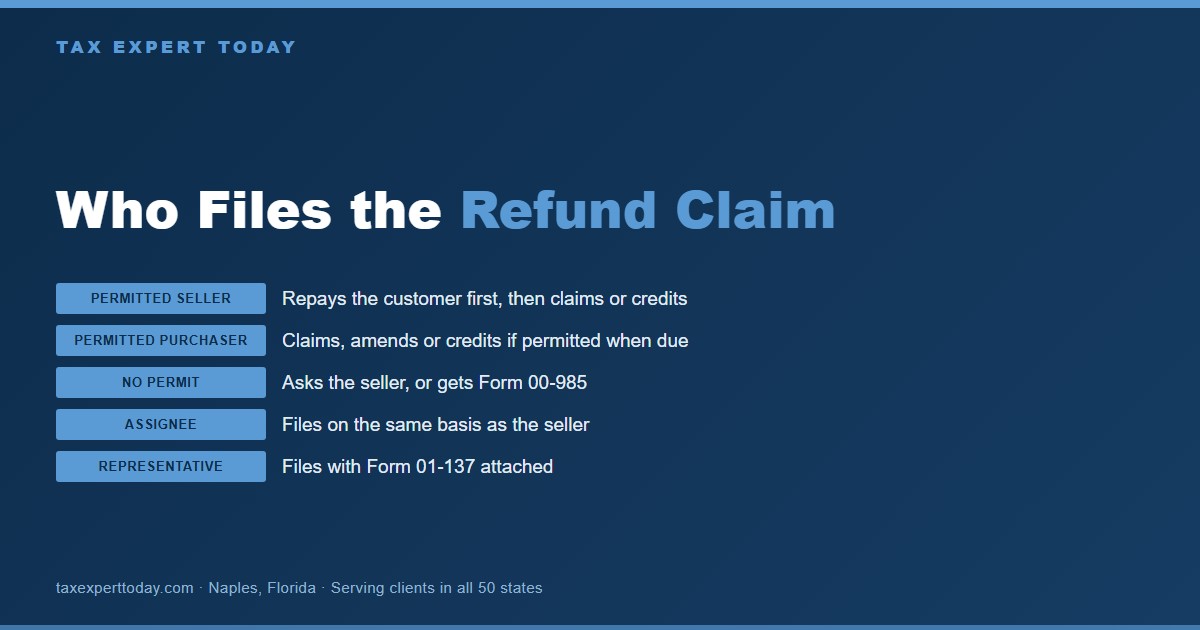
Only the person who directly paid the tax to the state, or that person’s attorney, assignee or other successor, may file a Texas claim for refund. For sales tax, that usually means a permitted seller that remitted the tax, or a permitted purchaser that paid tax in error to a seller while holding its own Texas permit.
- Permitted seller. A seller holding a Texas sales and use tax permit that collected and remitted the tax.
- Permitted purchaser. A purchaser that held a Texas permit when the tax was due and payable.
- Non-permitted purchaser. Must ask the seller first, or obtain an assignment from the seller.
- Representative. An accountant or attorney filing for the business submits Form 01-137, the limited power of attorney.
Standing is the first question because Section 111.104(b) answers it narrowly. The claim belongs to “the person who directly paid the tax to this state.” In a typical sales transaction, the purchaser pays tax to the seller and the seller pays it to the state. The purchaser bore the economic cost, but the seller made the payment. That is why the Comptroller’s rule divides claimants into three groups, and why the first step in any refund project is to place each transaction into the right group.
Rule 3.325(a)(3) gives a permitted purchaser more room than a non-permitted one. A purchaser that held a Texas sales and use tax permit at the time the tax paid in error was due and payable may claim the refund directly from the Comptroller, amend a return for the period of the overpayment, or take a credit on a later return. The permit has to have been in place at that earlier time. A business that obtained its permit later cannot reach back and use its new status to claim directly for the earlier period; it needs an assignment from the seller for those transactions.
| Claimant | Who it is | How it recovers the tax |
|---|---|---|
| Permitted seller | Collected tax from a customer and remitted it | Refunds or credits the customer first, then claims from the Comptroller or takes a credit on a later return |
| Permitted purchaser | Held a Texas permit when the tax was due and paid tax in error to a seller | Direct claim, amended return for the period, or credit on a later return |
| Non-permitted purchaser | No Texas permit during the claim period | Asks the seller for a refund, or obtains Form 00-985 from the seller and files with the Comptroller |
| Assignee or successor | A purchaser, creditor, settlement trustee or successor entity holding the seller’s right | Files with the assignment attached, on the same basis as the original seller |
| Representative | Accountant, attorney or other agent | Files for the claimant with Form 01-137 attached |
When Must a Non-Permitted Purchaser Go Back to the Seller?
A purchaser without a Texas sales and use tax permit that paid tax in error to a permitted seller may request the refund only from that seller. The seller can refund the tax directly, or it can assign its right to the refund on Form 00-985 so the purchaser can file with the Comptroller.
- Seller first. Rule 3.325(a)(1) sends the non-permitted purchaser to the seller.
- Two seller options. Refund the tax and claim it back, or sign an assignment.
- One form per vendor. A separate Form 00-985 is needed for each seller.
- Remote seller exception. No assignment is needed for a refund of local tax only that was paid to a remote seller.
This route is where many purchaser refunds stall, and the reason is practical rather than legal. The seller has no economic interest in the refund. It collected the tax, remitted it and moved on, and refunding the customer means reopening its own records, obtaining a certificate and then filing its own claim or taking its own credit. Some sellers do this routinely for large customers. Others prefer to sign an assignment and let the purchaser do the work. A purchaser with many vendors should expect a mix of responses and should start the outreach early, because the limitations period keeps running while it waits.
The Comptroller’s Texas Claim for Refund web form notes one exception. If the purchaser is requesting a refund of local tax only, paid to a remote seller, the assignment form is not required. That situation arises when a remote seller applied a local rate that should not have applied, and it is narrow. For every other transaction with a permitted seller, a non-permitted purchaser that wants to file directly needs the signed assignment.
How Does an Assignment of Right to Refund Work?
Form 00-985 transfers the seller’s right to a refund to another person, usually the purchaser. The seller chooses whether to assign the right to file and receive the refund or only the right to receive it, describes the tax, period and transactions, and affirms that it has not claimed and will not claim the same tax.
- Two scopes. The right to file and receive, or the right to receive only.
- Specific description. Tax type, period and transactions, with a schedule if needed.
- Seller affirmation. No prior refund or credit for the same tax, and none in the future.
- Authorized signer. An officer, director, partner or managing member signs for the seller.
The current Form 00-985 carries a September 2025 revision date, and its structure answers most of the questions purchasers ask about it. The seller is the assignor and the purchaser is the assignee. The seller selects one of two options: assignment of the right to file a refund request and receive the refund, or assignment of the right to receive the refund only. For a purchaser that intends to prepare and file the claim itself, the first option is the one that matters. A receive only assignment leaves the filing in the seller’s hands.
The form also states that the Comptroller may require both parties to provide documents needed to verify the claim or to transfer any verified amount. An assignment does not end the seller’s involvement in the verification. A purchaser that obtains assignments from a dozen vendors should expect that the Comptroller’s reviewer may contact some of those vendors about their records.
Rule 3.325(a)(2)(E) extends the same mechanism beyond purchasers. A permitted seller’s right to a refund may be assigned to a creditor, a settlement trustee or a successor entity, and the Comptroller grants or denies a claim by the assignee “on the same basis as if it had been claimed by the original seller.” The assignee inherits the seller’s obligations too, including the duty to refund or credit tax paid in error to the purchaser before claiming it.
| Form 00-985 item | What it does | Common problem |
|---|---|---|
| Assignor and assignee | Identifies the seller and the purchaser receiving the right | Assignee taxpayer number left blank even though the purchaser is now permitted |
| Option a | Assigns the right to file and to receive the refund | Purchaser receives option b and cannot file |
| Option b | Assigns the right to receive the refund only | Seller never files, so nothing is received |
| Tax, period and transactions | Defines exactly what is assigned | Description narrower than the claim the purchaser later files |
| Seller affirmation | No prior or future claim or credit by the seller | Seller already took a credit on a later return for part of the same tax |
| Signature | Authorized officer, director, partner or managing member | Signed by a salesperson or accounts receivable clerk |
What Must a Seller Do Before Claiming Tax It Collected in Error?
A seller that collected tax in error must refund or credit that tax to the customer before the Comptroller will refund it to the seller. Before refunding the customer, the seller must obtain a properly completed resale or exemption certificate and keep it as the basis for the refund. Returned merchandise follows a separate rule.
- Customer first. Section 111.104(f) bars a refund to a person who collected the tax from someone else until that person has been repaid.
- Certificate first. The seller obtains a resale or exemption certificate before refunding.
- Proof of repayment. Cancelled checks or credit memos show the customer was repaid.
- Returns. A seller that refunds the price of returned goods may claim the matching sales tax.
The order of steps matters more than it appears. Rule 3.325(a)(2)(B) requires the seller to obtain a certificate that meets the requirements of the resale and exemption certificate rules before it refunds the customer. A seller that refunds first and asks for the certificate later is exposed if the certificate never arrives, or arrives incomplete. Our guides to the Texas resale certificate and the Texas sales tax exemption certificate explain what a properly completed certificate contains and the good faith standard a seller has to meet.
Once the customer has been repaid, the seller has two routes. It may file a claim with the Comptroller under the procedures in paragraph (4) of the rule, or it may take a credit on a future sales and use tax return in the amount refunded or credited to the customer. The Comptroller’s Sales Tax Refunds page lists “canceled checks or credit memo acceptance forms as proof that tax collected in error by a seller was refunded to the customer” among the documents it may request, which tells a seller what to keep.
How Long Does a Business Have to File a Texas Claim for Refund?
A Texas claim for refund generally must be filed within four years from the date the tax was due and payable. A claim for tax paid under a deficiency determination may instead be filed within six months after the determination becomes final, if that is later, and a written agreement with the Comptroller can extend the period.
- General rule. Four years from the due date of the tax, under Rule 3.325(b)(1).
- Deficiency rule. The later of four years or six months after the determination becomes final.
- Extension agreements. Written, with stated reasons, and no single agreement longer than 24 months.
- Waiver. A claim not filed in time waives any demand against the state for that overpayment.
The four year period runs from the date the tax was due and payable, not from the date of the purchase and not from the date the business discovered the error. For a monthly filer, each month’s return has its own due date and therefore its own deadline. A refund project covering four years of purchases is really a series of deadlines, one for each reporting period, and the oldest periods are lost one at a time as each due date passes its fourth anniversary.
The deficiency determination rule is narrower than it looks. Section 111.104(c)(3) allows a claim “before the expiration of six months after a jeopardy or deficiency determination becomes final,” whichever period expires later. Section 111.104(d) then limits that claim to the amount of tax, penalty and interest and to the tax payment period for which the determination was issued. Rule 3.325(b)(3) says the same thing in operational terms: a claim filed in the six month window is timely for all items included in the determination, and every other item remains subject to the ordinary four year rule. The six month window cannot be used to reach purchases the audit never examined.
Section 111.203 allows the Comptroller and a taxpayer to agree in writing, before the period expires, to extend the time for filing a refund claim. The agreement must state the reasons, no single extension may run more than 24 months past the expiration date being extended, and further agreements may follow. In practice these agreements are usually signed during an audit. Rule 3.325(b)(4) adds two limits worth noting: an extension applies only to the periods the agreement names, and any refund request for those periods must be made before the agreement expires.
| Situation | Filing period | Limit |
|---|---|---|
| Ordinary overpayment | Four years from the date the tax was due and payable | Each reporting period has its own deadline |
| Tax paid under a deficiency determination | Later of four years or six months after the determination is final | Limited to the items and periods in the determination |
| Signed extension agreement | Until the agreement expires | Only the named periods; each agreement 24 months or less past the expiration being extended |
| Final determination by a regulatory agency, including an IRS audit | Before the first anniversary of the date the determination becomes final | Applies to overpayments resulting from that determination under Section 111.206 |
| Claim not filed in time | None | Treated as a waiver of the demand against the state |
The last row of that table deserves a word. Section 111.206 applies when a final determination by a local, state or federal regulatory agency, expressly including an IRS audit, changes a Texas tax liability. If that determination shows an overpayment of Texas tax, the taxpayer may file a refund claim before the first anniversary of the date the determination became final. This matters most for taxes measured by federal figures, and it is a reason to review the Texas side whenever a federal examination closes with changes.
When Does a Refund Claim Stop the Limitations Clock?
A refund claim stops, or tolls, the limitations period only if it states each ground fully and in detail, identifies the period of the overpayment, includes any required assignment from a non-permitted assignee and includes a power of attorney when someone else files. A claim missing those elements does not stop the clock.
- Grounds. Each reason stated fully and in detail.
- Period. The period of the claimed overpayment identified.
- Assignment. Attached when a non-permitted assignee or successor files.
- Power of attorney. Attached when anyone other than the claimant submits the claim.
Rule 3.325(b)(10) is the provision that turns a filing into a protected claim. It separates two kinds of defects. If the four core elements are present but other paragraph (a)(4) details are missing, the claim still tolls the period, although it may be denied and the claimant may then request a hearing. If one of the four core elements is missing, the period is not tolled at all. The Comptroller’s refunds page puts it plainly: “The statute of limitations will not be tolled (does not end) until a refund claim includes all of the required elements.”
That distinction has a direct planning consequence. A business approaching a four year deadline on an older period should not wait to assemble every invoice before filing. It should file a claim that contains the four tolling elements, states the grounds completely and identifies the period, and then supply the supporting detail. What it must not do is file a placeholder that says only that tax was overpaid. That kind of claim does not toll anything, and the period keeps expiring underneath it.
Rule 3.325(d) answers the related question of when a claim is made. The postmark date, or its equivalent, on the refund request determines the claim date. Where a business files additional claims while earlier ones are pending, the date of each claim controls separately, both for timeliness and for interest. A supplemental claim filed later for additional transactions is a new claim with its own date.
What Must the Claim Say About Each Ground?
The claim must state fully and in detail each reason or ground on which it is founded, such as the statutory exemption or exclusion that applies to each transaction. The Comptroller’s form and web form both warn that simply stating tax paid in error is not a sufficient reason for a refund.
- Specific authority. Rule 3.325(a)(4)(C)(v) asks for the specific reason, such as the applicable statute.
- Every ground. A transaction that qualifies on two theories should state both.
- Facts tied to law. The ground explains why this item, on these facts, was not taxable.
- Not a label. Phrases such as “overpayment” or “exempt purchase” alone do not state a ground.
A ground is the legal reason the tax was not owed, connected to the facts that make the reason apply. “Exempt manufacturing equipment” is a label. A ground would identify the manufacturing exemption by statute, describe the equipment and where it is used in the production process, and explain why it meets the exemption’s conditions. “Out of state use” is a label. A ground would identify the provision relied on, describe where the item was delivered and used, and explain the documents that show it.
The reason this matters more in Texas than in many other settings is what happens to a ground after a denial, explained in the next section. The ground is also what defines the rest of the dispute. If the claim is denied and the business takes the matter to court, Section 112.152 limits the issues in the suit to the grounds of error in the motion for rehearing or the material facts and legal bases in a notice of intent to bypass the hearing. The administrative steps narrow the case, and the original claim is where that narrowing begins.
| Weak statement | Why it falls short | A stronger approach |
|---|---|---|
| Tax paid in error | Expressly rejected by the form as insufficient | Name the exemption or exclusion and the facts for each transaction group |
| Exempt purchases | Does not say which exemption or why it applies | Cite the provision, describe the items and their use |
| Wrong rate charged | Does not say which jurisdiction or which rate was correct | Identify the delivery location, the local jurisdictions charged and the correct ones |
| Duplicate payment | Does not identify the payments | Give the dates, amounts and confirmation numbers of both payments and the return they relate to |
| Items resold | Does not show the resale basis | Describe the resale, attach or reference the resale certificate and the sales records |
Why Can a Denied Ground Never Be Refiled?
Section 111.107(b) provides that a person may not refile a refund claim for the same transaction or item, tax type, period and ground that the Comptroller previously denied. Once a ground is denied and the denial becomes final, that ground is gone for that item, even if time remains in the limitations period.
- Four matching elements. Same transaction or item, tax type, period and ground.
- Applies within the period. The Comptroller’s publication says a denied refund cannot be requested again even within the statute of limitations.
- No credit workaround. A denied refund cannot later be taken as a credit on a return, report, audit or examination.
- Different ground differs. The bar is tied to the ground that was denied.
This is the rule that most changes how a claim should be written, and it is the one most often left out of general guidance. Read with the tolling rule, it creates a tension. A business wants to file early to stop the clock, which argues for filing quickly. It also gets one opportunity to present each ground for each transaction, which argues for filing carefully. The answer is not to delay; it is to put the thinking before the filing, so that the claim that stops the clock is also the claim the business would be content to defend.
Publication 96-1253 states the consequence directly. If the Comptroller does not receive a Statement of Grounds or a Notice of Intent to Bypass the Hearing within 60 days of the refund denial letter, the refund results become final, and a refund that has been denied “cannot be requested again at a later date, even if the period is still within the statute of limitations.” The same passage adds that a denied refund cannot be included as a credit on a return, report, audit or examination.
Section 111.1042 adds a quieter trap. The Comptroller may review a claim informally and grant or deny it in whole or in part. If the claimant does not exercise the right to a hearing after a full or partial denial, the time the claim spent in informal review does not toll the limitations period for any later claim on the same period and tax type. A business that lets a partial denial go final and then tries to file a fresh claim for the same period on a new ground may find that the period ran out while the first claim was under review.
What Documentation Supports a Texas Claim for Refund?
The claim needs transaction level support: the seller or purchaser name, invoice number, date, description, specific reason, taxable amount, tax requested, the local jurisdictions that received the tax and, for purchaser claims, the seller’s permit information. Invoices, proof of payment, certificates and ledgers support each line.
- Nine data points per transaction. Listed in Rule 3.325(a)(4)(C).
- Schedule format. More than 10 invoices go on a schedule such as Form 01-911.
- Local detail. For sales tax, the name, authority ID and amount for each local jurisdiction.
- Records statement. If records cannot easily be submitted, a statement that they will be made available.
The rule’s list of required transaction details is specific, and a claim schedule built around it saves time later. For each transaction, Rule 3.325(a)(4)(C) asks for the purchaser or seller name, the invoice number, the date, a description of the items, the specific reason for the refund, the purchase or sale amount subject to refund, the total tax requested, the local jurisdictions to which tax was remitted and, where tax was paid in error to a permitted seller, that seller’s name, address and permit number or information that identifies it.
The local jurisdiction column is the one most often missing. Texas sales tax combines the state rate with city, county, transit and special purpose district rates, and a refund is paid from each of the funds that received the tax. Form 00-957 requires, for sales tax claims, the name, authority ID and amount of tax claimed for each local jurisdiction on the schedule. A claim that shows a single combined tax figure per invoice will usually come back with a request for the breakdown.
| Document | What it proves | When it is needed |
|---|---|---|
| Invoices | The transaction, the tax charged and the parties | Every claim for tax paid to a seller; scheduled when more than 10 |
| Proof of payment | That the tax was actually paid | Purchaser claims and duplicate payment claims |
| Resale, exemption or direct pay certificates | The basis for the exemption or the purchaser’s status | Seller claims and exemption based claims |
| Sales journal and general ledger | That the transactions were recorded as claimed | Accounting error claims and large seller claims |
| Executed contracts | The nature of the service or the separate statement of charges | Service and bundled transaction claims |
| Utility predominant use study | The exempt share of electricity or gas use | Utility exemption claims |
| Cancelled checks or credit memos | That the seller repaid the customer | Seller claims for tax collected in error |
| Form 00-985 and Form 01-137 | Standing of an assignee and authority of a representative | Assignee claims and claims filed by an agent |
The Comptroller’s web form accepts supporting files in PDF or ZIP format up to 2 MB. For an accounting error claim it asks for accounting records; for other claims it asks for invoices. A large refund will not fit inside that limit, which is one reason the email and mail routes remain in use. The Comptroller’s refunds page also reminds claimants that the agency “can request additional information for each transaction during the verification process,” so the schedule filed with the claim is the starting point rather than the full record.
Can a Business Use Sampling to Calculate a Refund?
Yes, in some cases. A permitted purchaser that paid tax in error to permitted sellers may compute the overpayment with a projection based on a sample of transactions, using a generally accepted sampling method approved by the Comptroller, if it was permitted for the entire period. The method must be kept and made available on request.
- Who may sample. A permitted purchaser, under Rule 3.325(a)(3)(B).
- Whole period permit. The purchaser must have been permitted throughout the projection period.
- Approved method. Generally accepted sampling methods as approved by the Comptroller.
- Retained workpapers. The method and computation must be kept and produced on request.
Sampling makes large purchaser claims feasible. A manufacturer with a very large volume of purchase invoices over four years cannot reasonably build a claim one invoice at a time. A projection lets it review a statistically valid sample, measure the error rate and project it across the population. The trade is that the method itself becomes part of what the Comptroller reviews, and a weak sample design can produce a disagreement about the method rather than about the tax.
Two cautions follow from the rule’s wording. First, the permit condition applies to the entire projection period, so a business that was unpermitted for part of the window has to separate that part and handle it through seller refunds or assignments. Second, the rule speaks to a permitted purchaser that paid tax in error to a permitted seller. It is not a general license to project every kind of refund, and claims based on different grounds or different kinds of transactions may need to be handled separately.
Should You File a Claim, Amend a Return or Take a Credit?
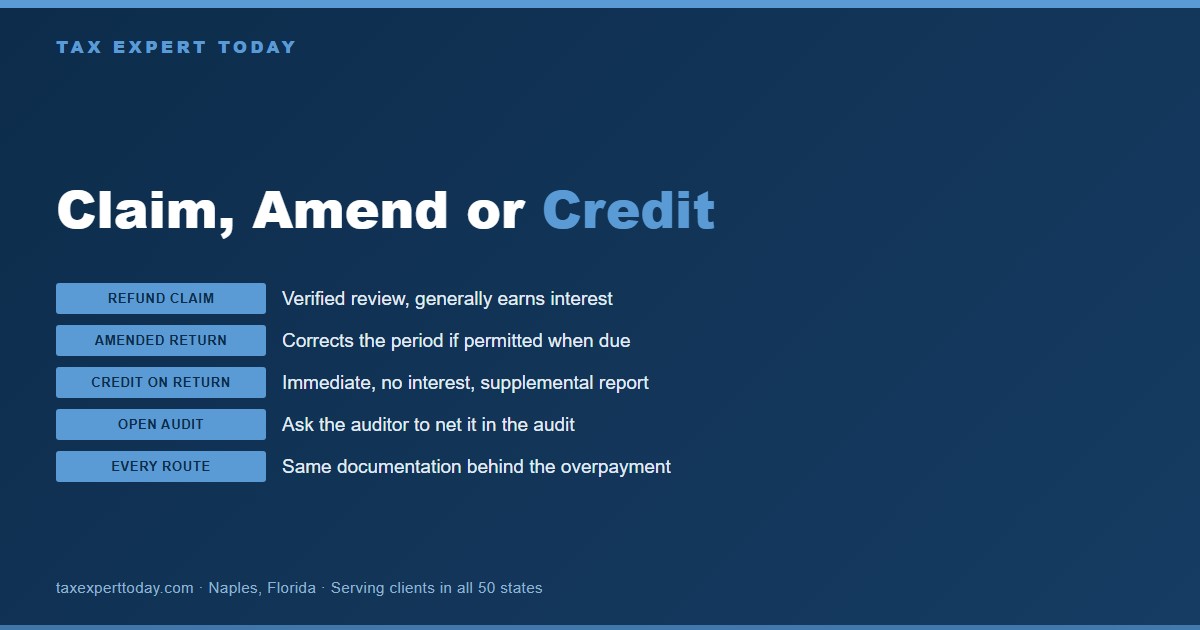
A permitted purchaser may file a refund claim, amend the return for the period of the overpayment, or take a credit on a later return. A credit is fast but earns no interest and must be reported on a supplemental report. A claim earns interest when granted and creates a clear record of the grounds and the period.
- Refund claim. Formal claim; may earn interest; subject to verification.
- Amended return. Corrects the period directly for a permitted taxpayer.
- Credit on a later return. No interest; reported with the earliest date of the tax paid in error.
- Same documentation. Every route requires the records that support the overpayment.
Rule 3.325(a)(3)(A) lists the three routes for a permitted purchaser, and the choice is less obvious than it seems. A credit taken on a later return is the quickest way to recover the money, but Section 111.064(b) provides that a credit taken by a taxpayer on its return does not accrue interest. Rule 3.325(a)(3)(C) also requires the purchaser to report the total credit and the earliest date of the tax paid in error on a supplemental sales tax report and to keep all documentation supporting the credit for the record retention period.
A formal claim is slower and invites a verification review, but it has advantages that a credit does not. It is the route that accrues interest when the refund is granted. It fixes a claim date for tolling purposes. And it states the grounds in writing, which gives the business a defined position to defend if the Comptroller disagrees. The Form 00-957 and the web form both ask whether an amended return has already been filed online for the same period, so the agency can match the two and avoid paying the same amount twice.
| Route | Speed | Interest | Main consideration |
|---|---|---|---|
| Refund claim on Form 00-957 or the web form | Slower; reviewed and verified | Generally accrues when granted, subject to the rule’s exceptions | Grounds stated once, and a denied ground cannot be refiled |
| Amended return for the period | Depends on review | Follows the refund rules if a refund results | Must have been permitted when the tax was due |
| Credit on a later return | Immediate on the return | None, under Section 111.064(b) | Supplemental report required; credit can still be reviewed in a later audit |
| Inside an open audit | Resolved with the audit | Handled within the audit results | The Comptroller suggests this route when the same tax type is under audit |
What Happens After a Texas Claim for Refund Is Filed?
The Comptroller reviews and verifies the claim, may request more information for each transaction, and then issues one of three outcomes: approved, incomplete or denied in whole or in part. Approved amounts are first applied against any liability. A denial letter starts a 60 day window to contest it.
- Approved. A refund check, or a direct deposit if set up through Form 74-221.
- Incomplete. The Comptroller identifies what is missing; the period is not tolled until the claim is complete.
- Denied or partially denied. The letter gives the reasons and starts the contest period.
- Status. Inquiries go to refund.status@cpa.texas.gov, separate from the filing address.
The Comptroller’s Sales Tax Refunds page describes these three outcomes and the steps after each one. The incomplete outcome is the one to watch. It is not a denial, so it does not start the contest window, but it also does not protect the claim. If the missing element is one of the tolling requirements, the period keeps running until the business supplies it.
| Outcome | What the Comptroller does | What the business should do |
|---|---|---|
| Approved | Issues a refund check or direct deposit, after any offsets | Reconcile the amount received against the claim, the offsets and any interest |
| Incomplete | Notifies the claimant of the information needed | Supply the missing elements quickly; confirm whether the period is tolled |
| Partially denied | Grants part and identifies the reasons for the denied part | Decide within 60 days whether to contest the denied part |
| Denied | Identifies the reasons for the denial | Decide within 60 days between a hearing request and a notice of intent to bypass |
What Is a Refund Verification and What Can It Review?
A refund verification is the Comptroller’s review of the records behind a refund claim. The reviewer can request transaction level support, ledgers, certificates and contracts, and amounts found due are credited against the refund. Publication 96-1253 treats a refund verification alongside audits and examinations for contest purposes.
- Same tools as an audit. The publication groups audits, examinations and refund verifications together.
- Offsets. Amounts owed are credited before any remainder is refunded.
- Recovery period. Under Section 111.108, an erroneous refund can be recovered within four years after it is paid.
- Review options. Taxability guidance and the Independent Audit Review Conference are described for verifications too.
A business thinking about a refund claim should understand that it is asking the Comptroller to look at its records. The refunds page lists the sales journal and general ledger among the items the agency may request, alongside invoices and certificates, which are the same records reviewed in a Texas Comptroller audit. A purchaser that claims a refund of tax paid on equipment is presenting its purchase records for that period. A seller that claims a refund of tax it collected in error is presenting its sales records. Whatever else those records show is in front of the reviewer.
That is not a reason to avoid a valid claim. It is a reason to review the same period from both directions before filing. A purchaser with an overpayment on some invoices may also have untaxed purchases from out of state vendors that should have been accrued as Texas use tax. A seller with tax collected in error on some sales may have exempt sales with missing certificates. Because Section 111.104(a) directs the Comptroller to credit any overpayment against other amounts due, a business that knows its whole position before filing can estimate the net result, and can decide whether a voluntary approach to the other side is the better first step. Our guide to the Texas voluntary disclosure agreement covers that route.
Section 111.108 closes the loop on the Comptroller’s side. Within four years after the date a refund is erroneously paid, the Comptroller may recover it in a jeopardy or deficiency determination. A refund received is therefore not necessarily final, and the documentation behind it should be kept for at least that long.
Should a Refund Be Raised Inside an Open Audit Instead?
If the Comptroller is already auditing the business for the tax type that was overpaid, the Comptroller’s guidance is to ask the auditor about including the refund in the audit. Doing so may reduce the penalty and interest assessed and increase the net refund, because overpayments and underpayments for the same periods are netted.
- Comptroller guidance. The refunds page tells audited taxpayers to raise the refund with the auditor.
- Netting. Overpayments offset underpayments within the same audit periods.
- Extension agreements. Audits often come with agreements that extend the refund period too.
- After the audit. A claim tied to the deficiency determination has a six month window, limited to the audited items.
Our guide to the Texas Comptroller audit covers the examination itself, including how sampling and projections are used and how the audit closes. From the refund side, the important point is timing. Overpayments discovered while an audit is open are usually best presented to the auditor, because the results of the audit will then reflect them. Overpayments discovered after the audit closes can still be claimed, but the window that opens after a deficiency determination becomes final is limited to the items and periods in that determination.
There is a practical reason the Comptroller frames the advice in terms of penalty and interest. An audit that finds underpayments assesses penalty and interest on them. If overpayments in the same periods are included, the net deficiency is smaller, and so are the charges that are calculated on it. A standalone claim filed after the audit can recover the overpaid tax, but it does not reach back and reduce the penalty and interest already computed on the gross deficiency.
| Question | Standalone claim | Raised inside an open audit |
|---|---|---|
| When it fits | No audit open for that tax type, or the audit has closed | The overpaid tax type and periods are under audit |
| Who reviews it | Refund verification staff | The auditor, as part of the audit results |
| Effect on penalty and interest | Does not change charges computed in a separate audit | May reduce penalty and interest by netting within the periods |
| Limitations | Four years, or an extension agreement | Audit extension agreements often cover the refund period as well |
| Contest route if disputed | Refund hearing or notice of intent to bypass, within 60 days of the denial letter | Redetermination process for the audit results |
How Do You Contest a Denied Texas Claim for Refund?
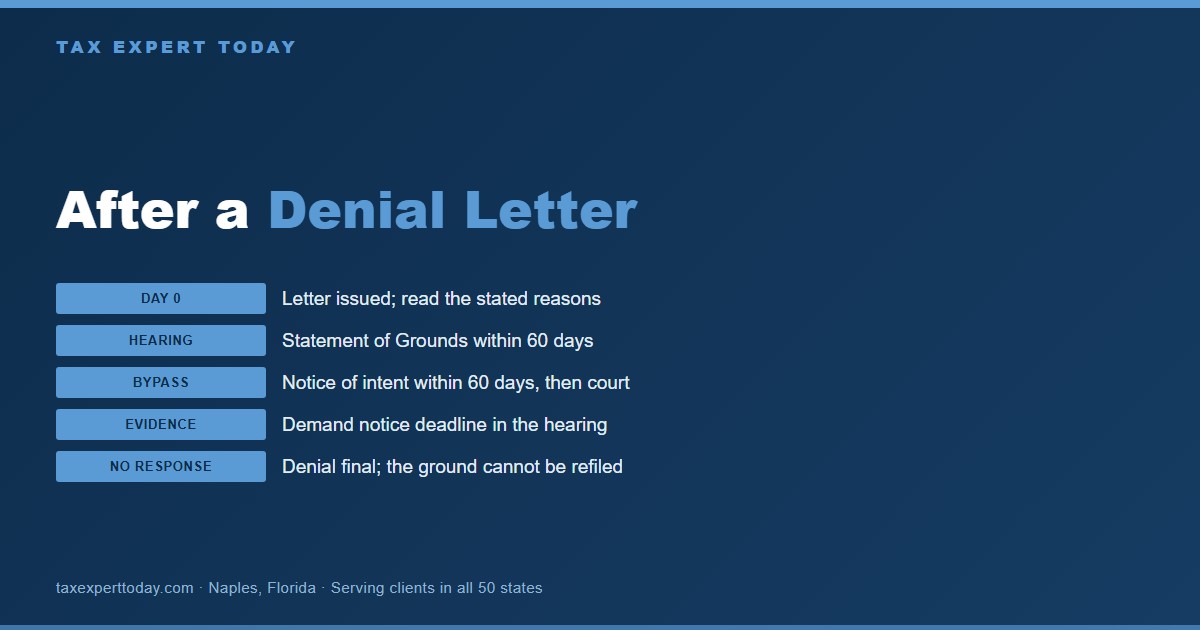
A business that disagrees with a denial has two options, either of which must reach the Comptroller within 60 days of the denial letter: a Statement of Grounds requesting an administrative refund hearing, or a Notice of Intent to Bypass the Hearing and go to district court. If neither arrives in time, the denial becomes final.
- Hearing route. Section 111.105, with 20 days’ notice of the hearing.
- Bypass route. Section 111.106, leading to a suit in district court.
- Statement of Grounds. Lists the disputed items and the factual and legal basis, with legal authority for any disagreement over the law.
- Signature and authority. Signed by the claimant or its representative, with a power of attorney for third parties.
Publication 96-1253 describes the hearing route in some detail. A timely and complete Statement of Grounds is acknowledged by letter and sent back to the auditor to review any additional documentation. If the matter is not resolved there, it is assigned to an attorney in Tax Administration, who generally issues a Position Letter. The claimant can accept that position or reply to it and ask for the case to be heard by an administrative law judge. After a decision, Section 111.105(c) and (d) provide for a written motion for rehearing that asserts each specific ground of error and states the amount sought.
The Statement of Grounds is a second drafting exercise of the kind the original claim required. The publication says that if the claimant disagrees with the agency’s interpretation of the law, it must cite legal authority for its position. The same Statement of Grounds procedure applies to disagreed audits, which our Texas Comptroller audit guide covers from the audit side. A claim that stated its grounds well gives the Statement of Grounds a foundation. A claim that stated them thinly leaves the business trying to build its position under a 60 day deadline.
Is the Refund Hearing Deadline 30 Days or 60 Days?
The current statute sets 60 days. Tax Code Section 111.105(a) entitles a claimant to a hearing if it requests one on or before the 60th day after the Comptroller issues the denial letter. The Comptroller’s refunds page and its August 2026 publication use 60 days. The published rule text still says 30 days.
- Statute. 60 days, after a 2017 amendment by S.B. 1095.
- Comptroller guidance. 60 days on the refunds page and in Publication 96-1253.
- Rule text. 34 TAC 3.325(e)(1), last amended effective January 2013, still reads 30 days.
- Practical course. Calendar from the letter date and act well before the shorter figure.
Practitioner pages disagree on this point, and the reason is visible in the sources. The rule’s subsection (e)(1) says a claimant may “request a refund hearing within 30 days of the denial.” The rule notes show it was adopted in 2011 and last amended effective January 7, 2013. Section 111.105(a), as amended in 2017, sets the hearing request deadline at the 60th day after the date the Comptroller issues the letter denying the claim, and the Comptroller’s current refunds page and Publication 96-1253 both use 60 days. Where a statute and an older rule conflict, the statute generally controls.
The practical advice does not depend on resolving that question. The 60 day period runs from the date the denial letter is issued, not the date it is received, and the publication says the request must be received by the Comptroller within that time. A business that receives a denial should treat the letter as a deadline notice, read the reasons the same day and plan to file well before either figure would expire.
What Is the Evidence Demand Notice in a Refund Hearing?
After a hearing is requested, the Comptroller may issue a written demand that all evidence supporting the claim be produced by a specified date. Under the Comptroller’s guidance that date is the later of 60 days after the demand or 180 days after the refund was claimed. Evidence produced late cannot be considered in the administrative hearing.
- Statutory floor. Section 111.105(e) bars a deadline earlier than 180 days after the refund is claimed.
- Comptroller practice. The later of 60 days from the demand or 180 days from the claim.
- Exclusion. Late evidence cannot be considered or introduced at the hearing.
- Court exception. The limit does not apply in a judicial proceeding under Chapter 112.
The demand notice is one of the strongest reasons to treat the original claim as a full presentation. Rule 3.325(e)(3) notes that the Comptroller’s power to demand documentation once a hearing is requested “does not eliminate the requirement that persons provide documentation” when the refund is first claimed. In other words, the demand notice is not a second chance to assemble records. It is a final deadline, and a business that has not gathered its support by then may find that the hearing proceeds without it.
The judicial exception is real but should not be relied on as a plan. A suit in district court has its own requirements, including the record production duty in Section 112.151(f), which requires contemporaneous records and supporting documentation to substantiate the claim. The safer course is to assume that the records needed to win the claim are the records that should exist and be organized before it is filed.
When Can a Business Bypass the Hearing and Go to Court?
A claimant may file a Notice of Intent to Bypass the Hearing within 60 days of the denial letter, stating the material facts, each legal basis and the amount claimed. The Comptroller may require a conference. The suit must then be filed in district court within the period Section 111.106 sets, and the hearing right is waived.
- Notice contents. Written, with the material facts, each specific legal basis and the amount.
- Conference. If required, the Comptroller gives notice within 30 days and sets it within 90 days of the notice of intent.
- Suit timing. Within 60 days after the conference concludes, or 90 days after the notice if no conference is required.
- Parties. The suit names both the Comptroller and the Attorney General.
The bypass route exists for disputes that are fundamentally about the law rather than the records, where the claimant expects to end up in court regardless of the administrative result. Section 111.106 sets out its mechanics. The claimant may amend a material fact or legal basis after a conference only if the Comptroller agrees in writing. If a conference cannot be scheduled by agreement within the statutory window, the claimant may rescind the notice and request a hearing instead, within the period the section provides. Otherwise, filing the notice waives the hearing.
Section 112.151 sets the conditions for the suit itself. The claimant must have filed a refund claim, must either have had a motion for rehearing denied or be authorized under the bypass section, and must have paid any additional tax found due in a jeopardy or deficiency determination for the same liability period. A suit after a denied motion for rehearing must be filed within 60 days after the denial is issued. The petition states the amount sought and attaches the motion for rehearing or the notice of intent, and no other person may intervene.
| Step | Hearing route | Bypass route |
|---|---|---|
| Start | Statement of Grounds within 60 days of the denial letter | Notice of Intent to Bypass the Hearing within 60 days of the denial letter |
| What it must contain | Disputed items, factual basis, legal grounds and authority | Material facts, each specific legal basis and the amount claimed |
| Middle stage | Auditor review, Tax Administration attorney, Position Letter, administrative law judge | Optional Comptroller conference |
| Evidence limit | Demand notice deadline applies in the administrative hearing | Chapter 112 record production rules apply in court |
| Path to court | Motion for rehearing, then suit within 60 days after its denial | Suit within 60 days after the conference, or 90 days after the notice if none |
| Issues in court | Grounds of error in the motion for rehearing | Facts and legal bases in the notice of intent |
Does Texas Pay Interest on a Sales Tax Refund?
Generally yes, when a refund is granted on a claim. Under Section 111.064, interest accrues from the later of 60 days after payment or the due date of the report, at the lesser of the state treasury deposit rate or the delinquent tax rate. Credits taken on a return earn no interest.
- Start date. The later of 60 days after the payment or the due date of the report.
- End date. The date of the credit allowance or a date within 10 days before the refund warrant.
- Rate. The lesser of the treasury deposit rate or the rate under Section 111.060.
- No interest. Credits taken on a return, and reports due before January 1, 2000.
Interest is one of the reasons the route choice matters. A large overpayment recovered by credit on a later return earns nothing for the time the state held it. The same overpayment recovered by claim generally earns interest from the later of the two start dates in Section 111.064(a). The rate is set by formula rather than fixed in the statute, so the Comptroller’s current figure should be checked when the claim is evaluated.
Rule 3.325(c) lists further exceptions. Interest is not earned on tax paid on an account that is later written off as a bad debt for federal tax purposes, and the rule reserves other situations as the Comptroller determines. Interest on a refund is also part of the amount that can be offset against an existing liability, as the refunds page notes.
Which Taxes Use the Texas Claim for Refund Form?
Form 00-957 and the web form list sales tax, direct pay, the Texas Emissions Reduction Surcharge, mixed beverage sales and gross receipts taxes, the petroleum product delivery fee, motor vehicle seller financed sales tax and the state hotel occupancy tax, with a box for other taxes. Section 111.104 itself applies broadly to taxes and fees the Comptroller administers.
- Sales and use tax. Code 26, and direct pay under code 27.
- Mixed beverage taxes. Codes 63 and 73, covered in our guide to the Texas mixed beverage tax.
- Hotel occupancy. Code 75, the state portion only.
- Other. Other taxes have their own forms and procedures, such as the Texas franchise tax, so confirm the right vehicle first.
Direct pay taxpayers deserve a separate note. A business holding a direct pay permit accrues and remits tax on its own purchases rather than paying it to vendors, so an overpayment is its own remittance and the claim is its own. Our guide to the Texas direct pay permit explains how that changes the purchasing side and why it simplifies some refund questions.
What Situations Commonly Produce a Texas Sales Tax Refund?
Common sources include exempt purchases where the business did not give the vendor a certificate, items bought for resale that were taxed, incorrect local rates, out of state use, charges for nontaxable services billed with taxable ones, duplicate remittances, and accrual of use tax on items that were already taxed by the vendor.
- Missing certificates. Exempt purchases taxed because no certificate was on file with the vendor.
- Rate and location errors. Local tax charged for the wrong jurisdiction.
- Service classification. Nontaxable services taxed as if taxable.
- Double tax. Use tax accrued on purchases where the vendor had already charged tax.
Each source points to a different set of rules, and the claim’s grounds should come from those rules. Whether a service is taxable at all is covered in our guide to Texas taxable services. Whether a remote vendor should have collected tax, and at what local rate, connects to Texas sales tax nexus. Whether a purchase qualified for exemption turns on the exemption itself and on the exemption certificate or resale certificate behind it. A business that accrues tax on its own purchases should also review its use tax accruals, since tax accrued on an item the vendor already taxed is a common double payment, and a remote seller that receives a Texas nexus questionnaire may find refund questions on its own collection history as well.
| Source of overpayment | Usual claimant | Key support |
|---|---|---|
| Exempt purchase taxed by a vendor | Permitted purchaser, or vendor after refunding the customer | Exemption basis and invoices, plus the certificate the vendor needs before refunding |
| Resale item taxed by a vendor | Permitted purchaser, or vendor with a resale certificate | Resale certificate and records showing resale |
| Wrong local rate | Usually the seller, or the purchaser for local tax only paid to a remote seller | Delivery address, jurisdiction codes and amounts |
| Nontaxable service taxed | Purchaser or seller depending on who remitted | Contract and invoice showing the nature and separate statement of the service |
| Use tax accrued on an already taxed purchase | The purchaser that accrued and remitted it | Vendor invoice showing tax charged and the use tax return |
| Duplicate remittance | The taxpayer that paid twice | Payment confirmations and the return for the period |
A Hypothetical Texas Claim for Refund Timeline
The following example is hypothetical and is included only to show how the deadlines interact. It does not describe any client or predict any outcome.
| Date | Event | Rule at work |
|---|---|---|
| Month 1 | A permitted purchaser identifies tax paid on equipment it believes is exempt, across 30 monthly periods | Each period has its own four year deadline |
| Month 1 | The oldest period is two months from its fourth anniversary | Four years from the date the tax was due and payable |
| Month 2 | A claim is filed stating the exemption, the equipment, its use and every period, with a schedule to follow | Tolling elements present: grounds and period |
| Month 4 | The full schedule, invoices and local jurisdiction detail are supplied | Transaction details under Rule 3.325(a)(4)(C) |
| Month 9 | The Comptroller grants part and denies the rest in a letter | 60 day contest window begins on the letter date |
| Month 10 | Statement of Grounds filed for the denied items | Section 111.105; evidence demand may follow |
Two points stand out. Filing a complete claim at month 2 protected the oldest period even though the detail came later. And because a denied ground cannot be refiled, the Statement of Grounds at month 10 is the only remaining route for the denied items.
How Does a Texas Claim for Refund Compare With a Federal Claim?
They are separate systems. A Texas claim goes to the Comptroller under the Tax Code and Comptroller rules. A federal claim for certain taxes and penalties goes to the IRS, often on Form 843, under federal law. Deadlines, forms, standing rules and appeal routes differ, and filing one does nothing for the other.
- Different agency. The Comptroller is a state agency, not part of the IRS.
- Different deadlines. Texas uses its own four year rule and 60 day contest windows.
- Connected only by events. A final IRS audit result can open a one year Texas refund window under Section 111.206.
- Federal side. See our guide to IRS Form 843.
What Mistakes Commonly Cost Businesses a Texas Refund?
The most common mistakes are filing a claim that says only tax paid in error, missing the four year deadline period by period, filing as a non-permitted purchaser without an assignment, omitting local jurisdiction detail, letting a denial go final, and taking a credit without the supplemental report or documentation.
- Thin grounds. A claim that does not toll and a ground that may be lost.
- Waiting for perfect records. Older periods expire while the schedule is built.
- Wrong claimant. A purchaser filing directly for periods when it was not permitted.
- Ignoring the denial letter. The 60 day window runs from the letter date.
Most of these mistakes come from treating the claim as paperwork rather than as a legal position. The rules reward a business that decides, before filing, who the claimant is, which periods are at risk, what the ground is for each group of transactions, whether an audit is open, and what the rest of the period looks like from the Comptroller’s side. Our Texas tax services work starts from those questions.
Texas Claim for Refund Help in Naples & Southwest Florida
Tax Expert Today LLC advises businesses on federal tax matters and on state tax matters nationwide from our office in Naples, Florida. Texas clients are served from Naples along with clients in every other state. Southwest Florida business owners raise Texas refund questions when they operate Texas locations, sell into Texas, buy equipment for Texas facilities or have moved a business from Texas to Florida and want to recover tax from earlier periods before the deadlines pass.
Our review follows the structure of this guide. We confirm who the proper claimant is for each group of transactions, map each period’s deadline, identify the grounds and the authority for each, check whether an audit is open or recently closed, review the same periods for any offsetting exposure, and prepare the claim and schedule so the tolling elements are present from the first filing. If a claim is denied, we evaluate the hearing and bypass routes against the 60 day window.
- Texas sales tax refund help Naples business owners can reach in person. Our office is on Tamiami Trail North in Naples, Florida, and we work with clients locally and remotely.
- State tax refund claim Naples FL and nationwide. We serve businesses in all 50 states.
- Standing and assignments. Seller outreach and Form 00-985 coordination.
- Deadline mapping. Period by period four year dates and extension agreements.
- Claim drafting. Grounds, authority, schedule and local jurisdiction detail.
Related services include our Texas tax services and our Naples tax planning work for Southwest Florida business owners.
Tax Expert Today LLC
11983 Tamiami Trail N, Naples, FL 34110
Phone: (239) 441-2005
Hours: Monday through Friday, 10:00 a.m. to 5:00 p.m. ET
Local question we are asked often: A Naples company closed its Texas warehouse two years ago and gave up its Texas sales and use tax permit. It now believes it paid tax on exempt equipment while the warehouse operated. Can it still file? Generally yes, for periods still inside the four year window, because the company held its permit when the tax was due and payable. Closing the permit later does not by itself remove that standing, but each period’s deadline keeps running, so the facts should be reviewed promptly with an adviser.
When Should You Engage a Professional?
A business with a single duplicate payment or one invoice taxed in error may be able to file using the Comptroller’s web form and the steps in this guide. Professional review becomes worthwhile when the claim covers many periods or vendors, when older periods are close to their deadlines, when the business was not permitted for part of the period, when sampling is being considered, when the ground depends on an exemption or a service classification that could be disputed, when an audit is open or recently closed, or when a claim has been denied. Texas sales and use tax refunds are state tax matters administered by the Texas Comptroller, not the IRS, and our multidisciplinary team of tax advisors, enrolled agents, CPAs and attorneys advises on state tax matters nationwide. Results depend on individual facts, and this guide describes how the rules work rather than what any particular claim should expect.
If you would like a review of a possible refund or a denial letter, contact Tax Expert Today at (239) 441-2005 or visit our Texas tax services page.
Frequently Asked Questions
What is a Texas claim for refund?
It is a written request to the Texas Comptroller for the return of tax, penalty or interest that was unlawfully or erroneously collected. It is usually filed on Form 00-957 or through the Comptroller’s web form, and it must state each ground fully and in detail and identify the period of the overpayment.
How long do I have to file a Texas sales tax refund claim?
Generally four years from the date the tax was due and payable, period by period. A claim for tax paid under a deficiency determination may instead be filed within six months after the determination becomes final, limited to those items, and a written extension agreement can extend the time.
Can a purchaser file directly with the Comptroller?
A purchaser that held a Texas sales and use tax permit when the tax was due may file directly, amend its return or take a credit. A purchaser without a permit must ask the seller for the refund or obtain a signed Form 00-985 assignment from the seller before filing.
Is it enough to write tax paid in error on the claim?
No. The Comptroller’s form and web form both state that this is not a sufficient reason. The claim should identify the specific reason for each transaction, such as the statutory exemption, and the facts that make it apply.
Can I refile a refund claim that was denied?
Not for the same transaction or item, tax type, period and ground. Section 111.107(b) bars refiling, and the Comptroller’s guidance says a denied refund cannot be requested again even if the period is still open. The route after a denial is a hearing request or a notice of intent to bypass within 60 days.
How long do I have to request a refund hearing in Texas?
Section 111.105(a) allows 60 days after the date the Comptroller issues the denial letter, and the Comptroller’s current guidance uses 60 days. The older rule text still says 30 days, so the safest course is to act well before the shorter figure.
Does Texas pay interest on refunds?
Generally yes on a granted refund claim, from the later of 60 days after payment or the report due date, at a formula rate under Section 111.064. A credit taken on a return does not earn interest.
Should I file a refund claim during a Comptroller audit?
The Comptroller suggests asking the auditor to include the refund in the audit when the same tax type is under audit, because netting overpayments and underpayments may reduce penalty and interest. Facts vary, so the choice should be reviewed with an adviser.
Published November 14, 2026 by Dr. Pellumb Kabashi « Back to Learning Center
Have a question this article touches on?
Tax Expert Today LLC, based in Naples, Florida and serving clients across the United States.
Schedule a Consultation (239) 441-2005