
By Dr. Pellumb Kabashi, DBA, MBA, CES, CFE, EA
Founder, Tax Expert Today LLC · Tax advisors, enrolled agents, CPAs, and attorneys · Serving clients in all 50 states
Quick Answer: A Texas Comptroller audit is a state examination of whether a business collected, reported and paid Texas taxes correctly, usually covering the most recent four years. Two decisions shape what you end up owing: how the auditor samples your records under Tax Code Section 111.0042, and whether you request a managed audit within 60 days of the notice. Call (239) 441-2005 for a free consultation.
A letter from the Texas Comptroller’s Audit Division tends to arrive without much warning and with a questionnaire attached. Most of the pages that rank for this topic then walk the reader through the same sequence of meetings: notice, entrance conference, fieldwork, exit conference, and a hearing if you disagree. That sequence is accurate, and it is laid out in the Comptroller’s own guide to the auditing process. It is also the least useful part of the picture, because the meetings happen whether or not you prepare for them.
What actually decides the number on a Texas Comptroller audit is a short list of choices, most of which are open for only a few weeks. The auditor decides whether to examine every transaction or to test a sample and project the error rate across four years. You decide whether to ask for a managed audit, which can change how penalty and interest are treated. You decide whether to raise your own overpayments inside the audit or leave them on the table. And when the results arrive, a 60 day clock starts that determines whether you can contest the assessment without paying it first.
This guide is organized around those decisions rather than around the meetings. It covers how businesses are selected, how far back the Comptroller can reach, what the auditor will ask for, how sampling works and how to challenge it, when a managed audit is worth requesting, how refunds fit into an open audit, what penalty and interest apply, and every route available when you disagree. Each stage is paired with the statute or Comptroller publication that sets its deadline, so you can check the rule yourself. Because Texas has no state income tax on individuals, the Comptroller’s audit program is concentrated on business taxes, which is why most Texas audits land on companies rather than on their owners. Most of the examples involve sales and use tax, which is where the majority of audit adjustments arise, but the procedural rules in Tax Code Chapter 111 apply to franchise tax and the other state taxes the Comptroller administers as well.
What Is a Texas Comptroller Audit?
A Texas Comptroller audit is an examination by the Comptroller of Public Accounts to determine whether a business properly collected, reported and paid state taxes. Auditors look for both underpaid and overpaid tax. The Notice of Routine Audit states that audits cover both assessments and refunds for every period within the statute of limitations, usually the most recent four years.
- It is a state matter, not an IRS matter. The Comptroller administers Texas sales and use tax, franchise tax, hotel occupancy tax, mixed beverage taxes and dozens of other state taxes and fees. A Texas audit has its own procedures, deadlines and appeal path. State unemployment tax is the exception, because the Texas Workforce Commission administers it, as our guide to Texas payroll taxes explains.
- It runs in both directions. The Comptroller describes the auditor’s task as identifying under- and overpaid tax, because businesses sometimes pay tax on items that were exempt.
- It is routine for many businesses. The Comptroller’s own brochure tells taxpayers not to assume they were singled out, and some large accounts are audited on a regular cycle.
- Representation is optional. The Comptroller states that professional representation is not required and is a business decision, and its Taxpayer Bill of Rights confirms the right to engage the person of your choice.
The authority for the examination is broad. The Comptroller rule on auditing records, 34 TAC Section 3.282, allows the Comptroller or an authorized representative to audit a taxpayer’s accounts and records at any time during regular business hours. Tax Code Section 111.0041 requires taxpayers to keep records open to inspection for at least four years, and longer while any tax may still be assessed or refunded or while a hearing or lawsuit is pending. It also places the burden on the taxpayer to produce records sufficient to substantiate its own claims.
One feature of a Texas audit surprises many business owners. The Comptroller states that the identity of taxpayers under audit is public information and subject to open records requests. That is why a business that has just received an audit notice often starts receiving letters from consultants within days. Those letters are a consequence of the public list, not a sign that anything unusual is wrong with the account.
The audit is also not limited to Texas businesses. The Comptroller’s contesting publication lists 20 audit offices in 17 cities, including offices in Chicago, Los Angeles, New York and Tulsa that examine out-of-state sellers. A remote seller that registered in Texas after crossing the economic nexus threshold described in our guide to Texas sales tax nexus can receive the same notice as a Houston retailer.
How Does the Comptroller Choose Businesses to Audit?
The Comptroller uses several selection methods. Its published list includes Priority One accounts, which are the largest sales tax reporters, prior productive accounts whose earlier audits found $25,000 or more due, computer-based random selection by industry, information shared with other agencies and states, analysis of tax returns, business publications and leads from the public.
- A prior productive audit matters. A business whose last audit produced an assessment of $25,000 or more is flagged as a prior productive account, so one costly audit raises the odds of another.
- Industry selection is random within the industry. Computer-based random selection by specific industry means a clean history does not rule out an audit.
- Return analysis looks for inconsistencies. Large swings in reported sales, deductions that are high relative to gross sales, or mismatches with other filings can draw attention.
- Information sharing crosses agency lines. The Comptroller lists information-sharing programs with other state agencies and other state governments among its sources.
Selection criteria are worth understanding mainly because of what they tell you about scope. An audit opened because of a large exempt sales figure will spend most of its time in the certificate file. An audit of a contractor will look closely at whether materials were taxed when purchased and whether the contracts were lump-sum or separated. An audit of a professional firm will look at whether any of its services fall on the taxable list in our guide to Texas taxable services, which is where data processing, information services and similar items catch many businesses that assumed services were not taxed.
The Comptroller also runs examinations that are not full field audits. Its contesting publication refers to examinations by the Business Activity Research Team, known as BART, and to a separate Texas Notification of Exam Results. Those examinations often focus on whether a business that was not registered should have been. A business that receives a BART inquiry should treat it with the same care as an audit notice, because the question is frequently whether a permit and four years of filings were required, and as the next section explains, a business that never filed is not protected by the four year limit.
How Far Back Can a Texas Comptroller Audit Go?
Usually four years. Tex. Tax Code Section 111.201 bars assessing any tax more than four years after it became due and payable. Section 111.205 removes that limit entirely when a false or fraudulent report was filed with intent to evade, when no report was filed, or when a gross error understated the tax by at least 25 percent.
- The default window is four years from the due date. Section 111.201 measures the period from the date the tax became due and payable, period by period.
- Non-filers have no limit. If no report was filed for a tax, the Comptroller may assess at any time, which is why an unregistered business faces open-ended exposure.
- A 25 percent understatement opens the door. A gross error means that, after correction, the tax due exceeds the amount reported by at least 25 percent.
- Statute waivers extend the window by agreement. The Comptroller commonly asks for waivers to keep periods open while an audit or conference is pending, and declining one has consequences.
| Situation | How far back the Comptroller can assess | Authority |
|---|---|---|
| Reports filed, no gross error, no fraud | Four years from the date each tax became due and payable | Tax Code Section 111.201 |
| No report filed for the tax | Any time, with no limitation period | Tax Code Section 111.205(a)(2) |
| Report understated the tax by 25 percent or more | Any time for that report | Tax Code Section 111.205(a)(3) and (b) |
| False or fraudulent report filed with intent to evade | Any time | Tax Code Section 111.205(a)(1) |
| Federal or other agency final determination changes the Texas liability | One year after the required report to the Comptroller, even if the period is otherwise closed | Tax Code Section 111.206 |
| Taxpayer signs a statute waiver | The period agreed in the waiver | Waiver agreement |
The 25 percent rule deserves attention because it is measured report by report, not across the whole audit. A business that underreported modestly in most months but badly in a few months may find that those specific reports are open indefinitely while the rest close on schedule. That makes the accuracy of the auditor’s period-by-period schedules more than a formality. If a sampled error rate is projected evenly across every month, it can push individual months over the 25 percent line on paper even when the actual records for those months would not support it.
The Notice of Routine Audit says the audit normally covers the most recent four-year period, and the Comptroller’s process page adds that it may audit for longer periods if a business was not permitted but should have been, or if fraud has been detected. For a business that grew into a filing obligation without noticing, for example a seller whose Texas revenue crossed the remote seller threshold years ago, the first audit can reach back to the start of the obligation rather than four years. That is the strongest practical argument for resolving an unfiled period before the Comptroller finds it, a subject the Texas voluntary disclosure process exists to address.
Statute waivers are a routine part of Texas audits, and the Comptroller’s own guidance anticipates them. The Notice of Routine Audit says waivers should not be requested before fieldwork begins unless the taxpayer has asked for a long delay. Later, a waiver may be needed to allow time for a reconciliation conference or an independent review. The contesting publication notes that an independent audit review conference is not available when it cannot be held in time and the taxpayer declines to sign a waiver. Signing is usually the practical choice, but it is a real decision that keeps old periods open, and its scope should match the issues still in dispute.
What Happens Step by Step After the Audit Notice Arrives?
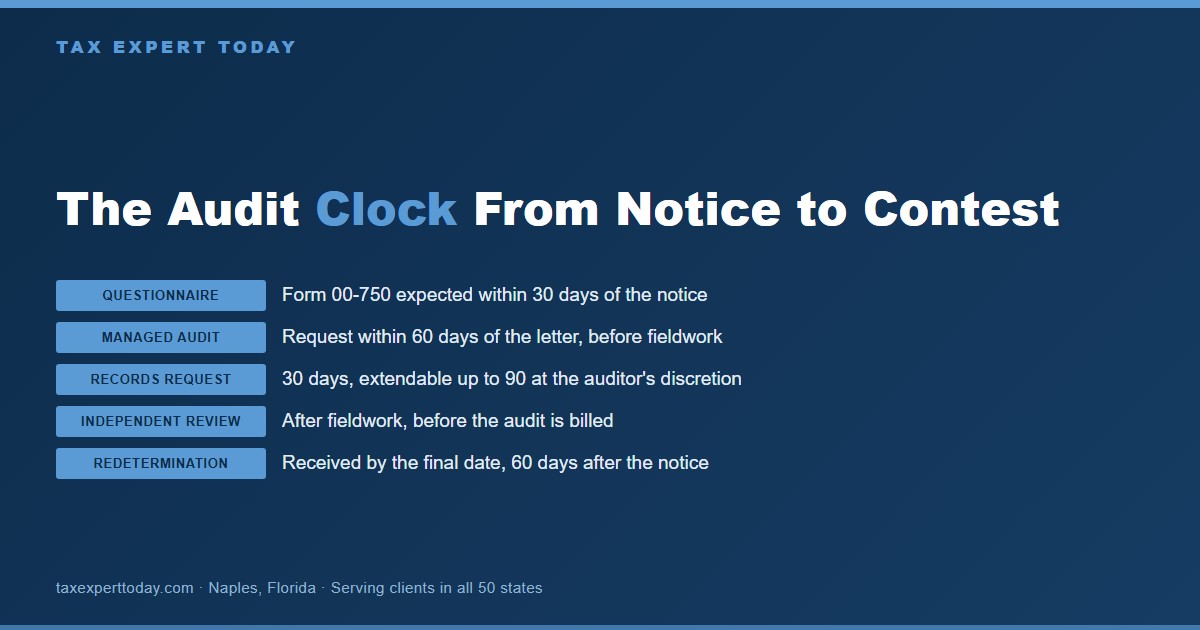
The Comptroller sends an audit notification letter and Form 00-750, the Audit Questionnaire. After the questionnaire is returned, the auditor schedules an entrance conference, examines records in detail or by sample, presents proposed adjustments at an exit conference, and finalizes the audit. A Texas Notification of Audit Results then starts the 60 day contest period.
- Return the questionnaire on time. The Notice of Routine Audit says the auditor contacts the taxpayer within two weeks of receiving it, and follows up if it has not been returned within 30 days.
- Silence is costly. If the questionnaire is not returned or contact cannot be made, the Comptroller may establish a liability by the best available method, including estimation.
- Watch the 60 day managed audit window. A managed audit request must reach the audit manager within 60 days of the date on the notification letter, and it is denied once fieldwork has begun.
- Records requests carry their own deadline. A written request for specific records gives 30 days, with possible extensions at the auditor’s discretion up to 90 days in total.
| Stage | What happens | Deadline or timing |
|---|---|---|
| Notice of audit | Notification letter and Form 00-750 Audit Questionnaire mailed | Questionnaire expected within 30 days |
| Managed audit request | Taxpayer asks the audit manager to self-audit under a written agreement | Within 60 days of the notification letter date, before fieldwork begins |
| Taxpayer contact and entrance conference | Auditor reviews the business, plans the audit and lists needed records | Auditor contact within two weeks of the questionnaire |
| Records request | Written list of specific records the auditor still needs | 30 days, extendable at the auditor’s discretion up to 90 days |
| Examination of records | Detailed review or sample and projection, with written notice of any sampling procedure | Auditors are told to avoid gaps longer than 30 days without activity |
| Exit conference | Proposed adjustments, penalty waiver recommendation and interest presented | Amounts are preliminary and subject to review |
| Reconciliation and independent review | Supervisor conference, then an Independent Audit Review Conference if issues remain | Independent review must be requested after fieldwork and before billing |
| Texas Notification of Audit Results | The official determination of tax, penalty and interest | Becomes final 60 days after its statement date |
The entrance conference is where the audit plan is designed, and it is worth treating as a negotiation rather than a courtesy call. The Comptroller describes it as a formal discussion intended to design a cost-efficient audit plan. That is the point at which the categories of transactions to be examined, the periods to be tested and the sampling units are first discussed. A business that arrives with an organized account of how it records sales, deductions and purchases is in a much stronger position to shape a sensible plan than one that leaves the auditor to discover the system for itself.
The exit conference is the last chance to fix factual problems informally. The Comptroller’s Auditing Fundamentals manual, Chapter 8, says the exit conference should not produce surprises, and that the auditor should explain the records examined, the methods used, including detail, sample, strata or estimate, and the reasons for those methods. The Audit Adjustment Report presented there is marked as a draft with preliminary amounts, so the numbers can still move during review at the regional processing center. Ask for the schedules in a usable electronic format and check them line by line before the audit is billed.
One timing point catches many businesses. The Notice of Routine Audit says that when a previous audit has been billed or is in the hearings stage, it is treated as complete, and a follow-up audit will no longer be delayed while the earlier dispute is resolved. A business with a contested prior audit should therefore expect the next audit to run in parallel, and should make sure the positions taken in both are consistent.
What Records Will the Auditor Ask For?
The Comptroller lists sales invoices with resale and exemption certificates, purchase and capital asset invoices, depreciation schedules, general and subsidiary ledgers, charts of accounts, financial statements, federal income tax information, bank statements, working papers used to prepare tax reports, electronic data, and documentation supporting credits and any overpaid tax. Taxpayers must furnish all records the auditor requests.
- Certificates are the first battleground. The Comptroller’s audit manual describes examining the certificate file as among the first audit procedures, because exempt and resale sales depend on it.
- Electronic data speeds the work. The Comptroller uses computer audit software on taxpayer data files, so a clean export of sales and purchase detail often shortens fieldwork.
- Federal returns are fair game. Federal income tax information is on the standard list, and auditors reconcile reported Texas sales to it.
- Your own refund support belongs in the file too. Documentation supporting overpaid tax is on the Comptroller’s own list, which signals that refund issues are expected to be raised.
The reconciliation of reported Texas sales to the general ledger and to federal returns is the first test most auditors run in a Texas Comptroller audit. The Comptroller’s Auditing Fundamentals manual, Chapter 5, describes short tests such as tracing sales journal postings to the general ledger, tracing daily sales totals to journals, and scanning for unusual entries such as debits to the sales tax accrual account. Those short tests decide whether the auditor trusts the records enough to sample them. A business whose sales tax returns cannot be tied to its books gives the auditor a reason to move toward estimation, which is the least favorable method for the taxpayer.
Resale and exemption certificates have a specific rule that every seller should know before fieldwork begins. Under 34 TAC Section 3.282(k), certificates should be available at the time of the audit. Certificates obtained after the auditor actually begins work are subject to verification, and incomplete certificates are disallowed regardless of when they were obtained. After a petition for redetermination or a refund claim is filed, the Comptroller may give written notice, and the seller then has 90 days, or a later date agreed in writing, to deliver the missing certificates. Certificates delivered after that period are not accepted. Once that notice is received, a certificate is the only acceptable proof that a sale was for resale or exempt. Our guide to the Texas resale certificate covers what makes a certificate complete and accepted in good faith.
The rule cuts in an important way. A seller cannot simply wait for the 90 day window and collect certificates at leisure, because certificates gathered after fieldwork begins face independent verification and the window opens only after a formal contest is filed. The practical approach is to review the certificate file as soon as the audit notice arrives, identify missing or incomplete certificates for the largest exempt customers, and request replacements before the auditor reaches that part of the examination. Rule 3.282(l) and (m) also allow the Comptroller to proceed against the seller, the purchaser or both, so a customer that failed to provide a valid certificate may face its own assessment.
Finally, the Comptroller can and does move to estimation when records are missing. Rule 3.282(j) says that when records are inadequate to reflect the business operations accurately, the auditor will base the audit on the best information available. The Notice of Routine Audit warns that if requested records are not provided within the deadline, the audit will be estimated or the refund denied. An estimated audit also forfeits access to the independent review conference, as discussed later, which makes the records request deadline one of the most consequential dates in the whole process.
How Does Sampling Decide What You Owe?
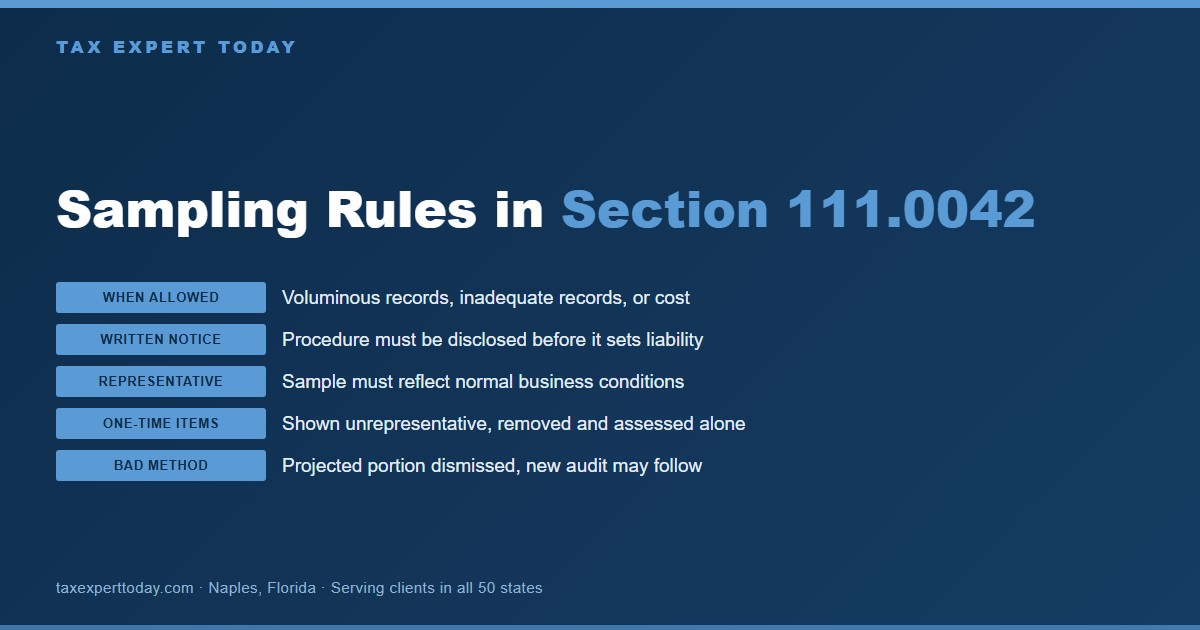
When records are voluminous, the auditor examines a sample period or a sample of transactions, calculates an error rate, and projects that rate across the entire audit period. Tex. Tax Code Section 111.0042 allows sampling only in three situations, requires written notice of the sampling procedure before it is used, and requires the sample to reflect normal business conditions.
- Three conditions permit sampling. Records too detailed or voluminous to review in full, records too inadequate for a competent detailed audit, or a detailed audit whose cost would be unreasonable relative to the benefit.
- Written notice comes first. Before a sample technique is used to establish a liability, the Comptroller must notify the taxpayer in writing of the procedure.
- The sample must be representative. It must reflect as nearly as possible the normal conditions under which the business operated during the audit period.
- A small error can become a large assessment. A projected error rate is multiplied across every period in the audit, so the inputs to the sample matter more than any single invoice.
Sampling is where most of the dollars in a Texas Comptroller audit of sales and use tax are decided, and it receives the least attention in published guidance. The Notice of Routine Audit describes three methods. In a detailed audit the auditor examines all business records for the entire period. In a sample audit, errors found in representative samples are projected throughout the audit period. In an estimate, the audit is based on the best information available because records are inadequate or missing. The Comptroller’s publication notes that the auditor generally examines a portion of the records first to decide whether errors exist and which method to use.
The Comptroller’s audit manual explains when each approach tends to be chosen. A detailed examination fits claimed deductions that consist of relatively few items. A sample fits gross sales or deductions that are numerous and similar in unit value. A stratified sample, which separates transactions into dollar bands and samples each band differently, fits a business with wide price variation or only occasional large sales. Capital asset purchases, which are usually fewer and larger, are preferably examined in detail. Expense purchases, which are numerous, are commonly sampled. The choice of sampling unit, whether individual transactions, clusters or whole months, depends on how the business files its invoices and on the dollar strata of its items.
The statute itself sets the guardrails, and Rule 3.282(c) through (e) repeats them. The Comptroller may use a detailed procedure or a sample and projection method, including manual and computer-assisted techniques, whichever produces the most accurate result in the most efficient manner. The written notice requirement means you should receive a document describing the populations, the sample selection and the projection method before the liability is established. Keep it. Every later challenge to the sample starts with comparing what was actually done to what that notice said would be done.
To see why the inputs matter, consider a hypothetical. This example is for illustration only and does not reflect any particular audit or any typical result.
| Hypothetical sample of expense purchases | Sample as drawn | After removing one unrepresentative item |
|---|---|---|
| Purchases in the sample period | $400,000 | $380,000 |
| Untaxed taxable purchases found | $30,000, including one $20,000 one-time equipment purchase | $10,000 |
| Error rate | 7.50 percent | 2.63 percent |
| Purchases in the four year audit population | $6,000,000 | $5,980,000 |
| Projected taxable purchases | $450,000 | $157,368 |
| Tax at an assumed combined rate of 8.25 percent | $37,125 | $12,983 |
| Unrepresentative item assessed separately | Not applicable | $1,650 |
| Total hypothetical tax before penalty and interest | $37,125 | $14,633 |
The 8.25 percent rate in the illustration is the maximum combined rate the Comptroller publishes, made up of the 6.25 percent state rate and up to 2 percent in local taxes. Actual audits apply the rates for each location and period. The point of the example is the mechanism, not the figures. A single unusual purchase that happened to fall inside the sample period nearly tripled the projected tax, because it was treated as if it recurred in every period of the audit. The statute speaks to exactly that situation, which is the subject of the next section.
Can You Challenge a Sample as Unrepresentative?
Yes. Under Section 111.0042(d), a transaction the taxpayer shows is not representative of its business operations must be eliminated from the sample and assessed separately. Under Section 111.0042(e), if the sampling method departed from generally recognized sampling techniques, the projected portion of the audit is dismissed and a new audit may be performed.
- Removal is mandatory once shown. The statute uses the word shall: a demonstrated unrepresentative transaction is removed from the sample and assessed on its own.
- The burden is on the taxpayer. The business must demonstrate the transaction is unrepresentative, which means records and an explanation of why it was unusual.
- Method defects are a separate challenge. A projection built on a method outside generally recognized sampling techniques can be dismissed for that portion of the audit.
- Sampling disputes fit the informal conferences. The contesting publication lists sampling issues among the matters an Independent Audit Review Conference can address.
The most common unrepresentative items are one-time events: a large equipment purchase, a building improvement, a single unusually large customer order, a period of construction, a system conversion that produced duplicate entries, or a season that was distorted by a hurricane, a plant shutdown or a pandemic closure. Each of these can inflate or deflate an error rate in a way that does not recur. The useful question to ask of every large error in the sample is simple: would we expect to see this transaction, at this size, in every other period of the audit? If the honest answer is no, it is a candidate for removal and separate assessment.
Representativeness also works at the level of the sample period itself. A business that changed its point-of-sale system, opened a new location, acquired another company or changed its product mix during the audit period may have a sample period that reflects only one version of the business. Projecting that period across years when the business operated differently is a fair ground for objection, and the remedy is usually to stratify the population by period or to draw separate samples before and after the change. The Comptroller’s managed audit guidance makes the same point indirectly when it says completion dates should be adjusted for company growth, acquisitions and the sale of business divisions.
Challenges to method are more technical. They concern whether the population was defined correctly, whether the sample was drawn from the whole population, whether strata were set sensibly, whether credits and reversals were handled consistently, and whether the projection was calculated correctly. The Comptroller’s audit manual states that regardless of whether an audit or a managed audit is being performed, all sampling procedures must meet Comptroller guidelines. When a projection appears to have been built on a population that excluded certain accounts, or on a sample that was not drawn at random within its stratum, it is worth having the work reviewed by someone familiar with statistical sampling before the exit conference.
Timing matters as much as substance. The best time to raise a sampling problem is during the planning discussion, before the sample is drawn, when the auditor is identifying populations and accounts of interest. The second best time is when the auditor delivers the sample results and explains how errors will be projected, which the Comptroller’s process page says should happen when a sample is performed. Objections raised for the first time in a redetermination hearing are still available, but by then the record has hardened and interest has continued to accrue.
What Is a Managed Audit, and When Is It Worth Requesting?
A managed audit is a self-review the taxpayer performs under a written agreement with the Comptroller. Under Tex. Tax Code Section 151.0231, absent fraud or willful evasion, the Comptroller may not assess a penalty and may waive all or part of the interest. The request must reach the audit manager within 60 days of the notification letter date.
- It applies to sales and use tax. Section 151.0231 sits in Chapter 151, so the managed audit is a sales and use tax program, and it may be limited to categories such as asset purchases or expense purchases.
- The penalty bar is statutory. Absent fraud or willful evasion, no penalty may be assessed on amounts identified in a managed audit, though tax collected and not remitted is excluded from that protection.
- Interest waiver is discretionary. The Comptroller may waive all or part of the interest, and its program rules tie that waiver to meeting the agreed timeline and schedule quality.
- Approval rests solely with the Comptroller. The decision is not appealable, and the Comptroller weighs compliance history, resources, records and ability to pay.
The managed audit statute and the Comptroller’s Managed Audit Program page together set out how the program works. The request goes to the field office manager by letter or email and should be received within 60 days of the date the audit notification letter was sent. It will be denied if fieldwork has already begun. The Notice of Routine Audit says the Audit Division will approve or deny the request within 30 days, and that once approved, the taxpayer must submit a signed managed audit agreement, an audit plan describing procedures for each area, and a completion timeline within 45 days. The program page adds a 90 day statute waiver beyond the timeline completion date.
Eligibility is not automatic. The program page says that, as a rule, a managed audit will be considered if the prior audit took more than 120 hours, and that a business with no prior audit must show that a managed audit will save state resources and that it can deliver a quality product on time. The taxpayer must be current on all tax types with no outstanding liabilities, must not have filed excessive estimated returns, must have been permitted for the covered tax for the entire audit period, and must have a person performing the work who has Texas tax knowledge. A business in bankruptcy is ineligible, and a bankruptcy filed during the managed audit revokes the agreement.
| Factor | Standard audit | Managed audit |
|---|---|---|
| Who performs the examination | Comptroller auditor | Taxpayer or its representative, with Comptroller review |
| Which taxes | Any tax the Comptroller administers | Sales and use tax under Chapter 151 |
| Request deadline | Not applicable | Within 60 days of the notification letter date, before fieldwork |
| Penalty on amounts found due | 10 percent audit penalty, subject to waiver | None absent fraud or willful evasion, except tax collected and not remitted |
| Interest | Accrues, subject to waiver factors | All or part may be waived if timelines and quality standards are met |
| Who selects the sample | Auditor, after written notice | Comptroller selects; analysis is joint, final selection rests with the auditor |
| Refunds for covered periods | May be raised in the audit or by separate claim | Must be processed within the managed audit; outstanding claims must be withdrawn |
| Main risk | Penalty and interest exposure | Losing the interest waiver or the agreement for missed timelines or schedule errors above 25 percent |
The managed audit trades control for workload. The taxpayer does the scheduling in an Excel format the Comptroller specifies, and the auditor reviews it. The program page sets a hard quality line: if the auditor’s first review finds an error rate above 25 percent, the schedules are returned with written notice that the interest waiver will be denied if they are not corrected. A second review above 25 percent denies the interest waiver, and a third revokes the agreement. Failure to meet the agreed timeline can lead to assessment of interest and denial of credit interest from the date the audit should have been completed. Extensions must be requested in writing at least 30 days before the current completion date.
When is a managed audit worth requesting in a Texas Comptroller audit? It tends to make sense for a business with good electronic records, an internal tax or accounting function or an outside adviser with Texas sales tax experience, a prior audit that consumed significant time, and a likely liability concentrated in purchases rather than in collected but unremitted tax. It tends to make less sense for a business with disorganized records, thin staff, or a known problem with tax that was collected from customers and not paid over, because that category gets none of the penalty protection. The Comptroller also cautions that after two consecutive managed audits, penalty and interest will not automatically be waived on a third, and the waiver depends on whether errors from earlier audits were corrected.
One more structural point favors the managed audit for some businesses: the Notice of Intent to Bypass the Hearing. The contesting publication says that a taxpayer who disagrees with the results of a managed audit or a refund verification may waive the administrative hearing and go to district court on a refund claim, by filing the notice within 60 days of the Notification of Audit Results or the refund denial letter. That route is not described as available for a standard audit assessment.
Can You Claim Refunds Inside an Open Audit?
Yes. The Notice of Routine Audit says audits cover both assessments and refunds for all periods within the statute of limitations, and the Comptroller lists documentation supporting overpaid tax among the records it reviews. Raising your own overpayments during fieldwork lets them offset the assessment directly, instead of waiting for a separate refund claim under Tax Code Section 111.104.
- Overpayments are common. Businesses often pay tax to vendors on items that qualify for exemption, such as items bought for resale or qualifying manufacturing purchases.
- Sampling can work for refunds too. Rule 3.282(h) allows a permitted taxpayer to compute an overpayment of tax paid in error by projection from a sample, using a Comptroller-approved method.
- Credit interest is paid on refunds. Tax amounts found to be overpaid earn credit interest, whether claimed by refund request or in an audit.
- Managed audits require it. All refunds for periods covered by a managed audit must be processed inside it, and outstanding claims for those periods must be withdrawn.
The refund side of a Texas Comptroller audit is often neglected because the taxpayer is focused on defending against an assessment. That is a missed opportunity. The same detailed purchase review that finds untaxed expense items will often find taxed items that should not have been taxed, and the same sample that produces a projected deficiency can produce a projected credit. Under Section 111.104, a refund claim must be written, must state fully and in detail each ground, and must be filed within the limitation period or within six months after a deficiency determination becomes final, whichever is later. It may be filed only by the person who directly paid the tax to the state, or that person’s attorney, assignee or successor.
That last requirement shapes strategy. When a business paid tax to its vendors rather than directly to the state, it generally cannot file a refund claim with the Comptroller for that vendor-paid tax unless it obtains an assignment of the vendor’s right. Inside an audit, however, the auditor can recognize tax paid in error on purchases as part of the overall determination, and Rule 3.282(i) describes how a permitted taxpayer may obtain reimbursement for amounts determined to have been overpaid, either by taking a credit on a return or by filing a claim within the limitation period. Raising those items during fieldwork, with invoices showing the tax paid and the basis for exemption, is usually simpler than pursuing them later.
There are limits to keep in mind. Under Section 111.104(f), no tax may be refunded to a person who collected it from someone else unless that person has refunded the tax and interest to the customer. Under Section 111.107(b), a refund claim for the same transaction, tax type, period and ground that the Comptroller previously denied may not be refiled. And the contesting publication notes that a refund denied by the Comptroller cannot be requested again later, even if the period is still within the statute of limitations. The practical lesson is to present each refund issue once, completely documented, rather than in pieces.
What Penalties and Interest Apply to an Audit Assessment?
For most taxes, an audit assessment carries a 10 percent penalty, plus another 10 percent if it is not paid when due. Interest accrues at the prime rate plus one percent, 7.75 percent for 2026, starting 61 days after each original due date. Fraud or tampering with audit records adds a 50 percent penalty.
- The audit penalty is 10 percent. The contesting publication says most taxes and fees assessed in an audit or examination are subject to a penalty of 10 percent of the amount due.
- Late payment adds another 10 percent. Under Tax Code Section 111.0081, a determination not paid within 10 days after it becomes final draws an additional 10 percent penalty.
- Interest runs period by period. Under Section 111.060, the rate is the prime rate plus one percent, set on the first business day of each year, and it continues to accrue until paid.
- Fraud carries a 50 percent penalty. Section 111.061(b) imposes it for fraud or intent to evade, and also for altering, destroying or concealing records to affect an audit.
| Charge | Amount | When it applies | Source |
|---|---|---|---|
| Audit penalty | 10 percent of the amount due | Most taxes and fees assessed in an audit or examination | Publication 96-1253 |
| Late payment of a final determination | Additional 10 percent | Not paid within 10 days after the determination becomes final | Tax Code Section 111.0081(a) |
| Late payment after a redetermination decision | Additional 10 percent | Not paid within 20 days after the decision becomes final, abated for amounts in a timely suit | Tax Code Section 111.0081(c) and (d) |
| Fraud or record tampering | Additional 50 percent of the tax due | Fraud, intent to evade, or altering or concealing records to affect an audit | Tax Code Section 111.061(b) |
| Interest on tax due | Prime plus one percent, 7.75 percent for 2026 | Begins 61 days after the original due date and runs until paid | Tax Code Section 111.060 and the Comptroller interest rate table |
| Credit interest on overpayments | Lower of prime plus one percent or the state treasury deposit rate | Overpaid taxes and fees, effective September 1, 2021 | Publication 96-1253 |
The 2026 rate comes from the Comptroller’s interest rate table, which lists 7.75 percent for 2026, 8.50 percent for 2025 and 9.50 percent for 2024. Because interest is calculated period by period, the oldest periods in a four year audit carry the most interest, and the rate applied to each year’s balance changes with the published rate. Interest does not stop for conferences. The contesting publication states that interest continues to accrue on all proposed assessments and that an independent review conference does not stop it.
Waivers are considered automatically. The Comptroller presumes the taxpayer wants penalty and interest waived and states its decision in the letter sent with the audit package. Penalty waivers are usually limited to periods that were originally filed on time, and the Comptroller’s Taxpayer Bill of Rights says it will consider waiving penalties in a first-time audit situation. Rule 3.5 lists the factors considered. The Auditing Fundamentals manual adds that even where the audit penalty is waived, it is still assessed for periods that were originally filed late. If you disagree with a waiver decision, it can be contested in a redetermination hearing.
Payment strategy is a lever in a Texas Comptroller audit that many businesses overlook. You can pay all or part of a proposed assessment at any time to stop interest on the amount paid, and the contesting publication describes mailing a payment to Audit Headquarters before the notification is issued. Paying does not forfeit the right to contest. A taxpayer who pays in full can still request a refund hearing within six months after the determination becomes final. The choice between contesting without paying, through redetermination, and paying first and seeking a refund depends on the size of the disputed amount, the strength of the position and the cost of interest at the current rate.
What Are Your Options If You Disagree With the Results?
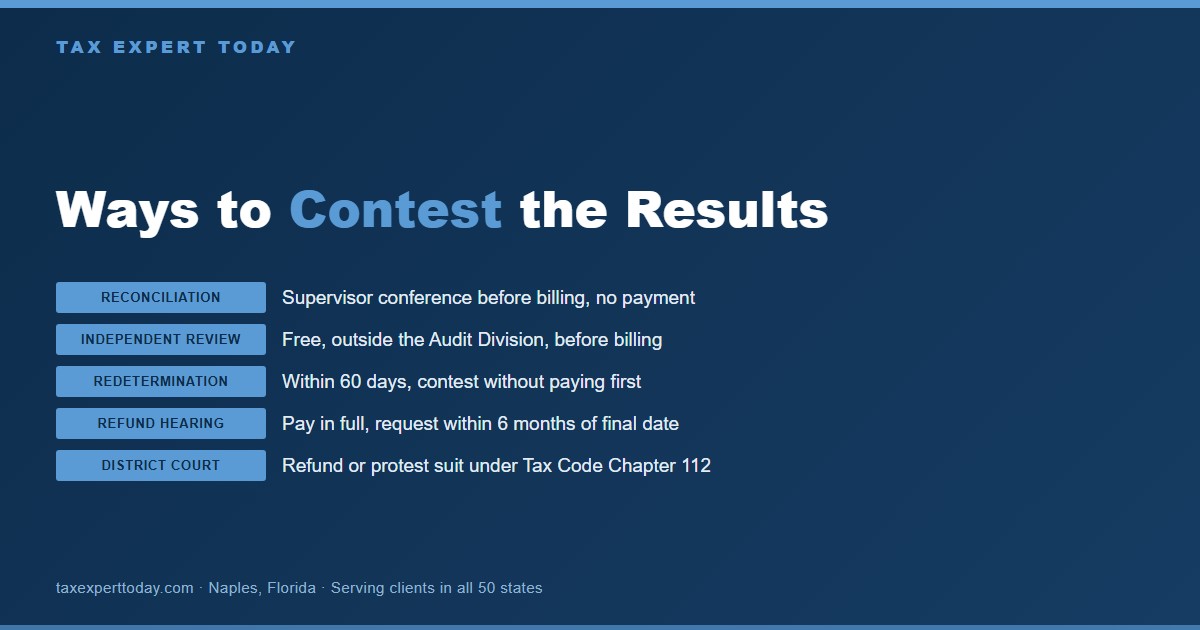
Before billing, you can request a reconciliation conference and then an Independent Audit Review Conference. After the Texas Notification of Audit Results issues, you can request a redetermination hearing without paying if your statement of grounds is received by the final date, 60 days after the statement date. Paid assessments can be contested through a refund hearing.
- Reconciliation conference. An informal meeting with the audit supervisor or manager to resolve disagreements, held at your location or the audit office.
- Independent Audit Review Conference. A free meeting with a Comptroller employee outside the Audit Division, requested after fieldwork and before billing, covering taxability, sampling, accounting disputes and waivers.
- Redetermination hearing. Under Tax Code Section 111.009, a petition filed within 60 days of the notice of determination preserves the right to contest without first paying.
- Refund hearing or later refund claim. After paying in full, a refund hearing may be requested within six months after the final date, and a refund claim may be filed later for periods still within the four year limit.
The deadline that matters most is the redetermination deadline. Section 111.009(b) says a petition must be filed before 60 days after the date the notice of determination is issued, or the redetermination is barred and the determination becomes final. The contesting publication translates that into practice: find the final date printed on the notification, and make sure your letter with a statement of grounds is received on or before it. The Comptroller’s process page specifies how receipt is measured. Mail is timely if the agency mail room date stamp is on or before the expiration date, hand delivery if received by staff by that date, and electronic submission if received by 11:59 p.m. on that date by the agency system’s time stamp.
The statement of grounds is not a formality. The contesting publication requires it to list the items you disagree with, individually or by category, and to state the factual basis and legal grounds for your position. If you disagree with the agency’s interpretation of the law, you must cite legal authority. A request that is late or incomplete draws a letter explaining the deficiency and your remaining options, which may not include a hearing without payment. A third party filing on your behalf must include a power of attorney, and the Comptroller provides a limited power of attorney on Form 01-137.
| Route | When to use it | Deadline | Payment required first? |
|---|---|---|---|
| Reconciliation conference | Disputes remain after the exit conference | Before the audit is billed | No |
| Independent Audit Review Conference | Disputes remain after reconciliation; not available for estimated audits or issues with a written taxability determination | After fieldwork is complete and before billing | No |
| Redetermination hearing | You disagree with the Texas Notification of Audit Results | Statement of grounds received on or before the final date, 60 days after the statement date | No, but interest continues on any amount ultimately due |
| Refund hearing | You paid the full liability and want to contest it | Within six months after the final date | Yes, including penalty and interest |
| Refund claim | You paid in full and the six month window has passed | While the period is still within the four year limitation | Yes |
| Notice of Intent to Bypass the Hearing | You disagree with a managed audit or refund verification and want to go to district court | Received within 60 days of the notification or denial letter | Refund suit requirements apply |
| Settlement | A case has been referred for a formal hearing | Requested through the Audit Division or Tax Administration | No |
Once a timely and complete statement of grounds is filed, the contested case follows a defined path. The auditor first reviews any new documentation, and if the parties agree, the taxpayer signs a withdrawal and receives an amended notification. If disagreement remains, the case goes to an attorney in Tax Administration, who generally issues a Position Letter. The taxpayer can accept it, or reply and ask to have the case heard by an administrative law judge at the State Office of Administrative Hearings. The judge issues a Proposal for Decision, and the Comptroller renders the final decision. At any point after the case is assigned to an attorney and before referral to the hearings office, the parties may settle through a Compromise and Settlement Agreement.
Beyond the administrative process lies district court. Tax Code Section 112.151 allows a refund suit against the Comptroller and the Attorney General after a refund claim and a denied motion for rehearing, generally filed within 60 days of the denial, with any additional tax found due for the period paid. Section 112.051 provides a separate protest payment route that requires paying the amount claimed with a written protest stating each reason in detail. The contesting publication recommends consulting a private attorney promptly when a court challenge is contemplated, and court proceedings generally call for a licensed Texas attorney.
Two points about the informal stage are worth emphasizing. First, the Independent Audit Review Conference has a narrow window: after fieldwork is complete but before the audit is billed. Once the Texas Notification of Audit Results issues, that option is gone. Second, the conference is unavailable in several situations the contesting publication lists, including when records were not provided and the liability had to be estimated, even if the dispute is about how the estimate was calculated. That is one more reason the records request deadline deserves attention early in the audit.
For a collected but unpaid balance, the Comptroller’s collection tools are significant. The contesting publication lists requiring a security bond, filing a tax lien, freezing or seizing non-exempt assets, suspending permits, filing criminal charges and holding state warrants payable to the taxpayer. A taxpayer that does not intend to contest should arrange payment promptly after the determination becomes final. Payment is due within 10 days after that date, and the additional 10 percent penalty applies after it. Owners who are winding down a business while an audit is open should also read our guide to closing a business in Texas, since the Comptroller’s tax clearance process and successor liability rules interact with any open audit.
How Should a Business Prepare Before Fieldwork Starts?
Calendar the 30 day questionnaire date and the 60 day managed audit date, appoint one contact, and sign a power of attorney if someone will represent you. Then reconcile reported Texas sales to the ledger and federal returns, review the certificate file for gaps, and identify your own overpayments before the entrance conference.
- Reconcile first. Tie each period’s reported gross sales, deductions and taxable sales to the general ledger and to the federal return, and document the reconciling items.
- Audit the certificate file. Pull every exempt and resale sale above a meaningful dollar level and confirm a complete certificate is on file for each customer.
- Review accrued use tax. Identify untaxed purchases of taxable items consumed by the business, since these are among the most common expense adjustments.
- Find your overpayments. Look for tax paid to vendors on items bought for resale or otherwise exempt, and assemble the invoices.
The order of these steps reflects how auditors approach a Texas Comptroller audit. The first thing an auditor does is test whether the books can be trusted, so a documented reconciliation of reported Texas sales to the ledger answers the first question before it is asked. The second thing is usually the certificate file, so filling gaps there before fieldwork avoids the verification that applies to certificates obtained after the auditor begins. The third is purchases, where the business’s own review of accrued use tax and overpaid tax can shape the sampling discussion rather than react to it. Purchases made under a Texas resale certificate and later used by the business deserve particular attention, since they are a frequent source of use tax adjustments.
| Area | What to prepare | Why it matters in the audit |
|---|---|---|
| Calendar | Questionnaire date, managed audit date, records request dates | Missing a date can lead to estimation or lose the managed audit option |
| Representation | One contact person; Form 01-137 limited power of attorney if a representative is used | Third-party requests and hearing filings require written authorization |
| Sales reconciliation | Reported sales tied to the general ledger and federal returns, with reconciling items explained | Determines whether the auditor relies on records or moves toward estimation |
| Exempt and resale sales | Complete certificates for the largest customers, collected before fieldwork | Incomplete certificates are disallowed, and later ones face verification |
| Expense and asset purchases | Untaxed taxable purchases and accrued use tax by period | Usually the largest source of sampled adjustments |
| Overpaid tax | Invoices showing tax paid on exempt or resale items | Offsets the assessment and earns credit interest |
| Unusual events | A list of one-time purchases, system changes, acquisitions and closures by period | Supports removing unrepresentative items from any sample |
Industry-specific taxes deserve their own review. A business that rents rooms or short-term properties should check its hotel tax filings against bookings and platform reports using our guide to the Texas hotel occupancy tax. A business that sells services should check its service descriptions against the taxable categories in our guide to what services are taxable in Texas. And every taxable entity should confirm that its Texas franchise tax reports and Public Information Reports are current, because the Comptroller’s managed audit guidance requires a taxpayer to be current in reporting all tax types, and franchise tax returns are themselves subject to examination under the same Chapter 111 procedures.
The list of unusual events is the item most businesses skip, and it is the one that most directly supports a sampling challenge. Preparing it before fieldwork, with dates and amounts, allows you to raise each item when the sample is designed rather than arguing after the projection is done that a particular month was not typical. It also helps the auditor build a better sample, which is in both parties’ interest because a well-designed sample is less likely to be disputed later.
Does an IRS Audit Change Your Texas Exposure?
It can. Tex. Tax Code Section 111.206 requires a taxpayer to report a final federal or other agency determination that affects Texas tax liability within 120 days after it becomes final. The statute expressly includes an IRS audit, and it lets the Comptroller assess within one year after the report even if the period has closed.
- The report is due within 120 days. It must include a detailed statement of the reasons for the change in Texas liability.
- Closed periods can reopen. The Comptroller may assess a resulting deficiency within one year after the report, or after discovering the determination if no report was filed.
- The rule works both ways. If the federal change means you overpaid Texas tax, you may file a refund claim within one year after the determination becomes final.
- Franchise tax is the usual link. Franchise tax revenue is computed from federal return amounts, so an IRS adjustment to gross receipts or cost of goods sold can change the Texas margin.
This provision is easy to miss because it sits outside the usual audit discussion, yet it explains why a federal examination can produce a Texas bill years later. Section 111.206 applies to a final determination from an administrative proceeding of a local, state or federal regulatory agency, and its definitions specifically include the Internal Revenue Service and an IRS audit. A business that settles an IRS examination should therefore ask, as part of closing the federal matter, whether any adjustment flows into a Texas computation. Our IRS resolution and audit support service handles the federal side, and Southwest Florida clients can also see our IRS audit help in Naples page. The federal side of that process is covered in our overview of what happens if you get audited by the IRS, and the federal limitation periods, which differ from the Texas four year rule, are explained in our guide to the IRS audit statute of limitations.
The interaction also matters in the other direction. A Texas Comptroller audit can surface facts that are relevant to federal returns, because auditors review federal income tax information as part of every audit. A reconciliation that shows unreported sales for Texas purposes raises an obvious question about federal gross receipts. Businesses should make sure that any position taken in a Texas audit is consistent with what has been reported to the IRS, and where it is not, that the difference is understood and addressed before it becomes a second problem.
Texas Comptroller Audit Help in Naples & Southwest Florida
Tax Expert Today LLC advises businesses on state tax matters nationwide from our office in Naples, Florida. Texas audit questions reach us from several directions. Owners who have relocated from Texas to Southwest Florida often keep operating Texas businesses and receive a Comptroller notice at their new address. Florida companies that sell into Texas, or that formed Texas entities as they expanded, find themselves registered for Texas sales tax and then selected for audit by one of the Comptroller’s offices. And some businesses discover an unfiled Texas obligation only when the Comptroller’s inquiry arrives.
Our approach is built around the decisions described in this guide. We calendar the questionnaire and managed audit deadlines on the day the notice arrives, evaluate whether a managed audit fits the business and its records, reconcile reported Texas sales to the books and federal returns, review the certificate file, and identify overpaid tax that belongs in the audit. When a sample is proposed, we review the population, the strata and the sample period for representativeness, and we document unusual transactions before the projection is calculated. When results arrive, we assess each contest route against its deadline.
- Texas sales tax audit help Naples business owners can reach in person. Our office is on Tamiami Trail North in Naples, Florida, and we work with clients locally and remotely.
- State tax audit representation Naples FL and nationwide. We serve clients in all 50 states, and the Texas procedures are the same wherever the business owner lives.
- Sampling and managed audit decisions reviewed early. Both are decided within weeks of the notice, which is when advice is most useful.
- Refunds raised inside the audit. We look for overpaid tax so that it offsets the assessment rather than being left unclaimed.
- Federal and Texas positions coordinated. Where an IRS examination or a federal return is involved, we keep the two sets of positions consistent.
Related services include our Texas tax services for businesses with Texas obligations, and our Naples tax planning work for Southwest Florida owners. Businesses that are expanding into Texas can start with our checklist for moving a business to Texas, which covers registration before an audit ever becomes an issue.
Tax Expert Today LLC
11983 Tamiami Trail N, Naples, FL 34110
Phone: (239) 441-2005
Hours: Monday through Friday, 10:00 a.m. to 5:00 p.m. ET
Local question we are asked often: A Naples company that sells equipment online registered for Texas sales tax two years ago and has just received a Texas Comptroller audit notice from an out-of-state audit office. Does it have to travel to Texas, and should it request a managed audit? Travel is generally not required, because the Comptroller operates audit offices outside Texas and much of the work can be done with electronic records. The managed audit question turns on timing and records. The request must reach the audit manager within 60 days of the notification letter date and before fieldwork begins, and it works best for a business with clean electronic sales and purchase data and someone with Texas tax knowledge to prepare the schedules. Because the company registered only two years ago, the first question is also whether it should have registered earlier under the Texas economic nexus rules, since unfiled periods are not limited to four years.
When Should You Engage a Professional?
The Comptroller states plainly that representation is not required, and many small audits are handled by the business owner and a bookkeeper. Professional help tends to earn its cost in specific circumstances rather than as a general rule.
- A sample is proposed on a large population. The design of the sample and the treatment of unusual transactions often matter more than any other part of the audit.
- A managed audit is under consideration. The 60 day request window and the quality standards for schedules make an early decision important.
- Records are incomplete. Estimation is the least favorable method, and it also closes off the independent review conference.
- Exempt or resale sales are significant. Certificate gaps can produce large adjustments, and the rules on timing are strict.
- Periods were never filed. An unregistered period has no limitation, and the strategy for addressing it differs from a routine audit.
- The results are disputed. The redetermination deadline, the statement of grounds requirements and the choice between paying and contesting all have lasting consequences.
Tax Expert Today LLC is a multidisciplinary firm of tax advisors, enrolled agents, CPAs and attorneys serving clients in all 50 states. A Texas Comptroller audit is a state tax matter, not an IRS matter, and we handle it as part of our broader state and local tax practice, with Texas licensed counsel involved where a contested case or court proceeding calls for it. Where a federal return or an IRS examination is also involved, the federal work is handled by credentialed practitioners in the same engagement so the state and federal records agree.
To discuss a Texas audit notice, call (239) 441-2005 or use our contact page to arrange a consultation. For the wider context of how Texas taxes businesses, see our overview of Texas LLC taxes.
Frequently Asked Questions
How far back can the Texas Comptroller audit?
Generally four years from the date each tax became due and payable, under Tex. Tax Code Section 111.201. Under Section 111.205 there is no limit if no report was filed, if a false or fraudulent report was filed with intent to evade, or if a report understated the tax by at least 25 percent.
What triggers a Texas sales tax audit?
The Comptroller lists several selection methods: being among the largest sales tax reporters, a prior audit that found $25,000 or more due, computer-based random selection by industry, information shared with other agencies and states, analysis of tax returns, business publications and leads from the public.
How long does a Texas Comptroller audit take?
It depends on the size of the business and the condition of its records. The Comptroller’s Notice of Routine Audit sets internal deadlines, including 30 days for records requests and an instruction that auditors avoid gaps of more than 30 days without activity, but it does not set a fixed total length.
What is a managed audit in Texas?
A self-review of sales and use tax liability performed by the taxpayer under a written agreement with the Comptroller, authorized by Tax Code Section 151.0231. Absent fraud or willful evasion, no penalty may be assessed on amounts found, and the Comptroller may waive all or part of the interest. The request must be received within 60 days of the notification letter date.
Can I challenge the auditor’s sample?
Yes. Tax Code Section 111.0042 requires the sample to reflect normal business conditions. A transaction you show to be unrepresentative must be removed from the sample and assessed separately, and a projection built on a method outside generally recognized sampling techniques is dismissed for that portion of the audit.
What is the deadline to contest a Texas Comptroller audit?
A redetermination request with a statement of grounds must be received on or before the final date shown on the Texas Notification of Audit Results, which is 60 days after its statement date. Filing on time allows you to contest without paying first, although interest continues to accrue on any amount ultimately due.
What penalty applies to a Texas audit assessment?
For most taxes, a 10 percent penalty applies to the amount assessed in the audit, and another 10 percent applies if the determination is not paid within 10 days after it becomes final. Interest accrues at the prime rate plus one percent, which is 7.75 percent for 2026. Penalty waivers are considered automatically.
Do I need a representative for a Texas Comptroller audit?
No. The Comptroller states that professional representation is not required and is a business decision. If a representative acts for you, a written authorization such as Form 01-137, the limited power of attorney, is required for requests and filings made on your behalf.
Published October 4, 2026 by Dr. Pellumb Kabashi « Back to Learning Center
Have a question this article touches on?
Tax Expert Today LLC, based in Naples, Florida and serving clients across the United States.
Schedule a Consultation (239) 441-2005