
By Dr. Pellumb Kabashi, DBA, MBA, CES, CFE, EA
Founder, Tax Expert Today LLC · Tax advisors, enrolled agents, CPAs, and attorneys · Serving clients in all 50 states
Quick Answer: Is shipping taxable in Texas? Yes, when the item shipped is taxable. Shipping, freight, delivery and handling charges a seller bills to its customer are part of the sales price, even when stated separately. They are exempt when the item is exempt, when the buyer gives a valid resale or exemption certificate, or when the seller ships the item outside Texas. Call (239) 441-2005 for a free consultation.
Every Texas seller that ships product eventually has to decide what to do with the freight line. The invoice shows the item, then a separate charge for shipping, delivery, freight or handling, and the question is whether the sales tax calculation stops at the item or carries through to the freight. In many states the answer turns on whether the charge is separately stated. In Texas it does not, and that single difference is the reason so many sellers who moved into Texas from another state, or who set up an online store using a default software setting, discover the issue only when an auditor recalculates their returns.
The short rule is easy to state and appears on every page that ranks for this question: the delivery charge follows the taxability of the item. If the item is taxable, the delivery charge is taxable. If the item is exempt, the delivery charge is exempt. What the short rule does not settle are the facts that actually decide an audit finding. Who contracted with the carrier? How is one freight charge split across an order that mixes taxable and exempt items? Which local rate applies when the order ships from a Texas warehouse to a customer in a different city? What proof keeps a shipment to another state outside Texas tax? Those questions are the subject of this guide.
Texas sales and use tax is a state tax administered by the Texas Comptroller of Public Accounts. It is not an IRS matter, and nothing here concerns federal income tax treatment of freight costs. The guide describes how the statute and the Comptroller’s rules work. It does not predict how the Comptroller will treat any particular business, and facts that look similar on paper can produce different results.
Is Shipping Taxable in Texas?
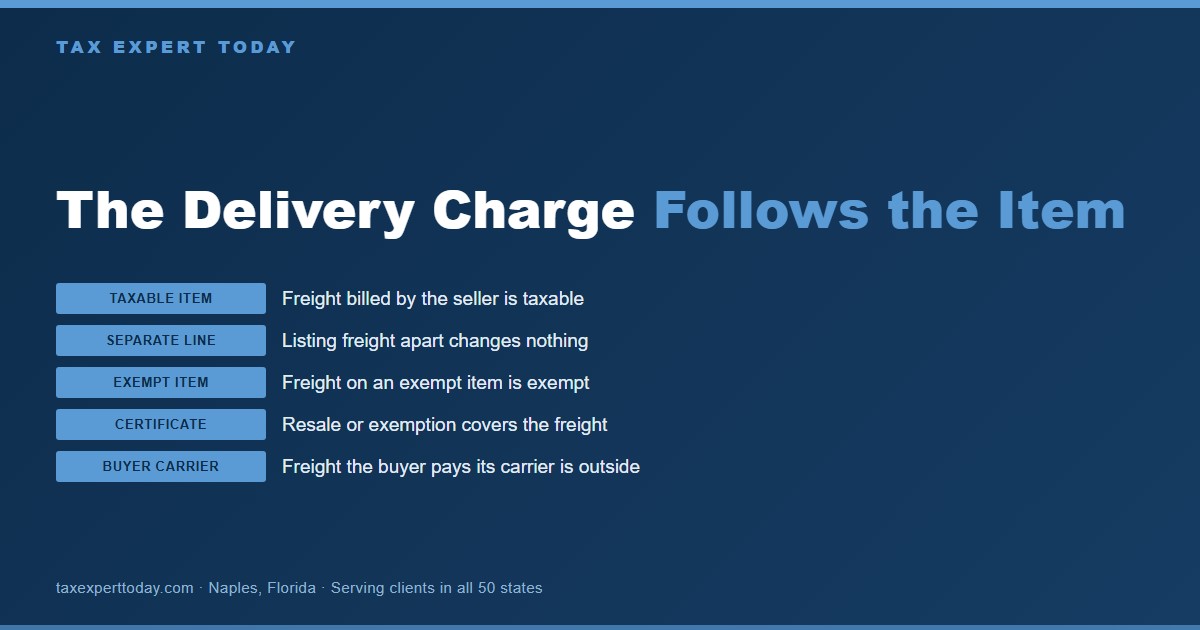
Yes, when the item being shipped is taxable. Texas treats shipping, freight, delivery and handling charges the seller bills to the buyer as part of the item’s sales price, taxed at the item’s rate even on a separate line. When the item is exempt or sold for resale, the delivery charge is exempt as well.
- Follows the item. A taxable sale makes the delivery charge taxable, and an exempt sale makes it exempt.
- Separate statement does not help. Rule 3.303(a) says delivery charges are taxable “even if stated separately” from the sales price.
- Billed by the seller. The rule reaches charges the seller bills to the purchaser, not freight the buyer pays to its own carrier.
- Certificates carry through. A valid resale or exemption certificate covers the delivery charge too.
- Out of state is different. Items the seller ships outside Texas are exempt under Tax Code Section 151.330, with proof of delivery.
The Comptroller’s collection FAQ answers the question with an example that is worth reading closely. A seller sells a sofa for a stated price and agrees to deliver it for a separate delivery fee. Because the sale of the sofa is taxable, the delivery fee is also taxable, and the seller collects tax on the total of the two. In the second example, the same customer gives the seller a resale or exemption certificate. Because the sale of the sofa is then exempt, the delivery fee is exempt too, and no tax is collected on either amount. The FAQ states the principle in one line: “Delivery and shipping charges connected with taxable items or services sold are taxable.”
The examples are simple on purpose, and they describe the most common situation: a seller that sells one kind of item, bills the freight itself and delivers inside Texas. Most of the rest of this guide is about the situations those examples leave out.
| Situation | Is the delivery charge taxable? | Main authority |
|---|---|---|
| Taxable item, seller bills delivery, delivered in Texas | Yes, at the same rate as the item | Tax Code 151.007(a)(3); 34 TAC 3.303(a) |
| Taxable item, delivery stated on a separate line | Yes; separate statement does not change the result | 34 TAC 3.303(a) |
| Exempt item, seller bills delivery | No; the charge follows the exempt item | Comptroller collection FAQ |
| Taxable item sold for resale with a valid resale certificate | No; the certificate covers the delivery charge | Comptroller collection FAQ |
| Buyer hires and pays its own carrier directly | The freight is not part of the seller’s sales price | 34 TAC 3.303(a) and (b) |
| Seller ships the item to a point outside Texas | No, with proof of delivery out of state | Tax Code 151.330(a); Publication 94-171 |
| Mixed taxable and exempt items under one freight charge | The share connected with taxable items is taxable | 34 TAC 3.303(a); see the allocation section below |
Why Does Texas Tax Delivery Charges Even When They Are Separately Stated?
Because the Tax Code defines the sales price as the total amount for which a taxable item is sold, without any deduction for the cost of transporting it. Section 151.007(a)(3) lists transportation by name among the costs that cannot be subtracted, and Rule 3.303 treats delivery charges as services or expenses connected to the sale.
- The statute. Section 151.007(a) defines sales price “without a deduction for the cost of” the item, labor, expenses and “the transportation or installation of tangible personal property.”
- The services rule. Section 151.007(a)(4) adds “transportation incident to the performance of a taxable service.”
- The exclusions list. Section 151.007(c) lists what can be excluded when separately identified, and freight is not on it.
- The rule. Rule 3.303(a) calls delivery charges “services or expenses connected to the sale.”
The reason separate statement matters in other states is that their definitions of sales price carve out delivery charges when they are listed apart from the item. The Texas definition works the other way. Section 151.007 starts from the total amount the buyer pays for the taxable item and then names the costs a seller may not subtract, and transportation is one of them. Subsection (c) does contain a list of amounts that are left out of the sales price when they are separately identified to the customer on an invoice, contract or sales slip. That list includes cash discounts, returned merchandise that is refunded, finance and carrying charges, trade-ins of the kind the seller regularly sells and certain restaurant gratuities. It does not include shipping, freight or delivery.
That structure explains a mistake that shows up often with sellers who moved operations into Texas. A business used to a state that exempts separately stated shipping sets up its invoices to break out freight and assumes the separate line removes it from the tax base. In Texas the separate line has no tax effect. It is still useful, because the customer can see what was charged and because a separate line makes allocation and audit review easier, but it does not change the amount on which tax is computed.
Rule 3.303 has been in place in substantially its current form since the late 1980s, with the most recent amendment effective in April 2005. Subsection (a) states that sales tax applies to all transportation or delivery charges to a customer when a taxable item is sold, leased or rented and the delivery charges are billed by the seller or lessor to the purchaser or lessee. Two details in that sentence do a great deal of work. The rule covers leases and rentals as well as sales, so a rental company that charges a delivery and pickup fee for taxable equipment is in the same position as a retailer. And the rule is tied to charges billed by the seller, which is the basis for the buyer-arranged carrier discussion below.
Does It Matter Whether the Charge Is Called Shipping, Freight, Postage or Handling?
Generally no. Rule 3.303(c) says transportation and delivery charges include every term carriers use for transportation, including freight, shipping, delivery and postage. Handling, packaging and fuel surcharges billed with a taxable sale are expenses the seller cannot deduct under Section 151.007, so they follow the same rule. A narrow postage exception applies to certain distribution services.
- Label does not control. Shipping, freight, delivery, postage and similar labels are treated alike.
- Handling. A handling fee is an expense connected with the sale and is taxable when the item is taxable.
- Surcharges. Fuel, residential delivery and expedite surcharges billed by the seller generally follow the item.
- Postage exception. Rule 3.303(d) excludes separately stated postage a seller pays at a client’s request to distribute taxable items to third parties the client designates.
Sellers sometimes rename the freight line in the hope that a different label produces a different answer. It does not. Rule 3.303(c) defines the term to include “all other terms used by common or contract carriers to describe transportation, such as freight, shipping, delivery, or postage.” A charge labelled shipping and handling, delivery and setup, freight recovery or logistics fee is examined for what it is, not what it is called.
Handling deserves a separate word because it is not transportation in the narrow sense. A handling fee pays for picking, packing and preparing an order. Under Section 151.007(a)(2), the sales price is computed without a deduction for “labor or service employed” or “other expenses,” and the Comptroller’s publication on online orders describes shipping and handling charges together as part of the sales price. A seller that charges a handling fee on taxable merchandise should expect that fee to be taxed with the item.
The postage exception in Rule 3.303(d) is narrow and is often misread. It applies when a seller, typically a printer or a fulfillment house, distributes taxable items to recipients designated by its client and bills the client separately for the postage it incurred at the client’s request. In that setting the separately stated postage is not taxable. The exception does not apply to an ordinary retailer that charges a customer postage to mail the customer’s own order, and it does not turn every postage line into an exempt amount.
| Label on the invoice | How it is generally treated with a taxable item |
|---|---|
| Shipping, freight, delivery | Part of the sales price and taxable |
| Shipping and handling, handling fee | Part of the sales price and taxable |
| Fuel surcharge, residential surcharge, expedite fee billed by the seller | Generally part of the sales price and taxable |
| Postage charged to the buyer for its own order | Part of the sales price and taxable |
| Separately stated postage for distributing items to recipients the client designates | Not taxable under Rule 3.303(d) |
| Installation of tangible personal property billed with the sale | Part of the sales price under Section 151.007(a)(3) |
Are Delivery Charges Taxable When the Item Itself Is Exempt?
No. When the item sold is exempt, or the buyer gives a properly completed resale or exemption certificate, the delivery charge connected with that item is exempt as well. The Comptroller’s collection FAQ shows this with a delivered sofa sold to a customer holding a certificate: no tax is collected on the item or on the delivery fee.
- Exempt items. Delivery of an item exempt by statute is not taxed.
- Resale. A valid resale certificate covers the freight on the items bought for resale.
- Exempt organizations. A valid exemption certificate covers the freight connected with the exempt purchase.
- Good faith. The seller should accept the certificate in good faith and keep it with its records.
The rule cuts both ways, and the exempt side is where sellers sometimes over-collect. A distributor that sells to retailers for resale and charges tax on the freight line, while correctly leaving tax off the merchandise, has collected tax that was not due. A seller of an exempt product that applies tax to the shipping line because its software treats shipping as taxable by default has the same problem. Tax collected in error belongs either to the customer or to the state, and it creates its own reporting and refund questions, which are covered later in this guide.
Certificates carry the delivery charge with them only if the certificate itself is valid. The resale certificate rules are covered in our guide to the Texas resale certificate, and the exemption certificate rules in our guide to the Texas sales tax exemption certificate. For freight purposes the point is simple: when an auditor rejects a certificate, the tax computed on the item and the tax computed on the delivery charge are both at stake.
Is Freight Taxable in Texas When the Buyer Hires the Carrier?
Generally not as part of the seller’s sale. Rule 3.303(a) reaches delivery charges billed by the seller. When the buyer contracts with and pays its own carrier, the freight is a separate transaction, and under Rule 3.303(b) a carrier that only transports and does not sell the item has no duty to collect tax on it.
- Who contracted. The carrier agreement, the bill of lading and the freight bill show who hired the carrier.
- Who paid. Freight billed by the carrier directly to the buyer is outside the seller’s invoice.
- Collect or third-party billing. Shipping on the buyer’s own carrier account generally keeps the freight off the seller’s sales price.
- Prepay and add. When the seller pays the carrier and rebills the cost, the rebilled freight is the seller’s charge and follows the item.
This is the first gap in most published explanations, and it is often the largest dollar issue in a distribution business. The rule text is precise. Rule 3.303(a) taxes delivery charges when they “are billed by the seller or lessor to the purchaser or lessee.” Subsection (b) adds that a third party carrier, meaning a separate legal entity, is not responsible for collecting or remitting tax as long as it only provides transportation and does not sell the item being delivered.
Read together, those two subsections mean the question is not whether the item moved by truck but whose freight it was. If the buyer chooses the carrier, signs the carrier’s terms and receives and pays the carrier’s freight bill, the transportation charge never becomes part of the amount the buyer pays the seller for the taxable item. The seller’s sales price is the price of the goods. If the seller arranges the shipment, pays the carrier and then charges the buyer, whether at cost or with a markup, the freight is part of what the buyer pays the seller and it follows the item.
Three practical points follow from that reading. First, the documents need to match the story. A seller that says the buyer arranged freight but whose own name appears as the shipper paying the carrier will have trouble supporting the position. Second, the terms of sale matter. Shipping terms that put the freight obligation on the buyer, a buyer carrier account number on the bill of lading and a freight invoice addressed to the buyer all point the same way. Third, convenience billing undoes the result. When a seller pays the buyer’s freight to keep the shipment moving and then adds the amount to the buyer’s invoice, the charge is billed by the seller and is treated as part of the sale.
| Freight arrangement | Who bills the buyer for freight | General Texas treatment |
|---|---|---|
| Seller ships on its own trucks and charges a delivery fee | Seller | Part of the sales price; follows the item |
| Seller pays a common carrier and rebills the freight at cost | Seller | Part of the sales price; follows the item |
| Seller pays a common carrier and rebills with a markup | Seller | The full rebilled amount follows the item |
| Seller quotes a delivered price with freight built in | Seller, inside the item price | The entire delivered price is the sales price |
| Buyer ships on its own carrier account; carrier bills the buyer | Carrier | Not part of the seller’s sales price |
| Buyer picks up with its own truck at the seller’s dock | No freight charge | The sale is made in Texas; no freight issue arises |
What Happens When the Seller Marks Up the Freight?
The entire amount the seller charges for delivery follows the item, including any markup over the carrier’s actual cost. Texas does not tax only the carrier’s charge and exempt the seller’s margin. Because Section 151.007 allows no deduction for transportation, a delivery charge of any size billed with a taxable item is part of the sales price.
- No cost split. The markup and the pass-through cost are treated alike.
- Flat fees. A flat shipping fee is taxable in full when the item is taxable, whatever the actual cost was.
- Free shipping. When no delivery charge is billed, there is no separate amount to tax beyond the item price.
- Delivered pricing. Freight built into the item price is simply part of the price.
Ecommerce sellers often charge a flat shipping fee that is higher or lower than the actual carrier cost on a given order. For Texas purposes the actual cost does not matter. The tax base is what the buyer pays the seller, and the delivery charge is part of that amount. The same logic means that free shipping is not a tax planning device in itself. A seller that builds freight into a higher item price collects tax on the higher price. A seller that charges a lower item price plus a shipping fee collects tax on both. When the total paid is the same, the tax is generally the same.
The markup point matters most for distributors that use freight as a profit center. Because the full rebilled amount is part of the sales price on taxable sales, a freight markup program increases the tax collected from customers on those orders. That is not a problem in itself, provided the tax is collected and remitted. It becomes a problem when the seller’s billing system computes tax on the item only and treats the freight line as nontaxable.
Is Inbound Freight Taxable Before the Sale?
Yes, when the seller passes it on to the customer. Rule 3.303(a) taxes transportation charges “both before and after the sale” when billed with a taxable item. A freight-in charge added to the customer’s invoice for a taxable item adds to the sales price; it is not a separate exempt service.
- Freight-in rebilled. Inbound freight the seller recovers from the customer follows the item.
- Special orders. A drop-in freight charge on a special order item is part of that sale.
- The seller’s own cost. Freight the seller absorbs is simply a cost of doing business.
- The seller’s purchases. When the seller buys for resale, its supplier’s delivery charge is covered by the resale certificate.
The phrase “both before and after the sale” is easy to overlook. It covers a common billing pattern in which the seller orders an item from a supplier, pays the inbound freight to bring it to the seller’s location and then adds that inbound freight to the customer’s invoice. The customer is paying for transportation that happened before the sale to the customer occurred, but the charge is still a cost connected with the sale of a taxable item, and it is taxed with the item.
On the purchasing side, the same principle explains why a seller’s own resale certificate matters for freight. When a reseller buys inventory from a supplier and the supplier bills delivery, the supplier’s delivery charge is covered by the resale certificate along with the merchandise. If the reseller instead buys supplies or equipment for its own use, the delivery charge on that purchase is taxable with the purchase. Our guide to Texas use tax covers what happens when a supplier fails to collect on a taxable purchase.
How Do You Split One Freight Charge on a Mixed Taxable and Exempt Order?
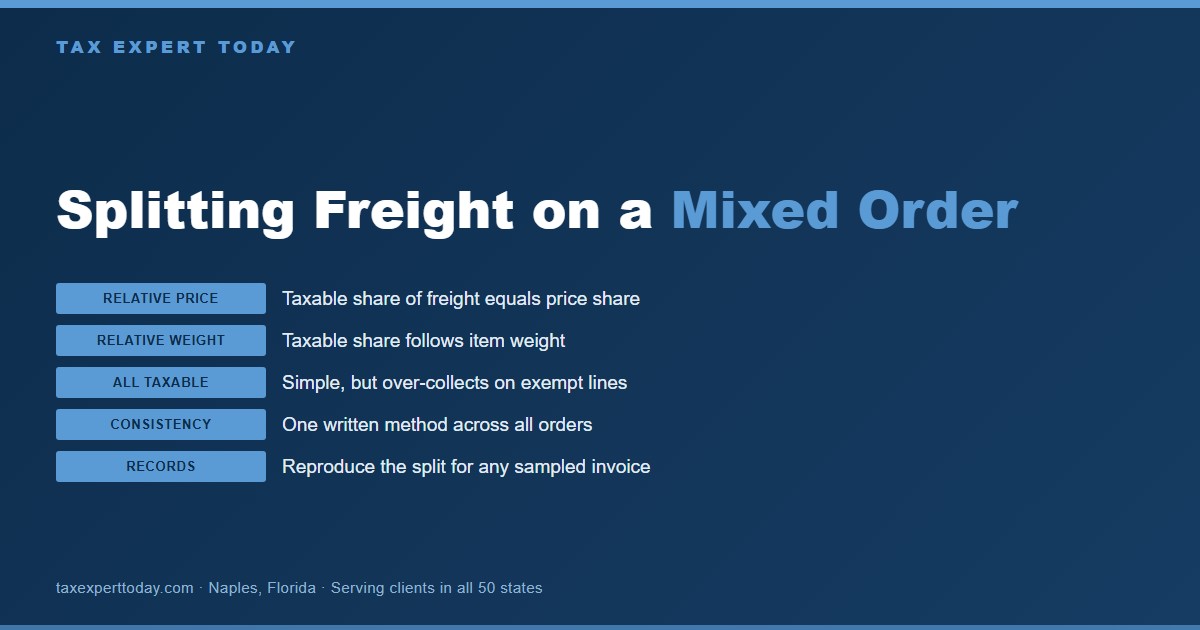
The share connected with taxable items is taxable and the share connected with exempt items is not. Neither Rule 3.303 nor the collection FAQ prescribes a formula, so sellers generally allocate by relative price or weight, apply the method consistently and keep the calculation. Without a supportable split, the whole charge is at risk.
- Relative price. The taxable share of the freight equals the taxable share of the merchandise price.
- Relative weight. The taxable share follows the weight of the taxable items, which fits freight priced by weight.
- Consistency. The same method applied the same way across orders is easier to support than order by order choices.
- Documentation. The allocation should be visible on the invoice or reproducible from the order data.
- Default risk. A seller that cannot show its split may face the full charge treated as taxable.
This is the second gap in most published explanations, and it is a daily issue for any seller whose catalog mixes taxable and exempt products. Grocery and pharmacy sellers, farm and ranch suppliers, industrial distributors with manufacturing exempt customers, and medical supply sellers all ship orders in which some lines are taxable and some are not, with one freight charge on the order. The Texas rule tells the seller that delivery charges connected with taxable items are taxable. It does not say how to measure which part of a single charge is connected with which items.
The Comptroller’s guidance that is easy to find does not answer the allocation question directly. Rule 3.303 has four short subsections, none of which addresses mixed orders, and the collection FAQ uses single item examples. That leaves the seller to choose a method that is reasonable and to be ready to explain it. Some sellers avoid the problem by shipping taxable and exempt items under separate freight charges. Others treat the full freight as taxable whenever any taxable item is on the order, which is simple and conservative but over-collects from customers whose orders are mostly exempt.
A worked example helps show the difference the method makes. The figures below are hypothetical and are not drawn from any client matter.
| Hypothetical order | Amount or measure |
|---|---|
| Taxable merchandise | $800, weighing 20 pounds |
| Exempt merchandise | $200, weighing 60 pounds |
| Single freight charge billed by the seller | $50 |
| Taxable freight using relative price (80 percent) | $40 |
| Taxable freight using relative weight (25 percent) | $12.50 |
| Taxable freight treating the whole charge as taxable | $50 |
The example shows why the method should be chosen deliberately rather than left to a software default. A price based split is easy to compute and easy to explain, and it is the approach most sales tax software applies. A weight based split can reflect the actual cost of carrying the goods more closely, especially when the exempt items are heavy and the taxable items are light, but it requires the order data to carry item weights. Whatever method is used, the seller should be able to reproduce the calculation for any invoice an auditor selects, which in practice means the method lives in the billing system rather than in someone’s judgment at the time of the sale.
Are Shipping Charges Taxable on Items Shipped Out of Texas?
No, when the seller ships the item outside Texas under the sales contract. Section 151.330(a) exempts the sale when the seller delivers by its own facilities, to a carrier for shipment to an out-of-state consignee, or to a forwarding agent for shipment to another state. The delivery charge is exempt with the item.
- Seller’s own trucks. Delivery by the seller’s facilities to an out-of-state point qualifies.
- Common carrier. Delivery by the seller to a carrier for shipment to an out-of-state consignee qualifies.
- Forwarding agent. Delivery to a forwarding agent for shipment to another state or a United States territory qualifies.
- Possession in Texas. A buyer that takes possession in Texas is generally outside this exemption, even if it later moves the item.
Section 151.330(a) is the statutory basis, and its conditions are specific. The item must be shipped to a point outside Texas “under the sales contract,” and the shipment must be made by the seller through one of three channels: the seller’s own facilities, delivery by the seller to a carrier for shipment to a consignee outside the state, or delivery by the seller to a forwarding agent for shipment to a location in another state or a United States territory or possession. The exemption is about where the seller delivers the item, not about where the buyer is located or where the buyer eventually uses it.
That distinction explains a common audit issue for Texas sellers with out-of-state customers. A customer from another state that sends its own truck to the seller’s Texas dock and takes possession there has taken delivery in Texas. The fact that the customer is based elsewhere and drives the item across the state line afterward does not, by itself, bring the sale within Section 151.330(a). The seller generally collects Texas tax on that sale, and the customer’s remedy, if any, lies with its home state’s credit rules. The answer can change when the carrier is the seller’s agent or when the documents show the seller delivered to a carrier for shipment out of state, so the paperwork deserves a close look before a position is taken.
Publication 94-171 puts the general rule plainly for online sellers: Texas sellers do not need to collect Texas sales tax on items shipped and delivered to out-of-state locations. It adds that the seller may have collection obligations in the destination state, which is a separate question governed by that state’s law.
What Proof Keeps an Out-of-State Delivery Exempt?
Proof of delivery outside Texas. The Comptroller’s Publication 94-171 says the seller’s records must include proof of delivery, such as a bill of lading, a shipping invoice or a postal receipt. A ship-to address on the sales invoice alone may not be enough if the carrier documents do not confirm that the item left Texas under the seller’s shipment.
- Bill of lading. Shows the consignee, the destination and the carrier that took the shipment from the seller.
- Carrier tracking or shipping invoice. Confirms the shipment was tendered and delivered to the out-of-state address.
- Postal receipt. Supports parcel shipments sent by mail.
- Sales contract or order. Shows the shipment was required under the sale, as Section 151.330(a) expects.
- Retention. The documents should be kept with the sale record for the full audit period.
The exemption is only as good as the records behind it, and the records are what a Comptroller audit tests. Publication 94-171 names three examples of acceptable proof: a bill of lading, a shipping invoice or a postal receipt. In an audit, the reviewer will usually sample out-of-state sales and ask for the delivery documents for each sampled invoice. An invoice that shows an out-of-state ship-to address but has no matching carrier record is the type of item that can be treated as a Texas sale.
Sellers that ship a large volume of parcels often rely on integrated carrier data rather than paper. That can work well, provided the data can be matched to each invoice and retrieved for the period under review. The risk lies in systems that purge tracking data after a short period or that store tracking numbers without linking them to the sales record. The audit period can reach back four years, so a delivery record that is gone after ninety days does not help much.
| Delivery method | Generally acceptable proof | Common weakness |
|---|---|---|
| Seller’s own truck to an out-of-state customer | Signed delivery receipt, driver log, trip record | No signed receipt at the destination |
| Common carrier hired by the seller | Bill of lading and carrier freight invoice | Bill of lading not retained or not matched to the sale |
| Parcel carrier | Shipping invoice or tracking record tied to the sale | Tracking data purged before the audit period ends |
| United States mail | Postal receipt | No receipt kept for low value parcels |
| Forwarding agent to another state | Forwarding agent documents and the onward shipping record | No record of the onward shipment |
| Buyer pickup in Texas | Not an out-of-state delivery by the seller | Exemption claimed on a ship-to address alone |
Is Shipping Taxable on Exports Outside the United States?
Generally no when the seller ships the item to another country or to a freight forwarder for export and keeps the required documents. Publication 94-171 says Texas tax is not due in those cases, and Section 151.330(d) ties foreign shipments to the Section 151.307 documentation rules. The delivery charge follows the exempt export.
- Direct export. The seller ships the item to a foreign address.
- Freight forwarder. The seller delivers the item to a freight forwarder for export.
- Documentation. Section 151.307 governs the export proof the seller must keep.
- Resale certificates. A resale certificate generally cannot be used for items shipped outside the United States, except taxable items shipped to Mexico.
The Comptroller’s online orders publication says Texas sales tax is not due when a purchaser buys an item in Texas and has the seller ship it to another country, or has the seller send it directly to a freight forwarder for export, and that the seller must maintain documentation to show why tax was not collected. It also refers sellers to Rule 3.323 on imports and exports for the detailed requirements. Export documentation is more demanding than domestic proof of delivery, and the requirements differ depending on how the item leaves the country, so an exporter should build its records around the rule rather than around the shipping label.
Exports are outside the main scope of this guide. The key point for freight is the same as for domestic shipments: if the sale qualifies as an exempt export and the documents support it, the delivery charge billed with that sale is exempt too. If the export documents are missing, both the item and the freight charge are exposed.
Which Local Rate Applies When an Order Ships From a Texas Warehouse?
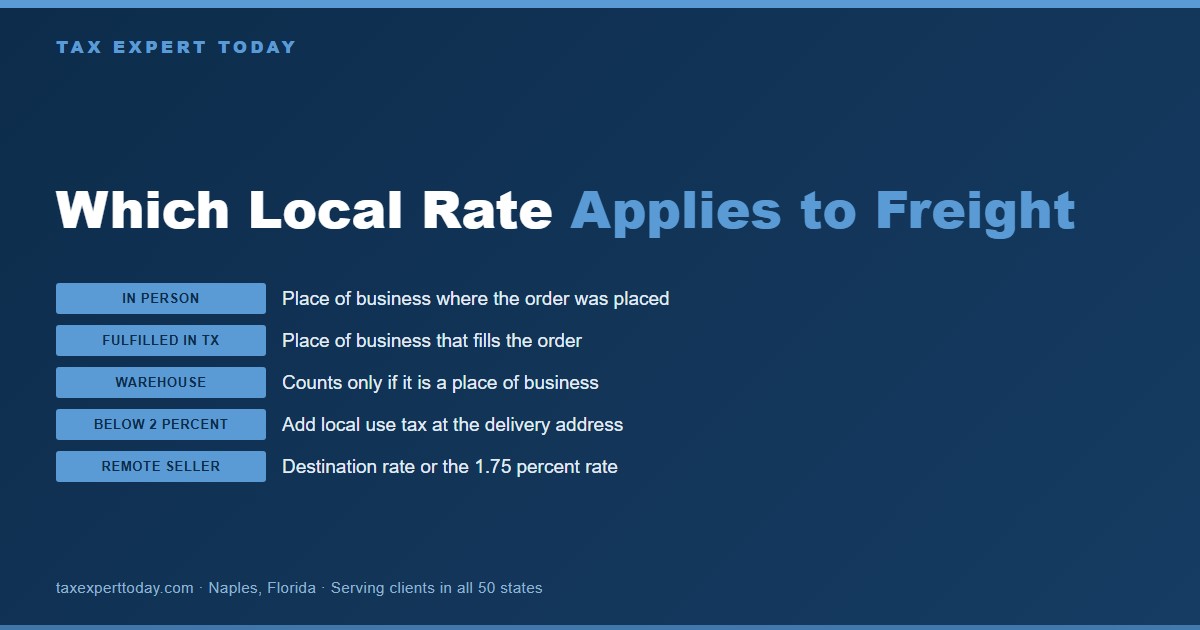
It depends on where the sale is consummated under Rule 3.334. An order received at a seller’s Texas place of business is generally consummated there, or at the place of business that fulfills it. A warehouse counts as a place of business only if it qualifies under the rule. The delivery charge takes the item’s local rate.
- Origin based for most Texas sellers. Local sales tax is generally based on the seller’s place of business where the sale is consummated.
- Fulfillment location. An order received at one Texas place of business and fulfilled at another is generally consummated where it is fulfilled.
- Warehouses. Publication 94-105 says a warehouse that ships items is not a place of business unless it qualifies as one.
- Same rate as the item. The delivery charge is part of the sales price and takes the item’s local rate.
The third gap in most published explanations is the local rate. Some pages say the rate follows the delivery address. That is correct for many remote sellers and for marketplace providers, but it is not the general rule for a seller with a place of business in Texas. Texas combines a 6.25 percent state rate with local taxes that cannot exceed 2 percent in total, and for sellers engaged in business in Texas the local sales tax is generally based on where the sale is consummated under Rule 3.334(c), which takes its rules from Tax Code Sections 321.203 and 323.203.
The rule works through a series of cases. When an order is placed in person at a Texas place of business, the sale is consummated at that place of business regardless of where the order is fulfilled. When an order is not placed in person but is received at a Texas place of business and fulfilled at a Texas place of business, the sale is consummated at the place of business that fulfills it. When the order is received at a Texas place of business and fulfilled from a location that is not a place of business, the sale is consummated where the order was received. When the order is received somewhere that is not a place of business and is fulfilled from a Texas place of business, the sale is consummated at the fulfilling place of business. When the order is neither received nor fulfilled at a Texas place of business but is fulfilled from a location in Texas, the sale is consummated at the delivery location.
Whether the warehouse counts is therefore central. The Comptroller’s Publication 94-105 explains that call centers, showrooms and clearance centers can be places of business if they meet the definition, but that a warehouse from which a person ships items is not a place of business unless it qualifies as one. The same publication notes that computer servers, websites and software applications are not places of business. A seller with an office in one city and a distribution center in another should determine, under the rule’s definitions, which of its locations are places of business before it decides which local rate its billing system applies.
| Where the order is received | Where it is fulfilled | Where the sale is generally consummated under Rule 3.334(c) |
|---|---|---|
| In person at a Texas place of business | Anywhere | The place of business where the order was placed |
| At a Texas place of business, not in person | A Texas place of business | The place of business that fulfills the order |
| At a Texas place of business, not in person | A location that is not a place of business | The place of business where the order was received |
| Not at a Texas place of business | A Texas place of business | The place of business that fulfills the order |
| Not at a Texas place of business | A Texas location that is not a place of business | The Texas location where the item is delivered |
| Not at a Texas place of business | Outside Texas | No Texas sale; local use tax at the first Texas point of use |
Is Part of the Local Sourcing Rule Being Challenged?
Yes. Publication 94-105 states that, under an agreed temporary injunction, the Comptroller will not enforce the Rule 3.334 provision on orders not received by sales personnel while its validity is challenged in district court. The rule’s effective date is unchanged, so online sellers should confirm the current status before changing their sourcing.
- What is affected. The provision that treats orders not received by sales personnel as received at a location that is not a place of business.
- Who it matters to. Sellers that take orders online or through automated systems and ship from Texas locations.
- What has not changed. The effective date of the rule and the binding effect of the court’s eventual decision.
- What to do. Check the Comptroller’s current guidance before relying on either reading.
The current version of Rule 3.334, adopted effective July 4, 2024, addresses how orders that no salesperson receives, such as orders placed through a website or an automated system, should be treated for sourcing. Publication 94-105 describes the rule as treating those orders as received at locations that are not places of business, so that they are consummated at the destination unless a place of business fulfills them. It then states that, pursuant to an agreed temporary injunction, the agency has agreed not to enforce the provision relating to orders not received by sales personnel while its validity is challenged in district court, and that if the courts ultimately determine the rule follows the statute, taxpayers and the agency will be bound by that determination.
For a seller that ships taxable goods from a Texas location, this is not an abstract issue. The sourcing answer determines which local jurisdiction receives the local tax on both the item and the delivery charge, and in some cases it changes the total rate. A seller should not assume that a software vendor’s default setting reflects the current enforcement position. We describe the dispute as the Comptroller describes it and do not predict its outcome. Any change in sourcing should be made after confirming the Comptroller’s current guidance at the time.
When Is Additional Local Use Tax Due at the Delivery Address?
When local sales tax where the sale is consummated is below 2 percent and the item is delivered into a different local jurisdiction. Rule 3.334 and Publication 94-171 require the seller to collect any additional local use tax due at the delivery location, up to the 2 percent cap. The delivery charge is part of that tax base.
- The 2 percent cap. Total local tax on one sale cannot exceed 2 percent, so the combined rate tops out at 8.25 percent.
- Origin first. Local sales tax at the consummation location is applied first.
- Destination top up. Additional local use tax at the delivery address applies only to the extent the cap has not been reached.
- Seller responsibility. The seller collects the additional local use tax; if it does not, the purchaser must accrue it.
Origin based sourcing does not always end the local tax analysis. A seller located in a jurisdiction with less than 2 percent in local tax that delivers into a jurisdiction with additional local taxes may owe local use tax for the delivery location. Publication 94-171 puts it this way for online sales from a Texas place of business: the seller collects state and local tax based on its location, and if the rate at its location is lower than the rate at the purchaser’s location, the seller must also collect any additional local use tax due where the item is shipped or delivered. Rule 3.334 states that the seller is responsible for collecting the additional local use tax regardless of its location in Texas, and that if the seller fails to collect it, the purchaser is responsible for accruing and remitting it.
For freight, the point is that the delivery charge is part of the sales price for local tax purposes too. A seller that computes local use tax for the delivery address on the item price but not on the freight line has under-collected on every order that crosses into a higher rate jurisdiction. The Comptroller’s Sales Tax Rate Locator can confirm the rates for a specific address, and local boundaries do not follow ZIP codes, so a rate table keyed to ZIP code alone may produce errors.
How Do Remote Sellers Treat Shipping Charges?
The same way: the delivery charge is part of the sales price on taxable items delivered into Texas, and Publication 94-171 says that price includes all shipping and handling. A remote seller may use destination local rates or elect the 1.75 percent single local use tax rate, and the delivery charge takes the item’s rate.
- State rate. 6.25 percent applies to the item and the delivery charge.
- Local choice. Destination based local rates or the single local use tax rate of 1.75 percent.
- No extra tax for the buyer. A buyer that pays the single local rate to a remote seller owes no additional local tax.
- Refund for the difference. A buyer whose local rate is lower than the single rate may seek the difference on Form 00-957.
Whether a remote seller must collect Texas tax at all is a separate question, covered in our guide to Texas sales tax nexus. A remote seller that receives a Comptroller inquiry about its activity may also find our guide to the Texas nexus questionnaire useful. Once a remote seller is collecting, freight works exactly as it does for an in-state seller. The Comptroller’s online orders publication says remote sellers must collect state and local use tax on taxable items delivered to customers in Texas and that the sales price includes all shipping and handling charges. The local rate is either the rate at the shipping destination or the single local use tax rate, which the publication states as 1.75 percent. A seller that collects the single rate applies it to the delivery charge as well as to the item.
The single rate election also affects the buyer. Publication 94-171 says purchasers who pay use tax to remote sellers using the single local rate owe no additional tax, and that a purchaser whose own local rate is lower may apply for a refund of the difference on Form 00-957. Refund claims are covered in our guide to the Texas claim for refund.
How Are Drop Shipments Taxed in Texas?
Under Rule 3.285(d), a Texas seller may accept an out-of-state retailer’s resale certificate even when it ships the item directly to that retailer’s customer inside Texas. With a valid certificate, the Texas seller’s charge, including freight, is a sale for resale. Without one, it generally collects tax on its price and its delivery charge.
- Three parties. A Texas supplier, an out-of-state retailer that makes the retail sale and a Texas customer that receives the item.
- Resale certificate. The out-of-state retailer may give the Texas supplier a resale certificate in lieu of tax.
- Permit not the supplier’s problem. Rule 3.285(d)(3) says the Texas seller is not responsible for determining whether the out-of-state retailer must hold a Texas permit.
- Retail sale tax. The out-of-state retailer’s own Texas collection duty depends on whether it is engaged in business in Texas.
Drop shipments are the fourth gap in most published explanations. In a typical drop shipment, an online retailer located in another state takes an order from a Texas customer and has a Texas supplier ship the item directly to that customer. Two sales occur, one from the supplier to the retailer and one from the retailer to the customer, but only one shipment. The Comptroller’s resale certificate rule addresses the first sale directly. Rule 3.285(d) says a seller in Texas may accept a resale certificate from a retailer located outside Texas who buys taxable items for resale in the United States or Mexico, and that the certificate may be accepted “even if the Texas retailer ships or delivers the taxable item directly to a recipient located inside Texas.”
The certificate has to meet the rule’s content requirements, which include the purchaser’s signature and address, the date, the state in which the purchaser intends to resell, and either a permit or registration number from the state where the purchaser is authorized to do business or a statement that it is not required to hold one. When the certificate is valid, the supplier’s delivery charge on that sale is covered with the merchandise. When the supplier has no certificate, it is making a retail sale of a taxable item delivered in Texas, and its delivery charge is taxable with the item.
The second sale, from the out-of-state retailer to the Texas customer, is governed by the retailer’s own obligations. If the retailer is engaged in business in Texas, it collects tax on its full price, including any shipping it charges the customer. If it is not, the customer may owe use tax on the purchase, including the shipping charge, as described below. The Texas supplier is not required to police that second sale, but it should keep the certificate and the shipping documents together so that its own exemption is easy to support.
| Drop shipment fact | Supplier’s sale to the retailer | Retailer’s sale to the Texas customer |
|---|---|---|
| Valid resale certificate from the out-of-state retailer | Sale for resale; supplier’s freight covered | Retailer collects if engaged in business in Texas |
| No resale certificate | Supplier generally collects tax on its price and freight | Retailer’s own obligations apply separately |
| Retailer not engaged in business in Texas | Depends on the certificate as above | Customer generally owes use tax, including shipping |
| Delivery outside Texas | Section 151.330(a) may apply to the supplier’s shipment | Governed by the destination state’s law |
How Do Marketplace Sales Handle Shipping?
A marketplace provider engaged in business in Texas collects and remits tax on all marketplace sales, using the local rate at the shipping destination. Shipping charges on taxable items are part of the sales price, so the provider’s calculation should include them. The marketplace seller relies on the provider’s written certification.
- Provider collects. The provider collects on all marketplace sales once engaged in business in Texas.
- Destination rate. Local tax on marketplace sales is based on the shipping destination.
- Certification. The provider must certify in writing that it is collecting; until it does, the seller should collect.
- Off-marketplace sales. Sales a marketplace seller makes through its own website follow the seller’s own rules.
Publication 94-171 describes the marketplace rules in a few sentences. A marketplace is a physical or electronic store, website, application or catalog that sellers use to make sales, and a marketplace provider is an entity that owns or operates the marketplace and processes sales or payments for marketplace sellers. Providers engaged in business in Texas must collect and remit tax on all sales by marketplace sellers, the local rate is based on the shipping destination, and providers must certify in writing that they are assuming those responsibilities. A marketplace seller is not responsible for collecting on its marketplace sales once it has that certification, and if no certification is issued, it should collect until it receives one.
For a seller that sells through a marketplace and through its own website, the freight analysis splits in two. Marketplace orders are the provider’s responsibility, and the seller’s main task is to keep the certification on file and to report the sales correctly. Website orders are the seller’s responsibility, and the full analysis in this guide applies: the delivery charge follows the item, the local rate depends on sourcing, and out-of-state deliveries need proof.
Who Owes Use Tax on Shipping When the Seller Did Not Collect?
The Texas purchaser. When a seller does not collect Texas tax on a taxable item shipped into Texas, the purchaser owes use tax on the sales price, and Publication 94-171 says shipping and handling charges are part of that price. A permitted business reports the amount as taxable purchases on its sales tax return; others use Form 01-156.
- Measured on the full price. Use tax applies to the item and the shipping and handling billed with it.
- Location. Local use tax is based on where the purchaser first receives, stores or uses the item.
- Permitted businesses. Report the use tax under taxable purchases on the sales and use tax return.
- Others. File Form 01-156, the Texas Use Tax Return.
- Credit for other states. Tax properly paid to another state can generally be credited against Texas use tax.
The purchaser side of the freight rule is where businesses with large equipment and supply purchases tend to find exposure. A Texas company that buys machinery from an out-of-state vendor that does not collect Texas tax owes use tax on the purchase price, and the freight the vendor billed is part of that price. The Comptroller’s online orders publication states that use tax is due on taxable items purchased online and shipped or delivered into Texas, “and any shipping and handling charges are part of the sales price.” The same rule applies to purchases made by phone, catalog or purchase order.
Accrual errors on freight are common because accounts payable systems often post the freight line to a separate expense account. When the use tax accrual is computed only on the equipment account, the freight is left out. In a Comptroller audit of purchases, the auditor generally reviews the vendor invoice as a whole, so the freight line is likely to be picked up if the tax was not accrued. Our guide to Texas use tax covers accrual, reporting and the credit for tax paid to another state in more detail, and a business with significant direct purchases may also want to review whether a Texas direct pay permit fits its operations.
What Shipping Errors Show Up in a Texas Sales Tax Audit?
The recurring findings are freight left out of the tax base on taxable sales, tax charged on freight for exempt sales, unsupported mixed order allocations, out-of-state exemptions without delivery proof, the wrong local rate on freight and use tax not accrued on vendor freight. Billing and records design can prevent each one.
- Freight marked nontaxable. A system setting that treats every shipping line as exempt.
- Freight taxed on exempt sales. Tax collected on shipping for resale or exempt customers.
- No allocation support. Mixed orders split by judgment, with no reproducible method.
- Missing delivery proof. Out-of-state exemptions supported only by a ship-to address.
- Purchases. Use tax accrued on equipment but not on the freight line.
A Comptroller sales tax audit usually reviews sales and purchases separately and often relies on samples. On the sales side, the auditor compares the tax charged on invoices with the taxable amount the law requires, and a systematic freight error will appear on most sampled invoices. When a sample is projected across the audit period, a small error on each invoice can produce a meaningful assessment. On the purchase side, the auditor reviews vendor invoices for tax paid or accrued. Our guide to the Texas Comptroller audit process explains sampling, projection and the steps after an audit is completed.
The table below lists the patterns we see raised most often when reviewing freight treatment. It describes how the issues arise, not how any audit will be resolved. Outcomes depend on the records, the sampling method and the facts of each business.
| Pattern | How it usually arises | Preventive step |
|---|---|---|
| Freight excluded on taxable sales | Billing software set up for a state that exempts separately stated shipping | Map the shipping line to the item’s taxability |
| Tax charged on freight for exempt sales | Shipping coded as always taxable | Let the certificate or exemption carry to the freight line |
| Unsupported mixed order splits | Manual allocation at invoicing | Adopt a written, system based allocation method |
| Out-of-state exemptions without proof | Tracking data not retained | Keep bills of lading and tracking tied to each invoice |
| Buyer pickup treated as an interstate sale | Exemption based on the customer’s home state | Apply Section 151.330(a) to where the seller delivered |
| Wrong local rate on freight | Rate table keyed to ZIP code or a default setting | Confirm sourcing under Rule 3.334 and use the rate locator |
| Use tax missed on vendor freight | Freight posted to a separate expense account | Accrue use tax on the whole vendor invoice |
Can a Business Recover Tax It Collected or Paid on Nontaxable Shipping?
Often yes, through a refund claim or amended return filed within the limitations period, generally four years from the date the tax was due. A seller that over-collected from customers generally must show the tax was or will be returned to them first. A purchaser that paid tax on exempt freight may seek recovery from the seller or the Comptroller.
- Seller over-collected. Refunding the customers is generally the first step before recovery from the state.
- Purchaser overpaid. The purchaser may ask the seller for the refund or, in some cases, file directly.
- Accrued in error. A business that accrued use tax on exempt freight may amend or file a claim.
- Time limit. Each period has its own four year deadline under Tax Code Section 111.107.
Over-collection on freight is common enough that it should be considered whenever a business corrects its shipping setup. A distributor that charged tax on freight for resale customers, or a seller of exempt products that taxed every shipping line, has collected amounts that were not due. Because the tax was collected from customers, the money belongs to them, and recovery from the Comptroller generally requires showing that it has been returned. The process, the forms, the standing rules for purchasers and the deadline traps are covered in our guide to the Texas claim for refund.
Under-collection is the opposite problem. A seller that finds it has been excluding freight on taxable sales should not simply change the setting going forward and leave the past periods alone. Tax that was due and not collected remains the seller’s liability, and the approach to earlier periods, whether amended returns, a Texas voluntary disclosure agreement or waiting for an audit, deserves professional review before any filing is made.
How Should an Invoice Show Shipping for Texas Sales Tax?
The invoice should show the delivery charge, the tax on it and enough detail to support the treatment: which lines are taxable, the certificate on file for exempt sales, the allocation on mixed orders and the destination for out-of-state shipments. Separate statement does not change Texas tax, but it makes the treatment easier to support.
- Itemized freight. List the delivery charge as its own line.
- Taxability flag. Show which lines are taxable and the tax on each.
- Certificate reference. Note the resale or exemption certificate that supports exempt lines.
- Allocation note. On mixed orders, show the taxable share of the freight.
- Tax identification. Out-of-state sellers with a Texas permit identify the tax as Texas sales and use tax.
Invoice design is not a legal requirement in the sense of a prescribed format, but it is the first document an auditor sees, and a clear invoice reduces the time spent reconstructing what happened on each order. The Comptroller’s collection FAQ adds two mechanical points that apply to freight as to everything else. Tax should be computed to the third decimal place and rounded, so that a third decimal of five or more rounds up to the next cent. And out-of-state sellers that hold a Texas permit, which our guide to Texas sales tax nexus explains, must identify the tax as Texas sales and use tax on their invoices.
A brief hypothetical shows the rounding rule at work on a delivered order. A taxable item priced at $500 with a $50 delivery charge, delivered at a combined 8.25 percent rate, produces tax computed on $550. The product is $45.375, and because the third decimal place is five, the tax charged is $45.38. The figures are illustrative only and are not drawn from any client matter.
Are Delivery Charges Taxable on Taxable Services?
Yes, when the transportation is incident to the performance of a taxable service. Section 151.007(a)(4) lists that transportation among the costs that cannot be deducted from the sales price, so a trip charge or mileage fee billed with a taxable service is taxed with the service. Transportation tied to a nontaxable service follows the nontaxable service.
- Trip charges. A service call or trip fee billed with a taxable repair is part of the taxable price.
- Mileage. Mileage billed with a taxable service follows the service.
- Pickup and return. Charges to collect and return an item for taxable repair follow the repair.
- Nontaxable services. Transportation billed with a service Texas does not tax is not taxed as part of that service.
Texas taxes a defined list of services, and whether a particular service is on the list is covered in our guide to Texas taxable services. Once a service is taxable, Section 151.007(a)(4) brings the related transportation into the sales price. Service businesses that bill trip charges, travel time or mileage separately sometimes treat those lines as reimbursements outside the tax base. For a taxable service, they are not.
Real property services and contracts to improve real property raise their own rules about who owes tax on materials and how charges are classified, and they fall outside the scope of this guide. The freight principle still applies: the charge follows the taxability of the thing being sold, whether that thing is a good or a service.
Is Shipping Taxable in Texas Under the Rules Other States Use?
No. The Texas answer differs from states that exempt separately stated shipping or that exempt shipping when the customer can choose another delivery method. A seller that applies another state’s freight rule to Texas orders is likely to under-collect. Each state’s rule should be applied to orders delivered into that state, and the Texas rule to orders delivered in Texas.
- Texas. Delivery charges billed by the seller follow the item, whether or not they are separately stated.
- Other states. Some exempt separately stated shipping or apply different conditions.
- Multistate sellers. Software settings must be configured state by state.
- Relocated businesses. Businesses that moved into Texas should review settings carried over from their former state.
State to state comparisons are useful mainly as a warning. A business that expanded into Texas or moved its headquarters here may have built its billing rules around a state where freight is treated differently. Texas does not borrow those rules, and an invoice format that worked elsewhere can produce under-collection here. Businesses relocating from Florida can find our broader coverage in our guide to Texas versus Florida taxes, and we keep the Florida rules out of this guide so that the Texas rule is not blurred.
The practical step is a configuration review. Every jurisdiction in which the seller collects should have its own freight rule set in the billing system, and the Texas rule should be checked against Rule 3.303, Section 151.007 and the Comptroller’s FAQ rather than against a vendor default.
Texas Shipping and Freight Sales Tax Help in Naples & Southwest Florida
Tax Expert Today LLC advises businesses on federal tax matters and on state tax matters nationwide from our office in Naples, Florida. Texas clients are served from Naples along with clients in every other state. Southwest Florida business owners raise Texas freight questions when they sell into Texas online, operate a Texas warehouse or distribution center, buy equipment for Texas locations or have moved a business between the two states and carried their billing setup with them.
Our review follows the structure of this guide. We map each freight arrangement to who contracted the carrier and who billed the freight, test the allocation method on mixed orders, review proof of delivery for out-of-state sales, confirm the sourcing and local rate for each Texas location under Rule 3.334, review use tax accrual on vendor freight, and identify any over-collection or under-collection in open periods, including whether a refund claim fits.
- Texas sales tax on shipping help Naples businesses can reach in person. Our office is on Tamiami Trail North in Naples, Florida, and we work with clients locally and remotely.
- Freight sales tax advice Naples FL and nationwide. We serve businesses in all 50 states.
- Billing configuration review. Freight taxability, allocation and local rate settings.
- Records review. Certificates, bills of lading and tracking retention.
- Correction planning. Refund claims for over-collection and options for past under-collection.
Related services include our Texas tax services and our Naples tax planning work for Southwest Florida business owners.
Tax Expert Today LLC
11983 Tamiami Trail N, Naples, FL 34110
Phone: (239) 441-2005
Hours: Monday through Friday, 10:00 a.m. to 5:00 p.m. ET
Local question we are asked often: A Naples company sells taxable products online and ships orders to Texas customers from a third-party warehouse in Texas. Does it charge Texas tax on the shipping fee? Generally yes, if it is required to collect Texas tax, because the shipping fee is part of the sales price of a taxable item. The local rate depends on whether the warehouse is a place of business of the company under Rule 3.334 and on how its orders are received, so the setup should be reviewed with an adviser.
When Should You Engage a Professional?
A seller with one taxable product line, freight it bills itself and deliveries only inside Texas can usually apply the rule in this guide directly: tax the delivery charge at the same rate as the item. Professional review becomes worthwhile when the business ships mixed taxable and exempt orders, uses customer carrier accounts, sells for resale or to exempt organizations, ships out of state or for export, operates more than one Texas location, drop ships for out-of-state retailers, sells through marketplaces and its own website, or has found that its freight setting may have been wrong for past periods. Texas sales and use tax is a state tax matter administered by the Texas Comptroller, not the IRS, and our multidisciplinary team of tax advisors, enrolled agents, CPAs and attorneys advises on state tax matters nationwide. Results depend on individual facts, and this guide describes how the rules work rather than what any particular business should expect.
If you would like a review of your freight treatment, contact Tax Expert Today at (239) 441-2005 or visit our Texas tax services page.
Frequently Asked Questions
Is shipping taxable in Texas?
Yes, when the item shipped is taxable. Shipping, freight, delivery and handling charges billed by the seller are part of the sales price under Tax Code Section 151.007 and Rule 3.303, even when stated separately. They are exempt when the item is exempt, when a valid resale or exemption certificate is given, or when the seller ships the item outside Texas.
Is freight taxable in Texas if it is listed separately on the invoice?
Yes, if the item is taxable. Rule 3.303(a) says delivery charges are taxable even if stated separately from the sales price of a taxable item, and Section 151.007(c) does not list freight among the amounts excluded when separately identified.
Are handling fees taxable in Texas?
Generally yes when the item is taxable. Handling is an expense connected with the sale, and Section 151.007(a) allows no deduction for labor, services or other expenses in computing the sales price.
Is freight taxable when the buyer uses its own carrier account?
Generally not as part of the seller’s sale. Rule 3.303(a) applies to delivery charges billed by the seller. When the buyer contracts with and pays its own carrier, the freight is not part of the seller’s sales price, and a carrier that only transports does not collect tax on the item.
How do I tax one shipping charge on an order with taxable and exempt items?
Tax the part connected with the taxable items. Texas rules do not prescribe a formula, so sellers generally allocate by relative price or weight, apply the method consistently and keep the calculation for each invoice.
Is shipping taxable on orders delivered outside Texas?
No, when the seller ships the item to a point outside Texas under the sales contract and keeps proof of delivery such as a bill of lading, a shipping invoice or a postal receipt. A buyer that takes possession in Texas is generally outside this exemption.
Which local rate applies to shipping charges?
The same local rate as the item. For sellers with a Texas place of business, that is generally the rate where the sale is consummated under Rule 3.334, plus any additional local use tax at the delivery address up to the 2 percent local cap.
Does a Texas buyer owe tax on shipping if the seller did not charge it?
Yes, if the item is taxable. The buyer owes use tax on the sales price, which includes shipping and handling, and reports it on its sales tax return or on Form 01-156.
Published November 16, 2026 by Dr. Pellumb Kabashi « Back to Learning Center
Have a question this article touches on?
Tax Expert Today LLC, based in Naples, Florida and serving clients across the United States.
Schedule a Consultation (239) 441-2005