
By Dr. Pellumb Kabashi, DBA, MBA, CES, CFE, EA
Founder, Tax Expert Today LLC · Tax advisors, enrolled agents, CPAs, and attorneys · Serving clients in all 50 states
Quick Answer: A Texas voluntary disclosure agreement lets a business that owes unreported Texas tax come forward before the Comptroller contacts it. The Comptroller limits its review to reports due in the four years before first contact and provides for relief from statutory penalties and most interest, subject to conditions. Tax that was collected and never remitted has no lookback limit. Call (239) 441-2005 for a free consultation.
Most businesses that learn they owe Texas tax for past years learn it the same way. A new controller reviews the sales tax setup and finds that a product line was never taxed. An out of state seller realizes its Texas revenue crossed the economic nexus threshold several years ago. A buyer’s due diligence team asks why the target has no Texas franchise tax filings. A letter arrives from the Comptroller asking the business to describe its Texas activities. At that point the question is no longer whether there is a problem. The question is which way of resolving it costs less and carries less risk.
The Texas voluntary disclosure agreement, which practitioners call a VDA, is the Comptroller’s answer to that question for businesses that find the problem first. It is a written agreement between the business and the Comptroller under which the business reports and pays tax it should have paid in prior periods, and the Comptroller limits how far back it looks and provides relief from penalties and, in most cases, interest. The program is available all year. It covers almost every tax and fee the Comptroller administers. And it has one condition that controls everything else: the business must come forward before the Comptroller contacts it about the liability.
The ranking pages on this subject describe the program, or advertise a service, or both. What none of them does is work through the comparison that actually decides whether a business should use it. That comparison is between the limited review period under a voluntary disclosure agreement and the unlimited assessment period that Texas law applies to any period for which no report was ever filed. A business that never registered for sales tax, or never filed a franchise tax report, is not protected by the ordinary four year statute of limitations at all. Every unfiled period stays open. The voluntary disclosure agreement is the mechanism that converts that open ended exposure into a defined one, and this guide explains how it does that, what it costs in return, and where its limits are.
This guide covers the Texas voluntary disclosure program administered by the Comptroller of Public Accounts. It explains eligibility, the lookback, the relief and its conditions, the traditional and Fast-Track processes, the treatment of tax collected but not remitted, the differences between sales tax and franchise tax disclosures, and what happens after the agreement is signed. How a business establishes Texas nexus in the first place is covered in our guides to Texas sales tax nexus and the Texas nexus questionnaire, and how a Comptroller examination works once it begins is covered in our guide to the Texas Comptroller audit.
What Is a Texas Voluntary Disclosure Agreement?
A Texas voluntary disclosure agreement is a written agreement under which a business that has not been contacted by the Comptroller reports and pays previously unpaid or underpaid Texas tax, and the Comptroller limits its review to reports due in the four years before first contact and provides relief from statutory penalties and, in most cases, interest.
- Self initiated. The business, usually through a representative, approaches the Comptroller first.
- Defined lookback. Review is limited to reports due in the four years before the business initially contacts the Comptroller.
- Conditional relief. Statutory penalties and interest are waived under the program terms, except interest on tax collected and not remitted.
- Binding paperwork. The relief comes from a signed agreement with specific deadlines, not from an informal conversation.
The Comptroller describes the program in Publication 96-576, most recently revised in August 2026. The publication states that a voluntary disclosure agreement is available to taxpayers to report previously unpaid or underpaid taxes, and that the program gives a taxpayer the opportunity to pay those taxes voluntarily with relief from penalties and, in most cases, from interest. It then states the specific rule: statutory penalties and interest will be waived, except interest on taxes collected and not remitted.
Two features distinguish a voluntary disclosure agreement from simply filing late returns. The first is the lookback limit. A business that files every missing return on its own, without an agreement, has no promise from the Comptroller about how far back the state will go, and the penalty and interest statutes apply in full to every period filed. The second is the documentary structure. A voluntary disclosure agreement is a contract. It states the tax types, the periods, the amount due, the deadline for paying it, and the conditions under which the Comptroller may deny the relief or void the agreement. That structure gives the business certainty, and it also imposes obligations that the business must meet to keep the benefit.
The program is administered by the Business Activity Research Team, a unit of the Comptroller’s Audit Division known as BART. BART receives the initial requests, reviews eligibility, prepares the agreements, and processes the reports and payments. The Audit Division director signs the executed agreement on behalf of the Comptroller. Questions about the program can be directed to the Comptroller at 800-688-6829, the number stated in the publication.
Which Texas Taxes Can a Voluntary Disclosure Agreement Cover?
A Texas voluntary disclosure agreement can cover any tax or fee administered by the Comptroller except taxes collected under the International Fuel Tax Agreement. That includes sales and use tax, franchise tax, hotel occupancy tax, mixed beverage taxes and the Comptroller’s other excise taxes and fees. Unclaimed property has a separate disclosure program with a different lookback.
- Sales and use tax. The most common subject of a Texas disclosure, for both remote sellers and Texas based businesses.
- Franchise tax. Available for unfiled or underreported franchise tax, with separate treatment for combined groups.
- Other Comptroller taxes. Hotel occupancy, mixed beverage and other excise taxes and fees qualify.
- The one exclusion. International Fuel Tax Agreement taxes are not eligible.
Publication 96-576 states the scope in one sentence: all taxes and fees administered by the Comptroller’s office, other than IFTA, are eligible for a voluntary disclosure agreement. The breadth matters, because the exposures a business discovers rarely arrive one tax at a time. A remote seller that never registered for Texas sales tax often has a franchise tax filing gap for the same years, because the same physical or economic presence that created one obligation usually created the other. A hospitality business that misreported its mixed beverage taxes may also have hotel occupancy tax or ordinary sales tax issues. A single request to BART can ask for an agreement covering more than one tax type, and the initial written request must identify each tax type for which an agreement is requested.
| Tax or program | Eligible for a Comptroller VDA? | Lookback stated by the Comptroller | Where it is administered |
|---|---|---|---|
| Sales and use tax (state and local) | Yes | Reports due in the four years before first contact; no limit for tax collected and not remitted | Business Activity Research Team, Audit Division |
| Franchise tax | Yes | Reports due in the four years before first contact | Business Activity Research Team, Audit Division |
| Hotel occupancy tax (state) | Yes | Reports due in the four years before first contact; no limit for tax collected and not remitted | Business Activity Research Team, Audit Division |
| Mixed beverage taxes | Yes | Reports due in the four years before first contact; no limit for tax collected and not remitted | Business Activity Research Team, Audit Division |
| Other Comptroller taxes and fees | Yes, other than IFTA | Reports due in the four years before first contact | Business Activity Research Team, Audit Division |
| International Fuel Tax Agreement taxes | No | Not applicable | Not available through the program |
| Unclaimed property | Yes, under a separate program | 10 years | Unclaimed Property Division, Holder Reporting Section |
Local sales and use taxes ride along with the state tax. The Fast-Track agreement form states that the taxpayer will collect and remit state tax at 6.25 cents per dollar plus local taxes at the proper rate for each jurisdiction, and that the Comptroller will distribute the tax above the state rate to the local taxing jurisdictions. A business disclosing sales tax therefore discloses by jurisdiction, and the Comptroller’s sample worksheet requires a city, county, transit authority and special purpose district code for each line. Getting the local allocation right is one of the more time consuming parts of preparing a sales tax disclosure.
Who Qualifies for the Texas Voluntary Disclosure Agreement?
A business qualifies for a Texas voluntary disclosure agreement if it has a liability for a tax or fee the Comptroller administers, other than IFTA, has not been contacted by the Comptroller verbally or in writing about a liability or estimated liability, and has not received notification of an audit or examination. Eligibility is lost once contact occurs.
- A real liability. The program is for tax actually owed, not for filing returns that show nothing due.
- No prior contact. No verbal or written contact from the Comptroller concerning the liability or an estimate of it.
- No audit notice. No notification of an audit or examination.
- Good faith. The Fast-Track agreement lists lack of good faith as a ground for rescission.
Publication 96-576 sets out the three eligibility conditions as a list. A business qualifies if it has any liability for a tax or fee administered by the Comptroller’s office, other than taxes collected under the International Fuel Tax Agreement; it has not been previously contacted by the Comptroller, either verbally or in writing, concerning a liability or estimated liability; and it has not received a notification of an audit or examination.
The first condition is easy to overlook. The agreement exists to waive penalties and interest on tax that is due. The Fast-Track agreement states that where a taxpayer submits returns showing no additional tax is due, there is no penalty and interest waiver, the returns are processed, the late filer fee may be waived if the taxpayer qualifies, and no agreement will be executed. A business whose only problem is missing franchise tax reports that would show no tax due because its revenue falls under the no tax due threshold explained in our Texas franchise tax guide does not need a voluntary disclosure agreement for those reports. It needs to file them, and it may also owe information reports that carry their own consequences.
The second and third conditions are where most eligibility questions arise, and they are the subject of the next section. The Fast-Track agreement adds a fourth practical condition. It allows the Comptroller to rescind the agreement if the taxpayer was informed before the effective date of the Comptroller’s intent to audit, if the taxpayer is under active investigation, if the taxpayer submitted franchise tax returns as a result of an IRS audit, or if the agreement was not entered into in good faith. It also states that an agreement will not be granted where the taxpayer was audited for periods before the disclosure period and the errors disclosed are similar to the errors revealed in the prior audit. In that case the taxpayer may still bring the items to BART, which will determine the amount of penalty and interest waiver, if any, but no agreement will be executed.
What Counts as Prior Contact From the Comptroller?
Prior contact means any verbal or written communication from the Comptroller concerning the liability or an estimated liability, or a notification of an audit or examination. A routine form or general mailing may not qualify, but a letter asking about the business’s Texas activities for the tax in question can, so the safest course is to resolve the question before responding.
- Tax specific. The publication ties contact to “a liability or estimated liability,” and the request letter must state whether the company has been contacted about each tax type for which it seeks an agreement.
- Verbal counts. A telephone call from Comptroller staff about the liability is contact.
- Audit notices end it. Notification of an audit or examination ends eligibility.
- Customers and vendors. For sales tax, a customer or vendor already contacted about an audit is excluded from the agreement.
The contact rule is the reason timing dominates every voluntary disclosure decision. The program rewards the business that finds its own problem. Once the Comptroller has asked about the liability, the business is no longer volunteering information the state did not have, and the program’s premise no longer applies.
The required contents of the initial request confirm how the Comptroller frames the question. Publication 96-576 requires a statement indicating that the company has or has not been contacted by the Comptroller about the tax types for which a voluntary disclosure agreement is requested. Contact is therefore evaluated tax type by tax type. A business that has been contacted about franchise tax, for example by a letter asking it to complete the Texas nexus questionnaire, is in a different position from a business that has been contacted about nothing at all, and whether that letter forecloses a sales tax disclosure is a question to raise with BART rather than to assume. Our Texas nexus questionnaire guide explains why a business with several years of unreported Texas activity should consider the disclosure route before it returns that form, because the answers on the questionnaire set the beginning date the Comptroller then assesses from.
Three situations produce most of the uncertainty.
Registration for a different tax. A business may hold a Texas sales tax permit and file sales tax returns correctly, while never having filed franchise tax reports. Holding a permit for one tax is not contact about another. The request letter must list any taxes the entity is already set up for in Texas and the taxpayer number, and a business in this position can still seek an agreement for the unfiled tax.
Generic correspondence. The Comptroller sends many routine mailings: rate change notices, filing reminders for taxes the business already reports, and general announcements. A mailing that does not concern the liability in question is different from a letter that asks about the business’s activities for the tax it now wants to disclose. Where a letter is ambiguous, the practical approach is to describe it accurately in the request and let BART decide eligibility before the business identifies itself.
Contact through a third party. For sales and use tax, the Fast-Track agreement states that if one of the taxpayer’s customers or vendors disclosed in the agreement has been contacted by the Comptroller regarding an audit or investigation, that customer or vendor will be excluded from the agreement. A business that sells to a customer already under audit may find that the transactions with that customer fall outside the protection, because the Comptroller is likely to learn of them through the customer’s examination.
How Far Back Does a Texas Voluntary Disclosure Agreement Reach?
The Comptroller limits its review under a voluntary disclosure agreement to reports due in the four years before the date the business initially contacts the Comptroller. There is no lookback limit for tax that was collected from customers and not remitted. The four year period is measured from the first contact, not from the date the agreement is signed.
- Four years of reports. Review is limited to reports due within four years of the initial contact date.
- Clock starts at first contact. An anonymous initial request through a representative fixes the date.
- Collected tax is different. Tax collected and not remitted must be reported in full, however old.
- Not the same as a release of audit rights. Periods inside the agreement remain open to audit within the statute of limitations.
Publication 96-576 states that the Comptroller’s office will limit its review to reports due four years from the date the business initially contacts the agency. The wording matters in two ways. First, the measure is reports due, not periods of activity. A monthly sales tax filer looks at the reports that came due in the 48 months before first contact. A franchise tax filer looks at the annual reports due on May 15 within that window. Second, the clock runs from initial contact. Because the initial request can be made anonymously through a representative, a business can fix its lookback date by submitting the request promptly, and then use the time BART takes to review eligibility to finish its exposure calculations.
The Fast-Track agreement form states the same rule from the taxpayer’s side. For sales and use tax, the taxpayer agrees to report and remit, along with the agreement, all state and local sales and use taxes due within the last four years from the date of the agreement, and further agrees to report and remit all state and local sales or use taxes that were collected before the agreed four year lookback period and have not previously been reported and paid. For franchise tax the form refers to all franchise taxes due within the last four years from the date of the agreement. A business using the Fast-Track route should therefore read the specific agreement it signs, because the reference date in that form is the agreement date rather than the date of an earlier anonymous request.
The release that comes with the agreement is what gives the lookback its value. The Fast-Track agreement provides that, contingent on the taxpayer’s good faith compliance, the Comptroller releases the taxpayer from all actual or potential liability for not reporting and remitting taxes for periods due before the agreement period. The release applies only to taxes and issues disclosed under the agreement, and it does not apply to tax previously collected but not remitted. In other words, the older periods are closed only for what the business actually disclosed, and only if the business keeps its side of the agreement.
Why Does the Unlimited Assessment Period for Unfiled Reports Matter?
Texas generally cannot assess tax more than four years after it becomes due, but Section 111.205 allows assessment at any time when no report was filed, when a report was fraudulent, or when a report contains a gross error. A business that never filed has no limitations protection, which is the economic case for a voluntary disclosure agreement.
- The general rule. Section 111.201: no tax may be assessed after four years from the date it becomes due and payable.
- No report, no limit. Section 111.205(a)(2) lets the Comptroller assess at any time if no report for the tax has been filed.
- Fraud and gross error. Section 111.205(a)(1) and (a)(3) lift the limit for false or fraudulent reports filed with intent to evade and for reports with a gross error.
- The agreement converts the exposure. A voluntary disclosure replaces an open ended exposure with a defined four year review.
Every page that ranks for this topic mentions the four year lookback. Very few explain why four years is valuable, and the reason is not obvious until the two statutes are read together. Section 111.201 states the general rule in a single sentence: no tax imposed by this title may be assessed after four years from the date that the tax becomes due and payable. On its own, that rule would make a voluntary disclosure agreement look like a modest benefit, because the Comptroller could not go back more than four years anyway.
Section 111.205 changes the picture. It provides that the limitation in Section 111.201 does not apply, and the Comptroller may assess a tax at any time, if with intent to evade the tax the taxpayer files a false or fraudulent report, if no report for the tax has been filed, or if information contained in the report of the tax contains a gross error. The second condition is the one that matters for most disclosure candidates. A business that never registered for Texas sales tax has filed no sales tax reports. A business that never filed franchise tax reports has filed no franchise tax reports. For those businesses, the four year statute of limitations does not run at all. Every period since the obligation began is open to assessment, with penalties and interest.
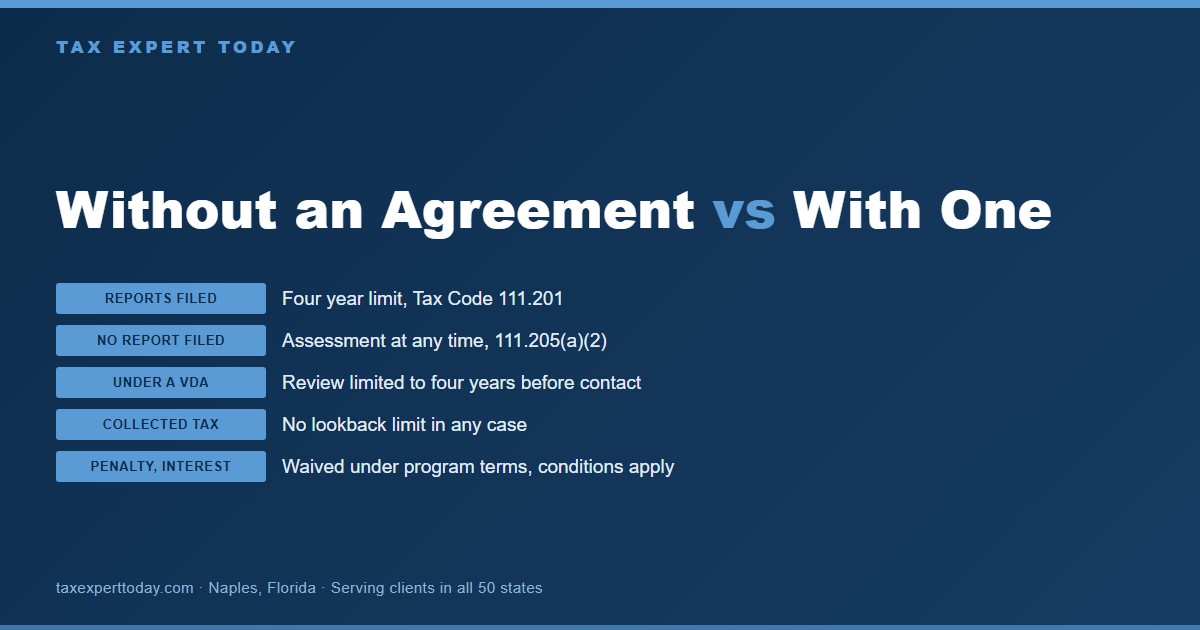
That is the comparison a business needs to see before it decides. Without an agreement, the exposure for a nonfiler reaches back to the date the obligation first arose, which may be the date the business first had a Texas employee, a Texas warehouse, an inventory position in a Texas fulfillment center, or Texas revenue above the economic nexus threshold. With an agreement, the Comptroller limits its review to reports due in the four years before first contact. The longer the business has had the obligation, the larger the difference.
| Situation | How far back the Comptroller can assess | Authority |
|---|---|---|
| Reports filed, no fraud, no gross error | Four years from the date the tax became due and payable | Tax Code Section 111.201 |
| No report filed for the tax | No limitation; assessment at any time | Tax Code Section 111.205(a)(2) |
| False or fraudulent report filed with intent to evade | No limitation; assessment at any time | Tax Code Section 111.205(a)(1) |
| Report containing a gross error | No limitation; assessment at any time | Tax Code Section 111.205(a)(3) |
| Limitation period extended by written agreement | To the agreed date, in extensions of no more than 24 months each | Tax Code Section 111.203 |
| Reports covered by a voluntary disclosure agreement | Review limited to reports due in the four years before first contact | Comptroller Publication 96-576 |
| Tax collected from customers and not remitted, with or without an agreement | No lookback limit under the program | Comptroller Publication 96-576; Tax Code Section 111.016 |
The limitation period also stops running in certain circumstances. Section 111.207 provides that the periods during which a judicial proceeding is pending to determine the tax, during which an administrative redetermination or refund hearing is pending, and during which certain felony indictments are pending are not counted. Section 111.203 allows the Comptroller and a taxpayer to extend the limitation period by written agreement, in extensions of no more than 24 months each, which is common during audits. None of those rules helps a nonfiler, because for a nonfiler there is no running limitation period to extend or suspend.
How Does the Comparison Work on a Real Timeline?
On a timeline, the comparison counts report periods rather than dollars. A monthly sales tax obligation that began eight years before first contact leaves about 96 unfiled reports open to assessment without an agreement. Under a voluntary disclosure agreement, the Comptroller limits its review to the roughly 48 reports due in the last four years.
- Find the start date. The date the Texas obligation first arose controls the exposure without an agreement.
- Count the open reports. Every unfiled report since that date is open under Section 111.205.
- Count the agreement window. Reports due in the four years before first contact.
- Add collected tax separately. Any tax collected from customers is owed in full regardless of the window.
The following illustration is hypothetical. It is not based on any client, and it is not a prediction of what the Comptroller would assess or agree to in any particular case. It shows how the two rules interact for a business with a long running obligation, measured in report periods so that the mechanism is visible without implying any particular outcome.
Assume an out of state distributor first stored inventory in a Texas third party warehouse in January 2018. Physical presence through inventory gave it a Texas sales tax collection obligation from that month. It never registered, never collected Texas tax from its Texas customers, and never filed. In November 2026, after its new chief financial officer identifies the issue, it submits an anonymous initial request to BART through a representative. Assume it would have been a monthly filer throughout.
| Measure | Without an agreement | With a voluntary disclosure agreement |
|---|---|---|
| Earliest report open to assessment | The report for January 2018, due February 20, 2018 | The earliest report due within four years before the November 2026 first contact |
| Approximate number of monthly reports in scope | About 106 (January 2018 through October 2026) | About 48 |
| Legal basis for the reach | Tax Code Section 111.205(a)(2), no report filed | Comptroller Publication 96-576, four year review limit |
| Statutory penalties under Section 111.061 | Apply to each late report under the statute | Waived under the program terms, if the conditions are met |
| Interest under Section 111.060 | Applies from 60 days after each due date | Waived under the program terms, except on tax collected and not remitted |
| Tax collected from customers and not remitted | None in this illustration | None in this illustration; if any existed it would be owed in full, with interest |
| Who decides the outcome | The Comptroller, through an audit and assessment | The terms of a signed agreement, subject to the program’s conditions |
The illustration makes a narrow point. The disclosure route does not reduce the tax due for the periods inside the window; the business still pays all of that tax. What changes is the number of periods in scope and the treatment of penalties and interest on them. Whether that difference is material for a particular business depends on how long the obligation has existed, how much taxable activity occurred, and whether the business can recover any of the tax from its customers, all of which require an actual exposure calculation before any decision is made.
The same structure applies to franchise tax, with annual reports instead of monthly ones. A business that has owed Texas franchise tax since report year 2017 and never filed has every one of those annual reports open under Section 111.205(a)(2). A voluntary disclosure agreement would limit the Comptroller’s review to the reports due in the four years before first contact.
What Relief Does the Program Provide, and What Are the Conditions?
Publication 96-576 states that statutory penalties and interest are waived for disclosed tax, except interest on tax collected and not remitted. The relief is conditional: the Comptroller may deny the waiver or void the agreement if program policies are not followed, and similar errors found in a prior audit can bar the agreement.
- Penalties. The 5 percent and additional 5 percent late penalties in Section 111.061 are the statutory penalties at issue.
- Interest. Interest under Section 111.060 is waived under the program terms, except on collected and unremitted tax.
- The tax itself. The tax for the periods in the window is due in full.
- Conditions. Program compliance, timely payment, good faith, and no history of similar errors in a prior audit.
It helps to be precise about what is and is not relieved. The tax is not reduced. A voluntary disclosure agreement requires the business to report and pay all of the tax due for the periods covered. What the program addresses is the cost added on top of the tax.
The penalties come from Section 111.061. Except as otherwise provided, a penalty of 5 percent of the tax due is imposed on a person who fails to pay a tax or file a report when due, and if the person fails to file or pay within 30 days after the due date, an additional 5 percent penalty is imposed. Section 111.061(b) imposes an additional penalty of 50 percent of the tax due where the failure to pay or file was the result of fraud or an intent to evade the tax, or where the taxpayer alters, destroys or conceals records for the purpose of affecting an audit or other proceeding. The interest comes from Section 111.060, which sets the rate on delinquent taxes at the prime rate plus one percent, as published in The Wall Street Journal on the first business day of each calendar year, for report periods originally due after December 31, 1999, and provides that delinquent taxes draw interest beginning 60 days after the date due, with certain exceptions.
Publication 96-576 states that statutory penalties and interest will be waived, except interest on taxes collected and not remitted. The Fast-Track agreement form states the same rule in contract language: once the disclosed taxes are paid in full with the agreement, the Comptroller will waive both penalties and interest unless a previous Comptroller audit or investigation reflects a history of similar omissions or errors by the taxpayer in reporting or remitting taxes, no waiver will be granted on tax due related to similar omissions or errors, and interest will not be waived for taxes collected but not previously remitted.
Three conditions qualify that relief, and each one is stated by the Comptroller rather than inferred.
Program compliance. Publication 96-576 states that the Comptroller’s office reserves the right to deny the waiver of penalty or interest, or to void the agreement entirely, if the business does not adhere to program policies and procedures. The most common way to lose the benefit is to miss the deadline for submitting the tax data and payment, which the publication states is 60 days after the agreement is signed by both parties, as specified in the agreement.
No history of similar errors. A business that was audited before and is now disclosing the same kind of error is not in the position the program is designed for. The Fast-Track terms state that an agreement will not be granted in that case and that BART will research the amount of penalty and interest waiver, if any.
Policy may change. The publication states that the Comptroller may change voluntary disclosure policies and procedures at any time. A business should rely on the current publication and the terms of the agreement it actually signs, not on a description of the program from a prior year or from another state.
None of this means relief is uncertain for a business that qualifies and follows the process. It means the relief is a product of the agreement’s terms, and those terms have to be met.
What Happens to Tax That Was Collected but Never Remitted?
Tax collected from customers and not remitted is treated differently under every part of the program. Section 111.016 says the collector holds it in trust for the state. Publication 96-576 places no lookback limit on it, the interest on it is not waived, and the agreement’s release does not cover it. All of it must be reported and paid, however old.
- Trust funds. Collected tax belongs to the state from the moment it is collected.
- No lookback limit. It is owed for every period, not just the last four years.
- Interest not waived. Interest on collected and unremitted tax is excluded from the relief.
- Must be disclosed. The request letter must state whether the company has or has not collected but not remitted any Texas tax.
Section 111.016(a) provides that any person who receives or collects a tax, or any money represented to be a tax, from another person holds the amount so collected in trust for the benefit of the state and is liable to the state for the full amount collected plus any accrued penalties and interest on the amount collected. Section 111.016(a-1) adds a presumption: a person who files, or causes to be filed, a return showing tax due is presumed to have collected that tax, although the presumption can be rebutted with documentation that the tax on a transaction was not collected.
The program follows that trust principle at every step. Publication 96-576 states that there is no limit on the lookback period for taxes collected and not remitted. The Fast-Track agreement requires the taxpayer to report and remit all sales or use taxes collected before the four year lookback that have not been reported and paid, excludes interest on that tax from the waiver, and states that the release does not apply to tax previously collected but not remitted.
For most disclosure candidates this provision does not apply, because the typical case is a business that never collected Texas tax at all. It applies with force in two situations. The first is a business that charged Texas tax on its invoices but never registered or never filed, often because its billing system applied tax automatically by ship to address. The second is a business that collected and reported tax for some periods and then stopped filing while continuing to collect. In both cases the collected amounts sit outside the four year window and must be quantified separately.
The trust fund character of collected tax also connects to personal exposure. Section 111.0611 makes an officer, manager, director or certain partners personally liable for taxes, penalty and interest if the individual took an action or participated in a fraudulent scheme or plan to evade the payment of taxes, and it lists intentionally failing to file a required return as one of the actions that may indicate such a scheme. Whether particular facts rise to that level is a legal question for counsel. The relevant point for this guide is that a voluntary disclosure undertaken in good faith before contact is a different posture from waiting for an audit to find collected tax that was kept. Personal liability that arises when a business entity forfeits its privileges is a separate subject, covered in our guide to closing a business in Texas.
How Does the Traditional Voluntary Disclosure Process Work, Step by Step?
A representative submits a written request to BART by email or mail, without naming the business if preferred. A BART examiner reviews eligibility and, after preliminary approval, prepares the agreement. The business signs and is identified, the Audit Division director countersigns, and the tax data and payment are due within 60 days.
- Step 1. Written request to BART at VDA@cpa.texas.gov or by mail.
- Step 2. BART examiner reviews the submission and grants preliminary approval.
- Step 3. BART prepares the agreement and sends it to the representative.
- Step 4. The business signs and returns it, disclosing its name; BART completes review and the director signs.
- Step 5. The executed agreement arrives with reporting forms; data and payment are due within 60 days.
Publication 96-576 calls this the traditional voluntary disclosure agreement and describes the sequence in detail. A company representative initiates the process by contacting BART in writing. It is not necessary to name the company or client during the initial contact, although the publication notes there is no harm to the client if it is disclosed at the beginning, and that identifying the business as part of the initial contact, while purely voluntary, streamlines the process further.
The written request is submitted by email to VDA@cpa.texas.gov or by mail to the Texas Comptroller of Public Accounts, Business Activity Research Team, P.O. Box 13003, Austin, Texas 78711-3003. Assuming the initial contact was made without naming the business, an examiner with BART reviews the submission. Once preliminary approval is obtained, BART prepares an agreement and sends it to the company representative.
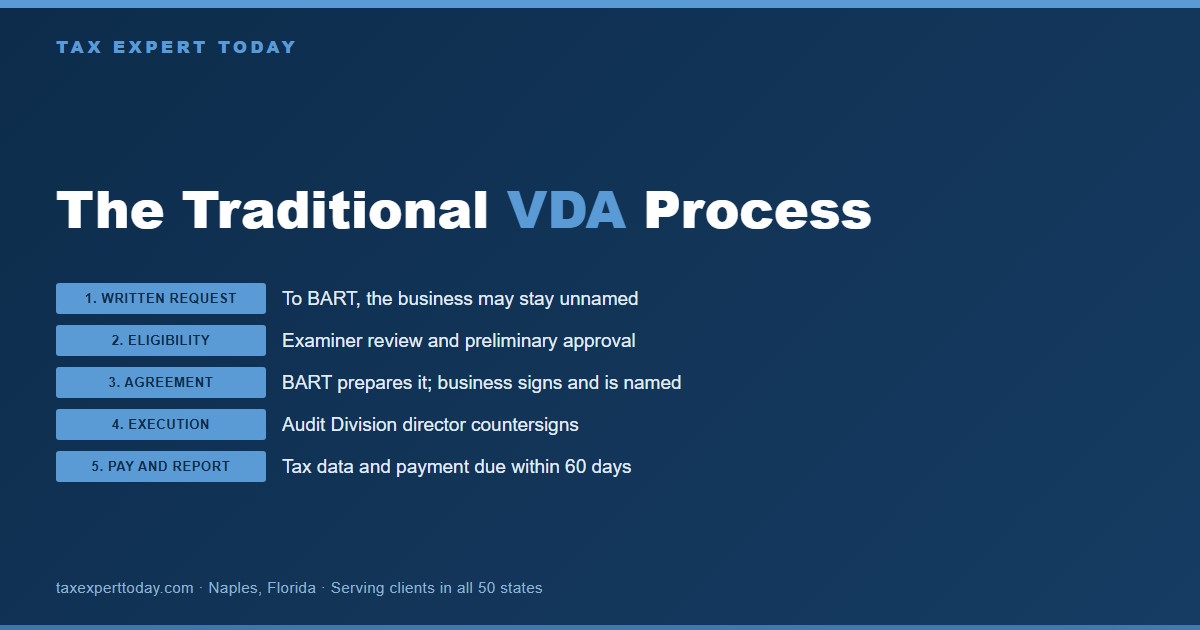
Once the signed agreement is returned and the taxpayer name has been disclosed, BART completes the review process and obtains the signature of the Audit Division director. After the agreement is signed by both parties, BART sends the executed agreement with the applicable reporting forms. The tax data and payment of the voluntarily disclosed taxes are due within 60 days, as specified in the agreement.
The sequence has a practical consequence for planning. The business does not need a final number to start. It needs an estimate, which the request must include, and enough facts to describe its activities and dates. The final reports and payment are due after the agreement is executed, so the detailed work of preparing period by period returns or a jurisdiction by jurisdiction worksheet can continue while BART reviews eligibility. What the business cannot do is let the 60 day deadline pass, because a missed deadline is a failure to adhere to program procedures and puts the relief at risk.
| Stage | Who acts | What happens | What the business should have ready |
|---|---|---|---|
| Initial written request | Representative | Request sent to BART by email or mail, with or without the business name | Facts, dates, tax types, contact status, collected tax status and an estimate |
| Eligibility review | BART examiner | Submission reviewed; preliminary approval if eligible | Answers to follow up questions; continued exposure work |
| Agreement prepared | BART | Draft agreement sent to the representative | Review of every term before signing |
| Signature and identification | Business | Signed agreement returned; business name disclosed | An authorized signer and accurate identifying information |
| Countersignature | Audit Division director | Review completed and agreement executed | Final reports in preparation |
| Reporting and payment | Business | Tax data and payment submitted on the forms provided | Completed reports and funds, within 60 days |
| Going forward | Business | Correct reporting begins with the ending date of the agreement | Registration, systems and filing calendar in place |
What Must the Initial Written Request Contain?
The initial request must state the entity type, a description of the business and its Texas activities, the dates it began business at home and in Texas, the tax types requested, existing Texas accounts, whether the Comptroller has made contact, whether tax was collected and not remitted, any payment agreement request, and an estimate of the amount owed.
- Identity facts without the name. Entity type and business description can be given anonymously.
- Dates that set exposure. When business began in the home state and in Texas.
- Two required statements. Whether the business was contacted, and whether it collected tax it did not remit.
- A number. An estimate of the amount owed.
Publication 96-576 lists the required information. The list is short, but each item has a purpose, and the way each one is answered can affect eligibility, the scope of the agreement or the speed of the review.
| Required item | Why the Comptroller asks | Practical point |
|---|---|---|
| Entity type (corporation, partnership and so on) | Determines which taxes apply, including franchise tax | State the entity type for each entity if more than one is involved |
| Brief description of the business and its Texas activities | Shows the basis for the Texas obligation | Describe the activity that created nexus accurately; it frames the review |
| Date business began in the home state and date Texas activities began | Shows how long the obligation has existed | The Texas start date drives the exposure without an agreement |
| Tax types for which an agreement is requested | Defines the scope of the agreement | List every tax type the business wants covered |
| Taxes already set up in Texas, and the taxpayer number | Distinguishes registered accounts from the disclosed taxes | An existing permit for one tax does not by itself foreclose a disclosure for another |
| Statement of whether the Comptroller has contacted the company about each tax type | Eligibility | Describe any letter accurately; let BART decide if it is contact |
| Statement of whether the company has collected but not remitted any Texas tax | Collected tax has no lookback limit and no interest waiver | Quantify collected amounts separately and completely |
| Request for a payment agreement, if desired | Allows the Comptroller to consider installment terms | Include a statement that the business anticipates problems with full payment |
| Estimate of the amount owed | Gives the examiner a sense of scale | A reasoned estimate is expected; the final figure comes later |
| Additional supporting information | Context for unusual facts | Explain any complicating factor at the start rather than after signing |
The description of Texas activities deserves care. The examiner uses it to understand which taxes apply and from when. A description that understates the activity, for example by omitting Texas employees while describing only Texas sales, risks an agreement that does not match the facts, and the Fast-Track terms make clear that the Comptroller relies on the accuracy and truthfulness of the taxpayer’s factual representations. An agreement built on an incomplete description protects less than the business may think, because the release applies only to taxes and issues disclosed under the agreement.
What Is the Fast-Track Voluntary Disclosure Agreement?
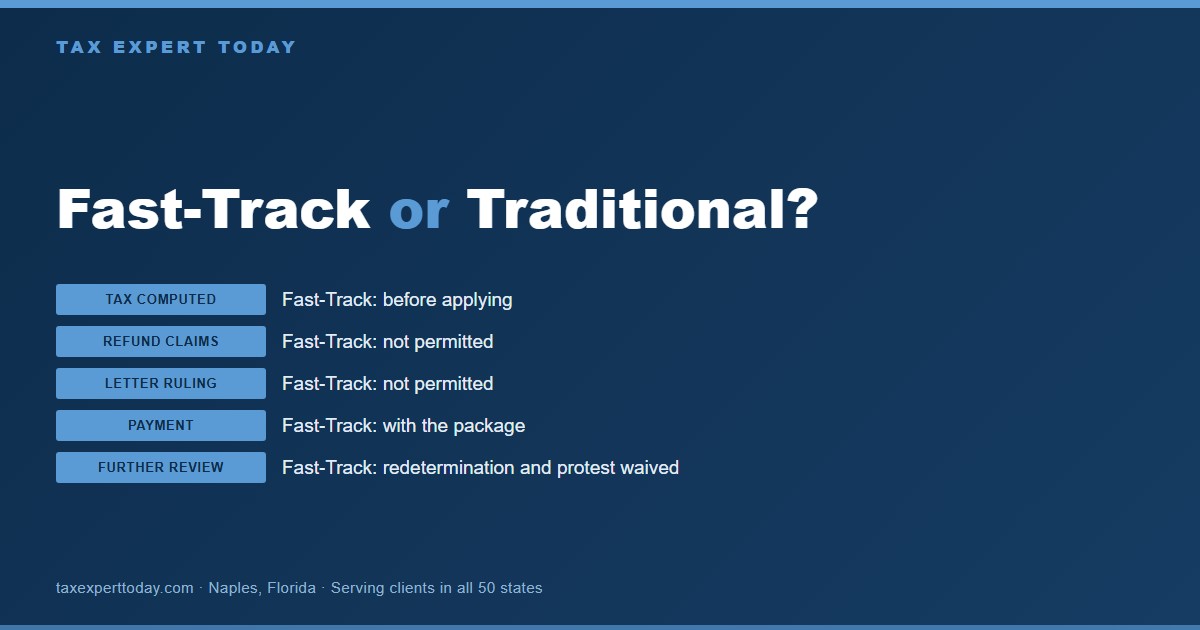
The Fast-Track voluntary disclosure agreement is an expedited route for a business that meets all the regular criteria and has already calculated the tax due. It cannot include refund claims or a letter ruling request. The business submits a signed agreement, application, worksheet or returns, and payment together, and the Comptroller processes them quickly without reviewing for additional tax.
- Same eligibility. All current voluntary disclosure criteria must be met.
- Tax computed up front. The business calculates the amount due before applying.
- No refunds, no rulings. Refund claims, letters of assignment and letter ruling requests are excluded.
- Payment with the paperwork. The disclosed taxes are paid in full with the agreement.
Publication 96-576 describes the Fast-Track route as follows. To qualify, a taxpayer must meet all the current criteria for a voluntary disclosure agreement and must have calculated the tax amount due up front. The agreement cannot include any refund claims, including letters of assignment, and may not ask for a letter ruling from Tax Administration. For sales and use tax, the taxpayer completes a spreadsheet with a breakdown of state and local taxes by report period; for other taxes, the taxpayer submits returns. If all criteria are met, the Comptroller proceeds with the Fast-Track agreement for the unpaid or underpaid tax and processes the reports and payment quickly, without review for additional taxes the business may owe.
The submission package consists of a completed and signed agreement, the Fast-Track application, the spreadsheet showing sales tax owed, a sales and use tax permit application if applicable, and payment, sent to BART by email or mail. Once the reports are processed, the taxpayer receives the signed agreement and a statement of account.
The Fast-Track agreement form contains terms worth reading closely before choosing it. It provides that the agreement may not be modified, that its terms are binding and final, and that by signing, the taxpayer acknowledges it is not entitled to any additional administrative review, redetermination or refund hearing involving the tax, penalty or interest in question, and may not file a protest payment under Tax Code Section 112.051. It also provides that execution of the agreement does not constitute acceptance by the Comptroller of the methodology used to determine the taxes remitted, that the taxpayer must keep records of the methodology, and that all periods included are subject to audit as allowed by the statute of limitations. Venue for any suit arising from the agreement is exclusively in the district courts of Travis County, and Texas law governs.
The sample worksheet the Comptroller publishes shows the level of detail expected for sales and use tax. Each line carries a date or month, a location, the invoice amount, the taxable amount, a description, whether state tax applies, and the city, county, transit authority and special purpose district codes for the jurisdiction. The Comptroller asks that worksheets be submitted electronically and points to its local jurisdiction code file for the codes.
Traditional or Fast-Track: Which Path Fits?
The Fast-Track route fits a business with a single, well defined error, complete records and a finished calculation, that does not need refunds or a ruling and is comfortable waiving further review. The traditional route fits a business with uncertain facts, several tax types, offsetting overpayments, a payment agreement need or open legal questions.
- Certainty of numbers. Fast-Track assumes the calculation is done and correct.
- Offsets. A business with overpayments to claim needs the traditional route.
- Legal questions. A taxability question that needs a ruling belongs on the traditional route.
- Finality. Fast-Track waives redetermination, refund hearings and protest payment for the items in question.
| Feature | Traditional VDA | Fast-Track VDA |
|---|---|---|
| Eligibility criteria | Standard program criteria | Standard program criteria, plus tax calculated up front |
| Anonymous initial contact | Yes, through a representative | Package submitted with the signed agreement and application |
| Calculation of tax | Estimate with the request; final reports after execution | Completed before submission |
| Refund claims and letters of assignment | Can be raised in the process | Not permitted |
| Letter ruling request | Can be pursued separately | Not permitted |
| Payment | Due within 60 days after execution, unless a payment agreement is arranged | Submitted with the package |
| Review for additional tax | BART completes its review | Processed without review for additional taxes the business may owe |
| Further administrative review of the items | Depends on the agreement terms | Waived, including redetermination, refund hearing and protest payment under Section 112.051 |
| Future audit of included periods | Periods remain open to audit within the statute of limitations | Periods remain subject to audit as allowed by the statute of limitations |
The Fast-Track route is attractive for its speed, and for a business whose problem is narrow, for example one taxable service line that was never taxed, with clean invoice data, it can be the efficient answer. The trade is finality. A business that pays on a Fast-Track agreement and later discovers that part of what it paid was not actually taxable has, by the terms of the form, given up the administrative routes for revisiting it. A business that is not sure whether every item in its calculation is taxable should consider whether the traditional route, or a ruling first, is the better course. Our guide to Texas taxable services covers the taxability questions that most often turn up in this kind of calculation.
Can a Business Stay Anonymous During a Texas Voluntary Disclosure?
Yes, during the early stage of a traditional agreement. A company representative can make the initial written contact without naming the business, and BART can review eligibility and grant preliminary approval on the facts described. The business is identified when it signs and returns the agreement, after which BART completes its review.
- Representative required for anonymity. The publication describes a company representative initiating the contact.
- Preliminary approval first. BART reviews eligibility before the name is disclosed.
- Identification at signature. The business is named when it returns the signed agreement.
- Optional. Naming the business at the start is permitted and streamlines the process.
Anonymity serves a specific purpose. It lets the business test eligibility and learn the terms before it reveals itself. If BART concludes that the business is not eligible, for example because a prior letter counts as contact, the business has not identified itself through the request. Publication 96-576 is explicit that the initial contact need not name the company or client, and equally explicit that identifying the business is purely voluntary and makes the process faster. The choice depends on how confident the business is about its eligibility. Where the facts are clean, naming the business at the outset may be the more efficient route.
Anonymity is also the reason the representative’s role matters. The representative must describe the business accurately enough for BART to evaluate eligibility, without identifying it. Authority to act for the business before the Comptroller is documented through the Comptroller’s power of attorney forms, which becomes relevant once the business is named and the representative communicates on its behalf about its specific account.
The Fast-Track agreement form also contains a confidentiality provision. It states that taxpayer information disclosed to the Comptroller in or under the agreement will be kept confidential by the Comptroller to the greatest extent permitted by law.
Can the Disclosed Tax Be Paid Over Time?
Possibly. The initial written request can include a request for a payment agreement, together with a statement that the business anticipates problems paying the disclosed taxes in full. Whether installment terms are granted is a matter for the Comptroller. Without a payment agreement, the tax is due within 60 days of execution, and Fast-Track payment is due with the package.
- Ask at the start. The request for a payment agreement belongs in the initial letter.
- Explain the need. The request should state that the business anticipates problems with full payment.
- Fast-Track is pay in full. The Fast-Track terms require the disclosed taxes to be paid in full with the agreement.
- No promise. The publication lists the request as an option, not an entitlement.
Publication 96-576 includes, in its list of required information, a request for a payment agreement, if desired, and a statement that the business anticipates problems regarding full payment of the disclosed taxes. That is the only route the publication describes for paying over time, and it must be raised at the beginning. A business that signs an agreement calling for payment within 60 days and then cannot pay is in a far weaker position than one that disclosed its cash constraints at the outset.
A business weighing whether it can afford a disclosure should compare the cash required under an agreement with the cash that an audit assessment would require, including penalties and interest for every open period. Where the obligation extends well beyond four years, the disclosure route limits the periods in scope, but it requires its cash on a defined schedule, which is why the payment question deserves attention before the request is sent.
How Does a Sales Tax Voluntary Disclosure Differ From a Franchise Tax One?
A sales tax disclosure is built transaction by transaction and jurisdiction by jurisdiction, and the business can often reduce it with resale and exemption certificates or proof that customers paid use tax. A franchise tax disclosure is built report year by report year, and a combined group or separate reporting entity needs its own agreement.
- Sales tax. Local allocation, certificates and customer payments drive the number.
- Use tax. Untaxed purchases the business consumed are part of the same disclosure.
- Franchise tax. Annual reports, margin computations and reporting entity rules.
- Federal link. Franchise returns filed because of an IRS audit are a rescission ground on the Fast-Track form.
Sales and use tax. The starting point of a sales tax exposure is every Texas sale of a taxable item since the obligation began. That figure is rarely the final number, because Texas law provides several ways to show that a sale was not taxable or that the tax was already paid. Under Section 151.054, gross receipts are presumed taxable unless a properly completed resale or exemption certificate is accepted, but a business can often obtain certificates from customers who bought for resale or who were exempt. The rules on what a valid certificate requires, and the timing rules that apply when the Comptroller asks for certificates, are explained in our guides to the Texas resale certificate and the Texas sales tax exemption certificate. A business can also ask customers whether they accrued and paid use tax on their purchases, since tax on a transaction is due only once. Each of these steps takes time, and the anonymous initial request allows the business to fix its lookback date while that work continues.
A sales tax disclosure is not only about sales. A business that never registered also never accrued use tax on the taxable items it bought from out of state vendors for its own use: equipment, software, supplies and furniture. How that obligation works is explained in our guide to Texas use tax. Those purchases are part of the same exposure, and a complete disclosure includes them. Use tax on the business’s own purchases is a frequent finding in Texas sales tax audits, as our Texas Comptroller audit guide explains, which makes it an obvious item to include rather than leave for an examiner.
Franchise tax. A franchise tax disclosure works on annual reports. For each report year in the window, the business computes its total revenue and, where tax is due, its taxable margin under one of the permitted methods. The Fast-Track agreement form adds two structural points. It states that franchise tax reports that must be filed under a separate related reporting entity are not part of the agreement and that a separate agreement is needed for the reporting entity. And it states that if a combined franchise tax report is submitted under the agreement, the term taxpayer in the rescission section refers to the reporting entity and each of the affiliates reported in the combined report, so a disqualifying fact about any affiliate can affect the whole agreement.
The franchise tax computation itself, including the no tax due threshold and the margin methods, is covered in our Texas franchise tax guide and is not repeated here. Two points are specific to disclosures. First, report years that would show no tax due do not belong in a voluntary disclosure agreement, as explained earlier. Second, the Fast-Track form lists as a rescission ground the situation where the taxpayer submitted franchise tax returns as a result of an IRS audit. A federal examination that changes revenue or deductions can change Texas margin, and the Comptroller does not treat franchise tax returns prompted by an IRS audit as voluntary.
| Feature | Sales and use tax disclosure | Franchise tax disclosure |
|---|---|---|
| Unit of measurement | Monthly, quarterly or annual report periods | Annual reports |
| Fast-Track format | Spreadsheet by report period with state and local breakdown | Returns |
| Common ways to reduce the figure | Resale and exemption certificates; proof customers paid use tax; nontaxable items | Correct margin method; revenue exclusions; reports below the no tax due threshold |
| Collected tax issue | Often present; no lookback limit and no interest waiver | Not applicable; franchise tax is not collected from customers |
| Related entities | Each permit holder | Separate agreement for a separate reporting entity; combined group affiliates treated together |
| Federal interaction | Limited | Returns filed because of an IRS audit are a rescission ground |
| Local allocation | Required by jurisdiction code | Not applicable |
How Should a Business Measure Its Exposure Before Contacting the Comptroller?
A business should establish the date its Texas obligation began, identify every taxable activity and tax type, quantify any tax collected and not remitted, estimate the tax for the four year window and for the full open period, and identify certificates and customer payments that reduce it. That analysis drives both the decision and the required estimate.
- Start date. When physical presence or economic nexus first arose.
- Scope. Every tax type, including use tax and franchise tax.
- Collected tax. Any amount charged to customers as tax.
- Two estimates. The four year window and the full open period, for comparison.
An exposure analysis serves two purposes. It tells the business whether a disclosure is worth pursuing, and it produces the estimate the initial request must contain. A reasonable sequence follows.
Fix the start date. Identify when the Texas obligation first arose. For sales tax, that may be the first Texas employee, office, inventory or other physical presence, or the date Texas revenue first exceeded the economic nexus threshold explained in our Texas sales tax nexus guide. For franchise tax, it is the date the entity first had Texas nexus under the franchise tax rules. Businesses that moved operations into the state should also review the registration steps in our guide to moving a business to Texas.
Map the activity. List every type of Texas activity and the tax each one triggers. A company selling equipment may also provide taxable repair services, and a software company may sell a product that Texas treats as a taxable data processing service at a reduced base. Our guide to Texas taxable services covers those categories.
Find collected tax. Search invoice data for any line labelled as Texas tax. That amount stands outside the four year window and must be quantified completely.
Estimate both ways. Compute the estimated tax for the reports in the four year window, and separately for every open period back to the start date. The comparison between the two, together with the penalty and interest that would apply to the full period, is the decision. Without the second figure, a business cannot see what the agreement is worth.
Identify reductions. Determine which customers bought for resale or were exempt, which may have paid use tax directly, and which sales were not taxable at all. Decide whether to pursue certificates before or after the initial request.
Prepare the data in the Comptroller’s format. For sales tax, organize the data by report period and jurisdiction code, matching the Comptroller’s worksheet. Doing this early shortens the 60 day period after execution.
Preserve the methodology. The Fast-Track terms require the taxpayer to keep records, including the methodology used, and state that the Comptroller does not accept the methodology by signing. Whatever sampling or estimation is used should be documented as if it will be examined.
What Obligations Continue After the Agreement Is Signed?
After the agreement, the business must pay on time, register for and correctly report the disclosed taxes going forward beginning with the ending date of the agreement, keep records of its methodology, and accept that the periods covered remain open to audit within the statute of limitations. Failing to follow program procedures can cost the relief.
- Pay within the deadline. Generally 60 days after execution for a traditional agreement.
- Report correctly going forward. Starting with the ending date of the agreement.
- Keep the records. Including the methodology used to compute the disclosed tax.
- Expect possible review. Included periods remain open to audit within the limitation period.
Publication 96-576 states the continuing obligations plainly. The business must report and pay the tax correctly going forward beginning with the ending date of the agreement. Report periods included in the agreement remain open to future audit, within the statute of limitations. The Fast-Track form states that the taxpayer will begin properly reporting Texas sales or use taxes effective immediately, that it will collect on taxable sales and accrue on taxable purchases at the proper state and local rates, and that it will adjust its rates if state or local rates change.
The point about audit is often misunderstood. A voluntary disclosure agreement limits the Comptroller’s review to the window and, for older periods, provides a release for the taxes and issues disclosed. It does not make the periods inside the window immune from examination. If the Comptroller later audits those periods within the limitation period and finds that the disclosed figures were understated, the agreement does not prevent an assessment of the difference, and a material understatement may raise questions about whether the agreement was entered into in good faith.
The practical lesson is that the systems that failed before the disclosure need to be fixed at the same time. A business that discloses four years of untaxed sales and then continues to bill without tax because its invoicing system was never reconfigured has created a new exposure, without the program’s protection, starting the day after the agreement ends.
Is Voluntary Disclosure the Right Choice for Every Business?
No. A voluntary disclosure agreement is generally worth evaluating when the obligation predates the four year window, when penalties and interest would be material, or when a sale, financing or audit risk makes certainty valuable. It is not available, or adds little, when no tax is due, when the Comptroller has already made contact, or when the exposure is recent and small.
- Strong candidates. Long running unfiled obligations, multistate sellers, businesses preparing for a sale.
- Weak candidates. Reports showing no tax due; obligations that began within the last year or two.
- Not eligible. Businesses already contacted, under audit or investigation, or with similar prior audit errors.
- Different tool. After contact, penalty relief turns on reasonable diligence under Section 111.103.
The decision is a comparison, and the comparison has more than one dimension. The most obvious is the number of periods in scope with and without an agreement. A business whose Texas obligation began only 18 months ago gains little from a four year lookback, since every open period already falls inside it, although it may still value the penalty and interest relief and the certainty of an agreement. A business whose obligation began eight years ago is in a very different position.
Certainty has its own value. A business preparing for a sale will face buyer due diligence, and an unfiled Texas obligation can surface as a price reduction, an escrow holdback or an indemnity demand. A signed and performed agreement is a document a buyer can evaluate. The same is true for lenders and auditors reviewing financial statements that need to reflect an uncertain tax liability. For a seller, the interaction with the transaction is covered in our guide to taxes on selling a business.
Some businesses are better served by other routes. A business with only no tax due franchise reports should simply file them. A business that owes a small amount for a short period may find that filing the missing returns and requesting penalty relief is proportionate. Section 111.103 gives the Comptroller authority to grant relief from penalty or interest where the taxpayer exercised reasonable diligence to comply, which is a different standard from the voluntary disclosure program and is decided on the facts of each case.
Federal parallels exist but are not the same. A business that also has unfiled federal returns or federal penalty questions is dealing with a separate system, with its own procedures for unfiled tax returns and reasonable cause penalty relief. The Texas program is a state program administered by the Comptroller and does not affect federal obligations.
What If the Comptroller Has Already Made Contact?
Once the Comptroller has contacted the business about the liability, or notified it of an audit, the voluntary disclosure program is generally no longer available for that tax. The business still has options: responding accurately, working through the audit process, requesting penalty relief based on reasonable diligence, and asking about payment arrangements.
- Do not ignore the letter. A nonresponse does not stop the assessment process.
- Confirm the scope. Determine which tax types the contact concerns.
- Prepare for the audit. Records, certificates and the methodology the examiner will use.
- Ask about relief. Penalty and interest relief can still be requested on the facts.
Contact changes the business’s position, but it does not leave it without choices. The first step is to read the contact carefully and determine which tax types it concerns, because eligibility is evaluated tax type by tax type. A letter about franchise tax does not necessarily foreclose a disclosure request for an unrelated tax, and the request letter itself must state the contact status for each tax type. The second step is to respond accurately and on time. The third is to prepare for the examination, which follows the process described in our Texas Comptroller audit guide, including the sampling methods, the requests for resale and exemption certificates and the review of untaxed purchases.
Penalty relief remains available on the facts. Section 111.103 allows the Comptroller to grant relief from penalty or interest where the taxpayer exercised reasonable diligence, and a business that can document why it did not know of its obligation, or why it reasonably believed it had none, can make that case. The outcome of a request for relief depends on the facts and the Comptroller’s evaluation, and no particular result should be assumed.
How Does the Texas Program Compare With Other States and the Multistate Route?
Each state runs its own voluntary disclosure program with its own lookback, conditions and paperwork, and a Texas agreement covers Texas only. A business with exposure in several states can approach them individually or, as the Comptroller notes, use the Multistate Tax Commission’s National Nexus Program to approach several states at once.
- State by state. A Texas agreement has no effect on another state’s liability.
- Different lookbacks. States set their own review periods and conditions.
- Multistate option. The National Nexus Program coordinates disclosures with participating states.
- Sequence matters. Contact in one state can affect eligibility elsewhere if information is shared.
Publication 96-576 states that multistate businesses who wish to approach several states simultaneously may choose to use the services of the National Nexus Program of the Multistate Tax Commission, even if the business has unreported or underpaid taxes in multiple states. For a remote seller that discovers economic nexus in many states at once, coordinating the disclosures matters, because states do share information and a contact from one state may prompt questions from another.
The Texas terms should not be assumed to match another state’s. Lookback periods, the treatment of interest, the handling of collected tax and the availability of anonymous contact vary from state to state, and some states change their programs from time to time. A business should evaluate each state on that state’s current published terms.
How Is a Texas Voluntary Disclosure Different From Unclaimed Property Disclosure?
They are separate programs with separate rules. The tax program covers unpaid Comptroller taxes, is handled by BART and limits review to four years. The unclaimed property program covers funds a business holds that belong to others, such as uncashed checks and customer credits, is handled by the Unclaimed Property Division and has a 10 year lookback.
- Tax VDA. Unpaid tax; Business Activity Research Team; four year review.
- Unclaimed property VDA. Property owed to others; Holder Reporting Section; 10 year lookback.
- Separate contacts. UP.VDA.requests@cpa.texas.gov for unclaimed property; VDA@cpa.texas.gov for tax.
- Both can apply. A business may have exposure under both programs at once.
The two programs are often confused because both are called voluntary disclosure and both are run by the Comptroller. Publication 96-576 describes both. Unclaimed property holders who meet the criteria may enter a voluntary disclosure agreement by contacting the Unclaimed Property Division in writing, at the Holder Reporting Section, P.O. Box 12247, Austin, Texas 78711, or by email to UP.VDA.requests@cpa.texas.gov, and a company representative or authorized employee can initiate the process without naming the company. The lookback period for an unclaimed property agreement is 10 years. Unclaimed property is not a tax, and this guide does not address its substantive rules.
What Are Common Texas Voluntary Disclosure Mistakes?
The most common mistakes are responding to a Comptroller letter before considering eligibility, describing Texas activities incompletely, overlooking tax collected from customers, omitting use tax on the business’s own purchases, choosing Fast-Track before the numbers are final, missing the 60 day deadline, and failing to fix the underlying systems.
- Timing. Waiting until contact makes the program unavailable for that tax.
- Completeness. The release covers only what is disclosed.
- Collected tax. It has no lookback limit and must be quantified fully.
- Follow through. Deadlines and going forward compliance keep the relief.
| Mistake | Why it matters | Better approach |
|---|---|---|
| Returning a Comptroller questionnaire before considering a disclosure | The answers may fix a beginning date and the contact may affect eligibility | Evaluate eligibility and the disclosure route first, then respond accurately |
| Describing only some Texas activities | The release applies only to taxes and issues disclosed | Describe every Texas activity and every tax type it triggers |
| Ignoring tax shown on invoices | Collected tax has no lookback limit and no interest waiver | Search invoice data for any tax line and quantify it separately |
| Leaving out use tax on purchases | Untaxed purchases are a frequent audit finding | Include equipment, software and supplies bought without tax |
| Choosing Fast-Track with uncertain taxability | Fast-Track waives redetermination, refund hearings and protest payment for the items | Use the traditional route or resolve the taxability question first |
| Filing no tax due reports under an agreement | No agreement is executed where no additional tax is due | File those reports directly |
| Missing the 60 day deadline | The Comptroller may deny the waiver or void the agreement | Prepare data during eligibility review; request a payment agreement at the start if needed |
| Leaving billing systems unchanged | Reporting must be correct from the ending date of the agreement | Register, reconfigure systems and calendar filings before the agreement ends |
| Assuming Texas terms apply in other states | Each state sets its own lookback and conditions | Review each state’s current published program |
Texas Voluntary Disclosure Agreement Help in Naples & Southwest Florida
Tax Expert Today LLC advises businesses on state tax matters nationwide from our office in Naples, Florida. Southwest Florida owners reach the Texas voluntary disclosure program more often than they expect. Florida companies that sell into Texas cross the economic nexus threshold as they grow, Naples investors own interests in Texas operating businesses, and owners who moved from Texas to Florida often keep Texas entities whose filings lapsed after the move. In each case, the Texas rules apply to the Texas obligation regardless of where the owner lives.
Our work on a Texas disclosure follows the sequence in this guide. We establish when the obligation began, map the activities and tax types, look for collected tax, prepare the two estimates that frame the decision, identify certificates and customer payments that reduce the figure, and prepare the initial request and the reports in the Comptroller’s format.
- Texas voluntary disclosure help Naples owners can reach in person. Our office is on Tamiami Trail North in Naples, Florida, and we work with clients locally and remotely.
- Texas sales tax VDA Naples FL and nationwide. We serve clients in all 50 states, and the Comptroller’s rules apply the same way wherever the owner lives.
- Exposure analysis before contact. The comparison between the four year window and the full open period comes first.
- Multistate coordination. Where several states are involved, we sequence the approaches so that one does not undermine another.
- Coordinated with your other obligations. Sales and use tax, franchise tax, payroll and federal positions are reviewed together.
Related services include our Texas tax services for businesses with Texas obligations and our Naples tax planning work for Southwest Florida owners.
Tax Expert Today LLC
11983 Tamiami Trail N, Naples, FL 34110
Phone: (239) 441-2005
Hours: Monday through Friday, 10:00 a.m. to 5:00 p.m. ET
Local question we are asked often: A Naples based online retailer has stored inventory in a Texas fulfillment center since 2019 and never registered for Texas sales tax. It recently received a general marketing letter from a software vendor about Texas compliance, but nothing from the Comptroller. Is it still eligible? A letter from a private vendor is not contact from the Comptroller, so on those facts the retailer would generally remain eligible, provided it has not been contacted by the Comptroller about the liability and has not received an audit notice. Because its obligation likely predates the four year window, the comparison between the window and the full open period is worth preparing before it decides, and the request can be submitted anonymously through a representative.
When Should You Engage a Professional?
A business with a single tax type, a short period of exposure, clean data and no collected tax can often understand its position using this guide and the Comptroller’s publication. Professional review becomes worthwhile when the obligation predates the four year window, when more than one tax type or entity is involved, when tax was collected from customers and not remitted, when a Comptroller letter has arrived and its effect on eligibility is unclear, when the business operates in several states, or when a sale or financing makes certainty important. The Texas voluntary disclosure program is a state tax matter administered by the Texas Comptroller, not an IRS matter, and our multidisciplinary team of tax advisors, enrolled agents, CPAs and attorneys advises on state tax matters nationwide. Questions of potential personal or criminal exposure, and contested matters that proceed to a formal hearing or to court, may call for Texas licensed counsel; we coordinate with those professionals where appropriate.
If you would like an exposure analysis, help deciding whether a disclosure fits your situation, or help preparing a request and the supporting reports, contact Tax Expert Today at (239) 441-2005 or visit our Texas tax services page. Businesses dealing with a federal examination at the same time can also review our IRS resolution and audit support services.
Frequently Asked Questions
What is a Texas voluntary disclosure agreement?
It is a written agreement with the Texas Comptroller under which a business that has not been contacted about a liability reports and pays previously unpaid Texas tax. The Comptroller limits its review to reports due in the four years before first contact and provides for relief from statutory penalties and most interest, subject to the program conditions.
How far back does a Texas voluntary disclosure agreement go?
The Comptroller limits its review to reports due in the four years before the business initially contacts the agency. There is no lookback limit for tax collected from customers and not remitted, which must be reported and paid in full for every period.
Does a Texas voluntary disclosure agreement waive penalties and interest?
Comptroller Publication 96-576 states that statutory penalties and interest are waived, except interest on tax collected and not remitted. The relief is conditional. The Comptroller may deny the waiver or void the agreement if program procedures are not followed, and no waiver is granted for errors similar to those found in a prior audit.
Who is eligible for the Texas voluntary disclosure program?
A business with a liability for a tax or fee the Comptroller administers, other than IFTA, that has not been contacted by the Comptroller verbally or in writing about the liability or an estimated liability, and has not received notification of an audit or examination.
Can I apply for a Texas voluntary disclosure agreement anonymously?
Yes, for the initial stage of a traditional agreement. A company representative can contact the Business Activity Research Team in writing without naming the business. The business is identified when it signs and returns the agreement after preliminary approval.
What is the Texas Fast-Track voluntary disclosure agreement?
It is an expedited route for a business that meets the regular criteria and has calculated the tax up front. Refund claims and letter ruling requests are not permitted, payment is submitted with the package, and the form waives further administrative review of the tax, penalty and interest in question.
Why does the voluntary disclosure lookback matter if Texas has a four year statute of limitations?
Because the four year limitation in Tax Code Section 111.201 does not apply when no report was filed. Section 111.205 allows assessment at any time in that case, so a business that never filed has every period open. The agreement limits review to four years.
Can a Naples, Florida business owner use the Texas voluntary disclosure program?
Yes. Eligibility depends on the Texas obligation and the contact history, not on where the owner lives. Tax Expert Today advises on state tax matters nationwide from Naples, Florida, including exposure analysis, the initial request and the supporting reports for Texas disclosures.
Published October 25, 2026 by Dr. Pellumb Kabashi « Back to Learning Center
Have a question this article touches on?
Tax Expert Today LLC, based in Naples, Florida and serving clients across the United States.
Schedule a Consultation (239) 441-2005