
By Dr. Pellumb Kabashi, DBA, MBA, CES, CFE, EA
Founder, Tax Expert Today LLC · Tax advisors, enrolled agents, CPAs, and attorneys · Serving clients in all 50 states
Quick Answer: The Texas hotel occupancy tax is a 6 percent state tax on rooms costing $15 or more per day, and cities and counties layer their own tax on top of it. The state portion goes to the Comptroller. The local portion goes to the city or county, which collects its own. A booking platform that remits the state tax for you does not necessarily remit the local one. Call (239) 441-2005 for a free consultation.
Almost everything published about the Texas hotel occupancy tax is written by the people who collect it. The Comptroller publishes the state rate. Cities publish their own rates and their own remittance addresses. The Texas Municipal League publishes a guide explaining to city administrators how to run the tax. Every one of those documents is accurate, and not one of them is written for the person who actually owes the money.
That matters because the owner of a short-term rental in Texas sits at the intersection of two separate taxes, administered by two separate authorities, filed on two separate schedules, with two different dollar thresholds and two different definitions of what counts as a taxable room. Reading the Comptroller page alone tells you half of your obligation. Reading your city page alone tells you the other half. Nothing tells you that they are different, or that a booking platform can satisfy one while leaving the other entirely with you.
This guide is written from the owner side. It covers what the state tax reaches, what the local tax reaches, where the two diverge, what your booking platform does and does not take off your plate, and how the lodging tax interacts with the federal return you file in April.
What Is the Texas Hotel Occupancy Tax?
The Texas hotel occupancy tax is a transaction tax on short-term lodging, imposed by Tax Code Section 156.051 at a state rate of 6 percent of the price of a room costing $15 or more each day. Cities, counties and certain special purpose districts may impose an additional local hotel tax on top of it. The tax is collected from the guest and remitted by the owner, operator or manager.
- It is a tax on the guest, collected by you. The statute imposes the tax on the person who pays for the right to use the room. Your legal role is collection and remittance, which is why an uncollected tax still becomes your liability.
- It reaches far more than hotels. The Comptroller applies it to bed and breakfasts, condominiums, apartments and houses, not only to traditional hotels and motels.
- Thirty days is the dividing line. A residential property rented to someone who is not a permanent resident, meaning a stay of 29 days or less, is a short-term rental for this purpose under the definition in Section 156.001(b).
- It has nothing to do with your annual property tax. The hotel occupancy tax is a transaction tax on each booking. It is assessed, filed and paid separately from anything the appraisal district sends you.
The Comptroller states the point about homeowners directly. With the volume of sporting and entertainment events around the state, many homeowners rent out their houses or individual rooms to attendees, and persons leasing their houses must collect hotel occupancy tax from their customers in the same way a hotel or motel collects the tax from its guests. There is no casual-host exception. One weekend of renting a house in Austin during a festival creates the same collection duty that a 200 room hotel carries, on a smaller base.
Who Has to Collect Texas Hotel Occupancy Tax?
A hotel owner, operator or manager must collect the state hotel occupancy tax from guests who rent a room or space costing $15 or more each day. For short-term rentals, the duty falls on the property owner unless a booking platform has agreed to collect and remit on the owner’s behalf. Property management companies and online travel companies may also carry collection responsibility.
- Owner, operator or manager. The obligation follows control of the lodging transaction, not title to the building, so a management company running the bookings can be the responsible party. Where the property is held in an entity, that entity carries its own separate obligations under the Texas franchise tax and the rules covered in our guide to Texas LLC taxes.
- Individual homeowners are included. Renting your own house or a single room in it for short stays puts you inside the definition of a hotel for this tax.
- The platform question is a question of agreement. A platform collects the state tax only where it has agreed with owners to do so, and that agreement is a contractual fact you have to verify rather than assume.
- Local duty is a separate determination. Whether anyone collects the local tax for you is decided jurisdiction by jurisdiction, and the Comptroller directs owners to the city and county for that answer.
The Comptroller defines a hotel for state tax purposes as any building in which members of the public rent sleeping accommodations. The Local Hotel Occupancy Tax Overview expands the list to include a hotel, motel, tourist home, tourist house, tourist court, lodging house, inn, rooming house or bed and breakfast, as well as short-term room rentals arranged through platforms. Treehouses and tiny houses are named in the same discussion. The form of the structure is close to irrelevant. What matters is that members of the public are paying for sleeping accommodations on a short-term basis. Note that this is a different tax from Texas sales tax, which has its own permit and its own nexus rules. Owners who also sell goods or services alongside the lodging should read our guides to Texas sales tax nexus and Texas taxable services, because those obligations run in parallel rather than instead of this one.
What Is the Difference Between State and Local Hotel Occupancy Tax?
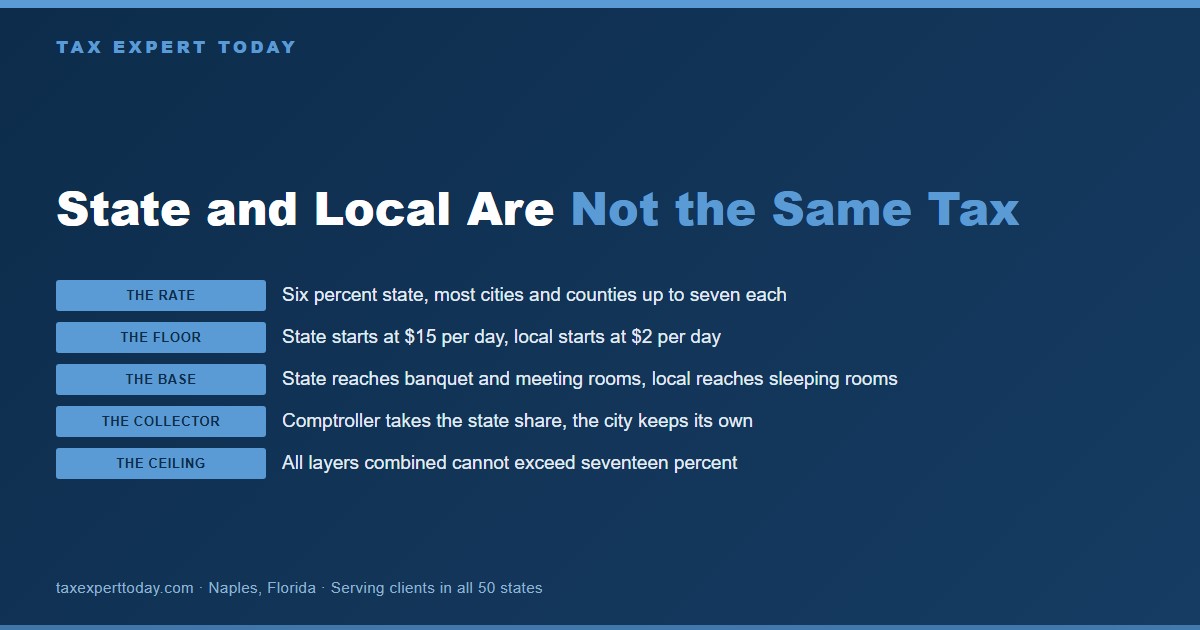
They differ on five points, not one. The state tax is 6 percent and applies to charges of $15 or more per day. Local taxes apply to charges of at least $2 per day. The state tax reaches meeting and banquet rooms while local taxes reach only rooms ordinarily used for sleeping. The Comptroller administers the state tax and each local government collects its own.
- Two different dollar thresholds. A room priced between $2 and $14.99 per day is below the state threshold but above the local one, so the local tax can apply where the state tax does not.
- Two different tax bases. State hotel tax applies to sleeping accommodations, meeting rooms and banquet rooms. Local hotel tax applies only to rooms ordinarily used for sleeping.
- Two different collectors. The state portion goes to the Comptroller. The local portion goes to the city or county entity that levied it.
- Two different exemption outcomes for nonprofits. A qualifying religious, charitable or educational organization is exempt from the state tax and still has to pay the local tax.
- One shared ceiling. The combined rate of state, county, municipal and sports and community venue taxes cannot exceed 17 percent.
| Feature | State hotel occupancy tax | Local hotel occupancy tax |
|---|---|---|
| Rate | 6 percent of the price of the room | Set by the jurisdiction; most cities up to 7 percent, most counties up to 7 percent |
| Governing law | Tex. Tax Code Chapter 156 | Tex. Tax Code Chapter 351 (municipal) and Chapter 352 (county) |
| Price threshold | $15 or more each day | At least $2 each day |
| Rooms covered | Sleeping accommodations, meeting rooms and banquet rooms | Rooms ordinarily used for sleeping only |
| Administered by | Texas Comptroller of Public Accounts | Each city or county that levies the tax |
| Where the money is sent | Comptroller, via Webfile or the paper report | The local taxing entity, on its own form and schedule |
| Nonprofit religious, charitable, educational | Exempt | Not exempt; the organization pays the local tax |
| Federal government employee on official business | Exempt | Exempt |
| Combined ceiling | State, county, municipal and sports and community venue taxes together cannot exceed 17 percent | |
The rate ceilings on the local side are heavily bracketed in the statute, which is a drafting style Texas uses to write rules that apply to specific places without naming them. Section 351.003 sets the general municipal maximum at 7 percent, then carves out higher ceilings: 9 percent for an eligible central municipality, 9 percent for a municipality bordering the Gulf of Mexico with a population over 250,000, and 8.5 percent for an eligible barrier island coastal municipality. Certain cities funding a convention center may collect an additional 2 percent. Texas funds itself this way precisely because it levies no state income tax, which pushes the revenue burden onto transaction taxes like this one. The practical consequence for an owner is that you cannot reason your way to your own local rate from the statute. You have to read the ordinance for the specific city, and the order or resolution for the specific county.
| Municipality type under Section 351.003 | Maximum municipal rate |
|---|---|
| General rule, most Texas municipalities | 7 percent of the price paid for a room |
| Eligible central municipality | 9 percent |
| Municipality bordering the Gulf of Mexico with population over 250,000 | 9 percent |
| Municipality under 5,000 adjacent to a home-rule city under 80,000 | 9 percent |
| Eligible barrier island coastal municipality | 8.5 percent |
| Certain municipalities funding a convention center | An additional 2 percent |
| Most counties under Chapter 352 | Up to 7 percent |
The adoption mechanics differ too. A city may impose the local tax by passing an ordinance. A county may impose it by adopting an order or resolution, but only after the Legislature has added that county into the law. A sports and community venue tax requires voter approval. This is why two neighboring properties can carry materially different combined rates, and why the answer changes when a property sits inside a city limit as opposed to the unincorporated part of the same county.
Does Airbnb or Vrbo Pay Your Texas Hotel Occupancy Tax?
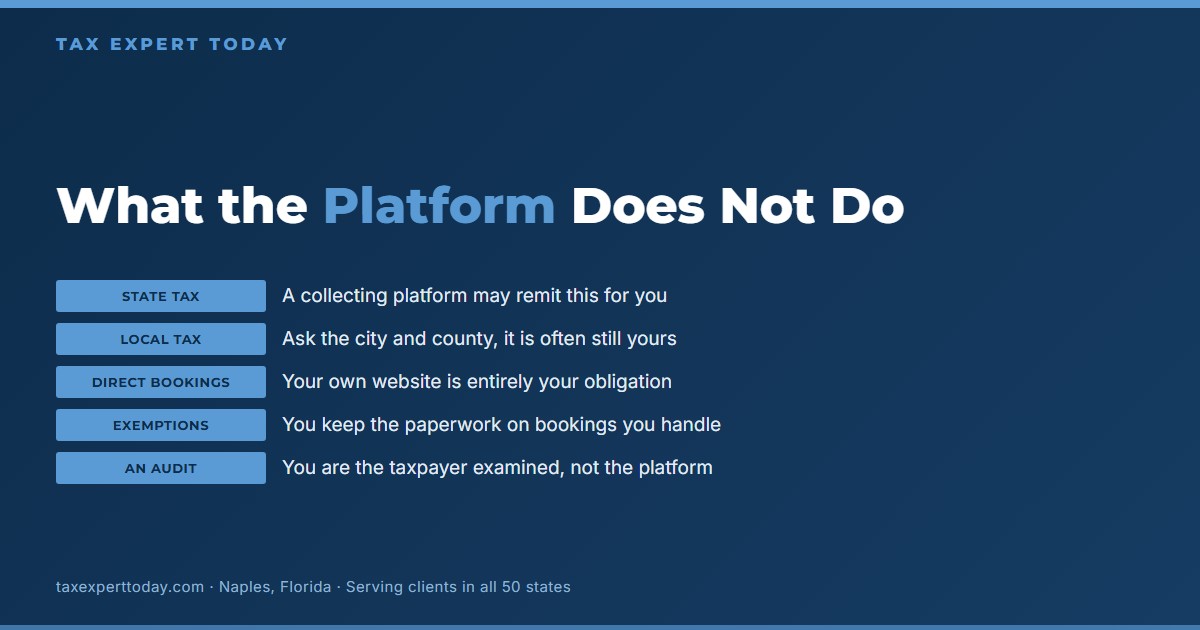
A short-term rental platform that has agreed to collect and remit state hotel occupancy tax on your behalf is required to do so, and in that case you do not collect the state tax yourself. The local tax is a separate matter. The Comptroller directs property owners to contact the county and city where the property sits to find out who handles local hotel tax there.
- The state tax can be fully handled for you. Where you rent only through a collecting platform, you are not required to collect and remit the state portion.
- The local tax frequently is not. The Comptroller’s own instruction is to contact the city and county about collecting and reporting local hotel tax, which is not the answer you would give if the platform always handled it.
- Direct bookings fall back on you entirely. Rentals made through your own website or through a non-collecting platform remain your obligation for the state tax as well.
- A collecting platform files its own paperwork. The platform must complete and submit Form AP-102, the Hotel Occupancy Questionnaire, to the Comptroller.
- Terms change. The Comptroller advises owners to check frequently with both collecting and non-collecting platforms about the terms and the responsibilities of each party, because those terms may change.
This is the single largest gap between what Texas short-term rental owners believe and what the rules actually say. The belief is reasonable. An owner sees a line item for occupancy taxes on the platform payout statement, concludes that lodging tax is handled, and stops thinking about it. The line item is usually real. It is usually the state portion. It does not follow that every local tax on that booking has been paid.
The structural reason is administrative rather than legal. The state tax has one collector for the entire state, which makes a single platform-level agreement workable. Local hotel tax has hundreds of separate collectors, each with its own ordinance, rate, form and filing schedule, and each receiving its own money directly. A platform can reach an arrangement with some of those jurisdictions and not others. Whether yours is covered is a question about your specific city and county, and the only reliable way to answer it is to ask them and to read your current platform terms.
| How the booking was made | Who collects the state tax | Who handles the local tax | Who keeps the records |
|---|---|---|---|
| Through a platform that has agreed to collect and remit | The platform | Confirm with the city and county; often still the owner | The owner, using history obtained from the platform |
| Through a platform that has not agreed to collect | The owner | The owner, per the local jurisdiction | The owner |
| Through the owner’s own website | The owner | The owner, per the local jurisdiction | The owner |
| A mix of collecting platform and direct bookings | Split by channel, and the split has to be documented | The owner, per the local jurisdiction | The owner, with the channels kept separate |
The mixed-channel case is where owners are most exposed. An owner who lists on a collecting platform and also takes direct bookings through a personal website or by referral has a state tax obligation on the direct bookings and none on the platform bookings. Nothing in the platform payout statement flags the direct bookings, because the platform never saw them. Owners in this position should be registered and filing on the direct-booking share, reporting only that share, and keeping the channels separated in their records so the two halves can be told apart later.
Are Cleaning Fees Subject to Texas Hotel Occupancy Tax?
Yes. Section 156.051(b) excludes the cost of food served by the hotel and the cost of personal services from the price of a room, but it expressly carves back in those services related to cleaning and readying the room for use or possession. A separately stated cleaning fee is part of the taxable room price rather than an untaxed add-on.
- The statute names cleaning specifically. The exception for personal services does not extend to cleaning and readying the room, which the text pulls back into the taxable base.
- Separate statement does not help here. Breaking the cleaning fee onto its own line changes the presentation, not the taxability.
- Food served by the property is genuinely excluded. The cost of food served by the hotel sits outside the room price for state tax purposes.
- Lump sum billing pulls everything in. Where the bill to the customer is a single sum, the entire amount is subject to hotel tax, including components that would have been outside the base if stated separately.
Cleaning fees are a large share of the total on a typical short-term rental booking, and they are one of the most commonly mishandled items on this tax. An owner charging a nightly rate plus a cleaning fee per stay who remits tax only on the nightly rate has understated the base on every single booking. The shortfall is systematic rather than occasional, which is exactly the pattern an audit finds quickly, because it shows up as a constant percentage gap between the booking records and the returns. Owners who also buy furnishings and supplies for the property should understand the separate documentation rules covered in our guide to the Texas resale certificate, which is a different instrument from the hotel tax exemption certificate discussed below.
The lump sum rule cuts the other way and deserves equal attention. The Comptroller’s guidance on local hotel tax explains that hotel tax does not apply to food sales, meeting spaces or banquet rooms, but that when the bill to the customer is a lump sum the entire amount becomes subject to hotel tax. Honeymoon packages, hunting packages at a lodging house and meal-inclusive bed and breakfast stays are the examples given. Where the bill separately states the room charge from the other package items, only the room charge is subject to hotel tax, and the other items may be subject to different taxes such as sales tax or mixed beverage taxes. For an operator selling any kind of package, how the invoice is structured determines the tax, and the structure has to exist at the time of the transaction rather than being reconstructed afterward.
How Does the 30 Day Permanent Resident Exemption Work?
Section 156.101 removes the tax for a person with the right to use or possess a room for at least 30 consecutive days, so long as there is no interruption of payment for the period. A guest who gives written notice of intent to stay 30 days is exempt from the notice date if the stay actually happens. A guest who gives no notice pays tax for the first 30 days and is exempt after that.
- Thirty consecutive days, with no interruption. Any interruption in the term of occupancy voids the exemption, and the statute frames the continuity requirement around payment for the period.
- Written notice moves the start date. A guest who notifies the property in writing of the intention to stay 30 or more consecutive days is exempt from the date of notification, provided the stay continues for the next 30 consecutive days.
- No notice means tax first, exemption later. Without notice, the guest pays tax for the first 30 days and becomes exempt only after that point.
- The property carries the risk on a failed stay. A hotel is liable for the tax if a guest fails to stay 30 consecutive days, which is why many operators collect the tax and issue a refund or credit once the stay is complete.
- No exemption certificate is needed. Property records are the proof for a permanent resident, and Form 12-302 is not required for this category.
The liability point is the one to plan around. If you waive the tax at check-in on the strength of a stated intention and the guest departs on day 26, the exemption is gone and the tax is owed. The guest has left. The money was never collected. The obligation is still yours. Collecting the tax and refunding or crediting it once the thirty-first day passes shifts that risk off the property, at the cost of a slightly more complicated conversation at booking.
A person for this purpose is defined by Rule 3.161 as an individual, organization or entity. That is broader than it first appears. A company that holds a unit continuously for 30 days or more for rotating employees can qualify on the strength of its own continuous right to occupy, even though no individual employee stays that long. The continuity attaches to the person holding the right to use the room, not to the body in the bed. Corporate housing arrangements are built on exactly this reading, and the documentation that supports it is the contract showing the continuous right of occupancy.
Who Is Exempt From Texas Hotel Occupancy Tax?
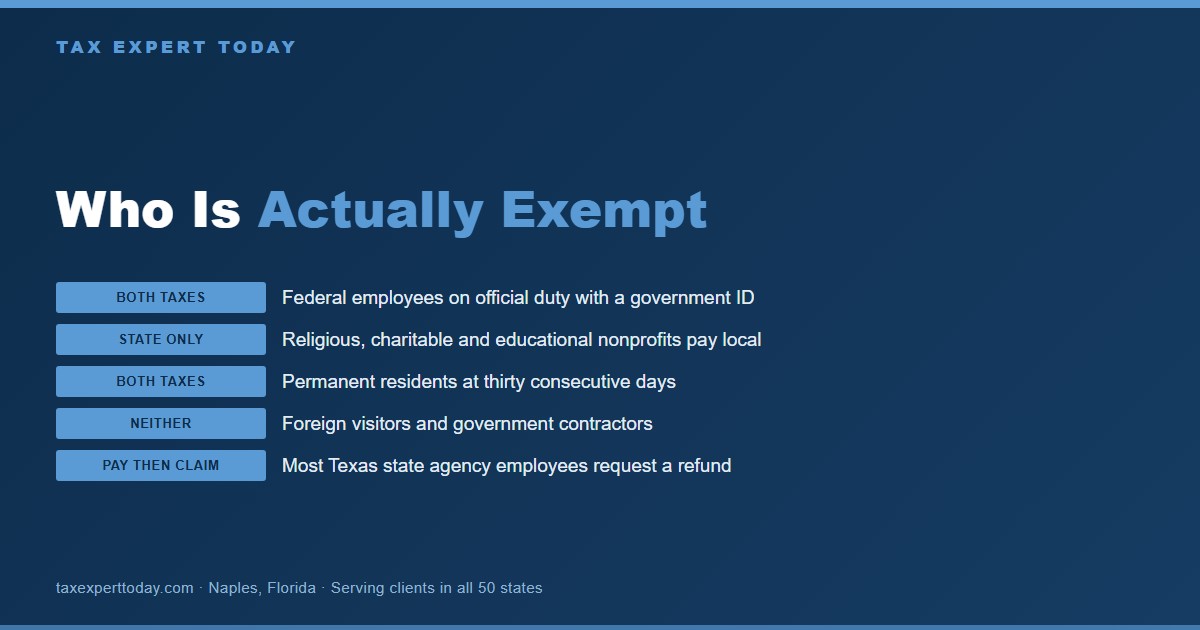
Publication 96-224 describes four categories of guest who can claim an exemption: nonprofit religious, charitable or educational organizations, specific nonprofit entities named in the statutes, government agencies including federal employees and certain designated Texas state officials, and permanent residents under the 30 day rule. Several of these exempt the state tax only.
- Nonprofits get the state tax, not the local tax. Employees and representatives of qualifying religious, charitable or educational organizations are exempt from state hotel tax when traveling on official business, and must pay local hotel taxes.
- Federal employees are exempt from both. Employees of United States government agencies, including military personnel, traveling on official business with a valid government identification card are exempt from state and local hotel taxes.
- Most Texas state employees are not exempt at the desk. Employees of state agencies, boards, commissions and institutions generally must pay both taxes and then request a refund, and Section 156.103(b) sets out that refund mechanism.
- Foreign guests are not exempt. Only foreign diplomatic personnel holding a hotel tax exemption card qualify. Ordinary foreign visitors pay both taxes.
- Contractors do not inherit the exemption. Contractors, and city and county government employees working for the State of Texas or the federal government, are not exempt from either tax.
| Guest category | State tax | Local tax | Documentation required |
|---|---|---|---|
| Nonprofit religious, charitable or educational organization on official business | Exempt | Pays | Form 12-302 plus a Comptroller exemption letter or Tax-Exempt Entity Search printout |
| Specific nonprofit entities, such as electric and telephone cooperatives, housing authorities and public facility corporations | Exempt | Exempt | Form 12-302 plus proof of the entity type |
| Federal employee or military personnel on official business | Exempt | Exempt | Form 12-302 plus a valid government identification card |
| Foreign diplomatic personnel with an exemption card | Exempt | Exempt | Form 12-302 plus the card issued by the U.S. Department of State or the American Institute in Taiwan |
| Designated Texas state officials, including agency heads, judicial officials and legislators | Exempt | Exempt | Form 12-302 plus the special hotel tax exemption photo identification or card |
| Other Texas state agency employees | Pays, then claims a refund | Pays, then claims a refund | Refund request rather than an exemption certificate |
| Permanent resident, 30 consecutive days or more | Exempt | Exempt | Property records only; Form 12-302 is not required |
| Contractor working for a government entity | Pays | Pays | No exemption available |
| Ordinary foreign visitor | Pays | Pays | No exemption available |
The nonprofit split is the trap in this table. A church group books rooms for a mission trip, presents an exemption certificate, and the front desk zeroes out the entire tax line. The state portion was correctly removed. The local portion should have stayed. The property has now undercollected the local tax on that stay and owes it to the city regardless, because the exemption the guest held never covered it.
The distinction between the two nonprofit categories is worth reading carefully, because the names are similar and the outcomes are not. A qualifying religious, charitable or educational organization under Section 156.102 is exempt from the state tax only. A specific nonprofit entity, which is a defined list including cultural education facilities finance corporations, electric cooperatives, health facilities development corporations, housing authorities, housing finance corporations, public facility corporations and telephone cooperatives, is exempt from both. Publication 96-1045 carries the detail on which organizations qualify under which heading.
One more nuance on the nonprofit category concerns who pays. Employees of a qualifying nonprofit are exempt when traveling on official business and may pay for the accommodation with personal funds. A representative claiming the exemption who is not an employee must pay with the organization’s funds, meaning a check, a credit card in the organization’s name, or direct billing. A volunteer paying personally does not qualify.
What Records Does a Property Owner Have to Keep?
Hotels must keep all records, including exemption certificates, for at least four years. Except for permanent residents, every person claiming an exemption must complete Form 12-302, the Texas Hotel Occupancy Tax Exemption Certificate, and provide proof of the exemption to the property. Certificates may be accepted in good faith when the supporting documentation is present.
- Four years is the retention period. The requirement covers all records and specifically names exemption certificates.
- Form 12-302 is the instrument. It is required for every exemption category other than permanent residents, where property records serve as the proof instead.
- Good faith acceptance requires the backup. The certificate is acceptable where the guest also provides the supporting document for their category, such as the government identification card or the Comptroller exemption letter.
- One certificate can cover repeat stays. An exempt organization may use a single exemption certificate to claim the exemption for more than one stay.
- Platform bookings do not remove your documentation duty. Where you allow an exemption on a direct or non-collecting-platform booking, you must keep the documentation that supports it.
A missing certificate converts an exempt stay into a taxable one on audit. The tax was never collected from the guest, who has long since departed, so the assessment lands on the property with penalty and interest attached. This is the least dramatic and most common way a lodging tax audit produces a bill. Nothing was done dishonestly. The paperwork supporting a genuine exemption was simply never obtained, or was obtained and not retained for the full four years.
The Comptroller is explicit about what makes a certificate acceptable for each category. Federal employees on government business present a valid government identification card. Designated Texas state employees present a special hotel tax exemption photo identification or card stating that the holder is exempt from hotel taxes. Foreign diplomats present a tax exemption card issued by the U.S. Department of State, unless that card specifically excludes hotel tax, which is a detail worth actually reading on the card. Employees and representatives of a nonprofit organization present a Comptroller letter of hotel tax exemption, or verification that the organization appears on the Comptroller’s list of exempted entities, such as a printed copy of a Tax-Exempt Entity Search result. Filing the supporting document alongside the certificate is what makes the good faith acceptance defensible later.
When Is the Texas Hotel Occupancy Tax Return Due?
The state return is due on the 20th day of the month following the end of each calendar month, or the 20th day of the month following the end of the calendar quarter for qualified quarterly filers. A $50 penalty applies to each report filed late regardless of the amount owed, and interest begins 61 days after the due date. Local returns follow the schedule set by each jurisdiction.
- Monthly filers report by the 20th. March activity is due April 20, and the same pattern holds through the year.
- The $50 late report penalty is flat. It applies to each report filed after the due date, including a report showing no tax due.
- Late payment penalties escalate. Tax paid 1 to 30 days late carries a 5 percent penalty, and tax paid more than 30 days late carries 10 percent.
- Timely filing earns a discount. Filing and paying by the due date allows a 1 percent discount of the tax due on a monthly or quarterly return.
- Local deadlines are set locally. Some jurisdictions file quarterly where the state return is monthly, so the two calendars need to be tracked separately.
| Event | Consequence under the state hotel occupancy tax |
|---|---|
| Report filed after the due date | $50 penalty for each late report |
| Tax paid 1 to 30 days after the due date | 5 percent penalty |
| Tax paid more than 30 days after the due date | 10 percent penalty |
| Tax still unpaid 61 days after the due date | Interest begins to accrue |
| Report and payment both made by the due date | 1 percent discount of the tax due |
The flat $50 penalty for a late report is worth internalizing if your rental is seasonal. A property that sits empty for part of the year still has a filing obligation once it is registered, and a zero-activity month filed late costs $50 even though no tax was due. Owners who mentally file the tax away during the off season accumulate these quietly.
Reporting and payment methods are tiered by the amount of tax paid in the preceding state fiscal year, which runs September 1 through August 31. Below $10,000 you may use Webfile or paper tax forms, and pay by web electronic funds transfer, credit card through Webfile, TEXNET or check. From $10,000 to $49,999 the reporting options are the same but the check option drops away. At $50,000 and above Webfile becomes the only acceptable reporting method. Most individual short-term rental owners sit comfortably in the lowest tier, but an owner adding properties can cross a threshold and find the familiar filing route no longer available.
How Does the Hotel Occupancy Tax Affect Your Federal Return?
The Texas hotel occupancy tax and your federal income tax are independent obligations with independent thresholds. Section 280A(g) excludes rental income from gross income when a dwelling unit used as a residence is rented for fewer than 15 days in the year. That federal exclusion does not relieve the Texas hotel occupancy tax on those same bookings.
- Fourteen days of rental can still owe Texas tax. The federal exclusion under Section 280A(g) turns off the income reporting, not the state transaction tax.
- The state threshold is per day, not per year. Texas asks whether the room cost $15 or more each day, not how many days you rented across the year.
- Collected tax is not your income. Hotel occupancy tax collected from guests is money held for the taxing authorities and does not belong in your gross receipts.
- Local tax paid is generally a rental expense. Where the rental activity is reported, lodging taxes that you bear rather than collect follow the normal rules for taxes attributable to the activity.
- Two sets of records, one set of bookings. The same booking log supports both filings, which is a strong argument for keeping it in a form that serves each.
| Question | Federal income tax | Texas hotel occupancy tax |
|---|---|---|
| What is the measuring period | The taxable year | Each individual booking |
| What is the threshold | Fewer than 15 rental days triggers the Section 280A(g) exclusion | A room costing $15 or more each day |
| Ten days of rental in the year | Income excluded, no deduction allowed | State and local tax still apply to each stay |
| Where it is reported | Generally Schedule E when the exclusion does not apply | The Comptroller return, plus the local return |
| Who bears the tax | The owner, on net rental income | The guest, collected and remitted by the owner |
This divergence produces the most counterintuitive result in the whole area. Consider an owner who rents a primary residence in Austin for ten days during a large event and does not use the property for rental purposes at any other point in the year. Under Section 280A(g) the rental was for fewer than 15 days, so no deduction is allowed for the rental use and the income is not included in gross income. On the federal return, the activity effectively does not appear.
Texas takes a completely different view of the same ten days. Each of those nights was a room rented for more than $15 per day to someone who is not a permanent resident, which is a short-term rental within the definition and squarely inside the state hotel occupancy tax. The local tax applies on its own terms as well. An owner who reasons from the federal treatment to the state treatment concludes that nothing is owed anywhere, and that conclusion is wrong on the state side.
Where the rental activity does not qualify for the Section 280A(g) exclusion, the ordinary rules for residential rental property apply and the activity is generally reported on Schedule E. IRS Publication 527 covers the treatment of residential rental property, including the allocation between personal and rental use that matters when a property serves both purposes during the year. The interaction between personal use days and rental days is a federal determination with its own tests, and it has no effect on whether the Texas tax applied to a given booking. When the property is eventually sold, a further set of federal rules applies, and our guides to selling rental property after a move and to capital gains tax in Texas cover that stage.
What Happens if the Comptroller Audits Your Short-Term Rental?
The property owner remains the subject of a Comptroller examination even where a collecting platform handled the state tax. The Comptroller instructs owners in that position to contact the platform to obtain the account’s transaction history and to provide that information to the auditor. The records duty does not transfer with the collection duty.
- You are the taxpayer under examination. A platform collecting on your behalf does not make the platform the party answering the questions about your property.
- The transaction history has to be requested. Owners obtain it from the platform and hand it to the auditor, which means the access needs to still work when the examination arrives.
- Platform reporting is aggregated. A platform generally reports only total receipts and total taxable receipts for each city and county rather than owner-level detail.
- Exemption documentation is yours to produce. Where you allowed an exemption on a booking you handled, the supporting paperwork is your responsibility.
- Channel separation is what saves the reconciliation. Records that distinguish platform bookings from direct bookings make the return defensible without reconstruction.
The aggregation point deserves emphasis because it changes what your own records have to do. A platform’s hotel occupancy tax report to the Comptroller generally carries total receipts and total taxable receipts per city and county, not personally identifiable information about individual owners or guests. That is sensible privacy practice, and it means the Comptroller’s file does not contain a clean property-level record of what was remitted for you. When an examination asks what was collected and paid on your property, the answer has to come from your records and from the history you retrieve from the platform.
Practically, this argues for pulling and saving your own platform tax statements periodically rather than relying on being able to retrieve four years of history on demand. Platform access can lapse. Accounts get closed when a property is sold. The four year retention requirement runs regardless of whether you still have a login.
How Do You Register for Texas Hotel Occupancy Tax?
State registration is handled through the Comptroller, and a collecting short-term rental platform files Form AP-102, the Hotel Occupancy Questionnaire, for the properties it covers. Local registration is separate and is arranged with the city and county where the property is located, each of which sets its own permit, reporting and remittance requirements.
- Register for the state tax if you collect it. An owner taking direct bookings or using a non-collecting platform needs to be set up to report and remit the state portion.
- Form AP-102 is the platform’s filing. A collecting platform submits the Hotel Occupancy Questionnaire to the Comptroller for the arrangement it operates.
- Local registration is a separate errand. The city and county where the property sits hold the information about local permits and reporting.
- Ask about both the rate and the form. Knowing the local rate is not enough without knowing the filing frequency and the remittance method.
- Do the local step before the first booking. Local registrations are easier to complete in advance than to backfill once taxable stays have already occurred.
| Step | Where it happens | What to confirm |
|---|---|---|
| Establish the jurisdiction | City and county records | Whether the property sits inside a city limit or in the unincorporated county |
| Confirm the local rate and form | The city, then the county, separately | Rate, filing frequency, remittance method and any permit |
| Read the platform terms | Each platform you list on | Whether it collects state tax, and whether it addresses local tax there |
| Register for the state tax | Texas Comptroller | Needed wherever you take direct or non-collecting-platform bookings |
| Set the filing calendar | Your own records | The state 20th of the month deadline plus each local deadline |
Owners frequently ask why they cannot complete all of this in one place. The answer is structural. The Comptroller administers the state portion of the tax for the entire state. Each local government sets its own rate under Chapters 351 and 352 and receives its own money directly. There is no single portal that covers both because the two taxes have different owners. Owners holding several properties sometimes ask whether separate entities help here, and our guide to the Texas series LLC covers what that structure does and does not change. Owners winding an operation down should read closing a business in Texas, because lodging tax accounts have to be closed deliberately rather than abandoned. The Comptroller collects local hotel tax reporting information from municipalities annually, between January 1 and February 20, but that is a reporting obligation running from cities to the state rather than a route for owners to file local tax through the Comptroller.
For an owner adding a property in an unfamiliar jurisdiction, the sequence that avoids trouble is short. Confirm whether the property sits inside a city limit or in the unincorporated area of the county, since that determines which local taxes reach it. Ask the city and the county separately for their rate, their filing frequency and their form. Read the current terms of every platform you list on to establish which of them collects the state tax and whether any of them addresses the local tax in that jurisdiction. Then register for whatever remains yours to file.
Texas Hotel Occupancy Tax Help in Naples & Southwest Florida
Tax Expert Today LLC advises property owners and business owners on state and federal tax matters nationwide from our office in Naples, Florida. Texas lodging tax work reaches us from two directions that look different and raise the same questions. Florida owners who have bought short-term rental property in Texas markets and now face a two-authority filing obligation they did not have at home, and Texas owners who have relocated to Southwest Florida while continuing to operate rentals back in Texas. Both groups arrive with bookings already taken and a reasonable belief that the platform was handling the tax. For owners who have actually relocated, the domicile questions are covered separately in our guides to establishing Texas residency and Texas compared with Florida, and owners moving an operating business should read moving a business to Texas.
Our approach starts with the booking records rather than the returns. We separate platform bookings from direct bookings, because the collection duty differs between them. We test whether the amount remitted matches the full taxable price including cleaning and readying charges, which is where the systematic understatements appear. We confirm which local jurisdiction the property actually sits in, and we check whether the local tax has been addressed by anyone at all. Where a prior period looks exposed, we say so plainly and discuss the options for addressing it rather than leaving it to surface in an examination.
- Hotel occupancy tax help Naples owners can reach in person. Our office is on Tamiami Trail North in Naples, Florida, and we meet clients locally as well as remotely.
- Short term rental tax Naples FL and nationwide. We work with clients in all 50 states, and the Texas analysis is the same wherever the owner now lives.
- Two authority compliance mapped before the season starts. Registration and filing calendars are far cheaper to set up in advance than to reconstruct after a year of bookings.
- Coordination with the federal rental reporting. The lodging tax and the Schedule E position use the same booking data, and building them together avoids two inconsistent records of the same year.
- Multi property owners across several jurisdictions. Where properties sit in different cities and counties, the local obligations differ property by property and need to be tracked that way.
Related services include our Texas tax services and our business consulting practice for owners formalizing a rental operation. Southwest Florida owners can also review our Naples tax planning work, and owners who need the underlying books maintained across multiple properties can look at our CFO advisory and bookkeeping support.
Tax Expert Today LLC
11983 Tamiami Trail N, Naples, FL 34110
Phone: (239) 441-2005
Hours: Monday through Friday, 10:00 a.m. to 5:00 p.m. ET
Local question we are asked often: A Naples couple owns a house near a Texas lake that they rent out about twenty weekends a year, entirely through one booking platform, and they also let a few repeat guests book directly by text message to avoid the platform fee. The platform statement shows occupancy tax collected. Are they compliant? Probably not, on two counts. The direct bookings sit outside the platform arrangement, so the state tax on those stays is theirs to collect and remit, and nothing on the platform statement covers them. Separately, the local tax in that jurisdiction may never have been addressed by anyone, because the platform arrangement they are relying on generally speaks to the state portion. The fix is mechanical once the two booking channels are separated and the city and county have been asked directly what they require.
When Should You Engage a Professional?
Plenty of single-property owners handle this tax themselves once the structure is clear, and this guide is written to make that possible. Professional help earns its cost in specific situations rather than as a general rule.
- Mixed booking channels. If some bookings come through a collecting platform and others come direct, the state obligation splits between the two and the split has to be documented.
- Properties in more than one jurisdiction. Local rates, forms and filing frequencies differ by city and county, and the analysis does not carry over from one property to the next.
- Prior periods that look exposed. Where cleaning fees were left out of the base, or local tax was never filed, the question of how to address earlier periods deserves a considered answer rather than a hopeful one.
- Corporate or long stay arrangements. Permanent resident treatment for an entity holding continuous occupancy is defensible and documentation dependent, and it is worth structuring deliberately.
- An examination notice. Once the Comptroller has opened an examination, the records you can assemble and the platform history you can still retrieve shape the outcome.
- A federal position that interacts. Where Section 280A, personal use allocation or the treatment of a property converted to rental use is in play, the state and federal analyses should be built from one set of facts.
Tax Expert Today LLC is a multidisciplinary firm of tax advisors, enrolled agents, CPAs and attorneys serving clients in all 50 states. Texas Comptroller matters are state tax matters rather than federal ones, and we handle them as part of a broader state and local tax practice. Where a matter is genuinely federal, such as the Schedule E reporting or a Section 280A question, the federal side is handled by credentialed practitioners in the same engagement so the two records agree.
To discuss a Texas lodging tax question, call (239) 441-2005 or use our contact page to arrange a consultation.
Frequently Asked Questions
What is the Texas hotel occupancy tax rate?
The state rate is 6 percent of the price paid for the room. Cities and counties add their own local hotel tax, most commonly up to 7 percent each, and the combined rate of state, county, municipal and sports and community venue taxes cannot exceed 17 percent.
Do I owe Texas hotel occupancy tax on an Airbnb rental?
Yes, short-term rentals are subject to the tax. Where a platform has agreed to collect and remit the state portion on your behalf, you are not required to collect that portion yourself. The Comptroller directs owners to contact the city and county about the local hotel tax, which is administered separately.
Are cleaning fees taxable for Texas hotel occupancy tax?
Yes. Section 156.051(b) excludes food and personal services from the room price but expressly keeps services related to cleaning and readying the room inside the taxable price. Stating the cleaning fee separately does not remove it from the base.
How long does a guest have to stay to be exempt in Texas?
At least 30 consecutive days, with no interruption of payment for the period. A guest who gives written notice of the intention to stay 30 days is exempt from the notice date if the stay actually continues, and a guest who gives no notice pays tax for the first 30 days and is exempt thereafter.
When is the Texas hotel occupancy tax report due?
Monthly filers report by the 20th day of the month following the reporting month. Qualified quarterly filers report by the 20th day of the month following the end of the quarter. A $50 penalty applies to each late report, and filing and paying on time earns a 1 percent discount.
How long do I have to keep hotel occupancy tax records?
At least four years, and the requirement specifically includes exemption certificates. Except for permanent residents, every guest claiming an exemption must provide Form 12-302 along with proof of the exemption category.
Do I owe Texas hotel occupancy tax if I rented my house for only ten days?
Very likely yes. The federal rule in Section 280A(g) excludes the income when a residence is rented for fewer than 15 days in the year, but that is a federal income tax provision. The Texas tax applies per booking to rooms costing $15 or more per day, so the state and local tax can be owed on stays that never appear on your federal return.
Are nonprofit organizations exempt from Texas hotel occupancy tax?
Qualifying religious, charitable and educational organizations are exempt from the state hotel tax when traveling on official business, and they still have to pay local hotel taxes. A separate and narrower list of specific nonprofit entities, including electric and telephone cooperatives and housing authorities, is exempt from both.
This article is general information about Texas hotel occupancy tax and federal rental reporting, current as of September 2026. It is not legal or tax advice for any particular situation, and rates, thresholds and local requirements change. Local hotel tax rates and filing requirements vary by city and county and should be confirmed with the jurisdiction where the property is located. Please consult a qualified professional regarding your circumstances before acting.
Published September 13, 2026 by Dr. Pellumb Kabashi « Back to Learning Center
Have a question this article touches on?
Tax Expert Today LLC, based in Naples, Florida and serving clients across the United States.
Schedule a Consultation (239) 441-2005