
By Dr. Pellumb Kabashi, DBA, MBA, CES, CFE, EA
Founder, Tax Expert Today LLC · Tax advisors, enrolled agents, CPAs, and attorneys · Serving clients in all 50 states
Quick Answer: Texas sales tax nexus is the connection that obligates a business to collect Texas sales and use tax. A remote seller crosses the economic threshold at $500,000 of total Texas revenue in the preceding twelve calendar months, and physical presence creates nexus at any revenue level. Registration itself also starts a franchise tax obligation. Call (239) 441-2005 for a free consultation.
What Is Texas Sales Tax Nexus?
Texas sales tax nexus is the legal connection between a business and the state that obligates the business to register for a permit and collect Texas sales and use tax. Two independent paths create it. Physical presence in Texas creates nexus at any revenue level, and economic activity creates nexus once total Texas revenue passes $500,000 in the preceding twelve calendar months.
The word nexus carries more weight than most owners expect. It does not describe how much tax a business owes. It describes whether Texas has the authority to require that business to act as a collection agent on behalf of the state. Once nexus exists, the obligation to register, collect, file, and remit follows regardless of whether the business ever intended to operate in Texas. Nexus settles whether a business must collect. What it then charges tax on is a separate question, answered by the enumerated list of Texas taxable services.
- Two independent tests. Falling under the economic threshold does not protect a business that has physical presence, and having no physical presence does not protect a business that crosses the revenue threshold.
- Collection, not liability. Sales tax is imposed on the purchaser. The seller with nexus collects and remits it, and becomes exposed when that collection does not happen.
- Separate from income tax. Texas imposes no personal income tax, which is a common source of confusion for arriving owners. See our guide to what Texas having no state income tax actually means.
- Separate from franchise tax, but linked. The two regimes use the same $500,000 figure and are frequently conflated, and registering for one can start the other.
The modern rule dates to 2018. In South Dakota v. Wayfair, Inc., the United States Supreme Court overruled the earlier decisions that had limited state collection authority to sellers with a physical presence. States responded by writing economic thresholds into their own law, and Texas adopted its remote seller rule with enforcement beginning October 1, 2019.
What Is the Texas Economic Nexus Threshold?
The Texas economic nexus threshold is $500,000 of total Texas revenue in the preceding twelve calendar months. The Comptroller frames this as a safe harbor rather than as a tax trigger, meaning remote sellers below that figure are not required to obtain a permit or to collect tax. Texas applies no transaction count test of any kind.
That last point separates Texas from many states and works in favor of smaller sellers. A business with four thousand small orders shipped into Texas has no Texas collection obligation on volume alone if the dollars stay under the threshold.
- The figure is $500,000. It has not changed since the rule took effect and it is not indexed for inflation.
- The window is the preceding twelve calendar months. This is a rolling test rather than a calendar year test, so it has to be monitored monthly rather than at year end.
- No transaction count applies. Texas has no 200 transaction rule of the sort several other states use.
- The safe harbor protects only remote sellers. A business with physical presence in Texas cannot rely on it at any revenue level.
| Feature | Economic nexus | Physical nexus |
|---|---|---|
| Revenue threshold | $500,000 in the preceding 12 calendar months | None, any amount creates the obligation |
| Transaction count test | None in Texas | Not applicable |
| Who it reaches | Remote sellers whose only Texas activity is remote solicitation | Any seller engaged in business in Texas |
| Measurement period | Rolling twelve months | Measured from the date presence begins |
| Safe harbor available | Yes, below $500,000 | No |
| When collection starts | First day of the fourth month after the month the threshold is exceeded | When the business becomes engaged in business in Texas |
What Counts Toward the $500,000 Texas Revenue Test?
Texas measures the threshold on gross revenue rather than on taxable revenue. The figure includes sales of both taxable and nontaxable tangible personal property and services delivered into Texas, separately stated handling, transportation, and installation fees, sales for resale, and sales made to exempt entities. Very little is excluded.
This is the most misread element of the Texas rule, and it is where businesses most often conclude wrongly that they sit under the threshold. An owner who sells mostly wholesale, or mostly to schools and hospitals, may carry almost no taxable sales and still be well over $500,000 on the measure that actually governs.
- Nontaxable sales count. A product or service being exempt from tax does not remove the revenue from the threshold computation.
- Wholesale counts. Sales for resale are included even though the seller collects no tax on them.
- Exempt customers count. Sales to exempt organizations are included in the gross figure.
- Freight and handling count. Separately stated handling, transportation, installation, and similar fees form part of total Texas revenue.
| Revenue item | Counts toward the $500,000 test? |
|---|---|
| Taxable sales of tangible personal property | Yes |
| Nontaxable and exempt sales | Yes |
| Sales for resale to wholesalers | Yes |
| Sales to exempt entities such as schools and nonprofits | Yes |
| Separately stated shipping, handling, and installation fees | Yes |
| Taxable services delivered into Texas | Yes |
| Sales delivered to customers outside Texas | No |
The practical consequence is that the monitoring figure a business should track is total Texas destination revenue taken from the accounting system, not the taxable sales line from a tax report. Businesses that track only taxable sales tend to discover the crossing late, and lateness is costly because the collection obligation runs from a date fixed by the rule rather than from the date the business noticed. Independent contractors and consultants selling into Texas should note that this is a separate question from federal self employment liability, which we cover in our guide to self employment tax in Texas.
What Physical Presence Creates Texas Sales Tax Nexus?
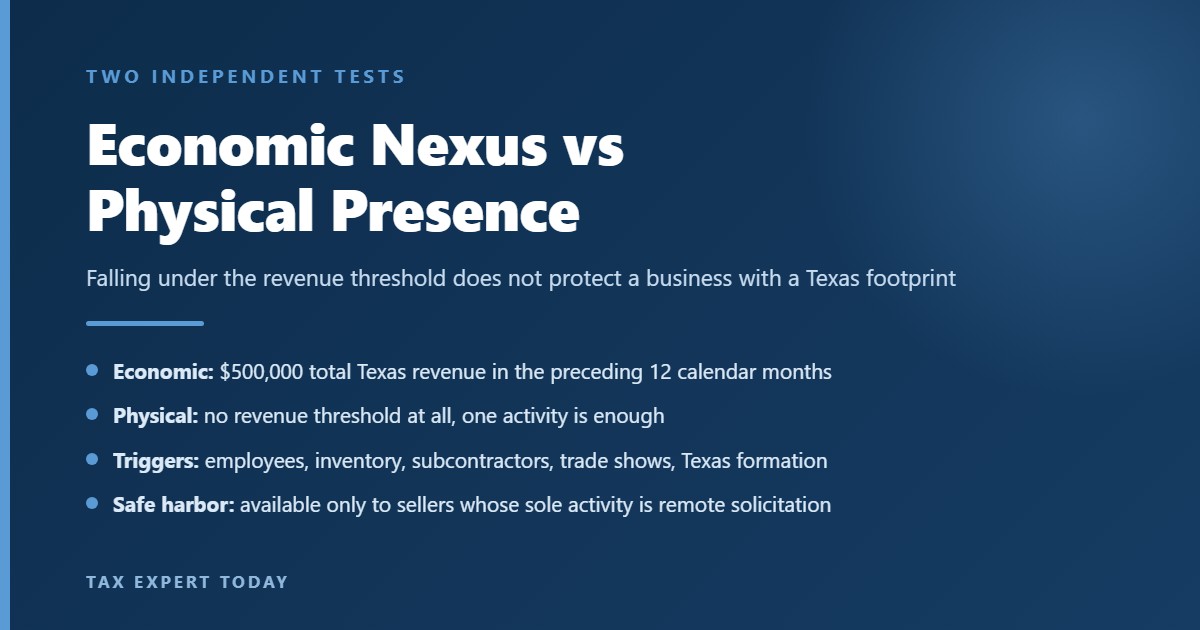
Texas Comptroller Publication 94-108 lists the activities that make a business engaged in business in Texas. The list is broad and reaches well past the obvious office or storefront. Employees, contractors, inventory, leased property, trade show attendance, delivery in company vehicles, and even owning or using software in Texas can each create physical nexus.
Because physical presence carries no revenue threshold, a single triggering activity creates a collection obligation on the first taxable sale. This is the exposure that catches remote sellers who believed the $500,000 safe harbor protected them, when in fact that safe harbor is available only to sellers whose sole Texas activity is remote solicitation.
- Any Texas location. A kiosk, office, distribution center, sales room, sample room, warehouse, or storage place operated directly or through an agent.
- People in the state. An employee or representative who sells, delivers, or takes orders, including independent salespersons and employees exhibiting at trade shows or conferences.
- Property in the state. Owning or using tangible personal property in Texas, including computer software, and leasing equipment to others in Texas.
- Service performance. Performing services in Texas using company employees, authorized service agents, or subcontractors.
- Texas formation. Forming, organizing, or incorporating the business in Texas, even with no other listed activity.
| Activity in Texas | Creates physical nexus? | Practical note |
|---|---|---|
| Office, warehouse, or storage location | Yes | Temporary locations count as well as permanent ones |
| Remote employee working from a Texas home | Yes | Also raises a separate payroll registration question |
| Inventory held in a third party fulfillment center | Yes | Owning or using tangible personal property in Texas |
| Attending a Texas trade show with product samples | Yes | Employees exhibiting products are named in the publication |
| Subcontractor performing installation in Texas | Yes | Services performed through subcontractors are listed |
| Delivery in company owned or leased vehicles | Yes | Delivery by common carrier is treated differently |
| Entity formed under Texas law | Yes | Applies even with no other Texas activity |
| Advertising into Texas by mail, catalog, or online | Yes, as solicitation | This is what defines a remote seller |
The affiliate provisions deserve separate attention. A business has Texas nexus where it holds at least a fifty percent ownership interest in, or is at least fifty percent owned by, an entity that maintains a Texas distribution center or warehouse and delivers the first business’s products, or that sells substantially similar products under a substantially similar business name, or that uses its Texas facilities or employees to promote the first business’s sales. Related company structures can therefore create nexus that the operating entity never established on its own. Owners restructuring during a move should read this alongside our checklist for moving a business to Texas.

When Must You Register and Start Collecting?
A remote seller that exceeds the $500,000 safe harbor must obtain a permit and begin collecting state and local use tax no later than the first day of the fourth month after the month in which the threshold was exceeded. The rule provides a short administrative runway, and the deadline runs from the crossing date rather than from the date the business discovers it.
The worked example published by the Comptroller is worth restating precisely. If a remote seller had total Texas revenue exceeding the safe harbor for the twelve month period running July 1, 2021 through June 30, 2022, that seller was required to obtain a permit by October 1, 2022 and to begin collecting use tax from that date.
- Count from the month of crossing. The month in which revenue passed $500,000 is the reference month, and collection begins on the first day of the fourth month after it.
- Register through the Comptroller. Application is made through the Texas Online Tax Registration Application or by mailing Form AP-201.
- Sellers outside the United States have a separate channel. They may register by emailing or faxing the application to the Comptroller.
- Keep the records regardless. All sellers must keep required records, including gross receipts of sales and purchases, for at least four years.
| Event | Timing rule | Illustration |
|---|---|---|
| Threshold first exceeded | Month the rolling twelve month total passes $500,000 | June 2026 |
| Permit required and collection begins | First day of the fourth month after that month | October 1, 2026 |
| Obligation may terminate | After 12 consecutive months below $500,000 | Reviewed no earlier than the following year |
| Collection must resume | First day of the second month after any 12 consecutive months back above $500,000 | Two months of runway, not four |
Note the asymmetry in that table, because it is a genuine trap. A business receives roughly three months of runway the first time it crosses the threshold, but only one month of runway if it terminates and later crosses again. A seller whose Texas revenue moves up and down across the threshold should plan around the shorter second window rather than assume the original timeline repeats.
How Does a Texas Sales Tax Permit Trigger Franchise Tax Nexus?
Obtaining a Texas use tax permit on or after January 1, 2019 establishes franchise tax nexus on the date the permit is issued. This is the least understood consequence of registering. A remote seller that registers purely to comply with the sales tax rule also becomes a taxable entity for franchise tax purposes and inherits an annual report obligation.
The Comptroller states this directly on the same Remote Sellers page that explains the sales tax threshold, yet it appears in almost none of the commercial guidance written about Texas nexus. For an out of state business, the sequence matters: the sales tax registration is the act that starts the franchise tax clock.
- The permit itself is a nexus event. Franchise tax nexus begins on the date the entity obtains a Texas use tax permit if that permit was obtained on or after January 1, 2019.
- A separate economic test also exists. A foreign taxable entity with annual gross receipts of $500,000 or more from business done in Texas has franchise tax economic nexus with no physical presence, for reports due on or after January 1, 2020.
- Filing follows nexus, not tax due. Each taxable entity with nexus must file a Franchise Tax Report together with an Information Report, whether or not any tax is owed.
- The two regimes are administered separately. Sales tax and franchise tax have different returns, different due dates, and different computations.
| Question | Sales and use tax | Franchise tax |
|---|---|---|
| Threshold figure | $500,000 total Texas revenue | $500,000 gross receipts from business done in Texas |
| Measurement window | Preceding 12 calendar months, rolling | The federal income tax accounting period |
| Started by taking a permit | The permit is the compliance step | Yes, the permit date itself creates nexus |
| Return required with no tax due | Yes, once permitted | Yes, report plus Information Report |
| Who administers it | Texas Comptroller | Texas Comptroller |
The planning point is not that a business should avoid registering. Where nexus exists, registration is required. The point is that the franchise tax consequence should be modeled before the permit application goes in, so the first franchise tax report is expected rather than discovered. Our guide to the Texas franchise tax for business owners covers the no tax due threshold, the margin computation methods, and the report deadlines in detail, and owners operating through a limited liability company should also review how a Texas LLC is taxed, which sets out where the permit question sits in the wider entity picture.
What Is the Single Local Use Tax Rate?
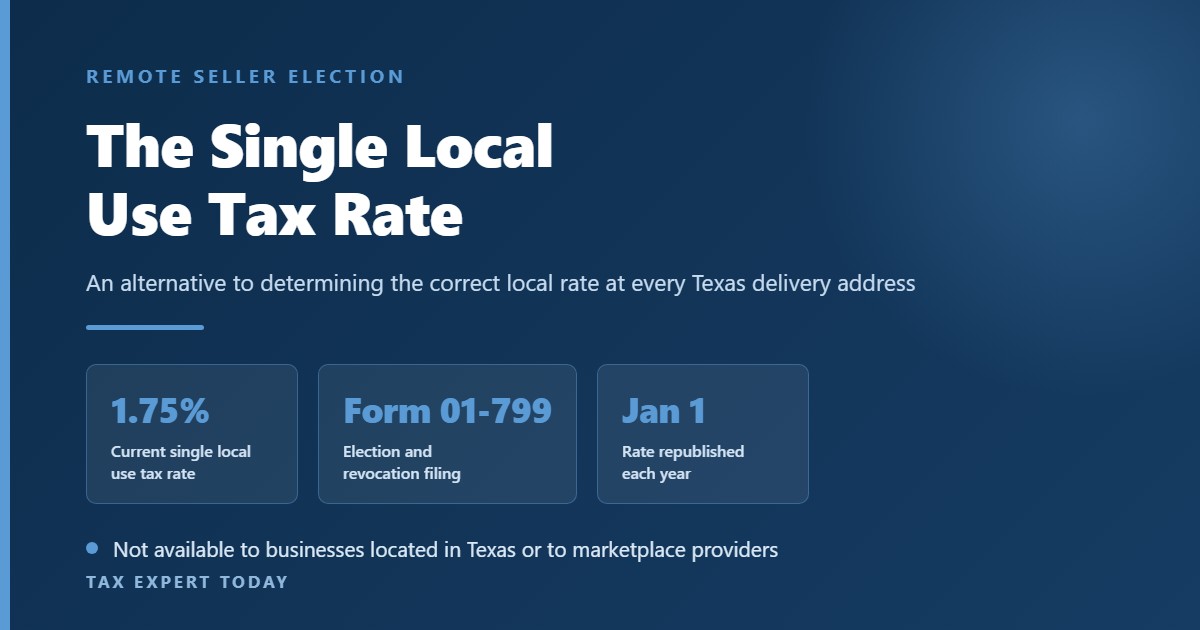
The single local use tax rate is an alternative flat local rate that remote sellers may elect instead of determining the correct local rate at each destination address. The current single local use tax rate is 1.75 percent, and the Comptroller publishes the rate in the Texas Register by January 1 of each year. The election is made on Form 01-799.
For a remote seller shipping into hundreds of Texas jurisdictions, the election removes a substantial compliance burden. Texas local rates vary by city, county, transit authority, and special purpose district, and destination sourcing requires the seller to resolve the correct combined rate for every delivery address.
- The rate is 1.75 percent. It is republished annually, so it should be re-checked each January rather than assumed.
- It is available only to remote sellers. Businesses located in Texas are not remote sellers and cannot use it, and it is not available to marketplace providers collecting on behalf of marketplace sellers.
- New registrants elect on the application. An existing remote seller elects later by filing Form 01-799 with the Comptroller by email or mail.
- The effective date is period based. The election takes effect at the beginning of a reporting period, so an election made in February takes effect in March.
| Consideration | Single local use tax rate | Destination sourcing |
|---|---|---|
| Rate applied | 1.75 percent statewide | Actual combined local rate at the ship to address |
| Available to | Remote sellers only | All sellers |
| Compliance burden | Low, one rate | Higher, address level rate determination |
| Election required | Yes, on the application or Form 01-799 | No, it is the default |
| Best suited to | High volume sellers shipping statewide | Sellers concentrated in low rate areas |
Revocation carries its own timing rule and it is easy to misjudge. If the Comptroller receives a revocation before October 1, the seller must continue using the single local use tax rate until the end of that calendar year. If the revocation arrives on or after October 1, the seller must continue collecting at the single rate until the end of the following year. A revocation filed on November 1, 2026 would therefore not take effect until January 1, 2028.
How Do Marketplace Sales Change Your Obligation?
A remote seller that sells only through a marketplace provider which certifies it is collecting and reporting Texas tax on the seller’s behalf is not required to hold a Texas tax permit. The moment that seller also sells through its own website or another channel, the analysis changes and the seller may need its own permit for those direct sales.
This is where owners who sell across several channels most often get the answer wrong. The marketplace relief is channel specific rather than seller specific. It removes the obligation on marketplace sales, not the obligation on everything the business sells.
- Certification is the condition. Relief depends on the marketplace provider certifying that it collects and reports the tax.
- Direct sales stand alone. Sales made outside a marketplace are the seller’s own responsibility to collect, report, and remit.
- Roles can overlap. A business may be a remote seller, a marketplace seller, and a marketplace provider at the same time, with different responsibilities attaching to each role.
- Records survive the relief. All sellers, including those relieved of collection, must keep records of marketplace sales for at least four years.
| Role | Who it describes | Collection responsibility |
|---|---|---|
| Remote seller | Out of state seller whose only Texas activity is remote solicitation | Own sales, once above the safe harbor |
| Marketplace seller | Seller listing products on a third party marketplace | None on certified marketplace sales |
| Marketplace provider | Operator that processes sales for third party sellers | Collects on behalf of its marketplace sellers |
| Hybrid seller | Sells on a marketplace and direct to consumers | Own permit needed for the direct channel |
The threshold computation is the second half of this question and it is easy to overlook. A hybrid seller should not assume that only its direct sales count toward the $500,000 test simply because the marketplace collects on the rest. Channel mix is exactly the kind of fact pattern that rewards a written Texas sales tax nexus analysis before the permit decision is made.
When Can You Terminate Texas Sales Tax Nexus?
A remote seller may terminate Texas use tax collection responsibilities after twelve consecutive months in which total Texas revenue for the preceding twelve calendar months stayed below $500,000. Termination is not automatic. The seller must notify the Comptroller using the Remote Seller Intent to Terminate Use Tax Responsibilities web form.
Almost no commercial guide covers the exit, which leaves businesses collecting and filing Texas returns years after their Texas revenue fell away. The obligation does not lapse on its own, and continuing to file zero returns indefinitely is a real and avoidable administrative cost.
- Twelve consecutive months below the threshold. The measurement mirrors the entry test and must hold for a full twelve month run.
- Notification is required. The Comptroller provides a dedicated web form for terminating remote seller status.
- Resumption is faster than entry. Collection must resume on the first day of the second month following any consecutive twelve months in which total Texas revenue again exceeds $500,000.
- Franchise tax is a separate exit. Ending franchise tax responsibility follows the Comptroller process for reinstating and terminating a business and is not covered by the sales tax termination form.
That last point matters because of the permit rule discussed earlier. A business that registered for sales tax, thereby creating franchise tax nexus, and later terminates its sales tax collection responsibility has closed only one of the two obligations it opened. The franchise tax filing requirement continues until it is separately addressed.
What Are the Texas Sales Tax Rates and Filing Deadlines?
Texas imposes a 6.25 percent state sales and use tax on most retail sales, leases, and rentals of goods and on taxable services. Local taxing jurisdictions may add up to 2 percent, for a maximum combined rate of 8.25 percent. Filing frequency is assigned by the Comptroller after a permit application is approved.
Local jurisdictions include cities, counties, transit authorities, and special purpose districts, and a single delivery address can sit inside several of them at once. That layering is precisely what makes the single local use tax rate election attractive to remote sellers shipping statewide. Lodging sits outside this rate structure entirely, because short stays are taxed under the Texas hotel occupancy tax rather than the sales tax, at different rates and with the local portion payable to the city or county directly.
- State rate is 6.25 percent. This portion is uniform across Texas.
- Local add on is capped at 2 percent. The combined rate therefore never exceeds 8.25 percent.
- Frequency is assigned, not chosen. The Comptroller notifies a taxpayer by letter after approving the permit application.
- Weekend and holiday due dates roll forward. Where a due date falls on a Saturday, Sunday, or legal holiday, the next working day becomes the due date.
| Filing frequency | Reports due | Typical assignment |
|---|---|---|
| Monthly | 20th of the month following the reporting month | Higher volume taxpayers |
| Quarterly | April 20, July 20, October 20, and January 20 | Moderate volume taxpayers |
| Yearly | Annual report for the prior period | Lower volume taxpayers |
Full due date detail is published by the Comptroller on its tax due dates page. Filing is handled electronically through Webfile or Electronic Data Interchange, both offered without charge by the Comptroller.
What If You Crossed the Threshold and Never Registered?
A business that had Texas sales tax nexus and did not register generally carries exposure for the tax it should have collected, plus interest and potential penalties, running back to the date the obligation began. Because the tax was never collected from customers, the amount usually comes out of the business rather than being recoverable from purchasers.
This is the fact pattern that turns a compliance question into a cash question, and it is worth being direct about it. The outcome in any specific case depends on the facts, the periods involved, and the remediation path chosen, and no responsible practitioner can promise a particular result in advance.
- The tax was not collected. Unlike a late remittance, unregistered periods usually mean the business absorbs the tax itself.
- Records determine the number. The four year record retention rule matters here, because reconstruction of Texas destination sales drives the computation.
- Resale documentation can reduce exposure. Sales that were genuinely for resale or to exempt entities may be supportable, which is why certificate files are worth reconstructing early.
- Voluntary approaches exist. States generally offer routes for taxpayers who come forward before an audit contact, and the availability and terms depend on the circumstances.
The practical sequencing advice is consistent. Establish the date Texas sales tax nexus actually began before estimating anything, because a business that assumes the wrong start date will either overstate the exposure and panic or understate it and under reserve. Where the periods are significant, this analysis belongs in a written engagement rather than in a spreadsheet built from memory. Owners who are also selling the business or realizing gain in the same period should read this alongside our guide to Texas capital gains tax, because an unresolved state registration issue can surface during buyer diligence.
How Does Texas Nexus Compare With Other States?
Texas sales tax nexus sits at the higher end of state economic nexus thresholds at $500,000, and Texas is one of the states that applies no transaction count test. That combination makes Texas comparatively forgiving for small sellers with many low value orders and comparatively unforgiving for wholesalers, because the Texas threshold counts nontaxable and resale revenue. A seller that crosses the threshold and registers then has to decide, sale by sale, whether to collect tax or accept a Texas resale certificate instead, and that decision is the one an audit tests.
Businesses expanding across several states rarely have the luxury of analyzing one state in isolation. The threshold, the measurement window, and the definition of includable revenue differ by state, and a single national sales figure cannot answer the question in any of them.
- Threshold level. Texas uses $500,000, which is above the $100,000 figure used by many states.
- Transaction counts. Texas has none, while a number of states still apply a separate transaction based trigger.
- Gross versus taxable measurement. Texas measures gross revenue including exempt and resale sales, which is broader than the measure some states use.
- Interaction with entity level taxes. The Texas franchise tax link described above has no direct analogue in states without a similar entity tax.
Owners weighing Texas against other no income tax states will find the broader comparison in our guide to Texas versus Florida for choosing a no tax state, and those planning a relocation should also review how to establish Texas residency for tax purposes. Businesses adding Texas employees should pair this analysis with our guide to Texas payroll taxes for employers, since a Texas remote worker can create both a payroll registration and a sales tax nexus question at the same time.
Texas Sales Tax Nexus Help in Naples & Southwest Florida
Tax Expert Today LLC advises business owners on state and local tax matters nationwide from our office in Naples, Florida. Texas sales tax nexus questions reach us from two directions: Florida based businesses that have grown into Texas customers, and Texas based owners who have relocated or who hold interests in both states. Both situations turn on the same analysis, which is where the obligation began and what it obligates the business to do next.
Our work on these engagements is documentary rather than promotional. We map the Texas revenue by month against the rolling twelve month test, identify any physical presence activity that removes the safe harbor, fix the date the obligation began, and set out the registration, franchise tax, and filing consequences that follow. Where historical periods are open, we scope the remediation options before any filing is made.
For sales tax nexus help Naples business owners can reach in person, or for Texas nexus advisory delivered remotely, we work with clients in all 50 states. Related services include our Texas tax services and our Naples tax planning practice.
Tax Expert Today LLC
11983 Tamiami Trail N, Naples, FL 34110
Phone: (239) 441-2005
Hours: Monday through Friday, 10:00 a.m. to 5:00 p.m. ET
Local question we are asked often: A Naples company ships products to customers in Texas but has no office, employees, or inventory there. Does it owe Texas sales tax? Not until its total Texas revenue passes $500,000 in the preceding twelve calendar months, because a Florida business whose only Texas activity is remote solicitation is a remote seller and may rely on the safe harbor. The figure to monitor is total Texas destination revenue including exempt and wholesale sales, not the taxable portion alone. If any Texas employee, contractor, or stored inventory enters the picture, the safe harbor stops applying and the obligation can begin immediately.
When Should You Engage a Professional?
Texas sales tax nexus rewards early analysis and punishes late discovery, because the collection obligation attaches on a date fixed by rule rather than on the date a business becomes aware of it. Several situations justify a professional review rather than a self assessment.
- Texas revenue approaching $500,000. The measurement is broader than most owners expect, so the crossing often happens earlier than the internal numbers suggest.
- Any Texas physical footprint. A remote employee, stored inventory, a subcontractor, or recurring trade show attendance each removes the safe harbor.
- Multi channel selling. Marketplace relief applies by channel, and hybrid sellers need the direct channel analyzed separately.
- Historical periods already open. Where the obligation began in a prior year, sequencing the remediation matters more than the arithmetic.
- A pending Comptroller contact. Correspondence or an examination notice should be reviewed before any response is filed.
Our team includes tax advisors, enrolled agents, CPAs, and attorneys, and we coordinate the state and federal sides of these questions together rather than in isolation. Businesses facing an examination or a notice can review our resolution and audit support services, and clients in Southwest Florida can start with our Naples tax resolution practice. A remote seller that has received an audit notice can read how the Texas Comptroller audit process works, including the rule that unfiled periods have no four year limit. To discuss a Texas nexus question, call (239) 441-2005 for a free consultation.
Frequently Asked Questions
Does Texas have a transaction count threshold for sales tax nexus?
No. Texas applies only the $500,000 revenue safe harbor and has no transaction count test. A remote seller with a very large number of small orders into Texas has no collection obligation on volume alone provided total Texas revenue stays under the threshold for the preceding twelve calendar months.
Do wholesale and exempt sales count toward the Texas threshold?
Yes. The $500,000 figure is based on gross revenue from taxable and nontaxable sales of tangible personal property and services into Texas, and it expressly includes sales for resale and sales to exempt entities. It also includes separately stated handling, transportation, and installation fees collected by the seller.
Does storing inventory in a Texas fulfillment center create nexus?
Generally yes. Owning or using tangible personal property in Texas is one of the activities that makes a business engaged in business in the state, and a Texas location where goods are stored is listed separately. Physical presence carries no revenue threshold, so the safe harbor does not apply.
Does registering for a Texas sales tax permit create a franchise tax obligation?
Yes. Franchise tax nexus begins on the date an entity obtains a Texas use tax permit where the permit was obtained on or after January 1, 2019. The business then has to file a Franchise Tax Report and an Information Report even in a year when no franchise tax is due. A business that is shutting down entirely, rather than simply ending its Texas nexus, also files a final sales tax return and cancels the permit as part of closing a business in Texas.
Can a remote seller stop collecting Texas sales tax?
Yes, after twelve consecutive months in which total Texas revenue for the preceding twelve calendar months remained below $500,000, and only after notifying the Comptroller through the Remote Seller Intent to Terminate Use Tax Responsibilities web form. Collection must resume on the first day of the second month after any consecutive twelve months back above the threshold.
What is the single local use tax rate and who can use it?
It is an alternative flat local rate of 1.75 percent that remote sellers may elect instead of computing the actual local rate at each destination address. Businesses located in Texas are not remote sellers and cannot use it, and it is not available to marketplace providers collecting on behalf of marketplace sellers.
This article is general tax information and does not constitute tax, legal, or accounting advice for any particular situation. State and local tax rules change and their application depends on specific facts. Consult a qualified professional regarding your circumstances before acting.
Published August 23, 2026 by Dr. Pellumb Kabashi « Back to Learning Center
Have a question this article touches on?
Tax Expert Today LLC, based in Naples, Florida and serving clients across the United States.
Schedule a Consultation (239) 441-2005