
By Dr. Pellumb Kabashi, DBA, MBA, CES, CFE, EA
Founder, Tax Expert Today LLC · Tax advisors, enrolled agents, CPAs, and attorneys · Serving clients in all 50 states
Quick Answer: A Texas resale certificate is Form 01-339, given by a buyer to a supplier so that inventory can be bought without sales tax. It is furnished to the seller and never filed with the Comptroller. The certificate does not eliminate the tax. It moves the risk onto whichever party handles it incorrectly, and in a Texas audit that is usually the seller who accepted it. Call (239) 441-2005 for a free consultation.
What Is a Texas Resale Certificate?
A Texas resale certificate is Form 01-339, a document a buyer gives a seller in order to purchase taxable items without paying sales tax, on the representation that those items will be resold. It is furnished to the supplier and never sent to the Comptroller. It shifts the tax question rather than removing it.
Almost everything published about this document is written for the buyer. The typical guide explains that a Texas resale certificate lets a business purchase inventory without paying sales tax, points at the form, and stops there. That is accurate, and it describes about half of the arrangement.
The other half is the part that generates assessments. When a supplier accepts a certificate and does not collect tax, that supplier has made a decision. The Comptroller will later test the decision, and if it does not hold, the supplier is the party that owes the tax. The buyer signed the form, but the seller is left holding an uncollected liability on a transaction that closed years earlier. That test starts one step further back, with whether the item or service sold was taxable at all, which for services means the closed list of Texas taxable services.
The Comptroller states the mechanism plainly. A taxable item purchased for resale is exempt from sales or use tax if the seller accepts a properly completed Form 01-339 instead of collecting the tax due, and the certificate is described as the seller evidence as to why sales tax was not collected on that transaction. Evidence is the operative word. The certificate exists to be produced later, to someone who is looking for a reason to assess.
- The document is issued by the buyer and relied on by the seller. Both parties carry exposure, and it is a different exposure for each of them.
- It is never filed with the state. The form itself instructs that it be furnished to the supplier and that the completed certificate not be sent to the Comptroller of Public Accounts.
- It is not a registration, and it is not a number. A Texas resale certificate is a per transaction or per relationship document, not a credential the state issues to a business.
- It is evidence in an audit before it is anything else. Its practical value is measured entirely by whether it survives review four years later.
- It does not make the item permanently untaxed. If the item is used rather than resold, the tax reappears, and it reappears on the buyer.
That last point surprises business owners more often than any other, and it is worked through in full below. An item bought under a Texas resale certificate carries a condition. Break the condition, and the tax comes back.
Who Can Issue a Texas Resale Certificate?
A buyer holding an active Texas sales and use tax permit can issue a Texas resale certificate, using the eleven digit permit number the form requires. Out of state retailers use a home state registration number instead, and retailers based in Mexico use a Federal Taxpayers Registry number and must also give the seller a copy of their Mexico registration form.
The permit comes first. A business must obtain a Texas sales and use tax permit if it sells, leases, or rents tangible personal property in Texas, sells taxable services in Texas, or sells into Texas from an out of state business with revenue from Texas of $500,000 or more in the past twelve months. That final threshold is the economic nexus rule, and it is worked through in our guide to Texas sales tax nexus.
Two details about the permit answer questions that arise in nearly every engagement. There is no fee for a Texas sales and use tax permit, although the Comptroller may require a security bond. And a permit is needed for each active place of business, where a place of business means an outlet, office, or location at which the seller receives three or more orders for taxable items in a calendar year. A warehouse, storage yard, or manufacturing plant is not a place of business for this purpose unless it meets that same three order test.
Businesses forming a new entity to trade in Texas usually reach the permit question at the same moment as the entity question. Our guides to Texas LLC taxes and moving a business to Texas cover the registration sequence, and Form AP-201 is the paper route where the online registration system is not used.
- The permit number must contain eleven digits. The form states this on its face, and a shorter or longer number is a defect a reviewing auditor will notice immediately.
- An out of state retailer without a Texas permit can still issue one. The form provides a line for an out of state registration number, so a Texas supplier can sell into a resale relationship with a buyer located elsewhere.
- Mexican retailers carry an extra document requirement. The RFC number goes on the certificate, and a copy of the Mexico registration form goes to the seller alongside it.
- There is no fee for the underlying permit. Businesses sometimes pay third party services for something the Comptroller issues at no charge.
- A cancelled or inactive prior permit cannot be reused. A new business needs its own permit rather than an old number carried across from a previous venture.
What Can You Buy Tax Free With a Resale Certificate?
Four categories qualify. Taxable items you intend to resell in the form you acquired them or as an integral part of other merchandise, tangible personal property bought to lease or rent to customers, taxable services performed on items already in resale inventory, and property bought to use in performing a taxable service where care, custody, and control transfer to the customer.
The list is narrower than most buyers assume, and the boundary sits in a place that catches people out. The test is not whether the purchase is a legitimate business expense. Operating supplies, office equipment, cleaning products, display fixtures, and the tools a business uses to do its work are all ordinary and necessary business costs, and none of them qualify for resale treatment. They are consumed by the business rather than resold by it, so tax is due at purchase. That distinction is separate from whether the cost is deductible for federal purposes, which for unincorporated owners runs alongside self employment tax in Texas.
Two of the four categories are frequently missed. Property bought to lease or rent qualifies, which matters for equipment rental businesses and for anyone who buys an asset in order to put it on hire. And where a business performs a taxable service on an item and hands over care, custody, and control of property used in that service, the property can be bought on a certificate. The Comptroller list of taxable services sets the boundary for that fourth category, and it is worth reading rather than assuming.
| Purchase | Resale certificate? | Reason |
|---|---|---|
| Inventory bought to resell as is | Yes | Resold in the form and condition acquired from the vendor |
| Components built into a product you sell | Yes | Resold as an integral part of other merchandise |
| Equipment bought to rent out to customers | Yes | Tangible personal property bought to lease or rent |
| Repair work performed on your resale stock | Yes | A taxable service performed on items in resale inventory |
| Shelving, racks, and display fixtures | No | Used by the business, not resold to the customer |
| Office computers, phones, and software | No | Consumed in operations regardless of business purpose |
| Cleaning supplies and packaging you do not sell | No | Used up in the business rather than transferred |
| Free samples given to customers | No | The Comptroller treats giving samples away as a use |
The Comptroller gives the buyer one further instruction that is easy to comply with and easy to forget. A resale certificate should not be used where there is any question whether the property will actually be resold, and where a single order mixes resale items with items for the buyer own use, the buyer must clearly tell the vendor which items are for resale and on which the vendor should collect tax. A certificate handed over for a whole mixed invoice is a defect that belongs to both parties.
Is a Resale Certificate the Same as an Exemption Certificate?
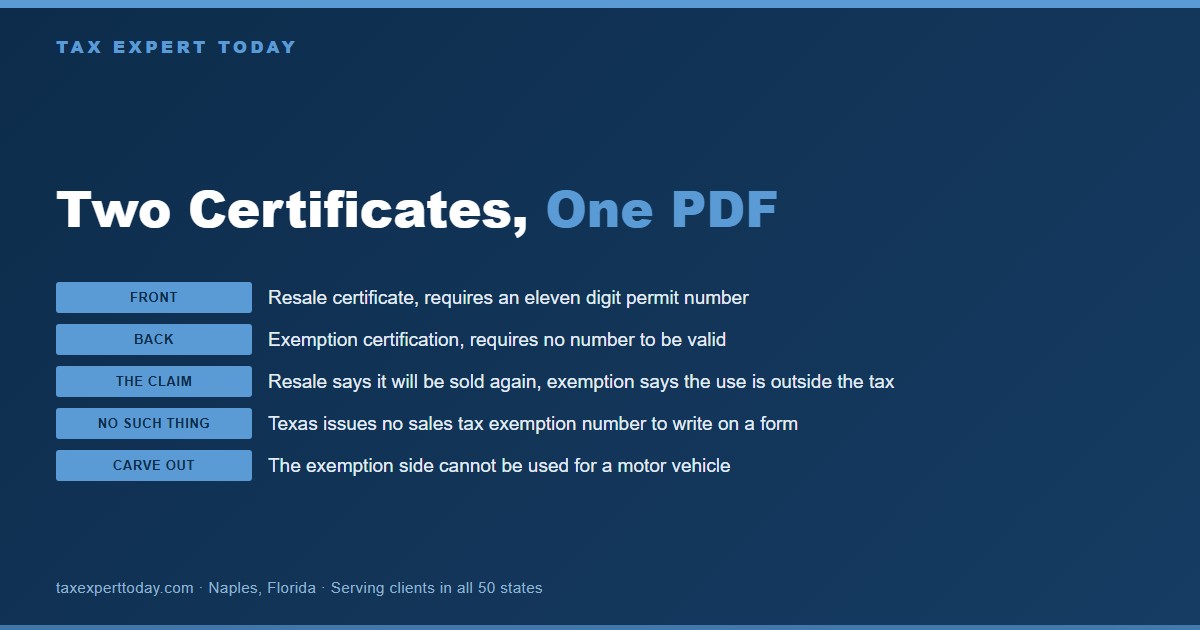
No. They are two different certificates printed on two sides of the same PDF. The front of Form 01-339 is the resale certificate and requires a permit number. The back is the exemption certification, which the form states does not require a number to be valid and cannot be used for a motor vehicle purchase, lease, or rental.
This single design decision produces a steady stream of errors. Because both documents live inside one file, businesses download Form 01-339, complete whichever side they happen to land on, and send it to the supplier. A wholesaler receiving an exemption certification from an ordinary retail buyer has been given the wrong document, and if the wholesaler files it and moves on, the sale is unsupported.
The two certificates also rest on different logic. A resale claim says the item will be sold again, so tax will be collected downstream from the final consumer. An exemption claim says this particular buyer or this particular use is outside the tax entirely, which is why a nonprofit, a government body, or a qualifying manufacturer uses the reverse side. The Comptroller guidance for nonprofit and exempt organizations covers that second route.
One line on the back of the form deserves to be quoted in full because it contradicts something many businesses believe they possess. The form states that sales and use tax exemption numbers, or tax exempt numbers, do not exist. There is no Texas issued exemption number to write on a certificate, and a supplier asking for one is asking for something the state does not produce.
| Feature | Resale certificate (front) | Exemption certification (back) |
|---|---|---|
| What it claims | The item will be resold, leased, or rented | The buyer or the use is exempt from tax |
| Permit number | Required, eleven digits | Not required, and no exemption number exists |
| Typical issuer | Retailer, wholesaler, or equipment lessor | Nonprofit, government body, qualifying manufacturer |
| Business activity description | Required on the form | Reason for exemption required instead |
| Motor vehicles | Handled under separate motor vehicle tax rules | Expressly cannot be issued for purchase, lease, or rental |
| Later use for another purpose | Use tax on purchase price or fair market rental value | Use tax where the use is not the exempt one claimed |
What Makes a Texas Resale Certificate Valid?
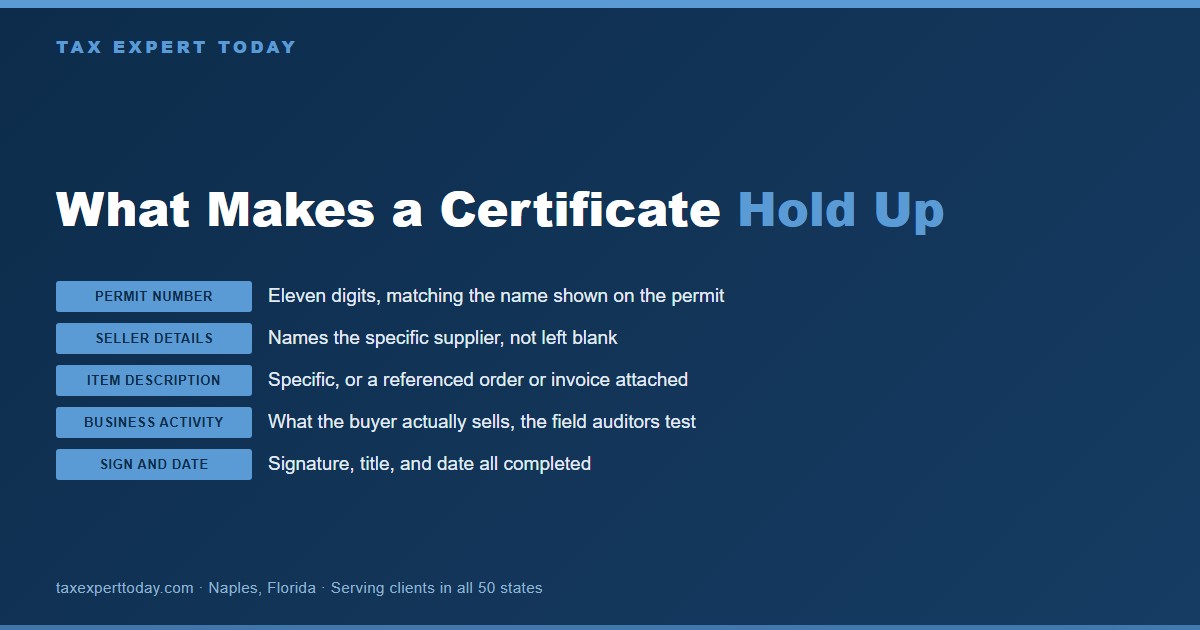
A properly completed certificate carries the buyer name as shown on the permit, address and phone, the eleven digit permit number, the seller name and address, a description of the items being bought, and a description of the type of business the buyer conducts. It also needs a signature, a title, and a date. Missing fields are what auditors find.
The field that fails most often is the description of the type of business activity generally engaged in, or the type of items normally sold by the purchaser. Buyers treat it as a formality and write a company name, a two word summary, or nothing at all. It is not a formality. It is the field that lets the seller carry out the review the Comptroller expects, because without knowing what the buyer sells, no seller can judge whether the items on the invoice are plausibly for resale.
The description of items matters for the same reason. A certificate that says goods, or products, or various supplies, gives an auditor nothing to test the transaction against. A certificate can properly reference an attached order or invoice, which is often the cleanest approach for businesses with wide product lines, and the form expressly contemplates that.
| Field on Form 01-339 | Requirement | Common defect |
|---|---|---|
| Purchaser name | As shown on the sales tax permit | A trading name that does not match the permit |
| Texas permit number | Eleven digits | Blank, a federal EIN, or a truncated number |
| Out of state or Mexico number | Registration number, plus Mexico form copy | Left blank by a buyer with no Texas permit |
| Seller name and address | Identifies the specific supplier | Blank, which makes the certificate non specific |
| Description of items | Specific, or a referenced order or invoice | Vague catch all wording such as goods or supplies |
| Description of business activity | What the buyer sells or does | Blank or a company name repeated |
| Signature, title, date | All three completed | Undated certificates and missing titles |
One further point closes off a widespread shortcut. The Comptroller states directly that although resale certificates require the purchaser Texas taxpayer number, the customer sales tax permit number, or a copy of the customer permit, is not a substitute for a resale certificate and does not relieve the seller responsibility for collecting sales tax. Keeping a photocopy of a customer permit on file is not the same as holding a certificate, and a seller who has built a compliance process around collecting permit copies has built the wrong process.
What Is the Good Faith Standard for Accepting a Certificate?
A seller must make sure the certificate is properly completed, note the general character of the buyer business, and question the certificate where the property would not normally be resold by a business of that type. A seller may not accept a certificate if the seller knows, or has reason to believe, the property is being bought for something other than resale.
This is the standard that decides which party ends up paying, and it is the single largest gap in the published guidance on this topic. Accepting a certificate is not a clerical act. It carries a duty of inquiry, and the duty is proportionate to how obviously wrong the transaction looks.
The Comptroller illustrates it with an example worth keeping in mind, because it is deliberately unsubtle. A seller should not accept a resale certificate describing the buyer business as a service station for the purchase of a sofa, or any other item a service station does not regularly sell. The example is easy. Real transactions are not, which is exactly why the business activity description on the form is not optional. It is the only information the seller has with which to run this test.
Notice what the standard does not require. It does not require a seller to audit the buyer, verify how goods were eventually used, or follow up after the sale. It requires attention at the point of acceptance. A seller who looked at the certificate, saw a coherent business description, and sold goods consistent with that description has met the standard even if the buyer later diverted the goods. A seller who never looked has not.
- Completeness is checked by the seller, not the buyer. The obligation to make sure the certificate is properly completed sits with the party accepting it.
- The business description drives the review. Without it the seller cannot form a view on whether the items would normally be resold, which is precisely the test.
- Reason to believe is an objective standard. A seller does not escape it by declining to ask an obvious question.
- Permit status can be checked. The Comptroller operates a sales tax permit search, and confirming an active permit is a cheap step in a recurring relationship.
- Consistency over time matters. A buyer whose orders drift steadily away from the stated business is a pattern a reviewer will spot later.
For sellers with meaningful volume, the practical answer is a process rather than a judgment call on each invoice. Certificates collected before the first untaxed sale, fields checked against a short list, the business description compared with the product being shipped, and the file kept somewhere it can actually be retrieved four years later.
When Can a Seller Accept a Blanket Resale Certificate?
A certificate is generally required for each purchase, with one exception. Where a customer buys exclusively for resale, the seller can accept a blanket resale certificate, and that certificate should state that all purchases will be resold in the regular course of business. The exclusivity condition is the whole of the exception.
Blanket certificates are the normal arrangement between wholesalers and their trade customers, and they are also where a compliant file quietly turns into a defective one. The condition attaches to the customer, not to the paperwork. A blanket certificate is appropriate while the customer buys only for resale from that supplier. It stops being appropriate the moment the relationship changes, and the change is usually invisible from the supplier side.
The common pattern runs like this. A retailer sets up a blanket certificate with a wholesaler and buys stock under it for several years. The retailer then starts buying its own shop fittings, its packaging, or equipment for its own use from the same supplier, because the supplier is convenient and the account already exists. Those purchases are not for resale, the blanket certificate does not cover them, and neither party notices until an auditor compares invoice descriptions against the certificate on file.
- Exclusivity is the trigger, not convenience. A blanket certificate is available because the customer buys only for resale, not because issuing certificates repeatedly is tiresome.
- The wording is specific. The certificate should state that all purchases will be resold in the regular course of business.
- Mixed invoices break it. Where an order contains both resale and own use items, the buyer must tell the vendor which is which, and the vendor must collect on the rest.
- A stale certificate is a weak certificate. Nothing in the rules sets an expiration date, and a certificate signed years ago against a business that has since changed shape is harder to defend.
- Review beats renewal paperwork. Periodically comparing what a blanket customer actually buys against what the certificate claims is the check that matters.
What Happens If You Use Inventory You Bought Tax Free?
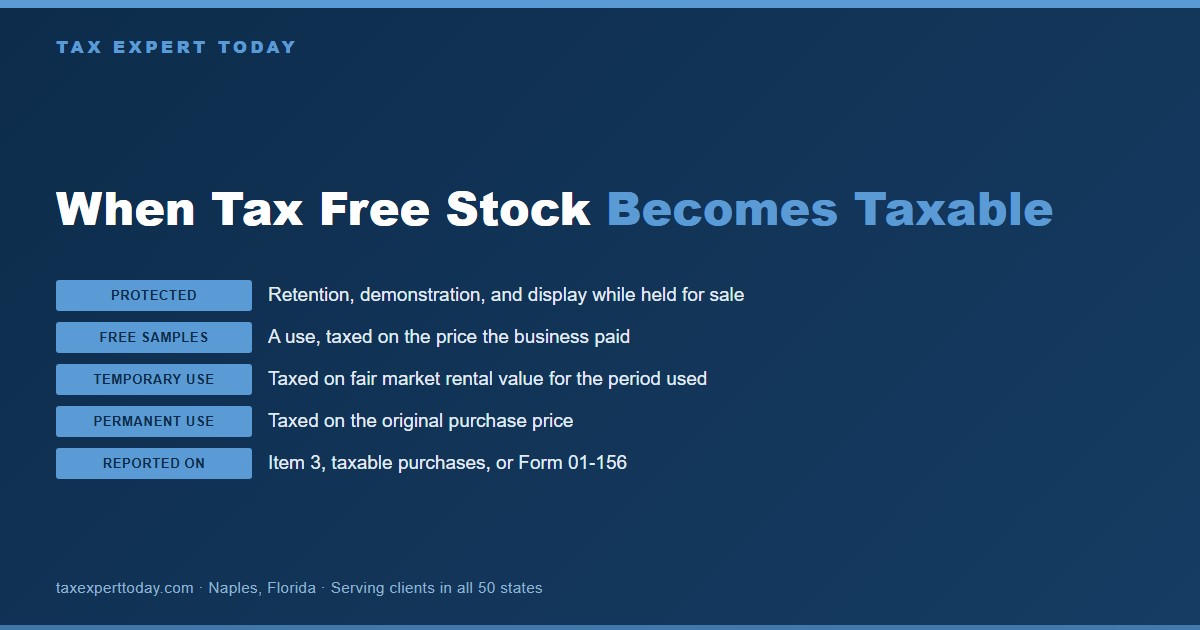
Tax comes back on the buyer. Where merchandise bought under a Texas resale certificate is used rather than resold, the buyer owes tax measured on either the purchase price or the fair market rental value for the period of use. Retention, demonstration, and display while holding items for sale do not count as use.
This is the divergent use rule, and it is the buyer side counterpart to the seller good faith standard. The buyer signs an acknowledgment of it on the face of Form 01-339, in language stating that if the buyer makes any use of the items other than retention, demonstration, or display while holding them for sale, lease, or rental, the buyer must pay sales tax at the time of use based on either the purchase price or the fair market rental value for the period of time used.
Two things make this rule expensive in practice. The first is that the safe harbor is narrower than it sounds. Holding stock, showing it to a customer, and putting it on display are protected. Handing it out is not, and the Comptroller says so directly: using merchandise for display or demonstration before it is sold is not subject to use tax, but providing free samples to customers is a use, and tax is owed on what the business paid for the samples. A marketing program built on giveaways from resale stock creates a running liability.
The second is the measurement choice. The Comptroller allows tax on the purchase price or on the fair market rental value for the period of use, and those produce very different numbers. Pulling a broom out of inventory to sweep the shop, to use the Comptroller own illustration, is not a purchase price event if the item goes back into stock. Equipment taken permanently into business use is.
| What the business does with resale stock | Use tax? | Measure |
|---|---|---|
| Holds it in inventory awaiting sale | No | Retention is expressly protected |
| Demonstrates it to a customer, then sells it | No | Demonstration is expressly protected |
| Puts it on display in the showroom | No | Display is expressly protected |
| Uses it briefly in the business, then resells it | Yes | Fair market rental value for the period of use |
| Takes it permanently into business use | Yes | Purchase price |
| Gives it away as a free sample | Yes | Purchase price paid for the samples |
| Takes it home for personal use | Yes | Purchase price |
Reporting is straightforward once the liability is identified. A business holding a permit reports the amount in Item 3, taxable purchases, on its Texas sales and use tax return. A purchaser without a permit reports on Form 01-156, the Texas Use Tax Return, and files by January 20 of the following year where less than $1,000 of use tax is owed, or by the twentieth of the month after the month in which $1,000 is reached. The rate is the same as sales tax, 6.25 percent at state level with local jurisdictions adding up to 2 percent for a maximum combined rate of 8.25 percent.
How Long Must You Keep Texas Resale Certificates?
Four years. Sales and use tax records must be kept for at least four years unless the Comptroller gives written authorization for earlier destruction, and accepted resale certificates are part of that record. Where an audit is under way, records for the audited period are held until the audit, and any appeal or refund claim, is resolved.
The retention rule is where good practice on the front end either pays off or turns out to have been pointless. A seller can perform a flawless good faith review at the point of sale and still lose the assessment four years later, for the ordinary reason that nobody can find the certificate. The Comptroller position on that outcome is unambiguous and worth reading twice: keep the resale or exemption certificates accepted as proof of why tax was not collected on a particular sale, because if those records are not kept, the sales will be presumed taxable in an audit. The same retention and good faith rules govern the other side of Form 01-339, which our guide to the Texas sales tax exemption certificate covers for exempt organizations and agricultural buyers.
Presumed taxable is a heavy phrase. It means the burden has moved. The transaction is treated as a taxable sale on which tax was not collected, and it is the seller job to displace that treatment. Producing a certificate does it. Explaining that a certificate once existed does not.
The consequences of thin records reach further than a single transaction. Failure to keep or provide records can lead the Comptroller to estimate the tax liability, or to suspend the sales tax permit issued to the business. An estimate built by someone else, from partial information, is rarely favorable, and challenging one costs more than keeping the file would have.
- Four years is a floor, not a target. The clock runs on the transaction, so a certificate supporting a long relationship needs to cover every year in the period under review.
- An audit freezes the clock. Records for the period being examined are retained through the audit and through any appeal or refund claim.
- Retrievable counts, stored does not. A certificate in an unsearchable archive is functionally a missing certificate when an auditor gives a deadline.
- Blanket certificates need the same discipline. One document supporting years of untaxed sales is a concentration of risk, not a reduction of it.
- Missing records invite estimation. The alternative to the taxpayer records is the Comptroller estimate of what the liability should have been.
What Happens to Unsupported Certificates in a Texas Audit?
The sale is treated as taxable and the assessment lands on the seller. An untaxed sale with no valid certificate behind it has no support, so the Comptroller treats it as a sale on which tax should have been collected. Interest runs from the original due date, and the seller right to recover from the customer is a commercial question, not a tax one.
This is the point of the whole exercise, and it is why a Texas resale certificate is best understood as an audit document rather than a purchasing convenience. Sales tax examinations do not usually turn on whether a business understood the law. They turn on whether the file supports what the returns claimed. Our guide to the Texas Comptroller audit process explains the 90 day window for producing missing certificates after a contest is filed, and why certificates gathered once fieldwork begins face verification.
The economics are unforgiving because of the direction of the liability. A seller who did not collect tax has nothing set aside. The assessment is paid from current cash, on transactions that may be three or four years old, against customers who may no longer trade with the business, may no longer exist, or may simply decline to reimburse. Recovering the tax from the buyer afterwards is a contractual matter between the parties, and a Texas assessment does not wait for it to be resolved.
Businesses facing an examination should also be clear about what the Comptroller can do where records are thin. Estimation of the liability and suspension of the permit are both available, and neither is a remote possibility reserved for extreme cases. Our resolution and audit support services cover the examination process, and businesses that reached this point through a change in filing obligations often need to revisit Texas sales tax nexus at the same time. Southwest Florida businesses can also start with our Naples tax resolution practice.
| What the file shows | Likely audit result | Who pays |
|---|---|---|
| Complete, properly filled certificate on file | Sale supported as a resale | Nobody, on that transaction |
| Certificate on file but key fields blank | Support challenged, facts examined | Seller, where the defect is not cured |
| Only a copy of the customer permit | Not a substitute for a certificate | Seller |
| No certificate produced | Sale presumed taxable | Seller |
| Certificate accepted against an implausible business | Good faith acceptance challenged | Seller |
| Valid certificate, buyer later used the goods | Divergent use assessed on the buyer | Buyer |
| Records missing across the period | Liability may be estimated, permit may be suspended | Seller |
What Are the Penalties for Misusing a Texas Resale Certificate?
Beyond the tax itself, misuse is a criminal offense in Texas, and the grade rises with the amount of tax evaded. It runs from a Class C misdemeanor below $20 through to a felony of the second degree at $20,000 or more. The buyer signs an acknowledgment of this exposure on the face of the form.
Most owners are unaware of this schedule, partly because the buyer facing guidance rarely mentions it and partly because the acknowledgment sits in small print on a form people complete quickly. The wording on Form 01-339 is explicit. The buyer states an understanding that it is a criminal offense to give a resale certificate to a seller for taxable items that the buyer knows, at the time of purchase, are being bought for use rather than for resale, lease, or rental.
The word carrying the weight is knows. This schedule addresses deliberate misuse at the moment of purchase, not the honest divergent use that happens when plans change after the fact. A business that genuinely intended to resell an item and later took it into service owes use tax under the rule described above. A business that issued a certificate for something it always intended to keep is in a different category.
| Tax evaded by the invalid certificate | Offense grade |
|---|---|
| Less than $20 | Class C misdemeanor |
| $20 or more but less than $200 | Class B misdemeanor |
| $200 or more but less than $750 | Class A misdemeanor |
| $750 or more but less than $20,000 | Felony of the third degree |
| $20,000 or more | Felony of the second degree |
The practical lesson is not that ordinary businesses face prosecution. It is that the thresholds are low. Tax of $750 corresponds to roughly $9,000 of purchases at the 8.25 percent combined rate, which is a modest amount of equipment. Treating certificate discipline as an administrative nicety understates what the state has attached to it.
Can You Use a Texas Resale Certificate for Sales Outside Texas?
Within limits. The form states that items bought under it will be resold, rented, or leased within the United States, its territories and possessions, or within the United Mexican States, either in their present form or attached to other taxable items to be sold. Resale destined for any other country falls outside the certificate.
The geographic scope surprises exporters, because it is broader than Texas and narrower than the world. Goods bought in Texas for resale in another state are covered, which is the ordinary case for a distributor with customers across the country. Goods bought for resale in Mexico are covered as well, which reflects the volume of trade along the border. Goods bought for resale in Canada, or in Europe, or in Asia, are not.
Businesses in that last position are not without options, because Texas has separate rules for items shipped out of the country, and those rules turn on export documentation rather than on a resale claim. The point for present purposes is narrower. A resale certificate is the wrong instrument for that transaction, and using it anyway produces an unsupported sale of exactly the kind described above.
| Where the goods will be resold | Resale certificate covers it? |
|---|---|
| Texas | Yes |
| Another United States state | Yes |
| United States territories and possessions | Yes |
| Mexico | Yes, with the Mexico registration form copy where the buyer is a Mexican retailer |
| Canada or any other country | No, the export rules apply instead |
Multistate sellers should also keep in mind that a Texas certificate answers only the Texas question. Where a business has registration obligations in several states, each state has its own certificate, its own acceptance standard, and its own retention period, and a Texas form does not travel. That coordination problem is the usual reason a growing business moves from handling this internally to handling it with advisors.
Texas Resale Certificate Help in Naples & Southwest Florida
Tax Expert Today LLC advises business owners on state and federal tax matters nationwide from our office in Naples, Florida. Texas sales tax work reaches us from two directions. Florida owners who sell into Texas or hold a Texas entity and now carry a collection obligation there, and Texas owners who have relocated to Southwest Florida and still operate the original business. Owners in that second group frequently arrive having already worked through how to establish Texas residency for themselves while leaving the business registered where it started. Both groups arrive with the same question, which is whether the certificate file behind their untaxed sales would survive review.
Our work on these engagements is documentary. We reconstruct which sales were treated as exempt, test the certificates supporting them against the completeness and good faith standards, identify divergent use exposure on the purchasing side, and set up a process the business can actually run afterwards. Where an examination is already open, the sequence changes and the exposure assessment comes first.
- Texas sales tax help Naples business owners can reach in person. Our office is on Tamiami Trail North and we meet clients locally as well as remotely.
- Resale certificate review delivered remotely. We work with clients in all 50 states, and the Texas analysis is the same regardless of where the owner now lives.
- Multistate certificate management. Businesses registered in several states need a process that accounts for each state rules rather than one template applied everywhere.
- Purchasing side exposure as well as selling side. Divergent use liability is frequently larger than owners expect, and it is assessed against the buyer.
Related services include our Texas tax services and our business consulting practice for owners building out a compliance function. Southwest Florida businesses can also review our Naples tax planning work.
Tax Expert Today LLC
11983 Tamiami Trail N, Naples, FL 34110
Phone: (239) 441-2005
Hours: Monday through Friday, 10:00 a.m. to 5:00 p.m. ET
Local question we are asked often: A Naples business sells equipment to Texas customers and has been accepting resale certificates by email for years without checking them. Is that a problem? Usually yes, and the problem is rarely the email. It is that nobody confirmed the permit numbers had eleven digits, nobody completed the business activity field, and nobody can now locate certificates for the earliest years. Each of those is a separate defect, and the first two are fixable going forward while the third is not. The practical starting point is a sample review of recent untaxed sales to size the exposure before deciding what to do about it.
When Should You Engage a Professional?
A single business with one supplier relationship and a tidy file does not need advisors to handle a Texas resale certificate. Several situations move the work out of that category, and each of them turns on the size of the exposure rather than on the difficulty of the form.
- You accept certificates at volume. Where untaxed sales are a meaningful share of revenue, the aggregate exposure justifies a process rather than a habit.
- Your certificate file has gaps. Missing certificates cannot be created retrospectively with any credibility, so the exposure needs sizing before anyone contacts the state.
- You are already under examination. The order of work changes once an audit is open, and steps taken without advice can narrow the options available later.
- You buy on certificates and also consume stock. Divergent use liability accumulates quietly and is assessed on the buyer, not the supplier.
- You sell into several states. Each state has its own certificate rules, and a single template applied everywhere fails in most of them.
- Your business model changed. A blanket certificate written for a purely resale relationship does not follow a business that has started buying for its own use.
Our team includes tax advisors, enrolled agents, CPAs, and attorneys, and we work the Texas state analysis and the federal position together rather than in isolation. Businesses closing down rather than continuing should also review our guide to closing a business in Texas, which covers the final sales tax return and the inventory left on hand, and owners weighing the wider Texas picture can start with Texas franchise tax and the reality behind no state income tax. Businesses with employees in the state should also review Texas payroll taxes, and owners comparing the two states can read Texas versus Florida taxes. To discuss a Texas resale certificate review, call (239) 441-2005 for a free consultation.
Frequently Asked Questions
How do I get a Texas resale certificate?
You do not apply for one. Unlike a permit, a resale certificate is not issued by the state. You download Form 01-339 from the Comptroller, complete it with your permit number and business details, and give it to your supplier. The step that does require an application is the underlying sales and use tax permit, which you obtain through the Comptroller online registration system or on Form AP-201.
How much does a Texas resale certificate cost?
Nothing. The form is a free download and the state charges no fee for it. The underlying sales and use tax permit is also free, although the Comptroller may require a security bond in some circumstances. Businesses are sometimes charged by third party services for obtaining documents that the Comptroller provides at no cost.
Is a resale certificate required in Texas?
It is required if you want to buy inventory without paying sales tax, and it is required from the seller side as the evidence supporting an untaxed sale. Nothing compels a business to use one. A buyer can pay the tax at purchase, and in some cases that is the simpler outcome. What is not available is buying tax free without a certificate.
Does a Texas resale certificate expire?
The form carries no expiration date. A blanket certificate remains effective while the customer continues to buy exclusively for resale, which means the practical life of the document depends on the relationship rather than on a date. A certificate that no longer describes what the customer actually buys is weak support regardless of how recently it was signed.
Can I use my sales tax permit number instead of a certificate?
No. The Comptroller states directly that a customer permit number, or a copy of the customer permit, is not a substitute for a resale certificate and does not relieve the seller responsibility for collecting sales tax. Sellers who have built their process around collecting permit copies are holding the wrong document.
What happens if I use something I bought with a resale certificate?
You owe tax on it. The measure is either the purchase price or the fair market rental value for the period of use, depending on whether the item was taken permanently into the business or used temporarily. Retention, demonstration, and display while holding goods for sale are not treated as use. Giving items away as free samples is.
Who pays if a resale certificate turns out to be invalid?
Generally the seller who accepted it. An untaxed sale without valid support is treated as a taxable sale, and the assessment falls on the business that failed to collect. Recovering the amount from the customer afterwards is a commercial matter between the parties and does not affect what is owed to the state.
This article is general tax information and does not constitute tax, legal, or accounting advice for any particular situation. State and federal tax rules change and their application depends on specific facts. Consult a qualified professional regarding your circumstances before acting.
Published August 31, 2026 by Dr. Pellumb Kabashi « Back to Learning Center
Have a question this article touches on?
Tax Expert Today LLC, based in Naples, Florida and serving clients across the United States.
Schedule a Consultation (239) 441-2005