
By Dr. Pellumb Kabashi, DBA, MBA, CES, CFE, EA
Founder, Tax Expert Today LLC · Tax advisors, enrolled agents, CPAs, and attorneys · Serving clients in all 50 states
Quick Answer: The Texas nexus questionnaire is Comptroller Form AP-114, which asks a business formed outside Texas when it first had physical presence in Texas and whether its Texas gross receipts reached $500,000. Those answers set the date franchise tax responsibility began and the first report due date, so a business with years of unreported Texas activity should review its exposure before it signs. Call (239) 441-2005 for a free consultation.
Search for the Texas nexus questionnaire and almost every result offers the same thing: a blank copy of Form AP-114. The Comptroller posts the PDF, form libraries republish it, and fillable PDF services offer to complete it online. A business that receives a letter asking it to complete the questionnaire can find the form in seconds. What it cannot easily find is an explanation of what the answers do once they reach Austin, and that is the part that decides how much the business may owe.
The short version is that the Texas nexus questionnaire is the Comptroller’s tool for deciding when a business formed outside Texas began doing business in Texas. That date is the franchise tax beginning date. It decides which annual reports the business should have filed, when the first one was due, and therefore which periods the Comptroller can now assess. For a business that started selling into Texas last month, the questionnaire is routine paperwork that sets up an account. For a business that has had employees, inventory, contractors or $500,000 of Texas receipts for several years without filing, the questionnaire is a disclosure of every one of those unfiled years, and Texas law places no time limit on assessing a year for which no report was filed.
This guide is organized around that mechanism. It explains who receives the questionnaire and why, walks through what Form AP-114 actually asks, sets out the physical presence and economic nexus tests that the answers are measured against, and then follows the answers forward into the beginning date, the lookback period, penalties, and the voluntary disclosure alternative. It covers the Texas franchise tax only. Sales and use tax nexus is a separate test with its own thresholds, which we explain in our guide to Texas sales tax nexus, and the mechanics of computing and filing the franchise tax itself are in our guide to the Texas franchise tax.
What Is the Texas Nexus Questionnaire (Form AP-114)?
The Texas nexus questionnaire is Comptroller Form AP-114, a two page form that asks a business organized outside Texas to describe its Texas activities, give the earliest date it had physical presence in Texas, and state whether its Texas gross receipts reached $500,000. The Comptroller uses the answers to decide whether and when franchise tax responsibility began.
- A franchise tax form. AP-114 is filed with the Comptroller’s franchise tax function, not with the Texas Secretary of State and not with the sales tax registration unit.
- Aimed at non-Texas entities. Texas entities have a beginning date fixed by their formation documents, so the questionnaire matters most for businesses formed in another state or country.
- Signed under a declaration. The preparer declares that the information is true and correct to the best of their knowledge and belief.
- The source of the beginning date. The answers to items 12 and 13 are what the Comptroller uses to set the date the business first became responsible for the tax.
The current version of Form AP-114 carries revision date 4-21/19, which places it just after the Comptroller adopted economic nexus for the franchise tax. That timing is visible on the form itself: item 13a asks directly whether the entity will exceed $500,000 in gross receipts from business done in Texas, and item 13b asks for the start date of any federal income tax accounting period in which it did. Those two items did not exist before economic nexus, and they are the items most likely to surprise a business that has never had an office, employee or warehouse in Texas.
The form is titled simply Texas Nexus Questionnaire. It is returned by mail to the Comptroller at P.O. Box 149348 in Austin, and it directs readers to Rule 3.586 for further detail on what counts as physical presence. That cross reference is the key to reading the form correctly. The form is a short checklist, while the rule is the legal standard the checklist summarizes, and the rule is broader than the checklist in several places.
The franchise tax itself is imposed by Tax Code Section 171.001 on each taxable entity that does business in Texas or that is chartered or organized in Texas. Subsection (b) adds that the tax extends to the limits of the United States Constitution and the federal law adopted under it. In practical terms, Texas asserts franchise tax nexus as far as the Constitution allows, and the questionnaire is the mechanism the Comptroller uses to find out whether a particular out of state business has crossed that line.
Why Does the Comptroller Send a Texas Nexus Questionnaire?
The Comptroller sends a Texas nexus questionnaire when it has information suggesting that a business may be doing business in Texas but has no franchise tax account or no confirmed beginning date. Common triggers include a new registration with the Texas Secretary of State, a sales tax permit, and information from other agencies or sources.
- Secretary of State registration. A foreign entity that registers to transact business in Texas generates an account and a request for information.
- A sales or use tax permit. A Texas use tax permit creates a presumption of franchise tax nexus under Rule 3.586(e).
- Information from other sources. The Comptroller states that it sets up accounts based on Secretary of State data and other sources.
- A clearance request. Businesses seeking account status or clearance letters may be asked to complete a questionnaire first.
The Comptroller’s Franchise Tax Accountability Questionnaire page describes the process plainly. The Comptroller sets up a franchise tax account for a business based on information from the Texas Secretary of State and other sources, and the questionnaire lets the business update that information. The page names three things the questionnaire establishes: a mailing address, the tax responsibility beginning date, and the first report due date for non-Texas entities. The last two are the substance. Everything else on the form supports them.
That framing explains why a questionnaire can arrive at a business that has never thought of itself as a Texas taxpayer. A Florida company that registered with the Texas Secretary of State because a Texas customer required it, or because it hired one remote employee in Houston, has given the state a record of its presence. A company that applied for a Texas sales tax permit because it sells products to Texas customers has given the Comptroller a second record. Either one can produce a franchise tax account with a blank beginning date, and the questionnaire is how the Comptroller fills it in.
It also explains why ignoring the questionnaire is rarely a sound choice. The account exists whether or not the business answers. If the business does not supply a beginning date, the Comptroller works from the information it already has, and unfiled reports for an open account carry their own consequences, which we cover below. A questionnaire is an opportunity to establish the correct date with documentation, and the correct date is often later, or more limited, than the one the Comptroller would assume.
Who Must File the Texas Nexus Questionnaire?
Newly registered Texas and non-Texas corporations, LLCs, limited partnerships and professional associations, plus any entity that received a Comptroller letter, complete the accountability questionnaire online. All other entities, Texas or non-Texas, file a paper questionnaire, which for most out of state businesses is Form AP-114. Banks and savings institutions use Form AP-223.
- Online filers. Entities newly registered with the Secretary of State, and any entity that received a letter, use the Webfile number printed on the letter.
- Paper filers. All other entities complete and mail the paper questionnaire.
- Banks. State and federal banks, savings banks and savings and loans use Form AP-223, the Bank Nexus Questionnaire.
- Self-identified filers. A business that concludes on its own that it has Texas nexus can file the questionnaire to establish its account.
The online route is described on the Comptroller’s questionnaire page. Texas corporations, LLCs, limited partnerships and professional associations newly registered with the Texas Secretary of State, non-Texas corporations and LLCs newly registered with the Secretary of State, and any other entity that received a letter by mail from the Comptroller must complete the questionnaire online. The letter contains a Texas taxpayer number and a Webfile number beginning with FQ followed by six digits. Those two numbers are what the business enters after logging in to the Comptroller’s eSystems portal.
Everyone else uses paper. The page states that all other entities, whether Texas or non-Texas, must complete and submit a paper questionnaire. For a corporation, LLC, partnership, trust or similar entity formed outside Texas, the paper version is Form AP-114. Financial institutions use a separate form. Form AP-223, the Bank Nexus Questionnaire, applies to state banks, federal banks, savings banks, savings and loans and foreign country banks, and it asks about Texas activities during the last seven years.
| Situation | Questionnaire route | What the business needs |
|---|---|---|
| Non-Texas corporation or LLC newly registered with the Texas Secretary of State | Online accountability questionnaire | Texas taxpayer number and FQ Webfile number from the Comptroller letter |
| Any entity that received a Comptroller letter asking for the questionnaire | Online accountability questionnaire | The letter, a Webfile eSystems profile, and the activity history |
| Non-Texas entity with no letter and no recent registration | Paper Form AP-114 | The completed form mailed to P.O. Box 149348, Austin |
| Bank, savings bank or savings and loan | Paper Form AP-223 | Activity history for the last seven years |
| Texas entity newly formed with the Secretary of State | Online accountability questionnaire | The beginning date is the effective date of the charter |
The online questionnaire and the paper AP-114 collect the same core facts, and the legal tests behind them are identical. The difference is mechanical. The online version is tied to an account the Comptroller has already opened, while a paper AP-114 can be the document that opens one. A business that has decided on its own that it owes Texas franchise tax, and that has not been contacted, is in a different strategic position from a business responding to a letter, and that difference is the subject of the voluntary disclosure section later in this guide.
What Does Form AP-114 Ask, Item by Item?
Form AP-114 asks for identifying information, the entity type and formation details, existing Texas permits, a description of Texas business activities, the earliest date of physical presence in Texas, whether Texas gross receipts exceed $500,000 and from when, any nexus end date, and owner information for partnerships and joint ventures.
- Items 1 to 9: name, FEIN, addresses, contact details, organization structure, state of formation, Secretary of State file number and NAICS code.
- Item 10: Texas permits already held and any combined group reporting entity.
- Items 11 and 12: the activity description and the physical presence checklist with start dates.
- Items 13 to 15: the $500,000 test, the nexus end date, and owners with 10 percent or more.
Reading the form item by item shows where the decisions are. Most of the first page is identification, and a business can complete it from its formation documents. The weight sits in items 11 through 14, which ask the business to describe what it does in Texas and to put a date on when it began. The table below summarizes each item and the question a careful preparer should ask before answering it.
| AP-114 item | What it asks | What to check before answering |
|---|---|---|
| 1 to 5 | Entity name, FEIN, mailing address, contact person, phone, email and website | Use the legal name exactly as formed; the website can itself show Texas marketing or service areas |
| 6 | Organization structure, such as corporation, LLC, partnership or business trust | Nexus is tested entity by entity, so each affiliate answers separately |
| 7 and 8 | State or country of formation, formation date, Texas Secretary of State file number | A Secretary of State registration date is evidence, not proof, of when Texas activity began |
| 9 | NAICS code | The code should match the federal return and the actual business |
| 10a | Tax permits or licenses issued by the Comptroller | A use tax permit triggers the presumption of nexus in Rule 3.586(e) |
| 10b | Reporting entity taxpayer number if included in a combined group | Confirm whether the entity belongs in a Texas combined report |
| 11 | Description of Texas business activities | Describe what actually happened, in the terms Rule 3.586 uses |
| 12 | Earliest date of physical presence in Texas, with a checklist of activities | Build a dated activity timeline first; this date can open years of reports |
| 13a and 13b | Whether Texas gross receipts exceed $500,000, and the start of the first such accounting period | Source receipts under Rule 3.591(e) and (f), period by period |
| 14 | Reason nexus ended and the last date of Texas activity | Supporting documents; a final report is due within 60 days of ceasing nexus |
| 15 | Members, general partners and limited partners with 10 percent or more | Each owner may have its own nexus question to answer |
Item 12 deserves particular care. The form asks for the earliest date the entity had a physical presence in Texas and lists examples, including a place of business, real or personal property, employees or independent representatives, inventory, providing a service, performing a contract, delivery and transportation, solicitation, warranty work, holding company activities, acting as a general partner, shows and sporting events, advertising, federal enclaves, franchising, and managing or operating the business from Texas. Each activity has its own start date box. The instruction says the examples include but are not limited to those items, and it points to Rule 3.586 for further details.
Item 13 is the economic nexus question. It asks first whether the entity will exceed $500,000 in gross receipts from business done in Texas, and then, if the answer is yes, for the start date of any federal income tax accounting period in which Texas gross receipts exceeded $500,000. The wording on the form says exceed, while the rule says $500,000 or more, a small difference that matters only for a business sitting exactly on the line. The rule controls. A business answering item 13 is effectively being asked to look back across every accounting period since 2019 and identify the first one that crossed the threshold.
Item 14 runs the other way. It asks for the reason nexus ended and the last date of activity in Texas, and it asks for home state documents if the entity ceased to exist. A business that once had Texas activity and has since stopped can use this item to close the account properly, which we discuss in the section on businesses without current nexus.
What Counts as Physical Presence in Texas for Franchise Tax?
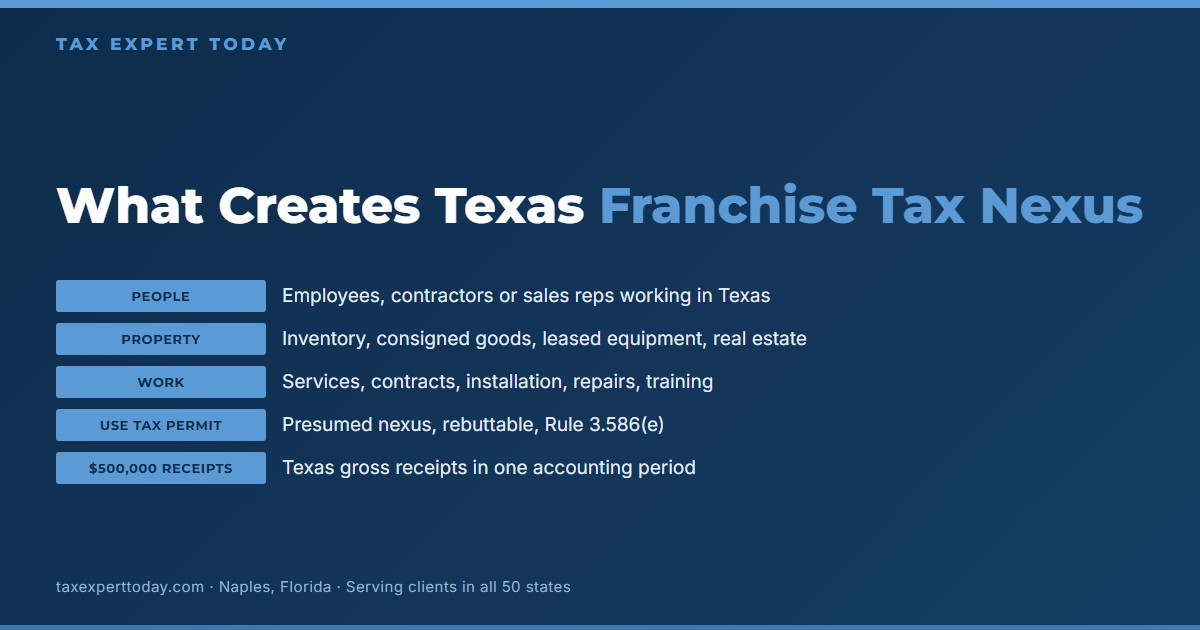
Physical presence for the Texas franchise tax is broad. Rule 3.586(d) lists 21 activities, including employees or representatives in Texas, inventory, delivering goods in company vehicles, performing services or contracts, solicitation, leasing property used in Texas, and even a telephone number answered in Texas. The list is illustrative, not exhaustive.
- People in Texas. Employees, independent contractors, agents or representatives doing the business of the entity, whether or not they live in Texas.
- Property in Texas. Inventory, consigned goods, leased equipment, real estate, or goods stored awaiting shipment.
- Work performed in Texas. Services, contracts, installation, repairs, warranty work, training, and technical assistance.
- Selling into Texas. Solicitation by representatives, delivery in the seller’s own vehicles, and franchising arrangements.
Rule 3.586(c) starts from a constitutional standard: a taxable entity is subject to the Texas franchise tax when it has sufficient contact with Texas to be taxed without violating the United States Constitution, and nexus is determined at the individual entity level. Subsection (d) then lists specific activities that subject an entity to the tax, introduced by the words include, but are not limited to. Form AP-114 condenses this list into its item 12 checklist, which is why the form tells the reader to consult the rule.
Several items on the rule’s list catch out of state businesses that would not describe themselves as operating in Texas. Services under subsection (d)(16) include providing any service in Texas regardless of whether the people performing it reside in Texas, maintaining or repairing property in Texas, installing or modifying property, conducting training classes or seminars, providing technical assistance including engineering services, and handling customer complaints in Texas. Solicitation under (d)(19) covers employees, contractors, agents or other representatives in Texas who promote sales, again regardless of residence. A telephone number answered in Texas appears as (d)(20).
| Category | Rule 3.586(d) activities | Typical out of state example |
|---|---|---|
| People | Employees or representatives (5); solicitation (19); loan production activities (11) | A remote sales employee living in Dallas, or a contractor calling on Texas customers |
| Property | Consignments (2); inventory (9); leasing (10); real estate (15); shipment (17) | Goods held in a Texas third party warehouse or marketplace fulfillment center |
| Work in Texas | Contracting (3); services (16), including repairs, installation, training and technical support | A Florida firm sending technicians to install or service equipment in Texas |
| Delivery and transport | Delivering (4); transportation (21) | Delivering sold goods into Texas in the company’s own trucks |
| Places | Place of business (13); processing (14); federal enclaves (6); telephone listing (20) | A small Texas office, a manufacturing step done in Texas, or work on a military base |
| Structure | Holding companies (8); partners (12); franchisors (7) | A general partner in a Texas partnership, or a franchisor with Texas franchisees |
| Events and promotion | Advertising (1); shows and performances (18) | Staging events in Texas, or entering Texas to place advertising for another business |
Two items narrow the reach rather than extend it. Under (d)(12)(B), a foreign entity that is a limited partner in a limited partnership does not have physical presence in Texas if that is its only connection with Texas. And subsection (h) points to Rule 3.583 for an exemption for certain trade show participants under Tax Code Section 171.084. Both are narrow, and neither helps a business whose people, property or services are in Texas for other reasons.
The practical lesson is that the physical presence question on the Texas nexus questionnaire is a factual history, not a yes or no box. Before answering item 12, a business should list every way it touched Texas, date each one, and match each to the rule. That timeline is what supports a beginning date the business can defend, and it frequently shows that the earliest qualifying activity is later than a casual reading of the form would suggest, or that an apparent activity, such as a single sales visit, has to be weighed against the constitutional standard rather than treated as automatic.
How Does the $500,000 Economic Nexus Test Work?
For each federal accounting period ending in 2019 or later, a foreign entity has Texas franchise tax nexus, even with no physical presence, if its gross receipts from business done in Texas reach $500,000 during that period. Receipts are sourced under Rule 3.591(e) and (f), and an amendment effective January 7, 2026 confirms the test applies regardless of apportionment method.
- Threshold: $500,000 or more of Texas gross receipts in a single federal income tax accounting period.
- Gross receipts: all revenue reportable on the federal return, with no deduction for cost of goods, materials, labor or other costs.
- Sourcing: the Texas apportionment sourcing rules in Rule 3.591(e) and (f) decide which receipts count as Texas receipts.
- Timing: nexus begins on the first day of the accounting period in which the threshold is met, not on the day it is crossed.
Economic nexus sits in Rule 3.586(f). Paragraph (1) provides that for each federal income tax accounting period ending in 2019 or later, a foreign taxable entity has nexus in Texas and is subject to franchise tax, even if it has no physical presence, if during that period it had gross receipts from business done in Texas of $500,000 or more, as sourced under Rule 3.591(e) and (f). Paragraph (2) defines gross receipts as all revenue reportable on the federal return, without deduction for the cost of property sold, materials used, labor performed or other costs.
The rule was amended again this year. The Comptroller proposed adding a paragraph (3) in the November 14, 2025 Texas Register and adopted it without changes in the January 2, 2026 Texas Register, effective January 7, 2026. The new paragraph states that the economic nexus threshold is based on gross receipts and applies to a foreign taxable entity that apportions its margin using a method other than gross receipts, such as the methods described in Rule 3.591(c)(1) or (2). The effect is to close an argument that an entity using a special apportionment method could measure the threshold some other way. Every foreign entity measures the $500,000 line using gross receipts sourced to Texas.
The timing rule is where economic nexus produces results that surprise owners. Under Rule 3.586(g)(2)(C), a foreign entity that meets the threshold begins doing business in Texas on the first day of the federal accounting period ending in 2019 or later in which it had $500,000 or more of Texas gross receipts. A calendar year business that crosses $500,000 of Texas receipts in November is treated as having had nexus since January 1 of that year. That is why item 13b on the Texas nexus questionnaire asks for the start date of the accounting period rather than the date the threshold was reached.
| Feature | Physical presence nexus | Economic nexus |
|---|---|---|
| Source of the rule | Rule 3.586(d), 21 listed activities, not exhaustive | Rule 3.586(f), periods ending in 2019 or later |
| Trigger | Any qualifying activity in Texas | $500,000 or more of Texas gross receipts in one accounting period |
| Beginning date | The date the activity began, Rule 3.586(g)(2)(A) | The first day of the accounting period that met the threshold, Rule 3.586(g)(2)(C) |
| AP-114 item | Item 12 checklist with start dates | Items 13a and 13b |
| Apportionment method | Not relevant to the presence test | Gross receipts measure applies to every method, per paragraph (3) effective January 7, 2026 |
| Typical business affected | Firms with staff, inventory, crews or offices in Texas | Remote sellers, software and digital businesses, service firms with Texas customers |
Sourcing is the technical core of the test, and it is easy to get wrong. Texas sources receipts for franchise tax apportionment under its own rules in Rule 3.591, which differ by type of receipt. Sales of tangible personal property are generally sourced to Texas when delivered to a buyer in Texas, while receipts from services are generally sourced to the location where the service is performed, and receipts from intangibles and other categories have their own rules. A consulting firm with large Texas clients and all of its people in Florida may have much less Texas sourced revenue than its client list suggests, while a product seller shipping into Texas may cross the threshold faster than expected. This is the computation that should support any answer to item 13.
Economic nexus also interacts with the no tax due threshold, which is a different number for a different purpose. Crossing $500,000 of Texas receipts creates nexus and a filing responsibility. Whether any tax is due depends on total revenue against the no tax due threshold, which the Comptroller lists as $2,650,000 for report years 2026 and 2027, up from $2,470,000 for 2024 and 2025. A business can have nexus, file, and owe nothing. It cannot skip the filing simply because the tax would be zero.
Does Public Law 86-272 Protect a Business From the Texas Franchise Tax?
No. Public Law 86-272 bars states from imposing a net income tax on a business whose only in-state activity is soliciting orders for tangible goods approved and shipped from outside the state. The Comptroller’s position, stated in Rule 3.586(i), is that the federal law does not apply to the Texas franchise tax.
- What the federal law covers: net income taxes only, under 15 U.S.C. Section 381.
- What it protects: solicitation of orders for tangible personal property, approved and filled from outside the state.
- Why Texas says it does not apply: the franchise tax is measured on margin, and Rule 3.586(i) states plainly that Public Law 86-272 does not apply.
- Practical effect: a sales force that would be protected in an income tax state can create franchise tax nexus in Texas.
Public Law 86-272, codified at 15 U.S.C. Section 381, provides that no state may impose a net income tax on income derived within the state from interstate commerce if the only business activity in the state is the solicitation of orders for sales of tangible personal property, where the orders are sent outside the state for approval and filled by shipment from outside the state. For decades it has allowed manufacturers and distributors to send sales representatives into income tax states without owing those states income tax.
Texas takes a different view of its own tax. Texas has no personal income tax and no corporate income tax, as our guide to Texas no state income tax explains, and the franchise tax is what it relies on instead. Rule 3.586(i) states that Public Law 86-272 does not apply to the Texas franchise tax. The Texas tax is computed on margin, a measure built from total revenue less one of several deductions, rather than on net income. A manufacturer whose representatives only solicit orders in Texas therefore cannot rely on the federal protection the way it might in a state with a corporate income tax. Under the rule, solicitation by representatives in Texas is itself a listed physical presence activity.
Businesses that operate nationally sometimes complete the Texas nexus questionnaire using the same playbook they use for income tax states, reasoning that protected solicitation does not count. That approach can produce a wrong answer on item 12. If the representatives are in Texas promoting sales, the rule treats that as physical presence, and the beginning date is the date the activity began. A business that believes it has a sound position to the contrary should treat that as a legal question to evaluate before signing, not as a default assumption.
How Does a Texas Use Tax Permit Create a Nexus Presumption?
Under Rule 3.586(e), a foreign entity holding a Texas use tax permit is presumed to have franchise tax nexus. The presumption can be overcome, and the beginning date for a permit obtained on or after January 1, 2019 is the permit date, or January 1, 2019 for a permit obtained earlier, unless an earlier physical or economic nexus date applies.
- Who it affects: remote sellers that registered to collect Texas use tax.
- The presumption: holding the permit is treated as evidence of franchise tax nexus.
- Rebuttable: an entity can show it does not otherwise have nexus.
- If rebutted: the beginning date is set under the physical presence or economic nexus rules instead.
Rule 3.586(e) states that a foreign taxable entity with a Texas use tax permit is presumed to have nexus in Texas and is subject to the franchise tax. If the entity overcomes the presumption, its beginning date is determined under subsection (g)(2)(A), physical presence, or (g)(2)(C), economic nexus. Under (g)(2)(B), the permit itself sets the beginning date at the date the permit was obtained, if on or after January 1, 2019, or at January 1, 2019 if the permit was obtained before that date. The overall beginning date is the earliest of the three.
The presumption is the reason many remote sellers first hear about the franchise tax. A business that registers for a Texas sales and use tax permit, often because marketplace or economic nexus rules for sales tax require it, receives a franchise tax account as a consequence. Item 10a on Form AP-114 asks for exactly this information: any tax permits or licenses issued by the Comptroller. The two taxes have different nexus tests, and a business can meet the sales tax threshold without meeting the franchise tax threshold, but the permit shifts the burden. The business has to show why it does not have franchise tax nexus rather than the Comptroller having to show that it does.
For a remote seller below $500,000 of Texas receipts with no physical presence, the presumption is the main question on the questionnaire. Our guide to Texas sales tax nexus explains when the sales tax permit is required. The franchise tax analysis then asks whether anything other than the permit connects the business to Texas, and whether its Texas gross receipts, sourced under the franchise tax rules rather than the sales tax rules, have reached the economic nexus line in any period.
Why Does the Beginning Date on the Texas Nexus Questionnaire Matter So Much?
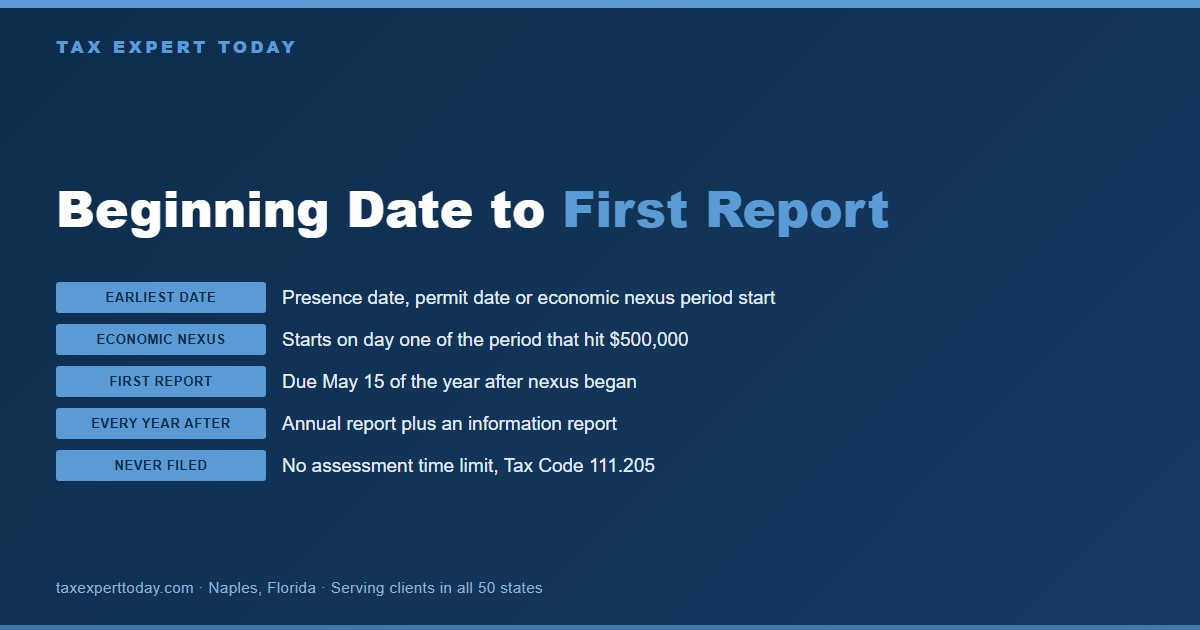
The beginning date decides when franchise tax responsibility started, which annual reports were due, and which periods the Comptroller can assess. A business that became subject to the tax during a calendar year owes its first annual report on May 15 of the following year, covering the period from the beginning date.
- Statutory definition: for a non-Texas entity, the date it begins doing business in Texas, under Tax Code Section 171.0001(4).
- Rule definition: the earliest of the physical presence date, the use tax permit date, or the start of the first economic nexus period.
- First report: due May 15 of the year after the entity became subject to the tax.
- Every later year: an annual report is due each May 15 from then on.
Tax Code Section 171.0001(4) defines beginning date. For an entity chartered or organized in Texas, it is the date the charter or organization takes effect. For any other taxable entity, it is the date the entity begins doing business in Texas, with a special rule for qualifying new veteran-owned businesses. The Texas nexus questionnaire exists to answer that second clause. Rule 3.586(g) then supplies the detail: before January 1, 2019, a foreign entity began doing business on the date it had physical presence; on or after that date, it begins on the earliest of the physical presence date, the use tax permit date, or the first day of the first economic nexus period.
The first report follows from that date. The Comptroller’s franchise tax reports and payments guidance states that a taxable entity first subject to the tax on or after October 4, 2009 files a first annual report, instead of an initial report, on May 15 of the year following the year it became subject. The Comptroller’s own example is an entity that became subject during calendar year 2025, which had a 2026 annual report due on May 15, 2026. The first annual report covers an accounting period beginning on the date the entity became subject to the tax. Where the entity’s normal accounting year ended before that date, the guidance describes a one day accounting period that produces a zero report.
| If the beginning date falls in | First annual report due | Reports due since then, through May 2026 |
|---|---|---|
| 2019 | May 15, 2020 | 7 (report years 2020 through 2026) |
| 2021 | May 15, 2022 | 5 (report years 2022 through 2026) |
| 2023 | May 15, 2024 | 3 (report years 2024 through 2026) |
| 2025 | May 15, 2026 | 1 (report year 2026) |
| 2026 | May 15, 2027 | None yet |
The table shows why the answer to item 12 or item 13b is the most consequential line on the form. Moving the beginning date back two years can add two annual reports, each with its own information report, its own potential tax, and its own late filing penalty. Moving it forward, where the facts support a later date, removes them. The goal is not a convenient date. It is the correct date, documented well enough that it holds up if the Comptroller later reviews it, because a beginning date that turns out to be too late can be revisited in an audit, as described in our guide to the Texas Comptroller audit process.
Relocating businesses face a related issue. A company that moves its operations to Texas, or opens a Texas location before formally registering, often has physical presence weeks or months before its Secretary of State registration. The beginning date is the first qualifying activity, not the registration date. Our checklist for moving a business to Texas covers the registration sequence, and the questionnaire is where the earlier activity has to be reported accurately.
How Far Back Can the Comptroller Assess a Business That Never Filed?
Ordinarily the Comptroller has four years from the date a tax becomes due to assess it. That limit does not apply when no report was filed. Under Tax Code Section 111.205(a)(2), a year with no report can be assessed at any time, which is why the beginning date reported on the questionnaire can reach far back.
- General rule: four years from the date the tax became due and payable, under Section 111.201.
- No report filed: no limitation, under Section 111.205(a)(2).
- Other exceptions: fraudulent reports with intent to evade, and gross errors of at least 25 percent.
- Penalties: 5 percent, plus another 5 percent after 30 days, plus $50 for each late report, with interest from day 61.
Tax Code Section 111.201 sets the general assessment limitation: no tax imposed by Title 2 may be assessed after four years from the date the tax becomes due and payable. Section 111.205(a) then lists three exceptions under which the Comptroller may assess at any time: a false or fraudulent report filed with intent to evade the tax, a gross error of at least 25 percent, and, in paragraph (2), a case where no report for the tax has been filed. The franchise tax is a Title 2 tax, so these rules apply to it.
For a business answering the Texas nexus questionnaire, paragraph (2) is the provision that matters, and it is the same rule that leaves unfiled sales tax periods open in a Texas Comptroller audit. If the business had Texas nexus since 2019 and never filed, none of those years is protected by the four year rule. Reporting a 2019 beginning date tells the Comptroller that every annual report since the 2020 report year was due and unfiled. The Comptroller can then request or estimate those reports, with tax, penalties and interest.
The penalty structure for the franchise tax is in Tax Code Section 171.362. A taxable entity that fails to pay the tax when due or fails to file a required report on time owes a penalty of 5 percent of the tax due. If the tax is not paid or the report is not filed within 30 days after the due date, an additional 5 percent applies. A separate $50 penalty applies to each report not filed as required, regardless of whether the report is later filed and regardless of whether any tax was due. The Comptroller’s franchise tax page adds that past due taxes are charged interest beginning 61 days after the due date.
| Filing posture for a Texas report year | Assessment window | Authority |
|---|---|---|
| Report filed, accurate | Four years from the date the tax became due | Tax Code Section 111.201 |
| Report filed, understated by at least 25 percent | No limitation | Tax Code Section 111.205(a)(3) and (b) |
| False or fraudulent report filed with intent to evade | No limitation | Tax Code Section 111.205(a)(1) |
| No report filed | No limitation | Tax Code Section 111.205(a)(2) |
| Reports covered by a voluntary disclosure agreement | Review limited to reports due in the four years before first contact, except collected and unremitted tax | Comptroller Voluntary Disclosure Program |
The last row of that table is the reason the next section exists. The statutes give the Comptroller an open window for unfiled years. The voluntary disclosure program narrows that window, by policy, for businesses that come forward before the Comptroller contacts them (our guide to the Texas voluntary disclosure agreement walks through the full process).
Should a Business Consider a Voluntary Disclosure Agreement Before Answering?
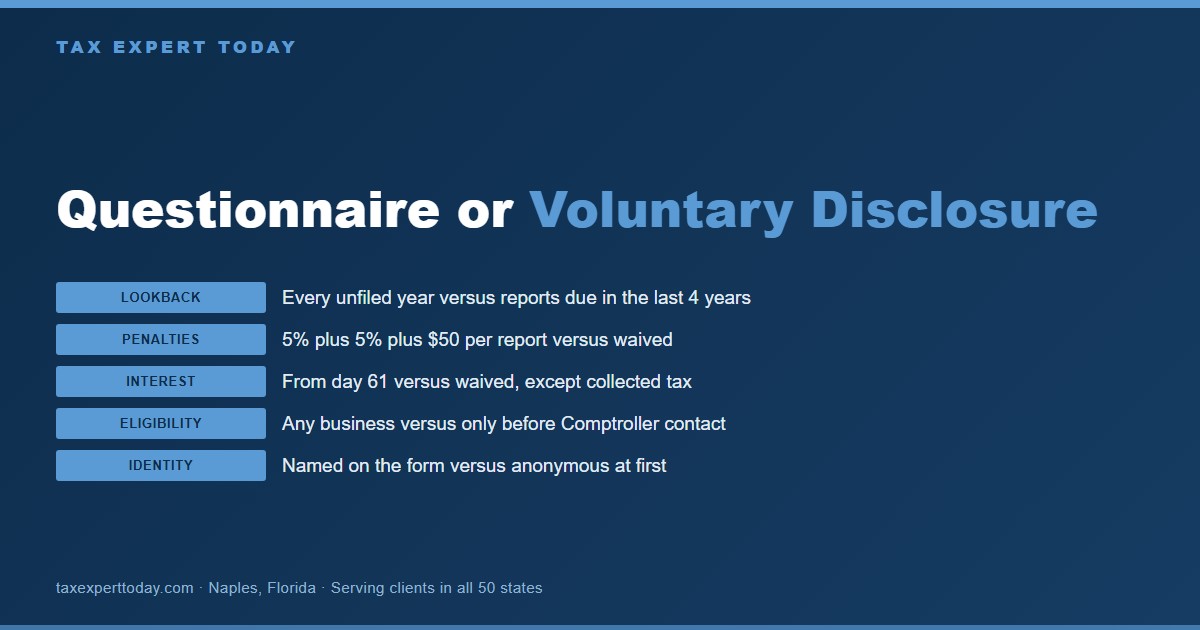
A business with several years of unreported Texas nexus should evaluate a voluntary disclosure agreement before it files a questionnaire. The program limits review to reports due in the four years before first contact and waives penalties and most interest, but it is available only to businesses the Comptroller has not already contacted about the liability.
- Lookback: limited to reports due in the four years before the business first contacts the Comptroller.
- Relief: statutory penalties and interest waived, except interest on taxes collected and not remitted.
- Eligibility: no prior contact from the Comptroller about the liability, and no notice of an audit or examination.
- Anonymous start: a representative can begin the process without naming the business.
The Comptroller describes the program in its Voluntary Disclosure Program publication. A voluntary disclosure agreement lets a taxpayer report previously unpaid or underpaid taxes and pay them with relief from penalties and, in most cases, interest. Statutory penalties and interest are waived, except interest on taxes collected and not remitted. The Comptroller limits its review to reports due four years from the date the business initially contacts the agency, with no limit for taxes collected and not remitted. All taxes and fees the Comptroller administers, other than those collected under the International Fuel Tax Agreement, are eligible. The franchise tax qualifies.
Eligibility is the constraint. A business qualifies only if it has not been contacted by the Comptroller, verbally or in writing, concerning a liability or estimated liability, and has not received notification of an audit or examination. That condition is why timing matters so much. A business that discovers its Texas exposure on its own, before any letter arrives, can approach the Comptroller’s Business Activity Research Team through a representative, without naming itself at first, and negotiate the agreement. A business that has already received a letter asking it to complete the Texas nexus questionnaire should not assume it remains eligible. Whether a particular letter counts as contact about a liability is a question to raise with the Comptroller before the questionnaire is returned.
| Question | Returning the questionnaire without a VDA | Voluntary disclosure agreement |
|---|---|---|
| How far back | Every unfiled year back to the beginning date reported | Reports due in the four years before first contact |
| Penalties | 5 percent, another 5 percent after 30 days, and $50 per late report | Statutory penalties waived |
| Interest | Charged from 61 days after each due date | Waived, except on taxes collected and not remitted |
| Who can use it | Any business | Only a business not previously contacted about the liability or notified of an audit |
| Identity at first contact | Disclosed on the form | Can be withheld until preliminary approval |
| Payment timing | As billed by the Comptroller | Returns and payment due within 60 days of the executed agreement, with payment agreements available on request |
The process itself is straightforward. The program publication lists what the first written request should contain: entity type, a brief description of the business and its Texas activities, when the company began business in its home state and in Texas, the tax types involved, any existing Texas accounts, statements about prior contact and about collected but unremitted tax, any request for a payment agreement, an estimate of the amount owed, and supporting information. The request goes to the Business Activity Research Team by email or mail. Once both sides sign, the agreement specifies returns and payment due within 60 days. A faster version, the Fast-Track VDA, is available where the business has already calculated what it owes and does not seek refunds or a letter ruling.
A voluntary disclosure is not automatically the right choice. Where the business’s Texas activity began recently, the four year window may cover everything anyway, and the waiver of penalties becomes the main benefit. Where the business has a credible position that it did not have nexus in earlier years, that position may be worth asserting directly. And a business that has collected Texas tax without remitting it faces unlimited lookback on those amounts even inside the program. The decision turns on how many years are open, how strong the nexus facts are for each, and whether the business is still eligible. We cover the full voluntary disclosure process for Texas taxes in a separate guide in this series.
What Happens After the Texas Nexus Questionnaire Is Returned?
After the questionnaire is processed, the Comptroller records the beginning date and the first report due date on the franchise tax account. The business then owes an annual franchise tax report or No Tax Due filing and a Public Information Report or Ownership Information Report each May 15, starting with the first report year the answers established.
- Account updated: mailing address, beginning date and first report due date are set.
- Annual reports: due May 15 each year, moving to the next business day when May 15 falls on a weekend or holiday.
- Information report: a Public Information Report or Ownership Information Report is due even when no tax is owed.
- Back years: any reports due before the questionnaire was filed become delinquent reports on the account.
Once the Comptroller has a beginning date, the account behaves like any other franchise tax account. The Comptroller’s franchise tax page states that the annual report is due May 15, moving to the next business day when May 15 falls on a weekend or holiday. Each report year also requires an information report. The Comptroller’s Public Information Report and Ownership Information Report guidance is explicit that the information report is due even when the entity does not have to file a franchise tax report because its annualized total revenue is at or below the no tax due threshold.
If the beginning date the business reported falls in an earlier year, the reports for every year since then are already past due when the account is updated. That is the moment the penalties and interest described above begin to matter, and it is also when the Comptroller’s collection and forfeiture processes start to apply to the account. For a corporation, Tax Code Section 171.251 provides that the Comptroller shall forfeit corporate privileges if the corporation does not file a required report, or does not pay the tax or related penalty, within 45 days after a notice of forfeiture is mailed or provided electronically. The PIR guidance adds that failing to file a completed and signed information report can lead to forfeiture of the right to transact business in Texas even when no tax is due.
The practical sequence after a questionnaire therefore has three parts: confirm the beginning date and first report due date the Comptroller recorded, prepare every report now due back to that date, and file the information reports alongside them. A business that only completes the questionnaire and stops there has converted an unknown exposure into a known delinquency.
Does Owing No Tax Mean a Business Can Ignore the Questionnaire?
No. A business with total revenue at or below the no tax due threshold, $2,650,000 for 2026 and 2027 reports, may owe no franchise tax, but it still has a filing obligation once it has nexus. It files the required No Tax Due information and a Public Information Report or Ownership Information Report each year.
- Threshold for 2026 and 2027: $2,650,000 of annualized total revenue.
- Threshold for 2024 and 2025: $2,470,000.
- Still required: the information report, and for report years 2024 and later the Comptroller’s No Tax Due reporting procedures.
- Risk of ignoring it: a $50 penalty for each report not filed and possible forfeiture.
Many small and mid sized out of state businesses that receive the Texas nexus questionnaire will owe little or no franchise tax. The Comptroller’s franchise tax page lists the no tax due threshold at $2,650,000 for report years 2026 and 2027, with tax rates of 0.375 percent for retail and wholesale entities and 0.75 percent for others, a compensation deduction limit of $480,000, and an EZ computation available for total revenue up to $20 million at a rate of 0.331 percent. A business with revenue under the threshold may conclude the questionnaire does not matter.
That conclusion is incomplete. The $50 penalty in Section 171.362(f) applies to each report not filed as required, whether or not any tax was due. The information report is required regardless of tax. And for a corporation, persistent nonfiling can lead to forfeiture, after which Tax Code Section 171.252 denies the corporation the right to sue or defend in a Texas court, and Section 171.255 can make each director or officer liable for debts the corporation creates or incurs in Texas after the missed due date and before its privileges are revived. A business below the threshold usually has a manageable, inexpensive compliance task, and the questionnaire is how it starts that task cleanly. For an overview of how the tax and the threshold work for small entities, see our guide to Texas LLC taxes.
How Should a Business Without Texas Nexus Answer the Questionnaire?
A business that never had Texas nexus, or that no longer does, should answer the questionnaire rather than ignore it. It describes its actual activities, explains why they do not meet the physical presence or economic nexus tests, and, where nexus once existed, gives the end date and reason in item 14 with supporting documents.
- Never had nexus: describe the limited contact accurately and why it falls short of Rule 3.586.
- Nexus ended: complete item 14 with the last date of Texas activity and the reason.
- Final report: an out of state entity ending its nexus must file its final report within 60 days.
- Use tax permit holders: address the presumption directly and consider closing an unneeded permit.
Not every questionnaire goes to a business with Texas nexus. Some arrive because of a stale Secretary of State registration, a sales tax permit opened for a single project, or a data match that does not reflect current operations. Those businesses still benefit from answering. A completed questionnaire that documents no Texas nexus, or a clear end date, closes the question on the record rather than leaving an account open for the Comptroller to estimate.
Where nexus existed and then ended, the Comptroller’s franchise tax page states that an out of state entity ending its nexus in Texas must file its final report and pay any amount due within 60 days of ceasing to have nexus. Item 14 on AP-114 asks for the reason and the last date of Texas activity, and it asks for home state documents if the entity ceased to exist. Closing an entity, or ending its Texas operations, involves other steps as well, which we cover in our guide to closing a business in Texas.
A business that holds a Texas use tax permit but believes it has no franchise tax nexus faces the presumption in Rule 3.586(e). Its answer should explain why, by reference to both the physical presence list and the economic nexus threshold, and it should consider whether the permit is still needed. If the permit is required for sales tax purposes, the business may have to keep it and rebut the franchise tax presumption on the facts. If the permit is no longer needed, closing it removes the trigger going forward, although it does not change the analysis for past periods.
How Do Combined Groups and Partnerships Answer the Questionnaire?
Nexus is decided entity by entity, so each affiliate in a group answers for itself. Item 10b asks for the reporting entity’s taxpayer number when the entity is included in a combined group report, and item 15 asks partnerships and joint ventures to list members, general partners, and limited partners holding 10 percent or more.
- Entity level test: Rule 3.586(c) states that nexus is determined at the individual taxable entity level.
- Combined groups: affiliated entities in a unitary business may report together, which item 10b captures.
- General partners: acting as a general partner in a partnership doing business in Texas is physical presence.
- Limited partners: a limited partner whose only Texas connection is the partnership interest does not have physical presence.
Groups add a layer of complexity because the questionnaire is answered entity by entity while the tax may be reported on a combined basis. Rule 3.586(c) makes the starting point clear: nexus is determined at the individual taxable entity level. A parent company with no Texas activity does not acquire nexus merely because a subsidiary has it, although it may have nexus through its own activities, including holding company activities under Rule 3.586(d)(8) such as managing, directing or performing services in Texas for subsidiaries.
Partnership structures need the same attention. Item 15 asks limited partnerships, general partnerships, joint ventures and joint stock companies to list every member and general partner and each limited partner with a 10 percent or greater interest, with each owner’s FEIN, ownership percentage and begin date. Under Rule 3.586(d)(12), acting as a general partner in a partnership doing business in Texas is itself physical presence, so a general partner listed on the partnership’s questionnaire may have its own franchise tax responsibility. A limited partner whose only connection with Texas is the limited partnership interest does not have physical presence under (d)(12)(B). Entity choice and structure decisions that affect these results are discussed in our guides to the Texas series LLC and Texas LLC vs S corp elections.
What Does a Texas Nexus Questionnaire Look Like for a Remote Seller?
In a typical remote seller case, the key questions are when the business first met either nexus test and how many reports have gone unfiled since. The hypothetical below shows how a reported beginning date translates into open report years, and how a voluntary disclosure would narrow them.
- Facts first: build a dated history of Texas activity and Texas sourced receipts.
- Earliest date controls: the beginning date is the earliest of the qualifying events.
- Count the reports: each May 15 since the first report due date is a report year.
- Compare paths: map the years open on the questionnaire against the voluntary disclosure window.
The following is a hypothetical for illustration only. It is not based on any client, and actual results depend on the facts, the sourcing of receipts, and the Comptroller’s review. Assume a Florida LLC taxed as a corporation for federal purposes sells equipment nationwide on a calendar year. It has no Texas office, but from March 2021 it has used a Texas third party warehouse to hold inventory for faster delivery. Its Texas sourced gross receipts first reached $500,000 in calendar year 2020. It registered for a Texas sales tax permit in 2022 and has never filed a franchise tax report. In October 2026 it is considering how to respond to the Texas nexus questionnaire.
| Event in the hypothetical | Date | Effect on the beginning date |
|---|---|---|
| Texas gross receipts reach $500,000 in calendar year 2020 | Period starting January 1, 2020 | Economic nexus beginning date of January 1, 2020, under Rule 3.586(g)(2)(C) |
| Inventory placed in a Texas warehouse | March 2021 | Physical presence from March 2021, later than the economic nexus date |
| Texas sales tax permit obtained | 2022 | Use tax permit date, also later |
| Earliest qualifying event | January 1, 2020 | Beginning date; first annual report due May 15, 2021 |
| Report years due through May 2026 | 2021 through 2026 | Six annual reports and six information reports, all unfiled |
| Voluntary disclosure, first contact in October 2026 | Reports due in the prior four years | Review limited to the 2023 through 2026 report years, if the business is eligible |
In this illustration the questionnaire would disclose six unfiled report years, with no statutory limit on assessment for any of them under Section 111.205(a)(2), plus penalties and interest. A voluntary disclosure, if the business remains eligible, would limit the Comptroller’s review to four report years and waive penalties and interest on the franchise tax. Whether any tax is actually due for each year depends on total revenue against the no tax due threshold for that year, the margin computation, and apportionment, so the dollar difference may be large or small. The structural difference, six years against four and penalties against none, is the point of the example.
Two refinements are worth noting. First, the business should test the receipts sourcing for 2020 carefully, because the 2020 economic nexus date is what makes the earliest year open. If properly sourced Texas receipts did not reach $500,000 until 2021, the beginning date and the count change. Second, the warehouse inventory independently creates physical presence from March 2021, so even a favorable sourcing result would not eliminate the later years.
What Are Common Mistakes on the Texas Nexus Questionnaire?
The most common mistakes are treating the Secretary of State registration date as the beginning date, overlooking contractors and inventory as physical presence, relying on Public Law 86-272, measuring the $500,000 test with the wrong sourcing rules, and returning the form before checking voluntary disclosure eligibility.
- Wrong start date: registration, permit or first invoice used instead of the first qualifying activity.
- Missed presence: independent contractors, marketplace inventory and service visits left off item 12.
- Wrong legal test: income tax protections applied to a margin tax.
- Wrong sequence: filing first and considering a voluntary disclosure afterward.
| Mistake | Why it causes problems | Better approach |
|---|---|---|
| Using the Secretary of State registration date as the beginning date | The beginning date is when doing business began, which may be earlier or later than registration | Build a dated activity timeline and match each item to Rule 3.586(d) |
| Ignoring independent contractors and remote staff | Representatives in Texas count regardless of where they live or how they are classified | List every person who worked or sold for the business in Texas, with dates |
| Ignoring third party warehouse inventory | Inventory, including spot inventory and consigned goods, is listed physical presence | Obtain storage location reports from fulfillment providers |
| Relying on Public Law 86-272 | Rule 3.586(i) states that it does not apply to the franchise tax | Analyze solicitation as physical presence under Rule 3.586(d)(19) |
| Measuring $500,000 using sales tax rules or total customer billings | Economic nexus uses franchise tax sourcing under Rule 3.591(e) and (f) | Source each accounting period’s receipts under the franchise tax rules |
| Dating economic nexus from the day the threshold was crossed | Nexus starts on the first day of that accounting period | Report the period start date, as item 13b asks |
| Answering for the whole group on one form | Nexus is tested entity by entity | Complete a questionnaire for each entity that needs one |
| Filing before checking voluntary disclosure eligibility | Prior contact can end eligibility for the four year limit and penalty waiver | Evaluate exposure and eligibility before the form is signed |
| Ignoring the questionnaire because no tax would be due | Information reports and $50 late filing penalties still apply | File and document No Tax Due status each year |
Most of these mistakes come from treating the questionnaire as a form to complete rather than a set of factual and legal conclusions to support. The form takes perhaps twenty minutes to fill out. The analysis that should sit behind it, the activity timeline, the receipts sourcing by period, and the decision about voluntary disclosure, takes longer and is where the result is actually decided.
How Does the Texas Nexus Questionnaire Relate to Sales Tax Nexus?
They are separate tests for separate taxes. The nexus questionnaire concerns the franchise tax, measured with franchise tax sourcing and Rule 3.586. Sales tax nexus decides whether a business must collect sales and use tax. A sales tax permit can, however, trigger the franchise tax presumption, which links the two in practice.
- Different taxes: franchise tax on the entity’s margin versus sales and use tax collected from customers.
- Different thresholds: each tax has its own nexus rules and its own measurement of Texas revenue.
- Linked by the permit: a use tax permit creates a rebuttable franchise tax nexus presumption.
- Separate audits possible: each tax can be examined on its own schedule.
Businesses often first encounter both questions at once, which makes it easy to blur them. Sales tax nexus decides whether the business must register, collect tax on taxable sales, and file sales tax returns. Our guides to Texas sales tax nexus and Texas taxable services cover that side. The franchise tax nexus question decides whether the entity itself owes the annual franchise tax and information reports. A software company may have no sales tax collection duty on some of its products and still meet the franchise tax economic nexus threshold, and a small seller may need a sales tax permit while sitting well below the franchise tax threshold.
The permit presumption is what ties them together. Once a business holds a Texas use tax permit, Rule 3.586(e) presumes franchise tax nexus, so the sales tax registration decision has a franchise tax consequence. Once registered, a seller also has to manage the Texas resale certificate and exemption certificate files that support its untaxed sales. Businesses registering for sales tax should expect a franchise tax account and a questionnaire, and should prepare the franchise tax analysis at the same time rather than waiting for the letter. Employers with Texas staff face a third registration, with the Texas Workforce Commission, which we explain in our guide to Texas payroll taxes, and those employees are themselves physical presence for franchise tax purposes.
How Should a Business Prepare Before Answering the Texas Nexus Questionnaire?
Before answering, a business should assemble a dated history of its Texas activities, source its Texas gross receipts for every accounting period since 2019, identify the earliest qualifying date, count the report years that date would open, and decide whether a voluntary disclosure or a direct response is the better path.
- Step 1: gather Secretary of State, permit, payroll, contractor, inventory and contract records touching Texas.
- Step 2: source Texas gross receipts by accounting period under Rule 3.591(e) and (f).
- Step 3: apply Rule 3.586(d), (e), (f) and (g) to find the earliest beginning date.
- Step 4: count open report years and estimate tax, penalties and interest for each.
- Step 5: choose between a voluntary disclosure, if eligible, and a documented direct response.
The records that matter are usually scattered. Payroll systems show employees working in Texas, accounts payable shows Texas contractors, fulfillment providers can report where inventory sat, sales systems show where products were delivered, and service records show where technicians worked. Combining them into a single dated timeline is the most valuable step in the process, because every later decision depends on it.
The receipts analysis comes next. For each federal accounting period ending in 2019 or later, the business computes gross receipts as defined in Rule 3.586(f)(2) and sources them to Texas under the apportionment rules. The first period at or above $500,000 sets an economic nexus date. Comparing that date with the earliest physical presence date and any use tax permit date identifies the beginning date under Rule 3.586(g).
With a beginning date in hand, the business can count report years, estimate the tax for each using the no tax due threshold, rates and deductions for that year, and see the effect of penalties and interest. Only then is it in a position to decide whether to file the questionnaire directly, with full supporting documentation, or to first approach the Comptroller about a voluntary disclosure. Where the business decides to file directly, it should be prepared to file every report the questionnaire makes due, promptly, to limit the additional penalty that accrues after 30 days.
Texas Nexus Questionnaire Help in Naples & Southwest Florida
Tax Expert Today LLC advises businesses on state tax matters nationwide from our office in Naples, Florida. The Texas nexus questionnaire reaches Southwest Florida businesses more often than many owners expect. Florida companies that sell products into Texas, send crews to Texas job sites, keep inventory in Texas fulfillment centers, or hire remote staff in Texas can meet the physical presence or economic nexus tests without ever opening a Texas office. Owners who relocated from Texas to Florida, a move we compare in our guide to Texas vs Florida taxes, sometimes keep Texas operations running from Naples, while owners arriving in Texas face the separate personal question covered in our guide to how to establish Texas residency. And a Texas sales tax registration often brings a franchise tax questionnaire close behind it.
Our work on this topic follows the sequence in this guide. We build the dated activity timeline, source Texas receipts period by period, identify a beginning date the business can support, count the report years it opens, and evaluate whether a voluntary disclosure is available and worthwhile before the questionnaire is signed. Where the business files directly, we prepare the delinquent reports and information reports so the account is brought current together rather than year by year.
- Texas nexus questionnaire Naples FL businesses can reach in person. Our office is on Tamiami Trail North in Naples, Florida, and we work with clients locally and remotely.
- Texas franchise tax nexus help Naples and nationwide. We serve clients in all 50 states, and the Texas rules apply the same way wherever the owner lives.
- Exposure reviews before a letter arrives. Voluntary disclosure options are widest before the Comptroller makes contact.
- Remote sellers and service businesses. We focus on the receipts sourcing that decides the $500,000 test.
- Coordinated with your other Texas obligations. Franchise tax, sales tax, payroll tax and federal positions are reviewed together.
Related services include our Texas tax services for businesses with Texas obligations and our Naples tax planning work for Southwest Florida owners.
Tax Expert Today LLC
11983 Tamiami Trail N, Naples, FL 34110
Phone: (239) 441-2005
Hours: Monday through Friday, 10:00 a.m. to 5:00 p.m. ET
Local question we are asked often: A Naples landscape design firm sends a crew to Texas for two or three projects a year and recently received a Comptroller letter asking it to complete the franchise tax accountability questionnaire. Does a few weeks of work a year really count? It may. Performing a contract in Texas, with the firm’s own employees or with subcontractors, is a listed physical presence activity under Rule 3.586(d)(3), and there is no minimum number of days in the rule. The firm should date the first Texas project, consider whether it was ever below the constitutional threshold, count the report years that date would open, and compare that with its total revenue against the no tax due threshold for each year. For a firm below the threshold, the result may be a set of No Tax Due and information filings rather than tax, but the filings themselves still matter.
When Should You Engage a Professional?
A business that started Texas activity recently, has one clear qualifying event, and expects to stay under the no tax due threshold can often complete the questionnaire itself using this guide and the Comptroller’s instructions. Professional review becomes worthwhile when the business has had Texas activity for several years without filing, when its Texas receipts are near the $500,000 line and depend on sourcing, when it has multiple entities or partnerships, when it relied on Public Law 86-272 in the past, or when it needs to decide whether a voluntary disclosure is still available. The Texas nexus questionnaire is a state tax matter administered by the Texas Comptroller, not an IRS matter, and our multidisciplinary team of tax advisors, enrolled agents, CPAs and attorneys advises on state tax matters nationwide. Contested matters that proceed to a formal hearing or to court may also call for Texas licensed counsel, and we coordinate with counsel where appropriate.
If you would like a review of your Texas nexus history before you answer, help evaluating a voluntary disclosure, or preparation of the reports a questionnaire makes due, contact Tax Expert Today at (239) 441-2005 or visit our Texas tax services page. Businesses dealing with a federal examination at the same time can also review our IRS resolution and audit support services.
Frequently Asked Questions
What is the Texas nexus questionnaire?
It is Comptroller Form AP-114, the Texas Nexus Questionnaire. It asks a business formed outside Texas to describe its Texas activities, give the earliest date it had physical presence in Texas, and state whether its Texas gross receipts reached $500,000. The answers set the franchise tax beginning date and first report due date.
Do I have to file the Texas nexus questionnaire online or on paper?
Entities newly registered with the Texas Secretary of State and any entity that received a Comptroller letter complete the accountability questionnaire online using the taxpayer number and FQ Webfile number on the letter. All other entities file a paper questionnaire, which for most out of state businesses is Form AP-114. Banks use Form AP-223.
What is the Texas economic nexus threshold for franchise tax?
A foreign entity has franchise tax nexus for any federal accounting period ending in 2019 or later in which its gross receipts from business done in Texas are $500,000 or more, sourced under Rule 3.591(e) and (f). An amendment effective January 7, 2026 confirms the gross receipts measure applies whatever apportionment method the entity uses.
Does Public Law 86-272 apply to the Texas franchise tax?
No, according to the Comptroller. Rule 3.586(i) states that Public Law 86-272, which limits state net income taxes on businesses that only solicit orders for tangible goods, does not apply to the Texas franchise tax. Solicitation by representatives in Texas is a listed physical presence activity.
How far back can Texas assess franchise tax if I never filed?
Generally there is no time limit. Tax Code Section 111.201 sets a four year assessment period, but Section 111.205(a)(2) allows assessment at any time when no report was filed. A voluntary disclosure agreement, where available, limits the Comptroller’s review to reports due in the four years before first contact.
Can I still get a voluntary disclosure agreement after receiving the questionnaire?
Possibly not. The program is available only to businesses not previously contacted by the Comptroller, verbally or in writing, about a liability or estimated liability, and not notified of an audit. Whether a particular questionnaire letter counts as that contact should be confirmed with the Comptroller before the questionnaire is returned.
If my revenue is under the no tax due threshold, do I still file?
Yes. The threshold is $2,650,000 for 2026 and 2027 reports. An entity at or below it owes no franchise tax but still files under the Comptroller’s No Tax Due procedures and must file a Public Information Report or Ownership Information Report. A $50 penalty applies to each report not filed as required.
Can a Naples, Florida business have Texas franchise tax nexus without a Texas office?
Yes. A Florida business can have Texas nexus through employees or contractors working in Texas, inventory in a Texas warehouse, services or contracts performed in Texas, or $500,000 or more of Texas sourced gross receipts in an accounting period. No office is required, and the business answers the questionnaire under the same rules as any other foreign entity.
Published October 16, 2026 by Dr. Pellumb Kabashi « Back to Learning Center
Have a question this article touches on?
Tax Expert Today LLC, based in Naples, Florida and serving clients across the United States.
Schedule a Consultation (239) 441-2005