
By Dr. Pellumb Kabashi, DBA, MBA, CES, CFE, EA
Founder, Tax Expert Today LLC · Tax advisors, enrolled agents, CPAs, and attorneys · Serving clients in all 50 states
Quick Answer: Closing a business in Texas takes two clearances, not one. The Comptroller must certify that franchise tax is settled, and only then will the Secretary of State accept the Certificate of Termination. Around that state filing sits a federal close out: final returns marked final, a payroll wind down, and tax on the assets left behind. Call (239) 441-2005 for a free consultation.
What Does Closing a Business in Texas Require?
Closing a business in Texas requires clearing the Texas Comptroller before the Secretary of State will accept anything. The entity files its final franchise tax report, requests a Certificate of Account Status, then files a Certificate of Termination with that certificate attached. The federal close out of returns, payroll, and assets runs alongside it.
Most published guidance on this subject is written by business litigators and by formation services, and it is organized around the corporate law event. Hold the vote, wind up the affairs, file the form, pay the fee. That guidance is accurate as far as it goes, and it stops at exactly the point where the tax work begins.
The practical difficulty is that Texas has built a dependency into the sequence. The Secretary of State does not evaluate whether an entity has paid its taxes. It simply refuses to file the termination without a document that only the Comptroller can issue, and the Comptroller does not issue that document until the franchise tax account is settled through the intended termination date. An owner who treats the tax filing as paperwork to handle after the closure discovers that the closure never actually happened.
- Two agencies, in a fixed order. Comptroller first, Secretary of State second. Reversing the order does not work, because the second filing requires an output of the first.
- Two governments, running in parallel. The Texas sequence settles state franchise and sales tax. Nothing in it touches the federal returns, and the IRS is not notified by the state filing.
- An entity that is not terminated stays a taxable entity. Ceasing operations is not the same as ceasing to exist. Franchise tax reporting obligations continue against an entity that remains on the Secretary of State records.
- The assets are a taxable event of their own. Equipment, inventory, and intangibles do not disappear when the doors close. They are disposed of, and disposition has a tax result.
- Personal exposure is statutory, not theoretical. Texas law shifts unpaid franchise tax debt onto directors and officers personally once forfeiture occurs, and federal law does the same for unremitted payroll trust funds.
This guide works the tax side of closing a business in Texas in the order the filings actually have to happen. For the mirror image transaction, where an owner is bringing an entity into the state rather than winding one down, our guide to moving a business to Texas covers registration and trailing nexus in the departure state.
Are You Dissolving, Selling, or Just Going Inactive?
These three outcomes look similar to an owner and are entirely different to the tax law. A dissolution distributes assets to the owners and ends the entity. A sale transfers assets or interests to a buyer and triggers allocation rules. Going inactive ends the operations but leaves the entity, and its filing obligations, alive.
Choosing among them is the first decision, and it should be made deliberately rather than by default. Owners frequently drift into the third outcome without intending it. They stop trading, close the bank account, and assume the entity has lapsed. It has not. It is still registered, still a taxable entity, and still accruing reporting obligations that will surface later, usually at the worst possible moment, such as when the owner tries to register a new venture.
| Outcome | What happens to the entity | Principal federal consequence | Texas franchise tax result |
|---|---|---|---|
| Dissolution and termination | Ceases to exist on the effective date of the Certificate of Termination | Final return filed with the final return box checked and assets treated as distributed to owners | Final report due within 60 days of losing nexus, then reporting ends |
| Sale of the assets | Entity survives the sale and may terminate afterward | Gain or loss computed asset by asset, with a Form 8594 allocation from both parties | Franchise tax continues until the entity itself terminates |
| Sale of membership interests or stock | Entity survives with new owners | Gain or loss at the owner level, and the entity generally continues its tax history | No final report, because the entity remains a taxable entity under new ownership |
| Going inactive without terminating | Remains registered and in existence | Returns still required for as long as the entity exists | Annual reports still due, and failure leads to forfeiture |
| Involuntary forfeiture by the state | Loses the right to transact business but is not terminated | No federal effect, so federal obligations continue unchanged | Directors and officers become personally liable under Section 171.255 |
The distinction between a sale and a dissolution matters more than it first appears. Where a buyer exists, the transaction is governed by an allocation regime, and the negotiation over that allocation carries real money. Our guide to the tax treatment of selling a business covers that ground. This article addresses the more common case, where there is no buyer and the entity is simply being wound down and terminated.
What Is the Final Texas Franchise Tax Report?
The final franchise tax report covers the period beginning the day after the last annual report accounting period ended and running through a date within 60 days of the termination date. The Comptroller states that the report and the payment are both due within 60 days after the entity no longer has sufficient nexus with Texas to be subject to the tax.
This is the filing owners most often miss, because it does not fall on the familiar May 15 annual date. It is triggered by the closure itself and it runs on its own 60 day clock. An entity that terminates in September does not wait until the following May. It has roughly two months, and the clock starts on an event rather than on a calendar date.
The reporting mechanics are otherwise the same as the annual report. The 2026 and 2027 report years carry a no tax due revenue threshold of $2,650,000, tax rates of 0.375 percent for retail and wholesale and 0.75 percent for other taxable entities, an EZ computation rate of 0.331 percent available to entities under $20 million in total revenue, and a compensation deduction limit of $480,000. Our guide to the Texas franchise tax works through the margin calculation methods in detail, and our guide to Texas LLC taxes covers how the franchise tax interacts with federal pass through treatment.
- Every outstanding annual report comes first. The Comptroller requires all prior annual franchise tax reports and the accompanying information reports to be on file before it will consider the termination request.
- The final report period is defined by two endpoints. It begins the day after the prior accounting period ended, and it must run through a date within 60 days of the termination date.
- Falling under the threshold does not remove the filing. An entity below $2,650,000 of total revenue owes no tax, and it still files the report and the required information report.
- An extension exists and it is limited. A final report extension is requested through Webfile or Form 05-164, requires payment of at least 90 percent of the tax due, and moves the due date by 45 days.
- The termination date drives everything downstream. Fix it before filing, because the certificate you receive is tied to it and expires against it.
How Do You Request the Certificate of Account Status?
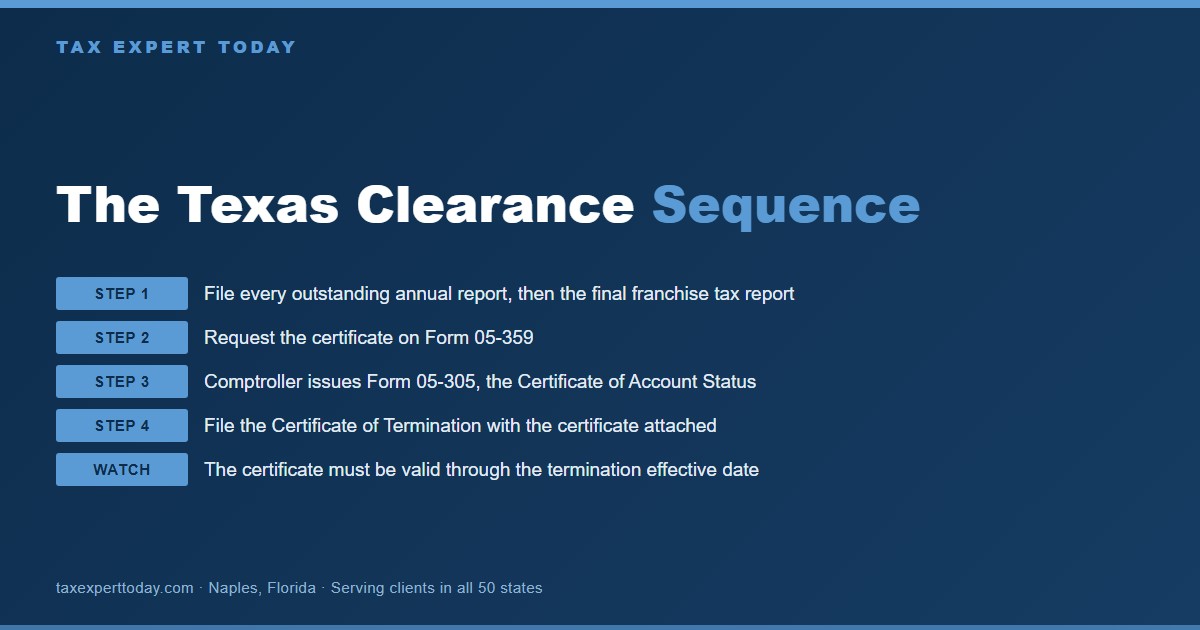
The entity requests the certificate on Form 05-359, the Request for Certificate of Account Status to Terminate a Taxable Entity Existence in Texas or Registration. Once the account is clear, the Comptroller issues Form 05-305, the Certificate of Account Status to Terminate Texas Registration, and that issued certificate is what the Secretary of State requires.
The two form numbers cause real confusion because they sound alike and travel in opposite directions. Form 05-359 is the request the taxpayer sends in. Form 05-305 is the certificate that comes back. Only the second one is attached to the termination filing, and an entity that files a copy of its own request rather than the issued certificate will have the termination rejected.
There is a timing trap in this step that deserves particular attention. The Secretary of State warns that a rejection cause is an invalid or expired effective date on the certificate of account status, which must be valid through the effective date of the Certificate of Termination. A certificate obtained too early, against a termination date that then slips by a few weeks, expires before it is used. The remedy is straightforward once it is understood: fix the termination date first, request the certificate against that date, and file promptly rather than holding the certificate.
| Document | Form number | Direction | What it does |
|---|---|---|---|
| Request for Certificate of Account Status to Terminate | 05-359 | Taxpayer to Comptroller | Asks the Comptroller to review the franchise tax account and certify it |
| Certificate of Account Status to Terminate Texas Registration | 05-305 | Comptroller to taxpayer | The clearance document that must accompany the termination filing |
| Final franchise tax report | Report forms for the applicable report year | Taxpayer to Comptroller | Reports margin through the final period and settles the tax |
| Public or Ownership Information Report | 05-102 or 05-167 | Taxpayer to Comptroller | Required alongside the report, and a missing one holds up the certificate |
| Extension request for a final report | 05-164 | Taxpayer to Comptroller | Moves the final report due date by 45 days where 90 percent of tax is paid |
| Certificate of Termination | Secretary of State termination filing | Taxpayer to Secretary of State | Ends the legal existence of the entity on its effective date |
How Do You File the Certificate of Termination?
The Certificate of Termination is submitted through SOSDirect with the Comptroller certificate attached and the filing fee paid. For a for profit corporation, limited liability company, limited partnership, or professional association the fee is $40. A nonprofit corporation pays $5 and does not attach a franchise tax certificate at all.
The Secretary of State frames its own role narrowly. The entity must first take the necessary internal steps to wind up its affairs, and the filing office does not supervise or verify that process. It checks that the required document is present, that the fee is paid, and that the tax certificate is valid through the effective date. Everything substantive has already happened by the time the filing is made.
The nonprofit carve out is worth noting, because it is easy to over comply with. A nonprofit corporation terminates without the franchise tax certificate and pays a small fraction of the for profit fee. Everything else in this guide about final federal returns, payroll, and asset disposition still applies to it in full.
- Wind up before you file, not after. Debts paid, remaining assets distributed to owners according to their interests, and open contracts closed out.
- Cancel the assumed names separately. A registered DBA does not lapse with the entity and has to be abandoned on its own filing.
- Foreign entities withdraw rather than terminate. An entity formed elsewhere but registered in Texas ends its Texas registration, and the same tax certificate requirement applies to it.
- The effective date is a choice, so make it consciously. It anchors the final report period and the certificate validity window.
- Rejection is common and recoverable. The most frequent cause is an invalid or expired effective date on the certificate of account status, which is a sequencing failure rather than a substantive one.
What Happens to Your Texas Sales Tax Permit?
A sales taxpayer closing a place of business must file a sales tax return covering the final filing period, and the permit is cancelled rather than left open. Tax may also be due on items that were purchased tax free for resale, as the Comptroller close business location guidance sets out, because unsold inventory diverted to personal use, used in the business, or given away becomes subject to use tax.
That second sentence is where most closures go wrong, and it is almost entirely absent from the general guidance on closing a business in Texas. Sales tax is a collection obligation while the business trades, and it becomes a liability of the owner at the moment the business stops. Inventory bought under a resale certificate was never taxed, on the understanding that tax would be collected when it was sold. If it is never sold, that understanding fails, and the Comptroller looks to the purchaser. The rule behind that outcome, and the retention record that supports it, are covered in our guide to the Texas resale certificate.
The practical exposure appears in ordinary closing decisions that owners do not think of as taxable at all. Taking the remaining stock home. Keeping the shop equipment. Handing leftover inventory to staff as a goodwill gesture at the end. Each of those is a diversion of tax free inventory to a use other than resale, and each carries use tax on the purchase price.
- File the final return for the final filing period. The obligation runs through the last period in which the business operated, not to the end of the calendar year.
- Account for the unsold inventory. Use tax is due on the purchase price of items diverted to personal use, consumed in the business, or given away as gifts or promotional items.
- Equipment bought tax free follows the same logic. Assets acquired without tax under an exemption need to be reviewed against how they are ultimately disposed of.
- Closing one location is not closing the business. An owner who keeps selling into Texas after shutting a physical location still collects on sales delivered in the state.
- Nexus can survive the storefront. Remote selling into Texas continues to create obligations under the economic threshold, which our guide to Texas sales tax nexus covers in full.
Which Final Federal Returns Does the IRS Require?
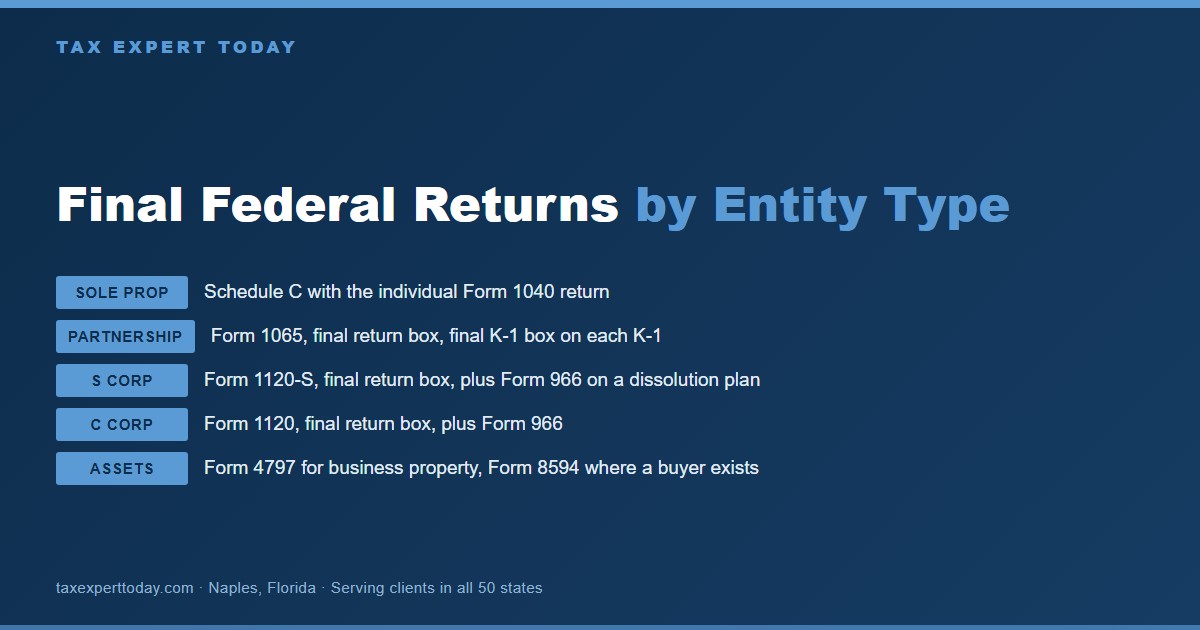
Every entity type files a final income tax return for the year the business closes, and the final return box must be checked. Winding down one series of a Texas series LLC works differently, because the reporting entity survives even though the series does not. Partnerships file Form 1065, S corporations file Form 1120-S, C corporations file Form 1120, and sole proprietors file Schedule C with the individual return. Corporations adopting a plan of dissolution also file Form 966.
The final return box is a small item with disproportionate consequences. The IRS states that it sits near the top of the front page of the return, below the name and address. An unchecked box leaves the IRS expecting a return for the following year, and the absence of that return generates notices against an entity that no longer exists and no longer receives mail at the address on file.
Pass through entities carry a second box on the Schedule K-1 itself. The IRS instructs S corporations to check the final K-1 box, and the same discipline applies to partnership K-1s. This is what tells each owner that no further schedule is coming and that the capital account has been closed out.
| Entity type | Final income tax return | Box to check | Additional filing |
|---|---|---|---|
| Sole proprietorship | Schedule C with Form 1040 or 1040-SR | No entity level final box, so the schedule simply ends | Schedule SE for the final year of self employment earnings |
| Single member LLC, disregarded | Schedule C with the owner return | Same as a sole proprietorship for federal purposes | Texas franchise reporting still applies at the entity level |
| Partnership or multi member LLC | Form 1065 for the year of closure | Final return box, plus the final K-1 box on each K-1 | Form 4797 for business property disposed of |
| S corporation | Form 1120-S for the year of closure | Final return box, plus the final K-1 box on each K-1 | Form 966 where a plan of dissolution or liquidation is adopted |
| C corporation | Form 1120 for the year of closure | Final return box | Form 966 for the resolution or plan to dissolve or liquidate stock |
| Any entity that sold its business | The return for its own type | Final return box if the entity also terminates | Form 8594 asset acquisition statement from buyer and seller |
Form 966 is frequently overlooked because it is not a return and it has no tax attached to it. The IRS requires Form 966 where a corporation adopts a resolution or plan to dissolve the corporation or liquidate any of its stock. It is an information filing, and filing it late is a far better outcome than never filing it at all. Owners of S corporations should also review the final payroll year against our guide to S corporation reasonable compensation, because a short final year distorts the usual annual analysis.
How Do You Wind Down Payroll When Closing a Business in Texas?
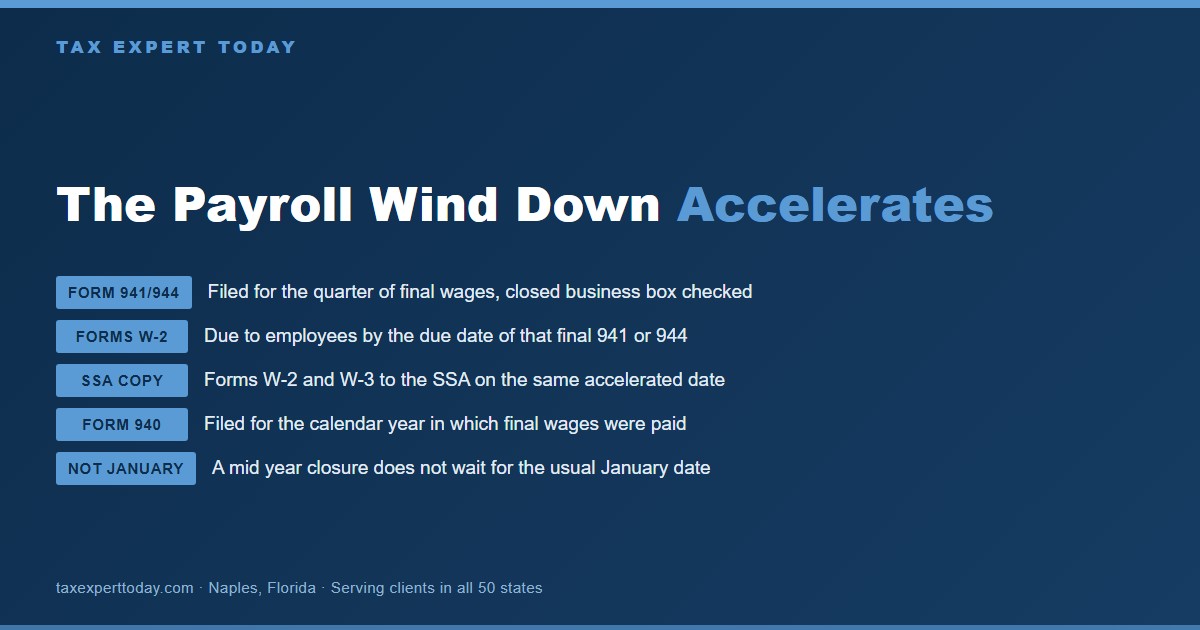
The employer files Form 941 or Form 944 for the quarter containing the final wage payments and checks the box telling the IRS the business has closed. It files Form 940 for the calendar year in which final wages were paid. Critically, Forms W-2 are accelerated: they are due by the due date of that final Form 941 or 944.
That acceleration is the single most missed deadline in a business closure, and it is stated plainly in the IRS instructions: an employer that terminates its business must provide Forms W-2 to employees for the calendar year of termination by the due date of the final Form 941 or 944, and must also file those Forms W-2 with the Social Security Administration by that same date. A business that closes in March does not wait until the following January. Its wage statements are due with its final quarterly return.
The reason this matters beyond the filing itself is that employees need those statements to file their own returns, and a defunct employer is very difficult for them to chase. Texas has no state income tax withholding to unwind, which simplifies the picture considerably compared with a closure in a withholding state, but it does not touch the federal obligations. Our guide to Texas payroll taxes for employers covers the state unemployment side that continues alongside these federal filings.
| Filing | Covers | When it is due on a closure | Point to watch |
|---|---|---|---|
| Form 941 or Form 944 | The quarter or year of the final wage payments | Normal due date for that period | Check the box that reports the business has closed |
| Forms W-2 to employees | The calendar year of termination | By the due date of the final Form 941 or 944 | Accelerated well ahead of the usual January date |
| Forms W-2 and W-3 to the SSA | The calendar year of termination | By the due date of the final Form 941 or 944 | The same accelerated date applies to the SSA copy |
| Form 940 | The calendar year in which final wages were paid | The annual FUTA due date for that year | Filed even though the business closed mid year |
| Form 8027 | Tip income and allocated tips | Annual filing for a tipped establishment | Applies to food and beverage operations closing mid year |
| Forms 1099-NEC and 1096 | Contractors paid $600 or more in the closing year | The normal information return dates | Contractor payments are reported even though the payer no longer exists |
One relief valve is worth knowing about. Where employees move immediately to a successor employer, the successor and predecessor rules can change how wages and taxes are reported between the two, and that is worth analyzing before the final filings are prepared rather than after.
What Tax Do You Owe on Equipment, Inventory, and Other Assets?
Closing a business disposes of its assets, and disposition is a taxable event whether or not money changes hands. Depreciated equipment generally produces ordinary income to the extent of prior depreciation under the recapture rules, and Form 4797 reports the sale or exchange of business property for each year in which it happens.
Owners closing a business in Texas are often surprised by this, because the intuition is that a business that closes without profit cannot owe tax. The intuition fails for a specific reason. Depreciation deductions taken in earlier years reduced ordinary income at ordinary rates. When the asset leaves the business for more than its remaining basis, that earlier benefit is recaptured under Internal Revenue Code Section 1245, and recapture is ordinary income rather than capital gain.
The effect is most visible with equipment expensed aggressively in its first year. An asset written down to zero basis and then distributed to the owner or sold for a modest amount produces gain equal to that amount, taxed as ordinary income. Nothing about the business having failed changes that arithmetic. Our guide to Texas capital gains tax covers the basis mechanics that determine where the line falls.
| Asset | What happens on closure | Federal treatment | Texas angle |
|---|---|---|---|
| Depreciated equipment sold | Proceeds compared with adjusted basis | Gain is ordinary to the extent of prior depreciation, reported on Form 4797 | No state income tax on the gain |
| Equipment distributed to the owner | Treated as a disposition at fair market value | Same recapture analysis as a sale, with no cash to pay the tax | Use tax may apply if it was acquired tax free |
| Unsold inventory taken personally | Removed from the business | Reduces cost of goods sold and affects the final year result | Use tax due on the purchase price of diverted resale inventory |
| Real property held by the entity | Sold or distributed | Separate recapture rules apply to real property depreciation | Local property tax runs to the transfer date |
| Intangibles and goodwill | Sold only where a buyer exists | Allocated under the asset acquisition rules and reported on Form 8594 | Not relevant to a pure wind down with no buyer |
| Receivables written off | Collected or abandoned | Bad debt treatment depends on the accounting method used | A cash basis business generally has no basis to write off |
| Owner loans to the entity | Repaid or forgiven | Forgiveness may create income or a capital account adjustment | Review before the entity is terminated, not afterward |
When Do Officers and Owners Become Personally Liable?
Texas Tax Code Section 171.255 makes each director and officer personally liable for entity debts created after a missed franchise tax report or payment, once corporate privileges are forfeited. Section 171.2515 extends the same rule to any taxable entity, so limited liability companies are inside it, not outside it.
This is the provision that turns an administrative oversight into a personal financial event, and it is the strongest argument for closing an entity properly rather than abandoning it. The statute is direct. Where privileges are forfeited for failure to file a report or pay a tax or penalty, each director or officer is liable for each debt of the entity created or incurred in Texas after the date the report, tax, or penalty was due and before the privileges are revived. The liability expressly includes franchise tax and penalties that become due after the forfeiture.
Two features of the statute deserve emphasis. First, Section 171.255 measures the liability in the same manner and to the same extent as if the director or officer were a partner and the entity were a partnership, which is precisely the exposure the entity was formed to avoid. Second, reviving the entity later does not undo it: the statute states that the liability is not affected by the revival of the charter and privileges.
- Forfeiture follows a 45 day notice. The Comptroller forfeits privileges where the entity does not file a required report or pay a tax or penalty within 45 days after notice of forfeiture is mailed or provided electronically.
- Forfeiture also blocks the courthouse. A forfeited entity is denied the right to sue or defend in a Texas court, which matters if a dispute arises during the wind down.
- The statute reaches LLC managers and officers. Section 171.2515 applies the same subchapter, including Section 171.255, to the forfeiture of a taxable entity right to transact business.
- Two narrow defenses exist. A director is not liable where the debt was created over that director objection, or without that director knowledge where reasonable diligence would not have revealed the intention to create it.
- The federal parallel is the trust fund penalty. Under Internal Revenue Code Section 6672, a responsible person who willfully fails to remit withheld payroll taxes can be assessed personally for the trust fund portion.
The combination is what makes an abandoned entity genuinely dangerous. An owner who walks away with unpaid franchise tax and unremitted withholding faces a state statute that removes the liability shield and a federal statute that reaches the individual directly. Neither is discharged by the passage of time or by the entity fading from view.
How Do You Close Your EIN Account and Keep the Right Records?
The employer identification number itself is never reused or cancelled, but the IRS business account attached to it can be closed. The owner sends a letter to the IRS in Cincinnati stating the complete legal name, the EIN, the business address, and the reason for closing. The IRS will not close the account until all required returns are filed and all tax owed is paid.
That last condition is the reason this step belongs at the end of the sequence rather than the beginning. Owners sometimes write the letter first, hoping it will draw a line under the matter. It does not. The account stays open, the unfiled returns stay unfiled, and the notices continue. The letter is a confirmation of a completed close out, not a substitute for one.
Record retention outlives the entity by a considerable margin, and the entity is usually gone before the retention period expires. The IRS instruction is to keep records relating to property until the period of limitations expires for the year in which the property is disposed of, and to keep all employment tax records for at least four years. The practical translation is that somebody has to own the files after the business stops existing.
- Send the letter last. Final returns filed, final payroll filings made, and tax paid, then request the account closure.
- Include all four identifying items. Complete legal name, EIN, business address, and the reason for closing the account.
- Keep the property records to the statute. Depreciation schedules and basis records support the disposition year, which is the year most likely to be examined.
- Keep employment tax records at least four years. This is the retention floor, and a closure does not shorten it.
- Assign custody of the files to a person. After termination there is no entity to hold them, and the owner is the one who will need them.
What Does the Closing a Business in Texas Timeline Look Like?
The sequence runs from the internal decision through the state clearance to the federal close out. The two hard clocks are the 60 day final franchise tax report deadline running from the loss of nexus, and the accelerated wage statement deadline running from the due date of the final Form 941 or 944.
Laying the steps of closing a business in Texas out in order is more useful than any single deadline, because the failures in practice are almost always sequencing failures rather than knowledge failures. The certificate expires because it was requested too early. The termination is rejected because the information report was missing. The wage statements are late because the owner assumed a January deadline.
| Step | Action | Who receives it | Timing |
|---|---|---|---|
| 1 | Approve the wind down internally and fix the intended termination date | Owners, members, or the governing authority | Before any filing is made |
| 2 | Wind up affairs, pay debts, and distribute remaining assets | Creditors, vendors, employees, and owners | Before the termination filing |
| 3 | File the final sales tax return and account for diverted inventory | Texas Comptroller | Covering the final filing period |
| 4 | File all outstanding annual reports, then the final franchise tax report | Texas Comptroller | Within 60 days of losing sufficient Texas nexus |
| 5 | Request the Certificate of Account Status on Form 05-359 | Texas Comptroller | Against the fixed termination date, not before it is fixed |
| 6 | File the Certificate of Termination with the issued certificate and fee | Texas Secretary of State | While the certificate is still valid through the effective date |
| 7 | File the final Form 941 or 944 with the closed business box checked | IRS | Normal due date for the final wage period |
| 8 | Furnish and file Forms W-2 and W-3 | Employees and the Social Security Administration | By the due date of the final Form 941 or 944 |
| 9 | File the final income tax return with the final return box checked | IRS | Normal due date for the closing year |
| 10 | File Form 966 where a corporation adopted a plan of dissolution | IRS | Following adoption of the resolution or plan |
| 11 | Write to close the IRS business account | IRS, Cincinnati | After all returns are filed and tax is paid |
| 12 | Assign custody of the records and hold them to the retention period | The owner | Four years minimum for payroll, longer for property |
An owner who is closing one Texas venture and opening another should also review how the residency and entity questions interact, which our guides to establishing Texas residency and the absence of a Texas state income tax address. Sole proprietors closing an unincorporated activity should also confirm the final year self employment position, covered in our guide to self employment tax in Texas.
Business Closure Tax Help in Naples & Southwest Florida
Tax Expert Today LLC advises business owners on state and federal tax matters nationwide from our office in Naples, Florida. Business closures reach us from two directions. Florida owners who built or acquired a Texas entity and now need to unwind it, and Texas owners who have relocated to Southwest Florida and left an entity behind. Both situations turn on the same question, which is whether the entity was terminated or merely abandoned.
Our work on these engagements is documentary rather than promotional. We reconstruct the franchise tax filing history, identify what is outstanding, fix a defensible termination date, sequence the Comptroller clearance against that date, and then work the federal side of final returns, payroll, and asset disposition. Where an entity has already forfeited its privileges, we scope the exposure under Section 171.255 before any filing is made.
- Business closure help Naples owners can reach in person. Our office is on Tamiami Trail North and we meet clients locally as well as remotely.
- Texas business closure advisory delivered remotely. We work with clients in all 50 states, and the Texas filings are handled the same way regardless of where the owner now lives.
- Multi state wind downs. Where an entity was registered in more than one state, each registration is withdrawn on its own timetable.
Related services include our Texas tax services and our business consulting practice for owners deciding between a wind down and a sale.
Tax Expert Today LLC
11983 Tamiami Trail N, Naples, FL 34110
Phone: (239) 441-2005
Hours: Monday through Friday, 10:00 a.m. to 5:00 p.m. ET
Local question we are asked often: A Naples owner formed a Texas LLC several years ago, stopped operating it in 2023, and never filed anything with Texas since. Is it closed? Almost certainly not. Ceasing operations does not terminate an entity, so the LLC most likely remains registered, has unfiled annual franchise tax reports, and may already have forfeited its right to transact business. The remedy is usually to bring the reports current, obtain the Certificate of Account Status, and terminate properly, because the alternative leaves the owner exposed personally under Section 171.255 for entity debts incurred after the missed filings.
When Should You Engage a Professional?
Closing a business in Texas with no employees, no inventory, and current filings is a manageable self service project. Several situations move it out of that category, and each of them turns on exposure rather than on complexity.
- Franchise tax reports are already outstanding. Where forfeiture has occurred or is close, the personal liability analysis should come before the filings, not after them.
- The business had employees. The accelerated wage statement deadline and the trust fund exposure both reward getting the sequence right the first time.
- Tax free inventory or equipment is on hand. Diverted resale inventory carries use tax, and the calculation is easier to defend when it is documented at the time.
- Significant depreciated assets are being distributed. Recapture can create tax in a year with no cash, and the timing is sometimes controllable.
- A buyer may still appear. The choice between terminating and selling changes the entire tax result, and it is difficult to revisit after the entity is gone.
- The entity is registered in more than one state. Each registration has its own withdrawal requirements and its own trailing obligations.
Our team includes tax advisors, enrolled agents, CPAs, and attorneys, and we coordinate the state and federal sides of a closure together rather than in isolation. Businesses facing an examination or a notice can review our resolution and audit support services, and clients in Southwest Florida can start with our Naples tax resolution practice. To discuss closing a business in Texas, call (239) 441-2005 for a free consultation.
Frequently Asked Questions
Can I just stop filing and let my Texas LLC lapse?
No, and this is the most expensive misconception in the area. A Texas entity does not lapse. It remains registered until it is terminated, and the franchise tax reporting obligation continues against it. Failing to file leads to forfeiture of the right to transact business, and forfeiture brings each director and officer inside Section 171.255 personally for entity debts incurred after the missed report or payment.
How long does closing a business in Texas take?
The controlling variable is the state of the franchise tax account. An entity with every report current can request the Certificate of Account Status, receive it, and file the termination within a matter of weeks. An entity with several years of unfiled reports has to bring all of them current first, and that work sets the timetable rather than the termination filing itself.
Do I still owe franchise tax if my business never made money?
The tax and the report are separate obligations. An entity below the $2,650,000 no tax due threshold for the 2026 and 2027 report years owes no franchise tax, and it still has to file the report and the required information report. Failing to file is what triggers forfeiture, not failing to pay, so a business that earned nothing can still lose its privileges.
What happens if I close my business mid year and have employees?
The payroll wind down accelerates. The final Form 941 or 944 is filed for the quarter containing the final wage payments with the closed business box checked, and the Forms W-2 are then due to employees and to the Social Security Administration by the due date of that final return rather than in January. Form 940 is still filed for the calendar year in which the final wages were paid.
Do I owe tax on equipment I keep after the business closes?
Generally yes. Taking a business asset personally is a disposition at fair market value, and gain is ordinary income to the extent of the depreciation previously claimed. If the equipment was originally purchased tax free under an exemption, Texas use tax may also apply on the purchase price. Neither result depends on the business having been profitable.
Does closing my Texas business notify the IRS?
No. The Texas termination and the federal close out are entirely separate. The Secretary of State does not inform the IRS, and the IRS continues to expect returns until the final return box is checked on a filed return and the business account is closed by written request. Both steps are the taxpayer responsibility.
This article is general tax information and does not constitute tax, legal, or accounting advice for any particular situation. State and federal tax rules change and their application depends on specific facts. Consult a qualified professional regarding your circumstances before acting.
Published August 26, 2026 by Dr. Pellumb Kabashi « Back to Learning Center
Have a question this article touches on?
Tax Expert Today LLC, based in Naples, Florida and serving clients across the United States.
Schedule a Consultation (239) 441-2005