
By Dr. Pellumb Kabashi, DBA, MBA, CES, CFE, EA
Founder, Tax Expert Today LLC · Tax advisors, enrolled agents, CPAs, and attorneys · Serving clients in all 50 states
Quick Answer: A Texas series LLC is one legal entity to the state and potentially many entities to the IRS. Texas treats it as a single taxable entity filing one franchise tax report and one information report. Federal law reaches the opposite result, so a structure marketed as simpler often produces more filings, not fewer. Call (239) 441-2005 for a free consultation.
The Texas series LLC is sold as a way to hold several businesses or several properties inside one filing, with one fee and one annual report. The formation side of that pitch is accurate. The tax side is where owners get surprised, because the two governments that tax the structure do not agree on what it is. Texas says one entity. Federal law probably says several. Nobody sells the structure on that sentence, and it is the sentence that determines how many returns get filed every year.
This guide works the tax treatment rather than the formation mechanics. The formation questions are answered thoroughly by the Secretary of State and by the business law firms that file these documents. What almost nothing available online does is reconcile the state answer with the federal answer and then say what an owner actually files. That reconciliation is the whole subject here.
What Is a Texas Series LLC?
A Texas series LLC is a limited liability company whose governing documents establish one or more designated series of members, managers, membership interests, or assets, each with separate rights, obligations, liabilities, and business purposes from the general LLC. Each series can sue and be sued, enter contracts, hold title to assets, and grant liens in its own assets.
- One certificate of formation creates the whole structure. The Secretary of State has no dedicated series LLC form, so filers use the general Form 205 and add the required language in the supplemental text area.
- The enabling language is mandatory, not optional. The Secretary of State states that at minimum the language required by Business Organizations Code Section 101.602(a)(1) and (2) must appear in both the certificate of formation and the company agreement.
- Separate records are a condition of the structure working. The same guidance pairs the required language with a requirement to maintain separate records for the assets of each series.
- A series is not a separate domestic entity under Texas business law. A protected or registered series is not a separate domestic entity or organization for purposes of Title 1 and Chapter 101 of the Business Organizations Code, under Section 101.622, effective June 1, 2022.
That last point is the state law half of the mismatch this guide is about. Texas built a structure in which the internal walls between series are real for liability purposes, while the thing as a whole remains one entity in the eyes of the Secretary of State and, as the next sections show, in the eyes of the Comptroller as well.
Those walls are what people buy the structure for. A creditor of one series generally cannot reach the assets of another series or of the parent, provided the statutory conditions are met, and those conditions include the enabling language and the separate records. They are not decorative. A series LLC administered as one undifferentiated pot of assets is a series LLC whose walls have not been maintained, and the tax filings are frequently the first place that failure becomes visible to an outsider.
Is a Texas Series LLC One Entity or Many?
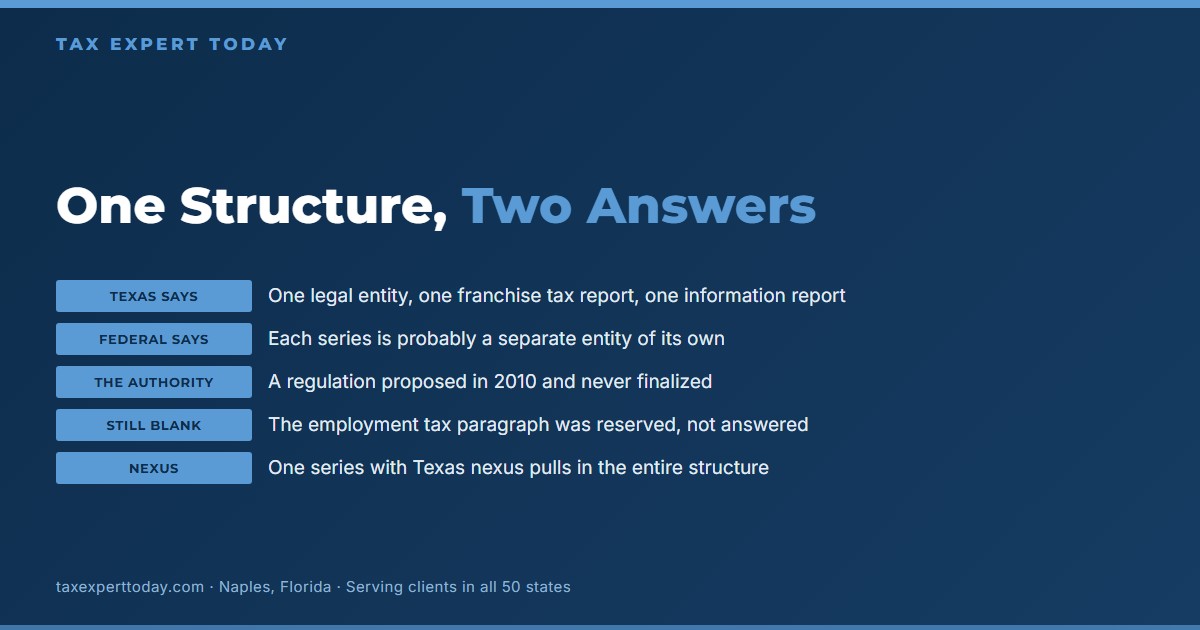
It depends entirely on which government is asking. For Texas franchise tax purposes a series LLC is one entity that files one report. For federal tax purposes the IRS proposed in 2010 to treat each series as a separate entity, and while that proposal has never been finalized, most advisors follow it. The two answers do not reconcile, and both apply at once.
- Texas answer, settled and published. The Comptroller states that a series LLC is treated as a single legal entity that files one franchise tax report and one information report.
- Federal answer, proposed and unfinalized. Proposed Regulation Section 301.7701-1(a)(5) would treat each series as an entity formed under local law, whether or not it qualifies as a juridical person under state law.
- The final regulation is why the answers are allowed to differ. Under 26 CFR 301.7701-1(a)(1), whether an organization is separate from its owners for federal tax purposes is a matter of federal tax law and does not depend on whether it is recognized as an entity under local law.
- Nothing forces the two systems to agree. A structure can be one taxpayer in Austin and several taxpayers in the federal system at the same time, and a Texas series LLC frequently is.
The detail almost never stated plainly is that the federal rule everyone cites is still a proposal. The IRS published it as REG-119921-09 in the Federal Register on September 14, 2010. By its own terms it applies on and after the date final regulations are published, and in the current Code of Federal Regulations, Section 301.7701-1 contains no paragraph (a)(5) and does not use the word series anywhere. The proposal has sat unfinalized for more than fifteen years.
That does not make it safe to ignore. It is the clearest available expression of the government position, it sets out the reasoning the IRS found persuasive, and no contrary authority displaced it. The practical consequence is that advisors generally administer a series LLC as though each series were a separate entity, while recognizing that the support for doing so is a proposal rather than a binding rule. Anyone who describes the federal treatment of a series as settled has not read the source.
One further gap is worth naming because it affects any structure with staff. The proposed regulation expressly reserved the paragraph dealing with employment taxes. Reserved means the government wrote the heading and declined to state a rule. So the question of which entity is the employer inside a series structure is not merely unfinalized. It was never answered at all.
| Question | Texas answer | Federal answer |
|---|---|---|
| Is each series a separate entity? | No, not for Title 1 and Chapter 101 purposes | Probably yes, under the 2010 proposed regulation |
| How many tax reports? | One franchise tax report for the whole structure | Potentially one federal return per series |
| How many identification numbers? | One Texas taxpayer number | Potentially one EIN per series |
| Is the governing rule final? | Yes, published Comptroller guidance | No, proposed since September 14, 2010 |
| Are employment taxes addressed? | Not applicable, Texas has no income tax withholding | No, that paragraph was reserved |
| Does activity in one series affect the others? | Yes for nexus, no for liability where conditions are met | Depends on how each series is classified |
Read that table as a description of administrative burden rather than as a curiosity. Every row where the two columns disagree is a row where somebody has to make a decision, document it, and then apply it consistently for as long as the structure exists.
How Does a Texas Series LLC Pay Franchise Tax?
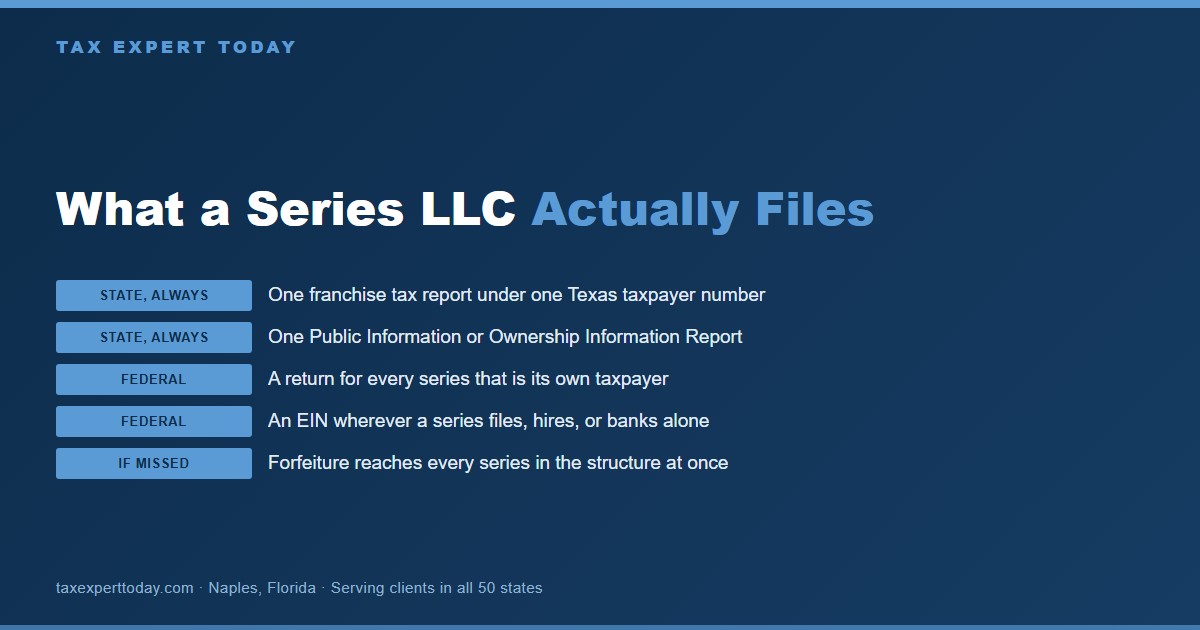
It pays as one entity. The Comptroller states that a series LLC is treated as a single legal entity, pays one filing fee, registers as one entity with the Secretary of State, and files one franchise tax report and one Public Information Report under its Texas taxpayer identification number. It does not file as a combined group, and the whole structure is measured against one threshold.
- One report, not one per series. The combined revenue of every series is reported together under a single eleven digit Texas taxpayer number.
- This is not combined reporting. The Comptroller draws the distinction explicitly. A combined group is several taxable entities reporting together, while a series LLC is one taxable entity to begin with.
- Nexus is contagious across the structure. If one of the series has nexus in Texas, the entire series LLC has nexus in Texas.
- The annual report is due May 15. If May 15 falls on a weekend or a holiday, the Comptroller reporting requirements move the due date to the next business day.
The nexus rule deserves its own paragraph because it runs opposite to what owners expect from a structure sold on separation. A series formed to hold an out of state asset does not sit outside the Texas system merely because its own activity is elsewhere. One series with Texas nexus pulls the whole series LLC into the Texas franchise tax system. Owners who set up a series specifically to keep an activity outside Texas should understand that the structure does not achieve that, and that a genuinely separate LLC would.
The single threshold works the same way, and it usually works against the owner. Ten separate LLCs each get measured against the no tax due threshold on their own. Ten series inside one series LLC are measured once, on the combined total. A structure that would have produced ten entities under the threshold can produce one entity over it. For the mechanics of the tax itself, our guide to Texas franchise tax works through the margin computation methods in detail, and Texas LLC taxes covers the ordinary single LLC case that most owners should compare this against.
| Item | Report years 2026 and 2027 |
|---|---|
| No tax due threshold | $2,650,000 annualized total revenue |
| Tax rate, retail or wholesale | 0.375 percent |
| Tax rate, all other | 0.75 percent |
| Compensation deduction limit | $480,000 per person |
| EZ computation revenue ceiling | $20 million |
| EZ computation rate | 0.331 percent |
| Annual report due date | May 15 |
Those figures are the current published amounts for report years 2026 and 2027 and they were confirmed against the Comptroller rate schedule while writing this guide. The threshold moved up from $2,470,000 for report years 2024 and 2025, and the compensation deduction limit moved from $450,000 to $480,000. Anything written before that adjustment is quoting a stale number, which is a common problem with series LLC content because much of it was published years ago and never revisited.
One more mechanical point matters for structures under the threshold. For the 2024 report year and later, an entity at or below the no tax due threshold is not required to file a No Tax Due Report, because the Comptroller discontinued that report for periods originally due on or after January 1, 2024. The entity is still required to file either Form 05-102, the Public Information Report, or Form 05-167, the Ownership Information Report. Being under the threshold removes the tax, not the filing.
Does Each Series Need Its Own EIN?
Frequently yes, and that surprises owners who chose the structure to reduce paperwork. If each series is a separate entity for federal tax purposes under the proposed regulation, then each series that must file a return, hire employees, or open a bank account in its own name generally needs its own employer identification number, even though Texas issues only one taxpayer number for the whole structure.
- The state number and the federal numbers are unrelated. One Texas taxpayer number covers the entire series LLC, while EINs are issued per federal entity.
- Banks usually force the question. A series holding its own account in its own name is normally asked for a number of its own, which is often when the owner learns the structure is not one taxpayer everywhere.
- Employment is the hardest case. The proposed regulation reserved the employment tax paragraph, so which entity is the employer inside a series structure has no published answer.
- A single member series is still separate for some taxes. The IRS states that an LLC with one member is disregarded for income tax purposes but remains a separate entity for employment tax and certain excise taxes.
The number of EINs a given structure needs is a facts question rather than a formula, and it is one of the more common reasons owners of series LLCs seek advice after formation rather than before. A series that holds a passive asset, has no employees, no separate bank account, and no separate return may not need a number at all. A series that operates a business, pays wages, and reports its own results almost certainly does.
| What the series does | Separate EIN generally needed? | Reason |
|---|---|---|
| Holds a single asset, one owner, no separate account | Usually no | Disregarded for income tax and reported by the owner |
| Has two or more owners | Yes | Defaults to a partnership filing its own return |
| Pays wages to employees | Yes | Employment tax filings require an employer number |
| Holds a bank account in its own name | Usually yes | Financial institutions generally require a number of their own |
| Elects corporate treatment on Form 8832 | Yes | The electing entity files a corporate return |
| Exists in the company agreement but holds nothing | No | No filing obligation has arisen |
Owners who employ people through any part of the structure should also read our guide to Texas payroll taxes, because the Texas Workforce Commission registration and the federal deposit rules apply on their own terms regardless of how the series question is resolved. The absence of an employment tax rule for series does not create an absence of employment tax obligations.
How Is a Texas Series LLC Taxed Federally?
Each series is classified on its own facts under the ordinary entity classification rules. A series with one owner defaults to a disregarded entity, a series with two or more owners defaults to a partnership, and any series can elect corporate treatment on Form 8832. The series LLC as a whole has no single federal classification, which is exactly why the filing count grows.
- Default rules apply series by series. The IRS states that a domestic LLC with at least two members is classified as a partnership unless it files Form 8832 to elect corporate treatment.
- A single owner series is normally disregarded. For income tax purposes an LLC with only one member is treated as an entity disregarded as separate from its owner unless it elects otherwise.
- Ownership can differ between series. Texas permits each series to have different members, so one structure can contain a disregarded series and a partnership series at the same time.
- Elections have timing limits. A Form 8832 election generally cannot take effect more than 75 days before it is filed, nor more than 12 months after.
| Ownership of the series | Default federal classification | Typical federal filing |
|---|---|---|
| One owner, no election | Disregarded entity | Reported on the owner return |
| Two or more owners, no election | Partnership | Form 1065 with Schedules K-1 |
| Any ownership, Form 8832 filed | Corporation | Corporate return for that series |
| One owner, employment or excise tax applies | Separate entity for those taxes | Employment and excise filings in its own name |
Those defaults come from the ordinary IRS guidance on limited liability company classification, applied to each series rather than to the structure as a whole. Work through what that means for a realistic arrangement. An owner forms a Texas series LLC with four series. Series A and B are wholly owned by that individual. Series C is owned equally by the individual and a business partner. Series D is owned by the parent LLC itself. Series A and B are likely disregarded and their activity is reported on the owner schedules. Series C is likely a partnership filing Form 1065 and issuing Schedules K-1. Series D depends on how the parent is classified and on whether the arrangement is respected as separate at all.
That single structure has now produced one Texas franchise tax report and one Public Information Report at the state level, alongside a partnership return, at least one EIN, and additional schedules at the federal level. The owner was told the structure meant one filing. The state half of that promise held. The federal half did not, and the federal half is where the professional fees are.
Owners considering an S corporation election on top of a series structure should be careful, and should read our discussion of reasonable compensation for S corporation owners first. The election is made by an entity, and identifying precisely which entity is making it inside a series structure is not always straightforward. Our guide to the LLC versus S corporation comparison covers how the underlying election works in a different state context, and the federal mechanics there are the same.
Owners who take profits out of an operating series should also review self employment tax in Texas, because the absence of a state income tax does nothing to the federal self employment tax that a disregarded or partnership series produces.
What Is the Difference Between a Protected Series and a Registered Series?
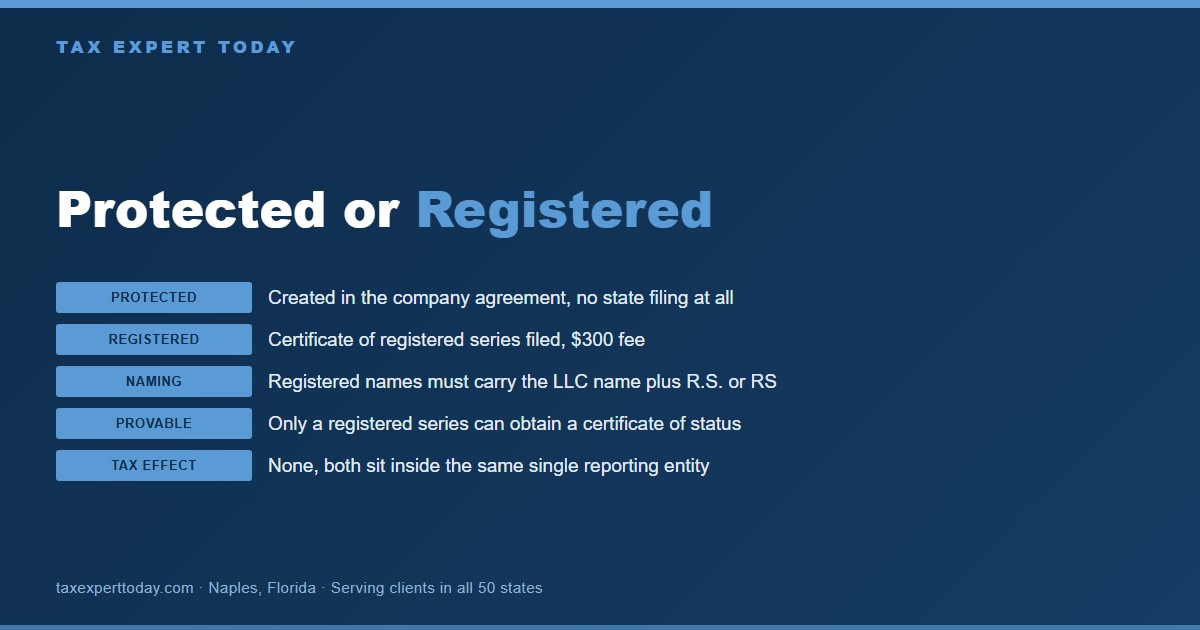
A protected series is created inside the company agreement with no state filing. A registered series is created by filing a certificate of registered series with the Secretary of State for a $300 fee. The Secretary of State states that a registered series has the same attributes as a protected series, with additional filing requirements at both formation and termination, plus the ability to obtain a certificate of status.
- Protected series means no filing to create. The Secretary of State describes a protected series as one created before June 1, 2022, or one not evidenced by a certificate of registered series.
- Registered series means a public record. The category was created by Senate Bill 1523 from the 87th Legislature, effective June 1, 2022.
- The naming rules are strict for registered series. The name must meet the Chapter 5 availability standards, contain the name of the series LLC, and contain the phrase registered series or the abbreviation R.S. or RS.
- Only a registered series can obtain a certificate of status. That document is what a lender or a counterparty asks for when it wants proof from the state rather than from the owner.
Neither category changes the tax answer. Both remain inside one Texas taxable entity filing one franchise tax report, and both face the same unresolved federal classification question. The choice between them is a legal and commercial choice about provability and cost, not a tax planning choice, and it should not be presented as one.
The assumed name rules are where administration usually slips. If a protected series does business under a name that does not include the full legal name of the parent LLC, the parent must file an assumed name certificate on behalf of that series under Chapter 71 of the Business and Commerce Code, following Senate Bill 1514, effective September 1, 2023. A registered series that conducts business under a name other than the one in its certificate of registered series must file its own assumed name certificate. Many series structures are operating under trade names with no assumed name certificate anywhere.
| Feature | Protected series | Registered series |
|---|---|---|
| State filing to create | None required | Certificate of registered series |
| State fee to create | None | $300 |
| Naming requirements | Governed by the company agreement | Must contain the LLC name plus registered series, R.S., or RS |
| Certificate of status available | No | Yes |
| Filing required to terminate | No state filing | Statutory filing required |
| Assumed name certificate | Filed by the parent LLC where the name differs | Filed by the registered series where the name differs |
| Franchise tax treatment | Inside the single entity report | Inside the single entity report |
| Federal classification question | Unresolved | Unresolved |
The bottom two rows are the point of the table. A structure choice that changes six things at the Secretary of State changes nothing at the Comptroller and nothing at the IRS.
What Records Must Each Series Keep?
Separate records of the assets of each series are a statutory condition of the liability separation, not an administrative preference. The Secretary of State pairs the required certificate and company agreement language with the requirement to maintain separate records for the assets of each series. Records that do not distinguish the series are records that undercut the reason the structure exists.
- Asset records must identify the owning series. Title documents, purchase records, and depreciation schedules should show which series holds each asset.
- Bank accounts should not be pooled. Commingled cash is the most common evidentiary problem in these structures and the hardest to explain after the fact.
- Income and expense must be traceable by series. Federal classification is applied series by series, so the books have to support a series by series result.
- Contracts should name the contracting series. A contract signed in the name of the parent LLC does not obviously bind or protect a particular series.
| Record | What it must show | Why it matters |
|---|---|---|
| Certificate of formation and company agreement | The enabling language required by Section 101.602(a)(1) and (2) | Without it the series structure does not exist at all |
| Asset register | Which series holds each asset and when it was acquired | Separate records of assets are a statutory condition |
| Bank statements | Accounts held by series rather than pooled | Commingled cash is the hardest defect to explain later |
| Income and expense ledgers | Results traceable to a single series | Federal classification is applied series by series |
| Contracts and title documents | The contracting or owning series named | A parent level signature does not obviously bind one series |
| Ownership records | The members of each individual series | Ownership determines the federal filing for that series |
Series bookkeeping is where the economics of the structure actually get decided. Owners compare the $300 registered series fee against the cost of forming another LLC and conclude the series structure is cheaper. That comparison ignores the recurring cost, which is maintaining a chart of accounts that keeps every series distinct for as long as the structure exists, and being able to produce that on demand years later.
An owner who would not maintain separate books for separate LLCs will not maintain them for separate series either. The difference is that with separate LLCs the state filings themselves impose some discipline, while with a series LLC there is one report and nothing external forcing the internal separation. The structure delegates the discipline entirely to the owner.
What Happens If You Miss the Public Information Report?
The entity may forfeit its right to transact business in Texas. The Comptroller states that the effects of forfeiture include denial of the entity right to sue or defend in a Texas court, and that each officer, director, partner, member, or owner becomes personally liable for certain debts of the entity. Because a series LLC files one report for the whole structure, one missed filing reaches every series at once.
- The report is due even when no tax is owed. The Comptroller states directly that the PIR or OIR is due even if the entity does not have to file a franchise tax report because it is at or below the no tax due threshold.
- Forfeiture removes the ability to defend a lawsuit. An entity that cannot defend in a Texas court is in a materially worse position than one that simply owes a penalty.
- Personal liability is the stated consequence. Each officer, director, partner, member, or owner becomes personally liable for certain debts of the entity.
- One filing covers the whole structure. There is no series level report that survives on its own if the entity level report is missed.
This is the sharpest tax related risk in the entire structure, and it is almost entirely absent from the material that markets series LLCs. The structure is bought for asset protection. The single annual information report that keeps the structure standing is the one filing owners are most likely to overlook, precisely because in a year with revenue under the threshold there is no tax to pay and therefore no payment to prompt the filing.
Consider the sequence. A series LLC holds four assets across four series. Revenue is comfortably under $2,650,000, so no franchise tax is owed and no franchise tax report is required. The owner concludes there is nothing to file, misses the Public Information Report, and the entity forfeits its right to transact business. A claim is then brought against one series. The entity cannot defend it, and the owners face personal liability for certain debts. Every liability wall the structure was built for is now irrelevant, and the cause was a report that would have cost nothing to file.
Entities in that position can generally resolve the forfeiture by bringing the filings current and paying the penalties and interest, and the Comptroller publishes guidance on making a franchise tax account current. The point is not that the situation is unrecoverable. The point is that the exposure runs through a single low salience filing, and structures with many series concentrate more risk behind that one filing than a single LLC does.
Does a Texas Series LLC Save You Money on Taxes?
No. A series LLC produces no federal or Texas tax saving that separate LLCs would not also produce. The savings are in formation and state filing costs, and they are frequently offset by higher accounting costs and by the single no tax due threshold applying to the combined revenue of every series rather than to each one separately.
- There is no series LLC tax rate. The franchise tax rates and thresholds are the same ones that apply to every other taxable entity.
- The threshold works against the structure. Combined revenue is tested once, so several small activities can push one entity over a line that would not have been crossed separately.
- Federal treatment is neutral at best. Each series is classified under the same rules that would apply to a standalone LLC in its position.
- Accounting cost usually rises. Series by series books plus an unresolved federal classification question is more work than one clean set of books, not less.
The genuine advantages are legal and administrative rather than fiscal. One certificate of formation instead of many, one registered agent relationship, one franchise tax report, and the ability to add a series without a new state formation filing. Those are real, and for an owner adding holdings frequently they can matter. None of them is a tax saving, and content that presents the structure as a tax strategy is describing something the tax rules do not contain.
There is also a scenario where the structure costs more in hard tax dollars. A series LLC whose combined revenue exceeds $2,650,000 owes franchise tax on its taxable margin, while the same activities held in separate LLCs, each under the threshold, would owe none. Whether that applies depends on the revenue distribution across the series and on the margin computation, so it needs to be worked rather than assumed, but owners should know the possibility exists before they form.
How Do You Terminate One Series of a Texas Series LLC?
It depends on which type of series it is. Terminating a registered series requires a statutory filing with the Secretary of State, because the registered series exists on the public record. Terminating a protected series involves no state filing, because nothing was filed to create it. The franchise tax report continues either way, since the reporting entity is the series LLC rather than the series.
- Registered series termination is a filing event. A statutory filing is required when winding up the business and terminating the existence of a registered series.
- Protected series termination is a governance event. It happens through the company agreement, and the evidence is internal rather than public.
- The entity level obligations survive. Winding down one series does not end the franchise tax report or the information report for the series LLC.
- Records must outlive the series. Documentation of what the terminated series held and owed still supports the entity return and any later examination.
The comparison worth drawing is with closing an ordinary Texas entity. Ending a whole Texas LLC requires a Certificate of Account Status from the Comptroller before the Secretary of State will accept the termination, and our guide to closing a business in Texas walks through that sequence in full. Ending one series inside a surviving series LLC does not trigger that entity level clearance, because the entity is not ending. That makes the exit simpler, and it also makes it easier for an owner to believe the exit was cleaner than the records show.
If the terminated series held inventory bought without sales tax, the purchasing side deserves attention on the way out. Our guide to the Texas resale certificate covers what happens when stock acquired tax free stops being held for resale, and a wind down is precisely the moment that question gets answered by default rather than deliberately.
Does a Texas Series LLC Work Outside Texas?
Not reliably. The Secretary of State notes that not all states recognize series LLCs and advises contacting the filing official in each state where business is contemplated. A Texas series LLC registering elsewhere generally registers as one legal entity, and a state that does not recognize series may not respect the internal liability separation at all.
- Recognition varies by state. The structure is a creature of the statutes that authorize it, and those statutes do not exist everywhere.
- Foreign registration is entity level. Texas applies the same logic in reverse, treating an out of state series LLC as a single legal entity for qualification purposes, with the LLC rather than the individual series registering.
- Assumed names follow the series. Where a series transacts business under a name other than the LLC name, an assumed name certificate is required.
- Multistate activity multiplies the open questions. Each additional state adds its own recognition question, its own filing requirements, and its own tax treatment.
For owners holding assets in more than one state, this is usually the decisive practical point. The liability separation an owner is paying for may hold in Texas and be untested or unavailable in the state where the asset actually sits. That is a legal question rather than a tax question, and it is one of the situations where the structure decision should involve counsel in each relevant state rather than a formation service.
Owners moving an existing business into Texas should look at the sequence rather than the structure first. Our guide to moving a business to Texas covers re-domestication against foreign registration, franchise tax registration, and the trailing obligations in the departure state. Owners relocating personally at the same time should read how to establish Texas residency, since the personal and business analyses are separate and are frequently confused.
Series LLC or Multiple LLCs: Which Is Cheaper to Run?
Formation is cheaper with a series LLC and administration is usually more expensive. Separate LLCs cost more up front in filing fees and registered agent relationships, and then behave predictably. A series LLC costs less to create and then requires the owner to maintain internal separation with no external filing forcing the discipline, while the federal treatment stays unsettled.
- Up front cost favors the series structure. One certificate of formation covers the whole arrangement, and adding a protected series requires no state filing.
- Ongoing state filings favor the series structure. One franchise tax report and one information report instead of several.
- The no tax due threshold favors separate LLCs. Each separate entity is tested against $2,650,000 on its own.
- Certainty favors separate LLCs. The federal and multistate treatment of an ordinary LLC is settled, and the treatment of a series is not.
- Accounting cost favors separate LLCs more often than owners expect. Books that must prove internal separation are not cheaper than books that are separate by construction.
| Factor | Texas series LLC | Separate Texas LLCs |
|---|---|---|
| State formation filings | One certificate of formation | One per entity |
| Cost to add a holding | None for a protected series, $300 for a registered series | A new formation filing each time |
| Franchise tax reports each year | One | One per entity |
| Information reports each year | One | One per entity |
| No tax due threshold applied | Once, to combined revenue | Separately, to each entity |
| Federal classification | Unsettled, governed by a proposed regulation | Settled under the existing rules |
| Recognition in other states | Varies and may be unavailable | Generally recognized everywhere |
| Consequence of one missed report | Reaches every series at once | Contained to one entity |
There is no universally correct answer in that table, and any source that gives one is selling something. The structure suits an owner who adds holdings frequently, keeps disciplined books, operates within Texas, and understands that the federal treatment rests on a proposal. It suits far less well an owner with a handful of stable holdings, activity in several states, or a preference for filings that are separate by construction rather than by diligence.
Texas Series LLC Help in Naples & Southwest Florida
Tax Expert Today LLC advises business owners on state and federal tax matters nationwide from our office in Naples, Florida. Texas entity work reaches us from two directions. Florida owners who formed a Texas series LLC to hold out of state assets and now need the returns to match the structure, and Texas owners who have relocated to Southwest Florida while leaving the original structure in place. Both arrive with the same question, which is how many returns the arrangement actually requires and who signs them.
Our work on these engagements starts with the structure as it exists rather than as it was described at formation. We read the certificate of formation and the company agreement to confirm the enabling language is present, map which series hold which assets, test whether the books support series by series treatment, and then determine the federal classification and identification number position for each series. Where the records do not support the structure, we say so before anything is filed.
- Series LLC tax help Naples business owners can reach in person. Our office is on Tamiami Trail North in Naples, Florida, and we meet clients locally as well as remotely.
- Texas entity tax help delivered remotely. We work with clients in all 50 states, and the Texas analysis is identical regardless of where the owner now lives.
- Entity structure review before formation. The cheapest version of this engagement is the one that happens before a structure is created rather than after three years of filings.
- Coordination between the state report and the federal returns. One franchise tax report and several federal returns is a normal outcome, and it needs to be planned rather than discovered.
Related services include our Texas tax services and our business consulting practice for owners building out an internal compliance function. Southwest Florida businesses can also review our Naples tax planning work.
Tax Expert Today LLC
11983 Tamiami Trail N, Naples, FL 34110
Phone: (239) 441-2005
Hours: Monday through Friday, 10:00 a.m. to 5:00 p.m. ET
Local question we are asked often: A Naples owner formed a Texas series LLC three years ago through an online service, added a series for each property, and has been filing one Texas report and one personal return the whole time. Is that right? Sometimes, and often not. The single Texas report is almost certainly correct. Whether one federal return is correct depends on who owns each series. If any series has a second owner, that series is likely a partnership that should have been filing its own return and issuing Schedules K-1. The starting point is reading the company agreement to establish the ownership of each series, because that document, rather than the formation paperwork, determines the federal answer.
When Should You Engage a Professional?
Engage a professional when the series have different owners, when any series employs people, when assets sit outside Texas, or when combined revenue approaches the no tax due threshold. Each of those facts changes the number of federal returns the structure produces, and none of them is visible from the formation paperwork alone.
An owner with a single series holding one passive asset does not need advisors to manage a Texas series LLC. Several situations move the work out of that category, and each turns on the number of open questions rather than on the difficulty of any one of them.
- Series have different owners. Mixed ownership across series is what turns one structure into several federal taxpayers, and it is the most commonly missed fact.
- You are deciding whether to form one at all. The comparison against separate LLCs is worth doing before formation, when it is still a choice rather than a cleanup.
- Any series employs people. The employment tax paragraph of the proposed regulation was reserved, so the employer question needs a documented position.
- Assets sit outside Texas. Recognition varies by state, and the separation may not hold where the asset actually is.
- Combined revenue is near the threshold. Approaching $2,650,000 across all series changes the franchise tax position for the entire structure at once.
- Filings have been missed. Forfeiture reaches every series simultaneously, and bringing the account current is more urgent than it looks when no tax was owed.
- You are winding down a series. Registered series termination is a filing event, and the records need to support what the series held on the way out.
Our team includes tax advisors, enrolled agents, CPAs, and attorneys, and we work the Texas state analysis and the federal position together rather than in isolation. Owners weighing the wider Texas picture can start with Texas franchise tax and the reality behind no state income tax. Businesses selling into the state should review Texas sales tax nexus, and owners comparing the two no income tax states can read Texas versus Florida taxes. Owners contemplating a sale of one of the holdings should also review Texas capital gains tax. To discuss a Texas series LLC structure review, call (239) 441-2005 for a free consultation.
Frequently Asked Questions
Are series LLCs allowed in Texas?
Yes. Texas has authorized series LLCs since 2009, and Senate Bill 1523 from the 87th Legislature added the registered series category effective June 1, 2022. The Secretary of State accepts them, although it has not promulgated a dedicated form. A series LLC is formed using the general certificate of formation with the required series language added in the supplemental text area.
Is a series LLC better than a regular LLC?
It is different rather than better, and the difference is not tax. A series LLC is cheaper to form and to expand, and it produces one Texas franchise tax report regardless of how many series it contains. It also carries an unsettled federal classification, uncertain recognition outside Texas, and a single no tax due threshold applied to combined revenue. For most owners with a small number of stable holdings, separate LLCs remain the simpler answer.
Does a Texas series LLC file one franchise tax report or one per series?
One. The Comptroller treats a series LLC as a single legal entity that files one franchise tax report and one Public Information Report under its Texas taxpayer identification number, and specifically not as a combined group. The combined revenue of every series is tested once against the no tax due threshold, which is $2,650,000 for report years 2026 and 2027.
Does each series need its own EIN?
Often. Texas issues one taxpayer number for the whole structure, but employer identification numbers are federal and follow the federal entity analysis. A series that files its own return, hires employees, or holds a bank account in its own name generally needs its own number. A series with no separate activity may not. The answer depends on the facts of each series rather than on the structure as a whole.
What are the disadvantages of a series LLC in Texas?
The main ones are administrative rather than dramatic. The federal treatment rests on a regulation proposed in 2010 that has never been finalized. Other states may not recognize the structure. Separate records for each series are a statutory condition rather than a suggestion. Combined revenue is measured against one threshold. And because one information report covers everything, a single missed filing can reach every series at the same time.
What happens if my series LLC makes no money?
The filing obligation continues. For report years 2024 and later, an entity at or below the no tax due threshold is not required to file a No Tax Due Report, because that report was discontinued. It is still required to file Form 05-102, the Public Information Report, or Form 05-167, the Ownership Information Report. Skipping that filing can lead to forfeiture of the right to transact business, denial of the right to sue or defend in a Texas court, and personal liability for certain debts.
How much does a registered series cost in Texas?
The filing fee for a certificate of registered series is $300. A protected series requires no state filing and therefore no state fee. Neither choice changes the franchise tax outcome, since both sit inside the same single reporting entity, so the decision between them turns on whether the series needs a public record and a certificate of status rather than on tax.
If one series has Texas nexus, do the others?
Yes. The Comptroller states that if one of the series has nexus in Texas, the entire series LLC has nexus in Texas. That is the opposite of what many owners expect from a structure sold on separation, and it means a series cannot be used to hold an activity outside the Texas franchise tax system while other series operate inside it.
This article is general tax information and does not constitute tax, legal, or accounting advice for any particular situation. State and federal tax rules change and their application depends on specific facts. Consult a qualified professional regarding your circumstances before acting.
Published September 4, 2026 by Dr. Pellumb Kabashi « Back to Learning Center
Have a question this article touches on?
Tax Expert Today LLC, based in Naples, Florida and serving clients across the United States.
Schedule a Consultation (239) 441-2005