
By Dr. Pellumb Kabashi, DBA, MBA, CES, CFE, EA
Founder, Tax Expert Today LLC · Tax advisors, enrolled agents, CPAs, and attorneys · Serving clients in all 50 states
Quick Answer: Form 8332 is the IRS form a custodial parent signs to release the claim to a child, allowing the noncustodial parent to take the child tax credit, the additional child tax credit, and the credit for other dependents. It does not move head of household status, the earned income credit, or the dependent care credit. Call (239) 441-2005 for a free consultation.
What Is Form 8332 and Who Signs It?
Form 8332 is titled Release/Revocation of Release of Claim to Exemption for Child by Custodial Parent. The custodial parent signs it. The noncustodial parent attaches it to a return. The current version is Rev. December 2025, and a separate form is required for each child.
The form does one narrow thing. It converts a child who would otherwise be the qualifying child of the custodial parent into the qualifying child or qualifying relative of the noncustodial parent, but only for a defined set of tax benefits. Everything else in the Internal Revenue Code that depends on where the child actually lives stays where the child actually lives.
That distinction is the source of most of the confusion this form creates. Parents and, at times, the settlement agreements themselves treat the release as though it hands the whole child over for tax purposes. It does not. The IRS instructions to Form 8332 state the scope in a note at the top of page 1: the form applies to certain tax benefits, specifically the child tax credit, the additional child tax credit, and the credit for other dependents.
The form has three parts. Part I releases the claim for a single current year. Part II releases it for future years, either specified years or all future years. Part III revokes a release given earlier. The IRS instructions attach a plain caution to Part II that is worth repeating, because it is guidance from the agency rather than a planning opinion: to help ensure future support, a custodial parent may not want to release the claim for future years.
Who Is the Custodial Parent for Form 8332 Purposes?
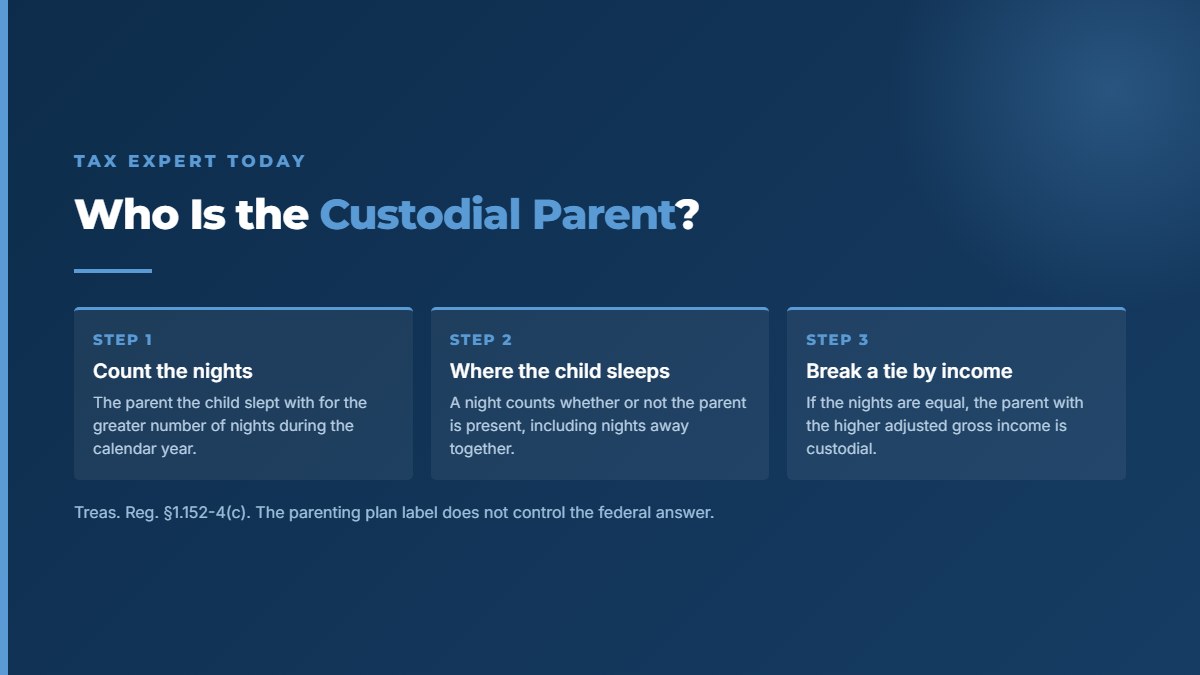
The custodial parent is the parent with whom the child lived for the greater number of nights during the calendar year. It is a counting exercise, not a legal label. A decree naming one parent the primary residential parent does not control the federal answer if the nights fall the other way, and the release has to be signed by whichever parent the night count identifies.
Treasury Regulation §1.152-4(c) defines what a night is. A child resides with a parent for a night if the child sleeps at that parent’s residence, whether or not the parent is present, or sleeps in the company of the parent when the child does not sleep at a parent’s residence, which covers a vacation taken together. The parent who is physically present is not the test. The place the child sleeps is the test.
When the nights come out even, the regulation breaks the tie by adjusted gross income. The parent with the higher adjusted gross income for the calendar year is treated as the custodial parent. In a leap year, or in a year where the parenting schedule genuinely splits down the middle, this rule decides who holds the right to sign Form 8332, and the answer can flip from one year to the next as incomes move.
Two practical points follow. First, the night count should be documented while the year is running rather than reconstructed the following spring from memory and text messages. Second, a parenting plan that produces a near tie is worth reviewing with both the family law attorney and the tax advisor before it is finalized, because it makes the federal answer unstable in a way neither parent usually intends.
What Does Form 8332 Transfer, and What Does It Not?
Form 8332 moves three benefits and leaves the rest with the custodial parent. It transfers the child tax credit, the additional child tax credit, and the credit for other dependents. It cannot transfer head of household filing status, the earned income credit, or the child and dependent care credit, because each of those is written to depend on the child living with the taxpayer.
This is the single most useful table in any discussion of the form, and it is the point most settlement agreements get wrong. The benefits do not travel together.
| Benefit | Does Form 8332 move it? | 2026 amount | Authority |
|---|---|---|---|
| Child tax credit | Yes | Up to $2,200 per qualifying child | IRC §24; Rev. Proc. 2025-32 §3.05 |
| Additional child tax credit (refundable portion) | Yes | Up to $1,700 per qualifying child | IRC §24(d); Rev. Proc. 2025-32 §3.05 |
| Credit for other dependents | Yes | $500 per dependent | IRC §24(h)(4) |
| Head of household filing status | No | 2026 standard deduction $24,150 | IRC §2(b) |
| Earned income credit | No | Up to $4,427 with one qualifying child | IRC §32; Rev. Proc. 2025-32 §3.06 |
| Child and dependent care credit | No | Based on qualifying expenses | IRC §21 |
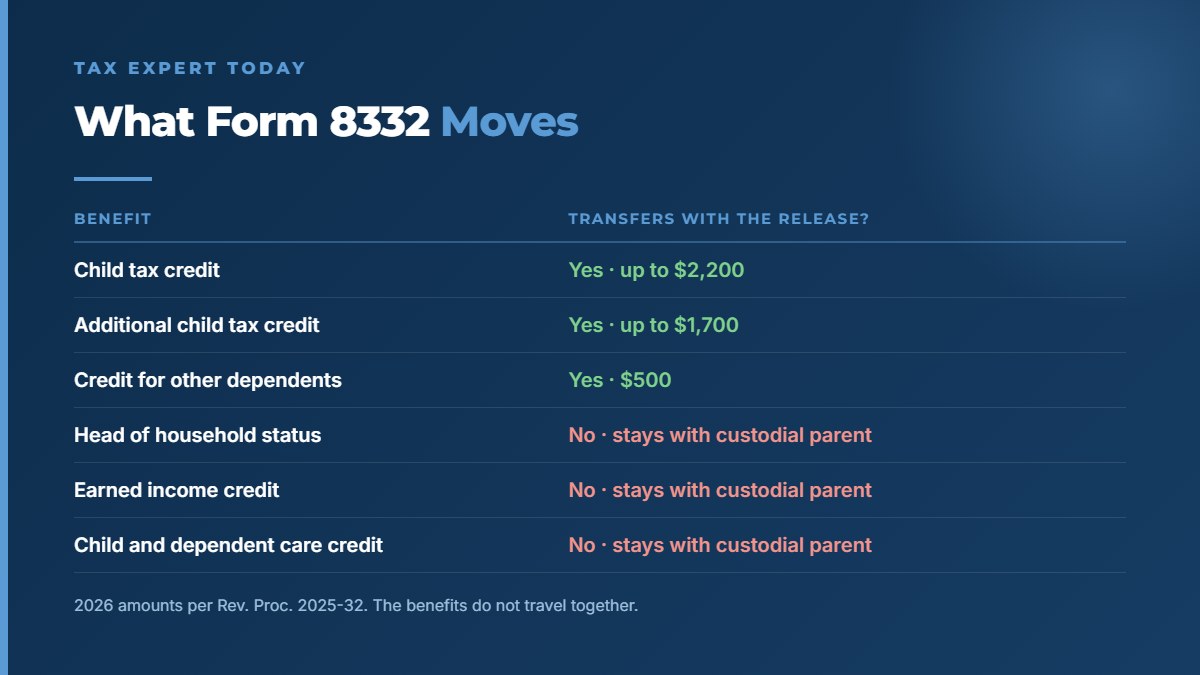
The consequence is that a single child can produce benefits on two different returns in the same year. The noncustodial parent claims the child tax credit because a signed Form 8332 is attached. The custodial parent, in the same year, may still file as head of household and may still claim the earned income credit and the dependent care credit for that same child. This is not a loophole and it is not double dipping. It is how IRC §152(e) is written.
Medical expenses follow a separate rule that surprises many divorced parents. Under IRC §213(d)(5), a child of divorced or separated parents is treated as a dependent of both parents for the medical expense deduction, so the parent who actually pays a medical bill is generally the parent who may include it, regardless of who signed Form 8332.
When Does the Special Rule for Divorced Parents Apply?
The special rule is not available in every separation. IRC §152(e) applies only when a threshold set of conditions is satisfied. If any one of them fails, the release accomplishes nothing, and a return claiming the child on the strength of it is exposed on examination.
The IRS instructions to the form set out the conditions. All of the following must apply for the child to be treated as the qualifying child or qualifying relative of the noncustodial parent.
| # | Condition | Practical note |
|---|---|---|
| 1 | The child received over half of the child’s support for the year from one or both parents | Support from a grandparent or a public program can break this. A multiple support agreement disqualifies the special rule entirely. |
| 2 | The child was in the custody of one or both parents for more than half of the year | Time with a third party counts against this condition. |
| 3 | The custodial parent signs Form 8332 or a similar statement | A pre-1985 decree can substitute if the noncustodial parent provides at least $600 of support. |
| 4 | The parents are divorced or legally separated, separated under a written separation agreement, or living apart at all times during the last 6 months of the year | Parents who are married, living together, and simply filing separately do not qualify. |
Condition 4 deserves attention in the year a separation begins. Parents who separate in August will not have lived apart at all times during the last six months of that calendar year, so §152(e) may not be available for that first year even though the marriage has functionally ended. This interacts directly with the filing status question, which is covered in our guide to divorce filing status and the December 31 rule.
Can a Divorce Decree Replace Form 8332?
For any decree that went into effect after 2008, the answer is no. Treasury Regulation §1.152-4(e) states that a court order or decree or a separation agreement may not serve as a written declaration. The noncustodial parent needs a signed Form 8332 or a similar statement that meets the form requirements, and attaching decree pages instead will not work.
This is the most common and most costly mistake in this area. A settlement agreement recites that the noncustodial parent shall claim the child in alternating years, both parties sign the agreement, a judge enters it, and everyone treats the matter as closed. The IRS is not a party to that agreement and does not enforce it. Without the signed form, the credit is not supported on the federal return.
| Decree effective date | Can decree pages substitute for Form 8332? | What must be attached |
|---|---|---|
| Pre-1985 | Yes, under the condition in the statute | The decree stating the noncustodial parent may claim the child, plus at least $600 of support provided during the year |
| After 1984 and before 2009 | Yes, if the pages are substantially similar to Form 8332 | Cover page with the other parent’s SSN, the pages showing the three required statements, and the signature page |
| After 2008 | No | A signed Form 8332 or a similar statement is required |
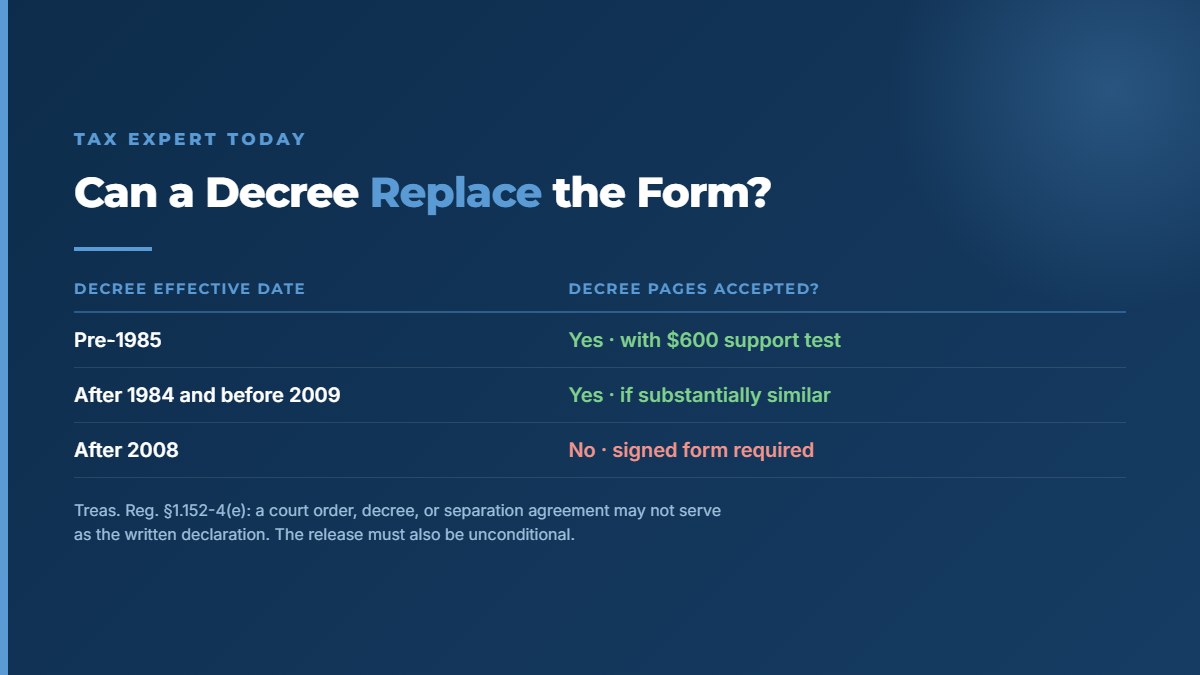
For the middle category, the IRS instructions are specific about what the decree must say. It must state that the noncustodial parent can claim the child without regard to any condition such as payment of support, that the other parent will not claim the child, and the years for which the claim is released. The instructions also caution that the required pages must be attached each year, even if they were filed with a return in an earlier year.
The word unconditional is doing real work here. Treas. Reg. §1.152-4(d) requires that the release be an unconditional release of the custodial parent’s claim. A release drafted to operate only while support is current is conditional on its face, and a conditional release is not a valid written declaration. Family law counsel and the tax advisor should look at that language together before it is signed.
How Do You File Form 8332 With an Electronically Filed Return?
The noncustodial parent attaches Form 8332 to the return for each year the claim is made. When the return is filed electronically, the IRS instructions direct that Form 8332 be filed with Form 8453, the U.S. Individual Income Tax Transmittal for an IRS e-file Return, which is mailed separately after the return is transmitted.
Several details matter in practice. A separate form is required for each child, so two children means two forms. Where Part II released future years, the noncustodial parent must attach a copy of that form to the return for every future year in which the claim is made, not only the first. The custodial parent should keep the original, and the noncustodial parent should keep a copy indefinitely, because the attachment obligation does not expire while the release is being relied upon.
Missing the Form 8453 step is a quiet failure. The electronic return is accepted, the credit appears on the transcript, and nothing looks wrong until the IRS asks for substantiation of the claim months later. At that point the form usually still exists and can be produced, but the correspondence is avoidable.
How Does a Custodial Parent Revoke a Form 8332 Release?
Part III of the form revokes a release given for future years. The revocation is not immediate. Under the form instructions, it takes effect no earlier than the tax year following the year in which the custodial parent provides the noncustodial parent with a copy of the revocation, or makes a reasonable effort to do so.
The IRS gives its own worked example in the instructions. A parent who released the claim in 2022 for the years 2023 through 2027, and who completes Part III and delivers a copy to the other parent during 2025, has a revocation effective for 2026 and 2027. The 2025 year is already gone. This built-in lag is why a Part II release covering all future years is a decision worth deliberating rather than conceding at the settlement table.
Two record-keeping duties come with a revocation. The custodial parent must attach a copy of the revocation to the return for each year the claim is made as a result of it, and must keep a copy of the revocation together with evidence of delivery to the noncustodial parent, or evidence of reasonable efforts to provide actual notice. Certified mail with a return receipt is the ordinary way to build that evidence.
What Happens if Both Parents Claim the Same Child?
The IRS matches dependent Social Security numbers across returns. When the same child appears on two returns, the second electronic return is rejected, and the parent who filed second must either paper file or remove the child. Filing on paper is not a workaround. It moves the dispute from an instant rejection to a slower review of both returns.
The notice that follows is generally a CP87A. The IRS is explicit that this notice is not an audit and that no documentation should be sent in response to it. Each parent is asked to compare the Social Security numbers on the notice against the dependent’s Social Security card, and then either keep the claim if entitled to it or file an amended return on Form 1040-X. The notice goes to both parents, and neither is told who the other filer is.
If neither parent backs down, the IRS applies the tiebreaker rules in IRC §152(c)(4). Where both claimants are parents, the child is treated as the qualifying child of the parent with whom the child resided for the longer period during the year, and if the child resided with both for the same length of time, the parent with the higher adjusted gross income prevails. A valid Form 8332 takes the case out of that contest entirely, which is precisely why the signed form matters more than the decree language.
The parent who loses this determination faces the ordinary consequences of an overstated credit, which may include repayment of the credit with interest and, depending on the facts, accuracy-related penalties. Our IRS penalty and interest calculator illustrates how those amounts accumulate on a balance while it remains unpaid. Where the error was the result of reasonable reliance rather than carelessness, relief may be available in qualifying cases, and our discussion of reasonable cause penalty abatement describes how that standard is applied. Where a joint return from the marriage is the source of the exposure, innocent spouse relief is a separate track with its own requirements. If instead a joint refund was applied to a debt belonging only to one spouse, injured spouse relief is the claim that recovers your portion.
How Does Florida Law Treat the Dependency Waiver?
Florida addresses the dependency exemption directly in its child support statute. Fla. Stat. §61.30(11)(a)8 lists the impact of the federal dependency exemption and related credits among the factors a court may consider, and provides that the court may order a parent to execute a waiver of the Internal Revenue Service dependency exemption if the paying parent is current in support payments.
Read that provision alongside Treas. Reg. §1.152-4(d) and a genuine tension appears. The Florida statute allows the court to condition its order on the payer being current. The federal regulation requires that the release the parent actually signs be unconditional. Both can be satisfied, but only if the drafting keeps them separate. The state court order may be conditioned on support being current. The form the custodial parent signs must not carry that condition on its face.
The practical sequence that follows from this is straightforward. The decree obligates the custodial parent to sign Form 8332 for the years the court specifies, subject to whatever state law conditions the court imposes. The custodial parent then signs a clean, unconditional Form 8332 for those years. If the custodial parent later refuses to sign, the remedy is a motion to enforce in the Florida court, not an adjustment on the federal return. The IRS will not accept a decree in place of the form for any post-2008 judgment.
A related Florida point concerns alimony. The 2023 reform in Fla. SB 1416 eliminated permanent alimony, which changed how support packages are structured in this state, and the federal tax treatment of those payments is covered in our guide to alimony taxes after divorce. Child-related benefits and spousal support are analyzed separately, but they are usually negotiated in the same room and traded against each other.
Form 8332 Help Naples: Working With Your Family Law Attorney
Tax Expert Today LLC works with divorcing and separated parents in Naples, Florida, across Southwest Florida, and in all 50 states, on the tax side of a dissolution. The team includes tax advisors, enrolled agents, CPAs, and attorneys. We do not provide family law advice and we do not replace your attorney. We work alongside counsel so that the tax result matches what the settlement was intended to accomplish.
Form 8332 Naples: the work in this area typically includes reviewing draft settlement language before it is signed, running the night count for the year in question, modeling which parent each benefit is worth more to, confirming that the release language is unconditional as the regulation requires, and preparing or reviewing the form itself and the Form 8453 transmittal. Where two parents have already claimed the same child, the work shifts to responding to the notice and documenting the correct result.
The office is at 11983 Tamiami Trail N, Naples, FL 34110. Consultations can be scheduled by phone at (239) 441-2005, Monday through Friday, 10am to 5pm ET. Clients elsewhere in Florida and in other states are served remotely. Related work is described on our divorce tax consulting and Naples tax planning pages.
Local question: our Collier County parenting plan gives us alternating weeks. Who signs Form 8332? Alternating weeks rarely produce an exact split once holidays, school breaks, and summer time are counted, so the answer comes from the actual night count for that calendar year rather than from the plan on its face. If the count truly ties, the parent with the higher adjusted gross income is the custodial parent under Treas. Reg. §1.152-4(c) and is the parent who signs. Because the tie is broken by income, the signing parent can change from year to year, and the count should be tracked contemporaneously.
When to Engage a Professional
Form 8332 is worth professional review whenever the child-related benefits are material to either return or the parenting schedule is close to even. That generally includes cases where a settlement is still being drafted, where a release for all future years is being requested, where the parents live in different states, which raises separate questions covered in our guide to establishing Florida residency, where one parent has income near the child tax credit phase-out thresholds of $200,000 for a single filer and $400,000 on a joint return, and where both parents have already claimed the same child.
When a credit of this size moves from one return to the other, both parents may also need to revisit withholding and estimated payments for the year, and our quarterly estimated tax calculator is a starting point for that check. A review before the settlement is signed is materially more useful than a review afterward. Once a decree obligates a parent to release all future years, unwinding it requires going back to the family law court, and the federal revocation mechanism carries a built-in delay of at least one tax year. Coordinating with your family law attorney at the drafting stage is the point at which the tax outcome is still fully adjustable. The same is true of the marital home provisions described in our guide to divorce house buyout taxes.
Outcomes depend on individual facts, on the terms of the decree, on the actual residence of the child during the year, and on IRS review of the return as filed. Nothing in this article is a promise about how a particular return will be treated, and nothing in it is family law advice.
Frequently Asked Questions
Does Form 8332 give the noncustodial parent head of household status?
No. Head of household status under IRC §2(b) requires that the taxpayer maintain a household that is the principal place of abode of a qualifying person for more than half the year. The release does not change where the child lived, so it cannot create head of household status for the noncustodial parent. The custodial parent may still qualify for that status in the same year the release is in effect.
Can the noncustodial parent claim the earned income credit with Form 8332?
No. The earned income credit under IRC §32 requires that the qualifying child live with the taxpayer in the United States for more than half the year. That residency requirement is not waivable, and the release does not address it. The earned income credit stays with the custodial parent even when the child tax credit has been released.
Is Form 8332 mandatory, or is the divorce decree enough?
For any decree that went into effect after 2008, Form 8332 or a similar signed statement is required. Treas. Reg. §1.152-4(e) provides that a court order, decree, or separation agreement may not serve as the written declaration. Decrees effective after 1984 and before 2009 may substitute qualifying pages if those pages are substantially similar to the form.
Can a Form 8332 release be conditioned on child support being paid?
No. Treas. Reg. §1.152-4(d) requires an unconditional release, and it specifically rules out conditioning the release on the noncustodial parent meeting an obligation such as the payment of support. A Florida court may condition its order to sign on support being current under Fla. Stat. §61.30(11)(a)8, but the signed form itself must be unconditional.
How many years can one Form 8332 cover?
Part I covers the current year only. Part II can release specified future years or all future years. A separate form is required for each child regardless of the years covered, and the noncustodial parent must attach a copy to the return for every year the claim is made.
What is the deadline to revoke a Form 8332 release?
There is no deadline, but there is a lag. A revocation on Part III takes effect no earlier than the tax year after the year in which the custodial parent delivers a copy to the noncustodial parent or makes a reasonable effort to do so. A revocation delivered during 2026 is therefore generally effective for 2027 at the earliest.
Published August 1, 2026 by Dr. Pellumb Kabashi « Back to Learning Center
Have a question this article touches on?
Tax Expert Today LLC, based in Naples, Florida and serving clients across the United States.
Schedule a Consultation (239) 441-2005