
By Dr. Pellumb Kabashi, DBA, MBA, EA, CFE, CES
Founder, Tax Expert Today LLC · Tax advisors, enrolled agents, CPAs, and attorneys · Serving clients in all 50 states
Quick Answer: The Georgia tobacco tax is a state excise tax of 37 cents per pack of 20 cigarettes, 2.5 mills per little cigar, 23 percent of the wholesale cost price for large cigars, 10 percent for loose and smokeless tobacco, 5 cents per milliliter for closed system vapor products, and 7 percent for open system and single use vapes. Licensed distributors generally collect it, with returns due by the 10th. Call (239) 441-2005 for a free consultation.
Most of what ranks for the Georgia tobacco tax today is either the Department of Revenue rate table, a policy paper arguing the rate should go up, or a news story about a bill that did not pass. None of them answers the questions a store owner, a vape shop, a distributor, or an out of state seller actually brings to a tax advisor: who owes the tax, how it is paid, what happens when untaxed product shows up at the back door, and what an audit looks like when the numbers do not tie.
This guide covers the Georgia tobacco tax as a working compliance system. It explains the rates for every product class the Department of Revenue taxes, the difference between the stamp method for cigarettes and the monthly report method for everything else, the license and fee rules, the 24 hour reporting duty for untaxed product, refunds, records, penalties, and how the excise tax sits next to Georgia sales tax and income tax. Every rate and rule below was checked against the Department of Revenue and the Georgia administrative rules on October 27, 2026. For the wider picture of Georgia state taxes, including income, sales, and business taxes, see our Georgia tax services overview.
What Is the Georgia Tobacco Tax in 2026?
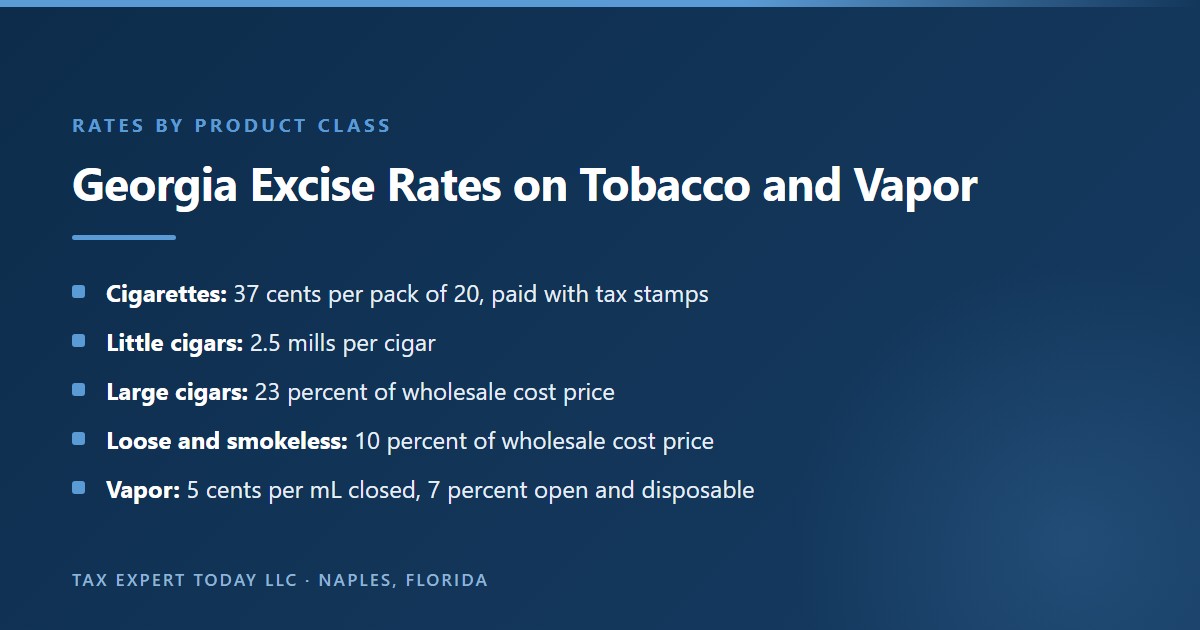
The Georgia tobacco tax is a state excise tax under Chapter 11 of Title 48 of the Official Code of Georgia Annotated. For 2026 it is 37 cents per pack of 20 cigarettes, 2.5 mills per little cigar, 23 percent of wholesale cost for large cigars, 10 percent for loose and smokeless tobacco, and separate vapor product rates.
- Cigarettes: 37 cents per pack of 20, or $3.70 per carton, paid through tax stamps.
- Little cigars: 2.5 mills (a quarter of a cent) per cigar weighing 3 pounds or less per 1,000.
- Large cigars: 23 percent of the wholesale cost price.
- Loose and smokeless tobacco: 10 percent of the wholesale cost price.
- Vapor products: 5 cents per milliliter for closed systems, 7 percent of wholesale cost for open systems and single use devices.
The rate table below is taken from the Department of Revenue tobacco excise page as it reads on October 27, 2026. The Department lists packs of 25 cigarettes at 46.25 cents, which is the 37 cent rate applied pro rata to the larger pack.
| Product | Examples | Tax base | Georgia rate |
|---|---|---|---|
| Cigarettes | Paper or non tobacco wrapper | Per pack | 37 cents per 20; 46.25 cents per 25 |
| Little cigars | Tobacco wrapper, 3 pounds or less per 1,000 | Per cigar | 2.5 mills |
| Large cigars | Tobacco wrapper, over 3 pounds per 1,000 | Wholesale cost price | 23 percent |
| Loose tobacco | Pipe tobacco, roll your own, shisha | Wholesale cost price | 10 percent |
| Smokeless tobacco | Chewing tobacco, snuff | Wholesale cost price | 10 percent |
| Closed system vapor | Pods, cartridges, prefilled | Per fluid milliliter | 5 cents |
| Open system vapor | E-liquid, e-juice, vape juice | Wholesale cost price | 7 percent |
| Single use vapor device | Disposable vape pens | Wholesale cost price | 7 percent |
Two definitions decide which row a product falls into. Under Ga. Comp. R. & Regs. 560-8-1-.01, a cigar is any roll for smoking made wholly or in part of tobacco whose cover is also tobacco, and a cigarette is a roll whose cover is paper or any substance other than tobacco. A filtered little cigar wrapped in tobacco leaf is therefore a cigar for Georgia tobacco tax purposes, and a roll wrapped in paper is a cigarette, whatever the packaging calls it. Weight then separates little cigars from large cigars at 3 pounds per thousand.
Who Pays the Georgia Tobacco Tax?
Legally, licensed in state distributors collect and remit the Georgia tobacco tax when they sell to a retailer. The consumer bears it in the shelf price. When untaxed product is shipped into Georgia to anyone else, including a retailer, the receiver is deemed the distributor and owes the tax directly to the Department of Revenue.
- Distributors and wholesalers: the normal collection point, at the first sale to a retailer.
- Retail dealers: responsible when they buy from an unlicensed out of state seller.
- Manufacturers and importers: licensed and required to file monthly, even with no activity.
- Consumers: pay the tax inside the retail price, not on a separate return.
The Department of Revenue states the rule plainly: Georgia tobacco and vapor excise taxes are collected by in state licensed wholesalers at the time of sale to the retailer, but may also be remitted by the dealer when the dealer obtains untaxed product shipped into Georgia, which makes the dealer the distributor. For vapor products, the Department’s vapor FAQ adds that the tax is collected on the first transaction in the state, and that a retail dealer who is deemed a distributor for that purpose does not need a separate distributor license.
This “first transaction” structure is the reason most Georgia tobacco tax problems start at a retailer, not at a wholesaler. A convenience store that buys a few cases of disposables from an online seller in another state, at a price that looks attractive because no Georgia tax is built in, has just become the taxpayer for that shipment, with a reporting clock that starts on the day the boxes arrive.
How Does the Georgia Cigarette Tax Work With Tax Stamps?
Georgia collects the cigarette tax through tax stamps. Licensed distributors buy stamps from the Department of Revenue, apply them to each pack before sale, and receive a 4 percent discount on the face value under Rule 560-8-3-.07. A pack without a proper Georgia stamp is untaxed product in the hands of anyone who holds it.
- Stamp first: distributors may use only stamping methods and stamps the Commissioner approves.
- Single discount bracket: 4 percent of the face value of stamps purchased.
- Carton math: 10 packs of 20 carry $3.70 of Georgia tax before the discount.
- Retailer check: unstamped packs trigger the 24 hour reporting rule.
Ga. Comp. R. & Regs. 560-8-3-.07 says the Commissioner adopts one uniform single bracket for discounts on cigarette stamps, and that licensed distributors may buy stamps at a discount of four percent of face value. The statute that authorizes the discount, O.C.G.A. 48-11-3, allows a range set by volume; the rule fixes the current figure. The discount is compensation for the work of stamping and collecting, and it is earned only by a licensed distributor buying stamps.
Here is the arithmetic for one master case, which the Department defines as 50 cartons of 10 packs. It is hypothetical and shows only the Georgia excise layer.
| Step | Figure | How it is computed |
|---|---|---|
| Packs in one master case | 500 | 50 cartons x 10 packs |
| Face value of Georgia stamps | $185.00 | 500 x $0.37 |
| Distributor discount | $7.40 | $185.00 x 4 percent |
| Cash paid for stamps | $177.60 | $185.00 minus $7.40 |
| Georgia tax built into the retail price | $185.00 | The full face value passes to the buyer |
Because the stamp is the proof of payment, a retailer cannot fix an unstamped pack by remitting 37 cents on a return. The rules give a dealer specific options for untaxed cigarettes, covered below, and none of them is “sell it and pay later.”
How Is the Georgia Tobacco Tax on Cigars, Loose, and Smokeless Tobacco Computed?
Cigars, little cigars, loose tobacco, and smokeless tobacco are not stamped. Georgia uses an alternate method: distributors file a monthly report by the 10th showing quantities received and the wholesale cost price, and pay the tax with the report. Distributor promotions stay in the wholesale cost; consumer promotions come out.
- No stamps: Rule 560-8-3-.06 requires monthly reports instead.
- Little cigars: counted by the stick, at 2.5 mills each.
- Large cigars, loose, smokeless: a percentage of wholesale cost price.
- Promotions: consumer promotions excluded, distributor promotions included, under Rule 560-8-1-.07.
- Invoices: every purchase invoice must note that the tax was paid.
Ga. Comp. R. & Regs. 560-8-3-.06 says taxes on loose tobacco, smokeless tobacco, cigars, and little cigars are paid by filing monthly reports on everything received, purchased, possessed, consumed, handled, distributed, or used in Georgia during the period. Distributors, and anyone deemed a distributor under O.C.G.A. 48-11-2, file on or before the 10th of each month. The report shows the number of cigars and containers and the wholesale cost price.
The wholesale cost price is where Georgia tobacco tax audits on cigars and smokeless products usually focus. Rule 560-8-1-.07 says costs for “consumer promotions” are not included in the wholesale cost price, while all “distributor promotions” are. A consumer promotion, under the definitions rule, is a manufacturer promotion used only by the consumer, designed to induce the purchase of a specified product, and packaged with distinct promotional labeling. A price allowance paid to the distributor is not that, so it stays in the base.
| Hypothetical monthly receipts | Tax base | Rate | Georgia tax |
|---|---|---|---|
| Large cigars, wholesale cost $5,000 | $5,000 | 23 percent | $1,150.00 |
| Little cigars, 10,000 sticks | 10,000 cigars | 2.5 mills each | $25.00 |
| Smokeless tobacco, wholesale cost $3,000 | $3,000 | 10 percent | $300.00 |
| Pipe and roll your own tobacco, wholesale cost $1,200 | $1,200 | 10 percent | $120.00 |
| Total for the month | $1,595.00 |
The numbers are illustrative. The point of the table is the structure: the same dollar of wholesale cost carries more than twice the Georgia tobacco tax as a large cigar (23 percent) as it does as smokeless tobacco (10 percent), so product classification and the cost figure on the invoice drive the result.
How Are Vapes Taxed Under the Georgia Tobacco Tax?
Since January 1, 2021, Senate Bill 375 has taxed vapor products in Georgia. Closed system pods and cartridges pay 5 cents per fluid milliliter. Open system e-liquid and single use disposable devices pay 7 percent of wholesale cost. The tax is paid by monthly return, not stamps, and is due on the first transaction in the state.
- Closed system: prefilled, sealed pods or cartridges not designed to be refilled, 5 cents per milliliter.
- Open system: e-liquid that can be customized by nicotine level, flavor, and size, 7 percent.
- Single use device: a disposable that contains the liquid at sale, 7 percent.
- What is taxed: the liquid or substance, including products sold with it as one package.
The Department’s vapor products FAQ sets out the three categories and states that the Department designated an alternate method for paying vapor tax: on or before the 10th of each month, a distributor or dealer submits a return with payment. The tax applies to a liquid or other substance that functions as part of a vapor product or is sold with a vapor product as one packaged item, which includes e-liquid, pods, cartridges, and prefilled or disposable products.
A hypothetical month for a vape shop that receives untaxed product directly from an out of state supplier shows how differently the three categories behave:
| Product received | Tax base | Rate | Georgia tax |
|---|---|---|---|
| 1,000 closed system pods at 2 milliliters each | 2,000 milliliters | 5 cents per milliliter | $100.00 |
| Open system e-liquid, wholesale cost $2,000 | $2,000 | 7 percent | $140.00 |
| Disposable vapes, wholesale cost $6,000 | $6,000 | 7 percent | $420.00 |
The closed system rate is volume based, so a pod’s price does not matter, only its fill. The other two are price based, so the wholesale cost on the invoice drives the result. A shop that sells all three needs its purchase records to show milliliters for one category and cost for the other two.
What Licenses Does a Georgia Tobacco or Vape Business Need?
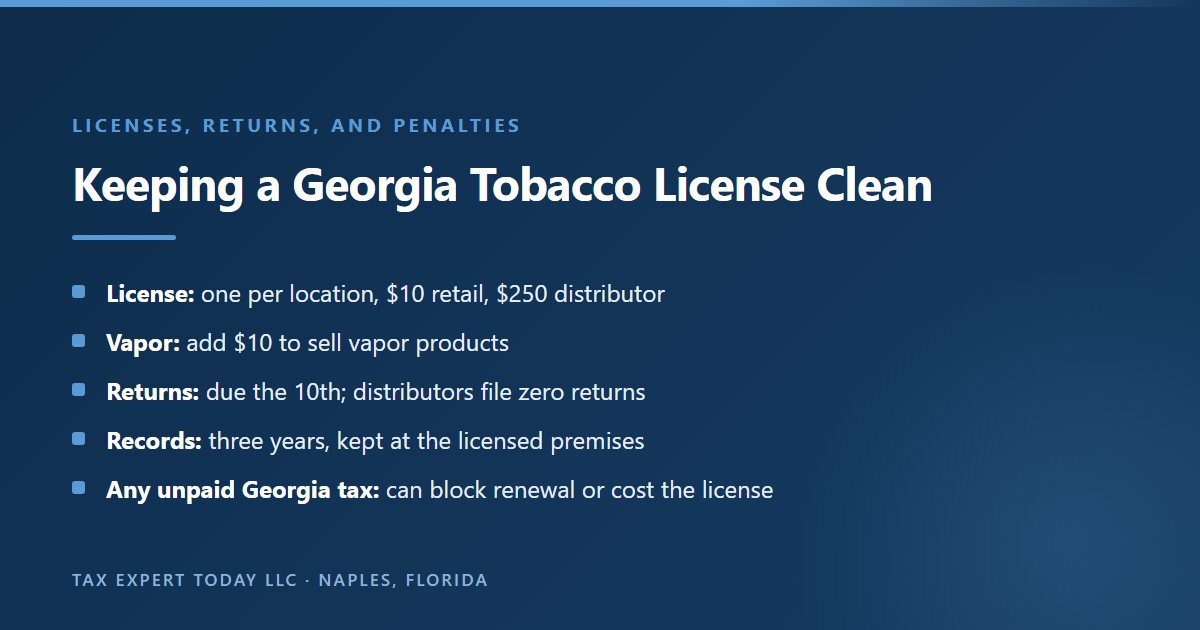
Anyone who manufactures, imports, distributes, or sells tobacco, alternative nicotine, or vapor products in Georgia needs a Department of Revenue license for each place of business. Retail dealers pay $10, plus $10 to add vapor products. Distributors and manufacturers pay $250 at first registration, plus $10 for vapor.
- One license per location: a license covers only the premises it names.
- One license, several products: tobacco, alternative nicotine, and vapor can share one license.
- Annual renewal: at least 30 days before expiration, through the Georgia Tax Center.
- Clean tax record: unpaid Georgia taxes can block or cost a license.
Ga. Comp. R. & Regs. 560-8-1-.02 says no person may engage in manufacturing, purchasing, selling, consigning, vending, dealing in, or distributing cigarettes, cigars, little cigars, loose tobacco, or smokeless tobacco in Georgia without a license from the Commissioner. The license applies only to the premises for which it is issued, a separate license is required for each place of business, and product may not be stored anywhere else without written approval.
| License or permit | Initial fee | Vapor add on | Renewal |
|---|---|---|---|
| Retail dealer | $10 | $10 | Annually, 12 months from issue; $10 plus $10 for vapor |
| Wholesaler or distributor | $250 | $10 | Annually, July 1 to June 30; $10 plus $10 for vapor |
| Manufacturer or importer | $250 | $10 | Annually, July 1 to June 30; $10 plus $10 for vapor |
| Special event tobacco permit | $10 | Not applicable | Per event, 1 to 10 days |
| Representative permit tied to a manufacturer or importer | $10 | Not applicable | Annually |
The fees come from the Department’s tobacco permits page and its vapor FAQ. A representative registered to a Georgia wholesaler or distributor needs no payment or renewal, and a person who conducts promotional activities for a distributor needs a separate $10 promotional license under Rule 560-8-3-.11, with renewals filed before June 15.
The licensing rules also carry a tax compliance condition that matters more than the fee. Under Rule 560-8-1-.03, no license application will be considered while the applicant, or anyone holding an interest in the business, has failed to meet an obligation under any Georgia tax law, and the same failure is grounds to suspend or revoke an existing license. An unpaid sales tax or withholding balance can therefore put a store’s tobacco license at risk, even when every tobacco return is current.
Since the same 2020 law, the minimum age to buy tobacco, alternative nicotine, and vapor products in Georgia has been 21. Retail dealers must post a compliant sign, check a government issued ID, train staff, and refuse sales to anyone under 21, according to the Department’s vapor FAQ.
Stores that also sell beer, wine, or spirits hold a separate Georgia alcohol license with its own state fee, local license, and renewal season. Georgia rules bar an alcohol license application while any owner is behind on Georgia taxes, including tobacco excise. Our guide to the Georgia alcohol license covers the details.
When Are Georgia Tobacco Tax Returns Due?
Georgia tobacco and vapor excise tax returns are due by the 10th of each month, moving to the next business day when the 10th falls on a weekend or a state holiday. They are filed through the Georgia Tax Center. Distributors, manufacturers, and importers must file even with no activity; retailers need not.
- Due date: the 10th of the month following the activity.
- Where: the Georgia Tax Center, under a tobacco or vape tax account.
- Zero returns: required for distributors, manufacturers, and importers.
- Retailers: file only when they owe tax as a deemed distributor.
- Import option: the Department publishes a template for uploading return data.
The Tobacco Excise Tax FAQ sets these rules out, and the Department’s excise tax page lists alcohol returns as due by the 15th and tobacco returns by the 10th, a five day difference that catches businesses that hold both licenses. A missed zero return is a common, avoidable problem for a small distributor: the account shows as delinquent even though no tax was owed, and a delinquent account is the kind of failure Rule 560-8-1-.03 treats as grounds for license action.
A dealer who buys from an unlicensed nonresident has a tighter schedule. Under Rule 560-8-2-.02, that dealer is deemed a distributor and must report the shipment within 24 hours of receipt, register with the Commissioner as buying from a nonresident who is not a manufacturer or distributor, keep books for all untaxed product, report monthly, and remit the tax no later than the 10th day of the month after the purchase.
What Must a Retailer Do With Untaxed Tobacco or Cigarettes?
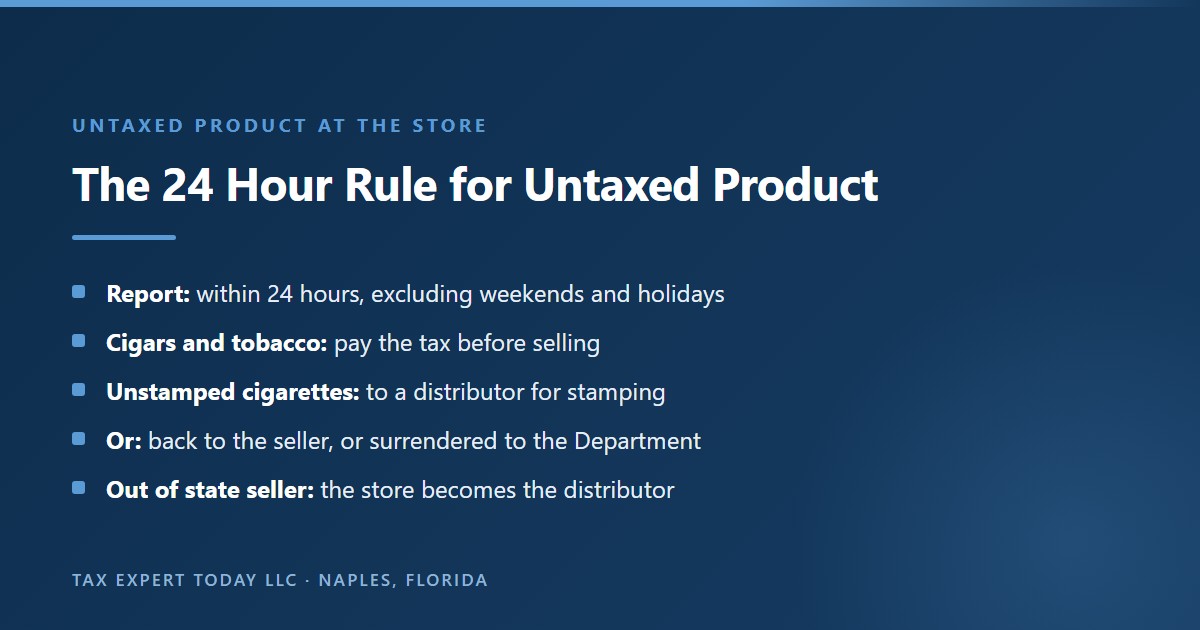
A Georgia dealer who receives untaxed cigars or tobacco, or cigarettes without Georgia stamps, must report it within 24 hours, excluding weekends and holidays. Untaxed cigars and tobacco need the tax paid before sale. Unstamped cigarettes must go to a licensed distributor for stamping, back to the seller, or to the Department.
- Report: within 24 hours, on the Department’s form.
- Cigars and tobacco: pay the tax under the alternate method before selling or using the product.
- Cigarettes, option one: deliver to a licensed distributor, who may stamp them and invoice the cost.
- Cigarettes, option two: return them to the seller and keep proof of the return.
- Cigarettes, option three: surrender them to the Department for disposal, at no cost to it.
Ga. Comp. R. & Regs. 560-8-2-.03 lays out these duties. It also requires every invoice covering loose tobacco, smokeless tobacco, cigars, or little cigars to note the payment of tax, which is how an auditor tests whether the tax was paid upstream. An invoice from an out of state seller that is silent on Georgia tax is the first thing a Department examiner looks for, because it signals product that entered Georgia without the excise.
The practical lesson for a store owner is that a low price from an out of state supplier is often a missing tax, not a discount. A vape or cigar order that arrives without Georgia tax on the invoice converts the store into the taxpayer, and the 24 hour clock does not wait for the next monthly return.
Can You Get a Refund of Georgia Tobacco Tax?
Yes, in limited cases. Under Rule 560-8-3-.08, the Department refunds the cost of cigarette stamps, or the tax paid under the alternate method, when it is shown that the product became unfit for use, consumption, or sale, or was destroyed, including product shipped out of Georgia and then destroyed.
- Unfit product: damaged, stale, or otherwise unsaleable goods.
- Destroyed product: destruction in Georgia, or after shipment out of state.
- Proof: the claim must satisfy the Commissioner, so documentation matters.
- Losses in transit: distributors report loss, damage, and refused product under a separate rule.
The refund rule, Ga. Comp. R. & Regs. 560-8-3-.08, is narrow. It does not create a refund for product that simply did not sell, and it does not cover price based tax computed on a cost figure the taxpayer later wants to revise. A request to correct a monthly return because the wholesale cost price was overstated is a separate amended return question, and it turns on invoices rather than on destruction records.
What Records Does the Georgia Tobacco Tax Require?
Each Georgia manufacturer, importer, distributor, and dealer must keep complete and accurate records of all tobacco products manufactured, purchased, and sold for three years, in the form the Commissioner prescribes, and must keep them at the licensed location unless the Commissioner approves another place in writing.
- Retention: three years from the date of receipt by the Commissioner.
- Location: the licensed premises, unless written approval says otherwise.
- Purchase invoices: showing quantities, cost, and whether Georgia tax was paid.
- Vapor detail: milliliters for closed systems, wholesale cost for open systems and disposables.
- Inspection: licensed premises and records are open to Department inspection.
Rule 560-8-1-.06 sets the three year retention period and bars storing shipping, invoicing, sales, payment, or storage records anywhere other than the licensed location without written approval. That second rule surprises owners who keep everything with an outside bookkeeper. A copy at the bookkeeper is fine; the records the rule requires still belong at the store or warehouse the license covers.
What Penalties Apply for Georgia Tobacco Tax Violations?
Georgia can assess unpaid tobacco tax with civil penalties for incorrect reports, nonpayment, failure to file, and fraud, and the unpaid tax becomes a lien that can lead to seizure and sale. Criminal penalties apply to unstamped cigarettes, unlicensed operation, false reports, and counterfeit stamps or cigarettes.
- Civil: deficiencies, penalties, and fraud penalties under O.C.G.A. 48-11-12, 48-11-14, and 48-11-17.
- Lien: unpaid tax is a lien against property, with seizure and sale possible.
- Criminal: offenses under O.C.G.A. 48-11-22 and the sections that follow.
- License: suspension or revocation for failure to meet any Georgia tax obligation.
The civil side is summarized in Rule 560-8-1-.14, which lists assessment of deficiencies and penalties for incorrect reports and nonpayment, a penalty for deficiencies due to fraud, assessment against a person who fails to file or files an incorrect report, and the unpaid tax as a lien against property. Rule 560-8-1-.13 lists the criminal offenses within the jurisdiction of the superior courts, including transporting or possessing unstamped cigarettes or untaxed cigars, operating an unlicensed business, failing to file or filing a false report, false entries or invoices, counterfeit stamps or tampering with metering machines, false testimony, and possessing or selling counterfeit cigarettes.
Georgia tobacco tax exposure for a store or distributor is typically civil and typically starts with an inventory or invoice mismatch, not with a criminal referral. The outcome of any particular case depends on its facts, and the earlier the records are organized, the more options a business generally has.
Stores that sell beer, wine, or spirits alongside tobacco deal with a second excise system that works differently. Alcohol excise is collected by the wholesaler at delivery and reported by the 15th of the month rather than the 10th, and cities and counties add their own beer, wine, and liquor by the drink taxes. Our guide to the Georgia alcohol tax sets out those rates.
How Does the Georgia Tobacco Tax Compare With the Federal Excise Tax?
Federal excise tax applies in addition to the Georgia tobacco tax. Under 26 U.S.C. 5701, small cigarettes carry $50.33 per thousand, about $1.01 per pack of 20, collected from the manufacturer or importer. Together with Georgia’s 37 cents, a pack carries roughly $1.38 of excise before any sales tax.
- Federal cigarettes: $50.33 per thousand, which is $1.0066 per pack of 20.
- Georgia cigarettes: $0.37 per pack of 20.
- Combined excise: about $1.38 per pack of 20.
- Different collectors: federal tax at the manufacturer or importer, Georgia tax at the distributor.
| Layer | Rate per pack of 20 | Authority | Who remits |
|---|---|---|---|
| Federal excise | $1.0066 | 26 U.S.C. 5701 | Manufacturer or importer |
| Georgia excise | $0.37 | O.C.G.A. 48-11-2 | Licensed distributor, or the deemed distributor |
| Combined excise | About $1.38 | Built into the shelf price | |
| Georgia sales tax | 4 percent state rate plus local rates | O.C.G.A. Title 48, Chapter 8 | Retailer, on the retail sale |
The federal figure comes from the text of 26 U.S.C. 5701, which sets $50.33 per thousand for cigarettes weighing not more than 3 pounds per thousand. Federal tobacco excise is administered by the Alcohol and Tobacco Tax and Trade Bureau, not by the Georgia Department of Revenue, and the two systems have separate permits, returns, and audits.
Has Georgia Raised Its Cigarette Tax Recently?
No. The Department of Revenue rate table on October 27, 2026 still shows 37 cents per pack of 20. Proposals to raise it have been filed, including House Bill 96 in the 2025 to 2026 session, which proposed $1.37 per pack, but the published Georgia rate has not changed.
- Current rate: 37 cents per pack of 20, per the Department of Revenue.
- Last change: policy groups date the 37 cent rate to 2003.
- Vapor: the only major addition in recent years, effective January 1, 2021.
- Watch item: any new rate would appear on the Department’s rate table first.
Georgia’s cigarette rate is among the lowest of any state, and that is a recurring subject in the legislature. The Georgia Budget and Policy Institute and Truth Initiative both describe the 37 cent rate as dating to 2003. For a business, the planning point is narrower: budgets, price files, and stamp purchases should follow the rate the Department publishes, and a business holding stamped inventory on the effective date of any future increase should expect the change to come with its own transition rules. We will update this guide if the published rate changes.
Do Georgia Tobacco Businesses Also Owe Sales Tax and Income Tax?
Usually yes. The Georgia tobacco tax is an excise tax, separate from Georgia sales and use tax on retail sales and from Georgia income tax on the business’s profit. A store collects sales tax at the register, files sales tax returns, and its owners report profit at Georgia’s 4.99 percent flat rate for 2026.
- Sales tax: a separate registration and return for retail sales.
- Use tax: owed on taxable items bought for the business without Georgia sales tax.
- Income tax: Georgia’s flat 4.99 percent individual rate for 2026, or the entity’s own return.
- Payroll: Georgia withholding on store employees.
The excise tax and the sales tax are filed on different returns with different due dates, and a business can be current on one while delinquent on the other. Our guides to Georgia use tax and Georgia sales tax exemption certificates cover the sales tax side, including resale certificates. For income tax, the Georgia state income tax guide explains the 4.99 percent flat rate the Department confirms for 2026, and the Georgia LLC taxes guide explains which return a store’s LLC files. Stores with staff should also review Georgia withholding tax.
What If a Business Cannot Pay a Georgia Tobacco Tax Assessment?
An unpaid Georgia tobacco tax assessment can become a lien, block a license renewal, and lead to suspension or revocation. Options generally include paying in full, requesting a Department of Revenue payment arrangement, an offer in compromise in qualifying cases, and contesting the assessment through the Department’s appeal process or the Georgia Tax Court.
- Review first: test the assessment against invoices, stamp purchases, and inventory.
- Appeal rights: deadlines run from the notice date, so read the notice carefully.
- Payment plan: the Department offers payment arrangements for qualifying balances.
- License impact: unresolved balances affect renewals under Rule 560-8-1-.03.
For the mechanics, see our guides to the Georgia Department of Revenue payment plan, the Georgia offer in compromise, and the Georgia Tax Court, which replaced the Georgia Tax Tribunal. Each of those paths has its own eligibility rules and deadlines, and whether one fits depends on the business’s facts, its records, and the size of the balance.
Georgia Tobacco Tax Mistakes That Cost Money
The most expensive Georgia tobacco tax mistakes are buying untaxed product from out of state sellers, skipping the 24 hour report, filing no zero return as a distributor, putting product in the wrong rate class, leaving distributor promotions out of wholesale cost, and letting an unrelated Georgia tax balance put the license at risk.
- Cheap out of state orders: often untaxed, which makes the store the distributor.
- Misclassified products: a leaf wrapped little cigar is a cigar, not a cigarette.
- Wrong vapor category: pods by the milliliter, disposables and e-liquid by cost.
- Missing invoices: no proof of upstream tax payment.
- Records off site: required records belong at the licensed location.
Each of these is fixable in advance with a purchasing policy, a short checklist for receiving clerks, and a monthly reconciliation of purchases to returns. After the fact, they become an audit finding with penalties and interest.
Georgia Tobacco Tax Help in Naples & Southwest Florida
Tax Expert Today LLC helps tobacco, vape, and convenience store owners with Georgia tobacco tax questions from its office in Naples, Florida, including untaxed shipments, licenses, and notices. Georgia clients are served nationwide from Naples, Florida, by phone and secure document exchange. Call (239) 441-2005.
- Georgia tobacco tax help Naples: rate classification and return review.
- Retailers: untaxed shipment problems and the 24 hour reporting rule.
- Distributors: wholesale cost price, promotions, and stamp reconciliation.
- Notices: organizing records when the Department of Revenue sends an assessment.
- Owners in Florida: Southwest Florida residents who own Georgia stores.
Tax Expert Today LLC is based at 11983 Tamiami Trail N, Naples, FL 34110, and our office is open Monday through Friday, 10 a.m. to 5 p.m. Eastern time. You can reach us at (239) 441-2005. Many of the Georgia questions we see come from Collier and Lee County residents who own a store, a vape shop, or a distribution business in Georgia, and from families who split the year between Southwest Florida and Georgia. We work with Georgia clients remotely, and there is no need to visit Naples to work with us.
For the full range of our Georgia work, see our Georgia tax services page. A point of scope, stated plainly: the Georgia tobacco tax is administered by the Georgia Department of Revenue, and these are state tax matters. Our team of tax advisors, enrolled agents, CPAs, and attorneys handles state tax matters nationwide, and we explain how the Georgia rules apply to your facts rather than predicting any particular result.
When to Engage a Professional
Many retailers handle Georgia tobacco tax compliance through their licensed distributor without help. A review makes sense when a business buys from out of state sellers, adds vapor products, opens a second location, becomes a distributor, receives a Department notice, or finds unstamped or untaxed product in inventory.
- Before buying direct: to set up registration, reporting, and payment correctly.
- Before expanding: each new location needs its own license.
- After a discovery: when untaxed product is already on the shelf.
- After a notice: when an assessment or audit questions purchases or returns.
Call (239) 441-2005 to schedule a free consultation. We will look at your licenses, purchase records, and returns, and explain the options in writing.
Frequently Asked Questions About the Georgia Tobacco Tax
What is the Georgia tobacco tax rate on cigarettes?
Georgia taxes cigarettes at 37 cents per pack of 20, which is $3.70 per carton, and 46.25 cents per pack of 25. The tax is paid through stamps that licensed distributors buy from the Department of Revenue and apply before sale. Federal excise of about $1.01 per pack also applies.
How much is the Georgia tax on vapes?
Since January 1, 2021, Georgia taxes closed system pods and cartridges at 5 cents per fluid milliliter, and open system e-liquid and single use disposable vapes at 7 percent of the wholesale cost price. The tax is paid on a monthly return by the 10th, not with stamps.
Who pays the Georgia tobacco tax?
Licensed in state distributors normally collect and remit it when they sell to retailers, and consumers bear it in the shelf price. A retailer that receives untaxed product shipped into Georgia from an unlicensed seller is deemed the distributor and owes the tax directly.
When is the Georgia tobacco excise tax return due?
Returns are due by the 10th of each month, or the next business day if the 10th falls on a weekend or a state holiday, and are filed through the Georgia Tax Center. Distributors, manufacturers, and importers file even when they have no activity.
How much is a Georgia tobacco license?
A retail dealer license costs $10, plus $10 to add vapor products. Distributors and manufacturers pay $250 at first registration, plus $10 for vapor. Licenses renew every year, at least 30 days before expiration, and each place of business needs its own license.
What should I do if I receive cigarettes without Georgia tax stamps?
Report them to the Department of Revenue within 24 hours, excluding weekends and holidays. Then deliver them to a licensed distributor for stamping, return them to the seller with proof, or surrender them to the Department for disposal. Do not sell them.
Can I get a refund of Georgia tobacco tax on damaged product?
Under Rule 560-8-3-.08, the Department refunds stamp costs or tax paid when it is satisfied that the product became unfit for use, consumption, or sale, or was destroyed, including product shipped out of Georgia and then destroyed. Unsold product alone does not qualify.
I live in Naples, Florida, and own a convenience store in Georgia. Can you help with the Georgia tobacco tax?
Yes. Tax Expert Today LLC reviews Georgia tobacco and vapor excise questions, licenses, and notices from its Naples, Florida office at 11983 Tamiami Trail N, and Georgia clients work with us remotely. Call (239) 441-2005 for a free consultation.
Published October 27, 2026 by Dr. Pellumb Kabashi « Back to Learning Center
Have a question this article touches on?
Tax Expert Today LLC, based in Naples, Florida and serving clients across the United States.
Schedule a Consultation (239) 441-2005