
By Dr. Pellumb Kabashi, DBA, MBA, EA, CFE, CES
Founder, Tax Expert Today LLC · Tax advisors, enrolled agents, CPAs, and attorneys · Serving clients in all 50 states
Quick Answer: A Georgia tax clearance letter is a Department of Revenue letter confirming that a taxpayer has no balance due and no delinquent filing periods on its Georgia accounts. You request it in the Georgia Tax Center, and it is usually viewable the next day. Business buyers rely on it because O.C.G.A. 48-8-46 and 48-7-106 can make them liable for a seller’s unpaid sales and withholding tax. Call (239) 441-2005 for a free consultation.
A Georgia tax clearance letter is a short document with a large job. It is the Georgia Department of Revenue saying, as of a specific date, that it found no unpaid balance and no missing returns on the accounts it administers for a named taxpayer. People ask for it when money is about to change hands: a business sale, a bank loan, a license application, a contract, or the wind down of a company. The letter itself costs little effort when the accounts are clean. When they are not, the request produces a denial letter instead, and that denial can stall a closing.
This guide explains what the Georgia tax clearance letter is, how the request works in the Georgia Tax Center (GTC), what the Department checks, what a denial means and how to fix it, and why buyers of Georgia businesses treat the letter as a condition of closing. It also covers the related tools that are often confused with clearance, including the release of property from a state tax execution on Form CD-14135, the subordination certificate on Form CD-14134, and the disclosure forms a buyer, lender, or representative needs before the Department will discuss someone else’s account. Every rule below is tied to the statute, case, or Department guidance behind it.
What Is a Georgia Tax Clearance Letter?
A Georgia tax clearance letter is a letter from the Georgia Department of Revenue confirming that, when it ran its check, a taxpayer had no balance due and no delinquent periods on its Department accounts. It is requested through the Georgia Tax Center, covers all tax types, and is available to individuals, sole proprietors, and businesses.
- Who issues it: the Georgia Department of Revenue, not the Secretary of State or a county.
- What it confirms: no balances due and no delinquent filing periods on Department accounts.
- Who can request it: individuals, sole proprietors, and business entities with a GTC login.
- How it arrives: online the next day, with a copy also mailed.
- What happens if accounts are not clear: the system generates a denial letter instead.
The Department’s Request Tax Clearance Letter page describes the process in a few lines. A requester must have a GTC login. The request is available for all tax types. The system checks for tax balances and delinquent periods on all accounts. If every account clears, the letter lists all of the account types it reviewed. If any account shows a balance due or a delinquent period, a denial letter generates. The letter is available to view or print online the next day, and a copy is also mailed.
Two words in that description matter more than the rest. The first is “all.” The check is not limited to the tax type a buyer or lender cares about. A business that is current on sales tax but missed one quarterly withholding return will not receive a clean letter. The second is “delinquent periods.” A zero balance is not enough. An unfiled return for a period when the account was open counts against the taxpayer even if no tax would have been due on it.
The letter is also a snapshot. It reflects what the Department’s records showed when the request ran. It does not promise that no audit will later find additional tax for an earlier period, and it says nothing about returns that come due after the letter is issued. That limit is the reason buyers pair the letter with holdbacks, escrow terms, and representations in the purchase agreement, which later sections cover.
Is a Georgia Tax Clearance Letter the Same as a Tax Clearance Certificate?
In everyday use, yes. The statutes speak of a certificate from the commissioner stating that no taxes are due, and the Department’s online process produces a tax clearance letter. Buyers, lenders, and attorneys use the two names interchangeably for the same Department confirmation, but neither is a lien release.
- Statutory wording: “a certificate from the commissioner” under 48-8-46 and 48-7-106(d).
- Department wording: “Tax Clearance Letter” in the Georgia Tax Center.
- Older paper route: Form TSD-10, Application for Tax Clearance Certificate.
- Not the same thing: a release or subordination of a state tax execution.
O.C.G.A. 48-8-46 lets a buyer release withheld purchase money when the former owner produces “either a receipt from the commissioner showing that the taxes, interest, and penalties have been paid or a certificate from the commissioner stating that no sales and use taxes, interest, or penalties are due.” O.C.G.A. 48-7-106(d) uses the same structure for withholding tax. The Georgia Tax Center letter is the modern way to obtain that confirmation for all tax types at once.
For years the Department also published a paper Form TSD-10, Application for Tax Clearance Certificate, which listed sales tax, withholding tax, corporate income tax, net worth tax, income tax, motor fuel tax, and unrelated business income of exempt organizations. When we checked on November 16, 2026, the Department’s download link for that form returned a not found page, and the current request page directs taxpayers to GTC. A seller or representative holding an old copy of the TSD-10 should confirm with the Department before mailing it rather than assume it is still processed.
| Document | What it does | How it is requested | Authority |
|---|---|---|---|
| Tax clearance letter | Confirms no balances and no delinquent periods on all Department accounts as of the check | Georgia Tax Center, Request Tax Clearance Letter | Department guidance; certificate language in 48-8-46 and 48-7-106(d) |
| Denial letter | Issued instead of clearance when any account shows a balance or a delinquent period | Generated automatically by the same GTC request | Department guidance |
| Certificate of release of property | Removes the state tax lien from named property only; the tax debt remains | Form CD-14135 by fax or mail to Central Collections | O.C.G.A. 48-2-58 |
| Certificate of subordination | Places the state tax lien behind another lien, such as a refinance | Form CD-14134 | Department form guidance |
| Payoff receipt | Shows the taxes, interest, and penalties were paid | Payment records from the Department | Receipt language in 48-8-46 and 48-7-106(d) |
Who Needs a Georgia Tax Clearance Letter?
No Georgia statute requires every taxpayer to hold a clearance letter. The need comes from the transaction. Sellers of a Georgia business, buyers protecting themselves from successor liability, borrowers whose lenders ask for proof of good standing, and applicants for licenses or contracts that require tax compliance are the usual requesters.
- Sellers of a business or its assets: to let the buyer release withheld purchase money.
- Buyers: to avoid personal liability for the seller’s sales and withholding tax.
- Borrowers: when a lender’s closing checklist asks for state tax good standing.
- License applicants: where an agency will not act while Georgia tax is delinquent.
- Owners winding down: to confirm nothing is left open before final distributions.
The most common trigger is a sale. A buyer’s attorney will usually make delivery of a Georgia tax clearance letter a closing condition, or will hold back part of the price until it arrives. That practice is not a formality. It tracks the statutory text that makes a buyer who fails to withhold personally liable for the seller’s unpaid sales and use taxes and withholding taxes, up to the total purchase money. A seller who cannot produce the letter may see the deal delayed, a larger escrow, or a lower price.
Lenders ask for the letter for a related reason. Georgia taxes are a personal debt of the taxpayer under O.C.G.A. 48-2-55(a), and the Department can attach property and use garnishment to collect. A lender financing equipment, inventory, or receivables wants to know that a state collection action is not about to compete with its collateral. Commercial third-party services also describe clearance letters as a standard item when an entity is reinstated, dissolved, or applies for a loan or incentive, although the specific requirement comes from the other party, not from a general Georgia statute.
Individuals request the letter too. The Department’s page states that the request is available for individuals and sole proprietors. A person selling a Georgia sole proprietorship, a contractor asked by a customer for proof of compliance, or a taxpayer who simply wants to confirm that an old balance is gone can request one the same way a corporation does.
How Do You Request a Georgia Tax Clearance Letter in GTC?
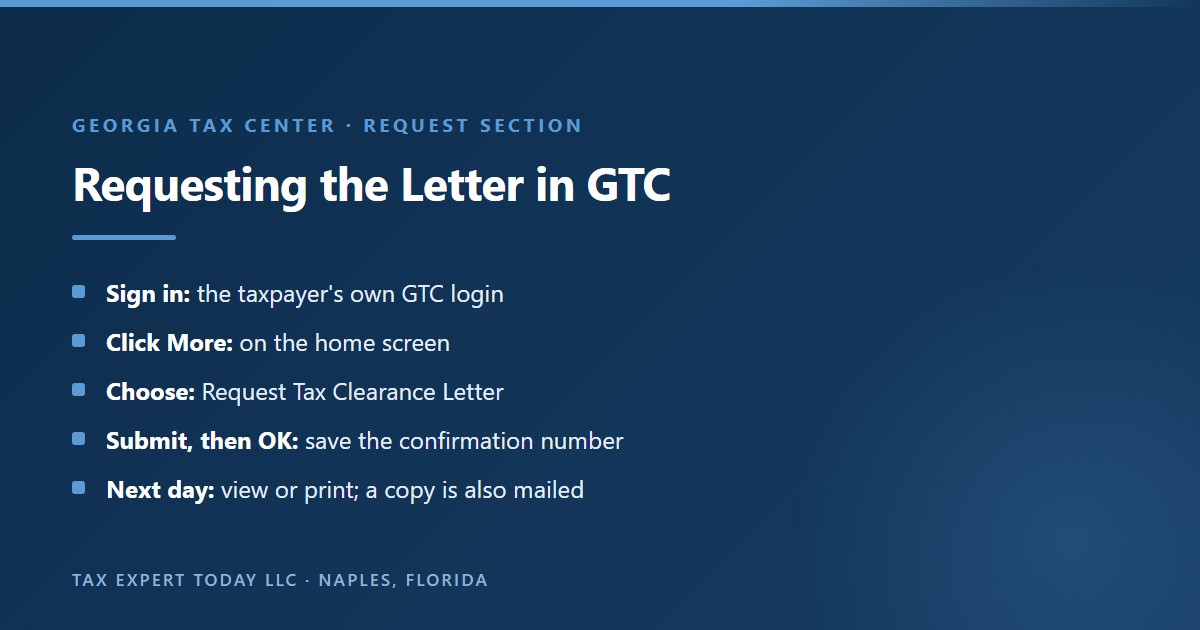
Log in to the Georgia Tax Center, click the More link on the home screen, choose Request Tax Clearance Letter under the Request section, click Submit, and confirm with OK. GTC returns a confirmation number. The letter, or a denial letter, is available online the next day and a copy is mailed.
- Step 1: sign in to the Georgia Tax Center with the taxpayer’s own login.
- Step 2: on the home screen, select the More hyperlink.
- Step 3: under Request, choose Request Tax Clearance Letter.
- Step 4: click Submit, then OK to confirm, and save the confirmation number.
- Step 5: return the next day to view or print the letter; watch the mail for the copy.
These steps come straight from the Department’s request page. The process is short because the work happens on the Department’s side. The system reviews every account tied to the taxpayer’s login for balances and delinquent periods. A taxpayer who has never set up a GTC login will need to create one first. Businesses that file through a payroll provider or an outside accountant sometimes discover at this point that no one inside the company has an active login, so building that access early saves a day or two when a closing date is fixed.
Keep the confirmation number and note the date of the request. If the letter does not appear the next day, the confirmation number is what the Department will ask for. If the result is a denial, the confirmation number and the date are also useful when the taxpayer later shows a buyer that the problem was found and fixed promptly.
A practical point: request the letter after the last return that is due before closing has been filed and processed, not before. A letter requested on the 15th of a month can be accurate that day and still leave a buyer exposed to a sales tax return due on the 20th. The cleanest sequence is to file and pay every return due before closing, wait for the payments to post, and then request the Georgia tax clearance letter close to the closing date.
What Does the Department Check Before Issuing the Letter?
The Department checks every account linked to the taxpayer for two things: any balance due, including tax, penalty, and interest, and any delinquent filing period. A clean result on every account produces a letter listing all of the account types. A problem on any one account produces a denial.
- Balances due: unpaid tax, penalties, interest, and fees on any account.
- Delinquent periods: returns not filed for periods when an account was open.
- All tax types: sales and use, withholding, corporate income, net worth, individual income, and others.
- All linked accounts: not only the account the buyer cares about.
Delinquent periods are the most common surprise. Georgia expects a return for every period an account is open, even when the business had no sales or no payroll. A seasonal business that stopped filing zero sales tax returns in the off season, or a company that stopped running payroll but never closed its withholding account, will show delinquent periods. Our guide to the Georgia tax ID number explains how each Department account is opened and closed, and why an account left open after the activity stops keeps generating filing obligations.
Balances are the second issue. A small penalty or interest charge on a return filed a few days late can sit on an account unnoticed for years, because the business assumed the return payment covered everything. The clearance check does not round small amounts away. Any balance is enough to produce a denial, so the account history should be reviewed before the request is submitted, not after.
The check also covers tax types that a seller may not think of as “business tax.” A corporation’s net worth tax, discussed in our article on the Georgia net worth tax, and the use tax a business owes on untaxed purchases, covered in our Georgia use tax guide, are Department accounts like any other.
How Long Does a Georgia Tax Clearance Letter Take, and What Does It Cost?
When every account is clear, the Department makes the letter available to view or print online the next day and also mails a copy. The Department’s request page lists no fee for the letter. The real timing risk is the work needed beforehand to file missing returns and pay balances.
- Online availability: the next day after the request, according to the Department.
- Mailed copy: sent in addition to the online version.
- Fee: none listed on the Department’s request page.
- Real delay: curing unfiled periods and waiting for payments to post.
- Lien releases: a separate process the Department asks to receive 30 days before closing.
The one-day turnaround applies to a taxpayer whose accounts are already clean. A taxpayer who receives a denial has to file the missing returns, pay the balances, allow the payments and returns to process, and then submit a new request. That cycle can take days or weeks depending on how many periods are open and whether the Department needs to review anything filed late. For that reason, sellers who expect to close on a set date should run a first clearance request well ahead of time, treating it as a diagnostic.
Requests that involve a recorded state tax execution take longer still. The Department’s instructions for Form CD-14135 ask applicants to submit at least 30 days before the closing or transaction date, to leave time for review, determination, notification, and delivery of documents. A closing that depends on removing a Georgia lien from real estate or equipment should be scheduled around that 30-day window, not around the one-day clearance letter.
| Situation | Typical timing driver | Planning step |
|---|---|---|
| All accounts filed and paid | Next-day online letter | Request close to closing, after the last pre-closing return posts |
| Small balance on one account | Payment posting, then a new request | Pay the exact balance shown in GTC and re-request |
| Unfiled periods | Filing and processing late returns, plus any penalty and interest | File every open period, including zero returns, then re-request |
| Accounts that should be closed | Final returns and account closure | File final returns and close dormant accounts before requesting |
| Recorded state tax execution on property | Form CD-14135 review by Central Collections | Submit at least 30 days before the closing date |
What Happens If Your Georgia Tax Clearance Request Is Denied?
If any account shows a balance due or a delinquent period, GTC generates a denial letter instead of a clearance letter. A denial is not a penalty or an assessment. It means the Department found at least one open item, and the taxpayer must resolve it and submit a new request.
- What a denial means: at least one account has a balance or an unfiled period.
- What it does not mean: a new tax, an audit, or a collection action by itself.
- First step: review each account in GTC for balances and missing periods.
- Second step: file and pay what is open, then request again.
- For a pending sale: tell the buyer early and agree on an escrow or holdback.
A denial letter often arrives at the worst moment, when a buyer’s attorney asks for the clearance letter a week before closing. The useful response is a quick inventory. Sign in to GTC and look at every account, not only the one the seller assumes is the problem. Note each balance and each period without a return. Then decide which items can be fixed before closing and which need to be handled in the purchase agreement.
Many denials trace to items that are simple to fix once found: a quarter with no payroll where no Form G-7 was filed, a sales tax period with no sales where no return was filed, a few dollars of interest left after a late payment, or a withholding account that stayed open after the last employee left. Our guides to Georgia Form G-7 and Georgia withholding tax explain the quarterly filing duty that often produces these gaps.
Other denials reflect real liabilities: an assessment the taxpayer disputes, an audit result still under appeal, or years of unfiled income tax returns. Those take longer. A taxpayer who disagrees with an assessment has appeal rights, which our article on the Georgia Tax Tribunal explains, but an open dispute will generally keep the account from clearing while it is pending. In a sale, that usually means escrowing the disputed amount rather than waiting for the appeal to finish.
How Do You Fix the Problems Behind a Denial Letter?
Work account by account. File every missing return, including zero returns, pay each balance shown in GTC, close accounts that are no longer active by filing final returns, and wait for the filings and payments to post. Then submit a new clearance request rather than relying on the earlier denial.
- Inventory: list every Department account and every open period.
- File: submit missing returns, using zero returns where nothing was due.
- Pay: clear tax, penalty, and interest to the cent as GTC shows it.
- Close: file final returns for accounts tied to ended activity.
- Re-request: run a fresh clearance request once everything has posted.
Start with the oldest open period. Late returns may carry failure to file and failure to pay penalties and interest, and those additions only post after the return is processed. Paying the tax shown on a late return without waiting for the penalty and interest to post is a common reason a second request also comes back denied. When the GTC balance updates after processing, pay the remaining amount and then request again.
Accounts that should not exist anymore deserve particular attention. If a business stopped selling taxable goods, stopped paying wages, or moved its operations out of Georgia, it should file final returns and close the matching accounts. Leaving them open keeps creating future delinquent periods. Sellers in a sale also need to file the final returns the statutes require: a final sales tax return and payment within 15 days after selling or quitting the business under 48-8-46, and a final withholding return under 48-7-106(d), which incorporates the rule that the final return is due on or before the 30th day after the final payment of wages.
When a past-due balance cannot be paid at once, the Department offers installment arrangements, which our guide to the Georgia Department of Revenue payment plan describes. In some cases where full payment is not realistic, an offer in compromise may also be worth reviewing. Both tools address the debt. Neither one, by itself, is likely to turn a denial into a clearance letter, as the next section explains.
Can You Get a Georgia Tax Clearance Letter While on a Payment Plan?
Generally, you should not expect one. The Department’s check looks for any balance due, and a payment plan leaves a balance on the account until the final installment. An installment agreement keeps collection orderly, but a seller with a plan usually pays the balance from the sale proceeds to obtain the letter.
- Why it usually fails: the balance remains until the plan is paid off.
- What a plan does help: it can stop or limit collection while payments continue.
- In a sale: pay the balance at closing, often directly from escrow.
- For licenses: some programs accept a current installment agreement as compliance.
The Department’s description of the clearance check is direct: any account with a balance due produces a denial. An installment agreement does not erase the balance; it schedules it. So a taxpayer in good standing on a plan should plan on paying the remaining balance before requesting a letter that will satisfy a buyer or lender. This is our reading of the Department’s published process, not a written Department policy on installment agreements, so a taxpayer in this position should confirm the result with the Department or simply run the request.
That does not make a payment plan useless in a transaction. In a sale, the remaining balance can often be paid directly from the closing proceeds, after which the seller requests the letter and the buyer releases any holdback tied to it. Outside of a sale, some Georgia regulators treat an active installment agreement as enough to keep a license in good standing. The Department’s Alcohol and Tobacco Division, for example, describes installment payment agreements as a way for licensees to avoid a citation for tax delinquency, discussed further below.
Why Do Buyers of a Georgia Business Ask for a Tax Clearance Letter?
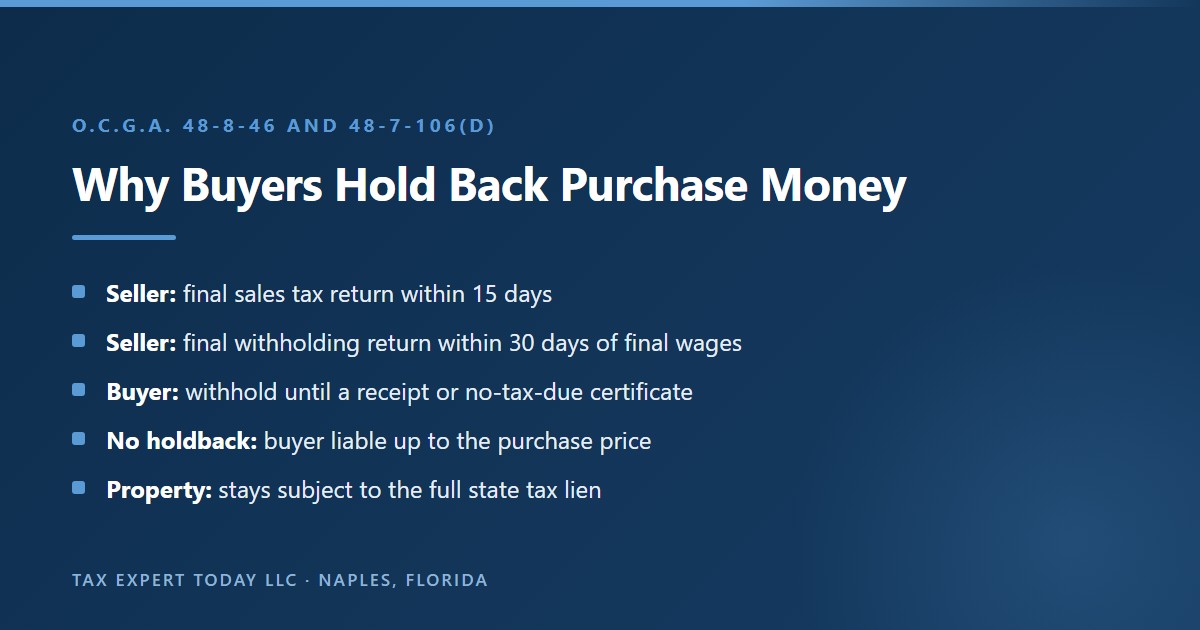
Because Georgia makes a buyer who fails to withhold part of the price personally liable for the seller’s unpaid sales and withholding taxes, up to the total purchase money, and leaves the transferred property subject to the state’s full tax lien. A clearance letter lets the buyer release withheld money safely.
- Sales and use tax: buyer withholding and liability under O.C.G.A. 48-8-46.
- Withholding tax: the parallel rule in O.C.G.A. 48-7-106(d) and (e).
- Liability cap: the total purchase money paid for the business or assets.
- Property exposure: the transferred property stays subject to the full tax lien.
- Contract terms: a seller’s promise that taxes are paid does not bind the Department.
Georgia’s two successor statutes are short and strict. Each one tells the buyer, described as the dealer’s or employer’s “successor or assigns,” to withhold enough of the purchase money to cover the unpaid tax, interest, and penalties until the seller produces a receipt or a certificate from the commissioner. Each then says that a buyer who fails to withhold is personally liable for the seller’s unpaid tax. The Georgia tax clearance letter is the practical way for the seller to produce that certificate.
The liability is not only about money paid to the seller. Both statutes add that “the property being transferred shall in all cases be subject to the full amount of the tax lien arising from the delinquencies of the former owner.” So even a buyer who keeps its own exposure under the purchase price can find the assets it bought tied up by a state tax lien larger than that price. A buyer of equipment or inventory with a modest price tag, purchased from a seller with years of unpaid sales tax, can face exactly that.
Buyers sometimes assume a seller’s written representation that all taxes are paid will protect them. Between the buyer and seller, that promise may support a claim for damages. Against the Department, it does not. The Supreme Court of Georgia addressed this situation directly in 2007, in a case where the seller had promised that all taxes were paid and no lien had been recorded.
What Does O.C.G.A. 48-8-46 Require of a Buyer and a Seller?
The seller must file a final sales tax return and pay within 15 days after selling out or quitting the business. The buyer must withhold enough of the purchase money to cover unpaid sales tax, interest, and penalties until the seller produces a Department receipt or a certificate that nothing is due.
- Trigger: a dealer sells out the business or its stock of goods or equipment, or quits.
- Seller duty: final return and payment within 15 days.
- Buyer duty: withhold sufficient purchase money until a receipt or certificate is produced.
- Penalty for not withholding: personal liability, capped at the total purchase money.
- Lien: the property transferred remains subject to the full state tax lien.
The full text of O.C.G.A. 48-8-46 is a single paragraph. It applies when “any dealer liable for any tax, interest, or penalty imposed by this article sells out his business or stock of goods or equipment or quits the business.” The seller then “shall make a final return and payment within 15 days after the date of selling or quitting the business.” The buyer “shall withhold a sufficient amount of the purchase money” until the former owner produces the receipt or certificate.
Three features of the text shape how deals are drafted. First, the statute reaches a sale of the “stock of goods or equipment,” not only a sale of the whole company. An asset purchase of inventory and equipment can trigger it. Second, the duty to withhold falls on the buyer, so a seller’s unwillingness to cooperate does not excuse the buyer. Third, the statute does not set a dollar amount. “A sufficient amount” means enough to cover what is actually owed, which a buyer cannot know without the seller’s account information or a clearance letter.
The statute is in the sales and use tax article, so its direct reach is sales and use tax. Our guide to Georgia sales tax exemptions covers the dealer side of that tax, and buyers of retail, restaurant, and distribution businesses should expect the sales tax account to be the largest open question in diligence.
How Does Withholding Tax Successor Liability Work Under 48-7-106?
Subsection (d) of O.C.G.A. 48-7-106 applies the same holdback rule to Georgia income tax withholding. An employer that sells out or quits files its final withholding return, and the buyer withholds enough purchase money until a receipt or certificate is produced. Subsection (e) makes a non-withholding buyer personally liable, capped at the purchase money.
- Trigger: an employer liable for withholding tax sells out or quits the business.
- Seller duty: file the final withholding return required by subsection (a) or (b).
- Final return timing: on or before the 30th day after the final payment of wages.
- Buyer duty: withhold purchase money until a receipt or a no-tax-due certificate.
- Buyer liability: personal, up to total purchase money, with the full lien on the property.
O.C.G.A. 48-7-106(d) says that if an employer liable for withholding tax “sells out his or her business or stock of goods or equipment or quits the business, he or she shall file the final return as required.” The successor “shall withhold a sufficient amount of the purchase money” until the former owner provides “a receipt from the commissioner showing that the taxes, interest, and penalties have been paid or a certificate from the commissioner stating that no withholding taxes, interest, or penalties are due.” Subsection (e) adds the personal liability and the lien language.
Withholding tax is a trust tax. The employer holds it for employees and the state. Unpaid withholding often grows quietly in a business under financial stress, because payroll keeps running while deposits slip. That makes the withholding account an important item in any purchase diligence, even for a buyer that plans to rehire the same employees under its own new account. The year-end reporting side of the same account is covered in our Georgia Form G-1003 guide, which also explains the 30-day closing filing.
Georgia unemployment insurance tax is a different matter. It is administered by the Georgia Department of Labor, not the Department of Revenue, as our article on Georgia unemployment tax explains. A Department of Revenue clearance letter speaks only to Department of Revenue accounts, so a buyer who wants comfort on the unemployment account should ask about it separately.
| Rule | Sales and use tax | Income tax withholding |
|---|---|---|
| Statute | O.C.G.A. 48-8-46 | O.C.G.A. 48-7-106(d) and (e) |
| Trigger | Dealer sells out business, stock of goods, or equipment, or quits | Employer sells out business, stock of goods, or equipment, or quits |
| Seller’s final return | Return and payment within 15 days | Final return on or before the 30th day after final wages |
| Buyer’s duty | Withhold sufficient purchase money | Withhold sufficient purchase money |
| Release condition | Receipt of payment or certificate that no sales tax is due | Receipt of payment or certificate that no withholding tax is due |
| Buyer liability if no holdback | Personal, up to the total purchase money | Personal, up to the total purchase money |
| Property transferred | Subject to the full tax lien | Subject to the full tax lien |
What Did JD Design Group v. Graham Decide?
In 2007 the Supreme Court of Georgia held that a buyer of most of a florist’s assets was liable as successor for the seller’s unpaid sales tax under 48-8-46, even though the seller promised all taxes were paid and no lien was recorded. The buyer could have protected itself by withholding until a clearance certificate was produced.
- Facts: purchase of inventory, fixtures, equipment, vehicles, and goodwill of a flower shop.
- Seller’s promise: the purchase agreement stated all taxes due had been paid.
- Public record: no tax lien had been recorded against the seller.
- Holding: the purchase fell within 48-8-46 and the buyer was not a protected purchaser.
- Lesson: the statute itself is the notice; search results are not enough.
In JD Design Group, Inc. v. Graham, decided June 4, 2007, a new company bought most of the assets of an existing flower shop. The seller stated in the asset purchase agreement that all taxes due had been paid, and no tax liens had been recorded against it. In fact, sales tax was outstanding. Several months after the purchase, the Department assessed the buyer as successor. The trial court ruled for the buyer because no lien had been recorded. The Court of Appeals reversed, and the Supreme Court agreed with the Department.
The Court made two points that still guide deal practice. First, buying the inventory, furniture, fixtures, equipment, vehicles, goodwill, and other assets of a business that then closed is a purchase of the “stock of goods or equipment” under the statute, even if not every asset changed hands. Second, the buyer could not claim to be an innocent purchaser with no means of protecting itself, because the statute itself gave it the means: withhold the purchase money until the seller produced a receipt or a clearance certificate.
The practical message is that a clean lien search does not end diligence. Georgia does not have to record a lien before it can pursue a successor that skipped the holdback. A buyer that wants protection needs the seller’s clearance letter, a payoff receipt, or a holdback sized to the exposure, and preferably all three.
How Should a Buyer Structure a Holdback Around the Clearance Letter?
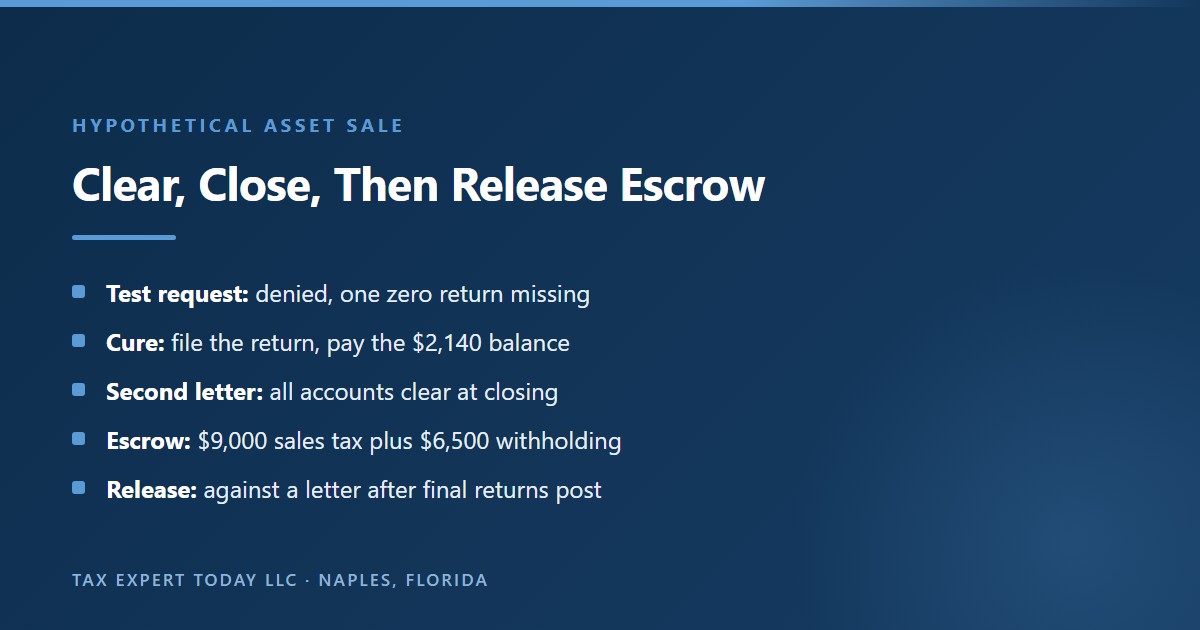
Withhold or escrow enough of the price to cover the seller’s likely Georgia sales and withholding tax exposure, release it when the seller delivers a Georgia tax clearance letter dated after the final returns post, and keep a smaller reserve for periods the letter cannot yet cover, such as the final return itself.
- Size: based on filed returns, recent sales volume, payroll, and any known assessments.
- Timing: release only against a letter issued after the final returns are processed.
- Payoffs: pay known balances from escrow at closing in exchange for receipts.
- Reserve: hold a smaller amount for the stub period and any audit risk.
- Documents: keep the letter, receipts, and confirmation numbers with the closing file.
Consider a hypothetical. A buyer agrees to pay $480,000 for the assets of a Georgia restaurant. The seller’s GTC accounts show sales and use tax, withholding, and corporate income tax. A first clearance request three weeks before closing comes back denied: one quarterly withholding return is missing for a period with no wages, and the sales tax account shows a $2,140 balance of penalty and interest from a late return. Monthly sales tax runs about $9,000, and the final sales tax return will cover the first half of the closing month.
| Step (hypothetical) | Amount or action | Why |
|---|---|---|
| Seller files the missing zero withholding return | Filed before closing | Clears the delinquent period |
| Seller pays the posted sales tax balance | $2,140 | Clears the balance due |
| Second clearance request after posting | Letter issued, all accounts clear | Covers periods filed through that date |
| Escrow for the final sales tax return | $9,000 | Final return due within 15 days of the sale |
| Escrow for final withholding return | $6,500 | Final return due within 30 days after final wages |
| Release | After a third letter dated after both final returns post | Matches the certificate condition in 48-8-46 and 48-7-106(d) |
In this hypothetical, the buyer closes on time with $15,500 held in escrow instead of the full exposure the statutes could impose. The seller receives the rest of the price at closing, and the escrow is released when a later Georgia tax clearance letter confirms that the final returns were filed and paid. The figures are illustrative only. The right holdback depends on the seller’s actual filing history, the size of the business, any open audit, and the terms both sides negotiate.
Buyers should also think about which entity is buying. A stock purchase leaves the seller’s tax history inside the company the buyer now owns, so successor statutes matter less and the company’s own liability matters more. An asset purchase leaves the history with the seller, which is exactly the situation 48-8-46 and 48-7-106(d) address. Our overview of Georgia LLC taxes covers the entity-level accounts that a buyer of membership interests inherits.
How Can a Buyer or Lender See the Seller’s Georgia Tax Account?
Through the seller. The clearance letter request runs from the taxpayer’s own GTC login, and the Department generally discusses an account only with the taxpayer or someone the taxpayer has authorized. Department forms identify Form RD-1061, Power of Attorney, and Form RD-1062, Disclosure Authorization, as the authorization documents.
- Clearance letter: requested by the taxpayer and delivered to the buyer as a closing item.
- Form RD-1061: a power of attorney for a representative who acts for the taxpayer.
- Form RD-1062: a disclosure authorization letting the Department share information.
- Lender and title company: often named as the interest a representative serves.
- Deal practice: require the seller to sign authorizations in the letter of intent.
Georgia tax returns and account details are confidential. A buyer cannot simply call the Department and ask whether a seller owes tax. The usual approach is to make the seller responsible for producing the letter, to have the seller sign a disclosure authorization so the buyer’s representative can confirm details, or both. The Department’s Form CD-14135 instructions show how it treats this: an applicant whose representative serves an interest other than the taxpayer, such as a lender or title company, must attach either Form RD-1062 or Form RD-1061, completely filled out, signed, and dated.
Building these signatures into the letter of intent avoids a common delay. A seller who has agreed in writing to cooperate on tax clearance will usually provide the authorization quickly. A seller asked for the first time a week before closing may hesitate, especially if the seller suspects the accounts are not clean.
What Is the Difference Between a Clearance Letter and a Release of a State Tax Execution?
A clearance letter says the taxpayer owes nothing and has no unfiled periods. A certificate of release on Form CD-14135 removes a recorded state tax lien from one named property so it can be sold or refinanced, usually in exchange for proceeds, while the taxpayer’s remaining tax debt stays in place.
- Clearance letter: about the taxpayer’s whole account status.
- Release under 48-2-58: about one property and one lien, not the taxpayer.
- Application: Form CD-14135 by fax to (404) 417-6513 or by mail to Central Collections.
- Lead time: at least 30 days before the closing or transaction date.
- Subordination instead: Form CD-14134 places the state lien behind another lien.
In Georgia, a recorded state tax lien is called a state tax execution. When a taxpayer with a recorded execution needs to sell or refinance a specific property before the whole debt is paid, a clearance letter is not available, because the account has a balance. The tool is a certificate of release. The Department’s instructions for Form CD-14135, revised August 2024, state that a certificate of release under O.C.G.A. 48-2-58 removes the state’s tax lien from the property named in the certificate, pertains solely to that property, and does not release the taxpayer from any remaining tax liabilities.
The application is detailed. It asks for the proposed sale price and the proceeds the Department can expect in exchange for the release, a description of the property with the legal description from the deed for real estate, a professional appraisal by a disinterested third party or an allowed alternative valuation, copies of the executions or their lien numbers, the sales contract, an arm’s length transaction affidavit, a current title report or a list of senior encumbrances, and the proposed closing statement. For a short sale, the instructions say an appraisal is not needed, but the Department requires the lender’s approval letter for the sale amount. If no proceeds are expected, the Department will require a minimum amount for the release.
The completed form goes by fax to (404) 417-6513 or by mail to the Georgia Department of Revenue, Attn: Central Collections Section, 2595 Century Parkway, Suite 339, Atlanta, GA 30345. Payoff questions go to (404) 417-6543, a Department regional office, or the assigned revenue officer. When the goal is a refinance rather than a sale, the related Form CD-14134 asks the Department to subordinate its lien to another lien.
Does a Georgia Tax Clearance Letter Protect Officers and Members Personally?
Only indirectly. A clean letter shows the business owed nothing on the date of the check, which leaves nothing for personal liability to attach to for those periods. But officers, LLC members and managers, and partners who controlled trust tax payments can be personally liable under O.C.G.A. 48-2-52 for amounts that were not paid over.
- Who can be liable: officers, employees, LLC members and managers, and LLP partners with control.
- Which taxes: amounts collected from purchasers and taxes withheld from employees.
- Standard: willful failure to collect, account for, or pay over.
- Collection: assessed and collected like the underlying tax, on notice and demand.
- Takeaway: clearing the account before a sale or dissolution also protects the people behind it.
O.C.G.A. 48-2-52(a) makes personally liable any officer or employee of a corporation, any member, manager, or employee of a limited liability company, and any partner or employee of a limited liability partnership who has control or supervision of collecting sales tax from purchasers or withholding from employees and paying it over, and who willfully fails to do so. Subsection (b) provides that the liability is paid upon notice and demand and is assessed and collected in the same manner as the tax itself.
This is why sellers and owners who are winding down should want a Georgia tax clearance letter even when no buyer asks for one. Selling the assets and distributing the cash does not end the trust tax exposure of the people who ran the business. A clean letter obtained after the final returns are filed is good evidence that those accounts were settled. If the letter cannot be obtained, the owners know there is still an item that could follow them personally.
What Does a Georgia Tax Clearance Letter Not Cover?
The letter reflects Department of Revenue accounts as of the date of the check. It does not cover future periods, later audit findings for past periods, county and city taxes administered locally, Georgia unemployment insurance tax at the Department of Labor, or any federal tax owed to the IRS.
- Future periods: returns that come due after the letter, including final returns.
- Later audits: additional tax found for periods that appeared clear.
- Local taxes: county property taxes and other locally administered taxes and fees.
- Unemployment tax: administered by the Georgia Department of Labor.
- Federal tax: payroll, income, and excise taxes owed to the IRS.
| Gap in the letter | Where to check | Typical protection |
|---|---|---|
| Final sales tax and withholding returns | A later clearance letter after they post | Escrow until the later letter |
| Audit of earlier periods | Seller’s audit history and open notices | Representations, indemnity, longer reserve |
| Recorded state tax executions | Lien and title search | Payoff or Form CD-14135 release |
| Unemployment insurance tax | Georgia Department of Labor | Separate confirmation and escrow |
| Federal payroll and income tax | IRS account transcripts and federal lien search | Separate federal diligence and indemnity |
Each limit points to another diligence step.Future periods are handled with an escrow for the final returns. Audit risk is handled with representations, indemnities, and sometimes a longer reserve, sized to the seller’s history. Local taxes are checked with the county and city where the business operates. Unemployment tax is checked with the Department of Labor. Federal exposure is a separate review entirely: unpaid federal payroll taxes can lead to IRS liens and to personal liability for the people who controlled payment, and a Georgia letter says nothing about them. Our IRS resolution and audit support page describes how that federal side is handled.
The letter also does not settle disputes between the buyer and seller. It is evidence of the state’s records on a date, not a binding promise from the state. A buyer who relies on a letter and later receives an assessment for a period the letter covered may have arguments, but the safer course is to treat the letter as one layer of protection in a deal that also has a holdback and contract terms.
Do Alcohol and Other Licensees Need Tax Clearance in Georgia?
Tax compliance is a condition of several Georgia licenses. For alcohol licenses, the Department will not consider an application while an owner is behind on Georgia tax, and existing licensees with past-due tax face a compliance contact, then a citation, a hearing, and possible suspension or revocation.
- Applications: no alcohol license application is considered while any owner is delinquent.
- Existing licensees: Compliance Division contact first, with 10 calendar days to cure.
- Cure options: file and pay in full, or enter an installment payment agreement.
- Default: a citation and hearing; unpaid liability can lead to suspension or revocation.
- Reinstatement: only after the liability is paid in full.
The Department’s Alcohol and Tobacco Division explains the existing licensee process in Policy Bulletin 2016-04, effective September 15, 2016. When a licensee first fails to meet a tax obligation, the Compliance Division contacts the licensee and gives it ten calendar days to file all missing returns and pay in full, or to apply for an installment payment agreement. A licensee that does neither, or later defaults on the agreement, receives a citation and a hearing date, and must pay in full by the hearing or face suspension or revocation. A suspended license is eligible for reinstatement only after the liability is paid in full.
Our guide to the Georgia alcohol license covers the application side, including the rule that no application is considered while any owner is behind on any Georgia tax. Buyers of bars, restaurants, and package stores face both issues at once: the successor statutes for the seller’s taxes, and the licensing tax compliance bar for their own application. A Georgia tax clearance letter for the seller and a clean account for each new owner should both be on the closing checklist.
How Does a Seller Prepare for a Clean Georgia Tax Clearance Letter?
Start at least a month before closing. Confirm GTC access, list every account, file every open period, pay every balance after it posts, close dormant accounts, and run a first clearance request as a test. Then file the final returns and request the letter the buyer will rely on.
- Access: confirm an active GTC login for the taxpayer that owns the accounts.
- Inventory: every account, its open periods, and its posted balance.
- Cure: file and pay oldest periods first; wait for penalty and interest to post.
- Test: run a first request early and treat any denial as a to-do list.
- Finish: file final returns after closing and request the release letter.
| When | Seller task | Buyer task |
|---|---|---|
| Letter of intent | Agree to deliver a clearance letter and sign Form RD-1062 | Make clearance and a holdback conditions of closing |
| 30 or more days before closing | Inventory accounts and run a test request | Review returns filed, sales volume, payroll, and lien search |
| Same window, if a lien exists | File Form CD-14135 for any property that needs a release | Confirm the release is expected before closing |
| Two weeks before closing | Cure every item on any denial and re-request | Set escrow amounts for final returns and known items |
| Closing | Deliver the latest letter; pay known balances from proceeds | Fund escrow and keep the letter and receipts |
| Within 15 days after the sale | Final sales tax return and payment under 48-8-46 | Hold escrow |
| Within 30 days after final wages | Final withholding return under 48-7-106 | Hold escrow |
| After final returns post | Request a new clearance letter and deliver it | Release escrow against the new letter |
The test request is the step most sellers skip. It costs nothing but a day, and it turns an unknown into a list. A denial three weeks before closing is a scheduling issue. A denial three days before closing is a negotiation, and the seller is usually the one who gives ground.
Sellers with income tax issues should look at their individual accounts as well. An owner of a pass-through entity may have Georgia individual income tax accounts, composite return obligations, or a pass-through entity tax election in play. Our guides to the Georgia composite return and the Georgia pass-through entity tax explain those accounts. If an owner’s personal account is linked to the business login, any balance there can affect the result.
How Long Is a Georgia Tax Clearance Letter Good For?
The Department’s request page does not state an expiration period. The letter reflects the accounts on the date the system checked them, so its value fades as new returns come due. Buyers and lenders usually ask for a letter dated close to closing, and escrow releases should rely on a letter issued after the final returns post.
- Stated expiration: none on the Department’s request page.
- Practical life: until the next return comes due.
- For closing: a letter dated within days of the closing date.
- For escrow release: a letter dated after the final returns are processed.
- Third parties: lenders and agencies may set their own age limits.
Because the letter is a snapshot, a reasonable buyer will not accept one that is months old. A sales tax return or a withholding return may have come due in between, and the letter says nothing about it. When a lender, licensing agency, or contracting office asks for a clearance letter, check whether it sets a maximum age, and request the letter so that it is fresh on the date it will be used. Requesting a new one costs little, so there is no reason to stretch an old one.
Should Owners Leaving Georgia for Florida Request a Clearance Letter?
Often, yes. An owner who sells or closes a Georgia business before moving to Florida should file final returns, close the Georgia accounts, and request a letter confirming nothing is open. It documents the exit and reduces the chance of a notice arriving years later at an old address.
- Close accounts: sales tax, withholding, and other business accounts no longer needed.
- Final returns: on the statutory timelines for each account.
- Individual return: a part-year resident return for the year of the move.
- Address: update the mailing address in GTC before moving.
- Records: keep the letter with the sale and closing records.
This is a common pattern for Georgia owners who retire or relocate to Southwest Florida: they sell or close a company in Atlanta, Savannah, or a smaller Georgia market and then move south. Florida has no individual income tax, but Georgia still expects the final business returns and a part-year resident individual return for the year of the move, which our Georgia part-year resident tax return guide covers. A Georgia tax clearance letter obtained after those filings is a clean record that the Georgia chapter is closed, at least as of that date.
If the owner keeps Georgia income after the move, such as rent from Georgia property or a continuing share of a Georgia pass-through entity, some Georgia accounts will stay open. In that case the clearance letter is still useful at the time of the sale, but it will not be a permanent goodbye. The broader planning around those moves is covered on our Naples tax planning page.
What Mistakes Delay a Georgia Tax Clearance Letter?
The usual delays are self-inflicted: requesting too late, ignoring zero-activity periods, paying tax but not the penalty and interest that post later, leaving dormant accounts open, assuming a payment plan counts as clear, and confusing a lien release with clearance.
- Requesting late: leaves no time to cure a denial before closing.
- Skipping zero returns: creates delinquent periods with no tax due.
- Paying too soon: before penalty and interest on late returns post.
- Dormant accounts: withholding or sales tax accounts left open after activity ends.
- Wrong tool: seeking clearance when the need is a release on Form CD-14135.
Two other mistakes come from the buyer’s side. One is relying on a lien search alone, which JD Design Group shows is not enough. The other is releasing the holdback against the letter delivered at closing instead of a later letter issued after the seller’s final returns are filed. The statutes tie the release of withheld purchase money to a receipt or certificate covering the taxes due, and the final returns are part of what is due.
Georgia Tax Clearance Letter Help in Naples & Southwest Florida
Tax Expert Today LLC advises on Georgia tax clearance questions from its office in Naples, Florida, and serves Georgia sellers, buyers, and business owners nationwide and remotely. We review account histories before a clearance request, file missing Georgia returns, work through denial letters, and help structure holdbacks with the parties’ attorneys.
- Office: 11983 Tamiami Trail N, Naples FL 34110.
- Phone: (239) 441-2005.
- Hours: Monday through Friday, 10 a.m. to 5 p.m. Eastern.
- Georgia tax clearance help Naples: Naples and Southwest Florida in person, Georgia and all 50 states remotely.
Southwest Florida is home to many owners who built businesses in Georgia and still hold them, are selling them, or are buying into a Georgia company from here. A Georgia tax clearance letter request often surfaces the loose ends of years of filings: a withholding account that stayed open, a quarter that was never filed, or a balance nobody noticed. We work as tax advisors on state tax matters nationwide, and a clearance review often connects to the owner’s Georgia nonresident return, entity structure, and Florida planning. For the full range of our Georgia work, see the Georgia tax services page. Owners planning a sale or a move can also start with our Naples tax planning page.
We coordinate with the deal attorneys rather than replace them. Purchase agreement terms, escrow instructions, and lien questions under real property law belong with counsel. Our role is the tax side: what the seller’s Georgia accounts show, what has to be filed and paid, how much exposure the final returns represent, and what documents the Department will expect.
When to Engage a Professional
Engage a tax professional if your Georgia tax clearance request was denied, you are selling or buying a Georgia business, a lien or state tax execution must be released before closing, you have years of unfiled Georgia returns, or a license or contract depends on proving tax compliance. Early review leaves time to cure problems.
- Denial letters: sorting balances from delinquent periods across all accounts.
- Pending sales: sizing holdbacks to the sales and withholding exposure.
- Liens: preparing Form CD-14135 at least 30 days before closing.
- Unfiled periods: filing late returns in an order that posts cleanly.
- Licenses: resolving delinquencies within the Department’s cure windows.
Tax Expert Today LLC reviews Georgia account histories and clearance problems as part of our wider state and federal tax practice. Our Georgia tax help covers clearance reviews, late filings, payment arrangements, and coordination with buyers, lenders, and attorneys. We are tax advisors, enrolled agents, CPAs, and attorneys serving clients in all 50 states. Call (239) 441-2005, Monday through Friday, 10 a.m. to 5 p.m. Eastern.
Frequently Asked Questions About the Georgia Tax Clearance Letter
What is a Georgia tax clearance letter?
It is a letter from the Georgia Department of Revenue confirming that, when the Department checked, a taxpayer had no balance due and no delinquent filing periods on any of its Department accounts. It is requested in the Georgia Tax Center and is available for individuals, sole proprietors, and businesses.
How do I get a tax clearance letter from the Georgia Department of Revenue?
Log in to the Georgia Tax Center, click More on the home screen, select Request Tax Clearance Letter under Request, click Submit, and confirm with OK. Save the confirmation number. The letter or a denial letter is available online the next day, and a copy is mailed.
How much does a Georgia tax clearance letter cost?
The Department’s request page lists no fee. The real cost of a clearance letter is any tax, penalty, and interest that must be paid, and any missing returns that must be filed, before every account clears.
Why was my Georgia tax clearance letter denied?
A denial generates when any account shows a balance due or a delinquent period. Common causes are unfiled zero-activity returns, small penalty and interest balances left after a late payment, accounts left open after activity stopped, and unresolved assessments.
Is a Georgia tax clearance certificate the same as a clearance letter?
In practice, yes. The successor statutes speak of a certificate from the commissioner stating that no taxes are due, and the Department’s online process issues a tax clearance letter. Neither is a release of a recorded state tax execution, which uses Form CD-14135.
Does a buyer of a Georgia business need the seller’s clearance letter?
A buyer that does not withhold purchase money until the seller produces a receipt or certificate can be personally liable for the seller’s unpaid sales and withholding tax, up to the purchase price, under O.C.G.A. 48-8-46 and 48-7-106. The clearance letter is how most buyers release that holdback.
Can I get a Georgia tax clearance letter if I am on a payment plan?
Generally not, because the Department checks for any balance due and a plan leaves a balance until it is paid off. In a sale, the remaining balance is often paid from the closing proceeds, and the letter is requested once the payment posts.
How long is a Georgia tax clearance letter valid?
The Department’s request page states no expiration. The letter reflects accounts on the date of the check, so it loses value as new returns come due. Buyers and lenders usually want a recent letter, and escrow releases should rely on one issued after the final returns post.
Can a Naples, Florida tax firm help with a Georgia tax clearance letter?
Yes. Tax Expert Today LLC works from its office at 11983 Tamiami Trail N in Naples, Florida, and serves Georgia sellers, buyers, and business owners remotely. We review account histories, file missing returns, work through denial letters, and support holdback planning. Call (239) 441-2005, Monday through Friday, 10 a.m. to 5 p.m. Eastern.
This article is general information about Georgia tax rules as of its publication date and is not tax or legal advice for any particular situation. Figures in examples are hypothetical. Results depend on the facts of each case, and Georgia law and Department guidance may change.
Published November 16, 2026 by Dr. Pellumb Kabashi « Back to Learning Center
Have a question this article touches on?
Tax Expert Today LLC, based in Naples, Florida and serving clients across the United States.
Schedule a Consultation (239) 441-2005