
By Dr. Pellumb Kabashi, DBA, MBA, CES, CFE, EA
Founder, Tax Expert Today LLC · Tax advisors, enrolled agents, CPAs, and attorneys · Serving clients in all 50 states
Quick Answer: A cost segregation study is an engineering-based analysis that separates a building’s purchase or construction cost into shorter-lived asset classes. Instead of depreciating the entire property over 27.5 or 39 years, the study identifies components that carry 5, 7, or 15 year recovery periods. Those shorter-lived assets may qualify for 100 percent bonus depreciation in 2026, which can move a substantial deduction into the first year depending on the facts.
What Is a Cost Segregation Study?
A cost segregation study is a formal engineering and accounting analysis that breaks a building’s total cost into its component assets and assigns each component the recovery period the tax law actually allows. Real property is depreciated over 27.5 years for residential rental and 39 years for nonresidential property under IRC Section 168. Many components inside and around that building are not real property at all.
The distinction that drives everything is the line between Section 1245 property and Section 1250 property. Carpeting, decorative lighting, dedicated equipment wiring, removable partitions, and similar items are generally tangible personal property with a 5 or 7 year life. Paving, site lighting, fencing, and landscaping are generally land improvements with a 15 year life. The roof, foundation, framing, and structural walls remain part of the building. The IRS Cost Segregation Audit Technique Guide devotes an entire chapter to the tests courts and the IRS use to draw that line, including the inherently permanent test and the reasoning in the Hospital Corporation of America line of cases.
The study does not create a new deduction. It changes the timing of a deduction the owner was always entitled to. That distinction matters when you evaluate whether a study is worth commissioning, because timing has real value only when the owner can use the deduction in the year it lands.
What Does a Cost Segregation Study Actually Reclassify?
A study reclassifies building costs into four broad buckets: 5 year personal property, 7 year personal property, 15 year land improvements and qualified improvement property, and the remaining building structure at 27.5 or 39 years. The percentage that moves out of the long life bucket depends entirely on the building type, its age, and what the engineering analysis actually finds.
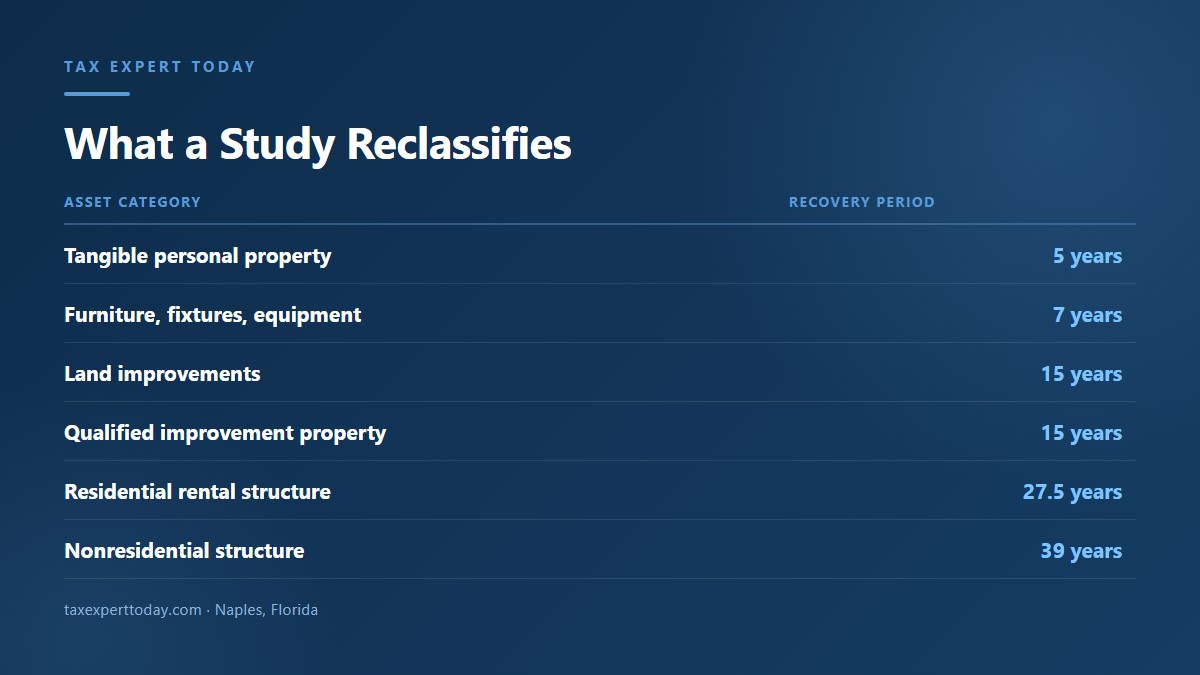
| Asset category | Typical recovery period | Representative components |
|---|---|---|
| Tangible personal property (Section 1245) | 5 years | Carpeting, vinyl flooring, decorative lighting, dedicated electrical for equipment, appliances, window treatments |
| Tangible personal property (Section 1245) | 7 years | Certain furniture, fixtures, and equipment that do not fall in a 5 year asset class |
| Land improvements (Section 1250) | 15 years | Paving, curbing, sidewalks, site lighting, fencing, landscaping, underground utilities |
| Qualified improvement property | 15 years | Interior nonstructural improvements to a nonresidential building placed in service after the building itself, under Section 168(e)(6) |
| Residential rental structure | 27.5 years | Roof, foundation, framing, structural walls, structural components |
| Nonresidential structure | 39 years | Roof, foundation, framing, structural walls, HVAC serving the structure |
Land itself is never depreciable, so the first step in any credible study is a defensible allocation between land and improvements. A study that quietly understates land value to inflate the depreciable base is exactly the pattern the Audit Technique Guide flags for examiners.
How Much Depreciation Does a Cost Segregation Study Accelerate?
The answer in 2026 turns on bonus depreciation. Section 70301 of Public Law 119-21 provides a permanent 100 percent additional first year depreciation deduction for qualified property acquired and placed in service after January 19, 2025, and IRS Notice 2026-11 supplies the interim guidance implementing it. Property with a recovery period of 20 years or less is eligible, so the 5, 7, and 15 year buckets a study identifies may be deducted in full in the first year where the property otherwise qualifies.
This is a genuine change from the prior law many published articles still describe. Under the phase-down schedule that applied before the 2025 amendment, the applicable percentage had fallen to 40 percent for qualified property placed in service during 2025. Any analysis built on the old phase-down assumptions understates the current first year result.
Illustrative hypothetical. Assume an investor acquires a nonresidential commercial building in January 2026 for $3,000,000, of which a supportable appraisal allocates $600,000 to land. The depreciable basis is $2,400,000. Assume the property is qualified property that meets the acquisition requirements, and assume a study reclassifies 12 percent to 5 year property and 8 percent to 15 year land improvements. These percentages are assumptions chosen to illustrate the mechanism and are not a prediction of what any particular study would find.
| First year depreciation | Without a study | With a study (illustrative) |
|---|---|---|
| 5 year property (12 percent of basis) | Not separately identified | $288,000, eligible for 100 percent bonus |
| 15 year land improvements (8 percent of basis) | Not separately identified | $192,000, eligible for 100 percent bonus |
| Remaining 39 year structure | $2,400,000 at 2.461 percent | $1,920,000 at 2.461 percent |
| Structure deduction | Approximately $59,100 | Approximately $47,300 |
| Total first year deduction | Approximately $59,100 | Approximately $527,300 |
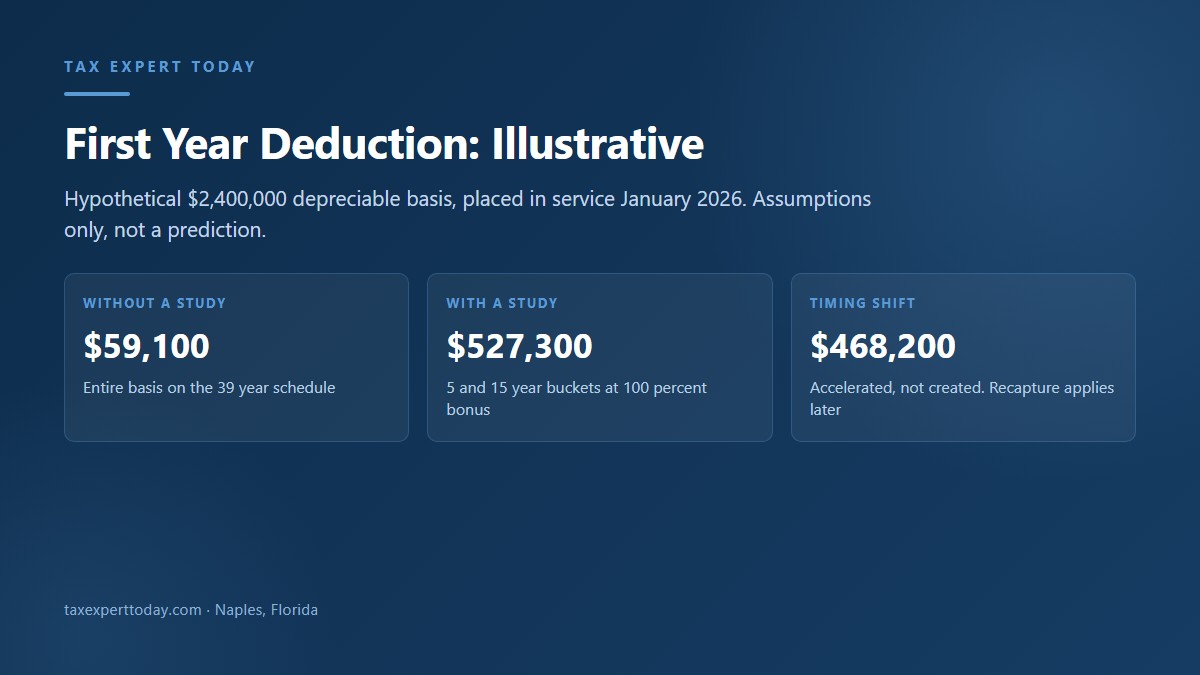
The illustrative difference is roughly $468,200 of additional first year deduction. Two cautions belong immediately next to that number. First, it is a deduction and not a refund, so its cash value depends on the owner’s marginal rate. Second, and more often overlooked, a deduction is worth nothing in the current year if the passive activity rules will not let the owner use it.
When Can the Owner Actually Use the Deduction?
This is the question that separates a study that produces cash from a study that produces a suspended loss carryforward. IRC Section 469 generally treats rental activity as passive regardless of how much time the owner spends on it, and passive losses generally offset only passive income. A large accelerated deduction on a passive rental may simply suspend and carry forward.
| Owner situation | Governing rule | Practical effect on the deduction |
|---|---|---|
| Owner materially participates in an operating business that occupies the building | Section 469(h) | Loss is generally nonpassive and may offset active business income |
| Rental real estate, owner is not a real estate professional | Section 469(c)(2) | Generally passive; loss typically suspends and carries forward until passive income arises or the activity is disposed of in a qualifying transaction |
| Real estate professional who materially participates in the rental | Section 469(c)(7) | The rental is not automatically passive, so the loss may offset nonpassive income where the tests are met |
| Short-term rental with an average customer use period of seven days or less | Treasury Regulation 1.469-1T(e)(3)(ii)(A) | Not a rental activity for Section 469 purposes; the material participation tests govern instead. See the short term rental tax loophole for the full computation and the gates that follow it |
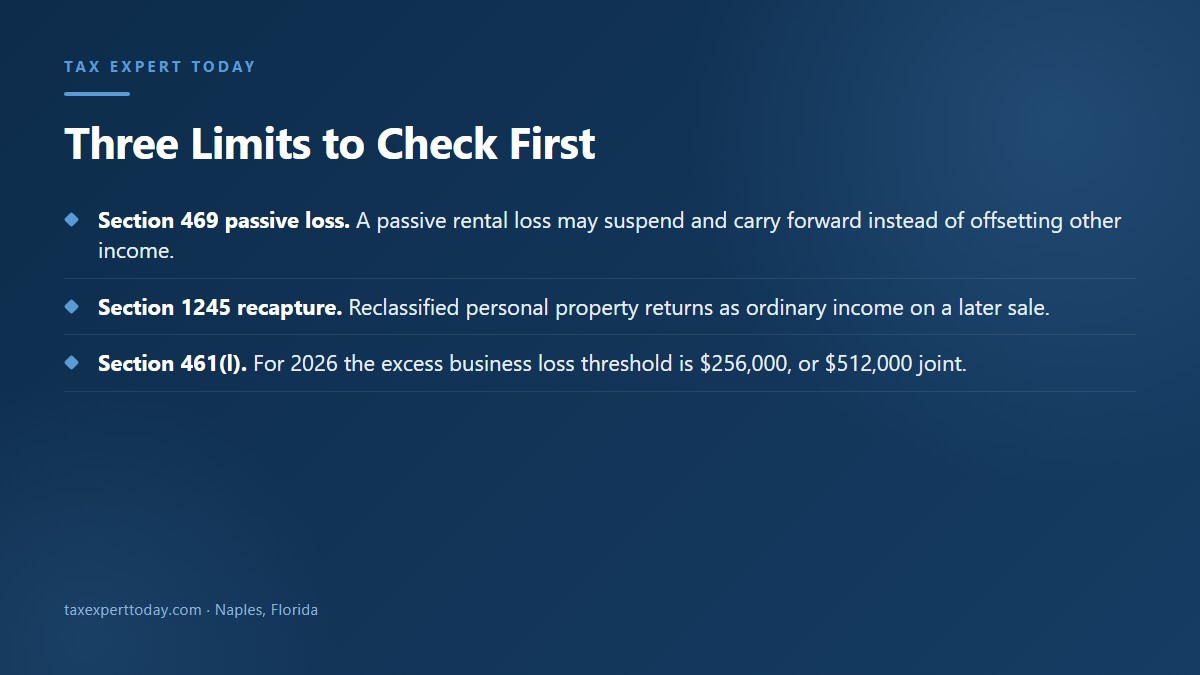
| Any of the above producing a very large loss | Section 461(l) | For taxable years beginning in 2026 the excess business loss threshold is $256,000, or $512,000 on a joint return, so part of the deduction may be deferred |
The 2026 excess business loss figures come from Revenue Procedure 2025-32, the annual inflation adjustment guidance. Whether any of these provisions apply depends on individual circumstances, and the real estate professional tests in particular are factually intensive and frequently examined.
Can I Do My Own Cost Segregation Study, or Can My CPA Do One?
There is no licensing rule that reserves cost segregation work to a particular credential. The Audit Technique Guide states plainly that the Service has not established any requirements or standards for the preparation of cost segregation studies. What the guide does say is that the supporting authorities assume the study is performed by qualified individuals and professional firms competent in design, construction, auditing, and estimating procedures relating to building construction.
In practice that means a study prepared without construction and engineering competence is the one most likely to fail on examination. The guide describes six approaches and evaluates them very differently.
- Detailed engineering approach from actual cost records. The most rigorous approach, used when actual construction cost records exist.
- Detailed engineering cost estimate approach. Used for acquired property where original cost records are unavailable.
- Survey or letter approach. Relies on contractor and subcontractor responses.
- Residual estimation approach. Estimates short-lived assets and assigns the remainder to the building.
- Sampling or modeling approach. Applies results from a model property across similar properties.
- Rule of thumb approach. The guide treats this one with explicit caution because it lacks sufficient documentation to support the allocation of project costs.
The guide also notes that substantiation using actual costs is more accurate than using estimates, and that where estimation is the only option the methodology and the source of the cost data should be clearly documented. Chapter 4 of the guide lists thirteen principal elements of a quality study, including preparation by an individual with expertise and experience, a detailed description of the methodology, appropriate documentation, interviews with appropriate parties, an explanation of the legal analysis, reconciliation of total allocated costs to total actual costs, and explicit identification of the Section 1245 property. A report that omits several of those elements is a weaker report regardless of how large the reclassification percentage looks.
Can You Do a Cost Segregation Study on a Property You Already Own?
Yes, and this look-back capability is one of the most useful features of the technique. An owner who has been depreciating a building over 39 years for several years may commission a study now and claim the depreciation that would have been allowed had the assets been classified correctly from the start. The correction is made as a change in method of accounting.
The mechanism is Form 3115, Application for Change in Accounting Method, with a Section 481(a) adjustment that captures the cumulative catch-up in the year of change. A favorable Section 481(a) adjustment is generally taken into account entirely in the year of change rather than spread forward. Amending prior returns is generally not the route for this correction, and the automatic change procedures carry their own eligibility conditions and filing deadlines, so the timing should be confirmed before the study is commissioned.
What Is the Downside of a Cost Segregation Study?
The three real downsides are recapture on sale, the passive loss problem described above, and the study cost itself relative to the holding period. Recapture is the one owners most often fail to model, because acceleration that felt free in year one changes the character of gain later. For how that recapture lands inside a full sale calculation, see our guide to selling a business taxes.
| Asset class | Treatment on a later sale | Rate character |
|---|---|---|
| 5 and 7 year personal property | Section 1245 recapture on depreciation allowed or allowable, including bonus depreciation | Ordinary income |
| 15 year land improvements | Section 1250 property, but depreciation in excess of straight line is additional depreciation subject to recapture | Ordinary income to the extent of the excess |
| Building structure depreciated straight line | No ordinary Section 1250 recapture, but gain attributable to the depreciation is unrecaptured Section 1250 gain | Maximum 25 percent rate for individuals |
Read that table together with the acceleration table above. Moving cost into 5 year property converts what would have been 25 percent rate gain into ordinary income on a later sale. Reclassified components are personal property, which since 2018 cannot travel through a like-kind exchange at all, so an owner who may exchange the building later should read the 1031 exchange rules alongside this study. Where the owner expects to hold the property long term, or expects to exchange it under Section 1031, the arithmetic looks different than it does for a short hold. The general rules on dispositions are set out in IRS Publication 544.
A shorter holding period is the most common reason a study does not pay off. The benefit is the time value of money on the accelerated deduction, and a sale a few years after acquisition can return much of that benefit through recapture at ordinary rates.
How Much Should a Cost Segregation Study Cost?
Fees for a cost segregation study are scoped rather than listed, and any figure quoted before the property is reviewed should be treated with caution. What drives the fee is measurable: the size and use of the building, the number of separate structures and units, whether original construction cost records exist or the work must be reconstructed by engineering estimate, whether a site visit is required, the number of tax years in a look-back, and the level of documentation the report will carry.
The more useful screening question is not the fee but whether the property clears three thresholds at once. The depreciable basis needs to be large enough that a meaningful percentage reclassification matters. The owner needs a tax position that allows the deduction to be used rather than suspended. And the expected holding period needs to be long enough that recapture does not claw back the timing benefit. When any one of those three fails, a study that is technically sound can still be the wrong decision. We scope and quote this work after a consultation, once the property and the owner’s tax position are both on the table.
How Does a Cost Segregation Study Fit With Other Planning?
A study is a timing tool, and timing tools work best inside a plan rather than on their own. The year a large accelerated deduction lands is often the right year to look at the rest of the picture together: entity structure, owner compensation, retirement plan contributions, and the interaction with Section 179 expensing, which for taxable years beginning in 2026 carries a $2,560,000 limit that phases down dollar for dollar once Section 179 property placed in service exceeds $4,090,000, per Revenue Procedure 2025-32.
Section 179 and bonus depreciation are not interchangeable. Section 179 is limited by taxable income from the active conduct of a trade or business and cannot create a loss, while bonus depreciation can. For an owner whose goal is a current deduction against active income, the ordering of those two elections matters. Which of the two 2026 bonus percentages actually reaches the reclassified basis is a separate question, and it is settled by the acquisition date rather than the date the study is completed, as set out in our guide to bonus depreciation rules and limits for 2026. Business owners weighing a large deduction year alongside a retirement funding decision may also want to read our guide to cash balance plans for business owners, and owners who use their own home for business meetings should review the documentation standards in our guide to the Augusta Rule. Broader strategy sits in our Naples tax planning overview and our tax planning services.
Cost Segregation Study Help in Naples and Southwest Florida
Southwest Florida property owners face this question often, because the region’s commercial, multifamily, and short-term rental inventory turns over steadily and construction has been active. Tax Expert Today LLC works with property owners, operating businesses, and investors on whether a cost segregation study fits the facts, how the reclassification interacts with the passive activity rules, and how the recapture exposure looks against the expected holding period. Our team includes tax advisors, enrolled agents, CPAs, and attorneys, and we coordinate with qualified engineering providers rather than substituting for them.
Our office is at 11983 Tamiami Trail N, Naples, FL 34110. Call (239) 441-2005, Monday through Friday, 10:00am to 5:00pm ET. We serve clients in Naples, Bonita Springs, Estero, Fort Myers, Marco Island, and throughout Florida and all 50 states. Owners who also need ongoing financial oversight can review our business consulting and fractional CFO services.
When to Engage a Professional
Consider professional guidance before commissioning a study rather than after. The decisions that determine whether the study produces value are made early: the land allocation, the choice of methodology, whether a look-back on Form 3115 is available and worth filing, and above all whether the resulting deduction will be usable in the year it lands. A study delivered into the wrong tax position produces a carryforward and a fee rather than cash.
Engagement is particularly worth considering when the property was acquired or substantially improved in the last several years, when the owner’s participation level is uncertain under Section 469, when a sale or exchange is plausible within the next several years, or when the owner is weighing Section 179 and bonus depreciation against each other in the same year. Outcomes depend on individual facts and are subject to IRS review. This article is educational and is not tax advice for any particular taxpayer.
Frequently Asked Questions
Is a cost segregation study worth it for a small rental property?
It depends primarily on depreciable basis and on whether the owner can use the deduction. A modest basis produces a modest reclassification, and if the rental is passive under Section 469 the resulting loss may simply suspend. Owners of smaller properties should test usability before fee, because a suspended loss delivers no current benefit regardless of how well the study is prepared.
Does a cost segregation study increase audit risk?
The IRS publishes an Audit Technique Guide for examiners on this exact topic, which tells you the area receives attention. A well documented study prepared by qualified personnel and containing the principal elements described in the guide is defensible. A rule of thumb allocation with thin documentation is the profile the guide instructs examiners to scrutinize.
Can bonus depreciation still be claimed in 2026?
Yes. Public Law 119-21 provides a permanent 100 percent additional first year depreciation deduction for qualified property acquired and placed in service after January 19, 2025, and Notice 2026-11 supplies interim guidance taxpayers may rely on pending proposed regulations. Property with a recovery period of 20 years or less is generally eligible where the other requirements are met.
Do I need to amend prior returns to claim a look-back study?
Generally no. A change in the depreciation classification of already placed in service property is treated as a change in method of accounting, made on Form 3115 with a Section 481(a) adjustment in the year of change. The automatic change procedures carry eligibility conditions and deadlines, so confirm the route before relying on it.
Where can I get help with a cost segregation study in Naples, FL?
Tax Expert Today LLC advises property owners and businesses on cost segregation from our Naples office at 11983 Tamiami Trail N, Naples, FL 34110, reachable at (239) 441-2005. Our team includes tax advisors, enrolled agents, CPAs, and attorneys serving Naples, Bonita Springs, Estero, Fort Myers, and clients in all 50 states. We assess whether a study fits your facts before any engineering work is commissioned.
Published July 26, 2026 by Dr. Pellumb Kabashi « Back to Learning Center
Have a question this article touches on?
Tax Expert Today LLC, based in Naples, Florida and serving clients across the United States.
Schedule a Consultation (239) 441-2005