
By Dr. Pellumb Kabashi, DBA, MBA, CES, CFE, EA
Founder, Tax Expert Today LLC · Tax advisors, enrolled agents, CPAs, and attorneys · Serving clients in all 50 states
Quick Answer
The short term rental tax loophole is the rule in Treas. Reg. 1.469-1T(e)(3)(ii)(A) that removes a property from the definition of a rental activity when the average period of customer use is seven days or less. Removal is only the first step. The owner must still materially participate, clear the Section 280A personal-use test, and survive recapture at sale. Call (239) 441-2005 for a free consultation.
What is the short term rental tax loophole?
The short term rental tax loophole is not a loophole in the ordinary sense. It is a named exception inside the passive activity rules. When the average period of customer use for a property is seven days or less, Treas. Reg. 1.469-1T(e)(3)(ii)(A) says the activity is not a rental activity, which means losses are no longer automatically passive.
- The default rule is unforgiving. IRC Section 469(c)(2) provides that the term passive activity includes any rental activity, without regard to how much the owner works.
- The exception is regulatory, not statutory. The seven-day test lives in the temporary regulations under Section 469, which is why it carries no headline in the Code itself.
- There are six exceptions, not one. Paragraph (e)(3)(ii) lists exceptions (A) through (F). The seven-day rule is only the first of them.
- Escaping the definition is a doorway, not a destination. The activity moves out of the per-se passive bucket and into the ordinary trade-or-business bucket, where a second test waits.
| Exception in Treas. Reg. 1.469-1T(e)(3)(ii) | What it requires | Typical short term rental relevance |
|---|---|---|
| (A) Seven-day average | Average period of customer use is seven days or less | The usual route, and the one commonly called the loophole |
| (B) Thirty-day average with significant personal services | Average of 30 days or less plus significant personal services | A fallback where stays run longer, but the services test is demanding |
| (C) Extraordinary personal services | Extraordinary personal services provided, regardless of stay length | Rarely met by a conventional rental |
| (D) Rental incidental to a nonrental activity | The rental is incidental to another activity of the taxpayer | Generally inapplicable to a dedicated rental property |
| (E) Property available during defined business hours | Nonexclusive use by various customers during business hours | Generally inapplicable to whole-property lets |
| (F) Property provided to a passthrough entity | Property used in an activity conducted by an entity the taxpayer owns | Relevant only where an entity structure is involved |
Most published explanations stop at the seven-day rule and present the result as automatic. It is not. The regulation is structured in two steps, and the second step is where most examinations are decided. Understanding the difference is the whole of the planning question, and it is also why two owners with identical properties can reach opposite answers on the same facts.
Why is a short term rental not automatically passive?
Because Treas. Reg. 1.469-1T(e)(1) defines a passive activity in two alternative ways. An activity is passive if it is a trade or business in which the taxpayer does not materially participate, or if it is a rental activity regardless of participation. Escaping the second prong drops the owner into the first, where participation governs.
- Prong one is the participation test. A trade or business activity is passive only if the taxpayer does not materially participate for the year.
- Prong two is the rental test. A rental activity is passive without regard to whether or to what extent the taxpayer participates.
- The seven-day exception moves the activity from prong two to prong one. It does not make the activity non-passive by itself.
- Material participation must then be established every single year. Qualification is annual, not permanent, and a year that fails stands on its own.
This two-step structure explains a pattern that shows up repeatedly in practice. An owner reads that a seven-day average makes the property non-passive, books the loss against wage income, and only later learns that the regulation requires a second showing the owner never documented. The seven-day test is objective and provable from booking records. Material participation is a facts-and-circumstances exercise that has to be built during the year, not reconstructed afterward.
How is the seven-day average period of customer use actually computed?
Under Treas. Reg. 1.469-1(e)(3)(iii)(C), the average period of customer use for a class of property is the aggregate number of days in all periods of customer use divided by the number of those periods. Only periods ending during the taxable year, or including the last day of it, are counted. The activity-level figure then weights each class by its share of gross rental income.
- The denominator is reservations, not guests. Each period during which a customer has a continuous or recurring right to use the property is a separate period of customer use.
- Renewals do not create a new period. A recurring right under renewals of a single agreement is treated as one continuous period, which quietly lengthens the average.
- Vacant nights are irrelevant. Nothing in the computation reduces the average because a property sat empty, so a slow season does not help.
- Multiple properties can be classed separately. Owners may organize property into classes provided that items with significantly different daily rents are not lumped together.
- The weighting is by gross rental income. Each class contributes its average multiplied by its share of the activity’s gross rental income.
The practical consequence is arithmetic rather than judgment, and it is unforgiving. On a property rented 210 nights in the year, the average depends entirely on how many separate reservations produced those nights.
| Reservations in the year | Nights rented | Average period of customer use | Seven-day test |
|---|---|---|---|
| 45 | 210 | 4.67 days | Passes |
| 35 | 210 | 6.00 days | Passes |
| 30 | 210 | 7.00 days | Passes, exactly at the limit |
| 25 | 210 | 8.40 days | Fails |
| 18 | 210 | 11.67 days | Fails |
| 7 | 210 | 30.00 days | Fails |
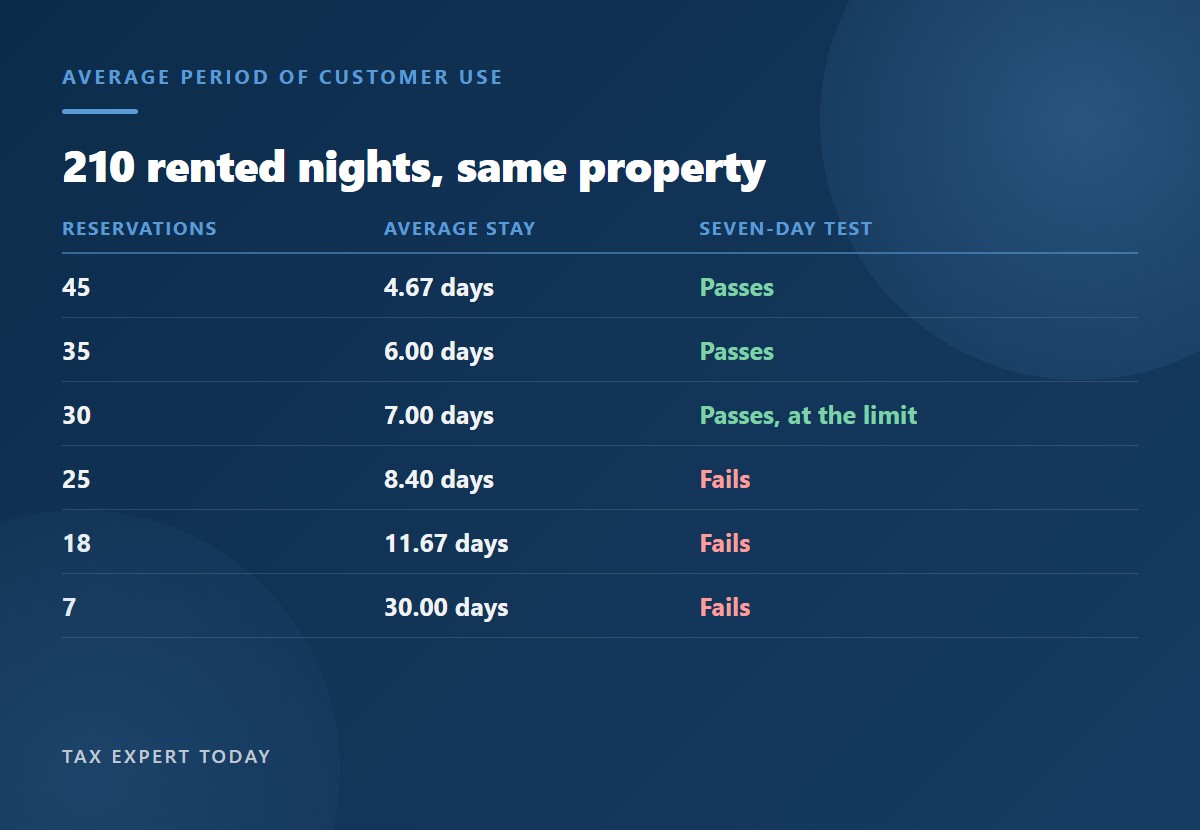
On 210 rented nights, the property needs at least 30 separate reservations to hold the average at seven days or less. This figure is illustrative and depends on each owner’s own booking records. The table is worth reading twice by anyone renting in a seasonal market, because a booking calendar that looks commercially attractive can be the calendar that fails the test.
Why does the seven-day test fail so often in Southwest Florida?
Seasonal markets tend to produce long bookings. A Naples property that fills its high season with monthly lets earns well and fails the seven-day test decisively. The regulation measures the average length of stay, and a market whose economics reward multi-week bookings works directly against the exception the owner is trying to claim.
- Season rentals in Southwest Florida are frequently monthly. A property let for the season on month-long terms can produce an average period of customer use far above seven days.
- A high nightly rate does not rescue the average. The computation counts days and periods, not dollars, within a class of property.
- Mixing short stays with a few long ones can still work. A single long booking is absorbed if enough short reservations sit alongside it.
- The thirty-day exception is a separate route. Exception (B) covers an average of 30 days or less where significant personal services are provided, which is a different and harder test.
The same seasonal booking pattern drives the Section 280A allocation question for owners across Lee County. Our Fort Myers tax advisor guide works through that allocation alongside the county filings that accompany a rental there.
Owners in this market sometimes face a genuine commercial trade-off between the booking pattern that maximizes revenue and the booking pattern that supports the tax position. That trade-off deserves to be modeled before the season is booked rather than discovered at filing. It is also a reason the analysis belongs alongside the rest of an owner’s planning rather than in isolation, which is the approach taken in our Naples tax planning practice.
What are the seven material participation tests?
Treas. Reg. 1.469-5T(a) provides seven alternative tests, and meeting any one of them establishes material participation for the year. The tests most relevant to short term rentals are the 500-hour test, the substantially-all test, and the 100-hour test that also requires the owner to work at least as much as any other individual.
- Test one, 500 hours. The individual participates in the activity for more than 500 hours during the year.
- Test two, substantially all. The individual’s participation constitutes substantially all of the participation of all individuals, including individuals who are not owners.
- Test three, 100 hours and no one more. More than 100 hours, and not less than the participation of any other individual, again including non-owners.
- Test four, significant participation activities. The activity is a significant participation activity and aggregate participation in all such activities exceeds 500 hours.
- Tests five through seven. Material participation in five of the preceding ten years, a personal service activity with three preceding years, or a regular, continuous, and substantial facts-and-circumstances showing.
Test seven carries two limitations that matter. Under Treas. Reg. 1.469-5T(b)(2)(iii), an individual who participates for 100 hours or less cannot use it at all. Under (b)(2)(ii), management services do not count toward it unless no other person receives compensation for managing the activity and no individual performs more management hours than the owner. Real estate professional status under Section 469(c)(7) is a separate regime and is not required here, which is the feature that draws high earners to the strategy in the first place.
Why does the 100-hour test fail most short term rental owners?
Because the 100-hour test measures the owner against every other individual who works on the property, whether or not that person owns any part of it. A cleaner, a co-host, or a property manager who logs more hours than the owner defeats the test outright, and in a professionally managed rental that is the normal outcome rather than the exception.
- Non-owners count. The regulation says expressly that the comparison includes individuals who are not owners of interests in the activity.
- Cleaning hours accumulate quickly. A turnover cleaning of several hours across 35 reservations can exceed a part-time owner’s annual involvement.
- A management company is usually fatal to test three. Where a manager is engaged, the owner is generally left with the 500-hour test.
- Investor activity does not count at all. Under Treas. Reg. 1.469-5T(f)(2)(ii), reviewing financial statements, preparing summaries for personal use, and monitoring operations in a non-managerial capacity are excluded.
- Work arranged to manufacture hours is disregarded. Under (f)(2)(i), work not customarily done by an owner is ignored where one of the principal purposes is to avoid the loss disallowance.
One provision cuts the other way and is frequently overlooked. Treas. Reg. 1.469-5T(f)(3) treats participation by a spouse as participation by the taxpayer, without regard to whether the spouse owns an interest and without regard to whether the couple files jointly. For a household where one spouse manages the property, that rule can be the difference between a test that fails and a test that passes.
Does the short term rental tax loophole survive the Section 280A personal-use gate?
Only if personal use stays low enough. IRC Section 280A(d)(1) treats a dwelling unit as a residence when personal use exceeds the greater of 14 days or 10 percent of the days rented at a fair rental. Once that happens, Section 280A(c)(5) caps deductions at gross income from the use, and the loss disappears before Section 469 is ever reached.
- Section 280A runs first in the ordering. A deduction denied by Section 280A never becomes a passive loss to be released.
- The threshold moves with rental days. On 210 rented days, 10 percent is 21 days, so the greater-of test sets the ceiling at 21 rather than 14.
- Family use is personal use. Use by any person with an interest in the unit, or by a member of the family as defined in Section 267(c)(4), counts against the owner.
- Below-market lets count too. A day rented to anyone at less than a fair rental is a personal-use day, and it is also stripped out of the fair-rental denominator.
- Disallowed amounts carry forward. Section 280A(c)(5) carries the excess into the succeeding year, subject to the same cap again.
The mirror image of this provision is worth noting because it is the basis of a different planning idea entirely. Section 280A(g) provides that where a dwelling unit is used as a residence and rented for fewer than 15 days, no rental deduction is allowed and the rental income is excluded from gross income altogether. That is the mechanism behind the Augusta Rule, and it is the opposite end of the same statute.
How much can the short term rental tax loophole actually deduct?
The deduction is driven by depreciation rather than by cash losses. Pairing the non-passive position with a cost segregation study and the 100 percent bonus allowance under Section 168(k) can produce a first-year paper loss many times larger than the property’s actual cash shortfall. The figures below are hypothetical and illustrate mechanism only.
Assume a Naples short term rental acquired for $1,300,000, of which $455,000 is allocated to land. An engineering study reclassifies 24 percent of the $845,000 building basis into five, seven, and fifteen-year property.
| Item | Amount |
|---|---|
| Purchase price | $1,300,000 |
| Less land, not depreciable | ($455,000) |
| Building basis | $845,000 |
| Reclassified to 5, 7 and 15-year property at 24 percent | $202,800 |
| Remaining building basis over 27.5 years | $23,353 per year |
| Gross rental revenue | $95,000 |
| Operating expenses | ($58,000) |
| Mortgage interest | ($34,000) |
| Net before depreciation | $3,000 |
| 100 percent bonus on reclassified property | ($202,800) |
| Building depreciation | ($23,353) |
| First-year loss | ($223,153) |
The bonus percentage is the current one. Section 168(k)(1)(A) now reads 100 percent, and the phase-down schedule that previously sat at paragraph (k)(6) was repealed by P.L. 119-21, section 70301(b)(1)(B). A transition election at Section 168(k)(10) allows a taxpayer to substitute 40 percent, or 60 percent for certain longer-production property, for the first taxable year ending after January 19, 2025. The mechanics of the study itself are covered in our article on the cost segregation study. The percentage that then applies to the reclassified components, and the acquisition date test that decides it, are covered in our guide to bonus depreciation rules and limits for 2026.
Is a short term rental depreciated over 27.5 years or 39 years?
It depends on the building, not on the length of the stays. Section 168(e)(2)(A) defines residential rental property by reference to gross rental income from dwelling units, and excludes from the term dwelling unit any unit in a hotel, motel, or other establishment more than one-half of the units in which are used on a transient basis.
- A standalone house is usually still residential rental property. It is not a unit in a multi-unit establishment, so the transient exclusion generally does not reach it.
- A condominium unit can be different. Where more than half the units in the building are used on a transient basis, the exclusion may apply and the 39-year nonresidential period may govern.
- The 80 percent test is measured on gross rental income. The classification turns on the income mix of the building or structure for the taxable year.
- Owner-occupied portions are added back. Where the taxpayer occupies part of the structure, the rental value of that portion is included in gross rental income for the test.
The distinction changes the annual building deduction meaningfully and is frequently assumed rather than analyzed. It does not affect the reclassified five, seven, and fifteen-year components, which carry their own recovery periods either way. Owners of resort-style condominium units in Southwest Florida should treat the classification as a question to be answered on the facts of the building rather than a default.
Can the excess business loss limitation still cap the deduction?
Yes. IRC Section 461(l) disallows an excess business loss for a noncorporate taxpayer, measured as aggregate business deductions over the sum of aggregate business gross income and an indexed threshold. Per Rev. Proc. 2025-32, the 2026 threshold is $256,000, or $512,000 for a joint return.
- The cap applies after Section 469. A loss that is properly non-passive can still be limited at this stage.
- Wage income is excluded from the computation. Deductions and income attributable to the trade or business of performing services as an employee are left out.
- The disallowed amount is not lost. Section 461(l)(2) treats it as a net operating loss carryover for subsequent years.
- The limitation is now permanent. P.L. 119-21, section 70601(a), struck the scheduled sunset, and section 70601(b) reset the inflation base year to 2024.
Applying the threshold to the illustration above shows why scale matters. With one property, aggregate business deductions of $318,153 against business gross income of $95,000 plus the $256,000 threshold leaves no excess business loss, so the deduction is allowed in full. With two identical properties, deductions of $636,305 against income of $190,000 plus the same $256,000 threshold produces an excess business loss of $190,305, disallowed for the year and carried forward. The threshold is per taxpayer, not per property, which is the point most often missed by owners scaling a portfolio.
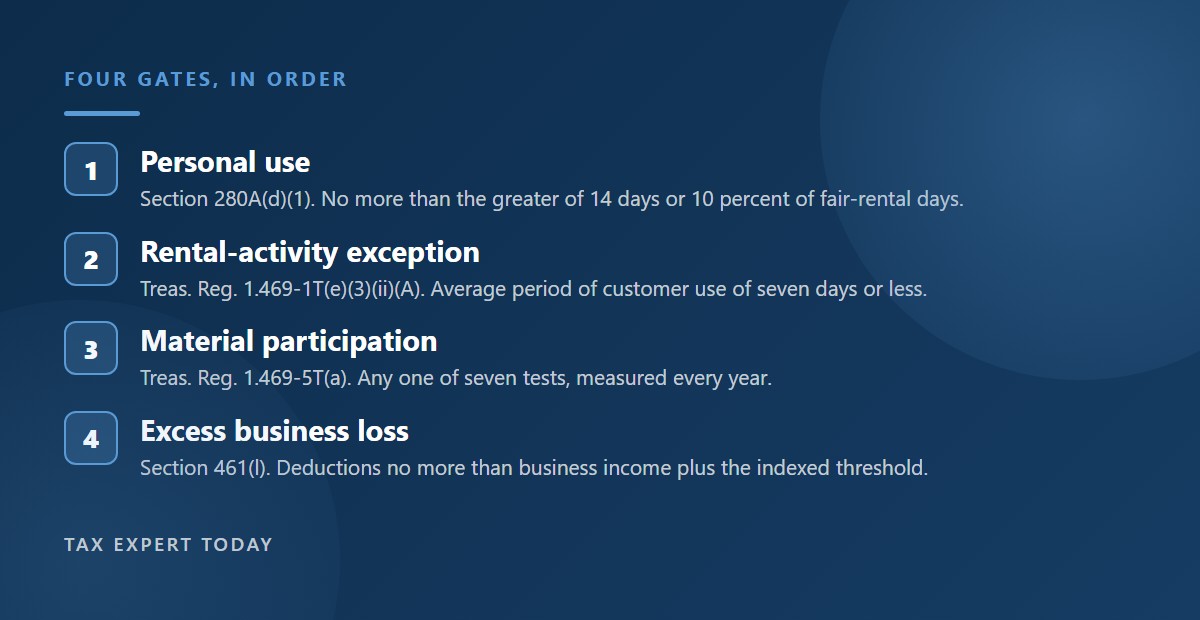
Taken together, four separate provisions have to be cleared in order before a short term rental loss reaches a wage. Failing any one of them ends the analysis at that point, and the gates are not interchangeable.
| Order | Gate | Authority | Test | Effect of failing |
|---|---|---|---|---|
| 1 | Personal use | Section 280A(d)(1) and (c)(5) | Personal use no more than the greater of 14 days or 10 percent of fair-rental days | Deductions capped at gross income from the use, excess carried forward |
| 2 | Rental-activity exception | Treas. Reg. 1.469-1T(e)(3)(ii)(A) | Average period of customer use of seven days or less | Activity stays a rental activity and the loss is passive regardless of hours worked |
| 3 | Material participation | Treas. Reg. 1.469-5T(a) | Any one of the seven tests, measured annually | Loss is passive and suspended, tracked on Form 8582 |
| 4 | Excess business loss | Section 461(l) | Business deductions no more than business income plus the indexed threshold | Excess disallowed for the year and carried forward as a net operating loss |
Does the short term rental tax loophole trigger self-employment tax?
It can, and this is the risk that receives the least attention. IRC Section 1402(a)(1) excludes rentals from real estate in computing net earnings from self-employment. Where services rendered to occupants are substantial enough that the payments are no longer principally for the use of the property, that exclusion may not hold.
- The Section 469 answer does not decide the Section 1402 answer. They are separate regimes with separate tests, and a property can be non-passive for one and still excluded under the other.
- Ordinary rental services do not create self-employment income. Cleaning between guests, maintenance, trash collection, and utilities are generally incident to the rental.
- Hotel-like services are a different matter. Daily housekeeping during a stay, meals, concierge arrangements, and similar services rendered for the occupant’s convenience move the analysis.
- The reporting follows the substance. An activity with substantial services is generally reported on Schedule C rather than Schedule E, and self-employment tax follows.
The outcome that owners rarely anticipate is that succeeding at one goal can defeat another. An owner who adds services to strengthen a material participation position may push the activity toward self-employment treatment, converting a strategy meant to reduce tax into one that adds a tax the property did not previously bear. The two positions should be modeled together rather than sequentially. Where an activity does become subject to self-employment tax, the entity question follows close behind, and the wage that an S corporation would then have to support is governed by reasonable compensation rather than by the owner’s preference. IRS Topic 425 summarizes the passive activity framework that sits alongside it.
What happens to the deduction when the property sells?
Much of it comes back. Depreciation reduces basis, so it increases gain on sale. The reclassified personal property is recaptured as ordinary income under Section 1245, and building depreciation returns as unrecaptured Section 1250 gain taxed at a maximum 25 percent rate. The strategy is therefore best understood as a deferral rather than a permanent exclusion.
Continuing the same hypothetical, assume a sale in year six for $1,450,000.
| Item | Amount |
|---|---|
| Sale price | $1,450,000 |
| Depreciation taken over six years | $342,916 |
| Adjusted basis | $957,084 |
| Total gain | $492,916 |
| Section 1245 recapture, ordinary rates | $202,800 |
| Unrecaptured Section 1250 gain, 25 percent maximum | $140,116 |
| Remaining Section 1231 gain, long-term rates | $150,000 |
The comparison that matters is between the rate at which the deduction was taken and the rate at which it returns. The accelerated component was deducted at 37 percent, producing $75,036 of benefit, and it is recaptured at ordinary rates, costing $75,036. On those assumptions the permanent saving on the accelerated piece is zero, and what remains is the time value of the deferral. That is a real economic benefit, but it is a different benefit from the one most descriptions of the short term rental tax loophole imply.
| Marginal rate when deducted | Marginal rate at recapture | First-year benefit | Recapture cost | Net rate effect |
|---|---|---|---|---|
| 37 percent | 37 percent | $75,036 | $75,036 | $0 |
| 37 percent | 32 percent | $75,036 | $64,896 | $10,140 |
| 37 percent | 24 percent | $75,036 | $48,672 | $26,364 |
| 35 percent | 37 percent | $70,980 | $75,036 | ($4,056) |
| 24 percent | 37 percent | $48,672 | $75,036 | ($26,364) |
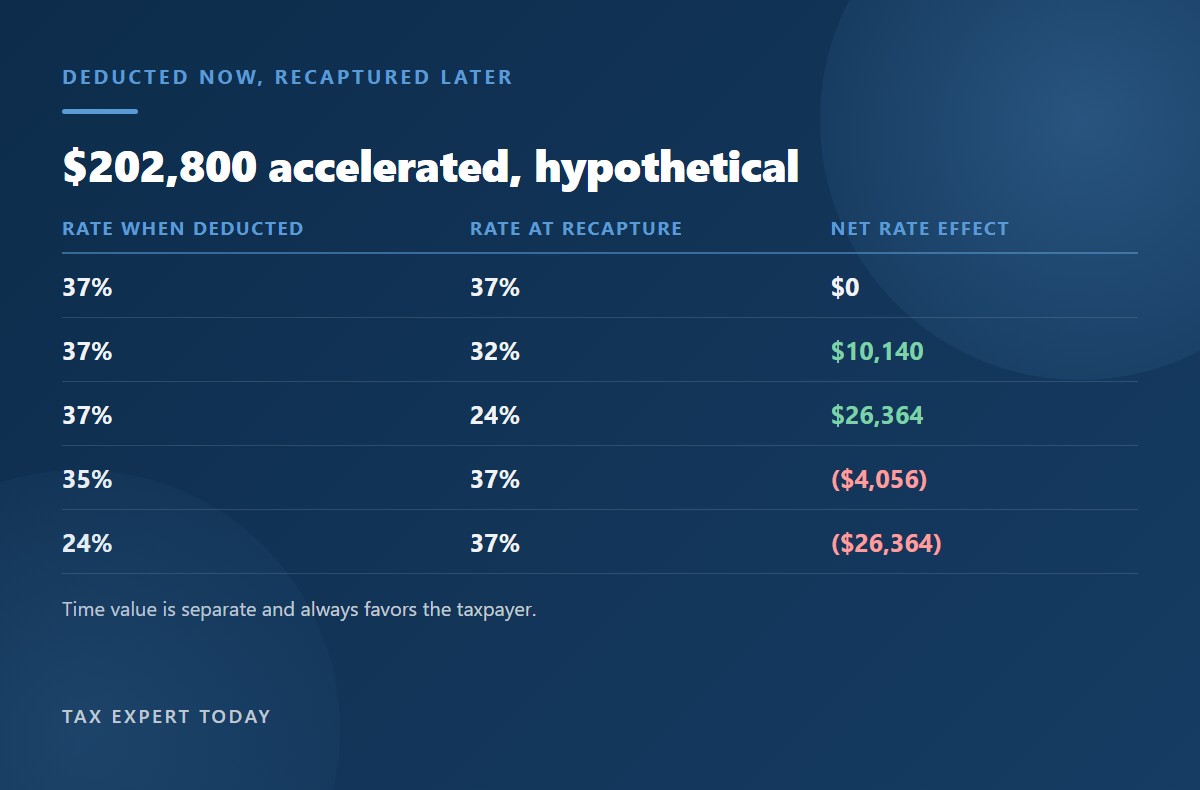
Read as a whole, the table says the strategy is partly a bet on the owner’s own future rate. It performs best where income is expected to fall before the property is sold, and it can perform poorly in the reverse case. Two further points belong in the same analysis. Section 469(g) releases suspended passive losses on a fully taxable disposition of the entire interest, which can matter in a year that failed the participation test. And because Section 1031 is limited to real property, the reclassified personal property does not carry into an exchange, so a like-kind exchange does not defer the Section 1245 component. Gain and recapture are reported on Form 4797, and the unrecaptured amount is computed under Section 1250. The interaction with an eventual sale is covered further in our article on the tax treatment of a sale. An owner facing a large embedded gain who also has charitable intent sometimes weighs the sale against a charitable remainder trust, which addresses the gain through a different mechanism entirely.
What records does the IRS expect for the short term rental tax loophole?
Two files, kept contemporaneously. The first proves the average period of customer use from booking records. The second proves material participation. Treas. Reg. 1.469-5T(f)(4) permits any reasonable means of proof and does not require a daily log, but appointment books, calendars, and narrative summaries are named as acceptable.
- Booking-level detail, not summary totals. The computation needs each reservation’s start and end date, because the denominator is the number of periods.
- Hours by task and by person. The 100-hour test is comparative, so hours worked by cleaners, co-hosts, and managers matter as much as the owner’s own.
- Separate investor time out. Time spent reviewing statements or monitoring performance should not be included in the total.
- Record spouse hours as well. They count under Treas. Reg. 1.469-5T(f)(3) and are frequently omitted.
- Keep the grouping position consistent. Elections under Treas. Reg. 1.469-4 should be documented and applied the same way each year.
A reconstructed log prepared after a notice arrives is weaker evidence than an imperfect contemporaneous one. Passive losses that are suspended rather than allowed are tracked on Form 8582, and the reporting position taken in the first year tends to set expectations for the years that follow.
Short term rental tax loophole Naples: help in Southwest Florida
Tax Expert Today LLC advises short term rental owners in Naples, Florida and across Southwest Florida on the seven-day computation, material participation documentation, cost segregation timing, and the recapture modeling that decides whether the position is worth taking. The firm serves clients in all 50 states under federal practice authority.
Florida imposes no personal income tax, so for the individual owner the federal answer is very close to the whole answer, and that is one reason owners establishing Florida residency often revisit a rental portfolio at the same time. The state layer arrives instead as transaction tax on the rental itself. Florida imposes sales and use tax at 6 percent on transient rental accommodations, and Collier County adds a 5 percent tourist development tax collected by the Collier County Tax Collector on rentals of six months or less. On $95,000 of gross rental receipts, that combination is roughly $5,700 of state tax and $4,750 of county tax, or about $10,450 in total. Rates and administration vary by county, and short term rental registration requirements are separate again, so an owner in Lee County should confirm the local figures rather than assume the Collier ones.
Our office is at 11983 Tamiami Trail N, Naples, FL 34110. Call (239) 441-2005, Monday through Friday, 10am to 5pm ET. Owners in Naples, Bonita Springs, Estero, Fort Myers, Marco Island, and the surrounding communities work with us in person or remotely.
Does the tourist development tax affect the federal short term rental analysis?
Not directly. The tourist development tax and the state sales tax are transaction taxes on the rental charge, collected from the guest and remitted by the operator, so they do not enter the Section 469 or Section 280A tests. They do affect the property’s economics, and where the operator absorbs rather than passes through any part of them, the amount generally becomes a deductible operating expense of the activity. Registration and remittance obligations begin when the property is first offered, not when the first return is filed.
When to engage a professional
The short term rental tax loophole is a documentation exercise wrapped around a computation. The work worth paying for is the modeling done before the property is acquired or the season is booked, not the return prepared afterward. Consider engaging an adviser when any of the following is true.
- The booking pattern is seasonal and the average period of customer use has never been computed from actual reservation records.
- A management company or co-host is engaged, which usually removes the 100-hour test and leaves the 500-hour test.
- A cost segregation study is under consideration and the recapture consequences on an expected sale date have not been modeled.
- The property is used personally at all, since the Section 280A test runs before Section 469 and can end the analysis.
- More than one property is involved, where the Section 461(l) threshold and the grouping election both come into play.
- Substantial services are provided to guests, raising the self-employment tax question alongside the passive activity one.
Tax Expert Today LLC works as a multidisciplinary firm of tax advisors, enrolled agents, CPAs, and attorneys, which matters here because the analysis sits across depreciation, passive activity, employment tax, and eventual disposition. Our tax planning services cover the modeling, and fees are scoped and quoted after a consultation. Owners weighing the strategy alongside other deferral vehicles often review it next to a cash balance plan, since the two answer the same question through very different mechanisms. Where the rental sits inside a wider operating business, the entity and structuring questions are handled through our business consulting services.
Frequently asked questions
What is the short term rental tax loophole?
The short term rental tax loophole is the exception in Treas. Reg. 1.469-1T(e)(3)(ii)(A) that removes a property from the definition of a rental activity when the average period of customer use is seven days or less. Because Section 469(c)(2) makes rental activities passive without regard to participation, removal from that definition allows losses to be treated as non-passive provided the owner also materially participates.
Do I need real estate professional status to use it?
No, and that is the principal appeal. Real estate professional status under Section 469(c)(7) requires more than 750 hours in real property trades or businesses and more than half of all personal services performed during the year. The short term rental route requires only that the seven-day test be met and that one of the seven material participation tests in Treas. Reg. 1.469-5T(a) be satisfied. Our guide to real estate professional status covers that other regime in full, including the aggregation election and the records that prove the hours.
Does the average period of customer use include vacant nights?
No. The computation in Treas. Reg. 1.469-1(e)(3)(iii)(C) divides the aggregate number of days in all periods of customer use by the number of those periods. Nights on which no customer had a right to use the property are in neither the numerator nor the denominator, so a property with low occupancy does not gain any advantage from being empty.
Can I count the hours my cleaner works toward material participation?
No, and their hours work against the owner under the 100-hour test. Treas. Reg. 1.469-5T(a)(3) requires the owner’s participation to be not less than that of any other individual, including individuals who are not owners. A spouse is the exception, because Treas. Reg. 1.469-5T(f)(3) treats spousal participation as the taxpayer’s own.
Is the short term rental tax loophole a permanent tax saving?
Generally it is a deferral. Depreciation reduces basis, so it increases gain on a later sale, and the accelerated components are recaptured as ordinary income under Section 1245 while building depreciation returns as unrecaptured Section 1250 gain. Whether any permanent saving results depends largely on whether the owner’s marginal rate at sale is lower than the rate at which the deduction was taken.
What happens if I fail the test in a later year?
The activity is passive for that year and its loss is suspended rather than lost. Suspended losses are tracked on Form 8582 and are generally released under Section 469(g) when the taxpayer disposes of the entire interest in the activity in a fully taxable transaction to an unrelated party. Qualification is tested annually, so a single failed year does not disturb earlier years that were properly supported.
Published August 28, 2026 by Dr. Pellumb Kabashi « Back to Learning Center
Have a question this article touches on?
Tax Expert Today LLC, based in Naples, Florida and serving clients across the United States.
Schedule a Consultation (239) 441-2005