
By Dr. Pellumb Kabashi, DBA, MBA, EA, CFE, CES
Founder, Tax Expert Today LLC · Tax advisors, enrolled agents, CPAs, and attorneys · Serving clients in all 50 states
Quick answer: Cape Coral tax preparation is mostly a federal and former-state exercise, because Florida imposes no state individual income tax. The recurring Lee County work is the year-of-move part-year return, the 4 U.S.C. 114 bar on a former state taxing pension and IRA income, section 280A allocation on a canal home rented seasonally, and seawall and dock casualty losses. Call (239) 441-2005 for a free consultation.
What does Cape Coral tax preparation involve when Florida has no income tax?
Cape Coral tax preparation rarely turns on a Florida filing, because Florida imposes no state individual income tax and Lee County levies no local income tax. The work sits almost entirely on the federal return and on whatever the taxpayer still owes the state they left. For a city built largely on arrivals, that second half is the part most often handled badly.
That distinction matters more in Cape Coral than in most Florida cities. A household that has lived in Lee County for twenty years usually has a simple filing profile. A household that closed on a Cape Coral house in March and moved from Ohio in June has three returns to think about in that one year, a residency start date that has to be defensible, and retirement income whose treatment changes on the date the domicile changed.
- No Florida individual return. There is no state form to file, no Florida withholding, and no Florida credit to claim for tax paid elsewhere.
- A departure-state return is usually still due. Most states require a part-year or nonresident return for the year of the move, covering income earned while still a resident there.
- The federal return does not change. Form 1040 is filed the same way it was before the move, and Florida residency changes nothing about federal rates or deductions.
- Local filings are property-side and business-side. The county touches a Cape Coral household through the property appraiser rather than through an income tax.
The practical effect is that the value in Cape Coral tax preparation comes from the transition years and from the property itself, not from an annual Florida form. A permanent resident with wage income and one home often has a return that needs no professional attention at all, and it would be misleading to suggest otherwise.
Which returns does a new Cape Coral resident file in the year of the move?
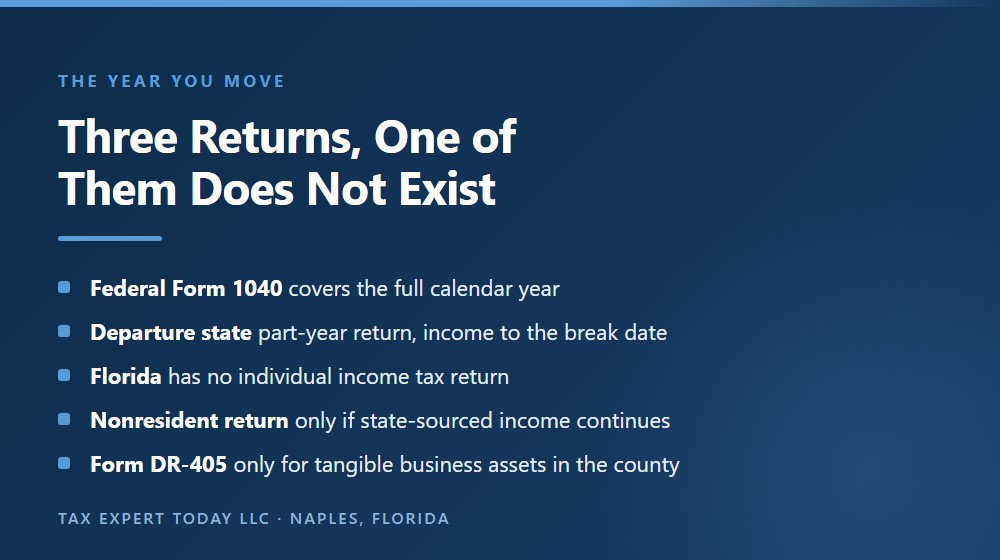
In the year of a move to Cape Coral a taxpayer generally files a federal Form 1040 covering the full year, plus a part-year resident return in the state they left covering income earned up to the break date. Florida requires nothing. The departure-state return is where the year-of-move analysis actually happens and where errors carry a cost.
The part-year return is not a formality. It fixes the date the former state stops having a claim, it allocates income across the two periods, and it is the document a state examiner reads first if the residency change is ever questioned. Filing it as a full-year nonresident return, or skipping it because Florida wanted nothing, is a common and expensive shortcut.
- Income earned before the break date is generally taxable by the former state, whether or not it was paid after the move.
- Income earned after the break date is generally outside the former state’s reach unless it is sourced to that state, such as rent from property left behind.
- Deferred compensation and bonuses often follow where the work was performed rather than where the taxpayer lived when paid.
- A sale of the former home may be taxable by the former state even after the move, and the federal exclusion under 26 U.S.C. § 121 is analyzed separately.
| Return | Filed for the year of the move? | What it covers |
|---|---|---|
| Federal Form 1040 | Yes, as usual | Worldwide income for the whole calendar year, unchanged by the move |
| Departure-state part-year return | Usually yes | Income earned while still a resident there, plus any income sourced to that state afterward |
| Departure-state nonresident return | Only if state-sourced income continues | Rent, business income, or wages sourced to that state after the move |
| Florida individual return | No such return exists | Florida imposes no individual income tax |
| Form DR-405, tangible personal property | Only for a business or rental with tangible assets | Business equipment and furnishings in Lee County on January 1 |
Taxpayers arriving from states with an aggressive residency practice should expect the break date to be examined rather than accepted. Our guides to the New York residency audit and the New Jersey exit tax set out how those two states approach a departure, and the pattern they describe is the one Cape Coral arrivals from the Northeast and the Midwest run into most often.
The transition year also changes the withholding picture in a way that is easy to miss. State withholding stops, which raises take-home pay, while federal withholding and federal liability continue unchanged. A retiree who was having a single combined amount withheld from a pension may find that the federal portion alone no longer covers the year, and an underpayment penalty can follow even though the total tax bill went down. Reviewing the federal estimate part way through the move year, using Form 1040-ES and the safe harbor rules described in IRS Publication 505, is a small step that prevents an avoidable penalty in the first Florida filing season.
Can a former state still tax a Cape Coral retiree’s pension or IRA?
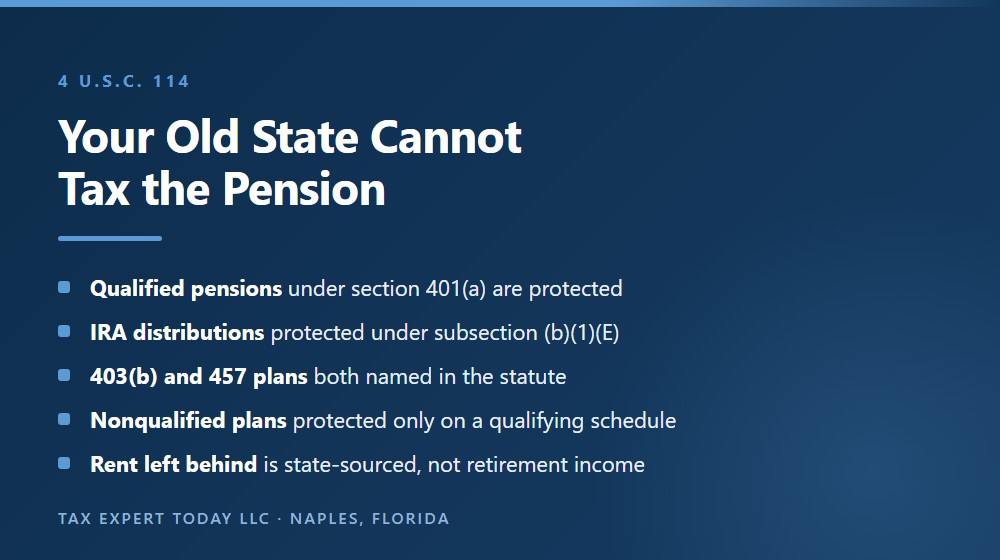
No, not once Florida domicile is established. Federal law at 4 U.S.C. 114 bars any state from imposing an income tax on the retirement income of a person who is not a resident or domiciliary of that state. A Cape Coral retiree drawing a pension earned in Ohio, Michigan, New York, or Illinois owes those states nothing on it.
This is the single most valuable rule for the population Cape Coral actually attracts, and it is the one competitors writing about this market do not mention. The protection is federal, it does not depend on a state statute, and it applies regardless of where the income was earned or which employer paid it.
The statute defines retirement income by listing the plans it covers. 4 U.S.C. § 114(b)(1) reaches a qualified trust under section 401(a), a simplified employee pension under section 408(k), an annuity plan under section 403(a), an annuity contract under section 403(b), an individual retirement plan under section 7701(a)(37), an eligible deferred compensation plan under section 457, a governmental plan under section 414(d), and a trust described in section 501(c)(18).
| Income type | Former state may tax after the move? | Basis |
|---|---|---|
| Qualified pension distributions | No | 4 U.S.C. 114 source-tax bar |
| Traditional and Roth IRA distributions | No | 4 U.S.C. 114(b)(1)(E) |
| Section 457 and 403(b) distributions | No | 4 U.S.C. 114(b)(1)(D) and (F) |
| Nonqualified deferred compensation paid in installments | Generally no if the schedule meets the statute’s terms | 4 U.S.C. 114(b)(1)(I), which turns on the payment period |
| A lump-sum nonqualified payout | Often yes | Falls outside the protected installment pattern |
| Rent from a house kept in the former state | Yes | State-sourced income, not retirement income |
The nonqualified deferred compensation row is where the analysis gets real. The protection for those arrangements depends on the payment schedule rather than on the label, so a plan paid over a short period or as a single sum can fall outside the bar entirely. Anyone moving to Cape Coral with a nonqualified plan should have the payout schedule read before the first distribution, not after.
Two related planning items sit alongside this one for the same households. A qualified charitable distribution from an individual retirement account is unaffected by the move, since the federal treatment does not depend on the state of residence, but it interacts with the withholding review described above. The same rule creates a planning question on the way in. A Roth conversion carried out while the taxpayer is still a resident of a state with an income tax is generally taxed by that state, while a conversion completed after Florida domicile is established is not, because there is no Florida tax to apply. Conversions are irrevocable once made, so the sequence relative to the move date is the whole decision. 26 U.S.C. § 408A governs the federal treatment, which does not change either way. The point is only that a conversion deferred until the Florida year avoids a state tax that a conversion made a few months earlier would have carried, and that the residency change therefore deserves to be settled before the conversion is executed rather than after.
How does a Cape Coral resident prove the Florida residency start date?
Florida domicile is proven by a pattern of conduct, not by a single document. Section 222.17 of the Florida Statutes lets a new resident file a sworn declaration of domicile with the clerk of the circuit court, which for Cape Coral is the Lee County Clerk. That filing is strong evidence, though no single item is conclusive on its own.
A former state examining a departure looks at where the taxpayer actually lived, not at the paperwork alone. The declaration of domicile matters because it is dated, sworn, and public, which makes it difficult to reconstruct after the fact. The rest of the record has to point the same direction.
- Declaration of domicile under section 222.17, a sworn statement that the Cape Coral address is the permanent and principal home, filed with the Lee County Clerk.
- Florida driver license and vehicle registration, obtained promptly rather than at the next renewal.
- Voter registration in Lee County, with the former state’s registration cancelled.
- Day counts, documented contemporaneously, because several departure states apply a day-count test in addition to a domicile test.
- Where the center of life moved, meaning physicians, advisors, clubs, houses of worship, and the location of items of sentimental value.
The homestead exemption belongs in this list only as domicile evidence. Filing for it signals that the Cape Coral property is the permanent residence, and a former state will read it that way. It is not the reason to establish Florida residency and it is not a tax planning strategy on its own. Our article on Florida wealth migration covers the broader residency picture, and selling a home after moving to Florida deals with the former residence.
How is a Cape Coral canal home taxed when it is rented part of the year?
A Cape Coral canal home rented for part of the year is governed by section 280A, which allocates expenses between rental and personal use based on days. The rental days produce income reported on Schedule E, and deductions are limited once personal use crosses the statutory line. The day count is the whole analysis.
Cape Coral is a waterfront city platted around an extensive canal network, so a very large share of its housing stock sits on water with a seawall, a dock, or a boat lift. Those homes rent well in season, which means a meaningful number of Cape Coral households have a rental question on the return whether or not they think of themselves as landlords.
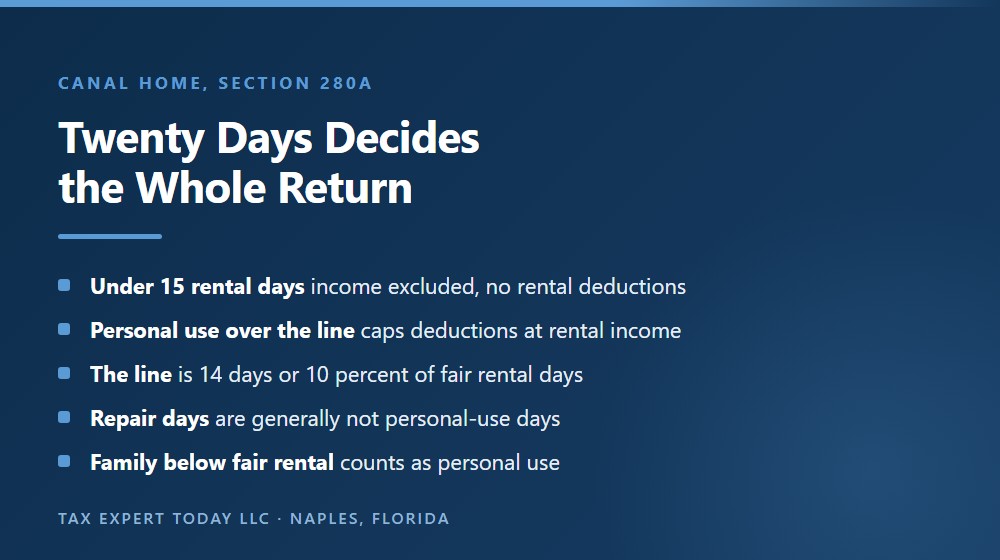
- Fewer than fifteen rental days in the year means the rental income is excluded entirely and no rental deductions are taken, under the section 280A de minimis rule.
- Personal use exceeding the greater of fourteen days or ten percent of rental days makes the property a residence, which caps rental deductions at rental income.
- Personal use below that threshold can allow a loss, subject to the passive activity rules.
- A day spent mainly on repairs and maintenance is generally not a personal-use day, which is why a maintenance log is worth keeping.
- Days rented to a family member at less than fair rental count as personal use, a trap for owners who let relatives use the house in season.
| Use pattern in the year | Rental income reported? | Deduction treatment |
|---|---|---|
| Rented 12 days, personal use the rest | No, excluded | No rental deductions; mortgage interest and taxes follow the personal rules |
| Rented 120 days, personal use 10 days | Yes, on Schedule E | Expenses allocated by days; a loss is possible, subject to passive activity limits |
| Rented 120 days, personal use 30 days | Yes, on Schedule E | Property is a residence; deductions capped at rental income, excess carries forward |
| Rented 200 days, no personal use | Yes, on Schedule E | Full rental property treatment, no section 280A limitation |
The middle two rows are only twenty days apart and produce materially different returns. IRS Publication 527 sets out the counting rules and the order in which allocated deductions are applied, and our guide to the short-term rental rules covers the material participation questions that arise when the rentals are short stays rather than seasonal leases.
What happens when personal use of a Cape Coral waterfront home exceeds the section 280A line?
Once personal use exceeds the greater of fourteen days or ten percent of the days rented at fair rental, the dwelling is treated as a residence. Deductions allocable to the rental use are then capped at gross rental income, so the property cannot generate a deductible loss. The disallowed amount carries forward to later years.
This is the outcome most Cape Coral owners land in without meaning to, because the house is both an investment and a place the family uses. The cap is not a penalty and the carryforward is not lost, but it changes what the property does on the return, and it changes the value of stacking deductible expenses into a given year.
- Deductions are applied in a fixed order, starting with the items allowable regardless of rental use, then operating expenses, then depreciation.
- Depreciation is absorbed last, so it is the deduction most often suspended under the cap.
- Suspended amounts carry forward to a year in which the property produces enough rental income to absorb them.
- The allocation fraction for interest and taxes can be computed differently from the fraction used for operating expenses, a point that changes the result and is frequently missed.
Owners who want the property to behave as a rental have one reliable lever, which is the personal-use day count. Reducing family stays below the threshold, documenting genuine repair days correctly, and charging fair rental to anyone who uses the house are ordinary steps, and they are decided before the year ends rather than at filing time. That timing is the recurring theme in Cape Coral tax preparation for waterfront owners.
Are seawall, dock, and boat lift losses deductible in Cape Coral?
It depends on how the property is used. Damage to a seawall, dock, or boat lift at a rental property is generally handled as a repair or a capitalized improvement under the ordinary rental rules. Damage at a personal residence falls under the section 165 personal casualty loss rules, which are considerably narrower and carry their own floors.
Cape Coral waterfront structures take storm damage in a way inland property does not, so this question comes up here far more than it does a few miles east. The classification decided at the outset controls the entire result, and it is the step most often skipped.
- Rental property damage is deducted as a repair if it restores the structure, or depreciated if it betters or restores the property to a materially different condition.
- Personal residence damage runs through Form 4684 and the section 165(h) limits.
- Insurance proceeds reduce the loss, and a reasonable prospect of recovery defers the deduction until the claim resolves.
- A mixed-use canal home requires the damage to be allocated between the rental portion and the personal portion, using the same day-based fraction as the operating expenses.
Documentation is the difference between a claim that survives review and one that does not. Photographs dated before and after, the insurance adjuster’s report, the claim settlement letter, contractor invoices identifying the structure repaired, and evidence of the property’s adjusted basis are the records that matter. IRS Publication 547 sets out the measurement rules and the Form 4684 mechanics.
How does the 2026 casualty loss change affect Cape Coral property owners?
Public Law 119-21 made the personal casualty loss deduction permanent and, beginning in 2026, expanded eligible losses beyond federally declared disasters to include losses from state-declared disasters. For Cape Coral that widens the set of storm events that can support a personal casualty loss, provided the other section 165 requirements are met.
This is a genuine change and it is recent. The IRS states that under the Working Families Tax Cuts the deduction for certain personal casualty losses has been made permanent, and that beginning in 2026 a personal casualty loss deduction is no longer limited solely to losses attributable to federally declared disasters and may also include losses resulting from state-declared disasters, so long as the remaining requirements of section 165 are satisfied.
- The expansion does not remove the floors. The per-event floor and the reduction tied to adjusted gross income still apply to an ordinary personal casualty loss.
- A state declaration now matters. Events that drew a state declaration but no federal one can support a claim for tax year 2026 forward.
- The section 165(i) election is separate. For a federally declared disaster it allows the loss to be claimed on the prior year return, which can accelerate a refund.
- Itemizing is still required for an ordinary personal casualty loss, which is a real constraint for households taking the standard deduction.
The section 165(i) election deserves a word of its own, because it is the provision that decides which year the loss lands in. For a loss attributable to a federally declared disaster, the election allows the deduction to be claimed on the return for the year immediately preceding the year the disaster occurred. That is a choice rather than a default, and it is made by comparing two years rather than by preferring the earlier one. A year with higher adjusted gross income absorbs the ten percent reduction differently, and a year in which the taxpayer itemized may produce a better result than a year in which the standard deduction was taken. The election also has its own timing, so it is made rather than discovered.
As of the date of this article there is no open federal filing postponement for Florida. The most recent Florida disaster designations on the IRS relief list postponed deadlines to May 1, 2025, and those postponement periods have passed. The value of the 2026 change for Cape Coral therefore lies in the widened definition of a qualifying event rather than in any current extension of a filing deadline. Anyone relying on a state declaration for a 2026 loss should confirm the declaration covers Lee County and the specific event, since a statewide declaration and a county-level one are not the same document.
What does a remote worker who moved to Cape Coral still owe the old state?
Usually nothing on wages earned after the move, because wages are generally sourced to where the work is physically performed. The exception is a small group of states applying a convenience of the employer rule, which can tax a remote employee’s wages as if the work were still done in the state’s office.
Cape Coral has drawn a large number of remote employees who kept a job based elsewhere. For most of them the analysis is straightforward once the residency change is documented. For employees of New York and a handful of other states, it is not, and the difference is worth several thousand dollars a year on a typical salary.
- Withholding often continues wrongly. Payroll keeps withholding to the old state until the employee files a change, which produces a refund claim rather than a loss, but only if the return is filed.
- The employer’s records become evidence. A documented work location change supports the position if the former state asks.
- Business travel back to the old state can create a nonresident filing obligation in its own right.
- Equity compensation follows the work. Restricted stock and options generally allocate to the states where the vesting period was worked, not to the state of residence at vesting.
The convenience of the employer rule is the one item in this list that changes the outcome rather than the paperwork, and it is state-specific. Our detailed explanation of the convenience of the employer rule sets out which states apply it and how the test works, which is the right starting point for a Cape Coral remote worker whose employer is based in one of them.
Which Lee County filings reach a Cape Coral household or small business?
A Cape Coral household with only wage or retirement income generally has no county filing at all. A business, a rental operation, or a self-employed contractor may owe the DR-405 tangible personal property return, and every purchaser pays the Lee County discretionary sales surtax on top of the state sales tax.
These are shared Lee County facts rather than Cape Coral specifics, and they are covered in more depth in our Fort Myers tax advisor guide, which works the small-business side of the county in detail. For Cape Coral tax preparation they are usually a short checklist item rather than the substance of the engagement, so the table below is the short form for a Cape Coral filer.
| Item | Who it reaches | Timing and figure |
|---|---|---|
| Lee County discretionary sales surtax | Anyone buying taxable goods or services in the county | 0.5 percent through December 31, 2028, on top of the 6 percent state rate |
| Form DR-405, tangible personal property | Businesses, rentals, and self-employed contractors with tangible assets in the county on January 1 | Due April 1; exemption of up to $25,000 of assessed value under section 196.183, Florida Statutes |
| Homestead exemption filing | Owner-occupants of a permanent Florida residence | Relevant here only as domicile evidence for the residency analysis above |
| Federal Form 1040 | Every filer | Due April 15, unchanged by Florida residency |
| Departure-state part-year return | New arrivals in the year of the move | Due on that state’s calendar, which is often the same date |
The tangible personal property return catches people out because the threshold is low and the form is filed with the county property appraiser rather than with the state. The Florida Department of Revenue guidance confirms the April 1 due date and the exemption of up to $25,000 of assessed value, and the Lee County Property Appraiser administers the filing locally. A Cape Coral owner who files an initial return and stays at or below the threshold may qualify for a waiver of the annual filing in later years.
What records should a Cape Coral filer keep for the transition year?
The transition year record set is different from an ordinary year. It has to prove when Florida domicile began, how income was split between the two states, and what the property was used for. Assembled during the year it is straightforward, and reconstructed two years later it is often impossible.
- The dated declaration of domicile filed with the Lee County Clerk, together with the Florida license, registration, and voter record.
- A day log covering the move year and the two following years, since several departure states apply a day-count test.
- Closing statements for the Cape Coral purchase and for any sale in the former state.
- Pay records showing the work location change, plus any employer confirmation of the new work state.
- A rental and personal-use calendar for a canal home, distinguishing rented days, family days, and genuine repair days.
- Before and after photographs, adjuster reports, and contractor invoices for any storm damage, matched to the property’s adjusted basis records.
None of this is exotic, and none of it requires a professional to collect. What it requires is knowing in January which records the following April will need, which is the argument for having the conversation at the start of the transition year rather than at its end. Most of the difficulty in Cape Coral tax preparation for a recent arrival is a documentation problem rather than a technical one.
When does a Cape Coral filing question become a resolution matter?
It becomes a resolution matter when a notice arrives or a balance is assessed rather than merely computed. A former state questioning a residency break date, an IRS notice proposing a change to a casualty loss, or an unfiled year discovered after a move all move the work from preparation into representation.
- A departure-state residency examination, which typically arrives one to three years after the move and asks for the day log and domicile evidence.
- A proposed adjustment to a casualty loss, usually over basis substantiation or the treatment of insurance proceeds.
- Unfiled departure-state returns, where the taxpayer assumed Florida residency ended the obligation for the move year.
- A rental reclassification, where an examiner recounts personal-use days and applies the section 280A cap.
These are ordinary matters and they are workable, but they are answered with documentation rather than with argument, which is why the record keeping above pays for itself. Where a Cape Coral matter has already reached the notice stage, our Naples tax resolution practice handles that side of the work.
Cape Coral tax preparation from Tax Expert Today
Clients looking for Cape Coral tax preparation reach us at an office in Naples, Florida that serves Cape Coral and the rest of Lee County in person as well as remotely. The office sits on Tamiami Trail North, a straightforward drive down the corridor, and Lee County clients meet with us there regularly. Our team includes tax advisors, enrolled agents, CPAs, and attorneys.
Searches such as tax preparation Cape Coral and tax preparer Lee County tend to arrive from two situations. One is a household in its first Florida filing season, holding a W-2 or a pension statement from a state they no longer live in and unsure what that state still wants. The other is a canal-home owner who rented the house in season for the first time and has discovered that the return is no longer simple. Both are routine engagements, and both go better before April than during it.
Tax Expert Today LLC, 11983 Tamiami Trail N, Naples, FL 34110. Telephone (239) 441-2005. Office hours Monday through Friday, 10:00 to 5:00 Eastern time. Our Naples tax planning practice covers the residency and rental planning described above, and our Florida tax services page sets out the full range of work we handle across the state.
Do I need to come to Naples to have a Cape Coral return prepared?
No. Most of the work is handled through a secure document portal with scheduled calls, and many Lee County clients never come to the office. For those who prefer to meet face to face, the Tamiami Trail office in Naples, Florida is a short drive from Cape Coral and Fort Myers, and appointments are available Monday through Friday during office hours.
When should you bring in a professional?
A Cape Coral household with wage income, one home, and no rental activity files a return most people can handle without help. Florida’s absence of an income tax genuinely simplifies the picture for a settled household, and pretending otherwise would not be honest.
The situations that reward professional attention are the ones where a decision has to be made rather than a form filled in. A move year where the break date will be tested by a former state. Retirement income whose protection under 4 U.S.C. 114 depends on a payment schedule nobody has read. A canal home whose personal-use day count sits within twenty days of a different result. Storm damage whose classification determines whether the loss is deductible at all. A remote job based in a state that applies a convenience of the employer rule. In each of these, the outcome is set by analysis done before the filing rather than by the filing itself.
If any of those describe the year you are working through, a conversation about Cape Coral tax preparation is worth having early. Call (239) 441-2005 to arrange a consultation, and bring the prior year return along with whatever documentation exists for the item in question.
Published September 11, 2026 by Dr. Pellumb Kabashi « Back to Learning Center
Have a question this article touches on?
Tax Expert Today LLC, based in Naples, Florida and serving clients across the United States.
Schedule a Consultation (239) 441-2005