
By Dr. Pellumb Kabashi, DBA, MBA, EA, CFE, CES
Founder, Tax Expert Today LLC · Tax advisors, enrolled agents, CPAs, and attorneys · Serving clients in all 50 states
Quick Answer: The 1099 late filing penalty is charged per form under IRC 6721, and a separate penalty under IRC 6722 applies when the contractor copy is late. For returns due in 2026 it is $60 per form if filed within 30 days, $130 through August 1, and $340 after that. First Time Abate does not cover it, but reasonable cause can. Call (239) 441-2005 for a free consultation.
What is the 1099 late filing penalty?
The 1099 late filing penalty is a per form civil penalty under IRC §6721 for an information return not filed with the IRS by its due date, or filed with missing or wrong information. The amount depends on how late the correct form arrives, and a separate §6722 penalty applies when the recipient copy is late.
Most business owners think of a penalty as a percentage of tax owed. The 1099 late filing penalty is different. It has nothing to do with tax due. A business can owe zero income tax, pay every contractor in full, and still receive a proposed penalty in the mail because a stack of Forms 1099-NEC reached the IRS a few weeks after January 31. The 1099 late filing penalty is a flat dollar amount for each form, set by how long the failure lasted, and the IRS computes it automatically from the date its system records each return.
The reason is simple. Information returns are how the IRS matches income. When you pay a contractor, the Form 1099-NEC you file is what lets the IRS confirm that the contractor reported the payment. A late or wrong form breaks that matching program, so Congress attached a penalty to the form itself, not to any tax. That is why the 1099 late filing penalty lands on the payer, the business that hired the contractor, rather than on the person who received the money. The contractor sees the other side of the same matching program in the IRS CP2000 notice, which is what a contractor receives when income reported on a Form 1099 is missing from their return.
- Who owes it: the payer that was required to file the information return, usually a business paying contractors, landlords, or attorneys.
- What it is measured on: the number of late or incorrect forms, not the dollars paid or any tax owed.
- How it grows: in three time tiers ending August 1, then a flat top rate for forms filed later or never.
- The second penalty: a parallel charge under IRC 6722 when the contractor copy is late or wrong.
- How it is excused: reasonable cause under IRC 6724, plus several statutory exceptions for small errors.
Whether you search for the 1099 late filing penalty, a late 1099 penalty, or the penalty for late 1099 forms, the subject is the same. This guide is written around what a business owner actually holds when this penalty becomes real: a Notice 972CG, Notice of Proposed Civil Penalty. It explains how to read that notice, which relief rules apply to the 1099 late filing penalty and which do not, how the statutory safe harbors already forgive some errors, and how to file late forms now so the charge stays as small as the law allows. It covers Forms 1099 and the matching rules for Forms W-2, since both are information returns under the same statute.
How much is the 1099 late filing penalty in 2026 and 2027?
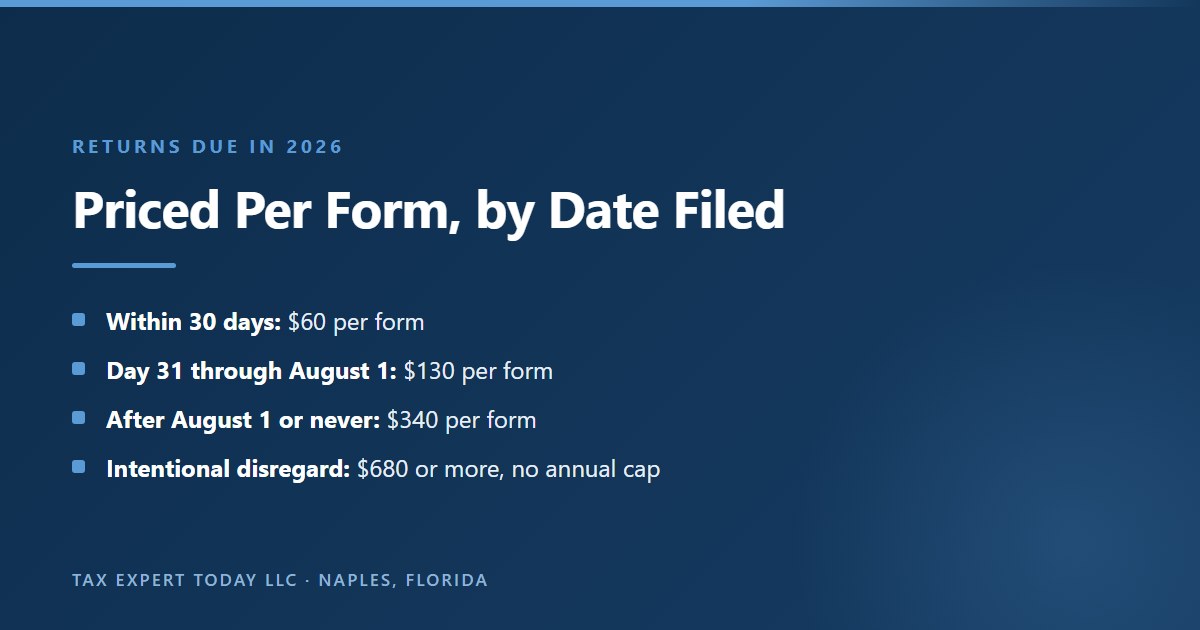
For information returns due in 2026, the 1099 late filing penalty is $60 per form if corrected within 30 days of the due date, $130 if filed after 30 days but by August 1, and $340 if filed after August 1 or never. For returns due in 2027 the tiers stay $60, $130, and $340, with higher annual caps.
The statute writes the base figures and then indexes them. IRC §6721(a)(1) sets a penalty of $250 for each return with a failure, and §6721(b) reduces it to $50 when the failure is corrected within 30 days of the required filing date and to $100 when it is corrected after that but by August 1 of the same year. Section 6721(f) then adjusts every one of those numbers for inflation for returns required to be filed after 2014, rounding down to the nearest $10 for per form amounts and the nearest $500 for the caps.
Because of that indexing, the figures that matter are the ones the IRS publishes each year. The IRS information return penalties page, last reviewed in October 2026, lists the following amounts per return or statement.
| When the correct form is filed | Due in 2026 (2025 payments) | Due in 2027 (2026 payments) | Statutory base before inflation |
|---|---|---|---|
| Up to 30 days late | $60 per form | $60 per form | $50 |
| 31 days late through August 1 | $130 per form | $130 per form | $100 |
| After August 1, or not filed | $340 per form | $340 per form | $250 |
| Intentional disregard | $680 per form, or more | $690 per form, or more | $500, or a percentage of the amount |
Two details in that table matter more than they look. First, the tiers measure the time to the date the correct form is filed, not the date you noticed the problem. A form filed on February 15 for a January 31 due date sits in the first tier; the same form filed on March 5 has moved to the second. Second, the August 1 line is a hard break. After August 1, the 1099 late filing penalty for that year is the full top rate whether the form is filed in September or never filed at all, so there is no penalty reason to wait once that date has passed, and every reason to file before it. Unlike percentage based charges on income tax returns, such as the IRS failure to pay penalty, the 1099 late filing penalty never depends on what anyone owes.
Older years use older figures. The same IRS page shows $330 as the top tier for returns due in 2025, $310 for 2024, and $290 for 2023, with $60 and $50 as the first tier in those years. If you are cleaning up several years of missed forms, each year is priced at the figure for its own due date.
For a broader view of how the IRS charges and removes penalties of every type, our guide on how to get IRS penalties removed explains where information return penalties sit next to the filing, payment, and deposit penalties.
Are filing late with the IRS and furnishing late to the contractor separate penalties?
Yes. IRC §6721 penalizes the copy filed with the IRS, and IRC §6722 penalizes the copy furnished to the recipient. Each uses the same tiers and caps, so a Form 1099-NEC that is late to both the IRS and the contractor can carry two penalties, one under each section, for the same form.
This is the point most short articles skip, and it is where the arithmetic surprises people. IRC §6722(a) imposes a penalty for each failure to furnish a payee statement by its due date and for each statement furnished with missing or incorrect information. The text of §6722 mirrors §6721 almost line for line: the same base amounts, the same 30 day and August 1 reductions, the same de minimis rules, and the same intentional disregard rule. The IRS page puts it plainly: it charges separate penalties for failing to file a correct information return on time and for failing to provide correct payee statements on time.
In practice, the two failures often travel together. A business that misses January 31 for Form 1099-NEC usually misses it for both copies, because the IRS filing date and the recipient date are the same day for that form. A business that sent the contractor copies on time but filed with the IRS late owes only the §6721 penalty. One that filed with the IRS on time but mailed the contractor copies late owes only the §6722 penalty, and it often does not learn about that one until a contractor complains or the IRS examines the account.
- Section 6721: the IRS copy. Measured from the IRS filing due date. Proposed on Notice 972CG from the IRS payer records.
- Section 6722: the recipient copy. Measured from the date the statement was due to the contractor.
- One per statement: under IRM 20.1.7.9.2, no more than one §6722 penalty applies to a single statement even when it has more than one failure; the higher amount is used.
- Separate caps: each section has its own annual maximum.
The practical lesson is that when you discover missed forms, fix both copies. Filing with the IRS stops the §6721 clock from moving into a higher tier; furnishing the contractor copy does the same for §6722. Doing one and not the other leaves half of the 1099 late filing penalty still growing toward August 1.
What are the annual maximums, and who counts as a small business?
Each tier of the 1099 late filing penalty has a yearly cap. A payer with average annual gross receipts of $5 million or less over its three most recent tax years gets the lower small business caps under IRC §6721(d). Intentional disregard has no cap at all.
The caps exist so the 1099 late filing penalty cannot run without limit for a large filer. Under IRC §6721(d), a person meets the gross receipts test for a calendar year if its average annual gross receipts for the three most recent taxable years ending before that calendar year do not exceed $5,000,000, using the aggregation rules of §448(c), so related businesses under common control are generally counted together. Those filers substitute lower base caps: $1,000,000 instead of $3,000,000 for the top tier, $175,000 instead of $500,000 for the 30 day tier, and $500,000 instead of $1,500,000 for the August 1 tier, all then indexed for inflation.
| Tier | Small business cap, due 2026 | Large business cap, due 2026 | Small business cap, due 2027 | Large business cap, due 2027 |
|---|---|---|---|---|
| Up to 30 days late | $239,000 | $683,000 | $244,500 | $698,500 |
| 31 days through August 1 | $683,000 | $2,049,000 | $698,500 | $2,095,500 |
| After August 1 or not filed | $1,366,000 | $4,098,500 | $1,397,000 | $4,191,500 |
| Intentional disregard | No maximum | No maximum | No maximum | No maximum |
For a typical small business filing a handful of Forms 1099-NEC, the caps will never come into play; a business would need a very large number of late forms to reach them. The caps matter for payroll providers, property managers, marketplaces, and other high volume filers. What matters for everyone is the small business definition itself, because the IRS uses it to choose which table applies. If your receipts crossed $5 million recently, check the three year average for the specific calendar year in question.
What is the penalty for intentional disregard of 1099 rules?
If a failure is due to intentional disregard of the filing or correct reporting requirement, the per form penalty jumps to $680 for returns due in 2026, or, if greater, generally 10 percent of the amounts that should have been reported. The time tier reductions, de minimis exceptions, and annual caps do not apply.
Section 6721(e) sets the base at $500 per failure or, if greater, 10 percent of the aggregate amount of items required to be reported correctly for most information returns, including Forms 1099-NEC and 1099-MISC. For certain broker returns the percentage is 5 percent, and for Form 8300 cash reports the statute uses a separate formula. Once intentional disregard is found, §6721(e)(1) switches off the reduced tiers, the de minimis rules, and the small business caps, and §6721(e)(3) removes the annual maximum.
The IRS does not presume intentional disregard from a late filing alone, and most 1099 late filing penalty notices never raise it. The Internal Revenue Manual describes it as a knowing or willful failure, and it lists the kinds of facts an examiner weighs: whether the filer corrected the failure promptly once it was discovered, whether it corrected within 30 days after written IRS notice, whether it has a pattern of the same failure, and whether it decided that paying the penalty would cost less than complying. These penalties are generally asserted manually by examination or campus personnel, not by the automated notice, often during an examination of the kind described in our guide to what happens if you get audited by the IRS, and the IRM provides an administrative pre-assessment appeal.
| Hypothetical payment to one contractor | 10 percent of amount required to be reported | Flat intentional disregard figure, due 2026 | Penalty for that form |
|---|---|---|---|
| $4,000 | $400 | $680 | $680 |
| $15,000 | $1,500 | $680 | $1,500 |
| $60,000 | $6,000 | $680 | $6,000 |
The figures above are hypothetical and show only the mechanics. The point is how quickly the percentage overtakes the flat figure on larger payments, and why the most important step after discovering missed forms is to file them promptly and keep a record of when and how the problem was found. A prompt correction is one of the facts the IRS weighs in deciding that a failure was not intentional.
What does a hypothetical 1099 late filing penalty look like?
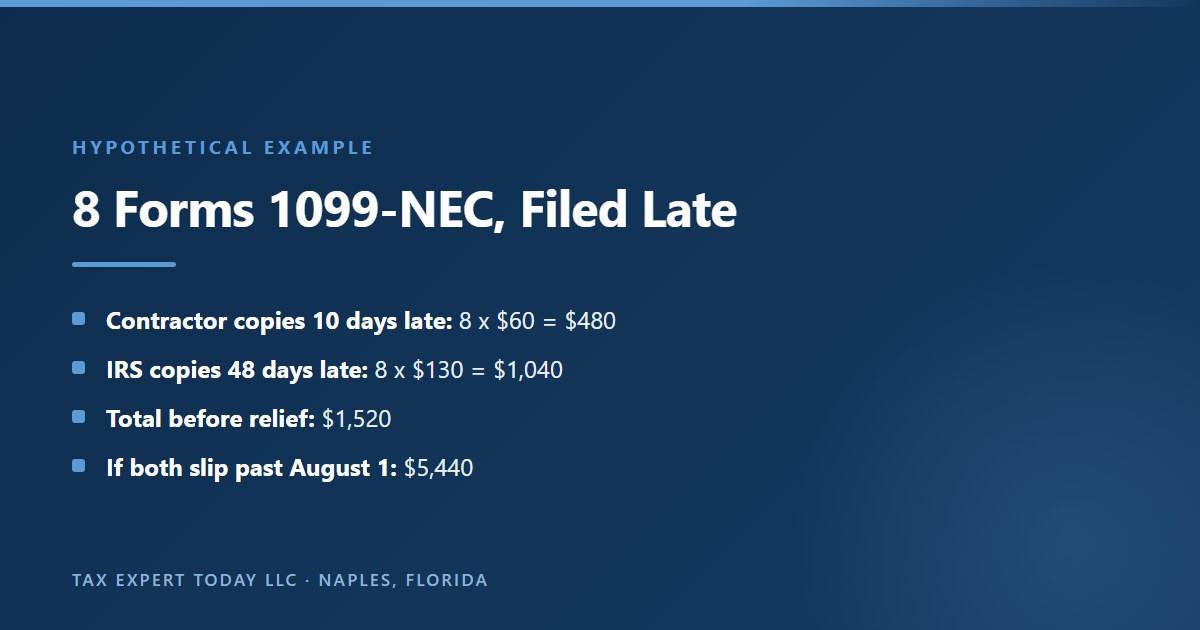
Take a small business that paid eight contractors in 2025, furnished their copies 10 days late, and filed with the IRS 48 days late. The 6722 penalty is 8 times $60, or $480. The 6721 penalty is 8 times $130, or $1,040. The total 1099 late filing penalty is $1,520 before any relief.
The numbers below are hypothetical and do not come from any client matter. They assume a business with gross receipts under $5 million, Forms 1099-NEC due January 31, 2026, no intentional disregard, and no reasonable cause yet established. They are there to show how the tiers and the two sections combine.
| Scenario (8 Forms 1099-NEC due January 31, 2026) | Section 6722, contractor copies | Section 6721, IRS copies | Total before relief |
|---|---|---|---|
| Contractor copies February 10; IRS copies March 20 | 8 x $60 = $480 | 8 x $130 = $1,040 | $1,520 |
| Both copies February 20 | 8 x $60 = $480 | 8 x $60 = $480 | $960 |
| Both copies July 15 | 8 x $130 = $1,040 | 8 x $130 = $1,040 | $2,080 |
| Both copies September 10, or never | 8 x $340 = $2,720 | 8 x $340 = $2,720 | $5,440 |
The table shows the whole logic of the 1099 late filing penalty in four rows. Acting inside 30 days keeps both sections at the lowest tier. Acting before August 1 still caps each form at the middle tier. Missing August 1 more than doubles the per form charge, and from that point the cost is the same whether you file in September or not at all. That is why, once a business learns it missed the January deadline, the most valuable step is usually to file and furnish the missing forms right away rather than wait for a notice.
Two further points apply to the example. The safe harbor and de minimis rules explained below would not help here, because they cover incorrect information on forms that were filed, not lateness. And interest runs on an assessed 1099 late filing penalty until paid, as the IRS page notes, so the table understates the eventual balance if the assessed amount sits unpaid. Our IRS penalty and interest calculator is built for income tax penalties; information return penalties are flat per form amounts and are figured from the rate table above.
What is Notice 972CG and how should you read it?
Notice 972CG, Notice of Proposed Civil Penalty, is the letter that usually delivers the 1099 late filing penalty. It is a proposal, not a bill. It lists the forms the IRS received late, incorrect, or with bad TINs, the tier it applied, and the proposed amount, and it gives you 45 days to respond before assessment.
The Internal Revenue Manual at 20.1.7.6 explains that Notice 972CG generates systemically from the Payer Master File, the IRS database of information returns each payer has filed. The system compares the received date of each return with its due date, counts the forms in each tier, checks payee names and taxpayer identification numbers against IRS records, and proposes a penalty. The notice is generated by computer, which is exactly why it is worth reading line by line, and, like any IRS letter, confirming it is genuine, as our guide to a certified letter from the IRS explains: the system does not know about an extension you were granted, a disaster postponement, a correction you made, or the reason a form was late.
Many business owners first hear of the 1099 late filing penalty from this notice, often many months after the forms were filed. That delay is normal. The IRS processes the information return year, then runs the penalty program, so a notice for forms due in early 2026 can arrive late in 2026 or in 2027. The IRS information return penalties page says that a filer with reasonable cause who received Notice 972CG should respond within 45 days, or 60 days for a foreign filer, before the penalty is assessed.
| Part of the notice | What it tells you | What to check |
|---|---|---|
| Tax period and form type | Which year and which information return the proposal covers | That the forms are yours and the year is right |
| Number of returns by category | How many forms the IRS counted as late, incorrect, or filed on paper when e-filing was required | Compare against your own filing confirmations and counts |
| Received date | The date the IRS system recorded for each transmission | Your FIRE or IRIS acknowledgment date, postmark, or approved extension |
| Penalty rate applied | The tier used for each group of forms | That the tier matches the days late, and that the small business rates were used if you qualify |
| Missing or incorrect TIN listing | Payees whose name and number did not match IRS records | Your Form W-9 file and any solicitations you made |
| Response section | How to agree, pay, or explain why the penalty should not apply | The 45 day response date printed on the notice |
Not every 1099 late filing penalty starts with Notice 972CG. The IRM notes that penalties for certain prior year returns and for returns that were unprocessable or filed in the wrong format can be assessed manually through the Civil Penalty Module, producing a balance due notice such as CP 215 or CP 15 without a prior proposal. If your first contact is a balance due notice, the penalty has already been assessed and relief becomes an abatement request rather than a pre-assessment response, usually by letter as the notice directs or, where appropriate, on IRS Form 843.
How do you respond to a Notice 972CG proposed penalty?
Read every count on the notice against your own filing records, then choose: agree and pay, agree in part, or explain in writing why some or all of the 1099 late filing penalty should not apply. Reply by the date on the notice with documents, because a timely reply is considered before the penalty is assessed.
The 1099 late filing penalty notice includes a response form with boxes for full agreement, partial agreement, and disagreement. The IRS page says that if you can correct an issue in the notice there may be a reduced penalty or none, and that if the information is correct and you disagree, you may dispute it. A strong response is specific: it identifies each group of forms, states which facts the IRS did not have, and attaches the proof.
- Confirm the counts. Pull your filing confirmations from FIRE, IRIS, your software provider, or SSA, and match form type, count, and transmission date to each line of the notice.
- Check the tier and the rate table. Confirm the IRS applied the right days late for each batch and used the small business rates if your receipts qualify.
- Look for an extension or postponement. An approved Form 8809 extension, or a disaster postponement covering your county, changes the due date the tiers are measured from.
- Identify forms that were never required. Payments below the reporting threshold, payments to most corporations, or payments made by card that are reported by the processor instead can fall outside the 1099 requirement.
- Write the reasonable cause statement. If a penalty properly applies, explain the mitigating factors or events beyond your control and how you acted responsibly, with dates and documents.
- Address TIN items separately. For name and TIN mismatches, show the Form W-9 and the solicitations described later in this guide.
- Keep proof of mailing. Send the response the way the notice directs and keep evidence of when it was sent.
After the response, the IRS generally issues Letter 1948-C, Civil Penalty Explained, either asking for more information or confirming that the explanation established reasonable cause. A denial generally comes on Letter 854-C, which explains appeal rights; the IRM also refers filers to collection appeal procedures such as Form 9423, which our guide to the collection due process hearing and CAP covers. Our guide to reasonable cause penalty abatement walks through how those requests are built and reviewed across penalty types.
Does First Time Abate or the new AEP apply to the 1099 late filing penalty?
No. The IRS list of penalties eligible for First Time Abate and the new Automatic Exemption from Penalty covers failure to file, failure to pay, failure to deposit, and the partnership and S corporation return penalties. Information return penalties under IRC 6721 and 6722 are not on it, so relief generally rests on reasonable cause.
This is the single most important difference between the 1099 late filing penalty and the late filing penalty on an income tax return. The IRS administrative penalty relief page explains that First Time Abate is transitioning to the Automatic Exemption from Penalty, which began in summer 2026 for 2025 tax year returns and 2026 quarterly returns. Its list of penalties eligible for either form of relief names IRC 6651(a)(1), 6698(a)(1), 6699(a)(1), 6651(a)(2), 6651(a)(3), and 6656. Sections 6721 and 6722 do not appear.
That matters because many businesses assume a clean history will make the penalty disappear the way it can for a late Form 941 or a late personal return. For information returns, a clean history is still valuable, but in a different legal box. Treas. Reg. §301.6724-1(b)(2) treats an established history of complying with the same information reporting requirement as a significant mitigating factor for reasonable cause, and the IRM says that history must be considered whether or not the filer asks. It is not automatic relief, and the filer must still show it acted in a responsible manner.
| Feature | Late income tax or payroll return | 1099 late filing penalty |
|---|---|---|
| Statute | IRC 6651, 6656, 6698, 6699 | IRC 6721 and 6722 |
| Measured on | Tax due, or per partner or shareholder | Number of forms |
| First Time Abate | Eligible, for periods before AEP | Not listed as eligible |
| Automatic Exemption from Penalty | Eligible series from 2025 returns | Not listed as eligible |
| Main relief path | FTA or AEP, then reasonable cause | Reasonable cause under IRC 6724 and the statutory exceptions |
| Usual first notice | Balance due notice after processing | Notice 972CG proposal before assessment |
If you hold a penalty on the business income tax return itself, our guides to the failure to file penalty and first time penalty abatement cover those rules. Keep the two penalties separate in your response; an argument that works for one may not apply to the other.
What counts as reasonable cause for a late 1099?
Under IRC 6724(a) and Treas. Reg. 301.6724-1, a filer shows reasonable cause by proving either a significant mitigating factor, such as being a first time filer of that form or having a clean history, or an event beyond its control, and also that it acted in a responsible manner before and after the failure.
Section 6724(a) is one sentence: no penalty shall be imposed for any failure shown to be due to reasonable cause and not to willful neglect. The regulation supplies the test. It has two halves, and a 1099 late filing penalty request that proves only one of them usually fails.
The first half is the reason. Under §301.6724-1(b), significant mitigating factors include that the filer was not previously required to file the particular type of return, and that the filer has an established history of compliance with that requirement, with significant weight on whether it was penalized under §6721 or §6722 in prior years. Under §301.6724-1(c), events beyond the filer’s control include unavailability of business records, for example after a fire or other casualty; certain failures of an agent the filer reasonably relied on; and failures by the payee or another person to provide information the filer needed.
The second half is conduct. Under §301.6724-1(d), acting in a responsible manner means the filer used the care a reasonably prudent person would use in handling its filing obligations, and that it took steps to avoid the failure, including requesting an extension when possible, and to correct it promptly once the impediment was removed or the failure was discovered.
| Basis | Typical qualifying scenario | Proof that usually matters |
|---|---|---|
| First time filer of that form | A new business hired its first contractor and had never been required to file Form 1099-NEC | Formation date, prior year records showing no reportable payments |
| Established compliance history | Timely, accurate filings for prior years and no earlier 6721 or 6722 penalties | Prior year filing confirmations and account transcripts |
| Records unavailable | A casualty damaged the books or the system used to prepare the forms | Insurance claim, repair records, dates of recovery |
| Agent failure | A payroll or 1099 service was engaged and given the data in time but did not file | Engagement terms, dates data was delivered, the provider’s failure notice |
| Payee failure | A contractor did not return a Form W-9 despite the required requests | Copies of the requests and their dates |
The IRM is equally clear about what does not work by itself. Carelessness and forgetfulness are not ordinary business care. A waiver is not automatically granted when the filer claims it did not know about the requirement, though ignorance of the law can be one factor when the other facts support it. And a filer cannot keep relying on the same explanation year after year when its history shows a pattern of the same failure. In the hypothetical eight form case above, a business with years of timely filing that missed the deadline because its bookkeeper left in January, and that filed everything within days of discovering the gap, has a very different file from a business with repeated late filings and no explanation.
What is the de minimis error safe harbor for Forms 1099?
Under IRC 6721(c)(3) and 6722(c)(3), a filed form with a dollar error of $100 or less, and no withholding error over $25, is treated as correct and needs no corrected return. The recipient can elect out, and the filer then generally has 30 days to issue the correction to stay within reasonable cause.
This safe harbor was added to stop penalties over small rounding and allocation mistakes. It applies only to incorrect dollar amounts on a return that was actually filed, and it requires that no single amount differ from the correct figure by more than $100 and that no amount of tax withheld differ by more than $25. When those limits are met, the statute says no correction is required and the return is treated as filed with all of the correct information. It does not cover a missing form, a late form, a wrong TIN, or a wrong name.
The recipient has a say. Section 6722(c)(3)(B) lets the person who receives the statement elect that the safe harbor not apply, and §6721(c)(3)(B) then removes the safe harbor for the matching IRS copy. Treas. Reg. §301.6724-1(h) provides that a filer establishes reasonable cause in that case if it files the corrected return or furnishes the corrected statement within 30 days of the election.
- Covers: small dollar errors on filed returns, within the $100 and $25 limits.
- Does not cover: late filing, missing forms, missing or incorrect TINs, or wrong payee names.
- Recipient election: a contractor can ask for a corrected form, and the filer then has 30 days to issue it.
- Anti abuse: the statute lets Treasury limit the safe harbor where it is used to avoid correct reporting.
Few ranking pages mention this rule, yet it answers a common question: whether a business needs to file a corrected Form 1099 to fix a $40 difference. In most cases, under the statute, it does not, unless the contractor asks for one.
Which 1099 errors can be corrected by August 1 without a penalty?
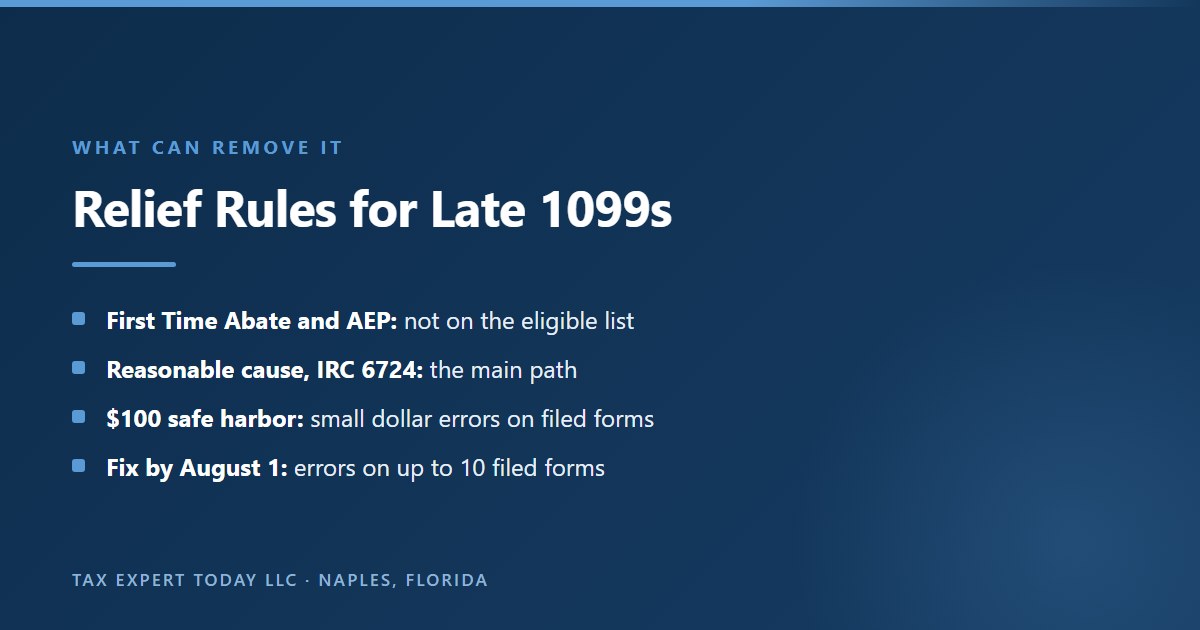
Under IRC 6721(c)(1) and (2), a filed return with missing or incorrect information that is corrected by August 1 is treated as correct, for up to the greater of 10 returns or one half of 1 percent of the returns you must file that year. This exception covers errors on filed forms, not late filing.
This is a second, older de minimis rule that works alongside the dollar safe harbor. It forgives a limited number of errors of any kind on information returns that were filed on time, as long as each error is corrected on or before August 1 of the year the returns were due. For a small business, the greater of 10 returns or one half of 1 percent will almost always be 10, which covers most real world correction needs. Section 6722(c) gives the same rule for payee statements.
The IRM adds a related principle for payee statements: an error or omission that is inconsequential is not penalized at all. Under IRM 20.1.7.9.2, an error is inconsequential when it does not prevent the timely receipt of correct information or the payee from putting the information to its intended use. Errors relating to a dollar amount, a significant item in the payee address, or use of the appropriate form are never treated as inconsequential, apart from the dollar safe harbor above, which is why that safe harbor exists as a separate statute.
| Rule | What it forgives | Deadline or limit | Applies to late forms? |
|---|---|---|---|
| Dollar safe harbor, 6721(c)(3) | Small dollar errors on filed returns | $100 per amount, $25 per withholding amount | No |
| De minimis correction, 6721(c)(1) | Missing or wrong information on filed returns | Corrected by August 1; greater of 10 or 0.5% of returns | No |
| Inconsequential error, IRM 20.1.7.9.2 | Payee statement errors that do not keep the payee from using the information | None, but dollar amounts, key address items, and the form itself never qualify | No |
| Reasonable cause, 6724(a) | Any failure with a qualifying reason and responsible conduct | Respond to Notice 972CG or request abatement | Yes |
The table makes the main point clear. For a form that was simply filed late, the only relief available is reasonable cause or an error in the IRS computation. That is why the time tiers, and how quickly you file after discovering the problem, drive most of the 1099 late filing penalty.
What happens if you file 1099s on paper when you were required to e-file?
Since information returns due in 2024, a filer with 10 or more information returns of all types combined in a calendar year must file electronically. Filing those returns on paper is treated as a failure to file under IRC 6721, so paper filing can trigger a 1099 late filing penalty notice even when every form arrived on time.
Final regulations issued in February 2023, Treasury Decision 9972, lowered the electronic filing threshold from 250 returns of the same type to 10 returns in the aggregate. The IRS e-file information returns page states the rule simply: 10 or more returns, e-filing is required. The count includes Forms W-2, which are e-filed with the Social Security Administration, so a business with 6 employees and 5 contractors is over the line.
Section 6724(c) limits this penalty. No penalty is imposed under §6721 solely because of a failure to meet the electronic filing requirement, except to the extent the failure involves more than the applicable number of returns. The IRM notes that this kind of failure is proposed on Notice 972CG, like a late filing. A filer facing real hardship can request a waiver on Form 8508, which the IRM says must be filed at least 45 days before the due date of the returns.
- The count is aggregate: Forms W-2, 1099-NEC, 1099-MISC, 1099-INT, and others are added together.
- Free filing exists: the IRS Information Returns Intake System, IRIS, lets businesses e-file most Forms 1099 at no cost.
- Waivers are prospective: Form 8508 is requested before the due date, not after a penalty is proposed.
- Corrections count too: if originals had to be e-filed, corrections generally follow the same rule.
Paper filing is one of the more avoidable sources of a 1099 late filing penalty notice, because the business did everything on time and still receives a proposal. If your notice shows a category for returns not filed electronically, check the aggregate count for that year before deciding how to respond.
When are Forms 1099 due, and does an extension help?
Form 1099-NEC is due to both the IRS and the contractor by January 31, on paper or electronically. Most other Forms 1099 go to recipients by January 31 and to the IRS by February 28 on paper or March 31 electronically. An approved Form 8809 extension moves the date the 1099 late filing penalty tiers are measured from.
The due date matters because every tier of the 1099 late filing penalty counts from it. The General Instructions for Certain Information Returns and the Instructions for Forms 1099-MISC and 1099-NEC set the dates, and IRC 6071(c) fixes January 31 for nonemployee compensation. When a due date falls on a Saturday, Sunday, or legal holiday, it moves to the next business day, which is why the instructions list March 2, 2026 for paper Forms 1099-MISC that year.
| Form | To the recipient | To the IRS on paper | To the IRS electronically | Extension to file with the IRS |
|---|---|---|---|---|
| 1099-NEC | January 31 | January 31 | January 31 | One non-automatic 30 days, paper request, specific reasons only |
| 1099-MISC | January 31 (February 15 if boxes 8 or 10 are used) | February 28 | March 31 | Automatic 30 days on Form 8809 |
| Most other 1099s (INT, DIV, R) | January 31 | February 28 | March 31 | Automatic 30 days on Form 8809 |
| W-2 and W-3 | January 31 | January 31, to SSA | January 31, to SSA | One non-automatic 30 days, paper request |
The extension rules are where many businesses get caught. The IRM at 20.1.7.2.4 explains that most information returns qualify for an automatic 30 day extension on Form 8809, requested by the due date, and that an additional non-automatic extension can be requested. Form 1099-NEC and Form W-2 are different: only one non-automatic 30 day extension is available, it must be requested on paper and mailed to the IRS for approval under 26 CFR 1.6081-8, so it is not a routine fallback. An extension to file with the IRS also does not extend the date to furnish the recipient copy. That requires a separate request, which the IRS instructions say must be made by fax.
- Ask before the due date: a Form 8809 filed after the due date generally does not help.
- Do not assume Form 1099-NEC gets an automatic extension: it does not.
- Recipient copies are separate: the IRS filing extension leaves the §6722 date unchanged.
- Separate from the business return: an information return extension is unrelated to the income tax return extension covered in our guide to tax extensions.
- Keep the approval: it is the proof you will need if Notice 972CG measures from the original date.
Does the new $2,000 reporting threshold change the 1099 late filing penalty?
The threshold changes which payments need a form, not the 1099 late filing penalty. For tax years beginning after 2025, Forms 1099-NEC and 1099-MISC are generally required for payments of $2,000 or more, up from $600, with inflation indexing starting in 2027. A required form that is late carries the same per form penalty.
The One Big Beautiful Bill Act raised the general reporting threshold for these forms. The current Instructions for Forms 1099-MISC and 1099-NEC state that for tax years beginning after 2025, the minimum threshold for reporting certain payments, and for backup withholding on those payments, increased to $2,000 and may be adjusted for inflation beginning in calendar year 2027. So payments made in calendar year 2026, reported by early 2027, are measured against $2,000. Payments made in 2025, reported in early 2026, used the older $600 rule.
For many small businesses this will reduce the number of forms they must file, and it can matter in a penalty response. If a Notice 972CG for a 2027 due date counts a form for a contractor paid $1,500 in 2026, that form may not have been required at all. The reverse is also true: a business that relied on the higher threshold for a payee who in fact crossed $2,000 across the year still owes that form on time. The threshold applies to total payments to the payee for the year, not to each invoice.
- 2025 payments, filed in 2026: generally $600 threshold for Forms 1099-NEC and 1099-MISC.
- 2026 payments, filed in 2027: generally $2,000 threshold, under the current instructions.
- Some items differ: the instructions keep separate rules for royalties, direct sales, and certain other boxes.
- Card payments: payments made by credit card or through third party networks are reported by the processor on Form 1099-K, not by the payer on Form 1099-NEC.
What about missing or incorrect contractor TINs?
A Form 1099 with a missing or incorrect taxpayer identification number is an information return with incorrect information, so it can draw the same per form amount as a 1099 late filing penalty. Reasonable cause for TIN failures depends on documented requests: an initial request when the relationship starts, usually on Form W-9, and annual requests when required.
Name and TIN mismatches are the second most common category on Notice 972CG, and they follow their own rules. Treas. Reg. §301.6724-1(e) and (f) say a filer shows it acted responsibly for a missing TIN only if it made an initial solicitation when the account was opened and, if no TIN came back, annual solicitations by the dates the regulation sets. For an incorrect TIN, annual solicitations are required after the IRS or a broker notifies the filer, including notification through a penalty notice under §6721. Generally no more than two annual solicitations are required. IRS Publication 1586 explains these requirements in plain language.
| TIN situation | What the regulation asks for | Practical step |
|---|---|---|
| Missing TIN at the start | Initial solicitation when the account or relationship begins | Collect a signed Form W-9 before the first payment |
| Still missing after the initial request | First and, if needed, second annual solicitation | Send dated written requests and keep copies |
| IRS says the TIN is wrong | Annual solicitation after the notification | Request a corrected Form W-9 and follow the B notice process if backup withholding applies |
| Payee never responds | Backup withholding may be required under IRC 3406 | Withhold as required until a TIN is provided |
The simplest prevention is procedural. Make a signed Form W-9 a condition of the first payment. Businesses that do this rarely see TIN categories on Notice 972CG, and when they do, the W-9 on file is usually enough to show they acted in a responsible manner.
Do W-2 late filing penalties work the same way?
Yes. Form W-2 is an information return under the same statutes, so a late or incorrect Form W-2 draws the same per form tiers under IRC 6721 for the copy filed with the Social Security Administration and under IRC 6722 for the employee copy. The due date is January 31, and the extension is limited.
Employers sometimes treat the W-2 deadline as softer than the payroll tax return deadline, because the tax was already deposited and reported on Form 941. For penalty purposes it is not softer. Form W-2 appears in the definition of information return in IRC §6724(d), so the same tiers, caps, and reasonable cause rules apply. Forms W-2 are filed with the Social Security Administration rather than the IRS, and the IRM notes that most of them are not posted to the IRS Payer Master File, so a W-2 penalty can reach an employer through a different route than the automated proposal. Forms W-2 also count toward the 10 return electronic filing threshold.
The difference is the extension. As with Form 1099-NEC, only one non-automatic 30 day extension is available for Form W-2, and it must be requested on paper. A payroll provider that misses January 31 for a whole client base can produce a 1099 late filing penalty notice and a W-2 late filing notice for the same employer in the same year; both may be candidates for the agent failure branch of reasonable cause, as long as the employer engaged the provider and delivered the data in time. S corporation owners who pay themselves wages file Forms W-2 for that pay as well, a point our guide to S corp reasonable compensation explains.
Payroll tax penalties for late deposits and late Forms 941 are different penalties under different statutes. For the personal liability that can follow unpaid payroll taxes, our guide to the trust fund recovery penalty covers that separate issue.
Does interest accrue on the 1099 late filing penalty, and can you pay over time?
Interest is charged on an assessed information return penalty until it is paid, and under IRC 6724(b) the penalty is collected on notice and demand in the same manner as tax. If you cannot pay in full, the IRS says you can pay what you can and apply for a payment plan.
The IRS information return penalties page states that the IRS charges interest on penalties, that the date interest begins varies by the penalty type and amount, and that by law interest cannot be removed unless the penalty is removed or reduced. That last point is useful: when reasonable cause removes the penalty, the interest on it goes with it.
Because §6724(b) treats the penalty like a tax for collection purposes, an unpaid 1099 late filing penalty sits on the business account and can move through the normal collection notices. For a business that already carries a balance, the penalty is one more line on the account, and the notices that follow are covered in our guide to the IRS CP161 notice for business balances, and our guide to the IRS CP220 notice explains changes posted to a business account. When a business has assessed penalties and tax it cannot pay at once, the payment options and the order of steps are explained on our page for IRS tax debt help Naples business owners use.
- Before assessment: respond to Notice 972CG; interest is not the issue yet.
- After assessment: a balance due notice follows; interest runs until paid.
- If removed: interest on the removed penalty is removed as well.
- If you cannot pay: a payment plan is available, and relief can still be requested; see our guide to IRS installment agreement options.
What mistakes make the 1099 late filing penalty larger than it needs to be?
The costliest mistakes are waiting past August 1 to file forms already late, fixing the IRS copy but not the contractor copy, filing on paper above the 10 return threshold, assuming First Time Abate will apply, and ignoring Notice 972CG until the proposed penalty is assessed.
Most of the expense in a 1099 late filing penalty is avoidable, because the tiers reward prompt action and the notice gives a window before assessment. These are the patterns that most often turn a modest proposal into a larger balance.
- Waiting for the notice: forms filed in March sit in a lower tier than forms filed after a notice arrives in the fall.
- Fixing half the problem: filing with the IRS but not furnishing the contractor copies leaves the §6722 penalty growing.
- Paper filing over the threshold: 10 returns in total, including Forms W-2, means e-filing is required.
- Relying on First Time Abate: information return penalties are not on the IRS eligibility list.
- Missing the 45 day window: after assessment, relief becomes an abatement request instead of a pre-assessment response.
- Filing corrections for tiny differences: the $100 safe harbor often makes a corrected form unnecessary unless the payee asks.
- No Form W-9 on file: without the initial solicitation, TIN penalties are hard to remove.
How do you file late 1099s now to keep the penalty as small as possible?
File every missing form with the IRS and furnish every contractor copy as soon as you discover the gap, electronically if you have 10 or more returns in total. Each day before the 30 day mark and before August 1 keeps forms in a lower tier. Then document why the forms were late.
There is no special procedure for late information returns, and no form that by itself reduces the 1099 late filing penalty. A late Form 1099 is filed the same way as a timely one, and the received date sets the tier. The IRS offers free electronic filing for most Forms 1099 through its Information Returns Intake System, and most software providers can transmit late originals.
- List every payee. Pull the year’s vendor payments and identify each payee whose total met the threshold for that year.
- Confirm W-9s. Use the name and TIN from a signed Form W-9 to avoid adding a TIN category to a lateness problem.
- Count all information returns. If Forms W-2 and Forms 1099 together reach 10, file electronically.
- File the IRS copies. Use IRIS, FIRE, or your software, and save the acknowledgment with its date.
- Furnish the contractor copies. Send them the same day by mail or, with consent, electronically, and keep proof.
- Write down the reason. Record when and how the gap was found and what changed, while the facts are fresh.
- Watch for Notice 972CG. When it arrives, compare its counts to your records and respond within the time on the notice.
On the contractor side, our self-employment tax calculator helps a contractor estimate what a Form 1099-NEC means for their own return. For the business, keeping a clean filing record in later years matters, because a compliance history is one of the factors the regulation weighs if a penalty is ever proposed again.
1099 late filing penalty help Naples: tax resolution Naples and Southwest Florida
Tax Expert Today LLC provides IRS tax resolution from its Naples, Florida office: back taxes and IRS tax debt, payment plans and installment agreements, offers in compromise, wage garnishment and bank levy release, federal tax lien withdrawal, penalty abatement, unfiled returns, and audit representation. The firm is led by Dr. Pellumb Kabashi, an Enrolled Agent with unlimited rights to represent taxpayers before the IRS, a Certified Fraud Examiner, and a Certified Estate and Trust Specialist, with a team of enrolled agents, CPAs, and tax attorneys.
Southwest Florida runs on contractors. Builders, remodelers, landscapers, pool services, property managers, medical practices, and seasonal hospitality businesses in Naples, Bonita Springs, Marco Island, and Fort Myers pay subcontractors all year, and many of them file a handful of Forms 1099-NEC each January. Florida has no state personal income tax, so the information return obligation that matters most for these businesses is the federal one. Hurricane seasons also matter: when a federal disaster declaration covers Collier or Lee County, the IRS has historically postponed filing deadlines under IRC §7508A, and a Notice 972CG that measures from the original date may be correctable.
If your business received a Notice 972CG proposing a 1099 late filing penalty, missed the January 31 deadline, or has Forms W-2 or 1099 still unfiled, our team can review the notice against your filing records, test whether the tiers and rates were applied correctly, and build a reasonable cause response where the facts support one. Learn more about our Naples tax resolution services, our IRS resolution and audit support, and, for businesses that want the filing calendar handled going forward, our CFO advisory and bookkeeping services and fractional CFO services in Naples. If the business also has unfiled tax returns, those are usually addressed in the same engagement.
Tax Expert Today LLC
11983 Tamiami Trail N, Naples, FL 34110
Phone: (239) 441-2005
Hours: Monday to Friday, 10 a.m. to 5 p.m. ET
Frequently Asked Questions About the 1099 Late Filing Penalty
What is the 1099 late filing penalty for 2026?
For information returns due in 2026, the penalty is $60 per form if filed within 30 days of the due date, $130 if filed after that but by August 1, and $340 if filed after August 1 or not filed. Intentional disregard is $680 per form or more, with no annual maximum.
Is the penalty for a late 1099 charged twice?
It can be. IRC 6721 penalizes the copy filed with the IRS and IRC 6722 penalizes the copy furnished to the recipient. A form that is late to both can carry one penalty under each section, each using the same tiers.
Does First Time Abate remove a late 1099 penalty?
Generally no. The IRS list of penalties eligible for First Time Abate and the Automatic Exemption from Penalty does not include information return penalties. A clean filing history still helps, as a mitigating factor in a reasonable cause request under Treas. Reg. 301.6724-1.
What is Notice 972CG?
Notice 972CG is the IRS Notice of Proposed Civil Penalty for information returns that were late, incorrect, or filed in the wrong format. It is a proposal, and the IRS says a filer with reasonable cause should respond within 45 days, or 60 days for a foreign filer, before the penalty is assessed.
Do I need to correct a 1099 that is off by a small amount?
Often not. Under IRC 6721(c)(3) and 6722(c)(3), a filed form with no dollar error over $100 and no withholding error over $25 is treated as correct. If the recipient asks for a corrected form, the filer generally has 30 days to issue it.
Can I still file a 1099 after the deadline?
Yes, and promptly is usually better. The tier is set by the date the correct form is filed, so filing within 30 days or before August 1 keeps the per form penalty lower than waiting. After August 1 the top rate applies whether the form is filed late or not at all.
What is the 1099 reporting threshold for 2026 payments?
Under the current IRS instructions, Forms 1099-NEC and 1099-MISC are generally required for payments of $2,000 or more for tax years beginning after 2025, up from $600, with inflation adjustments possible starting in 2027. Payments made in 2025 used the $600 threshold.
Where can I get help with a 1099 late filing penalty in Naples, FL?
Tax Expert Today LLC helps businesses in Naples, Florida and throughout Southwest Florida review Notice 972CG proposals, file late information returns, and request penalty relief. The office is at 11983 Tamiami Trail N, Naples, FL 34110, and you can call (239) 441-2005, Monday to Friday, 10 a.m. to 5 p.m. ET.
When to Engage a Professional
Many businesses can handle a small 1099 late filing penalty on their own, especially when the forms were only days late and the notice is easy to reconcile. Professional help tends to be worth considering when a 1099 late filing penalty proposal covers many forms or several years, when Forms W-2 and Forms 1099 are both involved, when the notice includes TIN categories, when a payroll or 1099 provider failed to file for you, when the IRS has raised intentional disregard, often in an examination where IRS audit help in Naples applies, or when the penalty has already been assessed and sits next to other business balances.
An enrolled agent, CPA, or tax attorney can pull the payer account records under a power of attorney, recompute each tier from the statute and the IRS rate table, identify forms that were never required, and present reasonable cause in the terms the regulation uses. If you are dealing with a late 1099 or W-2 penalty, talk with our Naples tax resolution team or review our IRS resolution services. Call (239) 441-2005 for a free consultation. Outcomes depend on individual facts, and no particular result can be promised.
This article is for general educational purposes and is not legal or tax advice for any specific situation. Figures reflect IRS guidance available as of November 2026 and can change. Examples are hypothetical.
Published November 16, 2026 by Dr. Pellumb Kabashi « Back to Learning Center
Have a question this article touches on?
Tax Expert Today LLC, based in Naples, Florida and serving clients across the United States.
Schedule a Consultation (239) 441-2005