
By Dr. Pellumb Kabashi, DBA, MBA, CES, CFE, EA
Founder, Tax Expert Today LLC · Tax advisors, enrolled agents, CPAs, and attorneys · Serving clients in all 50 states
Quick Answer: A Texas direct pay permit lets a business that buys at least $800,000 of taxable items a year for its own use give vendors one blanket certificate, Form 01-919, instead of paying sales tax at purchase. The business then accrues and pays state and local tax itself, monthly, by the 20th. It ends vendor overcharges but moves every sourcing and accrual error onto the holder. Call (239) 441-2005 for a free consultation.
Every Texas business that buys taxable goods and services pays sales tax the same basic way. The vendor adds Texas tax to the invoice, the business pays it, and the vendor sends the money to the Comptroller. For most companies that arrangement works well enough. For a business that buys a large volume of equipment, supplies, parts and taxable services across many locations, it can become a constant source of error. Vendors charge the wrong local rate, charge tax on items that are exempt, fail to charge tax on items that are taxable, and apply exemption certificates inconsistently. The buyer spends time reviewing invoices, chasing credits and filing refund claims, and it still ends up with use tax to accrue on whatever the vendors missed.
Texas offers a different arrangement for large buyers. A business that qualifies can apply for a direct payment permit. Once the permit is issued, the business stops paying tax to its vendors on the taxable items it buys for its own use. It gives each vendor a single blanket certificate instead, and it calculates and pays the tax directly to the state every month. The Comptroller’s own search tool calls this direct pay.
The ranking pages on this subject mostly define the permit and point to the forms. That is useful as far as it goes. What they do not do is weigh the permit as a decision. A direct pay permit solves real problems, but it does so by moving every taxability call, every local rate decision and every accrual onto the permit holder. It also changes how a Comptroller examination of the business is run. This guide covers the qualifications, the application, the certificate, the purchases the permit cannot cover, the monthly filing obligation and the audit consequence, using the Tax Code, the Comptroller’s rule and the Comptroller’s own forms. It closes with a framework for deciding whether the permit fits a particular business.
This guide is about the permit election. How any Texas business accrues use tax on purchases where the seller did not charge Texas tax is covered in our guide to Texas use tax. How a buyer claims a specific exemption at the register is covered in our guide to the Texas sales tax exemption certificate. And how a business buys inventory tax free for resale is covered in our guide to the Texas resale certificate.
What Is a Texas Direct Pay Permit?
A Texas direct pay permit is a Comptroller authorization under Tax Code Section 151.417 that lets a qualifying buyer give its sellers a blanket exemption certificate instead of paying Texas sales tax at purchase. The holder then accrues and pays all state and local sales and use tax on its taxable purchases directly to the state.
- Issued by the Comptroller. The permit is granted only after an application on Form AP-101 is approved.
- Used through one certificate. The holder gives each seller Form 01-919, which carries the permit number.
- Self-assessed tax. The holder decides what is taxable and reports the tax on a monthly direct payment return.
- For own use only. The permit covers items the holder uses or consumes, never items it resells.
The statute is two short subsections. Section 151.417(a) provides that the holder of a direct payment permit “may give a blanket exemption certificate to sellers who sell, lease, or rent taxable items to the holder.” The certificate “covers all future sales of taxable items to the permit holder and relieves the seller of the obligation of collecting the taxes imposed by this chapter from the permit holder.” Section 151.417(b) adds that the certificate must contain the permit number and a statement that the holder agrees to accrue and pay to the state all taxes that are or may become due on the taxable items sold under it.
The words “direct payment” describe what changes. Under the ordinary system, the seller is the collection point. The seller decides whether an item is taxable, decides which local rate applies, adds the tax and remits it. Under a direct payment permit, the seller steps out of that role for sales to the permit holder. The buyer becomes the collection point for its own purchases. It makes the taxability decision, applies the local rate and sends the tax to the Comptroller itself.
The permit does not exempt anything from tax. This is a frequent misunderstanding about it. The name of the certificate, the Texas Direct Payment Exemption Certification, suggests that the buyer is claiming an exemption, and in a narrow sense it is: it is claiming an exemption from paying the tax to the seller. The underlying tax is still owed. Every taxable item the holder buys for its own use remains taxable. Only the identity of the person who calculates and remits the tax changes.
How Does a Direct Payment Permit Work in Practice?
The holder gives each vendor a completed Form 01-919, and the vendor stops charging Texas tax on sales to the holder. Each month the holder reviews its purchases, determines which are taxable, applies the correct state and local rates, and reports and pays the tax on its direct payment return by the 20th of the following month.
- At setup. Certificates go to every vendor that sells the holder taxable items.
- At purchase. Invoices arrive without Texas tax on items covered by the certificate.
- At month end. The tax department classifies each purchase and computes state and local tax.
- By the 20th. The direct payment return is filed and the tax is paid, even when the amount is zero.
A simple sequence shows the mechanics. A manufacturer with plants in two Texas cities receives its permit. Its tax department sends Form 01-919 to its suppliers of maintenance parts, safety equipment, office supplies, computer hardware and taxable repair services. From that point, those suppliers invoice the manufacturer without Texas tax. Purchase orders and invoices flow into accounts payable as usual. At month end, the tax department pulls the purchase detail, separates items that are exempt (for example, qualifying manufacturing equipment) from items that are taxable (for example, office furniture and janitorial supplies), assigns each taxable item to the local jurisdiction where it is first used, computes the tax, and files the direct payment return with payment by the 20th.
Several practical consequences follow from that sequence. The vendors no longer need the manufacturer’s exemption certificates for individual exempt items, because the direct payment certificate already relieves them of collecting tax on every sale to the manufacturer. The manufacturer no longer has to review each vendor invoice for an incorrect tax charge, because no tax is charged. And the manufacturer’s tax department, rather than dozens of vendors’ billing systems, now decides what is taxable. That last point is the heart of the arrangement and the source of both its value and its risk.
The permit also changes where taxable purchases are reported. Form AP-101 requires the applicant to agree “to report all taxable purchases on the direct payment return” and states that “no taxable purchases may be reported on a sales and use tax return.” A business that also sells taxable items and holds an ordinary sales and use tax permit continues to report its sales on that return. Its purchases for its own use move to the direct payment return.
Who Qualifies for a Texas Direct Pay Permit?
An applicant qualifies if it annually buys at least $800,000 of taxable items for its own use and not for resale, is a responsible person, uses an accounting method that clearly separates taxable from nontaxable purchases, and signs an agreement to accrue and pay the tax monthly and to waive the discount.
- Purchase volume. At least $800,000 a year of taxable purchases for own use, under Section 151.419(b)(3).
- Responsible person. The applicant must satisfy the Comptroller of its reliability, under Rule 3.288(b)(2).
- Accounting method. A written description of how taxable and nontaxable purchases are separated.
- Signed agreement. Monthly accrual and payment, the discount waiver and resale certificates for resale items.
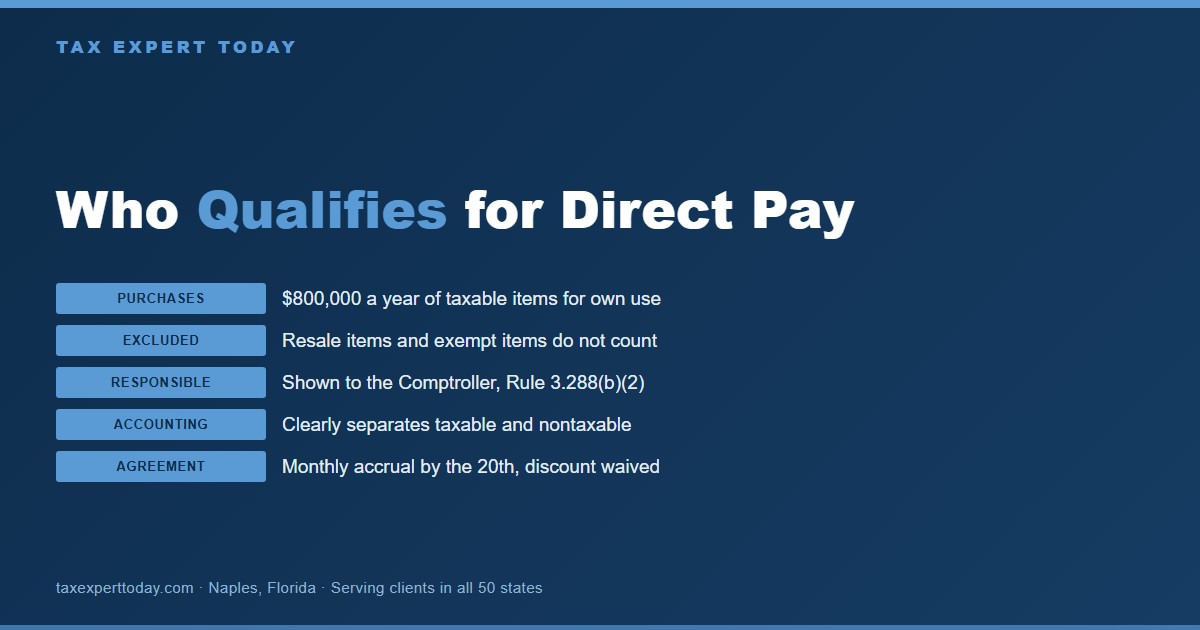
The qualifications appear in three places that say substantially the same thing: the statute, the Comptroller’s rule and the application form itself. The table below lines them up.
| Requirement | What it means | Authority |
|---|---|---|
| Annual taxable purchases of at least $800,000 | Purchases of taxable items for own use, excluding items for which a resale certificate was or could have been given | Tax Code 151.419(b)(3); Rule 3.288(b)(1); Form AP-101 Item 1a and Item 19 |
| Responsible person | The applicant must establish to the Comptroller’s satisfaction that it is reliable enough to self-assess the tax | Tax Code 151.419(b)(3); Rule 3.288(b)(2) |
| Accounting method | A written description of how taxable, exempt, tax-paid and resale purchases will be distinguished | Tax Code 151.419(b)(2); Rule 3.288(b)(2); Form AP-101 Item 20 |
| Agreement to accrue and pay | Accrue and pay all tax on taxable items used in Texas, monthly, by the 20th of the following month | Tax Code 151.419(b)(1)(A) and (B); Rule 3.288(b)(3) |
| Discount waiver | Waive the Section 151.423 discount on tax paid under the permit | Tax Code 151.419(b)(1)(C); Form AP-101 Item 1e |
| Resale certificates for resale items | Give a resale certificate, not the direct payment certificate, for anything that will be resold | Rule 3.288(b)(4); Form AP-101 Item 1d |
| Access and cooperation | Make books and records available and cooperate with examination | Form AP-101 Items 1f and 1g |
| Disclosure of related sellers | Disclose ownership or control in any business from which purchases are made under the permit | Form AP-101 Item 1h |
Two features of these qualifications are worth noticing. First, they are a floor, not an entitlement in practice. Section 151.418(a) says the Comptroller “shall issue” a permit to an applicant who qualifies, but Section 151.418(b) makes the Comptroller “the sole judge of an applicant’s qualifications” and provides that a refusal to issue a permit “is not appealable.” An applicant that is denied may ask to submit an amended application or may submit a new one after a reasonable period, under Section 151.418(c). There is no hearing route to force the issue.
Second, the responsible person and accounting method requirements are judgment calls by the Comptroller. A business with a history of late returns, unresolved audit findings or weak purchasing records may meet the dollar threshold and still struggle to show that it is a responsible person whose accounting clearly distinguishes taxable from nontaxable purchases. The application is a test of the business’s tax function as much as of its spending.
How Is the $800,000 Purchase Threshold Measured?
The threshold counts the annual value of taxable items the business buys for its own use, measured when purchased. It excludes items bought for resale or that could have been bought on a resale certificate. Form AP-101 asks for last year’s figure or the amount to be purchased, supported by records.
- Taxable items only. Exempt purchases, such as qualifying manufacturing equipment, do not count toward the figure.
- Own use only. Inventory and other resale purchases are excluded by statute.
- Historical or projected. Item 19 accepts purchases made last year or to be made.
- Must be documented. Rule 3.288(b)(1) requires records adequate to support the statement.
Section 151.419(b)(3) describes the measure precisely: taxable items “that have a value when purchased of $800,000 or more excluding the value of taxable items for which resale certificates were or could have been given.” Rule 3.288(b)(1) restates it as “at least $800,000 worth of taxable items for the person’s own use and not for resale” and adds that a statement to that effect must accompany the application and that “adequate records must be available to support this statement.”
The exclusions narrow the figure more than many applicants expect. A distributor with $50 million in annual purchases may have well under $800,000 of taxable items for its own use, because nearly all of its purchases are inventory bought for resale. A manufacturer may have large purchases of equipment that is exempt under the manufacturing exemption, and exempt items are not taxable items for this purpose. Our guide to the Texas manufacturing exemption explains which manufacturing purchases are exempt. The figure that matters is what remains after resale and exempt purchases are removed.
The threshold is also a continuing test, not a one-time hurdle. Rule 3.288(j) states that “a direct payment permit will be canceled when annual purchases are less than the amount required.” A business that qualified during an expansion and later shrinks its taxable spending can lose the permit and must return to paying tax to its vendors. Planning around a permit should therefore look at the expected level of taxable purchases over several years, not one strong year.
| Purchase category | Counts toward $800,000? | Reason |
|---|---|---|
| Office furniture, computers and supplies used by the business | Yes | Taxable items bought for own use |
| Maintenance and repair parts consumed in operations | Generally yes | Taxable items consumed by the business, unless a specific exemption applies |
| Taxable services bought for own use, such as certain repair or data processing services | Generally yes | Taxable services are taxable items; see our guide to Texas taxable services |
| Inventory bought for resale | No | Excluded by Section 151.419(b)(3) because a resale certificate could be given |
| Qualifying manufacturing equipment | No | Exempt, so not a taxable item for this measure |
| Motor vehicles subject to motor vehicle sales tax | No | Taxed under Chapter 152, outside the permit entirely |
How Do You Apply for a Direct Payment Permit?
The business files Form AP-101, Texas Application for Direct Payment Permit, with the Comptroller. The form includes the signed taxpayer’s agreement, the annual taxable purchase figure, a separate written description of the accounting method, a list of major fixed asset sites in Texas, and signatures of the owners or officers.
- Form AP-101. The application, mailed to the Comptroller in Austin.
- Item 19. The annual purchases subject to Texas use tax.
- Item 20. A separate sheet describing the accounting method and internal controls.
- Item 21. Every site of major fixed assets permanently located in Texas.
Form AP-101 is a four page form. Its first page states who may submit it (“if you annually purchase at least $800,000 worth of taxable items for your own use and not for resale”) and carries a warning that matters at the start: “No purchases may be made tax free until this application has been approved and your Direct Payment Permit has been issued.” A business that sends certificates to vendors in anticipation of approval is making untaxed purchases without authority, and the tax on those purchases remains due.
The second page is the taxpayer’s agreement. The applicant affirms, among other things, that it is a responsible person meeting the purchase threshold, that its accounting will distinguish taxable from nontaxable purchases, that it will accrue and pay all state, local, transit authority, county and special purpose district sales and use taxes due on its taxable purchases monthly by the 20th, that it will not use the certificate for resale items, that it will report all taxable purchases on the direct payment return and waive the discount, that it will make its records available and cooperate with examinations, and that it will disclose any ownership or control it has in businesses it buys from under the permit. The form cites Section 151.419 as the legal authority for the agreement.
The remaining pages collect identification and business information. Item 17 asks for the principal type of business and offers exploration and production, construction, manufacturer or processor, service and other as choices, which gives a sense of the businesses the Comptroller expects to see. Item 19 asks for the annual purchases subject to Texas use tax. Item 20 asks for the accounting method on a separate sheet. Item 21 asks the applicant to list and describe all sites of major fixed assets permanently located in Texas. The application must be signed by the sole owner, all general partners, members, officers or an authorized representative, and a representative must attach a written power of attorney.
Rule 3.288(c) still says applicants should write to the Comptroller to request that an application be sent. In practice the form is published on the Comptroller’s website. The form’s mailing address is the Comptroller of Public Accounts, 111 E. 17th St., Austin, TX 78774-0100. Because the Comptroller is the sole judge of qualifications and a denial cannot be appealed, the quality of the application, and particularly of the accounting method description, is the part of the process that deserves the most care.
What Does the Accounting Method Statement Need to Show?
The statement must fully describe the internal controls and data flow the business will use to prepare the direct payment return. Form AP-101 instructions list the questions it should answer, including how each class of purchase is identified, how local tax is assigned, and who reviews the return.
- Purchase classification. Direct pay, resale, nontaxable, in state, out of state, other tax free and tax-paid.
- Mixed vendors. How resale and own use purchases from the same supplier are separated.
- Timing. How use tax is reported in the month the vendor’s billing is received.
- Local reporting and review. How tax reaches the correct jurisdiction, and whether more than one person reviews it.
Item 20 is the part of the application where a business shows it can do the job the vendors used to do. The instructions say an applicant “must maintain an accounting method that clearly distinguishes between taxable and non-taxable purchases” and ask it to “explain the internal controls and the accounting flow of the data that will be used to prepare your direct payment return.” They then list specific questions. The table below groups those questions and notes what a well prepared answer usually covers.
| Form AP-101 question (paraphrased) | What a strong answer typically addresses |
|---|---|
| How will you distinguish direct pay, resale, nontaxable, in state and out of state, other tax free and tax-paid purchases? | Purchase order or general ledger coding that assigns a tax status at the time of purchase, with defined codes for each class |
| If you buy for resale and for own use from the same supplier, will you issue separate purchase orders? | Separate purchase order types or vendor sub-accounts, so resale certificates and the direct payment certificate are never confused |
| If you do not issue blanket certificates to some suppliers, how will you show which items the supplier taxes? | A vendor master file flag showing which vendors hold the certificate and which still charge tax |
| How will you report use tax in the same month you receive vendor billings? | A monthly close procedure that pulls all invoices received in the period, including corporate card and expense report purchases |
| How will you report tax to the correct city, transit authority, county and special purpose district? | Ship to or use location coding on each purchase, mapped to local jurisdictions, with a process for rate changes |
| From what sources will you get the data for the return, and how will it get there? | A description of the systems involved, such as procurement, accounts payable and fixed assets, and how data moves between them |
| Will more than one person review purchase records against reported purchases? | A preparer and reviewer structure with a documented reconciliation |
| How will you keep tax free purchases off the sales and use tax return? | A control that routes all own use purchases to the direct payment return only |
A business that cannot answer these questions clearly is not yet ready for a permit, whatever its purchase volume. The same questions are also a useful preview of an eventual audit. An examiner reviewing a permit holder will want to see the system described in Item 20 operating as described, and the gaps between the description and the reality are where findings tend to appear.
What Is Form 01-919 and How Is It Used With Vendors?
Form 01-919, the Texas Direct Payment Exemption Certification, is the certificate a permit holder gives each seller. It carries the permit number, the purchaser and seller details and an optional description of items. Once accepted, it relieves the seller of collecting Texas tax on covered sales to the holder.
- Permit number required. Rule 3.288(k) requires every certificate to carry the direct payment permit number.
- Blanket coverage. Under Section 151.417(a) it covers all future sales of taxable items to the holder.
- Description field. If left blank, it covers everything on the attached order, invoice or billing.
- No seller verification duty. The Comptroller says sellers are not required to confirm permit status.
Form 01-919 is a single page. The purchaser enters its direct payment permit number, name and address, and identifies the seller. The purchaser then “claim[s] an exemption from payment of state, city, county, special purpose district, and transit authority/department sales and use taxes upon purchase of taxable items” from that seller. A description field allows the purchaser to limit the certificate to particular items. The form notes that if the description is left blank, “this certificate covers everything on the attached order, invoice, or billing.”
The seller’s side is simple by design. The Comptroller’s Direct Pay Taxpayer Search page states that sellers “must get a properly completed Texas Direct Payment Exemption Certification” from the permit holder, and that sellers “are not required to confirm an entity’s permit status to accept a direct payment exemption certification.” The search tool exists for sellers who want to check, and the Comptroller updates it nightly, but checking is not a condition of relying on the certificate.
The certificate works at the level of the legal entity. Rule 3.288(e) provides that a permit is issued to a legal entity, “including all branches and divisions purchasing taxable items,” and that a certificate issued to a supplier by one branch or division “applies to purchases made by all branches or divisions from the same supplier.” That is convenient for a company with many locations. The same subsection sets a hard limit: holders “may not authorize any other person or firm to purchase any taxable items under their permit,” and use by others may result in revocation. A sister company, a parent, a joint venture partner or a contractor cannot buy under the holder’s permit, even if it is commonly owned.
Holders must also handle mixed vendors carefully. Rule 3.288(h) provides that when a holder deals with a person who may sell taxable items as well as nontaxable services, the certificate “must indicate that it does not cover any nontaxable services that the servicer may provide.” The reason is explained in the next section, where the purchases the permit cannot cover are listed.
What Purchases Can a Direct Pay Permit Not Cover?
The permit cannot cover items bought for resale, sales or rentals to anyone other than the holder, motor vehicles subject to Chapter 152 tax, materials a nontaxable service provider uses or consumes, or lump-sum new construction projects. It also cannot be given to providers of nontaxable services or used for occasional sales.
- Resale items. These require a resale certificate, never the direct payment certificate.
- Other buyers. Only the permit holder may purchase under the permit.
- Motor vehicles. Vehicles taxed under Chapter 152 stay outside the permit.
- Lump-sum construction. The certificate is not valid for lump-sum new construction on the holder’s real property.
Form 01-919 lists its own exclusions. The certificate states that it “does not cover” four categories: purchases of taxable items to be resold; sales or rentals to any purchaser other than the permit holder; sales or rentals of motor vehicles subject to the motor vehicle sales and use tax in Chapter 152; and materials or supplies used, transferred or consumed by a provider of a nontaxable service selling that service to the holder. It adds that the certificate “is not valid for lump-sum new construction projects to improve real property for a direct payment permit holder.” Rule 3.288 adds further limits. The table below collects them.
| Excluded use | What the holder must do instead | Authority |
|---|---|---|
| Items bought for resale | Give a resale certificate under Sections 151.054 or 151.104 | Form 01-919; Rule 3.288(b)(4); Form AP-101 Item 1d |
| Purchases by any other person or firm | The other person buys on its own terms; the holder may not lend its permit | Form 01-919; Rule 3.288(e) |
| Motor vehicles subject to Chapter 152 | Pay motor vehicle sales or use tax through the ordinary vehicle process | Form 01-919 |
| Materials consumed by a nontaxable service provider | The service provider pays tax on its own materials and supplies | Form 01-919; Rule 3.288(g) and (h) |
| Lump-sum new construction contracts | Never give the certificate to a lump-sum contractor | Form 01-919; Rule 3.288(f) |
| Occasional sales by the holder | The holder may not make an occasional sale of taxable items under Section 151.304(b)(1) | Rule 3.288(l) |
The nontaxable service limit is the one that catches businesses most often. Rule 3.288(g) states plainly that holders “may not issue direct payment exemption certificates to persons providing nontaxable services.” The logic is that a provider of a nontaxable service is itself the consumer of the materials and supplies it uses to perform that service, so it owes tax on them when it buys them. A permit holder cannot shift that tax to itself by handing the service provider a certificate. Where a vendor sells both taxable items and nontaxable services, the certificate must say that it does not cover the nontaxable services, under Rule 3.288(h).
The resale limit matters for businesses that buy the same item for both purposes. A distributor that buys tools from one supplier both to resell and to use in its own warehouse must give that supplier a resale certificate for the inventory and the direct payment certificate for the warehouse tools, and its purchasing records must show which is which. Form AP-101 asks applicants specifically whether they will issue separate purchase orders in that situation.
How Do Contractors Fit Into a Direct Payment Arrangement?
A holder may give the direct payment certificate to a contractor performing a separated contract for incorporated materials, but never to a lump-sum contractor. The contractor cannot accept the certificate for its own consumables or equipment. Holders that keep giving certificates to lump-sum contractors risk revocation of the permit.
- Separated contracts. The contractor buys materials for resale and accepts the certificate in lieu of charging tax.
- Lump-sum contracts. The certificate must never be issued, under Rule 3.288(f).
- Contractor’s own items. Consumables and equipment the contractor uses stay taxable to the contractor.
- Revocation risk. Persisting in issuing certificates to lump-sum contractors can cost the permit.
Texas treats construction contracts in two ways. In a separated contract, the contractor states the agreed contract price for materials separately from the charge for skill and labor, and it is treated as a seller of those materials. In a lump-sum contract, the contractor quotes one price and is the consumer of the materials it incorporates, paying tax on them when it buys them. Rule 3.288(f) builds the direct payment rules on that distinction and points readers to Rule 3.291 for the details of the two contract types.
For a separated contract, Rule 3.288(f) provides that the contractor “will purchase the taxable items for resale and accept the direct payment exemption certificate in lieu of charging tax.” The holder then accrues the tax on the materials itself, as it would on any other taxable purchase. The same subsection is equally clear about what the contractor cannot do: it “may not accept a direct payment exemption certificate in lieu of paying tax on consumables or equipment.” Those items are the contractor’s own, and the contractor pays tax on them.
For a lump-sum contract, the rule is absolute: “under no circumstances should a direct payment exemption certificate be issued to a contractor performing a lump-sum contract,” and holders “persisting in this practice may have their permits revoked.” Form 01-919 repeats the point for new construction. A holder with an active capital program therefore needs its project managers, not only its tax department, to understand which contracts are separated and which are lump-sum before any certificate is sent.
How Does the Permit Change Who Bears the Risk of Error?
Under ordinary purchasing, a vendor that fails to charge tax shares the exposure, and a vendor that overcharges leaves the buyer to seek a refund. Under a direct pay permit, the holder makes every taxability and local rate decision, so any underpayment is the holder’s own reporting error, found in its own audit.
- Taxability calls. Move from vendor billing systems to the holder’s tax department.
- Local rate and sourcing. Become the holder’s responsibility for every taxable purchase.
- Overcharges. Largely disappear, because vendors stop charging Texas tax on covered sales.
- Underpayments. Become direct reporting errors on the holder’s own return.
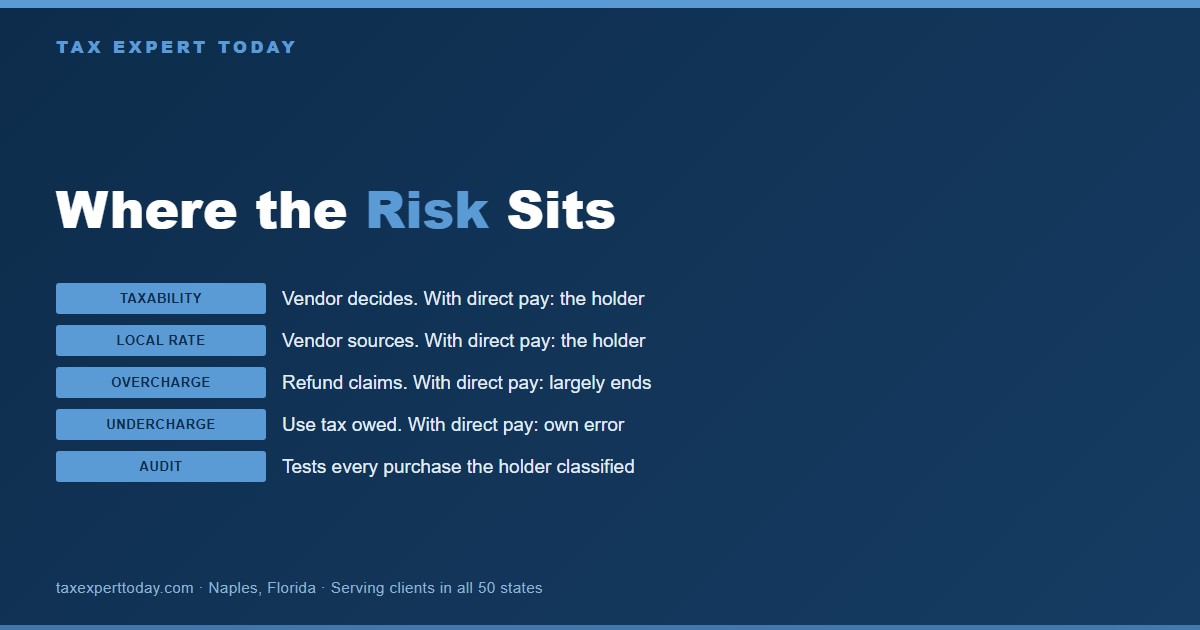
This is the question the permit decision turns on, and it is the one most descriptions of the permit skip. Under the ordinary system, the tax compliance work on a purchase is split between two parties. The vendor decides whether to charge tax and at what rate. The buyer reviews the invoice, accrues use tax where the vendor did not charge it, and seeks a refund or credit where the vendor charged too much. Errors are spread across hundreds of vendor billing systems, and many of them are the buyer’s to correct only after the fact.
Under a direct payment permit, that split ends for covered purchases. The vendor charges nothing. The holder makes every decision. That removes a large category of error that the holder never controlled, such as vendors applying the wrong local rate or taxing exempt items. It also concentrates every remaining decision in one place. If the holder’s coding treats a taxable item as exempt, or assigns the tax to the wrong city, or misses a month of corporate card purchases, there is no vendor collection to fall back on. The tax simply was not reported.
| Question | Ordinary purchasing | Direct pay permit |
|---|---|---|
| Who decides if the item is taxable? | The vendor, at the point of sale, subject to the buyer’s certificates | The permit holder, during its monthly review |
| Who applies the local rate? | The vendor, based on its own sourcing rules | The permit holder, based on where the item is used |
| What happens if tax is overcharged? | The buyer seeks a refund from the vendor or a refund or credit from the Comptroller | Overcharges largely stop on covered purchases |
| What happens if tax is undercharged? | The buyer owes use tax on the difference | The holder failed to accrue it on its own return |
| Where are purchases reported? | Untaxed purchases in Item 3 of the sales and use tax return, or on Form 01-156 | All taxable purchases on the direct payment return |
| Is a timely filing discount available on the purchase tax? | Not applicable to tax paid to vendors | Waived under Section 151.419(b)(1)(C) |
| What does an audit of purchases test? | Untaxed purchases the buyer should have accrued | Every taxable purchase the holder reported or should have reported |
Neither arrangement is better in the abstract. A business whose own tax function is strong and whose vendors are inconsistent may reduce its total error by taking the work in house. A business whose tax function is thin may increase its exposure by doing the same. The permit is a decision about where the business wants its compliance risk to sit.
What Are the Benefits of a Direct Pay Permit?
The main benefits are consistent taxability decisions, the end of most vendor overcharges and refund claims, one certificate per vendor instead of item by item exemption certificates, cash flow from paying tax monthly rather than at purchase, and a single certificate that covers every branch and division of the legal entity.
- Consistency. One set of decisions applied by the holder, instead of many vendor systems.
- Fewer refund claims. Vendors stop charging tax on covered sales, so overpayments shrink.
- Simpler certificate management. One blanket certificate per vendor covers future sales.
- Timing. Tax is paid by the 20th of the following month rather than with each invoice.
Consistency is usually the largest benefit. A company that buys from hundreds of vendors receives hundreds of different answers to the same taxability questions. One vendor taxes a repair service, another treats the same service as nontaxable, a third taxes it at the rate of its own location rather than the buyer’s. Under a direct payment permit, the holder applies one set of decisions to all of those purchases. That consistency is also easier to defend in an examination, because the holder can explain one method rather than reconstruct many vendors’ choices.
The reduction in overpayments is close behind. Where vendors routinely tax items that are exempt to the buyer, such as qualifying manufacturing equipment, the buyer must either manage exemption certificates item by item or recover the tax afterward. Recovery means refund claims, credits and documentation. A direct payment permit removes most of that work for covered purchases because no tax is charged in the first place. Our guide to the Texas sales tax exemption certificate describes the item by item approach that a permit replaces.
Certificate management becomes simpler as well. Section 151.417(a) makes the direct payment certificate cover “all future sales of taxable items to the permit holder,” and Rule 3.288(e) extends a certificate issued by one branch to every branch buying from the same supplier. A company with many sites can give each supplier one form rather than tracking separate certificates by location and by item.
Finally, there is a timing effect. Under ordinary purchasing, tax is paid to the vendor with the invoice. Under a direct payment permit, the tax on a month’s purchases is due by the 20th of the following month. For a business with large and steady taxable purchases, that difference has a modest cash flow value, although it is rarely the reason to apply on its own.
What Are the Costs and Burdens of Direct Pay?
The holder takes on monthly returns even when nothing is due, the full local tax sourcing burden, the waiver of the discount on tax paid under the permit, strict separation of own use from resale purchases, vendor notifications if the permit ends, and an audit that tests every purchase decision it made.
- Monthly returns, including zero returns. Required under Rule 3.288(j).
- Local tax sourcing. The holder must assign each purchase to the correct city, transit, county and special district.
- Discount waived. The Section 151.423 discount is not available on tax paid under the permit.
- Staffing and systems. Someone must classify every purchase every month, without exception.
The filing burden is fixed. Rule 3.288(j) states that “all direct payment permit holders must file direct payment returns, whether or not they have tax to report,” and that a zero return must be filed if the holder has no city, transit authority, county or special purpose district tax to report. The return is monthly, under Section 151.419(b)(1)(B). There is no quarterly or annual option for permit holders.
The local tax burden is often larger than applicants anticipate. A vendor that collects tax has to determine the correct local jurisdictions for each sale. Under a permit, the holder does that for every taxable purchase. Form AP-101 asks the applicant directly what procedure it will follow “to report use tax to the correct city, Metropolitan Transit Authority (MTA) or City Transit Department (CTD), County and/or Special Purpose District (SPD).” A business with sites in many jurisdictions, or with items that move between sites, needs location data on every purchase and a process for keeping rates current.
The discount waiver is a real cost for large holders. Section 151.419(b)(1)(C) requires the applicant to waive the discount permitted by Section 151.423 “on the payment of all taxes under the direct payment permit only.” The discount on any sales tax the business collects from its own customers under an ordinary permit is not affected. Only the tax paid under the direct payment permit loses it.
The staffing burden is the one that determines whether the permit works. Every purchase that crosses accounts payable, every corporate card transaction and every expense report item that might be taxable has to be classified every month. A tax department that already struggles to accrue use tax on the exceptions its vendors miss will not do better when every purchase becomes an exception.
| Burden | What it requires | Authority |
|---|---|---|
| Monthly direct payment return | File every month by the 20th, including zero returns | Tax Code 151.419(b)(1)(B); Rule 3.288(j) |
| Local jurisdiction reporting | Assign each taxable purchase to the correct city, transit authority, county and special purpose district | Form AP-101 taxpayer’s agreement and Item 20 instructions |
| Discount waiver | Forgo the Section 151.423 discount on tax paid under the permit | Tax Code 151.419(b)(1)(C) |
| Separate resale handling | Give resale certificates for resale items and keep them off the direct payment certificate | Rule 3.288(b)(4) |
| No lending of the permit | Only the legal entity holding the permit may buy under it | Rule 3.288(e) |
| Vendor notice if the permit ends | Immediately notify every vendor that the certificate is no longer valid | Rule 3.288(d) |
| Records and cooperation | Make books and records available and cooperate with examination | Form AP-101 Items 1f and 1g |
How Is Local Tax Reported Under a Direct Pay Permit?
The holder reports state tax and every applicable local tax on its direct payment return, assigning each taxable purchase to the city, transit authority, county and special purpose district where the item is used. Items stored in Texas before their use is known may be reported when first stored or when first removed for use, applied consistently.
- Every local layer. City, transit authority or department, county and special purpose district taxes all apply.
- Location data on each purchase. The holder needs to know where each item is first used.
- Storage election. Rule 3.288(i) allows reporting at storage or at removal, used consistently.
- Items leaving Texas. Use tax does not apply to items transported out of Texas for use solely outside Texas.
The taxpayer’s agreement on Form AP-101 covers “all taxes which are or may in the future be due by virtue of the State, Local, Metropolitan Transit Authority, City Transit Department, County and Special Purpose District Sales and Use Tax Acts.” The holder is therefore responsible for every layer of local tax that a collecting vendor would otherwise have charged. The detailed local use tax sourcing rules are the same ones that apply to any buyer accruing use tax, and they are covered in our guide to Texas use tax.
Rule 3.288(i) addresses a specific problem for holders that keep central stocks. If storage facilities contain taxable items bought under the direct payment certificate, and “at the time of storage it is not known whether the taxable items will be used in Texas,” the taxpayer “may elect to report the use tax either when the taxable items are first stored in Texas or are first removed from inventory for use in Texas, as long as use tax is reported in a consistent manner.” The same subsection states that use tax does not apply to items transported outside Texas for use solely outside Texas, or to items processed, fabricated or manufactured into other property, or incorporated into other property, and then transported outside Texas for use solely outside Texas.
The consistency requirement matters. A holder that reports some stocked items at storage and others at removal, depending on which is more convenient in a given month, is inviting an examiner to restate its reporting. The election should be made deliberately, documented in the accounting method, and followed.
When Is Direct Payment Tax Due and What Must Be Filed?
Tax on a month’s taxable purchases is due on or before the 20th day of the following month, reported on the direct payment return. A return must be filed every month even when no tax is due, and taxable purchases may not be reported on an ordinary sales and use tax return.
- Monthly period. Each calendar month is a reporting period, under Section 151.419(b)(1)(B).
- Due on the 20th. Payment is due on or before the 20th day of the following month.
- Zero returns. Required whenever there is no city, transit, county or special district tax to report.
- One return for purchases. All taxable purchases go on the direct payment return.
Rule 3.288(b)(3) describes the obligation as accruing and paying all taxes imposed by Section 151.101 “on the direct payment return for items not specifically exempted” and making the payments “on or before the 20th day of the month following each monthly period in which the items become subject to the tax by reason of use or consumption in this state.” The trigger is use or consumption in Texas, which is why the storage election in Rule 3.288(i) exists for items whose use is not yet known.
Form AP-101 adds two related points. The tax “is due on all taxable purchases; and, unless the tax is paid to the seller, it must be reported on the Texas Direct Payment Return.” That language recognizes that some vendors will still charge tax, for example a vendor that has not received a certificate. Tax properly paid to a seller does not have to be reported again. And the form requires the holder to report all taxable purchases on the direct payment return, so the holder’s ordinary sales and use tax return, if it has one, carries its sales but not its own use purchases.
The Comptroller’s audit procedures make late or missing returns costly in a way that goes beyond penalties and interest. A holder that falls behind on direct payment returns has, by definition, stopped doing the work that justified its permit. That history bears directly on whether the Comptroller continues to regard it as a responsible person, and on how the next examination is scoped.
How Does Direct Pay Relate to Ordinary Texas Use Tax?
Direct pay is a formalized, permit-based version of use tax accrual. Every Texas business owes use tax on taxable items it uses when the seller did not charge Texas tax. A permit holder extends that accrual to all its covered purchases, because its vendors stop charging tax entirely.
- Same tax. The holder pays the use tax imposed by Section 151.101.
- Different scope. Ordinary accrual covers exceptions; direct pay covers nearly every taxable purchase.
- Different return. Permit holders use the direct payment return, not Item 3 or Form 01-156.
- Same sourcing rules. Local use tax is assigned the same way in both systems.
Every Texas business that buys a taxable item for use in Texas without paying Texas tax to the seller owes use tax on it. A business with an ordinary sales and use tax permit reports those purchases in Item 3 of its return, and a business without a permit uses Form 01-156. That obligation, and how a business finds and accrues those purchases in its own books, is explained in our guide to Texas use tax. A direct payment permit does not create a new tax. It takes the same accrual obligation and extends it from the exceptions to the rule, by instructing vendors not to charge tax on covered sales, and it moves the reporting to a dedicated monthly return.
Can a Direct Pay Holder Use a Percentage-Based Reporting Method?
Yes, with Comptroller authorization under Rule 3.282(g). The holder categorizes purchases, reviews an agreed sample of invoices to find the taxable percentage, and applies it to report tax. The percentage is used for a three-year period and can be revoked if it stops being representative, without appeal.
- By authorization only. The holder must request and receive a letter of authorization.
- Sample based. An agreed sample of invoices sets the taxable percentage by category.
- Three-year period. The authorized percentage applies for a period the Comptroller specifies.
- Revocable. A change in operations or law can end it, and the decision is not appealable.
Rule 3.282(a)(2) defines a percentage-based reporting method as a method by which a direct payment permit holder “may be authorized to categorize purchase transactions according to standards specified in a letter of authorization,” reviews an agreed-on sample of invoices in those categories “to determine the percentage of taxable transactions,” and uses that percentage to calculate the tax to be reported. Rule 3.282(g) sets the conditions. The holder requests authorization; the authorized percentage “must be used for a three-year period specified by the comptroller, unless the authorization is revoked”; and the Comptroller may categorize transactions “by dollar amount, by type of taxable item purchased, by the purpose for which the taxable item will be used, or by other standards appropriate to the taxpayer’s operations.”
The method is attractive to holders with very high invoice volumes, because it replaces item by item classification of routine purchases with a tested ratio. It comes with two cautions in the rule itself. First, under Rule 3.282(g)(2) the authorization may be revoked if the percentage “is no longer representative because of a change in the taxpayer’s business operations or in law, including a change in the interpretation of a law or rule.” The rule gives the example of manufacturers whose percentages were affected by court decisions and later legislation. Second, under Rule 3.282(g)(3), a decision to deny or revoke authorization “is not subject to appeal.” A holder that relies on a percentage should monitor changes in its operations and in the law that might undermine it, rather than assume the ratio holds for the full period.
How Does the Comptroller Audit a Direct Pay Permit Holder?
The Comptroller may audit a holder’s records at any time during business hours, using a detailed review or a sample and projection method after written notice. Because the holder made every taxability and local rate call, the examination tests its own purchase classifications, local reporting and completeness, rather than vendors’ collections.
- Audit authority. Rule 3.282(b) allows audits at any time during regular business hours.
- Sampling allowed. Rule 3.282(c) and (d) permit sample and projection methods in defined cases.
- Written notice. Rule 3.282(e) requires notice of the sampling procedure before it is used.
- What is tested. Classifications, local jurisdiction reporting, completeness and the Item 20 controls.
Rule 3.282(b) provides that the Comptroller “may audit a taxpayer’s accounts and records at any time during regular business hours.” Rule 3.282(c) allows “a detailed auditing procedure or a sample and projection auditing method,” including manual and computer-assisted techniques. Under Rule 3.282(d), sampling is appropriate where the records are so detailed, complex or voluminous that a full audit would be unreasonable, where the records are inadequate, or where the cost of a full audit would be unreasonable in relation to the benefit. Rule 3.282(e) requires the Comptroller to notify the taxpayer in writing of the sampling procedure before using it to establish a liability. The Comptroller’s State Tax Automated Research system also indexes a subject heading for direct payment permit holder audit procedures, which reflects that these examinations have their own body of guidance.
A permit holder’s purchase records are usually voluminous, which makes sampling likely. That has a practical consequence. In a sample and projection audit, an error rate found in the sample is projected across the population of purchases for the audit period. A holder whose coding misclassifies one category of purchase consistently can see a modest sample error become a significant projected liability. The holder also does not have the option, open to an ordinary buyer, of arguing that the vendor was the party responsible for collecting the tax. Under the permit, the holder agreed to accrue and pay it.
In practice, examinations of permit holders tend to focus on the same areas the Item 20 questions describe. Examiners look at whether purchases coded as exempt were in fact exempt, whether taxable services were recognized as taxable, whether local tax was assigned to the right jurisdictions, whether purchases made outside the main procurement system (corporate cards, expense reports, direct invoices to field locations) reached the return, and whether certificates were given to anyone who should not have received one, such as lump-sum contractors or providers of nontaxable services. A general explanation of how a Texas sales and use tax examination runs, from the engagement letter through the exit conference, is in our guide to the Texas Comptroller audit.
| Audit focus area | Why it matters for a permit holder | Related authority |
|---|---|---|
| Exempt classifications | Items coded exempt but actually taxable are unreported tax | Tax Code 151.417(b) agreement to accrue all tax due |
| Taxable services | Services the holder treated as nontaxable may be taxable | Rule 3.288(g) and (h) |
| Local jurisdiction reporting | Tax assigned to the wrong city, transit authority, county or district | Form AP-101 taxpayer’s agreement |
| Completeness | Card, expense report and field purchases that never reached the return | Rule 3.288(b)(3) |
| Certificate misuse | Certificates given to lump-sum contractors, service providers or other entities | Rule 3.288(e), (f) and (g) |
| Sampling | Sample error rates projected across the audit period | Rule 3.282(c), (d) and (e) |
What Happens if the Permit Is Canceled or Given Up?
If the permit is voluntarily forfeited or canceled by the Comptroller, the holder must immediately notify every vendor that its direct payment certificate is no longer valid. Failing to notify is a violation of the sales tax law. The Comptroller cancels permits when annual purchases fall below the required amount.
- Immediate vendor notice. Required by Rule 3.288(d) after forfeiture or cancellation.
- Purchase level. The permit is canceled when annual purchases drop below the threshold.
- Misuse. Lending the permit or issuing certificates to lump-sum contractors can lead to revocation.
- Return to vendor collection. Vendors resume charging tax, and the holder accrues use tax on exceptions.
Rule 3.288(d) provides that any consumer whose permit “is either voluntarily forfeited or canceled by action of the comptroller’s office must immediately notify all vendors from whom purchases of taxable items are made advising them that the exemption certificate issued to them pursuant to the direct payment permit is no longer valid.” The rule adds that “failure to give notification is a violation of the Limited Sales, Excise, and Use Tax Act.” A business giving up a permit therefore needs a vendor list as complete as the one it used when it sent the certificates out.
The rule identifies several paths to cancellation. Rule 3.288(j) says a permit “will be canceled when annual purchases are less than the amount required.” Rule 3.288(e) says use of the permit by other persons “may result in revocation.” Rule 3.288(f) says holders that persist in issuing certificates to lump-sum contractors “may have their permits revoked.” Rule 3.288(j) also refers readers to the Comptroller’s rules on divergent use of a direct payment, resale or exemption certificate, which address what happens when items bought on a certificate are put to a use the certificate did not cover.
After the permit ends, the business returns to the ordinary system. Vendors charge Texas tax again, the business accrues use tax on whatever they miss, and it manages exemption and resale certificates item by item. The transition is smoother if the business has kept its vendor master data current and has a clear cutoff date for purchases under the permit.
Can a Direct Pay Holder Recover Tax Paid in Error?
Yes. A permit holder that overpaid Texas tax may compute the overpayment using a projection from a Comptroller-approved sample, then take a credit on its returns or file a refund claim within the Chapter 111 limitation period. Contemporaneous records supporting the claim must be kept for at least four years.
- Sampling for refunds. Rule 3.282(h) allows projection from an approved sampling method.
- Credit or refund. Rule 3.282(i) allows either route within the limitation period.
- Documentation. The method and underlying records must be available on request.
- Local tax detail. Local tax claims must identify the period and the jurisdiction.
Overpayments do not disappear under a permit. A holder can accrue tax on items that later turn out to be exempt, report tax to the wrong jurisdiction, or pay tax to a vendor that charged it despite the certificate and then report the same purchase again. Rule 3.282(h) provides that a permit holder that “has paid Texas tax in error on purchases of taxable items” may compute the overpayment “by use of a projection based on a sampling of transactions,” provided the sampling method is one the Comptroller has approved, and provided the holder records the method and makes the information and records available on request.
Rule 3.282(i) then allows the holder to obtain reimbursement “by taking a credit on one or more sales tax returns or by filing a claim for refund with the comptroller within the limitation period specified by Tax Code, Chapter 111.” The rule requires contemporaneous records supporting the claim to be kept “for a minimum of four years from the date on which the record is made,” and longer where an assessment, collection, refund, hearing or proceeding is pending. A credit is taken by amending the return for the period in which the tax was originally paid, and a refund claim must identify that period. For local taxes, the claim must identify both the period and the local taxing jurisdiction.
Holders that conclude they have unreported tax rather than overpaid tax face the opposite problem. A business that discovers past periods in which it failed to accrue tax on covered purchases should evaluate its options before filing amended returns, because the timing and form of the correction can affect penalties and the periods the Comptroller reviews. Our guide to the Texas voluntary disclosure agreement explains one of those options and when it is available.
Which Businesses Typically Consider a Direct Pay Permit?
Direct pay suits businesses with large, recurring taxable purchases for their own use, many vendors and locations, frequent exempt and taxable mixes, and a capable tax function. Form AP-101 itself lists exploration and production, construction, manufacturing and processing, and service businesses as principal types.
- Oil and gas exploration and production. Large equipment and supply purchases across field locations.
- Manufacturers and processors. Frequent mixes of exempt production items and taxable overhead items.
- Construction owners and developers. Heavy material purchases, with careful contract type controls.
- Large service businesses and multi-site operators. Many locations, many vendors and steady taxable purchases.
The categories on Form AP-101 Item 17, exploration and production, construction, manufacturer or processor, service and other, are a reasonable guide to who applies. What these businesses share is not an industry so much as a purchasing profile: large and recurring taxable purchases for their own use, bought from many vendors, delivered to many sites, with a mix of exempt and taxable items that vendors struggle to classify correctly.
Manufacturers are a common example. A plant buys production equipment that is often exempt under the manufacturing exemption, alongside office equipment, safety gear, janitorial supplies and maintenance items that may be taxable. Vendors frequently get that mix wrong in both directions. A permit lets the manufacturer apply one consistent set of decisions. The exemption analysis itself is covered in our guide to the Texas manufacturing exemption. Exploration and production companies often have a similar profile, with purchases delivered to many field locations in different local jurisdictions.
Businesses that are a poor fit tend to share the opposite profile. A company whose taxable purchases barely clear $800,000, whose purchases flow through few vendors that already charge tax correctly, or whose accounting cannot capture the use location of each purchase, takes on the full burden of the permit for limited benefit. So does a company whose spending is expected to fall, given that the permit is canceled when purchases drop below the threshold.
Direct Pay Permit vs Exemption Certificate vs Resale Certificate: Which Applies?
A resale certificate covers items bought to resell. An exemption certificate covers specific purchases that qualify for an exemption. A direct payment certificate covers all taxable items bought for the holder’s own use, and it does not exempt them: the holder still accrues and pays the tax itself.
- Resale certificate. No tax because the item will be resold and taxed on resale.
- Exemption certificate. No tax because a specific exemption applies to the purchase.
- Direct payment certificate. No tax charged by the seller, but the holder self-assesses it.
- Holders use all three. A permit does not replace resale certificates for resale items.
The three certificates are often confused because each one leads a seller to stop charging tax. They do so for different reasons, and the buyer’s obligations afterward are different. The table below sets them side by side.
| Feature | Resale certificate | Exemption certificate | Direct payment certificate (Form 01-919) |
|---|---|---|---|
| Purpose | Buy items to resell | Claim a specific exemption on a purchase | Self-assess tax on all own use taxable purchases |
| Is tax ultimately owed by the buyer? | No, the resale is taxed | No, if the exemption applies | Yes, accrued and paid by the holder |
| Who may use it? | A buyer that resells the items | A buyer whose purchase qualifies | Only a buyer holding a direct payment permit |
| Permit or threshold required? | Generally a sales tax permit | Depends on the exemption | A direct payment permit and $800,000 of annual own use taxable purchases |
| Coverage | Items for resale | The qualifying items | All future taxable purchases from that seller, with listed exclusions |
| Further guide | Texas resale certificate | Texas sales tax exemption certificate | This guide |
A permit holder will often use more than one of these certificates with the same vendor. A company that resells some items and uses others must give a resale certificate for the resale purchases, as Rule 3.288(b)(4) requires, and the direct payment certificate for its own use purchases. It may also keep exemption documentation for items it treats as exempt in its own monthly review, because the examiner will ask it to support those positions.
How Should a Business Decide Whether to Apply?
Compare the cost of current vendor errors, overpayments and refund work with the cost of classifying every purchase, sourcing local tax, filing monthly and defending the holder’s own decisions in audit. Apply only when purchases comfortably exceed $800,000 and the tax function can meet the Item 20 standard.
- Measure current errors. Sample vendor invoices for overcharges and missed tax.
- Test the threshold. Confirm own use taxable purchases clear $800,000 with room to spare.
- Test the systems. Confirm purchase coding and use location data are reliable.
- Price the work. Estimate the staff time for monthly classification and review.
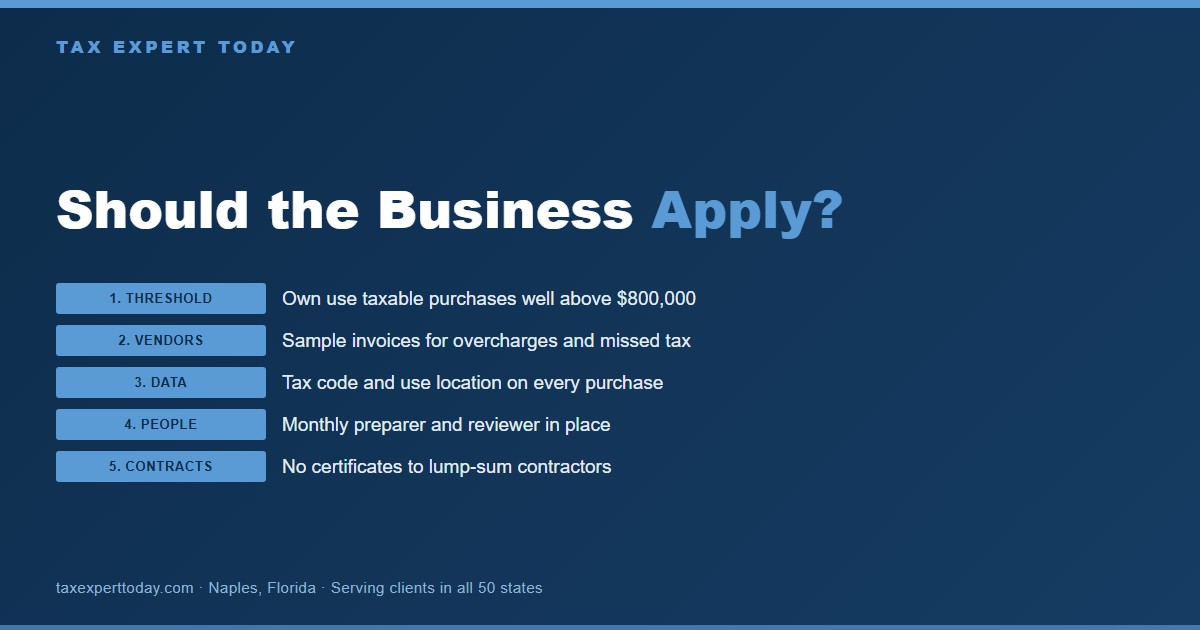
A sound decision starts with evidence from the business’s own records. A sample of recent vendor invoices shows how often vendors overcharge, how often they miss tax that should have been charged, and how much time the business spends correcting both. That is the problem a permit would solve. The same review shows whether the business’s purchase coding and location data are good enough to support self-assessment. That is the capability a permit would require.
Consider a hypothetical illustration, not drawn from any client. A company with three Texas plants has about $2.5 million a year of taxable purchases for its own use, bought from roughly 400 vendors. A sample of invoices shows frequent tax on exempt production items and inconsistent local rates on deliveries to its smaller plants. Its procurement system already captures a ship to location and a general ledger code on every purchase order, and its tax department reviews use tax accruals monthly. That profile suggests a permit could reduce error and refund work, provided card and expense report purchases are brought into the monthly review. A second hypothetical company with $900,000 of taxable purchases, most of it from five vendors that already tax correctly, and with no location coding in its payables system, would take on more risk than it removes.
| Decision factor | Points toward applying | Points against applying |
|---|---|---|
| Annual own use taxable purchases | Well above $800,000 and stable or growing | Close to $800,000 or expected to fall |
| Vendor accuracy | Frequent overcharges, missed tax and inconsistent local rates | Few vendors, mostly charging correctly |
| Exempt and taxable mix | Frequent mix that vendors classify poorly | Purchases mostly clearly taxable |
| Locations | Many sites in different local jurisdictions | One site in one jurisdiction |
| Purchase data | General ledger code and use location on every purchase | No reliable location or tax status coding |
| Tax function | Monthly review with a preparer and reviewer | No dedicated review of purchases |
| Construction activity | Separated contracts with clear controls | Frequent lump-sum contracts without controls |
Whatever the answer, the analysis is worth documenting. If the business applies, the analysis becomes the foundation for its Item 20 statement. If it does not, the same work usually identifies improvements in its ordinary use tax accrual that are valuable on their own.
What Are Common Texas Direct Pay Permit Mistakes?
Common mistakes include sending certificates before the permit is issued, treating the permit as an exemption, giving certificates to lump-sum contractors or nontaxable service providers, letting affiliates buy under the permit, missing card and expense purchases, mixing up local jurisdictions, skipping zero returns and failing to notify vendors when the permit ends.
- Premature use. No purchases may be made tax free until the permit is issued.
- Exemption confusion. The permit changes who pays the tax, not whether it is owed.
- Wrong recipients. Lump-sum contractors, nontaxable service providers and affiliates cannot use it.
- Incomplete returns. Purchases outside the main payables system are often missed.
Most of these mistakes trace back to a single cause: treating the permit as a purchasing convenience rather than a tax compliance obligation. The items below are the ones that tend to produce audit findings.
- Using the certificate before approval. Form AP-101 states that no purchases may be made tax free until the permit has been issued.
- Treating covered purchases as exempt. Section 151.417(b) requires the holder to accrue and pay all tax that is or may become due on items bought under the certificate.
- Issuing certificates to lump-sum contractors. Rule 3.288(f) forbids it and allows revocation for persistent use.
- Issuing certificates to nontaxable service providers. Rule 3.288(g) forbids it, and mixed vendors need a certificate limited under Rule 3.288(h).
- Letting affiliates buy under the permit. Rule 3.288(e) limits the permit to the legal entity and its branches and divisions.
- Using the direct payment certificate for resale items. Rule 3.288(b)(4) requires resale certificates for resale purchases.
- Missing purchases outside procurement. Corporate cards, expense reports and field invoices still carry tax due.
- Assigning local tax to the wrong jurisdiction. The holder is responsible for every local layer.
- Skipping zero returns. Rule 3.288(j) requires a return every month.
- Reporting purchases on the wrong return. Form AP-101 requires all taxable purchases on the direct payment return.
- Making an occasional sale. Rule 3.288(l) bars holders from the occasional sale provision of Section 151.304(b)(1).
- Not notifying vendors after cancellation. Rule 3.288(d) requires immediate notice.
How Does a Direct Pay Permit Fit With Other Texas Business Taxes?
The permit affects only Chapter 151 sales and use tax on the holder’s own purchases. It does not change franchise tax, payroll taxes, motor vehicle tax or the sales tax the business collects from customers. A holder that also sells taxable items keeps its ordinary permit and return for those sales.
- Sales to customers. Still collected and reported under the ordinary sales and use tax permit.
- Franchise tax. A separate tax with its own reports, unaffected by the permit.
- Motor vehicles. Chapter 152 tax stays outside the permit.
- Payroll. Unemployment tax and federal payroll obligations are unrelated.
A direct payment permit is narrow in scope. It changes how the holder pays sales and use tax on taxable items it buys for its own use. It does not affect the Texas franchise tax, which is computed on margin and reported separately. It does not affect employer obligations, covered in our guide to Texas payroll taxes. It does not reach motor vehicles taxed under Chapter 152, which Form 01-919 excludes. And it does not change the business’s obligations as a seller. A holder that sells taxable items continues to collect tax from its customers and report those sales on its ordinary sales and use tax return. Whether an out of state business must collect Texas tax at all is covered in our guide to Texas sales tax nexus.
Businesses relocating to Texas or opening Texas operations sometimes ask about a permit early, before purchasing patterns are settled. The permit is usually a later step. The first steps are registration, nexus, entity choice and the core reporting obligations, which are covered in our checklist for moving a business to Texas. A permit makes sense once the business has a track record of purchases and the systems to classify them.
Texas Direct Pay Permit Help in Naples & Southwest Florida
Tax Expert Today LLC advises businesses on state tax matters nationwide from our office in Naples, Florida. Southwest Florida owners meet the direct pay question in a few recurring ways. Florida based companies expand into Texas with plants, field operations or construction projects and find their Texas purchasing volume growing quickly. Naples investors hold interests in Texas operating companies whose purchase tax processes have never been reviewed. And finance leaders who manage multi-state operations from Florida want to know whether the Texas permit would simplify or complicate their compliance.
Our work on a direct pay question follows the sequence in this guide. We measure the business’s own use taxable purchases against the threshold, sample vendor invoices to quantify current errors, review purchase coding and location data, assess the tax function against the Item 20 questions, and give a recommendation. Where the business decides to apply, we help prepare the application and the accounting method statement and design the monthly review.
- Texas direct pay permit help Naples owners can reach in person. Our office is on Tamiami Trail North in Naples, Florida, and we work with clients locally and remotely.
- Texas direct pay permit Naples FL and nationwide. We serve clients in all 50 states, and the Comptroller’s rules apply the same way wherever the owner lives.
- Feasibility review. Threshold testing, invoice sampling and a written recommendation.
- Application support. Form AP-101 and an Item 20 accounting method statement built around the business’s systems.
- Coordinated with your other obligations. Use tax, franchise tax and federal positions are reviewed together.
Related services include our Texas tax services for businesses with Texas obligations and our Naples tax planning work for Southwest Florida owners.
Tax Expert Today LLC
11983 Tamiami Trail N, Naples, FL 34110
Phone: (239) 441-2005
Hours: Monday through Friday, 10:00 a.m. to 5:00 p.m. ET
Local question we are asked often: A Naples based company is building a second Texas plant and expects its Texas taxable purchases for its own use to pass $800,000 next year. Should it apply for a direct pay permit before construction starts? Usually the better sequence is to review the construction contracts first. Certificates can never go to lump-sum contractors, and a permit holder that cannot yet classify its purchases reliably would be taking on risk at the busiest moment. Whether and when to apply depends on the contracts, the systems and the expected level of purchases once the plant is running.
When Should You Engage a Professional?
A business that is simply curious about the permit can test the threshold using its own purchase records and this guide. Professional review becomes worthwhile when the business is close to the $800,000 threshold, operates in many local jurisdictions, has a frequent mix of exempt and taxable purchases, runs construction projects, is preparing the Item 20 accounting method statement, has been denied a permit before, is considering a percentage-based reporting method, has discovered past periods of unaccrued tax, or is facing a Comptroller examination as a permit holder. A Texas direct pay permit is a state tax matter administered by the Texas Comptroller, not an IRS matter, and our multidisciplinary team of tax advisors, enrolled agents, CPAs and attorneys advises on state tax matters nationwide. Contested matters that proceed to a formal hearing or to court may call for Texas licensed counsel; we coordinate with those professionals where appropriate.
If you would like a feasibility review, help with an application, or a review of your direct payment reporting, contact Tax Expert Today at (239) 441-2005 or visit our Texas tax services page. Businesses dealing with a federal examination at the same time can also review our IRS resolution and audit support services.
Frequently Asked Questions
What is a Texas direct pay permit?
It is a Comptroller authorization under Tax Code Section 151.417 that lets a qualifying business give its sellers a blanket certificate, Form 01-919, instead of paying sales tax at purchase. The business then accrues and pays the state and local tax on its taxable purchases directly, on a monthly direct payment return.
Who qualifies for a Texas direct payment permit?
A responsible person that annually buys at least $800,000 of taxable items for its own use and not for resale, uses an accounting method that clearly separates taxable and nontaxable purchases, and signs an agreement to accrue and pay the tax monthly and waive the discount, under Section 151.419 and Rule 3.288.
Does a direct pay permit mean the business pays no sales tax?
No. The permit changes who calculates and remits the tax, not whether it is owed. Section 151.417(b) requires the holder to agree to accrue and pay all taxes that are or may become due on the taxable items it buys under the certificate.
How do you apply for a Texas direct pay permit?
File Form AP-101 with the Comptroller, including the signed taxpayer’s agreement, the annual taxable purchase figure, a separate accounting method statement and a list of Texas fixed asset sites. No purchases may be made tax free until the permit is issued, and a denial is not appealable.
When are direct payment returns due?
Monthly, on or before the 20th day of the month following each calendar month. Under Rule 3.288(j), a return must be filed every month even when there is no tax to report, and all taxable purchases go on the direct payment return rather than an ordinary sales and use tax return.
Can a direct pay permit holder give the certificate to a contractor?
Only to a contractor performing a separated contract, for materials the contractor sells to the holder. Rule 3.288(f) forbids giving it to a lump-sum contractor, and the contractor may not use it for its own consumables or equipment.
Do sellers have to verify a direct payment permit?
No. The Comptroller states that sellers must get a properly completed Form 01-919 from the holder but are not required to confirm the permit status. The Comptroller offers a Direct Pay Taxpayer Search for sellers that choose to check.
Can a Naples, Florida business hold a Texas direct pay permit?
Yes, if the business buys at least $800,000 of taxable items a year for its own use in Texas and meets the other qualifications. Tax Expert Today advises on state tax matters nationwide from Naples, Florida, including feasibility reviews, applications and direct payment reporting.
Published November 2, 2026 by Dr. Pellumb Kabashi « Back to Learning Center
Have a question this article touches on?
Tax Expert Today LLC, based in Naples, Florida and serving clients across the United States.
Schedule a Consultation (239) 441-2005