
By Dr. Pellumb Kabashi, DBA, MBA, CES, CFE, EA
Founder, Tax Expert Today LLC · Tax advisors, enrolled agents, CPAs, and attorneys · Serving clients in all 50 states
Quick Answer: Business owner divorce taxes usually start at zero. Under IRC §1041, transferring a company interest to a spouse or former spouse incident to divorce produces no gain and no loss, and the recipient takes the transferor basis. The tax shows up later, in the redemption structure, the suspended losses, and the S corporation election. Call (239) 441-2005 for a free consultation.
A closely held company is usually the largest and least liquid asset in the marital estate, and it is the one that generates the most avoidable tax. The reason is structural. The moment the interest changes hands is almost always tax free, so the parties assume the whole transaction is tax free, and then the mechanics of how the buyout was funded produce a bill nobody modeled. Most business owner divorce taxes are created by structure rather than by the transfer, and structure is the one part still open to negotiation while the settlement is being drafted. This guide walks the mechanics from the transfer itself through the entity level consequences.
One boundary before we start. Tax Expert Today LLC advises on the tax side of a divorce only. Whether a business is marital property, what it is worth for equitable distribution, and how the estate should be divided are questions for your family law attorney, and you should coordinate any structure discussed here with that attorney before it is signed.
What Are the Business Owner Divorce Taxes on a Company Transfer?
There are none at the moment of transfer. IRC §1041(a) provides that no gain or loss is recognized on a transfer of property to a spouse, or to a former spouse when the transfer is incident to the divorce. The interest moves without tax regardless of how much it has appreciated, and IRC §1041(b)(2) gives the recipient the transferor adjusted basis rather than a stepped up one.
- Nonrecognition is mandatory, not elective. §1041 applies whether or not the parties want it to, so a spouse holding a loss position cannot deduct it on transfer.
- Basis carries over. The built in gain is not erased, it moves. A spouse who accepts low basis stock has accepted a future tax liability.
- The transfer is treated as a gift. IRC §1041(b)(1) provides that the property is treated as acquired by the transferee by gift, which drives several rules discussed below.
- A nonresident alien spouse breaks it. Under IRC §1041(d), nonrecognition does not apply where the transferee spouse is a nonresident alien.
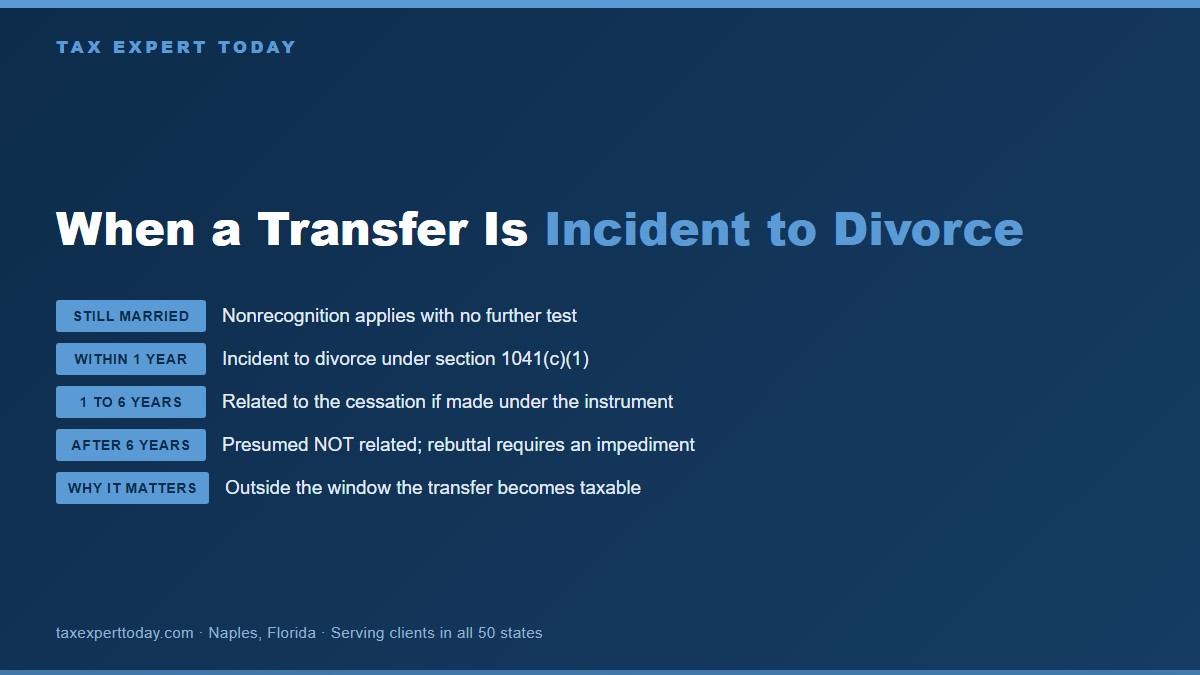
Timing is the part that gets missed. A transfer qualifies as incident to divorce if it occurs within one year after the marriage ends, or if it is related to the cessation of the marriage. Q&A-7 of Temp. Treas. Reg. §1.1041-1T supplies the working test: a transfer made pursuant to a divorce or separation instrument and occurring not more than six years after the marriage ceases is treated as related to the cessation. Outside those windows the transfer is presumed not related, and the presumption may be rebutted only by showing that a legal or business impediment, such as a genuine valuation dispute, delayed it and that the transfer happened promptly once the impediment was removed. Equity awards test these windows more than most assets, because option and RSU tranches can vest years after the decree, a problem our guide to dividing stock options in divorce addresses.
| When the transfer occurs | Status under §1041 | What has to be shown |
|---|---|---|
| While still married | Nonrecognition applies | Nothing beyond the spousal relationship |
| Within 1 year after the marriage ends | Incident to divorce, §1041(c)(1) | Nothing further; the one year test is mechanical |
| Between 1 and 6 years, under the instrument | Related to the cessation, Q&A-7 | The transfer is pursuant to a divorce or separation instrument |
| After 6 years, or outside the instrument | Presumed NOT related | Rebuttal: an impediment delayed it, and it closed promptly after removal |
For business owners the six year window matters more than it does for other assets, because valuation disputes and buy-sell provisions routinely push a company transfer past the one year mark. This is the first place business owner divorce taxes appear where none were expected, since a transfer that falls outside the window is a taxable event rather than a division of property. Documenting the impediment contemporaneously is far easier than reconstructing it years later under examination.
Does Buying Out a Spouse’s Share of the Business Trigger Tax?
A buyout paid by one spouse to the other for the business interest is not taxable, because it is a §1041 transfer rather than a sale. The principal is not income to the departing spouse and generates no deduction for the paying spouse. Interest on a deferred buyout is a different matter, and it is where business owner divorce taxes most often surprise both sides.
- Principal is tax free. The cash moves under §1041 and produces no gain even if the interest is worth many multiples of basis.
- Interest is ordinary income. A note paid over time carries interest, stated or imputed under IRC §483 and IRC §1274, and that interest is taxable to the recipient.
- The interest is rarely deductible. Interest on a note used to acquire an interest from a former spouse is generally personal interest for the payor, so the deduction that would offset the income often does not exist.
- Installment reporting does not apply. IRC §453 governs sales; a §1041 transfer is not a sale, so there is no installment gain to spread.
A deferred buyout is therefore the one common structure where business owner divorce taxes arise annually rather than once. The asymmetry is worth stating plainly. On a buyout note, the recipient reports interest income while the payor usually gets nothing back, so the parties should agree on the interest rate with that after tax result in view. Where a note is silent on interest, §483 imputes it anyway, which means the parties get the tax consequence without having negotiated it. Anyone budgeting for that income stream should also revisit estimated payments, and our quarterly estimated tax calculator is a reasonable starting point.
How Does a Corporate Redemption Change Business Owner Divorce Taxes?
This is the single largest trap in the area. If the company redeems the departing spouse shares rather than the remaining spouse buying them personally, §1041 may not shelter the payment at all. Treas. Reg. §1.1041-2 decides who is taxed, and the answer turns on whether the remaining spouse had a primary and unconditional obligation to purchase the stock.
- No constructive distribution. Under §1.1041-2(a)(1), the form is respected and the departing spouse is treated as receiving a redemption distribution, governed by IRC §302.
- Constructive distribution. Under §1.1041-2(a)(2), the stock is deemed transferred to the remaining spouse under §1041, then redeemed from that spouse, who bears the tax.
- §1041 never covers the corporate leg. The regulation is explicit that nonrecognition does not apply to the deemed transfer of stock from the remaining spouse to the redeeming corporation.
- A failed redemption is a dividend. Where §302 treats the redemption as a distribution under §302(d), it falls under IRC §301 for a C corporation or IRC §1368 for an S corporation.
The practical stakes are large. Funding a buyout from company cash feels natural to owners, because the company is where the money is. But routing the payment through the corporation converts what would have been a tax free §1041 transfer into a transaction that lands on somebody, and which spouse it lands on depends on how the settlement agreement was drafted rather than on where the cash came from. More business owner divorce taxes are created at this decision point than anywhere else in a closely held company division.
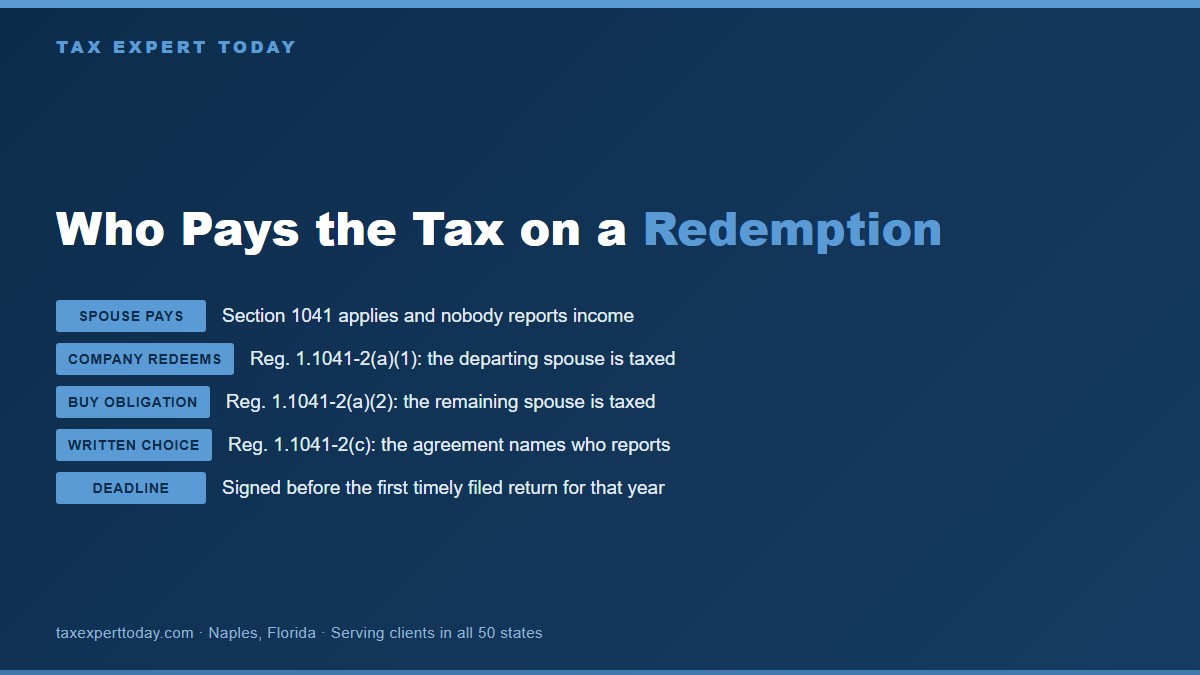
| How the buyout is funded | Governing rule | Who reports the income |
|---|---|---|
| Remaining spouse pays personally | IRC §1041 | Nobody; the transfer is tax free |
| Company redeems, no purchase obligation | Reg. §1.1041-2(a)(1), IRC §302 | The departing spouse |
| Company redeems, remaining spouse was obligated to buy | Reg. §1.1041-2(a)(2) | The remaining spouse |
| Either, with a conforming written agreement | Reg. §1.1041-2(c) | Whichever spouse the agreement names |
The regulation also supplies the fix, and it is the detail most commonly missed. Under §1.1041-2(c), the spouses may override the default analysis by written agreement. A divorce or separation instrument, or a valid written agreement between them, may expressly provide that both intend the redemption to be treated as a distribution to the departing spouse, or alternatively as a constructive distribution to the remaining spouse. The instrument must also state that it supersedes any other agreement concerning the purchase, sale, or redemption of that stock.
There is a hard deadline attached, and it is the one procedural date that decides business owner divorce taxes on a redemption. Under §1.1041-2(c)(3), the instrument must be effective, or the written agreement executed by both spouses, before the relevant spouse files the first timely filed federal income tax return for the year that includes the redemption date, and no later than that return due date including extensions. An agreement signed after that point does not work. Where a redemption has already happened and the parties are now arguing about who reports it, that filing date is the first thing to check.
What Happens to an S Corporation Election in a Divorce?
Transferring S corporation shares to a former spouse is normally safe, because an individual is an eligible shareholder. The election is at risk when the settlement routes shares somewhere else. Under IRC §1361(b)(1), an S corporation may not have a shareholder who is not an individual other than an estate or a qualifying trust, and may not have a nonresident alien shareholder.
- An ex-spouse is fine. An individual remains an eligible shareholder after the marriage ends, so a direct transfer does not threaten the election.
- A settlement trust may not be. Shares placed in trust terminate the election unless the trust is one of the types permitted under IRC §1361(c)(2), such as a qualified subchapter S trust or an electing small business trust.
- A nonresident alien spouse is disqualifying. IRC §1361(b)(1)(C) bars a nonresident alien shareholder outright, and IRC §1041(d) separately denies nonrecognition on the transfer.
- One class of stock still applies. A settlement that gives one spouse preferential distribution rights can create a second class of stock and end the election.
The trust point deserves emphasis because it is counterintuitive. Placing shares in trust for the benefit of a former spouse or the children looks conservative, and in family law terms it often is. In tax terms it can silently terminate the S election, converting the company to a C corporation with an entity level tax, which is the most severe of the business owner divorce taxes discussed in this guide because it is permanent and affects future years rather than the year of the divorce. If a trust is contemplated, the qualified subchapter S trust or electing small business trust election has to be made properly and on time.
Allocation of the year income is the other S corporation question. IRC §1377(a)(1) allocates each item pro rata across the days of the year and then across the shares outstanding each day, which means a spouse who leaves in March is allocated income earned in November. IRC §1377(a)(2) permits an election to treat the year as two taxable years, closing the books on the termination date, but only where the shareholder terminates the entire interest and all affected shareholders and the corporation agree. Where the shares went to the corporation in a redemption, everyone who was a shareholder during the year counts as an affected shareholder. Our guide to S corp reasonable compensation covers the related payroll questions in more depth.
What Happens to Suspended Losses When a Business Interest Transfers?
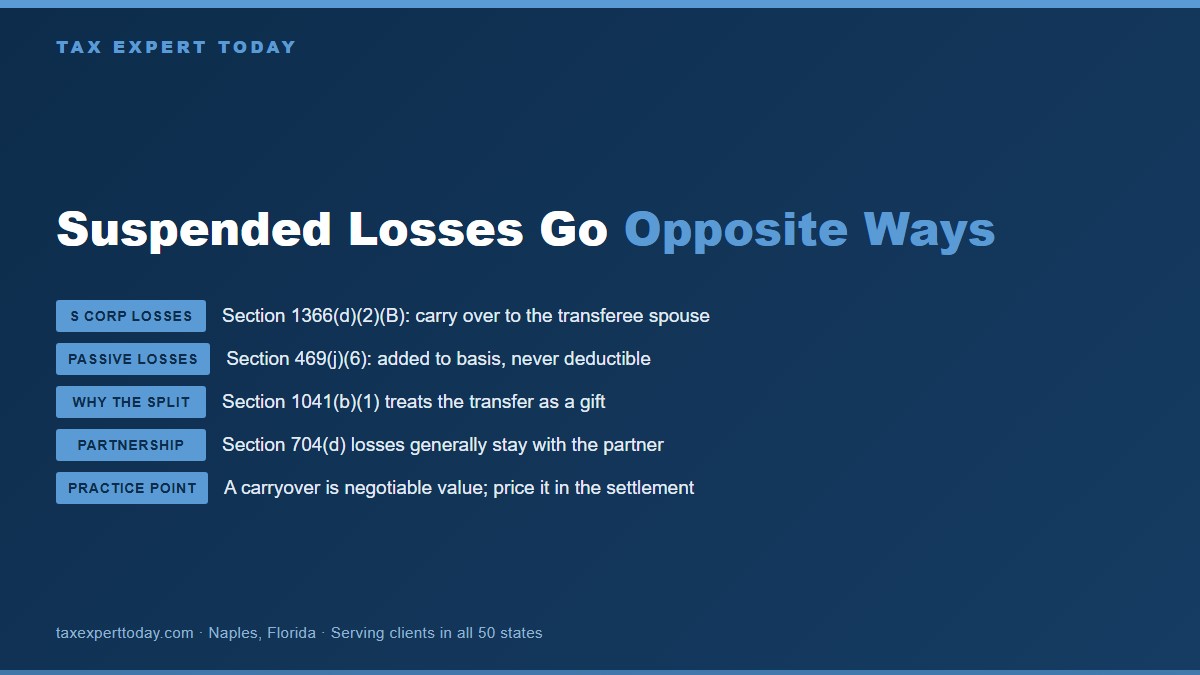
Two different suspended loss regimes produce opposite answers, and confusing them is expensive. Suspended S corporation losses follow the stock to the recipient spouse. Suspended passive activity losses do not; they are added to the basis of the transferred interest and are never deductible by the spouse who generated them.
- S corporation basis losses transfer. IRC §1366(d)(2)(B) provides that on a §1041(a) transfer of S corporation stock, losses disallowed for lack of basis are treated as incurred with respect to the transferee.
- Passive losses do not transfer as deductions. Because §1041(b)(1) treats the transfer as a gift, IRC §469(j)(6) increases the basis of the interest by the suspended passive losses and provides that those losses are not allowable as a deduction.
- Nonrecognition blocks the usual release. Suspended passive losses are ordinarily freed on a fully taxable disposition, and a §1041 transfer is not one.
- The value is real either way. A suspended loss carryover is a negotiable economic item and belongs in the settlement schedule alongside the assets.
| Type of suspended loss | Authority | Result on a §1041 transfer |
|---|---|---|
| S corporation loss disallowed for lack of basis | IRC §1366(d)(2)(B) | Carries over to the transferee spouse and remains usable |
| Passive activity loss under §469 | IRC §469(j)(6) via §1041(b)(1) | Added to the basis of the interest; not deductible |
| Partnership loss limited by basis | IRC §704(d) | Generally tied to the partner and lost on transfer; confirm case by case |
A spouse leaving with a large suspended passive loss carryover on a rental or non-participating business interest should understand that the carryover does not travel as a deduction. It increases the basis of what is handed over, which benefits the recipient rather than the person who funded the losses. That is a fair trade only if the settlement priced it. Suspended losses are the quietest of the business owner divorce taxes issues, because nothing appears on a return in the year of the divorce and the cost surfaces only when the losses are later needed.
How Is an LLC or Partnership Interest Handled in a Divorce Buyout?
The transfer itself is sheltered by §1041 exactly as stock is, but the entity can change character underneath it. When a two member LLC becomes a single member LLC, the partnership terminates for federal tax purposes and the entity becomes disregarded, which ends a filing obligation and starts a different one.
- The partnership terminates. Rev. Rul. 99-6 holds that a two member LLC terminates under IRC §708(b)(1)(A) when one member acquires the other entire interest.
- A final Form 1065 is due. The partnership year closes on the termination date and a short year final return is required.
- Reporting changes going forward. A single member LLC is disregarded by default, so the activity moves onto the remaining owner personal return.
- Liabilities matter. A shift in the share of entity liabilities is treated as a deemed cash distribution under IRC §752, which can reduce basis and, in some structures, produce gain.
Rev. Rul. 99-6 addresses a purchase between unrelated parties rather than a divorce transfer, and the two interact in a way worth flagging. In a sale the departing member reports gain under IRC §741 and the buyer takes a cost basis in the assets. In a §1041 divorce transfer the departing spouse recognizes nothing and basis carries over instead. The entity level consequence, that the partnership ends and the LLC becomes disregarded, still follows. Practitioners should treat the filing consequence as settled and the basis mechanics as fact dependent. Partnership and LLC structures therefore generate business owner divorce taxes questions at the entity level even when the transfer between the spouses produced no gain at all.
One further trap sits in IRC §1041(e). Where property is transferred in trust and the liabilities assumed plus the liabilities to which the property is subject exceed the total adjusted basis, nonrecognition does not apply to that excess and gain is recognized. A leveraged partnership or LLC interest transferred into a trust is precisely the fact pattern that provision was written for, and it is easy to walk into while trying to be careful. If the business is being wound down rather than divided, our guide to closing a business covers the termination filings in more detail.
Do Owner Compensation and Payroll Affect Business Owner Divorce Taxes?
Yes, and the exposure runs in both directions. Owner compensation set during a divorce is examined by two different audiences with opposite incentives: the family court looks at income available for support, and the IRS looks at whether compensation is reasonable under IRC §162(a)(1). A number chosen to satisfy one can create a problem with the other.
- Compensation must be reasonable. IRC §162(a)(1) allows a deduction for a reasonable allowance for salaries actually rendered, which cuts against both inflated and suppressed figures.
- S corporation owners face the opposite pressure. Understating wages to reduce apparent income invites a payroll reclassification, with employment tax and penalties.
- Personal expenses in the company are visible. Discovery in a divorce routinely surfaces them, and the same records support a constructive distribution analysis.
- The return is a sworn document. Filing positions taken to influence a support calculation carry consequences well beyond the divorce.
Compensation is where business owner divorce taxes and the family law record intersect most directly. Stated neutrally, the point is that the tax return and the financial affidavit are read side by side. Where they disagree, someone has to explain the difference, and the explanation is usually more costly than consistency would have been. This is one of the places where having the tax advisor and the family law attorney talking to each other before positions are locked in tends to pay for itself.
Estimated tax is the practical companion issue, and it is the business owner divorce taxes item most often discovered in April rather than in negotiation. A spouse who has been covered by withholding on a joint return may find that after the divorce the income arrives as a distribution with no withholding at all. Where joint estimated payments were made for the transition year, the parties need to agree how those payments are allocated, because the IRS will not divide them by agreement it has not been told about.
How Does the Buyout Allocation Change the Tax Result?
Where a buyout is structured as a purchase rather than a §1041 transfer, the allocation of the price across asset classes determines the character of the income. Amounts allocated to goodwill are capital in nature, while amounts allocated to a covenant not to compete are ordinary income to the recipient and amortized by the payor over fifteen years under IRC §197.
- Covenants produce ordinary income. A payment for a promise not to compete is compensation for a contractual undertaking, not proceeds of a capital asset.
- Goodwill is generally capital. The characterization is more favorable to the recipient and less favorable to the payor.
- Amortization runs fifteen years either way. IRC §197 assigns a fifteen year recovery period to both purchased goodwill and a covenant not to compete.
- Allocations should be consistent. Where an applicable asset acquisition occurs, both parties report the allocation, and IRS Form 8594 is the reporting vehicle.
Allocation is one of the few business owner divorce taxes questions where the parties can improve the combined result rather than simply shift it, because ordinary and capital treatment are priced differently on each side. The parties negotiate the split of the price, and their interests are genuinely opposed: the payor prefers ordinary deductions where available, and the recipient prefers capital treatment. That tension is normal and is best resolved explicitly in the agreement rather than left for two separate tax preparers to guess at a year later. Our guide to selling a business taxes covers the allocation mechanics in a sale context, and much of that analysis carries over. For owners weighing entity structure as part of the reorganization, LLC versus S corp comparisons set out the tradeoffs.
How Do Florida Rules Affect Business Owner Divorce Taxes?
Florida has no personal income tax, so a Florida resident faces only the federal analysis described above, and the §1041, §1.1041-2, and §1366 rules apply unchanged. What Florida law changes is what enters the marital estate in the first place, which is governed by Fla. Stat. §61.075 rather than by the Internal Revenue Code.
- No state layer on the transfer. A Florida resident has no state income tax consequence on a business interest transfer or a later distribution.
- Equitable distribution controls the split. Fla. Stat. §61.075 governs which assets are marital and how they are distributed.
- Enhancement in value can be marital. Appreciation in a separately owned business attributable to marital effort may be brought into the estate.
- Residency has to be real. A recent move does not settle the question by itself, and the facts are what establish domicile.
For business owner divorce taxes Naples clients, the most common Florida specific wrinkle is not the income tax at all, since there is none. It is that a business built during the marriage while one spouse ran it and the other supported the household often has a marital component that the owner did not expect, which increases the size of the buyout and therefore the size of every tax question above. Readers weighing a relocation as part of the transition may find our guide to moving to Florida taxes useful.
Business Owner Divorce Taxes Help Naples and Southwest Florida
Tax Expert Today LLC works from Naples, Florida as the tax side of a divorce team. We do not practice family law, and we do not advise on custody, support, or how the marital estate should be divided. What we do is model business owner divorce taxes on a proposed structure before it is signed, review the buyout and redemption provisions for the tax consequences they actually create, and coordinate with your family law attorney so the tax result matches the deal that was negotiated.
For divorce tax Naples FL clients who own a company, the pattern we see most often is a settlement that is complete on the family law side and silent on the tax side. Typical engagements include modeling a redemption against a cross-purchase, drafting the §1.1041-2(c) language and confirming it is executed before the filing deadline, checking whether a proposed trust would end an S election, quantifying suspended losses, and preparing the transition year returns once the division is complete. You can read more on our divorce tax consulting page, and about the broader practice at Naples FL tax planning.
Tax Expert Today LLC
11983 Tamiami Trail N, Naples, FL 34110
Phone: (239) 441-2005
Hours: Monday through Friday, 10:00am to 5:00pm ET
Does a Naples divorce change the business owner divorce taxes analysis? Not the federal analysis. Florida has no personal income tax, so a Florida resident owner faces only federal tax, and §1041, Treas. Reg. §1.1041-2, and the S corporation rules apply exactly as described above. What Florida changes is the size of the marital interest being bought out, under Fla. Stat. §61.075, and in particular whether appreciation in a business one spouse owned before the marriage was enhanced by marital effort.
When to Engage a Professional
Not every divorce involving a business needs a tax advisor. Where one spouse keeps a small service company, the other has no interest in it, and the buyout is paid personally in cash, §1041 does the work and the business owner divorce taxes for that year are effectively zero. Professional involvement tends to earn its cost when one or more of the following is present.
- The company is funding the buyout. A redemption raises the Treas. Reg. §1.1041-2 question, and the answer depends on drafting rather than intent.
- There is an S corporation in the structure. The election, the trust rules, and the §1377 allocation choice all have deadlines.
- Suspended losses exist. S corporation and passive losses go opposite directions, and both are negotiable value.
- The buyout is paid over time. Imputed interest under §483 creates income that is often not deductible to the payor.
- A trust is contemplated. Both the S corporation eligibility rules and IRC §1041(e) become live.
- A spouse is a nonresident alien. §1041(d) removes nonrecognition entirely and the transfer becomes taxable.
Where a joint return from the marriage is already under IRS examination, or a balance is owed on one, the liability question is separate from the division of the business, and our guide to innocent spouse relief addresses it. Where penalties have been assessed on a late or amended filing during the divorce, reasonable cause penalty abatement may be available. Readers working through other parts of a divorce will find the related mechanics in our guides to divorce house buyout taxes, QDRO taxes, alimony taxes after divorce, divorce filing status, and Form 8332. Owners who expect the business to absorb the legal bill for the divorce should first read our guide to whether divorce legal fees are tax deductible, which explains why the origin of the claim usually makes those fees personal.
This guide describes general business owner divorce taxes rules and is not advice on any particular situation. The application of §1041 and Treas. Reg. §1.1041-2 depends on the specific facts, the governing instrument, and the entity structure, and outcomes vary accordingly.
Frequently Asked Questions
Is transferring a business to my spouse in a divorce taxable?
No. IRC §1041(a) provides that no gain or loss is recognized on a transfer to a spouse, or to a former spouse where the transfer is incident to the divorce. The recipient takes the transferor adjusted basis under §1041(b)(2), so the built in gain moves rather than disappearing.
What is the deadline for the §1.1041-2 redemption agreement?
Under Treas. Reg. §1.1041-2(c)(3), the divorce or separation instrument must be effective, or the written agreement executed by both spouses, before the relevant spouse files the first timely filed federal income tax return for the year that includes the redemption date, and no later than that return due date including extensions.
Can the company buy out my spouse instead of me doing it personally?
It can, but the tax consequence changes. A redemption is analyzed under Treas. Reg. §1.1041-2, and depending on whether the remaining spouse had a primary and unconditional obligation to purchase the stock, either spouse can end up reporting the income. A conforming written agreement under paragraph (c) lets the parties choose.
Do suspended losses transfer to my former spouse?
It depends on the type. Suspended S corporation losses disallowed for lack of basis carry over to the transferee under IRC §1366(d)(2)(B). Suspended passive activity losses do not carry over as deductions; under IRC §469(j)(6) they are added to the basis of the transferred interest.
Will transferring S corporation shares in a divorce end the S election?
Not if the shares go to the former spouse directly, because an individual is an eligible shareholder. The election is at risk if the shares go to a trust that is not a permitted trust under IRC §1361(c)(2), or to a spouse who is a nonresident alien, which IRC §1361(b)(1)(C) prohibits.
What happens to our two member LLC when one of us leaves?
Under Rev. Rul. 99-6, the partnership terminates when one member acquires the entire interest of the other, so a final short year Form 1065 is due and the LLC becomes a disregarded entity reported on the remaining owner return.
Is the interest on a business buyout note taxable?
Yes. The principal moves tax free under §1041, but interest, whether stated or imputed under IRC §483 and IRC §1274, is ordinary income to the recipient, and it is generally not deductible to the payor because it is personal interest.
Does a Naples divorce change the business owner divorce taxes analysis?
Not federally. Florida has no personal income tax, so only the federal rules apply. Florida law affects the size of the marital interest through Fla. Stat. §61.075, including whether marital effort enhanced the value of a business one spouse owned beforehand.
Published August 31, 2026 by Dr. Pellumb Kabashi « Back to Learning Center
Have a question this article touches on?
Tax Expert Today LLC, based in Naples, Florida and serving clients across the United States.
Schedule a Consultation (239) 441-2005