
By Dr. Pellumb Kabashi, DBA, MBA, CES, CFE, EA
Founder, Tax Expert Today LLC · Tax advisors, enrolled agents, CPAs, and attorneys · Serving clients in all 50 states
Quick Answer: Fractional CFO cost is most usefully understood as a fraction of the fully loaded cost of a full-time chief financial officer. A full-time CFO carries a base salary that market surveys place in the range of roughly $250,000 to $450,000, plus employer payroll taxes, benefits, bonus, equity, and recruiting overhead that push the true annual cost well above the headline salary. A fractional engagement replaces that fixed overhead with senior financial leadership sized to what the business actually needs, and the fee is scoped and quoted after a consultation rather than published as a standard rate.
Business owners weighing senior financial leadership usually start with the wrong question. The question is not simply what a fractional CFO costs. The more useful question is what a full-time CFO truly costs once every line of overhead is counted, and whether the business needs that much fixed executive capacity in the first place. This guide walks through both sides of that comparison, using hypothetical math to show how the numbers behave. It also explains where the tax treatment fits, because how you engage financial leadership affects deductibility and how owner compensation is planned. All figures below are illustrative, and any engagement fee is scoped and quoted after a consultation.
What Does a Fractional CFO Cost?
A fractional CFO cost is the fee a business pays for part-time, senior financial leadership sized to the scope of work rather than a full-time salary. Instead of carrying a fixed executive on payroll, the business buys a defined set of CFO-level contributions, and the fee scales with how much the engagement covers. Tax Expert Today does not publish a standard rate because scope varies by business; the fee is quoted after a consultation.
The reason a fractional model exists is straightforward. Many companies need CFO-level judgment on cash, margins, financing, and planning, but they do not need a full-time executive sitting in that chair five days a week. A fractional engagement lets the business match the cost to the decisions it actually requires. When the work is a monthly close review, a 13 week cash flow forecast, and a quarterly reforecast, the engagement is smaller. When the business is raising capital, integrating an acquisition, or rebuilding its reporting from the ground up, the scope expands. Because the fee follows scope, a business is not paying for executive capacity it will not use. For a closer look at the work itself, see what a fractional CFO does month to month.
This is the core contrast with a full-time hire. A salaried CFO is a fixed cost that does not shrink in quiet quarters. A fractional engagement is a variable cost that can be scoped up when a financing round or a turnaround demands it, and scoped back down once the project is complete. For a discussion of what those contributions look like month to month, see our guide to the quarterly financial review a CFO runs.
How Does a Full-Time CFO Salary Compare?
A full-time CFO salary is only the visible part of the cost. Market compensation surveys place experienced CFO base pay in a range of roughly $250,000 to $450,000, and the U.S. Bureau of Labor Statistics classifies these roles within its financial managers category, one of the higher-paid management occupations. Base salary, however, understates the real annual commitment once employer taxes and benefits are layered on.
Every dollar of wages an employer pays carries statutory payroll tax. Under IRC §3111, the employer owes 6.2 percent for Social Security up to the annual wage base and 1.45 percent for Medicare on all wages, and under IRC §3301 the employer owes federal unemployment tax as well. On top of payroll taxes sit health coverage, a retirement plan match, an annual bonus, long-term or equity incentives, and the one-time cost of recruiting and onboarding an executive. These are the costs that turn a headline salary into a much larger loaded number.
What Overhead Comes With a Full-Time CFO?
The overhead that comes with a full-time CFO includes employer payroll taxes, benefits, bonus, equity or long-term incentives, and one-time recruiting and severance costs. Together these commonly add a meaningful percentage on top of base salary, so the fully loaded annual cost of the role runs well above the salary figure a business first considers.
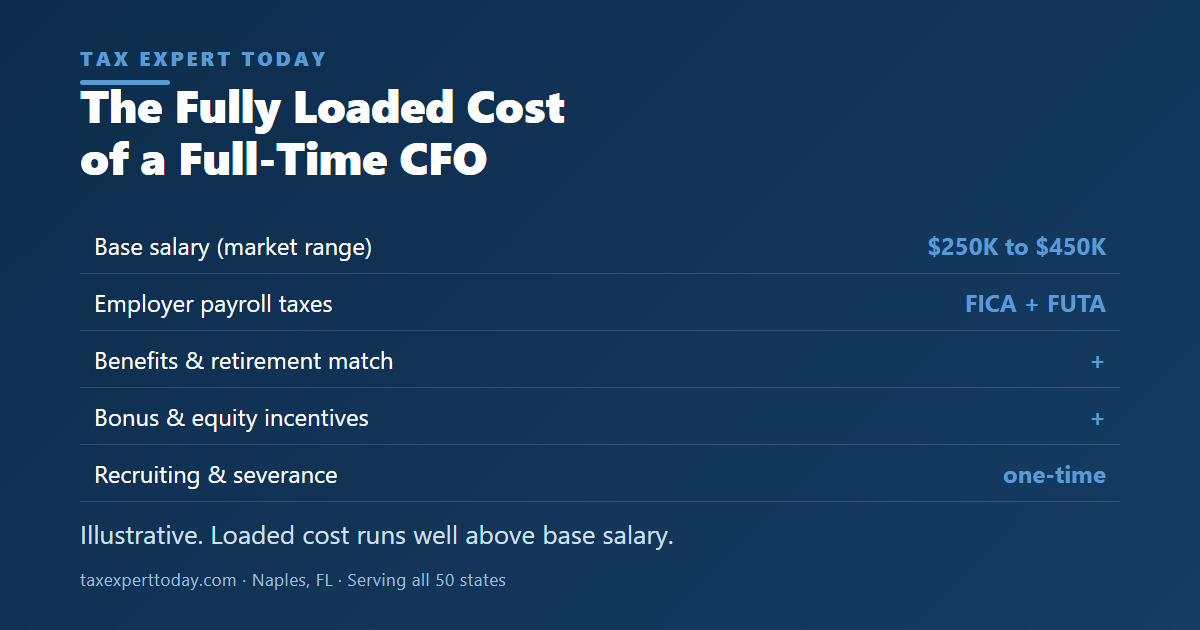
The table below is an illustrative build-up for a hypothetical CFO hired at a $300,000 base, a figure inside the market range noted above. The percentages shown are illustrative planning assumptions, not the firm’s rates, and actual amounts depend entirely on the employer’s benefit design and incentive plan.
| Cost component (illustrative) | Basis | Illustrative annual amount |
|---|---|---|
| Base salary | Within market range | $300,000 |
| Employer payroll taxes | Social Security (capped at wage base) + Medicare 1.45% + FUTA | ~$16,000 |
| Health, retirement match, other benefits | Illustrative 25% of base | $75,000 |
| Annual bonus | Illustrative 20% target | $60,000 |
| Long-term or equity incentive | Illustrative | $30,000 |
| Recruiting and onboarding | One-time, shown annualized | $15,000 |
| Illustrative loaded annual cost | Sum of the above | ~$496,000 |
The point of the table is not the exact total, which will differ for every employer. The point is the gap between the $300,000 salary a business budgets for and the roughly $496,000 the role can actually cost once overhead is counted. That gap is the fixed commitment a business takes on with a full-time hire, and it does not adjust downward in a slow year. A severance obligation, if the role does not work out, adds another layer of cost that a scoped engagement does not carry.
What Drives Fractional CFO Cost Up or Down?
Fractional CFO cost moves with the scope of the engagement. The main drivers are how many contributions the business needs, how often, and how complex its finances are. A monthly reporting and cash-review engagement sits at one end; an active capital raise, an acquisition, or a full reporting rebuild sits at the other. Because the fee follows scope, the business controls it by defining the work.
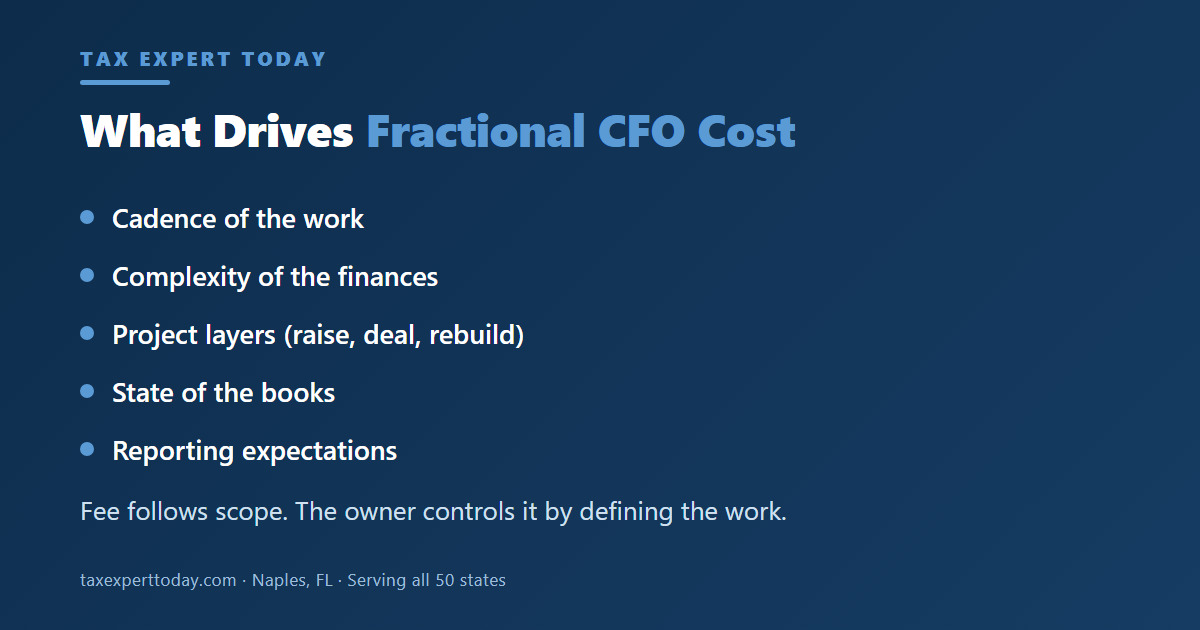
The factors below tend to expand or contract an engagement:
- Cadence of the work. A monthly close review and quarterly reforecast is a lighter scope than a weekly cash-management and board-reporting cadence.
- Complexity of the finances. Multiple entities, multi-state operations, inventory, or foreign activity add work compared with a single-entity service business.
- Project layers. A financing round, an acquisition, a systems migration, or a turnaround are defined projects that raise scope while they run and release it when they finish.
- State of the books. Clean, current accounting lowers scope; a backlog that must be rebuilt before analysis can begin raises it.
- Reporting expectations. A lender covenant package or investor reporting requirement adds recurring deliverables.
Because these levers are visible and adjustable, a fractional engagement gives the owner direct control over cost in a way a fixed salary does not. When the heavy project ends, the scope, and the fee, can step back down.
Is a Fractional CFO Tax-Deductible, and How Does It Affect Owner Pay?
Fees paid to a fractional CFO are generally deductible as an ordinary and necessary business expense under IRC §162, in the same way other professional and advisory fees are, subject to the usual documentation and business-purpose requirements. A full-time CFO’s wages are also deductible, but they arrive bundled with employer payroll tax and benefits obligations, and the classification of the relationship matters.
Whether financial leadership is engaged as an outside firm or hired as an employee is not a labeling choice; it follows the facts under the IRS independent contractor or employee analysis. A genuine fractional engagement with an outside advisory firm is a service arrangement, so the business deducts the fee and does not carry the payroll-tax and benefits load that comes with an employee.
There is a planning dimension as well. For owners of S corporations, officer compensation must be reasonable under the IRS wage compensation for S corporation officers guidance, and a CFO-level advisor often helps design owner pay so that salary, distributions, and retirement contributions work together rather than at cross purposes. This is where financial leadership and tax planning meet, and it is a reason many businesses want the two coordinated by advisors who see both sides. How that owner wage is actually set, and how it interacts with the Section 199A deduction and the retirement plan, is covered in our guide to S corp reasonable compensation.
The same reasonableness analysis that governs owner compensation also governs rent an entity pays its owner, which is the central issue in the Augusta Rule arrangements many closely held companies use for meeting space.
How Do You Decide Between a Fractional and a Full-Time CFO?
The decision between a fractional and a full-time CFO comes down to how much dedicated executive capacity the business genuinely needs and whether the value of CFO-level decisions justifies a fixed six-figure commitment. A full-time role fits a company large or complex enough to keep a CFO busy every day. A fractional model fits a company that needs the judgment but not the full-time overhead.
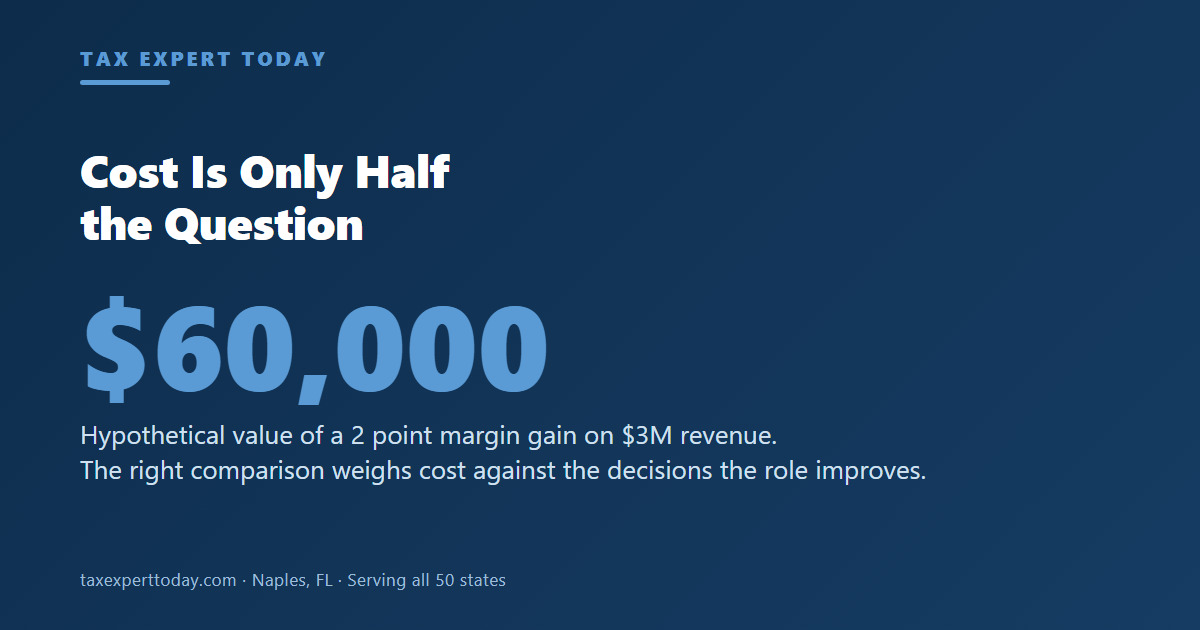
One way to frame the value side is to look at what better financial decisions are worth to the business, not just what they cost. CFO-level work often shows up in margin. The table below is a hypothetical illustration of what a modest margin improvement is worth on different revenue bases; it is not a promise of results, which depend entirely on the specific business.
| Annual revenue (hypothetical) | Value of 1 margin point | Value of 2 margin points |
|---|---|---|
| $3,000,000 | $30,000 | $60,000 |
| $6,000,000 | $60,000 | $120,000 |
| $10,000,000 | $100,000 | $200,000 |
These figures are arithmetic, not a forecast. Whether a business actually captures a margin point depends on its pricing, its costs, and dozens of decisions a CFO can influence but not guarantee. Our guide to how to improve gross margin works through the arithmetic behind each of those levers. The exercise simply shows why the cost question is incomplete on its own: the right comparison weighs the fully loaded cost of a full-time hire against a scoped engagement, and both against the value of the decisions the role is meant to improve. For businesses that do not need a full-time executive, a fractional model can deliver the judgment without the fixed overhead. Our fractional CFO service page describes how an engagement is scoped.
Fractional CFO Help in Naples & Southwest Florida
Tax Expert Today LLC provides fractional CFO and tax-integrated financial leadership to business owners in Naples and across Southwest Florida, as well as nationwide. The firm is multidisciplinary, with tax advisors, enrolled agents, CPAs, and attorneys, so financial-leadership decisions and business consulting and tax planning are coordinated rather than handled in separate silos. Every engagement is scoped to the business and quoted after a consultation. The office is at 11983 Tamiami Trail N, Naples, FL 34110, and appointments are available Monday through Friday, 10am to 5pm ET, at (239) 441-2005. Because the firm serves clients in all 50 states, a local Southwest Florida business and a company operating across several states can be supported the same way.
Frequently Asked Questions
What does a fractional CFO cost compared with a full-time CFO?
A fractional CFO cost is a fraction of the fully loaded cost of a full-time CFO, because the fee follows the scope of work rather than a fixed salary. A full-time CFO carries a base salary market surveys place near $250,000 to $450,000, plus payroll taxes, benefits, bonus, and equity that push the true cost higher. A fractional fee is scoped and quoted after a consultation.
Why is a full-time CFO more expensive than the salary suggests?
Because the salary is only the visible cost. Employer payroll taxes under IRC §3111 and IRC §3301, health and retirement benefits, an annual bonus, equity incentives, and one-time recruiting and severance all sit on top of base pay. Together they can lift the fully loaded annual cost well above the headline salary figure.
Are fractional CFO fees tax-deductible?
Fees for a genuine fractional CFO engagement are generally deductible as ordinary and necessary business expenses under IRC §162, subject to documentation and business-purpose requirements. Because the arrangement is a service engagement rather than employment, the business does not carry the employer payroll-tax and benefits load that comes with a salaried hire. Deductibility depends on the facts of the arrangement.
When does a business actually need a full-time CFO?
A full-time CFO generally fits a company large or complex enough to keep the role occupied every day, such as a business with multiple entities, heavy financing activity, or investor and board reporting that demands daily executive attention. A company that needs the judgment but not the full-time capacity is often a better fit for a fractional model.
Where can I get help deciding between a fractional and full-time CFO in Naples, FL?
Tax Expert Today LLC advises business owners in Naples, across Southwest Florida, and nationwide on fractional CFO engagements and how they integrate with tax planning. The multidisciplinary team can help scope the right level of support. Reach the Naples office at 11983 Tamiami Trail N, Naples, FL 34110, or (239) 441-2005, Monday through Friday, 10am to 5pm ET.
When to Engage a Professional
If you are weighing whether to hire a full-time CFO or engage fractional financial leadership, the decision is easier once the true cost of each path is on the table alongside the decisions the role is meant to improve. A conversation about your revenue, your entity structure, and where your finances are getting stuck is usually more productive than a rate comparison in the abstract. Because the fee follows scope, the first step is defining the work. To discuss how a fractional CFO engagement would be scoped for your business, and how it would coordinate with your tax planning, contact Tax Expert Today LLC at (239) 441-2005. Outcomes depend on individual facts, and any engagement is scoped and quoted after a consultation.
Published July 17, 2026 by Dr. Pellumb Kabashi « Back to Learning Center
Have a question this article touches on?
Tax Expert Today LLC, based in Naples, Florida and serving clients across the United States.
Schedule a Consultation (239) 441-2005