
By Dr. Pellumb Kabashi, DBA, MBA, EA, CFE, CES
Founder, Tax Expert Today LLC · Tax advisors, enrolled agents, CPAs, and attorneys · Serving clients in all 50 states
Quick Answer: An IRS CP23 notice means the IRS changed your return because the estimated tax payments you claimed do not match the payments posted to your account, and the change left a balance due. Compare every payment on the notice with your bank records, check any prior year credit, and call the number on the notice by the date shown if a payment is missing. Call (239) 441-2005 for a free consultation.
What is an IRS CP23 notice?
An IRS CP23 notice is a letter telling you the IRS corrected your individual return because the estimated tax payments claimed on it did not match the payments the IRS had posted to your account. The correction lowered your payment credits, so the return now shows a balance due of $1 or more, plus any penalty and interest.
- It is a return correction. The IRS has already changed the payments line of your return before the letter is printed.
- It is about payments, not income. The tax on your return is usually unchanged; the credit for what you paid is what moved.
- It is a bill. The notice asks you to pay the balance by the date shown or to make payment arrangements.
- It can be wrong. A payment that exists but sits in the wrong place is the most fixable problem in the IRS notice system.
The IRS describes the notice in two sentences on its CP23 page: the agency corrected your return because it found a difference between the estimated tax payments on the return and the amount it posted to your account, and you have a balance due because of those changes. The page adds that the notice may also cover other changes made while processing the return, which is why an IRS CP23 notice can carry a second correction on top of the payment discrepancy.
Inside the IRS, the notice has a longer name. IRM 21.3.1.6.16 titles it “Estimated Tax Credits Discrepancy, We Changed Your Return to Match Your Credits or Payments Posted to Your Account, Balance Due.” The manual says it notifies taxpayers of a discrepancy between estimated tax credits claimed on the return and credits posted to the account, resulting in a balance due of $1.00 or more, and that the notice also notifies the taxpayer of a math error. The code appears in the upper right corner of the letter, and IRS systems sometimes print it as CP 23.
For most people the IRS CP23 notice arrives a few weeks after filing, at the moment they expected a refund or a zero balance. A self-employed taxpayer, a retiree with investment income, or a couple who pays quarterly estimates claims four payments on the return, and the IRS finds only three. Sometimes the fourth payment is gone. Far more often it is sitting under a spouse’s Social Security number, posted to the wrong tax year, or stuck in a prior year credit that never carried forward. This guide explains how to tell which of those happened and how each one is fixed.
Why did I get an IRS CP23 notice if I made my estimated payments?
You usually got a CP23 because a payment you made is not on the tax year and Social Security number the return claimed. Common causes are a payment under the other spouse’s number, the wrong year, a prior year credit that did not carry forward, or a typo on the estimated tax line.
- Spouse’s number: a joint estimated payment entered under the secondary taxpayer’s Social Security number.
- Wrong year: a Direct Pay, EFTPS, or card payment tagged to the prior or following tax year.
- Prior year credit: an amount you elected to carry forward that was reduced, offset, or never posted.
- Entry error: a number typed on the estimated tax line that was never paid, a pattern the IRS calls the most common cause.
The IRS FAQ on the CP23 page addresses the most confusing version head on. To the question “I do not pay estimated taxes, why did I get this notice,” the IRS answers that the most common cause is an incorrect entry on the estimated tax line of the return. Software that carries last year’s numbers forward, a preparer who keys the balance due paid with an extension onto the wrong line, or a taxpayer who types the refund amount into the payments field can all produce a claimed estimated payment that never existed.
For taxpayers who do pay quarterly, the causes are mechanical rather than mysterious. Every estimated payment is posted by tax year and by taxpayer identification number. The return claims a total. If the payments posted to that year and that number add up to less than the total claimed, the IRS computer flags the difference before the return settles. The Internal Revenue Manual explains what happens next, and the sequence matters because it tells you what the IRS already searched before mailing the notice.
Under IRM 21.5.6.4.7, when a return claims more estimated tax credits than are available, the account receives a D- freeze. The system then automatically checks for additional credits under the spouse’s Social Security number, and the freeze releases three cycles after the return posts. If no additional credits are located, the system issues an IRS CP23 notice for a balance due, a CP24 for a remaining overpayment, or a CP25 for an even balance. In other words, the computer has already looked in the most common hiding place before you see the letter. When a joint payment under the spouse’s number does not move on its own, there is usually a specific reason, and the reasons are listed later in this guide.
What does an IRS CP23 notice show, and how do you read it?
An IRS CP23 notice shows the payments you claimed, the payments the IRS posted with their dates and amounts, the difference, any other change made to the return, the penalty and interest added, and the balance due with a pay by date. The section titled “What we changed on your return” is the part to read first.
- Payment list: each estimated payment the IRS credited, with its posting date and amount.
- Prior year credit line: any overpayment applied from last year’s return.
- Change summary: the claimed figure, the posted figure, and the amount of the reduction.
- Balance and deadline: the tax, penalty, and interest due, and the date to pay or call.
The IRS instructions are simple: read the notice carefully to see what was changed on your return and how those changes affected your balance, then compare the payments on the notice to your records. The CP23 page lists two specific checks: verify that the IRS listed all your estimated tax payments, and check the payments it applied, if any, from the prior year. Those two checks map directly to the two places a missing payment most often goes.
The payment list on the notice is the most valuable part of the letter because it shows you what the IRS found, not what you claimed. Line it up against your own record of the year: bank statements, Direct Pay confirmation emails, EFTPS acknowledgments with their 15 digit EFT numbers, card processor receipts, and cancelled checks front and back. A payment that appears on your bank statement but not on the notice is a misapplied or unprocessed payment. A payment that appears on neither is usually a payment that was never made.
| Part of the CP23 | What it tells you | What to compare it with |
|---|---|---|
| Payments we credited | Each estimated payment posted to the year, with dates | Bank statements, Direct Pay or EFTPS confirmations, cancelled checks |
| Amount applied from prior year | The overpayment carried forward from last year’s return, if any | Last year’s return, the line where you elected to apply the overpayment |
| Payments you claimed | The total from the estimated tax line of your return | Your copy of the return and your preparer’s worksheet |
| What we changed on your return | The reduction in credits and any other correction | Every line the notice names, one by one |
| Penalty and interest | Late payment penalty, interest, and any change to the estimated tax penalty | Form 2210 if you filed one; the original due date of the return |
| Amount due and pay by date | The balance and the date to pay or to call | Your calendar; the 21 day and 10 business day rules described below |
If the IRS CP23 notice lists a change that has nothing to do with payments, treat that as a separate math error correction. The notice can carry both. A combined notice deserves a careful read because, as explained in the math error section below, the payment correction and an ordinary math error are handled under different statutes with different abatement rights.
Where does a missing estimated tax payment usually go?
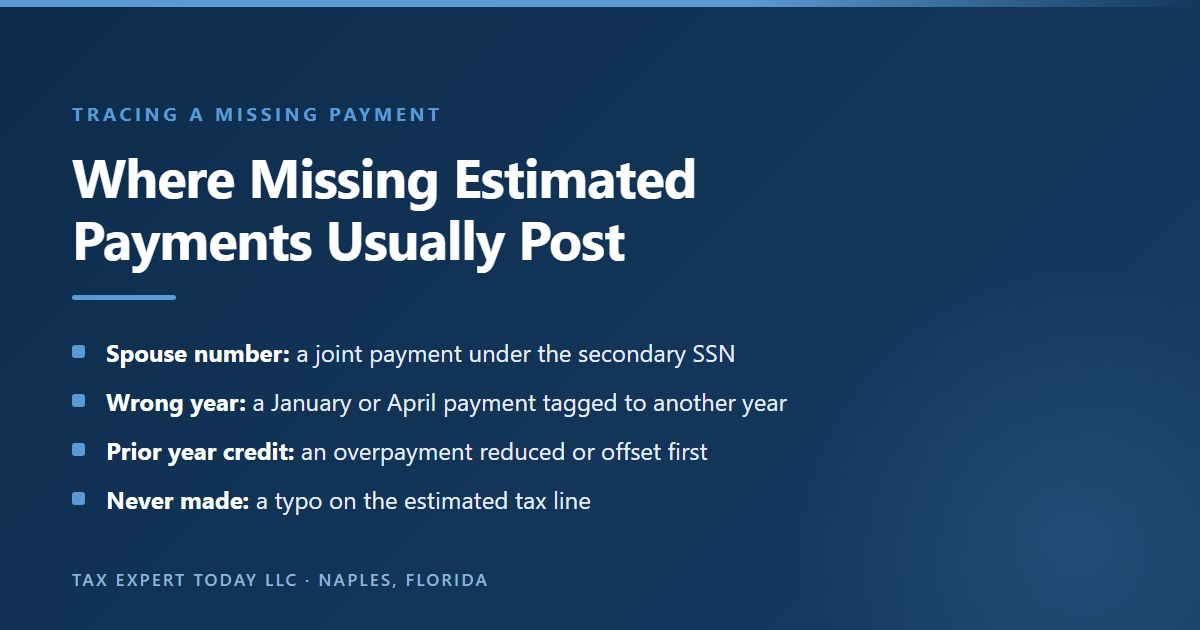
A missing estimated tax payment usually sits in one of five places: the spouse’s account under the secondary Social Security number, the prior or following tax year, the prior year module as an overpayment that never carried forward, a processing queue if the payment was recent, or nowhere because it was never made. Each place has a different fix.
- Spouse’s account: fixed by a credit transfer to the joint account.
- Wrong tax year: fixed by a credit transfer to the correct year, with the original payment date.
- Prior year module: fixed by tracing why the credit elect did not post.
- Never made: not fixable by research; the balance is owed.
The table below is the map most taxpayers need. It follows the order in which the IRS itself works these cases under IRM 21.3.1.6.16, which tells employees to review payment amounts and dates, research a missing payment or credit elect, transfer the credit if appropriate under IRM 21.5.8, and refer to the joint allocation rules if the taxpayer says the payments are under the spouse’s number.
| Where the payment went | Typical sign | Proof to gather | Usual fix |
|---|---|---|---|
| Spouse’s Social Security number | Joint return; one spouse paid from a personal account or entered their own number | Payment confirmation showing the number used; voucher copy | Credit transfer to the joint module (IRM 21.5.7.3.2.2, 21.5.8) |
| Prior tax year | A January payment for the fourth quarter tagged to the earlier year in Direct Pay | Direct Pay or EFTPS confirmation showing the year selected | Credit transfer to the correct year, keeping the original payment date |
| Following tax year | A late April payment meant for the current year posted as next year’s first quarter | Confirmation and the date the payment was scheduled | Credit transfer to the correct year |
| Prior year credit elect | The notice shows less applied from last year than you elected | Last year’s return and any notice that changed last year’s overpayment | Trace the prior year adjustment or offset; see the credit elect section |
| Still processing | Payment made within the last two or three weeks | Bank record showing the debit | Wait and recheck the account; then request a trace |
| Never made | No bank record, no confirmation | None | Pay or arrange to pay; correct your copy of the return |
Two of these causes deserve a word of caution. First, a payment posted to the following year is not lost, but the IRS will not move it backward just because you ask. Second, a prior year credit that did not carry forward often has a reason you did not see, such as an amended return, a math error on the earlier year, or an offset to another balance. Both are covered in their own sections below.
How do you check your estimated payments on an IRS account transcript?
Pull the account transcript for the tax year on the notice and for the years before and after it, for both spouses on a joint return. Estimated payments post as transaction code 660, later payments as 670, transfers as 666 and 667, and a prior year credit elect as 716 or 710. A payment missing from one module often appears in another.
- Online Account: the IRS CP23 page points taxpayers to Online Account to view payments and transcripts.
- Both spouses: pull the primary and the secondary taxpayer’s transcripts, not just the joint one.
- Three years: check the prior, the notice year, and the following year.
- Dates matter: the transcript shows the posting date that drives the estimated tax penalty.
An account transcript lists every transaction posted to one tax year for one taxpayer identification number. The CP23 page suggests visiting Online Account to view balances, make and view payments, and view tax transcripts, and its “tips for next year” section recommends verifying, before you file, that the estimated payments were applied to the year by viewing your tax account. That habit alone would prevent most CP23 notices.
Reading the transcript is easier with a short key. The codes below are the ones the IRS itself uses in its credit transfer procedures in IRM 21.5.8 and in the payment tracer and freeze sections of the manual.
| Transaction code | What it means | Why it matters on a CP23 |
|---|---|---|
| TC 660 | Estimated tax payment | Each quarterly payment should appear here, on the right year and number |
| TC 670 | Subsequent payment | An estimated payment transferred in after the due date can post as a 670 |
| TC 662 | Reversal of an estimated tax payment | Shows a payment moved out of this module |
| TC 666 and TC 667 | Credit transferred in, credit transferred out | The pair that appears when a payment moves between spouses or years |
| TC 716 | Credit elect from the prior year, computer generated | The prior year overpayment you asked to apply to this year |
| TC 710 | Credit elect, manually input | Same purpose, posted by an employee |
| TC 830 and TC 836 | Overpayment transferred out as a credit elect | On the prior year, shows the credit leaving for this year |
| TC 826 and TC 706 | Overpayment offset out, and credit offset in | A prior year credit used to pay another balance instead of carrying forward |
| TC 594 CC 084 | Return filed under the spouse’s number | Triggers the systemic spousal payment transfer |
The prior year transcript is the one people skip. If last year’s return showed an overpayment and you elected to apply it to this year, the prior year module should show the overpayment leaving as a TC 830 or TC 836, and this year’s module should show it arriving as a TC 716 or TC 710. If the prior year shows a TC 826 instead, the overpayment was offset to another balance, often an older tax year, and the IRS would normally have sent a CP49 explaining that offset. Our guide to the IRS CP49 notice explains how those offsets work and when they can be reversed.
Is an IRS CP23 notice a math error notice, and can you request abatement within 60 days?
Partly. Section 6201(a)(3) lets the IRS assess an overstated estimated tax credit in the same manner as a math error, but it expressly removes the 60 day abatement right in section 6213(b)(2). So a request alone does not reverse the payment correction; you must show the payment exists. Other math errors on the same notice keep the 60 day right.
- Payment correction: assessed under IRC §6201(a)(3); no automatic abatement on request.
- Other math errors: assessed under IRC §6213(b)(1); abated on a request filed within 60 days.
- No Tax Court petition: neither kind of assessment is a notice of deficiency.
- Practical result: proof of payment, not a protest letter, resolves the estimated payment piece.
This is the point most CP23 explanations get wrong, so it is worth quoting the statute. Section 6201(a)(3) provides that if on any return there is an overstatement of the credit for income tax withheld at the source, or of the amount paid as estimated income tax, the amount so overstated “may be assessed by the Secretary in the same manner as in the case of a mathematical or clerical error appearing upon the return, except that the provisions of section 6213(b)(2) (relating to abatement of mathematical or clerical error assessments) shall not apply with regard to any assessment under this paragraph.”
Section 6213(b)(2)(A) is the rule that makes ordinary math error notices unusually taxpayer friendly. It says a taxpayer may file a request for abatement within 60 days after the math error notice is sent, and “upon receipt of such request, the Secretary shall abate the assessment.” Any reassessment then has to go through the deficiency procedures, which means a statutory notice of deficiency and the right to petition the Tax Court. That right is what allows a taxpayer who disagrees with a math error adjustment to force the IRS to start over.
For the estimated payment portion of an IRS CP23 notice, Congress turned that rule off. The logic is straightforward: whether a payment was received is a question of fact the IRS can check in its own records, not a question of tax law that belongs in Tax Court. The consequence for you is practical. Writing to the IRS within 60 days to say “I disagree” does not by itself reverse a reduction in claimed estimated payments. What reverses it is locating the payment and having it transferred to the right module, or proving it was made through a payment trace.
The IRM’s description of the notice explains why the 60 day right still matters on some IRS CP23 notice letters. IRM 21.3.1.6.16 says the IRS CP23 notice “also notifies the taxpayer of a math error.” If the IRS changed something else on the return while processing it, such as a recomputed credit or a deduction limited by a statutory cap, that second change is an ordinary section 6213(b)(1) math error. A written abatement request on that second item, filed within 60 days of the notice date, generally requires the IRS to abate it and move to deficiency procedures if it still disagrees. Our guide to the IRS CP11 notice covers math error corrections and the 60 day request in depth.
What should you do first after an IRS CP23 notice?
First, note the pay by date and the date on the notice. Then compare the payment list with your bank records, pull account transcripts for both spouses and adjacent years, and decide whether the payment exists. If it exists, call with proof before the deadline. If it was never made, pay or set up a plan.
- Deadline: the notice date starts both the payment window and any 60 day math error window.
- Records: confirmations, statements, and cancelled checks for every quarter.
- Transcripts: both spouses, three tax years.
- Decision: payment found, payment missing, or payment never made.
| Step | What to do | Why |
|---|---|---|
| 1. Record the dates | Write down the notice date and the pay by date | Interest and the late payment penalty keep running on any unpaid amount |
| 2. List your payments | Make a table of every estimated payment: date, amount, method, number used, year selected | This is the comparison the IRS asks you to make |
| 3. Compare with the notice | Mark each payment as credited or missing | Isolates the exact amount in dispute |
| 4. Pull transcripts | Primary and secondary taxpayer, prior, current, and following year | Shows where a missing payment actually posted |
| 5. Check the prior year credit | Confirm last year’s elected overpayment and any change to it | The second check the IRS CP23 page lists |
| 6. Call or write | Use the number on the notice; have the return and proof ready | The IRS FAQ says it will discuss the issue and give further instructions |
| 7. Pay what you agree you owe | Pay the undisputed portion now | Stops interest and penalty on that portion |
Paying the part you agree with while the disputed part is researched is almost always sensible. The IRS notes on the CP23 page that if it adjusts your account, for example by fixing a misapplied payment, the late payment penalty and interest adjust automatically. If you pay the full balance and a missing payment is later found, the result is an overpayment that is refunded or credited, subject to the usual offset rules.
How do you fix an IRS CP23 notice when the payment was made under your spouse’s Social Security number?
Call the number on the notice with proof that the payment was a joint estimated payment for the year on the return. The IRS can transfer it from the spouse’s account to the joint account. Most such payments move automatically, so one that did not usually hit a blocking condition, such as a separate return already posted under the spouse’s number.
- Automatic transfer: spousal payments resequence to the joint account when conditions are met.
- Common blocks: the spouse’s account has its own posted return, or the payment was not a standard payment code.
- Allocation: payments made jointly cannot be credited to one spouse without an allocation.
- Prevention: list names and numbers on vouchers in the same order as the joint return.
IRM 21.5.7.3.2.2 describes the systemic process. Spousal payments resequence from the spouse’s account to the joint account if the joint account already exists and either there is a debit balance on the joint year or the joint account contains an unsettled return. The transfer is triggered when the return posts and the system detects payments under the other number. The manual tells employees to allow two to three weeks from the cycle the payment posted for the systemic process to occur, and to move the payment manually if it does not.
The same section lists the situations in which the systemic move does not happen. The transfer will not occur if the payment is not a TC 670, if the spouse’s account contains a posted return, original or substitute, if the spouse’s account has more than one return cross reference to different numbers, if a spousal offset is in progress, or if an identity theft indicator is set on the spousal account, among other conditions. Spousal processing also pauses at the end of each calendar year and resumes in the new year. Any one of those can leave a legitimate joint payment stranded on the wrong number and produce an IRS CP23 notice even though the money is in the IRS’s hands.
When spouses filed separately for the year, the question becomes allocation rather than transfer. The IRM’s joint allocation table in IRM 21.6.3.4.2.3.2 says that if both spouses file separate returns that divide the joint estimated payments between them, that is evidence they agreed on an allocation. If they cannot agree, each may submit a computation allocating the joint payments in proportion to each spouse’s separate tax, and the IRS can determine the allocation by that ratio. Taxpayers in community property states are referred to IRS Publication 555. IRS Publication 505 adds the prevention rule: if you file jointly and make joint estimated payments, enter the names and Social Security numbers on the payment voucher in the same order they will appear on the joint return.
Divorce and separation make this harder. Publication 505 explains that spouses cannot make joint estimated payments if they are legally separated under a decree of divorce or separate maintenance, and that registered domestic partners cannot make joint payments either. A couple that paid jointly early in the year and then separated will need an allocation, and an IRS CP23 notice on one spouse’s separate return is often the first sign the allocation was never made.
What if the estimated payment went to the wrong tax year?
If the payment was tagged to the wrong year, the IRS can transfer it to the correct year, but only with evidence that the payment was intended for that year or was misprocessed. The IRS will not move a current year estimated payment to pay an older balance on request, because an estimated installment is not an overpayment until the year closes.
- Typical error: a January fourth quarter payment tagged to the new year in Direct Pay.
- Evidence: the confirmation showing the year chosen and the date scheduled.
- Payment date: a transfer normally keeps the original payment date, which matters for penalties.
- Limit: requests to use this year’s estimates on an old balance are not honored.
The fourth quarter installment for a calendar year taxpayer is due January 15 of the following year, so it is paid in a new calendar year for the old tax year. That timing is the single biggest source of wrong year postings. A taxpayer using IRS Direct Pay or the debit card processors chooses a tax year on the payment screen; a default to the current calendar year sends the payment to the wrong module. The same thing happens in reverse in April, when a first quarter estimate for the new year and a balance due payment for the old year are made a few days apart.
The IRS has firm rules about what it will and will not move. The estimated tax section of the manual, IRM 21.6.3.4.2.3, says taxpayer requests to apply current year estimated payments to a previous year’s outstanding tax liability cannot be honored. The reason is section 6402(a): the IRS may credit only an overpayment, and an overpayment cannot be determined until after the close of the tax year when the liability is known. The manual lists two exceptions. The restriction does not apply to a payment incorrectly processed as an estimated payment because of an IRS processing error, which can be verified from the payment document, and it does not apply to obvious taxpayer errors, such as a call for a payoff amount followed by a payment of exactly that amount that posted as an estimated payment.
When a transfer is appropriate, the date it carries matters. The credit transfer table in IRM 21.5.8 moves an estimated payment received before the due date of the receiving year as a TC 660 using the original payment date, and one received after the due date as a TC 670, again using the original payment date. Keeping the original date is what allows the estimated tax penalty and the interest to be recomputed correctly once the payment lands where it belongs.
Direct Pay itself offers a small window to catch a mistake before it posts. The IRS Direct Pay page says you can change or cancel a payment within two days of the scheduled payment date. After that, the fix is a transfer request, and the confirmation number from the original payment is the piece of evidence the IRS asks for first.
What if your prior year overpayment did not carry forward?
If the notice shows less applied from last year than you elected, check whether last year’s overpayment was reduced by an IRS adjustment, an amended return, a math error, or an offset to another balance. The credit elect follows the corrected overpayment, not the figure on your original return, so a change to last year changes this year’s credit.
- Reduced overpayment: a math error or audit on last year’s return shrinks the amount available.
- Amended return: an amendment that adds tax can reduce the overpayment you elected.
- Offset: part of the overpayment may have paid an older balance first.
- Timing: a timely credit elect is treated as paid on the original due date of the earlier return.
The credit elect is the line on Form 1040 where you ask the IRS to apply part or all of an overpayment to next year’s estimated tax. Publication 505 explains that if you timely file, the credit is treated as a payment made on April 15, and that once you choose to have an overpayment credited to estimated tax you cannot have any of that amount refunded until you file the following year’s return. The publication gives an example that mirrors many IRS CP23 notice cases: a taxpayer credits $600 of a $750 overpayment to next year, later files an amended return showing $250 more tax, and the IRS bills the $250 separately because the $600 credit cannot be used to pay it.
Not every prior year problem works that way. If the earlier year’s overpayment was reduced before the credit elect posted, the amount that arrives in the new year is smaller than the return claims, and the new year’s return is then corrected by an IRS CP23 notice. The IRS adjusts the credit elect to match what actually transferred. The credit transfer procedures in IRM 21.5.8 use the later of the return due date or the date of the credit creating the overpayment, which is why a late prior year payment can produce a credit elect dated after April 15 and a small estimated tax penalty on the new year.
The IRS uses a separate notice when it cannot honor the credit elect at all. According to the IRS CP45 page, that notice means the IRS could not apply your overpayment to next year’s estimated taxes as you asked, and it explains why. If you received a CP45, a CP49, or an adjustment notice on the earlier year and then an IRS CP23 notice on the current year, read them together. The earlier notice usually explains the later one.
What if you never made the payment and the figure was a typo?
If no payment was made, the IRS correction is right and the balance is owed. Pay it by the date on the notice, or arrange a payment plan, and correct your own copy of the return without sending it to the IRS. Then ask whether the late payment penalty qualifies for first time abatement, because it often does.
- Agree: no reply is needed beyond payment.
- Correct your copy: the IRS says to fix the copy you kept, but not to mail it in.
- Payment plan: available if you cannot pay in full now.
- Penalty relief: the late payment penalty may qualify for first time abatement.
The IRS CP23 page lists three steps if you agree: pay the amount owed by the date on the notice to avoid additional penalties and interest, make arrangements to pay over time if you cannot pay the full amount, and correct the copy of your tax return that you kept for your records without sending it to the IRS. If you use a preparer, the IRS suggests asking them to correct their copy as well, so next year’s software does not carry the wrong figure forward.
If you cannot pay the balance immediately, the options are the same as for any other individual balance. Our overview of IRS installment agreement options explains the short term and long term plans and the costs of each, and a partial payment installment agreement may fit when the full balance cannot be paid within the collection period. The penalty question is covered in the penalty section below.
There is one narrow exception for people who never intended to pay estimates at all. The estimated tax section of the IRM says that if a taxpayer is not liable for estimated payments based on account history, for example no prior estimated payment history and no self-employment income, and a payment posted as an estimated payment, it can be refunded or applied to the correct year’s balance. That rule addresses a payment misclassified as an estimate. It does not create a payment that was never made.
Why did my estimated tax penalty change on the IRS CP23 notice?
The estimated tax penalty under section 6654 is computed from the dates and amounts of payments actually posted. When the IRS removes a claimed estimated payment, the underpayment for that quarter grows and runs longer, so the penalty is recomputed upward, or appears for the first time. Fixing the payment recomputes the penalty again.
- Quarter by quarter: the penalty measures each installment from its due date until paid.
- Safe harbors: 90 percent of this year’s tax, or 100 percent of last year’s, 110 percent above $150,000 of AGI.
- Small tax exception: no penalty if the tax after withholding is under $1,000.
- Waivers: casualty, disaster, or unusual circumstances, and certain retirements or disabilities.
People sometimes call this the mystery penalty on an IRS CP23 notice because the notice can show an estimated tax penalty that was not on the return as filed. The explanation is in the structure of IRC §6654. The required installment for each quarter is 25 percent of the required annual payment, which under section 6654(d)(1)(B) is the lesser of 90 percent of the tax shown on the current return or 100 percent of the tax shown on the prior year return. Section 6654(d)(1)(C) substitutes 110 percent for 100 percent if the prior year’s adjusted gross income exceeded $150,000, or $75,000 for a married individual filing separately. The penalty is computed on the shortfall for each installment for the period it remained unpaid.
When the return claimed a payment that the IRS did not find, the return’s own Form 2210 computation, or the software’s decision that no Form 2210 was needed, rested on payments that were not credited. The IRS recomputes the penalty from the payments it did credit. If the missing payment is later located and transferred with its original date, the penalty is recomputed again and usually falls back to where it started.
There are statutory exceptions worth checking before accepting the penalty. Section 6654(e)(1) imposes no penalty if the tax shown on the return, reduced by withholding, is less than $1,000. Section 6654(e)(2) imposes none if you had no tax liability for a full twelve month prior year and were a United States citizen or resident throughout it. Section 6654(e)(3) lets the IRS waive the penalty for casualty, disaster, or other unusual circumstances where imposing it would be against equity and good conscience, and for a taxpayer who retired after reaching age 62 or became disabled during the tax year or the prior year, if the underpayment was due to reasonable cause and not willful neglect. IRS Topic No. 306 summarizes those waivers.
The estimated tax penalty is not on the list of penalties eligible for first time abatement. The IRS first time abate page lists failure to file, failure to pay, and failure to deposit penalties, and it notes that a prior estimated tax penalty does not break your clean compliance history. Our calculators for the IRS underpayment penalty and for quarterly estimated tax can help you check the IRS figure and plan next year’s installments.
How are interest and the late payment penalty figured on a CP23 balance?
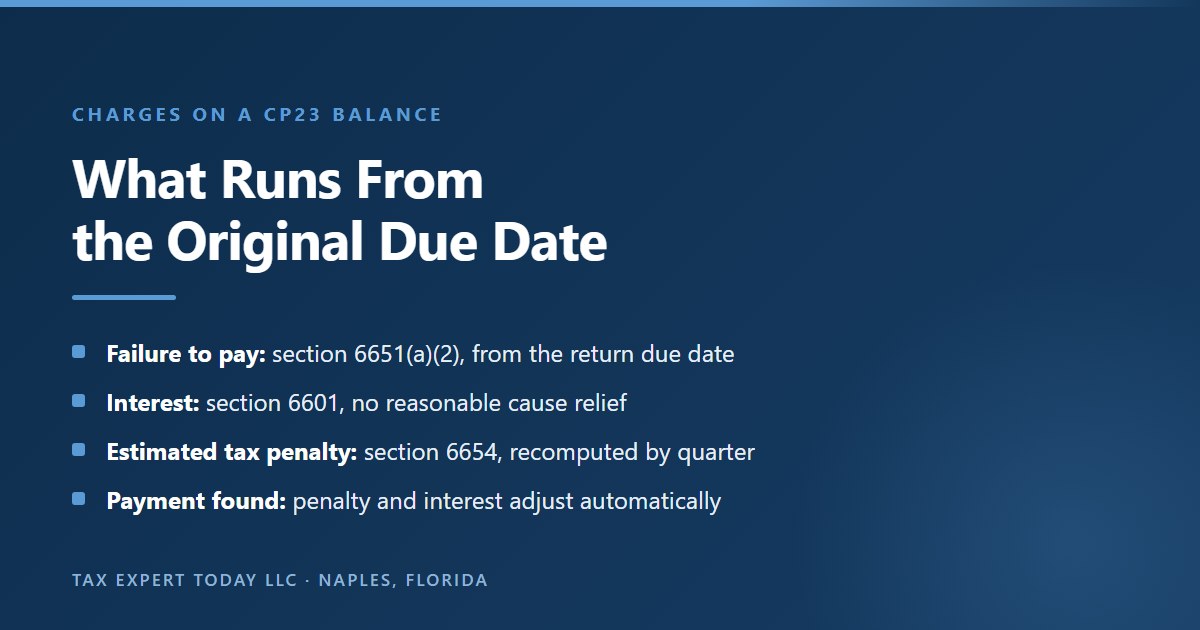
A CP23 balance is usually tax that was shown on your return but not paid on time, because the payment credit you counted on was not there. Interest and the failure to pay penalty therefore generally run from the original due date of the return, not from the notice date, until the balance is paid in full.
- Interest: required by law from the original due date; it cannot be waived for reasonable cause.
- Late payment penalty: 0.5 percent per month on tax shown but unpaid, up to 25 percent.
- Notice window: paying within 21 calendar days of the notice stops further interest on the paid amount.
- Large balances: the window is 10 business days if the notice demands $100,000 or more.
This is a real difference from a math error notice that increases your tax. When the IRS adds tax that was not on the return, section 6651(a)(3) gives a grace period before the failure to pay penalty begins. An IRS CP23 notice is different in kind: the tax on the return did not change, but the payments that were supposed to cover it fell short. Under IRC §6651(a)(2), the failure to pay penalty applies to the amount shown as tax on a return that is not paid by the date prescribed for payment, which for most individuals is April 15. That is why an IRS CP23 notice balance usually arrives with a late payment penalty already computed for several months.
Interest follows the same logic. IRC §6601(a) charges interest on any unpaid tax from the last date prescribed for payment until the date paid. Section 6601(e)(3) provides that if an amount is paid within 21 calendar days after notice and demand, or 10 business days if the amount demanded is $100,000 or more, no interest is imposed on that amount for the period after the notice date. The IRS CP23 page is blunt about relief: interest cannot be reduced for reasonable cause or first time relief, but if the tax or penalty is reduced, the interest is automatically reduced.
| Charge on a CP23 | Authority | Starts | Relief available |
|---|---|---|---|
| Balance from the payment correction | IRC §6201(a)(3) | Assessed with the notice | Locate and transfer the payment |
| Failure to pay penalty | IRC §6651(a)(2) | Original due date of the return | First time abatement or reasonable cause; adjusts if the payment is found |
| Estimated tax penalty | IRC §6654 | Each installment due date | Statutory exceptions and the section 6654(e)(3) waiver; not first time abatement |
| Interest | IRC §6601 | Original due date of the return | None for reasonable cause; falls automatically when tax or penalty falls |
| Other math error, if any | IRC §6213(b) | Assessed with the notice | 60 day abatement request |
For a hypothetical illustration of the scale, assume a return claimed four quarterly payments of $3,000, the IRS found three, and the taxpayer pays the resulting $3,000 balance in late June. The failure to pay penalty would be about 0.5 percent per month for April, May, and June, roughly $45, plus interest at the federal underpayment rate for the same period, plus any recomputed estimated tax penalty on the missing installment. The numbers are modest on a single quarter, which is exactly why many taxpayers pay the balance before they check whether the payment exists. Our IRS penalty and interest calculator shows how the figures grow with time.
If the late payment penalty remains after the payment question is settled, it may qualify for first time penalty abatement when the prior three years are clean, or for reasonable cause penalty abatement when a documented event explains the shortfall. Both requests are separate from the payment trace, can be made by phone or in writing on IRS Form 843, and can be made after the balance is paid.
How do you dispute an IRS CP23 notice?
Call the number on the notice by the date shown, with your return and proof of payment ready, or write to the address on the notice with copies. Proof means the date, amount, method, number and year used, and a confirmation number, EFT number, or cancelled check. If research cannot find the payment, the IRS opens a trace.
- Phone: the IRS FAQ says to call and have the return and documentation ready.
- Writing: include a copy of the notice and copies, not originals, of your proof.
- Trace: unresolved payments go to the Hardcore Payment Tracer Function on Form 4446.
- Collection hold: employees working a trace can delay notices and offsets.
The IRS answer to “What should I do if I find you misapplied a payment or have not credited a payment that I made” is to call the number in the “Where to find more information” section of the notice, with a copy of the return and documentation such as cancelled checks or an amended return ready, and the IRS will discuss the issue and give further instructions. The phone call is usually the fastest route when the payment is simply on the wrong number or year, because the employee can see both modules and transfer the credit.
IRM 21.5.7.3 lists what an employee will ask for before researching a missing payment. Two weeks must have passed since the payment was mailed or scheduled. After that, the employee gathers evidence of payment such as a copy of the cancelled check front and back, the date the payment cleared, the taxpayer name, address, and identification number, the date and amount, the tax period the payment was intended for, where it was mailed, the type of payment, check encoding information, a Direct Pay or card confirmation number, an EFTPS 15 digit EFT number, and the routing number of the bank the check was drawn on. Having that list ready before you call is the difference between a single call and a month of letters.
If internal research cannot locate the payment, the employee prepares Form 4446, Payment Tracer Research Record, and routes it to the Hardcore Payment Tracer Function at the campus that processed the payment. Under IRM 21.5.7.4.1, an employee working a payment tracer case is responsible for delaying balance due notices and refund offsets, either by placing the account in a notice hold status or by using a transaction that suspends notices and offsets for 15 weeks. Ask whether that hold has been placed if you are waiting on a trace and the next notice is due.
Taxpayers who mailed a check that was never cashed face a different path. The IRM tells employees to advise the taxpayer to stop payment on the original check and to make the payment again electronically, and it describes Form 8546 for reimbursement of bank charges caused by an IRS error. A payment that left your bank account, however, is almost always findable, and the encoding on the back of the check is what lets the IRS find it.
If a CP23 dispute is creating a financial hardship and cannot be resolved quickly, the IRS notes that you may be eligible for free help from the Taxpayer Advocate Service. If the balance is legitimate and you disagree with a penalty instead, the routes are the penalty requests described above, and if you disagree with a separate tax change on the same notice, the 60 day math error abatement request.
What is the difference between a CP23, a CP24, and a CP25?
All three notices report the same correction, a mismatch between estimated payments claimed and payments posted. They differ only in the result. An IRS CP23 notice leaves a balance due of $1 or more, a CP24 leaves an overpayment of $1 or more, and a CP25 leaves an even balance, meaning less than $5 owed or less than $1 overpaid.
- CP23: balance due; pay or dispute by the date shown.
- CP24: overpayment; no response needed if you agree, refund in about 4 to 6 weeks.
- CP25: even balance; no payment of less than $5 required.
- Same research: the payment comparison is identical for all three.
| Notice | Result after the correction | Response if you agree | IRM section |
|---|---|---|---|
| CP23 | Balance due of $1.00 or more | Pay by the date shown or arrange to pay | 21.3.1.6.16 |
| CP24 | Overpayment of $1.00 or more (smaller than claimed) | None; remaining refund generally within 4 to 6 weeks | 21.3.1.6.17 |
| CP25 | Overpayment under $1.00 or balance under $5.00 | None; small refunds issued only on written request | 21.3.1.6.18 |
The IRS CP24 page says that if you agree, no response is required and you should receive the remaining refund within 4 to 6 weeks, as long as you do not owe other taxes or debts the IRS is required to collect. The IRM adds that a CP24 may also tell the taxpayer the return contained a math error or that the statute for refund has expired, and that a taxpayer who received a CP24 before filing the return, and who did not want the estimated payments refunded, should be handled as a possible identity theft case. The CP24 FAQ also covers the reverse problem: a payment listed on the notice that you did not make should be reported, and any refund received by mistake must be returned.
The research is the same in every case. The difference is only whether the correction created a bill, shrank a refund, or roughly netted to zero. If you received a CP24 and believe a payment is missing, the steps in this guide apply in full, and finding the payment will increase the refund rather than reduce a balance.
How is an IRS CP23 notice different from a CP60 or a CP11?
A CP23 corrects the return because claimed estimated payments were never found on the account. A CP60 reports that the IRS removed a payment that had already posted, usually because it belonged to someone else. A CP11 reports a math error that changed the tax itself. The fix for each is different.
- CP23: the payment did not post where claimed; find and transfer it.
- CP60: a posted payment was moved away; find where it went and why.
- CP11: the tax computation changed; the 60 day abatement request applies.
- Overlap: one return can generate more than one of these.
The distinction matters because the authority, the deadline, and the evidence are all different. A CP60 means a payment was on your account and is no longer there; our guide to the IRS CP60 notice covers misapplied payment research and the transfer codes behind a removed payment in detail, so this guide does not repeat them. A CP11 means the IRS changed the tax on the return under section 6213(b), which carries the full 60 day abatement right that a CP23 payment correction does not. An IRS CP23 notice means the claimed payment never reached the module the return pointed to. And a CP2000 is different again: it proposes changes to income based on third party information returns and comes with a response deadline, as our guide to the IRS CP2000 notice explains.
Each of these notices can also lead into the standard balance due sequence if the amount is not paid. Our guide to the IRS CP14 notice explains the general first bill, and the notices that follow are covered below.
What happens if you ignore an IRS CP23 notice?
If you ignore a CP23, the balance stays assessed, interest and the late payment penalty keep growing, and the IRS moves the account through its reminder notices toward a notice of intent to levy. Future refunds can be applied to the balance, and a federal tax lien may be filed on larger amounts. A missing payment is also harder to trace later.
- Reminder notices: the CP501 and CP503 follow an unpaid balance.
- Intent to levy: the CP504 warns that a levy may follow.
- Refund offset: future refunds are applied to the balance.
- Lost evidence: bank records and confirmations become harder to retrieve.
A CP23 is assessed when it is issued. Because section 6201(a)(3) removes the math error abatement right, ignoring the notice does not preserve a challenge; it simply lets the balance age. The IRS collection sequence for individuals usually continues with a CP501 reminder, then a CP503, then a CP504 notice of intent to levy, with levy and lien rights following under the usual procedures. A refund on next year’s return would be applied to the balance and reported on a CP49. The IRS generally has ten years from assessment to collect, as our guide to the IRS 10-year rule for tax debt explains, and if a lien is filed against real estate you later sell or refinance, our IRS lien discharge guide covers how a specific property is released.
The quieter risk is evidentiary. A payment made through Direct Pay or EFTPS leaves a clear electronic trail that can be retrieved months later, but a paper check, a payment made from an account that has since closed, or a joint payment by a former spouse can become difficult to document. The right time to answer an IRS CP23 notice is while the year’s bank statements are still on hand.
What changes for IRS CP23 notices sent after November 25, 2026?
Public Law 119-39, enacted November 25, 2025, amends section 6213(b) for math error notices sent after November 25, 2026. Those notices must describe the error in plain language, give an itemized computation of adjustments, including estimated tax payments and amounts applied from the prior year, and display the abatement request deadline in bold next to your address.
- Effective date: notices sent more than 12 months after November 25, 2025.
- Itemized changes: the computation must list adjustments to estimated tax payments, including the prior year credit.
- Deadline display: the abatement date in bold, 14 point type, on page 1.
- Abatement notice: a plain language notice must follow any abatement.
The amendment, shown in the statutory notes to IRC §6213, adds a new subparagraph (B) to section 6213(b)(1). A math error notice must be sent to the last known address and describe the error in comprehensive, plain language, including the type of error, the section of the Code to which it relates, a description of its nature, and the specific line of the return on which it was made. It must include an itemized computation of any direct or incidental adjustments, and the list of items expressly includes “estimated tax payments, including amount applied from prior year’s return.” The notice must also include the telephone number for the automated phone transcript service and must display the date by which the taxpayer may request abatement, in bold 14 point type, immediately next to the taxpayer’s address on page 1. A notice that lists multiple possible errors is not specific enough.
How the IRS applies these rules to an IRS CP23 notice remains to be seen, because the estimated payment correction is assessed under section 6201(a)(3), which borrows the math error assessment procedure but excludes the abatement right. What is clear is that any ordinary math error carried on the same notice falls under the new rules. Taxpayers who receive an IRS CP23 notice after the effective date should expect a more detailed computation of the payment change, which makes the comparison described in this guide easier.
How do you prevent an IRS CP23 notice next year?
Before filing, view your Online Account and confirm every estimated payment posted to the correct year and number, then enter the IRS total on the return rather than your own. On joint returns, pay under the primary taxpayer’s number. In Direct Pay, check the tax year on every January and April payment.
- Verify before filing: the IRS itself recommends checking your account first.
- Use the primary number: list names and numbers in joint return order.
- Watch January and April: those payments are the ones most often tagged to the wrong year.
- Keep confirmations: save every confirmation number in one place.
The CP23 page closes with two tips. The first is to correct your copy of this year’s return so the same error does not repeat next year, and to have your preparer correct theirs. The second is to verify, before filing, that the estimated payments were applied to the year by viewing your tax account. A five minute check in January or February catches nearly every cause discussed in this guide.
A few habits make the check easier. Use one payment method for all four installments so the confirmations are in one place. Record each payment on a single worksheet with its date, amount, confirmation number, the number used, and the tax year selected. If a spouse pays from a separate account, make sure the voucher or online payment lists the primary taxpayer’s number. If you elected to apply last year’s overpayment, confirm that the credit elect arrived on the new year before you count it. And if your income is uneven, the annualized installment method in Publication 505 and our quarterly estimated tax calculator help you set installments that match the safe harbors, and our self-employment tax calculator estimates the part of the bill that withholding never covers.
CP23 notice help Naples: tax resolution Naples and Southwest Florida
Tax Expert Today LLC provides IRS tax resolution from its Naples, Florida office: back taxes and IRS tax debt, payment plans and installment agreements, offers in compromise, wage garnishment and bank levy release, federal tax lien withdrawal, penalty abatement, unfiled returns, and audit representation. The firm is led by Dr. Pellumb Kabashi, an Enrolled Agent with unlimited rights to represent taxpayers before the IRS, a Certified Fraud Examiner, and a Certified Estate and Trust Specialist, with a team of enrolled agents, CPAs, and tax attorneys.
- Address: 11983 Tamiami Trail N, Naples, FL 34110.
- Phone: (239) 441-2005.
- Hours: Monday through Friday, 10 a.m. to 5 p.m. Eastern Time.
- Representation: on Form 2848, which lets a representative speak with the IRS on your behalf.
Estimated tax is a fact of life for much of Southwest Florida. Retirees drawing from IRAs and brokerage accounts, seasonal residents with income in two states, self-employed contractors, real estate professionals, and small business owners all pay quarterly, and Florida’s lack of a state income tax means the federal estimate is often the only one they make. Many households here also pay from more than one bank account, or from a spouse’s account, which is exactly the setup that leaves a joint payment on the wrong Social Security number.
Our Naples tax resolution services handle IRS CP23 notice reviews alongside the payment plans and penalty requests that sometimes follow, and our IRS resolution and audit support covers cases where an IRS CP23 notice sits on top of a disputed adjustment or an older balance. If the balance itself is the larger problem, our IRS tax debt help Naples page explains the options for paying or resolving it.
Most of the work is account research. With a Form 2848 on file, a representative can pull transcripts for both spouses across the notice year and the years on either side, match each claimed payment to a posted transaction, identify a payment stranded on the wrong number or year, request the credit transfer with the original payment date, confirm the penalty and interest recompute, and request abatement of any late payment penalty that remains. Clients outside Florida can work with the office remotely; representation before the IRS is not limited by state.
Frequently Asked Questions About the IRS CP23 Notice
What does an IRS CP23 notice mean?
An IRS CP23 notice means the IRS changed your return because the estimated tax payments you claimed did not match the payments posted to your account, and the change left a balance due of $1 or more. The notice lists the payments the IRS credited, the amount it removed, and any penalty and interest added.
Do I have to respond to an IRS CP23 notice?
If you agree, pay the balance by the date on the notice or arrange a payment plan, and correct your own copy of the return without mailing it. If you believe a payment is missing, call the number on the notice by the date shown with your return and proof of payment ready.
Can I request abatement of an IRS CP23 notice within 60 days like other math errors?
Not for the payment correction itself. Section 6201(a)(3) lets the IRS assess an overstated estimated payment like a math error but excludes the 60 day abatement right in section 6213(b)(2). The payment piece is resolved by proving the payment. Any separate math error on the same notice keeps the 60 day right.
My estimated payment was made under my spouse’s Social Security number. What now?
Call the IRS with the payment confirmation. The IRS can transfer a joint estimated payment from the spouse’s account to the joint return. Payments often move automatically, but the transfer can be blocked, for example when a separate return has already posted under the spouse’s number.
Why is there an estimated tax penalty on my IRS CP23 notice?
The estimated tax penalty is computed from the payments actually posted. Removing a claimed payment increases the underpayment for that quarter, so the penalty is recomputed upward. If the missing payment is found and transferred with its original date, the penalty is recomputed again.
What is the difference between a CP23 and a CP24?
Both report a mismatch between estimated payments claimed and posted. An IRS CP23 notice leaves a balance due. A CP24 leaves a smaller overpayment, and the IRS says that if you agree, no response is needed and the remaining refund generally arrives within 4 to 6 weeks.
I do not pay estimated taxes. Why did I get an IRS CP23 notice?
The IRS says the most common cause is an incorrect entry on the estimated tax line of the return, for example a number carried forward by software or typed on the wrong line. If no payment was made, the correction is right and the balance is owed.
Where can I get help with an IRS CP23 notice in Naples, FL?
Tax Expert Today LLC, 11983 Tamiami Trail N, Naples, FL 34110, (239) 441-2005, helps taxpayers in Collier and Lee Counties and nationwide review IRS CP23 notices, trace missing estimated payments on transcripts, request credit transfers, and address penalties and balances. A representative authorized on Form 2848 can work with the IRS on your behalf.
When to Engage a Professional
Many people can resolve an IRS CP23 notice with one phone call, especially when the missing payment is on a spouse’s number or the wrong year and the confirmation is in hand. Consider engaging a representative when you cannot tell from the transcripts where a payment went; when the payment was made from an account that has since closed or by a former spouse; when a prior year credit elect was reduced by an adjustment or offset you do not understand; when the IRS CP23 notice also carries a separate math error you want to challenge within 60 days; when the penalty recomputation does not match your own figures; or when the balance is large enough that a payment plan or penalty relief request is part of the answer. As an Enrolled Agent, Dr. Kabashi can represent you before the IRS under a Form 2848 and handle the research, the transfer requests, and the penalty requests. Our IRS resolution and audit support and Naples tax resolution teams can review your notice and transcripts. Call (239) 441-2005 to schedule a review.
This article is educational and general in nature. It does not constitute tax or legal advice for any particular taxpayer, and outcomes depend on individual facts and circumstances. All dollar figures are hypothetical illustrations. IRS forms, phone numbers, and procedures are current as of the publication date and are subject to change.
Published November 2, 2026 by Dr. Pellumb Kabashi « Back to Learning Center
Have a question this article touches on?
Tax Expert Today LLC, based in Naples, Florida and serving clients across the United States.
Schedule a Consultation (239) 441-2005