
By Dr. Pellumb Kabashi, DBA, MBA, CES, CFE, EA
Founder, Tax Expert Today LLC · Tax advisors, enrolled agents, CPAs, and attorneys · Serving clients in all 50 states
Quick Answer: In a TSP divorce, the account is split by a retirement benefits court order, not a QDRO. The taxable part of a payment to a current or former spouse is taxed to that spouse, the TSP withholds 20 percent unless it is rolled over, and the 10 percent early withdrawal tax does not apply to the court-ordered payment. Call (239) 441-2005 for a free consultation.
A TSP divorce has two halves, and almost everything written about it covers only the first. The first half is procedure: drafting a retirement benefits court order the Thrift Savings Plan will accept, getting the account frozen, and waiting for the decision letter. That part belongs to your family law attorney, and the TSP publishes clear rules for it. The second half is tax, and it is where former spouses tend to get surprised. Whose return does the payment land on? Why did the check arrive 20 percent short? Is there a 10 percent penalty if the receiving spouse is 45? What happens to the Roth money, and to tax-exempt combat zone contributions from a military account? This TSP divorce guide answers those questions from the TSP’s own booklets, the Internal Revenue Code, and the IRS reporting instructions. It explains tax mechanics only. Whether the TSP is a marital asset, what share each spouse receives, and how the order is worded are questions for your family law attorney, and we work alongside that attorney as the tax side of the divorce team.
How Is a TSP Divided in a Divorce?
A TSP is divided by a retirement benefits court order, a decree or court-approved settlement issued under state domestic relations law that expressly names the Thrift Savings Plan and awards a dollar amount or percentage to a current or former spouse or dependent. The TSP pays the award directly to that payee as a one-time distribution.
- Not a QDRO: the TSP is a federal plan governed by 5 U.S.C. §8435(c), §8467, and 5 C.F.R. part 1653, so it does not follow the ERISA order rules used by private 401(k) plans.
- Who can be paid: a current spouse (including a separated spouse), a former spouse, or a dependent.
- How it is paid: pro rata from every traditional and Roth balance and from every fund in the account, as of the payment date.
- A $600 processing fee: charged to the participant when the TSP receives the initial order, unless the order allocates it differently.
The TSP’s retirement benefits court order page and the Court Orders and Powers of Attorney booklet list the drafting requirements, and those requirements are not optional. An order that tries to award a share as of a date the TSP cannot calculate, or that tries to choose the source of the money, will be rejected. For tax purposes, the important feature is the last one in the list above: the payment always comes out in proportion to what is in the account. That single rule drives most of the tax results described below.
The order can be issued at any time during the proceedings, and a separate “freeze” order can stop the participant from taking new loans or withdrawals while the case is pending. Once the TSP qualifies the order, it moves the payee’s entitlement into a temporary asset transfer account in the payee’s name, and the payee requests payment or a rollover from that temporary account. The court order itself cannot dictate payment or rollover instructions. Those choices belong to the payee, which is why the payee is the person who needs to understand the tax consequences before logging in.
Is a TSP Divorce Payment Taxable, and to Whom?
Yes, the taxable portion of a TSP divorce payment is taxable, and when the payee is a current or former spouse it is taxed to that spouse, not to the federal employee or service member. The spouse can avoid current tax by rolling the payment into a traditional IRA, Roth IRA, eligible employer plan, or their own TSP account.
- Spouse payee: the taxable portion is gross income to the spouse in the year it is paid, unless it is rolled over.
- Participant: reports nothing on a payment to a spouse or former spouse, because the spouse is treated as the distributee.
- The transfer itself: moving the award into a temporary asset transfer account is not a taxable event for anyone.
- The nontaxable portion: Roth contributions, qualified Roth earnings, and tax-exempt contributions come out free of income tax.
The legal chain is short. IRC §7701(j)(1) provides that the Thrift Savings Fund is treated as a trust described in section 401(a), and that its distributions are treated the same way as distributions from such a trust. IRC §414(p)(11) then provides that a payment from a governmental plan made under a domestic relations order meeting the basic definition in §414(p)(1)(A)(i) is treated as made under a qualified domestic relations order. Finally, IRC §402(e)(1)(A) provides that an alternate payee who is the spouse or former spouse of the participant is treated as the distributee of a payment made under a QDRO. Put together, the TSP court order payment to a spouse is taxed to the spouse. The same section reaches a FERS annuity that OPM pays directly to a former spouse, covered in our guide to FERS divorce tax rules.
The TSP booklet states the same result in plain terms: if a payment is made to the current or former spouse, the taxable portion is reported to the IRS as gross income for the spouse payee in the year the payment is made, unless the funds are rolled over. The booklet adds a point that matters for settlement negotiations: this applies even if the payment is intended to satisfy child support or spousal support arrears. We return to that point in its own section, because it changes how much a TSP dollar is worth to the person receiving it.
For the participant, the practical effect is that the share awarded to the spouse leaves the account without a tax bill attached. The participant’s remaining balance keeps its tax deferral, and the participant pays tax on that remaining balance only when they take their own withdrawals later. This is one reason a TSP split is often more tax efficient than having the participant withdraw money and pay the spouse in cash, which would leave the full withdrawal on the participant’s own return. The broader settlement map, including how retirement assets compare with property transfers under IRC §1041, is covered in our guide to which parts of a divorce settlement are taxable.
What Happens When the Court Order Pays a Child or a Support Agency?
When a TSP court order or legal process pays someone other than a current or former spouse, such as a dependent child or a state child support enforcement agency, the taxable portion is income to the participant, not to the recipient. The TSP withholds 10 percent rather than 20 percent, and the payment cannot be rolled over.
- Child as payee: taxed to the participant, under the same rule IRS Publication 575 describes for QDRO payments to a child or other dependent.
- Support agency as payee: taxed to the participant; no temporary asset transfer account is created.
- Withholding: 10 percent, and the person taxed may choose a higher or lower rate, including zero.
- Drafting point: if the parties intend child support arrears to be taxed to the participant, the order must name the child or the agency as payee.
The TSP booklet is explicit about the drafting consequence. If an order names a spouse or former spouse as payee, any portion of the award paid as cash is treated as taxable income to that payee. If the parties intend a payment for child support arrears to be taxable to the participant, the order must identify the dependent child or a state child support enforcement agency as the payee. Who is named on the order therefore decides whose return carries the income. That is a drafting choice for the family law attorney, but it should be made with the tax result in view, and the tax result should be computed before the order is signed.
This category also includes “legal process” orders, which are state law garnishments that enforce a current alimony or child support obligation. These are processed under 5 C.F.R. part 1653 subpart B and follow similar tax rules based on who receives the payment. The TSP pays a legal process only in a specific dollar amount, and only up to the participant’s vested balance at the time of payment.
How Much Does the TSP Withhold From a Court-Ordered Payment?
For a court order payment to a current or former spouse, the TSP treats the payment as an eligible rollover distribution and must withhold 20 percent of the taxable portion that is not directly rolled over. The spouse may ask for more than 20 percent, but cannot reduce it or choose zero. A direct rollover avoids the withholding entirely.
- 20 percent is a prepayment, not the tax: it is credited on the spouse’s return, and the final tax may be higher or lower.
- The participant cannot add withholding to a payment made to the spouse.
- Only the taxable portion is withheld on: Roth contributions and tax-exempt money are not subject to the 20 percent.
- The 60-day fix: a spouse paid in cash can still roll the full amount within 60 days, but must replace the withheld 20 percent from other funds.
The withholding rules come from IRC §3405(c), which requires 20 percent withholding on any eligible rollover distribution not paid in a direct rollover, and they are applied by the TSP based on who receives the payment. The Tax Rules about TSP Payments booklet, revised October 2026, lays the scenarios out in a single table. The relevant rows are summarized here.
| TSP payment type | IRS category | Can be rolled over? | Required withholding | Can choose 0 percent? |
|---|---|---|---|---|
| Court order payment to a current or former spouse | Eligible rollover distribution | Yes | 20 percent of the taxable portion not rolled over | No |
| Court order payment to anyone else (child, support agency) | Non-periodic payment | No | 10 percent | Yes |
| Court order payment from a beneficiary participant account | Non-periodic payment | No | 10 percent | Yes |
| For comparison: the participant’s own post-separation distribution | Eligible rollover distribution | Yes | 20 percent | No |
A short hypothetical shows why the withholding matters. Assume a former spouse is awarded $80,000 from a traditional TSP balance and asks for the whole amount in cash. The TSP withholds $16,000 and sends $64,000. If that spouse later decides to roll the money into an IRA, rolling only the $64,000 leaves $16,000 as a taxable distribution. To roll the full $80,000 within 60 days, the spouse has to add $16,000 of their own money, and recovers the withheld amount as a credit on the return. The cleaner path, when a rollover is the goal, is a direct rollover requested from the temporary asset transfer account, which carries no withholding at all.
Federal withholding is also not the same as the final tax. A former spouse in a low bracket for the year may find that 20 percent was more than enough, while a spouse with substantial other income may owe more. Because the 20 percent cannot be reduced, a spouse who needs a specific net amount in hand should plan for the gross award to be larger than the net check, or should combine a partial cash payment with a direct rollover of the rest.
Does the 10 Percent Early Withdrawal Penalty Apply to a TSP Divorce Payment?
No. A payment under a qualifying retirement benefits court order is exempt from the 10 percent early withdrawal tax, even if the spouse payee is under 59½. The exemption comes from IRC §72(t)(2)(C), applied to the TSP through §414(p)(11), and the TSP booklet confirms it. Ordinary income tax still applies to the taxable portion.
- The statute: §72(t)(2)(C) excludes any distribution to an alternate payee under a qualified domestic relations order.
- Why it reaches the TSP: §414(p)(11) treats a governmental plan payment under a domestic relations order as a QDRO payment.
- The TSP’s statement: a payment in response to a retirement benefits court order or legal process is not subject to an early withdrawal penalty tax.
- The exemption covers the TSP payment only: money rolled into an IRA and withdrawn later does not keep it.
IRC §72(t)(2)(C) reads, in full, “Any distribution to an alternate payee pursuant to a qualified domestic relations order (within the meaning of section 414(p)(1)).” On its own, that sentence might leave room to argue that a TSP court order is not a QDRO, because the TSP does not use ERISA’s order rules. Section 414(p)(11) closes that gap: a distribution or payment from a governmental plan “shall be treated as made pursuant to a qualified domestic relations order if it is made pursuant to a domestic relations order which meets the requirement of clause (i) of paragraph (1)(A).” The TSP booklet then states the result directly, that court-ordered payments are “exempt from the early withdrawal penalty tax under the Internal Revenue Code.”
The trap is the one we describe in our guide to QDRO taxes in a divorce, and it applies with full force to the TSP. The exception attaches to the distribution from the plan to the alternate payee. Once the former spouse rolls the money into an IRA, it is that spouse’s IRA, and a later withdrawal before 59½ is an ordinary early IRA distribution. The IRA rules have no QDRO exception, so the 10 percent additional tax can apply unless another exception on the IRS list of early distribution exceptions fits. A spouse under 59½ who expects to need part of the money soon should consider taking that part directly from the TSP payment, penalty free, and rolling only the rest.
| Hypothetical: spouse age 44, $90,000 traditional TSP award, needs $30,000 now | Income tax | 10 percent additional tax |
|---|---|---|
| Take $30,000 in cash from the TSP payment, roll $60,000 directly to an IRA | On $30,000 this year | None on the $30,000 (court order exemption) |
| Roll the full $90,000 to an IRA, then withdraw $30,000 from the IRA | On $30,000 this year | Generally $3,000, unless another IRA exception applies |
| Take all $90,000 in cash | On $90,000 this year, at higher marginal rates | None (court order exemption) |
The figures are hypothetical and ignore state tax, which Florida residents do not pay on these amounts. The point is the sequence. Because the TSP pays a court order award as a single total distribution from the temporary asset transfer account, the decision about how much to take in cash and how much to roll has to be made at that moment. It cannot be revisited later without losing the exemption on whatever was rolled.
Should the Former Spouse Roll Over the TSP Payment or Take Cash?
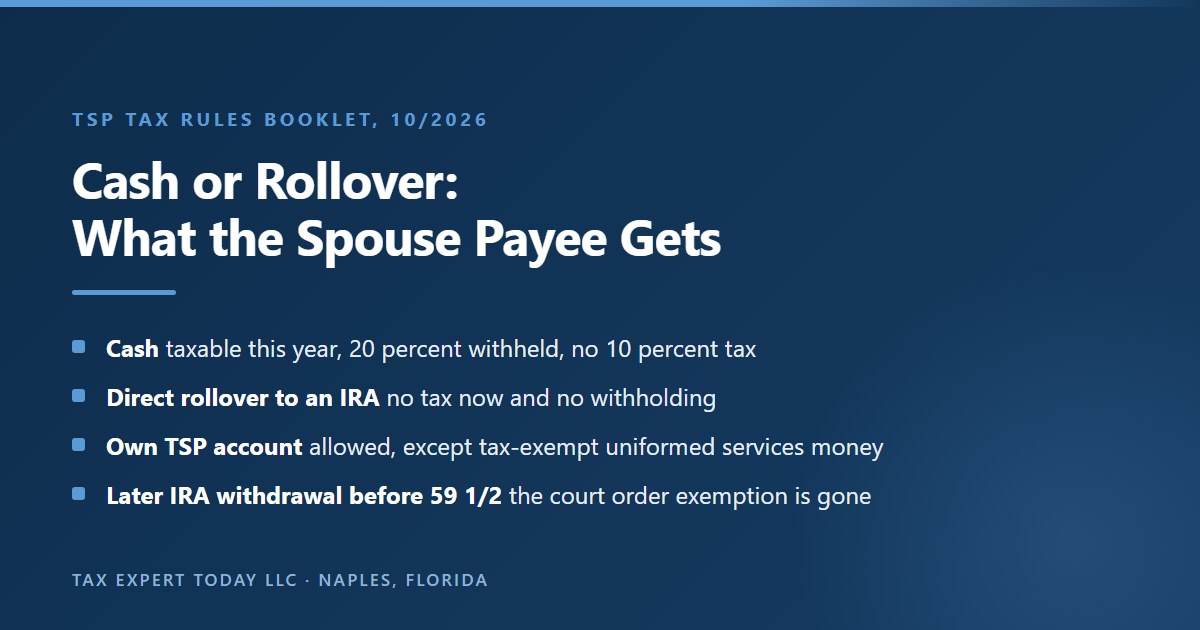
That depends on when the spouse needs the money and on their tax bracket. Rolling the payment over keeps the tax deferral and avoids the 20 percent withholding, while taking cash makes the taxable portion income this year but avoids the 10 percent tax for a spouse under 59½. Many spouses split the payment between the two.
- Traditional IRA: keeps the traditional money tax deferred; withdrawals later are ordinary income.
- Roth IRA: Roth TSP money can move in tax free; traditional money moved into a Roth IRA becomes a taxable conversion.
- Eligible employer plan: possible if the spouse’s own plan accepts rollovers.
- The spouse’s own TSP account: allowed if the spouse already has one, except for tax-exempt uniformed services money.
- Cash: taxable portion is income this year, 20 percent withheld, no 10 percent additional tax.
The rollover right comes from IRC §402(e)(1)(B), which applies the rollover rules of §402(c) to a spouse or former spouse alternate payee as if that person were the employee. The TSP booklet adds two practical points. First, even if the court order directs the TSP to send the payment to a third party such as the payee’s attorney, the spouse still has the right to ask the TSP to roll the payment over, and the TSP will honor that request. Second, a payment that is properly made cannot be returned to the TSP, citing 5 C.F.R. §1653.5(l). A spouse who takes cash by mistake cannot undo it by sending the check back.
A direct deposit cannot be used to roll over a payment. A direct rollover goes from the TSP to the receiving IRA or plan, and the spouse arranges it through the temporary asset transfer account or by contacting the ThriftLine. Timing matters too. The TSP typically disburses a court order payment 60 days after the decision letter. A spouse payee can ask for earlier payment by waiving the tax notification period, making a withholding election, or requesting a rollover, but in no case is payment made earlier than 30 days after the decision letter date.
| Destination for a spouse payee | Tax now | Withholding | Early withdrawal tax on later use before 59½ |
|---|---|---|---|
| Cash from the TSP payment | Taxable portion is income this year | 20 percent, cannot be reduced | Not applicable; exempt at payment |
| Direct rollover to a traditional IRA | None | None | Generally yes, unless an IRA exception applies |
| Direct rollover of traditional money to a Roth IRA | Taxable portion is income this year (a conversion) | None on a direct rollover | Depends on the Roth IRA ordering and 5-year rules |
| Rollover to the spouse’s own TSP account | None | None | Follows the spouse’s own TSP withdrawal rules |
Choosing among these options is a planning decision, and the right answer varies with age, cash needs, other income for the year, and whether the spouse expects to be in a higher or lower bracket in retirement. A spouse who is close to 59½ may find the penalty question irrelevant within a year or two. A spouse who is 40 and plans to use part of the award for a home down payment usually needs the penalty-free cash portion sized carefully before the request is submitted.
How Are Traditional and Roth TSP Balances Split for Tax?
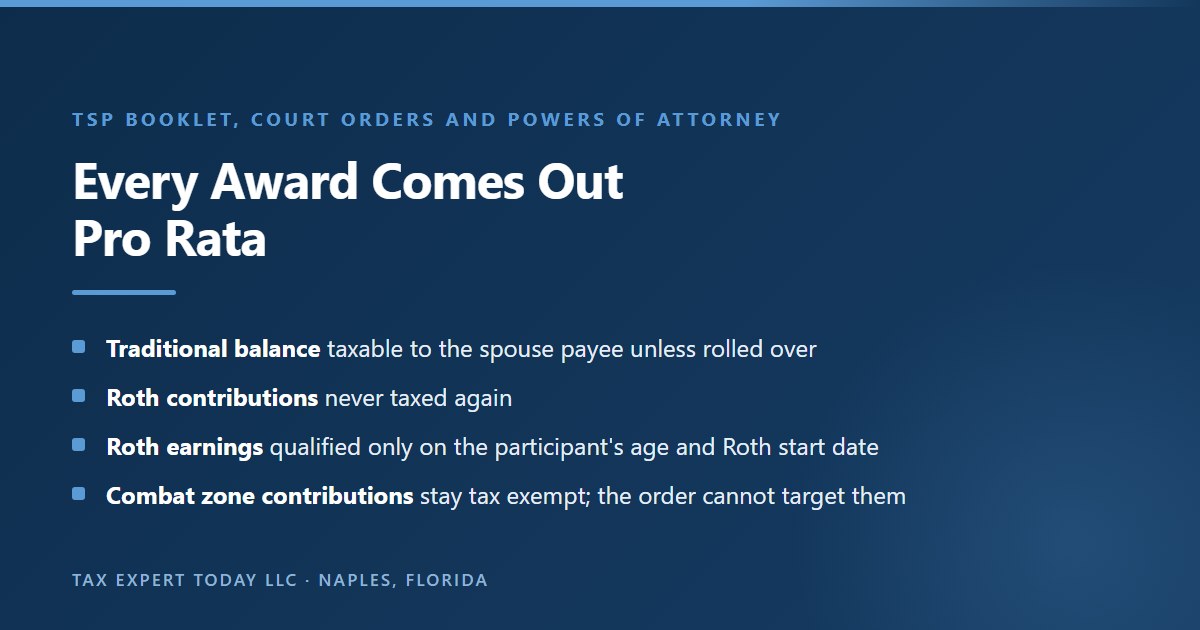
Every TSP court order payment comes out pro rata from the participant’s traditional and Roth balances, and the order cannot choose otherwise. The traditional portion is taxable to a spouse payee unless rolled over. The Roth contribution portion is never taxable, and Roth earnings are tax free only if they are qualified under the participant’s age and Roth start date.
- No cherry picking: an order that designates a specific source, traditional, Roth, or tax-exempt, is not qualifying and will not be processed.
- Traditional balance: fully taxable on distribution, because none of it was ever taxed.
- Roth contributions: already taxed, so they are not taxed again.
- Roth earnings: qualified, and tax free, only if 5 years have passed since January 1 of the year of the participant’s first Roth contribution and the participant is 59½, disabled, or deceased.
The TSP’s tax booklet is precise on the Roth point: “We use the TSP participant’s age (or date of death if applicable) and the date of the participant’s first Roth contribution to determine whether the earnings in the participant’s Roth balance are qualified and not subject to income tax to either the recipient or the participant.” In other words, when the TSP itself pays the award in cash, the tests are applied using the participant’s history, not the spouse’s. A former spouse who is 62 receiving a Roth share from a 50-year-old participant’s account does not get qualified earnings just because the spouse is over 59½.
Consider a hypothetical account of $300,000, of which $240,000 is traditional and $60,000 is Roth, with the Roth balance made up of $45,000 of contributions and $15,000 of earnings. An award of 50 percent, $150,000, is paid 80 percent traditional and 20 percent Roth: $120,000 traditional and $30,000 Roth. Within the Roth piece, the contribution and earnings proportions carry through, so roughly $22,500 is contributions and $7,500 is earnings. If the participant is under 59½, that $7,500 of Roth earnings is taxable to the spouse if paid in cash, along with the $120,000 traditional portion. The $22,500 of Roth contributions is not taxable in any case.
This proportional rule is why a settlement that says “the spouse receives the Roth TSP and the participant keeps the traditional balance” cannot be carried out through the TSP. The parties can reach the same economic result only by adjusting other assets. If the after-tax value of the Roth and traditional balances matters to the deal, and it often does, the valuation section below shows how to approach it.
What Happens to Roth TSP Money When the Former Spouse Rolls It to a Roth IRA?
The Roth portion of a TSP divorce payment can be rolled directly into a Roth IRA in the former spouse’s name without tax. After that, Roth IRA rules govern, including a Roth IRA 5-year period that the regulations determine separately from the TSP’s. A spouse with an older Roth IRA usually benefits.
- Two separate clocks: Treas. Reg. §1.408A-10, A-4, says the Roth IRA 5-year period and the plan’s 5-year period of participation are determined independently.
- When the Roth IRA clock starts: with the earlier of the owner’s first Roth IRA contribution year or the year a designated Roth rollover is made into the Roth IRA.
- Spouse with an existing Roth IRA: the older start date generally governs the combined account.
- Spouse with no Roth IRA: the clock starts with the year of the rollover.
The regulation text is direct. Under Treas. Reg. §1.408A-10, A-4, the 5-taxable-year period for a qualified distribution from a Roth IRA “begins with the earlier of the taxable year described in A-2 of §1.408A-6 or the taxable year in which a rollover contribution from a designated Roth account is made to a Roth IRA,” and the Roth IRA period and the plan’s period “are determined independently.” For a former spouse, that means the participant’s TSP Roth history does not follow the money into the spouse’s Roth IRA. The spouse’s own Roth IRA history does.
That can help or hurt. A spouse who opened a Roth IRA a decade ago already has a completed 5-year period, so the rolled-in Roth TSP money, including its earnings, can come out as a qualified distribution once that spouse is 59½. A spouse with no Roth IRA starts the clock in the year of the rollover. Our guide to Roth IRA divorce tax rules explains how a receiving spouse’s own contribution can start a clock, and how ordering rules decide which dollars come out first. Before the spouse submits the rollover request, it is worth checking whether they already own a Roth IRA, and in what year it was first funded.
Rolling Roth TSP money into the spouse’s own TSP account is a different path. In that case the money stays inside a plan and is subject to plan rules rather than Roth IRA rules. The TSP booklet confirms the spouse may roll all or part of the payment to their own TSP account, but it does not describe how the incoming Roth amount’s 5-year period is tracked for a court order rollover, so a spouse considering that route should confirm the treatment with the TSP before relying on it.
How Are Tax-Exempt Combat Zone Contributions Divided in a TSP Divorce?
For a uniformed services TSP account, contributions made from pay covered by the combat zone tax exclusion stay tax exempt when paid to a former spouse under a court order. They come out in proportion to the taxable money, the order cannot target them, and they cannot be rolled into another TSP account. Earnings on traditional tax-exempt money remain taxable.
- Tax-exempt contributions: not taxable to the spouse payee, even when paid in cash.
- Earnings on tax-exempt traditional money: taxable on distribution.
- Earnings on tax-exempt Roth money: tax free only if the Roth earnings are qualified.
- Rollover destination: a traditional IRA, a Roth IRA, or an employer plan that accepts tax-exempt funds, but not another TSP account.
- Partial rollover ordering: the taxable portion is rolled over first, and the rest is paid to the spouse.
The TSP booklet’s “Special Rules for Uniformed Services Accounts” section sets these rules out. Tax-exempt contributions “remain tax-exempt even when disbursed from the account through a qualifying court order or legal process.” When a payment comes from a traditional balance that holds both taxable and tax-exempt funds, it is disbursed proportionally from each. A court order “cannot specify that a payment be made exclusively from tax-exempt contributions.”
The partial rollover rule is the one that catches people. If a former spouse decides to roll only part of a traditional payment that includes tax-exempt money, the taxable portion goes into the IRA or plan first, and the amount paid to the spouse in cash is drawn from what is left, which will be weighted toward the tax-exempt money. In many cases that is a favorable result for the spouse, because the cash in hand is largely tax free while the taxable money keeps its deferral. It does, however, mean that the IRA receiving the rollover needs to be one that will accept tax-exempt funds if any tax-exempt money is in the rolled amount, and the spouse should keep the TSP’s statement of the tax-exempt amount with their records.
A service member who has both a civilian and a uniformed services TSP account should know that a single court order can affect both, but each account must be specifically identified, and the order must describe the payee’s entitlement for each account separately. Because the tax-exempt balance exists only in the uniformed services account, the choice of which account the award comes from can change the after-tax value of the award, which is worth computing before the order is drafted.
How Does a TSP Loan Affect the Divorce Split and the Taxes?
Unless the court order says otherwise, the TSP includes an outstanding loan balance when it calculates the spouse’s award, and the order cannot make the spouse responsible for repaying the loan. The spouse’s award is a payment, not a loan. Any later tax from a loan default stays with the participant, as a taxed or foreclosed loan.
- Default rule: the loan balance is added back, so a $10,000 account with a $5,000 loan is treated as $15,000.
- Exclusion: the order must say so expressly if the loan balance is to be excluded.
- No repayment shift: the payee cannot be made responsible for the participant’s loan.
- Tax exposure stays with the participant: an unpaid loan becomes a distribution to the participant, not to the former spouse.
The TSP explains its reasoning with a simple example: a participant with a $10,000 balance and a $5,000 outstanding loan has a $15,000 total balance for the purpose of computing the award, “because funds borrowed by a participant are not considered to be withdrawn from the account and are expected to be paid back.” The award is still paid only from money actually in the account, and a court order cannot require the TSP to pay more than the participant’s vested balance.
The tax consequence follows the loan, not the award. If the participant separates from federal service and does not repay, the TSP’s tax booklet treats the unpaid amount as a foreclosed loan, which is a distribution to the participant. If the loan is taxed while the participant is still employed, it is a non-periodic payment reported to the participant. Either way, the former spouse has no income from the loan. What the former spouse does have is a stake in whether the loan is included or excluded in the award, which is a negotiation point for the family law attorney rather than a tax question.
The freeze rule interacts with loans in a way participants should plan for. Once the TSP freezes an account, the participant cannot take a new loan or withdrawal until the court action is resolved, but can keep making loan payments and changing investments. A participant who was counting on a TSP loan to pay a lawyer or a moving deposit may find that option closed once an order is filed.
In What Tax Year Is a TSP Divorce Payment Taxed?
A TSP divorce payment is taxed in the year the TSP actually pays it, not the year of the divorce decree, the order, or the entitlement date. Because the TSP typically pays about 60 days after its decision letter, an order qualified in the fall can produce a payment, and a Form 1099-R, in the following calendar year.
- Entitlement date: sets how much the spouse receives, not when it is taxed.
- Payment date: sets the tax year for the spouse payee.
- Earnings: credited from the entitlement date only if the order says so; the order cannot set a rate.
- Payment to the payee’s estate: if the payee dies before payment, it is reported as income to the estate unless the order says otherwise.
The TSP calculates the award as of the date stated in the order, or the order’s effective date if none is stated, and then moves that entitlement into a temporary asset transfer account. The spouse is taxed only when money leaves that account to the spouse, which is the payment date. Booklet language confirms the year rule from the TSP side: the taxable portion of a payment to a spouse is reported “as gross income for the spouse payee in the tax year when the payment is made.”
The year boundary can be useful. A former spouse who has unusually high income in the year of the divorce, perhaps from the sale of a home or a large final paycheck, may prefer the taxable cash portion to arrive in January. A spouse whose income drops sharply after the divorce may prefer the reverse. Timing is not fully controllable, because the TSP sets its own processing schedule and will not pay earlier than 30 days after the decision letter, but the spouse’s own election, especially the choice to waive the tax notification period, can move a payment by weeks. That may be enough to cross December 31. A cash award also raises the spouse’s household income for the year, which can reduce a premium tax credit for Marketplace coverage, as described in our guide to shared policy allocation in a divorce. Filing status for the year also matters here, and our guide to divorce filing status explains how the December 31 marital status rule interacts with a mid-year payment.
Earnings on the award are a separate drafting question. The TSP will not add investment gains or losses to the award between the entitlement date and the payment date unless the order says so. If the order does award earnings, the TSP calculates a rate of return over the period from the actual account activity. For tax purposes, whatever is paid is simply part of the distribution, split pro rata like the rest.
How Is a TSP Divorce Payment Reported on Form 1099-R?
A TSP payment to a spouse or former spouse is reported on Form 1099-R under the spouse’s own name and taxpayer identification number, so it belongs only on the spouse’s return, as a pension or annuity distribution with any direct rollover shown as nontaxable. A payment to a child is reported under the participant.
- Spouse payee: Form 1099-R in the spouse’s name and TIN, per the IRS instructions for an alternate payee under a QDRO.
- Nonspouse payee: the instructions direct the payer to use the employee’s name and TIN.
- Return lines: the gross distribution and taxable amount go on the pensions and annuities lines of Form 1040, with “Rollover” noted for any amount rolled.
- Withholding: the 20 percent shown on the 1099-R is claimed as a payment on the spouse’s return.
The 2026 Instructions for Forms 1099-R and 5498 state that “distributions to an alternate payee who is a spouse or former spouse of the employee under a QDRO are reportable on Form 1099-R using the name and TIN of the alternate payee,” and that if the alternate payee is a nonspouse, the payer enters “the name and TIN of the employee.” The TSP follows those rules. The TSP’s own statement is that the party responsible for paying the federal income tax receives the tax reporting and withholding information.
Two practical points. First, a former spouse who moved after the divorce should make sure the TSP has a current mailing address, because the 1099-R is mailed early in the following year and is needed to file. Second, a spouse who takes part in cash and rolls the rest should expect the 1099-R to show the full gross distribution with only the cash portion as taxable, and should check that the two figures match what they actually did. A 1099-R that shows the whole award as taxable when part of it was directly rolled over needs to be corrected or explained on the return.
The participant should not see a 1099-R for the spouse’s award at all. If one arrives in the participant’s name for a payment that went to the former spouse, the error should be raised with the TSP promptly. Including someone else’s distribution on your own return is not a harmless placeholder.
TSP Divorce Versus a 401(k) QDRO: What Is Different for Tax?
For income tax, a TSP divorce payment and a 401(k) QDRO payment to a spouse work almost the same way: the spouse is taxed, can roll over, and owes no 10 percent tax on the plan payment. The differences are structural, and three of them change the tax outcome: pro rata sourcing, tax-exempt money, and the single payment rule.
- Order type: a retirement benefits court order under 5 C.F.R. part 1653 rather than an ERISA QDRO.
- Source of the money: always pro rata in the TSP; some private plans allow more flexibility in how a segregated account is invested or distributed.
- Form of payment: a one-time total distribution from a temporary account, rather than a separate account the spouse may be able to leave in the plan.
- Unique assets: tax-exempt combat zone contributions exist only in uniformed services accounts.
| Issue | TSP court order | Private 401(k) QDRO |
|---|---|---|
| Governing rules | 5 U.S.C. §8435(c), §8467; 5 C.F.R. part 1653; IRC §414(p)(11) | ERISA and IRC §414(p) |
| Who is taxed on a spouse payment | Spouse payee | Spouse alternate payee |
| 10 percent tax on the plan payment | Exempt | Exempt under §72(t)(2)(C) |
| Withholding on cash to a spouse | 20 percent mandatory | 20 percent mandatory |
| Can the order pick traditional or Roth? | No, always pro rata | Depends on plan terms |
| Can the spouse leave money in the plan? | Only by rolling to their own existing TSP account | Often yes, in a separate account, if the plan allows |
| Tax-exempt combat zone money | Possible in uniformed services accounts | Not applicable |
| Processing fee | $600, charged to the participant unless the order allocates it | Varies by plan |
The single payment rule deserves emphasis. A private plan may let a former spouse keep a segregated account inside the plan and take withdrawals over time, each one still eligible for the QDRO penalty exception because it comes from the plan to the alternate payee. The TSP does not work that way. The award is paid as a one-time total distribution, so the penalty-free window is a single event. That is why the cash-versus-rollover split described above has to be decided carefully at the moment of the request. For the private plan side of this comparison, see our guide to QDRO taxes.
Can a TSP Payment Satisfy Alimony or Child Support Arrears, and Who Pays the Tax?
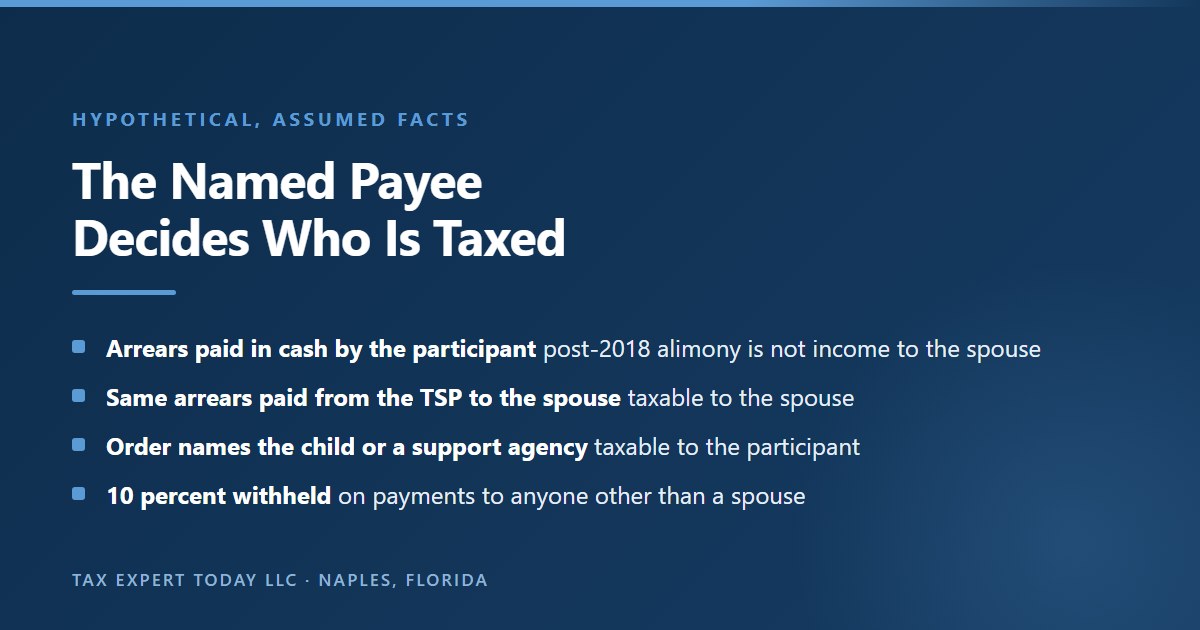
Yes, a court order can direct a TSP payment to cover support arrears, but the tax follows the named payee, not the purpose. A payment to a spouse or former spouse is taxable to that spouse even when it pays support arrears. To tax arrears to the participant, the order must name the child or a support agency.
- Named spouse payee: taxable portion is the spouse’s income, regardless of what the payment satisfies.
- Named child or agency: taxable portion is the participant’s income.
- Post-2018 alimony: ordinarily not income to the recipient, which makes a TSP-funded payment different in tax effect from a cash payment.
- Value gap: a pre-tax TSP dollar is worth less to a spouse than a tax-free support dollar.
The TSP booklet states that a payment to a current or former spouse is taxed to that spouse “even if the payment is intended to fulfill child or spousal support arrears.” That rule interacts awkwardly with the federal alimony rules. For divorce or separation instruments executed after 2018, alimony is neither deductible by the payer nor taxable to the recipient, as explained in our guide to alimony taxes after divorce. Child support has never been taxable to the recipient. So a spouse owed support arrears who is paid in cash from the participant’s checking account generally receives tax-free money, while the same spouse paid the same face amount from a traditional TSP balance receives taxable money.
Here is a hypothetical. Suppose $40,000 of post-2018 alimony arrears is owed. Paid from the participant’s bank account, the former spouse receives $40,000 that is not income. Paid from a traditional TSP balance to the former spouse, the TSP withholds $8,000 and the full $40,000 is the spouse’s income for the year, perhaps costing several thousand dollars more than the withholding depending on the spouse’s bracket. The participant, meanwhile, has moved $40,000 of pre-tax money off their own future return. The face amounts match; the after-tax values do not. Whether and how to account for that difference is a negotiation point for the family law attorney, but the tax computation should be on the table before anyone agrees to fund arrears from the TSP.
Florida’s 2023 alimony reform, SB 1416, eliminated permanent alimony for new awards and set durational limits. It did not change federal tax treatment. A Florida order that funds bridge-the-gap, rehabilitative, or durational alimony arrears from a TSP account still runs into the same federal rule: the named spouse payee is taxed on the taxable portion.
How Should a TSP Share Be Valued Against Other Assets in a Settlement?
A TSP share should be valued after tax, not at its statement balance, because a traditional TSP dollar carries a future income tax bill that home equity, cash, or a Roth balance may not. Comparing assets at face value can quietly shift tens of thousands of dollars between spouses, and the TSP’s pro rata rule makes this especially important.
- Traditional TSP: worth roughly the balance times one minus the expected tax rate when withdrawn.
- Roth TSP: contributions are tax free; qualified earnings are tax free; nonqualified earnings are taxable.
- Tax-exempt contributions: tax free; their earnings may not be.
- Home or brokerage account: carries over basis under IRC §1041, so built-in gain matters too.
The following table uses hypothetical figures and an assumed future tax rate to show why face values can mislead. It is a teaching example, not a valuation method, and the right assumptions depend on each spouse’s expected bracket, age, and timing.
| Asset (hypothetical) | Face value | Assumed tax on later use | Approximate after-tax value |
|---|---|---|---|
| Traditional TSP share | $200,000 | 22 percent federal on withdrawal | $156,000 |
| Roth TSP share, rolled to an established Roth IRA | $200,000 | None if distributions are qualified | $200,000 |
| Home equity with $80,000 of built-in gain | $200,000 | Often none if the §121 exclusion applies on a later sale | Up to $200,000, less selling costs |
| Cash in a bank account | $200,000 | None | $200,000 |
Two TSP-specific features sharpen the point. First, because every award is pro rata, the spouse who receives a TSP share receives the same mix of traditional, Roth, and tax-exempt money as the participant keeps. That is fair in the sense that both sides of the account carry the same mix, but it means that trading a TSP share against a home or a brokerage account needs an after-tax comparison on both sides. Second, a spouse under 59½ who needs liquidity can take part of the award in cash without the 10 percent tax, which makes a TSP share more liquid for that spouse than an IRA share of the same size. That liquidity has real value and should be counted.
The home is its own analysis. Built-in gain, the use and ownership tests under IRC §121, and the carryover basis rule under §1041 decide what a house is really worth to the spouse who keeps it. Our guide to divorce house buyout taxes covers those rules. A closely held company traded against a TSP share raises its own basis and valuation issues, covered in our guide to business owner divorce taxes. For stock compensation traded against retirement money, see dividing stock options in divorce.
How Does Florida Law Treat a TSP in a Divorce?
Florida treats retirement benefits accrued during the marriage, including a TSP, as marital assets subject to equitable distribution under Fla. Stat. §61.075 and §61.076, while federal law controls how the TSP actually pays the award. Florida has no personal income tax, so a Florida resident’s TSP divorce payment is taxed only on the federal return.
- Marital asset: §61.076(1) covers vested and nonvested benefits, rights, and funds accrued during the marriage in retirement and deferred compensation plans.
- Federal payment rules: the order still has to meet the TSP’s requirements under 5 C.F.R. part 1653.
- No state income tax: no Florida tax on the payment, the rollover, or later withdrawals.
- Beneficiary designations: TSP death benefits follow federal rules and the TSP’s beneficiary form, so a new designation should be reviewed after the divorce.
Fla. Stat. §61.076(1) states that “all vested and nonvested benefits, rights, and funds accrued during the marriage in retirement, pension, profit-sharing, annuity, deferred compensation, and insurance plans and programs are marital assets subject to equitable distribution.” How the marital portion is measured, and how it is divided under the equitable distribution rules of Fla. Stat. §61.075, are Florida family law questions. Once the share is set, the TSP’s federal rules decide how the order must be worded and how the payment is made.
Florida’s lack of a personal income tax simplifies the tax side considerably. A Naples resident who receives a cash TSP payment owes federal income tax on the taxable portion and nothing to the state. That also changes the math on a Roth conversion: a former spouse who rolls traditional TSP money into a Roth IRA pays only federal tax on the conversion, which may make a partial conversion more attractive in a low-income year after the divorce. Our Roth conversion ladder guide explains how staged conversions work. IRS Publication 721 covers the federal tax rules for civil service retirement benefits, including TSP payments, in more detail. A former spouse who later moves to a state with an income tax should check that state’s treatment of distributions before taking money out.
Beneficiary designations are a separate step that a divorce decree does not complete on its own. The TSP pays death benefits according to its own beneficiary records, as its family changes page reminds participants planning for divorce, and a participant who wants to remove a former spouse, or who has agreed in the settlement to keep a former spouse as a beneficiary, should file an updated designation with the TSP rather than relying on the decree. This is not an income tax issue, but it is one of the most common loose ends we see after a TSP divorce.
What Are the Most Common TSP Divorce Tax Mistakes?
The most common TSP divorce tax mistakes are rolling the entire award into an IRA and then withdrawing early, drafting an order that names the wrong payee, expecting the order to choose Roth or traditional money, ignoring the 20 percent withholding, and treating a traditional TSP share as equal in value to cash or home equity.
- Losing the penalty exemption: rolling everything to an IRA when part of the money was needed soon.
- Wrong payee for arrears: naming the spouse when the parties meant the participant to bear the tax.
- Source designation: an order that specifies traditional, Roth, or tax-exempt money will not be processed.
- Withholding surprise: planning around the gross award when only 80 percent of the taxable cash arrives.
- Face value trades: swapping pre-tax TSP money for after-tax assets dollar for dollar.
Several smaller mistakes recur as well. A participant sometimes reports the spouse’s award as their own income because a settlement worksheet showed the full balance; it does not belong on the participant’s return. A spouse who takes cash sometimes assumes the 20 percent withheld is the final tax and is surprised in April. A spouse who rolls traditional money into a Roth IRA without realizing it is a conversion can turn a tax-free transfer into a large taxable event. A participant who pays the $600 processing fee without reading the order may not realize the order could have allocated it differently, and legal fees for drafting the order have their own tax rules, explained in our guide to whether divorce legal fees are tax deductible. And once a payment is made correctly, it cannot be returned to the TSP, so a mistaken cash election is permanent.
Most of these are avoidable with a short tax review of the proposed order and of the spouse’s planned payment election, done before the order is signed and again before the payment request is submitted. The review is about the tax result of each option. The settlement terms themselves remain with the family law attorney.
TSP Divorce: Help in Naples & Southwest Florida
Tax Expert Today LLC is based in Naples, Florida, and works with divorcing and recently divorced clients across Collier and Lee counties and in all 50 states. Southwest Florida is home to many federal retirees and military retirees, and to spouses of active federal employees and service members, so a TSP account often sits on the same settlement worksheet as a FERS annuity, a military pension, an IRA, and the home, with Social Security after divorce close behind. The questions we see are federal and practical: who is taxed on the award, how much will be withheld, how much to take in cash and how much to roll, and what each account is worth after tax.
- Divorce tax Naples FL: computing the after-tax value of a TSP share, including the traditional, Roth, and tax-exempt mix, before the settlement fixes the split.
- TSP divorce help Naples: modeling the cash and rollover split for a spouse payee, including the penalty-free cash portion and the 20 percent withholding.
- Arrears and support payments: showing both sides the tax effect of funding arrears from the TSP compared with cash.
- Coordination with your attorney: giving the family law attorney the tax result of each proposed order, without advising on the negotiation itself.
You can read more on our divorce tax consulting page, about the broader practice at Naples FL tax planning, and about federal retirement income for Florida residents in our guide to retiring to Florida taxes.
Tax Expert Today LLC
11983 Tamiami Trail N, Naples, FL 34110
Phone: (239) 441-2005
Hours: Monday through Friday, 10:00am to 5:00pm ET
Does Florida tax a TSP divorce payment for a Naples resident? No. Florida has no personal income tax, so a Naples resident who receives a TSP payment under a divorce court order owes only federal income tax on the taxable portion. A direct rollover to an IRA or eligible plan is not taxed federally or by Florida.
When to Engage a Professional
A divorce in which the TSP is not divided, or in which the spouse payee rolls the entire award into an IRA and has no near-term need for the money, may need little tax work on this issue. Professional involvement tends to earn its cost when one or more of the following is present.
- A spouse payee under 59½ who needs part of the award: the cash and rollover split decides whether the 10 percent tax applies later.
- A Roth or tax-exempt balance in the account: the pro rata mix and the rollover destinations need to be planned.
- Arrears funded from the TSP: the named payee decides whose return carries the income.
- A trade of the TSP against the home, an IRA, a pension, or a business: after-tax values may differ substantially from statement balances.
- A Form 1099-R that looks wrong, or a payment already taken in cash: the reporting can sometimes be corrected, and the 60-day rollover window may still be open.
We work as the tax side of the divorce team, alongside your family law attorney, who remains responsible for the settlement terms and the wording of the court order. To discuss your situation, call (239) 441-2005 or visit our divorce tax consulting page. Every outcome depends on the facts, including each spouse’s age, the account’s traditional, Roth, and tax-exempt mix, other income for the year, and filing status.
Frequently Asked Questions About TSP Divorce
Is a TSP divorce payment taxable to the former spouse? Yes, the taxable portion is. When a retirement benefits court order pays a current or former spouse, the traditional portion and any nonqualified Roth earnings are income to that spouse in the year paid, unless rolled over to an IRA or eligible plan. The federal employee or service member does not report it.
Is there a 10 percent penalty on a TSP divorce payment? No. A payment under a qualifying retirement benefits court order is exempt from the 10 percent early withdrawal tax under IRC section 72(t)(2)(C), applied to the TSP through section 414(p)(11). The exemption covers the TSP payment itself; money rolled to an IRA and withdrawn early does not keep it.
Why did the TSP withhold 20 percent from my divorce payment? A court order payment to a current or former spouse is an eligible rollover distribution, so the TSP must withhold 20 percent of the taxable portion not directly rolled over. The rate cannot be reduced or waived. It is a prepayment credited on your return, and a direct rollover avoids it.
Can a court order split only the Roth part of a TSP? No. Every TSP court order payment comes out pro rata from the participant’s traditional and Roth balances and from every fund. An order that designates a specific source, traditional, Roth, or tax-exempt, is not qualifying and will not be processed. Any rebalancing has to happen through other assets in the settlement.
Can I roll my TSP divorce payment into my own TSP account? Yes, if you already have a TSP account, you can roll over all or part of the payment to it. Tax-exempt balances from a uniformed services account are the exception and cannot be rolled into another TSP account. You can also roll to a traditional IRA, a Roth IRA, or an eligible employer plan.
Does Florida tax a TSP divorce payment for a Naples resident? No. Florida has no personal income tax, so a Naples resident who receives a TSP payment under a divorce court order owes only federal income tax on the taxable portion. A direct rollover to an IRA or eligible plan is not taxed federally or by Florida.
Published October 21, 2026 by Dr. Pellumb Kabashi « Back to Learning Center
Have a question this article touches on?
Tax Expert Today LLC, based in Naples, Florida and serving clients across the United States.
Schedule a Consultation (239) 441-2005