
By Dr. Pellumb Kabashi, DBA, MBA, CES, CFE, EA
Founder, Tax Expert Today LLC · Tax advisors, enrolled agents, CPAs, and attorneys · Serving clients in all 50 states
Quick Answer: In a FERS divorce, the annuity is divided by a court order acceptable for processing, and OPM pays the former spouse’s share directly once the employee retires. That share is taxable income to the former spouse, not the retiree, and the retiree’s after-tax contributions are split between them pro rata. Call (239) 441-2005 for a free consultation.
A FERS divorce settles two different questions, and nearly everything published about it answers only the first. The first is division: how the court order is drafted, what the marital share is, whether a former spouse survivor annuity is awarded, and what OPM will accept. That work belongs to your family law attorney, and OPM publishes detailed rules and model language for it. The second question is tax, and it is where retirees and former spouses are most often caught off guard years after the decree. Whose return does the monthly apportionment land on? Why does the retiree’s Form 1099-R show the taxable amount as unknown? How is the retiree’s after-tax contribution balance divided? What does a former spouse survivor annuity do to each return? This FERS divorce guide answers those questions from OPM’s own pamphlets and regulations, the Internal Revenue Code, and IRS Publications 721 and 575. It explains tax mechanics only. The marital share, the order language, and whether to award a survivor benefit are decisions for you and your family law attorney, and we work alongside that attorney as the tax side of the divorce team.
How Is a FERS Annuity Divided in a Divorce?
A FERS annuity is divided by a court order acceptable for processing under 5 CFR Part 838. The order must expressly direct OPM to pay the former spouse a fixed amount, a percentage, a fraction, or a readily computable formula of the annuity, and OPM pays that share directly once the employee retires and the annuity becomes payable.
- Not an ERISA QDRO: OPM pamphlet RI 84-1 explains that FERS is a governmental plan exempt from ERISA, so a private plan QDRO may not be valid for it.
- No early start: a court order cannot affect a FERS benefit until the annuity is actually payable, which means the employee must be eligible and must have applied.
- Paid by OPM: the former spouse applies to OPM’s Court Ordered Benefits Branch with a certified copy of the order.
- Separate from the TSP: the Thrift Savings Plan is divided by its own order and its own rules, covered in our TSP divorce guide.
The Federal Employees Retirement System has three parts: the basic annuity paid by OPM, Social Security, and the Thrift Savings Plan. This article is about the first part, the monthly basic annuity, and about the two other FERS benefits a court order can reach through OPM: a refund of employee contributions and a former spouse survivor annuity. The title 5 sections that govern FERS court orders are 5 U.S.C. 8445 and 8467, and OPM’s regulations are in 5 CFR Part 838, which contains model paragraphs that attorneys are encouraged to use.
The way the order is written matters for tax even though tax is not its purpose. A share stated as a percentage of the gross annuity produces a different monthly dollar figure from the same percentage of the net annuity, and an order that awards a survivor annuity changes the gross annuity itself. Those definitions are discussed below because they decide how many dollars land on each return. They are not a recommendation about which formula to choose, which is a negotiation question for the attorneys.
Timing also differs from a private pension. Under many private plans, a former spouse with a separate interest can begin payments at the employee’s earliest retirement age even while the employee keeps working. OPM states plainly that this is not available under FERS. If the employee keeps working past the minimum retirement age, the former spouse waits. For tax planning, that means the former spouse’s income from the apportionment may begin in a year neither party can predict at the time of the decree, and the tax picture should be revisited when the retirement application is filed.
Who Pays the Tax on a FERS Annuity Apportionment?
The former spouse pays it. OPM’s own guidance says the former spouse must report the apportionment as taxable income, and the retiree’s Form 1099-R is reduced by the apportioned amount. Under IRC 414(p)(11), a governmental plan payment under a qualifying domestic relations order is treated as a QDRO payment, so the spouse payee is the distributee.
- Former spouse: reports the taxable part of each apportionment payment as pension income in the year received.
- Retiree: reports only the annuity left after the apportionment, not the gross before it.
- No alimony deduction: OPM states that apportionment payments cannot be deducted as alimony.
- Both recover basis: each side excludes a share of the retiree’s after-tax contributions, discussed in the next sections.
The statutory chain is short. Section 414(p)(11) provides that, for purposes of the entire income tax title, a distribution or payment from a governmental plan is treated as made under a qualified domestic relations order if it is made under a domestic relations order that meets the basic definition in section 414(p)(1)(A)(i). FERS is a plan established by the United States for its employees, so it is a governmental plan under section 414(d). Section 402(e)(1)(A) then says that an alternate payee who is the spouse or former spouse of the participant is treated as the distributee of any payment made to that alternate payee under a QDRO, for purposes of section 402(a) and section 72. The practical result is the one OPM describes: the person who receives the money reports it.
This is different from the result many people expect. In a divorce, the instinct is often that the retiree earned the pension, so the retiree must be taxed on all of it and the former spouse receives a tax-free property settlement. That instinct is wrong for an OPM apportionment. Retirement income does not become tax free because it changes hands in a divorce. Section 1041 makes the transfer of the right to the payments nontaxable when the order is entered, which is covered in our guide to which parts of a divorce settlement are taxable, but the payments themselves are pension income to whoever is treated as the distributee.
The rule applies only to a spouse or former spouse payee. When a domestic relations order directs a payment to a child or another dependent, section 402(e)(1)(A) does not shift the income, and the payment is generally taxed to the participant. Most FERS apportionments go to a former spouse, so this exception rarely matters for the basic annuity, but it is worth confirming when an order also addresses child support. Garnishment for support, which works differently, is discussed later in this guide.
Why Does the Retiree’s Form 1099-R Say the Taxable Amount Is Unknown?
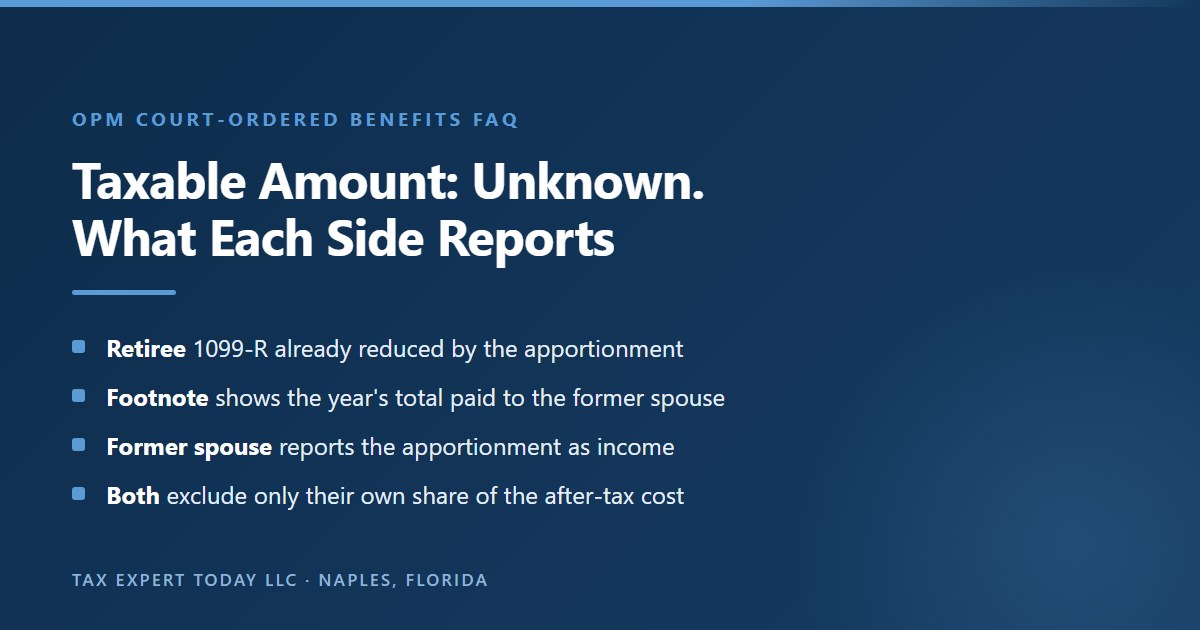
Because OPM does not calculate the taxable portion of an annuity that is subject to a court-ordered apportionment. The retiree’s Form CSA 1099-R shows the gross annuity reduced by the apportionment, a footnote states the amount paid to the former spouse, and the taxable amount box reads unknown, so the retiree must compute it.
- Box 1 is already reduced: the gross distribution reflects the annuity after the apportionment, once the retirement application is finalized.
- The footnote matters: it states the year’s total paid to the former spouse, which supports the basis allocation.
- Unknown means work: the retiree computes the tax-free part using the Simplified Method and only the retiree’s share of cost.
- Software defaults are risky: entering the full cost from the annuity statement overstates the retiree’s tax-free amount.
OPM’s frequently asked questions on court-ordered benefits describe this directly. The retiree’s 1099-R reflects a reduction in the gross annuity based on the apportionment, a footnote states the amount of the apportionment paid to the former spouse for the year, and because the annuity is subject to a court-ordered apportionment, OPM does not calculate the taxable portion. The taxable amount box shows unknown. OPM suggests speaking with the IRS or a tax advisor to calculate the tax-free portion.
For a retiree without a court order, OPM’s annuity statement and the Simplified Method worksheet in IRS Publication 721 produce a fixed tax-free monthly amount, and the arithmetic is routine. Once part of the annuity is apportioned, two inputs change. The monthly payment the retiree receives is smaller, and the cost the retiree may recover is smaller, because part of it belongs to the former spouse. If the retiree uses the full contribution balance from the annuity statement against the reduced annuity, the retiree excludes too much each month and understates income for every year until the cost is recovered. The error is small per month, which is why it can persist for decades unnoticed.
The former spouse faces the mirror image. The former spouse is generally entitled to exclude a share of the cost from each payment, but nothing on the payment record computes that share automatically. A former spouse who treats every dollar as fully taxable overpays, and one who treats the payments as a tax-free property settlement underreports. Both errors are common, and both are avoidable with the allocation described next.
How Is the Retiree’s After-Tax Cost Split With the Former Spouse?
The retiree’s investment in the contract, meaning the after-tax FERS contributions withheld from pay, is allocated between the retiree and the former spouse on a pro rata basis under IRC 72(m)(10). Publication 575 states the fraction: the present value of the former spouse’s benefits over the present value of all benefits payable under the order.
- What the cost is: the total employee contributions shown on the OPM annuity statement, plus any deposits or redeposits.
- The fraction: present value of the spouse’s payments divided by present value of all benefits payable.
- Each side recovers only its share: neither party excludes the full contribution balance.
- Records matter: both should keep the computation, since it sets the exclusion for every later year.
Every FERS employee contributes to the basic annuity through payroll withholding, and those contributions are included in gross income in the year withheld. The rate depends on the hiring date: generally 0.8 percent of basic pay for employees first covered before 2013, 3.1 percent for those first covered in 2013, and 4.4 percent for those first covered after 2013, with different rates for certain law enforcement and similar positions. Because the money was already taxed, it is recovered tax free as part of the annuity. Publication 721 calls this your cost, and it appears on the annuity statement OPM issues at retirement.
Section 72(m)(10) addresses what happens to that cost when a QDRO pays part of the benefit to a spouse or former spouse. It says the investment in the contract is allocated on a pro rata basis between the present value of the distribution or payment to the alternate payee and the present value of all other benefits payable with respect to the participant to which the order relates. Publication 575 restates the rule in plain language: the spouse or former spouse is allocated a share of the participant’s cost equal to the cost times a fraction, the numerator being the present value of the benefits payable to the spouse and the denominator the present value of all benefits payable to the participant. Section 414(p)(11) applies that QDRO treatment to a governmental plan order for purposes of the whole income tax title.
When the apportionment is a flat percentage of the annuity and both payment streams last for the retiree’s lifetime, the present value fraction usually works out close to the percentage itself. When the streams differ, for example a fixed dollar award with no cost of living increases against a retiree share that does increase, or an award that ends at a stated date, the present values diverge and an actual computation is needed. The table below shows how common order types tend to affect the allocation. It is a planning guide, not a substitute for the computation.
| Type of FERS order | Effect on the cost allocation | What to document |
|---|---|---|
| Percentage of the annuity, with cost of living increases shared | Fraction is usually close to the stated percentage | Order percentage, annuity statement cost, first year footnote amount |
| Fixed dollar amount with no cost of living increases | Spouse’s share of value shrinks relative to the retiree’s over time, so the fraction can be below the first year percentage | A present value computation with stated assumptions |
| Marital share formula (coverture fraction) | Convert the formula to OPM’s computed monthly award first, then compute the fraction | OPM’s acceptance letter showing the monthly benefit and the formula used |
| Apportionment plus a former spouse survivor annuity | The survivor benefit is part of the value payable under the order and may enter the denominator and numerator | Survivor award terms, reduction amount, both parties’ ages |
| Award of part of a refund of contributions only | Contributions in the refund are cost; only interest is taxable | OPM refund statement split between contributions and interest |
Because the regulations described in section 72(m)(10) leave room for judgment on assumptions such as interest rates and mortality, the defensible approach is a consistent method, written down once, used by both parties if possible, and kept with each return. When the retiree and former spouse use different allocations, the IRS could see the same dollars of basis excluded twice, which invites questions on both returns.
How Does the Simplified Method Work When Part of a FERS Annuity Is Apportioned?
Each party divides its own share of the cost by the number of expected monthly payments from the IRS tables in Publication 721, then excludes that fixed dollar amount from each monthly payment. For an annuity starting after November 18, 1996, a retiree aged 61 to 65 with no survivor benefit uses 260 months.
- Table 1: annuity without a survivor benefit, based on the retiree’s age at the annuity starting date.
- Table 2: annuity with a survivor benefit, based on the annuitants’ combined ages.
- Fixed exclusion: the tax-free monthly amount does not rise with cost of living increases.
- Stops at full recovery: once the cost is recovered, every later payment is fully taxable.
Publication 721 requires the Simplified Method for any CSRS or FERS annuity with a starting date after November 18, 1996, so every FERS retiree in a current divorce uses it. The worksheet takes the cost, divides it by the number of months from the IRS table, and produces a tax-free amount for each full monthly payment. The two tables for annuity starting dates after November 18, 1996 are reproduced below as Publication 721 prints them.
| Table 1: age at annuity starting date (no survivor benefit) | Months | Table 2: combined ages (with survivor benefit, start after 1997) | Months |
|---|---|---|---|
| 55 or under | 360 | 110 or under | 410 |
| 56 to 60 | 310 | 111 to 120 | 360 |
| 61 to 65 | 260 | 121 to 130 | 310 |
| 66 to 70 | 210 | 131 to 140 | 260 |
| 71 or over | 160 | 141 or over | 210 |
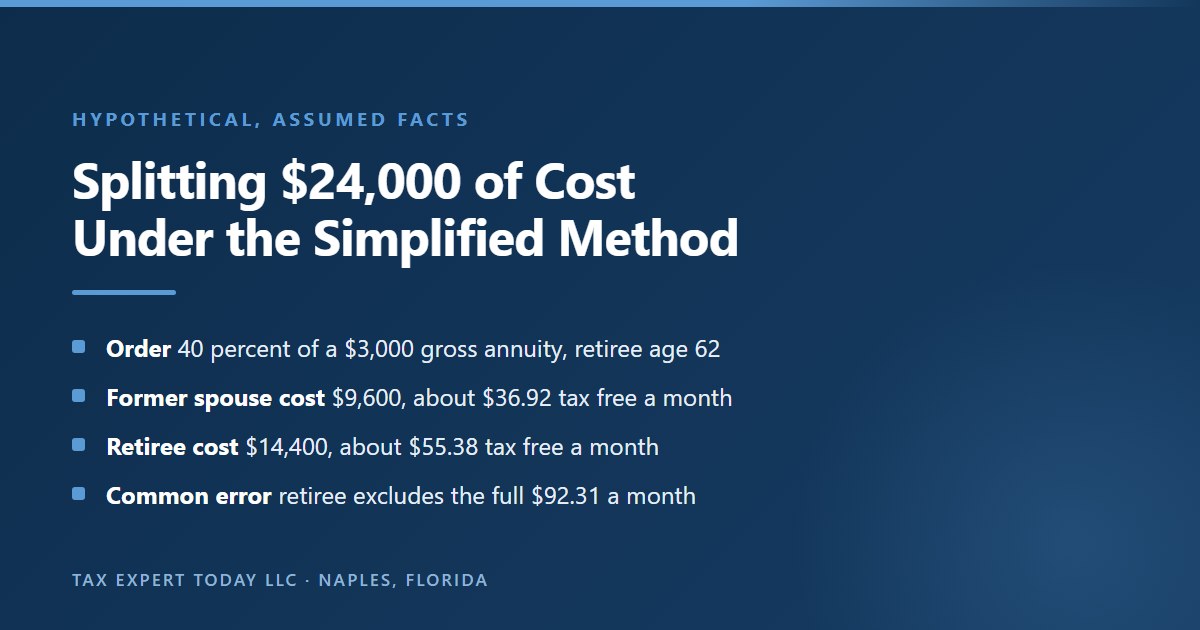
A hypothetical with assumed facts shows the effect of the allocation. Assume a FERS retiree begins an annuity at age 62 with a gross annuity of $3,000 a month and no survivor benefit. The annuity statement shows a cost of $24,000. A court order acceptable for processing awards the former spouse 40 percent of the gross annuity, so OPM pays $1,200 a month to the former spouse and $1,800 a month to the retiree, before deductions. Assume both payment streams last for the retiree’s lifetime and share cost of living increases, so the present value fraction is 40 percent.
- Former spouse’s cost: $24,000 times 40 percent is $9,600.
- Retiree’s cost: the remaining $14,400.
- Retiree’s tax-free amount: $14,400 divided by 260 months is about $55.38 a month, or about $665 for a full year, so about $20,935 of the retiree’s $21,600 is taxable.
- Former spouse’s tax-free amount: on the assumption that the same 260 month figure is used because the payments end at the retiree’s death, $9,600 divided by 260 is about $36.92 a month, or about $443 a year, so about $13,957 of the $14,400 is taxable.
- The common error: a retiree who divides the full $24,000 by 260 excludes about $92.31 a month instead of $55.38, understating income by roughly $443 a year for about 21 years.
Two lessons follow. First, because FERS contributions are modest relative to the annuity, the great majority of every payment is taxable to whoever receives it. The basis is real but small, and a former spouse should not expect a meaningful tax-free component. Second, the dollars are small enough that errors go unnoticed and large enough over a long retirement to matter. The month count used for the former spouse is an assumption in this example, chosen because the apportionment ends at the retiree’s death. Different facts, including an award that ends earlier or a survivor annuity, can change the right figure, and the method used should be documented.
Publication 721 also states that, if the retiree dies before the cost is recovered, the unrecovered cost can generally be claimed as a deduction on the final return, and that the exclusion cannot exceed the cost in total. Both rules apply separately to each party’s share once the cost has been allocated.
How Much Federal Tax Is Withheld on a FERS Divorce Payment?
Monthly FERS annuity payments are periodic payments, so withholding follows Form W-4P rather than a mandatory 20 percent rate. OPM’s FAQ says the retiree is taxed on the gross annuity according to the W-4P on file, so a retiree paying an apportionment may be over-withheld unless the W-4P is updated after the divorce.
- Periodic, not a rollover distribution: a monthly life annuity is not an eligible rollover distribution, so the 20 percent rule does not apply to it.
- Retiree: review the W-4P once OPM begins paying the former spouse, and again after any change in filing status.
- Former spouse: confirm whether tax is being withheld from the apportionment and, if not, plan estimated tax payments.
- Lump sums differ: a refund of contributions with taxable interest is an eligible rollover distribution with 20 percent withholding.
Publication 721 explains that a retiree can give OPM a Form W-4P for periodic payments and may choose to have tax withheld or not, and that if no W-4P is filed, OPM withholds under the default rules for a single filer. OPM’s court-ordered benefits FAQ adds the divorce-specific point: the retiree is taxed on the gross annuity according to the most recent W-4P marital status election on file, and the retiree can change that election at any time online or by contacting OPM. OPM also states that it is the retiree’s responsibility to make sure enough tax is withheld and to check early in the year.
The practical effect cuts in both directions. A retiree who changes from married filing jointly to single after the divorce, without updating the W-4P, may be under-withheld on the reduced annuity. A retiree whose withholding is still figured on the full gross annuity, including the share that now goes to the former spouse, may be over-withheld and wait for a refund each spring. Neither result is a tax cost in itself, but both are avoidable cash flow problems, and an underpayment can bring an estimated tax penalty if the shortfall is large enough. Publication 721 notes the general threshold: a penalty may apply if the balance due is $1,000 or more and more than 10 percent of the tax on the return.
For the former spouse, the published OPM materials say little about withholding mechanics on the apportioned share. The safer assumption is to verify rather than assume. A former spouse receiving $1,200 a month from an apportionment, with other income such as wages or Social Security, may owe meaningful tax on it, and a first filing season after payments begin is the most common time to discover a balance due. Quarterly estimated payments on Form 1040-ES or additional withholding from wages are the usual fixes. Our guide to divorce filing status covers the filing status change that often arrives in the same year.
Does Gross, Net, or Self-Only Annuity in the Order Change the Tax?
It changes the dollar amount each party receives, and therefore how much income lands on each return, but not the rule that each party is taxed on what it receives. Under 5 CFR 838.103, self-only, gross, and net annuity are defined terms, and net annuity is reduced by the retiree’s own income tax withholding.
- Self-only annuity: the unreduced annuity with no survivor annuity payable to anyone.
- Gross annuity: the self-only annuity after any reduction for survivor benefits, before other deductions.
- Net annuity: gross annuity minus items such as health and life insurance premiums, Medicare premiums, and properly withheld federal and state income tax.
- The order’s choice: a matter for the attorneys, with the tax effect shown below.
OPM’s training materials on court-ordered benefits list net annuity, gross annuity, and self-only annuity as the three bases an order can use when it states the former spouse’s share as a percentage or formula. The regulation’s definitions in 5 CFR 838.103 explain why the choice matters. Net annuity is the gross annuity after deducting amounts owed to the United States, health benefits premiums, life insurance premiums, Medicare premiums, federal income tax properly withheld, state income tax properly withheld, and amounts already payable to another person under a court order. The federal and state withholding count only to the extent they are not greater than they would be if the retiree claimed all dependents the retiree was entitled to claim.
| Base named in the order | What it means under 5 CFR 838.103 | Tax effect to watch |
|---|---|---|
| Self-only annuity | The unreduced annuity with no survivor annuity | The share is computed before any survivor reduction, so the retiree absorbs the cost of the survivor benefit unless the order says otherwise |
| Gross annuity | The annuity after the survivor reduction, before other deductions | The survivor reduction is shared in proportion; the former spouse’s taxable income is a fixed share of the gross |
| Net annuity | Gross minus premiums, debts to the United States, and properly withheld income tax | The retiree’s own withholding and health premiums reduce the former spouse’s payment, so the former spouse’s taxable income depends partly on the retiree’s choices |
The net annuity definition has a consequence that surprises many people. Because federal and state income tax withheld from the retiree’s annuity is subtracted before the percentage is applied, the retiree’s withholding level affects the size of the former spouse’s payment, within the limit the regulation sets. The regulation caps the subtraction at the withholding that would apply if the retiree claimed all available dependents, which keeps a retiree from shrinking the award simply by over-withholding. Even so, a net annuity award is less predictable for the former spouse’s tax planning than a gross annuity award. That is information for the negotiation, not advice on which base to choose, and the drafting decision stays with your family law attorney.
Whatever base is used, the tax rule is the same. OPM pays a dollar amount to the former spouse, the former spouse reports that dollar amount less its share of cost, and the retiree reports the remaining annuity less its share of cost. The base changes the numbers on each return, not the rule that decides whose return they belong on.
How Is a Former Spouse Survivor Annuity Taxed?
While the retiree is alive, the survivor annuity creates no income for the former spouse. Its cost is a reduction in the retiree’s annuity, and the retiree is taxed only on the reduced amount actually payable. After the retiree’s death, the survivor annuity payments are taxable to the former spouse, less any remaining tax-free cost recovery.
- The reduction is not income: the retiree never receives it and does not report it.
- The reduction is not deductible: it simply lowers the gross annuity on which the retiree is taxed.
- After death: the former spouse reports each survivor payment as pension income.
- Remarriage before 55: under OPM rules the survivor annuity generally ends, unless the marriage lasted 30 years or more.
Under FERS, 5 U.S.C. 8419 reduces the retiree’s annuity by 10 percent when a full survivor annuity is provided, and by a smaller percentage set by OPM regulations when a partial survivor annuity is provided. A former spouse survivor annuity under 5 U.S.C. 8445 is one of the survivor annuities that triggers that reduction. OPM pamphlet RI 84-1 adds the limits that matter for planning: a court-ordered survivor annuity requires a marriage of at least 9 months, the combined total of all current and former spouse survivor annuities under FERS cannot exceed 50 percent, and a former spouse survivor annuity ends if the former spouse remarries before age 55 unless the marriage lasted at least 30 years.
For income tax, the reduction works through the definitions already discussed. Gross annuity under 5 CFR 838.103 is the annuity after reducing the self-only annuity to provide survivor benefits. The retiree is taxed on what is actually payable, so a 10 percent reduction to fund the former spouse’s survivor benefit is income the retiree never reports. A hypothetical with assumed facts illustrates it. If a self-only annuity is $3,300 a month and a full former spouse survivor annuity reduces it by 10 percent, the gross annuity is $2,970. Any apportionment is then computed from whichever base the order names, and the retiree’s reportable annuity starts from $2,970, not $3,300. Publication 721 also directs a retiree with a survivor benefit to use Table 2, which is based on combined ages, when the annuity starting date is after 1997.
After the retiree dies, the survivor annuity becomes the former spouse’s own income. Publication 721 explains that a survivor of a retiree who used the Simplified Method keeps the same tax-free monthly amount the retiree was using, until the total cost has been recovered, and that payments are fully taxable once the cost is gone. Where the cost was split between the retiree and the former spouse during the retiree’s lifetime, the allocation should be revisited at that point so that neither the former spouse nor the retiree’s estate recovers the same cost twice.
Two related points sit outside income tax but belong in the same conversation. A former spouse who is awarded a portion of the annuity or a survivor annuity may qualify for health coverage under the Federal Employees Health Benefits spouse equity provisions, and the premiums are the former spouse’s own cost. Our guide to health coverage and shared policy allocation after divorce covers the federal tax side of losing family coverage. And a current spouse’s maximum survivor benefit shrinks when a former spouse has been awarded one, which matters if the retiree remarries.
Can a Survivor Annuity for a Former Spouse Be a Taxable Gift?
Publication 721 warns that providing a survivor annuity for someone other than a current spouse, such as a former spouse, does not qualify for the unlimited marital deduction and may be a taxable gift. When the benefit is provided under a written settlement agreement, IRC 2516 may treat the transfer as made for full consideration instead.
- The risk: no marital deduction is available for a gift to a former spouse.
- The usual answer: section 2516 covers transfers under a written agreement on marital and property rights.
- The timing test: divorce must occur within the 3 year period beginning 1 year before the agreement.
- Voluntary elections: an election made outside any agreement or order deserves a closer look.
Section 2516 provides that, where spouses enter into a written agreement relative to their marital and property rights and divorce occurs within the 3 year period beginning on the date 1 year before the agreement is entered into, transfers made under the agreement to either spouse in settlement of marital or property rights are deemed made for full and adequate consideration. A former spouse survivor annuity awarded as part of a settlement agreement, inside that window, generally fits that description. The gift tax question becomes more pressing when a retiree voluntarily elects a former spouse survivor annuity at retirement, years after the divorce and outside any agreement. RI 84-1 confirms that a retiring employee may make that election voluntarily, with a current spouse’s consent if the employee has remarried. Whether a Form 709 is needed in that case depends on the facts and should be reviewed before the election is made.
How Is a Court-Ordered Refund of FERS Contributions Taxed?
A court order can award a former spouse all or part of a refund of FERS employee contributions. The contribution portion is the employee’s after-tax cost and is not taxed again; any interest is taxable unless rolled over. A former spouse payee may roll over the taxable part, and OPM withholds 20 percent on interest paid directly.
- When it arises: the employee leaves federal service before an immediate annuity and applies for a refund.
- Contributions: already taxed when withheld from pay, so not taxed again.
- Interest: taxable to the payee, with 20 percent withheld unless directly rolled over.
- Blocking a refund: an order can block it only if it also awards a survivor annuity or part of the annuity.
RI 84-1 lists a refund of employee contributions among the benefits a court order can divide, and it explains that an order may block the refund only if it directs OPM not to pay it and also grants a survivor annuity or a portion of the annuity to the former spouse. Publication 721 states the tax rule for a refund: if the refund includes only contributions, none of it is taxable; if it includes interest, the interest is taxable unless rolled over directly to another qualified plan or a traditional IRA, and OPM withholds 20 percent on interest that is not directly rolled over. Publication 721 also states that a spouse or former spouse who receives a distribution from FERS under a court order in a divorce can roll it over as if the payee were the employee, provided it is an eligible rollover distribution.
A refund decision has consequences far larger than the tax on interest. Taking a refund generally gives up the future annuity based on that service. That is a retirement and settlement question for the employee and the attorneys. The tax point is narrower: a former spouse who receives part of a refund should expect most of it to be tax free contributions, should know which part is interest, and should decide on a rollover before OPM pays.
Does the 10 Percent Early Withdrawal Tax Apply to a FERS Divorce Payment?
Generally not for the former spouse. IRC 72(t)(2)(C) excludes distributions to an alternate payee under a qualified domestic relations order from the 10 percent additional tax, and IRC 414(p)(11) treats a qualifying governmental plan order as a QDRO for that purpose. Monthly annuity payments after retirement rarely raise the issue for either party.
- Monthly apportionments: paid only after the retiree retires, as part of a life annuity.
- Refund to a former spouse: the taxable interest paid under the order generally falls within the alternate payee exception.
- Money rolled to an IRA: loses the exception, so a later early IRA withdrawal can be subject to the 10 percent tax.
- The employee’s own refund: follows the employee’s age and separation rules, not the alternate payee rule.
The alternate payee exception is a single event rule. It applies to the distribution made under the order. If a former spouse rolls a refund into an IRA and withdraws it at age 45, the IRA withdrawal is an ordinary early IRA distribution, and the exception from the plan payment does not travel with the money. Our QDRO taxes guide explains that rule in detail for private plans, and the TSP divorce guide shows the same trap for Thrift Savings Plan awards. For a FERS basic annuity, where the former spouse’s share arrives as monthly payments after the retiree retires, the question rarely arises.
Apportionment Versus Garnishment for Support: Whose Income Is It?
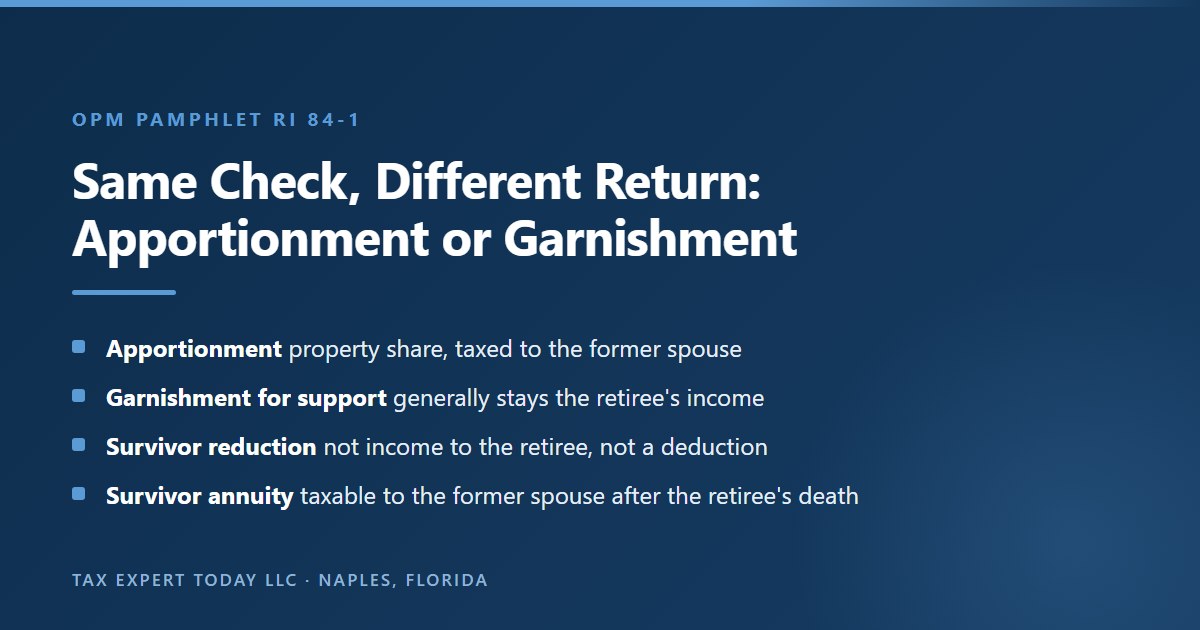
An apportionment divides the annuity as property and is taxable to the former spouse who receives it. A garnishment collects alimony or child support from the retiree’s annuity under state law, and the garnished dollars generally remain the retiree’s taxable income, because they pay the retiree’s own support obligation. The label on the order decides the result.
- Apportionment: division of the benefit under 5 CFR Part 838; income to the former spouse.
- Garnishment: collection of support under 5 CFR Part 581; generally still income to the retiree.
- Post-2018 alimony: not deductible by the payer and not income to the recipient.
- Child support: never deductible and never income to the recipient.
RI 84-1 separates the two clearly. A court order can apportion a FERS benefit as a result of a divorce, legal separation, or annulment, and FERS benefits can be garnished only for alimony, child support, or in cases involving child abuse, under the garnishment rules in 5 CFR Part 581. The tax treatment follows the nature of the payment. An apportionment is the former spouse’s own share of the retirement benefit, which is why OPM tells the former spouse to report it and reduces the retiree’s 1099-R. A garnishment is the retiree’s own income applied to the retiree’s own obligation, so it generally stays in the retiree’s income even though OPM sends the money elsewhere.
| How OPM pays the former spouse | Legal basis | Taxed to | Deductible by the retiree? |
|---|---|---|---|
| Apportionment of the annuity under a court order acceptable for processing | 5 CFR Part 838, IRC 414(p)(11) and 402(e)(1)(A) | Former spouse | Not needed; excluded from the retiree’s 1099-R |
| Garnishment for alimony under a post-2018 instrument | 5 CFR Part 581 | Generally the retiree | No |
| Garnishment for alimony under a pre-2019 instrument not modified to adopt the new rules | 5 CFR Part 581, former IRC 71 and 215 | Retiree, with alimony income to the recipient | Generally yes, as grandfathered alimony |
| Garnishment for child support | 5 CFR Part 581 | Retiree | No |
| Former spouse survivor annuity after the retiree’s death | 5 U.S.C. 8445, 5 CFR Part 838 | Former spouse | Not applicable |
The alimony rules for pre-2019 and post-2018 instruments are covered in our guide to alimony taxes after divorce. The point here is narrower. Two former spouses receiving the same monthly dollar amount from the same OPM annuity can face opposite tax results, depending on whether the money arrives as a property apportionment or as support collected by garnishment. When a settlement is being negotiated, the after-tax value of each structure should be compared before the order is finalized. Which structure to use is a question for your family law attorney.
What About the FERS Supplement in a Divorce?
The FERS special retirement supplement, paid to certain retirees before age 62, is divided only if the court order expressly addresses it, according to a 2025 Federal Circuit decision reported by FEDweek. For tax, whoever OPM pays reports the supplement as income, under the same apportionment principles that apply to the basic annuity.
- Who gets it: retirees who leave at the minimum retirement age with 30 years, or at 60 with 20 years, and some special category employees.
- Silence in the order: may mean the supplement is not divided at all.
- Tax: taxed to the person who receives it; it is not Social Security for federal income tax.
- Ends at 62: so any division of it is a short, front-loaded stream.
FEDweek’s November 2025 report on the decision, Court Clarifies Status of Retirement Supplement in Divorce Cases, describes the holding as turning on the order’s own language. The supplement approximates the Social Security benefit earned during federal service and bridges the gap until age 62. Because it is short lived and ends at a known age, a former spouse’s share of the supplement has a very different present value from a share of the lifetime annuity, which can affect the cost allocation described earlier if both are divided. Whether to divide the supplement at all is a drafting question for your family law attorney. The tax principle stays the same: the recipient reports what OPM pays, and the retiree’s 1099-R reflects what the retiree keeps.
FERS Divorce Versus a TSP Split Versus a Private Pension QDRO: What Is Different for Tax?
All three shift income to a spouse or former spouse payee, but they differ in how and when the money arrives. A FERS apportionment is a stream of monthly annuity payments after retirement, a TSP award is usually a single eligible rollover distribution, and a private plan QDRO can do either and may start before the employee retires.
- FERS annuity: periodic payments, W-4P withholding, cost shared pro rata.
- TSP: one payment, 20 percent withholding unless directly rolled over, pro rata by tax source.
- Private pension: shared payment or separate interest, with QDRO rules under ERISA.
- Rollover: available for eligible rollover distributions, not for a monthly life annuity.
| Feature | FERS basic annuity | Thrift Savings Plan | Private pension or 401(k) |
|---|---|---|---|
| Order type | Court order acceptable for processing, 5 CFR Part 838 | Retirement benefits court order, 5 CFR Part 1653 | QDRO under ERISA and IRC 414(p) |
| Earliest payment to the former spouse | When the employee retires and the annuity is payable | After the order is processed, even while the employee works | Can be as early as the employee’s earliest retirement age, depending on the plan |
| Who is taxed | Former spouse on the apportionment | Spouse payee, unless rolled over | Spouse or former spouse alternate payee |
| Withholding | Periodic payment rules, Form W-4P | 20 percent mandatory on a spouse payee’s eligible rollover distribution | Depends on whether payments are periodic or a lump sum |
| Basis | After-tax contributions split pro rata under IRC 72(m)(10) | Pro rata traditional, Roth, and tax-exempt amounts | Any after-tax contributions split pro rata |
| Survivor benefit | Former spouse survivor annuity funded by a reduction in the retiree’s annuity | Not applicable to an account balance | Qualified preretirement or joint and survivor annuity rules, if the order provides |
The comparison matters most when a settlement trades one account for another. A former spouse who gives up a FERS apportionment in exchange for a larger share of the TSP receives a lump sum now instead of monthly income later, with different withholding, a different rollover decision, and different exposure to the 10 percent tax on money that ends up in an IRA. A private pension in the same marriage follows the rules in our QDRO taxes guide. Each of those choices is a settlement term for the attorneys, and each has a tax effect that should be measured before the order is signed.
How Should a FERS Annuity Be Valued Against Other Assets in a Settlement?
On an after-tax basis. A FERS annuity is almost entirely taxable income when paid, so its value to either spouse is lower than its pre-tax present value. Comparing it dollar for dollar with home equity, a Roth IRA, or cash in a brokerage account overstates what the annuity is worth.
- Mostly taxable: after-tax contributions are a small share of a typical FERS annuity.
- Each spouse’s bracket: the same annuity is worth different amounts to spouses in different brackets.
- Cost of living increases: raise the value of an inflation-adjusted share compared with a fixed dollar award.
- Actuary, then tax: OPM states the present value must be determined by a private actuary.
RI 84-1 states that an employing agency cannot determine the proper division of benefits between spouses or the present value of the employee annuity, which must be determined by a private actuary. The actuary’s present value is a pre-tax figure. For a settlement that trades the annuity against other property, the next step is to estimate the tax that will be owed on the payments and compare after-tax values. Our guide to which parts of a divorce settlement are taxable explains why property received under section 1041 carries over its basis and its embedded tax, and the same thinking applies here: a dollar of FERS annuity and a dollar of home equity are not the same dollar. The home has its own rules, covered in our guide to divorce house buyout taxes.
Tax analysis does not decide what is fair, and it does not replace the actuary or the family law attorney. It gives both sides an accurate after-tax number to negotiate with, which is the role we play on the divorce team.
How Does Florida Law Treat a FERS Annuity in a Divorce?
Florida Statutes section 61.076(1) treats vested and nonvested retirement and pension benefits accrued during the marriage as marital assets subject to equitable distribution, which includes a FERS annuity. Florida has no personal income tax, so a Florida resident receiving a FERS apportionment owes only federal income tax on the taxable part.
- Marital share: Florida courts decide it; OPM carries out the order.
- No state tax: a Naples resident pays federal tax only on FERS payments.
- Not a community property state: the community property rules in Publication 721 generally do not apply to Florida service.
- Prior residence: service while domiciled in a community property state can still matter for a separate return.
Section 61.076(1) reads that all vested and nonvested benefits, rights, and funds accrued during the marriage in retirement, pension, profit-sharing, annuity, deferred compensation, and insurance plans and programs are marital assets subject to equitable distribution. That is the state law hook for dividing a FERS annuity in a Florida divorce. Publication 721 adds a federal tax wrinkle for couples who lived elsewhere: state community property laws can affect the income tax on an annuity when spouses file separately, based on marital status and domicile when the service was performed. Florida is not a community property state, but a federal employee who served while married and domiciled in a community property state may have part of the annuity treated as community income for years in which separate returns are filed. Florida’s absence of an income tax is also one reason many federal retirees settle in Southwest Florida, discussed in our guide to retiring to Florida taxes.
What Are the Most Common FERS Divorce Tax Mistakes?
The most common mistakes are treating the former spouse’s share as tax free, letting the retiree recover the full contribution cost against a reduced annuity, ignoring an unknown taxable amount on Form 1099-R, leaving an outdated W-4P in place, and confusing a property apportionment with garnishment for support.
- Former spouse reports nothing: the apportionment is taxable income to the former spouse, as OPM states.
- Double basis: both parties exclude the full cost instead of their pro rata shares.
- Unknown box left unknown: software may treat the whole 1099-R amount as taxable, or none of it.
- Stale withholding: a W-4P still based on married status or on the full gross annuity.
- Wrong label: assuming garnished support shifts income the way an apportionment does.
Each of these mistakes repeats every year until someone catches it, which is why the first tax year after OPM begins paying the former spouse is the year to get the computation right. If an error has already run for several years, amended returns may be possible for open years. A prior-year return can generally be amended on Form 1040-X within 3 years of filing or 2 years of payment, whichever is later, so older years may be closed. The fix should be made consistently on both sides where the parties are willing to coordinate, so the allocation of cost is not claimed twice.
FERS Divorce: Help in Naples & Southwest Florida
Tax Expert Today LLC is based in Naples, Florida, and works with divorcing and recently divorced clients across Collier and Lee counties and in all 50 states. Southwest Florida has a large community of federal retirees, and a FERS annuity often sits on the same settlement worksheet as a TSP account, an IRA, the home, and Social Security after divorce. The questions we see are federal and practical: who is taxed on the apportionment, how the contribution cost splits, what to do with an unknown taxable amount, and how much each side should have withheld.
- Divorce tax Naples FL: after-tax valuation of a FERS annuity share against other marital property before the settlement is fixed.
- FERS divorce help Naples: computing each party’s share of cost under IRC 72(m)(10) and the Simplified Method, and resolving the unknown taxable amount on Form 1099-R.
- Survivor annuity and supplement: showing both sides the income tax and gift tax effects of a former spouse survivor annuity and of dividing the FERS supplement.
- Coordination with your attorney: giving the family law attorney the tax result of each proposed order, without advising on the negotiation itself.
You can read more on our divorce tax consulting page and about the broader practice at Naples FL tax planning.
Tax Expert Today LLC
11983 Tamiami Trail N, Naples, FL 34110
Phone: (239) 441-2005
Hours: Monday through Friday, 10:00am to 5:00pm ET
Does Florida tax a FERS annuity apportionment for a Naples resident? No. Florida has no personal income tax, so a Naples resident who receives a share of a FERS annuity under a divorce court order owes only federal income tax on the taxable part. The same is true for the retiree’s own share and for a former spouse survivor annuity.
When to Engage a Professional
A FERS divorce in which the annuity is not divided, or in which the employee is decades from retirement and the order simply reserves the issue, may need little tax work now. Professional involvement tends to earn its cost when one or more of the following is present.
- OPM has begun paying the former spouse: both returns need a cost allocation, and the retiree’s 1099-R shows the taxable amount as unknown.
- A former spouse survivor annuity is awarded or being considered: it changes the retiree’s gross annuity and can raise a gift tax question.
- A trade of the FERS annuity against the TSP, the home, or other assets: after-tax values can differ substantially from present values.
- A refund of contributions is in play: the interest is taxable and the rollover decision must be made before OPM pays.
- Support is being collected by garnishment: the income may stay on the retiree’s return.
We work as the tax side of the divorce team, alongside your family law attorney, who remains responsible for the settlement terms and the wording of the court order. To discuss your situation, call (239) 441-2005 or visit our divorce tax consulting page. Every outcome depends on the facts, including each party’s age, the annuity starting date, the contribution balance, the order’s terms, other income for the year, and filing status.
Frequently Asked Questions About FERS Divorce
Is a FERS annuity apportionment taxable to the former spouse? Yes. OPM states that a former spouse must report the court-ordered apportionment as taxable income. Under IRC 414(p)(11) and 402(e)(1)(A), the former spouse is treated as the distributee. The former spouse may exclude a pro rata share of the retiree’s after-tax contributions, which is usually small.
Why does my OPM Form 1099-R show the taxable amount as unknown? OPM does not calculate the taxable portion when an annuity is subject to a court-ordered apportionment. The gross amount is already reduced by the former spouse’s share, and a footnote shows what was paid to the former spouse. The retiree computes the taxable amount using only the retiree’s share of cost.
Can the retiree deduct the apportionment as alimony? No. OPM states that apportionment payments cannot be used as alimony deductions. They are not alimony; they are the former spouse’s share of the retirement benefit, already removed from the retiree’s taxable annuity. Alimony under a post-2018 divorce instrument is not deductible in any case.
Is the survivor annuity reduction taxable to the retiree? No. The reduction that funds a former spouse survivor annuity lowers the annuity actually payable, and the retiree is taxed only on what is payable. The reduction is not income and is not a deduction. After the retiree’s death, the survivor annuity payments are taxable to the former spouse.
Is there a 10 percent penalty on a FERS divorce payment? Generally no for the former spouse. IRC 72(t)(2)(C) excludes payments to an alternate payee under a qualified domestic relations order, and section 414(p)(11) extends that treatment to a qualifying governmental plan order. Money rolled into an IRA and withdrawn early does not keep the exception.
Does Florida tax a FERS annuity apportionment for a Naples resident? No. Florida has no personal income tax, so a Naples resident who receives a share of a FERS annuity under a divorce court order owes only federal income tax on the taxable part. The same is true for the retiree’s own share and for a former spouse survivor annuity.
Published October 28, 2026 by Dr. Pellumb Kabashi « Back to Learning Center
Have a question this article touches on?
Tax Expert Today LLC, based in Naples, Florida and serving clients across the United States.
Schedule a Consultation (239) 441-2005