
By Dr. Pellumb Kabashi, DBA, MBA, CES, CFE, EA
Founder, Tax Expert Today LLC · Tax advisors, enrolled agents, CPAs, and attorneys · Serving clients in all 50 states
Quick Answer: QDRO taxes are zero at the moment the retirement account is divided. Under IRC §414(p), a qualified domestic relations order assigns a right to benefits rather than distributing cash, so nothing is taxed until money leaves the plan. The alternate payee then reports the income, and a direct rollover defers it entirely. Call (239) 441-2005 for a free consultation.
A retirement account is often the largest asset in a divorce, and it is the one most easily damaged by a decision made in the wrong order. The rules that govern QDRO taxes are generous, but several of them are one-time opportunities. Take the money the wrong way, or move it before taking it, and a benefit that was available permanently disappears. This guide walks the mechanics under federal tax law, then covers the Florida layer. For the cash side of a settlement rather than the asset side, see our guide to alimony taxes after divorce. Retirement accounts are only one part of the estate; where a spouse also owns a company, see our guide to business owner divorce taxes for the section 1041 and redemption mechanics.
One boundary before starting. This article addresses the tax mechanics only. Whether a particular account should be divided at all, how much of it belongs to each spouse, and how the order itself is drafted and entered are questions for your family law attorney. The most reliable outcomes happen when the attorney and the tax advisor read the same draft before it is signed, because the tax consequences are locked in by language the attorney controls.
Are QDRO Taxes Owed When the Account Is Divided?
No. Dividing a qualified plan under a qualified domestic relations order is not a taxable event to either spouse. The order assigns the right to receive benefits, and it does not move cash. QDRO taxes arrive later, only when money actually leaves the plan, and only for the person who receives it.
- An assignment, not a distribution. The order creates or recognizes an alternate payee’s right to benefits under IRC §414(p)(1)(A)(i).
- The participant is relieved. The spouse who gives up part of the account does not report income on the split.
- Tax follows the withdrawal. Pre-tax dollars are taxed as ordinary income whenever they are finally paid out.
- Deferral is available. A direct rollover into an eligible retirement plan postpones the tax indefinitely.
- Timing is discretionary. The alternate payee generally chooses when to withdraw, subject to the plan’s own terms.
This is the point most readers already know, and it is where most published explanations of QDRO taxes stop. The harder and more valuable questions are who exactly reports the income, what the penalty exception covers, and which account types are quietly excluded from it. Those answers are where real money is won or lost, and they are covered below.
Who Pays QDRO Taxes on the Distribution?
The alternate payee pays, but only when the alternate payee is the spouse or former spouse of the participant. IRC §402(e)(1)(A) treats that person as the distributee of any payment made under a qualified domestic relations order. The income lands on the recipient’s return, at the recipient’s rates, not the participant’s.
The statute is narrow and worth reading literally. It provides that “an alternate payee who is the spouse or former spouse of the participant shall be treated as the distributee of any distribution or payment made to the alternate payee under a qualified domestic relations order.” The shift in who reports the income depends on that relationship. A taxable payment received this way also counts in the provisional income of the alternate payee, which can raise the taxable share of any Social Security benefits, as our guide to divorce and Social Security benefits explains.
- Spouse or former spouse. The recipient reports the income and the participant does not.
- A child or other dependent. §414(p) permits a child or dependent to be an alternate payee, but §402(e)(1)(A) does not shift the tax to them, so the participant remains taxable on those payments.
- Rate arbitrage is real. Where the recipient sits in a lower bracket, the same dollars carry less tax than they would have in the participant’s hands.
- Rollover rights travel too. Under §402(e)(1)(B), a spouse or former spouse alternate payee may roll the money over as though they were the employee.
That child-versus-spouse distinction is a genuine drafting trap. An order that routes retirement money to a child in satisfaction of a support obligation can leave the participant paying QDRO taxes on dollars that person never receives. The child related tax questions that sit alongside this, including who claims the dependency exemption and the child tax credit, are covered in our guide to Form 8332. Where support is the goal, it is usually cleaner to name the former spouse as the alternate payee and address the support obligation separately, though the right structure depends on the facts and belongs in a conversation with your family law attorney.
What Makes an Order a Qualified Domestic Relations Order?
An order is qualified only if it satisfies the checklist in IRC §414(p). It must be a domestic relations order under state or tribal law, it must clearly specify four facts, and it must avoid three prohibited demands. An order that misses any one of these is not qualified, and none of the favorable tax treatment applies to it.
The plan administrator, not the judge, makes the qualification determination, and that determination is what unlocks the favorable QDRO taxes treatment. A signed order that the administrator rejects buys nothing until it is corrected, and in the meantime the benefits stay where they are. Reaching the same split by withdrawing the money instead is the costliest error available here, and it is one of the traps covered in our guide to whether a divorce settlement is taxable.
| Requirement | Source | What the order must do |
|---|---|---|
| Identify the people | §414(p)(2)(A) | Name and last known mailing address of the participant, and the name and mailing address of each alternate payee |
| State the amount | §414(p)(2)(B) | The amount or percentage of benefits to be paid, or the manner in which it is determined |
| State the duration | §414(p)(2)(C) | The number of payments or the period to which the order applies |
| Name the plan | §414(p)(2)(D) | Each plan to which the order applies |
| No new benefit forms | §414(p)(3)(A) | May not require a type or form of benefit the plan does not otherwise offer |
| No increased benefits | §414(p)(3)(B) | May not require increased benefits measured by actuarial value |
| No double assignment | §414(p)(3)(C) | May not assign benefits already committed to another alternate payee under a prior order |
Two practical notes sit alongside that list. First, §414(p)(1)(B) defines the underlying domestic relations order broadly enough to include approval of a property settlement agreement, and it now expressly covers orders issued under tribal domestic relations law. Second, §414(p)(4) contains a useful carve out: an order may direct payment to the alternate payee once the participant reaches the earliest retirement age, defined at §414(p)(4)(B) as the earlier of the date the participant could take a distribution, or the later of age 50 and the earliest date benefits could begin after separation from service. That provision is what allows an alternate payee to be paid before the participant actually retires.
How Does the QDRO Penalty Exception Work?
IRC §72(t)(2)(C) exempts a distribution paid to an alternate payee under a qualified domestic relations order from the 10 percent additional tax on early distributions. Age does not matter. An alternate payee well under 59 and a half may take cash directly from the plan and owe ordinary income tax without the penalty added to it.
The exception is written plainly. §72(t)(1) imposes an additional tax equal to 10 percent of the taxable portion of an early distribution. §72(t)(2)(C), captioned “Payments to alternate payees pursuant to qualified domestic relations orders,” removes that tax for “any distribution to an alternate payee pursuant to a qualified domestic relations order (within the meaning of section 414(p)(1)).”
- No age test. Unlike most of the §72(t)(2) exceptions, this one does not turn on the recipient’s age.
- Ordinary income still applies. The exception removes the penalty only, never the income tax.
- It must be paid to the alternate payee. The distribution has to run to that person pursuant to the order.
- Governmental and 457(b) plans qualify too. Under §414(p)(11) and §414(p)(12), a governmental plan, a church plan, or an eligible §457(b) deferred compensation plan gets this treatment through an order meeting only §414(p)(1)(A)(i).
For a spouse who needs liquidity to fund a new household, this is the most valuable provision in the entire divorce tax code, because it is the only common way to reach retirement money early without the penalty. It is also, as the next two sections explain, narrower than nearly every published summary of QDRO taxes suggests.
Why Do QDRO Taxes on an IRA Work Differently?
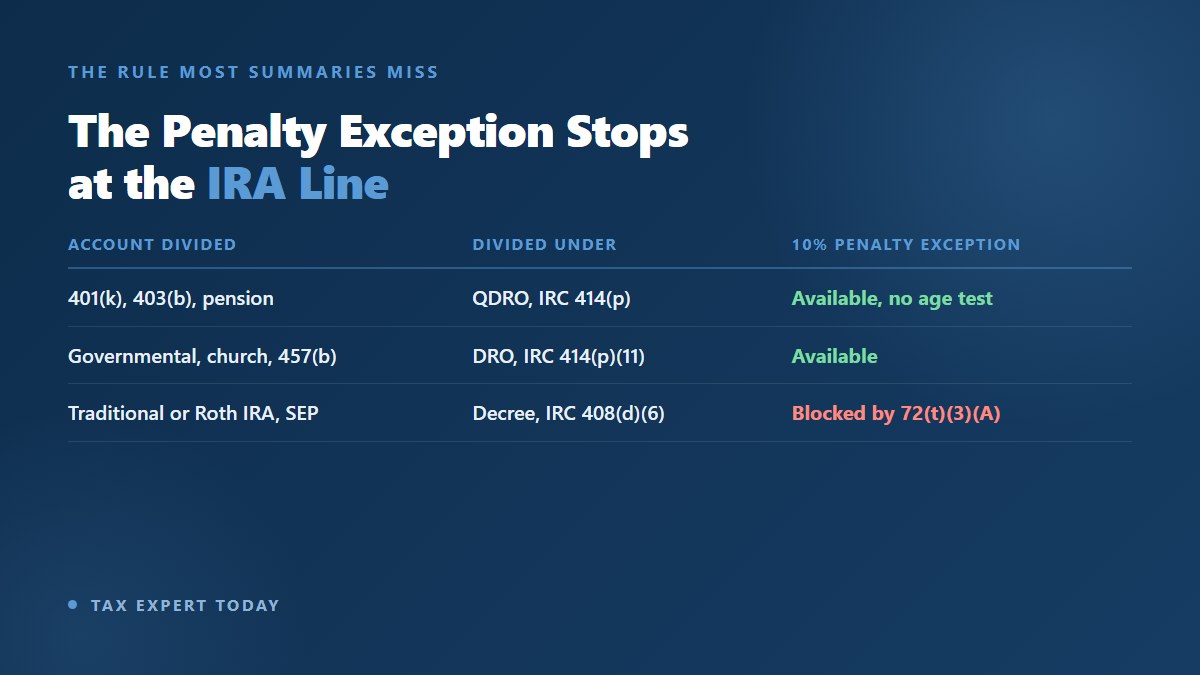
Because the penalty exception does not reach IRAs at all. IRC §72(t)(3)(A) states that subparagraph (C) of paragraph (2) “shall not apply to distributions from an individual retirement plan.” An IRA divided in a divorce moves tax free under a different statute, but a withdrawal from it carries the full 10 percent penalty before age 59 and a half.
This is the single most commonly misstated rule in the whole of QDRO taxes. At the time of writing, the Google AI Overview answer for this topic states that the alternate payee “enjoys an exemption from the 10% early withdrawal penalty regardless of age,” with no mention that the exemption stops at the IRA line. Read that way, it is wrong, and acting on it is expensive.
An IRA is not divided by a qualified domestic relations order in the first place. It moves under IRC §408(d)(6), which provides that transferring an individual’s interest in an IRA to a spouse or former spouse under a divorce or separation instrument is not a taxable transfer, and that the interest is thereafter treated as an IRA of the recipient. The instrument required is the one described in §121(d)(3)(C)(i), meaning a decree of divorce or separate maintenance or a written instrument incident to such a decree. When the IRA being divided is a Roth IRA, the receiving spouse also inherits questions about the 5-year clock and contribution basis, which our guide to Roth IRA divorce rules walks through.
| Account type | How it is divided | Penalty exception on a later withdrawal |
|---|---|---|
| 401(k), 403(b), profit sharing, private pension | Qualified domestic relations order under §414(p) | Available under §72(t)(2)(C), no age test |
| Governmental plan, church plan, §457(b) | Domestic relations order meeting §414(p)(1)(A)(i), per §414(p)(11) | Available, treated as a QDRO for federal tax purposes |
| Traditional or Roth IRA, SEP, SIMPLE | Transfer under §408(d)(6) pursuant to the decree | Not available, blocked by §72(t)(3)(A) |
| Military retired pay | Court order meeting Fla. Stat. §61.076(2) and federal uniformed services rules | Depends on the payment mechanism, review before relying on it |
Two expensive errors follow from missing this distinction, and both of them change the QDRO taxes result rather than merely the paperwork. Drafting a qualified domestic relations order against an IRA produces a document the custodian has no framework to honor. Conversely, having the IRA owner simply withdraw funds and hand them over is a taxable distribution to the owner, penalty included, and the §408(d)(6) protection is lost because the money did not move as a transfer of the interest. The transfer must be made directly between custodians pursuant to the instrument.
Does a Rollover Protect the Money or Forfeit the Exception?
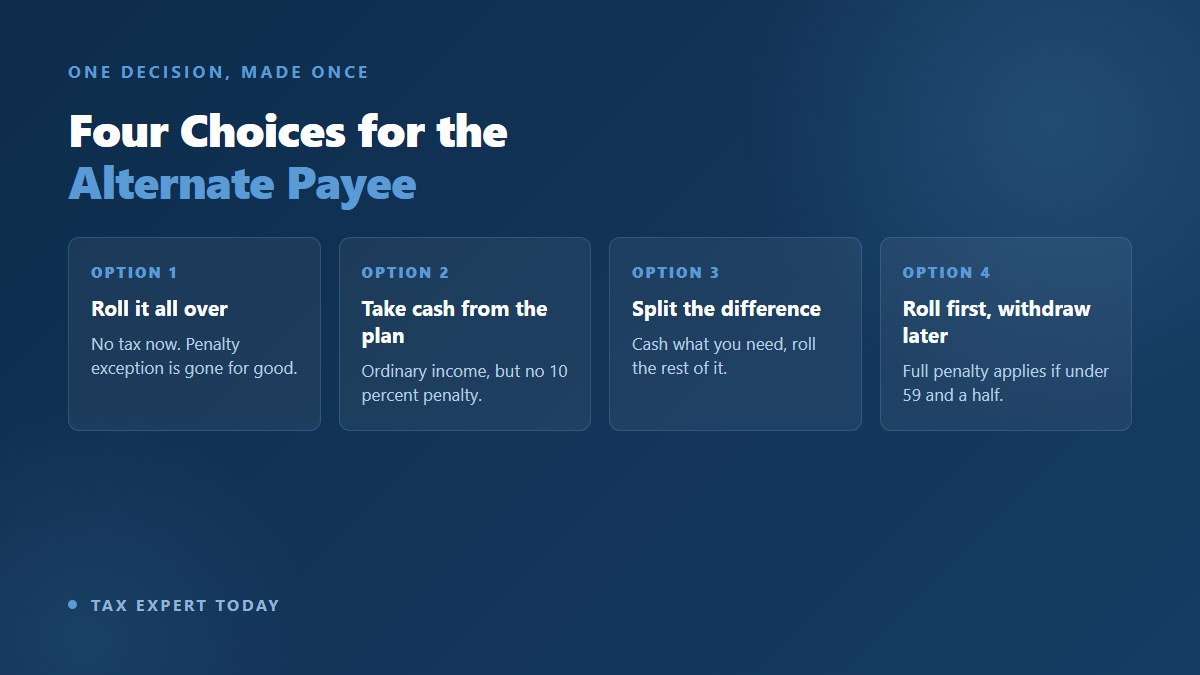
Both, and the alternate payee has to choose. A direct rollover into an IRA defers all income tax, which is usually correct for money that stays invested. It also permanently forfeits the §72(t)(2)(C) penalty exception, because a later withdrawal comes from an IRA rather than from the plan pursuant to the order.
The sequence matters more than almost anything else in QDRO taxes. The penalty exception attaches to a distribution paid to the alternate payee pursuant to the order. Once the money has been rolled into the alternate payee’s own IRA, two independent things have changed. The withdrawal is no longer being made pursuant to the qualified domestic relations order, and it is now a distribution from an individual retirement plan, which §72(t)(3)(A) removes from the exception entirely. There is no way to reverse this. The same one-way door applies where the plan holds employer stock, because rolling those shares into an IRA permanently forfeits net unrealized appreciation treatment, and Section 402(e)(4)(D)(vii) gives the alternate payee an independent lump-sum test worth running first.
| Alternate payee’s choice | Income tax now | 10 percent penalty | Typically suited to |
|---|---|---|---|
| Direct rollover of the full amount to an IRA | None | Not applicable, nothing distributed | Money that will stay invested until retirement |
| Cash directly from the plan under the order | Ordinary income on the full amount | Exempt under §72(t)(2)(C) | Cash genuinely needed now |
| Take the cash needed, roll the rest | Ordinary income on the cash portion only | Exempt on the cash portion | Most alternate payees who need some liquidity |
| Roll everything over, then withdraw later | Ordinary income when withdrawn | Applies in full if under 59 and a half | Rarely the right answer if cash is needed soon |
The third row is the one worth pausing on. An alternate payee who expects to need a defined amount of cash in the near term can generally take that amount directly from the plan under the order, penalty free, and roll the remainder into an IRA in the same transaction. Deciding the split before signing off on the distribution paperwork is the whole exercise, because the paperwork is where the choice is made and it is not revisited later. This single decision drives more of the eventual QDRO taxes bill than any other step in the process.
How Much Is Withheld From a Direct QDRO Payout?
Twenty percent, automatically. IRC §3405(c)(1)(B) requires the payor of an eligible rollover distribution to withhold 20 percent when the money is paid to the recipient rather than rolled over directly. The withholding is mandatory, the plan cannot waive it, and it applies even though the QDRO penalty exception removes the 10 percent additional tax.
- Withholding is not the tax. It is a deposit against the eventual liability, credited on the return.
- Direct rollovers escape it. §3405(c)(2) removes the requirement when the distributee elects a direct rollover under §401(a)(31)(A).
- Under-withholding is common. A recipient in a bracket above 20 percent will owe more at filing.
- Estimated payments may be needed. A large distribution can create an underpayment exposure for the year.
- Plan the cash need around it. Requesting the exact amount needed delivers roughly 80 percent of it.
There is a second trap layered on the first. Suppose an alternate payee requests a distribution intending to roll most of it over within 60 days rather than electing a direct rollover. The plan withholds 20 percent and sends the balance. To complete a full rollover, the payee has to replace the withheld 20 percent from other savings. Any portion not replaced is treated as distributed, taxable as ordinary income, and, for a distribution that is no longer being made pursuant to the order, potentially penalized as well. Electing the direct rollover at the outset avoids the entire problem.
Anyone taking a large distribution in a divorce year should also look at how the QDRO taxes interact with the rest of the return. A single payout can move a taxpayer into a higher bracket, and it interacts with the filing status determined on December 31, which is covered separately in our guide to divorce filing status. Running a projection before the money moves is far cheaper than discovering the result in April, and our quarterly estimated tax calculator is a reasonable starting point for sizing the shortfall.
How Are Roth and After-Tax Dollars Handled?
They keep their character. A designated Roth account divided under a qualified domestic relations order stays a Roth account in the alternate payee’s hands, and after-tax contributions in a traditional account carry their basis across. Only the pre-tax portion produces ordinary income when it is finally distributed.
- Roth stays Roth. The alternate payee’s share of a designated Roth account under §402A remains subject to the Roth rules.
- Qualified distributions stay tax free. A distribution meeting the holding period and a qualifying event is excluded from income.
- Basis is not lost. After-tax contributions in a traditional account carry over and reduce the taxable portion.
- Documentation matters. Request the plan’s accounting of pre-tax, after-tax, and Roth amounts at the time of the split.
- Mixed accounts need a stated allocation. An order that divides a single percentage of a mixed account should say how each source is treated.
The practical failure here is a records failure rather than a legal one, and it inflates QDRO taxes for no reason at all. An alternate payee who receives a share of an account containing after-tax money, and who never obtains the plan’s breakdown of those amounts, is at real risk of reporting the entire later distribution as taxable. Obtaining the source accounting while the plan is still processing the order costs nothing at that moment and can be difficult to reconstruct years later.
How Do Florida Rules Affect QDRO Taxes?
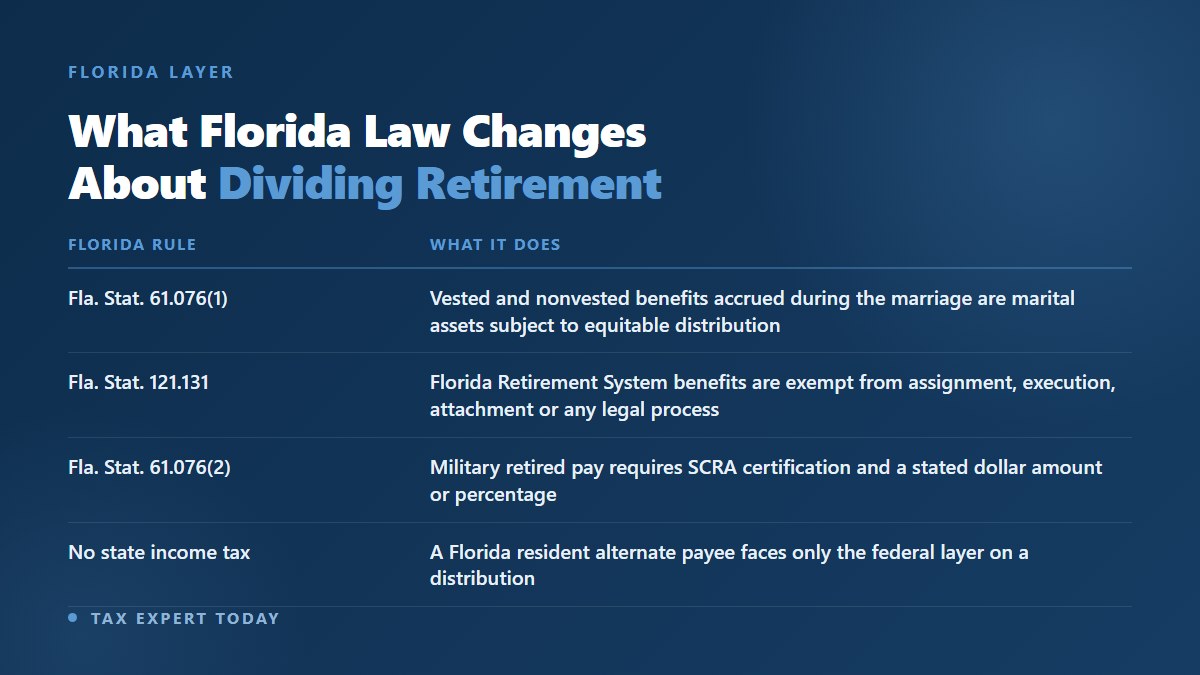
Florida law determines what gets divided, and federal law then determines how it is taxed. Fla. Stat. §61.076(1) makes all vested and nonvested retirement benefits accrued during the marriage marital assets subject to equitable distribution. The federal QDRO taxes analysis above applies once the state court has made that division.
Three Florida specific points are worth knowing before the order is drafted, because each of them changes which QDRO taxes rules end up applying.
- Accrual during the marriage is the measure. §61.076(1) reaches vested and nonvested benefits in retirement, pension, profit sharing, annuity, deferred compensation, and insurance plans.
- Florida Retirement System benefits are different. Fla. Stat. §121.131 exempts FRS benefits from assignment, execution, attachment, “or to any legal process whatsoever.”
- Military retired pay has its own checklist. §61.076(2) sets out what the final judgment must contain, and §61.076(3) bars payment more frequently than monthly.
The Florida Retirement System point deserves emphasis because Southwest Florida has a large population of retired teachers, county employees, and first responders. Because §121.131 shields FRS benefits from legal process, an FRS pension is generally not divided by an order directed at the plan in the way a private 401(k) is. Courts typically address the value of those benefits through the equitable distribution of other marital assets instead. That changes the tax picture significantly, because an offset against a taxable brokerage account or the marital home is a different transaction with different consequences than a share of a pension, and our guide to divorce house buyout taxes covers the home side of that trade. Confirm the mechanics for your specific plan with your family law attorney before relying on any particular structure.
Military divorce carries its own layer. §61.076(2) requires the final judgment to identify the servicemember, certify that the Servicemembers Civil Relief Act was observed where the decree issued while the member was on active duty and unrepresented, and specify the amount of retired or retainer pay in dollars or as a percentage of disposable retired pay. Those conditions attach where the parties were married at least 10 years during which the member performed at least 10 years of creditable service. Retired pay divided this way is generally taxed as income to whoever receives it, which is a different result from a plan distribution and should be modeled separately.
Florida imposes no personal income tax, so an alternate payee who lives in Florida faces only the federal layer on a distribution. That advantage is real but it is not automatic for someone who has recently arrived, and residency is established by facts rather than by intention. Readers working through that question may find our guide to retiring to Florida taxes useful, since the retirement account questions overlap heavily.
QDRO Tax Help Naples and Southwest Florida
Tax Expert Today LLC works from Naples, Florida as the tax side of a divorce team. We do not practice family law and we do not advise on custody, support, or how assets should be divided. What we do is model the QDRO taxes on a proposed division before it is signed, review draft orders for the tax provisions that determine who reports what, and coordinate directly with your family law attorney so the tax result matches the deal that was actually negotiated.
For divorce tax Naples FL clients, retirement accounts are the most common place we are brought in late. Typical engagements include projecting the tax on a proposed distribution, comparing a rollover against a direct payment under the order, checking that an order does not accidentally route taxable income to the wrong spouse, and preparing the transition year return once the division is complete. You can read more about that work on our divorce tax consulting page, and about our broader planning practice at Naples FL tax planning.
Tax Expert Today LLC
11983 Tamiami Trail N, Naples, FL 34110
Phone: (239) 441-2005
Hours: Monday through Friday, 10:00am to 5:00pm ET
Does a Naples divorce change the QDRO taxes analysis? Not the federal analysis. Florida has no personal income tax, so a Florida resident alternate payee faces only federal tax on a distribution, and the §414(p) and §72(t) rules apply exactly as described above. What Florida does change is what gets divided in the first place, under Fla. Stat. §61.076, and whether the plan can be divided by an order at all, which is where the Florida Retirement System exemption at §121.131 becomes relevant.
When to Engage a Professional
Not every divorce needs a tax advisor on the retirement question. A single 401(k) divided by percentage, with both spouses rolling their shares over and neither needing cash, produces QDRO taxes of zero for the year and is usually straightforward. Professional involvement tends to earn its cost when one or more of the following is present.
- An alternate payee under 59 and a half needs cash. The order of operations determines whether the penalty exception survives.
- The marital estate includes both plans and IRAs. They divide under different statutes with different penalty consequences.
- A defined benefit pension is involved. Valuation, survivor benefits, and the earliest retirement age provision all interact.
- Florida Retirement System or military benefits are in the estate. Both sit outside the ordinary private plan framework.
- The account mixes pre-tax, after-tax, and Roth money. Allocation should be stated rather than assumed.
- A large distribution lands in the transition year. Bracket, withholding, and estimated payment effects compound.
Because these outcomes depend entirely on the facts of a given case and on the language of a given order, nothing here should be read as a prediction about any particular divorce. If an order has already been entered and questions have surfaced about how a distribution was reported, that is a different conversation, and our innocent spouse relief guide covers the related problem of liability arising from a jointly filed return. Where an assessment has already been made, our IRS resolution and audit support practice handles it from there.
The practical recommendation on QDRO taxes is simple. Bring the tax advisor in while the order is still a draft. Once it is signed and the plan has processed it, the range of available choices narrows considerably, and several of the most valuable provisions in this article are available exactly once.
Frequently Asked Questions
Is a QDRO distribution taxable?
The division itself is not taxable. A distribution paid out of the plan is taxable as ordinary income to the alternate payee who receives it, under IRC §402(e)(1)(A), unless it is rolled over directly into an eligible retirement plan.
Can I avoid the 10 percent early withdrawal penalty with a QDRO?
Yes, on a distribution paid to you as the alternate payee directly from a qualified plan pursuant to the order. IRC §72(t)(2)(C) removes the penalty with no age requirement. The exception does not apply to distributions from an IRA, because IRC §72(t)(3)(A) excludes individual retirement plans from it.
Do I lose the penalty exception if I roll the money into an IRA first?
Yes. Once the funds are in your own IRA, a later withdrawal is a distribution from an individual retirement plan and is no longer made pursuant to the order, so §72(t)(3)(A) blocks the exception. If cash is needed, take it directly from the plan before rolling the balance over.
Does an IRA need a QDRO to be divided in a divorce?
No. An IRA is divided under IRC §408(d)(6), which requires a divorce or separation instrument rather than a qualified domestic relations order. The transfer should be made directly between custodians, because a withdrawal by the account owner followed by a payment to the former spouse is a taxable distribution to the owner.
Why was 20 percent withheld from my QDRO distribution?
IRC §3405(c)(1)(B) requires mandatory 20 percent withholding on an eligible rollover distribution paid to the recipient. It is withholding rather than tax, and it is credited on your return. Electing a direct rollover under §3405(c)(2) avoids it.
Who pays the tax if the alternate payee is my child?
The participant does. §414(p) allows a child or dependent to be an alternate payee, but §402(e)(1)(A) shifts the tax only to an alternate payee who is the spouse or former spouse, so payments to a child remain taxable to the participant.
Are QDRO taxes different for a government or 457(b) plan?
The federal tax treatment is substantially the same. Under §414(p)(11), a distribution from a governmental plan, church plan, or eligible §457(b) plan is treated as made pursuant to a qualified domestic relations order if the order meets §414(p)(1)(A)(i), and §414(p)(12) applies distributee rules similar to §402(e)(1)(A).
This article is educational and general in nature. It is not tax advice for any specific situation, and it is not legal advice about divorce, property division, or support. Tax outcomes depend on individual facts and on the language of the particular order. Coordinate with your family law attorney on the legal side and with a qualified tax advisor on the tax side before acting.
Published August 22, 2026 by Dr. Pellumb Kabashi « Back to Learning Center
Have a question this article touches on?
Tax Expert Today LLC, based in Naples, Florida and serving clients across the United States.
Schedule a Consultation (239) 441-2005