
By Dr. Pellumb Kabashi, DBA, MBA, CES, CFE, EA
Founder, Tax Expert Today LLC · Tax advisors, enrolled agents, CPAs, and attorneys · Serving clients in all 50 states
Quick Answer: Your divorce filing status is fixed by your marital status on December 31, not by the day you separated or the day the petition was filed. If the final judgment is entered on or before December 31, you file as single or, where the tests are met, as head of household. If the case is still pending on December 31, you remain married for federal tax purposes and choose between married filing jointly and married filing separately.
Filing status is the first line on the return and the one that quietly moves the most money. It sets the standard deduction, the rate brackets, the phaseout thresholds, and eligibility for several credits. In a divorce year it also becomes a negotiation point, because two people who used to file one return now have to divide a single set of tax attributes between two returns. Divorce filing status is therefore worth settling early, while both returns can still be planned together.
This guide covers the tax mechanics only. Which status you may claim is a federal tax question governed by the Internal Revenue Code. Whether a settlement should be timed around it, and how any of it interacts with your dissolution case, is a question for your family law attorney. Our role is the tax side of that team, working alongside counsel rather than in place of counsel.
What Determines Your Divorce Filing Status?
Marital status on the last day of the tax year determines filing status for the entire year. Under IRC §7703(a), the determination is made as of the close of the taxable year, and a taxpayer legally separated under a decree of divorce or of separate maintenance is not considered married. Nothing about the length of the separation changes the answer by itself.
That single rule produces results people find counterintuitive:
- A couple who separated in January and lived apart all year is still married for the whole year if the final judgment is entered on January 2 of the following year.
- A couple whose judgment is entered on December 29 is treated as unmarried for the entire year, including the eleven months they lived together.
- Filing the petition, entering mediation, signing a marital settlement agreement, and receiving temporary support all leave marital status unchanged. Only the decree does that work.
The IRS states the same rule plainly in its guidance on filing taxes after divorce or separation: a couple is considered married for filing purposes until a final decree of divorce or separate maintenance is entered. One narrow exception exists, and it is covered below.
Which Filing Statuses Are Available in the Year of Divorce?
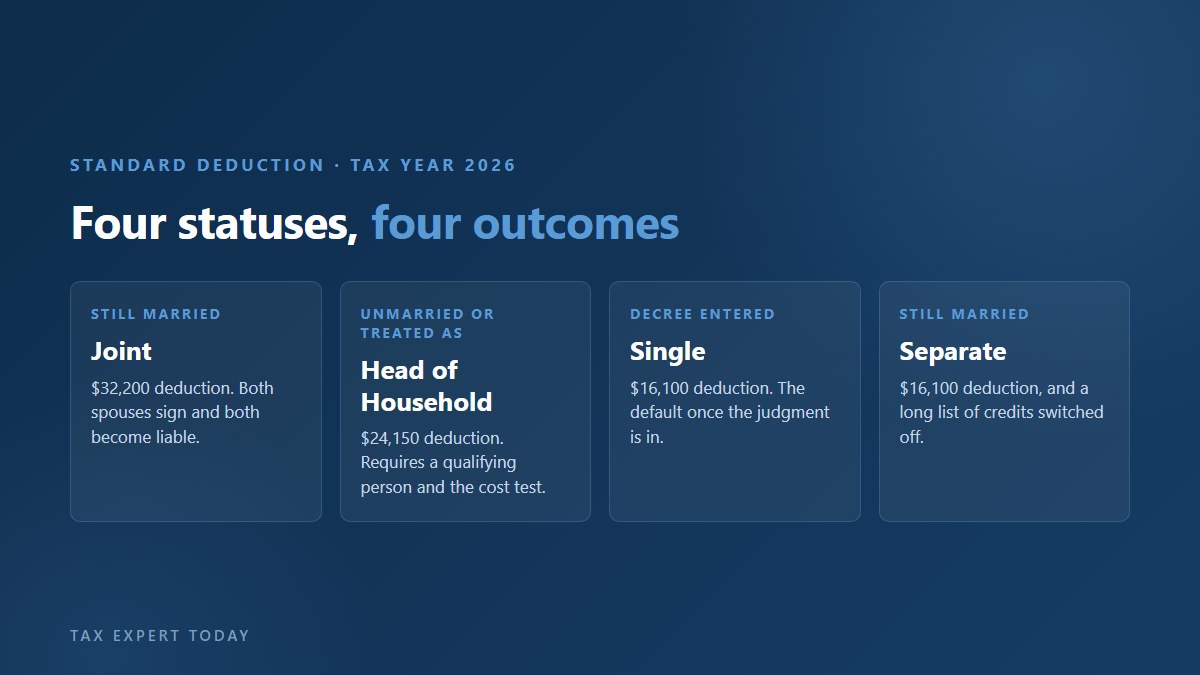
Four statuses are potentially in play. If the decree is entered by December 31, the choices are single and head of household. If the case is still open on December 31, the choices are married filing jointly and married filing separately, plus head of household for a spouse who satisfies the living-apart test. Qualifying surviving spouse applies to widowhood, not divorce.
| Filing status | Available when | 2026 standard deduction |
|---|---|---|
| Married filing jointly | Still married on December 31 and both spouses agree to sign | $32,200 |
| Head of household | Unmarried, or treated as unmarried under §7703(b), and maintaining a home for a qualifying person | $24,150 |
| Single | Decree entered on or before December 31 and no qualifying person | $16,100 |
| Married filing separately | Still married on December 31 and filing apart | $16,100 |
The 2026 amounts come from Rev. Proc. 2025-32, which sets the IRC §63(c) figures for tax years beginning in 2026. The gap between head of household and single is more than $8,000 of deduction, which is why the head of household question is usually where the real analysis sits.
Can You File as Head of Household While Still Married?
Yes, in defined circumstances. IRC §7703(b), commonly called the living-apart or abandoned-spouse rule, treats a still-married taxpayer as not married when three conditions are all satisfied. Meeting the test opens head of household to a spouse whose divorce is not yet final, which is often the single largest tax item in a pending case.
All three prongs must be met for the same tax year:
- The home is the child’s principal place of abode for more than half the year. The taxpayer maintains as a home a household that is, for more than one-half of the taxable year, the principal place of abode of a child within the meaning of §152(f)(1).
- The taxpayer furnishes more than half the cost of maintaining that household. This is a cost test, not an income test, and it is measured across rent or mortgage interest, property taxes, insurance, utilities, repairs, and food consumed in the home.
- The spouse is not a member of the household during the last six months of the year. The spouse must be out of the home for the entire July through December period. A spouse who moves out on July 5 does not satisfy this prong for that year.
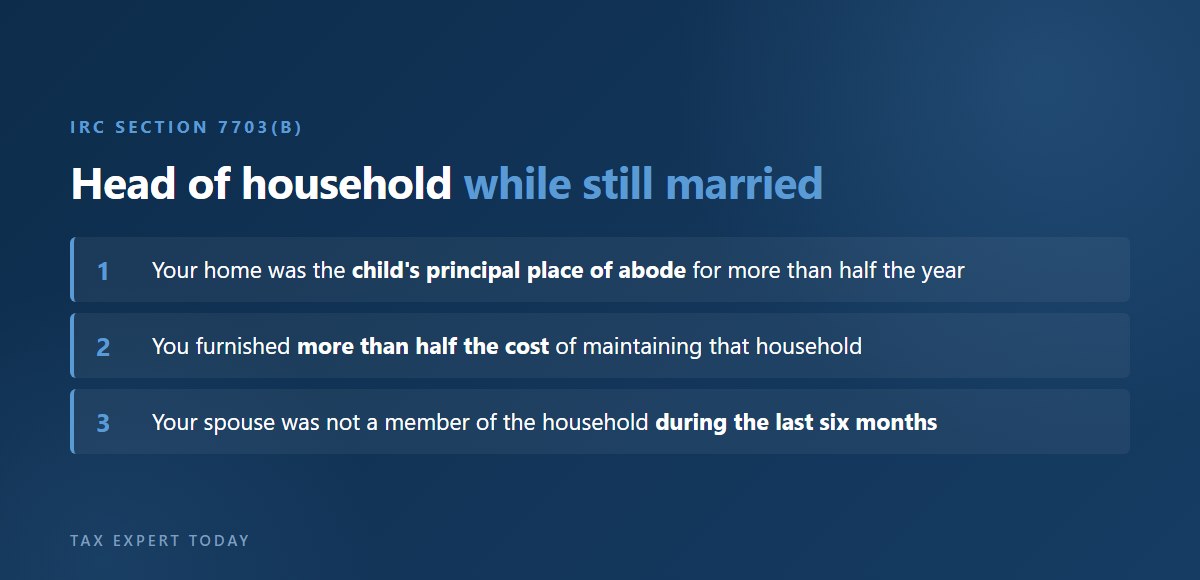
The third prong is the one that most often fails, and it fails on a calendar technicality rather than on substance. A separation that begins in early July pushes head of household to the following year. That timing consequence is worth raising with counsel early in the case, because it is one of the few tax outcomes in a divorce that depends on a specific date rather than on a negotiated term.
Head of household also requires the general §2(b) conditions, including that the taxpayer is not a qualifying surviving spouse and maintains a household for a qualifying person. Two parents cannot both claim head of household based on the same home, because each would have to furnish more than half the cost of the same household. Where there are two children and two separate homes, each parent may separately qualify if each home independently meets the tests.
Is Married Filing Separately Ever the Right Choice?
Sometimes, but it carries a specific and predictable cost. Married filing separately is generally the most expensive status in the code, because a long list of provisions is reduced or shut off entirely. It is chosen most often for a non-tax reason, namely a spouse who does not want to be jointly liable for the other spouse’s return.
| Provision | Effect of married filing separately | Authority |
|---|---|---|
| Standard deduction | Reduced to $16,100, and reduced to zero if the other spouse itemizes | §63(c)(6) |
| Earned income credit | Generally unavailable, subject to the separated-spouse exception below | §32(d) |
| Child and dependent care credit | Generally unavailable unless treated as unmarried | §21(e) |
| Education credits | Not allowed | §25A(g)(6) |
| Student loan interest deduction | Not allowed | §221(e)(2) |
| Capital loss deduction | Limited to $1,500 rather than $3,000 | §1211(b) |
| Roth and deductible IRA phaseouts | Phase out across a $0 to $10,000 band for a spouse who lived with the other spouse at any point in the year | IRS IRA deduction limits |
Two points deserve emphasis. First, the itemizing rule under §63(c)(6)(A) means one spouse can unilaterally destroy the other spouse’s standard deduction by itemizing. In a contested case that is a live risk, and it is worth addressing in writing before either return is filed. Second, the earned income credit is not always lost. Under §32(d)(2)(B), a married taxpayer who does not file jointly is still treated as not married for credit purposes if the taxpayer lives with a qualifying child for more than half the year and either does not share a principal place of abode with the spouse during the last six months of the year or holds a qualifying separation instrument and is not a member of the same household at year end.
What Happens to a Joint Return Filed During a Pending Divorce?
A joint return creates joint and several liability. Under IRC §6013(d)(3), both spouses are individually liable for the entire tax shown on the return and for any deficiency later assessed, regardless of who earned the income or who signed first. A divorce decree that assigns the tax to one spouse binds the two spouses to each other. It does not bind the IRS. Where the issue is not liability but a joint refund applied to one spouse’s separate debt, injured spouse relief is the remedy that returns your share.
This matters most where one spouse controls a business, reports self-employment income, or has unreported items. Signing a joint return for the last married year usually produces a lower combined tax, and it also permanently attaches the signing spouse to whatever is on that return. The trade is real and it should be made deliberately rather than by default.
Where a joint return has already been filed and a deficiency later appears, relief may be available under IRC §6015 by filing Form 8857. Relief is discretionary, fact-dependent, and subject to timing rules, so it functions as a remedy rather than as a plan. Where penalties rather than tax are the issue, the separate route is reasonable cause penalty abatement. In qualifying cases it can separate one spouse from the other spouse’s understatement, but no outcome is assured.
How Do the Child-Related Benefits Split Between Parents?
They do not travel together. This is the most common and most expensive misunderstanding in divorce tax work. Parents frequently agree that one parent will “claim the child,” sign Form 8332, and assume every child-related benefit moves with it. Several benefits stay with the custodial parent by operation of law and cannot be transferred by agreement. Our guide to Form 8332 and claiming a child after divorce sets out the benefit by benefit split and the night counting rules that decide who signs.
Under IRC §152(e), the custodial parent, meaning the parent with whom the child spent the greater number of nights during the year, may release the dependency claim to the noncustodial parent by signing Form 8332. That release is limited in scope.
| Benefit | Follows Form 8332 to the noncustodial parent? |
|---|---|
| Dependency claim for the child | Yes |
| Child tax credit and credit for other dependents | Yes |
| Head of household filing status | No, it stays with the parent who maintains the home |
| Earned income credit | No, it stays with the custodial parent |
| Child and dependent care credit | No, it stays with the custodial parent |
| Health coverage and premium tax credit determinations | No, generally tied to the custodial parent’s household |
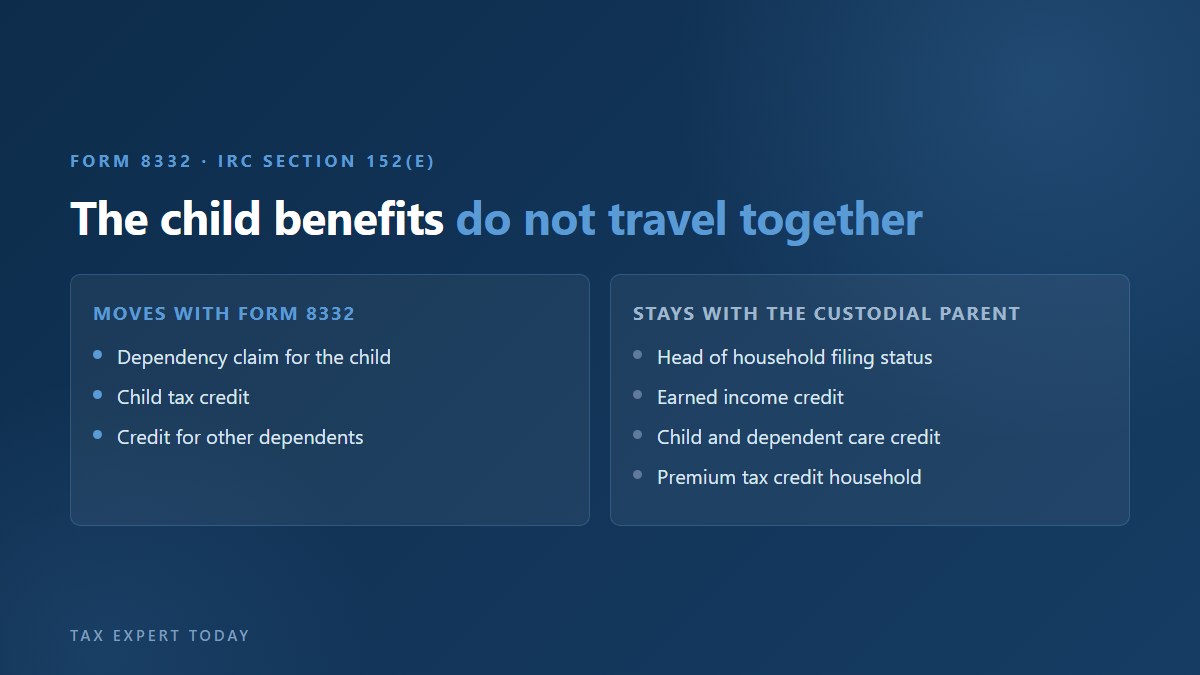
The practical consequence is that a settlement clause reading “the parties shall alternate claiming the minor child” is ambiguous as written. It should specify what is being alternated, who signs Form 8332 and by when, and whether the release covers one year or multiple years. Drafting that clause is a family law function. Telling counsel which benefits can actually move, and which cannot, is a tax function.
How Does Florida Law Affect Filing Status During a Divorce?
Florida has no general legal separation status that ends a marriage short of dissolution. That distinction matters because §7703(a)(2) treats a taxpayer as unmarried when legally separated under a decree of divorce or of separate maintenance. In states that offer legal separation, that decree can change filing status before the divorce concludes. Florida spouses generally do not have that option.
Florida does allow an action for support unconnected with dissolution under Fla. Stat. §61.09, and courts routinely enter temporary support orders while a dissolution is pending. Those orders address money. They do not dissolve the marriage, and a temporary order entered during a pending case should not be assumed to convert a Florida couple to unmarried status for federal filing purposes. Marital status generally changes when the final judgment of dissolution is entered under Fla. Stat. §61.19. Whether any particular order qualifies as a decree of separate maintenance is a facts-and-circumstances question that should be reviewed with counsel before a return is filed in reliance on it.
Two Florida consequences follow. First, because Florida imposes no individual income tax, the entire filing status analysis for a Florida couple is federal, with no offsetting state result to soften a bad choice. Second, the §7703(b) living-apart test carries more weight here than it does in a legal-separation state, because for many Florida spouses it is the only route to head of household before the judgment is entered. Divorce also unwinds tenancy by the entireties, a point covered in our guide to Florida asset protection for new residents. A sale of the marital home in the same year interacts directly with this choice, which is covered in our guide to divorce house buyout taxes.
What Should Change Once the Filing Status Changes?
Withholding is the item most often left alone and the one most likely to produce an unwelcome balance due. A newly single or head of household filer is taxed under a different bracket structure than a joint filer, and payroll withholding continues on the old assumptions until a new form is submitted. Filing a revised Form W-4 with each employer is the correction.
A short list of items to review in the year the status changes:
- Form W-4 with every employer, and estimated tax payments where income is not subject to withholding.
- Name and address of record with the Social Security Administration and the IRS, since a name mismatch delays refunds.
- Which spouse will claim which child, documented in writing, with Form 8332 signed if a release is intended.
- Alimony treatment for the instrument in question, which turns on the execution date rather than the payment date. Our guide to alimony taxes after divorce covers the post-2018 rule and the grandfathered agreements.
- Any joint balance still owed to the IRS, which survives the decree and remains collectible from both spouses until it is paid or the collection period expires. See our discussion of the IRS ten year collection rule.
- Estimated tax for the first post-divorce year, which is frequently understated because the prior-year safe harbor was computed on a joint return. Our quarterly estimated tax calculator is a starting point for the new figure.
What Do People Get Wrong About Divorce Filing Status?
Four recurring errors account for most of the corrected returns we see in this area. Each is avoidable with a conversation before the return is filed rather than after.
- Filing single while the case is pending. A separated spouse is still married until the judgment is entered. Filing single in that year is an incorrect status and generally requires an amended return.
- Assuming a separation agreement changed the status. A marital settlement agreement is a contract between the spouses. Absent a qualifying decree, it does not change marital status under §7703.
- Both parents claiming head of household on the same household. Only one taxpayer can furnish more than half the cost of a single home, so a duplicate claim invites correspondence from the IRS.
- Treating Form 8332 as a transfer of everything. The release moves the dependency claim and the child tax credit. It does not move head of household, the earned income credit, or the dependent care credit.
Divorce Filing Status Help in Naples & Southwest Florida
Tax Expert Today LLC works with divorcing clients across Southwest Florida and in all 50 states, coordinating with family law counsel on the tax side of a dissolution. The team includes tax advisors, enrolled agents, CPAs, and attorneys, and the work in this area typically covers filing status analysis for the transition year, modeling of joint versus separate outcomes, allocation of child-related benefits between two returns, and withholding correction after the judgment is entered. A retirement plan distribution taken in the same year interacts with the filing choice, and our guide to QDRO taxes walks through that timing. We do not provide family law advice and we do not replace your attorney. We work alongside counsel so the tax result matches what the settlement was intended to accomplish.
The office is at 11983 Tamiami Trail N, Naples, FL 34110. Consultations can be scheduled by phone at (239) 441-2005, Monday through Friday, 10am to 5pm ET. Clients elsewhere in Florida and in other states are served remotely. Related planning work is described on our divorce tax consulting and Naples tax planning pages.
When to Engage a Professional
Divorce filing status is worth professional review whenever the answer is not obvious on its face. That generally includes cases where the judgment may land near year end, where children divide their nights between two homes, where one spouse owns a business or reports self-employment income, and where a joint balance is already owed to the IRS.
A review before either return is filed is materially more useful than a review afterward, because status elections interact with each other across two returns and some of them are difficult to unwind. Outcomes depend on individual facts, on the terms of the decree, and on IRS review of the return as filed. Nothing in this article is a promise about how a particular return will be treated.
To discuss a transition-year return, contact Tax Expert Today LLC at (239) 441-2005 or through the divorce tax consulting page. Coordinate any filing status decision with your family law attorney before it is reflected in a settlement document.
Frequently Asked Questions
What filing status do I use if my divorce was final in December?
Marital status is determined on December 31 under IRC §7703(a), so a judgment entered on or before that date makes you unmarried for the entire tax year. You file as single, or as head of household if you maintained a home for a qualifying person and met the other §2(b) conditions for more than half the year.
Can I file as head of household if I am separated but not divorced?
Possibly. IRC §7703(b) treats a married taxpayer as unmarried when the home was the child’s principal place of abode for more than half the year, the taxpayer furnished more than half the cost of that household, and the spouse was not a member of the household at any time during the last six months of the year. All three conditions must be met.
Does a Florida temporary support order change my filing status?
Generally no. A temporary support order entered while a dissolution is pending addresses financial obligations rather than marital status. Marital status generally changes when the final judgment of dissolution is entered. Whether any particular order qualifies as a decree of separate maintenance under §7703(a)(2) should be reviewed with counsel before filing.
Am I liable for my spouse’s tax if we filed jointly?
Yes. IRC §6013(d)(3) imposes joint and several liability on both spouses for the full amount shown on a joint return and for any later deficiency. A divorce decree assigning the liability to one spouse binds the spouses to each other but does not bind the IRS. Relief under IRC §6015 may be available in qualifying cases and is requested on Form 8857.
If I sign Form 8332, do I lose head of household status?
No. Form 8332 releases the dependency claim and the child tax credit to the noncustodial parent. Head of household status, the earned income credit, and the child and dependent care credit stay with the parent who maintained the home and met the residency tests. Those benefits cannot be transferred by agreement.
Where can I get help with divorce filing status in Naples, FL?
Tax Expert Today LLC at 11983 Tamiami Trail N, Naples, FL 34110 advises Southwest Florida clients on the tax side of a divorce, including filing status for the transition year and allocation of child-related benefits. The team includes tax advisors, enrolled agents, CPAs, and attorneys, serving clients in all 50 states. Call (239) 441-2005, Monday through Friday, 10am to 5pm ET.
Published July 25, 2026 by Dr. Pellumb Kabashi « Back to Learning Center
Have a question this article touches on?
Tax Expert Today LLC, based in Naples, Florida and serving clients across the United States.
Schedule a Consultation (239) 441-2005