
By Dr. Pellumb Kabashi, DBA, MBA, CES, CFE, EA
Founder, Tax Expert Today LLC · Tax advisors, enrolled agents, CPAs, and attorneys · Serving clients in all 50 states
Quick Answer: A shared policy allocation splits the premiums, the benchmark silver premium, and the advance premium tax credit on one Form 1095-A between former spouses who shared a Marketplace plan in the year they divorced. Former spouses may agree on any percentage from 0 to 100, applied equally to all three amounts. If they do not agree, each takes 50 percent. Call (239) 441-2005 for a free consultation.
A divorce changes almost every line of a tax return, and for families who bought health insurance through the Marketplace it adds one more form that most people have never seen. When the plan covered both spouses, or covered a spouse and the children, the Marketplace issued one Form 1095-A for the whole household and paid advance credits based on an income and family size that no longer exist. The shared policy allocation is the mechanism that divides that single statement into two returns. This guide explains the federal rules from the statute and the regulations, shows the math with hypothetical numbers, and covers what changed for 2026 returns under Pub. L. 119-21. It explains tax mechanics only. Who pays the premium, who keeps the children on which plan, and how the settlement is drafted are questions for your family law attorney, and we work alongside that attorney as the tax side of the divorce team.
What Is a Shared Policy Allocation on Form 8962?
A shared policy allocation is the Form 8962, Part IV entry that divides one Marketplace policy between two tax families. It splits the enrollment premiums, the second lowest cost silver plan premium, and the advance premium tax credit shown on Form 1095-A, so each former spouse can compute a premium tax credit and reconcile advance payments on a separate return.
- Three numbers are divided: Form 1095-A, Part III, column A (enrollment premiums), column B (the applicable second lowest cost silver plan, or SLCSP, premium), and column C (advance payments of the premium tax credit, or APTC).
- One percentage per policy per period: the same allocation percentage applies to all three columns for the months being allocated.
- Each return then stands alone: after the allocation, each former spouse computes the credit using their own household income and family size for the year.
- The rule lives in the regulations: Treas. Reg. §1.36B-4(b)(3) governs spouses who divorce or legally separate during the year.
The premium tax credit under IRC §36B is computed on an annual return, but it is usually paid in advance, month by month, directly to the insurance company. The Marketplace estimates the credit from the income and household the applicant projected at enrollment. At filing time, Form 8962 compares the credit actually allowed with the advance payments already made. If the advance payments were larger, the difference is additional tax. If they were smaller, the difference is a refundable credit.
That comparison is easy when one tax family owns one policy. A divorce breaks the match. The policy was bought by a married couple who expected to file one joint return, and now there are two returns, two household incomes, and often two different family sizes. The shared policy allocation is how the IRS reassigns the policy amounts so that each return reconciles only its own share. The term comes from the Instructions for Form 8962, which group the possibilities into four allocation situations. Divorce is Allocation Situation 1.
| Form 1095-A, Part III column | What it reports | How a shared policy allocation treats it |
|---|---|---|
| Column A | Monthly enrollment premiums for the policy | Allocated by the agreed or default percentage (Form 8962, line 30, column (e)) |
| Column B | Monthly premium of the applicable second lowest cost silver plan | Allocated by the same percentage in a divorce (column (f)) |
| Column C | Monthly advance payments of the premium tax credit | Allocated by the same percentage (column (g)) |
The allocation does not change what was paid to the insurer and it does not create a new Form 1095-A. It is an entry on each former spouse’s own Form 8962 that tells the IRS how much of the shared statement belongs to that return. Both returns should report percentages that add up to 100 percent for the same months.
When Does a Divorce Trigger a Shared Policy Allocation?
A divorce triggers a shared policy allocation when two conditions are both met: the spouses were married to each other at some point during the year but not at year end, and for at least one month of the marriage one Marketplace policy covered someone in each spouse’s tax family. Both former spouses then allocate on separate returns.
- Married during the year, unmarried on December 31: a final decree of divorce or separate maintenance before year end, under state law.
- A shared policy during the marriage: both spouses on one plan, or one spouse on the same plan as the other spouse’s dependent.
- Applies to the married months only: months after the decree are handled under a different rule, covered below.
- Applies even with no APTC dispute: the allocation is required whenever the policy amounts must be split, not only when someone owes money back.
The regulation is precise about the trigger. Treas. Reg. §1.36B-4(b)(3) applies to taxpayers who are married within the meaning of IRC §7703 during the year “but legally separate under a decree of divorce or of separate maintenance during the taxable year,” and who are enrolled in the same qualified health plan at any time during the year. It also applies when one former spouse has a dependent enrolled in the same plan as the other former spouse, or in the same plan as the other former spouse’s dependent.
The Form 8962 instructions turn this into Step 1 of Table 3. If you divorced or legally separated during the year and, for one or more months of marriage, the policy covered at least one individual in your tax family and at least one individual in your former spouse’s tax family, you allocate under Allocation Situation 1. The phrase “tax family” matters. It means the people on your return: you and the dependents you claim. A policy that covered only you and the children you will claim is not shared with your former spouse, even if your former spouse paid for it.
Marital status for this purpose follows the year-end test in §7703. A person who is legally separated under a decree of divorce or separate maintenance is not considered married. A couple who separated physically in March but whose divorce is not final until the following February is still married on December 31, and the divorce rule does not apply to them. Their situation is Allocation Situation 2, which is far less forgiving and is explained later in this guide. Our guide to divorce filing status walks through the December 31 rule in detail.
How Do Former Spouses Choose a Shared Policy Allocation Percentage?
Former spouses may agree to allocate any percentage from 0 to 100 percent of the policy amounts to one of them, with the rest going to the other. The same percentage must apply to the premiums, the benchmark premium, and the advance credit. The agreed split is reported on each Form 8962 and should total 100 percent.
- Full freedom of percentage: 100 and 0, 70 and 30, 50 and 50, or any other pair that adds to 100.
- No cherry picking: one spouse cannot take the premiums while the other takes the advance credit; the regulation requires all items in the same proportion.
- Reported, not filed separately: there is no separate agreement form; each return shows the percentage on Part IV, line 30.
- Consistency matters: if the two returns do not match, the IRS may question both.
The flexibility comes straight from the regulation: “The taxpayers may allocate these items to each former spouse in any proportion but must allocate all items in the same proportion.” The Form 8962 instructions repeat it in plainer words for Allocation Situation 1: you and your former spouse “may agree to allocate any percentage (from 0% to 100%) of these amounts to one of you (with the remainder allocated to the other), but you must allocate all three amounts using the same percentage.”
Why would a percentage other than 50 matter? Because the two former spouses usually have different incomes and different family sizes after the divorce. The premium tax credit is computed from each return’s household income as a percentage of the federal poverty line for that return’s family size. Moving premiums, benchmark premium, and advance credit together toward the spouse whose income and family size produce a larger allowable credit can reduce the combined excess APTC that the two returns have to repay. Moving them toward the spouse whose credit would be smaller can increase it. The total paid to the insurer does not change, but the combined tax result can.
The table below shows how a hypothetical policy divides at three different percentages. The figures are illustrative, chosen only to show the arithmetic.
| Hypothetical: January to June, married months | Premiums (col. A) | SLCSP premium (col. B) | APTC (col. C) |
|---|---|---|---|
| Policy totals from Form 1095-A | $9,000 | $8,400 | $6,600 |
| Agreed 100 percent to Spouse A | A: $9,000 / B: $0 | A: $8,400 / B: $0 | A: $6,600 / B: $0 |
| Agreed 70 percent to A, 30 percent to B | A: $6,300 / B: $2,700 | A: $5,880 / B: $2,520 | A: $4,620 / B: $1,980 |
| No agreement: 50 percent default | $4,500 each | $4,200 each | $3,300 each |
Choosing the percentage is a tax calculation, but agreeing to it is part of the divorce. Whether one spouse gives up a more favorable allocation in exchange for something else in the settlement is a negotiation, and that belongs to your family law attorney. Our role is to run both returns under each percentage so the attorney knows what each option is worth before it is agreed in writing.
What Happens If Former Spouses Cannot Agree on the Allocation?
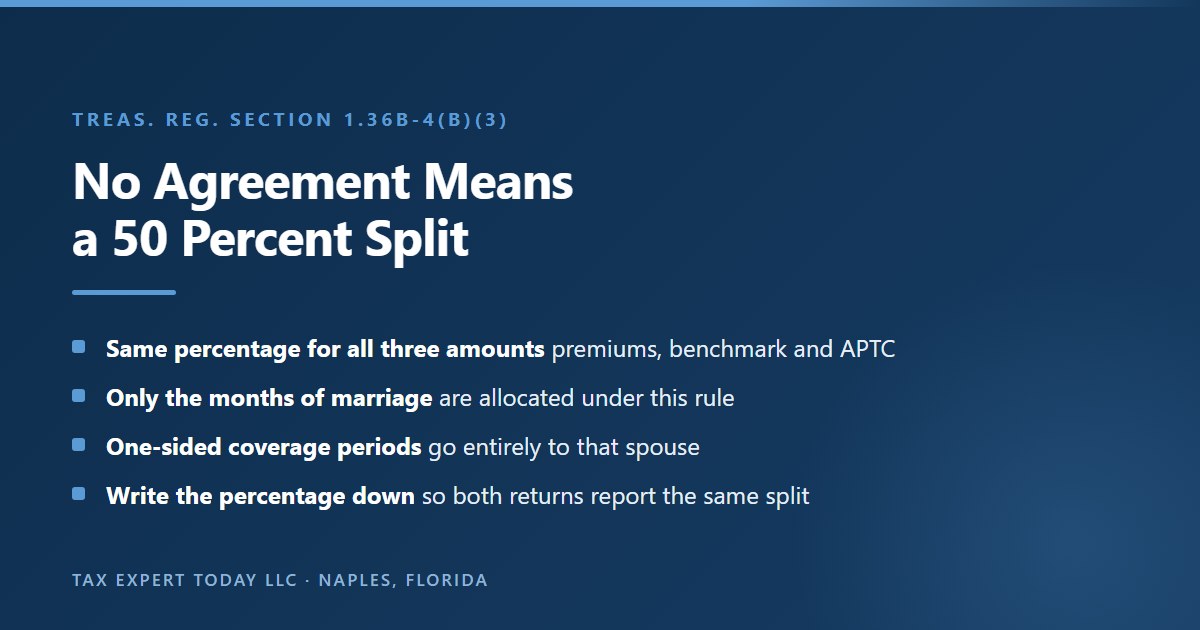
If former spouses do not agree on a reported percentage, the regulation allocates 50 percent of the premiums, 50 percent of the benchmark premium, and 50 percent of the advance credit for the married months to each of them. The exception is a period in which the plan covered only one spouse’s side of the family.
- Default split: 50 percent of each of the three amounts to each former spouse, for the months of marriage.
- Entered as a decimal: each former spouse enters “0.50” in columns (e), (f), and (g) of Part IV, line 30.
- One-sided coverage exception: if for a period the plan covered only one spouse, or only one spouse and that spouse’s dependents, or only that spouse’s dependents, those amounts go entirely to that spouse.
- Silence is not neutral: the default can produce a larger combined repayment than a negotiated percentage would.
The default is written into Treas. Reg. §1.36B-4(b)(3): if the taxpayers “do not agree on an allocation that is reported to the IRS in accordance with the relevant forms and instructions, 50 percent of: The benchmark plan premiums; the enrollment premiums; and the advance credit payments for the married period, is allocated to each taxpayer.” The instructions give the same result in Example 2 of Allocation Situation 1, where Keith and Stephanie cannot agree, so each enters 0.50 in all three columns.
The one-sided coverage rule in the same paragraph is easy to miss and often decides the outcome. If, for a stretch of months, the plan covered only one former spouse and no dependents, only one former spouse and that same spouse’s dependents, or only the dependents of one former spouse, then the premiums, benchmark premium, and advance credit for that stretch are allocated entirely to that former spouse. A common example is a policy that dropped one spouse in the spring after the couple separated, while the other spouse and the children stayed on until the decree in August. The months in which both spouses were covered are shared. The months in which only one side of the family was covered belong to that side.
When former spouses are not speaking, the practical problem is usually information rather than law. Only one of them may hold the Form 1095-A, and the other may not know the monthly figures. The instructions say the recipient of the form should provide a copy to the other person, and the Marketplace can reissue a copy on request. If cooperation is not possible, a 50 percent default is still a valid filing position, and the returns can be prepared without the other spouse’s agreement.
Which Months Are Allocated, and What About the Months After the Divorce?
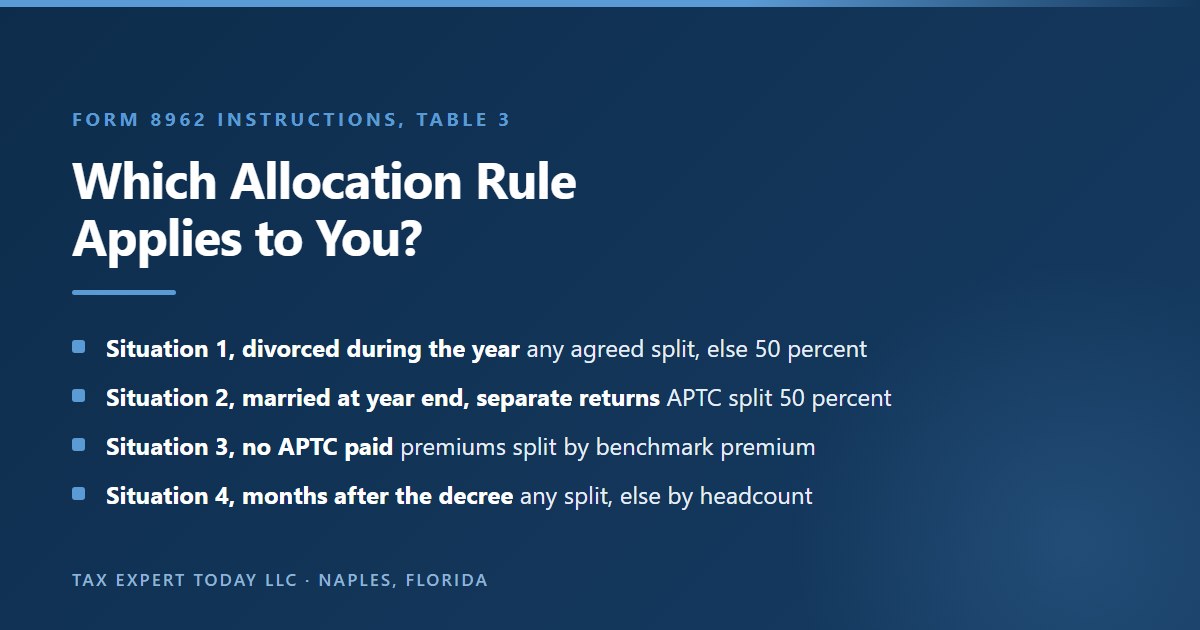
The divorce rule allocates only the months of marriage. If former spouses or their dependents stay on one Marketplace policy after the decree, those later months fall under Allocation Situation 4, where former spouses may agree on any percentage, month by month, and a headcount formula applies if they cannot agree.
- Months of marriage: Allocation Situation 1, entered on line 30 of Part IV.
- Months after the decree: Allocation Situation 4, entered on a separate line such as line 31.
- Different percentages allowed: under Situation 4 the agreed percentage may change from month to month.
- Default by headcount: the number of enrollees who belong to the other tax family, divided by everyone enrolled on that policy.
The Form 8962 instructions illustrate the split with Henry and Cara. Henry enrolled himself, his spouse Cara, and their two children in a Marketplace plan, with APTC paid for each. They divorced on June 30, and each bought separate coverage from July. Henry claims one child and Cara claims the other. The instructions direct them to allocate January through June on line 30 under Allocation Situation 1, and the months they were divorced on line 31 under Allocation Situation 4.
Allocation Situation 4 is the general rule for any policy that is shared between two tax families when none of the first three situations applies. In a divorce it typically arises when one former spouse keeps a child on a policy that they enrolled, while the other former spouse claims that child as a dependent. The rule appears in Treas. Reg. §1.36B-4(a)(1)(ii)(B), which calls the child a “shifting enrollee,” the parent who enrolled the child the “enrolling taxpayer,” and the parent who claims the child the “claiming taxpayer.”
The two taxpayers “may agree on any allocation percentage between zero and one hundred percent.” If they do not agree, the percentage allocated to the claiming taxpayer equals the number of shifting enrollees properly included in that taxpayer’s family divided by the number of individuals the enrolling taxpayer enrolled in the same plan. Two hypothetical cases show how the formula works.
| Hypothetical months after the decree | Enrolled on the policy | Claimed by the other parent | Default share to the claiming parent |
|---|---|---|---|
| Parent A enrolls self and one child; Parent B claims the child under Form 8332 | 2 | 1 | 1 / 2 = 50 percent |
| Parent A enrolls self and two children; Parent B claims one child | 3 | 1 | 1 / 3 = 33 percent (enter 0.33) |
| Parent A enrolls only the two children; Parent B claims both | 2 | 2 | 2 / 2 = 100 percent |
The practical lesson is that the allocation keeps running after the divorce for as long as coverage and the dependency claim point in different directions. A settlement that assigns the dependency exemption to one parent while the other parent carries the children on a Marketplace plan creates a shared policy allocation every year that arrangement continues, unless the enrollment is changed to match.
How Does Claiming the Children Change a Shared Policy Allocation?
The children follow the dependency claim, not the custody schedule. For the premium tax credit, family size is the number of people for whom the taxpayer claims a deduction under IRC section 151, so the parent who claims a child, including through a Form 8332 release, carries that child’s coverage into their own tax family and allocation.
- Family size test: §36B(d)(1) counts the individuals for whom the taxpayer is allowed a §151 deduction.
- Form 8332 moves the child: a noncustodial parent who claims a child under a signed release includes the child in their tax family.
- Coverage does not move automatically: the Marketplace enrollment still shows whoever enrolled the child.
- The mismatch creates the allocation: an enrolling parent and a claiming parent must split the policy amounts for that child.
IRC §36B(d)(1) sets family size as “the number of individuals for whom the taxpayer is allowed a deduction under section 151.” Although the exemption amount under IRC §151(d)(5) is zero for taxable years beginning after 2017, the §151 framework still determines who counts, and the special rule for children of divorced or separated parents in IRC §152(e) decides which parent that is. A child released to the noncustodial parent on Form 8332 is that parent’s dependent for this purpose, and therefore part of that parent’s tax family. Our guide to Form 8332 and claiming a child after divorce explains how the release works and which child-related benefits travel with it and which do not.
The interaction has two effects. First, the family size on each return changes, which changes the federal poverty line percentage and therefore the credit each parent is allowed. A larger family size at the same income usually produces a lower poverty line percentage and a larger allowable credit. Second, the claiming parent must pick up a share of the policy that the other parent enrolled. Where the claiming parent has a higher income, that shift can increase the excess APTC on the claiming parent’s return.
Which parent claims which child is a term of the divorce and is negotiated by the family law attorneys. The tax side is to show what each assignment does to both returns, including the premium tax credit, before the decree locks it in. Florida parents should also know that the dependency claim affects the child tax credit and head of household status differently, so a decision that helps one credit may hurt another.
What If You Are Separated but Still Married on December 31?
A spouse who is still married at year end generally cannot take the premium tax credit on a married filing separately return. Each spouse must allocate 50 percent of the shared advance credit and repay it. Two exceptions apply: married persons living apart who qualify to file as head of household, and victims of domestic abuse or spousal abandonment.
- The joint return rule: §36B(c)(1)(C) allows the credit to a married taxpayer only on a joint return.
- Allocation Situation 2: married at year end, separate returns, shared policy, so the advance credit is split equally.
- Exception 1: a spouse who meets the head of household rule for married persons living apart files as unmarried and may take the credit.
- Exception 2: a domestic abuse or abandonment victim may file separately, check the Form 8962 box, and take the credit, for no more than 3 consecutive years.
This is the situation that surprises separated couples most. Under IRC §36B(c)(1)(C) and Treas. Reg. §1.36B-2(b)(2)(i), a taxpayer who is married within the meaning of §7703 at the end of the year is an applicable taxpayer only if the spouses file a joint return. A married filing separately return, without an exception, is not eligible for the credit at all. The Form 8962 instructions state the consequence directly: the separate filer “must generally repay all of the APTC paid for a qualified health plan that covered only individuals in your tax family,” and if the policy also covered someone in the spouse’s tax family, “you must generally repay half of the APTC paid for the policy.”
The equal split comes from Treas. Reg. §1.36B-4(b)(4)(i), which requires married taxpayers who do not file a joint return to allocate the advance credit payments “equally to each taxpayer” for any period the plan covered both of them or their dependents. Unlike the divorce rule, there is no option to agree on a different percentage. In Part IV, the separate filer enters 0.50 in column (g) and leaves columns (e) and (f) blank.
Exception 1 covers a married person who lived apart from their spouse and meets the head of household test for married persons living apart in the Form 1040 instructions. That taxpayer files as if unmarried, using head of household or single status, and may take the credit. Exception 2 covers a victim of domestic abuse or spousal abandonment who is living apart from the spouse when the return is filed, is unable to file jointly for that reason, and checks the certification box on Form 8962. Under the instructions, a taxpayer “cannot claim the PTC using this exception for more than 3 consecutive years.” Spousal abandonment means the taxpayer cannot locate the spouse after reasonable diligence. Documentation is kept with the taxpayer’s records, not attached to the return.
When either exception applies and the policy was shared, the instructions still require a 50 percent allocation of the premiums and the advance credit, entered as 0.50 in columns (e) and (g). Column (f) is left blank because the benchmark premium is not allocated in this case; each spouse instead uses the second lowest cost silver plan premium that applies to their own coverage family. If you are still deciding on a filing status for a year in which the divorce will not be final, our guide to divorce filing status covers the head of household test, and IRS Publication 504 explains when a married person living apart is considered unmarried. A joint return remains an option when both spouses are willing to sign it.
Do You Have to Repay All of the Advance Premium Tax Credit?
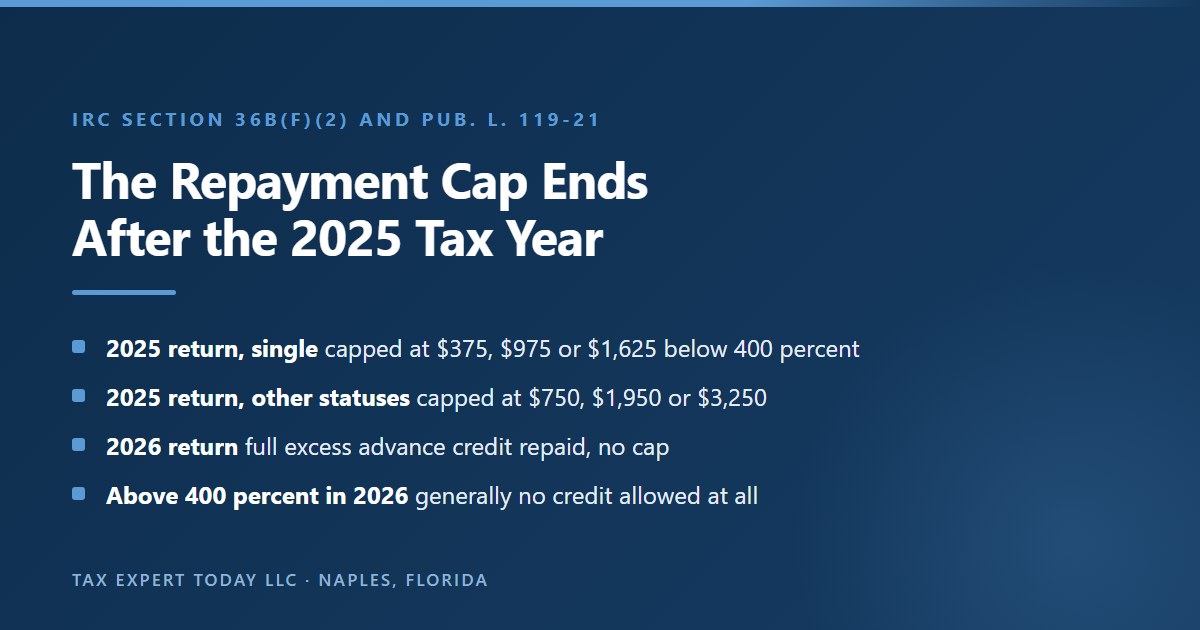
For a 2025 return, not always. If household income is below 400 percent of the federal poverty line, the excess advance credit you must repay is capped by Table 5 of the Form 8962 instructions, from $375 to $3,250 depending on income and filing status. At 400 percent or more, there is no cap.
- The cap is applied per return: each former spouse’s cap depends on the household income and family size on that spouse’s own return.
- Single filers have the lower caps: every other filing status uses the higher column.
- Separate filers still get a cap for 2025: the instructions apply Table 5 to each spouse separately.
- The cap is gone for 2026: see the next section.
The limitation is entered on Form 8962, line 28. For tax year 2025, Table 5 reads as follows.
| Household income as a percent of the federal poverty line (Form 8962, line 5) | Repayment limit, single | Repayment limit, any other filing status |
|---|---|---|
| Less than 200 | $375 | $750 |
| At least 200 but less than 300 | $975 | $1,950 |
| At least 300 but less than 400 | $1,625 | $3,250 |
| 400 or more | No limit; repay the full excess | No limit; repay the full excess |
The instructions add a point that matters for separated couples: “If you were married at the end of 2025 but are filing separately from your spouse, the repayment limitations shown in Table 5 apply to you and your spouse separately based on the household income reported on each return.” The same per-return rule appears in Treas. Reg. §1.36B-4(b)(4)(i). In a divorce year, the cap therefore depends on each former spouse’s separate household income, which is often lower than the joint figure the Marketplace used, and that difference can work in a former spouse’s favor on a 2025 return.
The final amount from line 29 is reported as additional tax on Schedule 2 (Form 1040), line 1a. If the allowed credit is larger than the advance payments, the net credit goes on Schedule 3 (Form 1040), line 9, and reduces tax or increases the refund.
What Changes for 2026 Returns After Pub. L. 119-21?
For tax years beginning after December 31, 2025, Pub. L. 119-21 section 71305 struck the repayment limitation from IRC section 36B(f)(2). A 2026 return repays the entire excess advance credit, whatever the income. The temporary rule that allowed a credit above 400 percent of the poverty line also expired after 2025.
- No more Table 5 cap: §36B(f)(2) now simply increases tax by the full excess of advance payments over the allowed credit.
- The 400 percent ceiling returns: the §36B(c)(1)(E) rule for 2021 through 2025 ended, so household income above 400 percent of the poverty line generally means no credit at all.
- The higher temporary credit percentages ended: the §36B(b)(3)(A)(iii) table applied only through 2025.
- The allocation stakes rise: without a cap, every dollar moved by the shared policy allocation can change the repayment dollar for dollar.
The amendment notes to IRC §36B record that Pub. L. 119-21, §71305(a) and (b)(1), “struck out subpar. (A) designation and heading and subpar. (B) which related to limitation on increase” of advance payments for taxpayers with household income under 400 percent of the poverty line, applicable to taxable years beginning after December 31, 2025. The current text of §36B(f)(2) now reads in full that if the advance payments for a year “exceed the credit allowed by this section … the tax imposed by this chapter for the taxable year shall be increased by the amount of such excess.”
Other changes in the same law affect who can claim the credit at all after 2025, including the repeal of a special rule for certain lawfully present individuals under §71302. They are outside the scope of this guide, but they are a reason to review eligibility, not only the allocation, for any 2026 return. This guide reflects the statute as it reads in October 2026. If Congress changes the credit again, the 2026 Form 8962 instructions will control, and they should be read when they are released.
The table below compares the same hypothetical excess advance credit of $2,600 on a former spouse’s own return under 2025 and 2026 law. The figures assume the full Form 8962 computation has already produced that excess; the actual excess depends on each return’s income, family size, and benchmark premium.
| Hypothetical former spouse, excess APTC of $2,600 | 2025 return (Table 5 cap) | 2026 return (no cap) |
|---|---|---|
| Single, household income at 250 percent of the poverty line | $975 | $2,600 |
| Single, household income at 350 percent of the poverty line | $1,625 | $2,600 |
| Head of household, household income at 250 percent of the poverty line | $1,950 | $2,600 |
| Single, household income at 420 percent of the poverty line | $2,600 (no cap at 400 or more) | $2,600, and generally no credit is allowed above 400 percent |
For divorcing couples, the 2026 change turns the shared policy allocation from a paperwork step into a real money decision. Under 2025 law, a lower-income former spouse could absorb a large allocated share of advance credit and still repay no more than the cap. Under 2026 law, that protection is gone, so an allocation agreed casually in a settlement can cost the receiving spouse the full excess. Couples divorcing in 2026 who shared a Marketplace plan should run both returns under more than one percentage before agreeing to any split.
How Does Household Income Change the Credit After a Divorce?
After a divorce, each former spouse computes the credit with their own household income and family size at the end of the year. Household income is modified adjusted gross income, which adds back tax-exempt interest, excluded foreign earned income, and untaxed Social Security, plus the income of dependents required to file.
- Year-end snapshot for the contribution amount: the expected contribution uses household income and family size at the end of the year, under Treas. Reg. §1.36B-4(b)(1).
- Month-by-month benchmark: the benchmark plan for each month follows the marital status on the first day of that month.
- Pre-2019 alimony counts: alimony that is still taxable under a grandfathered instrument is income to the recipient and deductible by the payer.
- Untaxed Social Security counts too: §36B(d)(2)(B) adds it back to adjusted gross income.
IRC §36B(d)(2) defines household income as the taxpayer’s modified adjusted gross income plus the modified adjusted gross incomes of the other individuals counted in family size who were required to file a return. Modified adjusted gross income is adjusted gross income increased by any amount excluded under §911, tax-exempt interest, and “the portion of the taxpayer’s social security benefits … which is not included in gross income under section 86.” A former spouse who receives Social Security on their own record or on the former spouse’s record should include the portion that IRC §86 leaves untaxed; our guide to divorce and Social Security benefits explains how those benefits are taxed.
Treas. Reg. §1.36B-4(b)(1) sets the timing. A taxpayer whose marital status changes during the year “computes the premium tax credit by using the applicable benchmark plan or plans for the taxpayer’s marital status as of the first day of each coverage month.” The contribution amount, which is household income times the applicable percentage, is “determined using the taxpayer’s household income and family size at the end of the taxable year.” So a former spouse who was married through June uses a benchmark for the married household in those months and a benchmark for the single household afterward, but measures affordability against a full year of their own income only.
Alimony is the item that most often moves household income in a divorce year. Under an instrument executed before 2019 and not modified to adopt the new rule, alimony is still included in the recipient’s income and deducted by the payer, so it raises the recipient’s household income and lowers the payer’s. Under a post-2018 instrument, alimony is neither, and it has no effect on either household income. Our guide to alimony taxes after divorce explains which rule applies. Property division under §1041 generally does not create income, but a sale of an asset to fund a buyout can; our guide to whether a divorce settlement is taxable walks through each component. Exercising stock options received in the divorce, or taking a cash distribution from a retirement plan, also adds income in the year it happens; see our guides to dividing stock options in divorce and QDRO taxes in divorce.
Self-employed former spouses face one more interaction. The self-employed health insurance deduction and the premium tax credit can depend on each other, because the deduction lowers adjusted gross income, which changes the credit, which changes the premium eligible for the deduction. Our guide to the self-employed health insurance deduction covers how those two calculations are coordinated, and Pub. 974 contains the iterative method.
Can Two People Use the Same Form 1095-A?
Yes. In a divorce year, both former spouses often work from one Form 1095-A. The Marketplace sends it to the person or people identified on the enrollment application, and the Form 8962 instructions say the recipient should give a copy to the other spouse. Each former spouse then applies their own allocation percentage to the same figures.
- One statement, two returns: both returns start from the same monthly amounts in columns A, B, and C.
- Each return identifies the other: Part IV asks for the policy number and the other taxpayer’s Social Security number.
- Several statements are possible: a policy change mid-year usually means a separate Form 1095-A for each policy.
- Check the statement first: errors in the benchmark premium or the months of coverage should be corrected before allocating.
The Marketplace must provide Form 1095-A for 2025 coverage by January 31, 2026, according to the Form 8962 instructions, and a person who does not receive one by early February should contact the Marketplace. The IRS Form 1095-A page describes the statement as the information the Marketplace reports about individuals enrolled in a qualified health plan. In the Melissa and Ryan example in the instructions, the couple shared a plan for January through April and “Melissa or Ryan will receive a Form 1095-A reporting their coverage for January through April. The recipient of the Form 1095-A should provide a copy to the nonrecipient.”
Before any allocation, confirm three things on the statement: that the months of coverage match what was actually in force, that the advance payment column matches the payments made, and that the benchmark premium in column B reflects the right coverage family. When spouses separate, the benchmark often reflects the old household. The instructions point taxpayers who enrolled through the federally facilitated Marketplace to the HealthCare.gov tax tool to look up the correct benchmark premium, and Pub. 974 explains the method for others, applying the benchmark plan rules in Treas. Reg. §1.36B-3(f).
How Do You Fill Out Form 8962 Part IV for a Shared Policy Allocation?
Part IV has four lines, 30 through 33, one for each policy and period allocated. Column (a) is the policy number, column (b) the other taxpayer’s Social Security number, columns (c) and (d) the first and last months as two digits, and columns (e), (f), and (g) the percentages for premiums, benchmark premium, and advance credit, as decimals.
- Check line 9 “Yes”: line 9 asks whether you are allocating policy amounts or using the year of marriage calculation.
- Decimals, two places: 40 percent is entered as 0.40, and 67 percent as 0.67.
- Full allocation: if 100 percent is allocated to you, enter 100; if none is allocated to you, enter -0-.
- Leave unused columns blank: for example, a separate filer with no exception completes only column (g).
The form itself is posted on the IRS About Form 8962 page. This is the question most searchers are really asking, so here is the sequence from the 2025 instructions. First, answer line 9. If you are allocating amounts from a shared policy, check “Yes” and complete Part IV before the monthly lines. Then, for each policy and period, complete one line in Part IV. A divorce year where the policy was shared during the marriage and a child stayed on afterward typically uses two lines: one for the married months under Allocation Situation 1, and one for the later months under Allocation Situation 4.
| Part IV column | Entry | Divorce year note |
|---|---|---|
| (a) Policy number | From Form 1095-A, line 2 | Both former spouses report the same number |
| (b) SSN of other taxpayer | The former spouse’s Social Security number | Each return names the other |
| (c) and (d) Allocation start and stop month | The first and last months covered by this allocation | For Situation 1, the months of marriage only |
| (e) Premium percentage | Your share of column A as a decimal | Same as (f) and (g) in a divorce |
| (f) SLCSP percentage | Your share of column B | Blank under Situation 2 and for separate filers |
| (g) APTC percentage | Your share of column C | Always completed when APTC was paid |
After Part IV, the allocated amounts flow into the monthly lines 12 through 23. For the months covered by the allocation, you enter your allocated share of each column rather than the full Form 1095-A figures. Where a month includes amounts from your own policy and an allocated share of a shared one, the figures are added together. The instructions handle a full allocation in a specific way: if 100 percent of the policy amounts are allocated to you, check “Yes” on line 9 and enter “100” in the appropriate boxes, and if 0 percent are allocated to you, enter “-0-.” Software screens usually ask the same questions in a different order, which is why this query is dominated by software help pages, but the underlying entries are the same.
What Happens If You Do Not File Form 8962?
If advance credit was paid for anyone in your tax family, you must file Form 8962 with your return. Mistakes on the form can delay the return or refund, and if you do not file a return at all, the IRS says you will not be eligible for advance credit payments in future years.
- Who must file: anyone taking the credit, anyone whose tax family received APTC, and anyone who enrolled someone that no one else included in a tax family.
- Future coverage at risk: no return means full-price premiums in later years until the reconciliation is done.
- Both former spouses are affected: each must reconcile their allocated share on their own return.
- Late is better than never: filing the missing form restores the process.
The Form 8962 instructions list who must file: anyone taking the premium tax credit, anyone for whom APTC was paid or for another individual in their tax family, and anyone for whom APTC was paid for an individual they told the Marketplace would be in their tax family when no one included that individual in a tax family. The last category catches divorcing parents who enrolled a child and then assumed the other parent would handle it.
The IRS questions and answers on the premium tax credit state that “if APTC is paid on behalf of you or an individual in your family, and you do not file a tax return, you will not be eligible for APTC to help pay for your Marketplace health insurance coverage in future years.” For a newly single parent buying coverage alone, losing the advance credit can be a serious budget problem. A missing Form 8962 is usually fixable by filing the form, and a notice asking for it should be answered promptly rather than set aside.
If the IRS has already offset a refund on a joint return to pay a former spouse’s separate debt, that is a different problem governed by the injured spouse rules; see our guide to injured spouse relief. If the concern is liability for an understatement on a past joint return, see our guide to innocent spouse relief. Neither replaces the shared policy allocation, which is about dividing the premium tax credit, not about joint liability.
How Should a Divorce Settlement Address Health Insurance Subsidies?
The settlement should state who enrolls each person, who claims each child, and what shared policy allocation percentage the former spouses will report for any shared months. Writing the percentage down avoids the 50 percent default and mismatched returns. Drafting those terms is the family law attorney’s work; the tax side models each option first.
- Name the percentage: a written allocation for each shared policy and period.
- Align coverage with dependency: enrolling a child under the parent who claims the child can avoid future allocations.
- Report changes promptly: tell the Marketplace about the divorce so advance payments are recalculated.
- Share the documents: an obligation to provide the Form 1095-A and the information each return needs.
From a tax standpoint, the most useful sentence in the settlement is the one that fixes the allocation percentage, because the regulation imposes 50 percent when former spouses “do not agree on an allocation that is reported to the IRS.” A written agreement gives both preparers the same number. It also reduces the risk that one former spouse reports 100 percent to the other while the other reports 50 percent, which leaves the IRS with two returns that do not add up.
The second most useful step happens outside the settlement. HealthCare.gov asks enrollees to update their application as soon as possible when income or household changes, and it warns that losing a household member or an income increase may mean qualifying for less help than is being paid. Reporting the divorce, and enrolling each person under the tax family that will actually claim them, brings advance payments back in line with the returns that will be filed. That limits the excess that has to be repaid, which matters more after 2025 now that the repayment cap is gone.
We provide the tax analysis that supports these terms: the effect of each allocation percentage on both returns, the effect of each dependency assignment, and the projected excess or net credit for the year. Whether a spouse accepts a less favorable allocation in exchange for another term, and how the obligation is enforced, are matters for your family law attorney. Our divorce tax consulting service is designed to give that attorney numbers rather than estimates.
Does Florida Add Anything to a Shared Policy Allocation?
No state layer applies. Florida has no personal income tax, so there is no state premium credit to reconcile and no state return on which to repeat the allocation. Florida residents generally enroll through HealthCare.gov, the federally facilitated Marketplace, and the federal reconciliation on Form 8962 is the entire exposure.
- No state income tax: Article VII, section 5 of the Florida Constitution limits the state’s power to tax the income of natural persons.
- Federal Marketplace: the HealthCare.gov tax tool is the source for the correct benchmark premium.
- The whole amount is federal: without a cap for 2026, the federal excess is the full cost.
- Florida alimony reform: SB 1416 (2023) changed alimony types, not the federal treatment of alimony or the premium tax credit.
The Florida Constitution, Article VII, section 5, restricts any tax on the income of residents who are natural persons, and Florida does not levy one. That simplifies the divorce year: the only reconciliation is the federal one. It also means there is no state cushion. Some states run their own subsidy programs on top of the federal credit, but a Florida resident’s health insurance help in a divorce year comes down to the federal premium tax credit and Form 8962.
Florida’s 2023 alimony reform, SB 1416, eliminated permanent alimony for new awards and reshaped the types of support a court may order. That is family law, and your attorney will explain how it applies to your case. For tax purposes, the federal rule still turns on the date of the instrument: alimony under a post-2018 agreement is neither income nor a deduction, so it does not move household income for the premium tax credit at all.
Shared Policy Allocation: Help in Naples & Southwest Florida
Tax Expert Today LLC is based in Naples, Florida, and works with divorcing and recently divorced clients across Collier and Lee counties and in all 50 states. Southwest Florida has a large population of self-employed people, early retirees, and seasonal workers who buy coverage through HealthCare.gov rather than through an employer, and many of them first meet the shared policy allocation in the year they divorce. The questions we see are federal and practical: which allocation situation applies, what percentage leaves the household with the smallest combined repayment, and what the 2026 repeal of the repayment cap means for a settlement being negotiated now.
- Divorce tax Naples FL: preparing both former spouses’ Form 8962 calculations under several allocation percentages before the settlement fixes one.
- Shared policy allocation help in Naples: completing Part IV correctly for the married months and for any months a child stayed on the other parent’s policy.
- Separated but not yet divorced: testing whether Exception 1 or Exception 2 applies, and comparing a joint return with separate returns for the premium tax credit.
- Coordination with your attorney: giving the family law attorney the tax result of each enrollment and dependency arrangement, without advising on the negotiation itself.
You can read more on our divorce tax consulting page, and about the broader practice at Naples FL tax planning.
Tax Expert Today LLC
11983 Tamiami Trail N, Naples, FL 34110
Phone: (239) 441-2005
Hours: Monday through Friday, 10:00am to 5:00pm ET
Does a Naples divorce change how Florida taxes my Marketplace subsidy? No. Florida has no personal income tax, so a Naples resident reconciles the premium tax credit only on the federal return. The shared policy allocation, the repayment of any excess advance credit, and the 2026 repeal of the repayment cap are all federal rules that apply the same way in Collier County as anywhere else.
When to Engage a Professional
A divorce in which each spouse had separate Marketplace coverage all year, or in which no advance credit was paid, may need no allocation at all. Professional involvement tends to earn its cost when one or more of the following is present.
- A shared policy and a large advance credit: the allocation percentage can change the combined repayment, and under 2026 law there is no cap to limit it.
- A settlement still being negotiated: the allocation, the enrollment of each child, and the dependency assignment can be modeled together before they are agreed.
- Separated but married on December 31: the choice between a joint return, Exception 1, Exception 2, and married filing separately can decide whether any credit is allowed.
- Self-employment or Social Security income: the self-employed health insurance deduction and the untaxed Social Security add-back both move household income.
- An IRS letter about Form 8962: a request for the form, or a proposed adjustment to the credit, should be answered with the correct allocation and documents.
We work as the tax side of the divorce team, alongside your family law attorney, who remains responsible for the settlement terms and the decree. To discuss your situation, call (239) 441-2005 or visit our divorce tax consulting page. Every outcome depends on the facts of the return, including each former spouse’s household income, family size, and coverage history.
Frequently Asked Questions About Shared Policy Allocation
Do I have to repay all the APTC after a divorce? Not necessarily. You repay only the excess of the advance credit allocated to you over the credit you are allowed on your own return. For 2025, Table 5 caps that repayment below 400 percent of the poverty line. For tax years beginning after 2025, Pub. L. 119-21 removed the cap, so the full excess is repaid.
Can two people use the same Form 1095-A? Yes. When former spouses shared a policy, one Form 1095-A often covers both. The recipient should give a copy to the other spouse, and each applies their own allocation percentage to the same monthly figures in Part IV of Form 8962, naming the other spouse in column (b).
What is the shared policy allocation if we cannot agree? For the months of marriage, 50 percent of the premiums, the benchmark premium, and the advance credit goes to each former spouse under Treas. Reg. §1.36B-4(b)(3). The exception is any period in which the plan covered only one spouse’s side of the family, which is allocated entirely to that spouse.
Can I take the premium tax credit if I file married filing separately? Generally no. A married taxpayer must file jointly to take the credit, unless they qualify as a married person living apart for head of household purposes, or they are a victim of domestic abuse or spousal abandonment and certify it on Form 8962, for no more than 3 consecutive years.
Does the shared policy allocation continue after the divorce is final? It can. If a child stays on a policy one parent enrolled while the other parent claims the child, the later months are allocated under Allocation Situation 4. The parents may agree on any percentage, or the headcount default applies.
Does a Naples divorce change how Florida taxes my Marketplace subsidy? No. Florida has no personal income tax, so a Naples resident reconciles the premium tax credit only on the federal return. The shared policy allocation and any repayment are federal rules that apply the same way in Collier County as anywhere else.
Published October 7, 2026 by Dr. Pellumb Kabashi « Back to Learning Center
Have a question this article touches on?
Tax Expert Today LLC, based in Naples, Florida and serving clients across the United States.
Schedule a Consultation (239) 441-2005