
By Dr. Pellumb Kabashi, DBA, MBA, CES, CFE, EA
Founder, Tax Expert Today LLC · Tax advisors, enrolled agents, CPAs, and attorneys · Serving clients in all 50 states
Quick Answer: Are divorce and Social Security benefits taxed differently? No. A benefit paid on an ex-spouse’s record is taxed under IRC §86 exactly like one on your own record, and up to 85 percent can be taxable. What divorce changes is your base amount: $25,000 once you are unmarried, but zero if you are married, file separately, and lived with your spouse at any time in the year. Call (239) 441-2005 for a free consultation.
Divorce and Social Security benefits are usually discussed as an eligibility question: who qualifies, at what age, and for how much. Those questions belong to the Social Security Administration, and its own pages answer them well. What the pages that rank for this topic rarely address is the tax, which is where a divorced filer can lose real money without noticing. Federal law can make up to 85 percent of a benefit taxable, and the rule that decides how much depends on marital status, filing status, and income that a divorce tends to change.
This guide is about the tax side of divorce and Social Security benefits. It explains how a benefit paid on an ex-spouse’s record is taxed, how the base amount changes at each stage of a divorce, why a separated but still married filer faces the single harshest rule in the calculation, which divorce payments and transfers count as income, and what the new deduction for seniors does and does not do. Eligibility is covered briefly and always with a link to the agency that decides it. Every figure below is checked against the statute or an IRS or SSA source, and each worked example is a hypothetical built to show the arithmetic.
One boundary before we start. Tax Expert Today LLC advises on the tax mechanics of divorce only. We do not practice family law, and nothing here is advice on whether Social Security benefits should be considered in a settlement, how they interact with support obligations, or what any party should agree to. Those decisions belong with your family law attorney, and this analysis is meant to sit alongside that representation rather than replace any part of it.
How Are Divorce and Social Security Benefits Taxed in 2026?
Social Security benefits are taxed under IRC §86 the same way whether they come from your own record or an ex-spouse’s record. Up to 50 percent is taxable above the base amount and up to 85 percent above the adjusted base amount. Divorce matters because your filing status sets those thresholds, and one status moves them to zero.
- Provisional income is your modified adjusted gross income plus one-half of your net benefits, and it is the figure compared with the thresholds (IRC §86(b)(1)).
- The 50 percent tier applies once provisional income passes the base amount, and at most one-half of your benefits can be taxed under it (IRC §86(a)(1)).
- The 85 percent tier applies once provisional income passes the adjusted base amount, and no more than 85 percent of your benefits can ever be taxed (IRC §86(a)(2)).
- The zero base amount applies to a married person who files separately and lived with a spouse at any time in the year, and it is the rule most divorcing filers have never heard of.
- The dollar thresholds are fixed by statute. Section 86(c) states them as flat amounts, and unlike the standard deduction they are not indexed for inflation.
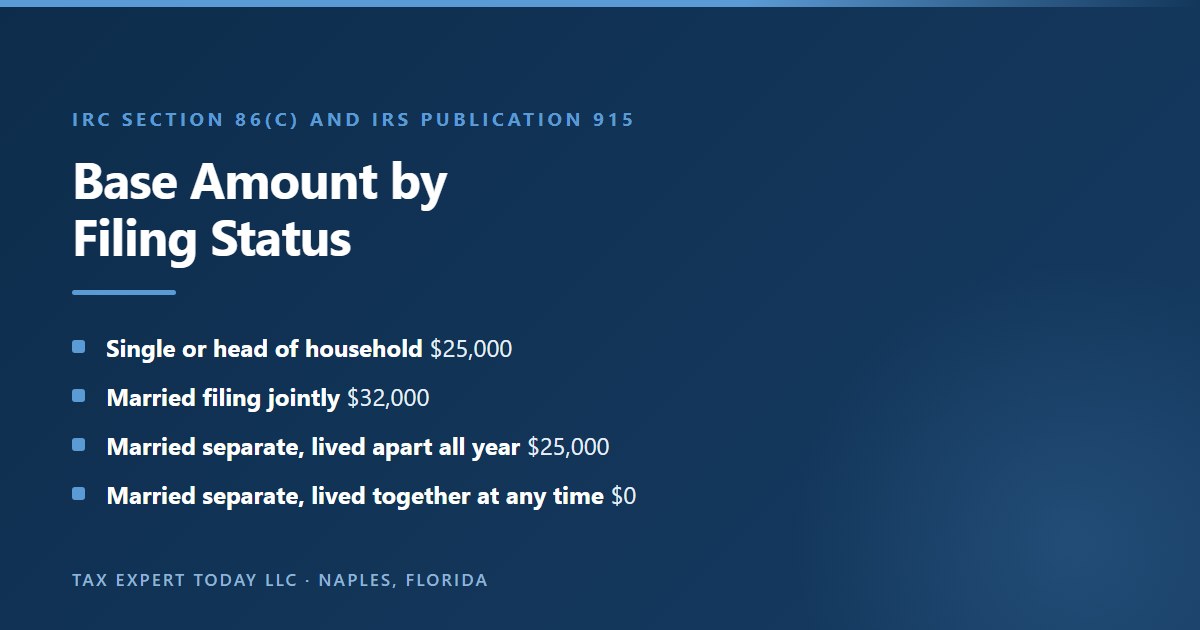
The table below shows the thresholds for each filing status, using the wording of IRC §86(c) and the base amount list in IRS Publication 915. When people research divorce and Social Security benefits, this is the table that decides the tax, because your status on the last day of the year selects the row.
| Filing status for the year | Base amount | Adjusted base amount | Authority |
|---|---|---|---|
| Single, head of household, or qualifying surviving spouse | $25,000 | $34,000 | IRC §86(c)(1)(A), (c)(2)(A); IRS Pub. 915 |
| Married filing jointly | $32,000 | $44,000 | IRC §86(c)(1)(B), (c)(2)(B) |
| Married filing separately, lived apart from the spouse for the entire year | $25,000 | $34,000 | IRS Pub. 915 (base amount list) |
| Married filing separately, lived with the spouse at any time during the year | $0 | $0 | IRC §86(c)(1)(C), (c)(2)(C) |
Two things stand out. The joint threshold of $32,000 is shared by two people, while a divorce produces two separate $25,000 thresholds, which is why a divorce can lower the combined tax on benefits when neither spouse receives taxable alimony. And the last row has no tier of protection at all, which is why the separation date matters so much and why a full section of this guide is devoted to it.
Are Social Security Benefits Taxed Differently When They Come From an Ex-Spouse’s Record?
No. IRC §86 taxes any monthly benefit under title II of the Social Security Act to the person who has the legal right to receive it. A benefit drawn on an ex-spouse’s record is reported on your own Form SSA-1099 and taxed exactly like a benefit drawn on your own earnings record, with no separate schedule and no special rate.
- Your Form SSA-1099 reports gross benefits in box 3 and net benefits in box 5, and box 5 is the figure that goes into the worksheet (IRS Pub. 915).
- No look-through to the ex-spouse. SSA states that benefits paid to a divorced spouse do not reduce the payments made to the former spouse, and nothing on the former spouse’s return depends on yours.
- Survivor benefits follow the same rule because §86(d)(1)(A) covers any monthly benefit under title II, so the tax analysis does not change if the former spouse later dies.
- Benefits for a child belong to the child. Pub. 915 says benefits are taxed to the person with the legal right to receive them, even when the check is made out in a parent’s name.
The last point matters to a custodial parent. If a child receives benefits on a parent’s record and the payments arrive in the custodial parent’s name, IRS Publication 915 says the parent uses only the parent’s own share to test whether any benefit is taxable. One-half of the child’s share is added to the child’s other income to test the child’s benefits. In practice a child with no other income usually has nothing taxable, but the rule only works if the shares are separated correctly, which is worth checking against the amounts on each Form SSA-1099 before filing.
The same logic explains a common mistake in the other direction. A person collecting divorce and Social Security benefits on an ex-spouse’s record sometimes assumes the ex-spouse’s income or filing status somehow carries over. It does not. Your provisional income is built from your own return, your own filing status, and your own benefits, and the former spouse’s tax position is irrelevant unless the two of you file a joint return for a year before the divorce is final.
Who Can Collect Divorce and Social Security Benefits on an Ex-Spouse’s Record?
The Social Security Administration decides eligibility. Its published rule is that a divorced person whose marriage lasted at least 10 years may be able to get benefits on a former spouse’s record, up to half of that person’s benefit amount. Age, marital status, and other factors apply, so confirm the details with SSA.
- Length of marriage. SSA’s answer for former spouses turns on a marriage lasting at least 10 years (SSA benefits-on-a-former-spouse’s-record page).
- Amount. SSA describes family benefits as up to half of the family member’s benefit amount, so the figure depends on the other person’s record.
- Marital status. SSA’s fact sheet on divorced spouses describes the requirement that the divorced person be unmarried when becoming eligible.
- Application. SSA’s Form SSA-2 page lists the final divorce decree among the documents to have ready, and says the application can be made online within 3 months of age 62 or older, or by phone or in person.
That is as far as this guide goes on eligibility, deliberately. Whether to claim on your own record or an ex-spouse’s record, at what age, and how the benefit interacts with your other retirement income are decisions to make with SSA and a retirement planner. What this article contributes is the part those pages leave out, and the tax rules for divorce and Social Security benefits in the sections that follow apply no matter which record pays the benefit.
How Do You Figure How Much Social Security Is Taxable After a Divorce?
Add your modified adjusted gross income to one-half of your net benefits. That total, often called provisional income, is compared with the base amount for your filing status. Below the base amount, no benefits are taxable. Above it, the taxable amount rises in two steps and is capped at 85 percent of your benefits.
- Step one, the 50 percent tier. The taxable amount is the lesser of one-half of your benefits or one-half of the excess of provisional income over the base amount (IRC §86(a)(1)).
- Step two, the 85 percent tier. Above the adjusted base amount, the taxable amount is the lesser of 85 percent of your benefits or the sum of 85 percent of the excess over the adjusted base amount plus the smaller of the step one amount or one-half of the gap between the two thresholds (IRC §86(a)(2)).
- Modified adjusted gross income is adjusted gross income with tax-exempt interest added back, and with several exclusions and deductions disregarded, including the student loan interest deduction and the foreign earned income exclusion (IRC §86(b)(2); IRS Pub. 915).
- Deductions do not reduce the test. Pub. 915 tells you not to reduce your other income by deductions or by the listed exclusions when you compare it with the base amount.
The table below runs three hypothetical single filers through the formula using the 2026 statutory amounts. The figures are illustrations of the arithmetic, not a forecast for any person. For the first row, one-half of $18,000 is $9,000, so provisional income is $22,000 plus $9,000, or $31,000. That is $6,000 over the $25,000 base amount, and one-half of the excess is $3,000, which is less than one-half of the benefits, so $3,000 is taxable. The second row passes the $34,000 threshold and uses the second step, and the third row reaches the 85 percent cap.
| Hypothetical single filer | Net benefits | Other income | Provisional income | Taxable benefits |
|---|---|---|---|---|
| Row 1: modest pension and interest | $18,000 | $22,000 | $31,000 | $3,000 (16.7 percent) |
| Row 2: larger retirement withdrawals | $24,000 | $30,000 | $42,000 | $11,300 (47.1 percent) |
| Row 3: a large one-time item in the year | $24,000 | $80,000 | $92,000 | $20,400 (85 percent, the cap) |
For the second row, 85 percent of the $8,000 by which provisional income exceeds $34,000 is $6,800. The second part of the step two sum is the smaller of $8,500 (the step one amount) or $4,500 (one-half of the $9,000 gap between $25,000 and $34,000), which is $4,500. The total is $11,300, well under the cap of $20,400. The third row is the important one for divorce and Social Security benefits, because a one-time item pushed the same person from 47 percent of benefits taxable to the maximum, and a later section shows exactly what that costs.
What Is the Zero Base Amount for Married Filing Separately, and Why Does It Matter in a Divorce?
If you are married at year end, file separately, and lived with your spouse at any time during the year, both thresholds drop to zero under IRC §86(c)(1)(C) and (c)(2)(C). The 50 percent tier disappears, and the taxable amount becomes 85 percent of your provisional income, capped at 85 percent of your benefits. Separating in July does not avoid it.
- Married at the close of the year. The first prong turns on marital status under §7703, so a final decree by December 31, or a decree of legal separation, means you are not married for this test.
- Lived together at any time. The second prong is met unless you lived apart from your spouse at all times during the year, and Pub. 915 states it as living with your spouse at any time in the year.
- Filed a separate return. A joint return uses the $32,000 and $44,000 amounts, not zero, so the zero base amount is a separate-return problem.
- Lived apart the entire year. A married separate filer who never shared a home during the year keeps the $25,000 and $34,000 amounts and checks the box on line 6d of the 2025 Form 1040.
IRS Publication 915 shows how severe the rule is with its own example. Kris and Taylor Jones are married and live together but file separate returns. Kris earned $8,000 and had $4,000 of net Social Security benefits. Because Kris is married filing separately and lived with Taylor during the year, Kris must include 85 percent of the benefits, which is $3,400. On a single return with the same $8,000 of wages, none of the benefits would be taxable, because provisional income of $10,000 is well under $25,000.
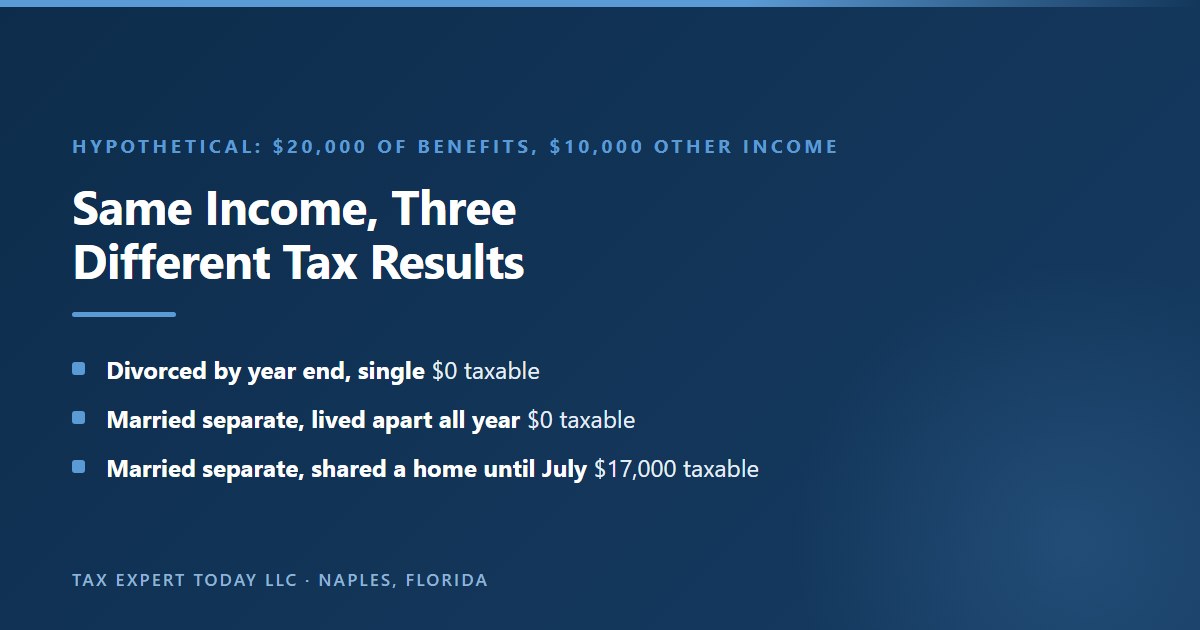
The table below applies the same idea to a hypothetical divorcing filer with $20,000 of net benefits and $10,000 of other income. Provisional income is $20,000 in every row. Only the marital facts change, and the taxable benefit swings from zero to $17,000.
| Marital facts on December 31 | Base amount | Taxable benefits |
|---|---|---|
| Divorced by a final decree earlier in the year, filing single | $25,000 | $0 (provisional income of $20,000 is under the base amount) |
| Still married, filing separately, lived apart for the entire year | $25,000 | $0 |
| Still married, filing separately, shared a home until July | $0 | $17,000 (85 percent of provisional income, which equals the 85 percent cap) |
The lesson for a household that is separating is that the tax on divorce and Social Security benefits keys on living arrangements and status, not on when papers are signed. Whether and when to separate households is a family and legal decision that we do not advise on. We flag only that a filer who is still married on December 31 and files separately carries the zero base amount for the whole year if there was any period under one roof, and that the cost is measured on the entire return.
One caution about a related rule. IRC §7703(b) treats some married separate filers who maintain a home for a child as not married, and it is often called the abandoned spouse rule. Section 86 says a person is married “within the meaning of section 7703,” and Publication 915 speaks only in terms of living apart for the entire year when it describes the $25,000 base amount for a married separate filer. We would not assume the abandoned spouse rule lifts the zero base amount without a review of the facts, so a filer who may qualify should have the return checked before relying on it. Our guide to divorce filing status covers the December 31 rule and the abandoned spouse test in detail.
How Does the Year You Divorce Change the Tax on Social Security Benefits?
Marital status is fixed on the last day of the year under IRC §7703(a). A final decree by December 31 makes you unmarried for the whole year, with a $25,000 base amount. Still married on that date, you file jointly at $32,000 or separately, where the zero base amount may apply. A decree of legal separation also counts as unmarried.
- Divorce final on or before December 31. You are single for the year (or head of household if you qualify), and the $25,000 and $34,000 amounts apply to your own benefits and income.
- Divorce final in the next January. You are still married for the earlier year, so the choice is a joint return with the spouse or a separate return and the zero base amount risk.
- Decree of legal separation. Section 7703(a)(2) says an individual legally separated under a decree of divorce or of separate maintenance is not considered married.
- Joint return with the spouse. The two of you combine income and benefits, the base amount is $32,000, and Pub. 915 says a spouse with no benefits still adds income to the test.
Divorce can lower the combined tax on benefits because two $25,000 base amounts replace one $32,000 base amount. The next table compares one hypothetical couple before and after. On a joint return, the couple has $38,000 of combined net benefits and $26,000 of other income, so provisional income is $45,000 and $6,850 of benefits is taxable. After a divorce with no alimony, the spouse with $20,000 of benefits and $26,000 of other income has provisional income of $36,000 and $6,200 taxable, and the spouse with $18,000 of benefits and no other income has provisional income of $9,000 and nothing taxable.
| Hypothetical couple | Provisional income | Base amount | Taxable benefits |
|---|---|---|---|
| Joint return: $38,000 of benefits and $26,000 of other income | $45,000 | $32,000 | $6,850 |
| After divorce, first spouse: $20,000 of benefits and $26,000 of other income | $36,000 | $25,000 | $6,200 |
| After divorce, second spouse: $18,000 of benefits and no other income | $9,000 | $25,000 | $0 |
The direction is not the same for every household. Taxable alimony under an older instrument, a retirement distribution paid to one spouse, or a gain on a home sale can push one former spouse well above the joint result, and the next sections show how. The point of the comparison is that the divorce changes the arithmetic, so the tax on divorce and Social Security benefits should be modeled for the year of the divorce and the years after, not assumed to stay where it was on the last joint return.
Which Divorce Payments and Transfers Count as Income When Figuring Taxable Benefits?
Anything that lands in adjusted gross income counts, and IRC §86(b)(2) makes almost no exclusions for divorce items. Taxable alimony under a pre 2019 instrument counts. Child support, post 2018 alimony, and tax-free property transfers do not. Taxable retirement distributions and gains you recognize on assets you sell count in the year recognized.
- Alimony is date sensitive. IRS Topic 452 says alimony under an agreement executed before 2019 is includible by the recipient, while alimony under an agreement executed after 2018 is not included in the recipient’s income.
- Child support never counts. Topic 452 states that child support is never deductible and is not considered income.
- A tax-free transfer creates no income at transfer. Property moved between spouses incident to divorce is not a recognized gain (IRC §1041(a)), and the transferee takes the transferor’s basis.
- Tax-exempt interest is added back. Municipal bond interest is not taxed, but IRC §86(b)(2)(B) counts it in provisional income.
The table below is a working list of the divorce items that most often change provisional income. The right-hand column gives the authority, and a yes means the item is part of the number that is compared with the base amount in the year it is included in gross income. Readers who want the mechanics behind any row can follow the linked guides in the text that follows the table.
| Divorce item | Counts toward provisional income? | Authority |
|---|---|---|
| Alimony received under an instrument executed before 2019 and not modified to adopt the repeal | Yes, it is included in gross income | IRS Topic 452; IRC §86(b)(2) |
| Alimony received under an instrument executed after 2018 | No | IRS Topic 452 |
| Alimony paid under an instrument executed before 2019 | The deduction lowers adjusted gross income, which lowers provisional income | IRS Topic 452 |
| Child support received | No | IRS Topic 452; IRS Pub. 504 |
| Property received in a transfer incident to divorce | No gain at transfer; a later sale is measured from the transferor’s basis | IRC §1041(a), (b) |
| IRA transferred to a former spouse under a divorce instrument | No, it is not a taxable transfer | IRC §408(d)(6) |
| Cash paid to you from a retirement plan under a qualified domestic relations order | Yes, to the extent taxable, because you are treated as the distributee | IRC §402(e)(1)(A) |
| A qualified Roth IRA distribution | No | IRC §408A(d)(1) |
| Gain on a home sale above the exclusion | Yes, in the year of the sale | IRC §121(b) |
| Tax-exempt interest | Yes, it is added back | IRC §86(b)(2)(B) |
Each of these has its own rules and its own traps. Our guides to alimony taxes after divorce, QDRO taxes in divorce, and divorce house buyout taxes work through the alimony instrument dates, the difference between an IRA transfer and a plan distribution, and the home sale exclusion in detail. What this guide adds for divorce and Social Security benefits is the interaction: every dollar in the middle column also feeds the formula that decides how much of a benefit is taxed, so a dollar of new income can add more than a dollar to taxable income.
Alimony shows the effect clearly. Take a hypothetical single recipient with $30,000 of net benefits and $20,000 of other income. Provisional income is $35,000 and $5,350 of the benefits is taxable. If the same person also receives $24,000 of taxable alimony under an instrument executed before 2019, provisional income becomes $59,000 and the taxable benefit rises to $25,500, which is 85 percent of the benefits. The alimony itself is taxable income, and it also raises the taxable benefit by $20,150. A recipient whose alimony instrument was executed after 2018 has no such effect, and a modification of an older instrument that expressly adopts the repeal changes the answer going forward.
Can a One-Time Divorce Event Push More Social Security Into Taxable Income?
Yes. Because taxable benefits rise as other income rises, a one-time item in the year of divorce, such as a taxable retirement distribution or a large gain, is taxed on its own and can also pull more of your benefits into income. The added benefit inclusion is a second cost that many settlement models leave out.
- A taxable distribution paid to you from a plan under a qualified domestic relations order is income to you as the alternate payee, and it counts in provisional income that year.
- A sale of the marital home can produce gain above the exclusion, and a sale or buyout of other appreciated assets can do the same.
- A lump sum of retirement money withdrawn in cash is treated differently from the same money transferred in a way the tax law does not treat as a distribution.
- A benefit already at the 85 percent cap cannot go higher, so the second cost matters most for a filer who sits between the 50 percent and 85 percent tiers.
The table below uses the third row of the earlier example. A hypothetical single filer has $24,000 of net benefits and $30,000 of other income, and $11,300 of the benefits is taxable. A one-time $50,000 taxable event is then added, such as a cash distribution taken from a retirement plan after a division of assets. Provisional income becomes $92,000 and the taxable benefit reaches the 85 percent cap of $20,400. The event added $59,100 to taxable income, not $50,000, because $9,100 more of the benefits became taxable.
| Hypothetical single filer | Other taxable income | Taxable benefits | Total taxable income from these sources |
|---|---|---|---|
| Without the one-time event | $30,000 | $11,300 | $41,300 |
| With a $50,000 one-time taxable event | $80,000 | $20,400 | $100,400 |
| Difference | $50,000 | $9,100 | $59,100 |
That extra $9,100 is why, for divorce and Social Security benefits, the way an asset is divided, and the year in which income is recognized, deserve a tax model before a settlement is signed. A transfer of an IRA under a divorce instrument is not a taxable transfer under IRC §408(d)(6), while a cash withdrawal from the same account is a distribution. Where a distribution or a sale can fall in either the year of the divorce or the year after, the difference in benefit taxation can be meaningful. Which asset each party receives, and whether the timing is negotiable, are matters for the family law attorney, and our guide to what parts of a divorce settlement are taxable explains the tax side of each choice.

What Did the 2025 Senior Deduction Change for Divorced Social Security Recipients?
It did not make Social Security tax free. Pub. L. 119-21 added a $6,000 deduction for each person age 65 or older for 2025 through 2028, phased out above $75,000 of modified adjusted gross income. It does not lower provisional income, and a married person can claim it only on a joint return.
- The amount and the years. IRC §151(d)(5)(C) allows $6,000 for each qualified individual for taxable years beginning before January 1, 2029, and the IRS fact sheet says it is in addition to the existing additional standard deduction for seniors.
- Who qualifies. The taxpayer must have attained age 65 before the close of the year, and the qualified individual’s Social Security number must be on the return.
- The phase-out. The $6,000 is reduced by 6 percent of modified adjusted gross income above $75,000 ($150,000 on a joint return), so it is fully phased out at $175,000 for a single filer.
- The marriage condition. Section 151(d)(5)(C)(v) says a married individual, within the meaning of §7703, may claim it only if the spouses file a joint return.
The last bullet is the divorce point. A person who is still married on December 31 and files separately gets no senior deduction at all, and also faces the zero base amount if the spouses lived together at any time in the year. A person who is divorced by a final decree on or before December 31 files as single or head of household and can claim the deduction if the age test is met. The status question therefore controls two separate tax results at once, which is one more reason the December 31 rule in our guide to divorce filing status is worth planning around.
The deduction also does not change the base amounts or the taxable benefit formula. Section 86 measures provisional income from adjusted gross income, and the senior deduction is taken after that figure is set. A divorced filer in the phase-out range can therefore find that the deduction is smaller than expected while the tax on benefits is unchanged. Statements that recent legislation eliminated the tax on Social Security benefits are not supported by the text of the statute, which still contains the 50 percent and 85 percent inclusion rules described above.
How Do Retroactive Benefits and Tax Withholding Work After a Divorce?
Benefits paid retroactively for an earlier year are taxed when received, but IRS Publication 915 lets you elect to use the earlier year’s income if that lowers the tax. You can also ask SSA to withhold 7, 10, 12, or 22 percent of each payment so a newly single filer is not surprised at filing time.
- The lump-sum election. Check the box on line 6c of the 2025 Form 1040 if you elect it, and use Worksheets 1 through 4 in Pub. 915 to compare the two methods and report the lower amount.
- No amended return. Pub. 915 says the earlier year’s taxable benefits are included in the current year, and no adjustment is made to the earlier year’s return.
- The election is sticky. Once made, it can be revoked only with the consent of the IRS (IRC §86(e)(2)(B)).
- Withholding. Form W-4V allows withholding of 7, 10, 12, or 22 percent and no other rate, and SSA’s own request page describes the same four choices.
- Estimated tax is the alternative. IRS Topic 423 says you can request additional withholding from other income or pay estimated tax during the year instead.
A retroactive payment can arise in more than one way. Pub. 915 gives the example of a disability claim that is denied and later won on appeal, so that a lump sum covers the earlier year and the current year, and box 3 of Form SSA-1099 shows the years the payment is for. Because the lump-sum election looks back to the earlier year’s income, a divorce that changed your filing status between the two years is exactly the kind of fact pattern that should be run both ways before choosing a method.
Withholding deserves attention for a different reason. A percentage chosen when two incomes shared one household may not fit a single-income household afterward, and a provisional income above $34,000 brings the 85 percent tier into play, which can produce a balance due at filing. Our quarterly estimated tax calculator is a quick way to test whether withholding on the benefit, or estimated payments, will cover the new position. Form W-4V is given to the payer, not to the IRS.
Does Divorce Change Medicare Premiums That Depend on Income?
It can. SSA sets higher Medicare premiums for higher earners using tax return income, and Form SSA-44 lists divorce or annulment as a life-changing event that lets you ask SSA to use a more recent year of income. This is an SSA process, not an IRS process, so the request and the supporting documents go to SSA.
- The event. Form SSA-44 describes the divorce or annulment category as a legal marriage that ended where you will not file a joint return with your spouse for the year.
- The request. The form lets you ask SSA to use a later tax year than the one it would otherwise apply if your income was reduced by a life-changing event.
- The marital status link. The form’s premium tables treat a person who files separately and lived with a spouse during part of the year as a separate category, which is the same marital fact that drives the zero base amount above.
This is adjacent to the tax rules and not part of them, so we mention it only so that a divorcing client knows the form exists. Whether the request will succeed, and which documents SSA will accept, are questions for SSA, and the premium tables change from year to year.
Does Florida Tax Social Security Benefits After a Divorce?
No. Florida levies no personal income tax, and Article VII, section 5(a) of the Florida Constitution restricts any state tax on the income of natural persons who reside in Florida. A Florida resident owes tax on benefits at the federal level only, though a move to another state can change that.
- Florida. There is no state return on which benefits are reported, so the federal calculation in this guide is the whole tax.
- Other states. Some states tax some Social Security benefits and many do not, and the rules and thresholds change, so check the current rules for the state where you will live.
- A move in the year of the divorce. A part-year resident may have one state’s rules for part of the year and another’s for the rest, and the residency facts should be documented.
A divorce frequently comes with a move, and a move can change the tax result of the same benefit. Our guides to retiring to Florida and the taxes involved and how to establish Florida residency cover the state side, and the divorce and Social Security benefits rules in this guide apply on the federal return in every state.
What Should You Check Before Signing a Settlement or Filing After a Divorce?
Confirm five facts: your marital status on December 31, whether you lived with your spouse at any time in the year, the execution date of any alimony instrument, when taxable distributions or sales will be recognized, and whether your withholding fits the new filing status. Each one moves the taxable share of your Social Security benefits.
- Status on December 31. A final decree or a decree of legal separation by that date makes you unmarried for the year under §7703(a), and it also decides the base amount and the senior deduction.
- Time under one roof. If you are still married and file separately, any period of shared living during the year triggers the zero base amount.
- Instrument dates. Alimony under an instrument executed before 2019 counts as income to the recipient, and a modification can change that going forward.
- Timing of income. A distribution, a sale, or a buyout that lands in one year rather than another changes provisional income and therefore the taxable benefit.
- Box 5 of Form SSA-1099. Check that each benefit reported to you is yours, that child benefits are separated correctly, and that withholding, if any, is what you intended.
None of these steps requires a decision about the divorce itself, and all of them are worth doing before the tax return is filed rather than after. A short review of the year’s divorce and Social Security benefits facts against the table of base amounts is usually enough to show which of the scenarios in this guide applies, and it is much easier to change the timing of a distribution before it happens than to explain it afterward.
Divorce and Social Security Benefits Help in Naples & Southwest Florida
Tax Expert Today LLC is based in Naples, Florida, and works with divorcing and recently divorced clients across Collier and Lee counties and in all 50 states. For a Florida resident the state adds no income tax on benefits, so the divorce and Social Security benefits questions we see are federal ones: which filing status applies on December 31, whether a separation date has triggered the zero base amount, and how an alimony instrument, a retirement transfer, or a home sale changes the taxable share of a benefit. Typical questions from local clients include the following.
- Divorce tax Naples FL: reviewing the year’s facts against the base amount table before a return is filed or a settlement is signed, and showing the tax on benefits under each version.
- Social Security tax after divorce in Southwest Florida: checking Form SSA-1099, separating child benefits from your own, and deciding whether withholding or estimated payments fit the new household.
- A move out of Florida: testing the state tax on benefits for the state where a former spouse is relocating.
- Coordination with your attorney: giving the family law attorney the tax cost of each division option so it can be weighed in negotiation, without advising on the negotiation itself.
You can read more on our divorce tax consulting page, and about the broader practice at Naples FL tax planning.
Tax Expert Today LLC
11983 Tamiami Trail N, Naples, FL 34110
Phone: (239) 441-2005
Hours: Monday through Friday, 10:00am to 5:00pm ET
Is Social Security taxable for a divorced Naples resident? Yes, at the federal level when provisional income exceeds the base amount for the filing status, up to 85 percent of the benefit. Florida has no personal income tax, so there is no state tax on benefits to add. The filing status on December 31 and any period of shared living during the year are the facts that decide the federal result.
When to Engage a Professional
For many divorced filers with modest income, the divorce and Social Security benefits question has a short answer, because little or none of the benefit is taxable, and a short check of the base amount table settles it. Professional involvement tends to earn its cost when one or more of the following is present.
- You are still married and separated. The zero base amount, the loss of the senior deduction, and the choice between a joint and a separate return all turn on facts that are easy to get wrong.
- Alimony is under a pre 2019 instrument. The income raises provisional income for the recipient, and a proposed modification can change the treatment going forward.
- A retirement account or a home is being divided. The form of the division decides whether income is recognized and in which year.
- You expect a retroactive benefit payment. The lump-sum election may lower the tax, and it should be compared before it is made.
- You are moving to another state. Some states tax some benefits, and a part-year return needs documented residency.
- Medicare premiums or withholding no longer fit. A change in status can affect both, and each has its own SSA or IRS process.
Where a joint return from the marriage is under examination or carries a balance, that liability question is separate from the benefit question, and our guides to innocent spouse relief and injured spouse relief address the two different situations it can present. The legal fees paid to reach a settlement have their own treatment, which our guide to whether divorce legal fees are tax deductible explains. Owners of a business in the estate can start with business owner divorce taxes, and a parent claiming a child after the divorce should read our guide to Form 8332 and claiming a child after divorce.
This article is general information about tax mechanics and is not legal, tax, or family law advice for any particular situation. Tax outcomes depend on the specific facts and on the law in effect for the year in question, and the dollar examples are hypotheticals that illustrate arithmetic and do not predict any result. Please coordinate with your family law attorney on the terms of any settlement, including how retirement accounts, support, and Social Security are addressed, and with a qualified tax advisor on the tax treatment, before relying on any figure or timing.
Frequently Asked Questions
Is Social Security taxed differently after a divorce? No. A benefit paid on an ex-spouse’s record is reported on your own Form SSA-1099 and taxed under IRC §86 exactly like a benefit on your own record. What changes is the base amount that applies to you, which depends on your filing status and, for a married separate filer, on whether you lived with your spouse during the year.
What is the base amount for divorced Social Security recipients? A person who is unmarried on December 31 uses $25,000 for the 50 percent tier and $34,000 for the 85 percent tier. A married joint filer uses $32,000 and $44,000. A married separate filer uses the single amounts only if the spouses lived apart for the entire year, and uses zero if they lived together at any time.
Can up to 85 percent of my Social Security be taxable after a divorce? Yes. Section 86 caps the taxable amount at 85 percent of your benefits, and the cap is reached once provisional income is high enough, or immediately for a married separate filer with a zero base amount whose provisional income is at least as large as the benefits. The tax is charged at your ordinary rate on that taxable portion, not on the whole benefit.
Do I pay tax on Social Security if I collect on my ex-spouse’s record? Only to the extent your own provisional income exceeds the base amount for your filing status. Your ex-spouse’s income and filing status do not carry over to your return, and SSA states that your benefit does not reduce the payments made to the former spouse.
Does the new deduction for seniors make my Social Security tax free? No. Pub. L. 119-21 allows $6,000 for each qualified individual age 65 or older for 2025 through 2028, phased out above $75,000 of modified adjusted gross income for a single filer. The deduction does not change the base amounts or the inclusion formula, and a married person can claim it only on a joint return.
Does alimony increase the tax on my Social Security benefits? It can, if you receive it under an instrument executed before 2019 and not modified to adopt the repeal of the deduction. Taxable alimony is part of adjusted gross income and therefore of provisional income. Alimony under an instrument executed after 2018 is not included in the recipient’s income and has no such effect.
Is Social Security taxable for a divorced Naples resident? Yes, at the federal level when provisional income exceeds the base amount, up to 85 percent of the benefit. Florida has no personal income tax, so there is no state tax on benefits to add. The filing status on December 31 and any period of shared living during the year are the facts that decide the federal result.
Published September 23, 2026 by Dr. Pellumb Kabashi « Back to Learning Center
Have a question this article touches on?
Tax Expert Today LLC, based in Naples, Florida and serving clients across the United States.
Schedule a Consultation (239) 441-2005