
By Dr. Pellumb Kabashi, DBA, MBA, CES, CFE, EA
Founder, Tax Expert Today LLC · Tax advisors, enrolled agents, CPAs, and attorneys · Serving clients in all 50 states
Quick Answer: In a pension divorce, a former spouse who receives pension payments under a qualified domestic relations order is generally taxed on those payments as if they were the plan participant, under IRC section 402(e)(1)(A). The participant reports only what remains. The participant’s after-tax basis is split pro rata under section 72(m)(10), and public plan orders follow the same rule through section 414(p)(11). Call (239) 441-2005 for a free consultation.
How Does a Pension Divorce Work for Tax Purposes?
A pension divorce works for tax purposes through one central rule: when a court order that qualifies as a QDRO directs the plan to pay part of a pension to a spouse or former spouse, that person reports the payments as their own income. Without a qualifying order, the participant generally remains taxed on every dollar the plan pays.
- The order decides the taxpayer: a qualified domestic relations order shifts the tax with the payment; an informal side agreement does not.
- The transfer itself is not taxed: assigning part of the pension under the order creates no income on the day the order is accepted.
- Each payment is taxed when paid: the former spouse reports the taxable part of each check in the year it arrives.
- Basis is shared: any after-tax contributions the participant made are split between the two by formula.
- Public plans follow the same pattern: section 414(p)(11) extends the QDRO tax treatment to governmental and church plans.
A defined benefit pension is different from a 401(k) or an IRA, and that difference shapes every pension divorce. There is usually no account balance to divide on the day of the decree. Instead, there is a promise to pay a monthly benefit at retirement, based on a formula that uses years of service and pay. A pension divorce therefore divides a future income stream, and the tax questions follow the stream: who reports each payment, how much of it is taxable, how much is withheld, and which state, if any, can tax it. The property division itself is a family law matter, and your family law attorney decides with you how much of the benefit is marital and how it should be divided. This guide covers what happens on the tax return once that decision is made.
The federal rules come from a small group of Internal Revenue Code sections. IRC section 414(p) defines a qualified domestic relations order. IRC section 402(e)(1)(A) says that a spouse or former spouse alternate payee is treated as the distributee of any payment made under that order. IRC section 72(m)(10) splits the participant’s investment in the contract between the two of them. Section 72(t)(2)(C) removes the 10 percent additional tax on early distributions for payments to an alternate payee under a QDRO. IRS Publication 575 applies all of this in plain language.
| How the pension is handled | Main federal rule | Who reports the payments |
|---|---|---|
| Plan pays the former spouse directly under a QDRO | IRC 402(e)(1)(A); IRC 414(p) | The former spouse reports the taxable part of the payments made to them |
| Public plan pays the former spouse under a qualifying domestic relations order | IRC 414(p)(11) | Treated as a QDRO payment, so the former spouse generally reports it |
| Participant keeps the pension and forwards part of each check | IRC 402(a); IRC 1041 | Generally the participant reports the full pension |
| QDRO pays a child or other dependent | Pub. 575; Pub. 504 | The participant reports the payments |
| Participant keeps the pension and the other spouse takes other assets | IRC 1041; IRC 402(a) | The participant reports all future pension income |
Two points from the table drive most of the planning. First, the qualified order is what moves the tax. Second, an offset settlement, where one spouse keeps the whole pension and the other takes the house or cash, leaves all of the future pension tax with the participant. That is a legitimate choice, and sometimes a sensible one, but the after-tax value of the pension should be measured before it is traded for assets that carry little or no built-in tax. That comparison is covered later in this guide, after the reporting rules.
Who Pays the Tax on Pension Payments Made to a Former Spouse?
The former spouse pays it when the payments are made under a qualified domestic relations order. Section 402(e)(1)(A) treats a spouse or former spouse alternate payee as the distributee of any payment made to them under a QDRO, so they report the taxable part as pension income, and the participant reports only the benefit left after the split.
- Former spouse: reports the taxable part of each payment received under the order, as pension and annuity income.
- Participant: reports only the payments actually made to them, not the gross benefit before the split.
- Form 1099-R: the plan generally issues a separate Form 1099-R to each person for what it paid them.
- No alimony deduction: the participant does not deduct the former spouse’s share, because it was never the participant’s income.
The statutory language is short. Section 402(e)(1)(A) provides that, for purposes of section 402(a) and section 72, an alternate payee who is the spouse or former spouse of the participant is treated as the distributee of any distribution or payment made to the alternate payee under a qualified domestic relations order. Publication 575 restates it this way: a spouse or former spouse who receives part of the benefits from a retirement plan under a QDRO reports the payments received as if they were a plan participant.
In practice, that means a pension divorce split happens at the plan level, not on the tax return. Suppose a hypothetical participant’s monthly benefit is $4,000 and the QDRO awards 40 percent of it to the former spouse. If the order is accepted and the plan pays $1,600 a month to the former spouse and $2,400 a month to the participant, each reports the taxable part of what they actually received. The participant does not report $4,000 and then look for a deduction. The plan’s records, and the two Forms 1099-R, should already reflect the split.
This rule is why the qualification of the order matters so much for tax. A plan administrator must review a domestic relations order and decide whether it meets the requirements of section 414(p). Until that review is done, and until the plan actually pays the alternate payee, the participant can remain the distributee for tax purposes. If the plan pays the full benefit to the participant while the order is pending, the participant generally reports what was paid. Your family law attorney and the plan’s QDRO procedures control the timing. From the tax side, the useful habit is to check that the first Form 1099-R issued after the order matches the split, and to raise any mismatch with the plan in the same year.
For a broader look at how retirement plan orders work across 401(k) plans and IRAs, including rollover mechanics, see our guide to QDRO taxes in a divorce. This article stays on the defined benefit pension, where the questions are about a monthly stream rather than an account balance.
Does It Matter Whether the Order Uses a Shared Payment or Separate Interest Approach?
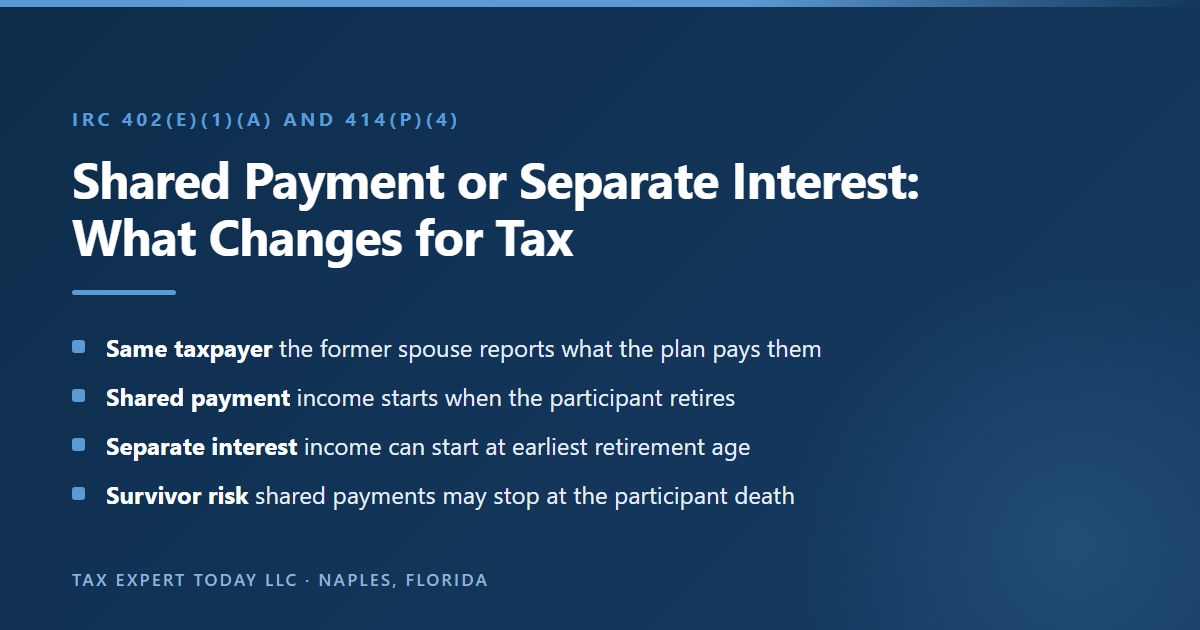
For federal income tax, both approaches tax the former spouse on what the plan pays them under a QDRO. The approach matters for timing, control, and survivor risk: a shared payment order splits each check only once the participant retires, while a separate interest order creates an independent benefit the former spouse may start on their own schedule.
- Shared payment: the former spouse receives part of each payment the participant receives, starting when the participant starts.
- Separate interest: the former spouse receives a separate benefit, often payable over their own lifetime.
- Earliest retirement age: section 414(p)(4) lets an order start payments to the former spouse at the participant’s earliest retirement age, even before the participant retires.
- Same tax character: under either approach, the payments are pension income to the person who receives them.
Pension orders are drafted in one of two styles. The shared payment approach treats the former spouse as a co-recipient of the participant’s benefit. Nothing is paid until the participant begins receiving benefits, and the payments usually stop when the participant dies unless the order also provides survivor coverage. The separate interest approach carves out a distinct portion of the benefit and converts it into a benefit for the former spouse, often actuarially adjusted to the former spouse’s own life expectancy. Which approach a plan allows, and which one fits the settlement, is a question for your family law attorney and the plan’s QDRO procedures.
From the tax side, the useful pension divorce comparison is about when income arrives and how predictable it is. The table below summarizes the practical tax differences.
| Feature | Shared payment approach | Separate interest approach |
|---|---|---|
| Who reports the former spouse’s payments | The former spouse, under IRC 402(e)(1)(A) | The former spouse, under IRC 402(e)(1)(A) |
| When taxable income starts | When the participant begins receiving benefits | When the former spouse elects to start, as early as the earliest retirement age under IRC 414(p)(4) |
| Whose life sets the payment period | Usually the participant’s | Usually the former spouse’s |
| Basis recovery period | Tied to the annuity the participant receives | Tied to the former spouse’s own annuity |
| Lump sum option | Rare; depends on the plan | Possible if the plan offers it in any form available to the participant |
| Risk of payments ending at the participant’s death | High unless the order provides survivor coverage | Lower, because the benefit is measured on the former spouse’s life |
The earliest retirement age rule deserves a closer look. Section 414(p)(4)(A) says an order does not fail merely because it requires payment to an alternate payee, in the case of a payment before the participant has separated from service, on or after the date the participant reaches the earliest retirement age, as if the participant had retired on that date. Practically, a former spouse under a separate interest order may be able to begin receiving income years before the participant actually retires. That choice puts taxable income on the former spouse’s return earlier, which can be helpful or unhelpful depending on their other income in that year. It is worth modeling before the start date is elected.
What If the Pension Is Split Without a Qualified Domestic Relations Order?
Without a qualified order, the plan pays the full benefit to the participant, and the participant generally reports all of it under section 402(a). Forwarding part of each check to a former spouse under the settlement does not move the income. For instruments executed after 2018, those forwarded amounts are not deductible as alimony either.
- Income stays with the participant: the plan’s Form 1099-R shows the full payment in the participant’s name.
- Forwarded payments are not deductible: they are a division of property or, for post-2018 instruments, nondeductible support.
- The former spouse generally reports nothing: cash received as a property division under section 1041 is not income to them.
- The result can be lopsided: one person pays tax on money the other person spends.
Some pension divorce settlements skip the QDRO, often to save drafting fees or because the plan is small, and instead require the participant to pay the former spouse a share of each pension check. The settlement may be perfectly enforceable as a family law matter. For tax, though, the plan has no instruction to pay anyone but the participant, so section 402(a) taxes the participant as the distributee. Section 402(e)(1)(A) shifts the tax only for payments made to the alternate payee under a qualified domestic relations order, and a private arrangement between the spouses is not that.
On the other side, the former spouse who receives forwarded cash is generally receiving their share of a property division. Under IRC section 1041, a transfer of property between spouses, or to a former spouse incident to the divorce, is not a taxable event, so the forwarded cash is generally not income to the recipient. If the payments are instead structured as support under an instrument executed before 2019, the old alimony rules may apply, and those are explained in our guide to alimony taxes after divorce. For instruments executed after 2018, alimony is neither deductible nor taxable, so the participant still carries the full tax.
The difference between the two paths can be large over a retirement. In a hypothetical case where the participant is in a 24 percent federal bracket and forwards $1,600 a month, the participant pays federal income tax on $19,200 a year of income that the former spouse spends, and the former spouse, who may be in a 12 percent bracket, reports none of it. A qualified order would have placed that income on the former spouse’s return at their own rate. Whether the extra tax is acceptable is a negotiation point for your family law attorney, but the size of it should be known before the agreement is signed.
Who Is Taxed When a Pension Order Pays a Child or Pays Child Support?
The participant is taxed. Publication 575 states that a distribution paid to a child or other dependent under a QDRO is taxed to the plan participant. The shift in section 402(e)(1)(A) applies only to an alternate payee who is a spouse or former spouse, so payments routed to a child stay on the participant’s return.
- Spouse or former spouse payee: taxed on the payments they receive.
- Child or other dependent payee: the participant is taxed on those payments.
- Rollover: only a spouse or former spouse alternate payee is treated as the employee for rollover purposes under section 402(e)(1)(B).
- Early withdrawal tax: the section 72(t)(2)(C) exception still applies to any distribution to an alternate payee under a QDRO.
A domestic relations order may relate to child support as well as marital property. Section 414(p)(1)(B) defines a domestic relations order as one that relates to child support, alimony payments, or marital property rights to a spouse, former spouse, child, or other dependent of a participant. So a QDRO can name a child as the alternate payee. The tax shift in section 402(e)(1)(A), however, is limited to a spouse or former spouse. IRS Publication 504 makes the same point under its headings for benefits paid to a child or other dependent and benefits paid to a spouse or former spouse.
The practical consequence is that a pension order designed to fund child support produces taxable income to the participant, while the child or the custodial parent receives the cash. Child support itself is neither deductible by the payer nor taxable to the recipient, so there is no offsetting deduction. When a settlement mixes a property division to the former spouse with support for a child in the same order, the two portions can be taxed to different people, and the order should make the split clear so the plan can report each portion correctly. Your family law attorney drafts that language; our role is to show each side what lands on whose return.
Withholding also differs. A payment taxed to the participant but paid to someone else is still subject to the plan’s withholding rules, and the participant may need to adjust their own withholding or estimated tax to cover income they never receive in cash. That is easy to miss in the first year.
How Is the Participant’s After-Tax Contribution Basis Split Under Section 72(m)(10)?
If the participant made after-tax contributions to the pension, that basis is shared. Section 72(m)(10) allocates the participant’s investment in the contract pro rata between the present value of the former spouse’s QDRO benefit and the present value of all other benefits payable under the order, so each person recovers part of the basis tax free.
- Numerator: the present value of the benefits payable to the spouse or former spouse.
- Denominator: the present value of all benefits payable with respect to the participant to which the order relates.
- Result: the former spouse’s share of the basis, which they recover tax free over their own payments.
- Remainder: the participant keeps the rest of the basis for their own payments.
In a pension divorce, the first basis question is whether any exists. Many private pensions are funded entirely by the employer, so there is no basis to split and every payment is fully taxable. Public plans and some older private plans are different. Members of many state and local systems make mandatory employee contributions, and depending on the plan, some of those contributions may have been made with after-tax dollars. Those after-tax dollars are the participant’s investment in the contract, and they come back tax free over the life of the annuity.
Section 72(m)(10) provides that, in the case of a distribution or payment made to an alternate payee who is the spouse or former spouse of the participant under a QDRO, the investment in the contract is allocated on a pro rata basis between the present value of that distribution or payment and the present value of all other benefits payable with respect to the participant to which the order relates. Publication 575 describes the same fraction: the numerator is the present value of the benefits payable to the spouse or former spouse, and the denominator is the present value of all benefits payable to the participant.
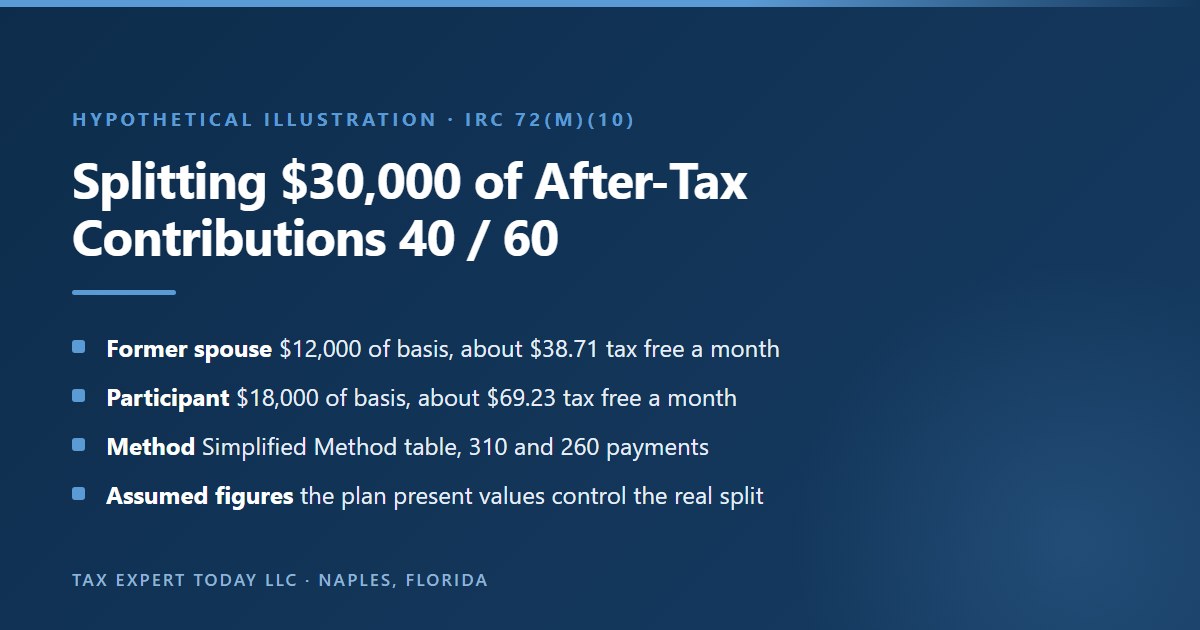
Here is a hypothetical illustration with assumed figures. The participant has $30,000 of after-tax contributions. The QDRO awards the former spouse 40 percent of the benefit, and the plan’s actuary values the former spouse’s benefit at 40 percent of the total present value.
| Hypothetical item (assumed figures) | Former spouse | Participant |
|---|---|---|
| Share of total present value of benefits under the order | 40% | 60% |
| Share of $30,000 investment in the contract under IRC 72(m)(10) | $12,000 | $18,000 |
| Age at annuity starting date | 60 | 62 |
| Expected payments from the Pub. 575 single life table (start after November 18, 1996) | 310 | 260 |
| Tax-free part of each monthly payment | About $38.71 | About $69.23 |
The present value figures come from the plan, not from either spouse, and the plan’s assumptions control. If the plan reports a taxable amount on Form 1099-R that does not reflect the allocation, the recipient can still compute the taxable part using the Simplified Method worksheet in Publication 575 and keep the calculation with their records. The key point for a settlement is that basis is an asset. A pension with substantial after-tax contributions is worth more after tax than an otherwise identical pension funded only by the employer, and the order determines who gets that value.
How Does the Simplified Method Work for Each Former Spouse?
Each person who receives annuity payments from a qualified plan generally uses the Simplified Method. They divide their share of the investment in the contract by the number of expected monthly payments from the IRS table for their age at the annuity starting date, and exclude that amount from each payment until their share of basis is recovered.
- Required for most qualified plan annuities: Publication 575 requires the Simplified Method for annuities from qualified plans that started after November 18, 1996.
- Table by age: 360 payments at 55 or under, 310 at 56 to 60, 260 at 61 to 65, 210 at 66 to 70, and 160 at 71 or older for a single life annuity.
- Separate clocks: the former spouse and the participant each use their own age and their own annuity starting date.
- Full recovery: once a person’s share of basis is fully recovered, the rest of their payments are fully taxable.
The Simplified Method is a worksheet in Publication 575. A recipient enters their cost in the plan, finds the number of expected payments from the table, and divides. The result is the tax-free part of each monthly payment. For a joint and survivor annuity, a second table uses the combined ages of the annuitants. The more complex General Rule, explained in IRS Publication 939, applies in narrower situations, such as some nonqualified annuities.
When a shared payment order splits each check between two people who receive payments at the same time, Publication 575 includes a multiple annuitants instruction: each annuitant excludes a pro rata share of the monthly tax-free amount, based on their monthly payment divided by the total monthly payments to all annuitants. In a pension divorce, the starting cost for each person should reflect the section 72(m)(10) allocation described above. Where the plan’s figures, the order, and the worksheet do not line up, the recipient should document how they computed the tax-free amount, because the plan’s Form 1099-R may show the taxable amount as not determined.
Two edge rules matter for older recipients. If a recipient dies before recovering their full share of basis, Publication 575 allows the unrecovered amount as a deduction on the final return. And if the annuity starting date was before November 19, 1996, older rules and a different table apply. Both are rare in new divorces, but they come up when a long-retired participant divorces.
Can the Former Spouse Take a Lump Sum, and How Is It Withheld?
A former spouse can take a lump sum only if the plan offers one in a form available to the participant. If a lump sum is an eligible rollover distribution, the plan generally must withhold 20 percent unless it is rolled directly to an IRA or plan. Monthly annuity payments are instead withheld like wages unless the recipient elects otherwise.
- Monthly annuity: treated like wages for withholding; the recipient files Form W-4P with the plan.
- Eligible rollover distribution: 20 percent mandatory withholding unless paid in a direct rollover.
- Other nonperiodic payments: 10 percent withholding unless the recipient elects out on Form W-4R.
- Rollover rights: a spouse or former spouse alternate payee can roll over as if they were the employee, under section 402(e)(1)(B).
Many defined benefit plans pay only annuities, so a lump sum is not available in every pension divorce. Others, especially cash balance plans, offer a lump sum. Under section 414(p)(4)(A)(iii), a QDRO can require payment to the alternate payee in any form in which benefits may be paid to the participant, other than a joint and survivor annuity with the alternate payee and a later spouse. So if the plan offers a lump sum, the former spouse may be able to take one.
Withholding depends on the type of payment. The rules are in IRC section 3405 and are summarized in Publication 575.
| Type of pension divorce payment | Federal withholding rule | Form the recipient uses |
|---|---|---|
| Monthly annuity payments to the former spouse | Treated like wages; withheld as if single with no adjustments if no certificate is filed | Form W-4P |
| Lump sum that is an eligible rollover distribution, paid to the former spouse | 20 percent mandatory, cannot be waived | Avoided only by a direct rollover |
| Lump sum paid in a direct rollover to an IRA or plan | No withholding | Plan’s rollover election |
| Nonperiodic payment that is not an eligible rollover distribution | 10 percent unless the recipient elects otherwise | Form W-4R |
| Payment to a child under a QDRO | Follows the payment type; the income is the participant’s | Participant adjusts own withholding or estimates |
The 20 percent rule surprises people who want cash. If a former spouse elects a $100,000 hypothetical lump sum paid to them directly, the plan generally withholds $20,000 and pays $80,000. If they later want to roll over the full $100,000 within 60 days, they need to replace the withheld $20,000 from other funds, or the unreplaced amount is taxable. A direct rollover avoids the problem entirely. The detailed rollover mechanics are in our QDRO taxes guide.
Does the 10 Percent Early Withdrawal Tax Apply to Pension Divorce Payments?
Generally no, for payments made directly from the plan to an alternate payee under a QDRO. Section 72(t)(2)(C) excludes any distribution to an alternate payee under a qualified domestic relations order from the 10 percent additional tax, regardless of the recipient’s age. The exception is lost if the money is first rolled into an IRA and then withdrawn early.
- Direct from the plan: the exception applies to the QDRO distribution itself.
- After a rollover to an IRA: later IRA withdrawals before 59 and a half generally face the 10 percent tax unless another exception applies.
- Income tax still applies: the exception removes only the additional tax, not ordinary income tax.
- Annuity payments: monthly pension payments to a younger former spouse also fall under the QDRO exception.
For a former spouse who is under 59 and a half and needs part of the money now, this exception can be one of the more valuable pension divorce rules. A former spouse who takes a lump sum can split it: take the cash they need directly from the plan, where section 72(t)(2)(C) applies, and roll the rest to an IRA. Once money sits in an IRA, the QDRO exception no longer applies to later withdrawals. The IRS lists the exceptions on its page on exceptions to tax on early distributions, and any additional tax owed is reported on Form 5329. Our QDRO guide walks through the sequencing in more detail.
The exception follows the order, not the plan type alone. A distribution to an alternate payee from a governmental plan under a domestic relations order that meets section 414(p)(11) is treated as made under a QDRO for purposes of the Internal Revenue Code, which generally brings it within the exception as well. If the order does not qualify, the payment is the participant’s, and the participant’s own age and exceptions control.
How Are Survivor Benefits for a Former Spouse Taxed?
Survivor pension payments to a former spouse are generally taxable pension income to the former spouse when received, like any other annuity payment. Under section 414(p)(5), a QDRO can treat the former spouse as the surviving spouse for the plan’s survivor annuity rules, and the cost of that coverage usually shows up as a smaller monthly benefit for the participant.
- Former spouse as surviving spouse: allowed to the extent a QDRO provides, under section 414(p)(5)(A).
- One year of marriage: a former spouse married at least one year is treated as meeting the section 417(d) marriage requirement.
- Cost of coverage: usually a reduction in the joint benefit, which lowers the participant’s taxable income.
- Taxed when paid: survivor payments are pension income to the former spouse in the year received.
Defined benefit plans subject to the qualified joint and survivor annuity rules must generally offer survivor protection to a spouse. A divorce ends that status unless an order preserves it. Section 414(p)(5) allows a QDRO, to the extent it provides, to treat the former spouse as the surviving spouse for purposes of sections 401(a)(11) and 417, and if they were married at least one year, as meeting the marriage requirement of section 417(d). A later spouse is then not treated as a spouse for those purposes, to the extent of the order.
For tax, a pension divorce survivor annuity is simply an annuity to the person who receives it. The former spouse reports the taxable part of each survivor payment, recovering any remaining share of the participant’s basis under the Simplified Method or the joint and survivor table. While the participant is alive, the reduction in the monthly benefit that pays for survivor coverage is not a deduction; it simply means the participant receives, and reports, less. Whether survivor coverage is worth its cost is a decision for the spouses and their family law attorney, often alongside a review of life insurance in the divorce, which can secure the same risk with a different tax profile.
Are Public Pensions Like the Florida Retirement System Treated Differently?
For federal income tax, mostly not. Section 414(p)(11) treats a payment from a governmental plan or a governmental 457(b) plan as made under a QDRO when paid under a domestic relations order that creates or recognizes an alternate payee’s right to benefits. So a former spouse paid by a public plan under such an order is generally the taxpayer.
- Governmental plans: not subject to ERISA’s QDRO rules, but the tax rule in section 414(p)(11) still applies.
- Florida Retirement System: Fla. Stat. 121.091 authorizes payments to an alternate payee for the division of marital assets under a qualified domestic relations order.
- Refund restriction: under Fla. Stat. 121.091, a member may not take a refund of employee contributions while a pending or approved QDRO is filed against the account.
- Basis is common: public plan members often have employee contributions, so the section 72(m)(10) split matters more.
State and local pension systems are governmental plans under section 414(d). ERISA’s QDRO procedures do not govern them, and each system has its own rules for what kind of order it will honor and how it divides benefits. For federal tax, though, Congress added section 414(p)(11): for purposes of the Internal Revenue Code, a distribution or payment from a governmental plan, a church plan, or an eligible deferred compensation plan under section 457(b) is treated as made under a qualified domestic relations order if it is made under a domestic relations order that meets clause (i) of section 414(p)(1)(A). That clause is the part of the definition that creates or recognizes an alternate payee’s right to receive benefits.
Florida’s own retirement system uses QDRO language directly. Florida Statutes section 121.091 provides that a member may not receive a refund of employee contributions if a pending or an approved qualified domestic relations order is filed against the member’s retirement account, and it allows a retired member to nullify a former spouse joint annuitant designation unless an existing qualified domestic relations order prevents it. The same section lists, among the deductions the system may make from a benefit, payments to an alternate payee for the division of marital assets under a qualified domestic relations order issued under s. 222.21. Those are plan administration rules; the tax treatment of the resulting payments follows the federal sections described above. A Florida public employee’s pension is also a marital asset to the extent it accrued during the marriage under Fla. Stat. 61.076(1), which your family law attorney applies to your facts.
Federal civilian and military pensions are divided under their own federal statutes rather than through a state plan’s QDRO procedure. We cover the federal civilian annuity in our guide to FERS divorce taxes and the federal defined contribution plan in our guide to TSP divorce taxes.
Can Alimony Be Paid Through a Pension Order, and How Is It Taxed?
Yes. A domestic relations order can relate to alimony, and when the plan pays a spouse or former spouse under a QDRO, section 402(e)(1)(A) taxes the payments to that person as pension income. This is a retirement plan rule, separate from the alimony rules, so it can place income on the recipient’s return even under a post-2018 divorce instrument.
- Allowed purpose: section 414(p)(1)(B) lists alimony payments among the purposes of a domestic relations order.
- Taxed as pension income: the recipient reports QDRO payments as if they were the participant.
- No alimony deduction needed: the participant never reports the payments, so there is nothing to deduct.
- Different from cash alimony: post-2018 cash alimony is neither deductible nor taxable, but a QDRO payment is taxed to the recipient.
Since the 2017 tax law change, alimony paid under a divorce or separation instrument executed after 2018 is not deductible by the payer and not taxable to the recipient, as IRS Topic 452 explains. A pension paid under a QDRO does not run through those rules at all. If an order directs the plan to pay a former spouse a monthly amount as support, the plan pays it from the participant’s benefit, and section 402(e)(1)(A) makes the former spouse the distributee. The practical effect resembles the old alimony regime: income moves from the participant to the recipient.
That makes the label in a pension divorce settlement less important than the mechanism. A support obligation paid in cash from the participant’s checking account is generally tax neutral after 2018. The same dollars paid by the plan under a qualified order are taxed to the recipient. Neither result is better in the abstract; it depends on the two brackets and on what the recipient expected. Because this is a meaningful difference, the spouses and their family law attorney should know which mechanism the agreement uses before it is signed, and the recipient should plan for withholding or estimated tax on payments that arrive without the tax already taken out.
Which State Can Tax Pension Divorce Payments When a Former Spouse Moves?
Only the state where the recipient lives. Federal law, 4 U.S.C. section 114, bars any state from taxing the retirement income of a nonresident, and it covers qualified plans, governmental plans, and 457 plans. A former spouse living in Florida owes no state income tax on pension payments, even if the pension was earned in a state that taxes income.
- Florida resident recipient: no state income tax, because Florida has no personal income tax.
- Former spouse who moves away: the new home state may tax the payments under its own rules and exclusions.
- Pension earned elsewhere: the former work state cannot tax a nonresident’s pension under 4 U.S.C. 114.
- State withholding: the recipient should update the plan’s state withholding election after a move.
Divorce often comes with a move. One spouse stays in the Naples home, and the other relocates to be near family. 4 U.S.C. section 114(a) provides that no state may impose an income tax on any retirement income of an individual who is not a resident or domiciliary of that state. Retirement income is defined to include income from a qualified trust under section 401(a), an annuity plan under section 403(a), a 403(b) annuity, an eligible 457 plan, and a governmental plan under section 414(d), among others.
So in a pension divorce, the residence of each recipient controls state tax on their share. A participant who earned a pension in a high tax state and retired to Florida generally pays no state income tax on it. A former spouse who receives part of that same pension and moves to a state with an income tax generally pays that state’s tax, subject to whatever retirement income exclusion the state offers. For readers weighing a move, our guide to retiring to Florida taxes covers the state side in more depth.
How Should a Pension Be Valued Against the House or Cash in a Settlement?
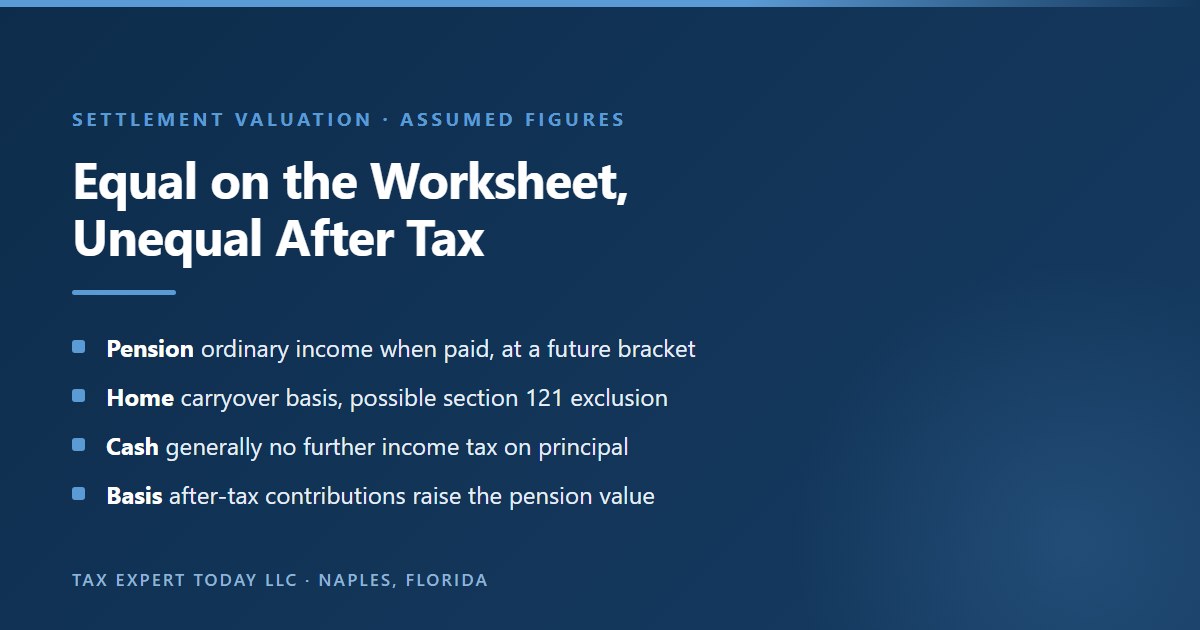
A pension should be compared with other assets on an after-tax basis. Pension payments are taxed as ordinary income when received, while cash generally carries no further income tax and a home may qualify for the section 121 exclusion. A pension and a house with the same present value on a worksheet can be worth quite different amounts after tax.
- Pension: every taxable dollar is ordinary income when paid, at the recipient’s future bracket.
- Cash or bank accounts: generally no further income tax on the principal.
- Home: carryover basis under section 1041, with possible gain exclusion under section 121 on a later sale.
- After-tax contributions: raise a pension’s after-tax value, because that part is recovered tax free.
The offset method, where one spouse keeps the whole pension and the other takes assets of equal value, is common because it avoids a QDRO and makes a clean break. Your family law attorney and, often, a pension actuary will determine the present value of the marital portion. From the tax side, the question is what that present value is worth in spendable dollars to each person. Here is a hypothetical illustration with assumed figures and a flat assumed effective federal rate, ignoring timing and investment growth.
| Hypothetical asset (assumed figures) | Present value on the worksheet | Assumed future income tax | Illustrative after-tax value |
|---|---|---|---|
| Pension, employer funded only, 22% assumed effective rate | $300,000 | $66,000 | $234,000 |
| Same pension with $30,000 of after-tax contributions | $300,000 | $59,400 | $240,600 |
| Home equity with gain inside the section 121 exclusion | $300,000 | $0 if fully excluded | $300,000 |
| Cash in a savings account | $300,000 | $0 on principal | $300,000 |
Real pension divorce numbers will differ, sometimes a lot. The effective rate depends on each person’s future income, filing status, Social Security, and state of residence. A home can carry gain above the exclusion, and the section 121 rules after a divorce have their own wrinkles, covered in our guide to divorce house buyout taxes. The point is narrower: present value before tax and value after tax are different measures, and a fair trade on one can be uneven on the other. Our broader map of what parts of a divorce settlement are taxable places the pension alongside every other asset class.
Timing also matters. A pension that will not pay for 15 years carries tax that is deferred for 15 years, while a house sold next year produces any taxable gain now. Your family law attorney decides how to use these figures in the negotiation; a tax review simply makes sure everyone is comparing like with like.
What Does Form 1099-R Show, and How Are Pension Divorce Payments Reported?
The plan generally issues Form 1099-R to each recipient in their own name and taxpayer identification number, showing the gross amount paid to them and, when it can be determined, the taxable amount. Each person reports the payments on the pensions and annuities lines of Form 1040, using their share of basis if the taxable amount is not shown.
- Separate forms: the former spouse receives a Form 1099-R for QDRO payments; the participant receives one for their share.
- Gross and taxable amounts: if the taxable amount box is blank or marked not determined, the recipient computes it.
- Withholding shown: federal and state tax withheld appear on the same form and are claimed on the return.
- Mismatch: a form that shows the full benefit in the participant’s name after an accepted order should be raised with the plan.
The IRS explains the form and its instructions on its About Form 1099-R page, and IRS Topic 410, Pensions and Annuities covers how periodic payments are reported. In the first year after a QDRO is accepted, it is common for one form to cover only part of the year, for example when the split begins mid-year. Each person should reconcile the form to the payments they actually received.
The year of the divorce adds a layer. Filing status is determined on December 31, so a couple whose divorce is final on December 15 files as unmarried for that year, while a couple still married on December 31 may file jointly or separately. Pension income received by each spouse lands on whichever return they file. Our guide to divorce filing status covers the December 31 rule and the head of household option.
Does Estimated Tax Become an Issue for the Former Spouse?
Often, yes. A former spouse who starts receiving pension payments under a QDRO may not have enough tax withheld, especially if they opted out of withholding or the plan withheld at a default rate that does not fit their total income. Section 6654 can impose an underpayment penalty when withholding and estimated payments fall short.
- Check withholding first: a new Form W-4P to the plan is usually simpler than quarterly payments.
- Safe harbors: paying enough through withholding and estimates to meet the section 6654 safe harbors generally avoids the penalty.
- First year after divorce: income that used to sit on a joint return now sits on a single return with a lower standard deduction.
- Participant too: a participant taxed on payments to a child or on forwarded amounts may need to increase their own withholding.
The estimated tax rules are in IRC section 6654, and quarterly payments are made using Form 1040-ES. Withholding is generally treated as paid evenly through the year, which is why increasing withholding late in the year can still cover a shortfall that quarterly estimates would have missed. Our quarterly estimated tax calculator is a starting point for sizing payments. If a penalty does arise in an unusually disruptive year, our page on reasonable cause penalty abatement explains when relief may be available, although estimated tax penalties have their own narrower waiver rules.
How Does a Private Pension Compare With FERS, the TSP, and Military Retired Pay for Tax?
The common thread is that a spouse or former spouse paid directly under a qualifying order is generally the taxpayer on what they receive. The differences are in the type of order, who pays, and how basis and withholding are handled. A private pension uses an ERISA QDRO; federal plans use their own federal court order processes.
- Private pension: ERISA QDRO, plan pays the alternate payee, section 402(e)(1)(A) shifts the tax.
- State or local pension: the plan’s own domestic relations order, with tax treatment through section 414(p)(11).
- FERS annuity: a court order processed by the Office of Personnel Management; covered in our FERS guide.
- TSP: a retirement benefits court order; covered in our TSP guide.
- Military retired pay: divided under a separate federal statute and outside the scope of this guide.
| Plan type | Order used | Where to read more |
|---|---|---|
| Private employer defined benefit pension | QDRO under IRC 414(p) and ERISA | This guide |
| Florida Retirement System and other state or local plans | Plan’s domestic relations order; tax through IRC 414(p)(11) | This guide |
| Federal civilian annuity (FERS) | Court order acceptable for processing by OPM | FERS divorce taxes |
| Thrift Savings Plan | Retirement benefits court order | TSP divorce taxes |
| 401(k) and other defined contribution plans | QDRO under IRC 414(p) | QDRO taxes |
| IRAs, including Roth IRAs | Transfer incident to divorce, not a QDRO | Roth IRA divorce |
Many divorces include more than one of these, so a pension divorce is rarely the only retirement question. A household with a state pension, a spouse’s 401(k), and a Roth IRA may need three different instruments, each with its own tax result. Social Security is not divided at all; a divorced spouse may qualify for benefits on the former spouse’s record, and the tax side of that is covered in our guide to divorce and Social Security benefits.
What Are the Most Common Pension Divorce Tax Mistakes?
The most frequent mistakes are relying on a side agreement instead of a qualified order, comparing a pension with cash or a house on a pre-tax basis, ignoring after-tax contribution basis, rolling a lump sum to an IRA before taking needed cash, and failing to adjust withholding once QDRO payments begin.
- No qualified order: the participant stays taxed on payments the former spouse spends.
- Pre-tax comparisons: a pension and an equal amount of cash are not equal after tax.
- Lost basis: after-tax contributions that are never allocated can be taxed twice in practice.
- Rollover sequencing: an early IRA withdrawal after a rollover loses the QDRO penalty exception.
- Withholding left on default: a new single filer may owe at filing time or face a penalty.
A few less obvious issues are worth adding. A shared payment order without survivor coverage can end the former spouse’s income at the participant’s death, which changes the value of what was bargained for. An order awarding payments to a child keeps the income on the participant’s return. A former spouse who moves states should update state withholding. And when joint returns were filed during the marriage, unpaid tax on pension income from those years can remain a joint liability after the divorce; relief in that situation is a separate subject, covered in our guide to innocent spouse relief.
Each of these pension divorce issues is easier to address before the order is signed and the plan begins paying than after. Because the order is drafted by your family law attorney and approved by the plan, the tax review works best as an input to that drafting rather than an afterthought.
Pension Divorce Help in Naples & Southwest Florida
Tax Expert Today LLC is based in Naples, Florida, and works with divorcing and recently divorced clients across Collier and Lee counties and in all 50 states. Southwest Florida divorces often involve pensions earned elsewhere: a teacher’s or police pension from a northern state, a Florida Retirement System benefit, or a private plan from a long corporate career, alongside 401(k) divisions and the marital home. The questions we see are federal and practical: who will be taxed on each payment, how basis is split, what will be withheld, and what each option is worth after tax.
- Divorce tax Naples FL: after-tax comparison of a pension against the house, cash, and other accounts before the division is fixed.
- Pension divorce help Naples: review of draft order terms for who becomes the taxpayer, basis allocation, and start dates.
- Withholding and estimates: setting Form W-4P and estimated payments for the first year of QDRO income.
- Relocation questions: the state tax effect when one former spouse leaves Florida.
- Coordination with your attorney: giving the family law attorney the tax result of each option, without advising on the negotiation itself.
You can read more on our divorce tax consulting page and about the broader practice at Naples FL tax planning.
Tax Expert Today LLC
11983 Tamiami Trail N, Naples, FL 34110
Phone: (239) 441-2005
Hours: Monday through Friday, 10:00am to 5:00pm ET
Does Florida tax pension payments a Naples resident receives under a divorce order? No. Florida has no personal income tax, so a Naples resident who receives pension payments under a qualified domestic relations order owes only federal income tax on the taxable part. Under 4 U.S.C. 114, the state where the pension was earned cannot tax a Florida resident’s retirement income either.
When to Engage a Professional
A pension divorce in which the pension is small, fully employer funded, and simply divided by percentage under a standard plan form may need little tax work beyond setting withholding. Professional involvement tends to earn its cost when one or more of the following is present.
- An offset settlement: one spouse keeps the pension in exchange for the house or cash, and the after-tax values should be compared.
- After-tax contributions: common in public plans, where the section 72(m)(10) allocation affects both returns for decades.
- A lump sum option: the choice between cash, rollover, or a split affects withholding and the early withdrawal exception.
- Support paid through the plan: a QDRO used for alimony changes who is taxed compared with cash support.
- A move out of Florida: one former spouse will face state tax on their share.
We work as the tax side of the divorce team, alongside your family law attorney, who remains responsible for the settlement terms and the language of any order. To discuss your situation, call (239) 441-2005 or visit our divorce tax consulting page. Every outcome depends on the facts, including the plan’s terms, the type of order, any after-tax contributions, each person’s age and other income, their state of residence, and filing status.
Frequently Asked Questions About Pension Divorce
Who pays tax on a pension split in a divorce? When the plan pays a spouse or former spouse under a qualified domestic relations order, that person reports the payments as pension income under IRC section 402(e)(1)(A). The participant reports only the benefit left after the split. Without a qualified order, the participant generally remains taxed on the full pension.
Is a pension payment to my former spouse deductible as alimony? Generally there is nothing to deduct. If the plan pays the former spouse under a QDRO, the payment is never the participant’s income. If the participant forwards part of each check without a qualified order, the participant reports the full pension, and for instruments executed after 2018 the forwarded amounts are not deductible.
Does the 10 percent early withdrawal penalty apply to a pension divorce payment? Not to a distribution made to an alternate payee under a QDRO. IRC section 72(t)(2)(C) excludes those payments regardless of age. If the money is rolled to an IRA first, later early withdrawals from the IRA generally do not qualify for that exception.
How is the participant’s after-tax basis split with a former spouse? Under IRC section 72(m)(10), the investment in the contract is allocated pro rata between the present value of the former spouse’s QDRO benefit and the present value of all benefits under the order. Each person then recovers their share tax free, usually under the Simplified Method.
Are Florida Retirement System pension payments to a former spouse taxed to the former spouse? Generally yes, for federal tax. IRC section 414(p)(11) treats a governmental plan payment under a qualifying domestic relations order as a QDRO payment, so the spouse payee is the distributee. Florida has no personal income tax, so a Florida resident owes no state income tax on it.
Does Florida tax pension payments a Naples resident receives under a divorce order? No. Florida has no personal income tax, so a Naples resident who receives pension payments under a qualified domestic relations order owes only federal income tax on the taxable part. Under 4 U.S.C. 114, the state where the pension was earned cannot tax a Florida resident’s retirement income either.
Published November 14, 2026 by Dr. Pellumb Kabashi « Back to Learning Center
Have a question this article touches on?
Tax Expert Today LLC, based in Naples, Florida and serving clients across the United States.
Schedule a Consultation (239) 441-2005