
By Dr. Pellumb Kabashi, DBA, MBA, CES, CFE, EA
Founder, Tax Expert Today LLC · Tax advisors, enrolled agents, CPAs, and attorneys · Serving clients in all 50 states
Quick Answer: In a life insurance divorce, a policy transferred to a spouse or former spouse incident to the divorce is generally tax free under IRC section 1041, and the carryover basis keeps the death benefit excludable under the section 101(a)(2)(A) exception to the transfer-for-value rule. Surrendering a policy for cash, or pledging a modified endowment contract, can create taxable income. Call (239) 441-2005 for a free consultation.
Life insurance turns up in almost every divorce settlement, and nearly everything written about it answers family law and insurance questions: whether the policy is marital property, how much coverage a court can require, and when to change the beneficiary. Those questions matter, and they belong to your family law attorney and your insurance professional. This life insurance divorce guide covers the questions that come up later, on a tax return or an estate tax return, when the settlement has already been signed. Is moving a whole life policy to a former spouse a taxable event? Does the transfer-for-value rule turn a tax-free death benefit into taxable income? Who reports the gain when a policy is cashed out so the proceeds can be split? Are the premiums deductible as alimony? Can a policy that secures support end up in the gross estate of the person who pays it? Each answer here comes from the Internal Revenue Code, Treasury regulations, IRS publications, and Florida statutes. We explain tax mechanics only. The division of the policy, the amount of coverage, and the beneficiary terms are decisions for you and your family law attorney, and we work alongside that attorney as the tax side of the divorce team.
How Does the Tax Code Treat Life Insurance in a Divorce?
The tax code treats life insurance in a divorce through four separate rule sets: section 1041 for transfers of the policy, section 101 for the death benefit, section 72 for cash value that is surrendered or borrowed, and section 2042 for estate tax. Which rule matters depends on what the settlement does with the policy.
- Transfer of ownership: generally no gain or loss under section 1041, with carryover basis.
- Death benefit: generally excluded from income under section 101(a)(1), unless the transfer-for-value rule applies.
- Cash surrender or loan: gain over the investment in the contract is ordinary income under section 72(e).
- Premiums paid under the decree: deductible as alimony only under instruments executed before 2019, and only when the recipient owns the policy.
- Estate tax: the death benefit is included in the insured’s estate if the insured holds any incident of ownership.
A life insurance divorce settlement usually does one of four things with a policy. It leaves the policy with the insured and requires that coverage stay in force to secure alimony or child support. It transfers ownership of a permanent policy to the other spouse as part of the property division. It surrenders the policy and splits the cash. Or it requires the insured to buy a new policy, sometimes with the former spouse or a trust as owner. Each path triggers a different combination of the rules above, and the tax result for each spouse can differ sharply even when the dollar value on the settlement worksheet looks identical.
| What the settlement does | Main federal tax rule | Typical tax result |
|---|---|---|
| Transfers a permanent policy to the other spouse | IRC 1041; IRC 101(a)(2)(A) | No gain or loss to either spouse; carryover basis; death benefit stays excludable |
| Surrenders the policy and splits the cash | IRC 72(e); Pub. 525 | Gain over the investment in the contract is ordinary income to the owner who surrenders |
| Keeps the policy with the insured to secure support | IRC 101(a)(1); IRC 2042 | Death benefit generally income tax free to the beneficiary; included in the insured’s gross estate |
| Requires premium payments on a policy the recipient owns | IRC 215 and former 71 (pre-2019); Topic 452 | Alimony only under an instrument executed before 2019; otherwise neither deductible nor income |
| Pledges a policy as collateral for support | IRC 72(e)(4)(A) and 72(e)(10) | No income for an ordinary policy; a pledge of a modified endowment contract is treated as a distribution |
Is Transferring a Life Insurance Policy in a Divorce Taxable?
Generally no. Under IRC section 1041(a), no gain or loss is recognized on a transfer of property to a spouse, or to a former spouse incident to the divorce. A life insurance contract is property, so a policy moved in the settlement is generally a non-event for income tax, and the recipient takes the transferor’s basis.
- Who qualifies: a spouse at any time, or a former spouse when the transfer is incident to the divorce.
- Incident to the divorce: within one year after the marriage ends, or related to the end of the marriage.
- Basis: the transferee takes the transferor’s adjusted basis under section 1041(b)(2).
- Gift treatment: section 1041(b)(1) treats the transfer as a gift for income tax purposes.
- Exception: section 1041(d) excludes a transfer to a nonresident alien spouse.
The temporary regulations under section 1041 fill in the timing. A transfer is incident to the divorce if it occurs within one year after the date the marriage ceases, or if it is related to the cessation of the marriage. Q&A-7 treats a transfer as related to the cessation of the marriage when it is made under a divorce or separation instrument and occurs within six years after the marriage ends. A transfer outside those windows is presumed unrelated, and the presumption can be rebutted only by showing that the transfer was delayed by factors that hampered an earlier transfer, such as a legal or business impediment, and that it was made promptly once the impediment ended. We walk through those presumptions in more detail in our guide to whether a divorce settlement is taxable.
For a policy, the practical effect is simple. When a husband who owns a whole life policy with $80,000 of cash value and $50,000 of premiums paid assigns that policy to his former wife under the settlement agreement, he reports no gain on the $30,000 of buildup inside the contract. She takes over his position, including his investment in the contract. If she later surrenders the policy, she reports the gain measured from his basis, not from the value on the day she received it. That is a real cost that rarely appears on the settlement worksheet, and it is the first tax point to flag for your family law attorney when a policy is valued at its cash surrender value.
What if the policy carries a loan?
Q&A-12 of the regulations confirms that section 1041 still applies when the transferred property is subject to liabilities that exceed its adjusted basis. The transferor recognizes no gain, and the transferee takes the transferor’s basis. A policy with an outstanding policy loan is the most common example in a divorce. The loan stays with the contract. The recipient spouse now owns a policy whose net cash value is lower, and whose loan will reduce the death benefit and can create taxable income later if the policy lapses with the loan outstanding. The one exception in section 1041(e) is narrow: it applies to a transfer in trust when the liabilities assumed exceed basis, and it requires gain recognition in that case. A direct assignment to a former spouse is not a transfer in trust.
The records duty most settlements skip
Q&A-14 requires the transferor to supply the transferee, at the time of the transfer, with records sufficient to determine the adjusted basis and holding period of the property. For a policy, that means the premium history, any dividends received in cash, any prior withdrawals, and the loan history: the pieces that make up the investment in the contract. The insurance company can usually produce a cost basis statement on request. Without it, the new owner cannot compute the taxable portion of a later surrender, and the burden of proving basis falls on the person who never paid the premiums.
Does the Transfer-for-Value Rule Apply When a Policy Goes to a Former Spouse?
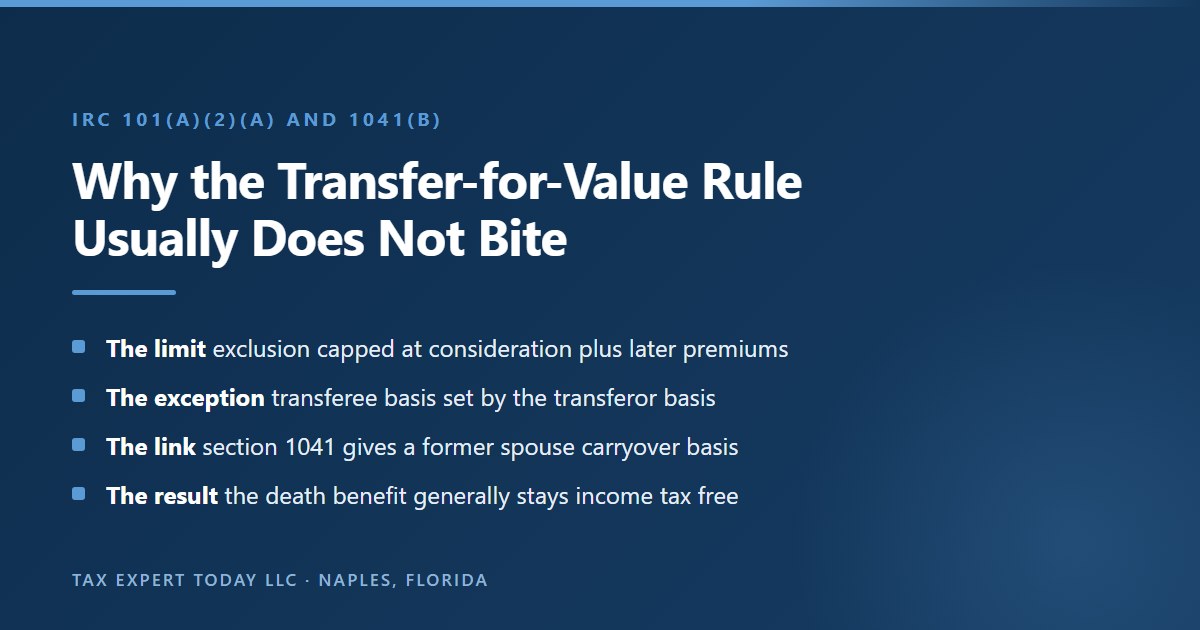
Generally no, and this is the point most divorce articles never address. Section 101(a)(2) can make most of a death benefit taxable when a policy is transferred for value. But section 101(a)(2)(A) exempts a transfer in which the transferee’s basis is determined by reference to the transferor’s basis, which is exactly what section 1041 provides.
- The general limit: after a transfer for value, the exclusion is capped at the consideration paid plus later premiums.
- The carryover basis exception: section 101(a)(2)(A) restores the full exclusion when basis carries over.
- The link to section 1041: a transfer incident to divorce gives the recipient carryover basis under 1041(b)(2).
- The regulation: Treas. Reg. 1.101-1(b)(1)(ii)(A) applies the exception and limits the exclusion to what the transferor could have excluded.
The rule exists to stop investors from buying policies on strangers and collecting tax-free death benefits. Section 101(a)(2) provides that, in the case of a transfer for a valuable consideration of a life insurance contract or any interest in it, the amount excluded from gross income may not exceed the actual value of the consideration plus the premiums and other amounts the transferee pays afterward. Everything above that amount is taxable as ordinary income when the insured dies.
A divorce settlement is arguably a transfer for value. Each spouse gives up rights in exchange for assets, and a policy assigned to one spouse is part of that exchange. That is why the exception matters. The statute says the limit does not apply if the contract has a basis in the hands of the transferee determined in whole or in part by reference to its basis in the hands of the transferor. Section 1041(b)(2) supplies exactly that basis. The final regulations under section 101 set out the carryover basis exception in three parts: the transfer is not a reportable policy sale, the basis is determined in whole or in part by reference to the transferor’s basis, and a separate rule for certain transfers after a reportable policy sale does not apply. When the exception applies, the excludable amount is limited to what the transferor could have excluded had the transfer not occurred.
For a typical life insurance divorce, that chain means the former spouse who receives a policy on the other spouse’s life through the property settlement can generally collect the full death benefit free of income tax. The protection depends on section 1041 actually applying. A transfer outside the incident-to-divorce windows, or a transfer to a nonresident alien spouse, may not produce carryover basis, and then the transfer-for-value analysis starts over. A second exception in section 101(a)(2)(B) covers a transfer to the insured, to a partner of the insured, to a partnership in which the insured is a partner, or to a corporation in which the insured is a shareholder or officer. That exception helps when a policy goes back to the insured spouse. It does not help a former spouse who is not the insured.
What If the Policy Is Sold Instead of Transferred Under the Settlement?
A sale to an unrelated buyer, such as a life settlement company, falls outside section 1041 and can be taxable. A purchase by one spouse from the other is generally still covered by section 1041 when incident to the divorce, because the statute does not require a gratuitous transfer. Who buys, and when, matters more than the label.
- Spouse to spouse for cash: generally still a section 1041 transfer with carryover basis.
- Sale to a third party: taxable to the seller, and the buyer’s death benefit is limited by the transfer-for-value rule.
- Reportable policy sale: section 101(a)(3) denies the carryover basis exception for a buyer with no family, business, or financial relationship to the insured.
- Timing: a buyout completed years later must still meet the incident-to-divorce tests.
Settlement agreements sometimes describe one spouse as buying the other spouse’s half of a policy. Section 1041 does not care whether money changes hands. Q&A-2 of the temporary regulations explains that the section applies to sales as well as gifts between spouses and to transfers incident to divorce, so a buyout of a policy between spouses generally carries over basis and keeps the death benefit protected under section 101(a)(2)(A).
A sale to an outside buyer is different. A life settlement company that buys a policy from a divorcing owner is not a spouse, has no carryover basis, and is the kind of acquirer section 101(a)(3) describes. The statute defines a reportable policy sale as the acquisition of an interest in a life insurance contract, directly or indirectly, if the acquirer has no substantial family, business, or financial relationship with the insured apart from the acquirer’s interest in the contract. The seller reports the sale under the rules for sales of life insurance contracts, and the buyer’s later death benefit is subject to the transfer-for-value limit. When a settlement contemplates selling a policy to raise cash, the after-tax proceeds can be noticeably lower than the gross offer, and the tax should be computed before the number goes into the agreement.
Is the Cash Value Taxable If a Policy Is Surrendered to Split the Money?
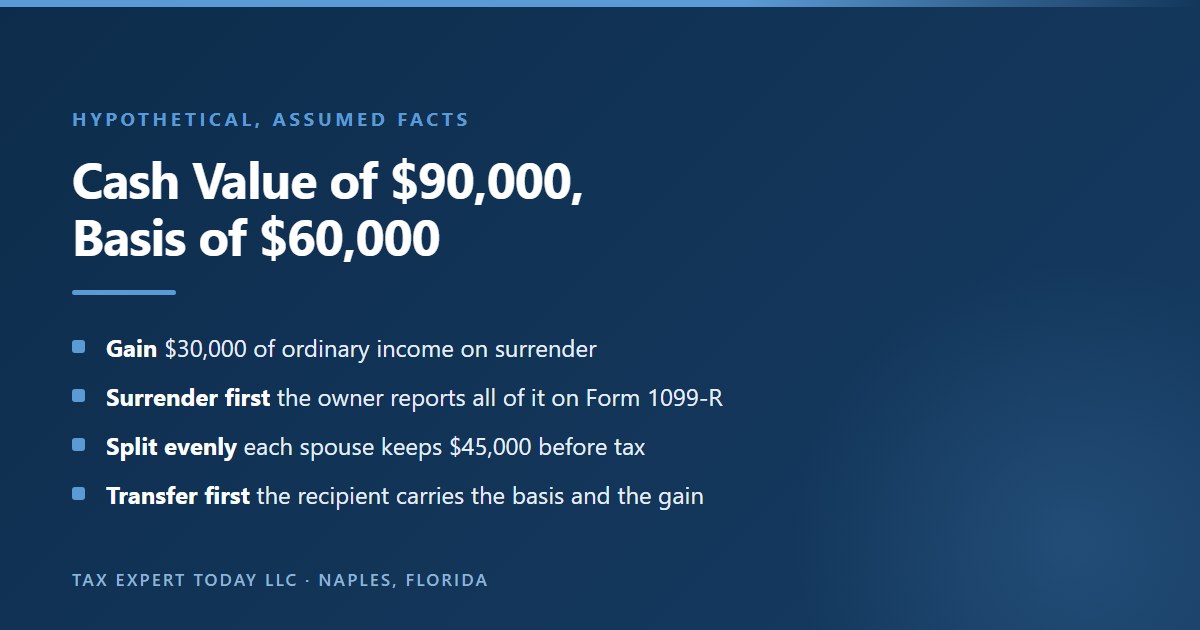
Yes, to the extent the cash received exceeds the investment in the contract. IRS Publication 525 states that if you surrender a life insurance policy for cash, you must include in income any proceeds that are more than the cost of the policy. The owner who surrenders the policy receives the Form 1099-R and reports the gain as ordinary income.
- Cost: generally premiums paid, less refunded premiums, rebates, dividends, and unrepaid loans not included in income.
- Character: the gain is ordinary income, not capital gain.
- Reporting: Form 1099-R, shown on lines 5a and 5b of Form 1040.
- Who pays: the owner of record at the time of surrender, regardless of how the cash is later divided.
- Order matters: transfer first and surrender later, or surrender first and split the cash, can put the gain on different returns.
IRS Publication 525 explains that in most cases the cost, or investment in the contract, is the total of premiums paid for the policy, less any refunded premiums, rebates, dividends, or unrepaid loans that were not included in income. The insurer issues a Form 1099-R showing the total proceeds and the taxable part. Under section 72(e), an amount received on a complete surrender is included in income to the extent it exceeds the investment in the contract.
In a life insurance divorce, the real problem is who carries that income. If the policy is owned by one spouse and the settlement says to cash it out and divide the proceeds equally, the owner reports all of the gain while receiving only half of the money. Nothing in the tax law automatically splits the 1099-R income to match the cash split. The fix is a drafting choice for your family law attorney, informed by the tax numbers: transfer an interest in the policy first and let each spouse bear tax on what each receives, gross up the owner’s share for the tax, or treat the tax as a liability in the property division. Which choice fits depends on each spouse’s tax bracket in the year of surrender, the same analysis that applies when other appreciated assets, such as stock options in a divorce, are divided.
| Hypothetical, assumed facts | Surrender first, then split | Transfer under 1041, recipient surrenders |
|---|---|---|
| Cash surrender value | $90,000 | $90,000 |
| Investment in the contract (premiums paid) | $60,000 | $60,000, carried over to the recipient |
| Taxable gain | $30,000, all on the owner’s return | $30,000, on the recipient’s return |
| Cash each spouse keeps before tax | $45,000 each | $90,000 to the recipient, offset elsewhere in the settlement |
| Common error | Owner pays tax on $30,000 while keeping half the cash | Recipient values the policy at $90,000 and ignores the built-in tax |
These numbers are illustrative only. The actual investment in the contract comes from the insurer’s cost basis statement, and dividends, prior withdrawals, and loans all change it. A term policy with no cash value has nothing to surrender, so this issue arises only with whole life, universal life, variable universal life, and similar permanent coverage.
Are Policy Loans and Modified Endowment Contracts a Problem in a Divorce?
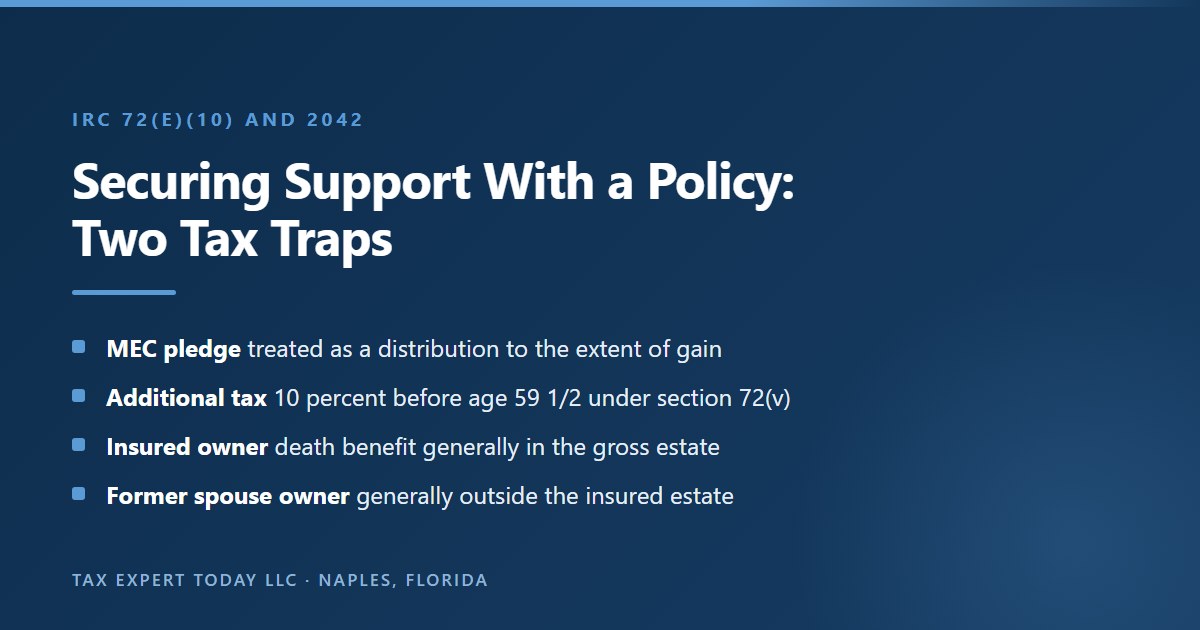
They can be. A loan from an ordinary permanent policy is generally not taxable when taken. But if the policy is a modified endowment contract under section 7702A, section 72(e)(10) treats loans, and any assignment or pledge of the policy, as distributions taxable to the extent of the gain, with a possible 10 percent additional tax under section 72(v).
- Ordinary policy loan: generally not income when borrowed; reduces cash value and death benefit.
- Lapse with a loan outstanding: can produce taxable income with no cash to pay the tax.
- Modified endowment contract: loans and pledges are treated as amounts received, gain first.
- Pledge to secure support: a collateral assignment of a MEC can itself be a taxable distribution.
- Additional tax: 10 percent of the taxable portion before age 59 1/2, unless an exception applies.
A modified endowment contract, defined in section 7702A, is a policy that was funded faster than the seven-pay test allows. Many single-premium and heavily funded policies fall into this category, and the owner often does not know it until the insurer says so. Section 72(e)(4)(A) provides that if an individual receives any amount as a loan under a contract, or assigns or pledges, or agrees to assign or pledge, any portion of the value of the contract, that amount is treated as received under the contract. For ordinary life insurance, section 72(e)(5)(C) keeps that rule from applying. Section 72(e)(10) reverses that for a modified endowment contract and applies the loan and pledge rule to any person.
That matters in a life insurance divorce for a specific reason. Courts and settlement agreements often secure alimony or child support by requiring the payor to keep a policy in force and to collaterally assign it, or pledge it, to the former spouse. If the policy is an ordinary whole life contract, a collateral assignment has no income tax effect. If it is a modified endowment contract, the pledge itself can be treated as a distribution to the extent of the gain in the policy, and section 72(v) adds a 10 percent additional tax on the taxable portion for an owner under age 59 1/2 unless an exception applies. Before agreeing to pledge a heavily funded policy, the owner should ask the insurer whether it is a modified endowment contract, and the answer belongs in front of the family law attorney before the language is final.
Ordinary policy loans carry a different risk. Borrowing against a whole life policy to fund an equalization payment is common, and the loan itself is not income. But if the policy later lapses or is surrendered with the loan outstanding, the loan is treated as part of the amount received, and the owner can report gain even though no cash comes out at that point. A recipient spouse who takes over a policy with a large loan inherits that exposure along with the contract.
Are Life Insurance Premiums Paid Under a Divorce Decree Deductible?
For divorce or separation instruments executed after 2018, no. Premiums are neither deductible by the payor nor income to the recipient. Under instruments executed before 2019, IRS Publication 504 states that alimony includes premiums you must pay under the instrument for insurance on your life, to the extent your spouse owns the policy.
- Post-2018 instruments: no alimony deduction and no alimony income, including for premiums.
- Pre-2019 instruments: premiums count as alimony only to the extent the recipient owns the policy.
- Payor-owned policy: premiums on a policy the payor owns are not alimony, even if the decree requires them.
- Modified pre-2019 instruments: the new rule applies only if the modification expressly adopts it.
IRS Topic 452 states that the payer cannot deduct alimony paid under a divorce or separation agreement executed after 2018, or executed before 2019 but later modified if the modification expressly states that the repeal of the alimony deduction applies, and that the recipient does not include those payments in income. Required premium payments are treated the same way. Our guide to alimony taxes after divorce covers the two regimes in full.
For the older agreements still in force, ownership decides the result. Publication 504 treats premiums as alimony only to the extent the spouse owns the policy. The temporary alimony regulations draw the same line from the other side: Q&A-6 of Temp. Treas. Reg. §1.71-1T says that payments to maintain property owned by the payor spouse and used by the payee spouse, including insurance premiums, are not payments on behalf of a spouse. So a pre-2019 decree that requires the payor to keep paying premiums on a policy the payor still owns produces no deduction, while a decree that transfers the policy to the recipient and then requires the payor to pay its premiums can produce a deduction for the payor and income for the recipient, provided every other alimony requirement in effect for that instrument is met.
| Instrument date and policy owner | Payor | Recipient |
|---|---|---|
| Executed after 2018, any owner | No deduction | No income |
| Executed before 2019, recipient owns the policy | Premiums can be deductible alimony if all requirements are met | Premiums can be alimony income |
| Executed before 2019, payor owns the policy | No deduction | No income |
| Pre-2019 instrument modified to adopt the new rule | No deduction after the modification | No income after the modification |
Is the Death Benefit Taxable to a Former Spouse Who Is the Beneficiary?
Generally no. Section 101(a)(1) excludes amounts received under a life insurance contract by reason of the insured’s death, and that exclusion applies to a former spouse the same as any other beneficiary. Interest paid on the proceeds is taxable, and the exclusion can be limited if the policy was transferred for value without a carryover basis.
- Lump sum death benefit: generally excluded from the beneficiary’s income.
- Interest on proceeds: taxable, reported as interest income.
- Installment payouts: the part of each payment that represents interest is taxable.
- Transfer-for-value cases: the exclusion may be capped at consideration plus later premiums.
- Proceeds that replace support: generally not alimony income under either regime.
The IRS states in its life insurance proceeds FAQ that proceeds received as a beneficiary because of the insured’s death are not includable in gross income and do not have to be reported, but that any interest received is taxable. The same FAQ notes the transfer-for-value limit when a policy was transferred for cash or other valuable consideration, subject to exceptions. For a former spouse named under a divorce decree, the death benefit replaces support that would have been paid over time, but it arrives as an insurance payout rather than a payment from the former spouse, so it is not alimony and the former spouse does not report it as income.
The exceptions that matter in practice are the ones already covered. A policy acquired from the other spouse through a section 1041 transfer keeps the full exclusion because of the carryover basis exception. A policy bought from a third party, or acquired in a transfer that falls outside section 1041, may not. Employer-owned policies under section 101(j) follow their own notice and consent rules and rarely sit at the center of a divorce, but a business owner whose company owns coverage on the owner’s life should flag it, because changing ownership of a company policy as part of a settlement can raise questions that a personal policy does not. Our guide to business owner divorce taxes covers the entity side of that conversation.
Can a Policy That Secures Alimony Pull the Death Benefit Into the Insured’s Estate?
Yes. Under IRC section 2042, the gross estate includes life insurance proceeds receivable by other beneficiaries if the decedent held any incident of ownership in the policy at death. A divorced insured who owns the policy securing support, and can change anything about it, generally has the full death benefit included in the gross estate.
- Incidents of ownership: the right to change beneficiaries, surrender, borrow, assign, or pledge.
- Payable to the estate: proceeds receivable by the executor are included under section 2042(1).
- Owner is the former spouse or a trust: the insured generally holds no incident of ownership.
- Reversionary interest: counts only if its value exceeds 5 percent of the policy value just before death.
- Who it matters to: estates large enough to face federal or state estate tax.
Section 2042 includes in the gross estate the amount receivable by the executor as insurance on the decedent’s life, and the amount receivable by all other beneficiaries under policies on the decedent’s life with respect to which the decedent possessed at death any of the incidents of ownership, exercisable alone or with any other person. The statute adds that a reversionary interest, including a possibility that the policy or proceeds may return to the decedent or the decedent’s estate, counts as an incident of ownership only if its value exceeded 5 percent of the value of the policy immediately before death.
In most life insurance divorce cases the federal estate tax is not in play, because the basic exclusion amount is far above the size of a typical estate. Our guide to the lifetime gift tax exemption for 2026 explains the current figures. But some Southwest Florida clients have estates that are large, own property in states with their own estate tax, or are likely to remarry and want to plan around a new family. For them, who owns the policy that secures support is an estate tax question as well as a divorce question. When the former spouse owns the policy, or an irrevocable trust owns it, the insured generally holds no incident of ownership and the proceeds stay out of the gross estate. When the insured keeps ownership, they are generally included. An irrevocable life insurance trust can be an alternative owner in some settlements, though its own rules, including the three-year rule for policies transferred into it, need to be addressed separately with your estate planning attorney.
Is Giving a Policy to a Former Spouse a Gift for Gift Tax Purposes?
Usually not, when the transfer is made under a written settlement agreement and the divorce occurs within the window in IRC section 2516. That section treats transfers in settlement of marital or property rights as made for full and adequate consideration, so no gift arises. Other transfers need a separate gift tax review.
- Written agreement required: the transfer must be made under a written agreement on marital and property rights.
- Timing window: divorce must occur within the three-year period beginning one year before the agreement.
- Court approval not required: the agreement qualifies whether or not the decree approves it.
- Child support provisions: a reasonable allowance for minor children is also covered.
- Premium payments later: payments required by the agreement generally fall within the same rule.
Section 2516 provides that where spouses enter into a written agreement relative to their marital and property rights, and divorce occurs within the three-year period beginning on the date one year before the agreement is entered into, whether or not the agreement is approved by the divorce decree, transfers made under the agreement to either spouse in settlement of marital or property rights, or to provide a reasonable allowance for the support of minor children, are deemed made for full and adequate consideration. A policy assigned to the former spouse under the agreement, and premiums the agreement requires the payor to keep paying, generally fall within that rule.
In a life insurance divorce, the gaps appear at the edges. A policy given to adult children, a policy transferred years after the divorce under an informal understanding, or premiums paid voluntarily beyond what the agreement requires can each be a gift. A gift return on Form 709 may then be required even if no gift tax is owed. The fix, again, is in the drafting: put the policy terms in the written agreement and make sure the divorce occurs within the statutory window.
What Does Florida Law Say About Life Insurance in a Divorce?
Florida law lets a court order life insurance to secure alimony or child support, and it automatically revokes a former spouse’s beneficiary designation on many policies at death. Fla. Stat. 61.08(4) requires specific findings of special circumstances before a court orders insurance to secure alimony, and Fla. Stat. 732.703 voids certain designations of a former spouse.
- Alimony security: Fla. Stat. 61.08(4) allows a policy or bond, with special-circumstance findings.
- Cost sharing: the court may apportion the cost of the insurance to either or both parties.
- Child support security: Fla. Stat. 61.13(1)(c) allows a policy or bond to protect child support.
- Automatic revocation: Fla. Stat. 732.703 treats a former spouse designation as if the former spouse died first, subject to exceptions.
- Federal plans: the revocation does not apply where controlling federal law provides otherwise.
The 2023 Florida alimony reform, Senate Bill 1416, reorganized section 61.08, and the life insurance provision now sits in Fla. Stat. 61.08(4). It provides that, to the extent necessary to protect an award of alimony, the court may order the obligor to purchase or maintain a life insurance policy or a bond, or otherwise secure the award with other suitable assets, but the court must make specific findings that special circumstances warrant it. The court may apportion the cost of the insurance or bond to either or both parties based on their ability to pay. Fla. Stat. 61.13(1)(c) gives a parallel power to protect an award of child support.
Separately, Fla. Stat. 732.703 provides that a designation of a former spouse as beneficiary of certain assets, including a life insurance policy that is not held within an employee benefit plan or a tax-qualified retirement account, becomes void when the marriage is dissolved, and the asset passes as if the former spouse predeceased the decedent. The statute lists exceptions. It does not apply to the extent controlling federal law provides otherwise, or where the dissolution order requires the decedent to maintain the asset for the benefit of a former spouse or children of the marriage and no other assets fulfilling that requirement exist, or where the designation was irrevocable, or where the decedent signed a new designation after the divorce expressly naming the former spouse. The United States Supreme Court upheld a similar Minnesota statute in Sveen v. Melin (2018), while in Egelhoff v. Egelhoff (2001) the Court held that ERISA preempts such a statute for employer plans governed by ERISA.
Those are family law and probate rules, not tax rules, even though they shape every life insurance divorce in Florida, and their application belongs to your family law attorney and your estate planning attorney. The tax link is this: whoever ends up receiving the proceeds, the income tax result under section 101 and the estate tax result under section 2042 are decided by the federal rules above, not by the state revocation statute. Federal retirement benefits follow their own federal rules as well, as our guide to FERS divorce taxes explains for the annuity side. A Florida resident who intends for a former spouse to stay the beneficiary of a policy securing support should make sure the dissolution order or a post-divorce designation says so expressly, so the policy does what the settlement intends and the tax planning built around it holds.
Who Should Own the Policy That Secures Support, From a Tax Point of View?
Ownership drives most of the tax result. An insured owner generally leaves the proceeds in the insured’s gross estate, and premiums are not alimony. A former spouse owner generally keeps the proceeds out of that estate, with the transfer protected by section 1041. A trust owner is a middle path. The final choice belongs with your family law attorney.
- Insured owns: simplest administration; estate inclusion; beneficiary changes are possible unless restricted.
- Former spouse owns: control and estate exclusion; the former spouse must keep paying or be reimbursed.
- Trust owns: control rests with a trustee; trust drafting and funding rules apply.
- Collateral assignment: secures the obligation without changing ownership; watch the MEC pledge rule.
| Owner of the policy securing support | Estate tax (IRC 2042) | Premiums (pre-2019 instrument) | Other tax points |
|---|---|---|---|
| Insured payor | Generally included | Not alimony | A pledge of a MEC to the former spouse can be a taxable distribution |
| Former spouse | Generally excluded if the insured holds no incident of ownership | Can be alimony if all requirements are met | Section 1041 transfer; carryover basis keeps the death benefit excludable |
| Irrevocable trust | Generally excluded if properly structured | Depends on the instrument and the beneficiaries | Three-year rule for existing policies transferred into the trust; trust terms control |
| New policy bought by the former spouse | Generally excluded from the insured’s estate | Reimbursed premiums can be alimony if all requirements are met | No transfer of an existing contract, so no transfer-for-value question |
None of these choices is right for every case. A payor who expects to remarry may prefer that the former spouse own the coverage, so that a new family is not tied to the old obligation. A recipient who wants certainty that the policy stays in force may prefer to own it and pay premiums, with the support figure adjusted to cover the cost. A family with a large estate may prefer a trust. The tax effect of each option is something we can quantify, and that number then becomes one input in a negotiation that remains with you and your family law attorney.
What Records Should Each Spouse Keep After the Policy Changes Hands?
The new owner should keep the insurer’s cost basis statement, the full premium and dividend history, the loan history, any statement on whether the policy is a modified endowment contract, and a copy of the settlement provision that transferred it. Q&A-14 of the section 1041 regulations requires the transferor to supply basis records at the time of the transfer.
- Cost basis statement: requested from the insurer, showing the investment in the contract.
- MEC status: a written statement from the insurer on whether section 7702A applies.
- Transfer documents: the change of ownership form and the agreement provision requiring it.
- Beneficiary designation: a copy of the current designation, reviewed after the divorce.
- Premium proof: records of who paid each premium after the transfer.
These records answer the life insurance divorce questions that arise years later. If the new owner surrenders the policy, the cost basis decides how much of the payment is taxable. If the insured dies, the transfer documents show that the policy moved under section 1041, which supports the carryover basis exception to the transfer-for-value rule. If an estate tax return is needed, the ownership history shows whether the insured held any incident of ownership. And if a pre-2019 instrument treats premiums as alimony, the premium proof supports the deduction and the matching income. A one-page summary of these items, kept with the divorce file, is the cheapest tax protection a settlement can include.
What Happens to Term Life and Employer Group Coverage in a Divorce?
Term life insurance has no cash value, so there is nothing to surrender and no gain to divide. A transfer of an individual term policy incident to the divorce is still covered by section 1041. Employer group term coverage usually cannot be transferred at all, and coverage above $50,000 keeps creating imputed income for the employee under section 79.
- Individual term policy: transferable as property under section 1041, with no built-in gain.
- Group term through work: owned under the employer plan, so the employee cannot assign it in a settlement.
- Imputed income: the cost of coverage above $50,000 is included in the employee’s wages.
- Beneficiary terms: employer plans governed by ERISA follow the plan documents, not the state revocation statute.
Most divorcing couples carry at least some term coverage, and much of it comes through an employer. Section 79(a) includes in an employee’s gross income the cost of group-term life insurance carried by the employer, but only to the extent that cost exceeds the cost of $50,000 of coverage plus any amount the employee paid toward it. A settlement that requires an employee to keep a large amount of employer coverage in force to secure support therefore carries a small, recurring tax cost on the employee’s Form W-2, and that cost continues for as long as the coverage does.
Because employer group coverage generally cannot be assigned, settlements that need security often rely on it only as a beneficiary designation, or require the payor to buy an individual policy instead. The tax point for the family law attorney is that an individual policy can be owned by the former spouse, which moves it out of the insured’s estate, while employer coverage stays with the employee. For federal employees, the same question arises alongside the retirement division covered in our guide to TSP divorce taxes, and the beneficiary rules for federal coverage follow federal law rather than the Florida statute.
How Is a Life Insurance Policy Valued for the Settlement, and Why Does Tax Basis Matter?
Settlements usually value a permanent policy at its cash surrender value, net of any loan. That figure ignores the tax that a later surrender would trigger. A fair after-tax comparison subtracts the expected tax on the gain over the investment in the contract, which the recipient inherits through carryover basis under section 1041.
- Cash surrender value: what the insurer would pay today, after surrender charges and loans.
- Investment in the contract: generally premiums paid, less tax-free amounts already received.
- Built-in gain: the difference, taxed as ordinary income on surrender.
- Gift tax valuation: a different measure, based on the interpolated terminal reserve, applies for Form 709 purposes.
The value a court or mediator places on a policy is a family law question. The tax effect of that value is not. Two assets with the same stated value can carry very different after-tax value: a $90,000 brokerage account holding cash has no built-in tax, while a $90,000 policy with $60,000 of basis carries $30,000 of ordinary income waiting for whoever surrenders it. The same reasoning applies to retirement accounts, which are fully taxable when withdrawn, as our guide to QDRO taxes in divorce explains, and to the home, covered in our guide to the divorce house buyout.
| Policy type | Value usually used in the settlement | Tax adjustment to consider |
|---|---|---|
| Individual term | No cash value | None for income tax; premium cost going forward |
| Whole life | Cash surrender value, net of loans | Expected tax on gain over the investment in the contract |
| Universal or variable universal life | Account value less surrender charges and loans | Expected tax on gain; lapse risk if a loan is outstanding |
| Modified endowment contract | Cash surrender value, net of loans | Gain-first taxation on loans and pledges; 10 percent additional tax before age 59 1/2 |
| Employer group term | Not divisible property in most plans | Section 79 imputed income on coverage above $50,000 |
For gift tax purposes, the regulations use a different measure. Treasury Regulation 25.2512-6 generally values a gift of an established policy on which further premiums are due by reference to the interpolated terminal reserve plus the unearned portion of the last premium, and our guide to the irrevocable life insurance trust walks through that calculation. In most divorces section 2516 removes the gift question entirely, but when a policy moves outside the written agreement, the gift value and the settlement value can differ.
Can the New Owner Exchange the Policy Without Triggering Tax?
Generally yes. Section 1035 provides that no gain or loss is recognized on the exchange of a life insurance contract for another life insurance contract, an endowment or annuity contract, or a qualified long-term care contract. A former spouse who receives a policy in the settlement can generally exchange it, and the carried-over basis follows into the new contract.
- Permitted exchanges: life insurance for life insurance, an annuity, an endowment, or qualified long-term care coverage.
- Not permitted in reverse: an annuity cannot be exchanged tax free for a life insurance contract.
- Basis: the investment in the contract generally carries into the replacement contract.
- Loans and cash: cash received, or a loan extinguished, in the exchange can be taxable.
Section 1035(a) lists the exchanges that qualify, and a policy acquired through a section 1041 transfer is an ordinary life insurance contract in the new owner’s hands. A recipient who does not need the death benefit, or who is not comfortable owning coverage on a former spouse’s life, sometimes asks whether the policy can be converted to an annuity instead of being surrendered. A section 1035 exchange can defer the built-in gain, subject to the conditions in the statute and regulations, and the deferred gain then follows the annuity. Whether that fits depends on the recipient’s age, liquidity needs, and the settlement terms, which is why the question belongs on the list for our divorce tax consulting review before the policy is surrendered.
Common Tax Mistakes With Life Insurance in a Divorce
The most common tax mistakes are valuing a permanent policy at its cash value without the built-in tax, cashing out a policy owned by one spouse and splitting the money evenly, pledging a modified endowment contract without checking its status, and assuming premiums are deductible under a post-2018 decree. Each is avoidable with numbers run before signing.
- Ignoring the built-in gain: $90,000 of cash value with $60,000 of basis is not worth $90,000 after tax.
- Uneven tax on an even split: the owner who surrenders reports all of the gain.
- Unchecked MEC pledges: a collateral assignment can be a taxable distribution.
- Assuming a deduction: premiums under a post-2018 instrument are never deductible alimony.
- Missing basis records: the new owner cannot prove cost without the transferor’s records.
A fifth life insurance divorce mistake is quieter. Many settlements require the payor to keep coverage in force until support ends, then say nothing about what happens to the policy afterward. If the recipient owns the policy, the recipient holds an asset with cash value after the obligation ends. If the payor owns it, a later decision to surrender or reduce coverage carries its own tax result. Because filing status after divorce and the bracket each person lands in can change in the years after the decree, the year in which a policy is surrendered can change the tax by a meaningful amount. Planning that timing is a tax question, while deciding whether the settlement should address it is a question for the family law attorney.
Life Insurance Divorce Help in Naples & Southwest Florida
Tax Expert Today LLC is based in Naples, Florida, and works with divorcing and recently divorced clients across Collier and Lee counties and in all 50 states. Many Southwest Florida settlements include permanent life insurance alongside retirement plan divisions, a Roth IRA, the marital home, and investment accounts, and the questions we see are federal and practical: what a policy is worth after tax, who reports the gain on a surrender, whether a pledge is safe, and how ownership affects the estate.
- Divorce tax Naples FL: after-tax valuation of whole life and universal life policies before the property division is fixed.
- Life insurance divorce help Naples: section 1041 transfer review, transfer-for-value analysis, and modified endowment contract checks before a policy is pledged.
- Surrender planning: modeling which spouse should surrender and in which year, using each party’s projected bracket.
- Estate coordination: working with your estate planning attorney on ownership of a policy that secures support.
- Coordination with your attorney: giving the family law attorney the tax result of each option, without advising on the negotiation itself.
You can read more on our divorce tax consulting page and about the broader practice at Naples FL tax planning.
Tax Expert Today LLC
11983 Tamiami Trail N, Naples, FL 34110
Phone: (239) 441-2005
Hours: Monday through Friday, 10:00am to 5:00pm ET
Does Florida tax the surrender of a life insurance policy in a Naples divorce? No. Florida has no personal income tax, so a Naples resident who surrenders a policy as part of a divorce owes only federal income tax on the gain over the investment in the contract. Florida also has no state estate tax, although an estate with property in another state may face that state’s tax.
When to Engage a Professional
A life insurance divorce in which the only coverage is employer group term insurance, or a small term policy with no cash value, may need little tax work beyond updating the beneficiary designation with your attorney’s guidance. Professional involvement tends to earn its cost when one or more of the following is present.
- A permanent policy with meaningful cash value: its after-tax value can differ substantially from the figure on the worksheet.
- A plan to surrender or sell a policy: the gain, and who reports it, should be computed before the agreement is final.
- A policy that will be pledged to secure support: its modified endowment contract status should be confirmed in writing.
- An older instrument that treats premiums as alimony: ownership and the other alimony requirements decide whether the deduction holds.
- A larger estate or property in another state: ownership of the policy can change the estate tax result.
We work as the tax side of the divorce team, alongside your family law attorney, who remains responsible for the settlement terms and the language of any order. To discuss your situation, call (239) 441-2005 or visit our divorce tax consulting page. Every outcome depends on the facts, including the type of policy, its cash value and investment in the contract, its modified endowment contract status, the date of the divorce instrument, each party’s other income, and filing status.
Frequently Asked Questions About Life Insurance in a Divorce
Is transferring a life insurance policy to my former spouse taxable? Generally no. Under IRC section 1041, no gain or loss is recognized on a transfer of property to a spouse, or to a former spouse incident to the divorce. The recipient takes over the transferor’s basis, which also keeps the death benefit excludable under the carryover basis exception to the transfer-for-value rule.
Does the transfer-for-value rule apply to a policy received in a divorce? Generally no. Section 101(a)(2)(A) exempts a transfer in which the transferee’s basis is determined by reference to the transferor’s basis. A section 1041 transfer provides exactly that, so the former spouse can generally exclude the death benefit in full. A sale to an unrelated buyer is treated differently.
Who pays tax when a policy is cashed out and the money is split? The owner who surrenders the policy receives the Form 1099-R and reports the gain over the investment in the contract as ordinary income. Splitting the cash does not split the taxable income. Settlements can address this by transferring an interest before surrender or by accounting for the tax in the division.
Are life insurance premiums I pay under my divorce decree deductible? Not under a divorce or separation instrument executed after 2018. Under an older instrument, IRS Publication 504 treats required premiums as alimony only to the extent the former spouse owns the policy, and only if the other alimony requirements are met. Premiums on a policy the payor owns are not alimony.
Is a life insurance payout to a former spouse taxable? Generally no. Section 101(a)(1) excludes death benefits paid by reason of the insured’s death, and the exclusion applies to a former spouse like any other beneficiary. Interest paid on the proceeds is taxable, and the exclusion can be limited if the policy was acquired in a transfer for value without carryover basis.
Does Florida tax the surrender of a life insurance policy in a Naples divorce? No. Florida has no personal income tax, so a Naples resident who surrenders a policy as part of a divorce owes only federal income tax on the gain over the investment in the contract. Florida also has no state estate tax, although an estate with property in another state may face that state’s tax.
Published November 4, 2026 by Dr. Pellumb Kabashi « Back to Learning Center
Have a question this article touches on?
Tax Expert Today LLC, based in Naples, Florida and serving clients across the United States.
Schedule a Consultation (239) 441-2005