
By Dr. Pellumb Kabashi, DBA, MBA, EA, CFE, CES
Founder, Tax Expert Today LLC · Tax advisors, enrolled agents, CPAs, and attorneys · Serving clients in all 50 states
Quick Answer: The Georgia jobs tax credit pays $3,500, $2,500, $1,250, or $750 per year for each net new full-time job, for five years, depending on the tier of the county where the jobs are created. Tier 1 needs only two new jobs; Tier 4 needs 25. Jobs must average 35 hours a week, meet a wage floor of $36,608 for 2026, and be offered health insurance. Call (239) 441-2005 for a free consultation.
Georgia has offered a credit for job creation since the early 1990s, and it remains one of the state’s most widely used business incentives. It is also one of the easiest to get wrong. The Georgia jobs tax credit is not an application program with an award letter. A business either meets the statutory tests in a given tax year or it does not, and the business proves it on its own return with Form IT-CA. There is no state official who signs off in advance, and the Department of Revenue can review the claim later.
That structure puts the burden on the employer and its advisors. The amount depends on where the jobs sit, not where the company is headquartered. The job count is a monthly average, not a year-end headcount. The wage test changes every year. The county tiers are re-ranked every year. And since January 1, 2025, unused credits for newly created jobs expire in five years instead of ten. This guide walks through each rule with the statute, regulation, or Department guidance behind it, along with worked examples using hypothetical figures.
The Georgia jobs tax credit described here is the statewide program under O.C.G.A. 48-7-40 and 48-7-40.1, which the Department of Revenue calls the Employer’s Jobs Tax Credit. It is a different program from the Georgia quality jobs tax credit, which rewards higher-paying jobs under a separate Code section, and from the retraining credit. Where those programs interact, this guide says so and links to our separate coverage.
What Is the Georgia Jobs Tax Credit?
The Georgia jobs tax credit is a state income tax credit for eligible businesses that create net new full-time jobs in Georgia. The annual amount per job depends on the economic tier of the county or census tract where the jobs are located, and each qualifying job can generate the credit for five years if it is maintained.
- Legal basis: O.C.G.A. 48-7-40 (county tiers) and 48-7-40.1 (less developed census tracts).
- Administered by: the Department of Community Affairs (rankings and rules) and the Department of Revenue (the credit itself).
- Department of Revenue codes: credit code 103, and credit code 157 for jobs created in 2025 and later.
- How it is claimed: Form IT-CA filed electronically with the Georgia income tax return.
- No advance application: the business qualifies by meeting the tests, except in State Opportunity Zones, which need a certification first.
The Department of Revenue’s Employer’s Jobs Tax Credit page lists two credit codes. Code 103 is the long-standing code. Code 157 applies to jobs created and maintained on or after January 1, 2025, and the page flags it with a short note: carryforward shortened to five years. Both codes describe the same program. The split exists so the Department can track which credits carry the old ten-year life and which carry the new five-year life.
Two state agencies share the work. The Department of Community Affairs ranks every county and certain census tracts each year, publishes the tier map and the wage floor, issues the program regulations in Subject 110-9-1, and decides whether net increases or decreases in jobs have occurred under O.C.G.A. 48-7-40(g). The Department of Revenue processes the credit on the return, reviews it, and controls the payroll withholding benefit.
The Department of Community Affairs states it plainly in its program overview: there is no application process. A business must meet the eligibility requirements and create eligible net new jobs. The one exception is a State Opportunity Zone, where a certification form must be completed and accepted before the credit is claimed. That makes documentation the whole game. Because nobody approves the credit in advance, the records kept during the year are the only proof that the credit was earned.
How Much Is the Georgia Jobs Tax Credit Worth in 2026?
For 2026, the Georgia jobs tax credit is $3,500 per job per year in Tier 1 counties and less developed census tracts, $2,500 in Tier 2, $1,250 in Tier 3, and $750 in Tier 4. Each qualifying job can earn the amount for the year it is created and the four following years.
- Tier 1: counties ranked 1 through 71, $3,500 per job, two or more new jobs.
- Tier 2: counties ranked 72 through 106, $2,500 per job, ten or more new jobs.
- Tier 3: counties ranked 107 through 141, $1,250 per job, 15 or more new jobs.
- Tier 4: counties ranked 142 through 159, $750 per job, 25 or more new jobs.
- Possible bonus: $500 per job in a county that belongs to a qualifying Joint Development Authority.
| Designation | County ranking | Minimum net new jobs | Credit per job per year | Share of income tax it may offset |
|---|---|---|---|---|
| Tier 1 | 1 through 71 | 2 | $3,500 | 100 percent, plus withholding |
| Tier 2 | 72 through 106 | 10 | $2,500 | 100 percent |
| Tier 3 | 107 through 141 | 15 | $1,250 | 50 percent |
| Tier 4 | 142 through 159 | 25 | $750 | 50 percent |
| Less developed census tract | Tract areas ranked by the Department of Community Affairs | 5 | $3,500 | 100 percent, plus withholding |
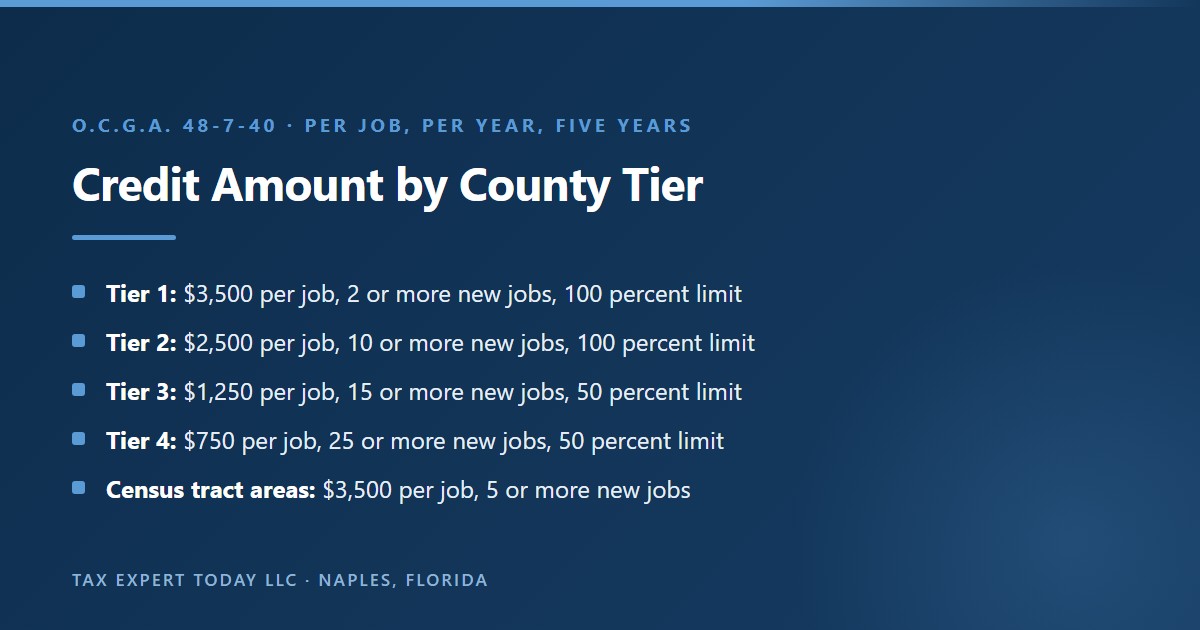
The amounts come straight from O.C.G.A. 48-7-40(e)(1) and match the table on the Department of Revenue page and the 2025 Form IT-CA instructions. They are fixed dollar amounts, not percentages of wages, so a $36,700 warehouse job and a $90,000 engineering job in the same Tier 2 county earn the same $2,500 a year. That is the key economic difference from the quality jobs credit, which scales with pay.
The five-year life is what makes the credit material. A Tier 1 job maintained for all five years can generate $17,500 in total credit. Ten Tier 2 jobs maintained for five years can generate $125,000. Those totals are gross figures. Whether the business can actually use the credit depends on its Georgia income tax liability, the tier’s liability limit, and the carryforward window, all covered below.
Which Businesses Qualify for the Georgia Jobs Tax Credit?
Outside the 40 least developed counties, the Georgia jobs tax credit is limited to businesses in manufacturing, warehousing and distribution, processing, telecommunications, broadcasting, tourism, research and development, biomedical manufacturing, and services for the elderly and persons with disabilities. Retail is excluded except in those 40 counties and certain designated zones.
- Eligible industries: listed in the “business enterprise” definition in O.C.G.A. 48-7-40(a)(2).
- Measured by establishment: each physical location is classified by its own NAICS activity.
- Mixed sites: only jobs in the qualifying activity count.
- Any lawful business: in the bottom 40 Tier 1 counties, Opportunity Zones, Military Zones, and pervasive poverty areas.
- Tax-exempt organizations: only to the extent of unrelated business income, for tax years beginning on or after January 1, 2023.
The statute defines a “business enterprise” as any business, or the headquarters of any business, engaged in manufacturing (including alternative energy products for solar, wind, battery, bioenergy, biofuel, and electric vehicle enterprises), warehousing and distribution, processing, telecommunications, broadcasting, tourism, research and development, biomedical manufacturing, and services for the elderly and persons with disabilities. The same paragraph says the term does not include retail businesses.
Eligibility is tested at the establishment level. O.C.G.A. 48-7-40(a)(2) defines an establishment as an economic unit at a single physical location where business is conducted or where services or industrial operations are performed, classified under the North American Industry Classification System. If more than one activity happens at a site, only the jobs engaged in the qualifying activity are eligible. A distribution center that also runs a retail showroom, for example, counts the warehouse jobs and not the sales floor jobs.
The retail exclusion falls away in the poorest areas. Under O.C.G.A. 48-7-40(i), in the counties ranked first through fortieth in the Tier 1 designation, the credit is available to “any business of any nature.” The Department of Community Affairs fact sheets apply the same any-lawful-business rule in State Opportunity Zones and Military Zones, and O.C.G.A. 48-7-40.1(c) does the same for areas designated as suffering from pervasive poverty. For a restaurant group, a retailer, or a professional services firm, those are the only places the credit is generally available.
The 2025 Form IT-CA adds a note on tax-exempt organizations. For taxable years beginning on or after January 1, 2023, organizations exempt under O.C.G.A. 48-7-25 are taxpayers for this credit only to the extent a trade or business they operate generates unrelated business income under Section 512 of the Internal Revenue Code. A hospital system or a nonprofit manufacturer should not assume the credit is available against its exempt operations.
What Counts as a New Full-Time Job for the Georgia Jobs Tax Credit?
A qualifying job is a newly created position not previously located in Georgia, requiring at least 35 hours of work each week, paying at or above the lowest county average wage in the state, and offered health insurance. Independent contractors, transferred jobs, replacement jobs, and part-time positions combined into equivalents do not count.
- Newly created: not a job moved from another Georgia location of the same or a related business.
- 35 hours: a minimum of 35 hours worked each week.
- Health insurance offered: the employer must make coverage available but need not pay for it unless it pays for existing employees.
- No contractors: workers classified as independent contractors for federal tax purposes are excluded.
- Leased employees: counted by the business using their services if they meet the full-time definition.
The definition in O.C.G.A. 48-7-40(a)(5) has three parts: a newly created position that was not previously located in Georgia, a minimum of 35 hours a week, and pay at or above the average wage of the lowest-wage county. The health insurance requirement sits in subsection (e)(1). The employer must make coverage available to the employee in the new job. It does not have to pay any part of the premium, unless it pays for coverage for its other employees. In that case, paying for the new employees on the same terms is the safer reading.
Regulation 110-9-1-.01(6)(g) adds several working rules. A net new job does not include a position classified as an independent contractor for federal tax purposes. Part-time jobs that become full-time jobs count as new full-time jobs, but part-time jobs cannot be added together to create full-time equivalents. Leased employees are treated as employees of the company using their services, and only that company may count them, if they meet the full-time definition.
Transferred jobs are the most common trap. The regulation defines a transferred job as one relocated by a business or a related business from one Georgia establishment to another, or a substantially similar job created at a location where the business or a related business ceased operations for six months or less. Transferred jobs cannot be counted. The IT-CA instructions add one helpful clarification: jobs relocated by the same taxpayer within the same county or census tract area are not treated as transferred. Replacement jobs, which take the place of jobs interrupted by a natural or manmade disaster, are also excluded from the monthly totals.
What Is the 2026 Wage Requirement for the Georgia Jobs Tax Credit?
For tax years beginning in 2026, each new job must pay at least the average wage of Georgia’s lowest-wage county, which the Department of Community Affairs lists as Quitman County at $704 a week, or $36,608 a year. For 2025, the floor was Taliaferro County at $680 a week, or $35,360 a year.
- 2026 floor: $704 weekly, $36,608 annualized (Quitman County).
- 2025 floor: $680 weekly, $35,360 annualized (Taliaferro County).
- What counts as wage: total W-2 pay, including bonuses and incentive pay.
- What does not: employer contributions to health, retirement, or other benefit plans.
- Tested every year: the wage must be met in each of years one through five.
| Tax year | Lowest-wage county | Weekly wage | Annualized wage |
|---|---|---|---|
| 2023 | Glascock | $636 | $33,072 |
| 2024 | Taliaferro | $686 | $35,672 |
| 2025 | Taliaferro | $680 | $35,360 |
| 2026 | Quitman | $704 | $36,608 |
The figures come from the Department of Community Affairs Job Tax Credit Historical Wage Detail, updated August 26, 2026. The table explains the timing. The wage used for a tax year comes from the Georgia Department of Labor’s Employment and Wages Averages publication for the prior calendar year, released the following summer. So the 2026 tax year uses the 2025 averages report, published in the summer of 2026. Regulation 110-9-1-.03(3)(b)1 says the average wage means the figure in the most recent annual report available as of the last day of the tax year in which the jobs are created.
Two points deserve attention. First, the floor does not only rise. It dipped from $686 to $680 between the 2024 and 2025 tax years, and the lowest-wage county changes. Employers who set pay at “last year’s floor plus a little” can still fall short if the floor jumps, as it did by $24 a week for 2026. Second, the statute uses slightly different words in different places: the definition says “at or above,” while subsection (e)(1) says the wage “must be above” the lowest county average. Setting pay with a margin above the published figure avoids having to argue which phrase controls.
The wage test is applied every year of the five-year period, not only in year one. The regulation’s definition of wage is total dollars paid as reported on Form W-2, including bonuses and incentive pay, and excluding employer contributions to benefit programs. A job that met the 2025 floor at $35,500 and received no raise would fall below the 2026 floor of $36,608, and that job would stop supporting the credit for 2026.
How Are Net New Jobs Counted for the Georgia Jobs Tax Credit?
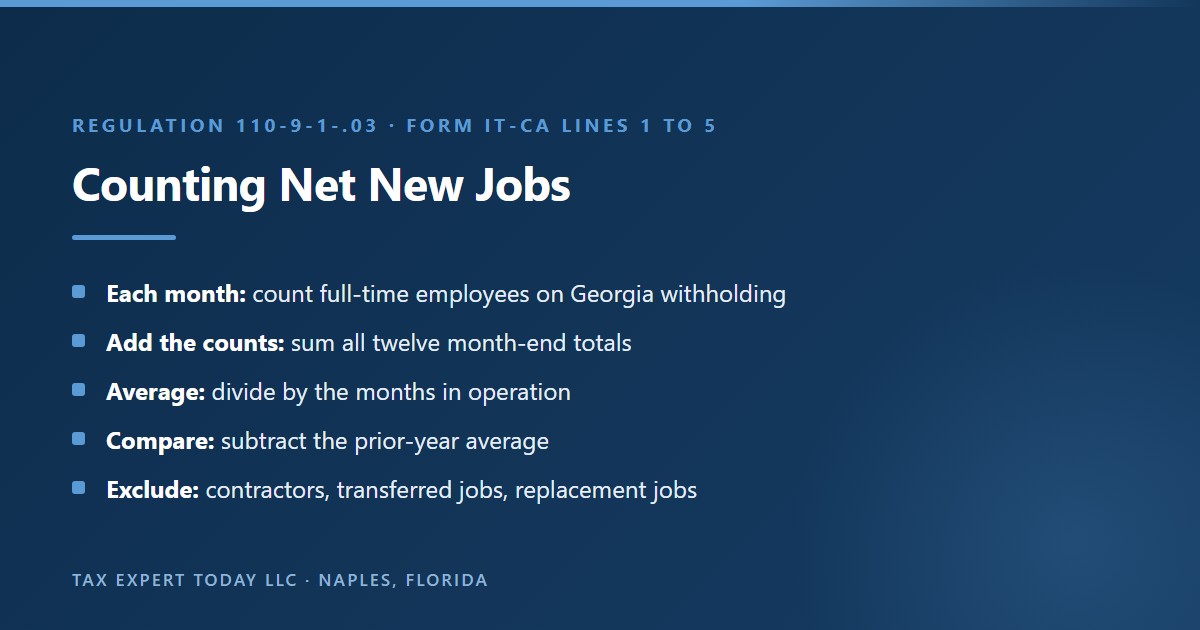
Net new jobs are measured by comparing the monthly average number of full-time employees subject to Georgia withholding in the current tax year with the same average for the prior tax year. Count full-time employees at the end of each month, add the twelve counts, and divide by the months in operation.
- Monthly snapshot: full-time employees as of the last payroll period of each month, or the period used for Department of Labor reports.
- Average: total of the monthly counts divided by the months the business operated.
- Net increase: current-year average minus prior-year average.
- Rounding: Form IT-CA rounds the average to the nearest whole number.
- Exclusions: transferred and replacement jobs never enter the monthly totals.
The statute sets the method in one sentence in O.C.G.A. 48-7-40(e)(1): compare the monthly average number of full-time employees subject to Georgia income tax withholding for the taxable year with the corresponding period of the prior taxable year. Regulation 110-9-1-.03(1)(c) spells out the steps. For each month, count the full-time employees as of the last payroll period of the month, or the payroll period used for Department of Labor reporting. Add the monthly totals. Divide by the number of months the business was in operation. Only an initial start-up year may be calculated on fewer than twelve months.
The averaging matters more than most employers expect. A business that hires 20 people in December has a large year-end headcount but a small average increase for that year, because those 20 people appear in only one of twelve monthly counts. The same hires made in January would show up in all twelve. Timing hiring early in the tax year, when the business can do so, often makes the difference between clearing a tier threshold and missing it.
| Hypothetical Tier 2 manufacturer | 2025 (prior year) | 2026 (year one) |
|---|---|---|
| Sum of twelve month-end full-time counts (IT-CA Line 1) | 960 | 1,104 |
| Months of operation (Line 2) | 12 | 12 |
| Monthly average (Line 3) | 80 | 92 |
| Average increase (Line 5) | Not applicable | 12 |
| Tier 2 threshold met? | Not applicable | Yes, 12 is at least 10 |
| Gross credit for 2026 | Not applicable | 12 x $2,500 = $30,000 |
The table follows the line structure of the 2025 Form IT-CA: Line 1 is the total of month-end full-time employees subject to Georgia withholding, Line 2 the months of operation, Line 3 the monthly average rounded to the nearest whole number, Line 4 the prior-year average, and Line 5 the increase or decrease. The figures are hypothetical. In this example, 12 new jobs in a Tier 2 county clear the ten-job threshold and generate a gross credit of $30,000 for 2026, provided every one of the counted jobs meets the hours, wage, and health insurance tests.
The count is also kept per county or census tract area. The IT-CA notes say that creating 2, 5, 10, 15, or 25 jobs spread across two or more counties or tract areas does not meet the threshold. A company that adds six jobs in one Tier 2 county and six in another has added twelve jobs in Georgia but has not met the ten-job threshold in either county. Each area needs its own Sections II through IV of the form, and each must clear its own threshold.
How Many Jobs Must a Business Create in Each Tier?
A business must create an average of at least two net new jobs in a Tier 1 county, State Opportunity Zone, or Military Zone, five in a less developed census tract, ten in a Tier 2 county, 15 in a Tier 3 county, and 25 in a Tier 4 county. The threshold must be met within a single tax year.
- Two jobs: Tier 1 counties, Opportunity Zones, Military Zones, and pervasive poverty areas.
- Five jobs: less developed census tract areas.
- Ten jobs: Tier 2 counties.
- 15 jobs: Tier 3 counties.
- 25 jobs: Tier 4 counties.
| Area | Minimum average increase | Who may claim | Statute |
|---|---|---|---|
| Tier 1 county | 2 | Eligible industries; any business in the bottom 40 | 48-7-40(e)(1), (i) |
| Less developed census tract | 5 | Eligible industries | 48-7-40.1(e) |
| Military Zone or pervasive poverty area | 2 | Any lawful business | 48-7-40.1(c)(2), (c)(4) |
| State Opportunity Zone | 2 | Any lawful business, after certification | 48-7-40.1(c)(4); Rule 110-24-1 |
| Tier 2 county | 10 | Eligible industries | 48-7-40(e)(1) |
| Tier 3 county | 15 | Eligible industries | 48-7-40(e)(1) |
| Tier 4 county | 25 | Eligible industries | 48-7-40(e)(1) |
The thresholds are minimums for the year the jobs are created. They also matter in every later year. O.C.G.A. 48-7-40(e)(1) says the credit is not allowed during a year in which the net employment increase falls below the number required in the tier, and the Department of Revenue adjusts the credit each year for net employment fluctuations above the minimum. A Tier 3 employer that created 18 jobs and later drops to an average increase of 14 earns nothing for that year, because 14 is below the 15-job minimum.
The two-job rule in pervasive poverty areas has an odd condition in O.C.G.A. 48-7-40.1(e): if a business increases employment by only two jobs there, the two people hired cannot be married to each other. It rarely matters, but it shows how literally the program is written. Every element, from the hours to the household, is a test the claim must pass.
How Do Less Developed Census Tracts, Opportunity Zones, and Military Zones Work?
These are special designations under O.C.G.A. 48-7-40.1 that give Tier 1 treatment, $3,500 per job, to areas inside counties that would otherwise rank in a higher tier. Less developed census tracts need five jobs; Opportunity Zones and Military Zones need two and allow any lawful business.
- Less developed census tracts: areas of ten or more contiguous tracts ranked by unemployment, income, and poverty.
- Military Zones: tracts adjacent to a federal military installation with a poverty rate of 15 percent or more, and certain tracts in counties with a large garrison and a public industrial park.
- State Opportunity Zones: areas near high-poverty block groups inside an enterprise zone or redevelopment plan area.
- Certification: an Opportunity Zone business must have its certification accepted before claiming.
- Finding them: the Department of Community Affairs interactive map has layers for counties, tracts, and Military Zones.
The county tiers are blunt instruments. A metropolitan county with high average income can still contain neighborhoods with deep poverty. O.C.G.A. 48-7-40.1 fills that gap. Each year the commissioner of community affairs ranks areas made up of ten or more contiguous census tracts using the same three factors used for counties: highest unemployment rate for the most recent 36 months, lowest per capita income for the most recent 36 months, and highest percentage of residents below the poverty level. Areas that rank like the bottom 71 counties are designated less developed, and jobs created there earn $3,500, the Tier 1 amount, with a five-job threshold.
The statute also authorizes special designations. Under subsection (c)(2), an area of one or more census tracts adjacent to a federal military installation with a poverty rate of 15 percent or greater can be designated, and subsection (c)(2.1) covers tracts in a county with a garrison of at least 5,000 personnel and a government-owned industrial park. Under subsection (c)(4), areas within or next to block groups with poverty of 15 percent or more, inside a state enterprise zone or a redevelopment plan area, can be designated. Regulation 110-9-1-.01(6) calls these Military Zones and Opportunity Zones. In those pervasive poverty areas, the credit is open to any lawful business and the threshold drops to two jobs.
The Opportunity Zone carries an extra step. The Department of Community Affairs overview says that if the business is in a State Opportunity Zone, the Opportunity Zone Certification form must be completed and accepted before the credit is claimed. Form IT-CA asks at line 7a whether the jobs are in an Opportunity Zone and tells the filer to attach the certification. A business that skips this step has created the jobs but cannot claim the credit for them until the certification is in hand.
The fastest way to check an address is the Department of Community Affairs interactive map linked from its Job Tax Credits page. The map has separate layers for counties, less developed census tracts, and Military Zones, and they must be switched on to appear. A site can sit in a Tier 3 county and still fall inside a less developed census tract, which would change the credit from $1,250 to $3,500 per job and the threshold from 15 to five.
What Is the Joint Development Authority Bonus?
A business enterprise located in a county that belongs to a qualifying Joint Development Authority of two or more contiguous counties earns an additional $500 credit for each new full-time job. The authority must be active, have a board, meet at least quarterly, and keep an operational business plan.
- Amount: $500 per new full-time job.
- Statute: O.C.G.A. 36-62-5.1(e)(2).
- Who qualifies: a business enterprise as defined in 48-7-40(a).
- Authority requirements: active and bona fide, with a board, quarterly meetings, and a business plan.
- Where it is claimed: Form IT-CA Line 14a.
Many Georgia counties have formed joint development authorities with their neighbors to pool industrial recruitment. O.C.G.A. 36-62-5.1 rewards that cooperation through the job tax credit. Under subsection (e)(1), a joint authority created by two or more contiguous counties must be active and bona fide, must have a board of directors, must meet at least quarterly, and must develop an operational business plan. A county may belong to more than one such authority. Under subsection (e)(2), a business enterprise located within the jurisdiction of a qualifying authority receives an additional $500 credit for each new full-time job.
On the 2025 Form IT-CA, the bonus is a checkbox on Line 14a and a computation on Line 14c, where the number of eligible jobs is multiplied by $500. Line 14b, a separate $500 bonus for areas designated by the Department of Community Affairs, is marked as expired effective December 31, 2010. Before claiming the Joint Development Authority bonus, confirm with the county’s development authority that the joint authority meets the subsection (e)(1) requirements for the year in question. A defunct or inactive authority does not support the bonus, and that is a fact the Department of Revenue can test on review.
How Does the Annual County Ranking Affect the Georgia Jobs Tax Credit?
The Department of Community Affairs re-ranks all 159 counties and the census tract areas every year, so a county’s tier can change. The designation in effect when a job becomes a net new job governs that job for its full five years, even if the county moves to a different tier later.
- Annual ranking: required by December 31 of each year under O.C.G.A. 48-7-40(b)(1).
- Three factors: unemployment, per capita income, and poverty, equally weighted.
- Locked for five years: jobs created in year one keep their designation in years two through five.
- Distress designations: a sudden closing can move a county up a tier for a year.
- Protection for planned expansions: a Notice of Intent can preserve the prior designation.
Under O.C.G.A. 48-7-40(b), the commissioner of community affairs ranks the counties by December 31 of each year using the most current Department of Labor and United States Department of Commerce data, weighting equally the highest unemployment rate for the most recent 36 months, the lowest per capita income for the most recent 36 months, and the highest share of residents below the poverty level. The Department of Community Affairs publishes the result as an annual ranking memo and tier map on its Job Tax Credits Documents and Downloads page, which currently posts the 2026 Job Tax Credit Annual Ranking Memo and the 2026 Tier Map.
The protection for existing jobs is written into Regulation 110-9-1-.03(1)(e): credits for net new jobs created in year one and maintained during part or all of the next four years are not affected if the county or tract area is no longer designated or is reclassified during years two through five. The Department of Community Affairs overview puts it more simply: the designation used when the job becomes a net new job is the designation used for the entire five years.
Subsections (c) and (c.1) of the statute allow upward moves for distress. The commissioner may move a Tier 3 county into Tier 2, or a Tier 2 county into Tier 1, when it suffers a sudden and severe period of economic distress caused by the closing of one or more business enterprises. The regulation says those designations last one year, after which the county may ask to be redesignated if it documents continuing distress. A company considering a site after a major plant closing should check whether such a designation is in place and how long it is expected to last.
What Is the Georgia Jobs Tax Credit Notice of Intent and When Is It Due in 2026?
A Notice of Intent preserves a more favorable prior designation for three more years of job creation when the annual ranking moves a county or tract to a less beneficial tier. It is due March 31 of the first affected year, or 90 days after a late ranking; the 2026 posted due date was July 5, 2026.
- Purpose: protects planned job creation from an unfavorable re-ranking for three years.
- When needed: only when the new ranking would reduce the benefit.
- Normal deadline: March 31 of the first calendar year affected.
- Late ranking rule: 90 days after publication if rankings come out after January 1.
- Online only: from January 1, 2026, paper, mailed, and emailed notices are not accepted.
O.C.G.A. 48-7-40(d) directs the commissioner of community affairs to prescribe redesignation procedures for businesses that plan significant expansions, so they can claim credits in future years regardless of reclassification. Regulation 110-9-1 implements that through the Notice of Intent. The regulation says the procedure protects companies, for a limited period of three years, from the results of the annual re-ranking, including changes in the credit amount, the job threshold, the share of liability that can be offset, and access to the withholding benefit. It does not protect against changes in law.
The deadline rule has two parts. Under the regulation, a Notice of Intent must be filed on or before March 31 of the calendar year first affected by the change in designation; however, if the annual rankings are published after January 1, the notice is due within 90 days of publication, whichever is later. The Department of Community Affairs Documents and Downloads page states that the Notice of Intent form for this cycle is due by July 5, 2026, which reflects the 90-day rule for a ranking published after January 1. The same page states that, effective January 1, 2026, the Department accepts Notices of Intent only through online submission.
The notice must identify the business, the address of the establishment creating the jobs, and the planned job creation, among other details. Form IT-CA asks at line 7b whether a Notice of Intent was filed when the county or tract was redesignated before the jobs were created, and tells the filer to attach the Department of Community Affairs certification. A company that is mid-expansion in a county that just moved from Tier 1 to Tier 2 can lose a large part of the expected benefit by missing this filing. The ranking memo lists areas where a notice is recommended, so reading it each year is part of managing the credit.
How Long Can the Georgia Jobs Tax Credit Be Claimed?
Each qualifying job can generate the Georgia jobs tax credit for five years: the tax year the job is created and the four following years, as long as the job is maintained and the business stays above its tier threshold. Additional jobs created in years two through five start their own five-year periods.
- Year one: the tax year the average increase first meets the threshold.
- Years two through five: the credit continues for jobs that are maintained.
- Below the threshold: no credit for that year, but earlier years are not affected.
- Fluctuations: the credit is adjusted for employment changes above the minimum.
- Additional jobs: new jobs above the prior peak earn their own five years.
O.C.G.A. 48-7-40(e)(1) grants the credit annually for five years, beginning with the first taxable year in which the new full-time job is created and for the four immediately succeeding taxable years. The Department of Community Affairs overview gives the example directly: net new jobs created in 2025 may be claimed on the 2025 Georgia return, and if they are maintained for the next four years, on each of those years’ returns as well. The regulation defines a maintained job as a net new job continued for all or part of the four-year period after its creation.
Maintenance is tested every year against the threshold. If the net increase over the base year falls below the tier minimum in any year, no credit is allowed for that year. The statute is clear that credits generated and used in earlier years are not affected. The Department of Revenue adjusts the credit for fluctuations above the minimum, so a Tier 2 company that created 14 jobs and drops to an average increase of 11 claims on 11 jobs that year, not 14.
Growth after year one is handled by O.C.G.A. 48-7-40(f). Additional new full-time jobs created by a qualified business earn their own five years of credit. The statute measures them by subtracting the highest total employment of the business during years two through five, or the completed portion of that period, from the total increased employment. In practice, a company that keeps hiring can stack several overlapping five-year layers of credit, each with its own creation year. The Department of Revenue page notes that additional jobs created in the four years after the initial year are eligible. That stacking is also why the five-year carryforward rule now requires careful tracking by layer.
How Much Tax Can the Georgia Jobs Tax Credit Offset?
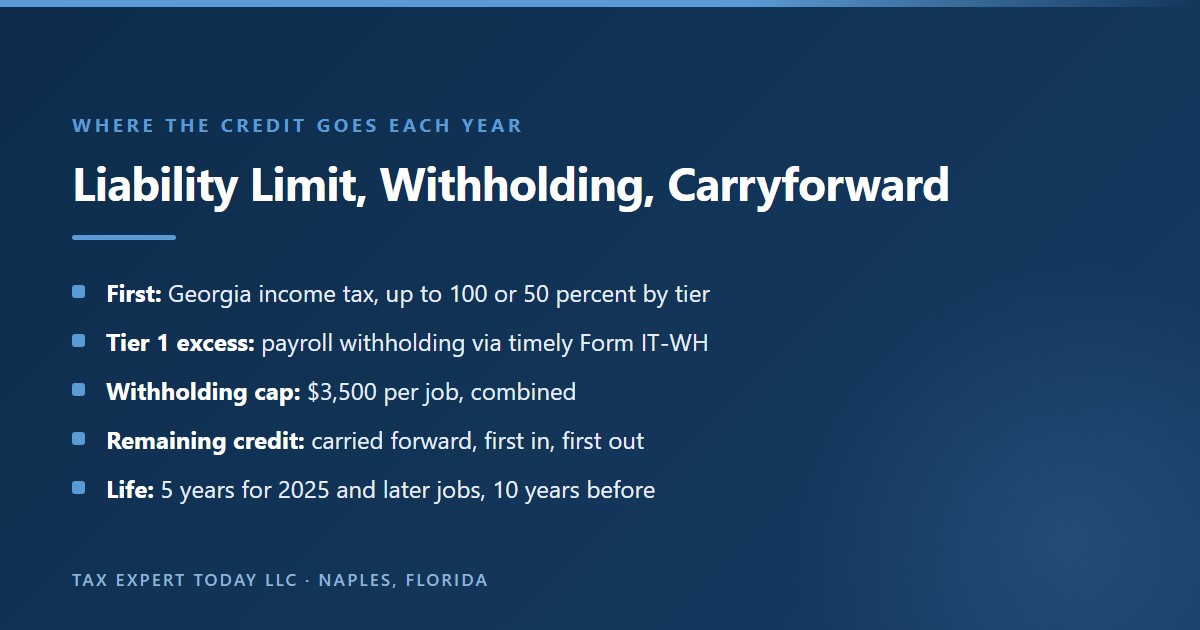
In Tier 1 and Tier 2 counties and less developed census tracts, the credit can offset up to 100 percent of the Georgia income tax attributable to Georgia operations. In Tier 3 and Tier 4 counties, it is limited to 50 percent of that liability each year. Unused credit carries forward.
- Tier 1 and Tier 2: up to 100 percent of Georgia income tax liability.
- Census tract areas: up to 100 percent under O.C.G.A. 48-7-40.1(h).
- Tier 3 and Tier 4: up to 50 percent of Georgia income tax liability.
- Liability measured: the tax attributable to income from operations in Georgia.
- Excess: carried forward, or applied to withholding where allowed.
The limits are in O.C.G.A. 48-7-40(h). In Tier 3 and Tier 4, the credit taken in any one taxable year cannot exceed 50 percent of the taxpayer’s state income tax liability attributable to income from Georgia operations. In Tier 1 and Tier 2, the limit is 100 percent of that liability. O.C.G.A. 48-7-40.1(h) applies the 100 percent limit to less developed census tract areas. The Department of Revenue page summarizes the same rules. On the 2025 Form IT-CA, Line 16 is the tax liability before the credit, Line 17 is the maximum allowable credit at 50 or 100 percent, Line 18 is the lesser of the available credit and the maximum, and Line 19 is the unused credit to carry forward.
The limit is a common reason a large gross credit produces a small current benefit. With Georgia’s flat income tax rate reduced to 4.99 percent for 2026, according to the Department of Revenue’s Important Tax Updates page, a company needs substantial Georgia taxable income to absorb a sizable credit. A Tier 3 company with $25,000 of credit and $30,000 of Georgia income tax (hypothetical figures) can use only $15,000 this year and must carry $10,000 forward. A company with losses or heavy deductions may generate credits it cannot use for years, which is where the shorter carryforward bites.
The Tier 1 rules are the most generous because they add a second outlet: payroll withholding. Tier 2, Tier 3, and Tier 4 businesses can use that outlet only for competitive projects certified by the commissioner of economic development, as the next section explains.
How Does the Georgia Jobs Tax Credit Withholding Benefit Work?
In Tier 1 counties, less developed census tracts, Opportunity Zones, and Military Zones, credit that exceeds income tax liability can be applied against the company’s Georgia payroll withholding, up to $3,500 per job. The company must file Form IT-WH in the Georgia Tax Center within 30 days of its return or the return’s due date, whichever comes first.
- Where available: Tier 1, census tract areas, Opportunity Zones, Military Zones, and certified competitive projects.
- Order: income tax liability first, withholding second.
- Cap: $3,500 per job per year, combined with the income tax credit.
- Filing: Form IT-WH Notice of Intent through the Georgia Tax Center, on time.
- Not allowed: on carryforwards or on an amended return.
The withholding benefit lets a company with little or no income tax still get cash value from the credit. O.C.G.A. 48-7-40(e)(1) allows the excess credit in a Tier 1 county to be taken against the business’s quarterly or monthly withholding payments under O.C.G.A. 48-7-103, not to exceed $3,500 per new job when combined with the credit used against income tax. For competitive projects certified by the commissioner of economic development, the same paragraph allows withholding use in Tier 2 when the credit exceeds the liability, and in Tier 3 and Tier 4 when it exceeds 50 percent of the liability, capped at $2,500 per job. The statute also protects employees: each employee still receives full credit on his or her own return for the tax withheld, and the withholding credit is not income to the employer.
The procedure runs through the Department of Revenue’s IT-WH Electronic Notice of Intent page. Since tax years beginning January 1, 2017, the IT-WH must be filed in the Georgia Tax Center, and paper filing is not allowed. The page lists requirements: a corporate account, a withholding account that is valid and in compliance, no missing returns, and no outstanding liabilities. In the Georgia Tax Center, the filer goes to the Summary tab, selects Manage My Credits next to the corporate income tax account, chooses Claim Withholding Tax Benefit, enters the taxpayer and credit information, verifies, and submits.
The Department of Community Affairs Tier 1 fact sheet adds the timing. The IT-WH Notice of Intent must be filed within 30 days after the due date of the income tax return, including extensions, or within 30 days after a timely filed return, whichever occurs first. Failure to file as provided results in disallowance of the withholding benefit. The Department of Revenue has 120 days to review after the return is filed and then notifies the business of the approved amount and when to begin claiming it on its withholding returns. The fact sheet also states that a carryforward of the job tax credit cannot be applied to withholding, withholding cannot be claimed on an amended return, and no refund is paid on unused withholding credits.
Pass-through entities have a choice. The fact sheet says a flow-through entity may elect to claim a specific portion of the credit against its own payroll withholding and pass the rest through to its owners, and that the election is annual and irrevocable. The approved withholding credit then shows up as a reduction on the company’s withholding returns, which our Georgia Form G-7 guide and Georgia withholding tax guide cover in more detail.
What Changed for Georgia Jobs Tax Credit Carryforwards in 2025?
For jobs created on or after January 1, 2025, unused Georgia jobs tax credit may be carried forward for five years from the close of the tax year the jobs were established. Credit for jobs created before 2025 keeps the prior ten-year carryforward. Form IT-CA tracks the two groups separately.
- Jobs created before 2025: ten-year carryforward, credit code 103.
- Jobs created in 2025 and later: five-year carryforward, credit code 157.
- Separate lines: IT-CA Lines 11a and 12a for older jobs, 11b and 12b for newer ones.
- Ordering: first in, first out, unless another method is explained.
- Practical effect: less time to absorb credits in loss years.
| Item | Jobs created before January 1, 2025 | Jobs created on or after January 1, 2025 |
|---|---|---|
| Department of Revenue credit code | 103 | 157 |
| Carryforward period | 10 years from the close of the year the jobs were established | 5 years from the close of the year the jobs were established |
| IT-CA job count line | 11a | 11b |
| IT-CA credit line | 12a | 12b |
| Annual credit amounts | Unchanged: $3,500, $2,500, $1,250, $750 | Unchanged: $3,500, $2,500, $1,250, $750 |
The Department of Revenue page states that a credit claimed but not used may be carried forward ten years from the close of the taxable year in which the qualified jobs were established, and that for taxable years beginning on or after January 1, 2025, credits generated but not used may be carried forward five years. The 2025 IT-CA instructions for Line 19 say the same thing in job terms: unused credits for jobs created after January 1, 2025, carry forward five years, and jobs created before that date keep the ten-year carryforward. The instructions direct filers to use the first-in, first-out method to decide which credits expire first and to explain any other method.
The annual credit amounts did not change. What changed is how long a business has to use them. For a company in a loss position, or one whose credits outrun its liability every year because of the 50 percent limit in Tier 3 and Tier 4, the shorter window can turn a valuable credit into an expiring one. Modeling the expected use of each year’s credit before committing to a site or a hiring schedule is now more important than it was under the ten-year rule. The online version of the statute on FindLaw is current as of March 28, 2024 and still shows the ten-year language, so rely on the Department of Revenue page and the current form for the 2025 change.
How Do You Claim the Georgia Jobs Tax Credit on Form IT-CA?
The Georgia jobs tax credit is claimed on Form IT-CA, submitted electronically with the Georgia income tax return. The form certifies the location, tier, and industry, reports month-end full-time employee counts, computes the average increase and credit, applies the liability limit, and tracks carryforwards.
- Part I: certification of the business, the county or tract, the tier, the site address, and NAICS codes.
- Opportunity Zone and Notice of Intent: lines 7a and 7b, with certifications attached.
- Transfers: line 8 asks whether benefits came by transfer from another company.
- Job count and credit: monthly totals, averages, jobs by creation date, bonus, and liability limit.
- Electronic only: the form must be submitted with the e-filed return.
The 2025 Form IT-CA (Rev. 01/23/26) is posted on the Department of Revenue IT-CA page. Its heading says it is used by taxpayers who initially claim the credit for any taxable year beginning on or after January 1, 2025, and that it must be submitted electronically with the return at the time the return is electronically filed. Part I asks for the business name and FEIN, the county or census tract, the tier, any specialty zone, the street address of each site where jobs were created, the NAICS or SIC codes for the products or services at those sites, the credit period, and the tax year if different.
Separate Sections II through IV must be filed for each eligible county or census tract area. Part II reports the number of full-time jobs at the end of each month of the fiscal year. Parts III through V carry the computation, using Year 1 as the year of the job increase and the Prior Year as the year before. The form says that to complete it, the filer must obtain the program regulations from the Department of Community Affairs, and it lists the governing rules: O.C.G.A. 48-7-40, 48-7-40.1, and 36-62-5.1, Department of Community Affairs Rules 110-9-1-.01 through .03, and Department of Revenue Rule 560-7-8-.36.
The form is attached to whatever Georgia income tax return the business files: Form 600 for a C corporation, Form 600S for an S corporation, Form 700 for a partnership, or Form 500 for a sole proprietor. Our guides to Georgia Form 600S and Georgia Form 700 cover where credits appear on those returns and how they pass to owners.
What Is the Deadline to Claim the Georgia Jobs Tax Credit?
The credit must be claimed within one year of the earlier of the date the original return was filed or its due date, including extensions. That is much shorter than the usual three-year amendment window, and the withholding benefit can never be claimed on an amended return.
- Claim window: one year under O.C.G.A. 48-7-40(j).
- Starting point: the earlier of the filing date or the due date with extensions.
- Overrides: the general refund limitation in O.C.G.A. 48-2-35.
- Amended returns: allowed within the one-year window for the income tax credit only.
- Withholding: original, timely return only.
O.C.G.A. 48-7-40(j) says that, notwithstanding the general statute of limitations for refunds in O.C.G.A. 48-2-35, any credit under the section must be claimed within one year of the earlier of the date the original return was filed or the date it was due under O.C.G.A. 48-7-56(a), including any approved extensions. The Department of Revenue page puts it plainly: the credit must be claimed within one year instead of the normal three-year statute of limitations period. The Department of Community Affairs overview says the credit may be filed on an amended return within one year of the original, timely filed return.
This rule regularly costs businesses money. A company that discovers in year two that it qualified for the credit in year one may already be outside the window. A calendar-year corporation that filed its 2025 Form 600 early, on March 1, 2026, would have until March 1, 2027 to amend for the credit, even though its extended due date was later in 2026. If you think you may have missed the credit for a recent year, the timing should be checked immediately. Our Georgia amended tax return guide explains the amendment mechanics, but the one-year limit for this credit controls over the general rules described there.
How Does a Full Georgia Jobs Tax Credit Calculation Work?
A full calculation counts the average increase in full-time jobs by county, confirms the tier threshold, multiplies qualifying jobs by the tier amount, adds any Joint Development Authority bonus and unused prior credit, applies the 50 or 100 percent liability limit, and carries the rest forward or, in Tier 1, to withholding.
- Step 1: compute the monthly average of full-time employees for the current and prior years.
- Step 2: confirm the increase meets the tier minimum in that county or tract.
- Step 3: test each counted job for hours, wage, and health insurance.
- Step 4: multiply qualifying jobs by the tier amount and add bonuses and carryforwards.
- Step 5: apply the liability limit and route the excess.
The three examples below use hypothetical figures to show how the same rules produce very different results depending on the tier and the company’s tax position. None reflects an actual client. Each assumes the counted jobs meet the 35-hour, wage, and health insurance tests and that the jobs were created in 2026, so the five-year carryforward applies.
| Hypothetical item | A: Tier 2 manufacturer | B: Tier 3 distributor | C: Tier 1 processor |
|---|---|---|---|
| Average increase in full-time jobs | 12 | 20 | 6 |
| Tier minimum | 10 | 15 | 2 |
| Credit per job | $2,500 | $1,250 | $3,500 |
| Gross credit for 2026 | $30,000 | $25,000 | $21,000 |
| Georgia income tax before credit | $40,000 | $30,000 | $5,000 |
| Liability limit | 100 percent = $40,000 | 50 percent = $15,000 | 100 percent = $5,000 |
| Credit used against income tax | $30,000 | $15,000 | $5,000 |
| Excess | $0 | $10,000 carried forward up to 5 years | $16,000 to withholding if IT-WH is filed on time; otherwise carried forward |
Company A shows the clean case: the credit fits inside the liability and is used in full. If its county belonged to a qualifying Joint Development Authority, Line 14 of the IT-CA would add $500 for each of the 12 jobs. Company B shows the 50 percent limit at work in Tier 3. It earned $25,000 but can use only $15,000 this year, and the remaining $10,000 starts a five-year clock. If its Georgia income stays flat, next year’s own credit will compete with that carryforward for the same 50 percent space, so a careful projection matters.
Company C shows why Tier 1 is valuable for a business with modest profits. Its $21,000 credit exceeds its $5,000 income tax, but because the jobs are in a Tier 1 county, the $16,000 excess can go to payroll withholding, up to $3,500 per job when combined with the income tax credit. Six jobs times $3,500 is $21,000, so the full excess fits under the cap. The benefit depends entirely on filing Form IT-WH in the Georgia Tax Center within the 30-day window. Miss it, and the excess becomes a carryforward that can never be used against withholding.
Each example then repeats for years two through five, provided the jobs are maintained and the average increase stays at or above the tier minimum. If Company B’s average increase over its 2025 base drops to 14 in 2028, it earns no credit for 2028 under the Tier 3 rule, while its 2026 and 2027 credits, and any carryforward from them, are unaffected.
How Do Pass-Through Owners Use the Georgia Jobs Tax Credit?
Partnerships, S corporations, and LLCs taxed as either compute the Georgia jobs tax credit at the entity level on Form IT-CA, and the credit flows through to members, partners, or shareholders. Owners use their share against their own Georgia income tax, subject to the same tier limits and carryforward rules.
- Computed by the entity: job counts, tiers, and thresholds are tested at the business level.
- Flows to owners: under the Department of Community Affairs overview and the statute.
- Withholding split: an entity may keep part for payroll withholding and pass the rest through.
- Owner limits: each owner needs Georgia income tax liability to use the credit.
- Nonresident owners: usable only against their Georgia tax, such as on a nonresident return.
The Department of Community Affairs overview states that the credit can be claimed by an eligible business as long as it is subject to income tax in Georgia, and that for flow-through entities, the credit is claimed by filing Form IT-CA with the Georgia income tax filing and then flows through to the members, partners, or shareholders. The business-level tests, including the threshold, the industry, and the establishment, are applied to the entity. The owners do not each have to create jobs.
The flow-through matters for owners who live outside Georgia, including Florida residents who own Georgia operating companies. A nonresident owner can use a flowed-through credit only against Georgia income tax, which usually means the tax on a Georgia nonresident return or on the owner’s share of a composite return. If the owner’s Georgia liability is small, much of the credit may go unused before the five-year window closes. Two planning points follow. First, a Tier 1 entity may be better off using the withholding election at the entity level for part of the credit. Second, if the entity has elected the pass-through entity tax, the interaction between the entity-level tax and the flowed-through credit should be modeled before filing. Our guides to the Georgia pass-through entity tax and Georgia composite returns explain those structures.
Employers that are retraining the workforce they already have, rather than adding jobs, may find a separate credit more relevant. Our guide to the Georgia employee retraining tax credit covers TCSG approval, the $500 per program and $1,250 annual limits, Form IT-RC, and the five-year carryforward for credits generated in 2025 and later.
Can You Combine the Georgia Jobs Tax Credit With Other Georgia Credits?
Not for the same jobs under the quality jobs credit: a taxpayer that claims the quality jobs credit must elect not to take the jobs tax credit for those jobs. Other credits, such as the research credit, the film credit, or the retraining credit, follow their own rules and can often coexist with the jobs tax credit.
- Quality jobs credit: mutually exclusive for the same jobs.
- Investment credits: separate elections and limits under their own Code sections.
- Research credit: based on research spending, not job counts.
- Retraining credit: based on approved retraining costs for existing employees.
- Total liability: every credit still competes for the same Georgia tax.
The Georgia quality jobs tax credit is the closest cousin and the most common source of confusion. It pays more per job for higher-wage positions and requires a larger number of jobs. Our Georgia quality jobs tax credit guide explains its rules in full, including that jobs claimed under the job tax credit in O.C.G.A. 48-7-40 and 48-7-40.1 are excluded from all quality jobs calculations. A company planning a large, high-wage project should model both programs before the first return, because the choice is effectively made by claiming one of them.
Other credits work on different bases. The research credit uses qualified research spending, and our Georgia R&D tax credit guide covers its withholding election. The film credit uses production spending, covered in our Georgia film tax credit guide. The retraining credit, under O.C.G.A. 48-7-40.5, reimburses part of the cost of approved retraining programs for existing employees. Even where credits can be claimed together, they all compete for the same Georgia income tax liability, and each has its own limits and carryforward. Stacking credits without a projection can leave the shortest-lived credit unused.
Two related credits are gone for taxable years beginning on or after January 1, 2026. House Bill 463 repealed the supplemental credit for personal protective equipment manufacturers in O.C.G.A. 48-7-40.1A and the headquarters credit in O.C.G.A. 48-7-40.18, as our Georgia corporate tax rate guide explains. Some Department of Community Affairs fact sheets dated July 2025 still describe the $1,250 supplemental credit for those manufacturers, so check the effective date before relying on it. The statewide credit in O.C.G.A. 48-7-40 and 48-7-40.1 was not on that repeal list.
What Happens to the Georgia Jobs Tax Credit When a Business Is Sold, Merged, or Moved?
A sale, merger, acquisition, or bankruptcy does not create new eligibility for the successor, so jobs that already existed are not new jobs to the buyer. Unused jobs tax credit, however, may be transferred to and continued by the transferee, and Form IT-CA asks whether benefits came by transfer.
- No fresh start: acquired jobs are not net new jobs for the buyer.
- Transferable credit: unused credit may follow the business to the transferee.
- Disclosure: IT-CA line 8 asks about transfers and requires an explanation.
- Moves within Georgia: relocated jobs are transferred jobs and do not count.
- Same county moves: relocations within the same county or tract area are not treated as transfers.
O.C.G.A. 48-7-40(g) is short: the sale, merger, acquisition, or bankruptcy of any business enterprise does not create new eligibility in any succeeding business entity, but any unused job tax credit may be transferred and continued by any transferee of the business enterprise. The same subsection authorizes the commissioner of community affairs to decide whether qualifying increases or decreases have occurred and to require reports and hold hearings. For a buyer, that means two things. Acquired employees do not become net new jobs on the buyer’s return, and the seller’s remaining credit may be an asset worth valuing and documenting in the deal.
Moves inside Georgia are governed by the transferred job rule. Relocating a plant from one Georgia county to another usually produces transferred jobs that cannot be counted at the new site, even if the new county is in a better tier. The regulation also treats a substantially similar job created at a location where the business or a related business stopped operations for six months or less as a transferred job. A business planning a consolidation should map the job counts by county for both the closing site and the receiving site before announcing the move.
When a business changes hands, the buyer will also want to confirm the seller’s Georgia accounts are current. Our Georgia tax clearance letter guide explains how the Department of Revenue’s clearance process works and why buyers rely on it, and the same review is a natural place to document the seller’s job tax credit history and carryforwards.
What Records Support a Georgia Jobs Tax Credit Claim?
Keep monthly full-time employee counts by establishment, payroll and W-2 records showing hours and wages, proof that health insurance was offered, the county tier or tract designation in effect, NAICS support for the site’s activity, any certifications or Notices of Intent, and a carryforward schedule by job creation year.
- Headcount: month-end full-time counts by county or tract for the base year and every credit year.
- Hours and pay: time records and Forms W-2 for each counted employee.
- Health insurance: plan documents and offer records for each new hire.
- Location and activity: the tier map, address check, and NAICS classification.
- Filings: IT-CA, IT-WH confirmations, Opportunity Zone certification, and any Notice of Intent.
Because the program has no advance approval, the Department of Revenue tests the claim after the fact, and the employer carries the burden of showing that each element was met. The best records are built during the year, not reconstructed after the return. Month-end headcount by establishment should come from payroll data tied to Georgia withholding, since the statute counts only employees subject to Georgia income tax withholding. The record for each counted job should show the start date, the weekly hours, total W-2 wages for each year of the credit, and the date health insurance was offered.
Keep a copy of the tier map and ranking memo for the year each layer of jobs was created, a printout of the interactive map check for each site address, and support for the NAICS code of each establishment. If a site mixes qualifying and nonqualifying activity, keep a record of which employees work in the qualifying activity. For Tier 1 withholding claims, keep the IT-WH submission confirmation and the Department of Revenue approval notice. Finally, maintain a running schedule of credits generated, used, carried forward, and expiring, split between pre-2025 jobs with a ten-year life and 2025 and later jobs with a five-year life.
What Are the Most Common Georgia Jobs Tax Credit Mistakes?
The most common mistakes are using a year-end headcount instead of the monthly average, counting transferred or contractor positions, missing the annual wage floor, adding jobs across counties to meet one threshold, missing the one-year claim window or the IT-WH deadline, and ignoring the new five-year carryforward.
- Wrong count: year-end headcount instead of a twelve-month average.
- Ineligible positions: contractors, transferred jobs, and combined part-time hours.
- Stale wage floor: using last year’s figure when the 2026 floor rose to $36,608.
- Aggregated counties: combining sites to reach a single threshold.
- Missed deadlines: the one-year claim window, the IT-WH filing, and the Notice of Intent.
Several other errors appear often enough to name. Some businesses assume the credit is available to any employer and claim it for retail or professional service jobs outside the bottom 40 counties and the special zones. Others claim the Tier 1 amount for a site that sits in a Tier 3 county without checking whether a less developed census tract actually covers the address. Some forget that the wage test applies in every year of the five-year period, so a job that met the floor when created can stop qualifying in a later year if pay does not keep pace.
A final group of mistakes involves interactions. Claiming both the jobs tax credit and the quality jobs credit for the same positions is not allowed. Applying a carryforward against payroll withholding is not allowed. Filing the withholding benefit on an amended return is not allowed. And treating a sale as a fresh start for the buyer’s job counts is not allowed. Each of these errors is avoidable with a short review before the return is filed, which is far cheaper than defending the claim later.
Georgia Jobs Tax Credit Help in Naples & Southwest Florida
Tax Expert Today LLC advises on the Georgia jobs tax credit from its office in Naples, Florida, and serves Georgia employers and their owners nationwide and remotely. We review job counts and tier designations, prepare Form IT-CA support, track carryforwards by creation year, and coordinate the Tier 1 withholding filing.
- Office: 11983 Tamiami Trail N, Naples FL 34110.
- Phone: (239) 441-2005.
- Hours: Monday through Friday, 10 a.m. to 5 p.m. Eastern.
- Georgia jobs tax credit help Naples: Naples and Southwest Florida in person, Georgia and all 50 states remotely.
Many owners in Southwest Florida run or invest in Georgia manufacturing, distribution, and processing businesses from here. For them, the Georgia jobs tax credit is often a question about how much of a flowed-through credit they can actually use on a Georgia nonresident return, and whether the entity should keep part of it for payroll withholding instead. We work as tax advisors on state tax matters nationwide, and a credit review usually connects to the owner’s entity structure, Georgia filing position, and Florida planning. For the full range of our Georgia work, see the Georgia tax services page. Owners weighing an expansion or a move can also start with our Naples tax planning page.
We work alongside the business’s payroll provider, economic development contacts, and attorneys rather than replacing them. Site selection negotiations and discretionary incentive agreements belong with the company’s development team and counsel. Our role is the tax side: whether the statutory tests are met, how the credit is computed and documented, which filings and deadlines apply, and how the credit fits with the company’s other Georgia credits and its owners’ returns.
When to Engage a Professional
Engage a tax professional before a Georgia expansion or relocation, when a county’s tier changes, when job counts sit near a threshold, when credits exceed liability and the withholding election or carryforward life matters, or when a recent return may have missed the credit and the one-year claim window is still open.
- Before hiring: mapping sites against tiers, tracts, and zones.
- Ranking changes: deciding whether a Notice of Intent is needed.
- Near thresholds: timing hires so the monthly average clears the minimum.
- Excess credit: planning the IT-WH filing and the five-year carryforward.
- Missed credits: amending within the one-year window.
Tax Expert Today LLC reviews Georgia credit positions as part of our wider state and federal tax practice. Our Georgia tax help covers job tax credit computations, Form IT-CA preparation support, withholding elections, carryforward schedules, and coordination with owners’ Georgia returns. We are tax advisors, enrolled agents, CPAs, and attorneys serving clients in all 50 states. Call (239) 441-2005, Monday through Friday, 10 a.m. to 5 p.m. Eastern.
Frequently Asked Questions About the Georgia Jobs Tax Credit
What is the Georgia jobs tax credit?
It is a Georgia income tax credit for eligible businesses that create net new full-time jobs. The credit is $3,500, $2,500, $1,250, or $750 per job per year depending on the tier of the county or tract, and it can be claimed for five years for each maintained job.
How many jobs do I need to create to qualify?
At least an average of two net new jobs in a Tier 1 county, Opportunity Zone, or Military Zone; five in a less developed census tract; ten in Tier 2; 15 in Tier 3; and 25 in Tier 4. The increase must be met in a single county or tract area within one tax year.
What is the minimum wage for a job to count in 2026?
For tax years beginning in 2026, the Department of Community Affairs lists the lowest county average wage as Quitman County at $704 a week, or $36,608 a year. Total W-2 wages, including bonuses, are compared with that figure in each year of the credit.
Do retail businesses qualify for the Georgia jobs tax credit?
Generally not. Retail businesses are excluded from the eligible industries, except in the 40 least developed counties in Tier 1 and in Opportunity Zones, Military Zones, and pervasive poverty areas, where any lawful business may qualify.
Is there an application for the Georgia jobs tax credit?
No. The business qualifies by meeting the statutory tests and claims the credit on Form IT-CA with its electronically filed Georgia return. The exceptions are State Opportunity Zones, which require an accepted certification first, and the Tier 1 withholding benefit, which requires a timely Form IT-WH.
How long can unused Georgia jobs tax credits be carried forward?
Credits for jobs created on or after January 1, 2025 carry forward for five years from the close of the tax year the jobs were established. Credits for jobs created earlier keep a ten-year carryforward. Form IT-CA reports the two groups on separate lines.
Can the credit be used against payroll withholding?
Yes, in Tier 1 counties, less developed census tracts, Opportunity Zones, Military Zones, and certified competitive projects. Excess credit can offset withholding, up to $3,500 per job, if Form IT-WH is filed in the Georgia Tax Center within 30 days of the return or its due date, whichever is first.
Can I amend a prior Georgia return to claim the jobs tax credit?
Only within one year of the earlier of the date the original return was filed or its due date, including extensions. That limit replaces the usual three-year window, and the withholding benefit cannot be claimed on an amended return.
Can a Naples, Florida tax firm help with the Georgia jobs tax credit?
Yes. Tax Expert Today LLC works from its office at 11983 Tamiami Trail N in Naples, Florida, and serves Georgia employers and owners remotely. We review job counts and designations, support Form IT-CA preparation, and plan withholding elections and carryforwards. Call (239) 441-2005, Monday through Friday, 10 a.m. to 5 p.m. Eastern.
This article is general information about Georgia tax rules as of its publication date and is not tax or legal advice for any particular situation. Figures in examples are hypothetical. Results depend on the facts of each case, and Georgia law, county designations, and agency guidance may change.
Published November 17, 2026 by Dr. Pellumb Kabashi « Back to Learning Center
Have a question this article touches on?
Tax Expert Today LLC, based in Naples, Florida and serving clients across the United States.
Schedule a Consultation (239) 441-2005