
By Dr. Pellumb Kabashi, DBA, MBA, EA, CFE, CES
Founder, Tax Expert Today LLC · Tax advisors, enrolled agents, CPAs, and attorneys · Serving clients in all 50 states
Quick Answer: The Georgia employee retraining tax credit equals half of the direct cost of an approved retraining program, up to $500 per full-time employee per program and $1,250 per employee per year. The Technical College System of Georgia must approve the training, the credit is claimed on Form IT-RC, it cannot exceed 50 percent of Georgia tax, and credits generated from 2025 carry forward five years. Call (239) 441-2005 for a free consultation.
Most Georgia business credits reward something new: a new job, a new building, new research spending. The Georgia employee retraining tax credit is different. It rewards an employer for investing in the people it already has, when new equipment, new technology, or new processes would otherwise leave those workers behind. The Department of Revenue lists it as credit code 102, the Employer’s Credit for Approved Employee Retraining, and it has been on the books under O.C.G.A. 48-7-40.5 since the 1990s.
The credit is modest per employee, but it is not limited to particular industries or particular counties, and it does not require the business to add a single job. A manufacturer installing a new production line, a hospital moving to a new imaging platform, a distributor adopting a new warehouse management system, or a software support team learning the product it services can all fall within the program if the training is approved and the paperwork is right. That last condition is where most claims succeed or fail. The training has to be approved and certified by the Technical College System of Georgia, the employees have to meet a statutory definition, the cost has to fit a narrow definition, and the claim has to be filed within a one-year window that is shorter than the usual statute of limitations.
This guide walks through each requirement with the Code section, Department of Revenue page, form, or policy statement behind it. It includes a line-by-line walkthrough of Form IT-RC, the Department’s rule for combining classes, the 2025 change that cut the carryforward from ten years to five, and worked examples using hypothetical figures. It also explains how the retraining credit fits with the Georgia jobs tax credit, the quality jobs credit, and the research credit, which all draw on the same Georgia income tax liability.
What Is the Georgia Employee Retraining Tax Credit?
The Georgia employee retraining tax credit is a state income tax credit for employers that provide or sponsor retraining programs approved by the Technical College System of Georgia. It equals half of the direct cost of retraining, capped at $500 per full-time employee per program and $1,250 per employee per year.
- Legal basis: O.C.G.A. 48-7-40.5.
- Department of Revenue code: credit code 102.
- Approval body: the Technical College System of Georgia (TCSG) approves and certifies the training.
- How it is claimed: Form IT-RC with the Georgia income tax return, plus the signed Program Completion Form.
- Who benefits: any employer subject to Georgia income tax, in any industry and any county.
The Department of Revenue’s credit page summarizes the program in one sentence: the credit “allows employers to claim certain costs of retraining employees to use new technology.” That phrase, new technology, is the heart of the program. The statute frames approved retraining as training that enhances the functional skills of employees who could not otherwise function effectively on the job because of skill deficiencies, or who would otherwise be displaced because those deficiencies would keep them from using new technology.
Three features set the Georgia employee retraining tax credit apart from the larger Georgia incentives. First, it is not tied to job creation. A business can hold its headcount flat, or even shrink, and still claim the credit for retraining the workers it keeps. Second, it is not tied to geography. The county tier system that drives the Georgia jobs tax credit plays no role here. Third, it does require advance approval of the training itself, which makes it an application-style credit at the program level even though the dollar amount is computed by the employer on its own return.
Which Employers Can Claim the Georgia Employee Retraining Tax Credit?
Any employer on which Georgia income tax is imposed can claim the credit. That includes C corporations, and through pass-through treatment the owners of S corporations, partnerships, and LLCs taxed as partnerships. Industry and location do not matter, but the employer must provide or sponsor the approved retraining and must not charge employees for it.
- Statutory test: an employer “upon whom an income tax is imposed” by Chapter 7 of Title 48.
- Corporations: claim the credit against Georgia corporate income tax.
- Pass-through entities: the Department says the benefit usually passes through to shareholders or partners.
- Sole proprietors: claim against their own Georgia individual income tax.
- Exempt organizations: generally have no Georgia income tax for the credit to offset.
O.C.G.A. 48-7-40.5(a)(4) defines an employer simply as “any employer upon whom an income tax is imposed by this chapter.” The definition is broad on purpose. Unlike the jobs tax credit, which lists eligible industries such as manufacturing, warehousing and distribution, processing, and telecommunications, the retraining credit has no industry list. A professional services firm, a retailer, a medical practice, or a construction company can qualify on the same terms as a manufacturer, provided the training meets the approval standard.
The practical limit is liability. A credit is only useful if there is Georgia income tax to offset, and this credit is further limited to half of that tax. An employer with Georgia losses, or with liability already absorbed by other credits, may generate a retraining credit it cannot use in the current year. Those credits move into the carryforward, which is now five years for credits generated in tax years beginning on or after January 1, 2025.
For pass-through entities, the General Business Credits FAQ answers the most common question directly: the benefits of credits earned by S corporations or partnerships are usually passed through to the shareholders or partners. That makes the credit relevant to owners who live outside Georgia, including Florida residents who own Georgia operating businesses and file Georgia nonresident returns. We cover that situation in its own section below.
Which Employees Count for the Credit?
An employee counts only if he or she lives in Georgia, works at least 25 hours a week, and has been continuously employed by the employer for at least 16 consecutive weeks. The credit is computed only for employees who successfully complete an approved program, and the amount is stated per full-time employee.
- Residence: the employee must be “resident in this state.”
- Hours: at least 25 hours a week.
- Tenure: at least 16 consecutive weeks of continuous employment with the employer.
- Completion: credit is allowed only for employees who successfully complete the program.
- Not eligible: trainees who drop out, fail the TCSG completion measure, or are new hires below 16 weeks.
The definition in O.C.G.A. 48-7-40.5(a)(3) is short, and each part does real work. The residence requirement means that an employee who works at a Georgia plant but lives across the state line in Alabama, Tennessee, South Carolina, or Florida does not count, even if he or she completes the training. Employers near a border should identify residence before training begins, not after.
The 16-week tenure rule is aimed at incumbent workers. The program is about retraining people the business already employs, so a new hire in onboarding generally does not fit, both because of tenure and because onboarding is not retraining on new technology. A worker hired at the start of a project may become eligible once he or she passes the 16-week mark, if the approved training takes place after that point.
The completion requirement ties into the standards TCSG sets under subsection (e), which include “standardized measures of employee evaluation to determine successful completion of a course of study.” The Program Completion Form that must be attached to Form IT-RC is the evidence that each employee met that measure. An employee who attends some sessions but does not complete the program generates no credit, even though the employer paid for his or her seat.
One drafting point deserves attention. The definition of employee requires only 25 hours a week, but subsection (b) states the credit amount “per full-time employee.” The Department’s page and Form IT-RC use the same full-time language. In practice the 25-hour threshold is the floor the statute sets for who counts, and employers should document weekly hours for every trainee so the claim can show that each one met it.
What Training Counts as Approved Retraining in Georgia?
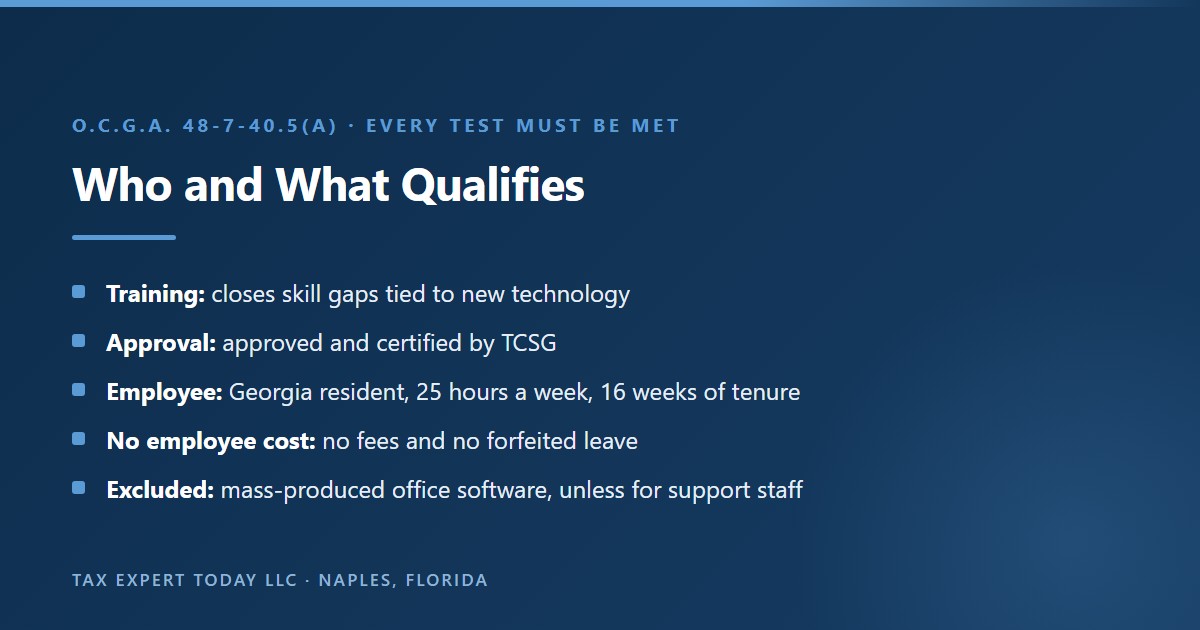
Approved retraining must enhance the functional skills employees need to use new technology or avoid displacement, must be approved and certified by the Technical College System of Georgia, and must cost the employee nothing. Training on mass-produced office software is excluded unless the trainees provide support or training on that software.
- Purpose test: closes skill deficiencies tied to job performance or to new technology.
- Approval test: approved and certified by TCSG under its program standards.
- No employee cost: no direct payment, and no forfeited leave, vacation, or other compensable time.
- Software exclusion: word processing, databases, presentations, spreadsheets, email, personal information management, and operating systems.
- Support exception: the excluded software qualifies for employees who provide support or training on it.
The definition in O.C.G.A. 48-7-40.5(a)(1) has three conditions, and all three must be met. The first is substantive. The training must enhance “the functional skills of employees otherwise unable to function effectively on the job due to skill deficiencies or who would otherwise be displaced because such skill deficiencies would inhibit their utilization of new technology.” That language fits equipment changes, process changes, and technology upgrades well. It fits general professional development, leadership courses, or soft skills workshops poorly, which is why secondary sources consistently describe management and soft skills training as outside the program.
The second condition is approval. The training must be “approved and certified by the Technical College System of Georgia.” Subsection (e) directs TCSG to set the standards, including “required hours of classroom instruction, required courses, certification of teachers or instructors, progressive levels of instruction, and standardized measures of employee evaluation.” In other words, TCSG approval is not a rubber stamp on a vendor invoice. It is a review of a structured program with defined hours, qualified instructors, and a way to measure whether each trainee succeeded.
The third condition protects employees. The employer may not require the employee “to make any payment for the retraining, either directly or indirectly through use of forfeiture of leave time, vacation time, or other compensable time.” Subsection (b) repeats the point: no credit is allowed if the employer requires the employee to reimburse or pay for the training. A training repayment agreement that claws back course costs if the employee leaves within a set period deserves a careful look before a claim is filed, because it can read as a required payment.
The software exclusion is quoted nearly word for word on the Department of Revenue page. A company rolling out a new version of a common office suite to its staff will not qualify for that training. A company training its help desk staff to support that same office suite can qualify, because the statute makes an exception for “those providing support or training on such software.” Specialized software is a different matter. Training on an enterprise resource planning system, a computer-aided design platform, a manufacturing execution system, or clinical software is not commercially mass-produced office software of the listed kinds, and it can fit within the program if TCSG approves it.
| Training scenario (hypothetical) | Likely treatment | Why |
|---|---|---|
| Machine operators trained on a new CNC line | Can qualify | New technology, functional skills, if TCSG approves the program |
| Warehouse staff trained on a new warehouse management system | Can qualify | Specialized software tied to new technology, not listed office software |
| All office staff trained on a new spreadsheet version | Excluded | Mass-produced spreadsheet software is expressly excluded |
| Help desk staff trained to support that spreadsheet software | Can qualify | The statute excepts employees who provide support or training on the software |
| Supervisors in a general leadership course | Generally not | Not tied to skill deficiencies with new technology |
| Training where employees use vacation days to attend | Excluded | Forfeiture of vacation time is an indirect payment by the employee |
What Costs Count as the Cost of Retraining?
The cost of retraining means direct instructional costs as TCSG defines them, including instructor salaries, materials, supplies, and textbooks. The statute expressly excludes the cost of renting or otherwise securing space. Costs the employee pays, directly or through forfeited leave, disqualify the training rather than reducing the credit.
- Included by statute: instructor salaries, materials, supplies, and textbooks.
- Defined by TCSG: the statute adopts TCSG’s definition of direct instructional costs.
- Excluded by statute: costs of renting or otherwise securing space.
- Disputed items: trainee wages and travel, which some secondary sources list as eligible.
- Evidence: invoices, instructor contracts, and payroll for in-house instructors, by program.
O.C.G.A. 48-7-40.5(a)(2) defines the cost of retraining as “direct instructional costs as defined by the Technical College System of Georgia including instructor salaries, materials, supplies, and textbooks but specifically excluding costs associated with renting or otherwise securing space.” The definition has two layers. The statute names four included categories and one excluded category, and it hands the rest of the definition to TCSG.
That second layer matters because some consultant summaries of the program list trainee wages during training and reasonable travel as eligible expenses. The statute does not mention either. Trainee wages are not instructor salaries, and travel is not a material, supply, or textbook. Whether TCSG’s definition of direct instructional costs reaches either item is a question for TCSG’s Retraining Tax Credit Procedures Guide, which the Department of Revenue says employers should request from TCSG. Until an employer has that guide in hand and confirms the treatment for its program, we treat trainee wages and travel as items to exclude from the computation rather than assume.
The way training is delivered also shapes the cost record. The statute recognizes two delivery models:
- Employer provided: training on the employer’s premises, or on premises TCSG approves, by instructors the employer hires or employs.
- Employer sponsored: a contract with a school, university, college, or other instructional facility that offers approved retraining paid for by the employer.
For employer provided training, the cost record is usually internal: payroll records for staff instructors, allocated by hours, plus purchase records for materials. For employer sponsored training, the cost record is usually a contract and an invoice from the provider. In both cases, the cost must be traceable to a specific approved program and to the employees who completed it, because the credit is computed program by program and employee by employee.
How Is the Georgia Employee Retraining Tax Credit Calculated?
For each employee who completes an approved program, the credit is the lesser of half the direct retraining cost or $500. An employee who completes more than one program in a year can generate no more than $1,250 of credit that year. The total is then limited to 50 percent of the employer’s Georgia income tax.
- Step 1: half of the direct cost of the program, per completing employee.
- Step 2: compare with $500 per completing employee; take the lesser.
- Step 3: cap each employee at $1,250 for the year across all programs.
- Step 4: add prior-year carryovers to reach the total available credit.
- Step 5: limit the amount used to 50 percent of Georgia income tax before credits.
Subsection (b) of the statute sets the per-employee amount as “one-half of the costs of retraining per full-time employee, or $500.00 per full-time employee, whichever is less, for each employee who has successfully completed an approved retraining program.” The $500 limit therefore binds whenever the direct cost per employee for a program reaches $1,000. Below that point, the credit is simply half the cost.
The annual cap was added for tax years beginning on or after January 1, 2009, according to Policy Statement IT-2010-01-07. It limits the credit to $1,250 per year per full-time employee who completes more than one approved program. Since a single program cannot exceed $500 per employee, the cap matters only when an employee completes three or more programs that each reach the $500 level, or a mix that adds up to more than $1,250.
| Direct cost per completing employee (hypothetical) | Half of cost | Per-program limit | Credit per employee |
|---|---|---|---|
| $300 | $150 | $500 | $150 |
| $800 | $400 | $500 | $400 |
| $1,000 | $500 | $500 | $500 |
| $2,400 | $1,200 | $500 | $500 |
| Three programs at $1,500 each | $750 each | $500 each | $1,250 after the annual cap (not $1,500) |
Because the credit is capped per employee, the Georgia employee retraining tax credit rewards breadth more than depth. Training 40 workers on a new line at $1,000 each produces up to $20,000 of credit. Spending the same $40,000 on deep training for eight workers produces at most $4,000, or $10,000 if each of the eight completes three qualifying programs and reaches the annual cap. That is not a reason to design training around the credit, but it does explain why some large claims involve many employees and modest per-head costs.
How Do You Fill Out Form IT-RC for the Retraining Tax Credit?
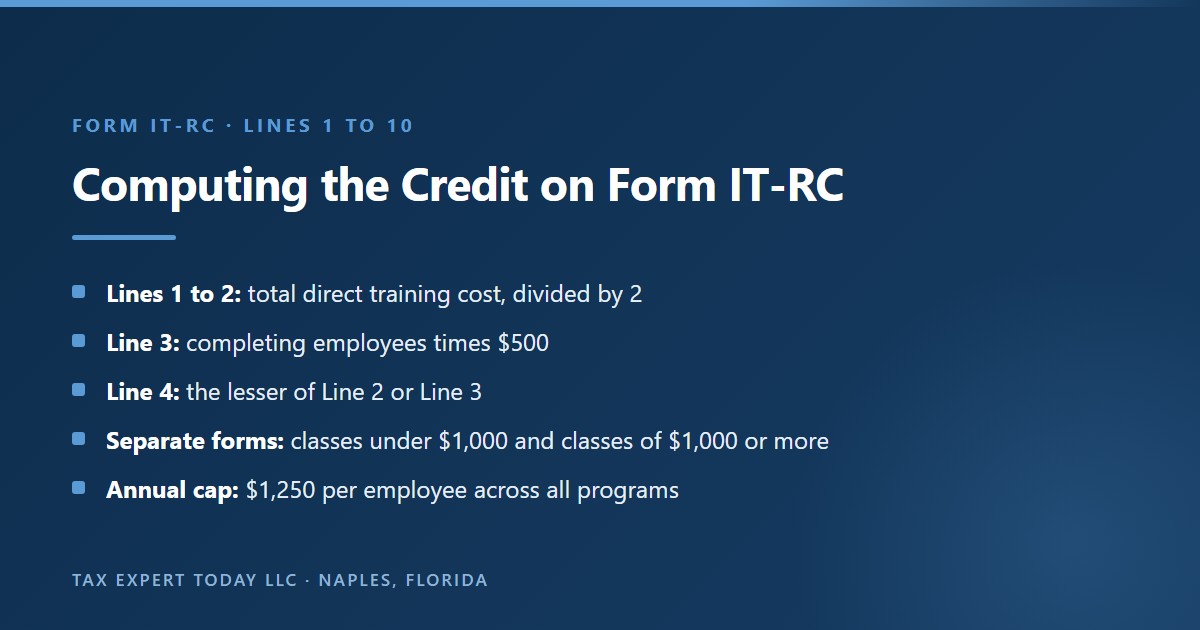
Form IT-RC walks through ten lines: total training costs, half of that cost, completing employees times $500, the lesser of the two, prior carryovers, total available credit, Georgia tax before credits, half of that tax, the credit used, and the unused credit. The Program Completion Form must be attached, and the form is submitted electronically with the return.
- Lines 1 to 4: the tentative credit earned this year.
- Lines 5 and 6: add carryover from prior years.
- Lines 7 and 8: compute the 50 percent liability limit.
- Lines 9 and 10: credit used this year and the amount carried forward.
- Attachments: the Program Completion Form signed by TCSG personnel.
The current Form IT-RC on the Department’s site is the 2009 version, revised April 13, 2018, and it applies to taxable years beginning on or after January 1, 2009. The lines read as follows.
| Line | Form IT-RC description | What goes there in practice |
|---|---|---|
| 1 | Total training costs | Direct instructional costs for the program group on this form |
| 2 | Divide the total training cost by 2 | Half of Line 1 |
| 3 | Multiply the number of employees trained by $500 | Completing, eligible employees only |
| 4 | Tentative credit earned, the lesser of Line 2 or Line 3 | Credit generated this year, before the $1,250 annual cap check |
| 5 | Carryover from prior years | Unused credit still within its carryforward period |
| 6 | Total available tax credit, Line 4 plus Line 5 | Everything usable this year |
| 7 | Income tax liability before application of any credit | Georgia income tax for the year |
| 8 | Maximum possible credit, 50 percent of Line 7 | The statutory ceiling for this credit |
| 9 | Credit to be claimed on this return, the lesser of Line 6 or Line 8 | Amount that reduces tax this year |
| 10 | Unused retraining tax credit, Line 6 minus Line 9 | Carryforward, tracked by the year it was generated |
Three instructions printed on the form are easy to overlook. First, “a copy of this schedule and the Program Completion Form must be attached to the Tax Return when filed, as well as when claiming any unused Retraining Tax Credit from a previous year.” A carryforward year is not a year off from documentation. Second, classes with a direct cost under $1,000 may not be combined with classes at $1,000 or more, and a separate form is required for classes that cannot be combined. Third, the $1,250 annual cap appears only as a footnote. The form has no line that applies it, so the preparer must check each employee who completed more than one program and reduce Line 4 when the cap binds.
The Department of Revenue page says the credit “should be claimed on Form IT-RC, with Program Completion forms signed by Technical College System of Georgia personnel attached.” Georgia now requires many credit forms to travel electronically with the return, and the Department’s current business credit forms carry that instruction. Practically, that means the retraining credit is claimed through tax software or an electronic filing provider that supports the Georgia attachment, not by mailing a paper form after the fact.
Can Retraining Classes Be Combined on One Form IT-RC?
Yes, within limits. Policy Statement IT-2010-01-07 lets employers combine classes with a direct cost under $1,000 on one form and classes at $1,000 or more on another. Combined classes should be similar in nature. The calculation does not allow averaging, and the grouping rule exists so that combining never changes the credit.
- Group A: classes with direct cost below $1,000 per employee.
- Group B: classes with direct cost of $1,000 or more per employee.
- Never mixed: one Form IT-RC per group, totals added on the return.
- Similar nature: combined classes should cover similar training.
- No averaging: each employee’s credit still follows the per-program rule.
The $1,000 dividing line is not arbitrary. It is the point at which half the cost equals the $500 limit. Below $1,000, Line 2 (half the cost) is always the smaller number, so adding several low-cost classes together on one form gives the same total as computing each separately. At $1,000 or more, Line 3 ($500 per employee) is always the smaller number, so adding high-cost classes together also gives the same result. Mixing the two groups is what breaks the math.
The policy statement’s own example shows why. A company has ten employees in a course costing $250 each and two employees in a course costing $5,000 each. Computed correctly, the first course yields $125 per employee, or $1,250, and the second yields $500 per employee, or $1,000, for a total of $2,250. If the two courses were put on one form, Line 1 would be $12,500, Line 2 would be $6,250, Line 3 would be 12 times $500, or $6,000, and Line 4 would show $6,000. The combined form would overstate the credit by $3,750 because the low-cost course borrowed limit room from the high-cost one. That is the averaging the Department prohibits.
What Do Worked Examples of the Retraining Credit Look Like?
The examples below use hypothetical figures to show how the per-program limit, the $1,250 annual cap, the 50 percent liability limit, and the carryforward interact. Actual results depend on TCSG’s approval of each program, the cost records, the employees who complete the training, and the employer’s Georgia tax for the year.
- Example 1: a manufacturer with two class groups and enough tax to use the full credit.
- Example 2: an employee who completes three programs and hits the annual cap.
- Example 3: a company whose credit exceeds the 50 percent limit and carries forward.
- All figures: hypothetical and rounded for illustration.
Example 1, two groups. A Georgia fabricator installs a new automated welding cell. Thirty incumbent employees, all Georgia residents who work 40 hours a week and have more than 16 weeks of tenure, complete a TCSG-approved operator program costing $1,400 per employee in direct instructional costs. Twelve of the same employees also complete a short approved safety-systems module for the cell costing $600 per employee. The operator program goes on one Form IT-RC: Line 1 is $42,000, Line 2 is $21,000, Line 3 is $15,000, and Line 4 is $15,000. The module goes on a second form: Line 1 is $7,200, Line 2 is $3,600, Line 3 is $6,000, and Line 4 is $3,600. No employee exceeds $1,250, since the most any one employee generates is $500 plus $300, or $800. The tentative credit is $18,600. If the company’s Georgia tax before credits is $60,000, the 50 percent limit is $30,000, and the full $18,600 is used.
Example 2, the annual cap. A medical device company retrains a maintenance technician on three approved programs during the year, each costing $1,500. Each program alone supports $500 of credit, for $1,500. Because the technician completed more than one approved program, the annual cap of $1,250 applies, and $250 must come off the forms’ Line 4 totals. Form IT-RC does not do this automatically. The preparer has to track each employee across forms.
Example 3, the liability limit and carryforward. A distributor with Georgia taxable income of $200,000 owes $9,980 at the 4.99 percent flat rate the Department lists for 2026. It generates $14,000 of retraining credit in its 2026 tax year and has no prior carryover. Line 7 is $9,980, Line 8 is $4,990, and Line 9 is $4,990. Line 10 shows $9,010 of unused credit. Because the credit was generated in a tax year beginning after January 1, 2025, that $9,010 carries forward for five years, and the company must attach Form IT-RC and the Program Completion Form again in each year it uses part of the carryover.
How Does the 50 Percent Tax Liability Limit Work?
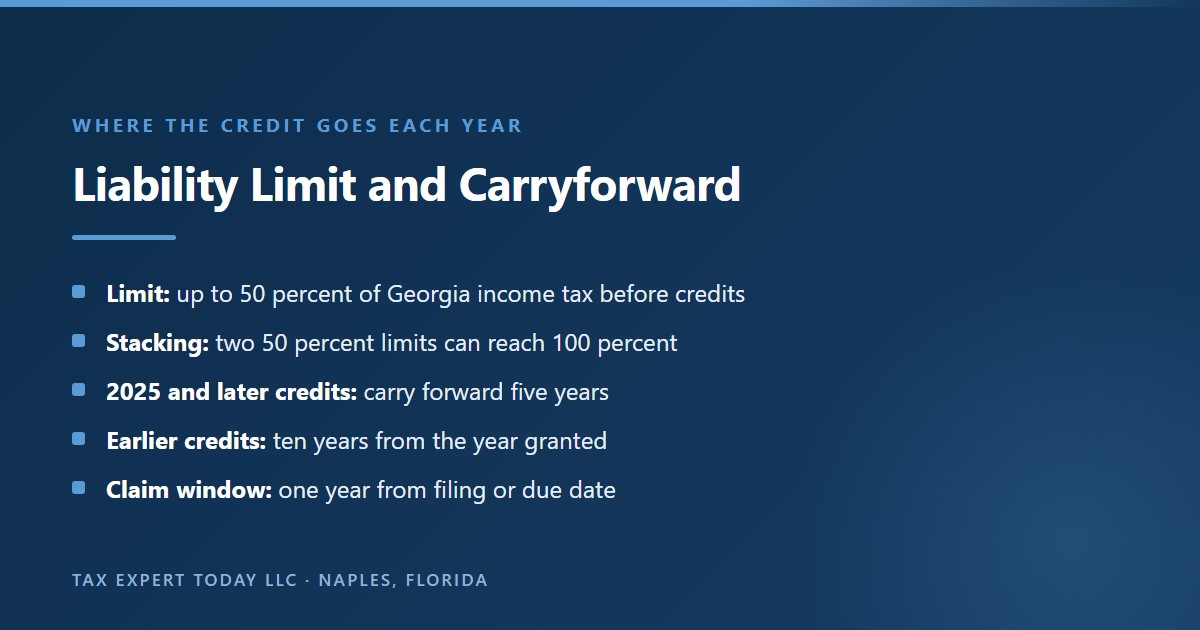
The retraining credit used in any year cannot exceed 50 percent of the employer’s Georgia income tax for that year, computed without regard to the retraining credit itself. The Department of Revenue allows one credit’s 50 percent limit to be stacked with another credit’s 50 percent limit, which can offset up to the full liability in some cases.
- Statute: the credit “shall not exceed 50 percent” of income tax liability, computed without regard to this Code section.
- Form IT-RC: Line 8 applies the limit to tax before application of any credit.
- Stacking: two credits with 50 percent limits may together offset up to 100 percent.
- Exceptions: some credits carry conditions that prevent a full 100 percent offset.
- No withholding offset: unlike certain job credits, this credit is used only against income tax.
O.C.G.A. 48-7-40.5(c) says the credit “shall not exceed 50 percent of the amount of the taxpayer’s income tax liability for the taxable year as computed without regard to this Code section.” Form IT-RC carries that through on Lines 7 and 8, with Line 7 described as income tax liability “before application of any credit.”
The interaction with other credits is addressed in the Department’s General Business Credits FAQ. It says a taxpayer may apply the 50 percent limitation of one credit together with the 50 percent limitation of another credit to offset up to 100 percent of the income tax liability, while noting that some credits have their own requirements when used this way. For a company that also claims the jobs tax credit, the quality jobs credit, or the research credit, the order and limits of each credit matter, and the total still cannot exceed the tax owed.
The size of the liability depends on the rate. The Department’s Important Tax Updates page lists a flat 4.99 percent individual rate for 2026, and corporations are taxed at the same rate for the same year, as our Georgia corporate tax rate guide explains. As Georgia’s rate continues to fall, the same retraining spend produces the same credit, but the 50 percent ceiling shrinks for a given level of income. More of the credit may move into the carryforward, which makes the shorter carryforward period for new credits more important. The credit offsets income tax only; it does not reduce the separate Georgia net worth tax that corporations also file.
How Long Can Unused Retraining Credits Be Carried Forward?
Retraining credits generated in tax years beginning on or after January 1, 2025 can be carried forward for five years. Credits generated in earlier tax years keep the ten-year carryforward measured from the close of the year the credit was granted. Employers should track each year’s credit separately so older credits are not lost.
- Credits from tax years before 2025: ten years from the close of the year granted.
- Credits from tax years beginning in 2025 or later: five years.
- Source of the five-year rule: the Department of Revenue credit page.
- Older codifications: some online copies of the statute still show only ten years.
- Tracking: a schedule by year of generation, amount used, and expiration.
The text of O.C.G.A. 48-7-40.5(c) reproduced on several legal research sites still reads that unused credit “may be carried forward for ten years from the close of the taxable year in which the tax credit was granted.” The Department of Revenue’s page for credit code 102 adds the newer rule: “For taxable years beginning on or after January 1, 2025, any credits generated but not used may be carried forward for five years.” The same five-year change appears across several Georgia business credits, including the jobs tax credit for jobs created in 2025 and later.
Because the two periods now run side by side, an employer with a retraining history needs a vintage schedule. A credit generated in a 2023 tax year and unused can still run to 2033. A credit generated in a 2026 tax year runs only to 2031. When both are available, the order in which they are used can determine whether any credit expires unused. Form IT-RC has one carryover line, so the schedule behind Line 5 is the employer’s own work paper, and it should be kept with the return.
| Year the credit was generated | Carryforward period | Last year to use (calendar-year filer) |
|---|---|---|
| 2022 | 10 years | 2032 |
| 2024 | 10 years | 2034 |
| 2025 | 5 years | 2030 |
| 2026 | 5 years | 2031 |
| 2027 | 5 years | 2032 |
When Must the Georgia Employee Retraining Tax Credit Be Claimed?
The credit must be claimed within one year of the earlier of the date the original return was filed or the date it was due, including approved extensions. That window replaces Georgia’s normal three-year refund period for this credit, so a missed claim generally cannot be recovered on an amended return filed later.
- Clock starts: the earlier of the filing date or the extended due date of the original return.
- Window: one year.
- Overrides: the general limitation in O.C.G.A. 48-2-35.
- Amended returns: possible only inside the one-year window.
- Practical risk: TCSG paperwork that arrives after the return is filed.
Subsection (c) of the statute is explicit: “Notwithstanding Code Section 48-2-35, any tax credit claimed under this Code section shall be claimed within one year of the earlier of the date the original return was filed or the date such return was due as prescribed in subsection (a) of Code Section 48-7-56, including any approved extensions.” The Department summarizes it as a claim that “must be claimed within one year instead of the normal three-year statute of limitation period.” Form IT-RC repeats the rule in its instructions.
Two situations put that window at risk. The first is timing of the completion paperwork. If an approved program ends near year end and the signed Program Completion Form has not arrived when the return is filed, the employer can still amend within the year, but the clock is already running. The second is an early return. A company that files its return in March, before its October extended due date, starts the one-year clock in March, because the statute uses the earlier of the two dates. For the general rules on correcting a Georgia return, see our Georgia amended tax return guide.
How Does TCSG Approval Work Before the Training Starts?
The employer submits the retraining program to the Technical College System of Georgia, which approves and certifies programs under standards it sets for hours, courses, instructor certification, progression, and evaluation. After employees complete the program, TCSG personnel sign the Program Completion Form that supports the claim on the return.
- Before training: obtain TCSG approval and certification of the program.
- Standards: classroom hours, required courses, instructor certification, progressive levels, and evaluation.
- Guide: the Department refers employers to TCSG for the Retraining Tax Credit Procedures Guide.
- After training: a Program Completion Form signed by TCSG personnel.
- Timing: secondary sources report roughly a 30-day approval turnaround; confirm with TCSG.
The statute gives TCSG the job of setting standards in subsection (e) and makes TCSG approval part of the definition of approved retraining in subsection (a)(1)(B). The Department of Revenue’s role is on the tax side: subsection (d) directs it to adopt rules and forms and “to work with the Technical College System of Georgia to ensure the proper granting of credits.” For the procedural detail, including what TCSG wants to see in a program submission, the Department simply says: “For a copy of the Retraining Tax Credit Procedures Guide, contact the Technical College System of Georgia.”
The sequence matters. Approval is a condition of the training being approved retraining at all, so the safe course is to obtain approval before the training begins, not to submit a finished course for approval after the fact. Consultant summaries describe an approval turnaround of about 30 days, and the AI summaries that appear in search results repeat that figure. We could not confirm it on a TCSG page, so we treat it as a planning estimate. Employers with a fixed installation date for new equipment should build the approval window into the project schedule.
The local technical college is often the practical contact. Many of Georgia’s technical colleges describe the retraining credit on their own business and industry pages and help employers prepare submissions. Whether the training is delivered by the college, by the equipment vendor, or by the employer’s own instructors, the approval and the completion form still run through TCSG.
What Records Should an Employer Keep for the Retraining Credit?
The employer must certify to the Department each trainee’s name, the coursework completed, and the training provider, plus any other information the Department requires. Keep the TCSG approval, the signed Program Completion Forms, cost records by program, trainee residence, hours, and tenure, and the carryforward schedule, for as long as any credit from that year is in use.
- Statutory certification: employee name, coursework completed, and provider name.
- TCSG documents: program approval and signed Program Completion Forms.
- Eligibility proof: Georgia residence, 25-hour weeks, and 16 weeks of continuous employment.
- Cost proof: invoices, contracts, and instructor payroll tied to each program.
- No-cost proof: leave records showing no forfeited vacation or leave, and no repayment terms.
Subsection (d) sets the certification requirement: the employer “shall certify to the department the name of the employee, the coursework successfully completed by such employee, the name of the provider of the approved retraining, and such other information as may be required by the department.” The certification exists so that credits “are only granted to employers who provide or sponsor approved retraining” and “only granted to employers with respect to employees who successfully complete such approved retraining.”
Retention should follow the life of the credit, not just the general statute of limitations for the year the training occurred. If a 2026 credit is still being used in 2031, the records that support it may be needed until the 2031 return can no longer be examined. Residence is the item most often missing from a file. Payroll systems record a work location, but the statute asks where the employee lives, so a home address on file for each trainee at the time of training is worth keeping. The state of residence on the employee’s withholding certificate, covered in our Georgia withholding tax guide, is a useful cross-check.
How Do Pass-Through Owners Use the Retraining Credit?
When an S corporation, partnership, or LLC taxed as a partnership earns the retraining credit, the Department of Revenue says the benefit usually passes through to the shareholders or partners. Each owner then applies his or her share against his or her own Georgia income tax, subject to the same 50 percent limit and carryforward rules.
- Entity level: the entity incurs the cost, obtains TCSG approval, and computes the credit.
- Owner level: shares flow to owners, usually in proportion to ownership.
- Nonresident owners: use their share against Georgia tax on their Georgia-source income.
- Composite returns: credits interact with any composite filing the entity makes for owners.
- Entity-level tax elections: review how an elected entity-level tax changes where the liability sits.
The flow-through answer in the Department’s FAQ is short, and the details sit in the owner’s return. An owner with a large Georgia liability from other sources may use his or her share in full. An owner whose only Georgia income is a modest share of the entity’s profit may be limited by the 50 percent rule and carry most of the share forward. Owners who live outside Georgia, including the many Southwest Florida residents who own Georgia operating companies, typically file a Georgia nonresident return and use the credit against the Georgia tax on that return.
Two entity-level choices can change the result. If the entity files a composite return for nonresident owners, the credit must be coordinated with that filing; our Georgia composite return guide covers the mechanics. If the entity has made the Georgia pass-through entity tax election, the Georgia income tax is imposed at the entity level for that year, and the question of where the retraining credit is applied should be answered before the return is prepared, not after. The statute and the Department page do not address that interaction directly, so it is a point to confirm against current Department instructions for the year in question.
How Does the Retraining Credit Fit With Other Georgia Business Credits?
The retraining credit rewards training existing employees, so it can generally be claimed alongside credits based on new jobs, new investment, or research spending. Each credit keeps its own rules, limits, and carryforward, and all of them draw on the same Georgia income tax liability, so the order of use and the stacking limits matter.
- Jobs tax credit: based on net new jobs by county tier, not training costs.
- Quality jobs credit: based on new higher-wage jobs; a separate election.
- Research credit: based on qualified research spending, with its own conditions on stacking.
- Same employees: a worker can count for a jobs credit and later complete approved retraining.
- Same liability: every credit competes for the same Georgia tax.
The credits measure different things. The Georgia jobs tax credit measures the monthly average increase in full-time jobs. The Georgia quality jobs tax credit measures new jobs paying above a wage threshold. The Georgia R&D tax credit measures qualified research spending against a base. The retraining credit measures direct instructional cost for incumbent employees. Production companies have their own regime in the Georgia film tax credit, and contribution credits such as the Georgia rural hospital tax credit and the Georgia qualified education expense credit also reduce the same income tax. An expansion project can touch all four: new hires counted for a job credit, new equipment, engineering work that may qualify as research, and approved retraining for the existing workforce on the new equipment.
Where the credits interact is the liability. The Department’s FAQ allows two 50 percent limits to be combined to reach up to 100 percent of tax, with the caution that some credits, research among them, have conditions. A company with more credits than liability should model the sequence, because the credits now carry different expiration periods. Using the credit that expires first is often the better order, but the right sequence depends on each credit’s limit and life.
Does Free State Training Generate a Retraining Credit?
Generally no. The credit is computed on the employer’s cost of retraining, meaning direct instructional costs the employer pays for training it provides or sponsors. When a public program delivers training at no charge to the employer, there is no employer-paid cost for the credit to reimburse.
- Employer provided: instructors hired or employed by the employer.
- Employer sponsored: a contract with an instructional facility, “paid for by the employer.”
- No-charge programs: no employer cost means no Line 1 amount.
- Partial funding: only the portion the employer actually pays belongs in the cost record.
- Grants: confirm how any grant or reimbursement affects the cost before claiming.
Georgia offers several workforce training services for new and expanding businesses, and some are provided at little or no cost to the employer. Those programs are valuable, but they are training services, not tax credits. The retraining credit’s definitions of employer provided and employer sponsored training both assume the employer bears the cost. If part of a program is paid by the employer and part is funded publicly, only the employer-paid direct instructional cost belongs on Form IT-RC, and the cost record should show the split.
What Are Common Mistakes With the Georgia Employee Retraining Tax Credit?
The most common mistakes are training without TCSG approval, counting employees who live outside Georgia or lack 16 weeks of tenure, including space rental or unconfirmed costs, mixing low-cost and high-cost classes on one form, missing the $1,250 annual cap, and filing after the one-year window closes.
- No approval: training completed before TCSG approval was obtained.
- Wrong employees: out-of-state residents, part-time staff under 25 hours, or recent hires.
- Wrong costs: facility rental, which the statute excludes, or trainee wages without TCSG support.
- Averaging: classes under and over $1,000 combined on one Form IT-RC.
- Late claim: an amended return filed after the one-year window.
Other errors are quieter. An employer may forget to attach Form IT-RC and the Program Completion Form in a later year when it uses only carryover. It may treat the excluded office software training as approved because a vendor described it as a technology upgrade. It may overlook a repayment agreement that requires employees to reimburse training costs if they leave, which can disqualify the program. It may also carry forward a 2025 or later credit as though the old ten-year period still applied. Each of these is avoidable with a short checklist at the start of the training project and a review before the return is filed.
| Checkpoint | When | What to confirm |
|---|---|---|
| Program design | Before training | Ties to new technology or skill deficiencies; not listed office software |
| TCSG approval | Before training | Approval and certification in hand; procedures guide requested |
| Trainee list | Before training | Georgia residence, 25-hour weeks, 16 weeks of tenure |
| No employee cost | Before training | No fees, no forfeited leave, no repayment terms |
| Completion | After training | Signed Program Completion Form for each completing employee |
| Computation | Return preparation | Class groups split at $1,000; $1,250 annual cap checked |
| Filing | Return preparation | Form IT-RC and completion forms attached; one-year window tracked |
| Carryforward | Every later year | Vintage schedule; five years for 2025 and later credits |
Is the Georgia Retraining Tax Credit Worth Pursuing?
For an employer already planning approved-quality training on new equipment or technology, the credit can return up to half of direct instructional cost, within the per-employee limits. Whether it is worth the effort depends on the number of eligible trainees, the cost per trainee, the employer’s Georgia tax, and the cost of documenting the program.
- Best fit: many incumbent employees trained on new technology at roughly $1,000 or more each.
- Weaker fit: a handful of trainees, low-cost sessions, or no Georgia liability.
- Hidden cost: time spent on approval, completion forms, and records.
- Timing value: credits are worth more when they can be used quickly.
- Design rule: train for the business need first; the credit follows.
A rough screen is simple. Multiply the number of eligible employees expected to complete each program by the lesser of half the cost or $500, apply the $1,250 cap for anyone completing several programs, and compare the result with half of the company’s expected Georgia tax. If the tentative credit is small relative to the administrative effort, or if the company expects years of Georgia losses that would let most of a five-year credit expire, the case is weaker. If the company is rolling out new equipment across a large Georgia workforce and pays Georgia tax, the Georgia employee retraining tax credit is often worth the paperwork. For an overview of Georgia entity taxation that frames these choices, see our Georgia LLC taxes guide.
Georgia Employee Retraining Tax Credit Help in Naples & Southwest Florida
Tax Expert Today LLC advises on the Georgia employee retraining tax credit from its office in Naples, Florida, and serves Georgia employers and their owners nationwide and remotely. We review program eligibility and trainee records, compute the credit on Form IT-RC, track carryforwards by year, and coordinate the credit with other Georgia credits and owner returns.
- Office: 11983 Tamiami Trail N, Naples FL 34110.
- Phone: (239) 441-2005.
- Hours: Monday through Friday, 10 a.m. to 5 p.m. Eastern.
- Georgia retraining tax credit help Naples: Naples and Southwest Florida in person, Georgia and all 50 states remotely.
Many owners in Southwest Florida run or invest in Georgia manufacturing, distribution, health care, and service businesses from here. For them, the retraining credit usually arrives as a line on a Schedule K-1 and a question: how much of this can I use on my Georgia nonresident return, and what happens to the rest? We work as tax advisors on state tax matters nationwide, and a credit review usually connects to the owner’s entity structure, Georgia filing position, and Florida planning. For the full range of our Georgia work, see the Georgia tax services page. Owners weighing an expansion, a move, or a sale can also start with our Naples tax planning page.
We work alongside the employer’s training managers, the Technical College System of Georgia, and the company’s equipment vendors rather than replacing them. Program design and TCSG approval belong with the employer and the college. Our role is the tax side: whether the statutory tests are met for each trainee and each cost, how the credit is computed and documented, which filings and deadlines apply, and how the credit fits with the company’s other Georgia credits and its owners’ returns.
When to Engage a Professional
Engage a tax professional before a training rollout tied to new equipment or technology, when trainees include border-state residents or recent hires, when costs include items beyond instructor pay and materials, when credits will exceed half of Georgia tax, or when a recent return may have missed the credit and the one-year window is still open.
- Before training: confirming the program, the trainees, and the no-cost rule.
- Cost review: separating direct instructional cost from excluded items.
- Return preparation: class groups, the annual cap, and attachments.
- Excess credit: modeling the five-year carryforward alongside other credits.
- Missed credits: amending within the one-year window.
Tax Expert Today LLC reviews Georgia credit positions as part of our wider state and federal tax practice. Our Georgia tax help covers retraining credit computations, Form IT-RC preparation support, carryforward schedules, and coordination with owners’ Georgia returns. We are tax advisors, enrolled agents, CPAs, and attorneys serving clients in all 50 states. Call (239) 441-2005, Monday through Friday, 10 a.m. to 5 p.m. Eastern.
Frequently Asked Questions About the Georgia Employee Retraining Tax Credit
What is the Georgia employee retraining tax credit?
It is a Georgia income tax credit, credit code 102 under O.C.G.A. 48-7-40.5, for employers that provide or sponsor retraining programs approved by the Technical College System of Georgia. It equals half of the direct cost of retraining, up to $500 per employee per program and $1,250 per employee per year.
How much is the Georgia retraining tax credit per employee?
The lesser of half the direct retraining cost or $500 for each employee who completes an approved program. An employee who completes more than one program in a year can generate no more than $1,250 of credit for that year.
Which employees qualify for the retraining credit?
Employees who live in Georgia, work at least 25 hours a week, have been continuously employed by the employer for at least 16 consecutive weeks, and successfully complete the approved program. Employees who live in another state do not count.
Does training on Microsoft Office or similar software qualify?
Generally no. The statute excludes retraining on commercially mass-produced software for word processing, databases, presentations, spreadsheets, email, personal information management, and operating systems. The exception is training for employees who provide support or training on that software.
What form is used to claim the Georgia retraining tax credit?
Form IT-RC, with the Program Completion Form signed by Technical College System of Georgia personnel attached. The form and completion form must be attached again in any later year when unused credit is carried over.
How much Georgia tax can the retraining credit offset?
Up to 50 percent of the employer’s Georgia income tax for the year, computed without the retraining credit. The Department of Revenue allows that 50 percent limit to be combined with another credit’s 50 percent limit, up to the full liability in some cases.
How long can unused retraining credits be carried forward?
Credits generated in tax years beginning on or after January 1, 2025 carry forward for five years, according to the Department of Revenue. Credits generated in earlier years keep a ten-year carryforward from the close of the year granted.
Can I amend a prior Georgia return to claim the retraining credit?
Only within one year of the earlier of the date the original return was filed or its due date, including approved extensions. That window replaces the usual three-year period, so claims made after it closes are generally not allowed.
Can a Naples, Florida tax firm help with the Georgia retraining tax credit?
Yes. Tax Expert Today LLC works from its office at 11983 Tamiami Trail N in Naples, Florida, and serves Georgia employers and owners remotely. We review eligibility and records, support Form IT-RC preparation, and plan carryforwards alongside other Georgia credits. Call (239) 441-2005, Monday through Friday, 10 a.m. to 5 p.m. Eastern.
This article is general information about Georgia tax rules as of its publication date and is not tax or legal advice for any particular situation. Figures in examples are hypothetical. Results depend on the facts of each case, and Georgia law, Technical College System of Georgia procedures, and agency guidance may change.
Published November 18, 2026 by Dr. Pellumb Kabashi « Back to Learning Center
Have a question this article touches on?
Tax Expert Today LLC, based in Naples, Florida and serving clients across the United States.
Schedule a Consultation (239) 441-2005