
By Dr. Pellumb Kabashi, DBA, MBA, EA, CFE, CES
Founder, Tax Expert Today LLC · Tax advisors, enrolled agents, CPAs, and attorneys · Serving clients in all 50 states
Quick Answer: Form 8993 is the IRS form a domestic C corporation attaches to Form 1120 to compute its section 250 deduction for export income, long called the FDII deduction and renamed FDDEI for 2026. For tax years beginning after 2025 the deduction is generally 33.34 percent, for an effective rate near 14 percent. S corporations cannot claim it. Call (239) 441-2005 for a free consultation.
What is Form 8993?
Form 8993 is the IRS form used to compute the section 250 deduction. A domestic C corporation uses it to figure a deduction for income from serving foreign customers, and for its net CFC tested income, then carries the result to Schedule C of Form 1120 and attaches Form 8993 to the return.
- Purpose: figure the deduction, not report foreign accounts or foreign entities.
- Main filer: a domestic corporation taxed under subchapter C.
- Export side: foreign-derived deduction eligible income, formerly foreign-derived intangible income.
- Foreign subsidiary side: net CFC tested income, formerly GILTI.
- Attached to: Form 1120, by the due date including extensions.
Congress created section 250 in the Tax Cuts and Jobs Act of 2017. It lowers the effective corporate rate on two kinds of income. The first is income a U.S. corporation earns by selling to foreign customers or serving people and property abroad. The second is the income of its controlled foreign corporations that is pulled into its U.S. return each year. Public Law 119-21, passed on July 4, 2025, kept both deductions, renamed both of them, changed the percentages, and rewrote how the export side is computed.
Form 8993 earned its awkward reputation because it has to sort a whole corporate income statement into groups, then apply rules that were written for multinational companies. Most articles about it still treat it as a multinational problem. In practice the people who search for it include a software founder with customers in Canada, an engineering firm with a client in Germany, and a small manufacturer that ships to a distributor in Colombia. The questions those owners ask are simpler and more practical: does my company qualify, how much is it worth, what do I have to keep in the file, and would I be better off in a different entity?
This guide answers those questions with worked figures. It focuses on the export side, which is where a U.S. operating business meets Form 8993. The foreign subsidiary side is covered briefly here, and our guide to GILTI for individual shareholders explains that side and the section 962 math in depth. Every example below is a hypothetical illustration with simplified figures.
| Question | Short answer | Where the rule lives |
|---|---|---|
| What does Form 8993 compute? | The deduction under section 250 | Treas. Reg. section 1.250(a)-1(d) |
| Who may claim the deduction? | Domestic corporations other than REITs, RICs, and S corporations, and section 962 electing individuals | Instructions for Form 8993, Who Must File |
| What is the 2026 export rate? | 33.34 percent of FDDEI | Section 250(a)(1)(A) |
| What is the 2026 foreign subsidiary rate? | 40 percent of net CFC tested income and the related section 78 amount | Section 250(a)(1)(B) |
| Is the deduction capped? | Yes, by taxable income, under a formula | Section 250(a)(2) |
| Must foreign use be documented? | Yes, with extra documentation for some transactions unless the small business exception applies | Treas. Reg. section 1.250(b)-3(f) |
Who files Form 8993, and who cannot claim the deduction?
A domestic C corporation that claims the section 250 deduction must file Form 8993, and so must a U.S. individual shareholder of a controlled foreign corporation making a section 962 election. S corporations, real estate investment trusts, regulated investment companies, partnerships as entities, and sole proprietors cannot claim the export deduction themselves.
- Eligible: U.S. C corporations, including an LLC that elected to be taxed as a corporation.
- Excluded by regulation: S corporations, REITs, and RICs.
- Section 962 individuals: file Form 8993 for the foreign subsidiary side.
- Partners: a corporate partner picks up its share of partnership items.
- Foreign corporations: not domestic corporations, so outside the deduction.
The Instructions for Form 8993 state the allowance plainly: the deduction is allowed only to domestic corporations, not including REITs, RICs, and S corporations, and to section 962 electing individuals. Treas. Reg. section 1.250(a)-1(c)(1) carries the same exclusions into the definition of a domestic corporation, and paragraph (d) of that regulation requires each corporation or section 962 individual claiming the deduction to make an annual return on Form 8993.
Two groups are often confused about their status. The first is the single-member LLC. An LLC that has made no election is ignored for federal income tax purposes, so its income lands on its owner’s return, and an individual owner has no corporation to claim the deduction. An LLC that elected corporate status on Form 8832 is treated as a corporation, and if it did not also elect S status, it can be an eligible filer.
The second group is individual owners of foreign companies. A section 962 election lets an individual be taxed as if the individual were a corporation on certain inclusions from a controlled foreign corporation. That is how an individual reaches the 40 percent side of Form 8993. It does not turn the individual’s own consulting or product sales into export income eligible for 33.34 percent. The election is covered in our guides to GILTI for individual shareholders and Subpart F income, and the company reporting that goes with it appears on Form 5471.
| Taxpayer | Export deduction (33.34 percent) | Foreign subsidiary deduction (40 percent) |
|---|---|---|
| Domestic C corporation | Yes, if it has FDDEI | Yes, if it has net CFC tested income |
| LLC taxed as a C corporation | Yes, same as a corporation | Yes, same as a corporation |
| S corporation | No | No at the entity level |
| Partnership or LLC taxed as a partnership | Not at the entity level; a corporate partner takes its share | Determined at the partner level |
| Sole proprietor or disregarded LLC owned by an individual | No | Only through a section 962 election on qualifying foreign income |
| Individual making a section 962 election | Not for the individual’s own business income | Yes, on qualifying inclusions |
| REIT or RIC | No | No |
What changed from FDII to FDDEI under the 2025 law?
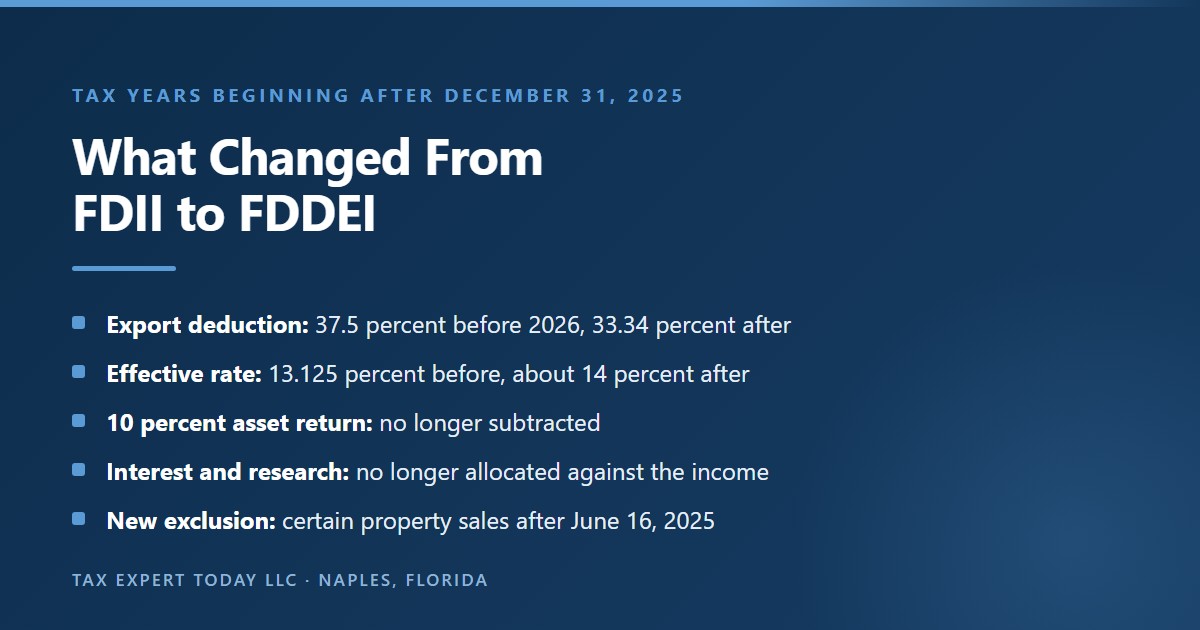
Starting with tax years beginning after 2025, foreign-derived intangible income became foreign-derived deduction eligible income. Form 8993 no longer subtracts a 10 percent return on tangible assets, interest and research costs no longer reduce the export income, and the deduction percentage moved from 37.5 percent to 33.34 percent.
- Name: FDII is now FDDEI, though most people still search for FDII.
- Tangible asset return removed: the 10 percent of QBAI subtraction is gone.
- Interest and research costs: no longer allocated against the income.
- New exclusion: gain on certain property sales after June 16, 2025.
- Rate: lower percentage, but often computed on a larger base.
Before 2026 the computation had a stubborn logic. It assumed that a 10 percent return on a company’s depreciable tangible assets was ordinary, then treated everything above that return as income from intangibles. The company subtracted 10 percent of its qualified business asset investment from its deduction eligible income, then multiplied the remainder by the share of its income that was foreign derived. A manufacturer with a heavy factory saw its benefit shrink. A software firm with almost no equipment did not.
Sections 70321 through 70323 of Public Law 119-21 changed the structure. The credit notes on section 250 record the removal of the former paragraphs that defined FDII, deemed intangible income, and the deemed tangible income return. The IRS draft Instructions for Form 8993 (Rev. December 2026) summarize the result: FDDEI is computed without determining deemed intangible income, the deemed tangible income return, and QBAI, and interest expense and research or experimental expenditures are not allocated and apportioned to DEI and FDDEI.
The statute also repealed a scheduled cut. Before the 2025 act, the percentages were set to fall to 21.875 percent and 37.5 percent for years beginning after 2025. The act replaced that schedule with 33.34 percent and 40 percent. Those are the percentages in the statute today. Note that the regulation at section 1.250(a)-1(b)(3) still shows the older 21.875 percent figure, because the regulations have not caught up with the statute. The statute controls.
| Item | Years beginning before 2026 | Years beginning after 2025 |
|---|---|---|
| Export income term | Foreign-derived intangible income (FDII) | Foreign-derived deduction eligible income (FDDEI) |
| Foreign subsidiary term | Global intangible low-taxed income (GILTI) | Net CFC tested income (NCTI) |
| Export deduction | 37.5 percent of FDII | 33.34 percent of FDDEI |
| Foreign subsidiary deduction | 50 percent | 40 percent |
| Subtract 10 percent of QBAI | Yes | No |
| Allocate interest expense | Yes | No |
| Allocate research or experimental costs | Yes | No |
| Exclude gain on certain property sales | Not before June 17, 2025 | Yes, for sales after June 16, 2025 |
| Form 8993 revision | Rev. December 2025 | Draft Rev. December 2026, subject to change |
What are the section 250 deduction rates for 2025 and 2026?
For tax years beginning before January 1, 2026, the deduction is 37.5 percent of FDII and 50 percent of GILTI. For tax years beginning after December 31, 2025, it is 33.34 percent of FDDEI and 40 percent of net CFC tested income, which produces federal effective rates near 14 percent and 12.6 percent.
- Corporate rate: 21 percent under section 11(b).
- 2026 export effective rate: 21 percent times 66.66 percent, about 14 percent.
- 2026 foreign subsidiary effective rate: 12.6 percent before foreign tax credits.
- Trigger: the first day of the tax year, not the calendar.
- State tax: computed separately under each state’s rules.
The arithmetic is short. The corporate rate under section 11(b) is 21 percent. A corporation that deducts 33.34 percent of a dollar of FDDEI pays tax on 66.66 cents of it, and 21 percent of 66.66 cents is about 14 cents. The precise figure is 13.9986 percent. For years beginning before 2026, the deduction of 37.5 percent produced 13.125 percent. The 2026 rate is higher, but as the worked example below shows, that does not automatically mean a smaller deduction.
Fiscal year corporations should read the effective date carefully. The percentage change applies to tax years beginning after December 31, 2025. A corporation whose year runs from July 1, 2025 through June 30, 2026 stays under the older rate and the older computation for that entire year. Its first year under the new rules begins July 1, 2026. The property sale exclusion is different. It applies to sales or other dispositions occurring after June 16, 2025, regardless of when the tax year began, so a fiscal year corporation can face the new exclusion and the old rate on the same return.
| Tax year | Export percentage | Export effective rate | Foreign subsidiary percentage | Foreign subsidiary effective rate |
|---|---|---|---|---|
| Calendar 2025 | 37.5 percent | 13.125 percent | 50 percent | 10.5 percent |
| Fiscal year beginning in 2025 | 37.5 percent | 13.125 percent | 50 percent | 10.5 percent |
| Calendar 2026 | 33.34 percent | About 14 percent | 40 percent | 12.6 percent |
| Fiscal year beginning in 2026 | 33.34 percent | About 14 percent | 40 percent | 12.6 percent |
When is Form 8993 due, and how is it filed?
Form 8993 is attached to the corporation’s income tax return and filed by that return’s due date, including extensions. A calendar year C corporation generally files Form 1120 by April 15, and a timely Form 7004 extends the return and the attached Form 8993 for six months, generally to October 15.
- No separate filing: Form 8993 travels with Form 1120.
- Calendar year C corporation: generally April 15.
- Extended due date: generally October 15 with Form 7004.
- Fiscal year: generally the 15th day of the fourth month after year end.
- Correction: a new form marked Corrected, attached to the amended return.
The due date comes from section 6072, and the automatic six month corporate extension comes from section 6081(b). Search traffic for Form 8993 peaks in September and October, which fits the extended corporate deadline: most of the people reading about Form 8993 in the fall are finishing a return they extended in April.
The due date has a second job in this area. The substantiation rules look to the “FDII filing date,” which Treas. Reg. section 1.250(b)-3(b)(3) defines as the date, including extensions, by which the return is required to be filed for the year the income is included. Where the documentation requirements apply, the documents must be in existence as of that date. That turns the extended deadline into a document deadline as well, and it is one reason the file should be assembled as the year goes on instead of during the last week before filing.
Which version of Form 8993 applies to a 2026 tax year?
The December 2025 revision of Form 8993 is the current final form and is written for the older computation, with lines for QBAI and interest allocations. The IRS has released a redesigned draft dated December 2026 for tax year 2026, marked not for filing. Corporations should check IRS.gov/Form8993 for the final version before preparing a 2026 return.
- Rev. December 2025: used for tax year 2025.
- Draft Rev. December 2026: redesigned for FDDEI and net CFC tested income.
- Layout change: built around Form 1120 lines and eight columns.
- Status: a draft is for information only and may change.
- New line items: a section 78 line and reconciliation to Form 1120.
The final December 2025 Form 8993 has three parts. Part I of Form 8993 determines deduction eligible income and deemed intangible income. Part II determines FDDEI in columns for general property, intangible property, and services. Part III determines the deduction. The draft December 2026 Form 8993 reorganizes all of this. Part I runs the corporation’s Form 1120 line items across eight columns, sorting each line among DEI exclusions, DEI, FDDEI sales of general property, FDDEI sales of intangible property, FDDEI services, and residual DEI. Part II lists the exclusions. Part III of Form 8993 computes the deduction.
The redesign is sensible, because it forces the sort to reconcile to the Form 1120 in front of the preparer. In the draft instructions, interest and research expenditures go only in the Form 1120 column and the exclusion column, which keeps them out of DEI and FDDEI. Line 17 column (a) must reconcile to taxable income before the net operating loss and section 250 deductions. Because this is a draft, nobody should file it, and line numbers may change. The sections below refer to the draft only where the 2026 mechanics need explaining.
How does a corporation compute the FDDEI deduction step by step?
The 2026 computation has five stages: remove the excluded income, subtract properly allocable deductions other than interest and research costs to reach deduction eligible income, isolate the part earned from foreign customers, apply the taxable income limit, and multiply the remaining FDDEI by 33.34 percent.
- Start: gross income from Form 1120.
- Remove: the listed exclusions, including new property sales income.
- Subtract: allocable deductions, but not interest or research costs.
- Isolate: gross FDDEI and its allocable deductions.
- Limit and multiply: the taxable income test, then 33.34 percent.
Consider a hypothetical Naples, Florida software and engineering company organized as a C corporation, on a calendar 2026 year. It has gross receipts of $2,500,000. Of that, $1,500,000 comes from foreign customers and meets the foreign use rules, and $1,000,000 comes from U.S. customers. It has no cost of goods sold. Its allocable deductions, other than interest and research costs, are $900,000 for the foreign sales and $700,000 for the domestic sales. It also has $20,000 of interest expense and $80,000 of research expenditures. It has no excluded income, so its Form 8993 begins with the full $2,500,000.
| Step | Foreign customers | U.S. customers | Total |
|---|---|---|---|
| Gross income | $1,500,000 | $1,000,000 | $2,500,000 |
| Allocable deductions, excluding interest and research | ($900,000) | ($700,000) | ($1,600,000) |
| Result | FDDEI $600,000 | Residual DEI $300,000 | DEI $900,000 |
| Interest expense | ($20,000) | ||
| Research expenditures | ($80,000) | ||
| Taxable income before section 250 | $800,000 | ||
| Is FDDEI below taxable income? | Yes, $600,000 is below $800,000 | ||
| Deduction at 33.34 percent of $600,000 | $200,040 | ||
| Taxable income after the deduction | $599,960 | ||
| Federal tax at 21 percent | $125,991.60 | ||
| Federal tax without the deduction | $168,000 | ||
| Tax difference | $42,008.40 |
For comparison, run the same company under the older rules, as if the old computation applied. Suppose its qualified business asset investment was $400,000, and 60 percent of its interest and research costs were allocated to foreign sales, which is $60,000.
| Line | Old computation | 2026 computation |
|---|---|---|
| DEI | $800,000 (after $100,000 of interest and research) | $900,000 |
| Foreign-derived amount | $540,000 (after $60,000 allocated) | $600,000 |
| 10 percent of $400,000 QBAI | $40,000 | Not applicable |
| Deemed intangible income | $760,000 | Not applicable |
| Foreign-derived ratio | 67.5 percent | Not applicable |
| FDII or FDDEI | $513,000 | $600,000 |
| Deduction percentage | 37.5 percent | 33.34 percent |
| Deduction | $192,375 | $200,040 |
The percentage went down, and the deduction went up by $7,665. That result is specific to these assumed figures. A company with no equipment and no interest would see the percentage cut reduce its deduction. A company with substantial equipment, research spending, or debt may well come out ahead. Anyone repeating the headline that the FDII deduction was cut should run the numbers before drawing a conclusion.
How does the deduction work for a small manufacturer?
A manufacturer’s benefit comes from the gross profit on qualifying sales less allocable expenses, with cost of goods sold attributed by a reasonable method. Removing the 10 percent tangible asset subtraction helps equipment-heavy companies most, and a distributor’s resale data can establish how much of a sale qualifies.
- Cost of goods sold: attributed to foreign and domestic receipts by a reasonable, consistent method.
- Distributor sales: only the portion resold to end users abroad qualifies.
- Equipment: no longer reduces the benefit for 2026.
- Interest: no longer allocated against the export income.
- Column: these sales belong in the general property column.
Consider a hypothetical Bonita Springs, Florida marine parts manufacturer, a C corporation on a calendar 2026 year, with $3,000,000 of sales. It ships $400,000 directly to foreign end users. It sells $800,000 of fungible parts to an unrelated distributor in the Bahamas, and the distributor’s records show that 90 percent is resold to end users outside the United States and 10 percent to customers in the United States. The remaining $1,800,000 is sold to U.S. customers. Cost of goods sold runs 60 percent of sales. Other allocable deductions run 20 percent of sales. The company has $50,000 of interest expense and $30,000 of research expenditures, and its qualified business asset investment would have been $1,500,000 under the old computation.
| Line | FDDEI portion | Residual portion | Total |
|---|---|---|---|
| Receipts | $1,120,000 ($400,000 plus 90 percent of $800,000) | $1,880,000 | $3,000,000 |
| Cost of goods sold at 60 percent | ($672,000) | ($1,128,000) | ($1,800,000) |
| Gross income | $448,000 | $752,000 | $1,200,000 |
| Allocable deductions at 20 percent of receipts | ($224,000) | ($376,000) | ($600,000) |
| Result | FDDEI $224,000 | Residual DEI $376,000 | DEI $600,000 |
| Interest and research | ($80,000) | ||
| Taxable income before section 250 | $520,000 | ||
| Deduction at 33.34 percent | $74,681.60 | ||
| Federal tax difference at 21 percent | $15,683.14 |
Under the old computation, the same company would have subtracted 10 percent of $1,500,000, or $150,000, from DEI of $520,000, leaving $370,000 of deemed intangible income. If interest and research costs were allocated in proportion to receipts, about $29,867 would have reduced the foreign-derived amount to about $194,133, for a foreign-derived ratio of about 37.33 percent. FDII would have been about $138,133, and the deduction at 37.5 percent would have been about $51,800. Under the 2026 rules, the deduction is $74,681.60, a meaningful increase for a company with real plant and equipment. A company with this profile that has not looked at the deduction since 2025 may find the numbers have moved.
What income is excluded from deduction eligible income?
Eight categories come out before the computation starts: Subpart F inclusions, net CFC tested income, financial services income, dividends from controlled foreign corporations, domestic oil and gas extraction income, foreign branch income, and, for sales after June 16, 2025, income and gain from sales of intangible property and depreciable, amortizable, or depletable property.
- Foreign subsidiary income: Subpart F, NCTI, and CFC dividends are all out.
- Financial services income: out under section 904(d)(2)(D).
- Foreign branch income: out, and easy to overlook for a small company.
- Oil and gas extraction: domestic extraction income is out.
- Property sales: intangible and depreciable property sold after June 16, 2025.
Section 250(b)(3)(A)(i) lists these items. Some have obvious logic: a controlled foreign corporation’s income is already handled on the other side of Form 8993. The exclusion that catches smaller companies off guard is foreign branch income. If a U.S. corporation runs an office in another country and earns income through it, that income may be foreign branch income as defined in section 904(d)(2)(J), and it is out of DEI even though it is plainly foreign. The export deduction rewards income earned by U.S. operations from foreign markets, not income earned by a business located abroad.
| Exclusion | Draft 2026 line | Practical example |
|---|---|---|
| Section 951(a)(1) inclusions, with section 78 | 19a | Subpart F income from a foreign subsidiary |
| Section 951A inclusions | 19b | Net CFC tested income |
| Section 78 gross-up on NCTI | 19bb | The foreign tax gross-up tied to NCTI |
| Financial services income | 19c | Income of a qualifying financial services company |
| CFC dividends | 19d | A dividend from a foreign subsidiary it controls |
| Domestic oil and gas extraction income | 19e | Income from U.S. wells |
| Foreign branch income | 19f | Profit of an office the corporation operates abroad |
| Sales of intangible property after June 16, 2025 | 19g | Selling a patent outright to a foreign buyer |
| Sales of depreciable, amortizable, or depletable property after June 16, 2025 | 19h | Selling used production equipment abroad |
What changed for sales of intellectual property and used equipment?
Income and gain from selling intangible property, or property of a type subject to depreciation, amortization, or depletion, is excluded from deduction eligible income for sales after June 16, 2025. Proposed regulations from August 2026 keep ordinary inventory sales and copyrighted articles outside the exclusion, and leases and true licenses remain eligible.
- Excluded: an outright sale of a patent or a copyright.
- Excluded: a sale of used equipment the seller depreciated.
- Not excluded: inventory that was always held as inventory.
- Not excluded: a true lease or license under general tax principles.
- Not excluded: a copyrighted article, such as a copy of software.
The rule began with Notice 2025-78, released December 4, 2025, and continued with REG-117130-25, published August 20, 2026. The comment period ended October 5, 2026, and Treasury said it expected to finalize the rules by January 4, 2027. Check for final regulations before relying on anything below. Taxpayers may rely on the proposed rules for sales before final regulations are published, provided the taxpayer and its related parties follow them in their entirety and in a consistent manner.
The definition of “sale” is the trap. Elsewhere in section 250, a sale includes any lease, license, exchange, or other disposition, under section 250(b)(2)(E). For this one exclusion, the statute switches that broad meaning off, and the proposed rules look to general federal income tax principles instead. That produces a practical sorting:
| Transaction with a foreign customer | Treatment under the exclusion | Why |
|---|---|---|
| Annual non-exclusive software license | Generally not excluded | A license under general tax principles is not a sale |
| Sale of a copy of software or a digital book | Generally not excluded | A copyrighted article is not intangible property here |
| Exclusive irrevocable license for the full remaining copyright term | Excluded | Notice 2025-78 treats that fact pattern as a sale, whatever the contract is called |
| Outright sale of a patent | Excluded | Sale of intangible property |
| Sale of inventory always held as inventory | Not excluded | Not of a character subject to depreciation |
| Sale of a machine used in the business | Excluded | Of a character subject to depreciation |
| Sale of refurbished equipment once depreciated and later moved to inventory | Excluded under the proposed rules | Property that is or has been depreciable keeps that character |
Take the hypothetical company above and add one fact: in 2026 it sells a used test machine to an unrelated buyer in Spain, recognizing $40,000 of gain. Under the proposed rules, that gain is excluded property sales income. It raises taxable income but stays out of DEI and FDDEI, so it does not increase the deduction. It would be reported on line 19h of draft Form 8993 and taxed at the full 21 percent.
A contract that says “license” may not be a license. Notice 2025-78 describes a grant labeled a license that is treated as a sale under general tax principles because the rights are exclusive and irrevocable for the remaining term of the copyright. Companies selling rights to software or to a brand should read the contract with this distinction in mind, and legal counsel should be part of any restructuring of those terms.
Which sales count as foreign-derived income?
A sale counts only if it meets two separate tests. The buyer must be a foreign person, and the property must be for a foreign use. Shipping or billing addresses can establish the first test by presumption, but the second test turns on where the property ends up and who uses it.
- Foreign person: not a U.S. person, including foreign governments.
- Foreign use: use, consumption, or disposition outside the United States.
- Presumption: foreign shipping address or, in other cases, billing address.
- Knowledge limit: no presumption when the seller knows otherwise.
- Territories: a bona fide resident of a U.S. territory is not a U.S. person.
Treas. Reg. section 1.250(b)-4(c) gives a helpful presumption of foreign person status. A foreign retail sale is presumed to be to a foreign person. For general property delivered to the recipient or end user, a shipping address outside the United States gives the presumption. In other cases, a billing address outside the United States does. For intangible property, the billing address is the test.
The presumption has a limit, and it is often the point where a company’s file breaks. It does not apply if the seller knows or has reason to know that the buyer is not a foreign person. The regulation lists warning signs: a U.S. phone number, billing address, shipping address, or place of residence, and for an entity, evidence that it is incorporated, formed, or managed in the United States. Under the regulation, a seller that sees those signs has reason to know unless it obtains evidence establishing that the buyer is in fact a foreign person. A foreign customer that uses a Miami freight agent, or a U.S. mailing address for invoices, deserves a closer look.
| Sale type | Foreign person presumption | Foreign use rule |
|---|---|---|
| Foreign retail sale | Automatic presumption | Property located outside the United States at the time of sale |
| Shipped to the end user | Foreign shipping address | End user receives delivery outside the United States |
| Shipped to a distributor or retailer | Foreign shipping address | Property will ultimately be sold to end users outside the United States, with substantiation |
| Sale to a foreign manufacturer | Foreign shipping address | Physical and material change abroad, or use as a component, with substantiation |
| Digital content transferred electronically | Billing address | End user downloads, installs, or accesses it outside the United States |
| Sale of intangible property | Billing address | Rights exploited outside the United States, based on end users and revenue |
How do the foreign use rules work for distributors and foreign manufacturers?
A sale to a foreign distributor is for a foreign use only if the goods will ultimately be sold to end users outside the United States and that is substantiated. A sale to a foreign manufacturer qualifies when the goods are physically and materially changed abroad or become a component of another product.
- Resale: the end user’s location controls, not the distributor’s address.
- Fungible goods: a proportion can be presumed from resale data.
- Manufacturing: the buyer must be a foreign unrelated party.
- Component rule: packaging, labeling, and minor assembly do not count.
- U.S. processing: further manufacture in the United States defeats foreign use.
Selling to a distributor in another country is the classic exporter’s fact pattern, and it does not stand on its own. The statute asks about use. Under Treas. Reg. section 1.250(b)-4(d)(1)(ii)(C), the goods must ultimately reach end users outside the United States. For a fungible mass of goods, the seller may presume that the portion ultimately sold abroad matches the distributor’s resale proportion. That is helpful when a foreign distributor resells some inventory back into the United States.
When the buyer manufactures, the regulation asks whether the goods are substantially transformed and cannot readily be returned to their original state, or whether they are incorporated as a component in activities that are substantial in nature. Packaging, repackaging, labeling, and minor assembly do not qualify. The regulation adds a useful safe harbor: goods are treated as a component if the seller expects, using reliable estimates, that their fair market value when delivered will be no more than 20 percent of the fair market value of the finished good. The regulation’s battery and tablet example shows how the safe harbor can work even when the battery could physically be removed.
Two limits are written into the statute itself. Under section 250(b)(2)(B), property sold to an unrelated person for further manufacture or modification within the United States is not for a foreign use even if that person later exports it. Likewise, services provided to an unrelated person located in the United States do not qualify even if that person uses them to serve foreign customers. A Fort Myers parts maker selling to a Florida assembler that exports the finished product generally has no foreign-derived income from that sale, however international the supply chain feels.

How do software and digital sales qualify?
Digital content sold electronically is for a foreign use if the end user downloads, installs, receives, or accesses it on a device outside the United States. A company generally needs location data such as IP addresses, and billing address is a fallback only when location data is unavailable and receipts from that end user stay under $50,000.
- Digital content: computer programs and other content in digital format.
- Sale or service: classified by the overall predominant character.
- Location data: device location, often from an IP address.
- $50,000 fallback: billing address only below that annual amount per end user.
- Above the fallback: without location data, a business customer is deemed domestic.
A software company first has to decide what it is selling. Under Treas. Reg. section 1.250(b)-3(d), a transaction with both sale and service elements is classified by its overall predominant character. A downloaded program sold under a limited use license is generally a sale of general property, because a copyrighted article is general property in these rules. A hosted application that the customer logs into, where value comes from the ongoing service, is more often an electronically supplied service. The distinction changes which rule applies, which column of Form 8993 the income belongs in, and what evidence is needed.
For a true sale of digital content, section 1.250(b)-4(d)(1)(ii)(D) looks at the end user’s device. If location data is unavailable and the seller’s gross receipts from all sales with respect to that end user are less than $50,000 for the year, a billing address outside the United States is enough. For an electronically supplied service to a business, section 1.250(b)-5(e)(2)(iii) looks at where the business, including its employees, contractors, or agents, accesses or uses the service. If that cannot be determined, and receipts from the business recipient are at least $50,000, the operations that benefit are deemed to be located in the United States. That default is harsh, and it arrives quietly.
The practical point for a software owner is that a server log from the year in question may be the single most valuable document in the file. A company that collects no access data has no way to apply this rule to a large customer. Turning on access logging costs little, and it should be done before the year begins rather than in September of the following year.
| Software arrangement | Likely classification | Main test | Evidence that helps |
|---|---|---|---|
| Download sold to a foreign individual | Sale of general property, digital content | Device location at download | IP data, or foreign billing address below $50,000 |
| Enterprise program installed on a foreign customer’s computers | Sale of general property, digital content | Where the end user installs and accesses it | Contract, deployment records, IP data |
| Hosted subscription used by a foreign business | Electronically supplied service | Where employees, contractors, or agents access it | User location logs by account |
| Hosted subscription for consumers | Electronically supplied service | Location of the consumer’s device | IP data, or billing address if unavailable |
| Grant of rights to copy and distribute the program | Sale of intangible property, or possibly excluded | Where the rights are exploited, and whether the grant is a sale under general tax principles | Contract terms and revenue projections |
Which services qualify for the FDII deduction?
Services qualify for the FDII deduction, now the FDDEI deduction, when they are provided to a person or with respect to property located outside the United States. The test differs by type: where a consumer resides, where a business’s benefiting operations are located, where a hands-on service is performed, or where the property is located.
- Consumers: where the individual resides when the service is provided.
- Business clients: where the operations that benefit are located.
- Proximate services: performed in the recipient’s physical presence abroad.
- Property services: tangible property located abroad throughout the work.
- Transportation: both ends abroad, or half when one end is abroad.
The rule that surprises most owners is the one for business clients. Section 1.250(b)-5(e)(1) says a general service is provided to a business recipient located outside the United States to the extent the service confers a benefit on the recipient’s operations outside the United States, and it expressly says that the recipient’s location of residence, incorporation, or formation is not relevant. A foreign-incorporated client with its whole operation in Texas may produce no foreign-derived income at all, while a U.S.-incorporated client with a factory in Mexico may produce some.
The benefit is determined under the principles of the services regulations at section 1.482-9. Advertising services are deemed to benefit operations where the advertisements are viewed. In a split case, the renderer has to determine what portion of the service benefits operations abroad, and the income qualifies only to that extent. The regulation’s example of a payroll service whose user accounts are split between the United States and other countries shows how the split works, and its other examples show that a provider that cannot determine the benefit may be unable to substantiate any foreign portion.
| Type of service | Definition in brief | When it qualifies |
|---|---|---|
| General service to a consumer | Individual buying for personal use | Consumer resides outside the United States when the service is provided |
| General service to a business | Any general service to a non-consumer | To the extent it benefits operations outside the United States |
| Advertising service | Transmitting or displaying content to promote a product or service | To the extent the advertisements are viewed outside the United States |
| Electronically supplied service | Delivered primarily over the internet or an electronic network | Based on the location of the device or of access |
| Proximate service | Substantially all performed in the recipient’s physical presence | Performed outside the United States, proportionately by time if split |
| Property service | More than 80 percent of the time at the property, with physical manipulation | Tangible property outside the United States for the whole service period |
| Transportation service | Moving people or property, including freight forwarding | Origin and destination both outside; 50 percent if only one is |
Consider a consulting firm in Naples, Florida with a client based in Toronto. The firm prepares a market study for the client’s Canadian operations. The service is a general service to a business recipient, and the benefit test points to Canada. If the same firm prepares a study of the client’s Tampa distribution center, the benefit lands in the United States, and the client’s Canadian address is beside the point. A contract statement that describes the operations being served, and an invoice that identifies the project, go a long way toward documenting which case is which.
How are sales to related foreign companies treated?
A sale of general property to a foreign related party qualifies only if the property is resold to, or used to serve, an unrelated foreign party, and foreign use is established. A service to a foreign related party qualifies only if it is not substantially similar to services the related party provides to persons in the United States.
- Related party: more than 50 percent common control, using an affiliated group test.
- Goods: must reach an unrelated foreign person through resale or use.
- Services: barred when substantially similar to the affiliate’s U.S. services.
- Disregarded entities: a foreign branch can move income out of DEI.
- Pricing: transfer pricing rules continue to apply.
Section 250(b)(2)(C) and Treas. Reg. section 1.250(b)-6 close the obvious loophole of selling to a company’s own foreign subsidiary and calling that an export. A family company with a distributor owned by the same family should treat that distributor as potentially related. Related party status looks to an affiliated group measured at more than 50 percent, and a non-corporate person can be treated as a member if it controls or is controlled by a member.
Owners with foreign affiliates also have to think about the rest of the structure. A foreign subsidiary may itself generate reporting on Form 5471, a foreign partnership on Form 8865, and income in a foreign branch may be excluded from DEI altogether. A U.S. company with a foreign owner has Form 5472 to consider. None of those filings is optional simply because the company is small.
What records prove foreign use for the deduction?
The statute requires the taxpayer to establish foreign use to the satisfaction of the IRS. For resale, foreign manufacturing, intangible property, and general services to businesses, the regulations add specific documents that must exist by the extended filing date, unless the taxpayer and related parties had under $25,000,000 of prior year gross receipts.
- Small business exception: under $25,000,000 of prior year receipts, group wide.
- Timing: documents must exist as of the extended due date.
- Production: within 30 days of an IRS request.
- Written statement option: allowed, but it must be corroborated by evidence.
- Still required: the underlying foreign use rules continue to apply.
Under Treas. Reg. section 1.250(b)-3(f)(1), the extra substantiation applies to four categories: general property sold for resale, general property sold for manufacture abroad, intangible property, and general services to business recipients. The substantiating documents must be in existence as of the FDII filing date, and they must be provided within 30 days of a request by the IRS or another agreed period.
The exception in section 1.250(b)-3(f)(2) is one of the most useful provisions for a small business, and it is rarely mentioned on the pages that explain Form 8993. The specific substantiation requirements do not apply if the taxpayer and all related parties, in the aggregate, received less than $25,000,000 in gross receipts during the taxable year prior to the transaction. A short prior year is annualized. The exception removes the specific document list, but it does not remove the statutory requirement that the taxpayer establish foreign use, and it does not change who counts as a foreign person or what a foreign use is. A small company should still keep a sensible file.
There is also a rule that points the other way. Under paragraph (f)(3), a corporation cannot use a lack of documents to avoid a loss. If failing to substantiate a transaction would increase FDDEI, because the transaction produced a loss, the loss transaction may be treated as a FDDEI transaction anyway when the seller knows or has reason to know the sale was foreign.
| Transaction | Specific documents required above the small business line | Regulation |
|---|---|---|
| Sale for resale | One of: a binding contract limiting sales to outside the United States; proof the goods are designed, labeled, or adapted for a foreign market; proof that return shipping is impractical; credible evidence from the recipient; or a corroborated written statement | 1.250(b)-4(d)(3)(ii) |
| Sale to a foreign manufacturer | Credible evidence of the manufacturing, assembly, or processing outside the United States, or a corroborated written statement | 1.250(b)-4(d)(3)(iii) |
| Sale of intangible property | One of: a binding contract limiting exploitation to outside the United States; credible evidence from the recipient of revenue earned abroad; or a corroborated written statement | 1.250(b)-4(d)(3)(iv) |
| General service to a business recipient | Credible evidence from the recipient of the extent of benefit abroad, or a corroborated written statement | 1.250(b)-5(e)(4) |
| Delivery to an end user, foreign retail, or consumer service | No special list; ordinary records show delivery or residence | 1.250(b)-4(d)(1), 1.250(b)-5(d) |
What should a small exporter keep in the file?
A small exporter should keep the sales contract, invoice, and shipping or access records for each foreign customer, a short statement of how foreign use was determined, and an allocation workpaper for expenses. Companies below the $25,000,000 line can keep a lighter file, but the deduction still has to be supportable if questioned.
- Customer identity: legal name, address, and whether the customer is related.
- Delivery or access: bill of lading, freight invoice, or access logs.
- Contract language: where the goods or services will be used.
- Allocation: how expenses were divided between foreign and domestic income.
- Prior year receipts: a schedule supporting the $25,000,000 test.
Few small exporters will ever be asked to produce a full substantiation binder, yet many will need to explain a five- or six-figure deduction to a return preparer, a lender, a buyer doing due diligence, or an examiner. The cost of keeping the documents is small when it is built into the invoicing process. The cost of rebuilding them three years later can be high, because foreign distributors change staff and freight portals purge records.
| Business type | Keep with each sale or customer | Keep once a year |
|---|---|---|
| Manufacturer shipping direct to foreign end users | Invoice, foreign shipping address, bill of lading or carrier record | Cost of goods allocation; receipts test schedule |
| Manufacturer selling to a foreign distributor | Contract territory clause; distributor statement of where goods are resold | Distributor’s resale proportion for fungible goods |
| Parts supplier to a foreign manufacturer | Purchase order describing the use; product specifications | Reliable estimate supporting the 20 percent component test, if used |
| Software or subscription company | Customer contract; billing address | User location or IP summary by account; $50,000 test by customer |
| Consulting or engineering firm | Engagement letter naming the operations served; invoices by project | Written explanation of how the foreign share was determined |
| Repair or field service company | Work orders showing site and dates; time records | Time analysis if work was split between countries |
Timing has a further consequence for prior years. A company above the $25,000,000 line that wants to claim a missed deduction on an amended return still needs documents that existed as of the original extended due date of that return. Evidence created today generally does not meet that requirement. A company below the line is in a better position, because the specific requirement does not apply to it, though it should still be able to establish foreign use with what it has.
How is Form 8993 completed line by line?
The December 2025 Form 8993 moves from gross income through exclusions, deduction eligible income, a 10 percent QBAI return, foreign-derived income, and a ratio, before reaching the deduction. The 2026 draft sorts Form 1120 lines across columns, then applies the taxable income limit and the 33.34 percent and 40 percent rates in Part III.
- Rev. 12/2025, Part I: DEI and deemed intangible income.
- Rev. 12/2025, Part II: FDDEI by general property, intangibles, and services.
- Rev. 12/2025, Part III: ratio, limit, and deduction.
- Draft 2026, Part I: Form 1120 lines sorted into columns.
- Draft 2026, Part III: limit, FDDEI deduction, NCTI deduction, and total.
| Rev. 12/2025 line | What it asks for | Note |
|---|---|---|
| 1 | Gross income | From Form 1120, line 11 |
| 2a to 2h | Exclusions | Lines 2g and 2h are the new property sale exclusions |
| 4 | Gross DEI | Line 1 less total exclusions |
| 5 | Deductions allocable to gross DEI | Determined without regard to sections 163(j), 170(b)(2), 172, 246(b), and 250 |
| 6 | DEI | If zero or negative, the FDII deduction is zero |
| 7a to 7c | 10 percent of QBAI | Older computation only |
| 8 | Deemed intangible income | Line 6 less line 7c |
| 9a to 11 | Foreign-derived gross receipts and cost of goods sold | By general property, intangible property, and services |
| 12 to 19 | Allocable deductions, interest, research, and other deductions, reaching FDDEI | Partnership shares on separate lines |
| 20 | Foreign-derived ratio | FDDEI over DEI; cannot exceed 1 |
| 21 | FDII | Line 8 times line 20 |
| 22 to 27 | GILTI, taxable income, excess, and reductions | Worksheets in the instructions |
| 28 and 29 | FDII and GILTI deductions | 37.5 percent and 50 percent; to Form 1120, Schedule C |
For a 2026 year, the draft instructions work differently. Lines 1 through 11 of Part I start from the Form 1120 lines. Interest expense and research expenditures, on lines 12 and 13, appear only in columns (a) and (b), which keeps them away from DEI and FDDEI. Line 14 of Form 8993 takes the allocable deductions, sorted under the section 861 regulations. Line 17 column (a) must reconcile to Form 1120 taxable income before the net operating loss and section 250 deductions. Part II lists the exclusions on lines 19a through 19h. Part III of draft Form 8993 takes the lesser of DEI and FDDEI on line 20, adds net CFC tested income on lines 21 and 22, and reaches the deduction on lines 27, 28, and 29.
| Draft 2026 line | Purpose | Note |
|---|---|---|
| Part I, Section 1, lines 1 to 11 | Sort gross income by column | Columns (a) through (h) |
| Lines 12 and 13 | Interest and research | Columns (a) and (b) only |
| Line 14 | Allocable deductions | Section 861 rules treat FDDEI and RDEI as statutory groupings |
| Line 17 | Taxable income before NOL and section 250 | Must reconcile to Form 1120 |
| Section 2, lines 18a to 18g | Partnership detail | From Schedule K-3, Part IV |
| Lines 19a to 19i | Exclusions | Including 19g and 19h |
| Line 20 | FDDEI | Lesser of columns (c) and (g) on line 17; not below zero |
| Lines 22 to 26 | Total, taxable income, excess, and reductions | Applied before the section 246(b) limit |
| Line 27 | FDDEI deduction | Remaining FDDEI times 33.34 percent |
| Line 28 | NCTI deduction | Remaining NCTI plus section 78 gross-up, times 40 percent |
| Line 29 | Total section 250 deduction | Before section 246(b) |
How does the taxable income limit work?
If FDDEI and net CFC tested income together exceed taxable income, section 250(a)(2) reduces both amounts before the percentages apply. The excess is shared in proportion, FDDEI bears its share, and net CFC tested income bears the rest. Section 250 contains no carryover for the lost deduction.
- Trigger: FDDEI plus NCTI greater than taxable income.
- Taxable income: determined without the section 250 deduction.
- Reduction: proportional, using FDDEI over the sum of the two.
- No carryover: a reduced deduction does not move to another year.
- Another limit: section 246(b) can also apply after this test.
The limit matters most in low-profit years. Because interest and research costs no longer reduce FDDEI for 2026, FDDEI can now be larger than taxable income more often. A company with $600,000 of FDDEI could have taxable income of only $450,000 because of a year of heavy research or debt costs.
| Line | Single source example | Mixed source example |
|---|---|---|
| FDDEI | $600,000 | $400,000 |
| Net CFC tested income | $0 | $200,000 |
| Total | $600,000 | $600,000 |
| Taxable income before section 250 | $450,000 | $450,000 |
| Excess | $150,000 | $150,000 |
| FDDEI reduction | $150,000 | $100,000 |
| NCTI reduction | Not applicable | $50,000 |
| FDDEI after the reduction | $450,000 | $300,000 |
| NCTI after the reduction | Not applicable | $150,000 |
| Deduction at 33.34 percent | $150,030 | $100,020 |
| Deduction at 40 percent | Not applicable | $60,000, before any section 78 amount |
| Total deduction | $150,030 | $160,020 |
In the mixed example, the excess of $150,000 is multiplied by $400,000 over $600,000, which is $100,000, and the remaining $50,000 falls on net CFC tested income. The structure mirrors the example in Treas. Reg. section 1.250(a)-1(f), which reduces FDII by a proportional share and GILTI by the remainder.
The lost deduction is gone. Nothing in section 250 carries an unused amount to another year, so the timing of income and of discretionary expenses can make a real difference to a company near the limit. That is a reason to look at the numbers before year end, and to consider this item alongside other timing decisions. The fractional CFO and bookkeeping work we do is often where those projections get built.
How do net operating losses affect the deduction?
A net operating loss deduction is computed first, without regard to section 250, and it reduces the taxable income used in the limit. A company using a large loss carryover can see most of its FDDEI deduction disappear in that year, and the deduction cannot itself create or increase a net operating loss.
- Order: NOL first, then the section 250 limit.
- 80 percent limit: applies to post-2017 losses under section 172(a)(2).
- Computation: the 80 percent test ignores sections 199A and 250.
- Effect: a loss carryover can shrink the limit sharply.
- Planning: the interaction deserves a multi-year projection.
Suppose the hypothetical company has taxable income of $800,000 before section 250 and the NOL deduction, and a $1,000,000 post-2017 loss carryover. Under section 172(a)(2)(B)(ii), the loss deduction is limited to 80 percent of taxable income computed without sections 172, 199A, and 250, which is $640,000. Taxable income for the section 250 limit falls to $160,000. FDDEI of $600,000 is capped at $160,000, and the deduction is $53,344 instead of $200,040. The tax paid on the remaining $106,656 is about $22,398.
The company still used the loss carryover, so this is not a penalty, but a company should be careful about assuming that it can have both in full. A multi-year projection can show whether accelerating income or changing the order of certain elections affects the combined result. Those are facts-specific judgments and should be made with the actual numbers.
Can an S corporation or LLC owner use the FDII deduction?
No. An S corporation cannot claim the section 250 deduction, and an owner of an LLC taxed as a partnership or disregarded entity cannot claim it on personal income. Those owners look instead to the qualified business income deduction, which has different rules, and an owner of an LLC can consider a corporate election.
- S corporation: excluded by regulation and by the instructions.
- Partnership LLC: only a corporate partner benefits through its share.
- Disregarded LLC: treated as its owner.
- QBI deduction: up to 20 percent of qualified business income, with limits.
- IC-DISC: a separate export structure that an S corporation owner may consider.
This single rule decides the entire question for many Florida exporters, because a large share of small U.S. businesses are organized as S corporations or as LLCs taxed as partnerships. The owner of such a business who reads about a 14 percent effective rate on export income is reading about a benefit that requires a C corporation.
The alternative for many owners is the qualified business income deduction under section 199A, which can allow up to 20 percent of qualified business income, subject to wage and property limits above an income threshold and a specified service trade or business rule. Qualified business income must be effectively connected with a U.S. trade or business within the meaning of section 864(c), so an export business should confirm how its income fits that test. Exporters organized as pass-through entities may also consider an interest charge domestic international sales corporation under section 991 and following, which is a separate regime with its own rules and is not covered in this guide.
| Feature | Section 250 FDDEI deduction | Section 199A QBI deduction |
|---|---|---|
| Available to | Domestic C corporations | Individuals, trusts, and estates with pass-through income |
| Percentage | 33.34 percent of FDDEI | Up to 20 percent of QBI |
| Income base | Foreign-derived income only | Qualified U.S. business income, foreign customer or not |
| Limit | Taxable income formula | Taxable income, wages, and property limits |
| Service businesses | Service income can qualify | Specified service trades phase out above a threshold |
| Foreign use proof | Yes | No foreign use test |
| Form | Form 8993 | Form 8995 or 8995-A |
Does the FDII deduction justify choosing a C corporation?
Rarely on its own. The deduction lowers corporate tax on foreign-derived income, but a C corporation’s profits are generally taxed again when distributed as dividends. If earnings are paid out each year, a pass-through with the QBI deduction often owes less. Retained earnings can change that result, so the deduction is one input.
- Corporate level: about 14 percent on FDDEI and 21 percent on the rest.
- Dividends: up to 20 percent plus the 3.8 percent net investment income tax.
- Pass-through: up to 37 percent, less any QBI deduction.
- Retention: deferral favors the corporation while earnings stay inside.
- Service firms: losing QBI can flip the comparison.
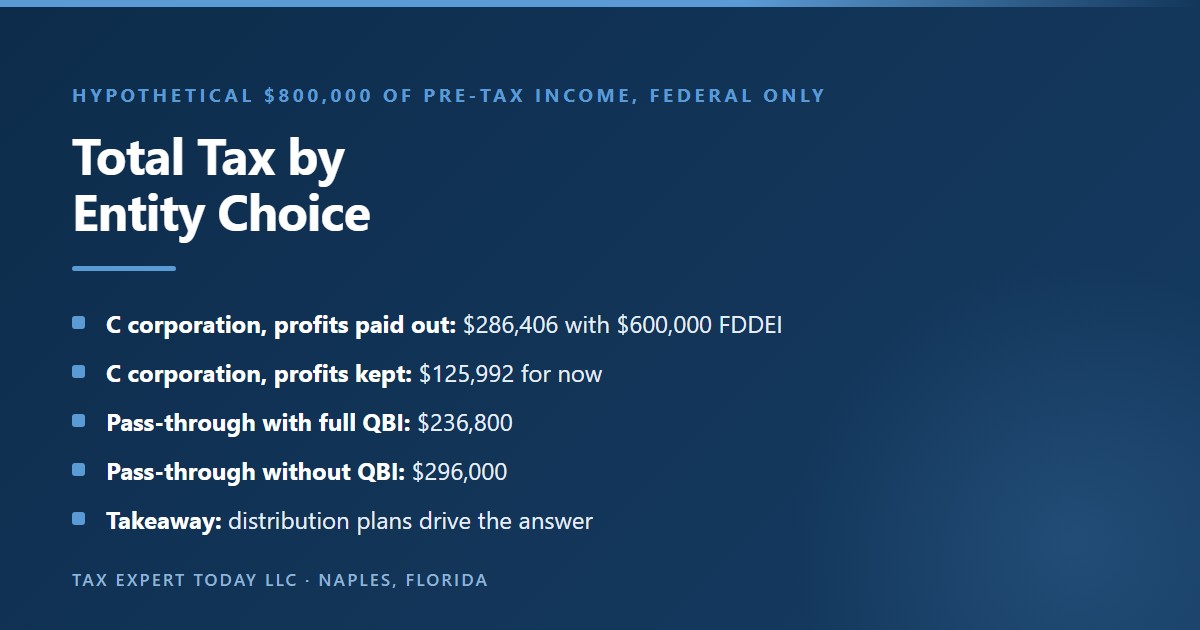
Take the same hypothetical $800,000 of pre-tax income. The table below compares federal income tax only and makes simplifying assumptions. The owner is active in the business, so the pass-through income is outside the net investment income tax. Pass-through income is taxed at the 37 percent top rate of section 1 on every dollar, which slightly overstates its tax. The wage and property limits are assumed to be met. Payroll taxes are ignored. Full distribution assumes all after-tax profit is paid as a qualified dividend and taxed at 20 percent plus 3.8 percent under section 1411.
| Structure and facts | Entity level tax | Owner level tax | Total federal tax | Combined rate |
|---|---|---|---|---|
| C corporation, $600,000 FDDEI, everything distributed | $125,992 | $160,414 | $286,406 | 35.8 percent |
| C corporation, FDDEI capped at $800,000, everything distributed | $111,989 | $163,747 | $275,735 | 34.5 percent |
| C corporation, no foreign customers, everything distributed | $168,000 | $150,416 | $318,416 | 39.8 percent |
| C corporation, $600,000 FDDEI, nothing distributed | $125,992 | $0 for now | $125,992 | 15.7 percent |
| Pass-through with full QBI deduction | $0 | $236,800 | $236,800 | 29.6 percent |
| Pass-through without QBI deduction, such as a specified service firm above the threshold | $0 | $296,000 | $296,000 | 37 percent |
The numbers tell a more nuanced story than either a promoter or a skeptic would. With full annual distributions, even a company whose taxable income is entirely foreign derived pays more in total as a C corporation than a pass-through with a full QBI deduction, $275,735 against $236,800. For a consulting firm above the QBI threshold, the same income as a pass-through costs $296,000, and the C corporation with $600,000 of FDDEI costs $286,406, so the corporation comes out ahead. For a company that reinvests its earnings for years, deferring the second layer of tax can matter a great deal more than the rate on either layer.
The decision also reaches beyond annual income tax. A C corporation may qualify for the qualified small business stock exclusion on an eventual sale, and that can dwarf everything above. It may also face the accumulated earnings tax of 20 percent under section 531 if it keeps earnings beyond the reasonable needs of the business. A corporation that revokes its S election generally cannot re-elect for five years under section 1362(g). Conversions can bring their own costs. Our business consulting and tax planning pages describe the work involved in modeling an entity choice on real numbers.
How does Florida treat the section 250 deduction?
Florida’s corporate income tax begins with federal taxable income, and the statute as published lists no adjustment naming section 250, so the deduction generally appears to flow through. Florida taxes corporations at a generally 5.5 percent rate after a $50,000 exemption, and Florida has no personal income tax on individuals.
- Rate: generally 5.5 percent under section 220.11, subject to adjustment.
- Exemption: $50,000 of net income under section 220.14.
- Conformity: Internal Revenue Code as in effect January 1, 2026, with exceptions.
- Foreign subsidiary side: Florida subtracts amounts under sections 78, 951, and 951A.
- Owners: no Florida tax on individual income or dividends.
Florida’s starting point appears in section 220.13 of the Florida Statutes, which also lists additions and subtractions. Paragraph (1)(b)2 subtracts amounts included in taxable income under sections 78, 951, and 951A. A text review of that section finds no line for the section 250 deduction itself. Section 220.03(1)(n) adopts the Internal Revenue Code as in effect on January 1, 2026, with listed exceptions for certain depreciation, research, interest, and other provisions that are held at January 1, 2025. Because Public Law 119-21 was enacted in July 2025, the amended section 250 falls within that adoption date. Whether any further adjustment applies on a given return, especially where net CFC tested income is subtracted but the related deduction remains in federal income, should be confirmed with the actual Florida return and current Department of Revenue guidance.
The rate in section 220.11 is 5.5 percent of Florida net income, and the rate provision allows for adjustment under section 220.1105. The $50,000 exemption in section 220.14 is limited to one exemption for members of a controlled group. An S corporation generally does not pay this tax on income passed through to its shareholders, so a move from S to C status brings the corporate tax into the picture. The comparison table above is federal only, and a Florida corporation should add this layer before it decides anything.
| Florida item | C corporation | S corporation or pass-through owner |
|---|---|---|
| Corporate income tax | Generally yes, on Florida-apportioned net income | Generally no, except in limited cases |
| Rate | Generally 5.5 percent | Not applicable |
| Exemption | $50,000, one per controlled group | Not applicable |
| Personal income tax on wages, dividends, or K-1 income | None in Florida | None in Florida |
| Starting point | Federal taxable income, as adjusted | Federal rules apply to the owner |
How does the deduction interact with foreign taxes?
Foreign taxes do not disqualify income from the deduction, but taxes are among the deductions allocated against FDDEI, and foreign taxes may be claimed as a credit on Form 1118 instead. The credit limitation is separately affected by the deduction. A company paying foreign withholding should model both before deciding how to claim those taxes.
- Allocated deductions: the statute includes taxes.
- Credit or deduction: foreign income taxes may be claimed either way, with limits.
- Corporate credit form: Form 1118, not Form 1116.
- Treaties: a treaty may reduce withholding on royalties or fees.
- Coordination: a treaty position may need its own disclosure.
A U.S. company paid royalties or service fees from a foreign customer may suffer foreign withholding tax. Section 250(b)(3)(A)(ii) says the expenses and deductions subtracted include taxes, other than the interest and research costs carved out. A company that deducts a foreign tax reduces its income accordingly. A company that claims it as a credit goes through the corporate foreign tax credit, and the section 250 deduction affects the fraction used in that limitation. Individual owners can read our Form 1116 guide for the individual version of the credit, though a corporation files Form 1118.
Income tax treaties may lower or eliminate withholding on some payments. Companies with Canadian customers can see our Canada United States tax treaty guide, and a position that a treaty overrides the Code may require Form 8833.
How do partnerships and Schedule K-3 fit in?
A partnership does not claim the deduction, but a domestic corporate partner takes into account its distributive share of the partnership’s gross DEI, gross FDDEI, and deductions. Partnerships report those items on Schedule K-3, Part IV, and the corporate partner attaches a statement to Form 8993 listing each partnership.
- Who claims: the domestic corporation that is a partner.
- Information source: Schedule K-3 of Form 1065 or Form 8865.
- Statement: partnership name, EIN, and partner’s share.
- Missing K-3: the draft instructions treat that income as residual DEI.
- Structure: a partnership can be a seller, a buyer, or a related party.
Under Treas. Reg. section 1.250(b)-1(e), a domestic corporate partner picks up its share of the underlying items. The partnership is treated as a person for these rules under section 1.250(b)-3(e), which is why a sale by a U.S. corporation to a domestic partnership is generally not itself a FDDEI sale even when the partnership later sells abroad. The corporate partner then picks up its share of the partnership’s own foreign sales.
The draft 2026 instructions tie Form 8993 directly to Schedule K-3, Part IV. Income from a partnership that did not provide Schedule K-3, Part IV is entered on line 18f and flows to DEI and residual DEI, which keeps it out of FDDEI. A corporate partner counting on an FDDEI share on its Form 8993 should ask for the schedule. Our guide to Schedule K-3 explains what partners receive and when.
How does the section 962 election use Form 8993?
An individual U.S. shareholder of a controlled foreign corporation who makes a section 962 election can use Form 8993 to take the section 250 deduction on net CFC tested income. The election applies the corporate rate to the inclusion and adds a second tax on later distributions, and it does not reach the individual’s own export income.
- Applies to: inclusions from a controlled foreign corporation.
- Does not apply to: business income earned directly.
- Annual choice: the election is made year by year.
- Second layer: distributions can be taxable later.
- Full analysis: covered in our separate guide.
The 40 percent side of Form 8993 is available to a section 962 electing individual under the instructions. This page leaves that math to our GILTI guide for individual shareholders, which walks through the election, the second layer of tax, and the foreign tax credit. A U.S. person who owns a foreign company should also review the annual Form 5471 requirements, because the information return applies whether or not a deduction is claimed.
What are the most common mistakes on Form 8993?
The most common mistakes include using a foreign address as if it proved foreign use, treating a domestic intermediary as a foreign customer, ignoring foreign branch income, using the older computation for a 2026 year, skipping the taxable income limit, and assuming a large company has the small business documentation exception.
- Address only: a foreign address does not establish foreign use.
- Wrong year’s rules: QBAI and old percentages applied to 2026.
- Interest and research: allocated when they should not be for 2026.
- Exclusions: used equipment gains counted in FDDEI.
- Related parties: sales to affiliates treated like outside sales.
| Mistake | Why it matters | Better practice |
|---|---|---|
| Foreign billing address taken as proof of use | Foreign person status and foreign use are separate tests | Document delivery, access, or end customer location |
| Foreign-incorporated client treated as automatically qualifying | Benefit to foreign operations controls, not incorporation | Record which operations are served |
| Export sold through a U.S. reseller claimed as FDDEI | A sale to a U.S. person is not a FDDEI sale | Identify the actual buyer of record |
| Foreign branch income left in DEI | It is an exclusion | Review for any foreign office or fixed place of business |
| Gain on used equipment included | Excluded for sales after June 16, 2025 | Separate operating revenue from asset sales |
| 2026 return prepared with old assumptions | QBAI and interest allocation no longer apply | Use the final 2026 form and current instructions |
| Limit overlooked in a low-profit year | The deduction shrinks and does not carry over | Test taxable income before finalizing |
| Prior year receipts test applied to one company | All related parties count toward $25,000,000 | Aggregate the whole related group |
| Fiscal year treated as calendar 2026 | The rate change depends on the year’s start date | Confirm the first day of the tax year |
| Form 8993 not attached | The regulation requires the annual form when the deduction is claimed | Include Form 8993 with Form 1120 |
Can a corporation claim a missed deduction on an amended return?
Potentially, within the refund statute of limitations. The corporation files an amended return with a corrected or new Form 8993 marked Corrected. For a corporation above the $25,000,000 line, however, required documents must have existed by the original extended due date, which can defeat a late claim.
- Window: generally the period in section 6511.
- Procedure: amended return with Form 8993 marked Corrected.
- Documents: required ones must predate the original extended due date.
- Small companies: the $25,000,000 exception may help.
- Old rules: prior years use the computation for those years.
The instructions say a taxpayer that later determines a Form 8993 is incomplete or incorrect should file a corrected form with an amended return, entering “Corrected” at the top. Section 6511 generally sets the period for a refund claim at three years from the return’s filing or two years from payment, whichever is later. A prior year uses the rules for that year, so a 2024 or 2025 calendar year return still uses the 37.5 percent rate and the older computation.
Whether an amended claim makes sense depends on how much is at stake, how good the records are, and whether the amendment would invite other questions. A corporation should weigh those factors before filing, and any claim should be supported by the facts at hand.
What penalties can apply to a Form 8993 error?
Section 250 has no separate penalty for Form 8993 itself. An overstated deduction can produce an underpayment subject to the general 20 percent accuracy-related penalty under section 6662, plus interest. Reasonable cause and good faith may be available in appropriate cases under section 6664, depending on the facts.
- Accuracy penalty: 20 percent of the underpayment portion, where it applies.
- Interest: runs on any additional tax.
- Reasonable cause: a facts and circumstances defense.
- Documents: records support both the deduction and any defense.
- Other forms: separate penalties exist on international information returns.
The general accuracy-related penalty in section 6662 can apply to negligence or to a substantial understatement. Section 6664(c) provides that the penalty does not apply to a portion of an underpayment if the taxpayer shows reasonable cause and good faith. Our guides to the reasonable cause standard and to how IRS penalty relief works explain those concepts, and outcomes depend on individual facts and on IRS review.
Companies with foreign bank accounts have a separate question. A U.S. corporation with signature authority over or a financial interest in foreign accounts may have an FBAR obligation; see our guide to who must file an FBAR. That duty does not depend on whether the corporation claims this deduction.
What should a C corporation do before year end?
Before year end, a C corporation with foreign customers should estimate FDDEI and taxable income, confirm whether its prior year receipts fall under the $25,000,000 line, gather customer and location records, separate any equipment or intangible sales, and review whether expenses are being tracked well enough to allocate them.
- Estimate: FDDEI against projected taxable income.
- Receipts test: prior year, group wide.
- Records: customer contracts, delivery, and access logs.
- Exclusions: equipment and intangible sales.
- Entity review: whether the current structure still fits.
| Step | Question to answer | Records or output |
|---|---|---|
| 1. Entity status | Is the company a domestic C corporation? | Formation documents and any Form 8832 or 2553 |
| 2. Year | Does the tax year begin after December 31, 2025? | First day of the tax year |
| 3. Revenue sort | Which revenue is from foreign customers? | Sales ledger by customer and country |
| 4. Exclusions | Any foreign branch income, Subpart F, or asset sales? | Fixed asset register and entity chart |
| 5. Foreign use | Does each stream meet the foreign use or service test? | Contracts, shipping, access logs, project records |
| 6. Documentation | Is the group below $25,000,000? | Prior year receipts schedule |
| 7. Allocation | How are expenses divided? | Allocation workpaper, excluding interest and research for 2026 |
| 8. Limit | Does FDDEI exceed projected taxable income? | Year end tax projection |
| 9. Filing | Is the final Form 8993 for the year available? | IRS.gov/Form8993 |
| 10. Structure | Does the entity still fit the business? | Multi-year entity comparison |
Form 8993 Help in Naples & Southwest Florida
Tax Expert Today LLC works with U.S. companies that sell to foreign customers from an office in Naples, Florida and serves clients in all 50 states. Southwest Florida has its share of exporters, software and engineering firms, marine and aviation suppliers, and family companies with buyers across the Caribbean, Canada, and Latin America. Our team of tax advisors, enrolled agents, CPAs, and attorneys helps companies determine whether a section 250 deduction is available, sort revenue between foreign and domestic customers, set up the foreign use file, prepare Form 8993 with Form 1120, and model the deduction as one input in a C corporation or pass-through decision.
- Form 8993 help Naples: computing and documenting the section 250 deduction with Form 1120.
- FDII deduction Naples: foreign use, the small business exception, and the 2026 rules.
- International tax Naples FL: Form 5471, Form 8865, Form 5472, and cross-border entity reporting.
- Foreign tax Naples: foreign tax credits, withholding on royalties and fees, and treaty positions.
- FBAR Naples: foreign accounts held by a company or its owners.
Our international and expat tax services page explains how we work with businesses and individuals with cross-border activity, and our international tax Naples FL guide covers the wider picture for Southwest Florida. Owners focused on the broader tax picture can see our Naples, Florida tax planning page.
Office: 11983 Tamiami Trail N, Naples FL 34110
Phone: (239) 441-2005
Hours: Monday through Friday, 10:00 to 5:00 ET
Frequently Asked Questions
Where can I get help with Form 8993 in Naples, Florida?
Tax Expert Today LLC, located at 11983 Tamiami Trail N in Naples, Florida, helps C corporations and their owners with Form 8993, the section 250 deduction, and related international reporting. The firm includes tax advisors, enrolled agents, CPAs, and attorneys and serves clients in all 50 states. Call (239) 441-2005 to discuss your facts.
Is the FDII deduction still available in 2026?
Yes, under a new name. For tax years beginning after December 31, 2025, foreign-derived intangible income is called foreign-derived deduction eligible income, and the deduction is generally 33.34 percent. The computation no longer subtracts a 10 percent return on tangible assets and no longer allocates interest or research costs against the income.
Does a small business have to keep the special documents for Form 8993?
The specific substantiation rules do not apply if the taxpayer and all related parties received less than $25,000,000 of gross receipts in the prior tax year. The statute still requires foreign use to be established, so a company below that line should keep contracts, invoices, and delivery or location records.
Can an S corporation file Form 8993 for its export sales?
No. The section 250 deduction is not available to S corporations. Their owners may look at the qualified business income deduction, or at other export structures, but the 33.34 percent export deduction requires a domestic C corporation.
Do sales to a foreign distributor qualify for the deduction?
They can. The goods must ultimately be sold to end users outside the United States, and a seller above the $25,000,000 line needs specific documents, such as a contract limiting sales to outside the United States or credible evidence from the distributor. A foreign address alone does not establish foreign use.
Does selling used machinery to a foreign buyer create FDDEI?
Generally no. For sales after June 16, 2025, income and gain from selling property of a type subject to depreciation is excluded from deduction eligible income. Proposed regulations confirm that inventory that was always held as inventory stays outside the exclusion, and final regulations should be checked when issued.
Must a C corporation file Form 8993 if it has no foreign customers?
Generally no. The regulation requires Form 8993 from a domestic corporation or section 962 individual that claims a section 250 deduction. A corporation with no FDDEI and no net CFC tested income has nothing to compute, though it should confirm that it has no foreign subsidiary inclusions before reaching that conclusion.
When to Engage a Professional
Form 8993 rewards careful sorting, and the sorting is where the judgment lies: whether a customer is a foreign person, whether use is truly foreign, whether a service benefits operations abroad, how much of an expense is properly allocable, and whether a contract labeled a license is a license. The 2026 changes add a new layer. Form 8993 is being redesigned, the regulations still reflect the older statute in places, and proposed rules on property sales were not final as of this writing.
A professional review is worth considering when a C corporation has meaningful foreign revenue, when an S corporation owner is weighing a change of entity because of export income, when a business sells to related foreign companies or through distributors, when a large customer’s location cannot be documented, when a business plans to sell equipment or intellectual property abroad, or when the deduction was never claimed in earlier years. Questions on contracts and corporate restructuring should also involve qualified legal counsel.
Tax Expert Today LLC is a tax advisory firm in Naples, Florida serving clients in all 50 states. Call (239) 441-2005 to discuss your facts.
This article is general information, not legal or tax advice for any particular taxpayer, and does not create a client relationship. The examples are hypothetical illustrations only, do not describe any client, and use simplified figures. Whether income qualifies, how expenses are allocated, whether a deduction is limited, and how an entity comparison comes out depend on the facts and on regulations and guidance that may change. Draft forms and instructions are not for filing, and proposed regulations are not final. The rules described here reflect 26 U.S.C. sections 1, 11, 172, 199A, 250, 531, 864, 904, 951A, 962, 991, 1362, 1411, 6072, 6081, 6511, 6662, and 6664 as amended by Public Law 119-21; Treasury Regulations sections 1.250(a)-1 and 1.250(b)-1 through 1.250(b)-6; Notice 2025-78; REG-117130-25; the Instructions for Form 8993 (Rev. 12/2025); the draft Form 8993 and Instructions (Rev. December 2026); and Florida Statutes sections 220.03, 220.11, 220.13, and 220.14, all reviewed on November 9, 2026.
Published November 9, 2026 by Dr. Pellumb Kabashi « Back to Learning Center
Have a question this article touches on?
Tax Expert Today LLC, based in Naples, Florida and serving clients across the United States.
Schedule a Consultation (239) 441-2005