
By Dr. Pellumb Kabashi, DBA, MBA, CES, CFE, EA
Founder, Tax Expert Today LLC · Tax advisors, enrolled agents, CPAs, and attorneys · Serving clients in all 50 states
Quick Answer: Intangible drilling costs are the wages, fuel, mud, hauling, site work and contractor charges spent drilling an oil or gas well that have no salvage value. Under IRC Section 263(c), the holder of a working interest may elect to deduct them in the year paid or incurred. Whether a Texas investor can use that deduction depends on how the interest is held, the alternative minimum tax and later recapture. Call (239) 441-2005 for a free consultation.
Oil and gas drilling is a large part of the Texas economy, and many of the people who invest in new wells do not work in the industry at all. They are physicians, business owners, executives and retirees who are offered a share of a drilling program by an operator, a sponsor or a friend. The first number they hear is usually some version of the same sentence: most of the cost of a new well can be deducted in the first year. That sentence describes intangible drilling costs, and it is broadly accurate. It is also incomplete in ways that decide whether the deduction actually reduces the investor’s taxable income.
The option to deduct intangible drilling costs has a long history. Congress recognized the regulations granting it in House Concurrent Resolution 50 of the 79th Congress, and Section 263(c) of the Internal Revenue Code still points to those regulations today. The rule itself is simple. The complications sit in the rules that surround it: the passive activity rules in Section 469, the at-risk rules in Section 465, the excess business loss limitation in Section 461(l), the alternative minimum tax preference in Section 57, the optional 60-month write-off in Section 59(e), the prepayment rule in Section 461(i) and the recapture rule in Section 1254.
The pages that currently rank for this subject mostly define intangible drilling costs and state that they are deductible. That is useful as a starting point. What they generally do not explain is the set of rules that decide whether a particular investor can use the deduction. This guide covers those rules for a Texas investor: what qualifies, how the election works, why the working interest exception is lost when the interest sits inside a limited liability wrapper, how the alternative minimum tax treats the deduction, what happens when the interest is sold, and how Texas itself treats the income and the entity that holds the well. It describes mechanisms and qualifying conditions. It is not a recommendation to invest in any oil and gas program, and it does not estimate tax savings for any reader.
What Are Intangible Drilling Costs?
Intangible drilling costs are the costs of drilling and preparing an oil or gas well that have no salvage value on their own, such as wages, fuel, repairs, hauling, supplies, drilling mud, site clearing, road building, surveying and contractor charges. Treasury Regulation Section 1.612-4(a) defines them, and Section 263(c) lets the operator deduct them rather than capitalize them.
- Labor and services. Drilling crew wages, contractor day rates, engineering and geological work needed to drill.
- Consumables. Fuel, power, water, drilling fluids, chemicals and cement used in the hole.
- Site preparation. Clearing, draining, grading, road making and surveying needed before drilling.
- Not equipment. Casing, wellheads, pumps, tanks and other items with salvage value are tangible and are recovered through depreciation.
The regulation describes the category with unusual specificity. It covers “wages, fuel, repairs, hauling, supplies, etc., incident to and necessary for the drilling of wells and the preparation of wells for the production of oil or gas.” It then gives three groups of examples: amounts used in the drilling, shooting and cleaning of wells; amounts used in clearing ground, draining, road making, surveying and geological work necessary in preparation for drilling; and amounts used in the construction of derricks, tanks, pipelines and other physical structures necessary for drilling and for preparing the well for production.
The word “intangible” is misleading. Nothing about these costs is abstract. A drilling rig burns real diesel and a crew draws real wages. The label means only that the cost does not produce an item that could be pulled out of the ground and sold. The regulation says this directly: the option applies “only to expenditures for those drilling and developing items which in themselves do not have a salvage value.” It adds that labor, fuel, repairs, hauling and supplies are not treated as having salvage value “even though used in connection with the installation of physical property which has a salvage value.” So the wages of the crew that installs casing are intangible drilling costs even though the casing itself is not.
Intangible drilling costs also include work done by contractors under any form of contract, including turnkey contracts, which are agreements under which a drilling contractor delivers a completed well for a stated price. The regulation excludes amounts payable only out of production, if those amounts are depletable income to the person receiving them, and amounts properly allocable to depreciable property. That second exclusion matters in turnkey arrangements, because a single contract price often covers both drilling work and equipment, and the equipment portion has to be separated out.
What Is the Difference Between Intangible and Tangible Drilling Costs?
Intangible drilling costs are spent on work and consumables that leave nothing salvageable behind, and they may be deducted when paid or incurred if the election is made. Tangible drilling costs buy equipment that keeps a value, such as casing, tubing, wellheads and pumping units, and they are capitalized and recovered through depreciation instead.
- Intangible. Deductible under the Section 263(c) election, subject to the limits in this guide.
- Tangible. Depreciable equipment recovered under the ordinary depreciation rules.
- Leasehold cost. The cost of acquiring the lease is neither, and is recovered through depletion.
- Mixed contracts. A turnkey price must be split between drilling work and equipment.
A typical drilling budget, called an authority for expenditure in the industry, separates the two categories line by line. Operators commonly describe intangible drilling costs as a majority of the cost of a new well, and figures in the range of 60 to 80 percent appear frequently in industry and adviser materials. That range is an industry estimate rather than a legal rule, and the actual split for any well depends on its depth, location, completion design and contract terms. An investor should look at the operator’s budget for the specific well rather than rely on a general percentage.
Tangible equipment follows the ordinary depreciation rules described in our 2026 depreciation guide, which means its treatment can change with depreciation legislation even when the intangible drilling cost rules do not. Our guide to bonus depreciation in 2026 covers the current depreciation rules for equipment generally. The cost of acquiring the lease itself, whether as a lease bonus or a purchase price for an existing working interest, is a third category. It is neither intangible drilling cost nor depreciable equipment, and it is recovered through depletion over the life of the property.
| Cost category | Typical examples | General federal treatment | Authority |
|---|---|---|---|
| Intangible drilling costs | Crew wages, fuel, drilling mud, cementing services, site clearing, roads, surveying, contractor day rates | Deductible when paid or incurred if the election is made; otherwise capitalized | IRC 263(c); Treas. Reg. 1.612-4 |
| Tangible drilling and completion equipment | Casing, tubing, wellhead, pumping unit, separators, tanks | Capitalized and depreciated | IRC 167 and 168 |
| Lease acquisition cost | Lease bonus, purchase price of a working interest | Capitalized and recovered through depletion | IRC 611 to 613A |
| Nonproductive well costs | Intangible drilling costs of a well that does not produce in commercial quantities | Deductible, and excluded from the alternative minimum tax preference | IRC 57(a)(2)(B); Treas. Reg. 1.612-4(b)(4) |
| Operating costs after completion | Lease operating expenses, pumper fees, utilities, routine repairs | Ordinary business expenses | IRC 162 |
Who Can Deduct Intangible Drilling Costs?
The option belongs to an operator, which the regulation defines as anyone holding a working or operating interest in the property, as fee owner, under a lease or under another operating contract. An investor who owns a working interest qualifies even if someone else runs the rig. A royalty owner does not, because it bears no drilling costs.
- Working interest owner. Pays a share of drilling and operating costs and can elect to deduct its share of intangible drilling costs.
- Royalty or overriding royalty owner. Receives a share of production free of costs and has no drilling costs to deduct.
- Partner in a drilling partnership. Receives an allocated share of the partnership’s intangible drilling costs on a Schedule K-1.
- Fractional interests earned by drilling. Only the share of costs attributable to the fraction kept qualifies.
The regulation’s definition of an operator is broader than the everyday meaning. In the industry, “the operator” is the single company that manages the well, obtains permits and hires contractors. For Section 263(c), an operator is “one who holds a working or operating interest in any tract or parcel of land either as a fee owner or under a lease or any other form of contract granting working or operating rights.” A passive investor who owns a two percent working interest and never sees the well site is an operator in the tax sense for that two percent.
This is why the distinction between a working interest and a royalty interest decides almost everything in this area. A royalty owner receives a share of production, or of the proceeds from production, without paying any share of the cost of drilling or operating the well. Because a royalty owner pays no drilling costs, there are no intangible drilling costs to deduct. Royalty income has its own rules, including percentage depletion, which are covered in our guide to royalty income taxes. This guide is about the investor who pays a share of the cost of drilling the well.
One limit in the regulation catches some investors. Where a drilling or development project is undertaken in exchange for a fraction of the operating rights, a common arrangement known as a farmout or carried interest, only the part of the costs attributable to the fraction the driller keeps falls within the option. The costs allocable to fractions held by others must be capitalized as the cost of the interest acquired. Investors in carried arrangements should confirm how the program allocates costs between the parties before assuming the full payment is deductible.
How Does the Intangible Drilling Cost Election Work?
The election is made simply by claiming intangible drilling costs as a deduction on the return for the first taxable year in which the taxpayer pays or incurs them; no formal statement is needed. A taxpayer who fails to deduct them in that first year is treated as having elected to capitalize them, and the choice binds all later years.
- Made on the return. Deducting the costs in the first year is the election, under Treas. Reg. 1.612-4(d).
- Binding. The choice applies to that year and all later years for the taxpayer.
- Default if missed. Not deducting in the first year means capitalization, recovered through depletion and depreciation.
- Nonproductive wells. A taxpayer who capitalizes may still elect to deduct costs of dry holes.
Treasury Regulation Section 1.612-4(d) states the rule plainly. The option “may be exercised by claiming intangible drilling and development costs as a deduction on the taxpayer’s return for the first taxable year in which the taxpayer pays or incurs such costs; no formal statement is necessary.” If the taxpayer fails to deduct the costs on that return, the taxpayer “shall be deemed to have elected to recover such costs through depletion to the extent that they are not represented by physical property, and through depreciation to the extent that they are represented by physical property.”
Two practical points follow. First, the election is made by the taxpayer who owns the working interest. When a partnership owns the interest, the partnership generally makes the election and passes the deduction through to the partners on Schedule K-1. Second, because missing the deduction in the first year is itself treated as an election, the first year in which an investor participates in drilling matters. An investor who files a late K-1 based return, or who omits the item because the K-1 arrived after the return was filed, should review the position promptly with a professional rather than assume the item can simply be picked up later.
Capitalized intangible drilling costs are not lost. They are recovered through depletion to the extent they are not represented by physical property, and through depreciation to the extent they are. The regulation also provides a secondary option: a taxpayer who chooses to capitalize may still elect to deduct the intangible drilling costs of nonproductive wells. IRS Publication 5652 notes that examiners review whether wells classified as nonproductive actually failed to produce in commercial quantities, because the treatment of nonproductive well costs is more favorable than the treatment of costs on successful wells.
Can a Texas Investor Deduct Intangible Drilling Costs Against Salary or Business Income?
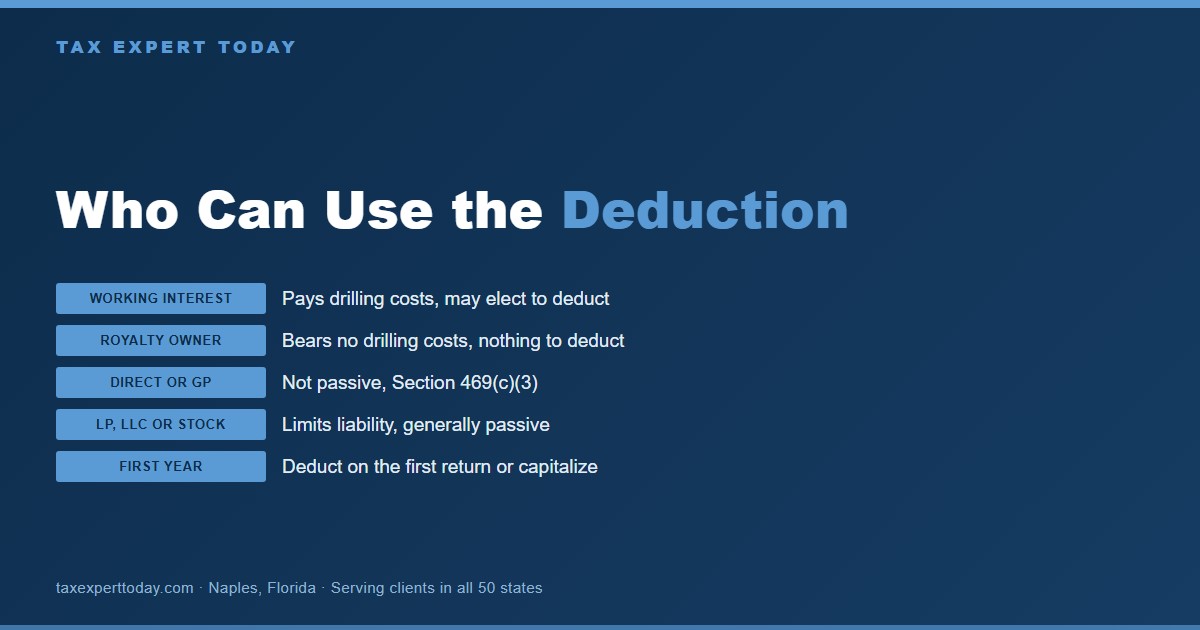
Possibly. Section 469(c)(3) says a working interest held directly, or through an entity that does not limit the investor’s liability, is not a passive activity, even without material participation. Losses from it can then offset wages and business income, subject to the at-risk rules and the excess business loss limitation.
- Direct ownership. A working interest held in the investor’s own name qualifies for the exception.
- General partner interest. Qualifies, because a general partner’s liability is not limited.
- Limited partner, LLC member or shareholder. Generally does not qualify, so the loss is passive.
- Other limits still apply. At-risk, basis and excess business loss rules can still defer the loss.
This is the point on which most drilling investments are actually marketed, and it is the point the ranking pages most often leave out. Ordinarily, an investor who does not materially participate in a business has a passive activity, and losses from passive activities can offset only passive income. A physician who invests in a business run by someone else generally cannot use losses from it to reduce salary. Section 469(c)(3) carves out working interests in oil and gas property from that rule. The statute says the term passive activity “shall not include any working interest in any oil or gas property which the taxpayer holds directly or through an entity which does not limit the liability of the taxpayer with respect to such interest.”
Section 469(c)(4) then adds that this exception applies “without regard to whether or not the taxpayer materially participates in the activity.” The investor does not have to work on the well, attend meetings or keep time logs. The exception turns entirely on the form of ownership and the investor’s exposure to liability. That is a deliberate policy choice. Congress allowed the losses to be treated as nonpassive because the investor carries unlimited liability for the costs and risks of drilling and operating the well.
The consequence is that an intangible drilling cost deduction allocated to a qualifying working interest can, in principle, produce a nonpassive loss that offsets wages, professional fees or business income. Whether it actually does depends on the remaining limits covered below. It also depends on whether the interest really is held in a form that leaves the investor’s liability unlimited, which is the question the next section answers.
When Is the Working Interest Exception Lost?
The exception is lost when the investor holds the working interest through an entity that limits the investor’s liability. Under Treas. Reg. 1.469-1T(e)(4)(v), that means a limited partnership interest where the investor is not also a general partner, stock in a corporation, or an interest in any entity that caps the holder’s liability under state law, such as an LLC.
- Limited partnership interest. Limits liability unless the investor is also a general partner.
- Corporate stock. Always limits liability for this purpose, including S corporation stock.
- LLC membership. Generally limits liability to a determinable amount under state law.
- Insurance and indemnities ignored. Contractual protection does not count as limited liability.
The regulation lists three forms of ownership that limit liability. An entity limits the investor’s liability if the investor’s interest is in the form of “(1) A limited partnership interest in a partnership in which the taxpayer is not a general partner; (2) Stock in a corporation; or (3) An interest in any entity (other than a limited partnership or corporation) that, under applicable State law, limits the potential liability of a holder of such an interest for all obligations of the entity to a determinable fixed amount (for example, the sum of the taxpayer’s capital contributions).”
The third category is where many Texas investors are caught. A limited liability company is designed to cap each member’s exposure at the member’s investment. That protection is the reason most investors want an LLC. For Section 469(c)(3), the same protection means the working interest is held through an entity that limits liability, so the interest is generally a passive activity unless the investor materially participates. An investor who forms a personal LLC to hold a working interest for asset protection reasons may convert what would have been a nonpassive loss into a passive one. That trade-off between liability protection and tax treatment should be weighed deliberately, not discovered on the first K-1.
The regulation also closes the obvious workaround. Protection against loss through an indemnification agreement, a stop loss arrangement, insurance or similar arrangements is not taken into account in deciding whether the entity limits liability. In one of the regulation’s examples, a general partner whose co-partners agree to provide indemnity against liability beyond that partner’s capital contribution is still treated as holding the interest through an entity that does not limit liability, because a general partner remains jointly and severally liable for the partnership’s debts. The investor keeps the exception, but only because state law liability is unlimited; the private indemnity is simply disregarded.
The regulation’s examples also show what happens when an investor holds both kinds of interest. A taxpayer who is both a general partner and a limited partner in the same partnership is treated as holding the entire interest in each well as a nonpassive interest. And Example 1 in Section 1.469-1T(e)(4)(iii) describes an investor who holds a general partnership interest during the drilling year and then converts it to a limited partnership interest. The investor’s interest is nonpassive for the year in which it was held as a general partner and passive for the following year in which liability was limited.
| How the working interest is held | Does the entity limit the investor’s liability? | General result under IRC 469(c)(3) |
|---|---|---|
| Directly, in the investor’s own name | No entity involved | Not a passive activity, regardless of participation |
| General partner interest in a drilling partnership | No | Not a passive activity, regardless of participation |
| General partner interest with an indemnity or insurance from others | No; protection by contract is disregarded | Not a passive activity |
| Both a general and a limited partner interest in the same partnership | No, for the whole interest in each well | Not a passive activity |
| Limited partner interest only | Yes | Passive unless the investor materially participates |
| Member of an LLC that holds the working interest | Generally yes, under state law | Passive unless the investor materially participates |
| Shareholder of a corporation, including an S corporation | Yes | Passive for the shareholder unless the shareholder materially participates |
How Do Drilling Programs Use the General Partner Conversion Structure?
Many programs admit investors as general partners or additional general partners during the drilling phase, so the intangible drilling cost deduction arrives while liability is unlimited, and then convert those interests to limited partner interests after drilling. The regulation tests each year separately, so the timing of conversion and of each deduction matters.
- Drilling year. Interest held as a general partner, so the exception applies to that year.
- Conversion. The interest becomes a limited partner interest once drilling is complete.
- Later years. Net income from the property stays nonpassive under Section 469(c)(3)(B).
- Disqualified deductions. Deductions whose economic performance falls in a limited liability period are treated as passive.
The structure exists because investors want two things that pull in opposite directions: a nonpassive deduction, which requires unlimited liability, and protection from the risks of drilling, which requires limited liability. A program that admits investors as general partners while the well is drilled, and converts them to limited partners afterward, tries to give them the first during the period when the deduction arises and the second for the life of the well. Investors in these programs are exposed to real liability during the general partner period. Insurance and indemnities may reduce the practical risk, but, as the regulation states, they do not change the tax analysis and they may not cover every exposure.
The regulation also anticipates the timing games that a conversion structure invites. Under Section 1.469-1T(e)(4)(ii), if the investor has a net loss from the well for a year in which the exception applies, deductions attributable to a later period during which liability is limited are “disqualified deductions” and are treated as passive. In the regulation’s Example 2, all drilling costs were paid before year end, but economic performance for part of them did not occur until the following year, after conversion. That part was treated as passive, and a ratable share of the gross income from the well was treated as passive as well.
After conversion, Section 469(c)(3)(B) produces a result many investors do not expect. If a taxpayer had a loss from a working interest that was treated as nonpassive, “any net income from such property” in later years is treated as nonpassive income. So the later production income from the well cannot be used to absorb passive losses from other investments, such as rental real estate. The early deduction is nonpassive and so is the later income. Investors who were counting on drilling income to free up suspended passive losses should take that rule into account.
What Other Limits Can Stop an Intangible Drilling Cost Loss?
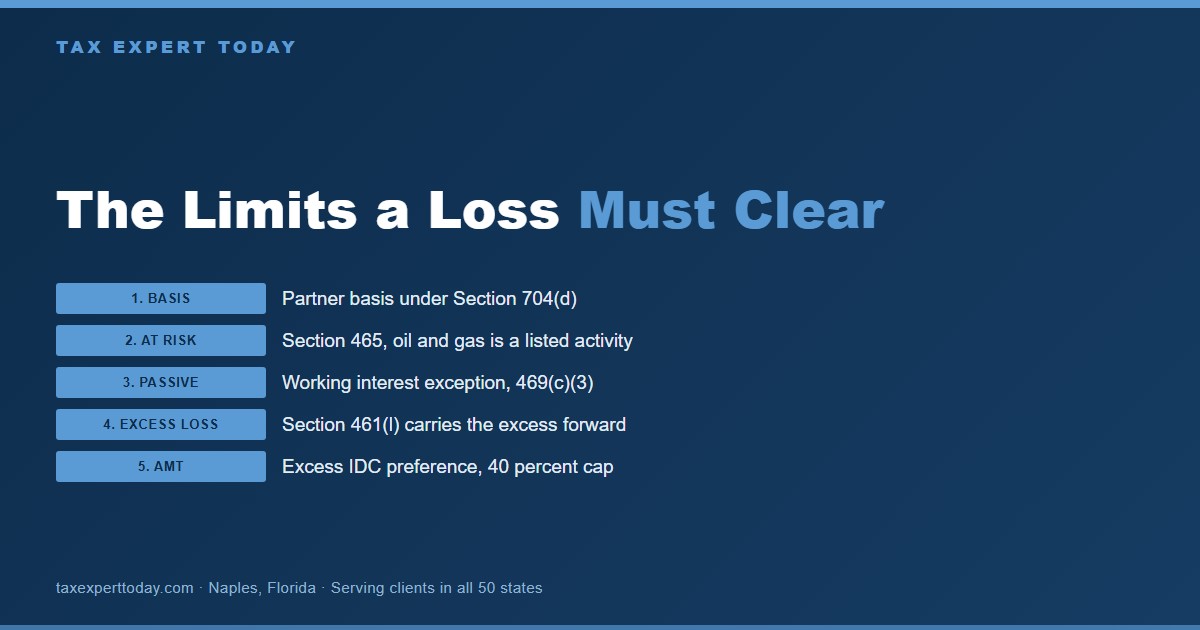
Even a nonpassive loss must clear three more tests. The investor needs enough basis, the loss is limited to the amount the investor has at risk under Section 465, and an individual’s total net business losses above an annual threshold become an excess business loss under Section 461(l) that carries forward as a net operating loss.
- Basis. A partner cannot deduct losses beyond the adjusted basis of the partnership interest.
- At risk. Section 465 lists exploring for or exploiting oil and gas resources as a covered activity.
- Excess business loss. Large combined business losses are deferred to later years.
- Order of the tests. Basis, then at risk, then passive activity, then excess business loss.
The passive activity rules are only one of several gates. Before them comes basis: a partner can deduct partnership losses only up to the adjusted basis of the partnership interest, under Section 704(d). Next comes the at-risk limitation in Section 465, which applies to individuals and certain closely held corporations engaged in listed activities. Section 465(c)(1) expressly includes “exploring for, or exploiting, oil and gas resources.” An investor is generally at risk for cash contributed and for borrowed amounts for which the investor is personally liable, and generally not at risk for nonrecourse financing or amounts protected against loss by stop loss agreements or similar arrangements. A program financed partly with nonrecourse debt may therefore pass a deduction to the investor that cannot be used in the year it arrives.
After basis, at-risk and passive activity limits, an individual investor faces the excess business loss limitation in Section 461(l). It caps the amount by which an individual’s aggregate business deductions can exceed aggregate business income and gains in a year. The disallowed portion becomes a net operating loss carryforward. For an investor with a large intangible drilling cost deduction and modest other business income, that rule can defer part of the deduction to later years even though it is nonpassive. Our guide to the excess business loss limitation explains how the threshold is computed and how the carryforward works.
Each limit operates on its own terms, and a loss that clears one may stop at the next. That is why two investors in the same drilling program, with identical K-1 figures, can end the year with very different usable deductions. A careful review looks at the K-1, the partnership agreement, the financing documents and the investor’s other income together.
| Limit | What it asks | If the loss fails the test | Authority |
|---|---|---|---|
| Partnership basis | Does the partner have enough adjusted basis in the partnership interest? | Excess loss is suspended until basis is restored | IRC 704(d) |
| At-risk amount | Is the investor economically at risk for the amount, considering nonrecourse debt and loss protection? | Excess loss carries forward to a later year with enough amount at risk | IRC 465 |
| Passive activity | Is the working interest held directly or through an entity that does not limit liability? | Loss is passive and can offset only passive income, with the excess suspended | IRC 469(c)(3); Treas. Reg. 1.469-1T(e)(4) |
| Excess business loss | Do total business losses exceed total business income plus the annual threshold? | Excess becomes a net operating loss carryforward (see our excess business loss guide) | IRC 461(l) |
| Prepayment timing | For a tax shelter, does drilling begin within 90 days after year end? | Prepaid amount is deducted when economic performance occurs instead | IRC 461(i)(2) |
Can Prepaid Intangible Drilling Costs Be Deducted Before Drilling Starts?
Sometimes. For an arrangement that is a tax shelter, Section 461(i)(2) treats economic performance on amounts paid during the year for drilling a well as occurring that year only if drilling begins before the close of the 90th day after year end. For a calendar year investor, that is generally by the end of March of the following year.
- The 90-day rule. Drilling must commence within 90 days after the close of the taxable year.
- Cash basis cap. For a tax shelter partnership, the deduction is limited by the partner’s cash basis.
- Ordinary rules otherwise. Prepayments that miss the rule follow the general economic performance rules.
- Examination focus. IRS Publication 5652 lists prepaid expenses as an examination topic.
Year end drilling programs are common because investors who learn of a large income year in the fall look for a deduction before December 31. The program collects funds in December and pays the drilling contractor before year end, but the well may not be spudded until the following year. Ordinarily, a deduction for services is not allowed until economic performance occurs, which for drilling services generally means when the work is done. Section 461(i)(2)(A) provides a special rule: “In the case of a tax shelter, economic performance with respect to amounts paid during the taxable year for drilling an oil or gas well shall be treated as having occurred within a taxable year if drilling of the well commences before the close of the 90th day after the close of the taxable year.”
The rule is often repeated as a March 31 deadline, which is approximately right for a calendar year taxpayer, though the exact 90th day depends on the year. It comes with a cap. Under Section 461(i)(2)(B), for a tax shelter that is a partnership, a deduction or loss attributable to the prepaid amount is limited by the partner’s “cash basis” rather than adjusted basis. Cash basis is computed without regard to partnership liabilities and without regard to amounts the partner borrowed with respect to the partnership in certain arrangements. That cap prevents a partner from deducting prepaid drilling funded by borrowing.
Prepayments outside the special rule are governed by the general rules for prepaid expenses and economic performance, including the requirement that the payment be for an actual drilling obligation rather than a deposit that could be refunded. Examiners look at the drilling contract, the date drilling actually began, whether the prepayment was required by the contract and whether there was a business purpose for paying early. An investor who participates in a year end program should keep the program’s documentation showing the spud date.
What Is the 60-Month Election Under Section 59(e)?
Section 59(e) lets a taxpayer elect to deduct any portion of qualifying intangible drilling costs ratably over 60 months, beginning with the month paid or incurred, instead of all at once. Amounts covered by the election are not treated as an alternative minimum tax preference, and each partner makes the election separately for its share.
- Any portion. The election can cover all or only part of the intangible drilling costs.
- Partner by partner. Each partner decides separately for its allocable share.
- No AMT preference. Elected amounts are removed from the Section 57 preference.
- Revocation. Revocable only with the consent of the IRS.
Section 59(e) is the main tool for managing the alternative minimum tax consequences of a large intangible drilling cost deduction. Under Section 59(e)(1), any qualified expenditure covered by the election “shall be allowed as a deduction ratably over the 10-year period,” except that for intangible drilling costs the period is “the 60-month period beginning with the month in which such expenditure was paid or incurred.” The election can be made “with respect to any portion of any qualified expenditure,” so an investor may deduct part of the costs currently and spread the rest.
Two details make the election useful in a partnership. Under Section 59(e)(4)(C), “any election under paragraph (1) shall be made separately by each partner with respect to the partner’s allocable share of any qualified expenditure,” and the same rule applies to S corporation shareholders. The program does not decide for the investor. And under Section 59(e)(6), any portion covered by the election “shall not be treated as an item of tax preference under section 57(a).” The IRS instructions for Form 6251 make the same point: do not make the intangible drilling cost adjustment for costs for which the optional 60-month write-off was elected for the regular tax.
The trade-off is timing. A current deduction reduces regular taxable income now. A 60-month deduction reduces it more slowly but may avoid or reduce alternative minimum tax. Which is better for a particular investor depends on that investor’s projected regular tax and alternative minimum tax over the next several years, which is a calculation to make with a professional before the return is filed. Section 59(e)(4)(B) provides that the election “may be revoked only with the consent of the Secretary,” so it should not be made casually.
How Does the Alternative Minimum Tax Treat Intangible Drilling Costs?
Section 57(a)(2) makes excess intangible drilling costs a preference item to the extent they exceed 65 percent of net income from oil, gas and geothermal properties. Section 57(a)(2)(E) then exempts taxpayers that are not integrated oil companies, but limits that benefit to 40 percent of alternative minimum taxable income.
- Excess IDC. Productive well intangible drilling costs deducted, minus what 120-month amortization would have allowed.
- 65 percent offset. Only the excess above 65 percent of net oil and gas income is a preference.
- Independent producer exception. Taxpayers that are not integrated oil companies are generally exempt.
- 40 percent cap. The exemption cannot reduce AMTI by more than 40 percent of AMTI before it.
The calculation has several layers. Under Section 57(a)(2)(B), excess intangible drilling costs are the intangible drilling costs on productive wells allowable under Section 263(c) or 291(b) for the year, minus “the amount which would have been allowable for the taxable year if such costs had been capitalized and straight line recovery of intangibles” had been used. Section 57(b) defines straight line recovery as “ratable amortization of such costs over the 120-month period beginning with the month in which production from such well begins,” or, at the taxpayer’s election, any method permitted for cost depletion. Costs of nonproductive wells are excluded from the computation.
The preference is then only the amount by which excess intangible drilling costs exceed “65 percent of the net income of the taxpayer from oil, gas, and geothermal properties for the taxable year.” For an investor in the first year of a new program, net income from the properties is often small or negative, so the 65 percent offset may do little.
The most important rule for individual investors is the exception in Section 57(a)(2)(E). The preference “shall not apply to any taxpayer which is not an integrated oil company,” as defined in Section 291(b)(4). Most individual investors are not integrated oil companies. But the exception is limited: the reduction in alternative minimum taxable income because of it “shall not exceed 40 percent of the alternative minimum taxable income for such year determined without regard to” the exception and the alternative tax net operating loss deduction. The Form 6251 instructions describe the procedure on line 2t: figure the preference as if the exception did not apply, then compare it with 40 percent of the combined amount through line 3, and enter only the excess.
In practice, an investor with a large intangible drilling cost deduction in a year with relatively modest other income is the one most likely to reach the 40 percent cap. An investor with substantial other income may find that the exception covers the whole preference. Either way, the computation belongs on the return, and it is one reason a Section 59(e) election is sometimes considered for part of the costs.
| AMT step | What is measured | Authority |
|---|---|---|
| 1. Productive well IDC deducted | Intangible drilling costs on productive wells allowed under 263(c) or 291(b), excluding nonproductive wells | IRC 57(a)(2)(B)(i); Form 6251 line 2t, Step 1 |
| 2. Hypothetical amortization | Amount allowable over 120 months from the start of production, or under a cost depletion method if elected | IRC 57(a)(2)(B)(ii) and 57(b) |
| 3. Excess IDC | Step 1 minus Step 2 | IRC 57(a)(2)(B) |
| 4. Preference before the exception | Excess IDC above 65 percent of net income from oil, gas and geothermal properties | IRC 57(a)(2)(A) and (C) |
| 5. Independent producer exception | Preference removed for taxpayers that are not integrated oil companies, but the removal is capped at 40 percent of AMTI computed without it | IRC 57(a)(2)(E); Form 6251 instructions |
| 6. Amounts under a 59(e) election | Not a preference at all | IRC 59(e)(6) |
What Changed for Intangible Drilling Costs in the 2025 Tax Law?
The core deduction did not change. Section 263(c), the passive activity exception and the individual AMT preference read as before. Public Law 119-21, enacted July 4, 2025, amended the corporate alternative minimum tax in Section 56A so that intangible drilling cost deductions reduce adjusted financial statement income for tax years beginning after December 31, 2025.
- Individuals. No change to the Section 263(c) deduction or the Section 469(c)(3) exception.
- Large corporations. The corporate AMT now allows intangible drilling cost deductions in computing adjusted financial statement income.
- Effective date. Taxable years beginning after December 31, 2025.
- Proposals. Repeal or limitation proposals recur, so the current law should be checked every filing season.
Section 70523 of Public Law 119-21 rewrote Section 56A(c)(13). As amended, adjusted financial statement income is reduced by “any deduction allowed for expenses under section 263(c) (including any deduction for such expenses under section 59(e) or 291(b)(2)) with respect to property described therein to the extent of the amount allowed as deductions in computing taxable income for the year,” with a matching adjustment to disregard depletion expense taken on the financial statements for those costs. The statutory note states that the amendments “shall apply to taxable years beginning after December 31, 2025.” The corporate alternative minimum tax applies only to very large corporations, so this change matters to major producers rather than to individual working interest investors. It is mentioned here because it is the most recent legislative change touching intangible drilling costs, and because individual investors sometimes hear about it and assume their own treatment changed. It did not.
Proposals to repeal or limit the deduction appear regularly in budget and policy discussions, and some of the pages that rank for this subject are policy papers rather than taxpayer guidance. A proposal is not law. The rules in this guide reflect the statute and regulations as read on the date of publication, and an investor should confirm the current law before relying on any of them.
How Is the Deduction Different for an Integrated Oil Company?
Under Section 291(b), a corporation that is an integrated oil company may deduct only 70 percent of its intangible drilling costs currently. The remaining 30 percent is amortized ratably over 60 months beginning with the month the costs are paid or incurred, and the amortized amount is still treated as a Section 263(c) deduction for recapture purposes.
- Who it covers. Corporations that do not qualify as independent producers under Section 613A(d).
- The split. 70 percent deducted currently, 30 percent over 60 months.
- Individuals unaffected. The rule applies to corporations, not to individual working interest owners.
- Dry holes. Publication 5652 notes that nonproductive well costs remain fully deductible.
Section 291(b)(1) provides that, for a corporation, the deduction allowable “under section 263(c) in the case of an integrated oil company” is “reduced by 30 percent,” and Section 291(b)(2) allows the reduced amount “as a deduction ratably over the 60-month period beginning with the month in which the costs are paid or incurred.” Section 291(b)(4) defines an integrated oil company by reference to Section 613A, generally a producer that also has substantial refining or retail operations. Publication 5652 adds a practical point from the examiner’s side: 100 percent of nonproductive well costs incurred by integrated oil companies remain currently deductible, while the 30 percent capitalization applies to successful wells.
This rule appears in many summaries as “the 70/30 split,” and some investors assume it applies to them. It does not apply to an individual who owns a working interest directly or through a partnership. It is worth knowing mainly because the same statutory term, integrated oil company, controls the alternative minimum tax exception described above.
Are Intangible Drilling Costs on Foreign Wells Deductible?
Not currently, for productive wells. Section 263(i) says the Section 263(c) option does not apply to intangible drilling costs on oil, gas or geothermal wells located outside the United States. Those costs are either added to basis for cost depletion or deducted ratably over 10 taxable years. Nonproductive foreign wells are excepted.
- Location test. The rule turns on where the well is, not where the investor lives.
- Two recovery methods. Cost depletion, by election, or 10-year ratable amortization.
- Dry holes excepted. The rule does not apply to nonproductive wells.
- Texas wells. Wells located in Texas are unaffected by this rule.
Texas investors occasionally receive offers to participate in international projects. Section 263(i) provides that, for intangible drilling and development costs “paid or incurred with respect to an oil, gas, or geothermal well located outside the United States,” Section 263(c) “shall not apply.” The costs are then either included in adjusted basis for cost depletion, at the taxpayer’s election, or “allowed as a deduction ratably over the 10-taxable year period beginning with the taxable year in which such costs were paid or incurred.” The subsection “shall not apply to costs paid or incurred with respect to a nonproductive well.” Publication 5652 confirms that nonproductive well costs for foreign wells remain currently deductible.
What Happens to Intangible Drilling Costs When a Working Interest Is Sold?
Section 1254 recaptures them. On a disposition of Section 1254 property, gain equal to the lesser of the intangible drilling costs and depletion previously deducted, or the gain itself, is treated as ordinary income. The rule reaches the deduction even when another person deducted it, and it applies notwithstanding any other provision.
- What is recaptured. Deducted intangible drilling costs and depletion that reduced basis.
- Cap. No more than the gain, measured by amount realized or fair market value over adjusted basis.
- Character. Ordinary income, not capital gain or Section 1231 gain.
- Partial interests. Undivided interests take a proportionate share of the recapture.
Recapture is the part of the analysis most often missing from marketing material, and it is one of the main gaps in the pages that rank for this subject. Section 1254(a)(1) provides that, when Section 1254 property is disposed of, the lesser of “(A) the aggregate amount of (i) expenditures which have been deducted by the taxpayer or any person under section 263, 616, or 617 with respect to such property and which, but for such deduction, would have been included in the adjusted basis of such property, and (ii) the deductions for depletion under section 611 which reduced the adjusted basis of such property,” or “(B)” the excess of the amount realized, or fair market value for other dispositions, over adjusted basis, “shall be treated as gain which is ordinary income. Such gain shall be recognized notwithstanding any other provision of this subtitle.”
Several features of that sentence matter. First, recapture covers deductions taken “by the taxpayer or any person,” so a buyer of a working interest that was previously drilled by someone else can inherit recapture exposure in some situations. Second, it covers depletion as well as intangible drilling costs. Third, it applies to amounts deducted under Section 291(b)(2) and Section 59(e), because both of those sections say their deductions are treated as Section 263(c) deductions for purposes of Section 1254. Spreading the deduction over 60 months does not avoid recapture. Fourth, the final sentence overrides nonrecognition rules that would otherwise defer the gain, subject to the exceptions and limitations the regulations provide in Treas. Reg. Section 1.1254-2.
Treasury Regulation Section 1.1254-1(a) adds that the ordinary income amount “is not included in the taxpayer’s gross income from the property for purposes of section 613,” which affects percentage depletion computations in the year of sale. For a partial sale, Section 1254(a)(2) allocates the entire amount of prior deductions to a portion of the property sold, to the extent of the gain, unless the taxpayer shows that the expenditures do not relate to the portion disposed of, and allocates a proportionate part to an undivided interest.
The practical effect is that the intangible drilling cost deduction often works as a timing benefit rather than a permanent one if the interest is later sold at a gain. The deduction reduced ordinary income in the drilling year, and the gain on sale is ordinary income up to the amount previously deducted. Whether the timing difference is valuable to a given investor depends on rates in each year and the length of the holding period. Owners selling an operating business face related recapture questions, covered in our guide to taxes on selling a business. The sale itself, and the capital gain portion above recapture, are covered from a Texas perspective in our guide to the Texas capital gains tax.
| Hypothetical sale of a working interest | Amount |
|---|---|
| Intangible drilling costs previously deducted by the investor | $70,000 |
| Depletion that reduced adjusted basis | $10,000 |
| Total Section 1254 costs | $80,000 |
| Amount realized on sale | $60,000 |
| Adjusted basis at sale | $15,000 |
| Gain realized | $45,000 |
| Ordinary income under Section 1254 (lesser of $80,000 or $45,000) | $45,000 |
| Remaining gain taxed under other rules | $0 |
The figures above are hypothetical and illustrate the mechanism only. They do not describe any client, program or expected result. In this illustration, every dollar of gain is ordinary income because the gain is smaller than the prior deductions. If the amount realized had been larger, the gain above $80,000 would be taxed under the ordinary rules for the property, which may include Section 1231.
How Are Intangible Drilling Costs Reported on a K-1 and on Form 1040?
A partnership reports a partner’s share of intangible drilling costs on Schedule K-1 so that the partner can make its own Section 59(e) decision and compute any AMT preference. The deductible amount flows to the partner’s return with the partnership’s other items, and the AMT figures go to Form 6251.
- Schedule K-1. Shows the partner’s share of intangible drilling costs and related items for the elections and computations the partner must make.
- Schedule E. Partnership income or loss is reported there, separated into passive and nonpassive.
- Form 8582. Used for passive activity losses when the interest is passive.
- Form 6251. The excess IDC preference, if any, is computed on line 2t.
One of the related searches on this subject is “intangible drilling costs on K-1,” and the question behind it is usually practical. An investor receives a K-1 that shows a large loss and a separate line identifying intangible drilling costs, and wants to know where each figure goes. In general, the partnership’s ordinary business loss already reflects the intangible drilling cost deduction. The separate disclosure exists because the partner may need it for two decisions the partnership cannot make for the partner: whether to elect Section 59(e) treatment for some or all of that share, and how much of it is an AMT preference on Form 6251.
The K-1 and the partnership’s accompanying statements should also show whether the interest was held as a general or limited partner during the year and the date of any conversion, because that determines whether the loss is reported as passive or nonpassive. Where the partnership does not provide enough information to apply the Section 469(c)(3) analysis, the investor or the investor’s preparer should request it from the program sponsor before filing. Reporting a passive loss as nonpassive, or the reverse, is a common correction item.
Working interest owners who hold their interest directly, rather than through a partnership, generally report the activity on their own return, and the reporting form and any related employment tax questions should be reviewed for each investor. A direct working interest owner may receive information returns from the operator but generally does not receive a K-1, so the owner’s own records of costs billed by the operator, and the operator’s authority for expenditure, are the source documents for the deduction.
How Does Texas Tax Intangible Drilling Costs and Working Interest Income?
Texas does not tax individual income, so an individual Texas resident who owns a working interest owes no Texas income tax on the production income and claims no Texas deduction for intangible drilling costs. An entity that holds working interests may owe the Texas franchise tax, which is a separate state tax matter administered by the Comptroller.
- Individuals. No Texas personal income tax, so the federal rules are the ones that matter.
- Entities. Partnerships, LLCs and corporations are generally taxable entities for the franchise tax.
- Passive entity test. Some partnerships that hold only nonoperating mineral interests may qualify as passive entities.
- Other states. An investor who lives elsewhere may face a state that treats the costs differently.
For an individual who lives in Texas, the analysis in this guide is essentially a federal analysis. Texas has no personal income tax, which our guide to Texas having no state income tax explains in more detail, so there is no state return on which to report the deduction or the later production income. That is part of why the federal rules carry so much weight for Texas investors.
The answer is different when the working interest is held by an entity. The Texas franchise tax applies to most partnerships, limited liability companies and corporations doing business in Texas, and our guide to the Texas franchise tax explains the margin computation and the current no-tax-due threshold. One provision is specific to mineral interests. Under Texas Tax Code Section 171.0003, a general or limited partnership, or a nonbusiness trust, can be a passive entity, which is not a taxable entity, if at least 90 percent of its federal gross income consists of listed passive items, which include “royalties, bonuses, or delay rental income from mineral properties and income from other nonoperating mineral interests,” and if it does not receive more than 10 percent of its federal gross income from conducting an active trade or business.
Texas Tax Code Section 171.0004(e)(1) adds that “the ownership of a royalty interest or a nonoperating working interest in mineral rights does not constitute conduct of an active trade or business.” Together, those provisions mean that a partnership holding only nonoperating working interests may be able to qualify as a passive entity, while an entity that operates wells generally will not. Section 171.0003(b)(2) excludes certain income received by a nonoperator under a joint operating agreement where an affiliate is the operator. A limited liability company is not listed among the entities that can be passive entities. Whether a particular entity qualifies is a fact question for the Texas Comptroller, not the IRS, and the entity’s annual reporting should be reviewed against the statute.
This creates a structuring tension that Texas investors should see clearly. The federal working interest exception generally favors holding the interest directly or as a general partner. The Texas passive entity rule is available to partnerships but not to limited liability companies. And asset protection considerations often favor an LLC, which helps with neither. The choice of vehicle has federal and state consequences that should be weighed together. Our guide to Texas LLC taxes covers the general franchise tax position of an LLC.
Investors who do not live in Texas should not assume that their home state follows the federal treatment. Some states decouple from particular federal provisions, and at least one state revenue department ranks on page one for this subject with guidance that treats these costs differently from the federal rule. An investor who lives outside Texas, or who is moving to or from Texas during the drilling year, should have the state treatment reviewed for each state involved. Our guide to establishing Texas residency explains the domicile questions that decide which state may tax the income.
| How the working interest is held | Federal working interest exception | Texas franchise tax position (general) |
|---|---|---|
| Individual Texas resident, directly | Available | Not a taxable entity; no Texas personal income tax |
| General partner in a partnership holding nonoperating working interests | Available | Partnership may qualify as a passive entity under 171.0003 if the income tests are met |
| Limited partner in the same partnership | Not available; generally passive | Same partnership level result as above |
| Member of an LLC holding working interests | Generally not available | LLC is generally a taxable entity; passive entity status is not available to LLCs |
| Partnership that operates the wells | Depends on each partner’s interest | Generally conducts an active trade or business, so not a passive entity |
How Do Intangible Drilling Costs Compare With Royalty Interests and Depletion?
A working interest owner pays a share of drilling and operating costs, can deduct intangible drilling costs and may hold a nonpassive interest, but carries cost and liability risk. A royalty owner pays no drilling costs, has no intangible drilling costs to deduct, and recovers its investment mainly through depletion against production income.
- Cost exposure. Working interests bear costs; royalties do not.
- Deductions. Intangible drilling costs for working interests; depletion for both.
- Passive status. Working interest exception available; royalties are generally portfolio income.
- Recapture. Both can face Section 1254 recapture of depletion on a sale.
Texas families often hold both kinds of interest, and they are taxed so differently that it is easy to apply the wrong rules to one of them. The intangible drilling cost deduction belongs only to the person who pays to drill. A mineral owner who leases land to an operator and keeps a royalty pays nothing toward drilling, so nothing in this guide about Section 263(c), Section 469(c)(3) or the 90-day rule applies to that royalty. The royalty owner’s main federal deduction is depletion, and the rules for it, including percentage depletion for independent producers and royalty owners, are explained in our guide to royalty income taxes.
| Feature | Working interest | Royalty interest |
|---|---|---|
| Pays share of drilling and operating costs | Yes | No |
| Can deduct intangible drilling costs | Yes, under the 263(c) election | No; no drilling costs are borne |
| Depletion | Yes | Yes |
| Passive activity status | Not passive if held directly or through an entity that does not limit liability | Generally portfolio income rather than a passive or active business |
| Liability for well costs and operations | Yes, unless held through a limited liability entity | No |
| Recapture on sale | Intangible drilling costs and depletion under 1254 | Depletion that reduced basis under 1254 |
How Does the IRS Examine Intangible Drilling Cost Deductions?
IRS Publication 5652, the Oil and Gas Audit Technique Guide, directs examiners to test whether costs claimed as intangible drilling costs are really intangible, whether wells classified as nonproductive actually failed to produce in commercial quantities, whether prepayments meet the timing rules, and whether turnkey contract prices were properly split.
- Classification. Equipment costs claimed as intangible drilling costs are a common adjustment.
- Nonproductive wells. A temporarily shut in well is not a nonproductive well.
- Prepayments. Spud dates and contract terms are compared with the 90-day rule.
- Turnkey contracts. The price must be allocated between drilling work and equipment.
Publication 5652 is written for IRS examiners rather than taxpayers, and it states on its cover that it “is not an official pronouncement of the law or the position of the Service and cannot be used, cited, or relied upon as such.” It is still the best public description of what an examiner looks at in an oil and gas case. The guide includes a section on the distinction between intangible drilling costs and nonproductive well costs, a section on prepaid expenses, and sample information document requests, including one for turnkey contracts.
On nonproductive wells, the guide quotes the regulation’s definition: a well “that does not produce oil or gas in commercial quantities,” including a delineation well drilled to find the extent of a reservoir. It notes that commercial quantities are not defined in the Code or regulations, and, citing Revenue Ruling 84-128, that “a well that is merely temporarily shut in does not constitute a nonproductive well for purposes of computing the AMT tax preference.” A well also should not be treated as nonproductive “if it is still producing oil and gas or is capable of being restored to economic production.” Because nonproductive well costs are excluded from the AMT preference and receive other favorable treatment, examiners obtain a list of costs classified as nonproductive and review the classification.
For investors, the examination risk sits mostly with the program and the operator, which make the classifications and prepare the K-1s. But the adjustments flow through to the partners. An investor who wants to understand the risk should ask how the program classifies costs, whether its turnkey contracts allocate the price between equipment and drilling work, and whether its prior returns have been examined. Our guide to moving a business to Texas covers the record keeping expected of Texas businesses more generally.
What Are Common Intangible Drilling Cost Mistakes?
The most frequent problems are holding the interest in an LLC and expecting a nonpassive loss, ignoring at-risk and basis limits on financed programs, missing the deduction in the first year, overlooking the AMT and the Section 59(e) option, and forgetting that a later sale recaptures the deduction as ordinary income.
- Wrong vehicle. A personal LLC can turn a nonpassive working interest into a passive one.
- Financing ignored. Nonrecourse debt can leave the investor not at risk for part of the loss.
- First year omitted. Failing to deduct in the first year is treated as electing to capitalize.
- Recapture forgotten. Sale proceeds can be ordinary income up to the prior deductions.
Most of these mistakes come from treating the deduction as a single number rather than as the first step in a sequence of rules. A short list of the problems seen most often in reviews:
| Mistake | Why it matters | Rule involved |
|---|---|---|
| Forming a personal LLC to hold a working interest | The LLC generally limits liability, so the working interest exception is lost and the loss is passive | IRC 469(c)(3); Treas. Reg. 1.469-1T(e)(4)(v) |
| Assuming insurance or an indemnity changes the result | Contractual protection is disregarded; only the form of ownership counts | Treas. Reg. 1.469-1T(e)(4)(v)(B) |
| Not checking the financing | Nonrecourse or loss-protected amounts may not be at risk, so part of the loss is deferred | IRC 465 |
| Expecting the full loss against wages in one year | The excess business loss limitation can defer part of a large nonpassive loss | IRC 461(l) |
| Omitting the deduction in the first year | Not deducting in the first year is deemed an election to capitalize | Treas. Reg. 1.612-4(d) |
| Ignoring the AMT | The excess IDC preference may apply above the 40 percent cap on the independent producer exception | IRC 57(a)(2)(E); Form 6251 line 2t |
| Assuming production income can absorb other passive losses | Net income from a working interest that produced a nonpassive loss stays nonpassive | IRC 469(c)(3)(B) |
| Treating sale proceeds as capital gain | Gain up to prior intangible drilling cost and depletion deductions is ordinary income | IRC 1254 |
| Assuming the home state follows the federal rule | Some states treat these costs differently, and residency decides which state may tax (see establishing Texas residency) | State law of the investor’s residence |
What Should an Investor Review Before Relying on an Intangible Drilling Cost Deduction?
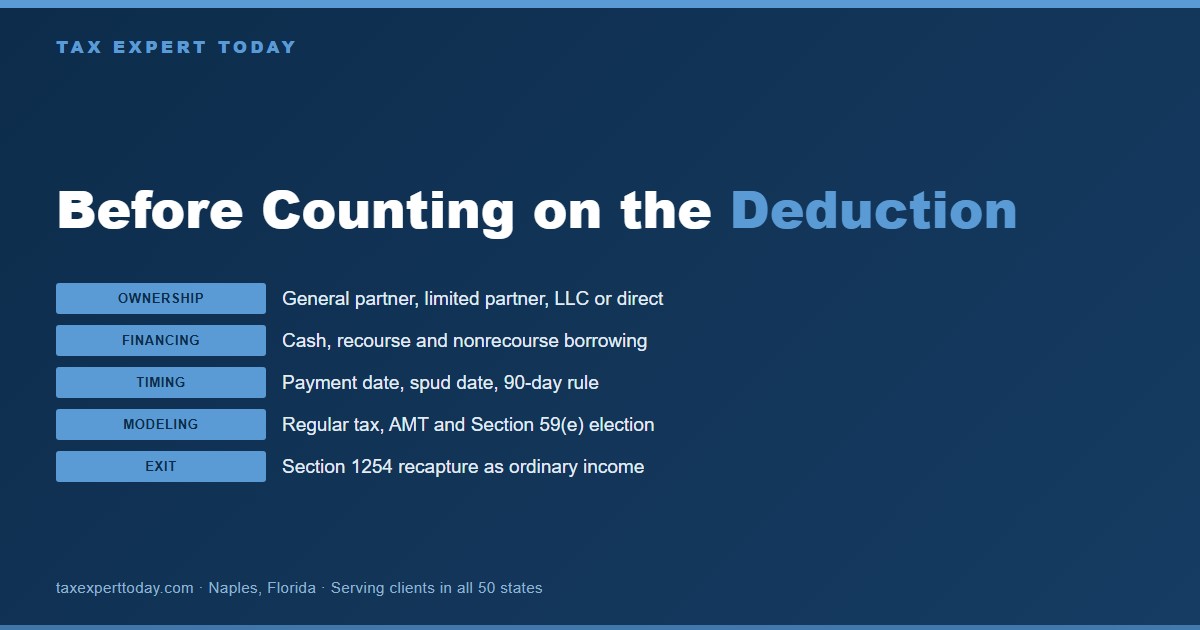
Before relying on the deduction, an investor should read how the interest will be held during drilling and after, how the program is financed, when drilling is scheduled to begin, how costs are classified, and what happens on exit, then model regular tax, AMT and later recapture with a professional.
- Ownership form. General partner, limited partner, LLC member or direct owner, and when any conversion occurs.
- Financing. Cash contributions versus recourse and nonrecourse borrowing.
- Timing. Payment dates, spud dates and the 90-day rule.
- Exit. Expected holding period and the recapture that a sale would trigger.
Tax treatment is only one part of evaluating a drilling investment, and it should never be the reason to make one. Drilling carries geological, operational, price and liability risks that can exceed any tax effect, and a dry hole or a poorly operated well can produce a loss that no deduction offsets. This guide does not evaluate any program and does not suggest that any reader should or should not invest. What it can do is list the tax questions to answer before the deduction is counted on:
- Read the ownership terms. Confirm whether the investor will be a general partner, an additional general partner, a limited partner, an LLC member or a direct owner, and the date of any conversion.
- Read the liability terms. Understand what unlimited liability during a general partner period could mean in practice, separate from any insurance the program carries.
- Read the financing terms. Identify any borrowing, whether it is recourse or nonrecourse, and any stop loss or other loss protection arrangements that affect the amount at risk.
- Check the timing. Compare the payment date with the expected spud date and the 90-day rule if the program prepays.
- Ask for the cost budget. Review the authority for expenditure for the split between intangible and tangible costs.
- Model the return. Run regular tax, the AMT with and without a Section 59(e) election, and the excess business loss limitation for the drilling year and the following years.
- Plan for the exit. Estimate the recapture amount that a sale would produce and the character of any remaining gain.
- Check the states. Confirm the treatment in the investor’s state of residence and any state where the investor is moving.
How Do Intangible Drilling Costs Fit Into a Move to Texas?
An investor moving to Texas may hold a working interest that produced deductions while living in a taxing state and income after becoming a Texas resident. The departure state may examine when residency changed, how the deduction was allocated and whether a later sale or production income belongs to it.
- Timing of the move. The residency date controls which state may tax later income.
- Deduction in the old state. Some states follow federal intangible drilling cost rules and some do not.
- Sourcing of income. Income from a Texas well may be sourced to Texas for a nonresident of another state.
- Documentation. Domicile evidence matters if the departure state audits.
Many of the investors who contact us about drilling deductions are in the middle of a relocation, often from a high tax state. The interaction between a large first year deduction, a change of domicile and later production income can be favorable or unfavorable depending on how the move is timed and documented. The former state may treat the deduction differently from the federal rule, may examine whether the investor really changed domicile, and may claim the income or the recapture on a later sale depending on its sourcing rules. Our guide to establishing Texas residency explains the domicile standard and the evidence that supports a move. The working interest analysis should be coordinated with that work rather than handled separately.
Intangible Drilling Costs Help in Naples & Southwest Florida
Tax Expert Today LLC advises investors and business owners on federal tax matters and on state tax matters nationwide from our office in Naples, Florida. Texas clients are served from Naples along with clients in every other state. Southwest Florida investors meet intangible drilling cost questions in a few recurring ways: a sponsor offers a year end drilling program, a family holds Texas working interests that were never reviewed after an inheritance, or an owner who has moved between Texas and Florida wants to understand how the federal rules apply to an interest that spans both moves.
Our review follows the order of this guide. We read the program documents for the form of ownership and any conversion, test basis, the amount at risk and the passive activity position, apply the excess business loss limitation, model the AMT with and without a Section 59(e) election, estimate recapture on an exit, and confirm the state treatment. We do not recommend investments and we do not evaluate the geology or economics of a well; we explain the tax mechanics so that the investor and the investor’s financial advisers can decide with the full picture.
- Intangible drilling costs help Naples investors can reach in person. Our office is on Tamiami Trail North in Naples, Florida, and we work with clients locally and remotely.
- Oil and gas tax Naples FL and nationwide. We serve working interest owners in all 50 states, and the federal rules apply the same way wherever the investor lives.
- Program document review. Ownership form, conversion dates, financing and cost classification.
- Return modeling. Regular tax, AMT, excess business loss and recapture over the expected holding period.
- Coordinated with your other interests. Royalty income, the Texas franchise tax on any entity and residency positions reviewed together.
Related services include our Texas tax services for clients with Texas interests and our Naples tax planning work for Southwest Florida investors.
Tax Expert Today LLC
11983 Tamiami Trail N, Naples, FL 34110
Phone: (239) 441-2005
Hours: Monday through Friday, 10:00 a.m. to 5:00 p.m. ET
Local question we are asked often: A Naples physician has been offered an additional general partner interest in a Texas drilling program in December and wants to hold it through the family LLC used for other investments. Will the deduction still offset practice income? Usually not in the way the investor expects. An LLC membership generally limits liability, which takes the interest outside the working interest exception, so the loss would generally be passive. Holding the interest directly or as a general partner changes that result but also changes the investor’s liability exposure, and the at-risk, excess business loss and AMT rules still apply. The right answer depends on the program documents and the investor’s full return.
When Should You Engage a Professional?
An investor with a small working interest held directly and a simple return may be able to apply the rules in this guide with ordinary preparation software. Professional review becomes worthwhile when the investor is considering a drilling program for the first time, when the interest will be held through an LLC, a trust or a partnership with a conversion feature, when the program uses borrowed money, when drilling is prepaid near year end, when the deduction is large relative to other income, when the AMT may apply, when the investor is moving between states, when a sale or exchange of the interest is being considered, or when a K-1 reports items the investor does not understand. Intangible drilling costs are a federal tax matter, and as enrolled agents our team can represent taxpayers before the IRS on examinations of these deductions. Any Texas franchise tax question for an entity that holds the interest is a separate state tax matter administered by the Texas Comptroller, not the IRS, and our multidisciplinary team of tax advisors, enrolled agents, CPAs and attorneys advises on state tax matters nationwide. Securities, investment suitability and liability questions about a particular program belong with the investor’s financial and legal advisers.
If you would like a review of a proposed program, a K-1, or the tax consequences of selling a working interest, contact Tax Expert Today at (239) 441-2005 or visit our Texas tax services page. Investors facing a federal examination of these items can also review our IRS resolution and audit support services.
Frequently Asked Questions
What are intangible drilling costs?
They are the costs of drilling and preparing an oil or gas well that have no salvage value, such as wages, fuel, repairs, hauling, supplies, drilling mud, site preparation and contractor charges. Treasury Regulation Section 1.612-4 defines them, and Section 263(c) lets a working interest owner elect to deduct them rather than capitalize them.
Can I deduct intangible drilling costs against my salary?
Possibly. Under Section 469(c)(3), a working interest held directly or through an entity that does not limit your liability is not a passive activity, even without material participation. The loss must still clear the basis, at-risk and excess business loss limits before it offsets wages or business income.
Does holding a working interest in an LLC affect the deduction?
It generally affects how the loss can be used. An LLC membership usually limits liability under state law, so under Treas. Reg. 1.469-1T(e)(4)(v) the interest is held through an entity that limits liability and the loss is generally passive unless you materially participate.
How do I elect to deduct intangible drilling costs?
By claiming them as a deduction on the return for the first taxable year in which you pay or incur them. No formal statement is required. If you do not deduct them in that first year, you are treated as having elected to capitalize them, and the choice binds later years.
Are intangible drilling costs an AMT preference?
Excess intangible drilling costs above 65 percent of net oil and gas income are a preference under Section 57(a)(2), but taxpayers that are not integrated oil companies are generally exempt, subject to a cap of 40 percent of alternative minimum taxable income. Costs covered by a Section 59(e) election are not a preference.
What happens to intangible drilling costs when I sell the working interest?
Section 1254 treats gain on the sale as ordinary income up to the intangible drilling costs and depletion previously deducted. Only gain above that amount is taxed under the ordinary rules for the property, so the deduction often works as a timing benefit if the interest is sold at a gain.
Does Texas tax working interest income or allow an intangible drilling cost deduction?
Texas has no personal income tax, so an individual Texas resident reports no Texas income and claims no Texas deduction. An entity holding working interests may owe the Texas franchise tax, although some partnerships holding only nonoperating mineral interests may qualify as passive entities under Tax Code Section 171.0003.
Can a Naples, Florida investor get help with intangible drilling costs on a Texas well?
Yes. Tax Expert Today advises on federal oil and gas tax questions from Naples, Florida, including program document reviews, K-1 questions, AMT and Section 59(e) modeling and recapture on a sale, and advises on state tax matters nationwide for Texas interests.
Published November 7, 2026 by Dr. Pellumb Kabashi « Back to Learning Center
Have a question this article touches on?
Tax Expert Today LLC, based in Naples, Florida and serving clients across the United States.
Schedule a Consultation (239) 441-2005