
By Dr. Pellumb Kabashi, DBA, MBA, EA, CFE, CES
Founder, Tax Expert Today LLC · Tax advisors, enrolled agents, CPAs, and attorneys · Serving clients in all 50 states
Quick Answer: Georgia IFTA is the quarterly fuel tax return a Georgia based motor carrier files under the International Fuel Tax Agreement for qualified trucks that cross state lines. The return is due the last day of the month after each quarter, and in 2026 Georgia miles driven during the fuel tax suspension windows are reported as non-taxable. Call (239) 441-2005 for a free consultation.
Search for Georgia IFTA and page one is an AI summary, a four year old YouTube walkthrough, two software vendors selling filing apps, a permit service, and a directory listing from the IFTA, Inc. website. None of them mentions the change that matters most to a Georgia carrier this year: the state suspended collection of its motor fuel excise tax for several stretches of 2026, the latest extended through November 30, 2026, and the Department of Revenue told carriers to report Georgia miles from those stretches as non-taxable on the quarterly return.
This guide covers Georgia IFTA from the tax side. It explains who needs a license, how the license and decals work, the 2026 and 2027 due dates, how the return is calculated, the Georgia fuel tax rates, how to report the suspension periods, the alternatives to a license, leased trucks, records, audits, penalties, unfiled returns, credits, dyed diesel, and where the federal truck taxes fit. Every rate, date, and rule below was checked against the Department of Revenue and the text of O.C.G.A. Title 48, Chapter 9, Article 2 on November 3, 2026. For the wider picture of Georgia income, sales, and business taxes, see our Georgia tax services overview.
What Is Georgia IFTA?
Georgia IFTA is Georgia’s administration of the International Fuel Tax Agreement, the compact among the 48 contiguous states and the Canadian provinces that lets a trucking company file one quarterly fuel tax return with its base jurisdiction. Georgia collects the tax for every member jurisdiction and sends each one its share.
- One license, one return: a Georgia based carrier reports miles and fuel for every member jurisdiction on a single return to Georgia.
- The tax being reported: a road use tax on fuel burned in each jurisdiction, measured by miles driven there.
- Who runs it here: the Motor Fuel Tax Unit of the Georgia Department of Revenue.
- The Georgia law behind it: O.C.G.A. 48-9-30 through 48-9-46, the motor carrier road tax article.
The Department of Revenue describes the agreement as one fuel use license and one administering base jurisdiction for each licensee. Georgia law imposes a road tax on every motor carrier for the privilege of using Georgia streets and highways, equal to the motor fuel excise tax and calculated on the fuel the carrier uses in its Georgia operations (O.C.G.A. 48-9-31). A truck that buys all its diesel in Georgia but drives half its miles in Alabama owes Alabama for the Alabama miles and earns a credit in Georgia for tax already paid at the pump. The Georgia IFTA return is where those debits and credits are netted.
Georgia IFTA is a separate account from the excise taxes collected from fuel distributors. Distributors remit the motor fuel excise tax on sales to unlicensed buyers; the motor carrier road tax is the carrier’s own obligation. The state also collects excise taxes on other products through separate accounts, which our guides to the Georgia tobacco tax and the Georgia alcohol tax cover.
Who Needs a Georgia IFTA License?
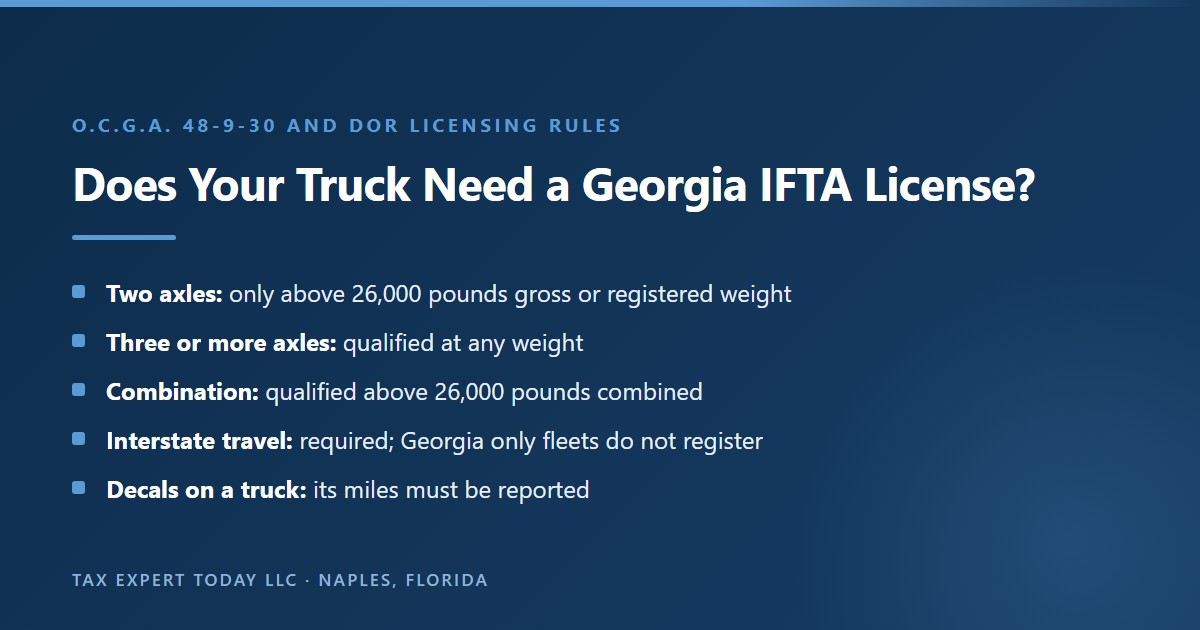
A Georgia based carrier needs a Georgia IFTA license if it runs a qualified motor vehicle in interstate commerce. A qualified vehicle has two axles and more than 26,000 pounds gross or registered weight, three or more axles at any weight, or runs in a combination over 26,000 pounds.
- Two axle trucks: qualified only above 26,000 pounds gross or registered gross weight (11,797 kilograms).
- Three or more axles: qualified regardless of weight.
- Combinations: qualified when the combined gross weight exceeds 26,000 pounds.
- Interstate operation: a fleet that never leaves Georgia does not register for IFTA.
- Base in Georgia: the carrier needs an established place of business in Georgia to use Georgia as its base.
The Department of Revenue page on motor fuel rules for interstate motor carriers says any qualified motor vehicle engaged in interstate commerce that is based in Georgia and is not IFTA registered in another jurisdiction must register with Georgia and file reports and payments covering all jurisdictions. The statute defines a motor vehicle for this article to include buses with seats for more than 20 passengers in addition to the driver, along with the weight and axle tests (O.C.G.A. 48-9-30).
The Department lists vehicles that should not register: school buses, federal, state, and local government vehicles, transit buses, recreational vehicles used exclusively for personal pleasure, and qualified vehicles used exclusively within Georgia. One trap sits inside the intrastate exception. The Department’s IFTA FAQ says that once decals are placed on a qualified vehicle, the carrier must report the miles and fuel for that vehicle, even if it never leaves the state. Decals ordered in anticipation of a hauling contract create a reporting obligation from the day they go on the truck.
To register, the Department asks for a Social Security number or federal employer identification number, IRP and US DOT numbers where they apply (or a lease or employment contract when driving under another carrier’s authority), an established Georgia place of business that is owned or leased, open, and staffed during regular hours, bulk fuel jurisdictions, ACH debit details, and the Social Security numbers of company officers and responsible parties. A carrier organized as an LLC should line the IFTA account up with the entity that actually owns or leases the trucks, which our guide to Georgia LLC taxes discusses.
How Do You Get and Renew a Georgia IFTA License and Decals?
A Georgia IFTA license is opened on the Georgia Tax Center by registering the business and adding an IFTA account. The license and two decals per truck cost $3 per vehicle, run from issue through December 31, and are renewed each fall through a renewal request on the Georgia Tax Center.
- Cost: $3 per set of decals, one set per qualified vehicle, set by O.C.G.A. 48-9-38(c).
- Placement: one decal on or near each cab door, with a copy of the license in every truck.
- Renewal season: opens October 1; the current decal expires December 31.
- Display deadline: new decals and license must be on the truck by the end of February.
- No clean account, no renewal: outstanding Georgia tax liabilities block the new year’s credentials.
The registration page sends new carriers to the Georgia Tax Center to register a new Georgia business and then add the IFTA account. Additional decals for a truck bought mid year are ordered through the same portal under Decal Request; the Department processes requests the next business day and mails them to the address on file. A carrier must account for every decal it buys and file returns for every qualified vehicle carrying one.
The renewal rule matters more than the fee. Under O.C.G.A. 48-9-38(b), the commissioner shall not issue a registration card or identification marker to any motor carrier with outstanding motor carrier, motor fuel, sales, or income tax liabilities, or penalties or fees owed to the Georgia Department of Transportation, unless the liabilities are under appeal. A carrier that owes Georgia sales tax or income tax, not just fuel tax, can find its Georgia IFTA renewal held. The IFTA FAQ adds that the agreement grants an extension to place the new decal through February 28, that next year’s decal must be requested by December 31, and that trucks without new decals and a license by March 1 face penalties in member jurisdictions.
Permitting services and preparers can file the application, but the Department says a third party who signs for the carrier needs a power of attorney. Whoever signs, the carrier stays liable for the returns and the tax.
When Are Georgia IFTA Returns Due in 2026 and 2027?
Georgia IFTA returns are due on the last day of the month after each calendar quarter: April 30, July 31, October 31, and January 31. When the last day falls on a weekend, the Department publishes the next business day, so the third quarter 2026 return was due November 2, 2026.
- Quarterly, not annual: O.C.G.A. 48-9-33 sets reports for the end of April, July, October, and January.
- File every quarter: a return is due even with no travel.
- Payment with the return: any tax due is paid by the same date.
- Online filing: the Georgia Tax Center, with Form IFTA 100 available for paper filers.
| Quarter | Months covered | 2026 due date | 2027 due date |
|---|---|---|---|
| First quarter | January to March | April 30, 2026 | April 30, 2027 |
| Second quarter | April to June | July 31, 2026 | August 2, 2027 |
| Third quarter | July to September | November 2, 2026 | November 1, 2027 |
| Fourth quarter | October to December | February 1, 2027 | January 31, 2028 |
The dates above come from the Department of Revenue IFTA due dates page, checked November 3, 2026. The fourth quarter 2026 return, due February 1, 2027, will be the first return to carry two full months of suspended Georgia tax, so its records deserve the most attention. The statute divides the year into four calendar quarters and requires payment of the road tax by the last day of the month after the quarter (O.C.G.A. 48-9-32).
How Is the Georgia IFTA Return Calculated?
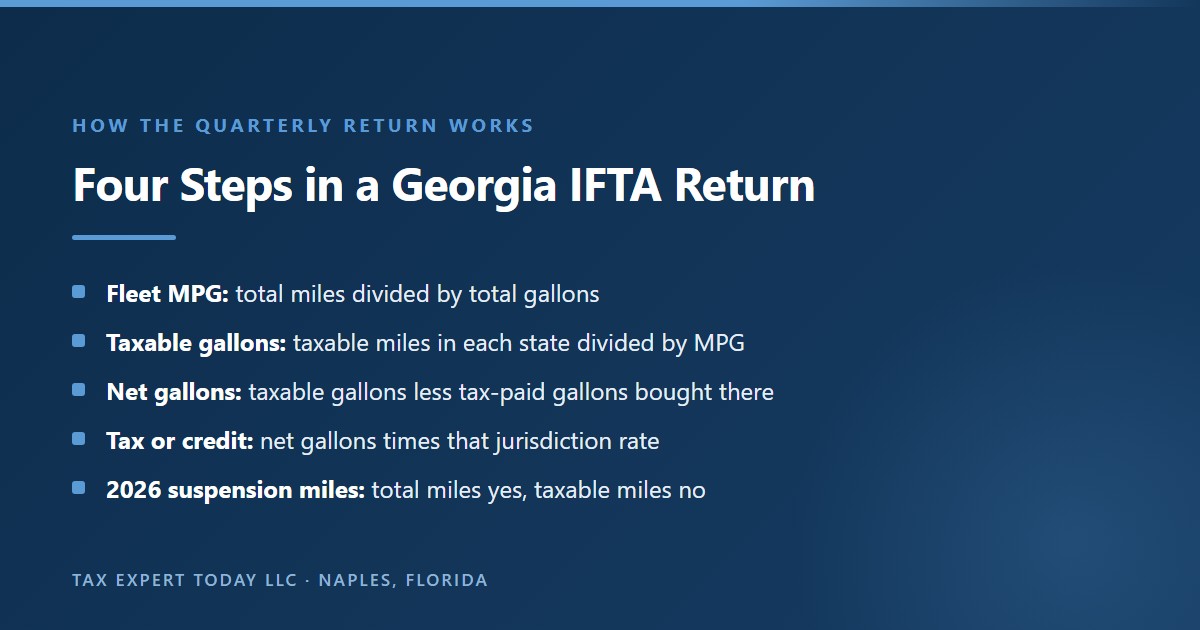
The Georgia IFTA return divides total miles by total gallons to find fleet miles per gallon, converts each jurisdiction’s taxable miles into taxable gallons, and multiplies by that jurisdiction’s rate. Tax already paid at the pump in that jurisdiction is credited, and the net amounts for all jurisdictions are added together.
- Step one: total miles in all jurisdictions divided by total gallons bought gives fleet MPG.
- Step two: taxable miles in each jurisdiction divided by fleet MPG gives taxable gallons.
- Step three: taxable gallons less tax-paid gallons bought there gives net taxable gallons.
- Step four: net taxable gallons times the jurisdiction’s rate, plus any surcharge, gives tax or credit.
Georgia law states the method in a single sentence: fuel used in Georgia is the share of total fuel that Georgia miles bear to total miles within and outside the state (O.C.G.A. 48-9-32). The Department’s motor carrier page explains that credits for over purchases in one jurisdiction offset under purchases in another, each calculated at the rate where the purchase was made or the debit arose. The Department’s filing instructions list what a return needs: tax-paid gallons from fuel receipts, the jurisdictions traveled, and the miles in each.
Here is a hypothetical Georgia IFTA calculation for a quarter with no suspension days, using the 2026 Georgia diesel rate of 37.3 cents per gallon for illustration. Rates for other jurisdictions are placeholders, not current figures; the actual return uses the rates on the IFTA tax rate matrix for that quarter.
| Line | Georgia | Jurisdiction B | Jurisdiction C | Fleet total |
|---|---|---|---|---|
| Miles driven | 12,000 | 10,000 | 8,000 | 30,000 |
| Fleet MPG (30,000 miles divided by 5,000 gallons) | 6.0 | |||
| Taxable gallons (miles divided by 6.0) | 2,000 | 1,667 | 1,333 | 5,000 |
| Tax-paid gallons bought there | 3,200 | 1,200 | 600 | 5,000 |
| Net taxable gallons | minus 1,200 | 467 | 733 | |
| Rate per gallon | $0.373 | $0.300 (placeholder) | $0.350 (placeholder) | |
| Tax due or credit | credit of $447.60 | $140.10 due | $256.55 due | net credit of $50.95 |
In this example the fleet bought more diesel in Georgia than it burned there, so Georgia shows a credit of $447.60, while the carrier owes $396.65 to the other two jurisdictions. Because Georgia is the base, everything nets on one return: here the Georgia credit more than covers the other two balances and leaves a net credit of $50.95. When the net is a balance due, the carrier pays it to Georgia and Georgia forwards each member its share. A fleet that fuels mostly in a low rate neighbor and drives mostly in Georgia sees the reverse.
What Are Georgia’s Fuel Tax Rates for IFTA in 2026?
Outside the suspension periods, Georgia’s 2026 motor fuel excise rate is 33.3 cents per gallon on gasoline and 37.3 cents on diesel, effective January 1, 2026. The Department has already published 2027 rates of 34.4 cents on gasoline and 38.5 cents on diesel, which apply from January 1, 2027.
- Annual reset: Georgia adjusts the excise rate each calendar year by formula under O.C.G.A. 48-9-3.
- Road tax equals excise: the carrier road tax mirrors the excise tax (O.C.G.A. 48-9-31).
- Quarterly matrix: the rate for each member jurisdiction is posted on the IFTA tax rate matrix.
- Suspension periods: Georgia miles in a suspension window are reported as non-taxable.
| Fuel type | 2026 rate per gallon | 2027 rate per gallon |
|---|---|---|
| Gasoline | $0.333 | $0.344 |
| Diesel | $0.373 | $0.385 |
| Liquefied petroleum gas | $0.333 | $0.344 |
| Special fuel, including CNG | $0.333 | $0.344 |
| Aviation gasoline to a licensed aviation distributor | $0.010 | $0.010 |
The figures come from the Department of Revenue bulletins on the 2026 state excise tax and the 2027 state excise tax. The statute that sets the base rate and the annual adjustment is O.C.G.A. 48-9-3, which ties the yearly change to the average fuel efficiency of new vehicles registered in Georgia. The Department’s IFTA FAQ points carriers to the IFTA, Inc. tax rate matrix for current and past quarterly rates, and the Georgia Tax Center shows updated rates when a return is filed online. Prepaid local sales tax on fuel is a separate tax that is not reported on the IFTA return and was not suspended.
Before you rely on any single number, check the matrix for the exact quarter. A rate printed on a vendor page can be a year old, and a 2026 return that uses the 2025 rate, or a full quarter rate across suspension days, will not tie to the Department’s figures.
How Do You Report the 2026 Georgia Fuel Tax Suspension on IFTA?
The Department of Revenue says IFTA returns are still required for quarters that include a suspension, and every Georgia mile driven during a suspension window goes in total miles but not in taxable miles. Georgia fuel bought tax free goes in total gallons but not in tax-paid gallons, so fleet MPG stays accurate.
- Total Miles: include all Georgia miles from the suspension window.
- Total Taxable Miles: exclude Georgia miles from the suspension window.
- Total Gallons: include Georgia gallons bought tax free.
- Tax-Paid Gallons: exclude Georgia gallons bought tax free.
- Records: keep date stamped trip and fuel records that separate suspension days.
Georgia suspended collection of the motor fuel excise tax in two long stretches in 2026, built from four separate actions. House Bill 1199 suspended it from 11:00 a.m. on March 20, 2026, through 11:59 p.m. on May 19, 2026 (Informational Bulletin MFT-2026-01). Executive Order 05.15.26.02 continued it from May 20 through June 2, 2026 (MFT-2026-02). Executive Order 09.28.26.01 suspended it again from 12:01 a.m. on September 29, 2026, through 11:59 p.m. on October 29, 2026 (MFT-2026-03). The Department’s suspension FAQ now states that Executive Order 10.24.26.01 extends the suspension of state collection of motor fuel taxes through November 30, 2026.
| Suspension window | Authority | IFTA quarter affected |
|---|---|---|
| 11:00 a.m. March 20 to 11:59 p.m. May 19, 2026 | H.B. 1199, Bulletin MFT-2026-01 | First and second quarters 2026 |
| May 20 to 11:59 p.m. June 2, 2026 | Executive Order 05.15.26.02, Bulletin MFT-2026-02 | Second quarter 2026 |
| 12:01 a.m. September 29 to 11:59 p.m. October 29, 2026 | Executive Order 09.28.26.01, Bulletin MFT-2026-03 | Third and fourth quarters 2026 |
| Extended through November 30, 2026 | Executive Order 10.24.26.01, per the DOR suspension FAQ | Fourth quarter 2026 |
The Department’s IFTA filing guidance says motor carriers licensed under IFTA and traveling in Georgia were exempt from the excise tax during the suspension, that returns are still required, and that all fuel purchases, tax free and tax paid, must be reported so the MPG reflects the period accurately. The published instructions name the first window, March 20 through May 19, 2026. As of November 3, 2026, we found no separate IFTA instruction page for the later windows, so carriers reporting the June, September, October, and November days should confirm with the Motor Fuel Unit at 1-877-423-6711 that the same method applies before filing.
The mechanics create two problems that we expect to see on audit. The first is mixed days: the first window started at 11:00 a.m., so trips on March 20 straddle taxable and non-taxable time. The second is mixed quarters: the second quarter return covered about two months of suspended time, and the fourth quarter return will cover two. A carrier whose electronic logging device or trip sheets cannot split Georgia miles by date and time will struggle to support the non-taxable miles it claims. If you remitted Georgia excise tax that should have been suspended, the FAQ says refund requests go through the Georgia Tax Center.
What If You Did Not Travel or Only Ran Georgia Miles?
You still file. Georgia requires a quarterly IFTA return even when a truck never left the state, and you check No Operations on Form IFTA 100. If a carrier reports no operation or Georgia only miles for three quarters in a row, IFTA terminates the account and the carrier moves to trip permits.
- Zero quarters: file the return and mark No Operations.
- Three quarters in a row: no operation or Georgia only miles ends the account.
- After termination: interstate trips run on fuel trip permits.
- Non-renewal: a lapsed account can be reinstated through a Renewal Request on the Georgia Tax Center.
The IFTA FAQ states the three quarter termination rule directly and explains that IFTA, Inc. requires the licensee to travel outside Georgia and report that travel. A seasonal hauler that parks for winter should expect to file No Operations returns and plan the restart so it does not lose the account. Under O.C.G.A. 48-9-33, the commissioner may by regulation allow annual reports for carriers with a small annual road tax and may exempt carriers whose operations are entirely within Georgia from reporting, but an IFTA licensee files on the quarterly schedule unless the Department says otherwise in writing.
What Are the Alternatives to a Georgia IFTA License?
A carrier that enters Georgia only occasionally can buy a temporary fuel permit instead of a Georgia IFTA license. The Department describes a 10 day temporary permit at $16 through permitting services, with no fuel tax report to file. Its FAQ also refers to 30 day fuel trip permits on the Georgia Trucking Portal.
- Temporary permit: covers one specific vehicle for consecutive days shown on the permit.
- No return: a permit carrier files no quarterly fuel tax report for those days.
- Where to buy: permitting services or the Georgia Trucking Portal.
- Emergency letter: the commissioner may authorize up to 30 days of operation in an emergency.
- Licensed elsewhere: a truck IFTA licensed in any member jurisdiction needs no Georgia permit.
The two Department pages describe the permit differently. The motor carrier rules page describes a temporary 10 day permit, issued for each unregistered vehicle entering Georgia, at $16 plus the service’s fee. The IFTA FAQ says a terminated account must travel on 30 day fuel trip permits from the Georgia Trucking Portal. Check the portal for the permit term in effect on the day you buy it. The arithmetic is simple: a carrier that crosses into Georgia a few times a year may pay less in permits than it spends keeping a quarterly return current, while a carrier that crosses most weeks almost always belongs on a license.
Operating without either is costly. O.C.G.A. 48-9-38 bars operating a qualified vehicle in Georgia without registration and an identification marker, O.C.G.A. 48-9-45(a) sets a $145 penalty for each vehicle in violation, and O.C.G.A. 48-9-39 makes failing to carry the card or display the marker a misdemeanor with a fine of $50 to $200, each day a separate offense.
Who Is Liable for Georgia IFTA on a Leased Truck?
Under Georgia law the lessee of a truck, not the lessor, is generally the carrier responsible for the road tax and the returns. A lessor can be the carrier when it supplies or pays for fuel or builds fuel into the rent, and both parties can end up jointly liable if the primary party fails to pay.
- Default rule: the lessee is the motor carrier (O.C.G.A. 48-9-37(a)).
- Lessor as carrier: when the lessor supplies or pays for fuel or charges rent that includes it.
- Exclusion: a lessee may leave off trucks leased from a lessor that is the carrier.
- Backstop: joint and several liability if the primary party fails to comply.
- Owner operators: the lease decides whose Georgia IFTA account carries the miles.
The rule in O.C.G.A. 48-9-37 matters most for owner operators leased onto a larger carrier. If the lease says the motor carrier reports fuel tax, the owner operator’s miles belong on that carrier’s return and the owner operator should keep copies of the trip and fuel records it turns in. If the owner operator runs under its own authority, it needs its own Georgia IFTA account. A lease that is silent on fuel tax is the usual source of double reporting or, worse, no reporting. The statute caps what the state collects at the tax due on the transaction plus costs and penalties, but it lets the state pursue either party for it.
What Records Must a Georgia IFTA Licensee Keep?
Keep distance and fuel records that support every number on the return. Georgia’s statute sets a three year minimum, but the IFTA Procedures Manual, section P510, sets four years from the later of the due date or filing date, so most carriers keep four years and longer if an audit is open.
- Distance records: trip date, origin, destination, route, odometer or ELD readings, and miles by jurisdiction.
- Fuel records: receipts showing date, seller, gallons, fuel type, price or tax paid, and unit number.
- Bulk tanks: withdrawal records by vehicle when one tank fuels IFTA and non-IFTA units.
- Suspension days: date and time detail that separates suspended and taxable Georgia miles.
- Decals and leases: which unit carried which decal, and every lease agreement.
O.C.G.A. 48-9-40(a) requires records in the form the commissioner requires, preserved for three years and available for inspection. The IFTA agreement Georgia joined sets the longer four year standard for member licensees, and the Department’s FAQ says records for a shared bulk storage tank must be kept as specified in the IFTA Procedures Manual. Holding four years of records costs little; losing an audit because the fourth year is missing costs a lot more, because the statute lets the Department estimate the tax when records are not kept.
| Record | What it should show | Why it matters |
|---|---|---|
| Trip or ELD report | Date, unit, route, jurisdictions, and miles in each | Supports taxable miles by jurisdiction |
| Fuel receipt or fuel card statement | Date, seller, location, gallons, fuel type, unit | Supports tax-paid gallons and credits |
| Bulk tank log | Withdrawals by unit and date | Separates IFTA and non-IFTA fuel |
| Suspension day detail | Georgia miles and gallons by date and time | Supports non-taxable 2026 Georgia miles |
| Decal and lease file | Which unit carried which decal, and who reports fuel tax | Decides which account reports the miles |
What Happens in a Georgia IFTA Audit?
The Department of Revenue may inspect a carrier’s books during business hours and can audit for every member jurisdiction. If records are missing or a return is not filed, the commissioner estimates the tax from the information it has, and the carrier carries the burden of proving that assessment wrong.
- Inspection right: books and records during regular business hours (O.C.G.A. 48-9-40(b)).
- Estimated assessment: when reports or records are missing (O.C.G.A. 48-9-40(c)).
- Burden of proof: on the carrier to show the assessment is wrong.
- Cooperative audits: other jurisdictions’ auditors act as Georgia’s agents.
- Time limits: the general Georgia assessment period, and seven years for fraud.
Under O.C.G.A. 48-9-40(c), the commissioner’s assessment is prima facie evidence of the state’s claim. Auditors in IFTA reviews commonly test reported fleet MPG against what the equipment can actually achieve, compare reported miles to ELD or GPS data, and look for fuel receipts that do not match a unit’s location. During 2026, expect added attention to suspension day miles, because those miles carry no Georgia tax and the incentive to overstate them is obvious.
Assessments follow the time limits in O.C.G.A. 48-2-49, but O.C.G.A. 48-9-41(a)(2) lets the commissioner reopen a period and assess at any time within seven years when a report contains fraudulent statements or omits material facts. A carrier that disagrees with a final assessment has the same appeal routes as other Georgia taxpayers, including the Georgia Tax Tribunal, which our guide to the Georgia Tax Tribunal explains.
What Are the Penalties for Late Georgia IFTA Returns?
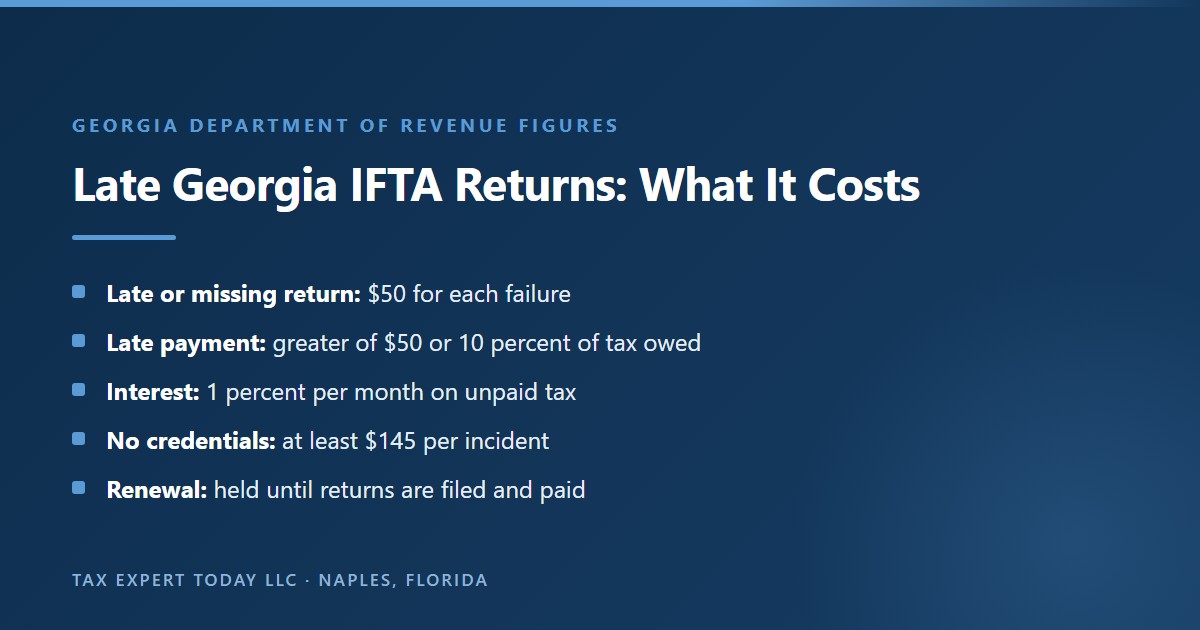
The Department of Revenue states a $50 penalty for each failure to file a Georgia IFTA return, a penalty of $50 or 10 percent of the unpaid tax, whichever is greater, for late payment, and interest of 1 percent per month on unpaid tax. Operating without credentials adds at least $145 per incident.
- Late or missing return: $50 per failure, as the Department applies it.
- Late payment: the greater of $50 or 10 percent of the tax owed.
- Interest: 1 percent per month or part of a month on unpaid tax.
- Unregistered operation: $145 per vehicle in violation.
- Renewal hold: back taxes, penalty, and interest may be required before renewal.
| Issue | Department of Revenue figure | O.C.G.A. 48-9-45 text |
|---|---|---|
| Failure to file a return | $50 for each failure | $25 for each failure |
| Failure to pay tax | Greater of $50 or 10 percent of the amount owed | Greater of $10 or 10 percent of the unpaid tax |
| Interest | 1 percent per month or part of a month | Rate in O.C.G.A. 48-2-40 |
| Operating without registration | At least $145 per incident | $145 for each vehicle in violation |
| Default | Back taxes may be required before renewal | Commissioner may suspend or revoke permits |
The statute and the Department page use different figures, and both are worth knowing. O.C.G.A. 48-9-45, in the version FindLaw shows as current to March 28, 2024, sets $25 for each failure to file, $10 or 10 percent of the unpaid tax for late payment, and interest at the rate in O.C.G.A. 48-2-40. The Department’s motor carrier page states $50 for each failure to file, $50 or 10 percent for late payment, and 1 percent per month. For an IFTA licensee, plan on the Department’s figures, because those are the ones that appear on a Georgia IFTA notice. Willfully failing to file a required report, or making a false statement to get a credit or refund, is a misdemeanor under O.C.G.A. 48-9-46.
What Happens If Georgia IFTA Returns Go Unfiled?
Unfiled Georgia IFTA returns bring a delinquency notice, an estimated assessment, and a blocked renewal, and the Department can close the account. The fix is to file every missing quarter on the Georgia Tax Center and pay or arrange the balance, because the next year’s license will not issue until the account is current.
- Delinquency notice: the Department notifies the carrier of missing returns.
- Estimated tax: the commissioner may fix the tax and penalties from the information it has.
- Account closure: an account closed for unfiled returns reopens only after filing and payment.
- Collection: levy, garnishment, attachment, or other collection tools for delinquent state taxes.
- Credential revocation: the commissioner may suspend or revoke permits held by a carrier in default.
The IFTA FAQ says a carrier that failed to file and pay will receive a delinquency notice, cannot renew until all returns are filed and liabilities paid, and may face further legal action. O.C.G.A. 48-9-41(b) authorizes collection by levy, garnishment, attachment, or any other method available for delinquent state taxes, and O.C.G.A. 48-9-45(d) lets the commissioner suspend or revoke any certificate or permit held by a carrier in default. For a fleet, losing the license means parking trucks or buying permits for every interstate trip.
The practical order is to rebuild the missing quarters from ELD data and fuel card statements, file them, and then deal with the balance. A carrier that cannot pay in full can ask about an installment arrangement, which our guide to a Georgia Department of Revenue payment plan covers, and in limited cases a compromise, covered in our guide to the Georgia offer in compromise. Filing the returns first usually replaces an estimated assessment with a lower actual figure.
How Do Georgia IFTA Credits and Refunds Work?
When a carrier pays more Georgia fuel tax at the pump than it owes on Georgia miles, the excess becomes a credit. Georgia law lets the credit carry forward to later quarters for up to two calendar years and allows a refund of credits above 2,000 gallons in a quarter if claimed within 180 days.
- Credit for tax paid: Georgia tax paid on fuel bought in Georgia (O.C.G.A. 48-9-35).
- Carryforward: excess credits used in later quarters, no later than the next two calendar years.
- Refund threshold: credits over 2,000 gallons in a quarter (O.C.G.A. 48-9-36).
- Refund deadline: 180 days from the end of the quarter, sworn and supported.
- No interest: refunds under this section bear no interest.
Under O.C.G.A. 48-9-35 and O.C.G.A. 48-9-36, a carrier claiming credit must furnish evidence of Georgia fuel tax paid, and the commissioner may require a bond of at least $1,000 before paying refunds without an audit. Under IFTA, credits and debits across all member jurisdictions are netted on the one return, so the Georgia credit may simply reduce what the carrier owes elsewhere. During the 2026 suspension, Georgia fuel bought tax free earns no Georgia credit, which is why the Department wants those gallons kept out of tax-paid gallons. A fleet that keeps showing large Georgia credits should check whether its fueling plan is costing more than it needs to.
What Are the Georgia Penalties for Red Dyed Diesel?
Dyed diesel is for off-road use, and running it in a highway truck in Georgia carries a minimum $1,000 penalty for a first offense and $2,000 for a second, plus $10 per gallon in a company tank that fueled the truck. Georgia waived those state penalties during the 2026 supply emergency through November 30, 2026.
- First offense: minimum $1,000, higher depending on the dyed fuel found.
- Second offense: minimum $2,000.
- Company storage tank: an additional $10 per gallon in the tank at inspection.
- 2026 waiver: state dyed fuel penalties waived through 11:59 p.m. on November 30, 2026.
- Federal rules: the waiver covers Georgia penalties, not federal excise tax rules.
The penalty amounts are from the Department’s IFTA FAQ. Informational Bulletin MFT-2026-05, issued October 29, 2026, says that under O.C.G.A. 48-2-43 the commissioner extended the temporary waiver of state penalties for selling, delivering, or consuming dyed fuel oil in on-road vehicles under O.C.G.A. 48-9-16(e) through November 30, 2026, in all 159 counties. The waiver is temporary and limited to state penalties, so a carrier that switched to dyed fuel during the shortage should plan to switch back on schedule and keep receipts showing when it did.
How Does Georgia IFTA Fit With Federal Truck Taxes?
Georgia IFTA covers state road use tax on fuel only. Federal obligations run separately: the heavy highway vehicle use tax on IRS Form 2290 for trucks at 55,000 pounds or more, federal fuel excise tax built into the pump price, and income tax deductions for fuel and road taxes as business expenses.
- Form 2290: the federal heavy vehicle use tax, filed with the IRS, not Georgia.
- IRP: apportioned registration is a separate program from IFTA.
- Income tax: fuel and fuel taxes are generally deductible business expenses for a trucking business.
- Georgia income tax: a carrier’s Georgia return is separate from its IFTA account.
The IRS describes the federal heavy vehicle use tax on its About Form 2290 page. Apportioned registration under the International Registration Plan is handled through the Georgia Trucking Portal and uses plates and cab cards, while IFTA uses a license and decals; a carrier usually needs both. On the income tax side, the road tax a carrier pays through IFTA is generally an ordinary business expense, and a Georgia based trucking company also files Georgia income and withholding returns, which our guides to Georgia withholding tax for drivers on payroll and Georgia use tax on equipment and parts bought out of state cover. A tractor titled in Georgia also pays the title tax described in our guide to the Georgia title ad valorem tax.
Georgia IFTA Mistakes That Cost Money
Most Georgia IFTA problems come from records, not rates. Missing fuel receipts, MPG that the trucks cannot achieve, unreported miles on decaled trucks, skipped No Operations returns, and 2026 suspension miles that cannot be tied to dates are the errors that turn a routine quarter into an assessment.
- Using last year’s rate: Georgia resets its rate every January 1.
- Full quarter math across suspension days: split the Georgia miles by date.
- Skipping zero quarters: three in a row ends the account.
- Decals on intrastate trucks: decals create a reporting duty.
- Ignoring other Georgia balances: unpaid sales or income tax can hold the renewal.
Each of these mistakes is avoidable with a quarterly close that ties ELD miles, fuel card gallons, and the return before filing. A one page reconciliation for each quarter, kept with the return, is often what makes an audit short.
Georgia IFTA Help in Naples & Southwest Florida
Tax Expert Today LLC helps Georgia based motor carriers, owner operators, and small fleets with the tax side of Georgia IFTA from its office in Naples, Florida. We serve Georgia clients nationwide and remotely, reviewing quarterly returns, rebuilding missing quarters, reconciling 2026 suspension miles, and responding to Department of Revenue notices.
- Office: 11983 Tamiami Trail N, Naples FL 34110.
- Phone: (239) 441-2005.
- Hours: Monday through Friday, 10 a.m. to 5 p.m. Eastern.
- Georgia IFTA help Naples: Naples and Southwest Florida in person, Georgia and all 50 states remotely.
Many trucking businesses run lanes between Georgia and Florida, and some owners live in Southwest Florida while the company is based in Georgia. We work as tax advisors on state tax matters nationwide, and we coordinate with the carrier’s ELD provider, fuel card company, and permitting service so that the numbers on the return come from records that will hold up. For our wider Georgia services, see the Georgia tax services page, and for planning work in Florida, our Naples tax planning page.
When to Engage a Professional
Engage a tax professional if you have unfiled Georgia IFTA quarters, a delinquency notice or audit letter, a renewal held for back taxes, 2026 suspension miles you are unsure how to report, or a lease that does not say who reports fuel tax. Fixing a quarter before an auditor finds it usually costs less.
- Unfiled quarters: rebuilt returns usually replace a higher estimated assessment.
- Audit notice: the burden of proof sits with the carrier.
- Renewal blocked: any Georgia tax balance can hold the license.
- Suspension reporting: mixed days and mixed quarters need clean records.
Tax Expert Today LLC reviews Georgia IFTA accounts as part of our wider state and federal tax work nationwide. Call (239) 441-2005 for a free consultation. This guide is general information about Georgia rules as of November 3, 2026, and is not legal or tax advice for your situation. Results depend on the facts of each case.
Frequently Asked Questions About Georgia IFTA
When is the Georgia IFTA return due?
Georgia IFTA returns are due the last day of the month after each quarter: April 30, July 31, October 31, and January 31, moved to the next business day when the date falls on a weekend. The third quarter 2026 return was due November 2, 2026, and the fourth quarter 2026 return is due February 1, 2027.
Do I have to file a Georgia IFTA return if I did not drive?
Yes. Georgia requires a quarterly IFTA return even when a truck did not leave the state, and you check No Operations on Form IFTA 100. If you report no operation or Georgia only miles for three quarters in a row, the account is terminated and interstate trips must run on fuel trip permits.
How do I report the 2026 Georgia fuel tax suspension on my IFTA return?
Report all Georgia miles from the suspension window in total miles but leave them out of taxable miles, and report Georgia fuel bought tax free in total gallons but leave it out of tax-paid gallons. The Department of Revenue published this method for March 20 through May 19, 2026; confirm with the Motor Fuel Unit for the later windows.
How much does a Georgia IFTA license cost?
The Georgia Department of Revenue charges $3 per set of decals, one set per qualified vehicle, and the license itself is issued with the decals. Permitting services and preparers that file for you usually add their own fee, and a third party who signs the application for you needs a power of attorney.
What is the Georgia IFTA fuel tax rate for 2026?
Outside the suspension periods, the 2026 Georgia motor fuel excise rate is 33.3 cents per gallon on gasoline and 37.3 cents on diesel. The 2027 rates are 34.4 cents on gasoline and 38.5 cents on diesel. Use the IFTA tax rate matrix for the exact quarter when you file.
What is the penalty for filing a Georgia IFTA return late?
The Department of Revenue states a $50 penalty for each failure to file, a penalty of $50 or 10 percent of the unpaid tax, whichever is greater, for late payment, and interest of 1 percent per month on unpaid tax. The Department may also require all back taxes, penalty, and interest before renewing the license.
How long do I need to keep Georgia IFTA records?
Georgia law requires motor carrier records for three years, but the IFTA Procedures Manual, section P510, requires four years from the later of the return due date or filing date. Keep four years of distance and fuel records, and longer while an audit or assessment is open.
I live in Naples, Florida, and my trucking company is based in Georgia. Can you help with Georgia IFTA?
Yes. Tax Expert Today LLC reviews Georgia IFTA returns, rebuilds missing quarters, reconciles 2026 suspension miles, and responds to Department of Revenue notices from its Naples, Florida office at 11983 Tamiami Trail N, Naples FL 34110, and serves Georgia clients nationwide. Call (239) 441-2005, Monday through Friday, 10 a.m. to 5 p.m. Eastern.
Published November 3, 2026 by Dr. Pellumb Kabashi « Back to Learning Center
Have a question this article touches on?
Tax Expert Today LLC, based in Naples, Florida and serving clients across the United States.
Schedule a Consultation (239) 441-2005