
By Dr. Pellumb Kabashi, DBA, MBA, EA, CFE, CES
Founder, Tax Expert Today LLC · Tax advisors, enrolled agents, CPAs, and attorneys · Serving clients in all 50 states
Quick Answer: The Georgia title ad valorem tax (TAVT) is a one time tax paid when a vehicle is titled in Georgia. The 2026 rate is 7.0 percent of fair market value, 3 percent for new residents, and 0.5 percent for qualifying family transfers and inheritances. It replaced sales tax and the annual vehicle tax for vehicles bought on or after March 1, 2013. Call (239) 441-2005 for a free consultation.
Search for the Georgia title ad valorem tax and page one is a Facebook group thread, a nine year old Reddit post, an insurance blog and a car magazine calculator that still quote a 6.6 percent rate, and two TurboTax community questions from 2019 asking whether the tax is deductible. The rate everyone should be using has been 7.0 percent since July 1, 2023, and the questions that cost buyers real money, such as how a private sale is valued, when a family transfer qualifies for the reduced rate, and what a late title costs, are scattered across a statute and a dozen Department of Revenue pages.
This guide puts the Georgia title ad valorem tax in one place. It covers what TAVT is, the 2026 rates, which vehicles still pay the old annual tax, how fair market value is set for new, used, private sale, and leased vehicles, the trade-in rule, worked examples, the new resident and family rates, inheritance and divorce transfers, exemptions, the transactions that owe nothing, business entity transfers, penalties, appeals, and the federal income tax question. Every rate and rule below was checked against the Department of Revenue and the text of O.C.G.A. 48-5C-1 on October 30, 2026. For the wider picture of Georgia income, sales, and business taxes, see our Georgia tax services overview.
What Is the Georgia Title Ad Valorem Tax?
The Georgia title ad valorem tax is a one time tax on a motor vehicle, paid to the county tag office when the vehicle is titled in Georgia. It took effect March 1, 2013, and replaced both the sales tax on vehicle purchases and the annual ad valorem tax that owners used to pay each year at tag renewal.
- When it is paid: at the time of title application, each time ownership changes.
- Who collects it: the county tag office in the county where the buyer lives, or the dealer on the buyer’s behalf.
- What it replaced: state and local sales tax on the purchase, plus the yearly “birthday tax” on vehicle value, both now replaced by the Georgia title ad valorem tax.
- Legal label: Georgia calls it an alternative ad valorem tax, a property tax collected once instead of every year.
The Department of Revenue vehicle tax page describes the Georgia title ad valorem tax as a one time tax paid at the time the vehicle is titled, and adds a point many buyers miss: it is paid every time vehicle ownership is transferred, and when a new resident registers a vehicle in Georgia for the first time. Buying a used car that was already taxed under TAVT does not carry that payment forward to you. The new owner pays again, at the new owner’s rate, on the value at the time of the new sale.
The statute that creates the Georgia title ad valorem tax is O.C.G.A. 48-5C-1. Subsection (b)(1)(A) says that a vehicle titled in Georgia on or after March 1, 2013, is exempt from sales and use tax to the extent provided in O.C.G.A. 48-8-3(95), is not subject to the annual ad valorem tax under Chapter 5 of Title 48, and instead pays a state title fee and a local title fee that the Georgia Constitution treats as alternative ad valorem taxes. In plain terms, one payment at titling stands in for both of the older taxes.
The Georgia title ad valorem tax sits next to, not inside, the title and registration fees. The Department of Revenue lists an $18 title fee and a $20 annual registration fee separately, and those still apply. TAVT is the large number on the bill, and it is the one this guide is about.
What Is the Georgia Title Ad Valorem Tax Rate in 2026?
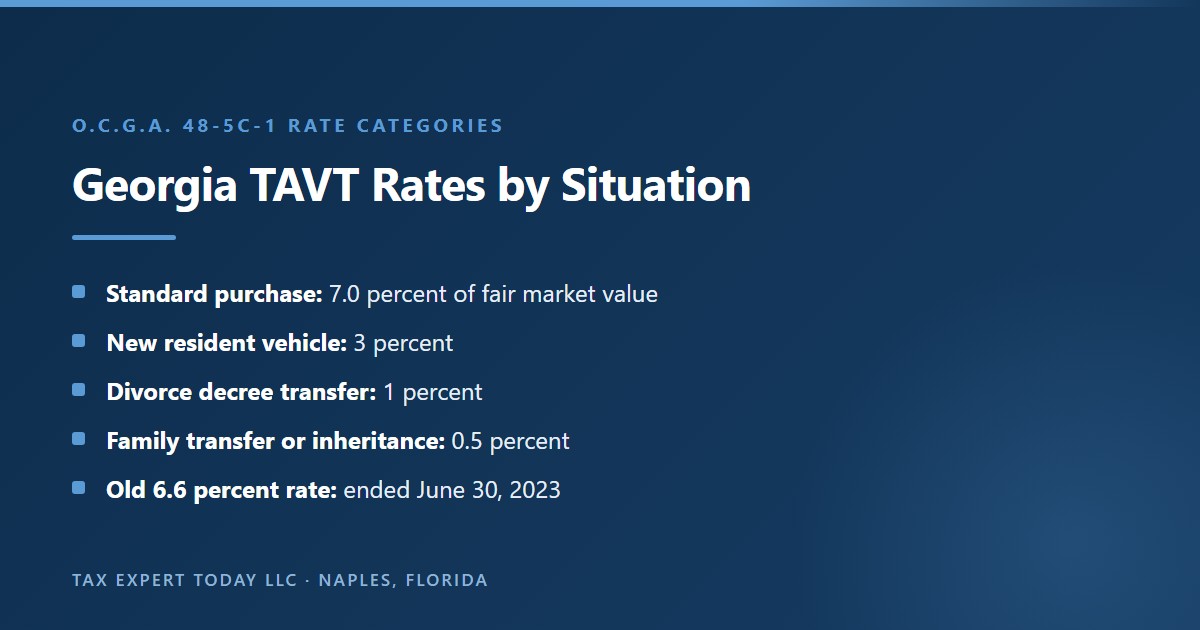
The standard Georgia title ad valorem tax rate in 2026 is 7.0 percent of the vehicle’s fair market value. New Georgia residents pay 3 percent, qualifying immediate family transfers and inheritances pay 0.5 percent, and a short list of special cases, such as salvage titles and older model years, pay 1 percent or another set rate.
- Standard rate: 7.0 percent, the Georgia title ad valorem tax rate the Department of Revenue lists as current.
- Rate history: the statute set 6.6 percent from January 1, 2020, through June 30, 2023, then 7 percent again.
- New resident rate: 3 percent for a vehicle you bring with you and title here for the first time.
- Family and inheritance rate: 0.5 percent when the vehicle is already in the TAVT system.
- Rate date: the rate in effect on the date of purchase applies.
| Situation | TAVT rate | Statute or form |
|---|---|---|
| Standard purchase, new or used | 7.0 percent of fair market value | O.C.G.A. 48-5C-1(b)(1)(B)(ii) |
| Purchases from January 1, 2020, through June 30, 2023 | 6.6 percent (historical only) | O.C.G.A. 48-5C-1(b)(1)(B)(ii) |
| New Georgia resident, vehicle from former state | 3 percent | O.C.G.A. 48-5C-1(d)(3) |
| Immediate family transfer, vehicle already in TAVT | 0.5 percent | O.C.G.A. 48-5C-1(d)(2)(B); Form MV-16 |
| Inheritance by immediate family, vehicle already in TAVT | 0.5 percent | O.C.G.A. 48-5C-1(d)(1)(B); Form T-20 |
| Transfer under a divorce decree or court order, vehicle already in TAVT | 1 percent | O.C.G.A. 48-5C-1(d)(18)(B) |
| Salvage title | 1 percent state fee | O.C.G.A. 48-5C-1(b)(2) |
| Vehicle donated to a 501(c)(3) nonprofit | 1 percent | O.C.G.A. 48-5C-1(d)(13) |
| 1963 through 1989 model year vehicle | 1 percent | O.C.G.A. 48-5C-1(d)(17)(A) |
| Rental fleet meeting the $400 sales tax test | 1.25 percent | O.C.G.A. 48-5C-1(d)(11) |
The rate history explains most of the stale Georgia title ad valorem tax figures on page one. O.C.G.A. 48-5C-1(b)(1)(B)(ii) sets the combined state and local rate at 7 percent of fair market value, with a carve out at 6.6 percent from January 1, 2020, through June 30, 2023. That window closed more than three years ago. Any calculator or article still using 6.6 percent for a 2026 purchase understates the tax on a $40,000 vehicle by $160.
The Department of Revenue TAVT FAQ states the calculation in one line: the tax is the fair market value multiplied by the rate in effect on the date of purchase. Two things drive the number, the rate category you fall into and the value the county uses. The rest of this guide is about getting both of those right.
Which Vehicles Pay TAVT and Which Still Pay the Annual Tax?
Most vehicles bought or titled in Georgia on or after March 1, 2013, pay TAVT. Vehicles bought before that date, and vehicles that are not titled at all, such as many trailers, stay in the older annual ad valorem system, which charges a tax each year based on value and the owner’s tax district.
- In the TAVT system: under the Georgia title ad valorem tax, cars, trucks, motorcycles, and motor homes titled on or after March 1, 2013.
- In the annual system: most vehicles bought before March 1, 2013, and non-titled vehicles and trailers.
- Annual tax due date: the last day of the owner’s registration period, usually the birthday.
- Annual late penalty: 10 percent if the annual tax is not paid by the end of the registration period.
Georgia runs two vehicle tax systems side by side. The Department of Revenue explains that annual ad valorem tax is a value tax assessed every year and paid at registration, and that payment is a condition of receiving a tag or renewal decal. It is due on every vehicle in that system whether or not the vehicle runs, and even if the owner does not renew the tag. The amount varies with the vehicle’s current value and the tax district where the owner lives, and the receipts go to the state, the county, the schools, and the city.
The two systems meet when an older vehicle changes hands. A vehicle still in the annual system that is sold to an unrelated buyer moves into the Georgia title ad valorem tax system, because the buyer is titling it. A vehicle in the annual system that passes to an immediate family member, by gift or by inheritance, does not have to move. Under O.C.G.A. 48-5C-1(d)(1)(A) and (d)(2)(A), the family member stays in the annual system unless he or she makes an affirmative written election to pay TAVT. We cover that choice in the family transfer and inheritance sections below.
Vehicles registered under the International Registration Plan, mainly interstate commercial trucks, are outside the Georgia title ad valorem tax altogether. The statute keeps them under apportioned ad valorem taxation, which is a separate regime for fleets that run in more than one state.
How Is Fair Market Value Determined for TAVT?
Fair market value depends on how the vehicle was bought. For a new vehicle it is the retail selling price less trade-in and rebates. For a used vehicle from a dealer it is generally the selling price less trade-in. For a private sale it is the value in the state assessment manual, whatever price the buyer and seller agreed.
- New vehicle: retail selling price, including dealer fees and add-ons, less trade-in and rebate.
- Used vehicle from a dealer: retail selling price less trade-in under O.C.G.A. 48-5C-1(a)(1)(A).
- Private sale or seller financed sale: assessment manual value, the average of current fair market and wholesale values.
- Not in the manual: a used car guide designated by the Revenue Commissioner.
- Leased vehicle: a lease formula, covered in its own section below.
| How the vehicle was acquired | Fair market value used | Trade-in reduction? |
|---|---|---|
| New vehicle from a dealer | Retail selling price, including fees and add-ons, less rebates | Yes, if the trade-in owner and VIN are on the bill of sale |
| Used vehicle from a dealer | Retail selling price | Yes |
| Used vehicle from a private seller | Assessment manual value (average of current fair market and wholesale values) | No |
| Used vehicle not listed in the manual | Value from a used car guide designated by the Commissioner | Only in a dealer seller financed sale |
| Consumer lease | Depreciation plus amortized amounts plus down payments | Net trade allowances are excluded from down payments |
| Business lease with a rental adjustment clause | Agreed upon value | Yes, less trade-in and rebate |
The new vehicle rule is broad. O.C.G.A. 48-5C-1(a)(1)(D) says the retail selling price includes charges for labor, freight, delivery, dealer fees and similar charges, tangible accessories, dealer add-ons, and mark-ups. It excludes any federal retailers’ excise tax, extended warranties, service contracts, maintenance agreements, and similar products itemized on the dealer’s invoice, and finance, insurance, and interest charges billed separately. A paint protection package bolted onto the price is taxed. An extended warranty listed on its own line is not.
The private sale rule is the one that surprises people. If you buy a used car from a neighbor for $9,000 and the assessment manual says the vehicle is worth $14,000, the county starts from $14,000. The bill of sale price does not set the tax. The statute builds the manual value from a nationally recognized pricing guide, averaging the current fair market value and the current wholesale value, the same method used under O.C.G.A. 48-5-442 for the annual tax.
There is a relief valve for a private sale vehicle in poor condition. Under O.C.G.A. 48-5C-1(a)(1)(B)(ii), a county tag agent may deviate from the manual value based on the mileage and condition of the used vehicle, on written application with supporting documents. The statute names a bill of sale, an odometer statement, and values from reputable pricing guides as examples. Photos of damage and a repair estimate are the kind of evidence that usually helps, and the county’s decision can be appealed.
The Department of Revenue FAQ describes the used vehicle value more simply, as the manual value with a trade-in reduction for dealer sales, and the online estimator works from the same valuation data. In a November 15, 2013, informational bulletin the Department also recognized that the values in its system are updated each year, so the value in the estimator can change between the sale date and the date the title is processed. It approved a county override when a dealer can document the value that existed on the date of purchase, for example with a date stamped screenshot of the estimator.
Does a Trade-In Lower Georgia TAVT?
Yes, when you trade a vehicle in to a dealer as part of buying another vehicle from that dealer. The trade-in value on the bill of sale reduces the fair market value before the 7.0 percent rate applies. There is no trade-in reduction in a private sale, and the bill of sale must show the trade-in owner and VIN.
- Dealer purchase with a trade: taxable value is reduced by the trade-in value on the bill of sale.
- Private sale: no reduction, even if you sold your old car the same week.
- Documentation rule: the owner’s name and the VIN of the trade-in must appear on the bill of sale.
- Rebates: dealer rebates and cash discounts at the time of sale also reduce a new vehicle’s value.
O.C.G.A. 48-5C-1(a)(7) defines the trade-in value as the value stated in the bill of sale for a vehicle traded in to the dealer in a transaction involving the purchase of another vehicle from the dealer. That definition carries two conditions. The trade has to go to the same dealer selling you the new vehicle, and it has to be part of the same transaction. Selling your old car to a different dealer for cash and then buying elsewhere does not produce a trade-in credit on the second purchase.
The paperwork condition matters more than it looks. Subsection (a)(1)(D) says no reduction for the trade-in is taken unless the name of the owner and the vehicle identification number of the trade-in are shown on the bill of sale. A bill of sale that lists a trade-in allowance as a lump sum, with no VIN, leaves the county without the support it needs to give the credit.
On a $45,000 purchase with a $15,000 trade-in, the taxable value is $30,000 and the Georgia title ad valorem tax at 7.0 percent is $2,100, instead of $3,150 on the full price. The $1,050 difference is the value of keeping the trade inside the dealer transaction, and it is often worth asking the dealer to show the trade-in as a separate line with the VIN before you sign.
How Much TAVT Will You Pay? Worked Examples
Multiply the taxable value by your rate. A $38,000 new car with a $10,000 trade-in owes $1,960 at 7.0 percent. A new resident’s car valued at $25,000 owes $750 at 3 percent. A $20,000 vehicle passed from a parent to a child owes $100 at 0.5 percent. These are hypothetical examples, not estimates for your vehicle.
- Step one: find your rate category, standard, new resident, family, or a special case.
- Step two: find the fair market value rule for how you bought the vehicle.
- Step three: subtract a dealer trade-in and rebates where the rules allow.
- Step four: multiply, then add the separate $18 title fee and the $20 registration fee.
| Hypothetical transaction | Taxable value | Rate | TAVT |
|---|---|---|---|
| New car, $38,000 price, $10,000 dealer trade-in | $28,000 | 7.0 percent | $1,960 |
| Used car from a dealer, $22,000, no trade | $22,000 | 7.0 percent | $1,540 |
| Private sale at $9,000, manual value $14,000 | $14,000 | 7.0 percent | $980 |
| New resident registers a car valued at $25,000 | $25,000 | 3 percent | $750 |
| Parent gives child a $20,000 car already in TAVT | $20,000 | 0.5 percent | $100 |
| Divorce decree awards a $25,000 car already in TAVT | $25,000 | 1 percent | $250 |
The examples show why the category question comes first. The same $25,000 vehicle can carry a tax of $1,750, $750, $250, or $125 depending on whether it is a standard purchase, a new resident’s car, a divorce transfer, or a family transfer of a vehicle already in the TAVT system. The value question comes second, and the private sale example shows how a low agreed price does not lower the tax unless the county agrees to deviate from the manual value.
For your own vehicle, the Department of Revenue points buyers to its TAVT estimator on DRIVES e-Services, and the state portal Georgia.gov links to it. The estimator needs the VIN and returns an estimate. It does not account for a dealer trade-in or a deviation request, so treat it as a starting point, not as the bill.

Do New Georgia Residents Pay the Full 7 Percent?
No. A person moving to Georgia who registers a vehicle that was registered in the state where he or she used to live pays TAVT at 3 percent of fair market value. The vehicle must be titled and registered within 30 days of the move, or a 10 percent penalty and interest can apply.
- Rate: 3 percent under O.C.G.A. 48-5C-1(d)(3), in effect since July 1, 2019.
- Deadline: register within 30 days from the date you moved to Georgia.
- First step: get a Georgia driver’s license or ID, which is required before registration.
- At the tag office: MV-1 Title/Tag Application, the out of state title, proof of Georgia insurance.
- Other fees: $18 title fee and $20 annual registration fee.
The Department of Revenue new resident page says vehicles must be registered with the state within 30 days from the date you moved to Georgia, and lists the Georgia title ad valorem tax at 3 percent of the vehicle’s fair market value alongside the $20 registration fee and the $18 title fee. If the vehicle has a loan or lease, the lender or leasing company usually holds the title, and you file Form T-17 so the county can request it. Residents of the 13 metropolitan Atlanta counties also need an emissions inspection before registering.
The 3 percent rate covers the vehicle you bring with you. It does not cover a vehicle you buy after you arrive. If you move to Georgia in March and buy a new truck in May, the truck pays 7.0 percent like any other purchase. The rate follows the transaction, and the new resident rate is tied to re-registering a vehicle from your former state.
The 30 day window is where new residents lose money. O.C.G.A. 48-5C-1(d)(9) imposes a penalty of 10 percent of the state and local title ad valorem tax on an owner who does not apply for a title within 30 days of the date the law requires registration, and adds interest at 1 percent per month if the tax and penalty are not paid within 60 days. On a $30,000 vehicle that is a $900 tax plus a $90 penalty, and the interest runs from there. The county can issue a temporary permit, with no penalty, when the delay is a lienholder’s failure to release the title.
When you become a Georgia resident also matters for your income tax return. The date you establish residence for vehicle registration is evidence in the residency question, but the income tax rules have their own tests. Our guide to the Georgia part year resident tax return explains how the move date splits your income between states.
How Does the Family Transfer Rate Work?
When an immediate family member transfers a vehicle that is already in the TAVT system, the recipient pays 0.5 percent of fair market value, a quarter percent state and a quarter percent local. Both people sign Form MV-16, the affidavit certifying the family relationship. Immediate family means spouse, parent, child, sibling, grandparent, or grandchild.
- Who qualifies: spouse, parent, child, sibling, grandparent, or grandchild under O.C.G.A. 48-5C-1(a)(2).
- Who does not: aunts, uncles, cousins, nieces, nephews, in-laws, and unmarried partners.
- Condition: the vehicle has a Georgia title and TAVT was already paid on it.
- Form: MV-16, Affidavit to Certify Immediate Family Relationship.
- False affidavit: a penalty of up to $2,500 state and $2,500 local.
The Department of Revenue lists the rule in two parts. If the vehicle has a Georgia title and the Georgia title ad valorem tax was paid, the family member can pay the reduced 0.5 percent rate. If the vehicle is still in the annual ad valorem system, the family member can stay under annual ad valorem or pay the full one time TAVT. The reduced rate is a reward for a vehicle that has already paid the tax once, which is why a vehicle that never entered TAVT does not get it.
The family list in the statute is shorter than many families assume. In-laws are not on it, so a vehicle passed from a father in law to a son in law pays the standard rate. Step relationships are not addressed in the definition, and we would not assume a stepchild qualifies without confirming with the county. A transfer that fails the family test is an ordinary sale under the Georgia title ad valorem tax even when no money changes hands.
A family transfer can also be a gift for federal tax purposes. Most vehicle gifts fall under the federal annual exclusion, and Georgia has no gift tax of its own, but a valuable vehicle given along with other gifts in the same year can require a federal gift tax return. Our guide to the Georgia gift tax covers the annual exclusion and the federal filing rule.
What TAVT Applies to an Inherited Vehicle?
An immediate family member who inherits a vehicle already in the TAVT system pays 0.5 percent of fair market value. If the vehicle is still in the annual system, the family heir can stay there or elect TAVT. Heirs file Form T-20, the Affidavit of Inheritance, or estate documents, with the title and death certificate.
- TAVT vehicle: 0.5 percent for an immediate family heir under O.C.G.A. 48-5C-1(d)(1)(B).
- Annual system vehicle: the heir stays in the annual system unless he or she elects TAVT in writing.
- Inheritance documents: Letters Testamentary, a Year’s Support order, or Form T-20.
- Family proof: Form MV-16 may be required to show the relationship.
- Non-family heir: no reduced rate, the standard TAVT applies.
The Department of Revenue estate vehicle page lists what the county tag office needs: a completed MV-1, the original title in the deceased’s name with any liens released, Form T-4 if a lien release is needed, an inheritance document, and a certified copy of the death certificate. The inheritance document can be certified Letters Testamentary, a certified Year’s Support order, or Form T-20 signed by the heir. If there is only one heir, a copy of an order finding no administration necessary can stand in for Form T-20.
The sequencing rule trips up families who want to sell. If Form T-20 is used, the heir must title the vehicle in his or her own name before selling it. That means the heir pays the 0.5 percent family rate on the inheritance title, and the buyer then pays the standard rate on the purchase. If the estate sells the vehicle instead, the executor signs the title assignment directly to the buyer, and only the buyer pays the Georgia title ad valorem tax. For a vehicle that no one in the family wants to keep, an estate sale avoids one title transaction.
The inheritance itself is not taxed by Georgia. Georgia has no inheritance tax and its estate tax does not reach deaths after 2004, as our guide to the Georgia inheritance tax explains. The 0.5 percent title tax is a title charge, not a tax on the inheritance, and it is the only Georgia tax most heirs pay on an inherited car.
What About a Vehicle Transferred in a Divorce?
A vehicle already in the TAVT system that passes to a spouse under a divorce decree or court order pays 1 percent of fair market value, a half percent state and a half percent local. A vehicle still in the annual system stays there after the transfer unless the receiving spouse elects TAVT in writing.
- Rule: O.C.G.A. 48-5C-1(d)(18) covers transfers made because of a divorce decree or court order.
- TAVT vehicle: 1 percent combined, compared with 7.0 percent for a sale.
- Annual system vehicle: stays in the annual system unless the recipient elects TAVT.
- Paperwork: bring a copy of the decree or order to the county tag office.
The divorce rule is a separate category from the spousal family transfer. A transfer between spouses while the marriage continues is a family transfer at 0.5 percent with Form MV-16. Once a decree divides the property, the transfer is made because of the court order, and the statute sets the rate at 1 percent. The difference is small in dollars, but it explains why the county may ask for the decree rather than a family affidavit when the spouses are divorcing.
A vehicle that one spouse buys after the divorce is an ordinary purchase. And a vehicle moved from a marital LLC or business to one spouse may be an entity transfer rather than a divorce transfer, depending on how the decree and the title are written. That is worth sorting out before the title work is filed, because the categories carry different rates.
How Is TAVT Calculated on a Leased Vehicle?
The leasing company pays TAVT when it titles the vehicle and can pass the cost to the lessee. For a consumer lease, the taxable value is the total depreciation and amortized amounts under the lease plus any down payment, not the full vehicle price. Business leases with a rental adjustment clause use the agreed value less trade-in and rebates.
- Who owes it: the purchaser that acquires title, including a lessor, under O.C.G.A. 48-5C-1(b)(1)(C), owes the Georgia title ad valorem tax.
- Pass through: a lessor that pays TAVT may seek reimbursement from the lessee.
- Consumer lease value: depreciation plus amortized amounts plus down payments.
- Down payment meaning: cash at signing, including a capital cost reduction, but not rebates or net trade allowances.
- Registration: a Georgia lessee registers within 30 days of the lease start or of becoming a resident.
For leases, the Georgia title ad valorem tax follows a formula in O.C.G.A. 48-5C-1(a)(1)(E). For an ordinary lease, the fair market value is the total of the depreciation plus any amortized amounts under the lease agreement plus any down payments. The statute defines down payments as cash collected from the lessee at the start of the lease, including cash supplied as a capital cost reduction and other upfront payments, but excluding rebates, noncash credits, net trade allowances, taxes and fees imposed by law, and monthly payments made in advance. The result is usually well below the sticker price, because the tax is measured by the part of the vehicle’s value the lessee uses up.
For a vehicle leased primarily for use in the lessee’s trade or business, where the lease contains a rental price adjustment clause of the kind described in O.C.G.A. 40-3-60, the value is the agreed upon value less trade-in and rebates. That is closer to a purchase value and produces a larger tax. The Department of Revenue FAQ confirms that for a new vehicle the agreed upon value in a lease takes the place of the retail selling price.
Lessors carry their own compliance duties. A lessor that leases vehicles for more than 31 consecutive days to Georgia residents must register with the Department of Revenue and pay a $100 annual registration fee, and failing to register carries a $2,500 civil penalty. The lessor must apply for a Georgia title within 30 days of the start of the lease. If you are moving to Georgia with a leased car, the lease company holds the title, and you file Form T-17 so the county can obtain it.
A tractor or heavy truck titled in Georgia pays the title tax like any other vehicle, but a carrier that runs it across state lines has a separate quarterly fuel tax obligation as well. Our guide to Georgia IFTA covers who needs a license, the 2026 fuel tax rates, and how to report the 2026 fuel tax suspension on the quarterly return.
Who Is Exempt From Georgia TAVT?
Georgia exempts certain veterans, including those compensated at 100 percent disability, former prisoners of war, Purple Heart recipients, and Medal of Honor recipients, using Form MV-30. Disabled first responders receive an exemption on up to $50,000 of value every three years. Qualifying nonresident service members and government owned vehicles are also exempt.
- Veterans: 100 percent disability compensation, former POWs, Purple Heart, and Medal of Honor, with Form MV-30.
- Disabled first responders: up to $50,000 of combined value in any three year period, with Form MV-PSFR-TAVT.
- Nonresident military: Form PT-472NS, the service member’s affidavit.
- Government vehicles: vehicles owned or leased by the state, counties, cities, and school districts.
- Donated vehicles: a vehicle donated to a 501(c)(3) pays a reduced 1 percent rate, not zero.
| Who | Treatment | Document |
|---|---|---|
| Veteran compensated at 100 percent disability | Exempt, subject to the veteran code conditions | Form MV-30 and military documentation |
| Former prisoner of war, Purple Heart or Medal of Honor recipient | Exempt, subject to the veteran code conditions | Form MV-30 and military documentation |
| Disabled first responder or surviving spouse | Exempt on up to $50,000 of value per three year period | Form MV-PSFR-TAVT and DOAS award letter |
| Nonresident military service member | Exempt | Form PT-472NS |
| State, county, city, or school district vehicle | Exempt if the entity is exempt from ad valorem and sales tax | Agency documentation |
| Non-titled vehicles and trailers | No TAVT, annual ad valorem tax applies | None for TAVT |
The veteran exemptions rest on O.C.G.A. 48-5C-1(b)(7)(B), which exempts from the Georgia title ad valorem tax any vehicle that is exempt from ad valorem tax under the veteran provisions in O.C.G.A. 48-5-478 through 48-5-478.3. The Department of Revenue lists the required documents as Form MV-30, the Georgian’s Veteran Affidavit for Relief of State and Local Title Ad Valorem Tax Fees, together with military documentation. Because the exemption is tied to those code sections, the qualifying vehicle and the number of vehicles can be limited, and the county tag office applies the specific conditions.
The first responder exemption is narrower than its name suggests. Under O.C.G.A. 48-5C-1(a)(.1) and (b)(7)(C), a disabled first responder is a law enforcement officer, firefighter, publicly employed emergency medical technician, or the surviving spouse of one, who receives payments from the Department of Administrative Services under O.C.G.A. 45-9-85 because of a line of duty disability or death. The exemption covers up to $50,000 of fair market value in total for all vehicles registered during any three year period. The application is Form MV-PSFR-TAVT with the award letter from the Department of Administrative Services.
Military members who keep a home state residence under federal law use Form PT-472NS. The Servicemembers Civil Relief Act generally lets a service member stationed in Georgia keep his or her domicile elsewhere, and the affidavit documents that status for the county. A service member who has become a Georgia domiciliary does not use it. For how Georgia taxes military income, see our guide to Georgia military retirement tax.
Which Title Transactions Owe No TAVT?
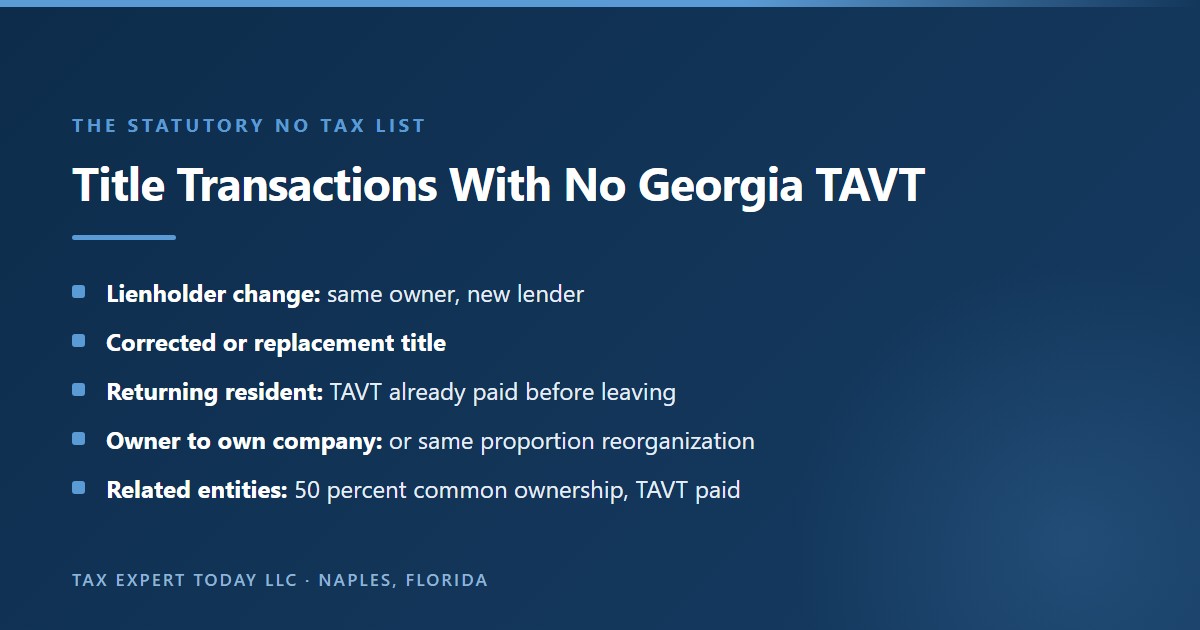
Georgia charges no TAVT on title transactions that do not change who really owns the vehicle. The list includes adding or changing a lienholder, corrected and replacement titles, retitling a vehicle you already taxed after moving away and back, and certain transfers between an owner and a company the owner controls.
- Lienholder changes: adding or substituting a lender while the owner stays the same.
- Corrected or replacement titles: no new tax on paperwork corrections.
- Returning residents: no tax to retitle a vehicle that already paid the Georgia title ad valorem tax before you left.
- Owner and company: owner to company, and company to owner for a prestige plate.
- Related entities: transfers between entities with at least 50 percent common ownership, if TAVT was paid.
| Title transaction | TAVT due? | Statute |
|---|---|---|
| Adding or substituting a lienholder, same owner | No | 48-5C-1(d)(15)(A) |
| Corrected title or replacement title | No | 48-5C-1(d)(4) |
| Retitle after moving away and returning, TAVT already paid | No | 48-5C-1(d)(15)(I) |
| Business reorganization, same proportionate ownership | No | 48-5C-1(d)(15)(K) |
| Company to owner for a prestige or special plate | No | 48-5C-1(d)(15)(L) |
| Owner to the owner’s company | No | 48-5C-1(d)(15)(M) |
| Entity to entity, at least 50 percent common ownership, TAVT paid | No | 48-5C-1(d)(15)(N) |
| Repossession title in the secured party’s name | No | 48-5C-1(d)(15)(G) |
The list sits in O.C.G.A. 48-5C-1(d)(15), which says there is no liability for state or local title ad valorem tax in a set of named title transactions. Besides the items above, it covers a bonded title issued in the applicant’s own name, a title after foreclosure of a mechanic’s lien, a dealer’s title to an abandoned vehicle, a title to a recovered stolen vehicle, a dealer or rebuilder title taken for resale with the Commissioner’s affidavit, a repossession title in the secured party’s name, an odometer correction, and a replacement title for a vehicle at least 15 years old whose title no longer exists. Subsection (d)(4) separately excludes corrected titles and replacement titles.
The returning resident item is worth knowing for snowbirds and job movers. If you paid the Georgia title ad valorem tax on a vehicle, moved out of Georgia, and later return and retitle the same vehicle in Georgia, subsection (d)(15)(I) says no TAVT is due on that retitle. Keep the original Georgia title receipt, because the county will need to see that the tax was paid the first time.
Do Businesses Pay TAVT When Moving Vehicles Between Entities?
Sometimes. A transfer from an owner to his or her company, a reorganization that keeps the same proportionate ownership, and a transfer between entities with at least 50 percent common ownership owe no TAVT if the tax was already paid. Selling an entity mainly to avoid TAVT on its vehicles can trigger a $2,500 per vehicle penalty plus the tax.
- Owner to company: no TAVT under O.C.G.A. 48-5C-1(d)(15)(M).
- Reorganization: no TAVT when owners keep the same proportionate interest, under (d)(15)(K).
- Related entities: no TAVT at 50 percent common ownership, if TAVT was paid, under (d)(15)(N).
- Anti-avoidance: up to $2,500 state and $2,500 local per vehicle, plus the tax, under (d)(8).
- Rental fleets: a rental concern can pay 1.25 percent combined if it meets a $400 sales tax test.
Small business owners often title a work truck personally, then form an LLC and want the truck in the company’s name. The statute treats that as a no tax transaction, because the owner is moving the vehicle into his or her own company. The reverse move, company to owner, is tax free only when it is for a prestige or special license plate. Otherwise a transfer out of the company to the owner is treated like any other change of ownership, unless it fits the 50 percent common ownership rule between two entities.
The anti-avoidance rule in subsection (d)(8) targets a specific play: selling an interest in a business whose main asset is one or more vehicles, so the vehicles change hands without a new title. If the Commissioner determines the transfer was done to evade the Georgia title ad valorem tax, the penalty can reach $2,500 state and $2,500 local per vehicle, plus the TAVT itself. The Commissioner must make that determination within 60 days of receiving information about the transfer.
For the income tax side of a business vehicle, including how a vehicle in an LLC is reported, see our guide to Georgia LLC taxes. Rental companies have a separate rate in subsection (d)(11): 0.625 percent state and 0.625 percent local, if in the prior year the average sales tax on rental charges per vehicle was at least $400 as certified by the Commissioner. Dealers’ loaner vehicles are not taxed for up to 366 days from the date they leave inventory.
What Are the Penalties for Paying TAVT Late?
An owner who does not apply for a Georgia title within 30 days of the date registration is required owes a 10 percent penalty, and interest at 1 percent per month starts if the tax and penalty are not paid within 60 days. Dealers holding collected TAVT face a separate penalty that climbs every 30 days.
- Owner penalty: 10 percent of the state and local TAVT after the 30 day window.
- Owner interest: 1 percent per month if not paid within 60 days.
- Lienholder delay: a temporary permit, with no penalty, if the lender failed to release the title.
- False bill of sale: a penalty of up to $2,500 state and $2,500 local.
- Willful failure to title: a misdemeanor under subsection (d)(16).
| Who and what | Timing | Penalty |
|---|---|---|
| Owner fails to apply for title | After 30 days from the date registration is required | 10 percent of state and local TAVT |
| Owner has not paid tax and penalty | After 60 days | Interest at 1 percent per month |
| Dealer holds collected TAVT | After 30 days from purchase | 5 percent |
| Dealer still has not remitted | At 60, 90, and 120 days | Additional 10, 15, and 20 percent |
| Dealer still has not remitted | Each later 30 day period | Additional 25 percent |
| False bill of sale or false family affidavit | Determined within 60 days of the information | Up to $2,500 state and $2,500 local |
The dealer schedule in O.C.G.A. 48-5C-1(b)(1)(E) explains why buyers sometimes get calls about late title work. A dealer that collects the Georgia title ad valorem tax from a buyer and does not submit the title application and remit the tax to the county within 30 days of the purchase is liable for 5 percent of the tax, with additional penalties of 10 percent at 60 days, 15 percent at 90 days, 20 percent at 120 days, and 25 percent for each 30 day period after that. A dealer that converts the collected tax to its own use is guilty of theft by conversion. The penalty falls on the dealer, not on the buyer who paid.
For a buyer, the practical protection is the paperwork. Keep the buyer’s order, the bill of sale showing the Georgia title ad valorem tax collected, and the dealer’s title application receipt. If your registration does not arrive, the county tag office can tell you whether the dealer filed. The tag office in your county of residence is where the title and tax are processed, as the Department of Revenue FAQ explains.
A TAVT balance is a county tag office matter, separate from a Georgia income tax or sales tax balance with the Department of Revenue. If you owe the Department of Revenue on other Georgia taxes at the same time, our guide to the Georgia Department of Revenue payment plan covers the installment options for those accounts.
Can You Appeal the Fair Market Value Used for TAVT?
Yes. O.C.G.A. 48-5C-1(e) lets you appeal the fair market value the same way an annual ad valorem vehicle value is appealed under O.C.G.A. 48-5-450, but you must pay the full TAVT first. If the appeal succeeds, the tax is recalculated and any overpayment is refunded promptly.
- Pay first: the full state and local TAVT is paid before the appeal is filed.
- Route: the same appeal process used for vehicle values in the annual system.
- Evidence: bill of sale, odometer statement, condition photos, repair estimates, pricing guides.
- Result: a recalculated tax and a refund of any overpayment if you win.
There are two separate ways to challenge a value, and they work at different times. Before you pay, a private sale buyer can ask the county tag agent to deviate from the manual value because of high mileage or poor condition, under subsection (a)(1)(B)(ii). After you pay, any owner can appeal the value under subsection (e). The deviation request is the faster route for a damaged or high mileage private sale vehicle. The appeal is the route when the county has already applied a value you believe is wrong.
Dealers have their own fix for timing problems. Under the Department of Revenue’s November 15, 2013, informational bulletin on the estimator value discrepancy, a county can override the system value with the value that existed on the purchase date when the dealer provides reliable documentation. If your dealer collected the Georgia title ad valorem tax on one value and the county is now asking for more, ask the dealer whether it kept that record.
Is Georgia TAVT Deductible on Your Federal Return?
Generally not as a personal property tax. Federal law allows that deduction only for an ad valorem tax imposed on an annual basis, and TAVT is paid once at titling. For a business vehicle, a tax paid on acquiring property is generally added to its cost. Ask your preparer about the sales tax election.
- Personal property tax test: 26 U.S.C. 164(b)(1) requires an ad valorem tax imposed on an annual basis.
- TAVT: a one time payment at titling, so it does not fit that definition.
- Annual ad valorem tax: on a vehicle still in the annual system, it is value based and yearly.
- Business vehicle: under section 164(a), a tax paid on an acquisition is part of the property’s cost.
- Sales tax election: Georgia labels TAVT an alternative ad valorem tax, not a sales tax, so get advice first.
The TurboTax community threads on page one ask this exact question, and the answer turns on the federal definitions. 26 U.S.C. 164(b)(1) defines a personal property tax as an ad valorem tax imposed on an annual basis in respect of personal property. Georgia’s annual ad valorem tax on an older vehicle is charged each year on value, so it fits that definition for an itemizer. The Georgia title ad valorem tax is charged once when the vehicle is titled, so it does not.
The sales tax route is less clear. An itemizer can elect to deduct state and local general sales taxes instead of state income tax. Section 164(b)(5)(B) defines a general sales tax as one imposed at one rate on the retail sale of a broad range of items, and subparagraph (F) says that for a motor vehicle taxed above the general rate, only the general rate counts. Georgia law, however, exempts vehicles subject to the Georgia title ad valorem tax from sales tax and calls TAVT an alternative ad valorem tax. We did not find a primary IRS source that addresses TAVT directly, so this is a position to take only with your preparer’s review. Also remember that the state and local tax deduction is subject to the federal cap, and many Georgia filers take the standard deduction anyway.
For a business vehicle the answer is cleaner. The last sentence of section 164(a) says a tax paid in connection with the acquisition of property is treated as part of the cost of the acquired property. The Georgia title ad valorem tax on a work truck is therefore generally added to the truck’s basis and recovered through depreciation, not deducted all at once as a tax. For how Georgia then taxes your income, see our guide to Georgia state income tax.
What Records Should You Keep for a Vehicle Title Transaction?
Keep the bill of sale with the trade-in VIN, the dealer’s buyer’s order, the TAVT receipt from the county, Form MV-1, any MV-16, T-20, MV-30, or PT-472NS form, and proof of the date you moved to Georgia. These papers support the rate you paid, a value appeal, and a later retitle.
- Purchase papers: bill of sale, buyer’s order, and the trade-in line with the VIN.
- Tax receipt: the county receipt, which proves the Georgia title ad valorem tax was paid on the vehicle.
- Rate forms: the family, inheritance, veteran, or military affidavit you filed.
- Move date proof: a lease, closing statement, or utility start date for the 30 day window.
- Business records: the asset record showing TAVT added to the vehicle’s basis.
The TAVT receipt is the record people lose and later need. It is what proves that a later family transfer qualifies for 0.5 percent, because the reduced rate requires that the Georgia title ad valorem tax was already paid. It is what supports a no tax retitle if you move away and come back. And for a business vehicle it is the number your preparer adds to basis.
Keep vehicle records at least as long as you own the vehicle, and for a business vehicle until at least three years after you file the return for the year you sell it, which lines up with the general federal assessment period. If the vehicle came to you as a gift or inheritance, also keep the paperwork showing how you received it, because that affects your basis if the vehicle is later sold.
Georgia TAVT Mistakes That Cost Money
The costly Georgia TAVT mistakes are using the outdated 6.6 percent rate, assuming a low private sale price sets the tax, selling a trade-in separately instead of trading it to the dealer, missing the 30 day window after a move, and filing a family affidavit for a relative who is not on the statutory list.
- Using 6.6 percent: that rate ended June 30, 2023; the 2026 Georgia title ad valorem tax rate is 7.0 percent.
- Trusting the private price: the county starts from the manual value, not the agreed price.
- Losing the trade-in credit: a trade must go to the selling dealer and show the VIN.
- Registering late: 10 percent penalty after 30 days, plus interest after 60.
- Stretching the family list: in-laws and cousins pay the standard rate.
A few less common mistakes show up in estates and businesses. Heirs who plan to sell sometimes title the vehicle in their own name first, paying a tax that an estate sale would have avoided. Business owners sometimes move a vehicle from the company to themselves without checking whether the move fits a no tax category. And buyers sometimes assume a vehicle they are taking over from a relative is in the TAVT system when it is still in the annual system, which changes the options.
The Georgia title ad valorem tax also interacts with Georgia’s other vehicle taxes. A vehicle bought outside Georgia and brought in by a Georgia resident is titled here and pays TAVT, which is why our guide to Georgia use tax treats vehicles separately from other out of state purchases. Electric vehicles pay TAVT like any other vehicle and also carry an annual alternative fuel vehicle fee, which our guide to the Georgia electric vehicle tax credit covers.
Georgia Title Ad Valorem Tax Help in Naples & Southwest Florida
Tax Expert Today LLC helps Georgia vehicle owners, families settling estates, and business owners with the tax side of the Georgia title ad valorem tax from its office in Naples, Florida. We serve Georgia clients nationwide and remotely, reviewing how a transfer should be classified, the records behind it, and the federal and Georgia income tax treatment.
- Office: 11983 Tamiami Trail N, Naples FL 34110.
- Phone: (239) 441-2005.
- Hours: Monday through Friday, 10 a.m. to 5 p.m. Eastern.
- Georgia TAVT help Naples: Naples and Southwest Florida in person, Georgia and all 50 states remotely.
Many of our Georgia clients split the year between Georgia and Southwest Florida, or are moving between the two states, which is exactly when the new resident rate, the 30 day window, and the returning resident rule come up. Others are settling a parent’s estate that includes vehicles, or running a business that holds a fleet in an LLC. We work as tax advisors on state tax matters nationwide, and we coordinate with the county tag office and with probate or family law counsel where the question is a title or court order issue. For our wider Georgia services, see the Georgia tax services page.
When to Engage a Professional
Engage a tax professional before the title work if a vehicle is passing through an estate, a divorce, or a business entity, if you are moving to or from Georgia with vehicles, if the county value looks wrong, or if you plan to claim TAVT on a federal return. Planning ahead usually costs less than fixing it after.
- Estate vehicles: the choice between an heir title and an estate sale changes who pays.
- Divorce or business moves: the category decides whether the rate is 1 percent, 7.0 percent, or zero.
- A move across state lines: the 30 day clock and the 3 percent rate start at the move.
- A value dispute: deviation before payment and appeal after payment work on different timelines.
Tax Expert Today LLC reviews Georgia vehicle transfers as part of our wider state and federal tax work nationwide, and helps clients line up the records the county and their tax returns need. Call (239) 441-2005 for a free consultation. This guide is general information about Georgia rules as of October 30, 2026, and is not legal or tax advice for your situation. Results depend on the facts of each case.
Frequently Asked Questions About the Georgia Title Ad Valorem Tax
What is the Georgia title ad valorem tax rate in 2026?
The standard rate is 7.0 percent of the vehicle’s fair market value. New Georgia residents pay 3 percent on a vehicle brought from their former state, and qualifying immediate family transfers and inheritances of a vehicle already in the TAVT system pay 0.5 percent. The 6.6 percent rate applied only from January 1, 2020, through June 30, 2023.
Do you pay sales tax and TAVT on a car in Georgia?
No. A vehicle titled in Georgia on or after March 1, 2013, pays the Georgia title ad valorem tax instead of state and local sales tax and instead of the old annual ad valorem tax. You still pay the separate $18 title fee and the $20 annual registration fee.
How is TAVT calculated on a private sale in Georgia?
For a used vehicle bought from a private seller, the county uses the value in the state assessment manual, not the price on the bill of sale, and multiplies it by 7.0 percent. There is no trade-in reduction. The county tag agent may deviate from the manual value for high mileage or poor condition on written application with documents.
How long do new residents have to pay TAVT in Georgia?
New residents must register their vehicles within 30 days from the date they move to Georgia and pay the Georgia title ad valorem tax at 3 percent. Missing the window adds a penalty of 10 percent of the tax, and interest at 1 percent per month applies if the tax and penalty are not paid within 60 days.
Who counts as immediate family for the Georgia TAVT family rate?
O.C.G.A. 48-5C-1 defines immediate family as a spouse, parent, child, sibling, grandparent, or grandchild. In-laws, cousins, aunts, uncles, nieces, and nephews are not on the list. Both people sign Form MV-16, and a false affidavit can bring a penalty of up to $2,500 state and $2,500 local.
Is Georgia TAVT tax deductible?
Generally not as a personal property tax, because federal law limits that deduction to ad valorem taxes imposed on an annual basis and the Georgia title ad valorem tax is paid once. For a business vehicle, a tax paid on acquiring property is generally added to the vehicle’s cost basis. Review any sales tax election position with your preparer.
Do you pay TAVT again if you move away from Georgia and come back?
No, if you already paid the Georgia title ad valorem tax on that vehicle. O.C.G.A. 48-5C-1(d)(15)(I) says there is no TAVT on retitling a vehicle in Georgia when the owner paid TAVT, moved out of the state, and returned. Keep the original county TAVT receipt to show the tax was paid.
I live in Naples, Florida, and have vehicles in Georgia. Can you help with the Georgia title ad valorem tax?
Yes. Tax Expert Today LLC reviews Georgia vehicle transfers, estate and business title questions, and the related income tax treatment from its Naples, Florida office at 11983 Tamiami Trail N, and Georgia clients work with us remotely. Call (239) 441-2005 for a free consultation.
Published October 30, 2026 by Dr. Pellumb Kabashi « Back to Learning Center
Have a question this article touches on?
Tax Expert Today LLC, based in Naples, Florida and serving clients across the United States.
Schedule a Consultation (239) 441-2005