
By Dr. Pellumb Kabashi, DBA, MBA, EA, CFE, CES
Founder, Tax Expert Today LLC · Tax advisors, enrolled agents, CPAs, and attorneys · Serving clients in all 50 states
Quick Answer: A Georgia GATE card is the Georgia Agricultural Tax Exemption certificate that the Georgia Department of Agriculture issues to qualified agricultural producers. It lets them buy farm production inputs, farm energy, and agricultural machinery without Georgia sales tax. It costs $150 for three years, generally requires $5,000 in annual agricultural sales or services, and applications for 2027 to 2029 open November 2, 2026. Call (239) 441-2005 for a free consultation.
Most of what ranks for the Georgia GATE card today is the Georgia Department of Agriculture explaining how to log in, pay, and reorder a card. That is useful if you already know you qualify and already know what the card covers. It leaves out the questions a farm owner, a timber investor, or a family with rented pasture actually brings to a tax advisor: do I qualify, which purchases are really exempt, what happens if I use the card for the wrong thing, and does any of this touch my income tax return?
The Georgia GATE card is a sales and use tax tool. It does not lower income tax, and it is not a general farm discount. It is a certificate that tells a seller that a specific buyer is a qualified agricultural producer under O.C.G.A. 48-8-3.3 and may buy three defined categories of property without paying Georgia sales tax. Used correctly, it removes a cost that can run from 6 to 9 percent of every qualifying purchase. Used carelessly, it creates a use tax bill, penalties, interest, and a possible suspension.
This guide works through the statute, the Department of Revenue policy bulletin, the Georgia Department of Agriculture rules, and the program pages as they read in October 2026. It is part of our Georgia tax services library, and it focuses on the compliance side of holding a card rather than on the online application screens.
What Is a Georgia GATE Card?
A Georgia GATE card is the wallet sized proof of a Georgia Agricultural Tax Exemption certificate. The Georgia Department of Agriculture issues it to qualified agricultural producers under O.C.G.A. 48-8-3.3, and it allows them to buy agricultural production inputs, energy used in agriculture, agricultural machinery and equipment, and diesel exhaust fluid without Georgia sales and use tax.
- Issued by: the Georgia Department of Agriculture, not the Department of Revenue.
- Enforced by: both agencies, which share information and may audit cardholders.
- Legal basis: O.C.G.A. 48-8-3.3 and Department of Revenue Rule 560-12-2-.03.
- Term: a three year certificate with a new card mailed each year.
- Fee: $150 per three year issuance or renewal.
The word “card” causes some confusion. Legally, the exemption is a certificate with an exemption number. The statute directs the Commissioner of Agriculture to issue a wallet sized card showing the producer’s name, address, exemption number, and expiration date, and to issue a fresh card each year the certificate is in effect, even though the certificate itself runs for three years. The program flyer adds that each primary cardholder also receives two key fobs. The card and fobs are evidence of the certificate; they are not the exemption itself.
The program sits at the intersection of two agencies. The Department of Agriculture decides who qualifies and issues, suspends, or revokes certificates. The Department of Revenue administers the sales tax, decides whether a particular purchase is exempt, and audits both sellers and cardholders. The statute expressly authorizes the two agencies to share information, and the application itself contains an acknowledgment that the applicant’s information will be shared with the Department of Revenue.
| Feature | Georgia GATE card rule | Source |
|---|---|---|
| What it exempts | Production inputs, farm energy, agricultural machinery and equipment, diesel exhaust fluid for agricultural uses | O.C.G.A. 48-8-3.3(b), SB 340 (2024) |
| Who may use it | Qualified agricultural producers only | O.C.G.A. 48-8-3.3(a)(5) |
| Income threshold | $5,000 in aggregate agricultural sales or services, or a qualifying alternative | O.C.G.A. 48-8-3.3(a)(5) |
| Fee | $150 per three year issuance or renewal | O.C.G.A. 48-8-3.3(e)(4) |
| Term | Three years, ending December 31 of the final year | GATE FAQs |
| Replacement card | $30 | GATE Program page |
| Authorized users | Primary holder plus no more than two authorized users, unless the Commissioner allows more | GDA Rule 40-29-.02 |
Who Qualifies for a Georgia GATE Card?
You qualify for a Georgia GATE card by meeting one of four statutory tests: land that produced and sold $5,000 of agricultural products in the year, $5,000 of agricultural services performed, long term crops such as timber able to generate $5,000 in annualized sales, or a discretionary showing the Commissioner of Agriculture accepts.
- Land test: owner or lessee of land producing $5,000 or more in aggregate sales, including government payments.
- Services test: a business performing agricultural operations that provided $5,000 of those services.
- Long term product test: timber, pulpwood, orchards, pecans, livestock, or other multiyear crops.
- Discretionary test: actively engaged, with volumes that will generate $5,000 in annualized sales.
The $5,000 figure is an aggregate test. The program flyer states that qualified activities can be aggregated across multiple crops or NAICS codes, so a family that sells hay, a few head of cattle, and some timber may add those revenues together. The land test also counts payments from government sources, which matters for operations that receive conservation or disaster program payments.
Several answers in the Department of Agriculture FAQs surprise people. Farm rent counts toward income, and a landowner who rents land out for more than $5,000 can get a Georgia GATE card. A retiree who wants to start a cattle operation can qualify by showing the operation will produce more than $5,000 a year. On the other side, an irrigation sales and service business does not qualify because it is treated as a contractor, and furniture makers and sawmills are outside the program entirely.
| Applicant situation | Likely treatment under the GATE rules |
|---|---|
| Row crop farm selling $40,000 of cotton and peanuts | Qualifies under the land test |
| Landowner renting pasture for $6,000 a year | Qualifies; the FAQs state that farm rent counts toward income |
| Timber owner who clear cut last year and replanted | May qualify under the long term test if the stand can produce enough future revenue (the FAQ example uses $75,000 over 15 years) |
| Pecan orchard recovering from storm loss | May qualify if the orchard can produce at least $50,000 of revenue 10 years after the loss, per the FAQ example |
| Cotton gin | Qualifies if it meets a producer test and has a listed NAICS code (115111) |
| Irrigation installer, sawmill, or furniture maker | Does not qualify |
The Commissioner of Agriculture may also qualify an applicant who falls under $5,000 but can show active engagement in production and volumes that will reach $5,000 in annualized sales. The FAQs direct applicants who rely on that provision to complete the application and explain in the designated area why they qualify. If the application is denied, the Department of Agriculture gives a reason, returns the fee, and allows a written appeal to the Georgia Agriculture Tax Exemption Advisory Board within 30 days.
Which Tax Forms Prove Eligibility for a GATE Card?
The statute requires GATE applicants to acknowledge and produce on request at least one federal return form showing farm activity: Schedule F, Form 4835 or Schedule E for farm rent, Form 4797, Form 1065, or Form 1120 or 1120S. An applicant who files none of these must supply whatever documentation the Commissioner of Agriculture requests.
- Schedule F: profit or loss from farming, the usual form for a sole proprietor farmer.
- Form 4835 or Schedule E: farm rental income, including crop share rents.
- Form 4797: sales of business property, often used for timber and livestock held for breeding.
- Form 1065, 1120, or 1120S: farm income reported by a partnership or corporation.
This is where the Georgia GATE card meets the income tax return. The Department of Agriculture uses the taxpayer identification number on the application, and the application guide explains that the number is submitted to the Department of Revenue for verification. The guide tells applicants to use the taxpayer ID number they use when filing their farming revenue. The statute adds that no certificate may be issued or renewed until the producer provides a valid state taxpayer identification number obtained through the Department of Revenue’s Georgia Tax Center.
The practical point is consistency. If the farm revenue is reported on a partnership return, the GATE application should be in the partnership’s name and number. If the farm is a Schedule F activity on a married couple’s joint return, the card belongs with that return. When the name on the card, the number on the application, and the return that reports the farm income do not line up, the Department of Revenue may struggle to match the qualifying information, and a mismatch is also a common thread in audits of exempt purchases. Federal resources from the IRS, including About Schedule F and About Form 4835, explain which form fits which activity.
What Can You Buy Tax Free With a Georgia GATE Card?
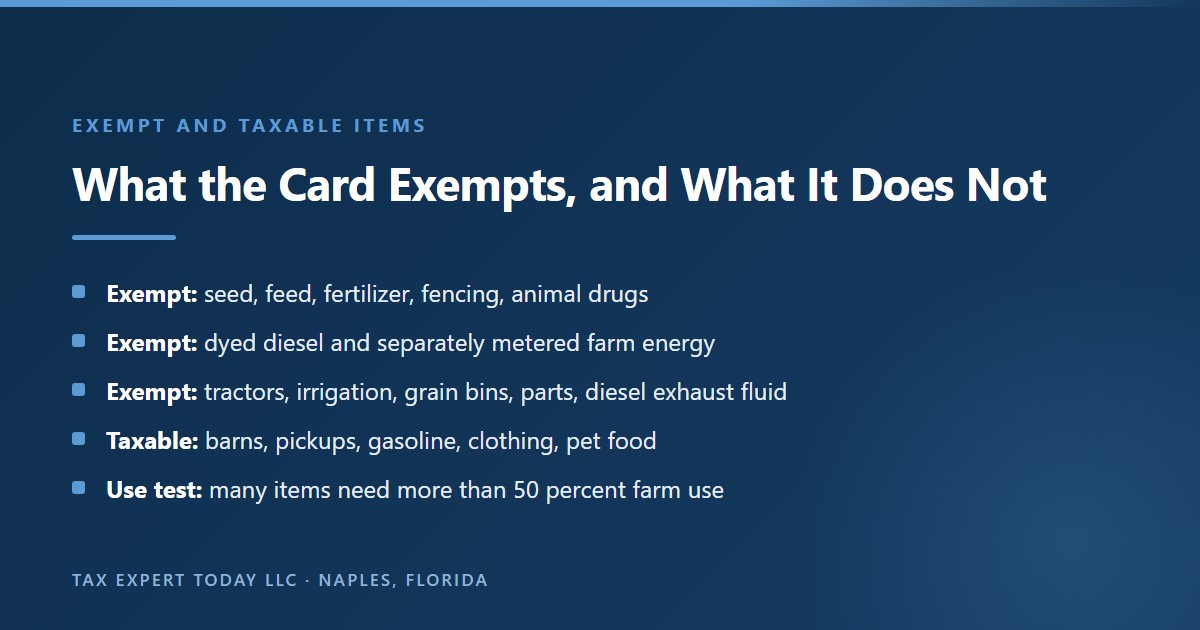
With a Georgia GATE card, a qualified agricultural producer can buy four groups of property without Georgia sales tax: agricultural production inputs such as seed, feed, and fertilizer; energy used in agriculture such as dyed diesel and separately metered electricity; agricultural machinery, equipment, and repair parts; and, since a 2024 amendment, diesel exhaust fluid for agricultural uses.
- Production inputs: seed, seedlings, fertilizer, pesticides, feed, animal drugs, and fencing materials.
- Farm energy: off road dyed diesel, propane, natural gas, wood, and metered electricity used in agriculture.
- Machinery and equipment: tractors and attachments, irrigation, grain bins, timber equipment, and parts.
- Diesel exhaust fluid: added by Senate Bill 340 in 2024, for agricultural uses only.
- Freight: shipping on items that qualify as exempt.
The statutory definitions are broader than most people expect. “Agricultural production inputs” include desiccants such as wood shavings, peanut hulls, straw, and hay; sugar fed to honeybees kept for commercial production; ice and refrigerants used to chill agricultural products in storage or delivery trucks; and packaging such as boxes, labels, sacks, and bottles when the product is sold in them. “Agricultural machinery and equipment” includes pecan shakers, crop spraying aircraft, livestock trailers, all terrain vehicles used in production, and off road timber equipment from the moment a tree is severed until it is loaded on a truck.
| Category | Examples the guidance lists as exempt | Common condition |
|---|---|---|
| Production inputs | Seed, seedlings, fertilizer, herbicides, feed, livestock drugs, fencing for livestock and poultry | Used to produce agricultural products, not for landscaping or pets |
| Energy used in agriculture | Off road dyed diesel, propane, butane, natural gas, wood, electricity for poultry houses and irrigation | Metered separately from non agricultural use, subject to the 10 percent de minimis rule |
| Machinery and equipment | Tractors, attachments, irrigation systems, grain bins, harvesters, trailers, ATVs used in production | Several items must be used in agriculture more than 50 percent of the time |
| Repair and maintenance | Repair and replacement parts, motor oil, filters, grease, hydraulic fluid for farm equipment | Installed on qualifying agricultural machinery |
| Diesel exhaust fluid | DEF used in agricultural equipment | Agricultural uses only (SB 340, 2024) |
| Breeding animals | Cattle, hogs, sheep, horses, poultry, and bees sold for breeding | Sold for breeding purposes |
The Department of Agriculture’s exemption guide states that it is an informational resource rather than written tax guidance from the Department of Revenue, and it is dated May 2016. The statute and the Department of Revenue’s policy bulletin control where they differ. When an item is unclear, the program pages tell merchants not to take the customer’s word for it and to contact the program, and the guide lists the Department of Revenue at 1-877-423-6711 for item exemption questions.
What Is Not Exempt, Even With a GATE Card?
A GATE card does not exempt clothing, food, buildings other than grain bins, gasoline or clear on road diesel, landscaping supplies, pet food, residential or office energy, on road vehicles and their parts, guns and hunting supplies, gravel for roads, or any item used for a non agricultural purpose. Sales tax must be collected on those purchases.
- Personal items: clothing, boots, food and drink, guns, ammunition, and hunting supplies.
- Real property: barns, concrete pads, greenhouses, metal buildings, and wiring or HVAC attached to them.
- Road fuel and vehicles: gasoline, clear diesel, on road motor vehicles, and their parts.
- Household use: pet food, residential energy, and cell phones or office supplies.
- Aesthetic use: landscaping plants, pine straw, and decorative fish for ponds.
The real property line is the one that trips up the most producers. The statute excludes from “agricultural operations” the construction, installation, alteration, repair, or demolition of real property structures or fixtures. The Department of Revenue bulletin then carves three items back in: grain bins, fencing, and irrigation equipment remain exempt even when they become part of the land. A new poultry house, a hay barn, or a greenhouse frame does not. The equipment inside the poultry house can be exempt, but the building and its wiring are taxable.
Ranch dogs are a specific example in the exemption guide. Food and supplies for domestic animals, including herding dogs, are taxable, because the statute’s definition of “animal” excludes animals commonly regarded as pets or companions. The same reasoning applies to a family horse that is not part of an equine production operation.
How Does the 50 Percent Use Test Work for Equipment?
Under the Department of Revenue policy bulletin, many items qualify only if used in an agricultural operation more than 50 percent of the time. That test covers trailers, grain bins, safety equipment, repair parts, and most general machinery. Self propelled sprayers and irrigation equipment must be used exclusively in agriculture.
- More than 50 percent: trailers, grain bins, safety equipment, parts, and other general machinery.
- Exclusive use: self propelled sprayers, crop dusting aircraft, irrigation, and timber site equipment.
- Hand tools: chainsaws and similar tools qualify if used more than 50 percent in agriculture.
- Excluded outright: motor vehicles, power lines, administrative equipment, and living organisms.
The test is about use, not ownership. A utility trailer that hauls cattle on weekdays and a boat on weekends may still pass if most of its use is agricultural. A zero turn mower is a closer call: the exemption guide treats commercial lawnmowers as exempt when they maintain areas around chicken houses and other farm structures, but a mower used mostly around the residence is taxable. No form is filed to prove the percentage at the time of purchase. The proof matters later, in an audit, which is why we suggest keeping a simple use note in the file for any dual use item.
The bulletin also excludes equipment that is not operated under the control of the producer’s own employees or other persons under the producer’s direction and control. Equipment bought with the card and then operated by an unrelated party for its own purposes is outside the exemption, which ties into the contractor rules discussed below.
How Does the GATE Exemption Apply to Farm Energy and Metered Electricity?
Energy used in agriculture is exempt with a GATE card, but metered energy must be metered separately from non agricultural use. If one meter serves agricultural use plus a small non agricultural use of 10 percent or less, all of that meter’s energy can be bought tax free, as long as the meter does not serve a personal residence.
- Exempt fuels: off road dyed diesel, propane, butane, natural gas, wood, and electricity used in agriculture.
- Not exempt: gasoline, clear diesel, aviation gasoline, and fuel used to propel vehicles on public roads.
- Residence rule: a meter that serves the farmhouse cannot be exempt.
- Paperwork: utilities may require the GATE Addendum for Metered Energy for each exempt meter.
The statute names energy used in poultry houses, swine and dairy facilities, crop storage, greenhouses raising plants for resale, irrigation systems used exclusively for agricultural products, and drying, cooking, or further processing of raw agricultural products. For a broiler operation, the electricity and propane for the houses are often among the largest recurring purchases, so getting the meter setup right has real dollar consequences.
The Department of Revenue’s addendum form, titled “Addendum for Metered Energy Sold to a Qualified Agriculture Producer,” asks for the eligible service address, the supplier account number, and the tax exempt meter number, and it is attached to a copy of the GATE certificate. When a farm has several meters under several entities, each entity needs its own card, a point we return to below.
How Much Does a Georgia GATE Card Cost, and How Long Does It Last?
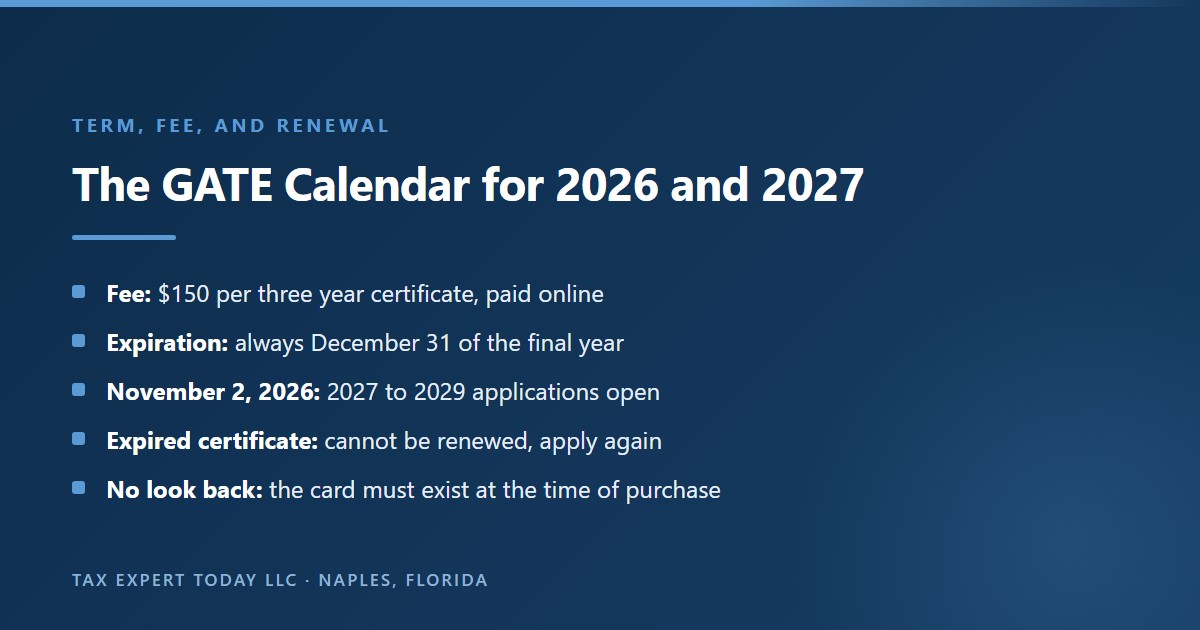
A Georgia GATE card costs $150 for a three year certificate, paid online by credit card or ACH. Certificates issued or renewed on or after January 1, 2019 run three years and always expire December 31 of the final year. A new wallet card is mailed each year at no charge, and a replacement card costs $30.
- Current window: new applications for 2026 to 2028 cards are open now.
- Next window: renewals and new applications for 2027 to 2029 open November 2, 2026.
- Expired cards: cannot be renewed; the holder must apply for a new card.
- Missing card: notify the Department within 45 days of payment or pay $30 for a replacement.
- Refunds: only for duplicate payments or accounts, not when a farm is sold mid term.
The three year term with a December 31 expiration means the timing of an application matters. The Department of Agriculture’s apply page says a new 2026 to 2028 card is valid as of the date it is paid for, so a producer who applies late in 2026 receives a card that still expires December 31, 2028. A producer whose certificate expires December 31, 2026 should watch for the November 2, 2026 opening and renew before year end, because an expired certificate cannot be renewed and the card must be in hand at the time of a purchase for that purchase to be exempt.
The fee itself goes into the Georgia Agricultural Trust Fund. The statute directs that for the period from July 1, 2022 through June 30, 2032, the money collected from the $150 fee is appropriated to that fund and used for marketing and promotion of Georgia agricultural products and the maintenance of state farmers markets.
| Event | Date or amount | What to do |
|---|---|---|
| Apply for a 2026 to 2028 card | Open now, $150 | Apply online if you have no active card |
| Wallet cards for 2027 | Mailed in November to holders whose participation runs into 2027 or later | Update your address before mailing |
| 2027 to 2029 renewals and new applications | Open November 2, 2026 | Renew before December 31 if your certificate ends in 2026 |
| Certificate expiration | December 31 of the final year | Expired certificates require a new application |
| Lost card or card never received | $30 replacement; 45 day notice window after payment | Email the program before reordering |
How Do You Apply for or Renew a Georgia GATE Card?
You apply for or renew a Georgia GATE card online through the Georgia Department of Agriculture’s GATE Program page. The application asks for a valid email address, the taxpayer ID number used to report the farm revenue, the federal tax forms you file, one NAICS code for your main commodity, and the $150 fee. Mailed applications are not accepted.
- Taxpayer ID: Georgia sales and use tax number, FEIN, or Social Security number, as matched to the farm return.
- Tax forms: select every form you file; choosing only “Other” sends the application for further review.
- Operation type: choose the option that produces the most income.
- NAICS code: pick the one code that most closely describes your primary agricultural commodity.
- Help: county Extension offices and county Farm Bureau offices will help complete the online application.
The application guide is a nine step walkthrough, and two of the steps deserve attention from a tax point of view. First, the taxpayer ID number is submitted to the Department of Revenue for verification, and the guide specifically tells applicants to check with their tax preparer if they are not sure which number to use. Second, the application asks the applicant to check each box and attest that the information is true and accurate, and the statute requires the application to warn producers about the consequences of false information or misuse. That attestation is the starting point if the Department of Revenue later questions the exemption.
The NAICS list comes from the GATE rules and is based on 2017 NAICS codes. It covers crop and livestock farming, timber tract operations, forest nurseries, logging, support activities for crops, animals, and forestry, and certain on farm processing such as dairy product manufacturing and wineries. A farm that grows cotton, peanuts, and soybeans picks the code for its most important crop, as the FAQs explain, but the $5,000 test still counts the revenue from all of them.
Can You Get Sales Tax Back on Purchases Made Before You Had a Card?
Generally no. The Department of Agriculture FAQs state that you must have a GATE card at the time of purchase to be eligible for the exemption. A producer who paid sales tax on $6,000 of fertilizer before the card arrived cannot use the later card to recover that tax. Timing the application before large purchases is the only reliable protection.
- Card first: the exemption depends on presenting a valid card when you buy.
- Plan purchases: schedule a new tractor or a season’s inputs after the card is active.
- Expired card: purchases after December 31 of the final year are taxable until a new card is issued.
- Seller errors: a refund claim for tax charged in error runs through the seller and the Department of Revenue, not the GATE program.
The FAQ example is blunt, and it is the single most expensive misunderstanding we see. New operations often buy fencing, seed, and equipment in the months before they apply, assuming the card will reach back to the start of the year. A Georgia GATE card does not. For a startup farm, applying under the long term or discretionary test before the first major purchases can matter more than any other step in the process. If the farm will not reach $5,000 until a later year, the discretionary test exists for exactly that situation, but it requires an explanation the Commissioner accepts.
The program page links a Department of Revenue Sales Tax Claim for Refund form (ST-12) for refund claims generally. A refund claim is a separate Department of Revenue process with its own requirements, and it is not a way around the rule that the card must exist at the time of purchase.
Do Separate LLCs or Partnerships Need Separate GATE Cards?
Yes. Sales tax exemptions belong to separate legal entities, each with its own tax registration. If several LLCs or partnerships each own exempt equipment or receive exempt energy through their own meters, each one needs its own Georgia GATE card. A card issued to one entity cannot be used for another entity’s purchases, even under common ownership.
- One entity, one card: the certificate is tied to the taxpayer ID on the application.
- Non transferable: the GATE rules state the certificate cannot be transferred.
- Authorized users: a primary holder may list no more than two authorized users unless the Commissioner allows more.
- Utilities: each meter account should match the entity that holds the card.
This Georgia GATE card rule follows directly from how many Georgia farms are organized. A family may hold land in one LLC, run the cattle in a second, and operate poultry houses under contracts in a third. Each entity that buys exempt property needs its own qualification, its own taxpayer ID, and its own card. Using the land company’s card to buy feed for the cattle company is a misuse under the GATE rules, which list use by “a person or entity other than the specified certificate holder” as a form of misuse. Our guide to Georgia LLC taxes explains how the return each entity files is chosen, which also determines the taxpayer ID number that belongs on each card.
What Must a Seller Check Before Accepting a GATE Card?
A seller must verify a GATE card on the first use of a new or renewed certificate each calendar year, then may keep honoring it until it receives actual notice of suspension or revocation. The Department of Revenue bulletin adds that the item must plausibly be exempt and fit the buyer’s type of business.
- Annual check: confirm the card is not expired on its first use each calendar year.
- Item check: the exemption could apply to the item being purchased.
- Business check: the exemption is not unreasonable for the buyer’s type of operation.
- Program advice: the Department of Agriculture tells merchants to check status and photo ID before each purchase.
- Records: sellers must keep the records needed to determine tax for at least three years.
The statute sets the minimum and the program sets a stricter practice. O.C.G.A. 48-8-3.3(e)(2) requires verification on first use each calendar year. The Department of Agriculture’s “Merchants, Read This!” section goes further: check the card status before each purchase, check identification against the cardholder and authorized users, do not take the customer’s word on whether an item is exempt, and keep copies of receipts. A feed store or equipment dealer that follows the program guidance is in a much stronger position if the Department of Revenue later questions a sale. Our guide to Georgia sales tax exemption certificates covers the seller’s burden of proof and good faith rules across all Georgia certificates, including the ST-5.
The bulletin states the starting rule plainly: all sales are subject to sales tax until the contrary is established, and the burden of proof is on the seller unless the seller takes a valid Georgia GATE card in good faith. A seller who skips the checks can end up owing the tax it did not collect.
What Happens If a GATE Card Is Misused?
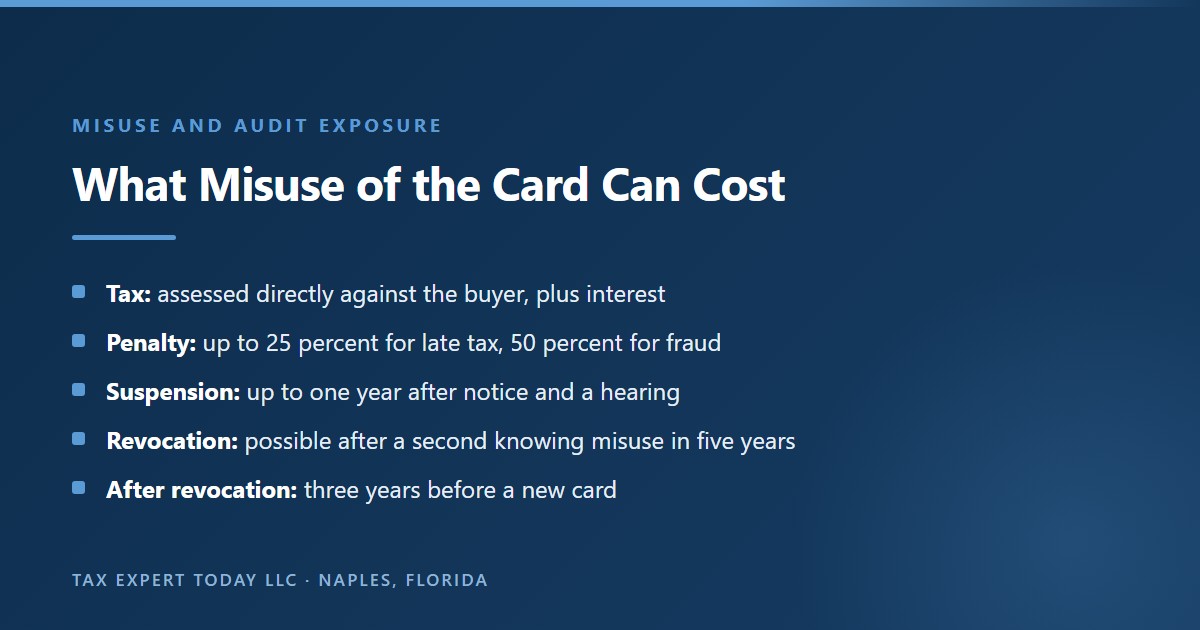
Knowing misuse of a GATE card can bring suspension for up to one year after notice and a hearing, possible revocation after a second knowing misuse within five years, and a three year bar on a new card. The Department of Revenue can also assess the unpaid tax against the buyer, plus penalties and interest.
- First knowing misuse: suspension for up to one year, subject to the Georgia Administrative Procedure Act.
- Second within five years: the Commissioner determines whether to revoke the certificate.
- After revocation: no new certificate for three years from the revocation date.
- Tax assessment: the buyer is treated as a dealer for tax it did not pay (O.C.G.A. 48-8-30(g)).
- Other penalties: civil or criminal penalties authorized by law may apply in addition.
The exemption guide puts it in one line: GATE cardholders are subject to audit by the Georgia Department of Revenue, and misuse may result in an assessment of taxes, penalties, and interest. The statute authorizes the Department of Revenue, together with the Department of Agriculture, to conduct audits as necessary to monitor compliance. In practice, the tax due on a misused purchase is the same use tax that applies to any taxable item bought without paying sales tax, at the state rate plus the local rate where the item is used. Our guide to Georgia use tax explains how that liability is computed and reported.
| Consequence | Rule | Source |
|---|---|---|
| Tax on the misused purchase | Assessed directly against the purchaser, who is treated as a dealer | O.C.G.A. 48-8-30(g), DOR Policy Bulletin SUT-2016-01 |
| Late payment penalty | 5 percent or $5 per 30 days, up to 25 percent or $25, whichever is greater | O.C.G.A. 48-8-66 |
| Fraud penalty | 50 percent of the tax due where willful intent to defraud exists | O.C.G.A. 48-8-66 |
| Suspension | Up to one year after notice and hearing | O.C.G.A. 48-8-3.3(e)(3) |
| Revocation | Possible after a second knowing misuse within five years; three year bar on reapplying | O.C.G.A. 48-8-3.3(e)(3) |
| Dealer that knowingly fails to collect | Misdemeanor up to $5,000 or one year; felony on a later conviction | O.C.G.A. 48-8-7 |
The word “knowingly” matters. Suspension and revocation under the statute apply to knowing unlawful use, while an honest classification error is more likely to produce a tax assessment with interest than a loss of the card. That distinction is one reason records matter: the rules require cardholders to keep records of exempt purchases and furnish them on request, and those records are what show whether an error was a reasonable judgment call. If an assessment does arrive, the Georgia Tax Court is the independent forum for contesting it, and a Georgia Department of Revenue payment plan is the usual route when the tax is owed but cannot be paid at once.
Can Contractors Use a Farmer’s GATE Card?
No. A real property contractor is not a qualified agricultural producer and cannot use a GATE card. A producer may buy exempt property with its own card and furnish it to the contractor, who owes no use tax if the property is returned afterward or is a grain bin, irrigation equipment, or fencing installed on the land.
- Contractor purchases: taxable, even when the job is on a farm.
- Owner furnished property: no contractor use tax if it stays personal property and is returned.
- Grain bins, irrigation, fencing: no contractor use tax when the producer buys them exempt for installation.
- Everything else installed into real property: the contractor incurs tax on property for which sales tax was not paid.
Subsection (h) of the statute is the source of the contractor rules for the Georgia GATE card. It creates a practical planning point for producers building or upgrading irrigation, fencing, or grain storage: buy the qualifying materials yourself with the card and furnish them to the installer, rather than letting the installer buy them on a lump sum bid. For a poultry house or barn, by contrast, the building materials are real property and are taxable no matter who buys them.
Can a Business Claim Both the Manufacturing and Agricultural Exemptions?
No, not at the same place of business in the same year. Under O.C.G.A. 48-8-3.3(g), a dealer that performs both manufacturing and agricultural operations at a single place of business may use the manufacturing exemption in 48-8-3.2 or the GATE exemption, but not both, for that location in any one calendar year.
- Who this affects: on farm processors such as dairies, wineries, canneries, and feed mills.
- Choice is annual: the election applies to one place of business for one calendar year.
- Compare first: the manufacturing exemption has its own scope, including a partial energy exemption.
For a farm that adds processing, this election can change which purchases are exempt. Our guide to Georgia sales tax exemptions covers the manufacturing exemption and its energy rules in detail, and the comparison is worth doing before the first purchase of the year at that location rather than after.
How Much Can a Georgia GATE Card Save?
A Georgia GATE card saves the full combined sales tax on qualifying purchases. The state rate is 4 percent, and the Department of Revenue chart effective October 1, 2026 shows most county rates between 6 and 9 percent. Buying $100,000 of qualifying equipment and inputs in an 8 percent county avoids about $8,000 of tax.
- State rate: 4 percent, included in all but two special Fulton County jurisdictions.
- Typical combined rates: 7 to 9 percent in rural counties on the October 2026 chart.
- Fee: $150 for three years, so the break even is roughly $1,900 of exempt purchases at 8 percent.
- Federal side: sales tax paid on equipment is generally added to its cost basis, so the exemption also lowers basis.
The table below uses hypothetical numbers to show how Georgia GATE card savings build. It assumes a combined rate of 8 percent, which matches many rural counties on the Department of Revenue’s October 1, 2026 rate chart. Your county rate may differ, and the result depends on each item actually qualifying.
| Hypothetical annual purchase | Amount | Sales tax avoided at 8 percent |
|---|---|---|
| Feed and supplements for a cow calf herd | $45,000 | $3,600 |
| Seed, fertilizer, and herbicide | $30,000 | $2,400 |
| Used tractor and attachments | $60,000 | $4,800 |
| Repair parts, oil, and filters | $6,000 | $480 |
| Fencing materials for pasture | $9,000 | $720 |
| Total | $150,000 | $12,000 |
These figures are illustrations only. They are not a projection for any operation, and they leave out purchases that would not qualify, such as a pickup truck, the farmhouse electric bill, or building materials for a new barn.
Does a Georgia GATE Card Affect Your Georgia Income Tax?
Not directly. The GATE card is a sales and use tax exemption and does not create a Georgia income tax credit or deduction. It does connect to the income tax return in two ways: eligibility is verified against the farm income reported on federal forms, and lower purchase costs flow into the farm’s expenses and equipment basis on the return.
- Eligibility link: the application uses the taxpayer ID and federal forms that report farm revenue.
- Expense link: exempt purchases reduce the deductible cost of inputs on Schedule F or an entity return.
- Basis link: equipment bought without sales tax carries a lower depreciable basis.
- Georgia rate: farm income is taxed at the flat 4.99 percent Georgia rate for 2026.
Farm income reaches the Georgia return through federal adjusted gross income, so the federal treatment of the farm generally carries into Form 500. The Department of Revenue’s Important Tax Updates page confirms the flat 4.99 percent rate. For an overview of how Georgia taxes individual income, see our guide to Georgia state income tax. Landowners who sell farmland or timber tracts should also review Georgia capital gains tax, and families moving land to the next generation can start with Georgia gift tax.
One distinction is worth stating plainly. Qualifying for a Georgia GATE card does not settle whether an activity is a business for federal income tax purposes. The GATE test is a $5,000 sales threshold set by Georgia law, while the federal question of whether a farm is engaged in for profit is a separate analysis under the Internal Revenue Code. A small operation can hold a valid card and still face federal questions about its losses.
Georgia GATE Card Mistakes That Cost Money
The most expensive Georgia GATE card mistakes are buying before the card is active, letting a certificate expire, using one entity’s card for another entity, applying the card to buildings, pickups, or household items, and keeping no record of how dual use equipment is used. Each one can turn an intended exemption into an assessment.
- Buying first, applying later: purchases before the card is issued stay taxable.
- Missing the renewal window: an expired certificate cannot be renewed and must be replaced by a new application.
- Wrong entity: each LLC or partnership needs its own card.
- Real property: barns, slabs, and greenhouse structures are taxable.
- No use records: dual use trailers, ATVs, and tools need proof of more than 50 percent agricultural use.
Three smaller Georgia GATE card errors also show up often. The first is a residential meter treated as exempt, which the bulletin rules out entirely. The second is letting an employee who is not an authorized user present the card. The third is an outdated mailing address, which delays the annual card; the Department of Agriculture asks holders to update contact information before the November mailing.
Georgia GATE Card Help in Naples & Southwest Florida
Tax Expert Today LLC reviews Georgia GATE card eligibility, exempt purchase records, entity structure, and the farm income return that supports the card from its office at 11983 Tamiami Trail N, Naples, FL 34110. Georgia clients are served nationwide from Naples, Florida, by phone and secure document exchange. Call (239) 441-2005.
- GATE card help Naples: eligibility review under the four statutory tests.
- Landowners: timber, pecan, and rented farmland under the long term and rent rules.
- Multi entity farms: matching each LLC, card, meter, and tax return.
- Audits: organizing exempt purchase records when the Department of Revenue asks questions.
- Movers: Florida residents who own Georgia farmland or timber.
Tax Expert Today LLC is based at 11983 Tamiami Trail N, Naples, FL 34110, and our office is open Monday through Friday, 10 a.m. to 5 p.m. Eastern time. You can reach us at (239) 441-2005. Many of the Georgia GATE card questions we see come from Collier and Lee County residents who own timber or farmland in south Georgia, and from families who split the year between Southwest Florida and a Georgia farm. We work with Georgia clients remotely, and there is no need to visit Naples to work with us.
For the full range of our Georgia work, see our Georgia tax services page. A point of scope, stated plainly: the GATE program is administered by the Georgia Department of Agriculture and the Georgia Department of Revenue, and these are state tax matters. Our team of tax advisors, enrolled agents, CPAs, and attorneys handles state tax matters nationwide, and we explain how the Georgia rules apply to your facts rather than predicting any particular result.
When to Engage a Professional
Most producers can apply for a GATE card on their own. A review makes sense when eligibility rests on the long term or discretionary test, when a farm uses several entities, when large equipment or construction purchases are planned, when a farm adds processing, or when the Department of Revenue asks for records of exempt purchases.
- Before applying: to choose the right entity, taxpayer ID, and qualification test.
- Before a large purchase: to confirm the item qualifies and the card is active.
- Before building: to separate exempt irrigation, fencing, and grain bins from taxable structures.
- After a notice: when an audit or assessment questions exempt purchases.
Call (239) 441-2005 to schedule a free consultation. We will look at your operation, your entity structure, and your purchase records, and explain the options in writing.
Frequently Asked Questions About the Georgia GATE Card
What is a Georgia GATE card?
A Georgia GATE card is the wallet card for a Georgia Agricultural Tax Exemption certificate issued by the Georgia Department of Agriculture under O.C.G.A. 48-8-3.3. It lets qualified agricultural producers buy production inputs, energy used in agriculture, agricultural machinery and equipment, and diesel exhaust fluid for agricultural uses without Georgia sales and use tax.
Who qualifies for a GATE card in Georgia?
A qualified agricultural producer meets one of four tests: land that produced and sold at least $5,000 of agricultural products in the year, at least $5,000 of agricultural services performed, long term products such as timber or pecans with capacity for $5,000 in annualized sales, or a discretionary showing approved by the Commissioner of Agriculture.
How much does a Georgia GATE card cost?
The fee is $150 for a three year certificate, paid online by credit card or ACH. A new wallet card is mailed each year at no charge. A replacement card costs $30, and the Department of Agriculture must be told within 45 days of payment if a new card does not arrive.
When does my GATE card expire, and when can I renew?
GATE certificates last three years and always expire December 31 of the final year. Renewals and new applications for 2027 to 2029 open November 2, 2026. A certificate that has already expired cannot be renewed; the holder must apply for a new card.
Can I get a refund of sales tax I paid before I had a GATE card?
Generally no. The Georgia Department of Agriculture states that you must have a GATE card at the time of purchase to be eligible for the exemption, so a card issued later does not reach back to earlier purchases.
Can I use my GATE card to buy a pickup truck or build a barn?
No. On road motor vehicles and their parts, gasoline and clear diesel, and buildings such as barns, slabs, and greenhouse structures are not exempt. Grain bins, fencing, and irrigation equipment are the exceptions that stay exempt even when attached to land.
What happens if I misuse a GATE card?
The Department of Revenue can assess the unpaid tax directly against you, with penalties and interest. Knowing misuse can lead to suspension for up to one year after notice and a hearing, possible revocation after a second knowing misuse within five years, and a three year bar on a new card after revocation.
I live in Naples, Florida, and own timber land in Georgia. Can you help with a GATE card?
Yes. Tax Expert Today LLC reviews GATE eligibility, including the long term timber test, and the farm income return behind it from its Naples, Florida office at 11983 Tamiami Trail N. Georgia clients work with us remotely. Call (239) 441-2005 for a free consultation.
Published October 26, 2026 by Dr. Pellumb Kabashi « Back to Learning Center
Have a question this article touches on?
Tax Expert Today LLC, based in Naples, Florida and serving clients across the United States.
Schedule a Consultation (239) 441-2005