
By Dr. Pellumb Kabashi, DBA, MBA, EA, CFE, CES
Founder, Tax Expert Today LLC · Tax advisors, enrolled agents, CPAs, and attorneys · Serving clients in all 50 states
Quick Answer: IRS Data Book figures on IRS civil penalties assessed and abated show the agency assessed 46,748,796 individual civil penalties in fiscal year 2025, the most in the eleven year series, and abated 3,884,049 of them. That is 8.3 percent, or roughly one penalty in twelve. The estimated tax penalty now accounts for a third of all individual penalties and is abated 1.4 percent of the time. Call (239) 441-2005 for a free consultation.
Published: August 2, 2026
Tax Expert Today Research · Report 2026-02
The Penalty Abatement Report, FY2015 to FY2025. An original analysis of eleven editions of the IRS Data Book civil penalty table. Every figure was computed directly from IRS source files and checked against the printed Data Book for four editions spanning the series. This report is updated annually when the IRS releases new Data Book figures. Download the PDF edition or browse all TET Research reports.
Penalties are the most common thing the IRS does to an individual taxpayer. In fiscal year 2025 the agency assessed nearly 47 million civil penalties against individuals, estates, and trusts, which is more than one penalty for every three individual returns filed. Far less is known about the other side of that ledger: how many of those penalties come back off. Tax Expert Today analyzed the civil penalty table in every IRS Data Book from fiscal year 2015 through fiscal year 2025 to build a verified eleven year series on penalties assessed, penalties abated, and how the answer differs by penalty type. The short version is that the volume of penalties has grown sharply while the share reversed has barely moved, and that one penalty behaves nothing like the others. For the mechanics of requesting relief, our companion guide to reasonable cause penalty abatement covers the standard and the process.
What Share of IRS Penalties Are Actually Abated?
In fiscal year 2025 the IRS abated 8.3 percent of the individual civil penalties it assessed, or about one in twelve. The agency assessed 46,748,796 penalties against individuals, estates, and trusts and abated 3,884,049, according to Table 4-2 of the FY2025 IRS Data Book. Measured in dollars rather than counts, the same year shows $7.51 billion abated against $33.10 billion assessed, or 22.7 percent.
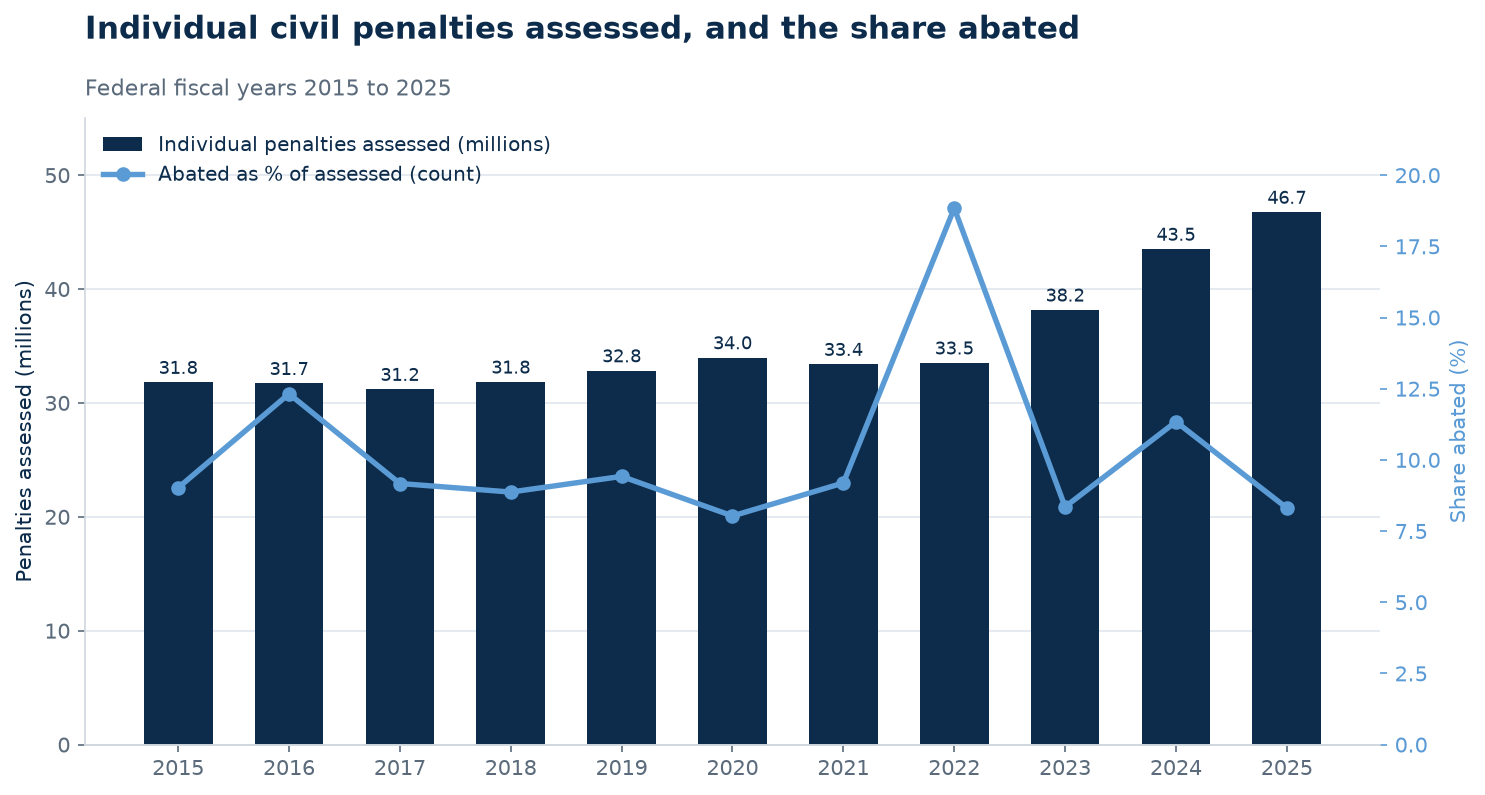
The striking feature of the series is not the FY2025 level but its stability. Across the eleven years studied, the share of individual penalties abated stayed inside a narrow band of 8.0 percent to 12.3 percent in ten of eleven years. The single exception is fiscal year 2022 at 18.8 percent, which coincides with the broad automatic relief the IRS announced for certain 2019 and 2020 returns. Over the same eleven years the number of penalties assessed rose 47.0 percent, from 31,809,876 to 46,748,796. The IRS is penalizing far more often, and reversing at close to the same rate it always has.
How Many Civil Penalties Did the IRS Assess in FY2025?
The IRS assessed 46,748,796 civil penalties against individuals, estates, and trusts in fiscal year 2025, totaling $33.10 billion. Both figures are the highest in the eleven year series. The count is up 7.5 percent from FY2024 and 47.0 percent from FY2015. The average individual penalty assessed reached $708, compared with $391 in FY2015.
That growth is not spread evenly. Two penalties account for the overwhelming majority of the volume: the failure to pay penalty under IRC Section 6651(a)(2) at 24,251,980 assessments, or 51.9 percent of the individual total, and the estimated tax penalty under IRC Section 6654 at 15,734,656, or 33.7 percent. Together those two penalties are 85.6 percent of everything the IRS assessed against individuals that year. The penalties that dominate practitioner conversation, such as the accuracy related penalty, are comparatively rare at 440,718 assessments.
Which IRS Penalties Are Most Likely to Be Abated?
Abatement rates vary by a factor of ten across penalty types. In FY2025 the accuracy related penalty was abated most often at 14.07 percent of assessments, followed by failure to pay at 12.99 percent and delinquency, meaning failure to file, at 10.91 percent. The estimated tax penalty was abated 1.37 percent of the time, far below every other category and far below the 8.31 percent individual average.
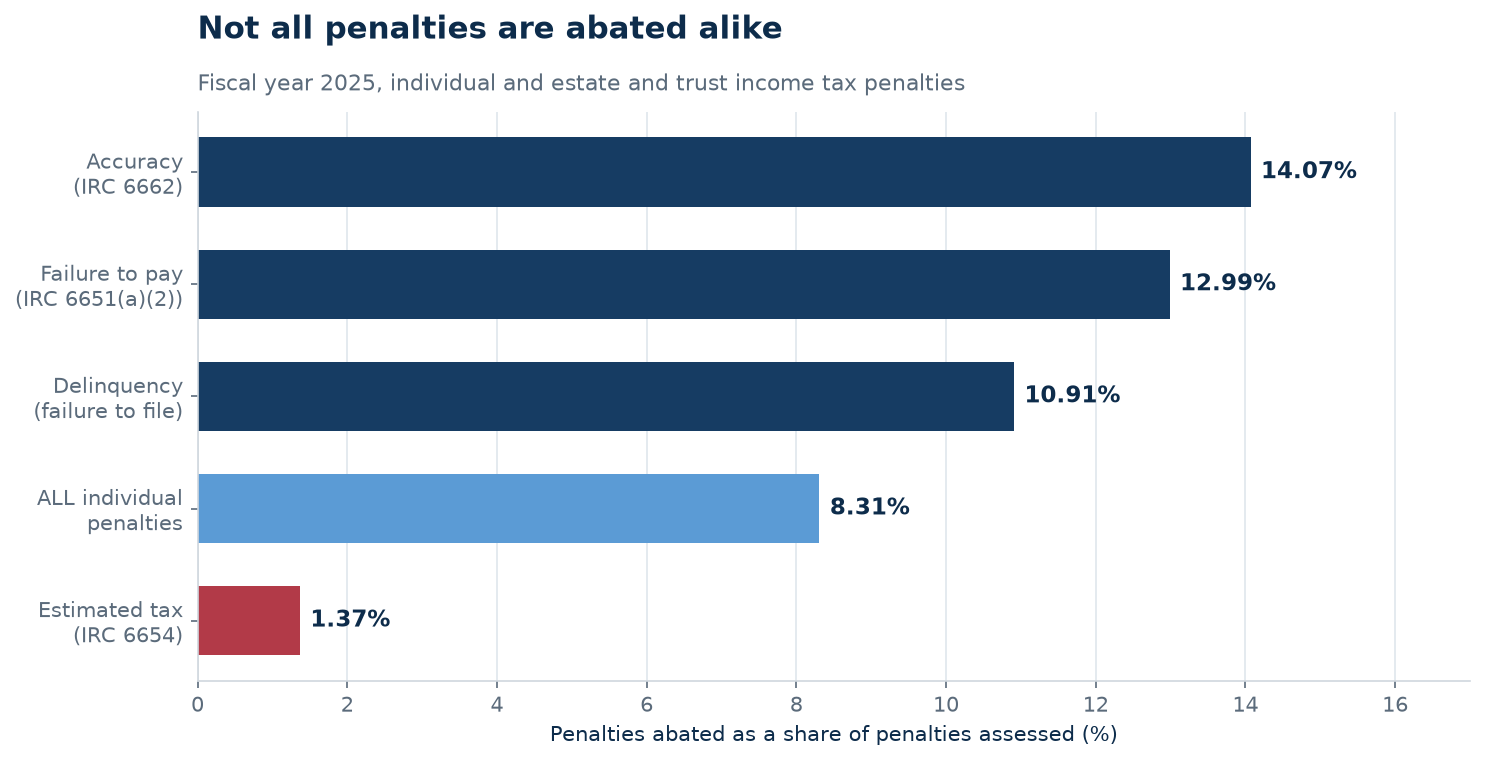
Because failure to pay is both the highest volume penalty and one of the more frequently abated, it dominates the abatement total. Failure to pay accounted for 3,149,546 of the 3,884,049 individual abatements in FY2025, which is 81.1 percent of every individual penalty the IRS reversed that year. Penalty relief for individuals is, in practice, overwhelmingly failure to pay relief.
| Penalty type (FY2025) | Assessed | Abated | Share abated | Dollars assessed |
|---|---|---|---|---|
| Failure to pay (IRC 6651(a)(2)) | 24,251,980 | 3,149,546 | 12.99% | $12.09B |
| Estimated tax (IRC 6654) | 15,734,656 | 215,192 | 1.37% | $12.06B |
| Delinquency, failure to file | 4,009,691 | 437,374 | 10.91% | $6.48B |
| Accuracy related (IRC 6662) | 440,718 | 62,000 | 14.07% | $1.50B |
| All individual penalties | 46,748,796 | 3,884,049 | 8.31% | $33.10B |
Source: IRS Data Book FY2025, Table 4-2, individual and estate and trust income taxes block. Categories shown do not sum to the total because bad check, fraud, federal tax deposit, and other penalties are omitted from this excerpt.
Why Is the Estimated Tax Penalty Almost Never Abated?
Because the two relief routes that clear most other penalties do not reach it. The IRS states plainly on its reasonable cause page that reasonable cause does not apply to certain penalties such as the estimated tax penalty, and its First Time Abate relief covers only failure to file, failure to pay, and failure to deposit. A taxpayer with a perfect explanation has nowhere standard to file it.
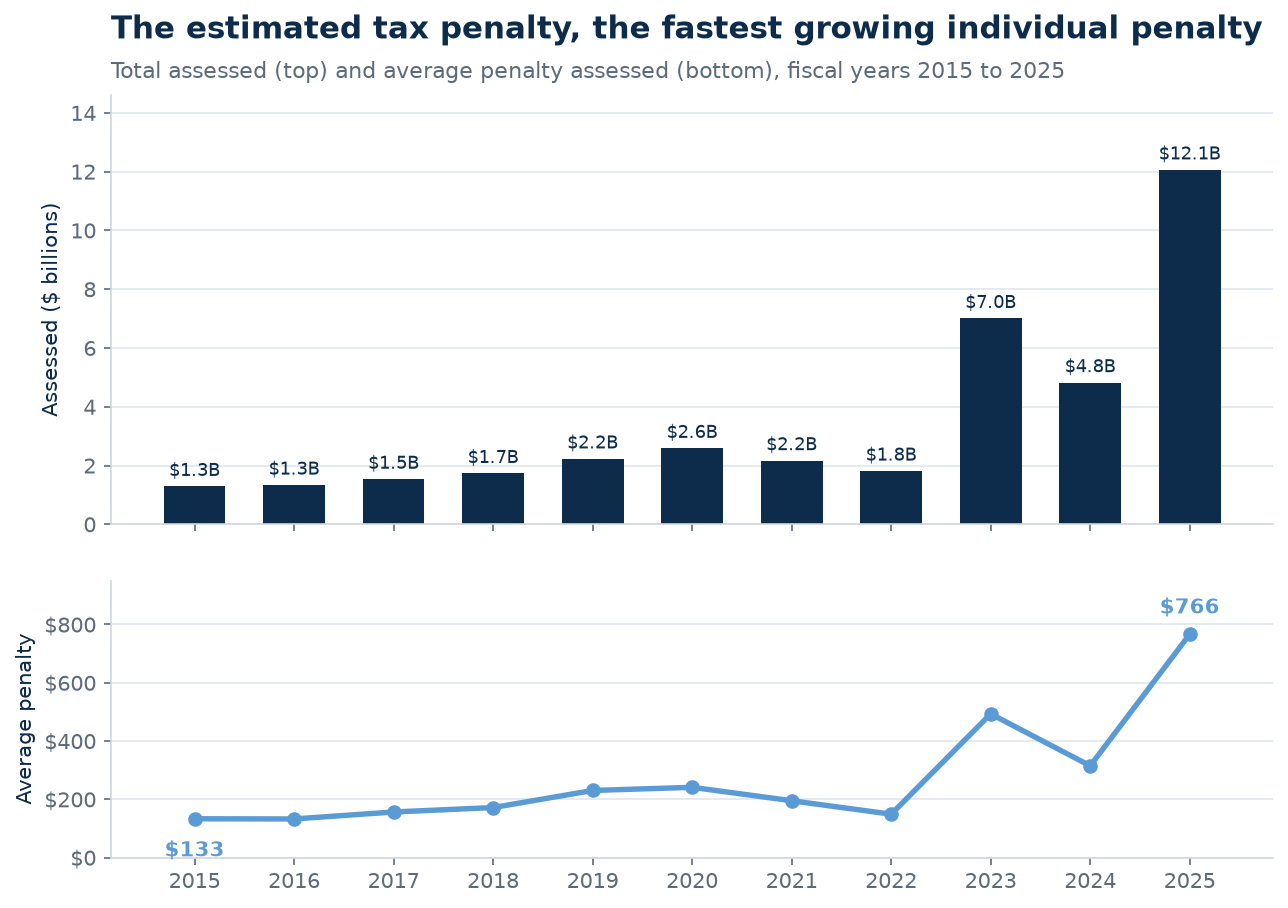
That structural gap shows up directly in the data, and it matters more every year because this is the fastest growing individual penalty by a wide margin. Estimated tax penalty assessments rose 62.5 percent by count between FY2015 and FY2025, from 9,680,042 to 15,734,656. The dollars rose more than nine times over, from $1.29 billion to $12.06 billion, including a 150.2 percent jump in the single year from FY2024 to FY2025. The average estimated tax penalty went from $133 to $766, and our IRS underpayment penalty calculator shows how the charge builds on a given balance.
The size of the jump is consistent with how the penalty is computed. It is not a flat charge but an interest style computation tied to the underpayment rate set under IRC Section 6621, which for individuals is the federal short term rate plus three percentage points. When that rate rises, the same underpayment produces a materially larger penalty. The Data Book reports outcomes rather than causes, so this report does not attribute the increase to any single factor, but the mechanism is set by statute and applies to every affected taxpayer.
The practical consequence is that the estimated tax penalty has to be managed before it is assessed rather than argued afterward. Section 6654 does contain narrow waivers, including for casualty, disaster, or other unusual circumstances where imposing the penalty would be against equity and good conscience, and for taxpayers who retired after reaching age 62 or became disabled. Those are genuinely narrow. For most taxpayers the working levers are the safe harbor rules, which our quarterly estimated tax calculator applies, the annualized income method on Form 2210 for income that arrives unevenly, and withholding, which is treated as paid throughout the year no matter when it was actually withheld.
Does an 8.3 Percent Abatement Rate Mean Most Requests Are Denied?
No, and this is the most common misreading of the figure. The 8.3 percent is the share of assessed penalties that were reversed, not the share of abatement requests that succeeded. The IRS Data Book publishes outcomes only. It does not publish how many taxpayers asked for relief, so no success rate for requests can be computed from this table in either direction.
The denominator includes tens of millions of penalties nobody ever contested. It also includes penalties abated for reasons that involve no taxpayer request at all. The Data Book footnote defining an abatement is explicit that the IRS may approve one for “IRS error; reasonable cause; administrative and collection costs not warranting collection of penalty; discharge of penalty in bankruptcy; and the IRS’s acceptance of partial payment of assessed penalty.” Reasonable cause is one ground among five. Treating 8.3 percent as the odds on a reasonable cause letter reads a number the data does not contain.
Why Do Other Sources Report a Different Penalty Abatement Rate?
Because the same IRS table supports four defensible abatement rates, ranging from 8 percent to 97 percent, depending on whether you count penalties or dollars and whether you include business taxes. Published figures that look contradictory are usually reporting different bases from the identical source rather than disagreeing about the underlying data.
| Basis, all from FY2025 Table 4-2 | Abatement rate | What it measures |
|---|---|---|
| Individual income tax, by count (this report) | 8.31% | Share of penalties on Form 1040 and 1041 filers reversed |
| Individual income tax, by dollars | 22.70% | Same population weighted by penalty size |
| All tax types, by count | 10.14% | Adds corporate, partnership, employment, excise, estate |
| All tax types, by dollars | 97.06% | Dominated by one employment tax line, see below |
The all tax types dollar basis is the one to treat with care. In FY2025 the employment tax line alone shows $1,150.62 billion assessed and $1,149.81 billion abated, against $26.85 billion assessed on that line in FY2024. Nearly everything assessed there was reversed within the same year. Those figures appear identically in the machine readable file and in the printed Data Book, so they are not a transcription error, but a measure driven by a single line behaving that way does not describe what happens to ordinary taxpayers. This report uses the individual income tax count basis for that reason and states the alternatives rather than leaving them to be discovered.
One widely repeated figure illustrates the point. The claim that the IRS “abated $50.9 billion, over two thirds of assessed penalties” traces to the FY2022 Data Book on the all tax types dollar basis, where $50,858,228 thousand was abated against $73,611,454 thousand assessed, or 69.09 percent. That statement is accurate on its basis. It is also more than eight times the individual count rate for the same year, which is why the basis has to travel with the number.
A separate timing point applies to every rate here. Data Book footnotes state that both assessments and abatements are recorded in the fiscal year they occur “regardless of the tax year to which the penalties may apply.” A penalty abated in FY2025 may have been assessed in FY2023. These ratios are therefore same year throughput measures rather than cohort outcome rates, which is why a few lines exceed 100 percent, including the FY2024 individual dollar ratio of 161.75 percent.
What Does the New Automatic Exemption From Penalty Change?
It removes the request step for compliant taxpayers. On July 8, 2026 the IRS announced the Automatic Exemption from Penalty, which replaces First Time Abate. Taxpayers who filed and paid on time for the three prior years, or twelve consecutive quarters, will not be assessed the penalty at all rather than having to ask for it back afterward.
The scope is specific. The exemption covers failure to file, failure to pay, and failure to deposit penalties, and it does not apply to daily delinquency penalties, accuracy related penalties, or information return penalties. It phases in beginning in the summer of 2026 for eligible original returns starting with tax year 2025 and 2026 quarterly returns, with full implementation for original returns due on or after January 1, 2027. During the transition, some qualifying taxpayers may still receive a penalty notice and can contact the IRS to request First Time Abate for those earlier returns.
This makes fiscal year 2025 the last full baseline year before the change, which is the main reason to record this series now. Two things are worth watching in next year’s data. First, whether the failure to pay abatement rate falls as relief shifts from after the fact abatement to prevention at assessment, since a penalty never assessed never appears in the abated column. Second, whether the estimated tax penalty gap widens, because the new exemption does not reach it any more than First Time Abate did.
IRS Civil Penalties Assessed and Abated, FY2015 to FY2025
It has moved remarkably little. The abatement rate by count was 9.02 percent in FY2015 and 8.31 percent in FY2025, with the lowest reading of the series in FY2020 at 8.03 percent. FY2025 is the second lowest of the eleven years, not the lowest. The dollar based rate swings far more widely because it is sensitive to a handful of large relief actions, which is visible in the FY2022 and FY2024 rows below.
| Fiscal year | Penalties assessed | Dollars assessed | Penalties abated | Dollars abated | Abated, by count | Abated, by dollars |
|---|---|---|---|---|---|---|
| 2015 | 31,809,876 | $12.44B | 2,868,559 | $3.62B | 9.02% | 29.11% |
| 2016 | 31,713,538 | $12.07B | 3,908,121 | $3.86B | 12.32% | 31.94% |
| 2017 | 31,194,792 | $11.01B | 2,861,242 | $2.89B | 9.17% | 26.28% |
| 2018 | 31,840,318 | $11.99B | 2,824,101 | $2.10B | 8.87% | 17.49% |
| 2019 | 32,828,655 | $14.17B | 3,091,328 | $2.25B | 9.42% | 15.85% |
| 2020 | 33,976,400 | $14.10B | 2,729,818 | $1.70B | 8.03% | 12.06% |
| 2021 | 33,393,194 | $17.13B | 3,069,510 | $2.70B | 9.19% | 15.77% |
| 2022 | 33,518,147 | $50.30B | 6,314,592 | $36.66B | 18.84% | 72.88% |
| 2023 | 38,165,237 | $44.44B | 3,185,987 | $2.85B | 8.35% | 6.41% |
| 2024 | 43,503,051 | $20.24B | 4,932,701 | $32.74B | 11.34% | 161.75% |
| 2025 | 46,748,796 | $33.10B | 3,884,049 | $7.51B | 8.31% | 22.70% |
Sources: IRS Data Book, civil penalties assessed and abated table, FY2015 through FY2025 editions (Table 17, then 26, then 28, then 4-2). Figures cover individual and estate and trust income taxes. Ratios divide abatements recorded in a fiscal year by assessments recorded in the same fiscal year; see the methodology note.
The two dollar spikes line up with periods of broad announced relief. Fiscal year 2022 shows $36.66 billion abated, and fiscal year 2024 shows $32.74 billion abated against only $20.24 billion assessed that year, which is what produces a ratio above 100 percent. Both coincide with IRS programs that reversed penalties on returns from earlier tax years. The count based series absorbs those episodes far more calmly, which is another reason this report leads with counts.
What This Means If You Are Holding an IRS Penalty Notice
The data supports a sequencing rule rather than a prediction. Identify which penalty you actually have before deciding how to respond, because the notice will often carry more than one and they do not behave alike. A failure to pay or failure to file penalty sits inside both the reasonable cause framework and, for a compliant taxpayer, the new automatic exemption. An estimated tax penalty on the same notice generally sits outside both, and time spent writing a reasonable cause narrative for that line is usually time spent on the one item the letter cannot fix.
The second point is that relief is worth pursuing before the balance is treated as fixed. The IRS reversed $7.51 billion of individual penalties in FY2025, and penalties compound the problem by accruing interest, so removing them shrinks both the penalty and the interest riding on it. That sequencing matters more now that settlement is harder to obtain: our companion report on the IRS offer in compromise acceptance rate found the IRS accepted 14.1 percent of offers in fiscal year 2025. When I review collection files, the most common missed opportunity is not a weak reasonable cause argument. It is a taxpayer who qualified for first time relief on the failure to file or failure to pay line, never asked, and then negotiated a payment plan on the larger balance. Under the new automatic exemption that specific gap should narrow for compliant filers, though only for returns inside the phase in window.
How Was This Report Prepared?
Methodology. Tax Expert Today extracted the individual and estate and trust income taxes block from the civil penalties assessed and abated table in eleven consecutive editions of the IRS Data Book, Publication 55-B, covering fiscal years 2015 through 2025. The table appears as Table 17 in the FY2015 through FY2018 editions, Table 26 in FY2019 through FY2022, Table 28 in FY2023 and FY2024, and Table 4-2 in FY2025; each table number was read from the source file itself rather than inferred. Unlike the collection activities table, this table reports a single fiscal year per edition, so no overlapping year cross check is available within the series. In its place, the machine readable file was checked against the same table as typeset in the printed Data Book for four editions spanning the series (FY2015, FY2019, FY2023, and FY2025). All counts matched exactly; two FY2019 dollar values differed by $1 thousand on figures of $14.2 billion and $2.2 billion, a rounding difference that affects no published figure.
Abatement rates divide abatements recorded in a fiscal year by assessments recorded in the same fiscal year. Data Book footnotes state that both are recorded in the year they occur regardless of the tax year to which the penalty applies, so these are throughput measures rather than cohort rates, which is why some lines exceed 100 percent. An abatement is any reduction of an assessed penalty; the IRS lists five grounds, of which reasonable cause is one, so these figures are not a reasonable cause success rate. The Data Book does not publish the number of relief requests, so no request success rate is computable from it. Federal fiscal years run October 1 through September 30. A corroboration sweep of the National Taxpayer Advocate 2025 Annual Report to Congress, TIGTA, and GAO found no competing published figure for this measure; where secondary sources report different rates, the divergence was traced to basis and is disclosed above. All source files, the extraction scripts, and a workpaper mapping every published figure to its source and calculation are retained and available on request. The full verified series is downloadable as a machine readable file: tet-penalty-series-fy2015-fy2025.csv. The data may be reused with attribution to Tax Expert Today LLC.
Tax Penalty Relief Naples: Local Help With IRS Penalties
Tax Expert Today LLC advises individuals and business owners in Naples, Florida and across Southwest Florida on IRS penalty notices, from first time and reasonable cause relief through the estimated tax exposure that the standard relief routes do not reach. The firm is multidisciplinary, with enrolled agents, CPAs, and attorneys, and it reads the full penalty and interest breakdown on a notice before recommending a response, because the right answer usually differs line by line. The office is at 11983 Tamiami Trail N, Naples, FL 34110, and the team can be reached at (239) 441-2005, Monday through Friday, 10am to 5pm ET.
Frequently Asked Questions
What percentage of IRS penalties are abated?
The IRS abated 8.3 percent of individual civil penalties in fiscal year 2025, reversing 3,884,049 of the 46,748,796 penalties it assessed against individuals, estates, and trusts, per IRS Data Book Table 4-2. Measured in dollars the figure is 22.7 percent, or $7.51 billion of $33.10 billion. The count based rate has stayed between 8 and 12 percent in ten of the last eleven fiscal years.
Why is the estimated tax penalty so rarely abated?
The IRS abated only 1.37 percent of estimated tax penalties in fiscal year 2025 because the two main relief routes do not reach it. The IRS states that reasonable cause does not apply to the estimated tax penalty, and First Time Abate covers only failure to file, failure to pay, and failure to deposit. IRC Section 6654 provides narrow waivers for disaster, retirement after age 62, and disability.
Does the 8.3 percent abatement rate mean my request will probably be denied?
No. That figure is the share of all assessed penalties reversed, not the share of requests granted. Its denominator includes tens of millions of penalties nobody contested, and its numerator includes abatements for IRS error, bankruptcy discharge, and partial payment acceptance as well as reasonable cause. The IRS does not publish how many relief requests it receives, so no success rate can be computed from this data.
Which IRS penalty is abated most often?
Among major individual penalties in fiscal year 2025, the accuracy related penalty under IRC Section 6662 was abated most often at 14.07 percent of assessments, followed by failure to pay at 12.99 percent and failure to file at 10.91 percent. Failure to pay produces the most abatements in absolute terms, accounting for 3,149,546 reversals, which is 81.1 percent of all individual penalty abatements that year.
What is the Automatic Exemption from Penalty and when does it start?
Announced July 8, 2026, the Automatic Exemption from Penalty replaces First Time Abate and applies relief without a request for taxpayers who filed and paid on time for the three prior years or twelve consecutive quarters. It covers failure to file, failure to pay, and failure to deposit penalties, phases in from summer 2026, and fully applies to original returns due on or after January 1, 2027.
Where can I get help with an IRS penalty notice in Naples, FL?
Tax Expert Today LLC, located at 11983 Tamiami Trail N, Naples, FL 34110, reviews IRS penalty notices for taxpayers in Naples and across Southwest Florida and represents clients before the IRS nationwide. The firm is multidisciplinary, with enrolled agents, CPAs, and attorneys, and it identifies which penalties on a notice qualify for relief and which require a different strategy. Consultations can be arranged at (239) 441-2005.
When to Engage a Professional About IRS Penalties
A single penalty notice rarely needs professional help. A notice carrying several penalties across several years usually does, because the sequencing decides the outcome. The value is in reading the account transcript to see which penalties were assessed when, applying first time or reasonable cause relief to the lines that accept it, addressing the estimated tax exposure through the computation rather than through an argument, and confirming that relief is applied before a balance gets locked into a payment agreement. With nearly 47 million individual penalties assessed in a single year and a new automatic exemption phasing in through 2027, the taxpayers who do best are the ones who match each penalty to the right route rather than sending one letter about all of them. Tax Expert Today LLC represents individuals and businesses in IRS penalty and collection matters nationwide, and Dr. Kabashi, the firm’s founder, leads the resolution practice.
Call (239) 441-2005 or schedule a consultation to review which penalties on your notice qualify for relief. Tax advisors, enrolled agents, CPAs, and attorneys serving clients in all 50 states.
Published August 2, 2026 by Dr. Pellumb Kabashi « Back to Learning Center
Have a question this article touches on?
Tax Expert Today LLC, based in Naples, Florida and serving clients across the United States.
Schedule a Consultation (239) 441-2005